

ISO 6670:2025
(Main)Instant coffee — Sampling method for bulk units with liners
- Abstract
1.1 This document specifies a sampling method for a consignment of instant coffee, shipped in 10 package units or more. This document is applicable to cases which have inner linings of moisture-resistant material hermetically sealed because of the hygroscopic nature of instant coffee and which are in package units greater than 10 kg net mass, typically up to 50 kg. This document is also applicable to units of more than 50 kg, usually called “big bags” or “supersacks”. The cases are generally made of cardboard of appropriate strength and the big bags are made of suitable plastic material. 1.2 This document is also applicable to the selection and preparation of a sufficiently representative sample of the consignment, which is intended: a) to serve as a basis for an offer for sale; b) for examination to verify that the instant coffee to be offered for sale satisfies the producer’s sales specification; c) for examination to determine one or more of the characteristics of the instant coffee for technical, commercial, administrative and arbitration purposes; d) for retention as a reference sample for use, if required, in litigation. 1.3 This document is applicable to all types of instant coffee, as defined in ISO 3509, contained in all types of units with liners, with the exception stated in 1.4. 1.4 For bulk density and particle size, this document is applicable to spray-dried powder and freeze-dried instant coffees only, as defined in ISO 3509, due to the intrinsic fragility of particles of agglomerated instant coffee, which leads to greater breakdown and headspace in the final packed units for the consumer.
- Status
- Published
- Publication Date
- 18-Dec-2025
- Technical Committee
- ISO/TC 34/SC 15 - Coffee
- Current Stage
- 6060 - International Standard published
- Start Date
- 19-Dec-2025
- Due Date
- 16-Oct-2025
- Completion Date
- 19-Dec-2025

Overview
ISO 6670:2025 specifies a standardized sampling method for instant coffee shipped in bulk units with moisture‑resistant liners (cases or “big bags” / “supersacks”). Applicable when a consignment contains 10 package units or more, the standard defines how to select, take and prepare representative samples for sale offers, quality verification, technical and commercial testing, arbitration and retention as reference samples.
Key topics and requirements
- Scope and applicability
- Applies to instant coffee units >10 kg (typically up to 50 kg) and units >50 kg (big bags).
- All instant coffee types per ISO 3509, with a limitation: bulk density and particle size sampling applies only to spray‑dried and freeze‑dried products (not fragile agglomerated particles).
- Definitions
- Increment: 100 g ± 20 g taken from a single unit.
- Bulk sample: ≥ 1 000 g combined increments.
- Laboratory sample: ≥ 300 g taken from blended bulk sample.
- Sampling personnel and conditions
- Sampling by trained or experienced samplers or specialist organizations.
- Protect samples from contamination and moisture; sampling preferably at ~20 °C and max 45% relative humidity.
- Equipment and tools
- Stainless steel scoop (Annex A) ~100 g capacity for increments.
- Moisture‑proof, oxygen‑proof containers with airtight closures to preserve sample integrity.
- Procedure
- Random selection of package units, open liners, take increments per scoop method (Annex A), reseal liners.
- Two preparation options: combine increments into a blended bulk sample or keep increments separate for per‑unit analysis.
- Avoid rough handling to prevent particle breakage.
- Marking, reporting and retention
- Samples must be labelled with date, product type, sampler, contract/shipping info, lot ID, number of units sampled and sample mass.
- Sampling report must document damaged units, environmental conditions and any observations.
- Laboratory samples dispatched promptly; blended bulk or increments retained until final acceptance.
Applications / Who uses it
- Coffee producers and packers preparing consignments for export or sale.
- Buyers, importers and quality assurance teams verifying producer specifications.
- Analytical laboratories performing compositional, particle size or density testing.
- Arbitration bodies, trade inspectors and legal teams requiring retained reference samples.
- Specialized sampling organizations executing representative sampling for commercial disputes.
Related standards
- ISO 3509 - Coffee and coffee products: Vocabulary (referenced for terms and instant coffee definitions).
Keywords: ISO 6670, instant coffee sampling, bulk units with liners, scoop sampling, blended bulk sample, laboratory sample, big bags, supersacks, moisture‑resistant liners, sampling method.
Relations
- Effective Date
- 21-Oct-2023
Get Certified
Connect with accredited certification bodies for this standard

BSI Group
BSI (British Standards Institution) is the business standards company that helps organizations make excellence a habit.

Bureau Veritas
Bureau Veritas is a world leader in laboratory testing, inspection and certification services.

DNV
DNV is an independent assurance and risk management provider.
Sponsored listings
Frequently Asked Questions
ISO 6670:2025 is a standard published by the International Organization for Standardization (ISO). Its full title is "Instant coffee — Sampling method for bulk units with liners". This standard covers: 1.1 This document specifies a sampling method for a consignment of instant coffee, shipped in 10 package units or more. This document is applicable to cases which have inner linings of moisture-resistant material hermetically sealed because of the hygroscopic nature of instant coffee and which are in package units greater than 10 kg net mass, typically up to 50 kg. This document is also applicable to units of more than 50 kg, usually called “big bags” or “supersacks”. The cases are generally made of cardboard of appropriate strength and the big bags are made of suitable plastic material. 1.2 This document is also applicable to the selection and preparation of a sufficiently representative sample of the consignment, which is intended: a) to serve as a basis for an offer for sale; b) for examination to verify that the instant coffee to be offered for sale satisfies the producer’s sales specification; c) for examination to determine one or more of the characteristics of the instant coffee for technical, commercial, administrative and arbitration purposes; d) for retention as a reference sample for use, if required, in litigation. 1.3 This document is applicable to all types of instant coffee, as defined in ISO 3509, contained in all types of units with liners, with the exception stated in 1.4. 1.4 For bulk density and particle size, this document is applicable to spray-dried powder and freeze-dried instant coffees only, as defined in ISO 3509, due to the intrinsic fragility of particles of agglomerated instant coffee, which leads to greater breakdown and headspace in the final packed units for the consumer.
1.1 This document specifies a sampling method for a consignment of instant coffee, shipped in 10 package units or more. This document is applicable to cases which have inner linings of moisture-resistant material hermetically sealed because of the hygroscopic nature of instant coffee and which are in package units greater than 10 kg net mass, typically up to 50 kg. This document is also applicable to units of more than 50 kg, usually called “big bags” or “supersacks”. The cases are generally made of cardboard of appropriate strength and the big bags are made of suitable plastic material. 1.2 This document is also applicable to the selection and preparation of a sufficiently representative sample of the consignment, which is intended: a) to serve as a basis for an offer for sale; b) for examination to verify that the instant coffee to be offered for sale satisfies the producer’s sales specification; c) for examination to determine one or more of the characteristics of the instant coffee for technical, commercial, administrative and arbitration purposes; d) for retention as a reference sample for use, if required, in litigation. 1.3 This document is applicable to all types of instant coffee, as defined in ISO 3509, contained in all types of units with liners, with the exception stated in 1.4. 1.4 For bulk density and particle size, this document is applicable to spray-dried powder and freeze-dried instant coffees only, as defined in ISO 3509, due to the intrinsic fragility of particles of agglomerated instant coffee, which leads to greater breakdown and headspace in the final packed units for the consumer.
ISO 6670:2025 is classified under the following ICS (International Classification for Standards) categories: 67.140.20 - Coffee and coffee substitutes. The ICS classification helps identify the subject area and facilitates finding related standards.
ISO 6670:2025 has the following relationships with other standards: It is inter standard links to ISO 6670:2002. Understanding these relationships helps ensure you are using the most current and applicable version of the standard.
ISO 6670:2025 is available in PDF format for immediate download after purchase. The document can be added to your cart and obtained through the secure checkout process. Digital delivery ensures instant access to the complete standard document.
Standards Content (Sample)
SLOVENSKI STANDARD
01-november-2026
Nadomešča:
SIST ISO 6670:2003
Instant kava - Metoda vzorčenja za pakiranja v razsutem stanju z notranjo prevleko
(ISO 6670:2025)
Instant coffee — Sampling method for bulk units with liners (ISO 6670:2025)
Café soluble — Méthode d'échantillonnage pour emballages en vrac avec doublure (ISO
6670:2025)
Ta slovenski standard je istoveten z: ISO 6670:2025
ICS:
67.140.20 Kava in kavni nadomestki Coffee and coffee substitutes
2003-01.Slovenski inštitut za standardizacijo. Razmnoževanje celote ali delov tega standarda ni dovoljeno.
International
Standard
ISO 6670
Third edition
Instant coffee — Sampling method
2025-12
for bulk units with liners
Café soluble — Méthode d'échantillonnage pour emballages en
vrac avec doublure
Reference number
© ISO 2025
All rights reserved. Unless otherwise specified, or required in the context of its implementation, no part of this publication may
be reproduced or utilized otherwise in any form or by any means, electronic or mechanical, including photocopying, or posting on
the internet or an intranet, without prior written permission. Permission can be requested from either ISO at the address below
or ISO’s member body in the country of the requester.
ISO copyright office
CP 401 • Ch. de Blandonnet 8
CH-1214 Vernier, Geneva
Phone: +41 22 749 01 11
Email: copyright@iso.org
Website: www.iso.org
Published in Switzerland
ii
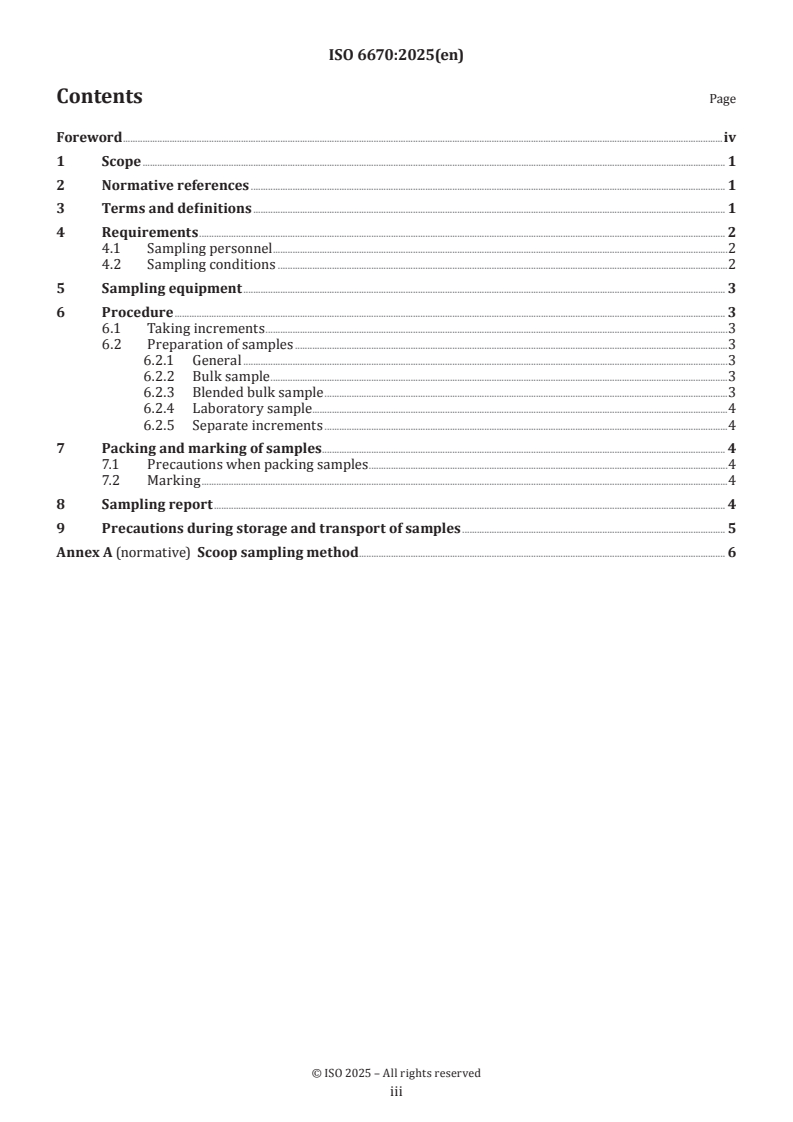
Contents Page
Foreword .iv
1 Scope . 1
2 Normative references . 1
3 Terms and definitions . 1
4 Requirements . 2
4.1 Sampling personnel .2
4.2 Sampling conditions .2
5 Sampling equipment . 3
6 Procedure . 3
6.1 Taking increments .3
6.2 Preparation of samples .3
6.2.1 General .3
6.2.2 Bulk sample .3
6.2.3 Blended bulk sample .3
6.2.4 Laboratory sample .4
6.2.5 Separate increments .4
7 Packing and marking of samples . 4
7.1 Precautions when packing samples .4
7.2 Marking .4
8 Sampling report . 4
9 Precautions during storage and transport of samples . 5
Annex A (normative) Scoop sampling method . 6
iii
Foreword
ISO (the International Organization for Standardization) is a worldwide federation of national standards
bodies (ISO member bodies). The work of preparing International Standards is normally carried out through
ISO technical committees. Each member body interested in a subject for which a technical committee
has been established has the right to be represented on that committee. International organizations,
governmental and non-governmental, in liaison with ISO, also take part in the work. ISO collaborates closely
with the International Electrotechnical Commission (IEC) on all matters of electrotechnical standardization.
The procedures used to develop this document and those intended for its further maintenance are described
in the ISO/IEC Directives, Part 1. In particular, the different approval criteria needed for the different types
of ISO document should be noted. This document was drafted in accordance with the editorial rules of the
ISO/IEC Directives, Part 2 (see www.iso.org/directives).
ISO draws attention to the possibility that the implementation of this document may involve the use of (a)
patent(s). ISO takes no position concerning the evidence, validity or applicability of any claimed patent
rights in respect thereof. As of the date of publication of this document, ISO had not received notice of (a)
patent(s) which may be required to implement this document. However, implementers are cautioned that
this may not represent the latest information, which may be obtained from the patent database available at
www.iso.org/patents. ISO shall not be held responsible for identifying any or all such patent rights.
Any trade name used in this document is information given for the convenience of users and does not
constitute an endorsement.
For an explanation of the voluntary nature of standards, the meaning of ISO specific terms and expressions
related to conformity assessment, as well as information about ISO’s adherence to the World Trade
Organization (WTO) principles in the Technical Barriers to Trade (TBT), see www.iso.org/iso/foreword.html.
This document was prepared by Technical Committee ISO/TC 34, Food products, Subcommittee SC 15, Coffee.
This third edition cancels and replaces the second edition (ISO 6670:2002), which has been technically
revised.
The main changes are as follows:
— the terms and definitions have been updated;
— the marking content has been updated;
— the procedure of Annex A has been updated.
Any feedback or questions on this document should be directed to the user’s national standards body. A
complete listing of these bodies can be found at www.iso.org/members.html.
iv
International Standard ISO 6670:2025(en)
Instant coffee — Sampling method for bulk units with liners
1 Scope
1.1 This document specifies a sampling method for a consignment of instant coffee, shipped in 10 package
units or more.
This document is applicable to cases which have inner linings of moisture-resistant material hermetically
sealed because of the hygroscopic nature of instant coffee and which are in package units greater than 10 kg
net mass, typically up to 50 kg. This document is also applicable to units of more than 50 kg, usually called
“big bags” or “supersacks”. The cases are generally made of ca
...
International
Standard
ISO 6670
Third edition
Instant coffee — Sampling method
2025-12
for bulk units with liners
Café soluble — Méthode d'échantillonnage pour emballages en
vrac avec doublure
Reference number
© ISO 2025
All rights reserved. Unless otherwise specified, or required in the context of its implementation, no part of this publication may
be reproduced or utilized otherwise in any form or by any means, electronic or mechanical, including photocopying, or posting on
the internet or an intranet, without prior written permission. Permission can be requested from either ISO at the address below
or ISO’s member body in the country of the requester.
ISO copyright office
CP 401 • Ch. de Blandonnet 8
CH-1214 Vernier, Geneva
Phone: +41 22 749 01 11
Email: copyright@iso.org
Website: www.iso.org
Published in Switzerland
ii
Contents Page
Foreword .iv
1 Scope . 1
2 Normative references . 1
3 Terms and definitions . 1
4 Requirements . 2
4.1 Sampling personnel .2
4.2 Sampling conditions .2
5 Sampling equipment . 3
6 Procedure . 3
6.1 Taking increments .3
6.2 Preparation of samples .3
6.2.1 General .3
6.2.2 Bulk sample .3
6.2.3 Blended bulk sample .3
6.2.4 Laboratory sample .4
6.2.5 Separate increments .4
7 Packing and marking of samples . 4
7.1 Precautions when packing samples .4
7.2 Marking .4
8 Sampling report . 4
9 Precautions during storage and transport of samples . 5
Annex A (normative) Scoop sampling method . 6
iii
Foreword
ISO (the International Organization for Standardization) is a worldwide federation of national standards
bodies (ISO member bodies). The work of preparing International Standards is normally carried out through
ISO technical committees. Each member body interested in a subject for which a technical committee
has been established has the right to be represented on that committee. International organizations,
governmental and non-governmental, in liaison with ISO, also take part in the work. ISO collaborates closely
with the International Electrotechnical Commission (IEC) on all matters of electrotechnical standardization.
The procedures used to develop this document and those intended for its further maintenance are described
in the ISO/IEC Directives, Part 1. In particular, the different approval criteria needed for the different types
of ISO document should be noted. This document was drafted in accordance with the editorial rules of the
ISO/IEC Directives, Part 2 (see www.iso.org/directives).
ISO draws attention to the possibility that the implementation of this document may involve the use of (a)
patent(s). ISO takes no position concerning the evidence, validity or applicability of any claimed patent
rights in respect thereof. As of the date of publication of this document, ISO had not received notice of (a)
patent(s) which may be required to implement this document. However, implementers are cautioned that
this may not represent the latest information, which may be obtained from the patent database available at
www.iso.org/patents. ISO shall not be held responsible for identifying any or all such patent rights.
Any trade name used in this document is information given for the convenience of users and does not
constitute an endorsement.
For an explanation of the voluntary nature of standards, the meaning of ISO specific terms and expressions
related to conformity assessment, as well as information about ISO’s adherence to the World Trade
Organization (WTO) principles in the Technical Barriers to Trade (TBT), see www.iso.org/iso/foreword.html.
This document was prepared by Technical Committee ISO/TC 34, Food products, Subcommittee SC 15, Coffee.
This third edition cancels and replaces the second edition (ISO 6670:2002), which has been technically
revised.
The main changes are as follows:
— the terms and definitions have been updated;
— the marking content has been updated;
— the procedure of Annex A has been updated.
Any feedback or questions on this document should be directed to the user’s national standards body. A
complete listing of these bodies can be found at www.iso.org/members.html.
iv
International Standard ISO 6670:2025(en)
Instant coffee — Sampling method for bulk units with liners
1 Scope
1.1 This document specifies a sampling method for a consignment of instant coffee, shipped in 10 package
units or more.
This document is applicable to cases which have inner linings of moisture-resistant material hermetically
sealed because of the hygroscopic nature of instant coffee and which are in package units greater than 10 kg
net mass, typically up to 50 kg. This document is also applicable to units of more than 50 kg, usually called
“big bags” or “supersacks”. The cases are generally made of cardboard of appropriate strength and the big
bags are made of suitable plastic material.
1.2 This document is also applicable to the selection and preparation of a sufficiently representative
sample of the consignment, which is intended:
a) to serve as a basis for an offer for sale;
b) for examination to verify that the instant coffee to be offered for sale satisfies the producer’s sales
specification;
c) for examination to determine one
...