

ISO 9116:2025
(Main)Green coffee — Guidance on methods of specification
- Abstract
This document gives guidance on methods of specification to be used to describe green coffee for sale and purchase. It also gives guidance on procedures for sampling, packing, marking, storage and shipping of green coffee. This document is applicable to green coffee as defined in ISO 3509.
- Status
- Published
- Publication Date
- 24-Sep-2025
- Technical Committee
- ISO/TC 34/SC 15 - Coffee
- Drafting Committee
- ISO/TC 34/SC 15 - Coffee
- Current Stage
- 6060 - International Standard published
- Start Date
- 25-Sep-2025
- Due Date
- 31-Aug-2026
- Completion Date
- 25-Sep-2025
Overview
ISO 9116:2025, titled "Green coffee - Guidance on methods of specification," is an international standard developed by ISO’s Technical Committee ISO/TC 34 (Food products), Subcommittee SC 15 (Coffee). This third edition provides comprehensive guidance on specifying green coffee for sale and purchase. It outlines accepted methods for describing green coffee lots or consignments and offers procedures on sampling, packing, marking, storage, and shipping of green coffee.
This standard applies specifically to green coffee as defined under ISO 3509 and aims to ensure clarity, uniformity, and reliability in the global trade of green coffee beans.
Key Topics
Specification Methods for Green Coffee
The document recommends including detailed information for each lot or consignment of green coffee to enhance traceability and quality assessment:
- Country and region of origin (state or plantation where relevant)
- Year of harvest or coffee age
- Type of green coffee
- Number of bags and net mass per bag or total net mass for bulk packs
- Moisture content and loss in mass on drying (per ISO 6673; moisture meters calibrated as per ISO 24115)
- Defects and foreign matter content (according to ISO 4149)
- Insect-damaged bean content (as per ISO 6667)
- Bulk density (ISO 6669)
- Bean size (ISO 4150)
Sampling Procedures
Sampling methods for green coffee in bags should follow the guidelines of ISO 4072, ensuring consistent and representative sampling to maintain accuracy in quality control and trade.
Packing, Marking, Storage, and Shipping
- Packing: Use materials that protect green coffee from contamination and damage. Bulk containers must be suitable for maintaining product integrity.
- Marking: Bags and bulk containers must bear clear and permanent markings including "green coffee," country of origin, region or plantation, year of harvest/age, and net mass.
- Storage and Shipping: Handling procedures align with ISO 8455 to preserve the quality of green coffee during storage and transportation.
Applications
ISO 9116:2025 is essential for:
- Coffee producers and exporters to provide standardized and detailed descriptions of green coffee consignments
- Importers, buyers, and traders to evaluate and compare green coffee lots based on harmonized quality parameters
- Quality assurance teams in the coffee supply chain seeking uniform sampling and testing methods
- Logistics and warehouse managers responsible for proper packing, storage, and shipping protocols that maintain coffee quality
- Regulatory and certification bodies promoting compliance with international coffee trade standards
By following this guidance, stakeholders help facilitate transparent, efficient, and quality-driven coffee trade.
Related Standards
ISO 9116:2025 references and complements several related ISO standards that govern coffee quality and handling, including:
- ISO 3509: Coffee and coffee products - Vocabulary
- ISO 18794: Coffee - Sensory analysis - Vocabulary
- ISO 4072: Green coffee in bags - Sampling
- ISO 4149: Green coffee - Examination of defects and foreign matter
- ISO 4150: Green coffee - Bean size analysis
- ISO 6667: Green coffee - Identification of insect-damaged beans
- ISO 6669: Bulk density determination for green coffee
- ISO 6673: Loss in mass determination at 105 °C
- ISO 8455: Guidelines for storage and transport of green coffee
- ISO 24115: Calibration procedures for moisture meters
These interconnected standards form a robust framework for the specification, sampling, analysis, and logistics of green coffee, promoting quality assurance and trade consistency worldwide.
Keywords: ISO 9116:2025, green coffee specification, coffee sampling methods, coffee packing standards, coffee marking guidelines, green coffee storage, coffee shipping, international coffee standards, green coffee quality, ISO coffee standards.
Relations
- Effective Date
- 02-Sep-2023
Get Certified
Connect with accredited certification bodies for this standard

BSI Group
BSI (British Standards Institution) is the business standards company that helps organizations make excellence a habit.

Bureau Veritas
Bureau Veritas is a world leader in laboratory testing, inspection and certification services.

DNV
DNV is an independent assurance and risk management provider.
Sponsored listings
Frequently Asked Questions
ISO 9116:2025 is a standard published by the International Organization for Standardization (ISO). Its full title is "Green coffee — Guidance on methods of specification". This standard covers: This document gives guidance on methods of specification to be used to describe green coffee for sale and purchase. It also gives guidance on procedures for sampling, packing, marking, storage and shipping of green coffee. This document is applicable to green coffee as defined in ISO 3509.
This document gives guidance on methods of specification to be used to describe green coffee for sale and purchase. It also gives guidance on procedures for sampling, packing, marking, storage and shipping of green coffee. This document is applicable to green coffee as defined in ISO 3509.
ISO 9116:2025 is classified under the following ICS (International Classification for Standards) categories: 67.140.20 - Coffee and coffee substitutes. The ICS classification helps identify the subject area and facilitates finding related standards.
ISO 9116:2025 has the following relationships with other standards: It is inter standard links to ISO 9116:2004. Understanding these relationships helps ensure you are using the most current and applicable version of the standard.
ISO 9116:2025 is available in PDF format for immediate download after purchase. The document can be added to your cart and obtained through the secure checkout process. Digital delivery ensures instant access to the complete standard document.
Standards Content (Sample)
International
Standard
ISO 9116
Third edition
Green coffee — Guidance on
2025-09
methods of specification
Reference number
© ISO 2025
All rights reserved. Unless otherwise specified, or required in the context of its implementation, no part of this publication may
be reproduced or utilized otherwise in any form or by any means, electronic or mechanical, including photocopying, or posting on
the internet or an intranet, without prior written permission. Permission can be requested from either ISO at the address below
or ISO’s member body in the country of the requester.
ISO copyright office
CP 401 • Ch. de Blandonnet 8
CH-1214 Vernier, Geneva
Phone: +41 22 749 01 11
Email: copyright@iso.org
Website: www.iso.org
Published in Switzerland
ii
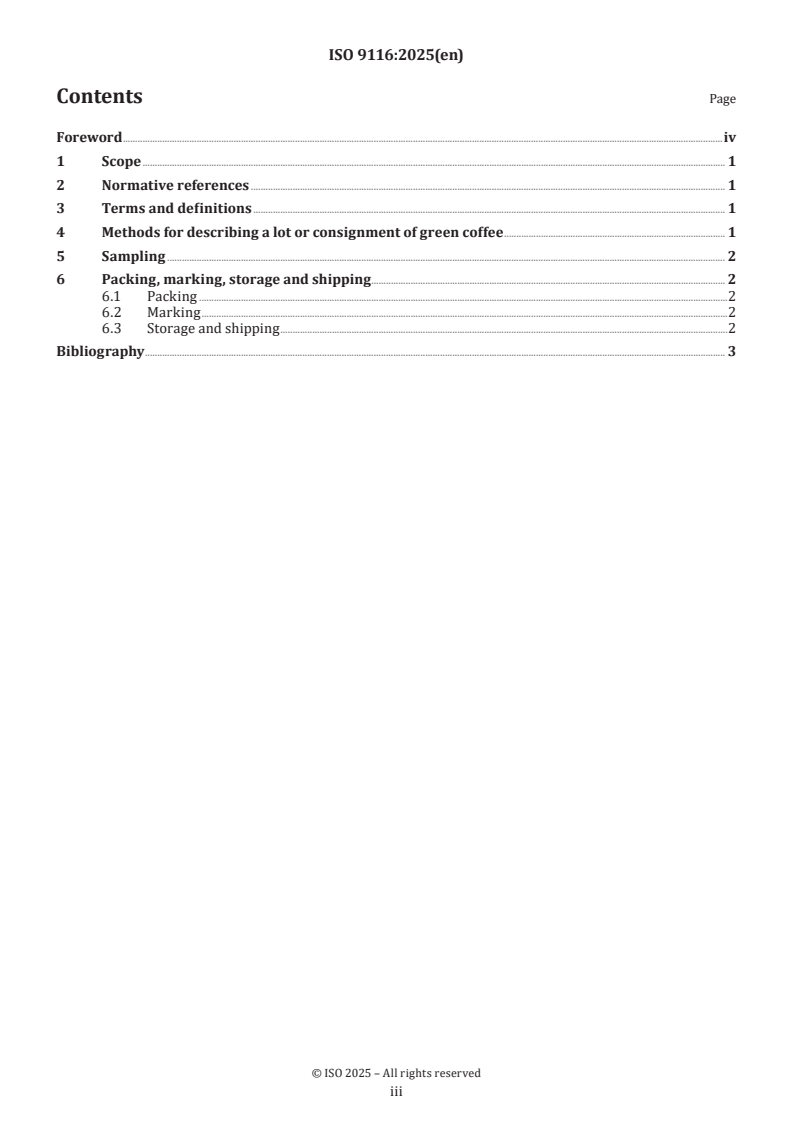
Contents Page
Foreword .iv
1 Scope . 1
2 Normative references . 1
3 Terms and definitions . 1
4 Methods for describing a lot or consignment of green coffee . 1
5 Sampling . 2
6 Packing, marking, storage and shipping . . 2
6.1 Packing .2
6.2 Marking .2
6.3 Storage and shipping .2
Bibliography . 3
iii
Foreword
ISO (the International Organization for Standardization) is a worldwide federation of national standards
bodies (ISO member bodies). The work of preparing International Standards is normally carried out through
ISO technical committees. Each member body interested in a subject for which a technical committee
has been established has the right to be represented on that committee. International organizations,
governmental and non-governmental, in liaison with ISO, also take part in the work. ISO collaborates closely
with the International Electrotechnical Commission (IEC) on all matters of electrotechnical standardization.
The procedures used to develop this document and those intended for its further maintenance are described
in the ISO/IEC Directives, Part 1. In particular, the different approval criteria needed for the different types
of ISO document should be noted. This document was drafted in accordance with the editorial rules of the
ISO/IEC Directives, Part 2 (see www.iso.org/directives).
ISO draws attention to the possibility that the implementation of this document may involve the use of (a)
patent(s). ISO takes no position concerning the evidence, validity or applicability of any claimed patent
rights in respect thereof. As of the date of publication of this document, ISO had not received notice of (a)
patent(s) which may be required to implement this document. However, implementers are cautioned that
this may not represent the latest information, which may be obtained from the patent database available at
www.iso.org/patents. ISO shall not be held responsible for identifying any or all such patent rights.
Any tra
...