

ISO 23648:2026
(Main)Plastics — Impinging flame test on water-filled plastic pipes
- Abstract
This document specifies a test method for assessing the fire performance of water-filled plastic pipes and fibre reinforced plastic (FRP) pipes.
- Status
- Published
- Publication Date
- 30-Sep-2026
- Technical Committee
- ISO/TC 61/SC 4 - Burning behaviour
- Drafting Committee
- ISO/TC 61/SC 4/WG 12 - Reaction-to-fire performance of plastics
- Current Stage
- 6060 - International Standard published - 60 Publication
- Start Date
- 01-Oct-2026
- Due Date
- 28-Nov-2026
- Completion Date
- 28-Nov-2026
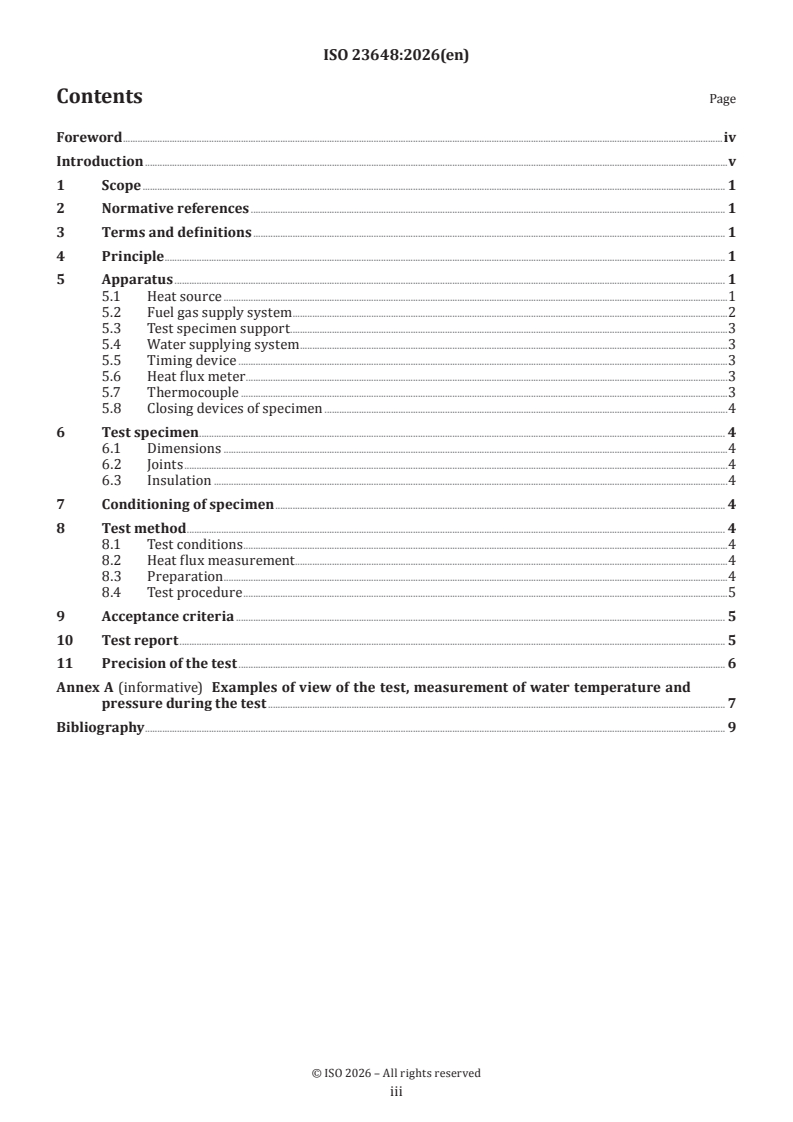
ISO 23648:2026 is an International Standard from ISO for an impinging flame test on water-filled plastic pipes. It specifies a test method for assessing the fire performance of water-filled plastic pipes and fibre reinforced plastic (FRP) pipes. In practice, it gives laboratories and suppliers a repeatable way to check whether a pipe can stay sealed when exposed to flame while holding water pressure.
What does ISO 23648:2026 specify?
ISO 23648:2026 specifies a fire test method for water-filled plastic pipes and FRP pipes, with an emphasis on ship-related piping applications. The document is organized to take the user from the test principle through apparatus, specimen preparation, test procedure, pass/fail criteria and reporting.
| Annex | What it covers |
|---|---|
| Annex A | Informative examples of the test view and of measuring water temperature and pressure during the test |
The main clauses cover scope, normative references, terms and definitions, principle, apparatus, test specimen, conditioning, test method, acceptance criteria, test report and precision.
What are the key requirements of ISO 23648:2026?
ISO 23648:2026 sets out a combined flame-and-pressure test. The pipe specimen is filled with water, exposed to specified burners for 30 minutes, and then held under pressure for another 15 minutes after the flame exposure.
Clause 4, Principle - The specimen must be water-filled and kept under specified pressure while flames impinge on it. This matters because the test is aimed at the pipe's ability to retain water in a fire situation, not just its surface burning behavior.
Clause 5.1 and 5.2, burners and fuel - The test uses a torch burner arrangement with defined burner dimensions, propane of at least 95% purity, and controlled gas flow. For pipes up to 150 mm nominal diameter, the burner set uses two rows; larger pipes need additional rows to maintain the specified heat flux. This matters because the heat input must be controlled if results are to be comparable.
Clause 5.3 to 5.8, apparatus - The setup includes steel specimen supports, a water supply system that maintains 0.3 MPa ± 0.05 MPa, a timing device, a heat flux meter calibrated to ISO 14934-3, a sheathed thermocouple for water temperature, and end-closure devices resistant to 150 °C. This means the lab needs equipment that can hold pressure, measure heat and temperature, and withstand the test environment.
Clause 6 and 7, specimen preparation - The specimen must be at least 1.5 m long, mounted horizontally, and free of trapped air. Joints and insulation are included when they are part of the intended product, and the specimen is conditioned at 23 °C ± 5 °C and 50% ± 10% relative humidity for at least 24 hours, or until equilibrium. In practice, the test should represent the product as it will actually be used.
Clause 8, test method - The test room must have adequate air supply and an atmospheric temperature between 15 °C and 35 °C. The water inside the specimen starts at not less than 15 °C, and the test records deformation, leakage, water temperature and water pressure. If pressure cannot be maintained above 0.25 MPa because of leakage, the test is stopped.
Clause 9 and 10, acceptance and reporting - The specimen passes if it shows no leakage during fire exposure, except for slight weeping up to 0.2 l/min through the wall, and if pressure is maintained during the fire and post-fire pressure-hold period. The report records the laboratory, sponsor, manufacturer or supplier, specimen construction, insulation details if used, test conditions, pass/fail decision and any reason for invalidity. This is what makes the result traceable for quality control or product qualification.
What terms does ISO 23648:2026 define?
ISO 23648:2026 uses the fire-safety vocabulary of ISO 13943 for its terms and definitions. The following terms are especially important in the test method:
- Fibre reinforced plastic (FRP) - A plastic pipe reinforced with fibres, tested here alongside plastic pipes.
- Stagnant water - Water held in the specimen during the test rather than flowing through it.
- Heat flux meter - The instrument used to check the heat load at the specimen position.
- Acceptance criteria - The pass/fail conditions in Clause 9, based on leakage and pressure retention.
- Test specimen - The pipe section being tested, including a joint or insulation when those features are part of the evaluation.
- Boiling liquid expanding vapor explosion (BLEVE) - The rapid pressure-related failure warned against if the water pressure drops suddenly.
Who uses ISO 23648:2026?
ISO 23648:2026 is used by testing laboratories, pipe manufacturers, suppliers and test sponsors. It is also relevant to engineers and quality managers working with plastic pipes or FRP pipes for ships.
The introduction points to shipboard services such as fresh water, sanitary and drain piping, sea-water piping and liquid cargo piping. That makes the document useful when a buyer or designer needs evidence that a pipe system can withstand fire exposure while remaining watertight.
Which standards are used with ISO 23648:2026?
ISO 23648:2026 cites ISO 13943 for the fire-safety vocabulary used throughout the document. It cites ISO 14934-3 for calibration and use of the heat flux meter.
The introduction also says the method was developed from the International Maritime Organization (IMO) guidelines in IMO Assembly resolution A.753(18) as amended. That background explains why the test is written for ship applications.
What does the ISO 23648:2026 document contain?
ISO 23648:2026 contains the full test sequence, the required apparatus and the reporting items needed for a repeatable fire-performance assessment. Figures show the burner appearance, the burner arrangement and an example test setup.
Annex A gives example views of the test and example records of water temperature during testing. The document also includes the specimen preparation details, the water-pressure and heat-flux checks, the stop condition for leakage, and the post-fire pressure-hold step used to judge performance.
Get Certified
Connect with accredited certification bodies for this standard

CIS Institut d.o.o.
Personal Protective Equipment (PPE) certification body. Notified Body NB-2890 for EU Regulation 2016/425 PPE.
Institut za varilstvo d.o.o. (Welding Institute)
Slovenia's leading welding institute since 1952. ISO 3834, EN 1090, pressure equipment certification, NDT personnel, welder qualification. Only IIW Au

Kiwa BDA Testing
Building and construction product certification.
Sponsored listings
Frequently Asked Questions
ISO 23648:2026 is a standard published by the International Organization for Standardization (ISO). Its full title is "Plastics — Impinging flame test on water-filled plastic pipes". This standard covers: This document specifies a test method for assessing the fire performance of water-filled plastic pipes and fibre reinforced plastic (FRP) pipes.
This document specifies a test method for assessing the fire performance of water-filled plastic pipes and fibre reinforced plastic (FRP) pipes.
ISO 23648:2026 is classified under the following ICS (International Classification for Standards) categories: 13.220.40 - Ignitability and burning behaviour of materials and products; 23.040.20 - Plastics pipes. The ICS classification helps identify the subject area and facilitates finding related standards.
ISO 23648:2026 is available in PDF format for immediate download after purchase. The document can be added to your cart and obtained through the secure checkout process. Digital delivery ensures instant access to the complete standard document.
Standards Content (Sample)
Contents
- Introduction
- 1 Scope
- 2 Normative references
- 3 Terms and definitions
- 4 Principle
- 5 Apparatus
- 5.1 Heat source
- 5.2 Fuel gas supply system
- 5.3 Test specimen support
- 5.4 Water supplying system
- 5.5 Timing device
- 5.6 Heat flux meter
- 5.7 Thermocouple
- 5.8 Closing devices of specimen
- 6 Test specimen
- 6.1 Dimensions
- 6.2 Joints
- 6.3 Insulation
- 7 Conditioning of specimen
- 8 Test method
- 8.1 Test conditions
- 8.2 Heat flux measurement
- 8.3 Preparation
- 8.4 Test procedure
- 9 Acceptance criteria
- 10 Test report
- 11 Precision of the test
- Annex A
- Bibliography
Introduction
Plastic pipes and fibre reinforced plastics pipes (FRP pipes) exhibit corrosion resistance against water, including sea water and liquid chemicals. These pipes have been used on ships in various applications, such as piping for supplying fresh water, sanitary and drain piping, sea-water piping and liquid cargo piping. The International Maritime Organization (IMO) adopted guidelines on use of plastic pipes (IMO Assembly [1] resolution A.753(18) as amended ). These guidelines contain requirements on the fire performance of plastic pipes and of FRP pipes to be used on-board ships. These guidelines also contain a brief explanation of the test procedures on a fire performance test for liquid-filled plastic pipes in the Appendix 2 of IMO A.753(18). However, the description of the fire test in the current guideline is very short and insufficient to conduct the test in a uniform and consistent manner.
[1] This document was developed based on the IMO A.753(18) and provides detailed descriptions of the fire test methods applicable to plastic pipes and FRP pipes used on ships.
International Standard ISO 23648:2026(en) Plastics — Impinging flame test on water-filled plastic pipes
1 Scope
This document specifies a test method for assessing the fire performance of water-filled plastic pipes and fibre reinforced plastic (FRP) pipes.
2 Normative references
The following documents are referred to in the text in such a way that some or all of their content constitutes requirements of this document. For dated references, only the edition cited applies. For undated references, the latest edition of the referenced document (including any amendments) applies. ISO 13943, Fire safety — Vocabulary ISO 14934-3, Fire tests — Calibration and use of heat flux meters — Part 3: Secondary calibration method
3 Terms and definitions
For the purposes of this document, the terms and definitions given in ISO 13943 apply. ISO and IEC maintain terminology databases for use in standardization at the following addresses:
- ISO Online browsing platform: available at https:// www .iso .org/ obp
- IEC Electropedia: available at https:// www .electropedia .org/
4 Principle
The test specimen of plastic pipes and FRP pipes are filled with water. The water is kept at a specified pressure. The test specimen is subjected to flames developed by a set of specified burners with a specified heat condition. The test specimen shall withstand the heat provided by the test flames for 30 minutes without water leakage. The specimen shall also keep water pressure without water leakage for 15 minutes after the flame exposure.
5 Apparatus
5.1 Heat source
A burner, usually known as “torch burner” for use when heating rooftop water seals, shall be used. The inner diameter of the burner heads shall be 29 mm ± 1 mm. The length of the burner shall be 87 mm ± 2 mm. The burner shall have air-supplying holes on the lower side of the burner. The burner complying with the dimensions above has a nominal output of 26 kW when the fuel gas is supplied at a pressure of approximately 0,4 MPa (4 bar). Typical appearance of the burner is shown in Figure 1. 1) NOTE Sievert torch burner No.2942 and 293401 has been found suitable as the heat source burner. 1) This information is given for the convenience of users of this document and does not constitute an endorsement by ISO of the product named. Equivalent products may be used if they can be shown to lead to the same results.
ISO 23648:2026(en) Figure 1 — Typical appearance of the burner Each burner shall be equipped with a valve in order to control the flame height. For testing pipe specimens of up to 150 mm in nominal diameter, the burner shall consist of two rows of five burner tips as shown in Figure 2. The burners shall be mounted in the same plane and the fuel gas shall be supplied through a manifold. The burner mount shall be able to move centrally below the test specimen with the row of burners parallel to the axis of the test specimen. The height of the burner stand shall be adjustable so that the distance between the top of the burner heads and the bottom surface of the test specimen is able to be maintained at 125 mm ± 10 mm.
For test specimens having a diameter greater than 150 mm, one additional row of burners shall be included for each 50 mm increase in the diameter of the pipe test specimen. Dimensions in millimetres Key 1 burner 2 burner mount Figure 2 — Burner set for the test, top view and side view
...