

ISO 3952-2:1981
(Main)Kinematic diagrams — Graphical symbols
General Information
- Abstract
The symbols system is intended for simplifying the preparation of diagrams of products in all branches of industry and is to be used in technical documentation as well as in technical and educational literature. It will facilitate the execution and understanding of such diagrams by specialists of different countries. This part contains friction and gear mechanisms and cam mechanisms.
- Status
- Published
- Publication Date
- 30-Jun-1981
- Technical Committee
- ISO/TC 10/SC 6 - Mechanical engineering documentation
- Drafting Committee
- ISO/TC 10/SC 6 - Mechanical engineering documentation
- Current Stage
- 9093 - International Standard confirmed
- Start Date
- 10-Jun-2024
- Completion Date
- 29-Aug-2026


Overview
ISO 3952-2:1981 - Kinematic diagrams - Graphical symbols - Part 2 defines a standardized system of graphical symbols for kinematic diagrams, focusing on friction and gear mechanisms and cam mechanisms. Published in 1981 by ISO/TC 10 (Technical drawings), this part is one of three in the ISO 3952 series and is intended to simplify the preparation, exchange and interpretation of kinematic schematics across industries and countries.
Key topics
- Scope and purpose: Establishes a uniform symbol system for elements of kinematic diagrams used in technical documentation, engineering drawings and educational literature.
- Symbol content: Covers graphical representations for friction mechanisms, gear trains and gear elements, and cam mechanisms (Part 2). (Part 1 and Part 3 of ISO 3952 address link motion, kinematic pairs, links, Geneva/ratchet mechanisms, couplings and brakes.)
- International application: Symbols designed to aid comprehension by specialists from different countries and to be used consistently in multilingual documentation.
- Standardization context: Developed by ISO/TC 10 and published as an international standard to harmonize engineering drawing practices.
Practical applications
ISO 3952-2 is practical for professionals and organizations that produce, interpret or teach mechanical motion diagrams:
- Mechanical engineers and machine designers documenting drive trains, gearboxes and cam-driven assemblies.
- Draftsmen and technical illustrators creating standardized kinematic schematics for manuals and specifications.
- Technical writers and maintenance engineers preparing repair, assembly and troubleshooting documentation.
- Educators and training providers using consistent graphical symbols in textbooks and course materials.
- CAD/CAM and technical documentation teams developing symbol libraries and templates to ensure cross-border consistency.
Benefits include:
- Faster, clearer communication of kinematic function and element relationships.
- Reduced ambiguity in international projects and component documentation.
- Easier creation of reusable symbol libraries for CAD and publishing.
Related standards
- ISO 3952-1 - Motion of links, kinematic pairs and link components (Part 1).
- ISO 3952-3 - Geneva and ratchet mechanisms; couplings and brakes (Part 3).
- Standards produced by ISO/TC 10 (Technical drawings) govern related graphical conventions.
Using ISO 3952-2:1981 helps organizations standardize kinematic diagrams, improve clarity in engineering drawings, and support consistent documentation of mechanical drives, gear mechanisms, and cam systems worldwide.
Frequently Asked Questions
ISO 3952-2:1981 is a standard published by the International Organization for Standardization (ISO). Its full title is "Kinematic diagrams — Graphical symbols". This standard covers: The symbols system is intended for simplifying the preparation of diagrams of products in all branches of industry and is to be used in technical documentation as well as in technical and educational literature. It will facilitate the execution and understanding of such diagrams by specialists of different countries. This part contains friction and gear mechanisms and cam mechanisms.
The symbols system is intended for simplifying the preparation of diagrams of products in all branches of industry and is to be used in technical documentation as well as in technical and educational literature. It will facilitate the execution and understanding of such diagrams by specialists of different countries. This part contains friction and gear mechanisms and cam mechanisms.
ISO 3952-2:1981 is classified under the following ICS (International Classification for Standards) categories: 01.080.30 - Graphical symbols for use on mechanical engineering and construction drawings, diagrams, plans, maps and in relevant technical product documentation; 21.020 - Characteristics and design of machines, apparatus, equipment. The ICS classification helps identify the subject area and facilitates finding related standards.
ISO 3952-2:1981 is available in PDF format for immediate download after purchase. The document can be added to your cart and obtained through the secure checkout process. Digital delivery ensures instant access to the complete standard document.
Standards Content (Sample)
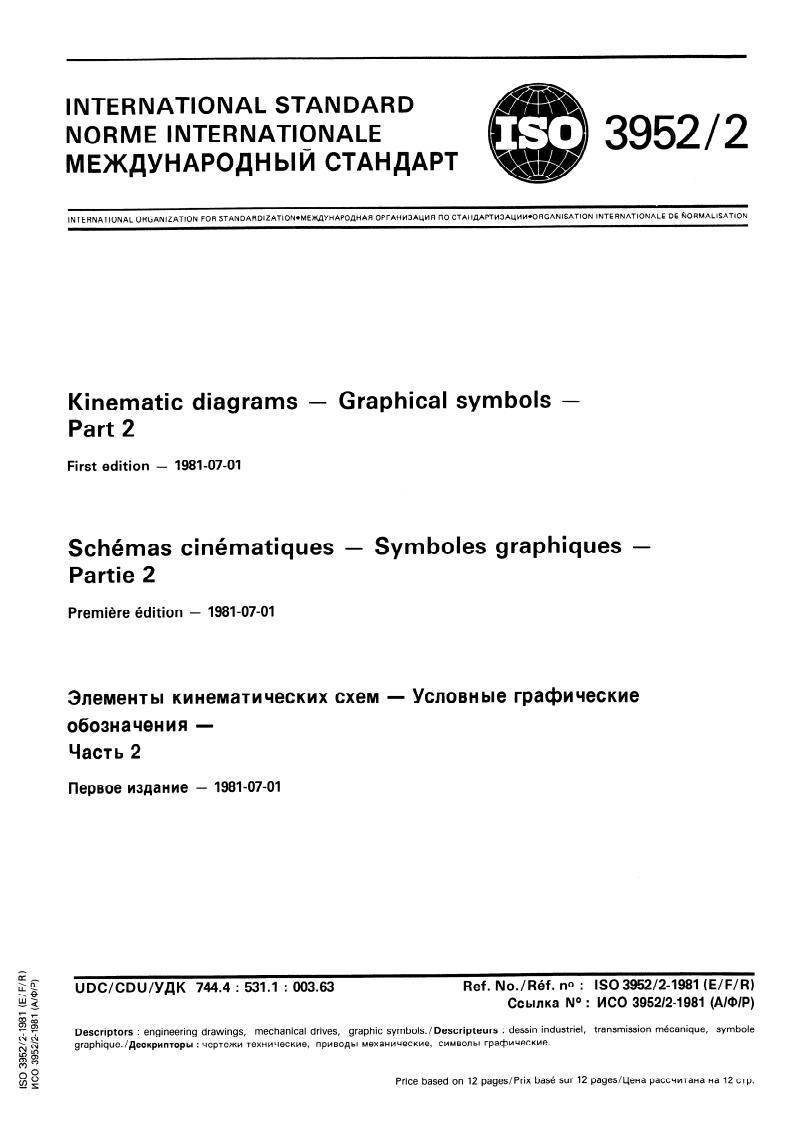
INTERNATIONAL STANDARD
NORME INTERNATIONALE
MEXflYHAPOflHblti CTAHAAPT
INTERNATIONAL ORGANIZATION FOR STANDARDIZATION~ME>YHAPO~HAR OPI-AHkl3AuMR fl0 CTAH~APTM3AWlM.ORGANISATION INTERNATIONALE DE hORMALISATION
Kinematic diagrams - Graphical Symbols -
Part 2
First edition - 1981-07-01
Schemas cinematiques - Symboles graphiques -
Partie 2
Premiere Edition - 1981-07-01
3JleMeHTbl KMHeMaTld~eCKHX CXeM - YCflOBH ble rpaC#WlWCKHe
o6o3tiaWtibM -
+CTb 2
llepeoe HsAatwe - 1981-07-01
LC
Ref. No./Ref. no : ISO 3952/2-1981 (E/F/R)
UDC/CDU/YAK 744.4 : 531.1 : 003.63
---43
wg
CCblIlKa No: MC0 395212-1981 (AIWP)
gg3
7-r Descriptors : engineering drawings, mechanical drives, graphic symbols. / Descripteurs : dessin industriel, transmission mkcanique, Symbole
2r
graphique./flecKpbInTopbi : qep-rexr/r Text-iMqecKMe, npm3oAbl MexaiiWecKMe, cMMBonbl rpacj3mecKMe.
SS!
3%
Price based on 12 pages/Prix bas6 Sur 12 pageS/uetia paccWTaHa Ha 12 CTP.
v,s
Foreword
ISO (the International Organization for Standardization) is a worldwide federation of national
Standards institutes (ISO member bedies). The work of developing International Standards is car-
ried out through ISO technical committees. Every member body interested in a subject for which
a technical committee has been set up has the right to be represented on that committee. Interna-
tional organizations, governmental and non-governmental, in liaison with ISO, also take part in
the work.
Draft Inter national Standards ad opted by the technical committees are circulated the member
to
bodies for I before their ce as International Standards by the IS
approva acceptan 0 Council.
International Standard ISO 395212 was developed Technical Committee ISO/TC 10,
by
Technical dfawings, and was circulated to the member bod ies in October 1979.
It has been approved by the member bodies of the following countries :
Austria Germany, F. R.
South Africa, Rep. of
Belgium Italy Spain
Bulgaria Libyan Arab Jamahiriya
United Kingdom
Czechoslova kia Netherlands
USA
Egypt, Arab Rep. of Norway USSR
Finland Poland
France Romania
The member of the following country expressed disapproval of the document on technical
body
grou nds :
Japan
Avant-propos
L’ISO (Organisation internationale de normalisation) est une federation mondiale d’organismes
nationaux de normalisation (comites membres de I’ISO). L’6laboration des Normes internationa-
les est confiee aux comites techniques de I’ISO. Chaque comite membre interesse par une etude
a Ie droit de faire Partie du comite technique correspondant. Les organisations internationales,
gouvernementales et non gouvernementales, en liaison avec I’ISO, participent egalement aux tra-
vaux.
Les projets de Normes internationales adoptes par les comites techniques sont soumis aux comi-
tes membres pour approbation, avant leur acceptation comme Normes internationales par Ie
Conseil de I’ISO.
La Norme internationale ISO 3952/2 a et6 6la bot-ee par Ie comite technique ISO/TC 10, Dessins
techniques, et a et6 soumise aux comites membres en octobre 1 979.
Les comites membres des pays suivants I’ont approuvee :
Afrique du Sud, Rep. d’ Finlande Roumanie
Allemagne, R.F. France Royaume-Uni
Autriche Italie Tchecoslovaquie
Belgique Jamahiriya arabe libyenne URSS
Bulgarie Norvege
USA
Egypte, Rep. arabe d’ Pays-Bas
Espagne Pologne
Le comite membre du pays suivant I’a desapprouvee pour des raisons techniques :
Japon
ii
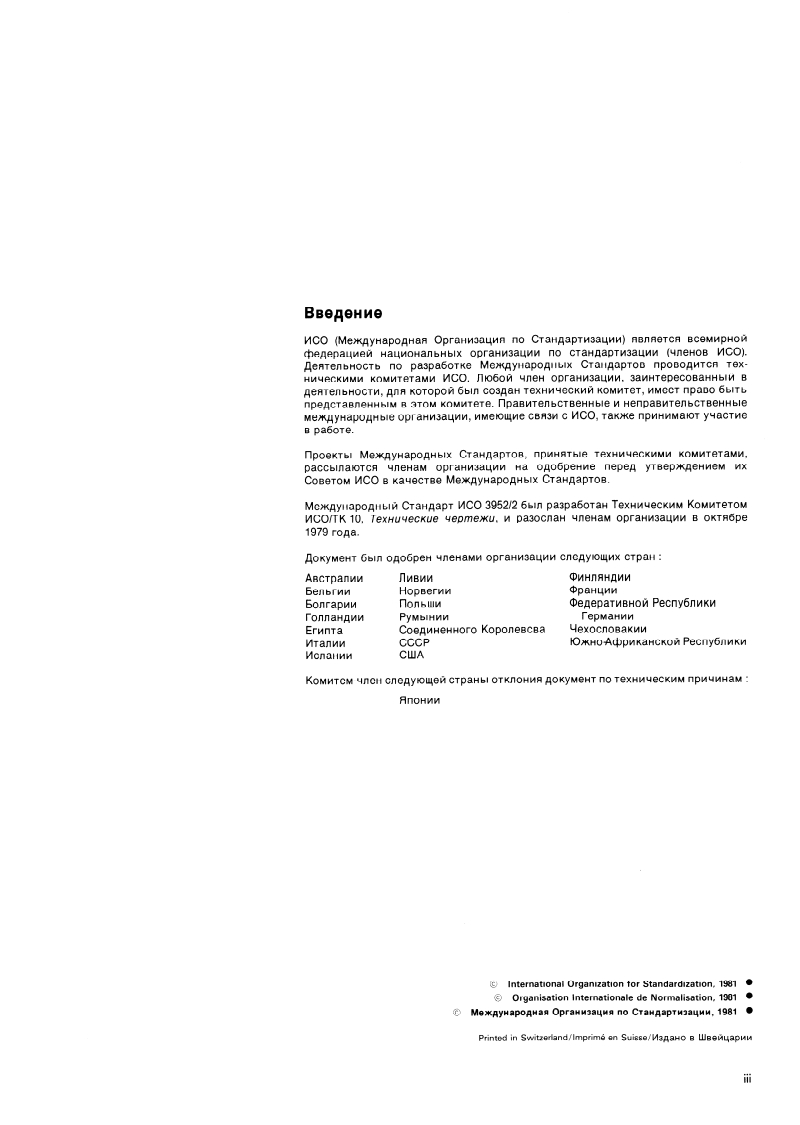
BBeAeHble
HC0 (MeqyHapO~tiafI OpratiM3a~MR i-IO CTaH~apTM3a~Mt4) FiBnfleTCfI BCeMMpHOL/I
@efiepauMeti Ha~LlOHafl bHblX opraHt43aqm no cTaH~apTM3a~lwl (WeHOB WO).
C\eflTefl bHOCTb l-l0 pa3pa60TKe MewyHapOAH blx CTaHplapTOB flpOBO~VlTCR TeX-
HM~eCKklML’l KOMMTeTaMM tdco. flm60ti ‘4JleH OpraHM3a~MM, JaklHTepeCOBaHHbiti B
AeRTenbHOCTM, Anfl KOTOpOI/I 6bln CO3AaH TeXHkl~eCKldl KOMMTeT, L’lMeeT flpaB0 6blTb
flpeACTaBfleHH blM B 3TOM KOMMTeTe. npaBl4TeJ.l bCTBeHH ble M HellpaBMTeJl bCTBeHHble
MeXfiyHapOAHble OpraHM3a~MM, VlMelOql4e CBR3Vl C c/1Co, TaKXe flpl4HklMaIOT yiraCTkle
B pa6OTe.
i-!pOeKTbl hdeX,4yHapO~HblX CTaHjJapTOB, llpklHFiTble TeXHVl~eCKLlMkl KOMMTeTaMM,
paccbInaloTCF1 weHaM opraHu3aum Ha oAo6peHMe nepeq yTBep>KReHMeM Mx
COBeTOM L/ICo B KaCleCTBe MeXflytiapOp,HblX CTaHjJapTOB.
MeXflyHapo~Hblri CTaHAapT HC0 3%2/2 6bin pa3pa60TaH TexHWIeCKkIM KOMMTeTOM
VlCO/TK 10, Texwvecwe vepmexu, VI pa3ocnaH weHaM opraHkI3aqwI B oKTR6pe
1979 roAa.
AOKyMeHT 6bln oAo6peH qneHaMM OpraHl’l3aqlWl Cne~yK>~VlX CTpaH :
AeCTpanvwI
JllflBWl @MHnRHAMM
6enbrm HopBeruiM Q>paHqwl
60nrapm rlonblwl @eAepaTt4BHoti Pecny6nvIKm
ronnaHflm4 PyMblHMM repMaHW4
Coe~vlHeHHoro Koponescsa
ErmTa YexocnoBaKm
klTanw4 CCCP K)XHO&#p~KaHCKO~ Pecny6mKM
McnaHm CLUA
KOMUTeM-WleH CneAyK)weti CTpaHbl OTKnOHMfl AOKyMeHT n0 TeXHMqeCKMM npWWlHaM :
ml0Htwl
6% International Organization for Standardization, 1981 l
C3 Organisation Internationale de Normalisation, 1981 l
0 MexAyHapoAHaa Opratwmaqm no CraHgaprwaqw, 1981 l
Printed in Switzerland/lmprim6 en Suisse/MsAaHo B UJeeMqapMM
. . .
Ill
This page intentionally lef? blank
...
2003-01.Slovenski inštitut za standardizacijo. Razmnoževanje celote ali delov tega standarda ni dovoljeno.Schémas cinématiques -- Symboles graphiquesKinematic diagrams -- Graphical symbols21.020Characteristics and design of machines, apparatus, equipment01.080.30GRNXPHQWDFLMLGraphical symbols for use on mechanical engineering and construction drawings, diagrams, plans, maps and in relevant technical product documentationICS:Ta slovenski standard je istoveten z:ISO 3952-2:1981SIST ISO 3952-2:1995en01-junij-1995SIST ISO 3952-2:1995SLOVENSKI
STANDARD
INTERNATIONAL STANDARD NORME INTERNATIONALE MEXflYHAPOflHblti CTAHAAPT 395212 INTERNATIONAL ORGANIZATION FOR STANDARDIZATION~ME>YHAPO~HAR OPI-AHkl3AuMR fl0 CTAH~APTM3AWlM.ORGANISATION INTERNATIONALE DE hORMALISATION Kinematic diagrams - Graphical Symbols - Part 2 First edition - 1981-07-01 Schemas cinematiques - Symboles graphiques - Partie 2 Premiere Edition - 1981-07-01 3JleMeHTbl KMHeMaTld~eCKHX CXeM - YCflOBH ble rpaC#WlWCKHe o6o3tiaWtibM - +CTb 2 llepeoe HsAatwe - 1981-07-01 02 LC UDC/CDU/YAK 744.4 : 531.1 : 003.63 Ref. No./Ref. no : ISO 3952/2-1981 (E/F/R) ---43 wg CCblIlKa No: MC0 395212-1981 (AIWP) gg3 7-r : dessin industriel, transmission mkcanique, Symbole 2r Descriptors : engineering drawings, mechanical drives, graphic symbols. / Descripteurs SS! graphique./flecKpbInTopbi : qep-rexr/r Text-iMqecKMe, npm3oAbl MexaiiWecKMe, cMMBonbl rpacj3mecKMe. 3% 0 00 v,s Price based on 12 pages/Prix bas6 Sur 12 pageS/uetia paccWTaHa Ha 12 CTP. SIST ISO 3952-2:1995
Foreword ISO (the International Organization for Standardization) is a worldwide federation of national Standards institutes (ISO member bedies). The work of developing International Standards is car- ried out through ISO technical committees. Every member body interested in a subject for which a technical committee has been set up has the right to be represented on that committee. Interna- tional organizations, governmental and non-governmental, in liaison with ISO, also take part in the work. Draft Inter national Standards ad opted by the technical committees are circulated to the member bodies for approva I before their acceptan ce as International Standards by the IS 0 Council. International Standard ISO 395212 was developed by Technical Committee Technical dfawings, and was circulated to the member bod ies in October 1979. ISO/TC 10, It has been approved by the member bodies of the following countries : Austria Germany, F. R. Belgium Italy Bulgaria Libyan Arab Jamahiriya Czechoslova kia Netherlands Egypt, Arab Rep. of Norway Finland Poland France Romania South Africa, Rep. of Spain United Kingdom USA USSR The member grou nds : body of the following country expressed disapproval of the document on technical Japan Avant-propos L’ISO (Organisation internationale de normalisation) est une federation mondiale d’organismes nationaux de normalisation (comites membres de I’ISO). L’6laboration des Normes internationa- les est confiee aux comites techniques de I’ISO. Chaque comite membre interesse par une etude a Ie droit de faire Partie du comite technique correspondant. Les organisations internationales, gouvernementales et non gouvernementales, en liaison avec I’ISO, participent egalement aux tra- vaux. Les projets de Normes internationales adoptes par les comites techniques sont soumis aux comi- tes membres pour approbation, avant leur acceptation comme Normes internationales par Ie Conseil de I’ISO. La Norme internationale ISO 3952/2 a et6 6la bot-ee par Ie comite technique ISO/TC 10, techniques, et a et6 soumise aux comites membres en octobre 1 979. Les comites membres des pays suivants I’ont approuvee : Afrique du Sud, Rep. d’ Allemagne, R.F. Autriche Belgique Bulgarie Egypte, Rep. arabe d’ Espagne Finlande France Italie Jamahiriya arabe libyenne Norvege Pays-Bas Pologne Roumanie Royaume-Uni Tchecoslovaquie URSS USA Dessins Le comite membre du pays suivant I’a desapprouvee pour des raisons techniques : Japon ii SIST ISO 3952-2:1995
BBeAeHble HC0 (MeqyHapO~tiafI OpratiM3a~MR i-IO CTaH~apTM3a~Mt4) FiBnfleTCfI BCeMMpHOL/I @efiepauMeti Ha~LlOHafl bHblX opraHt43aqm no cTaH~apTM3a~lwl (WeHOB WO). C\eflTefl bHOCTb l-l0 pa3pa60TKe MewyHapOAH blx CTaHplapTOB flpOBO~VlTCR TeX- HM~eCKklML’l KOMMTeTaMM tdco. flm60ti ‘4JleH OpraHM3a~MM, JaklHTepeCOBaHHbiti B AeRTenbHOCTM, Anfl KOTOpOI/I 6bln CO3AaH TeXHkl~eCKldl KOMMTeT, L’lMeeT flpaB0 6blTb flpeACTaBfleHH blM B 3TOM KOMMTeTe. npaBl4TeJ.l bCTBeHH ble M HellpaBMTeJl bCTBeHHble MeXfiyHapOAHble OpraHM3a~MM, VlMelOql4e CBR3Vl C c/1Co, TaKXe flpl4HklMaIOT yiraCTkle B pa6OTe. i-!pOeKTbl hdeX,4yHapO~HblX CTaHjJapTOB, llpklHFiTble TeXHVl~eCKLlMkl KOMMTeTaMM, paccbInaloTCF1 weHaM opraHu3aum Ha oAo6peHMe nepeq yTBep>KReHMeM Mx COBeTOM L/ICo B KaCleCTBe MeXflytiapOp,HblX CTaHjJapTOB. MeXflyHapo~Hblri CTaHAapT HC0 3%2/2 6bin pa3pa60TaH TexHWIeCKkIM KOMMTeTOM VlCO/TK 10, Texwvecwe vepmexu, VI pa3ocnaH weHaM opraHkI3aqwI B oKTR6pe 1979 roAa. AOKyMeHT 6bln oAo6peH qneHaMM OpraH
...
INTERNATIONAL STANDARD
NORME INTERNATIONALE
MEXflYHAPOflHblti CTAHAAPT
INTERNATIONAL ORGANIZATION FOR STANDARDIZATION~ME>YHAPO~HAR OPI-AHkl3AuMR fl0 CTAH~APTM3AWlM.ORGANISATION INTERNATIONALE DE hORMALISATION
Kinematic diagrams - Graphical Symbols -
Part 2
First edition - 1981-07-01
Schemas cinematiques - Symboles graphiques -
Partie 2
Premiere Edition - 1981-07-01
3JleMeHTbl KMHeMaTld~eCKHX CXeM - YCflOBH ble rpaC#WlWCKHe
o6o3tiaWtibM -
+CTb 2
llepeoe HsAatwe - 1981-07-01
LC
Ref. No./Ref. no : ISO 3952/2-1981 (E/F/R)
UDC/CDU/YAK 744.4 : 531.1 : 003.63
---43
wg
CCblIlKa No: MC0 395212-1981 (AIWP)
gg3
7-r Descriptors : engineering drawings, mechanical drives, graphic symbols. / Descripteurs : dessin industriel, transmission mkcanique, Symbole
2r
graphique./flecKpbInTopbi : qep-rexr/r Text-iMqecKMe, npm3oAbl MexaiiWecKMe, cMMBonbl rpacj3mecKMe.
SS!
3%
Price based on 12 pages/Prix bas6 Sur 12 pageS/uetia paccWTaHa Ha 12 CTP.
v,s
Foreword
ISO (the International Organization for Standardization) is a worldwide federation of national
Standards institutes (ISO member bedies). The work of developing International Standards is car-
ried out through ISO technical committees. Every member body interested in a subject for which
a technical committee has been set up has the right to be represented on that committee. Interna-
tional organizations, governmental and non-governmental, in liaison with ISO, also take part in
the work.
Draft Inter national Standards ad opted by the technical committees are circulated the member
to
bodies for I before their ce as International Standards by the IS
approva acceptan 0 Council.
International Standard ISO 395212 was developed Technical Committee ISO/TC 10,
by
Technical dfawings, and was circulated to the member bod ies in October 1979.
It has been approved by the member bodies of the following countries :
Austria Germany, F. R.
South Africa, Rep. of
Belgium Italy Spain
Bulgaria Libyan Arab Jamahiriya
United Kingdom
Czechoslova kia Netherlands
USA
Egypt, Arab Rep. of Norway USSR
Finland Poland
France Romania
The member of the following country expressed disapproval of the document on technical
body
grou nds :
Japan
Avant-propos
L’ISO (Organisation internationale de normalisation) est une federation mondiale d’organismes
nationaux de normalisation (comites membres de I’ISO). L’6laboration des Normes internationa-
les est confiee aux comites techniques de I’ISO. Chaque comite membre interesse par une etude
a Ie droit de faire Partie du comite technique correspondant. Les organisations internationales,
gouvernementales et non gouvernementales, en liaison avec I’ISO, participent egalement aux tra-
vaux.
Les projets de Normes internationales adoptes par les comites techniques sont soumis aux comi-
tes membres pour approbation, avant leur acceptation comme Normes internationales par Ie
Conseil de I’ISO.
La Norme internationale ISO 3952/2 a et6 6la bot-ee par Ie comite technique ISO/TC 10, Dessins
techniques, et a et6 soumise aux comites membres en octobre 1 979.
Les comites membres des pays suivants I’ont approuvee :
Afrique du Sud, Rep. d’ Finlande Roumanie
Allemagne, R.F. France Royaume-Uni
Autriche Italie Tchecoslovaquie
Belgique Jamahiriya arabe libyenne URSS
Bulgarie Norvege
USA
Egypte, Rep. arabe d’ Pays-Bas
Espagne Pologne
Le comite membre du pays suivant I’a desapprouvee pour des raisons techniques :
Japon
ii
BBeAeHble
HC0 (MeqyHapO~tiafI OpratiM3a~MR i-IO CTaH~apTM3a~Mt4) FiBnfleTCfI BCeMMpHOL/I
@efiepauMeti Ha~LlOHafl bHblX opraHt43aqm no cTaH~apTM3a~lwl (WeHOB WO).
C\eflTefl bHOCTb l-l0 pa3pa60TKe MewyHapOAH blx CTaHplapTOB flpOBO~VlTCR TeX-
HM~eCKklML’l KOMMTeTaMM tdco. flm60ti ‘4JleH OpraHM3a~MM, JaklHTepeCOBaHHbiti B
AeRTenbHOCTM, Anfl KOTOpOI/I 6bln CO3AaH TeXHkl~eCKldl KOMMTeT, L’lMeeT flpaB0 6blTb
flpeACTaBfleHH blM B 3TOM KOMMTeTe. npaBl4TeJ.l bCTBeHH ble M HellpaBMTeJl bCTBeHHble
MeXfiyHapOAHble OpraHM3a~MM, VlMelOql4e CBR3Vl C c/1Co, TaKXe flpl4HklMaIOT yiraCTkle
B pa6OTe.
i-!pOeKTbl hdeX,4yHapO~HblX CTaHjJapTOB, llpklHFiTble TeXHVl~eCKLlMkl KOMMTeTaMM,
paccbInaloTCF1 weHaM opraHu3aum Ha oAo6peHMe nepeq yTBep>KReHMeM Mx
COBeTOM L/ICo B KaCleCTBe MeXflytiapOp,HblX CTaHjJapTOB.
MeXflyHapo~Hblri CTaHAapT HC0 3%2/2 6bin pa3pa60TaH TexHWIeCKkIM KOMMTeTOM
VlCO/TK 10, Texwvecwe vepmexu, VI pa3ocnaH weHaM opraHkI3aqwI B oKTR6pe
1979 roAa.
AOKyMeHT 6bln oAo6peH qneHaMM OpraHl’l3aqlWl Cne~yK>~VlX CTpaH :
AeCTpanvwI
JllflBWl @MHnRHAMM
6enbrm HopBeruiM Q>paHqwl
60nrapm rlonblwl @eAepaTt4BHoti Pecny6nvIKm
ronnaHflm4 PyMblHMM repMaHW4
Coe~vlHeHHoro Koponescsa
ErmTa YexocnoBaKm
klTanw4 CCCP K)XHO&#p~KaHCKO~ Pecny6mKM
McnaHm CLUA
KOMUTeM-WleH CneAyK)weti CTpaHbl OTKnOHMfl AOKyMeHT n0 TeXHMqeCKMM npWWlHaM :
ml0Htwl
6% International Organization for Standardization, 1981 l
C3 Organisation Internationale de Normalisation, 1981 l
0 MexAyHapoAHaa Opratwmaqm no CraHgaprwaqw, 1981 l
Printed in Switzerland/lmprim6 en Suisse/MsAaHo B UJeeMqapMM
. . .
Ill
This page intentionally lef? blank
...