

ISO 28:1976
(Main)Cinematography — Camera usage of 8 mm Type R motion-picture film — Specifications
General Information
- Abstract
- Status
- Published
- Publication Date
- 30-Apr-1976
- Technical Committee
- ISO/TC 36 - Cinematography
- Drafting Committee
- ISO/TC 36 - Cinematography
- Current Stage
- 9060 - Close of review
- Completion Date
- 04-Mar-2029
Buy Documents

ISO 28:1976 - Cinematography — Camera usage of 8 mm Type R motion-picture film — Specifications Released:5/1/1976

ISO 28:1976 - Cinématographie — Emploi du film cinématographique 8 mm type R dans la caméra — Spécifications Released:5/1/1976
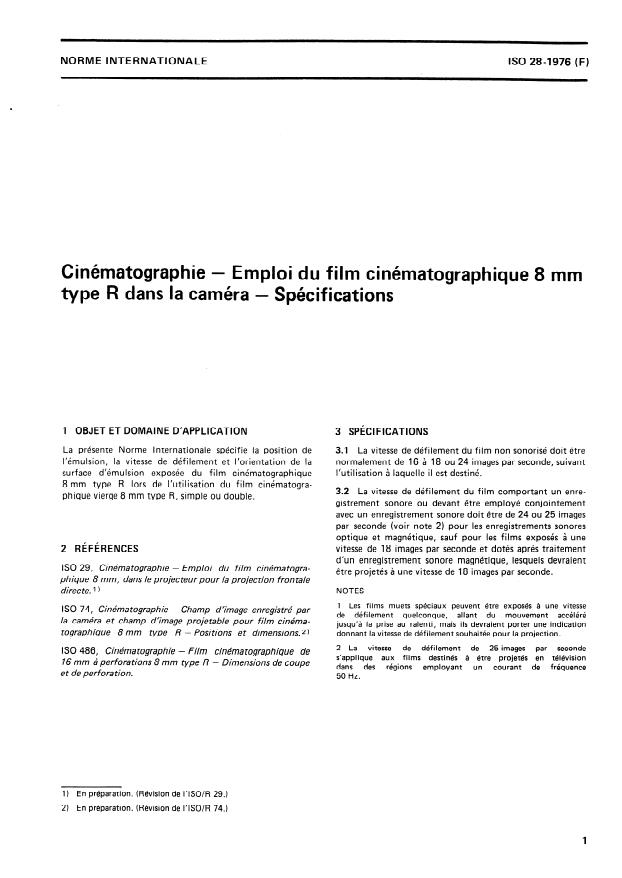

ISO 28:1976 - Cinématographie — Emploi du film cinématographique 8 mm type R dans la caméra — Spécifications Released:5/1/1976
Overview
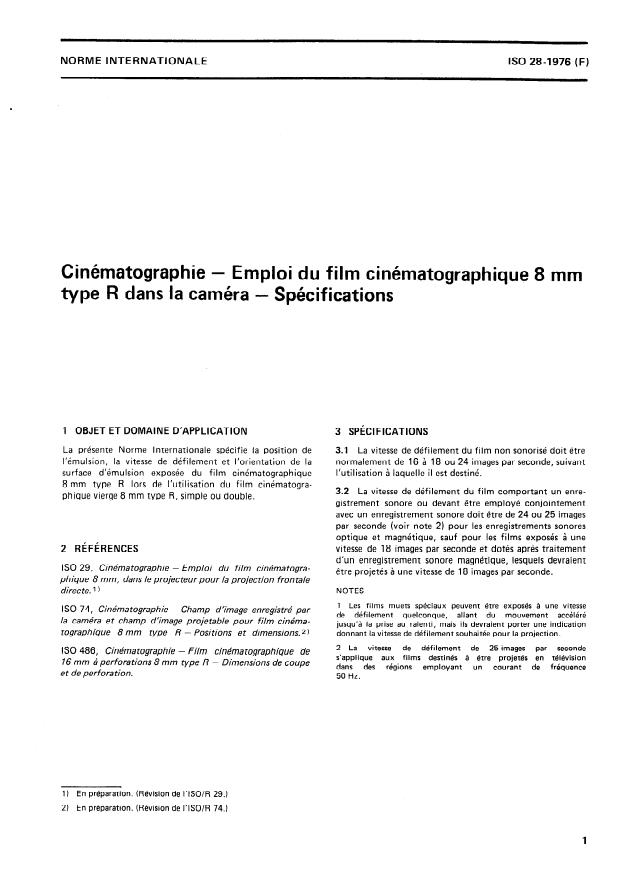
ISO 28:1976 - "Cinematography - Camera usage of 8 mm Type R motion‑picture film - Specifications" provides camera-side specifications for 8 mm Type R motion‑picture raw stock. Published in 1976 by ISO/TC 36 (Cinematography), this International Standard replaces ISO Recommendation R 28‑1956 and defines how 8 mm Type R film should be handled and exposed in motion‑picture cameras to ensure consistent image orientation, emulsion positioning and frame‑rate compatibility with projection and sound systems.
Key Topics and Technical Requirements
- Emulsion orientation and image area: Specifies the position of the emulsion and the photographic area to be exposed for both single and double 8 mm Type R raw stock; figures illustrate film as seen from inside the camera looking toward the lens.
- Frame rate (frames per second):
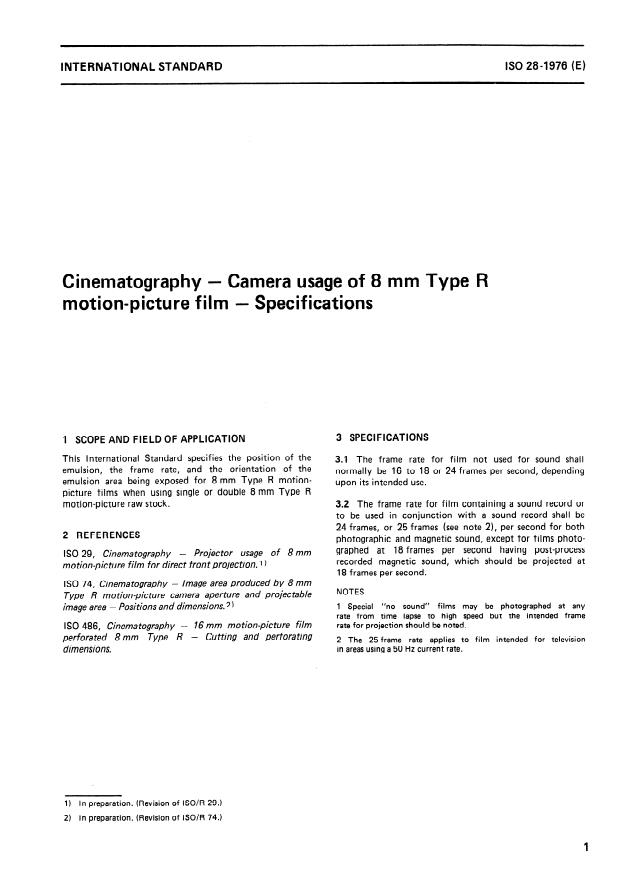
- For film not used for sound: normally 16–18 fps or 24 fps, depending on intended use.
- For film containing a sound record (photographic or magnetic): 24 fps, or 25 fps in regions using 50 Hz mains (television areas).
- Exception: films photographed at 18 fps with post‑process recorded magnetic sound should be projected at 18 fps.
- Note: special "no sound" films (e.g., time‑lapse or high‑speed) may be shot at other rates, but the intended projection rate should be recorded.
- Single vs. double 8 mm: Illustrative guidance for single and double 8 mm Type R formats, including direction of film travel and image‑forming side.
- Cross references: Points users to related standards such as ISO 29 (projector usage), ISO 74 (camera aperture and projectable image area), and ISO 486 (perforation/cutting for 8 mm).
Applications and Who Uses It
- Cinematographers and camera operators: for correct loading and framing of 8 mm Type R film in cameras.
- Camera and equipment manufacturers: to design camera transport, pressure plates, and guides compatible with ISO orientation and film travel.
- Post‑production and projection technicians: to match recorded frame rates and sound formats for accurate playback and synchronization.
- Archives, film labs and restorers: to document original shooting parameters and ensure faithful projection or transfer to digital formats.
- Broadcasters and transfer services: to select the correct target frame rate (24 vs 25 fps) when preparing film for television systems.
Related Standards
- ISO 29 - Projector usage of 8 mm motion‑picture film (in preparation/revision)
- ISO 74 - Image area produced by 8 mm Type R camera aperture and projectable image area (in preparation/revision)
- ISO 486 - 16 mm motion‑picture film perforations and cutting (relevant for related perforation specs)
This standard remains a practical reference for anyone working with 8 mm Type R motion‑picture film to ensure consistent exposure, orientation and frame‑rate compatibility across capture, sound recording and projection workflows.
Relations
- Consolidated By
ISO 12005:1999 - Lasers and laser-related equipment — Test methods for laser beam parameters — Polarization - Effective Date
- 06-Jun-2022
Buy Documents
ISO 28:1976 - Cinematography — Camera usage of 8 mm Type R motion-picture film — Specifications Released:5/1/1976
ISO 28:1976 - Cinématographie — Emploi du film cinématographique 8 mm type R dans la caméra — Spécifications Released:5/1/1976
ISO 28:1976 - Cinématographie — Emploi du film cinématographique 8 mm type R dans la caméra — Spécifications Released:5/1/1976
Frequently Asked Questions
ISO 28:1976 is a standard published by the International Organization for Standardization (ISO). Its full title is "Cinematography — Camera usage of 8 mm Type R motion-picture film — Specifications". This standard covers: Cinematography — Camera usage of 8 mm Type R motion-picture film — Specifications
Cinematography — Camera usage of 8 mm Type R motion-picture film — Specifications
ISO 28:1976 is classified under the following ICS (International Classification for Standards) categories: 37.060.10 - Motion picture equipment. The ICS classification helps identify the subject area and facilitates finding related standards.
ISO 28:1976 has the following relationships with other standards: It is inter standard links to ISO 12005:1999. Understanding these relationships helps ensure you are using the most current and applicable version of the standard.
ISO 28:1976 is available in PDF format for immediate download after purchase. The document can be added to your cart and obtained through the secure checkout process. Digital delivery ensures instant access to the complete standard document.
Standards Content (Sample)
INTERNATIONAL STANDARD
INTERNATIONAL ORGANIZATION FOR STANDARDIZATION .MEXAYHAPOAHAR OP~AHM3AUMSl l-IO CTAHAAPTW3AUWW~ORGANISATION INTERNATIONALE DE NORMALISATION
Cinematography - Camera usage of 8 mm Type R
motion-picture film - Specifications
Emploi du film cinkmatographique 8 mm type R dans Ia Camera -
Cinema tographie -
Spki fica tions
First edition - 1976-05-01
UDC 778.53 : 771.531.352 Ref. No. ISO 28-1976 (E)
Descriptors : cinematography, motion-picture film-8 mm, motion-picture cameras, specifications, utilization, orientation, exposure, rates
(per time).
Price based on 2 pages
ISO (the International Organization for Standardization) is a worldwide federation
of national Standards institutes (ISO Member Bodies). The work of developing
International Standards is carried out through ISO Technical Committees. Every
Member Body interested in a subject for which a Technical Committee has been set
up has the right to be represented on that Committee. International organizations,
governmental and non-governmental, in liaison with ISO, also take part in the work.
Draft International Standards adopted by the Technical Committees are circulated
to the Member Bodies for approval before their acceptance as International
Standards by the ISO Council.
International Standard ISO 28 was drawn up by Technical Committee ISO/TC 36,
Cinematography, and was circulated to the Member Bodies in March 1975.
lt has been approved by the Member Bodies of the following countries :
Australia India Spain
Austria Italy Sweden
Belgium Japan Switzerland
Canada Mexico Turkey
Czechoslovakia Netherlands United Kingdom
Denmark Romania U .S.A.
South Africa, Rep. of Yugoslavia
France
The Member Body of the following country expressed disapproval of the document
on technical grounds :
U.S.S.R.
This International Standard cancels and replaces ISO Recommendation R 28-1956.
0 International Organkation for Standardkation, 1976 l
Printed in Switzerland
INTER
...
NORME INTERNATIONALE
INTERNATIONAL ORGANIZATION FOR STANDARDIZATION l MEX!lYHAPOAHAR OPTAHM3ALlMR I-l0 CTAHAAPTM3ALIMM *ORGANISATION INTERNATIONALE DE NORMALISATION
Cinématographie -
Emploi du film cinématographique 8 mm
type R dans la caméra - Spécifications
Cïnema tograph y - Camera usage of 8 mm Type R motion-picture film - Specifications
Première édition - 1976-05-01
Réf. no : ISO 28-1976 (F)
CDU 778.53 : 771.531.352
utilisation, orientation, exposition, taux.
Descripteurs : cinématographie, film cinématographique 8 mm, caméra, spécification,
Prix basé sur 2 pages
AVANT-PROPOS
L’ISO (Organisation Internationale de Normalisation) est une fédération mondiale
d’organismes nationaux de normalisation (Comités Membres ISO). L’élaboration
des Normes Internationales est confiée aux Comités Techniques ISO. Chaque
Comité Membre intéressé par une étude a le droit de faire partie du Comité
Technique correspondant. Les organisations internationales, gouvernementales et
non gouvernementales, en liaison avec I’ISO, participent également aux travaux.
Les Projets de Normes Internationales adoptés par les Comités Techniques sont
soumis aux Comités Membres pour approbation, avant leur acceptation comme
Normes Internationales par le Conseil de I’ISO.
La Norme Internationale ISO 28 a été établie par le Comité Technique ISO/TC 36,
Cinématographie et a été soumise aux Comités Membres en mars 1975.
Elle a été approuvée par les Comités Membres des pays suivants :
Afrique du Sud, Rép. d’ France Royaume-Uni
Australie Inde Suède
Autriche Italie Suisse
Belgique Japon Tchécoslovaquie
Canada Mexique Turquie
Danemark Pays-Bas U.S.A.
Espagne Roumanie Yougoslavie
Le Comité Membre du suivant a désapprouvé le document pour des
Pays
raisons techniques :
U.R.S.S.
Internationale annule et remplace
Cette Norme la Recommandation
ISO/R 28-1956.
0 Organisation Internationale de Normalisation, 1976 l
Imprimé en Suisse
NORME INTERNATIONALE I-SO 28-1976 (F)
Cinématographie -
Emploi du film cinématographique 8 mm
type R dans la caméra - Spécifications
1 OBJET ET DOMAINE D’APPLICATION 3 SPÉCIFICATIONS
La présente Norme Internationale spécifie la position
...
NORME INTERNATIONALE
INTERNATIONAL ORGANIZATION FOR STANDARDIZATION l MEX!lYHAPOAHAR OPTAHM3ALlMR I-l0 CTAHAAPTM3ALIMM *ORGANISATION INTERNATIONALE DE NORMALISATION
Cinématographie -
Emploi du film cinématographique 8 mm
type R dans la caméra - Spécifications
Cïnema tograph y - Camera usage of 8 mm Type R motion-picture film - Specifications
Première édition - 1976-05-01
Réf. no : ISO 28-1976 (F)
CDU 778.53 : 771.531.352
utilisation, orientation, exposition, taux.
Descripteurs : cinématographie, film cinématographique 8 mm, caméra, spécification,
Prix basé sur 2 pages
AVANT-PROPOS
L’ISO (Organisation Internationale de Normalisation) est une fédération mondiale
d’organismes nationaux de normalisation (Comités Membres ISO). L’élaboration
des Normes Internationales est confiée aux Comités Techniques ISO. Chaque
Comité Membre intéressé par une étude a le droit de faire partie du Comité
Technique correspondant. Les organisations internationales, gouvernementales et
non gouvernementales, en liaison avec I’ISO, participent également aux travaux.
Les Projets de Normes Internationales adoptés par les Comités Techniques sont
soumis aux Comités Membres pour approbation, avant leur acceptation comme
Normes Internationales par le Conseil de I’ISO.
La Norme Internationale ISO 28 a été établie par le Comité Technique ISO/TC 36,
Cinématographie et a été soumise aux Comités Membres en mars 1975.
Elle a été approuvée par les Comités Membres des pays suivants :
Afrique du Sud, Rép. d’ France Royaume-Uni
Australie Inde Suède
Autriche Italie Suisse
Belgique Japon Tchécoslovaquie
Canada Mexique Turquie
Danemark Pays-Bas U.S.A.
Espagne Roumanie Yougoslavie
Le Comité Membre du suivant a désapprouvé le document pour des
Pays
raisons techniques :
U.R.S.S.
Internationale annule et remplace
Cette Norme la Recommandation
ISO/R 28-1956.
0 Organisation Internationale de Normalisation, 1976 l
Imprimé en Suisse
NORME INTERNATIONALE I-SO 28-1976 (F)
Cinématographie -
Emploi du film cinématographique 8 mm
type R dans la caméra - Spécifications
1 OBJET ET DOMAINE D’APPLICATION 3 SPÉCIFICATIONS
La présente Norme Internationale spécifie la position
...