

ISO 25:1994
(Main)Cinematography — Camera usage of 16 mm motion-picture film — Specifications
General Information
- Abstract
Specifies the position of the emulsion, the frame rate of exposure, and the orientation of the emulsion area being exposed for 16 mm silent and sound motion-picture film perforated along one or both edges.
- Status
- Published
- Publication Date
- 13-Jul-1994
- Technical Committee
- ISO/TC 36 - Cinematography
- Drafting Committee
- ISO/TC 36 - Cinematography
- Current Stage
- 9060 - Close of review
- Completion Date
- 04-Mar-2029
Overview
ISO 25:1994 - "Cinematography - Camera usage of 16 mm motion‑picture film - Specifications" is an international standard that defines essential camera‑side conventions for 16 mm motion‑picture film. It specifies the position and orientation of the emulsion, and the recommended frame rates of exposure for both silent and sound 16 mm film perforated along one or both edges. This second edition (1994) replaces the earlier edition and is aimed at ensuring compatibility between cameras, projection, and post‑production processes.
Key topics and technical requirements
- Scope: Applies to 16 mm silent and sound motion‑picture film perforated along one or both edges.
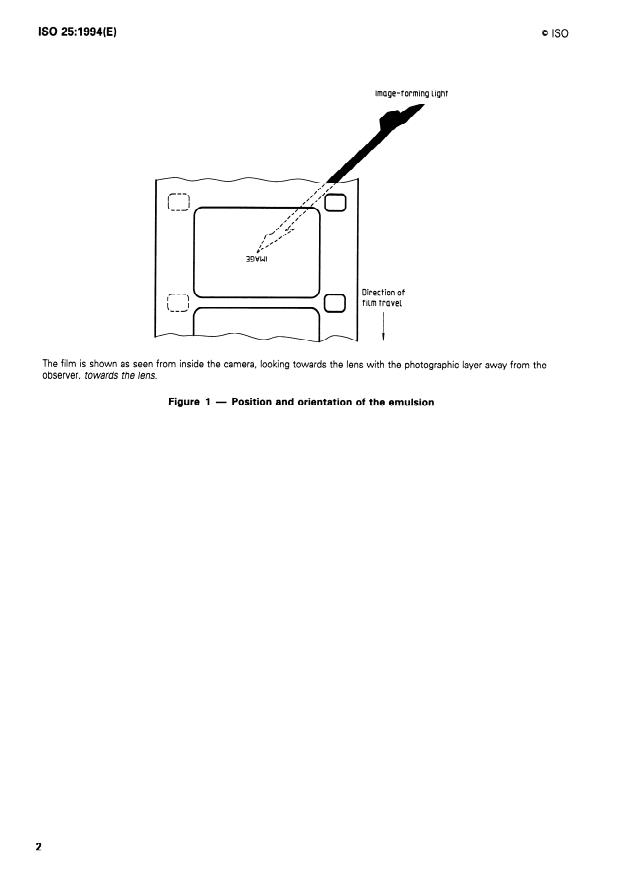
- Emulsion position and orientation: The standard prescribes how the emulsion area should be oriented in the camera (figure shows the film as seen from inside the camera, looking toward the lens, with the photographic layer away from the observer). Conformance ensures consistent image orientation and alignment.
- Frame rate (exposure speed):
- 24 frames per second (fps) is specified for film containing a sound record or used with a sound record (both photographic and magnetic sound).
- 18 fps may still be encountered for some silent films (historical practice).
- For non‑sound films, 24 fps is normally recommended but may vary depending on intended use.
- Special “no sound” films (time‑lapse, high‑speed) may be shot at any frame rate; the intended projection rate should be noted.
- Television‑targeted films may be shot at 25 fps (50 Hz systems) or 30 fps (60 Hz systems); 24 fps may also be used.
- Normative references: Cites related ISO standards that affect film cutting, perforating and projector usage.
Applications and who uses ISO 25:1994
- Cinematographers and camera operators using 16 mm film who need standardized guidance on film loading orientation and exposure speeds.
- Camera and equipment manufacturers designing 16 mm camera mechanisms and gate orientation.
- Film laboratories, post‑production facilities and archivists ensuring proper handling, projection and digitization of 16 mm material.
- Film restoration specialists and educators working with historical and contemporary 16 mm workflows.
- Standards committees and technical documentation authors referencing consistent camera usage practices.
Related standards
- ISO 26:1993 - Projector usage of 16 mm motion‑picture film (projector specifications)
- ISO 69:1990 - 16 mm film cutting and perforating
- ISO 466:1976 - Image produced by 16 mm camera aperture (position and dimensions)
Keywords: ISO 25:1994, 16 mm film, cinematography standard, emulsion orientation, frame rate, sound film, silent film, camera usage, film perforation.
Relations
- Effective Date
- 15-Apr-2008
Frequently Asked Questions
ISO 25:1994 is a standard published by the International Organization for Standardization (ISO). Its full title is "Cinematography — Camera usage of 16 mm motion-picture film — Specifications". This standard covers: Specifies the position of the emulsion, the frame rate of exposure, and the orientation of the emulsion area being exposed for 16 mm silent and sound motion-picture film perforated along one or both edges.
Specifies the position of the emulsion, the frame rate of exposure, and the orientation of the emulsion area being exposed for 16 mm silent and sound motion-picture film perforated along one or both edges.
ISO 25:1994 is classified under the following ICS (International Classification for Standards) categories: 37.060.10 - Motion picture equipment. The ICS classification helps identify the subject area and facilitates finding related standards.
ISO 25:1994 has the following relationships with other standards: It is inter standard links to ISO 25:1976. Understanding these relationships helps ensure you are using the most current and applicable version of the standard.
ISO 25:1994 is available in PDF format for immediate download after purchase. The document can be added to your cart and obtained through the secure checkout process. Digital delivery ensures instant access to the complete standard document.
Standards Content (Sample)
ISO
INTERNATIONAL
STANDARD
Second edition
1994-07-15
Cinematography - Camera usage of
16 mm motion-picture film -
Specifications
- Emploi du film cinematographique 16 mm dans Ia
Cindma tographie
Camera - Spkifica tions
Reference number
Foreword
ISO (the International Organization for Standardization) is a worldwide
federation of national Standards bodies (ISO member bodies). The work
of preparing International Standards is normally carried out through ISO
technical committees. Esch member body interested in a subject for
which a technical committee has been established has the right to be
represented on that committee. International organizations, governmental
and non-governmental, in liaison with ISO, also take part in the work. ISO
collaborates closely with the International Electrotechnical Commission
(IEC) on all matters sf electrotechnical standardization.
Draft International Standards adopted by the technical committees are
circulated to the member bodies for voting. Publication as an International
Standard requires approval by at least 75 % of the member bodies casting
a vote.
International Standard ISO 25 was prepared by Technical Committee
lSO/TC 36, Cinematography.
This second edition cancels and replaces the first edition (ISO 253 976),
of which it constitutes a technical revision.
0 ISO 1994
All rights reserved. Unless otherwise specified, no part of this publication may be reproduced
or utilized in any form or by any means, electronie or mechanical, including photocopying and
microfilm, without Permission in writing from the publisher.
International Organkation for Standardkation
Case Postale 56 l CH-l 211 Geneve 20 l Switzerland
Printed in Switzerland
INTERNATIONAL STANDARD 0 ISO
Cinematography - Camera usage of 16 mm
motion-picture film - Specifications
1 Scope 3 Specifications
This International Standard specifies the Position of
3.1 The frame rate of exposure for film containing
the emulsion, the frame rate of exposure, and the
a Sound record or to be used in conjunction with a
orientation of the emulsion area being exposed for
Sound record shall be 24 frames per second for both
16 mm silent and Sound motion-picture film perfor-
photographic and magnetic Sound.
ated along one or both edges.
NOTE 1 A frame rate of exposure of 18 frames per sec-
ond may still be found, especially for films without a Sound
record.
3.2 The frame rate of exposure for film not used for
2 Normative references
Sound shal
...