

ISO 2910:2018
(Main)Cinematography — Screen luminance and chrominance for the projection of film motion pictures
General Information
- Abstract
ISO 2910:2018 specifies the screen luminance level and chrominance white point for theatrical projection of 70 mm, 35 mm and 16 mm motion-picture prints at a rate of 24 frames per second. ISO 2910:2018 can also be applicable to the non-theatrical presentation of 70 mm, 35 mm and 16 mm motion-picture prints intended for projection at 24 frames per second. NOTE Throughout this document, the term "screen" means the screen-picture area appropriate to the film format and projection system in use.
- Status
- Published
- Publication Date
- 08-Feb-2018
- Technical Committee
- ISO/TC 36 - Cinematography
- Drafting Committee
- ISO/TC 36 - Cinematography
- Current Stage
- 9093 - International Standard confirmed
- Start Date
- 10-Jul-2023
- Completion Date
- 29-Aug-2026
Buy Documents

ISO 2910:2018 - Cinematography -- Screen luminance and chrominance for the projection of film motion pictures
ISO 2910:2018 - Cinematography — Screen luminance and chrominance for the projection of film motion pictures/9/2018
Overview
ISO 2910:2018 - "Cinematography - Screen luminance and chrominance for the projection of film motion pictures" specifies required screen light levels and white-point chrominance for the theatrical (and applicable non‑theatrical) projection of 70 mm, 35 mm and 16 mm film at 24 frames per second. The standard defines how to measure screen luminance and chrominance, reference values, acceptable tolerances and recommended distributions to ensure consistent visual reproduction in cinemas, review rooms and presentation venues.
Key topics and technical requirements
- Scope and operating conditions
- Applies to 70 mm, 35 mm and 16 mm film projected at 24 fps; measurements taken with the projector running and no film in the gate.
- Reference luminance
- Screen centre reference luminance: 55 cd/m² for all formats.
- Recommended acceptable indoor range: 35–65 cd/m² (non‑theatrical lower limit may be 25 cd/m²).
- Luminance distribution and tolerances
- Edge luminance measured at 10% of screen width should be 50%–85% of centre (recommended 75%).
- Evenness should be symmetrical and checked from seating extremes, especially for high‑gain screens.
- Multiple-projector luminance match: same-format projectors ≤ 7 cd/m² difference; different-format sequential projectors ≤ 14 cd/m² difference.
- Chrominance (white point)
- Reference correlated colour temperature: 5800 K with an acceptable single-projector tolerance of ±400 K.
- Two-projector chrominance match should not differ by more than 400 K.
- Measurement instruments
- Luminance: photometer with acceptance angle ≤ 2° (recommended 1.5°), spectral sensitivity of the CIE Standard Observer.
- Chrominance: colour‑temperature meter or spot spectroradiometer with acceptance angle ≤ 2°.
- Measurement positions
- Primary measurement: ~1 m above floor on the theatre longitudinal axis at two‑thirds of the distance from screen to back row; additional checks at two positions one‑third of theatre width to each side.
- Stray light limits
- No visible stray source with luminance > 3.5 cd/m² from standard observing area.
- Stray light on screen: review rooms ≤ 0.4% of projector luminance; theatres ≤ 1.0%.
Applications and who uses it
- Cinema operators, projectionists and facilities managers - to set and verify projector output and screen performance for compliant theatrical presentation.
- Post‑production, mastering and QC teams - to validate reference viewing conditions in review rooms.
- Equipment manufacturers and calibrators - to design and certify projectors, photometers and spectroradiometers for film projection.
- Venue planners and acoustical/lighting consultants - to specify screening room lighting and stray‑light control.
Related standards
- CIE publications on colorimetry (referenced: CIE 15:2004) and other ISO/IEC color and measurement guidance.
- Developed by ISO/TC 36 (Cinematography); consult ISO 2910:2018 for full normative text and Annex A recommended distributions and tolerances.
Keywords: ISO 2910:2018, screen luminance, chrominance, 55 cd/m², 5800 K, theatrical projection, 35 mm, 70 mm, 16 mm, 24 fps, photometer, spectroradiometer.
Relations
- Effective Date
- 02-Sep-2017
Buy Documents
ISO 2910:2018 - Cinematography -- Screen luminance and chrominance for the projection of film motion pictures
ISO 2910:2018 - Cinematography — Screen luminance and chrominance for the projection of film motion pictures/9/2018
Frequently Asked Questions
ISO 2910:2018 is a standard published by the International Organization for Standardization (ISO). Its full title is "Cinematography — Screen luminance and chrominance for the projection of film motion pictures". This standard covers: ISO 2910:2018 specifies the screen luminance level and chrominance white point for theatrical projection of 70 mm, 35 mm and 16 mm motion-picture prints at a rate of 24 frames per second. ISO 2910:2018 can also be applicable to the non-theatrical presentation of 70 mm, 35 mm and 16 mm motion-picture prints intended for projection at 24 frames per second. NOTE Throughout this document, the term "screen" means the screen-picture area appropriate to the film format and projection system in use.
ISO 2910:2018 specifies the screen luminance level and chrominance white point for theatrical projection of 70 mm, 35 mm and 16 mm motion-picture prints at a rate of 24 frames per second. ISO 2910:2018 can also be applicable to the non-theatrical presentation of 70 mm, 35 mm and 16 mm motion-picture prints intended for projection at 24 frames per second. NOTE Throughout this document, the term "screen" means the screen-picture area appropriate to the film format and projection system in use.
ISO 2910:2018 is classified under the following ICS (International Classification for Standards) categories: 37.060.10 - Motion picture equipment. The ICS classification helps identify the subject area and facilitates finding related standards.
ISO 2910:2018 has the following relationships with other standards: It is inter standard links to ISO 2910:2007. Understanding these relationships helps ensure you are using the most current and applicable version of the standard.
ISO 2910:2018 is available in PDF format for immediate download after purchase. The document can be added to your cart and obtained through the secure checkout process. Digital delivery ensures instant access to the complete standard document.
Standards Content (Sample)
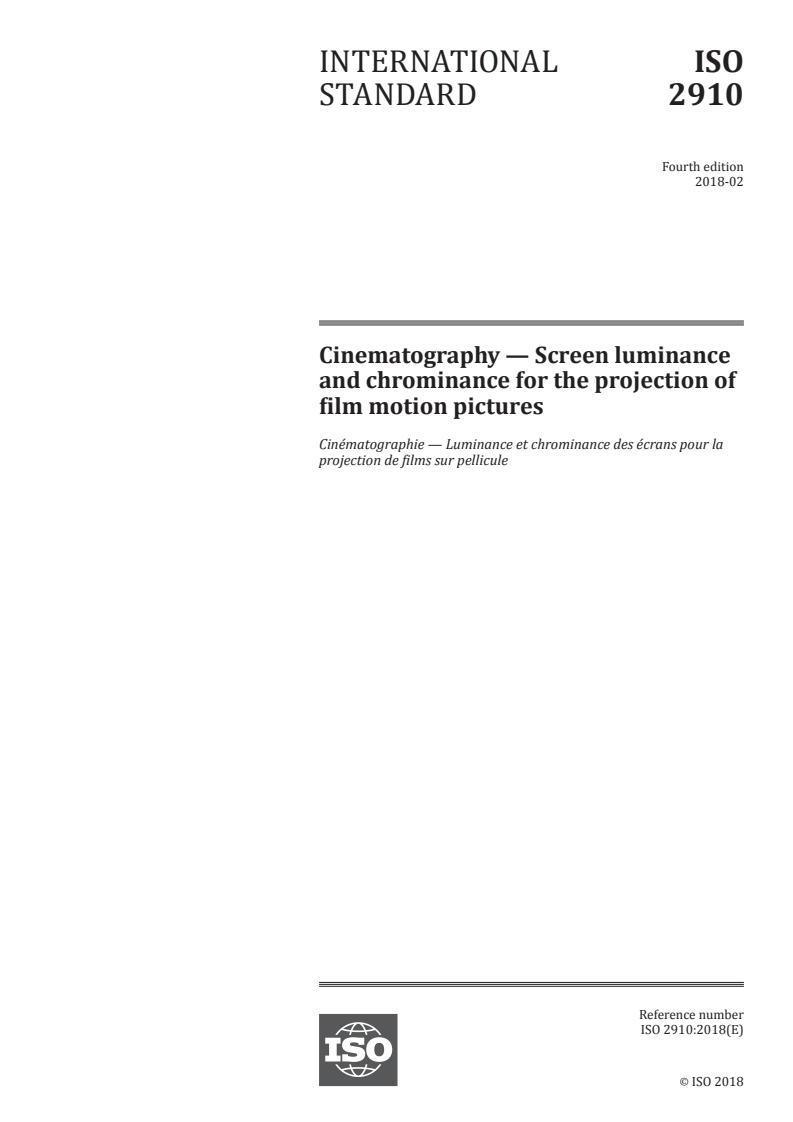
INTERNATIONAL ISO
STANDARD 2910
Fourth edition
2018-02
Cinematography — Screen luminance
and chrominance for the projection of
film motion pictures
Cinématographie — Luminance et chrominance des écrans pour la
projection de films sur pellicule
Reference number
©
ISO 2018
© ISO 2018
All rights reserved. Unless otherwise specified, or required in the context of its implementation, no part of this publication may
be reproduced or utilized otherwise in any form or by any means, electronic or mechanical, including photocopying, or posting
on the internet or an intranet, without prior written permission. Permission can be requested from either ISO at the address
below or ISO’s member body in the country of the requester.
ISO copyright office
CP 401 • Ch. de Blandonnet 8
CH-1214 Vernier, Geneva, Switzerland
Tel. +41 22 749 01 11
Fax +41 22 749 09 47
copyright@iso.org
www.iso.org
Published in Switzerland
ii © ISO 2018 – All rights reserved
Contents Page
Foreword .iv
1 Scope . 1
2 Normative references . 1
3 Terms and definitions . 1
4 Measurement method . 1
4.1 Operating conditions . 1
4.2 Luminance measuring device. 1
4.3 Chrominance measuring device . 1
4.4 Position of measuring device in theatres . 2
5 Luminance level of screen centre . 2
6 Chrominance . 2
Annex A (informative) Recommended distributions, limits and tolerances for
luminanceand chrominance . 3
Bibliography . 5
Foreword
ISO (the International Organization for Standardization) is a worldwide federation of national standards
bodies (ISO member bodies). The work of preparing International Standards is normally carried out
through ISO technical committees. Each member body interested in a subject for which a technical
committee has been established has the right to be represented on that committee. International
organizations, governmental and non-governmental, in liaison with ISO, also take part in the work.
ISO collaborates closely with the International Electrotechnical Commission (IEC) on all matters of
electrotechnical standardization.
The procedures used to develop this document and those intended for its further maintenance are
described in the ISO/IEC Directives, Part 1. In particular the different approval criteria needed for the
different types of ISO documents should be noted. This document was drafted in accordance with the
editorial rules of the ISO/IEC Directives, Part 2 (see www .iso .org/ directives).
Attention is drawn to the possibility that some of the elements of this document may be the subject of
patent rights. ISO shall not be held responsible for identifying any or all such patent rights. Details of
any patent rights identified during the development of the document will be in the Introduction and/or
on the ISO list of patent declarations received (see www .iso .org/ patents).
Any trade name used in this document is information given for the convenience of users and does not
constitute an endorsement.
For an explanation on the voluntary nature of standards, the meaning of ISO specific terms and
expressions related to conformity assessment, as well as information about ISO's adherence to the
World Trade Organization (WTO) principles in the Technical Barriers to Trade (TBT) see the following
URL: www .iso .org/ iso/ foreword .html.
This document was prepared by Technical Committee ISO/TC 36, Cinematography.
This fourth edition is a minor revision and the title changed to include the word film.
iv © ISO 2018 – All rights reserved
INTERNATIONAL STANDARD ISO 2910:2018(E)
Cinematography — Screen luminance and chrominance for
the projection of film motion pictures
1 Scope
This document specifies the screen luminance level and chrominance white point for theatrical
projection of 70 mm, 35 mm and 16 mm motion-picture prints at a rate of 24 frames per second.
It can also be applicable to the non-theatrical presentation of 70 mm, 35 mm and 16 mm motion-picture
prints intended for projection at 24 frames per second.
NOTE Throughout this document, the term “screen” means the screen-picture area appropriate to the film
format and projection system in use.
2 Normative references
There are no normative references in this document.
3 Terms and definitions
No terms and definitions are listed in th
...
INTERNATIONAL ISO
STANDARD 2910
Fourth edition
2018-02
Cinematography — Screen luminance
and chrominance for the projection of
film motion pictures
Cinématographie — Luminance et chrominance des écrans pour la
projection de films sur pellicule
Reference number
©
ISO 2018
© ISO 2018
All rights reserved. Unless otherwise specified, or required in the context of its implementation, no part of this publication may
be reproduced or utilized otherwise in any form or by any means, electronic or mechanical, including photocopying, or posting
on the internet or an intranet, without prior written permission. Permission can be requested from either ISO at the address
below or ISO’s member body in the country of the requester.
ISO copyright office
CP 401 • Ch. de Blandonnet 8
CH-1214 Vernier, Geneva, Switzerland
Tel. +41 22 749 01 11
Fax +41 22 749 09 47
copyright@iso.org
www.iso.org
Published in Switzerland
ii © ISO 2018 – All rights reserved
Contents Page
Foreword .iv
1 Scope . 1
2 Normative references . 1
3 Terms and definitions . 1
4 Measurement method . 1
4.1 Operating conditions . 1
4.2 Luminance measuring device. 1
4.3 Chrominance measuring device . 1
4.4 Position of measuring device in theatres . 2
5 Luminance level of screen centre . 2
6 Chrominance . 2
Annex A (informative) Recommended distributions, limits and tolerances for
luminanceand chrominance . 3
Bibliography . 5
Foreword
ISO (the International Organization for Standardization) is a worldwide federation of national standards
bodies (ISO member bodies). The work of preparing International Standards is normally carried out
through ISO technical committees. Each member body interested in a subject for which a technical
committee has been established has the right to be represented on that committee. International
organizations, governmental and non-governmental, in liaison with ISO, also take part in the work.
ISO collaborates closely with the International Electrotechnical Commission (IEC) on all matters of
electrotechnical standardization.
The procedures used to develop this document and those intended for its further maintenance are
described in the ISO/IEC Directives, Part 1. In particular the different approval criteria needed for the
different types of ISO documents should be noted. This document was drafted in accordance with the
editorial rules of the ISO/IEC Directives, Part 2 (see www .iso .org/ directives).
Attention is drawn to the possibility that some of the elements of this document may be the subject of
patent rights. ISO shall not be held responsible for identifying any or all such patent rights. Details of
any patent rights identified during the development of the document will be in the Introduction and/or
on the ISO list of patent declarations received (see www .iso .org/ patents).
Any trade name used in this document is information given for the convenience of users and does not
constitute an endorsement.
For an explanation on the voluntary nature of standards, the meaning of ISO specific terms and
expressions related to conformity assessment, as well as information about ISO's adherence to the
World Trade Organization (WTO) principles in the Technical Barriers to Trade (TBT) see the following
URL: www .iso .org/ iso/ foreword .html.
This document was prepared by Technical Committee ISO/TC 36, Cinematography.
This fourth edition is a minor revision and the title changed to include the word film.
iv © ISO 2018 – All rights reserved
INTERNATIONAL STANDARD ISO 2910:2018(E)
Cinematography — Screen luminance and chrominance for
the projection of film motion pictures
1 Scope
This document specifies the screen luminance level and chrominance white point for theatrical
projection of 70 mm, 35 mm and 16 mm motion-picture prints at a rate of 24 frames per second.
It can also be applicable to the non-theatrical presentation of 70 mm, 35 mm and 16 mm motion-picture
prints intended for projection at 24 frames per second.
NOTE Throughout this document, the term “screen” means the screen-picture area appropriate to the film
format and projection system in use.
2 Normative references
There are no normative references in this document.
3 Terms and definitions
No terms and definitions are listed in th
...