

ISO 23:1993
(Main)Cinematography — Camera usage of 35 mm motion-picture film — Specifications
General Information
- Abstract
Specifies the location of the photographic emulsion, the orientation of the areas intended for the picture and photographic sound exposures and the frame rate for 35 mm motion-picture film cameras.
- Status
- Published
- Publication Date
- 07-Jul-1993
- Technical Committee
- ISO/TC 36 - Cinematography
- Drafting Committee
- ISO/TC 36 - Cinematography
- Current Stage
- 9060 - Close of review
- Completion Date
- 04-Mar-2031
Buy Documents
ISO 23:1993 - Cinematography — Camera usage of 35 mm motion-picture film — Specifications Released:7/8/1993
ISO 23:1993 - Cinématographie — Position du film cinématographique de 35 mm dans le couloir de la caméra — Spécifications Released:7/8/1993
ISO 23:1993 - Cinématographie — Position du film cinématographique de 35 mm dans le couloir de la caméra — Spécifications Released:7/8/1993
Overview
ISO 23:1993, titled "Cinematography - Camera usage of 35 mm motion-picture film - Specifications", is an international standard published by the International Organization for Standardization (ISO). It establishes essential specifications for the proper handling and positioning of 35 mm motion-picture film within cinematographic cameras. This standard addresses critical aspects such as the location of the photographic emulsion, the orientation of image and sound exposure areas, and the standardized frame rates for filming. It aims to ensure consistency and compatibility across motion-picture production and projection processes, reinforcing the quality and interoperability of 35 mm film usage in the cinema industry.
Key Topics
Photographic Emulsion Positioning
ISO 23 specifies that the photographic emulsion on 35 mm film must be positioned towards the camera lens under normal conditions. This placement ensures optimal image capture quality.Orientation of Picture and Sound Exposure Areas
The standard defines how picture areas and photographic sound tracks are oriented on the film. This orientation facilitates efficient film printing and projection processes, making certain that image and sound align correctly.Frame Rate Specifications
The recommended frame rate is 24 frames per second for general filming. Exceptions exist for special processes such as high-speed, slow-motion, or miniature-scale cinematography. Additionally, for television broadcasting, frame rates of 25 or 30 frames per second may be used, depending on regional television systems.Lateral Offset for Sound Recording
ISO 23 references ISO 2906 regarding the lateral offset between the picture image and the film centerline. This offset allows for space to accommodate the photographic sound record during film printing, crucial for synchronized sound reproduction in motion pictures.Scope and Normative References
The standard applies to typical filming scenarios using 35 mm motion-picture cameras, except for special cases explicitly noted. It also cites ISO 2906 as an essential normative reference, tying together image area production standards for comprehensive guidance.
Applications
ISO 23:1993 is vital for professionals and organizations involved in:
Film Production
Camera manufacturers and cinematographers utilize this standard to align film placement and exposure techniques with industry norms, ensuring reliable image capture and sound synchronization.Post-Production and Printing
Film processing labs and post-production houses depend on adherence to positioning and frame rate provisions to facilitate accurate printing, editing, and sound integration.Broadcasting
Television broadcasters employing 35 mm film for content distribution refer to this standard when adapting frame rates for regional broadcast standards, maintaining video quality and compatibility.Standardization in Cinematography Equipment
Equipment manufacturers build 35 mm motion-picture cameras in compliance with ISO 23 to guarantee that their products meet internationally recognized cinematography specifications.
Related Standards
ISO 23:1993 complements and references other important standards in the cinematography domain, including:
ISO 2906:1984 – Cinematography: Image area produced by the camera aperture on 35 mm motion-picture film – Position and dimensions
Details dimensions and positioning critical for aligning image areas with the film’s physical characteristics.ISO 491:1988 – Cinematography: 35 mm motion-picture film and magnetic film – Cutting and perforating dimensions
Specifies the cutting and perforating dimensions required for 35 mm film handling and processing.ISO 2939:1986 – Cinematography: Picture image area and photographic sound record on 35 mm motion-picture release prints – Position and dimensions
Expands on the precise placement of picture and sound tracks on release prints for optimal reproduction.
These related standards ensure a cohesive framework for 35 mm cinematography, supporting consistent film usage, quality control, and interoperability across the motion-picture industry.
By adhering to ISO 23:1993 and its related standards, cinematography professionals can maintain high-quality, industry-standard film handling practices that support the seamless creation and distribution of motion-picture content. This standard remains critical for anyone working with 35 mm film technology in contemporary film and television production workflows.
Relations
- Effective Date
- 15-Apr-2008
Buy Documents
ISO 23:1993 - Cinematography — Camera usage of 35 mm motion-picture film — Specifications Released:7/8/1993
ISO 23:1993 - Cinématographie — Position du film cinématographique de 35 mm dans le couloir de la caméra — Spécifications Released:7/8/1993
ISO 23:1993 - Cinématographie — Position du film cinématographique de 35 mm dans le couloir de la caméra — Spécifications Released:7/8/1993
Frequently Asked Questions
ISO 23:1993 is a standard published by the International Organization for Standardization (ISO). Its full title is "Cinematography — Camera usage of 35 mm motion-picture film — Specifications". This standard covers: Specifies the location of the photographic emulsion, the orientation of the areas intended for the picture and photographic sound exposures and the frame rate for 35 mm motion-picture film cameras.
Specifies the location of the photographic emulsion, the orientation of the areas intended for the picture and photographic sound exposures and the frame rate for 35 mm motion-picture film cameras.
ISO 23:1993 is classified under the following ICS (International Classification for Standards) categories: 37.060.10 - Motion picture equipment. The ICS classification helps identify the subject area and facilitates finding related standards.
ISO 23:1993 has the following relationships with other standards: It is inter standard links to ISO 23:1976. Understanding these relationships helps ensure you are using the most current and applicable version of the standard.
ISO 23:1993 is available in PDF format for immediate download after purchase. The document can be added to your cart and obtained through the secure checkout process. Digital delivery ensures instant access to the complete standard document.
Standards Content (Sample)
INTERNATIONAL ISO
STANDARD 23
Second edition
1993-07-15
Cinematography - Camera usage of
35 mm motion-picture film -
Specifications
Cinema tographie - Position du film cinematographique de 35 mm dans
Ie couloir de Ia Camera - Spkcifications
Reference number
ISO 237 993(E)
Foreword
ISO (the International Organization for Standardization) is a worldwide
federation of national Standards bodies (ISO member bodies). The work
of preparing International Standards is normally carried out through ISO
technical committees. Esch member body interested in a subject for
which a technical committee has been established has the right to be
represented on that committee. International organizations, governmental
and non-governmental, in liaison with ISO, also take part in the work. ISO
collaborates closely with the International Electrotechnical Commission
(IEC) on all matters of electrotechnical standardization.
Draft International Standards adopted by the technical committees are
circulated to the member bodies for voting. Publication as an International
Standard requires approval by at least 75 % of the member bodies casting
a vote.
International Standard ISO 23 was prepared by Technical Committee
I SO/TC 36, Cinema tography.
This second edition cancels and replaces the first edition (ISO 23:1976),
of which it constitutes a technical revision.
Annex A of this International Standard is for information only.
0 ISO 1993
All rights reserved. No part of this publication may be reproduced or utilized in any form or
by any means, eiectronic or mechanical, including photocopying and microfilm, without per-
mission in writing from the publisher.
International Organization for Standardization
Case Postale 56 l CH-l 211 Geneve 20 l Switzerland
Printed in Switzerland
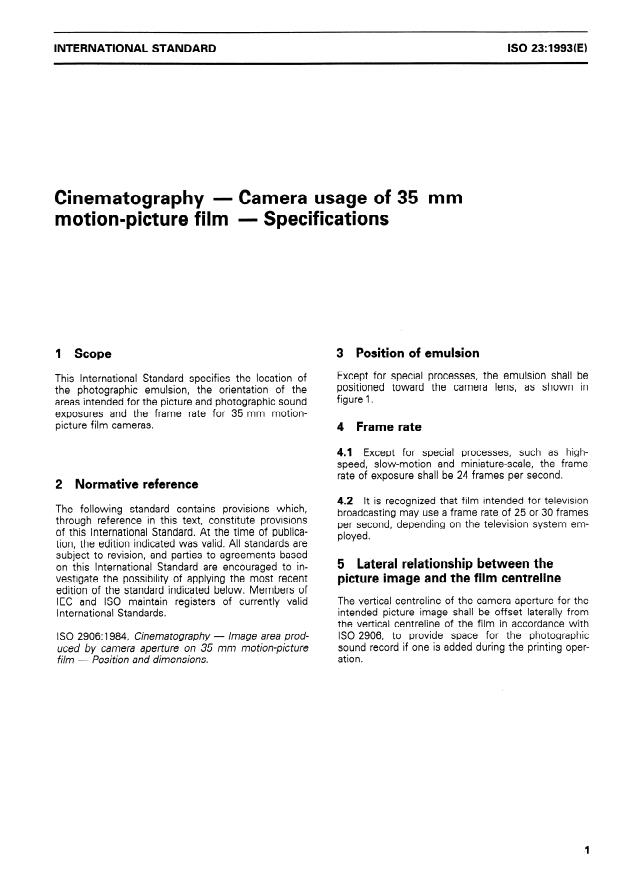
INTERNATIONAL STANDARD ISO 23:1993(E)
Cinematography - Camera usage of 35 mm
motion-picture film - Specifications
1 Scope 3 Position of emulsion
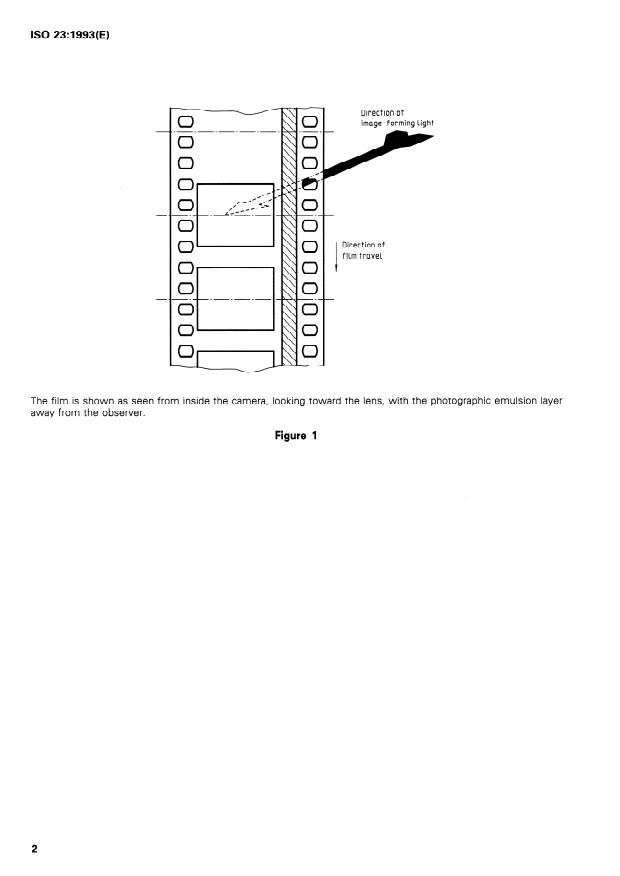
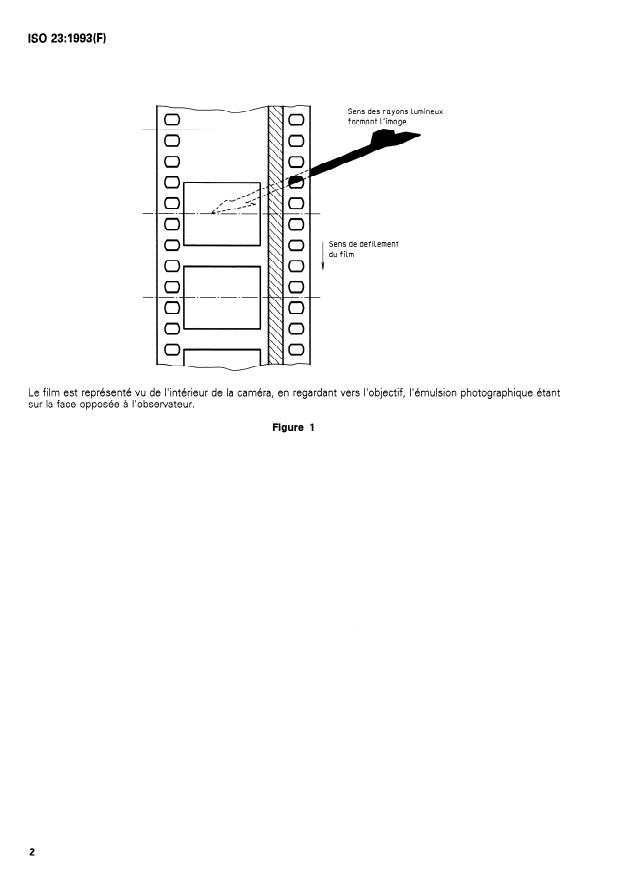
Except for special processes, the emulsion shall be
This International Standard specifies the location of
positioned toward the Camera lens, as shown in
the photographic emulsion, the orientation of the
figure 1.
areas intended for the picture and photographic Sound
exposures and the frame rate for 35 mm motion-
picture film cameras.
4 Frame rate
4.1 Except for special processes, su
...
NORME
ISO
INTERNATIONALE
Deuxième édition
1993-07-15
Cinématographie - Position du film
cinématographique de 35 mm dans le
couloir de la caméra - Spécifications
Cinema tograph y - Camera usage of 35 mm motion-picture film -
Specifica tions
Numéro de référence
Avant-propos
L’ISO (Organisation internationale de normalisation) est une fédération
mondiale d’organismes nationaux de normalisation (comités membres de
I’ISO). L’élaboration des Normes internationales est en général confiée aux
comités techniques de I’ISO. Chaque comite membre intéressé par une
étude a le droit de faire partie du comité technique créé a cet effet. Les
organisations internationales, gouvernementales et non gouvernemen-
tales, en liaison avec I’ISO participent également aux travaux. L’ISO colla-
bore étroitement avec la Commission électrotechnique internationale (CEI)
en ce qui concerne la normalisation électrotechnique.
Les projets de Normes internationales adoptés par les comités techniques
sont soumis aux comités membres pour vote. Leur publication comme
Normes internationales requiert l’approbation de 75 % au moins des co-
mités membres votants.
La Norme internationale ISO 23 a ete élaboree par le comite technique
I SO/TC 36, Cinématographie.
Cette deuxieme édition annule et remplace la première édition
(ISO 23:1976), d on t e II e constitue une révision technique.
L’annexe A de la présente Norme internationale est donnée uniquement
a titre d’information.
0 ISO 1993
Droits de reproduction réservés. Aucune partie de cette publication ne peut être reproduite
ni utilisée sous quelque forme que ce soit et par aucun procédé, électronique ou mécanique,
y compris la photocopie et les microfilms, sans l’accord écrit de l’éditeur.
Organisation internationale de normalisation
Case Postale 56 l CH-121 1 Geneve 20 l Su isse
Imprimé en Suisse
ii
NORME INTERNATIONALE
Cinématographie - Position du film
inématographique de 35 mm dans le couloir de la
- Spécifications
caméra
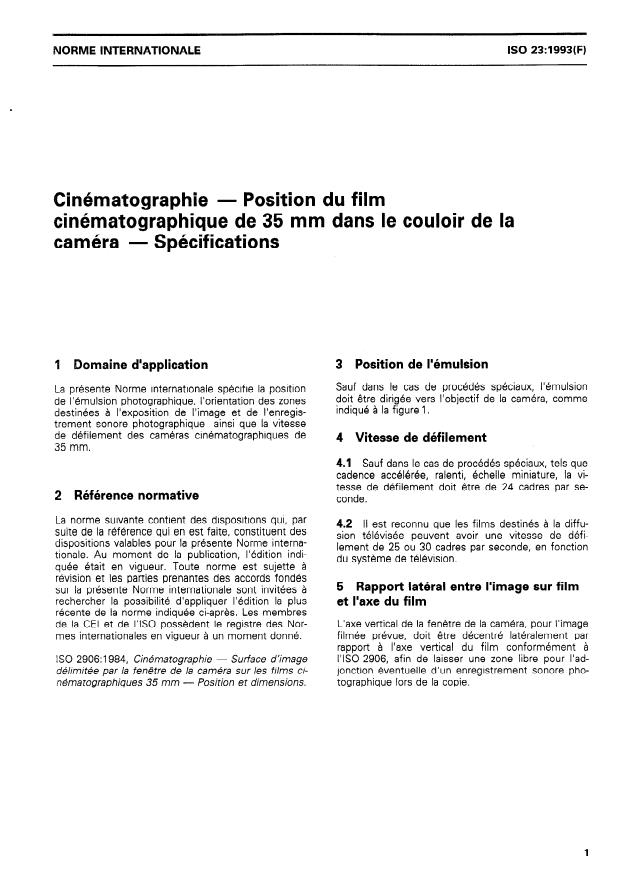
1 omaine d’application 3 Position de l’émulsion
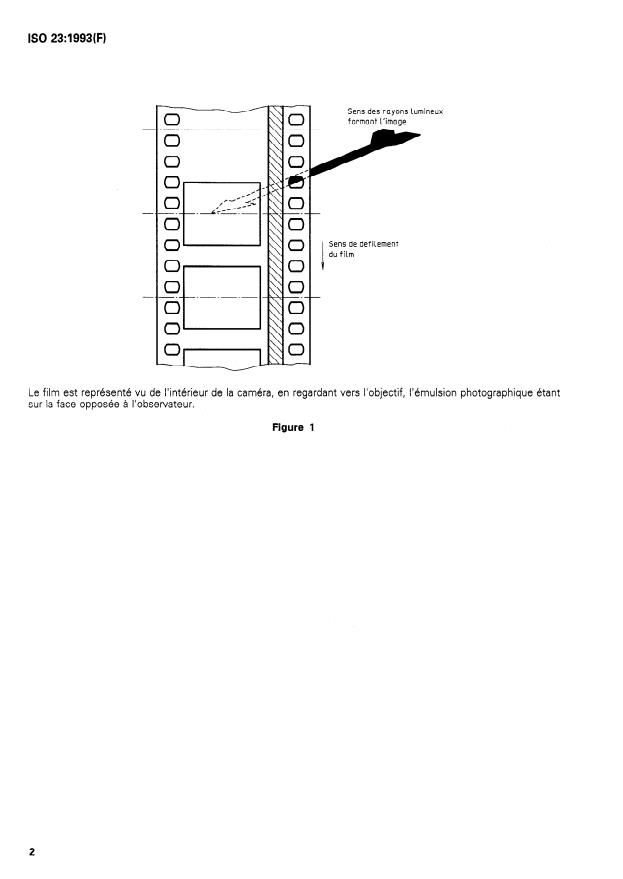
Sauf dans le cas de procédés spéciaux, I’emulsion
La présente Norme internationale spécifie la position
doit être dirigée vers l’objectif de la caméra, comme
de l’émulsion photographique, l’orientation des zones
indiqué à la figure 1.
destinées à l’exposition de l’image et de I’enregis-
trement sonore photographique ainsi que la vitesse
de défilement des cameras cinématographiques de
4 Vitesse de défilement
35 mm.
...
NORME
ISO
INTERNATIONALE
Deuxième édition
1993-07-15
Cinématographie - Position du film
cinématographique de 35 mm dans le
couloir de la caméra - Spécifications
Cinema tograph y - Camera usage of 35 mm motion-picture film -
Specifica tions
Numéro de référence
Avant-propos
L’ISO (Organisation internationale de normalisation) est une fédération
mondiale d’organismes nationaux de normalisation (comités membres de
I’ISO). L’élaboration des Normes internationales est en général confiée aux
comités techniques de I’ISO. Chaque comite membre intéressé par une
étude a le droit de faire partie du comité technique créé a cet effet. Les
organisations internationales, gouvernementales et non gouvernemen-
tales, en liaison avec I’ISO participent également aux travaux. L’ISO colla-
bore étroitement avec la Commission électrotechnique internationale (CEI)
en ce qui concerne la normalisation électrotechnique.
Les projets de Normes internationales adoptés par les comités techniques
sont soumis aux comités membres pour vote. Leur publication comme
Normes internationales requiert l’approbation de 75 % au moins des co-
mités membres votants.
La Norme internationale ISO 23 a ete élaboree par le comite technique
I SO/TC 36, Cinématographie.
Cette deuxieme édition annule et remplace la première édition
(ISO 23:1976), d on t e II e constitue une révision technique.
L’annexe A de la présente Norme internationale est donnée uniquement
a titre d’information.
0 ISO 1993
Droits de reproduction réservés. Aucune partie de cette publication ne peut être reproduite
ni utilisée sous quelque forme que ce soit et par aucun procédé, électronique ou mécanique,
y compris la photocopie et les microfilms, sans l’accord écrit de l’éditeur.
Organisation internationale de normalisation
Case Postale 56 l CH-121 1 Geneve 20 l Su isse
Imprimé en Suisse
ii
NORME INTERNATIONALE
Cinématographie - Position du film
inématographique de 35 mm dans le couloir de la
- Spécifications
caméra
1 omaine d’application 3 Position de l’émulsion
Sauf dans le cas de procédés spéciaux, I’emulsion
La présente Norme internationale spécifie la position
doit être dirigée vers l’objectif de la caméra, comme
de l’émulsion photographique, l’orientation des zones
indiqué à la figure 1.
destinées à l’exposition de l’image et de I’enregis-
trement sonore photographique ainsi que la vitesse
de défilement des cameras cinématographiques de
4 Vitesse de défilement
35 mm.
...