


ISO 15371:2009
(Main)Ships and marine technology — Fire-extinguishing systems for protection of galley cooking equipment
Ships and marine technology — Fire-extinguishing systems for protection of galley cooking equipment
ISO 15371:2009 applies to the design, testing, and operation of pre-engineered fire extinguishing systems to protect the galley hoods, ducts, fryers and other grease laden appliances. Pre-engineered fire-extinguishing system units are also required to comply with requirements for the construction and components performance as applicable to specific types, designs, sizes and arrangements. ISO 15371:2009 also provides minimum requirements for the testing and evaluation of components. A product that contains features, characteristics, components, materials or systems that are new or different from those covered by the requirements in ISO 15371:2009 and that involve a risk of fire, electric shock, or injury to persons, shall be evaluated using the appropriate additional component and end-product testing.
Navires et technologie maritime — Systèmes d'extinction d'incendie des équipements de cuisine
General Information
- Status
- Withdrawn
- Publication Date
- 10-Mar-2009
- Withdrawal Date
- 10-Mar-2009
- Technical Committee
- ISO/TC 8/SC 1 - Maritime safety
- Drafting Committee
- ISO/TC 8/SC 1/WG 3 - Fire protection
- Current Stage
- 9599 - Withdrawal of International Standard
- Start Date
- 16-Nov-2015
- Completion Date
- 12-Feb-2026
Relations
- Effective Date
- 05-Nov-2015
- Effective Date
- 15-Apr-2008
Get Certified
Connect with accredited certification bodies for this standard

DNV
DNV is an independent assurance and risk management provider.

Lloyd's Register
Lloyd's Register is a global professional services organisation specialising in engineering and technology.

ABS Quality Evaluations Inc.
American Bureau of Shipping quality certification.
Sponsored listings
Frequently Asked Questions
ISO 15371:2009 is a standard published by the International Organization for Standardization (ISO). Its full title is "Ships and marine technology — Fire-extinguishing systems for protection of galley cooking equipment". This standard covers: ISO 15371:2009 applies to the design, testing, and operation of pre-engineered fire extinguishing systems to protect the galley hoods, ducts, fryers and other grease laden appliances. Pre-engineered fire-extinguishing system units are also required to comply with requirements for the construction and components performance as applicable to specific types, designs, sizes and arrangements. ISO 15371:2009 also provides minimum requirements for the testing and evaluation of components. A product that contains features, characteristics, components, materials or systems that are new or different from those covered by the requirements in ISO 15371:2009 and that involve a risk of fire, electric shock, or injury to persons, shall be evaluated using the appropriate additional component and end-product testing.
ISO 15371:2009 applies to the design, testing, and operation of pre-engineered fire extinguishing systems to protect the galley hoods, ducts, fryers and other grease laden appliances. Pre-engineered fire-extinguishing system units are also required to comply with requirements for the construction and components performance as applicable to specific types, designs, sizes and arrangements. ISO 15371:2009 also provides minimum requirements for the testing and evaluation of components. A product that contains features, characteristics, components, materials or systems that are new or different from those covered by the requirements in ISO 15371:2009 and that involve a risk of fire, electric shock, or injury to persons, shall be evaluated using the appropriate additional component and end-product testing.
ISO 15371:2009 is classified under the following ICS (International Classification for Standards) categories: 13.220.10 - Fire-fighting; 47.020.99 - Other standards related to shipbuilding and marine structures. The ICS classification helps identify the subject area and facilitates finding related standards.
ISO 15371:2009 has the following relationships with other standards: It is inter standard links to ISO 15371:2015, ISO 15371:2000. Understanding these relationships helps ensure you are using the most current and applicable version of the standard.
ISO 15371:2009 is available in PDF format for immediate download after purchase. The document can be added to your cart and obtained through the secure checkout process. Digital delivery ensures instant access to the complete standard document.
Standards Content (Sample)
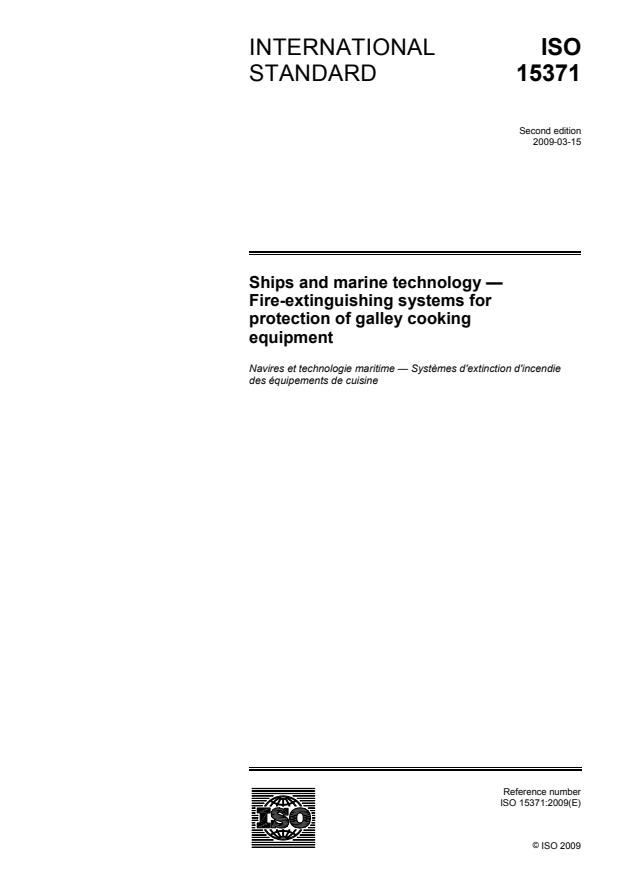
INTERNATIONAL ISO
STANDARD 15371
Second edition
2009-03-15
Ships and marine technology —
Fire-extinguishing systems for
protection of galley cooking
equipment
Navires et technologie maritime — Systèmes d'extinction d'incendie
des équipements de cuisine
Reference number
©
ISO 2009
PDF disclaimer
This PDF file may contain embedded typefaces. In accordance with Adobe's licensing policy, this file may be printed or viewed but
shall not be edited unless the typefaces which are embedded are licensed to and installed on the computer performing the editing. In
downloading this file, parties accept therein the responsibility of not infringing Adobe's licensing policy. The ISO Central Secretariat
accepts no liability in this area.
Adobe is a trademark of Adobe Systems Incorporated.
Details of the software products used to create this PDF file can be found in the General Info relative to the file; the PDF-creation
parameters were optimized for printing. Every care has been taken to ensure that the file is suitable for use by ISO member bodies. In
the unlikely event that a problem relating to it is found, please inform the Central Secretariat at the address given below.
All rights reserved. Unless otherwise specified, no part of this publication may be reproduced or utilized in any form or by any means,
electronic or mechanical, including photocopying and microfilm, without permission in writing from either ISO at the address below or
ISO's member body in the country of the requester.
ISO copyright office
Case postale 56 • CH-1211 Geneva 20
Tel. + 41 22 749 01 11
Fax + 41 22 749 09 47
E-mail copyright@iso.org
Web www.iso.org
Published in Switzerland
ii © ISO 2009 – All rights reserved
Contents Page
Foreword. iv
Introduction . v
1 Scope . 1
2 Terms and definitions. 1
3 Components . 4
3.1 General. 4
3.2 Detectors . 4
3.3 Discharge nozzles. 5
3.4 Operating devices. 5
3.5 Manual actuators . 5
3.6 Shutoff devices . 5
3.7 Pipe, fittings, tubing and hose . 6
3.8 Extinguishing agent. 6
3.9 Indicators. 6
4 System requirements . 6
4.1 General. 6
4.2 Use. 6
4.3 Applications . 6
4.4 System actuation . 7
4.5 Supervision . 7
4.6 System location . 8
4.7 Discharge nozzles. 8
4.8 Special requirements. 8
4.9 Protection of common exhaust duct . 8
5 Test methods. 9
5.1 Cooking appliance extinguishing tests. 9
5.2 Splash tests. 15
5.3 Hood and duct (full scale) extinguishing test. 18
5.4 Extinguishing system unit test. 20
6 Installation, operation and maintenance instruction manual. 22
7 Owner's manual . 24
8 Test report . 25
Foreword
ISO (the International Organization for Standardization) is a worldwide federation of national standards bodies
(ISO member bodies). The work of preparing International Standards is normally carried out through ISO
technical committees. Each member body interested in a subject for which a technical committee has been
established has the right to be represented on that committee. International organizations, governmental and
non-governmental, in liaison with ISO, also take part in the work. ISO collaborates closely with the
International Electrotechnical Commission (IEC) on all matters of electrotechnical standardization.
International Standards are drafted in accordance with the rules given in the ISO/IEC Directives, Part 2.
The main task of technical committees is to prepare International Standards. Draft International Standards
adopted by the technical committees are circulated to the member bodies for voting. Publication as an
International Standard requires approval by at least 75 % of the member bodies casting a vote.
Attention is drawn to the possibility that some of the elements of this document may be the subject of patent
rights. ISO shall not be held responsible for identifying any or all such patent rights.
ISO 15371 was prepared by Technical Committee ISO/TC 8, Ships and marine technology, Subcommittee
SC 1, Lifesaving and fire protection.
This second edition cancels and replaces the first edition (ISO 15371:2000). Clause 5 has been technically
revised along with minor editorial corrections throughout this International Standard.
iv © ISO 2009 – All rights reserved
Introduction
While this International Standard provides the marine industry with a means for evaluating the effectiveness of
fire-extinguishing systems for a variety of grease-laden cooking appliances that may be found in a galley, it is
also referenced by the International Maritime Organization (IMO) International Convention for the Safety of
Life at Sea (SOLAS), 1974, as amended, and provides organizations who are party to SOLAS with a means of
ensuring conformance of deep-fat cooking equipment with the fire suppression requirements prescribed in
SOLAS.
INTERNATIONAL STANDARD ISO 15371:2009(E)
Ships and marine technology — Fire-extinguishing systems
for protection of galley cooking equipment
1 Scope
This International Standard applies to the design, testing, and operation of pre-engineered fire extinguishing
systems to protect the galley hoods, ducts, fryers and other grease-laden appliances.
Pre-engineered fire-extinguishing system units are also required to comply with requirements for the
construction and components performance as applicable to specific types, designs, sizes and arrangements.
This International Standard also provides minimum requirements for the testing and evaluation of components.
A product that contains features, characteristics, components, materials or systems that are new or different
from those covered by the requirements in this International Standard and that involve a risk of fire, electric
shock, or injury to persons, shall be evaluated using the appropriate additional component and
end-product testing.
NOTE Only deep-fat cooking equipment, among the types of galley cooking equipment covered by this International
Standard, are required by SOLAS chapter II-2 Regulation 10.6.4 to have fixed fire-extinguishing systems.
2 Terms and definitions
For the purposes of this document, the following terms and definitions apply.
2.1
auxiliary equipment
equipment used in conjunction with the extinguishing system
EXAMPLE Auxiliary equipment can be used to shut down power, fuel or ventilation to the hazard area being
protected or to initiate alarm or signalling devices.
2.2
cooking appliance
cooking device that has, or is capable of having, a surface of liquid grease or one in which cooking with
grease is involved
EXAMPLE Deep fat fryer, griddle, range, chain-broiler, electric char-broiler, charcoal broiler, mesquite broiler, gas
radiant char broiler, wok, tilt skillet/braising pan and similar appliances.
NOTE The protected area is limited to the cooking area of the appliance only.
2.3
cooking grease
grease
vegetable shortening incorporating an antifoaming agent
2.4
cylinder/valve assembly
container that incorporates a valve and that provides storage for the extinguishing agent and expellant gas
until the valve is actuated
NOTE For cartridge-operated units, this assembly includes the extinguishing-agent storage container and cartridge
mechanism.
2.5
deep fat fryer
commercially available electric cooking appliance in which cooking greases in depth are used
2.6
discharge nozzle
device that is used to distribute the extinguishing agent over or into a specific area
2.7
discharge rate
ratio of the quantity of the extinguishing agent discharged from a nozzle to the discharge time measured to
within ± 1 s, expressed in kg/s
2.8
discharge time
time interval between the first appearance of the extinguishing agent at the nozzle and the time at which the
discharge becomes predominantly gaseous or ceases
2.9
duct
duct system
continuous enclosed passageway for the transmission of air and cooking vapours
2.10
expellent gas
nitrogen air or other gas used to facilitate the discharge of the extinguishing agent
2.11
extinguishing system unit
identified components that can be assembled into a system for the discharge of an extinguishing agent
through fixed piping and nozzles for the purpose of extinguishing fires
2.12
gas cartridge
container that provides storage for an expellant gas only
2.13
grease filter
component of a grease vapour removal system that deflects the air and vapours passing through it in such a
manner as to result in the grease vapours concentrating, condensing, or both, for the purpose of grease
collection
2.14
hood
device provided as part of an exhaust system to direct and capture grease vapours and exhaust gases from a
cooking appliance
2.15
indicator
mechanical or electrical device that shows when an extinguishing system or one of its critical components is
ready to operate or has already operated
2 © ISO 2009 – All rights reserved
2.16
inspection
visual examination of the system or portion thereof to verify that it appears to be in operating condition and is
free of physical damage
2.17
low quality fatty beef steak
beef steak containing 20 % to 30 % fat or gristle, well marbled and uniform in size
2.18
maintenance
work, including, but not limited to, repair, replacement and service, performed to ensure that the equipment
operates properly
2.19
manual means of actuation
means of system actuation in which a system is discharged by manual means
2.20
manufacturer's installation and maintenance manual
document containing the design, installation and maintenance instructions which is prepared and approved as
a complimentary part of the extinguishing system
2.21
multiple-vat deep fat fryer
multiple electric fryers that are mechanically joined together
NOTE Each vat incorporates a separately controlled heating source.
2.22
operable pressure
pressure developed in a fully charged container conditioned at 21 °C for at least 24 h
2.23
operable pressure range
pressure range corresponding to the pressures in the storage container at the specified minimum and
maximum temperatures for which the extinguishing system is intended to be operable
2.24
operating devices
mechanical, electrical or pneumatic devices involved in the operation of a system
2.25
operation
〈automatic operation〉 operation without human intervention
NOTE Methods of automatic operation include, but are not limited to, heat, rate of temperature rise, smoke or
pressure change.
2.26
operation
〈manual operation〉 operation of a system or its components through human action
2.27
owner's manual
pamphlet containing the manufacturer's recommendations for proper inspection and operation, which is
prepared and approved as a complimentary part of the extinguishing system
2.28
plenum
volume of enclosed space between the grease filters and the portion of the hood above the grease filters in a
hood and duct system
2.29
pre-engineered system
system that is tested in accordance with the limitations prescribed by the manufacturer for the maximum and
minimum pipe lengths, accessories, number of fittings, number and types of nozzles, nozzle placement, types
of fire risk and the maximum dimensions, volumes and areas of the appliances, hoods and ducts to be
protected
NOTE 1 The hazards protected by these systems are specifically limited as to type and size by testing on actual fires.
NOTE 2 The limitations on hazards that are permitted to be protected by these systems and piping and nozzle
configurations are those contained in the manufacturer's installation and maintenance manual.
2.30
pressure vessel
pressure cylinder
container that provides storage for the extinguishing agent and expellant gas
2.31
product
fire extinguishing system or any part thereof covered by the requirements of this International Standard
2.32
shut-off device
device that operates simultaneously with the extinguishing system to shut off fuel and power to the appliances
protected by the system and other appliances required to be shut off upon operation of the system
2.33
signal
status indication communicated by electrical or other means
2.34
split-vat deep fat fryer
electric fryer that incorporates a divided partition which splits the fryer in sections
NOTE Each split-vat fryer incorporates a separately controlled heating source.
2.35
tilt skillets/braising pans
cooking devices which are intended to braise, simmer, sauté, or fry foods
3 Components
3.1 General
Only system components referenced or permitted in the manufacturer's installation and maintenance manual
or alternative components that have been approved for use with the specific extinguishing system shall be
used.
3.2 Detectors
Detectors shall be approved devices that are capable of detecting fire.
4 © ISO 2009 – All rights reserved
3.3 Discharge nozzles
3.3.1 Discharge nozzles shall be approved for their intended use.
3.3.2 Nozzles shall be provided with an internal strainer or a separate approved strainer located
immediately up-stream of the nozzle.
3.3.3 Nozzles shall be constructed of brass, stainless-steel, or other corrosion-resistant materials, or be
protected inside and out against corrosion.
3.3.4 Nozzles shall be made of non-combustible materials and shall withstand the expected fire exposure
without deformation.
3.3.5 Nozzles shall be permanently marked for identification.
3.3.6 All discharge nozzles shall be provided with caps or other suitable devices to prevent the entrance of
grease vapours, moisture, or other foreign materials into the piping.
3.3.7 The caps or other protection devices shall blow off, open or blow out upon agent discharge.
3.4 Operating devices
3.4.1 Operating devices shall be designed for the service they will encounter and shall not be rendered
inoperative by, or be susceptible to, accidental operation.
3.4.2 Operating devices shall be designed to function properly through a temperature range from 0 °C to
49 °C, or marked to indicate the temperature limitations.
3.5 Manual actuators
3.5.1 Manual actuators shall not require a force of more than 178 N.
3.5.2 Manual actuators shall not require a movement of more than 356 mm to secure operation.
3.5.3 All manual actuators shall be provided with operating instructions. These instructions may include the
use of pictographs, and shall have lettering at least 6 mm in height.
3.5.4 All remote manual operating devices shall be marked to identify the hazard against which they protect.
3.6 Shut-off devices
3.6.1 On activation of any cooking equipment or hood/duct fire extinguishing system, all sources of fuel and
electric power that produce heat to all equipment protected by the system shall be shut off automatically.
3.6.2 Gas appliances not requiring protection but located under the same ventilation equipment shall also
be shut off.
3.6.3 Exhaust fans and dampers are not required to be shut off on system actuation if the fire-extinguishing
system has been tested under both zero and high-velocity flow conditions.
3.6.4 If the expellant gas is used to pneumatically operate the shut-off devices, the gas shall be sourced
prior to its entry into the agent storage cylinder.
3.6.5 Shut-off devices shall require manual resetting prior to fuel or power being restored.
3.7 Pipe, fittings, tubing and hose
3.7.1 Pipe and associated fittings shall be of non-combustible material having physical and chemical
characteristics compatible with the extinguishing agent.
3.7.2 The pressure rating of the pipe, fittings and connection joints shall withstand the maximum expected
pressure in the piping system.
3.7.3 Pipe, tubing, hose and fitting materials and types shall be in accordance with the manufacturer's
installation and maintenance manual.
3.8 Extinguishing agent
3.8.1 The agent used shall be identified for the particular system in the operation and maintenance manual
as recommended by the manufacturer of the system.
3.8.2 Agents from different manufacturers shall not be mixed.
3.9 Indicators
3.9.1 Systems shall be provided with an audible or visual indicator to show that the system is in a ready
condition or is in need of recharging.
4 System requirements
4.1 General
4.1.1 Fire-extinguishing systems shall meet the requirements of 5.4.
4.2 Use
4.2.1 Equipment that can be protected against hazard includes:
a) cooking hoods, plenums, ducts, and filters with their associated cooking appliances, including deep fat
fryers, ranges, broilers, griddles and similar grease-laden appliances;
b) special grease removal devices;
c) energy recovery devices installed in the exhaust system.
4.3 Applications
4.3.1 The manufacturer's installation and maintenance manual shall be consulted for the system's
limitations and applications for which the approved system is considered satisfactory protection.
4.3.2 Each protected cooking appliance, individual hood and branch exhaust duct directly connected to the
hood, shall be protected by a system or systems designed for simultaneous operation.
4.3.3 Where two or more hazards can be simultaneously involved in fire by reason of their proximity, the
hazards shall be protected by either of the following:
a) individual systems installed to operate simultaneously;
b) a single system designed to protect all hazards that can be simultaneously involved.
6 © ISO 2009 – All rights reserved
4.3.4 Any hazard that will allow fire propagation from one area to another shall constitute a single fire
hazard.
4.4 System actuation
4.4.1 All systems shall have a manual method of actuation or both manual and automatic actuations.
4.4.2 The automatic and manual means of system actuation, external to the control head or releasing
device, shall be separate and independent of each other so that a failure of one will not impair the operation of
the other.
4.4.3 When a releasing mechanism is used, employing a single line for the mechanical detection and the
remote manual control, the remote manual control shall be installed inline, prior to all detection devices, so
that a malfunction of one does not impede operation of the other.
4.4.4 Automatic detection and system actuation shall be in accordance with the manufacturer's installation
and maintenance manual.
4.4.5 The devices necessary for the proper operation of the system shall function simultaneously with the
system operation.
4.4.6 Operation of any manual actuator shall be all that is required to bring about the full operation of the
system.
4.4.7 At least one manual actuator shall be provided for each system.
4.4.8 All operating devices shall be designed, located, installed or protected so that they are not subject to
mechanical, environmental or other conditions that could render them inoperative or cause inadvertent
operation of the system.
4.4.9 An audible or visual indicator shall be provided to show that the system has operated, that personnel
response is needed and that the system is in need of recharge.
4.4.10 The extinguishing system shall be connected to the fire alarm system, if provided, so that actuation of
the extinguishing system will sound the fire alarm as well as provide the function of the extinguishing system.
4.4.11 A readily accessible means for manual actuation shall be located in a path of egress. When manual
activation is used for cooking related protection, the manual activation device shall be installed no more than
1 450 mm, nor less than 1 000 mm above the floor and shall clearly identify the hazard against which it
protects.
4.4.12 Automatic systems protecting common exhaust ducts shall not require a remote manual actuator.
4.4.13 The means for the mechanical actuator(s) shall be mechanical and shall not rely on electrical power
for actuation.
4.4.14 Electrical power shall be permitted to be used for the manual actuation if a reserve power supply is
provided or if supervision in accordance with 4.5 is provided.
4.5 Supervision
4.5.1 Where supervision of any of the following is provided, it shall be designed to provide an indication of
problems or failure:
a) automatic detection system;
b) electrical actuation circuit;
c) electrical power supply.
4.5.2 Signals indicating the failure of the supervised devices or equipment shall give prompt and positive
indication of any failure and shall be distinctive from signals indicating operation or hazardous conditions.
4.6 System location
4.6.1 Agent containers and expellant gas assemblies shall be located within the temperature range
specified in the manufacturer's installation and maintenance manual.
4.6.2 If ambient temperatures outside the manufacturer's operating temperature range are expected,
protection shall be provided to maintain the temperature within the approved range.
4.6.3 Agent containers and expellant gas assemblies shall not be located where they could be subjected to
mechanical, chemical, or other damage.
4.6.4 Where damage due to chemical or mechanical exposure is expected, protective devices such as
enclosures or guards shall be provided.
4.6.5 Agent containers and expellant gas assemblies shall be accessible for inspection, maintenance, and
recharge.
4.6.6 Agent containers and expellant gas assemblies shall be located near the hazard or hazards protected
but not where they will be exposed to the fire.
4.7 Discharge nozzles
4.7.1 All discharge nozzles shall be designed and subsequently located, installed, or protected so that they
are not subjected to mechanical, environmental, or other conditions that would render them inoperative.
4.7.2 Discharge nozzles shall be connected and supported.
4.8 Special requirements
4.8.1 Systems protecting two or more hoods or plenums, or both, shall be installed to ensure the
simultaneous operation of all systems protecting the hoods, plenums and associated cooking appliances
located below the hoods.
4.8.2 A single detection device shall be permitted for more than one appliance when installed according to
the system's approval detection arrangements.
4.8.3 At least one heat detector or fusible link shall be installed within each exhaust duct opening in
accordance with the manufacturer's approval.
4.8.4 A heat detector or fusible link shall be provided above each protected cooking appliance and in
accordance with the manufacturer's approval. Heat detectors or fusible links located at or within 300 mm into
the exhaust duct opening and above the protected appliance shall be permitted to meet this requirement.
4.8.5 Where the pipe or other conduit penetrates a duct or hood, the penetration shall have a liquid tight
continuous external weld or shall be sealed by an approved device.
4.9 Protection of common exhaust duct
4.9.1 Common exhaust ducts shall be protected by one of the following methods:
a) Simultaneous operation of all independent hood, duct, and appliance protection systems;
b) Simultaneous operation of any hood, duct, and appliance protection system and the system(s) protecting
the entire common exhaust duct.
8 © ISO 2009 – All rights reserved
4.9.2 A heat detector or fusible link shall be located at each branch duct-to-common duct connection.
4.9.3 Actuation of any branch duct-to-common duct exhaust duct heat detector or fusible link shall actuate
the common duct system only, or when all independent systems are connected to a fire alarm control panel.
4.9.4 All sources of fuel or heat to the appliances served by the common exhaust duct shall be shut down
upon actuation of any protection system.
4.9.5 Ignition sources contained within any exhaust system shall be protected and have a separate
detection system in accordance with the manufacturer's recommendations and the approval testing.
4.9.6 Moveable cooking equipment shall be provided with a means to ensure that it is correctly positioned in
relation to the appliance discharge nozzles during cooking operations.
5 Test methods
5.1 Cooking appliance extinguishing tests
5.1.1 General
5.1.1.1 An extinguishing system unit shall meet the coverage and nozzle placement limitations for each
type of cooking appliance with which it is intended to be used. When the coverage and nozzle placement
limitations from the results of successful deep fat fryer testing meet the requirements for any other cooking
appliance installations, further testing is not required (see 5.1.2). For cooking appliances with different nozzle
coverage and placement limitations, fire tests are required.
Specific fire extinguishing test methods are given in 5.1. Additional testing on splashing during the discharge
of a system, in accordance with 5.2, shall also be provided.
For hood, duct and broiler testing only, grease is to be new or used vegetable shortening, or rendered animal
fat.
5.1.1.2 When tested with a cooking appliance, the extinguishing system unit shall:
a) result in the flame in the appliance being completely extinguished in one minute or less;
b) within 10 seconds of the release of the system, not cause a fire ball over the appliance that is larger than
the initial fire;
c) for deep fat fryers, woks and ranges, not permit reigniting of the grease for 20 minutes or until the
temperature of the grease decreases at least 33,3 °C below its observed auto-ignition temperature,
whichever is longer; and
d) for all appliances other than deep fat fryers, woks and ranges, not permit re-ignition of the grease for five
minutes.
5.1.1.3 Unless otherwise noted, each fire test shall be conducted using the minimum quantity of agent
and the minimum discharge rate condition which is achieved by assembling the extinguishing system using its
maximum piping limitations with respect to the number of fittings and the size and length of the pipe in
accordance with the manufacturer's installation instructions.
5.1.1.4 The cylinder/valve assembly shall be filled to its rated capacity and the cylinder or gas cartridge
pressurized with the expellant gas to the normal operating pressure at 21 °C [see 6.2 k)]. The cylinder/valve
assembly or gas cartridge used for these tests shall be conditioned for at least 16 h at the minimum storage
temperature specified in the manufacturer's installation instructions. As an alternative to the conditioning,
stored pressure units may be under-pressurized to simulate the pressure at the minimum operating
temperature.
5.1.1.5 Extinguishing tests shall be conducted with both the maximum and minimum nozzle heights, with
each nozzle positioned in the most difficult location and orientation allowed by the manufacturer's installation
instruction with respect to fire extinction. Splash tests shall be conducted at the minimum nozzle height, with
the nozzle positioned in the most difficult locations and orientations allowed by the installation instructions.
5.1.1.6 The length and width of the cooking area of the appliance being tested shall correspond to the
maximum area coverage and dimension limitations specified in the installation instructions.
5.1.1.7 Multiple-appliance protection for single discharge nozzle coverage shall be tested as per the
manufacturer's installation instructions.
5.1.1.8 A larger appliance shall not be protected with multiple nozzles unless:
a) a deep fat fryer protected by multiple nozzles does not exceed a total cooking surface area of 0,55 m ;
and
b) the area of coverage for each nozzle does not exceed its single appliance coverage.
The following are exceptions to the requirements of this subclause.
1) When compliance with the deep fat fryer requirements is demonstrated using the specified cooking
surface area of coverage, the protection of a deep fat fryer with a total cooking surface area greater
than 0,55 m may be used.
2) The 0,55 m total surface cooking area requirement does not apply to tilt skillets/braising pans.
5.1.1.9 Prior to the conduct of each extinguishing test, the appliance shall be cleaned and provided with
new cooking grease.
5.1.2 Deep fat fryer
5.1.2.1 The deep fat fryer used for this test shall be a commercially available natural gas, propane, or
electric deep fat fryer, at least 230 mm deep, having a cooking surface area as specified in the manufacturer's
installation instructions. For a deep fat fryer with an integral drip board, or the like, the calculated cooking area,
along with the drip area, shall be as indicated in the manufacturer's installation instructions.
NOTE On certain electric fryers, the heating elements can be damaged due to the high temperatures during the fire
testing; therefore, natural gas or propane fuelled units are commonly used for the fire tests.
5.1.2.2 All deep fat fryers tested in accordance with 5.1.2.1, and 5.1.2.3 to 5.1.2.8 shall demonstrate an
average heating rate of not less than 7 °C per minute and an average cooling rate of not more than 3 °C per
minute. The average heating and cooling rates shall be determined by heating the liquid grease in an
uncovered fryer at the fryer's maximum energy input. The time required to heat the grease from 260 °C to
315 °C shall be used to calculate the rise in temperature of the appliance. When the temperature of the liquid
grease reaches 325 °C, the fryer's energy source shall be immediately shut off. The temperature of the
cooling liquid grease shall then be monitored. When the temperature of the grease returns to 315 °C, the
cooling rate, in °C per minute, shall be measured between the temperatures of 315 °C and 260 °C. The fryer
shall be tested with an ambient temperature of (21 ± 5) °C throughout the duration of the test. The
thermocouple monitoring the grease temperature shall be installed as indicated in 5.1.2.6.
5.1.2.3 Multiple-vat and split-vat deep fat fryers shall be separately tested with the discharge nozzle
positioned in the most difficult location and orientation allowed by the manufacturer's installation manual.
5.1.2.4 Split-vat fryers shall be tested wherein one or more of the vats adjacent to the vat to be
spontaneously ignited are filled with liquid cooking grease and heated to 175 °C to 190 °C. Energy shut-off for
all the vats shall occur when the extinguishing system is actuated.
10 © ISO 2009 – All rights reserved
If saponified foam from the adjacent vat(s) rolls over into the burning vat after system actuation, the grease
temperature of the adjacent vat(s) shall be reduced to the point where foam rollover does not occur or a
means shall be provided to prevent foam from rolling over into the burning vat.
5.1.2.5 The fryer shall be filled with new, unused liquid grease until the grease level is 75 mm below the
top edge of the fryer (see 5.1.1.9). The liquid grease shall have an auto-ignition temperature not less than
363 °C when tested with the deep fat fryers of the type specified in 5.1.2.1. During the testing, the auto-ignition
temperature shall not be less than 358 °C and the commencement of the timing of the two minute free burn
shall start at an oil temperature of 363 °C. For a deep fat fryer with an internal drip board, or the like, the
grease level shall be at the fryer wall/drip board interface, when the grease is at a temperature of 175 °C to
190 °C. In no case shall the grease level for any type of fryer be more than 75 mm below the top of the vat
when the grease temperature is between 288 °C to 315 °C.
5.1.2.6 The grease temperature during testing shall be measured with a thermocouple located 25 mm
below the grease surface. The thermocouple shall be located not closer than 75 mm to any side of the fryer.
5.1.2.7 The liquid grease in the fryer shall be heated by its heating source until auto-ignition occurs. If the
grease temperature reaches 363 °C and the grease has not ignited, it shall be ignited manually. The fire shall
burn freely with the fryer's heating source remaining on for a period of not less than two minutes. After the
free-burn period, the heating source shall be shut off and the extinguishing system shall be manually
discharged.
5.1.2.8 Upon complete discharge of the extinguishing agent, the deep fat fryer shall have complied with
the requirements in 5.1.1.2.
5.1.3 Griddle
5.1.3.1 The griddle used for the fire test is to be constructed of sheet metal at least 2 mm thick and is to
be 25 mm deep.
5.1.3.2 The griddle is to be filled with liquid grease to a depth of 6 mm.
5.1.3.3 The liquid grease in the griddle is to be heated by the griddle's heating source until spontaneous
ignition occurs. After the cooking area is fully involved in flames, the fire is to burn freely for a minimum of one
minute, with the heating source remaining on, after which the heating source is to be shut off and the
extinguishing system unit is to be discharged.
5.1.3.4 Upon complete discharge of the extinguishing agent, the griddle shall comply with the
requirements of 5.1.1.2.
5.1.4 Range top
5.1.4.1 The range top used for the test is to be a commercially available electric, natural gas or propane
fired range top or a commercial range top burner constructed to simulate variable range top configurations.
When a manufacturer references protection for a range top incorporating a back shelf, a back shelf of the
maximum size and located at the minimum height as specified in the manufacturer's installation instructions is
to be used for the test. The cooking surfaces of the range top are to be the maximum as specified for
coverage in the manufacturer's installation, operation and maintenance manual.
5.1.4.2 The following test vessels are to be used for the tests:
a) a cast iron skillet having a diameter of 330 mm to 360 mm at the top and having sides 45 mm to 60 mm
high, measured from inside the skillet;
b) a stainless steel pot having a diameter of (255 ± 6) mm at the top and having sides of 180 mm to 200 mm
high.
5.1.4.3 Separate extinguishment tests are to be conducted using each test vessel.
5.1.4.4 For the test with the cast iron skillet, the skillet is to be filled with liquid grease to a depth of
25 mm. For the test with the stainless steel pot, the pot is to be filled with liquid grease to a depth of 100 mm.
The grease level is to be measured when the grease temperature is between 288 °C to 315 °C.
5.1.4.5 The liquid grease is to have an auto-ignition temperature of not less than 363 °C. The
auto-ignition temperature shall not be less than 349 °C when the two minute free burn commences at an oil
temperature of 363 °C. The grease temperature is to be measured with a thermocouple located 12,5 mm
below the grease surface and not closer than 75 mm to the test vessel wall.
5.1.4.6 The test vessel is to be positioned on a burner in a location determined to be the most difficult to
achieve fire extinguishment. For the skillet test, the 255 mm pot is to be located adjacent to the skillet in a
location determined to be the most difficult with respect to achieving fire extinguishment. The range top burner
for the test vessel is to be adjusted to the maximum intensity position and the grease continuously heated until
auto-ignition occurs. After auto-ignition, the fire is to burn freely with the burner at its maximum intensity for a
period of not less than two minutes. After the free-burn period of not less than two minutes, the heating source
is to be shut off and the extinguishing system unit is to be discharged.
5.1.4.7 Upon complete discharge of the extinguishing agent, the range top shall comply with the
requirements of 5.1.1.2.
5.1.5 Gas radiant char-broiler
5.1.5.1 A commercially available gas radiant char-broiler or a char-broiler constructed to simulate a
commercially available gas radiant char-broiler is to be used for the test. The char-broiler is to have a drip pan
at least 12,5 mm deep located below the heating source. An extinguishing system unit is capable of being
used with an electric char-broiler based on a successful extinguishment test using a gas radiant char-broiler
using identical coverage and nozzle placement limitations.
5.1.5.2 A thin plastic sheet, such as plastic food wrap, containing steaks and grease is to be placed on a
flat surface at a location away from the char-broiler. The plastic sheet is to be covered with 6 mm of semi-solid
grease. Low quality fatty beef steaks are then to be placed on top of the grease-laden plastic sheet so as to
cover an area equal to 80 % to 90 % of the char-broiler grate area. The drip pan is to be filled with 3 mm of
liquid grease.
5.1.5.3 The char-broiler's radiant panels are to be heated with the burners at their maximum intensity so
that they are hot enough to ignite drops of liquid grease. When this occurs, the plastic sheet, grease and
steaks are to be placed on the broiler's grill in the normal cooking position. The char broiler is to become
quickly involved in flames. The heating source is to be shut off and the extinguishing system discharged after
the cooking area has been fully covered with flames for one minute and the peak flame height is at least
900 mm.
5.1.5.4 Upon complete discharge of the extinguishing agent, the gas radiant char-broiler shall comply
with the requirements in 5.1.1.2.
5.1.6 Electric char-broiler
5.1.6.1 A commercially available electric char-broiler, or a char-broiler constructed to simulate a
commercially available electric char-broiler is to be used for the test.
5.1.6.2 The test is to be conducted in the same manner as the gas radiant test specified in 5.1.5.1 to
5.1.5.4.
5.1.7 Lava, pumice or synthetic rock char-broiler
5.1.7.1 Identical coverage and nozzle placement limitations for lava rock, pumice stone or synthetic rock
type char-broilers is to be used based on a successful extinguishment test of a lava rock type char-broiler. A
gas or electrically heated char-broiler is to be used, and an extinguishing system unit can be used with either
heat source based on a successful extinguishment test using either heat source.
12 © ISO 2009 – All rights reserved
5.1.7.2 A commercially available lava, pumice or synthetic rock char-broiler, or a char-broiler constructed
to simulate a commercially available lava, pumice or synthetic rock char-broiler, is to be used for the test.
5.1.7.3 This test is to be conducted in the same manner as the gas radiant test specified in 5.1.5.1 to
5.1.5.4, except that the lava, pumice, or synthetic rock is to be heated in lieu of heating the gas radiant panels.
The grate is to be covered with two layers of lava, pumice, or synthetic rock, whichever is being used for test
purposes.
5.1.8 Natural charcoal broiler
5.1.8.1 A commercially available charcoal broiler or a charcoal broiler constructed to simulate a
commercially available charcoal broiler is to be used for the test.
5.1.8.2 A thin plastic sheet, such as plastic food wrap, containing steaks and grease is to be placed on a
flat surface at a location away from the charcoal broiler. The plastic sheet is to be covered with 6 mm of
semi-solid grease. Low quality fatty beef steaks are then to be placed on top of the grease-laden plastic sheet
so as to cover an area equal to 80 % to 90 % of the cooking area.
5.1.8.3 The fuel grate is then to be covered with charcoal briquettes to the maxim
...
Questions, Comments and Discussion
Ask us and Technical Secretary will try to provide an answer. You can facilitate discussion about the standard in here.
Loading comments...