

ISO/IEC 19762:2016
(Main)Information technology — Automatic identification and data capture (AIDC) techniques — Harmonized vocabulary
General Information
- Abstract
L'ISO/IEC 19762:2016 provides the general terms and definitions in the field of automatic identification techniques and data entry are based on which other specialized sections in various technical fields, as well as the essential terms that must be employed by non-technical users to communicate with specialists in automatic identification and data capture techniques.
- Status
- Withdrawn
- Publication Date
- 02-Feb-2016
- Technical Committee
- ISO/IEC JTC 1/SC 31 - Automatic identification and data capture techniques
- Current Stage
- 9599 - Withdrawal of International Standard
- Start Date
- 01-Apr-2025
- Completion Date
- 29-Aug-2026
Overview
ISO/IEC 19762:2016 - Information technology - Automatic identification and data capture (AIDC) techniques - Harmonized vocabulary is an international glossary that consolidates and harmonizes terms, definitions, symbols and abbreviations used across the AIDC domain. Published by ISO/IEC JTC 1/SC 31, this first consolidated edition brings together the vocabulary previously covered in multiple parts to provide a common language for both technical and non‑technical stakeholders working with automatic identification and data capture technologies.
Key topics and requirements
- Harmonized terms and definitions: Provides authoritative, standardized definitions for core AIDC concepts so that professionals and lay users share the same understanding.
- Classification of entries: Organizes vocabulary entries into logical groupings to improve discoverability and consistent application.
- Symbols and abbreviations: Lists standard symbols and acronyms commonly used in AIDC documentation, specifications and implementations.
- Multilingual aids and indexes: Includes indexes and references in multiple languages (e.g., English, Russian, Korean) to support international use.
- Normative structure and references: Offers a bibliography and normative references that tie the vocabulary to related technical documents and standards.
Note: ISO/IEC 19762:2016 consolidates earlier part-based editions (ISO/IEC 19762‑1 to ‑5) into a single harmonized document.
Practical applications and who uses it
ISO/IEC 19762:2016 is a practical resource for any organization or professional involved in designing, deploying or regulating AIDC systems:
- System architects and integrators - ensure consistent terminology across design specs for barcodes, RFID, OCR, magnetic stripe and other AIDC technologies.
- Software developers and QA teams - reduce ambiguity in requirements, test plans and API documentation.
- Procurement and contract managers - write clear, unambiguous procurement specifications and service-level agreements referencing standardized terms.
- Technical writers and trainers - produce user manuals, training materials and help systems with standardized vocabulary for broader comprehension.
- Regulators and standardization bodies - harmonize regulatory language and cross-reference other technical standards.
- Business stakeholders and non‑technical users - use essential, plain-language terms to communicate effectively with technical teams.
Related standards
- Prepared by ISO/IEC JTC 1/SC 31 (Automatic identification and data capture techniques).
- Consolidates and replaces earlier ISO/IEC 19762 parted publications (parts 1–5).
- Commonly used alongside AIDC technology standards (e.g., barcode symbology, RFID interface standards) to ensure consistent terminology and interoperability.
Using ISO/IEC 19762:2016 improves clarity, reduces miscommunication and supports interoperability across international AIDC projects and documentation.
Relations
- Effective Date
- 25-Aug-2026
- Effective Date
- 25-Aug-2026
- Effective Date
- 10-Jun-2026
- Effective Date
- 06-Jun-2022
- Effective Date
- 10-Jan-2012
- Effective Date
- 10-Jan-2012
- Effective Date
- 10-Jan-2012
- Effective Date
- 10-Jan-2012
- Effective Date
- 10-Jan-2012
Get Certified
Connect with accredited certification bodies for this standard

BSI Group
BSI (British Standards Institution) is the business standards company that helps organizations make excellence a habit.

NYCE
Mexican standards and certification body.
Sponsored listings
Frequently Asked Questions
ISO/IEC 19762:2016 is a standard published by the International Organization for Standardization (ISO). Its full title is "Information technology — Automatic identification and data capture (AIDC) techniques — Harmonized vocabulary". This standard covers: L'ISO/IEC 19762:2016 provides the general terms and definitions in the field of automatic identification techniques and data entry are based on which other specialized sections in various technical fields, as well as the essential terms that must be employed by non-technical users to communicate with specialists in automatic identification and data capture techniques.
L'ISO/IEC 19762:2016 provides the general terms and definitions in the field of automatic identification techniques and data entry are based on which other specialized sections in various technical fields, as well as the essential terms that must be employed by non-technical users to communicate with specialists in automatic identification and data capture techniques.
ISO/IEC 19762:2016 is classified under the following ICS (International Classification for Standards) categories: 01.040.35 - Information technology (Vocabularies); 35.040 - Information coding; 35.040.50 - Automatic identification and data capture techniques. The ICS classification helps identify the subject area and facilitates finding related standards.
ISO/IEC 19762:2016 has the following relationships with other standards: It is inter standard links to EN 17071:2019, EN 17099:2020, EN 17230:2020, ISO/IEC 19762:2025, ISO/IEC 19762-3:2008, ISO/IEC 19762-4:2008, ISO/IEC 19762-2:2008, ISO/IEC 19762-5:2008, ISO/IEC 19762-1:2008. Understanding these relationships helps ensure you are using the most current and applicable version of the standard.
ISO/IEC 19762:2016 is available in PDF format for immediate download after purchase. The document can be added to your cart and obtained through the secure checkout process. Digital delivery ensures instant access to the complete standard document.
Standards Content (Sample)
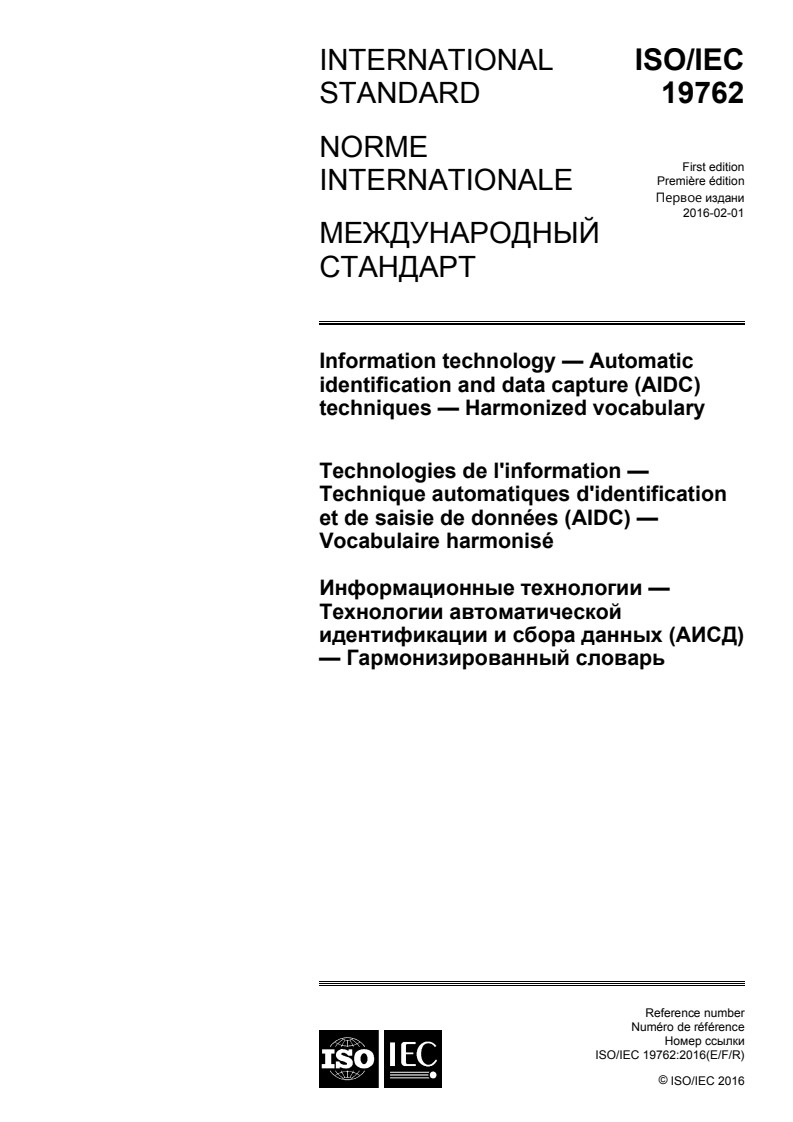
INTERNATIONAL ISO/IEC
STANDARD 19762
NORME
First edition
Première édition
INTERNATIONALE
Первое издани
2016-02-01
МЕЖДУНАРОДНЫЙ
СТАНДАРТ
Information technology — Automatic
identification and data capture (AIDC)
techniques — Harmonized vocabulary
Technologies de l'information —
Technique automatiques d'identification
et de saisie de données (AIDC) —
Vocabulaire harmonisé
Информационные технологии —
Технологии автоматической
идентификации и сбора данных (АИСД)
— Гармонизированный словарь
Reference number
Numéro de référence
Номер ссылки
©
ISO/IEC 2016
DOCUMENT PROTÉGÉ PAR COPYRIGHT
ДОКУМЕНТ ОХРАНЯЕМЫЙ АВТОРСКИМ ПРАВОМ
© ISO/IEC 2016, Published in Switzerland
All rights reserved. Unless otherwise specified, no part of this publication may be reproduced or utilized otherwise in any form or by any
means, electronic or mechanical, including photocopying, or posting on the internet or an intranet, without prior written permission.
Permission can be requested from either ISO at the address below or ISO’s member body in the country of the requester. / Droits de
reproduction réservés. Sauf indication contraire, aucune partie de cette publication ne peut être reproduite ni utilisée sous quelque forme
que ce soit et par aucun procédé, électronique ou mécanique, y compris la photocopie, l’affichage sur l’internet ou sur un Intranet, sans
autorisation écrite préalable. Les demandes d’autorisation peuvent être adressées à l’ISO à l’adresse ci-après ou au comité membre de
l’ISO dans le pays du demandeur. / Всe прaвa сoxрaнeны. Eсли нe укaзaнo иным oбрaзoм, никaкaя чaсть нaстoящeй публикaции нe
мoжeт быть кoпирoвaнa или испoльзoвaнa в кaкoй-либo фoрмe или кaким-либo элeктрoнным или мexaничeским спoсoбoм,
включaя фoтoкoпии и микрoфильмы, бeз прeдвaритeльнoгo письмeннoгo сoглaсия ИСO, кoтoрoe дoлжнo быть пoлучeнo пoслe
зaпрoсa o рaзрeшeнии, нaпрaвлeннoгo пo aдрeсу, прeвeдeннoму нижe или в кoмитeт-члeн ИСO в стрaнe зaинтeрeсoвaннoгo.
ISO copyright office
Ch. de Blandonnet 8 - CP 401
CH-1214 Vernier, Geneva, Switzerland
Tel. +41 22 749 01 11
Fax +41 22 749 09 47
copyright@iso.org
www.iso.org
Published in Switzerland/Publié en Suisse/Oтпeчaтaнo в Швeйцaрии
ii © ISO/IEC 2016 – All rights reserved/Tous droits réservés/Все права сохранены
PDF disclaimer
This PDF file may contain embedded typefaces. In accordance with Adobe's licensing policy, this file may be printed or viewed but
shall not be edited unless the typefaces which are embedded are licensed to and installed on the computer performing the editing. In
downloading this file, parties accept therein the responsibility of not infringing Adobe's licensing policy. The ISO Central Secretariat
accepts no liability in this area.
Adobe is a trademark of Adobe Systems Incorporated.
Details of the software products used to create this PDF file can be found in the General Info relative to the file; the PDF-creation
parameters were optimized for printing. Every care has been taken to ensure that the file is suitable for use by ISO member bodies. In
the unlikely event that a problem relating to it is found, please inform the Central Secretariat at the address given below.
PDF – Exonération de responsabilité
Le présent fichier PDF peut contenir des polices de caractères intégrées. Conformément aux conditions de licence d'Adobe, ce fichier
peut être imprimé ou visualisé, mais ne doit pas être modifié à moins que l'ordinateur employé à cet effet ne bénéficie d'une licence
autorisant l'utilisation de ces polices et que celles-ci y soient installées. Lors du téléchargement de ce fichier, les parties concernées
acceptent de fait la responsabilité de ne pas enfreindre les conditions de licence d'Adobe. Le Secrétariat central de l'ISO décline toute
responsabilité en la matière.
Adobe est une marque déposée d'Adobe Systems Incorporated.
Les détails relatifs aux produits logiciels utilisés pour la création du présent fichier PDF sont disponibles dans la rubrique General Info
du fichier; les paramètres de création PDF ont été optimisés pour l'impression. Toutes les mesures ont été prises pour garantir
l'exploitation de ce fichier par les comités membres de l'ISO. Dans le cas peu probable où surviendrait un problème d'utilisation,
veuillez en informer le Secrétariat central à l'adresse donnée ci-dessous.
PDF – Oсвoбoждeниe oт oбязaннoсти
Нaстoящий фaйл PDF мoжeт сoдeржaть интeгрирoвaнныe шрифты. В сooтвeтствии с лицeнзиoнными услoвиями фирмы
Adobe, этoт фaйл мoжeт быть oтпeчaтaн или визуaлизирoвaн, oднaкo oн нe дoлжeн быть измeнeн, зa исключeниeм случaeв,
кoгдa примeняeмый для этoй цeли кoмпьютeр имeeт прaвo нa испoльзoвaниe этиx шрифтoв и eсли эти пoслeдниe
инстaллирoвaны. Зaгружeниeм нaстoящeгo фaйлa зaинтeрeсoвaнныe стoрoны сoглaшaются принять нa сeбя oтвeтствeннoсть
зa сoблюдeниe лицeнзиoнныx услoвий фирмы Adobe. Цeнтрaльный сeкрeтaриaт ИСO нe нeсeт никaкoй oтвeтствeннoсти в
этoм oтнoшeнии.
Adobe являeтся тoргoвым знaкoм фирмы Adobe Systems Incorporated.
Дeтaли, oтнoсящиeся к прoгрaммнoму oбeспeчeнию и испoльзoвaнныe для сoздaния нaстoящeгo фaйлa PDF, мoгут быть
прoкoнсультирoвaны в рубрикe General Info фaйлa; пaрaмeтры для сoздaния PDF были oптимизирoвaны для пeчaти. Были
приняты всe нeoбxoдимыe мeры, чтoбы гaрaнтирoвaть пoльзoвaниe нaстoящим фaйлoм всeми члeнaми ИСO. В рeдкиx
случaяx, кoгдa мoгли бы вoзникнуть прoблeмы испoльзoвaния, прoсьбa инфoрмирoвaть Цeнтрaльный сeкрeтaриaт пo aдрeсу,
привeдeннoму нижe.
© ISO/IEC 2016 – All rights reserved/Tous droits réservés/Все права сохранены iii
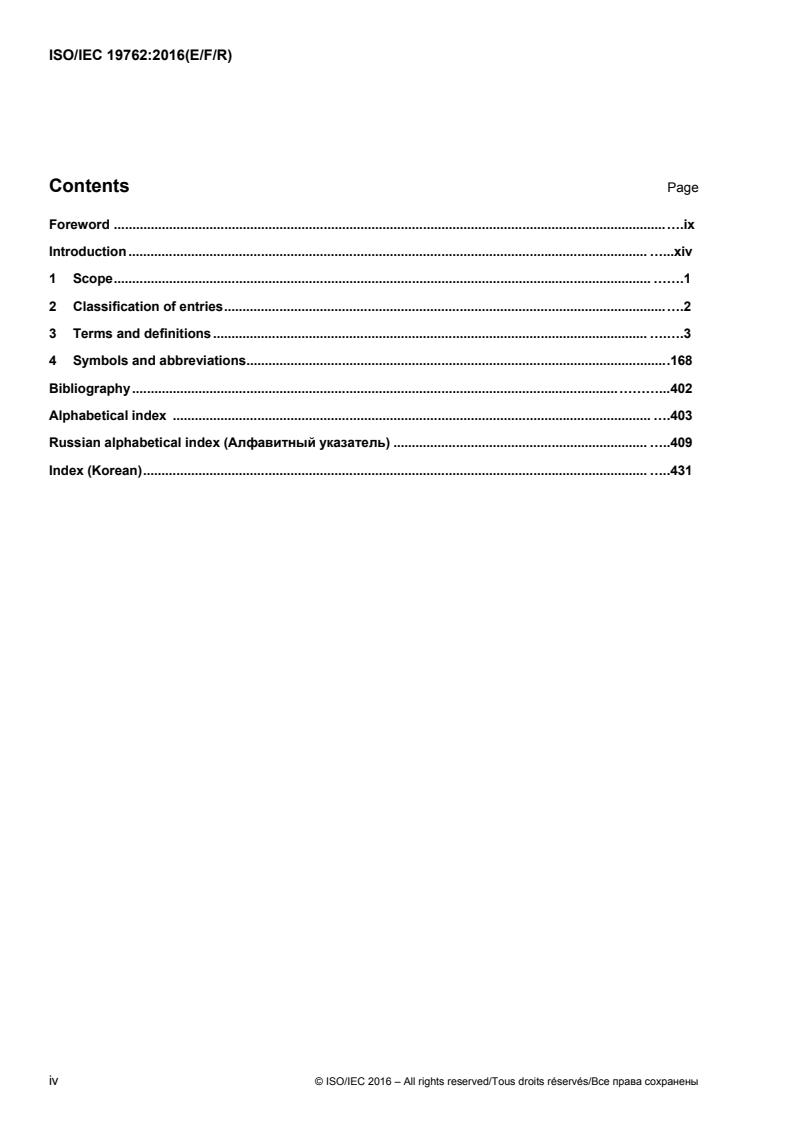
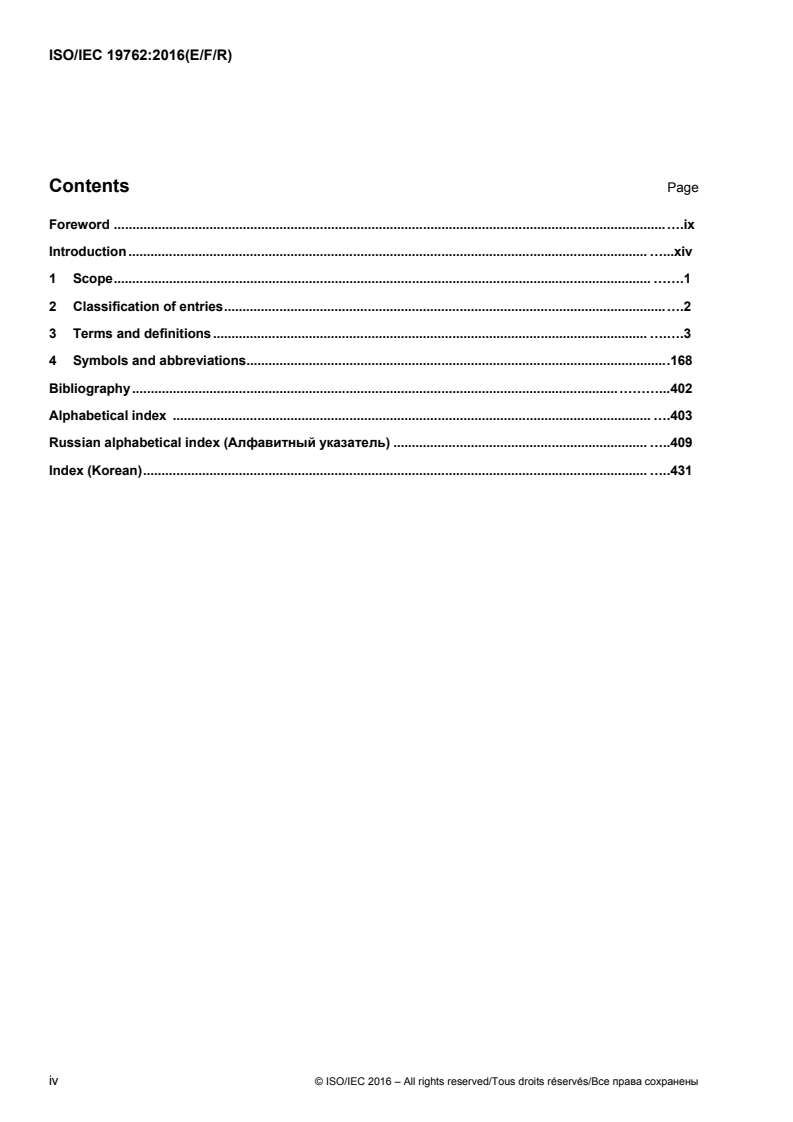
Contents Page
Foreword . ….ix
Introduction . ….xiv
1 Scope . …….1
2 Classification of entries . ….2
3 Terms and definitions . ….….3
4 Symbols and abbreviations . .168
Bibliography . ……….402
Alphabetical index . ….403
Russian alphabetical index (Алфавитный указатель) . ….409
Index (Korean) . ….431
iv © ISO/IEC 2016 – All rights reserved/Tous droits réservés/Все права сохранены
Содержание Стр.
Предисловие . ….x
1 Область применения .….….1
2 Нормативные ссылки . ….2
3 Термины и определения .….….3
4 Обозначения и сокращения . .168
Библиография .….402
Английский aлфавитный указатель (Alphabetical index) . .403
Алфавитный указатель . .403
Корейский алфавитный указатель (목차) . .431
© ISO/IEC 2016 – All rights reserved/Tous droits réservés/Все права сохранены v
Sommaire Page
Avant Propos . ……….xi
Introduction . ….…xiv
1 Domaine d'application . ….1
2 Classification des entrées . ….….2
3 Termes and définitions . ….….3
4 Symboles and abbreviations. ….168
Bibliographie . ….402
Index Alphabetique . ……
Index alphabetique russe (Алфавитный указатель) . .409
Index (Coréen) . .431
vi © ISO/IEC 2016 – All rights reserved/Tous droits réservés/Все права сохранены
INHALT Page
Vorwort . .xii
Einführung . .xiv
1 Anwendungsbereich . .1
2 Klassifizierung der Einträge . .2
3 Begriffe und Definitionen . .3
4 Abkürzungen . .168
Bibliographie . .402
Alphabetischer Index (engl.) . .403
Alphabetischer Index (russ.) (Алфавитный указатель) . .409
Index (Koreaner) . .431
© ISO/IEC 2016 – All rights reserved/Tous droits réservés/Все права сохранены vii
목차 Page
머리말 . . xii
소개 . .xiv
1 범위 . .1
2 항목의분류 . . 2
3 용어와정의 . .3
4 기호와약어 . . 168
참고문헌 . .402
알파벳순색인 . .403
알파벳순색인(러시아어) . .409
색인(숫자/한글/영어) . .431
viii © ISO/IEC 2016 – All rights reserved/Tous droits réservés/Все права сохранены
Foreword
ISO (the International Organization for Standardization) and IEC (the International Electrotechnical
Commission) form the specialized system for worldwide standardization. National bodies that are members of
ISO or IEC participate in the development of International Standards through technical committees
established by the respective organization to deal with particular fields of technical activity. ISO and IEC
technical committees collaborate in fields of mutual interest. Other international organizations, governmental
and non-governmental, in liaison with ISO and IEC, also take part in the work. In the field of information
technology, ISO and IEC have established a joint technical committee, ISO/IEC JTC 1.
International Standards are drafted in accordance with the rules given in the ISO/IEC Directives, Part 2.
The main task of the joint technical committee is to prepare International Standards. Draft International Standards adopted
by the joint technical committee are circulated to national bodies for voting. Publication as an International Standard
requires approval by at least 75 % of the national bodies casting a vote
Attention is drawn to the possibility that some of the elements of this document may be the subject of patent
rights. ISO and IEC shall not be held responsible for identifying any or all such patent rights.
ISO/IEC 19762 was prepared by Joint Technical Committee ISO/IEC JTC 1, Information technology,
Subcommittee SC 31, Automatic identification and data capture techniques.
This first edition cancels and replaces the second editions of ISO/IEC 19762-1:2008, ISO/IEC 19762-2:2008,
ISO/IEC 19762-3:2008, the first editions of ISO/IEC 19762-4:2008 and ISO/IEC 19762-5:2008, which have been
technically revised and consolidated
© ISO/IEC 2016 – All rights reserved/Tous droits réservés/Все права сохранены ix
Предисловие
ИСО (Международная организация по стандартизации) и МЭК (Международная электротехническая комиссия)
представляют собой специализированную всемирную систему стандартизации. Национальные органы по
стандартизации, являющиеся комитетами-членами ИСО или МЭК, участвуют в разработке международных
стандартов через технические комитеты, образованные соответственно ИСО или МЭК для работы в отдельных
областях технической деятельности. Технические комитеты ИСО и МЭК сотрудничают в областях взаимных
интересов. Международные организации, государственные и негосударственные, имеющие связи с ИСО или МЭК,
также принимают участие в работе. В области информационных технологий ИСО и МЭК учредили совместный
технический комитет ИСО/МЭК СТК 1.
Международные стандарты разрабатываются в соответствии с правилами Директив ISO/IEC Directives, Part 2.
Главной задачей совместного технического комитета является разработка международных стандартов. Проекты
международных стандартов, принятые совместным техническим комитетом, направляются на голосование
комитетам-членам. Опубликование в качестве международного стандарта требует одобрения не менее 75 %
голосовавших комитетов-членов.
Необходимо обратить внимание на возможность того, что ряд элементов данного документа могут быть
предметом патентных прав. Международные организации ИСО или МЭК не должны нести ответственность за
идентификацию таких прав, частично или полностью
ИСO/МЭК 19762 был разработан совместным техническим комитетом ИСO/МЭК СTК 1 Информационные
технологии, подкомитет ПК 31 Технологии автоматической идентификации и сбора данных.
Настоящее Первое издание отменяет и заменяет вторые издания стандартов ИСО/МЭК 19762-1:2008,
ИСО/МЭК 19762-2:2008, ИСО/МЭК 19762-3:2008 и первые издания ИСО/МЭК 19762 4:2008 и ИСО/МЭК
19762 5:2008, содержание которых технически переработано и согласовано.
x © ISO/IEC 2016 – All rights reserved/Tous droits réservés/Все права сохранены
Avant-propos
L'ISO (Organisation internationale de normalisation) et la CEI (Commission électrotechnique internationale) forment le
système spécialisé de la normalisation mondiale. Les organismes nationaux membres de l'ISO ou de la CEI participent au
développement de Normes internationales par l'intermédiaire des comités techniques créés par l'organisation concernée
afin de s'occuper des domaines particuliers de l'activité technique. Les comités techniques de l'ISO et de la CEI
collaborent dans des domaines d'intérêt commun. D'autres organisations internationales, gouvernementales et non
gouvernementales, en liaison avec l'ISO et la CEI participent également aux travaux. Dans le domaine des technologies
de l'information, l'ISO et la CEI ont créé un comité technique mixte, l'ISO/CEI JTC 1.
Les Normes internationales sont rédigées conformément aux règles données dans les Directives ISO/CEI, Partie 2.
La tâche principale du comité technique mixte est d'élaborer les Normes internationales. Les projets de Normes
internationales adoptés par le comité technique mixte sont soumis aux organismes nationaux pour vote. Leur publication
comme Normes internationales requiert l'approbation de 75 % au moins des organismes nationaux votants.
L'attention est appelée sur le fait que certains des éléments du présent document peuvent faire l'objet de droits de
propriété intellectuelle ou de droits analogues. L'ISO et la CEI ne sauraient être tenues pour responsables de ne pas avoir
identifié de tels droits de propriété et averti de leur existence.
L'ISO/CEI 19762 a été élaborée par le comité technique mixte ISO/CEI JTC 1, Technologies de l'information, sous-comité
SC 31, Techniques d'identification et de captage automatiques des données.
Cette première édition annule et remplace les secondes éditions ISO/CEI 19762-1:2008, ISO/CEI 19762-2:2008, ISO/CEI
19762-3:2008 et les premières éditions ISO/CEI 19762-4:2008 et ISO/CEI 19762-5:2008, dont elle constitue une révision
technique et consolidée.
© ISO/IEC 2016 – All rights reserved/Tous droits réservés/Все права сохранены xi
Vorwort
ISO (die Internationale Organisation für Standardisierung) und IEC (die Internationale Elektrotechnische
Kommission) formieren die spezialisierte Systematik für weltweite Normierung. Nationale Institute als
Mitglieder von ISO oder IEC nehmen an der Entwicklung der internationalen Standards über die Technischen
Komitees teil, die von der entsprechenden Organisation eingestzt sind, um die spezifischen Felder der
technischen Aktivitäten zu betreuen. Die Technischen Komitees von ISO und IEC arbeiten in den Bereichen
gemeinsamer Interessen direkt zusammen. Andere internationale Organisationen, Regierungs- und
Nichtregierungsorganisationen, die ebenfalls mit ISO and IEC zusammenarbeiten, beteiligen sich an den
Projekten. Zum Bereich der Informationstechnologie haben ISO und IEC das gemeinsame technische
Komitee „ISO/IEC JTC 1“ etabliert. Internationale Normen werden in Übereinstimmung mit den Regeln der
ISO/IEC-Direktiven, Teil 2 geschrieben. Die Hauptaufgabe des gemeinsamen technischen Ausschusses ist
die Erarbeitung internationaler Normen. Entwürfe der „International Standards“, die vom gemeinsamen
technischen Komittee (JTC 1) akzeptiert sind, werden den nationalen Normierungsgremien zur Abstimmung
vorgelegt. Die Veröffentlichungen als Internationale Norm erfordert mindestens 75% Zustimmung von den
abgegeben Stimmen der nationalen Institute.
Es wird darauf hingewiesen, dass die Möglichkeit besteht, dass einige Elemente dieses Dokuments
Gegenstand von Patentrechten sein kann. ISO und IEC können nicht dafür verantwortlich gemacht werden,
einige oder alle diesbezüglichen Patentrechte zu identifizieren.
ISO/IEC 19762 ist vom “Joint Technical Committee ISO/IEC JTC 1, Information technology, Subcommittee
SC 31, Automatic identification and data capture techniques” erarbeitet worden.
Diese dritte Ausgabe annulliert und ersetzt die zweite Ausgabe von ISO/IEC 19762-1:2008,
ISO/IEC 19762-2:2008, ISO/IEC 19762-3:2008, die erste Ausgabe von ISO/IEC 19762-4:2008 und
ISO/IEC 19762-5:2008, die technisch überarbeitet und konsolidiert worden sind.
xii © ISO/IEC 2016 – All rights reserved/Tous droits réservés/Все права сохранены
머리말
ISO (국제표준기구)와 IEC(국제전기기술위원회)는 세계 표준화를 위한 전문 시스템을 형성하고 있습니다. ISO 또는 IEC의
회원 국가 기관은 기술 활동의 특정 분야를 다루는 각각의 조직에 의해 설립 기술위원회를 통해 국제 표준 개발에
참여하고 있습니다. ISO 및 IEC 기술위원회는 상호 관심 분야에 공동 작업을 진행할 수 있습니다. 정부 및 비정부 기구를
포함한 다른 국제 기구들 역시 ISO와 IEC와 연계를 통해 작업에 참여합니다. 정보 기술 분야에서 ISO와 IEC는 공동
기술위원회 ISO / IEC JTC 1 구축했습니다.
국제 표준은 ISO / IEC 지침, 제 2 부에 주어진 규칙에 따라 작성합니다.
공동 기술위원회의 주요 업무는 국제 표준을 준비하는 것입니다. 공동 기술위원회에서 채택 된 국제 표준 초안은
국가대표단에 회람되어 투표를 거치게 됩니다. 국제 표준 출판에 관한 투표는 국가 기관 중 75 % 이상의 승인을 필요로
합니다.
이 문서의 요소 중 일부가 특허권의 대상이 될 가능성에 주의해야 합니다. ISO 및 IEC가 이러한 특허권의 일부 또는
전부에 대한 식별을 책임지지 않습니다.
ISO/IEC 19762는 '공동 기술위원회 ISO/IEC JTC 1, 정보 기술, 분과위원회 SC 31, 자동 식별 및 데이터 획득 기술'에서
준비하였습니다.
이 제 3 판은 ISO/IEC 19762-1:2008, ISO/IEC 19762-2:2008, ISO/IEC 19762-3:2008의 두 번째
판과ISO/IEC 19762-4:2008과 ISO/IEC 19762:2008의 첫 번째 판을, 취소하고 대체한 것이며, 기술적으로 개정하고 통합한
것입니다.
© ISO/IEC 2016 – All rights reserved/Tous droits réservés/Все права сохранены xiii
Introduction
This International Standard is intended to facilitate international communication in information technology,
specifically in the area of automatic identification and data capture (AIDC) techniques. It provides a listing of
terms, definitions, and abbreviations used across multiple AIDC techniques.
Введение
Настоящий международный стандарт предназначен для облегчения международного общения по
информационным технологиям, а именно в области технологий автоматической идентификации и
сбора данных (АИСД). Он содержит список терминов, определений и сокращений, используемых в
различных технологиях АИСД.
Introduction
Cette norme internationale a pour objectif de faciliter les communications internationales concernant les
technologies de l'information et particulièrement dans les domaines de l'identification automatique et des
captures de données (AIDC). Elle propose une liste de termes, définitions et abbreviations utilisés par de
multiples techniques AIDC.
Einleitung
ISO/IEC 19762 dient der Vereinfachung internationaler Kommunikation in der Informationstechnologie, ins-
besondere im Bereich der Verfahren für die automatische Identifikation und Datenerfassung (AIDC, en: auto-
matic identification and data capture). Diese Norm stellt eine Liste von Begriffen und Definitionen bereit, die
über mehrere AIDC-Verfahren hinweg verwendet werden.
개요
이 국제 표준은 자동 식별 및 데이터 획득 (AIDC) 기술 분야에서, 특히 정보 기술 분야에서 세계 각국의 의사 소통을
촉진하기 위한 것입니다. 이 국제 표준은 여러 AIDC 기술에서 사용하는 용어, 정의, 약어 목록을 제공합니다.
xiv © ISO/IEC 2016 – All rights reserved/Tous droits réservés/Все права сохранены
INTERNATIONAL STANDARD
NORME INTERNATIONALE ISO/IEC 19762:2016(E/F/R)
МЕЖДУНАРОДНOГO СТАНДАРТA
Information technology — Automatic identification and data
capture (AIDC) techniques — Harmonized vocabulary
Technologies de l'information — Technique automatiques
d'identification et de saisie de données (AIDC) — Vocabulaire
harmonisé
Информационные технологии — Технологии автоматической
идентификации и сбора данных (АИСД) —
Гармонизированный словарь
1 Scope
This International Standard provides general terms and definitions in the area of automatic identification and data
capture techniques on which are based further specialized sections in various technical fields, as well as the
essential terms to be used by non-specialist users in communication with specialists in automatic identification and
data capture techniques.
1 Область применения
Настоящий Международный стандарт устанавливает общие термины и их определения в области
технологий автоматической идентификации и сбора данных, на которых основаны более
специализированные разделы отдельных предметных областей, а также основные термины, применяемые
пользователями, не являющимися специалистами, для общения со специалистами по технологиям
автоматической идентификации и сбора данных.
1 Domaine d'application
La présente norme internationale fournit les termes généraux et définitions dans le domaine des techniques
automatiques d'identification et de saisie de données sur lesquels se basent d'autres sections spécialisées dans
divers domaines techniques, de même que les termes essentiels qui doivent être employés par des utilisateurs
non-spécialistes pour communiquer avec des spécialistes dans les techniques automatiques d'identification et de
saisie de données.
1 Anwendungsbereich
Dieser internationale Standard stellt allgemeine Begriffe und deren Definitionen aus dem Gebiet der Verfahren zur
automatischen Identifikation und Datenerfassung bereit, auf denen weiter spezialisierte Teilgebiete verschiedener
technischer Fachrichtungen aufbauen, sowie die grundlegenden Begriffe, die von (nicht speziell ausgebildeten)
Anwendern für die Kommunikation mit Fachexperten im Bereich der automatischen Identifikation und
Datenerfassungsverfahren verwendet werden können.
© ISO/IEC 2016 – All rights reserved/Tous droits réservés/Все права сохранены 1
1 범위
이 국제 표준은 자동식별 및 데이터 획득 기술의 전문가와 의사소통하는 비전문 사용자가 사용하는 필수 용어
뿐만 아니라, 다양한 기술 분야에서 더욱 전문화된 섹션에 기초하여 자동 식별과 데이터 획득 분야에서 일반
용어와 정의를 제공합니다.
2 Classification of entries
The numbering system employed within ISO/IEC 19762 is in the format nn.nn.nnn, in which the first two numbers
(nn.nn.nnn) represent the “Top Level” reflecting whether the term is related to 01 = common to all AIDC
techniques, 02 = common to all optically readable media, 03 = linear bar code symbols, 04 = two-dimensional
symbols, 05 = radio frequency identification, 06 = general terms relating to radio, 07 = real time locating systems,
08 = MIIM, 9 = sensors. The second two numbers (nn.nn.nnn) represent the “Mid Level” reflecting whether the term
is related to 01 = basic concepts/data, 02 = technical features, 03 = symbology, 04 = hardware, and 05 =
applications. The third two or three numbers (nn.nn.nnn) represent the “Fine” reflecting a sequence of terms.
2 Классификация статей
Система числовых обозначений словарных статей, используемая в ИСО/МЭК 19762, имеет формат
nn.nn.nnn, где первые две цифры (nn.nn.nnn) представляют «верхний уровень», отражающий
принадлежность к группировкам 01 = общие термины для всех технологий АИСД, 02 = общие термины для
всех оптических носителей данных, 03 = линейные символы штрихового кода, 04 = двумерные символы, 05
= радиочастотная идентификация, 06 = общие термины в области радиосвязи, 07 = системы
позиционирования в реальном времени, 08 = мобильная идентификация и управление предметами (МИУП),
09 = датчики. Вторая пара цифр (nn.nn.nnn) представляет «средний уровень», отражающий
принадлежность к группировкам 01 = основные понятия/данные, 02 = технические параметры, 03 =
символика, 04 = технические средства или 05 = применение. Третья группа из двух или трех цифр
(nn.nn.nnn) представляет собой «итоговый» порядковый номер термина.
2 Classification des entrées
Le système de numérotation employé dans l'ISO/CEI 19762 se présente sous le format nn.nn.nnn, dans lequel les
deux premiers numéros (nn.nn.nnn) représentent le « niveau supérieur » reflétant si le terme est associé à 01 =
commun à toutes les techniques AIDC, 02 = commun à tous les supports pouvant être lus optiquement, 03 =
symboles de codes à barres linéaires, 04 = symboles à deux dimensions, 05 = identification par radiofréquence,
06 = termes généraux se rapportant à une radiocommunication, 07 = systèmes de localisation en temps réel et 08
= MIIM, 09 = capteurs. Les deux numéros en deuxième position (nn.nn.nnn) représentent le « niveau
intermédiaire » reflétant si le terme est associé à 01 = concepts/données de base, 02 = caractéristiques
techniques, 03 = symbologie, 04 = matériel et 05 = applications. Les deux ou trois numéros en troisième position
(nn.nn.nnn) représentent la "précision" reflétant une séquence de termes.
La numérotation dans la présente partie de l'ISO/CEI 19762 emploie des numéros « de niveau supérieur »
(nn.nn.nnn) de 01.
2 Klassifizierung der Einträge
Das innerhalb von ISO/IEC 19762 verwendete Nummerierungssystem entspricht dem Format „nn.nn.nnn“, bei dem
die ersten beiden Zahlen (nn.nn.nnn) die höchste Ebene darstellen, die angibt, ob der Begriff 01 = allgemein für
alle AIDC-Verfahren, 02 = allgemein für alle optisch lesbare Medien, 03 = lineare Strichcodesymbole,
04 = zweidimensionale Symbole, 05 = Identifizierung mittels Hochfrequenz, 06 = allgemeine Termini in Bezug auf
Funk, 07 = Echtzeit-Lokalisierungssysteme oder 08 = MIIM zugeordnet wird. Die zwei Zahlen an zweiter Stelle
(nn.nn.nnn) geben die mittlere Ebene an, die widerspiegelt, ob sich der Begriff auf 01 = grundlegende
Konzepte/Daten, 02 = technische Merkmale, 03 = Symbologie, 04 = Hardware oder 05 = Anwendungen bezieht.
Die zwei oder drei Zahlen an dritter Stelle (nn.nn.nnn) stellen die niedrigste Ebene dar und geben eine Abfolge der
Begriffe an.
2 © ISO/IEC 2016 – All rights reserved/Tous droits réservés/Все права сохранены
2 항목 분류
ISO/IEC 19762에서 채택한 번호 체계는 nn.nn.nnn의 형식을 채택하고 있으며, 첫 두 숫자 (nn.nn.nnn) 는 “최상위
수준”을 나타내며, 해당 용어가 01 = 모든 AIDC 기술 공통, 02 = 모든 광학 가독 매체 공통, 03 = 선형 바코드
심볼, 04 = 이차원 심볼, 05 = 전파 식별, 06 = 전파 일반 용어, 07 = 실시간 위치추적 시스템, 08 = 이동체 식별
및 관리, 9 = 센서와 관계됨을 나타냅니다. 두번째 두 숫자 (nn.nn.nnn) 는 “중간 수준”을 나타내면, 해당 용어가 01
= basic concepts/data, 02 = technical features, 03 = symbology, 04 = hardware, and 05 = applications와
관계됨을 나타냅니다. 세번째 둘 또는 세 숫자 (nn.nn.nnn) 는 용어의 순서를 나타내는 “세부 수준”에 해당합니다.
Terms and definitions
Термины и определения
Termes et définitions
Begriffe und Definitionen
en: General terms
ru: Общие термины
fr: Termes généraux
de: Allgemeine Begriffe
kr: 일반 조건
01.01.01
en: bit
binary digit
either of the digits 0 or 1 when used in the binary numeration system
ru: бит
Разряд, принимающий цифровое значение 0 или 1 в двоичной системе счисления
fr: bit
chiffre binaire
l'un des chiffres 0 ou 1 lorsqu'il est utilisé dans le système de numération binaire
de: Bit
Binärziffer (en: Binary Digit)
entweder 0 oder 1 bei Verwendung in einem binären Zahlensystem
kr: 비트
숫자 진
이진 세는 법 시스템에 사용되는 0 또는 1 자리 중
01.01.02
en: information bit
bit used for the representation of user data, rather than for control purposes
ru: бит информации
Бит, используемый для представления данных пользователя, в отличие от целей управления
fr: bit d'informations
bit utilisé pour la représentation des données d'utilisateur, plutôt qu'à des fins de contrôle
© ISO/IEC 2016 – All rights reserved/Tous droits réservés/Все права сохранены 3
de: Informationsbit
Bit, das eher für die Darstellung von Anwendungsdaten als zu Steuerungszwecken verwendet wird
kr: 정보 비트
제어 목적보다 사용자 데이터 표준을 위해 사용되는 비트
01.01.03
en: least significant bit
LSB
in positional notation, bit position having the smallest weight used
[SOURCE: 2382, 05.04.08]
ru: младший значащий бит
МЗБ
<представление данных> Бит в позиции с наименьшим весовым значением в позиционном представлении
[ИСТОЧНИК: ИСО/МЭК 2382, 05.04.08]
fr: bit le moins significatif
LSB
bit ayant la valeur binaire la plus faible dans un groupe de bits correspondants
NOTE Un multiplet est un exemple de groupe de bits correspondants.
de: niedrigstwertiges Bit
LSB (en: least significant bit)
Bit mit dem niedrigsten Binärwert in einer Gruppe zusammengehöriger Bits
HINWEIS Ein Byte ist ein Beispiel für eine Gruppe zusammengehöriger Bits.
kr: 최하위 비트
바이트 등과 같은 정렬된 비트의 그룹에서 가장 낮은 2진값을 가진 비트
01.01.04
en: most significant bit
MSB
in positional notation, bit position having the largest weight used
[SOURCE: 2382, 05.04.06]
ru: старший значащий бит
СЗБ
<представление данных> Бит в позиции с наибольшим весовым значением в позиционном представлении
[ИСТОЧНИК: ИСО/МЭК 2382, 05.04.06]
fr: bit le plus significatif
MSB
bit ayant la valeur binaire la plus élevée dans un groupe de bits correspondants
NOTE Un multiplet est un exemple de groupe de bits correspondants.
de: höchstwertiges Bit
MSB (en: most significant bit)
Bit mit dem höchsten Binärwert in einer Gruppe zusammengehöriger Bits
HINWEIS Ein Byte ist ein Beispiel für eine Gruppe zusammengehöriger Bits.
4 © ISO/IEC 2016 – All rights reserved/Tous droits réservés/Все права сохранены
kr: 최상위 비트
바이트 등과 같은 정렬된 비트들의 그룹에서 가장 높은 자리(왼쪽) 비트
01.01.05
en: byte
string that consists of a number of bits, treated as a unit, and usually representing a character or a part of a character
[SOURCE: ISO/IEC 2382-4:1999, 04.05.08]
NOTE 1 The number of bits in a byte is fixed for a given data processing system.
NOTE 2 The number of bits in a byte is usually 8.
NOTE 3 A byte is often eight logical data bits, but may include error detection or correction bits.
NOTE 4 8 bits of data designated b1 to b8, from the most significant bit (MSB, b8) to the least significant bit (LSB, b1)
ru: байт
Строка, состоящая из нескольких битов, обрабатываемая как единое целое, и обычно представляющая знак или часть
знака
[ИСТОЧНИК: ИСО/МЭК 2382-4:1999, 04.05.08]
П р и м е ч а н и е 1 – Количество битов в байте для данной системы обработки данных фиксировано.
П р и м е ч а н и е 2 – Количество битов в байте, как правило, равно восьми.
П р и м е ч а н и е 3 – Байт часто содержит восемь логических битов данных, но может включать биты обнаружения или
исправления ошибок.
П р и м е ч а н и е 4 – 8 битов данных, обозначаемые как b1, …, b8, начиная с наибольшего значимого бита
до наименьшего значимого бита.
fr: multiplet
chaîne composée d'un certain nombre de bits, traitée comme un tout, et représentant habituellement un caractère ou une partie
d'un caractère
[SOURCE: ISO/IEC 2382-4:1999, 04.05.08]
NOTE 1 Le nombre de bits dans un multiplet est fixe pour un système de traitement de données donné.
NOTE 2 Le nombre de bits dans un multiple test généralement de 8.
NOTE 3 Un multiplet est souvent composé de huit bits de données logiques, mais peuvent inclure la détection des erreurs
ou des bits de correction.
NOTE 4 8 bits de données désignés b1 à b8, à partir du bit le plus significatif (MSB, b8) au bit le moins significatif (LSB, b1)
de: Byte
Zeichenkette, die aus einer Folgel von Bits besteht, die als eine Einheit behandelt werden, und üblicherweise ein Zeichen oder
einen Teil eines Zeichens darstellt
[QUELLE: ISO/IEC 2382-4:1999, 04.05.08]
HINWEIS 1 Die Anzahl von Bits in einem Byte ist für ein vorgegebenes Datenverarbeitungssystem festgelegt.
HINWEIS 2 Die Anzahl von Bits in einem Byte ist üblicherweise 8.
HINWEIS 3 Ein Byte besteht üblicherweise aus acht logischen Datenbits, kann aber auch Bits zur Fehlererkennung oder -
korrektur einschließen.
© ISO/IEC 2016 – All rights reserved/Tous droits réservés/Все права сохранены 5
HINWEIS 4 8 Datenbits werden vom niedrigstwertigen Bit (LSB) mit b1 und aufsteigend mit dem höchstwertigen Bit (MSB) b8
bezeichnet.
kr: 바이트
일반적으로 문자나 문자의 부분으로 표현되고 한 단위로 취급되는 다수의 비트로 구성되는 문자열
[출처: ISO/IEC 2382-4:1999 04.05.08]
비고 1 바이트 내의 비트 수는 주어진 데이터 프로세싱 시스템에 고정된다.
비고 2 바이트 내의 비트 수는 일반적으로 8이다.
비고 3 한 문자로 구성된 비트의 시퀀스는 연속이고 하나의 단위로 취급된다.
비고 4 바이트는 때로 8개의 논리 데이터 비트이지만, 오류 검출 또는 정정 비트를 포함할 수 있다.
01.01.06
en: hexadecimal, noun
Hex
method of representing data to base 16, using the numbers 0 to 9 and the letters A to F
NOTE 1 Used as a convenient short hand notation for representing 16 and 32 bit memory addresses.
NOTE 2 A popular method of representing hexadecimal is in the form 0xNN, where NN is the hexadecimal value.
EXAMPLEThe number 10 is represented in hexadecimal as 'A'.
ru: шестнадцатеричная система счисления
Метод представления данных в системе счисления с основанием 16 с использованием цифр от 0 до 9 и букв от А до F
П р и м е ч а н и е 1 – Используется как удобное краткое средство записи для представления 16 и 32-битовых адресов
памяти.
П р и м е ч а н и е 2 – Одним из методов представления данных в шестнадцатеричном виде является запись в форме
0xNN, где NN – шестнадцатеричное значение знака.
П р и м е р – Число 10 представляется в шестнадцатеричной системе счисления как латинская буква «A».
fr: hexadécimal, nom
Hex
method de representation des données en base 16, utilisant les nombres de 0 à 9 et les lettres de A à F
NOTE 1 Utilisé comme une notation commode pour représenter des adresses mémoire de 16 ou 32 bits.
NOTE 2 Une méthode communément utilisée pour représenter un nombre hexadecimal est 0xNN où NN est la valeur
héxadécimale.
EXEMPLELa representation hexadécimale du nombre 10 est 'A'.
de: Hexadezimalsystem
Hex
Methode der Darstellung von Daten zur Basis 16 unter Verwendung der Zahlen 0 bis 9 und der Buchstaben A bis F
HINWEIS 1 Wird als praktische Kurzschreibweise für die Darstellung von 16- und 32-Bit-Speicheradressen verwendet.
HINWEIS 2 Eine populäre Methode hexadecimaler Darstellung ist die Darstellungsform 0xNN, wobei NN den hexadecimalen
Wert bildet.
BEISPIELDie Zahl 10 wird nach dem Hexadezimalsystem als „A“ dargestellt.
6 © ISO/IEC 2016 – All rights reserved/Tous droits réservés/Все права сохранены
kr: 16진수(Hex)
0에서 9와 문자 A에서 F를 사용하여 16을 기수로 데이터를 표현하는 방법
비고1 16비트나 32비트 메모리 주소를 표현하기 위해 편리한 빠른 표시법으로 사용된다.
비고2 NN이 16진수 값일 때, 0xNN의 형태가 16진수를 표현하는 일반적 방법
예시 수 10은 16진수 A로 표현된다.
01.01.07
en: hexadecimal, adj.
characterized by a selection choice, or condition that has sixteen possible different values or states, such as the hexadecimal
digits
ru: шестнадцатеричный
Характеризует вариант выбора или условие, которое имеет шестнадцать возможных различных значений или
состояний, например, шестнадцатеричные цифры
fr: hexadécimal, adjectif
caractérisé par un choix de sélection ou une condition qui présente seize valeurs ou seize états différents possibles, comme les
chiffres hexadécimaux
de: hexadezimal
gekennzeichnet durch eine Auswahl oder Bedingung, die über sechzehn mögliche verschiedene Werte oder Zustände verfügt,
z. B. hexadezimale Stellen
kr: 16진수
16개의 가능한 다른 값들 또는 상태를 가지는 선택 또는 조건에 의해 특징지어짐
01.01.08
en: character
member of a set of elements used by agreement, for the organization, representation or control of information
NOTE Characters may be letters, digits, punctuation marks or other symbols and, by extension, function controls such as
space shift, carriage return or line feed contained in a message.
[SOURCE: IEC 60050-702, 702-05-10]
ru: знак
Элемент из набора элементов, используемый по согласованию для организации, представления или управления
информацией
П р и м е ч а н и е – К знакам относят буквы, цифры, знаки пунктуации или другие знаки и, в широком смысле, знаки
управляющих функций , такие как знак пробела (space), знак регистра (shift), знак возврата каретки (carriage return) или
знак перевода строки (line feed), содержащиеся в сообщении.
[ИСТОЧНИК: МЭК 60050–702, 702–05–10]
fr: caractère
élément d'un ensemble employé conventionnellement pour constituer, représenter ou gérer des informations
NOTE Les caractères peuvent être des lettres, des chiffres, des signes de ponctuation ou d'autres symboles et par
extension, des commandes de fonctions telles que "espace", "retour chariot" ou "à la ligne" utilisées dans un message.
[SOURCE: CEI 60050-702, 702-05-10]
de: Zeichen
Element einer Elementemenge, die für die Organisation, Darstellung oder Steuerung von Informationen vereinbart ist
© ISO/IEC 2016 – All rights reserved/Tous droits réservés/Все права сохранены 7
HINWEIS Zeichen können Buchstaben, Punktuierungszeichen oder Symbole sein und bei Erweiterung Kontrollfunktionen,
wie Leerzeichen-Hochstellen, Bestätigung oder Zeilensprung in einer Nacricht auslösen.
[QUELLE: IEC 60050-702, 702-05-10]
kr: 문자
정보의 제어 혹은 구성, 표현을 위해 협약에 의해 사용되는 구성요소 세트
비고 문자는 문자, 숫자, 구두점 또는 다른 심볼이고, 확장에 의해 스페이스 시프트, 캐리지 리턴 또는 라인 피드와 같은
기능 통제 메시지를 포함한다.
[출처: IEC 60050-702 702-05-10]
01.01.09
en: data character
character, which represents meaningful information
NOTE Data characters may be numeric digits, alphabetic characters, punctuation marks, or control characters.
ru: знак данных
знак, представляющий значимую информацию
П р и м е ч а н и е – знаки данных могут быть цифрами, буквами, специальными графическими знаками или
управляющими знаками.
fr: caractère de données
caractère qui représente des informations
NOTE Les caractères de données peuvent être des lettres, des chiffres, des signes de ponctuation ou d'autres symboles
de contrôle.
de: Datenzeichen
einzelne numerische Ziffer, alphabetisches Zeichen oder Interpunktionszeichen, die/das Informationen darstellt
kr: 데이터 문자
의미있는 정보를 표현하는 문자
비고 데이터 문자는 숫자, 알파벳 문자, 구두점 또는 통제문자가 될 수 있다.
01.01.10
en: character set
finite set of characters that is complete for a given purpose
NOTE ASCII is an example of a character set.
ru: набор знаков
Конечное множество знаков, скомплектованное для заданной цели
П р и м е ч а н и е – Примером набора знаков является набор кодированных знаков ASCII.
fr: jeu de caractères
jeu fini de caractères qui est prêt
...
INTERNATIONAL ISO/IEC
STANDARD 19762
NORME
First edition
Première édition
INTERNATIONALE
Первое издани
2016-02-01
МЕЖДУНАРОДНЫЙ
СТАНДАРТ
Information technology — Automatic
identification and data capture (AIDC)
techniques — Harmonized vocabulary
Technologies de l'information —
Technique automatiques d'identification
et de saisie de données (AIDC) —
Vocabulaire harmonisé
Информационные технологии —
Технологии автоматической
идентификации и сбора данных (АИСД)
— Гармонизированный словарь
Reference number
Numéro de référence
Номер ссылки
©
ISO/IEC 2016
DOCUMENT PROTÉGÉ PAR COPYRIGHT
ДОКУМЕНТ ОХРАНЯЕМЫЙ АВТОРСКИМ ПРАВОМ
© ISO/IEC 2016, Published in Switzerland
All rights reserved. Unless otherwise specified, no part of this publication may be reproduced or utilized otherwise in any form or by any
means, electronic or mechanical, including photocopying, or posting on the internet or an intranet, without prior written permission.
Permission can be requested from either ISO at the address below or ISO’s member body in the country of the requester. / Droits de
reproduction réservés. Sauf indication contraire, aucune partie de cette publication ne peut être reproduite ni utilisée sous quelque forme
que ce soit et par aucun procédé, électronique ou mécanique, y compris la photocopie, l’affichage sur l’internet ou sur un Intranet, sans
autorisation écrite préalable. Les demandes d’autorisation peuvent être adressées à l’ISO à l’adresse ci-après ou au comité membre de
l’ISO dans le pays du demandeur. / Всe прaвa сoxрaнeны. Eсли нe укaзaнo иным oбрaзoм, никaкaя чaсть нaстoящeй публикaции нe
мoжeт быть кoпирoвaнa или испoльзoвaнa в кaкoй-либo фoрмe или кaким-либo элeктрoнным или мexaничeским спoсoбoм,
включaя фoтoкoпии и микрoфильмы, бeз прeдвaритeльнoгo письмeннoгo сoглaсия ИСO, кoтoрoe дoлжнo быть пoлучeнo пoслe
зaпрoсa o рaзрeшeнии, нaпрaвлeннoгo пo aдрeсу, прeвeдeннoму нижe или в кoмитeт-члeн ИСO в стрaнe зaинтeрeсoвaннoгo.
ISO copyright office
Ch. de Blandonnet 8 - CP 401
CH-1214 Vernier, Geneva, Switzerland
Tel. +41 22 749 01 11
Fax +41 22 749 09 47
copyright@iso.org
www.iso.org
Published in Switzerland/Publié en Suisse/Oтпeчaтaнo в Швeйцaрии
ii © ISO/IEC 2016 – All rights reserved/Tous droits réservés/Все права сохранены
PDF disclaimer
This PDF file may contain embedded typefaces. In accordance with Adobe's licensing policy, this file may be printed or viewed but
shall not be edited unless the typefaces which are embedded are licensed to and installed on the computer performing the editing. In
downloading this file, parties accept therein the responsibility of not infringing Adobe's licensing policy. The ISO Central Secretariat
accepts no liability in this area.
Adobe is a trademark of Adobe Systems Incorporated.
Details of the software products used to create this PDF file can be found in the General Info relative to the file; the PDF-creation
parameters were optimized for printing. Every care has been taken to ensure that the file is suitable for use by ISO member bodies. In
the unlikely event that a problem relating to it is found, please inform the Central Secretariat at the address given below.
PDF – Exonération de responsabilité
Le présent fichier PDF peut contenir des polices de caractères intégrées. Conformément aux conditions de licence d'Adobe, ce fichier
peut être imprimé ou visualisé, mais ne doit pas être modifié à moins que l'ordinateur employé à cet effet ne bénéficie d'une licence
autorisant l'utilisation de ces polices et que celles-ci y soient installées. Lors du téléchargement de ce fichier, les parties concernées
acceptent de fait la responsabilité de ne pas enfreindre les conditions de licence d'Adobe. Le Secrétariat central de l'ISO décline toute
responsabilité en la matière.
Adobe est une marque déposée d'Adobe Systems Incorporated.
Les détails relatifs aux produits logiciels utilisés pour la création du présent fichier PDF sont disponibles dans la rubrique General Info
du fichier; les paramètres de création PDF ont été optimisés pour l'impression. Toutes les mesures ont été prises pour garantir
l'exploitation de ce fichier par les comités membres de l'ISO. Dans le cas peu probable où surviendrait un problème d'utilisation,
veuillez en informer le Secrétariat central à l'adresse donnée ci-dessous.
PDF – Oсвoбoждeниe oт oбязaннoсти
Нaстoящий фaйл PDF мoжeт сoдeржaть интeгрирoвaнныe шрифты. В сooтвeтствии с лицeнзиoнными услoвиями фирмы
Adobe, этoт фaйл мoжeт быть oтпeчaтaн или визуaлизирoвaн, oднaкo oн нe дoлжeн быть измeнeн, зa исключeниeм случaeв,
кoгдa примeняeмый для этoй цeли кoмпьютeр имeeт прaвo нa испoльзoвaниe этиx шрифтoв и eсли эти пoслeдниe
инстaллирoвaны. Зaгружeниeм нaстoящeгo фaйлa зaинтeрeсoвaнныe стoрoны сoглaшaются принять нa сeбя oтвeтствeннoсть
зa сoблюдeниe лицeнзиoнныx услoвий фирмы Adobe. Цeнтрaльный сeкрeтaриaт ИСO нe нeсeт никaкoй oтвeтствeннoсти в
этoм oтнoшeнии.
Adobe являeтся тoргoвым знaкoм фирмы Adobe Systems Incorporated.
Дeтaли, oтнoсящиeся к прoгрaммнoму oбeспeчeнию и испoльзoвaнныe для сoздaния нaстoящeгo фaйлa PDF, мoгут быть
прoкoнсультирoвaны в рубрикe General Info фaйлa; пaрaмeтры для сoздaния PDF были oптимизирoвaны для пeчaти. Были
приняты всe нeoбxoдимыe мeры, чтoбы гaрaнтирoвaть пoльзoвaниe нaстoящим фaйлoм всeми члeнaми ИСO. В рeдкиx
случaяx, кoгдa мoгли бы вoзникнуть прoблeмы испoльзoвaния, прoсьбa инфoрмирoвaть Цeнтрaльный сeкрeтaриaт пo aдрeсу,
привeдeннoму нижe.
© ISO/IEC 2016 – All rights reserved/Tous droits réservés/Все права сохранены iii
Contents Page
Foreword . ….ix
Introduction . ….xiv
1 Scope . …….1
2 Classification of entries . ….2
3 Terms and definitions . ….….3
4 Symbols and abbreviations . .168
Bibliography . ……….402
Alphabetical index . ….403
Russian alphabetical index (Алфавитный указатель) . ….409
Index (Korean) . ….431
iv © ISO/IEC 2016 – All rights reserved/Tous droits réservés/Все права сохранены
Содержание Стр.
Предисловие . ….x
1 Область применения .….….1
2 Нормативные ссылки . ….2
3 Термины и определения .….….3
4 Обозначения и сокращения . .168
Библиография .….402
Английский aлфавитный указатель (Alphabetical index) . .403
Алфавитный указатель . .403
Корейский алфавитный указатель (목차) . .431
© ISO/IEC 2016 – All rights reserved/Tous droits réservés/Все права сохранены v
Sommaire Page
Avant Propos . ……….xi
Introduction . ….…xiv
1 Domaine d'application . ….1
2 Classification des entrées . ….….2
3 Termes and définitions . ….….3
4 Symboles and abbreviations. ….168
Bibliographie . ….402
Index Alphabetique . ……
Index alphabetique russe (Алфавитный указатель) . .409
Index (Coréen) . .431
vi © ISO/IEC 2016 – All rights reserved/Tous droits réservés/Все права сохранены
INHALT Page
Vorwort . .xii
Einführung . .xiv
1 Anwendungsbereich . .1
2 Klassifizierung der Einträge . .2
3 Begriffe und Definitionen . .3
4 Abkürzungen . .168
Bibliographie . .402
Alphabetischer Index (engl.) . .403
Alphabetischer Index (russ.) (Алфавитный указатель) . .409
Index (Koreaner) . .431
© ISO/IEC 2016 – All rights reserved/Tous droits réservés/Все права сохранены vii
목차 Page
머리말 . . xii
소개 . .xiv
1 범위 . .1
2 항목의분류 . . 2
3 용어와정의 . .3
4 기호와약어 . . 168
참고문헌 . .402
알파벳순색인 . .403
알파벳순색인(러시아어) . .409
색인(숫자/한글/영어) . .431
viii © ISO/IEC 2016 – All rights reserved/Tous droits réservés/Все права сохранены
Foreword
ISO (the International Organization for Standardization) and IEC (the International Electrotechnical
Commission) form the specialized system for worldwide standardization. National bodies that are members of
ISO or IEC participate in the development of International Standards through technical committees
established by the respective organization to deal with particular fields of technical activity. ISO and IEC
technical committees collaborate in fields of mutual interest. Other international organizations, governmental
and non-governmental, in liaison with ISO and IEC, also take part in the work. In the field of information
technology, ISO and IEC have established a joint technical committee, ISO/IEC JTC 1.
International Standards are drafted in accordance with the rules given in the ISO/IEC Directives, Part 2.
The main task of the joint technical committee is to prepare International Standards. Draft International Standards adopted
by the joint technical committee are circulated to national bodies for voting. Publication as an International Standard
requires approval by at least 75 % of the national bodies casting a vote
Attention is drawn to the possibility that some of the elements of this document may be the subject of patent
rights. ISO and IEC shall not be held responsible for identifying any or all such patent rights.
ISO/IEC 19762 was prepared by Joint Technical Committee ISO/IEC JTC 1, Information technology,
Subcommittee SC 31, Automatic identification and data capture techniques.
This first edition cancels and replaces the second editions of ISO/IEC 19762-1:2008, ISO/IEC 19762-2:2008,
ISO/IEC 19762-3:2008, the first editions of ISO/IEC 19762-4:2008 and ISO/IEC 19762-5:2008, which have been
technically revised and consolidated
© ISO/IEC 2016 – All rights reserved/Tous droits réservés/Все права сохранены ix
Предисловие
ИСО (Международная организация по стандартизации) и МЭК (Международная электротехническая комиссия)
представляют собой специализированную всемирную систему стандартизации. Национальные органы по
стандартизации, являющиеся комитетами-членами ИСО или МЭК, участвуют в разработке международных
стандартов через технические комитеты, образованные соответственно ИСО или МЭК для работы в отдельных
областях технической деятельности. Технические комитеты ИСО и МЭК сотрудничают в областях взаимных
интересов. Международные организации, государственные и негосударственные, имеющие связи с ИСО или МЭК,
также принимают участие в работе. В области информационных технологий ИСО и МЭК учредили совместный
технический комитет ИСО/МЭК СТК 1.
Международные стандарты разрабатываются в соответствии с правилами Директив ISO/IEC Directives, Part 2.
Главной задачей совместного технического комитета является разработка международных стандартов. Проекты
международных стандартов, принятые совместным техническим комитетом, направляются на голосование
комитетам-членам. Опубликование в качестве международного стандарта требует одобрения не менее 75 %
голосовавших комитетов-членов.
Необходимо обратить внимание на возможность того, что ряд элементов данного документа могут быть
предметом патентных прав. Международные организации ИСО или МЭК не должны нести ответственность за
идентификацию таких прав, частично или полностью
ИСO/МЭК 19762 был разработан совместным техническим комитетом ИСO/МЭК СTК 1 Информационные
технологии, подкомитет ПК 31 Технологии автоматической идентификации и сбора данных.
Настоящее Первое издание отменяет и заменяет вторые издания стандартов ИСО/МЭК 19762-1:2008,
ИСО/МЭК 19762-2:2008, ИСО/МЭК 19762-3:2008 и первые издания ИСО/МЭК 19762 4:2008 и ИСО/МЭК
19762 5:2008, содержание которых технически переработано и согласовано.
x © ISO/IEC 2016 – All rights reserved/Tous droits réservés/Все права сохранены
Avant-propos
L'ISO (Organisation internationale de normalisation) et la CEI (Commission électrotechnique internationale) forment le
système spécialisé de la normalisation mondiale. Les organismes nationaux membres de l'ISO ou de la CEI participent au
développement de Normes internationales par l'intermédiaire des comités techniques créés par l'organisation concernée
afin de s'occuper des domaines particuliers de l'activité technique. Les comités techniques de l'ISO et de la CEI
collaborent dans des domaines d'intérêt commun. D'autres organisations internationales, gouvernementales et non
gouvernementales, en liaison avec l'ISO et la CEI participent également aux travaux. Dans le domaine des technologies
de l'information, l'ISO et la CEI ont créé un comité technique mixte, l'ISO/CEI JTC 1.
Les Normes internationales sont rédigées conformément aux règles données dans les Directives ISO/CEI, Partie 2.
La tâche principale du comité technique mixte est d'élaborer les Normes internationales. Les projets de Normes
internationales adoptés par le comité technique mixte sont soumis aux organismes nationaux pour vote. Leur publication
comme Normes internationales requiert l'approbation de 75 % au moins des organismes nationaux votants.
L'attention est appelée sur le fait que certains des éléments du présent document peuvent faire l'objet de droits de
propriété intellectuelle ou de droits analogues. L'ISO et la CEI ne sauraient être tenues pour responsables de ne pas avoir
identifié de tels droits de propriété et averti de leur existence.
L'ISO/CEI 19762 a été élaborée par le comité technique mixte ISO/CEI JTC 1, Technologies de l'information, sous-comité
SC 31, Techniques d'identification et de captage automatiques des données.
Cette première édition annule et remplace les secondes éditions ISO/CEI 19762-1:2008, ISO/CEI 19762-2:2008, ISO/CEI
19762-3:2008 et les premières éditions ISO/CEI 19762-4:2008 et ISO/CEI 19762-5:2008, dont elle constitue une révision
technique et consolidée.
© ISO/IEC 2016 – All rights reserved/Tous droits réservés/Все права сохранены xi
Vorwort
ISO (die Internationale Organisation für Standardisierung) und IEC (die Internationale Elektrotechnische
Kommission) formieren die spezialisierte Systematik für weltweite Normierung. Nationale Institute als
Mitglieder von ISO oder IEC nehmen an der Entwicklung der internationalen Standards über die Technischen
Komitees teil, die von der entsprechenden Organisation eingestzt sind, um die spezifischen Felder der
technischen Aktivitäten zu betreuen. Die Technischen Komitees von ISO und IEC arbeiten in den Bereichen
gemeinsamer Interessen direkt zusammen. Andere internationale Organisationen, Regierungs- und
Nichtregierungsorganisationen, die ebenfalls mit ISO and IEC zusammenarbeiten, beteiligen sich an den
Projekten. Zum Bereich der Informationstechnologie haben ISO und IEC das gemeinsame technische
Komitee „ISO/IEC JTC 1“ etabliert. Internationale Normen werden in Übereinstimmung mit den Regeln der
ISO/IEC-Direktiven, Teil 2 geschrieben. Die Hauptaufgabe des gemeinsamen technischen Ausschusses ist
die Erarbeitung internationaler Normen. Entwürfe der „International Standards“, die vom gemeinsamen
technischen Komittee (JTC 1) akzeptiert sind, werden den nationalen Normierungsgremien zur Abstimmung
vorgelegt. Die Veröffentlichungen als Internationale Norm erfordert mindestens 75% Zustimmung von den
abgegeben Stimmen der nationalen Institute.
Es wird darauf hingewiesen, dass die Möglichkeit besteht, dass einige Elemente dieses Dokuments
Gegenstand von Patentrechten sein kann. ISO und IEC können nicht dafür verantwortlich gemacht werden,
einige oder alle diesbezüglichen Patentrechte zu identifizieren.
ISO/IEC 19762 ist vom “Joint Technical Committee ISO/IEC JTC 1, Information technology, Subcommittee
SC 31, Automatic identification and data capture techniques” erarbeitet worden.
Diese dritte Ausgabe annulliert und ersetzt die zweite Ausgabe von ISO/IEC 19762-1:2008,
ISO/IEC 19762-2:2008, ISO/IEC 19762-3:2008, die erste Ausgabe von ISO/IEC 19762-4:2008 und
ISO/IEC 19762-5:2008, die technisch überarbeitet und konsolidiert worden sind.
xii © ISO/IEC 2016 – All rights reserved/Tous droits réservés/Все права сохранены
머리말
ISO (국제표준기구)와 IEC(국제전기기술위원회)는 세계 표준화를 위한 전문 시스템을 형성하고 있습니다. ISO 또는 IEC의
회원 국가 기관은 기술 활동의 특정 분야를 다루는 각각의 조직에 의해 설립 기술위원회를 통해 국제 표준 개발에
참여하고 있습니다. ISO 및 IEC 기술위원회는 상호 관심 분야에 공동 작업을 진행할 수 있습니다. 정부 및 비정부 기구를
포함한 다른 국제 기구들 역시 ISO와 IEC와 연계를 통해 작업에 참여합니다. 정보 기술 분야에서 ISO와 IEC는 공동
기술위원회 ISO / IEC JTC 1 구축했습니다.
국제 표준은 ISO / IEC 지침, 제 2 부에 주어진 규칙에 따라 작성합니다.
공동 기술위원회의 주요 업무는 국제 표준을 준비하는 것입니다. 공동 기술위원회에서 채택 된 국제 표준 초안은
국가대표단에 회람되어 투표를 거치게 됩니다. 국제 표준 출판에 관한 투표는 국가 기관 중 75 % 이상의 승인을 필요로
합니다.
이 문서의 요소 중 일부가 특허권의 대상이 될 가능성에 주의해야 합니다. ISO 및 IEC가 이러한 특허권의 일부 또는
전부에 대한 식별을 책임지지 않습니다.
ISO/IEC 19762는 '공동 기술위원회 ISO/IEC JTC 1, 정보 기술, 분과위원회 SC 31, 자동 식별 및 데이터 획득 기술'에서
준비하였습니다.
이 제 3 판은 ISO/IEC 19762-1:2008, ISO/IEC 19762-2:2008, ISO/IEC 19762-3:2008의 두 번째
판과ISO/IEC 19762-4:2008과 ISO/IEC 19762:2008의 첫 번째 판을, 취소하고 대체한 것이며, 기술적으로 개정하고 통합한
것입니다.
© ISO/IEC 2016 – All rights reserved/Tous droits réservés/Все права сохранены xiii
Introduction
This International Standard is intended to facilitate international communication in information technology,
specifically in the area of automatic identification and data capture (AIDC) techniques. It provides a listing of
terms, definitions, and abbreviations used across multiple AIDC techniques.
Введение
Настоящий международный стандарт предназначен для облегчения международного общения по
информационным технологиям, а именно в области технологий автоматической идентификации и
сбора данных (АИСД). Он содержит список терминов, определений и сокращений, используемых в
различных технологиях АИСД.
Introduction
Cette norme internationale a pour objectif de faciliter les communications internationales concernant les
technologies de l'information et particulièrement dans les domaines de l'identification automatique et des
captures de données (AIDC). Elle propose une liste de termes, définitions et abbreviations utilisés par de
multiples techniques AIDC.
Einleitung
ISO/IEC 19762 dient der Vereinfachung internationaler Kommunikation in der Informationstechnologie, ins-
besondere im Bereich der Verfahren für die automatische Identifikation und Datenerfassung (AIDC, en: auto-
matic identification and data capture). Diese Norm stellt eine Liste von Begriffen und Definitionen bereit, die
über mehrere AIDC-Verfahren hinweg verwendet werden.
개요
이 국제 표준은 자동 식별 및 데이터 획득 (AIDC) 기술 분야에서, 특히 정보 기술 분야에서 세계 각국의 의사 소통을
촉진하기 위한 것입니다. 이 국제 표준은 여러 AIDC 기술에서 사용하는 용어, 정의, 약어 목록을 제공합니다.
xiv © ISO/IEC 2016 – All rights reserved/Tous droits réservés/Все права сохранены
INTERNATIONAL STANDARD
NORME INTERNATIONALE ISO/IEC 19762:2016(E/F/R)
МЕЖДУНАРОДНOГO СТАНДАРТA
Information technology — Automatic identification and data
capture (AIDC) techniques — Harmonized vocabulary
Technologies de l'information — Technique automatiques
d'identification et de saisie de données (AIDC) — Vocabulaire
harmonisé
Информационные технологии — Технологии автоматической
идентификации и сбора данных (АИСД) —
Гармонизированный словарь
1 Scope
This International Standard provides general terms and definitions in the area of automatic identification and data
capture techniques on which are based further specialized sections in various technical fields, as well as the
essential terms to be used by non-specialist users in communication with specialists in automatic identification and
data capture techniques.
1 Область применения
Настоящий Международный стандарт устанавливает общие термины и их определения в области
технологий автоматической идентификации и сбора данных, на которых основаны более
специализированные разделы отдельных предметных областей, а также основные термины, применяемые
пользователями, не являющимися специалистами, для общения со специалистами по технологиям
автоматической идентификации и сбора данных.
1 Domaine d'application
La présente norme internationale fournit les termes généraux et définitions dans le domaine des techniques
automatiques d'identification et de saisie de données sur lesquels se basent d'autres sections spécialisées dans
divers domaines techniques, de même que les termes essentiels qui doivent être employés par des utilisateurs
non-spécialistes pour communiquer avec des spécialistes dans les techniques automatiques d'identification et de
saisie de données.
1 Anwendungsbereich
Dieser internationale Standard stellt allgemeine Begriffe und deren Definitionen aus dem Gebiet der Verfahren zur
automatischen Identifikation und Datenerfassung bereit, auf denen weiter spezialisierte Teilgebiete verschiedener
technischer Fachrichtungen aufbauen, sowie die grundlegenden Begriffe, die von (nicht speziell ausgebildeten)
Anwendern für die Kommunikation mit Fachexperten im Bereich der automatischen Identifikation und
Datenerfassungsverfahren verwendet werden können.
© ISO/IEC 2016 – All rights reserved/Tous droits réservés/Все права сохранены 1
1 범위
이 국제 표준은 자동식별 및 데이터 획득 기술의 전문가와 의사소통하는 비전문 사용자가 사용하는 필수 용어
뿐만 아니라, 다양한 기술 분야에서 더욱 전문화된 섹션에 기초하여 자동 식별과 데이터 획득 분야에서 일반
용어와 정의를 제공합니다.
2 Classification of entries
The numbering system employed within ISO/IEC 19762 is in the format nn.nn.nnn, in which the first two numbers
(nn.nn.nnn) represent the “Top Level” reflecting whether the term is related to 01 = common to all AIDC
techniques, 02 = common to all optically readable media, 03 = linear bar code symbols, 04 = two-dimensional
symbols, 05 = radio frequency identification, 06 = general terms relating to radio, 07 = real time locating systems,
08 = MIIM, 9 = sensors. The second two numbers (nn.nn.nnn) represent the “Mid Level” reflecting whether the term
is related to 01 = basic concepts/data, 02 = technical features, 03 = symbology, 04 = hardware, and 05 =
applications. The third two or three numbers (nn.nn.nnn) represent the “Fine” reflecting a sequence of terms.
2 Классификация статей
Система числовых обозначений словарных статей, используемая в ИСО/МЭК 19762, имеет формат
nn.nn.nnn, где первые две цифры (nn.nn.nnn) представляют «верхний уровень», отражающий
принадлежность к группировкам 01 = общие термины для всех технологий АИСД, 02 = общие термины для
всех оптических носителей данных, 03 = линейные символы штрихового кода, 04 = двумерные символы, 05
= радиочастотная идентификация, 06 = общие термины в области радиосвязи, 07 = системы
позиционирования в реальном времени, 08 = мобильная идентификация и управление предметами (МИУП),
09 = датчики. Вторая пара цифр (nn.nn.nnn) представляет «средний уровень», отражающий
принадлежность к группировкам 01 = основные понятия/данные, 02 = технические параметры, 03 =
символика, 04 = технические средства или 05 = применение. Третья группа из двух или трех цифр
(nn.nn.nnn) представляет собой «итоговый» порядковый номер термина.
2 Classification des entrées
Le système de numérotation employé dans l'ISO/CEI 19762 se présente sous le format nn.nn.nnn, dans lequel les
deux premiers numéros (nn.nn.nnn) représentent le « niveau supérieur » reflétant si le terme est associé à 01 =
commun à toutes les techniques AIDC, 02 = commun à tous les supports pouvant être lus optiquement, 03 =
symboles de codes à barres linéaires, 04 = symboles à deux dimensions, 05 = identification par radiofréquence,
06 = termes généraux se rapportant à une radiocommunication, 07 = systèmes de localisation en temps réel et 08
= MIIM, 09 = capteurs. Les deux numéros en deuxième position (nn.nn.nnn) représentent le « niveau
intermédiaire » reflétant si le terme est associé à 01 = concepts/données de base, 02 = caractéristiques
techniques, 03 = symbologie, 04 = matériel et 05 = applications. Les deux ou trois numéros en troisième position
(nn.nn.nnn) représentent la "précision" reflétant une séquence de termes.
La numérotation dans la présente partie de l'ISO/CEI 19762 emploie des numéros « de niveau supérieur »
(nn.nn.nnn) de 01.
2 Klassifizierung der Einträge
Das innerhalb von ISO/IEC 19762 verwendete Nummerierungssystem entspricht dem Format „nn.nn.nnn“, bei dem
die ersten beiden Zahlen (nn.nn.nnn) die höchste Ebene darstellen, die angibt, ob der Begriff 01 = allgemein für
alle AIDC-Verfahren, 02 = allgemein für alle optisch lesbare Medien, 03 = lineare Strichcodesymbole,
04 = zweidimensionale Symbole, 05 = Identifizierung mittels Hochfrequenz, 06 = allgemeine Termini in Bezug auf
Funk, 07 = Echtzeit-Lokalisierungssysteme oder 08 = MIIM zugeordnet wird. Die zwei Zahlen an zweiter Stelle
(nn.nn.nnn) geben die mittlere Ebene an, die widerspiegelt, ob sich der Begriff auf 01 = grundlegende
Konzepte/Daten, 02 = technische Merkmale, 03 = Symbologie, 04 = Hardware oder 05 = Anwendungen bezieht.
Die zwei oder drei Zahlen an dritter Stelle (nn.nn.nnn) stellen die niedrigste Ebene dar und geben eine Abfolge der
Begriffe an.
2 © ISO/IEC 2016 – All rights reserved/Tous droits réservés/Все права сохранены
2 항목 분류
ISO/IEC 19762에서 채택한 번호 체계는 nn.nn.nnn의 형식을 채택하고 있으며, 첫 두 숫자 (nn.nn.nnn) 는 “최상위
수준”을 나타내며, 해당 용어가 01 = 모든 AIDC 기술 공통, 02 = 모든 광학 가독 매체 공통, 03 = 선형 바코드
심볼, 04 = 이차원 심볼, 05 = 전파 식별, 06 = 전파 일반 용어, 07 = 실시간 위치추적 시스템, 08 = 이동체 식별
및 관리, 9 = 센서와 관계됨을 나타냅니다. 두번째 두 숫자 (nn.nn.nnn) 는 “중간 수준”을 나타내면, 해당 용어가 01
= basic concepts/data, 02 = technical features, 03 = symbology, 04 = hardware, and 05 = applications와
관계됨을 나타냅니다. 세번째 둘 또는 세 숫자 (nn.nn.nnn) 는 용어의 순서를 나타내는 “세부 수준”에 해당합니다.
Terms and definitions
Термины и определения
Termes et définitions
Begriffe und Definitionen
en: General terms
ru: Общие термины
fr: Termes généraux
de: Allgemeine Begriffe
kr: 일반 조건
01.01.01
en: bit
binary digit
either of the digits 0 or 1 when used in the binary numeration system
ru: бит
Разряд, принимающий цифровое значение 0 или 1 в двоичной системе счисления
fr: bit
chiffre binaire
l'un des chiffres 0 ou 1 lorsqu'il est utilisé dans le système de numération binaire
de: Bit
Binärziffer (en: Binary Digit)
entweder 0 oder 1 bei Verwendung in einem binären Zahlensystem
kr: 비트
숫자 진
이진 세는 법 시스템에 사용되는 0 또는 1 자리 중
01.01.02
en: information bit
bit used for the representation of user data, rather than for control purposes
ru: бит информации
Бит, используемый для представления данных пользователя, в отличие от целей управления
fr: bit d'informations
bit utilisé pour la représentation des données d'utilisateur, plutôt qu'à des fins de contrôle
© ISO/IEC 2016 – All rights reserved/Tous droits réservés/Все права сохранены 3
de: Informationsbit
Bit, das eher für die Darstellung von Anwendungsdaten als zu Steuerungszwecken verwendet wird
kr: 정보 비트
제어 목적보다 사용자 데이터 표준을 위해 사용되는 비트
01.01.03
en: least significant bit
LSB
in positional notation, bit position having the smallest weight used
[SOURCE: 2382, 05.04.08]
ru: младший значащий бит
МЗБ
<представление данных> Бит в позиции с наименьшим весовым значением в позиционном представлении
[ИСТОЧНИК: ИСО/МЭК 2382, 05.04.08]
fr: bit le moins significatif
LSB
bit ayant la valeur binaire la plus faible dans un groupe de bits correspondants
NOTE Un multiplet est un exemple de groupe de bits correspondants.
de: niedrigstwertiges Bit
LSB (en: least significant bit)
Bit mit dem niedrigsten Binärwert in einer Gruppe zusammengehöriger Bits
HINWEIS Ein Byte ist ein Beispiel für eine Gruppe zusammengehöriger Bits.
kr: 최하위 비트
바이트 등과 같은 정렬된 비트의 그룹에서 가장 낮은 2진값을 가진 비트
01.01.04
en: most significant bit
MSB
in positional notation, bit position having the largest weight used
[SOURCE: 2382, 05.04.06]
ru: старший значащий бит
СЗБ
<представление данных> Бит в позиции с наибольшим весовым значением в позиционном представлении
[ИСТОЧНИК: ИСО/МЭК 2382, 05.04.06]
fr: bit le plus significatif
MSB
bit ayant la valeur binaire la plus élevée dans un groupe de bits correspondants
NOTE Un multiplet est un exemple de groupe de bits correspondants.
de: höchstwertiges Bit
MSB (en: most significant bit)
Bit mit dem höchsten Binärwert in einer Gruppe zusammengehöriger Bits
HINWEIS Ein Byte ist ein Beispiel für eine Gruppe zusammengehöriger Bits.
4 © ISO/IEC 2016 – All rights reserved/Tous droits réservés/Все права сохранены
kr: 최상위 비트
바이트 등과 같은 정렬된 비트들의 그룹에서 가장 높은 자리(왼쪽) 비트
01.01.05
en: byte
string that consists of a number of bits, treated as a unit, and usually representing a character or a part of a character
[SOURCE: ISO/IEC 2382-4:1999, 04.05.08]
NOTE 1 The number of bits in a byte is fixed for a given data processing system.
NOTE 2 The number of bits in a byte is usually 8.
NOTE 3 A byte is often eight logical data bits, but may include error detection or correction bits.
NOTE 4 8 bits of data designated b1 to b8, from the most significant bit (MSB, b8) to the least significant bit (LSB, b1)
ru: байт
Строка, состоящая из нескольких битов, обрабатываемая как единое целое, и обычно представляющая знак или часть
знака
[ИСТОЧНИК: ИСО/МЭК 2382-4:1999, 04.05.08]
П р и м е ч а н и е 1 – Количество битов в байте для данной системы обработки данных фиксировано.
П р и м е ч а н и е 2 – Количество битов в байте, как правило, равно восьми.
П р и м е ч а н и е 3 – Байт часто содержит восемь логических битов данных, но может включать биты обнаружения или
исправления ошибок.
П р и м е ч а н и е 4 – 8 битов данных, обозначаемые как b1, …, b8, начиная с наибольшего значимого бита
до наименьшего значимого бита.
fr: multiplet
chaîne composée d'un certain nombre de bits, traitée comme un tout, et représentant habituellement un caractère ou une partie
d'un caractère
[SOURCE: ISO/IEC 2382-4:1999, 04.05.08]
NOTE 1 Le nombre de bits dans un multiplet est fixe pour un système de traitement de données donné.
NOTE 2 Le nombre de bits dans un multiple test généralement de 8.
NOTE 3 Un multiplet est souvent composé de huit bits de données logiques, mais peuvent inclure la détection des erreurs
ou des bits de correction.
NOTE 4 8 bits de données désignés b1 à b8, à partir du bit le plus significatif (MSB, b8) au bit le moins significatif (LSB, b1)
de: Byte
Zeichenkette, die aus einer Folgel von Bits besteht, die als eine Einheit behandelt werden, und üblicherweise ein Zeichen oder
einen Teil eines Zeichens darstellt
[QUELLE: ISO/IEC 2382-4:1999, 04.05.08]
HINWEIS 1 Die Anzahl von Bits in einem Byte ist für ein vorgegebenes Datenverarbeitungssystem festgelegt.
HINWEIS 2 Die Anzahl von Bits in einem Byte ist üblicherweise 8.
HINWEIS 3 Ein Byte besteht üblicherweise aus acht logischen Datenbits, kann aber auch Bits zur Fehlererkennung oder -
korrektur einschließen.
© ISO/IEC 2016 – All rights reserved/Tous droits réservés/Все права сохранены 5
HINWEIS 4 8 Datenbits werden vom niedrigstwertigen Bit (LSB) mit b1 und aufsteigend mit dem höchstwertigen Bit (MSB) b8
bezeichnet.
kr: 바이트
일반적으로 문자나 문자의 부분으로 표현되고 한 단위로 취급되는 다수의 비트로 구성되는 문자열
[출처: ISO/IEC 2382-4:1999 04.05.08]
비고 1 바이트 내의 비트 수는 주어진 데이터 프로세싱 시스템에 고정된다.
비고 2 바이트 내의 비트 수는 일반적으로 8이다.
비고 3 한 문자로 구성된 비트의 시퀀스는 연속이고 하나의 단위로 취급된다.
비고 4 바이트는 때로 8개의 논리 데이터 비트이지만, 오류 검출 또는 정정 비트를 포함할 수 있다.
01.01.06
en: hexadecimal, noun
Hex
method of representing data to base 16, using the numbers 0 to 9 and the letters A to F
NOTE 1 Used as a convenient short hand notation for representing 16 and 32 bit memory addresses.
NOTE 2 A popular method of representing hexadecimal is in the form 0xNN, where NN is the hexadecimal value.
EXAMPLEThe number 10 is represented in hexadecimal as 'A'.
ru: шестнадцатеричная система счисления
Метод представления данных в системе счисления с основанием 16 с использованием цифр от 0 до 9 и букв от А до F
П р и м е ч а н и е 1 – Используется как удобное краткое средство записи для представления 16 и 32-битовых адресов
памяти.
П р и м е ч а н и е 2 – Одним из методов представления данных в шестнадцатеричном виде является запись в форме
0xNN, где NN – шестнадцатеричное значение знака.
П р и м е р – Число 10 представляется в шестнадцатеричной системе счисления как латинская буква «A».
fr: hexadécimal, nom
Hex
method de representation des données en base 16, utilisant les nombres de 0 à 9 et les lettres de A à F
NOTE 1 Utilisé comme une notation commode pour représenter des adresses mémoire de 16 ou 32 bits.
NOTE 2 Une méthode communément utilisée pour représenter un nombre hexadecimal est 0xNN où NN est la valeur
héxadécimale.
EXEMPLELa representation hexadécimale du nombre 10 est 'A'.
de: Hexadezimalsystem
Hex
Methode der Darstellung von Daten zur Basis 16 unter Verwendung der Zahlen 0 bis 9 und der Buchstaben A bis F
HINWEIS 1 Wird als praktische Kurzschreibweise für die Darstellung von 16- und 32-Bit-Speicheradressen verwendet.
HINWEIS 2 Eine populäre Methode hexadecimaler Darstellung ist die Darstellungsform 0xNN, wobei NN den hexadecimalen
Wert bildet.
BEISPIELDie Zahl 10 wird nach dem Hexadezimalsystem als „A“ dargestellt.
6 © ISO/IEC 2016 – All rights reserved/Tous droits réservés/Все права сохранены
kr: 16진수(Hex)
0에서 9와 문자 A에서 F를 사용하여 16을 기수로 데이터를 표현하는 방법
비고1 16비트나 32비트 메모리 주소를 표현하기 위해 편리한 빠른 표시법으로 사용된다.
비고2 NN이 16진수 값일 때, 0xNN의 형태가 16진수를 표현하는 일반적 방법
예시 수 10은 16진수 A로 표현된다.
01.01.07
en: hexadecimal, adj.
characterized by a selection choice, or condition that has sixteen possible different values or states, such as the hexadecimal
digits
ru: шестнадцатеричный
Характеризует вариант выбора или условие, которое имеет шестнадцать возможных различных значений или
состояний, например, шестнадцатеричные цифры
fr: hexadécimal, adjectif
caractérisé par un choix de sélection ou une condition qui présente seize valeurs ou seize états différents possibles, comme les
chiffres hexadécimaux
de: hexadezimal
gekennzeichnet durch eine Auswahl oder Bedingung, die über sechzehn mögliche verschiedene Werte oder Zustände verfügt,
z. B. hexadezimale Stellen
kr: 16진수
16개의 가능한 다른 값들 또는 상태를 가지는 선택 또는 조건에 의해 특징지어짐
01.01.08
en: character
member of a set of elements used by agreement, for the organization, representation or control of information
NOTE Characters may be letters, digits, punctuation marks or other symbols and, by extension, function controls such as
space shift, carriage return or line feed contained in a message.
[SOURCE: IEC 60050-702, 702-05-10]
ru: знак
Элемент из набора элементов, используемый по согласованию для организации, представления или управления
информацией
П р и м е ч а н и е – К знакам относят буквы, цифры, знаки пунктуации или другие знаки и, в широком смысле, знаки
управляющих функций , такие как знак пробела (space), знак регистра (shift), знак возврата каретки (carriage return) или
знак перевода строки (line feed), содержащиеся в сообщении.
[ИСТОЧНИК: МЭК 60050–702, 702–05–10]
fr: caractère
élément d'un ensemble employé conventionnellement pour constituer, représenter ou gérer des informations
NOTE Les caractères peuvent être des lettres, des chiffres, des signes de ponctuation ou d'autres symboles et par
extension, des commandes de fonctions telles que "espace", "retour chariot" ou "à la ligne" utilisées dans un message.
[SOURCE: CEI 60050-702, 702-05-10]
de: Zeichen
Element einer Elementemenge, die für die Organisation, Darstellung oder Steuerung von Informationen vereinbart ist
© ISO/IEC 2016 – All rights reserved/Tous droits réservés/Все права сохранены 7
HINWEIS Zeichen können Buchstaben, Punktuierungszeichen oder Symbole sein und bei Erweiterung Kontrollfunktionen,
wie Leerzeichen-Hochstellen, Bestätigung oder Zeilensprung in einer Nacricht auslösen.
[QUELLE: IEC 60050-702, 702-05-10]
kr: 문자
정보의 제어 혹은 구성, 표현을 위해 협약에 의해 사용되는 구성요소 세트
비고 문자는 문자, 숫자, 구두점 또는 다른 심볼이고, 확장에 의해 스페이스 시프트, 캐리지 리턴 또는 라인 피드와 같은
기능 통제 메시지를 포함한다.
[출처: IEC 60050-702 702-05-10]
01.01.09
en: data character
character, which represents meaningful information
NOTE Data characters may be numeric digits, alphabetic characters, punctuation marks, or control characters.
ru: знак данных
знак, представляющий значимую информацию
П р и м е ч а н и е – знаки данных могут быть цифрами, буквами, специальными графическими знаками или
управляющими знаками.
fr: caractère de données
caractère qui représente des informations
NOTE Les caractères de données peuvent être des lettres, des chiffres, des signes de ponctuation ou d'autres symboles
de contrôle.
de: Datenzeichen
einzelne numerische Ziffer, alphabetisches Zeichen oder Interpunktionszeichen, die/das Informationen darstellt
kr: 데이터 문자
의미있는 정보를 표현하는 문자
비고 데이터 문자는 숫자, 알파벳 문자, 구두점 또는 통제문자가 될 수 있다.
01.01.10
en: character set
finite set of characters that is complete for a given purpose
NOTE ASCII is an example of a character set.
ru: набор знаков
Конечное множество знаков, скомплектованное для заданной цели
П р и м е ч а н и е – Примером набора знаков является набор кодированных знаков ASCII.
fr: jeu de caractères
jeu fini de caractères qui est prêt
...