

ISO/IEC 19762:2025
(Main)Information technology — Automatic identification and data capture (AIDC) techniques — Vocabulary
General Information
- Abstract
This document defines general terms used in automatic identification and data capture (AIDC) on which are based further specialized sections in various technical fields, as well as the essential terms to be used by non-specialist users in communication with specialists in AIDC.
- Status
- Published
- Publication Date
- 31-Mar-2025
- Technical Committee
- ISO/IEC JTC 1/SC 31 - Automatic identification and data capture techniques
- Current Stage
- 6060 - International Standard published
- Start Date
- 01-Apr-2025
- Due Date
- 10-Jan-2025
- Completion Date
- 01-Apr-2025

Overview
ISO/IEC 19762:2025 - "Information technology - Automatic identification and data capture (AIDC) techniques - Vocabulary" is an international terminology standard that defines the general terms used across AIDC technologies. Its purpose is to provide a consistent, cross‑technique vocabulary so specialists and non‑specialist users can communicate clearly about automatic identification and data capture topics such as barcodes, RFID, optically readable media and locating systems.
This second edition (2025) updates and streamlines the first edition (2016), removing outdated entries and some multilingual term sets, updating sources, and relocating abbreviated terms to an annex.
Key topics and technical focus
The standard is a vocabulary / glossary rather than a prescriptive technical specification. Key content areas (see clause structure) include:
- General concepts: core IT and data terms (bit, byte, character set, code, syntax, semantics, read/write, encode/decode).
- Symbology and media: optically readable media, linear bar code symbols and two‑dimensional symbols.
- Radio and RFID: basic concepts, technical features, hardware and application terms for radio frequency identification.
- Locating systems, mobile item identification and sensors: terminology for positioning, tracking and sensor integration in AIDC systems.
- Cross‑cutting terms for data structures, error control, message/record/file handling and data compaction.
The document contains no normative references and points users to ISO and IEC terminology databases (ISO OBP and IEC Electropedia) for related definitions.
Practical applications
ISO/IEC 19762 is used to:
- Standardize terminology in technical documentation, contracts, and procurement specifications for AIDC solutions.
- Align interdisciplinary teams (engineers, procurement, operations, regulatory bodies) on consistent definitions.
- Support international interoperability and regulatory compliance by removing ambiguity in requirements and test reports.
- Serve as a reference for training materials, glossaries in product manuals, and standards harmonization efforts.
Common technology contexts: barcodes, 2D symbols (QR, Data Matrix), RFID tags and interrogators, optical scanners, locating/RTLS systems, and sensor‑enabled asset management.
Who should use it
- Standards writers and national standard bodies
- System architects, integrators and AIDC solution vendors
- Procurement and compliance teams specifying AIDC requirements
- Technical writers and trainers creating user‑facing documentation
- Non‑specialist stakeholders needing clear communication with AIDC experts
Related standards and references
- ISO/IEC 15418 (data identifiers / MH10) - cited as a semantic example in the standard
- ISO/IEC 10646 - referenced as the international character set
- ISO OBP and IEC Electropedia - recommended terminology databases
For authoritative text and purchase, consult the ISO website (www.iso.org) and your national standards body.
Relations
- Effective Date
- 17-Jun-2026
- Effective Date
- 17-Jun-2026
- Effective Date
- 09-Feb-2026
- Effective Date
- 06-Jun-2022
Get Certified
Connect with accredited certification bodies for this standard

BSI Group
BSI (British Standards Institution) is the business standards company that helps organizations make excellence a habit.

NYCE
Mexican standards and certification body.
Sponsored listings
Frequently Asked Questions
ISO/IEC 19762:2025 is a standard published by the International Organization for Standardization (ISO). Its full title is "Information technology — Automatic identification and data capture (AIDC) techniques — Vocabulary". This standard covers: This document defines general terms used in automatic identification and data capture (AIDC) on which are based further specialized sections in various technical fields, as well as the essential terms to be used by non-specialist users in communication with specialists in AIDC.
This document defines general terms used in automatic identification and data capture (AIDC) on which are based further specialized sections in various technical fields, as well as the essential terms to be used by non-specialist users in communication with specialists in AIDC.
ISO/IEC 19762:2025 is classified under the following ICS (International Classification for Standards) categories: 01.040.35 - Information technology (Vocabularies); 35.040.50 - Automatic identification and data capture techniques. The ICS classification helps identify the subject area and facilitates finding related standards.
ISO/IEC 19762:2025 has the following relationships with other standards: It is inter standard links to EN 18220:2026, EN 18219:2026, EN 18184:2025, ISO/IEC 19762:2016. Understanding these relationships helps ensure you are using the most current and applicable version of the standard.
ISO/IEC 19762:2025 is available in PDF format for immediate download after purchase. The document can be added to your cart and obtained through the secure checkout process. Digital delivery ensures instant access to the complete standard document.
Standards Content (Sample)
International
Standard
ISO/IEC 19762
Second edition
Information technology —
2025-04
Automatic identification and data
capture (AIDC) techniques —
Vocabulary
Technologies de l'information — Technique automatiques
d'identification et de saisie de données (AIDC) — Vocabulaire
Reference number
© ISO/IEC 2025
All rights reserved. Unless otherwise specified, or required in the context of its implementation, no part of this publication may
be reproduced or utilized otherwise in any form or by any means, electronic or mechanical, including photocopying, or posting on
the internet or an intranet, without prior written permission. Permission can be requested from either ISO at the address below
or ISO’s member body in the country of the requester.
ISO copyright office
CP 401 • Ch. de Blandonnet 8
CH-1214 Vernier, Geneva
Phone: +41 22 749 01 11
Email: copyright@iso.org
Website: www.iso.org
Published in Switzerland
© ISO/IEC 2025 – All rights reserved
ii
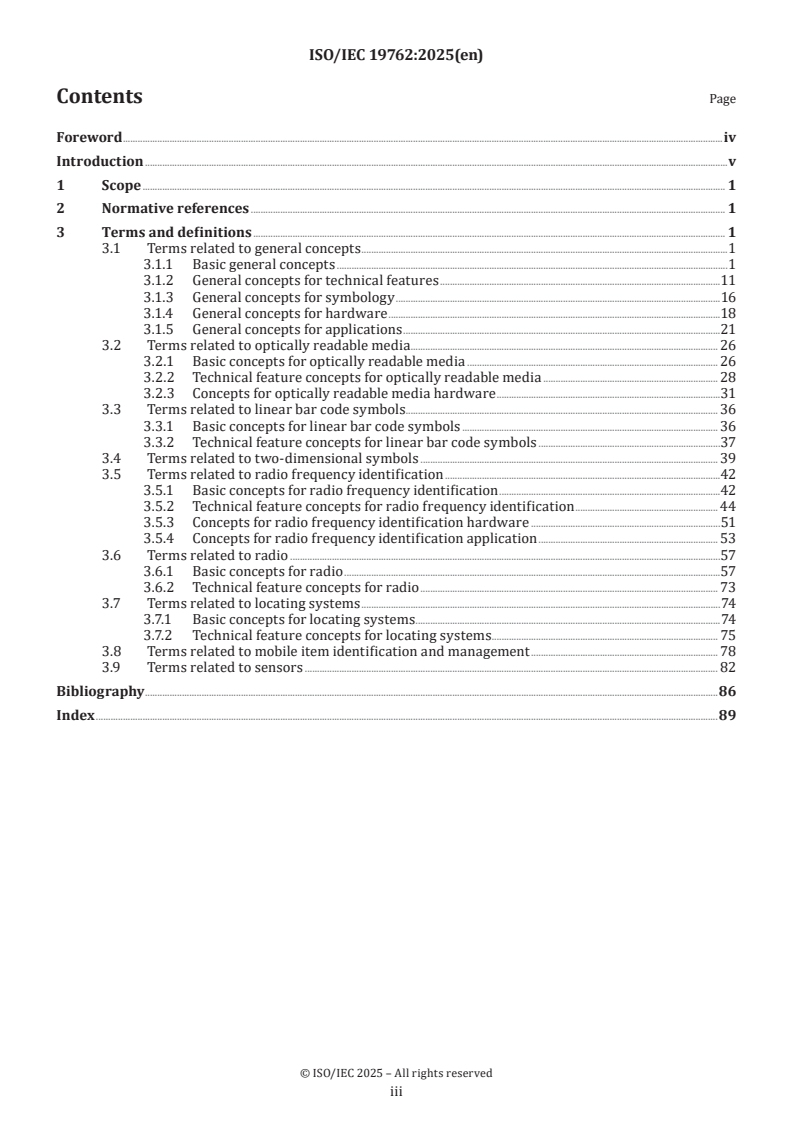
Contents Page
Foreword .iv
Introduction .v
1 Scope . 1
2 Normative references . 1
3 Terms and definitions . 1
3.1 Terms related to general concepts .1
3.1.1 Basic general concepts .1
3.1.2 General concepts for technical features .11
3.1.3 General concepts for symbology .16
3.1.4 General concepts for hardware .18
3.1.5 General concepts for applications .21
3.2 Terms related to optically readable media . 26
3.2.1 Basic concepts for optically readable media . 26
3.2.2 Technical feature concepts for optically readable media . 28
3.2.3 Concepts for optically readable media hardware .31
3.3 Terms related to linear bar code symbols . 36
3.3.1 Basic concepts for linear bar code symbols . 36
3.3.2 Technical feature concepts for linear bar code symbols .37
3.4 Terms related to two-dimensional symbols . 39
3.5 Terms related to radio frequency identification .42
3.5.1 Basic concepts for radio frequency identification .42
3.5.2 Technical feature concepts for radio frequency identification . 44
3.5.3 Concepts for radio frequency identification hardware .51
3.5.4 Concepts for radio frequency identification application . 53
3.6 Terms related to radio .57
3.6.1 Basic concepts for radio .57
3.6.2 Technical feature concepts for radio . 73
3.7 Terms related to locating systems .74
3.7.1 Basic concepts for locating systems .74
3.7.2 Technical feature concepts for locating systems . 75
3.8 Terms related to mobile item identification and management . 78
3.9 Terms related to sensors . 82
Bibliography .86
Index .89
© ISO/IEC 2025 – All rights reserved
iii
Foreword
ISO (the International Organization for Standardization) and IEC (the International Electrotechnical
Commission) form the specialized system for worldwide standardization. National bodies that are
members of ISO or IEC participate in the development of International Standards through technical
committees established by the respective organization to deal with particular fields of technical activity.
ISO and IEC technical committees collaborate in fields of mutual interest. Other international organizations,
governmental and non-governmental, in liaison with ISO and IEC, also take part in the work.
The procedures used to develop this document and those intended for its further maintenance are described
in the ISO/IEC Directives, Part 1. In particular, the different approval criteria needed for the different types
of document should be noted. This document was drafted in accordance with the editorial rules of the ISO/
IEC Directives, Part 2 (www.iso.org/directives or www.iec.ch/members_experts/refdocs).
ISO and IEC draw attention to the possibility that the implementation of this document may involve the
use of (a) patent(s). ISO and IEC take no position concerning the evidence, validity or applicability of any
claimed patent rights in respect thereof. As of the date of publication of this document, ISO and IEC had not
received notice of (a) patent(s) which may be required to implement this document. However, implementers
are cautioned that this may not represent the latest information, which may be obtained from the patent
database available at www.iso.org/patents and https://patents.iec.ch. ISO and IEC shall not be held
responsible for identifying any or all such patent rights.
Any trade name used in this document is information given for the convenience of users and does not
constitute an endorsement.
For an explanation of the voluntary nature of standards, the meaning of ISO specific terms and expressions
related to conformity assessment, as well as information about ISO's adherence to the World Trade
Organization (WTO) principles in the Technical Barriers to Trade (TBT) see www.iso.org/iso/foreword.html.
In the IEC, see www.iec.ch/understanding-standards.
This document was prepared by Joint Technical Committee ISO/IEC JTC 1, Information technology,
Subcommittee SC 31, Automatic identification and data capture techniques.
This second edition cancels and replaces the first edition of ISO/IEC 19762:2016, which has been technically
revised.
The main changes are as follows:
— French, Russian, Germany and Korean terms have been deleted;
— outdated terms have been deleted;
— the sources in terminological entries have been updated;
— the abbreviated terms have been updated and moved to Annex A.
Any feedback or questions on this document should be directed to the user’s national standards
body. A complete listing of these bodies can be found at www.iso.org/members.html and
www.iec.ch/national-committees.
© ISO/IEC 2025 – All rights reserved
iv
Introduction
This document is intended to facilitate international communication in information technology, specifically
in the area of automatic identification and data capture (AIDC) techniques by defining terms used across
multiple AIDC techniques.
© ISO/IEC 2025 – All rights reserved
v
International Standard ISO/IEC 19762:2025(en)
Information technology — Automatic identification and data
capture (AIDC) techniques — Vocabulary
1 Scope
This document defines general terms used in automatic identification and data capture (AIDC) on which are
based further specialized sections in various technical fields, as well as the essential terms to be used by
non-specialist users in communication with specialists in AIDC.
2 Normative references
There are no normative references in this document.
3 Terms and definitions
ISO and IEC maintain terminology databases for use in standardization at the following addresses:
— ISO Online browsing platform: available at https:// www .iso .org/ obp
— IEC Electropedia: available at https:// www .electropedia .org/
3.1 Terms related to general concepts
3.1.1 Basic general concepts
3.1.1.1
bit
binary digit
either of the digits 0 or 1 when used in the binary numeration system
3.1.1.2
information bit
bit (3.1.1.1) used for the representation of user data, rather than for control purposes
3.1.1.3
least significant bit
LSB
bit (3.1.1.1) position having the smallest weight used in positional notation
3.1.1.4
most significant bit
MSB
bit (3.1.1.1) position having the largest weight used in positional notation
3.1.1.5
byte
string that consists of a number of bits (3.1.1.1), treated as a unit, and usually representing a character or a
part of a character
Note 1 to entry: The number of bits in a byte is fixed for a given data processing system.
Note 2 to entry: The number of bits in a byte is usually 8.
© ISO/IEC 2025 – All rights reserved
Note 3 to entry: A byte is often eight logical data bits, but can include error detection or correction bits.
Note 4 to entry: 8 bits of data designated b1 to b8, from the most significant bit (MSB, b8) (3.1.1.4) to the least significant
bit (LSB, b1) (3.1.1.3).
3.1.1.6
hexadecimal,noun
Hex
representative data to base 16, using the numbers 0 to 9 and the letters A to F
Note 1 to entry: Used as a convenient short hand notation for representing 16 and 32 bit memory addresses.
Note 2 to entry: A popular method of representing hexadecimal is in the form 0xNN, where NN is the hexadecimal value.
EXAMPLE The number 10 is represented in hexadecimal as 'A'.
3.1.1.7
hexadecimal,adj.
characterized by a selection choice, or condition that has sixteen possible different values or states
3.1.1.8
character
member of a set of elements used by agreement, for the organization, representation or control of information
Note 1 to entry: Characters can be letters, digits, punctuation marks or other symbols and, by extension, function
controls such as space shift, carriage return or line feed contained in a message.
[SOURCE: IEC 60050-702:1992, 702-05-10]
3.1.1.9
data character
character (3.1.1.8) which represents meaningful information
Note 1 to entry: Data characters may be numeric digits, alphabetic characters, punctuation marks or control
characters.
3.1.1.10
character set
finite set of characters that is complete for a given purpose
Note 1 to entry: The international reference version of the character set is ISO/IEC 10646.
3.1.1.11
code
collection of rules that maps the elements of a first set onto the elements of a second set
Note 1 to entry: The elements of either set may be characters or character strings.
Note 2 to entry: The first set is called coded set and the second set is called code set.
Note 3 to entry: Each element of the code set may be related to more than one element of the coded set but the reverse
is not true.
3.1.1.12
code element
code value
result of applying a code to an element of a coded set
EXAMPLE "CDG" representing Paris Charles-de-Gaulle in the code for three-letter representation of airport
names; the hexadecimal number 0041 representing "Latin capital letter A" in ISO/IEC 10646.
© ISO/IEC 2025 – All rights reserved
3.1.1.13
coded character set
coded set whose elements are single characters (3.1.1.8)
EXAMPLE The characters of an alphabet when they are mapped onto a set of 7-bit strings.
3.1.1.14
coded set
set of elements that is mapped onto another set according to a code
Note 1 to entry: The characters of an alphabet when they are mapped onto a set of 7-bit strings.
3.1.1.15
numeric
denoting a character set that includes only numbers
3.1.1.16
alphanumeric
pertaining to data that consist of both letters and digits, and that can contain other characters (e.g.
punctuation marks)
3.1.1.17
digital
pertaining to data that consist of digits as well as to processes and functional units that use those data
Note 1 to entry: Digital data is presented in a binary form rather than a continuously varying analogue form.
Note 2 to entry: In the context of integrated artwork, it is produced by a number of discrete dots rather than a
continuous image.
3.1.1.18
word
character string or bit string treated as a unit for a given purpose
Note 1 to entry: The length of a computer word is defined by the computer architecture, while the words in text
processing are delimited by special characters or control characters.
Note 2 to entry: A bit string representing a word usually comprises 8, 16 or 32 bits (as used in computers).
3.1.1.19
read,verb
obtain data from an input device, from a storage device, or from
a data medium
3.1.1.20
read,noun
process of retrieving data from some data carrier (3.1.1.59)
and, as appropriate, the contention and error control (3.1.2.30) management, and channel (3.6.1.49) and
source decoding (3.6.1.52) required to recover and communicate the data entered at source
3.1.1.21
write,verb
send data to an output device, a data storage device or a data medium
3.1.1.22
encode,verb
convert data by the use of a code in such a manner that returning to the original form is possible
3.1.1.23
decode,verb
restore data from a coded representation to the original form
[SOURCE: IEC 60050-702:1992, 702-05-14]
© ISO/IEC 2025 – All rights reserved
3.1.1.24
decoding
process of restoring data from a coded representation to the original form
[SOURCE: IEC 60050-702:1992, 702-05-15]
3.1.1.25
incorrect read
misread
condition that exists when the data retrieved by the reader or interrogator (3.5.3.8) is different from the
corresponding data within the data carrier (3.1.1.59)
3.1.1.26
data coding
baseband data bit representation, or mapping of logical data bits to physical signals
3.1.1.27
data compaction
mechanism or algorithm (3.1.1.54) to process the original data so that it is represented efficiently in as few
code words as possible
3.1.1.28
data field
defined area of memory assigned to a particular item or items of data
3.1.1.29
message(1)
unit of information transmitted from a source to a destination
3.1.1.30
message(2)
ordered sequence of characters intended to convey
information
3.1.1.31
record
set of data elements treated as a unit
3.1.1.32
file
named set of records treated as a unit
Note 1 to entry: Files are stored within a computer, portable data terminal or information management system.
3.1.1.33
tag
language element in a mark-up language used for structuring data text or objects
EXAMPLE Start-tags, end-tags.
3.1.1.34
semantics
means by which the purpose of a field of data is identified
EXAMPLE The semantic examples used in automatic data capture include:
— ISO/IEC 15418/ANS MH10 Data Identifiers [MH10 is an acronym assigned to the Accredited Standards
Committee (ASC – a committee that has been accredited under the procedures of the American National
Standards Institute) for the Material Handling Industry whose scope is to facilitate freight movement
within transportation and distribution systems for transport-packages and unit-loads, including their
dimensions, definitions, terminology, coding, labelling and performance criteria; and to represent
© ISO/IEC 2025 – All rights reserved
the United States interests within the scope of ISO/TC 122. Contact: MHI, 8720 Red Oak Blvd., Suite
201|Charlotte, NC 28217, Phone: (704) 676-1190, https:// www .mhi .org/ ],
— GS1 Application Identifiers (GS1 is a worldwide coding management organization for identification
numbers, encompassing the associations previously known as EAN International and Uniform Code
Council. The GS1 System is maintained through a network of national and pluri-national agencies known
as Member Organizations.),
— X12/EDIFACT/CII EDI Data Element Qualifiers.
3.1.1.35
syntax
way in which data is put together to form messages, including rules governing the use of appropriate
identifiers, delimiters, separator character(s) and other non-data characters within the message
Note 1 to entry: Syntax is the equivalent to grammar in spoken language.
EXAMPLE The syntactic examples used in automaticdata capture (3.1.1.40) include ISO/IEC 15434.
3.1.1.36
automatic identification and data capture
AIDC
automatic identification of items, collecting data about them, and entering that data directly into computer
systems, eliminating manual entry
Note 1 to entry: Automatic identification and automatic data capture is carried out by means of bar codes, which can
be linear or two-dimensional symbols, radio frequency identification (3.5.1.1) and real time locating systems (3.7.1.1)
tags/chips (3.6.1.111).
[SOURCE: ISO 18530:2021, 3.2, modified — "methods or technologies for" has been deleted from the
definition and Note 1 to entry has been replaced.]
3.1.1.37
data capture
deliberate action that results in the registration of a record into a record keeping system
[SOURCE: ISO 18530:2021, 3.3]
3.1.1.38
automatic identification system
system for achieving accurate and unambiguous identification of a data bearing label, tag, transponder
(3.6.2.4) or a natural/prescribed feature, the data or feature being interrogated by means of a system
appropriate source
[SOURCE: ISO 21007-1:2005, 2.7]
3.1.1.39
automatic data capture media
ADC media
data carrier (3.1.1.59) that permits the direct transfer of information to a data processing system via
machine reading, without operator intervention
Note 1 to entry: Bar code, radio frequency identification, optical character recognition and real time locating systems
(3.7.1.1) are technologies of machine reading. The data is usually contained in pre-defined locations (fields) within a
data stream. This data can be interpreted by a computer program.
3.1.1.40
automatic data capture
ADC
means for automatic data capture (3.1.1.37)
Note 1 to entry: Automatic data capture is the set of means for creating, gathering, storing and retrieving item
identities and attributes.
© ISO/IEC 2025 – All rights reserved
3.1.1.41
human-readable information
text that appears with and is associated with automatic data capture media (3.1.1.39) and is intended to be
conveyed to a person
Note 1 to entry: Human-readable information appears typically on a label (e.g. bar code, two-dimensional symbol
(3.4.1), radio frequency tag).
Note 2 to entry: There are four types of human-readable information:
— human-readable interpretation (3.1.1.42),
— human translation (3.1.1.43),
— data area titles (3.1.1.44),
— free text (3.1.1.45) and data.
3.1.1.42
human-readable interpretation
linear bar code or two-dimensional symbol (3.4.1) information provided adjacent to a linear bar code,
representing the encoded data within a symbol
3.1.1.43
human translation
human-readable information provided within proximity of the automatic data capture media (3.1.1.39),
representing portions of the information encoded and data field descriptions not encoded in the symbols
3.1.1.44
data area title
data areas comprised of information in machine-readable or human-readable form
Note 1 to entry: Data areas are identified with the corresponding data area title in human-readable text that can be
prefixed, if relevant, by the appropriate identifier.
3.1.1.45
free text
human-readable information other than what is encoded in the automatic data capture media (3.1.1.39)
Note 1 to entry: This information can be needed by one or more users of the label.
EXAMPLE Product description.
3.1.1.46
human-readable character
representation of a bar code (3.2.1.4), data character (3.1.1.9) or data check character (3.1.2.32) in a standard
eye-readable alphabet or numerals, as distinct from its machine-readable representation
3.1.1.47
electronic data interchange
EDI
exchange of data and documents between computer systems according to standard rules
3.1.1.48
item(1)
smallest identifiable entity within an application
3.1.1.49
item(2)
data item
element of a set of data
EXAMPLE A file can consist of a number of items such as records, which, in turn, can consist of other items.
© ISO/IEC 2025 – All rights reserved
3.1.1.50
item(3)
single physical entity or a defined collection of entities having a distinct existence
3.1.1.51
unique item identifier
UII
identification mechanism that uniquely identifies a specific entity (e.g. a product, transport unit, returnable
asset) during its life within a particular domain and scope of a code system
Note 1 to entry: When used with a given data protocol, the particular object identifier that defines the unique item
identifier relies on the fact that each instance of its object is unique and unambiguous with all other related objects.
Note 2 to entry: As the object is unique, its use in the radio frequency tag confers uniqueness to the radio frequency
tag itself.
Note 3 to entry: ISO/IEC 18000-63 and ISO/IEC 18000-3, mode 3. The unique item identifier can be found in Memory
Bank “01” (MB01) beginning a memory location 0x20.
3.1.1.52
license plate concept
concept where the fixed code contained in an automatic data capture media (3.1.1.39) is used as a pointer
into a database
Note 1 to entry: The license plate concept is similar to the way in which the police can determine the name, address,
etc., of a person, from a car number plate.
3.1.1.53
font
set of characters of a specific style and size of graphic type
Note 1 to entry: In text processing, font is a set of characters of the same size and style; for example, 9-point Helvetica.
Note 2 to entry: The term font is also used analogously to refer to the set of bar code symbol characters for a symbology
(3.2.1.3) in on-demand printing equipment.
3.1.1.54
algorithm
finite ordered set of well-defined rules for the solution of a problem
3.1.1.55
programmer
person who designs, writes and tests programs
3.1.1.56
programming
designing, writing, modifying and testing of programs
3.1.1.57
tolerance
maximum permissible deviation of a system parameter value, caused by any system or environmental
influence or impact
Note 1 to entry: Tolerances are specified for a number of radio frequency parameters, including carrier frequencies,
sub-carriers, bit clocks and symbol clocks.
3.1.1.58
nominal
value at which a system is designed to assure optimal operation
© ISO/IEC 2025 – All rights reserved
3.1.1.59
data carrier
device or medium used to store data as a relay mechanism in an automatic identification and data capture
(3.1.1.36) system
EXAMPLE Bar code, optical character recognition character string, radio frequency tag.
3.1.1.60
leading zero
zero in a more significant digit place than the digit place of the most significant nonzero
digit of a numeral
3.1.1.61
leading zero
one or more zeros at the leading left of a numeric character string
3.1.1.62
zero-suppression
elimination of non-significant zeros from a numeral
Note 1 to entry: It can also be considered a function that allows the process by which unwanted zeros are omitted
from the printed or displayed result of a calculation.
3.1.1.63
distortion
unwarranted change in the form or intelligibility of a signal
Note 1 to entry: The distortion exhibits a noise-like effect that can be quantified as the ratio of the magnitude of the
distortion component to the magnitude of the undistorted signal, usually expressed as a percentage.
Note 2 to entry: Distortion is caused by undesired changes in the features of an image or waveform.
3.1.1.64
filler character
pad character
character inserted to extend an item of data to achieve a desired length
3.1.1.65
ID. filter
identification filter
software facility that compares a newly read identification (ID) with those within a database or set, with a
view to establishing a match
3.1.1.66
nominal range
range at which a system can assure reliable operation, considering the normal variability of the environment
in which it is used
3.1.1.67
query
electronic request of information from one or more sources
Note 1 to entry: A request to extract data directly or to derive them from a database, based on specified conditions.
Note 2 to entry: A request to a reservation system for availability of a seat on a specific flight is an example of a query,
as well as an electronic request of information from one or more sources.
3.1.1.68
readability
ability to retrieve data under specified conditions
© ISO/IEC 2025 – All rights reserved
3.1.1.69
resolution
smallest distance between indications of a measures attribute that can be meaningfully distinguished
Note 1 to entry: The attribute may be amplitude, colour distance, etc.
3.1.1.70
selection
operation of relational algebra that forms a new relation which is a subset of the entity occurrences from a
given relation
Note 1 to entry: In a relation of “books” containing the attributes “author” and “title”, the formation of a list of the titles
of the books written by a particular author.
3.1.1.71
service
software program that provides responses to requests from other software programs, which are frequently
on other remotely connected computers
3.1.1.72
time-slot
cyclic time interval that can be recognized and defined uniquely
[SOURCE: IEC 60050-704:1993, 704-13-08]
3.1.1.73
timing information
information pertaining to the timing relationship of several series of events and
which is conveyed by and/or derived from synchronization signals, timing signals or time-scales embedded
in digital signals
[SOURCE: IEC 60050-704:1993, 704-15-09]
3.1.1.74
verification
comparing an activity, a process or a product with the corresponding requirements or specifications, and
confirmation by examination and provisions of objective evidence that specified requirements have been
fulfilled
Note 1 to entry: Verification can also be defined as act of reviewing, inspecting, testing, checking, auditing or
otherwise establishing and documenting whether or not items, processes, services or documents conform to specified
requirements.
3.1.1.75
range
maximum distance at which a scanning device can successfully
read (3.1.1.19) a symbol or tag of given characteristics, equal to the sum of optical throw and depth of field
for linear and two-dimensional bar code (3.4.1)
3.1.1.76
data identifier
DI
specified character or string of characters that defines the intended use of the data element that follows
Note 1 to entry: For the purposes of automatic data capture technologies, data identifier means the alphanumeric
[ ]
identifiers, as defined in ISO/IEC 15418 and ANSI MH10.8.2 42 (American National Standards Institute (ANSI) is a
non-governmental organization responsible for the coordination of voluntary national (United States) standards.
Contact: ANSI, 25 West 43rd Street, 4th floor, New York, NY 10036, USA. Tel: 1.212.642.4900, Fax: 1.212.398.0023,
https:// www .ansi .org/ ).
© ISO/IEC 2025 – All rights reserved
3.1.1.77
application identifier
AI
GS1 prefix that defines the meaning and purpose of the data element that follows, as defined in ISO/IEC 15418
[41]
and GS1 General Specifications
3.1.1.78
octet
DEPRECATED: byte
ordered sequence of eight bits considered as a unit, equivalent to an 8-bit byte
3.1.1.79
interoperability
condition that exists between systems, from different vendors, to execute bi-
directional data exchange functions, in a manner that allows them to operate effectively together
3.1.1.80
interoperability
guarantee of a certain level of compatibility between different implementations
of the same standard
Note 1 to entry: The desired level of compatibility is specific to a given standard and can be limited to basic services.
Interconnection and interoperability are the main objectives of standardization.
3.1.1.81
compatibility
suitability of products, processes or services for use together under specific conditions to fulfil relevant
requirements without causing unacceptable interactions
Note 1 to entry: Interchangeability (3.6.1.109), interoperability and non-interference are differing levels (or degrees)
of compatibility.
3.1.1.82
duplicate read
more than one inadvertently readings of the same data carrier (3.1.1.59) when the intention was to read it once
3.1.1.83
schema
formalism for representing knowledge about a simple concept, an entity or a class of objects by means of its
possible uses
Note 1 to entry: The schema shows ways of using a concept. It does not describe typical instances of that concept.
3.1.1.84
data content
data stored in an automatic identification and data capture (3.1.1.36) data carrier (3.1.1.59)
3.1.1.85
cryptography
crypto
discipline that embodies the principles, means and methods for the transformation of data in order to hide
their semantic content, prevent their unauthorized use or prevent their undetected modification
3.1.1.86
internet of things
IoT
infrastructure of interconnected entities, people, systems and information resources together with services
which processes and reacts to information from the physical world and virtual world
© ISO/IEC 2025 – All rights reserved
3.1.1.87
monomorphic
singular uniform data structure stored over one or more memory locations of an automatic identification
and data capture (3.1.1.36)data carrier (3.1.1.59)
3.1.2 General concepts for technical features
3.1.2.1
baud
unit of modulation (3.6.1.20) rate equal to the number of signal elements per second where all such elements
are of equal length and each element represents one or more bits
Note 1 to entry: For some modems operating at or above 1200 bit/s the modulation rate, expressed in bauds, is usually
less than the bit rate because more than one bit is conveyed per signal element.
3.1.2.2
error correcting code
error detecting code (3.1.2.2) which permits the automatic correction of some of the errors detected
3.1.2.3
error detecting code
redundant code in which the rules of construction permit the automatic detection of certain errors which
have been produced during recording, processing or transfer of information, when these errors have caused
a deviation from the rules
[SOURCE: IEC 60050-702:1992, 702-05-19]
3.1.2.4
packet
block of data sent over a communication link
Note 1 to entry: Each packet may contain sender, receiver and error control information, in addition to the actual
message. Packets can be fixed- or variable-length, and they are reassembled, if necessary, when they reach their
destination.
3.1.2.5
packet
sequence of bits arranged in a specific format, containing control data and possibly
user data, and that is transmitted and switched as a whole
3.1.2.6
full-duplex transmission
FDX
data transmission in both directions at the same time
Note 1 to entry: specific communication protocol name for an ISO/IEC 18000-2, Type A RFID tag, in which the data is
communicated while the transceiver (3.6.2.8) transmits the activation field
3.1.2.7
half-duplex transmission
HDX
data transmission in either direction, one direction at a time
Note 1 to entry: In RFID, HDX refers as the specific communication protocol for ISO/IEC 18000-2, Type A RFID tags/
readers.
3.1.2.8
protocol
set of rules that determines the behaviour of functional units in achieving
communication
© ISO/IEC 2025 – All rights reserved
3.1.2.9
data transfer rate
actual transfer rate
average number of bits, characters or blocks transferred per unit time between two points
Note 1 to entry: The rate at which data is communicated between transponder (3.6.2.4) and the reader/interrogator
(3.5.3.9).
Note 2 to entry: Typical units are bits per second or bytes per second.
3.1.2.10
logical link control
LLC
higher component of the Data Link - Layer 2 in the OSI model that is primarily responsible for addressing
and providing end-to-end error control and end-to-end flow control
3.1.2.11
logical link control protocol
LLC protocol
protocol that governs the exchange of frames between data stations independently of
how the transmission medium is shared
3.1.2.12
spectrum
set of sinusoidal oscillations representing in the frequency domain a time-varying signal
or noise, each oscillation being characterized by its frequency, its amplitude and its initial phase
[SOURCE: IEC 60050-702:1992, 702-04-40]
3.1.2.13
memory partition
segmentation of an electronic memory to provide multiple levels of information
3.1.2.14
data transmission
transfer of data from one point to one or more other points over telecommunication facilities
3.1.2.15
synchronization
process of adjusting clock frequencies to achieve synchronism of two time-varying phenomena, time-scales
or signals
[SOURCE: IEC 60050-704:1993, 704-13-17]
3.1.2.16
scrambling
rearrangement or transposition of data to enhance security of stored data or the effectiveness of error
control schemes
3.1.2.17
reading angle
angle that characterizes the angular rotation of a symbol in an axis relative to a
scan line
3.1.2.18
reflectance factor
R
Note 1 to entry: quotient of the flux reflected in the directions delimited by a given cone with apex at a surface element,
Φ , and the flux reflected in the same directions by a perfect reflecting diffuser identically irradiated or illuminated,
n
Φ , which conform to the formula of R = Φ / Φ
d n d
© ISO/IEC 2025 – All rights reserved
Note 2 to entry: The definition holds for a surface element, for the part of the reflected radiation contained in a given
cone with apex at the surface element, and for incident radiation of given spectral composition, polarization and
geometric distribution.
Note 3 to entry: The reflectance factor is also defined spectrally and is called spectral reflectance factor, R(λ).
Note 4 to entry: The ideal isotropic (Lambertian) diffuser with reflectance or transmittance equal to 1 is called a
perfect diffuser.
Note 5 to entry: For regularly reflecting surfaces that are irradiated or illuminated by a beam of small solid angle, the
reflectance factor can be much larger than one if the cone includes the mirror image of the source.
Note 6 to entry: If the solid angle of the cone approaches 2 π sr, the reflectance factor approaches the reflectance
(3.2.2.8) for the same conditions of irradiation.
Note 7 to entry: If the solid angle of the cone approaches 0 sr, the reflectance factor approaches the radiance factor or
luminance factor for the same conditions of irradiation.
Note 8 to entry: The reflectance factor has unit one.
[SOURCE: IEC 60050-845:2020, 845-24-070, modified — the formula has been included in the definition.]
3.1.2.19
handshaking
mechanism for the regulation of the flow of data between devices, achieved by both hardware and
software methods
EXAMPLE Request to send / clear to send (RTS/CTS) and software techniques, for example, Xon/Xoff.
Note 1 to entry: Handshaking can involve protocols and procedures used by two computers or a computer and a
peripheral device for establishing communications.
3.1.2.20
multiplexing
reversible process for assembling signals from several separate sources into a single composite signal
for transmission over a common transmission channel (3.6.1.49), or for dividing the common channel into
distinct channels for transmitting independent signals in the same direction
[SOURCE: IEC 60050-701:1988, 701-03-09]
3.1.2.21
multiplexer
data multiplexer
controller
functional unit for assembling signals from separate sources into a single
composite signal
3.1.2.22
frame