

ISO/TS 19883:2017
(Main)Safety of pressure swing adsorption systems for hydrogen separation and purification
General Information
- Abstract
ISO/TS 19883:2017 identifies safety measures and applicable design features that are used in the design, commissioning, and operation of pressure swing adsorption systems for hydrogen separation and purification. It applies to hydrogen pressure swing adsorption systems that process all kinds of impure hydrogen streams as feed, including both stationary and skid-mounted pressure swing adsorption systems for hydrogen separation and purification in commercial or industrial use. This document also applies to small-scale PSA hydrogen system installed within containers, where allowed by local regulations.
- Status
- Published
- Publication Date
- 20-Mar-2017
- Technical Committee
- ISO/TC 197 - Hydrogen technologies
- Drafting Committee
- ISO/TC 197 - Hydrogen technologies
- Current Stage
- 9060 - Close of review
- Completion Date
- 02-Sep-2027
Buy Documents

ISO/TS 19883:2017 - Safety of pressure swing adsorption systems for hydrogen separation and purification Released:3/21/2017

ISO/TS 19883:2017 - Safety of pressure swing adsorption systems for hydrogen separation and purification/21/2017
Overview
ISO/TS 19883:2017 - "Safety of pressure swing adsorption systems for hydrogen separation and purification" - defines safety measures and design features for the design, commissioning and operation of hydrogen pressure swing adsorption (PSA) systems. It applies to stationary, skid‑mounted and certain small containerized PSA units processing impure hydrogen feed streams for commercial or industrial use. The technical specification addresses equipment within the PSA system envelope (adsorbers, buffer tanks, valves, piping, control and monitoring).
Key Topics
- Scope & definitions: PSA method, vacuum‑PSA (VSA), adsorber, adsorbent, buffer tank, tail gas, skid vs stationary systems.
- Operating ranges: Typical feed pressures 0.3–6.0 MPa; desorption to near atmospheric (
0.03 MPa) or vacuum (−0.09 MPa); normal working temperature 5 °C–40 °C. - Material compatibility and hydrogen embrittlement: Selection and testing of metallic and non‑metallic materials (references to ISO 11114 series and ISO/TR 15916).
- Hazard identification: Hydrogen properties (colourless, odourless, nearly invisible flame; explosive limits ~4 %–75 % by volume), leakage and buoyancy issues, pressure‑related stress and rapid energy release, ignition effects on system integrity.
- Field safety requirements: Layout, ventilation, fire‑separation distances, explosion‑proof area classification, electrostatic grounding, and flammable/toxic gas detection and alarms.
- Equipment & piping specifications: Safety provisions for adsorbers, buffer tanks, process control valves, piping design, relief valve placement (informative annex), electrical equipment, monitoring devices, inspection, testing, and maintenance practices.
Applications
ISO/TS 19883:2017 is used by:
- System designers and OEMs specifying PSA units for hydrogen separation and purification.
- Plant engineers and integrators for safe layout, ventilation and explosion‑proofing of hydrogen PSA installations.
- Commissioning teams and operators to meet safety requirements during startup, operation and maintenance.
- Safety engineers, inspectors and regulators assessing compliance and material selection against hydrogen embrittlement and leak risks.
Practical benefits include reduced risk of fire/explosion, informed material choices, clearer requirements for control/electrical systems, and guidance for safe siting of stationary, skid‑mounted or containerized PSA hydrogen systems.
Related standards
Normative references include:
- ISO 4126‑1 (safety valves), ISO 11114‑1/2/4 (material compatibility with hydrogen), ISO/TR 15916 (health and safety aspects of hydrogen), and IEC standards for explosive atmospheres (IEC 60079 series), IEC 60204‑1, IEC 60529, IEC 60364‑4, plus NFPA 56.
Keywords: ISO/TS 19883:2017, pressure swing adsorption, PSA, hydrogen separation, hydrogen purification, safety, hydrogen embrittlement, material compatibility, explosion‑proof, ventilation.
Buy Documents
ISO/TS 19883:2017 - Safety of pressure swing adsorption systems for hydrogen separation and purification Released:3/21/2017
ISO/TS 19883:2017 - Safety of pressure swing adsorption systems for hydrogen separation and purification/21/2017
Get Certified
Connect with accredited certification bodies for this standard

ECOCERT
Organic and sustainability certification.

Eurofins Food Testing Global
Global leader in food, environment, and pharmaceutical product testing.

Intertek Bangladesh
Intertek certification and testing services in Bangladesh.
Sponsored listings
Frequently Asked Questions
ISO/TS 19883:2017 is a technical specification published by the International Organization for Standardization (ISO). Its full title is "Safety of pressure swing adsorption systems for hydrogen separation and purification". This standard covers: ISO/TS 19883:2017 identifies safety measures and applicable design features that are used in the design, commissioning, and operation of pressure swing adsorption systems for hydrogen separation and purification. It applies to hydrogen pressure swing adsorption systems that process all kinds of impure hydrogen streams as feed, including both stationary and skid-mounted pressure swing adsorption systems for hydrogen separation and purification in commercial or industrial use. This document also applies to small-scale PSA hydrogen system installed within containers, where allowed by local regulations.
ISO/TS 19883:2017 identifies safety measures and applicable design features that are used in the design, commissioning, and operation of pressure swing adsorption systems for hydrogen separation and purification. It applies to hydrogen pressure swing adsorption systems that process all kinds of impure hydrogen streams as feed, including both stationary and skid-mounted pressure swing adsorption systems for hydrogen separation and purification in commercial or industrial use. This document also applies to small-scale PSA hydrogen system installed within containers, where allowed by local regulations.
ISO/TS 19883:2017 is classified under the following ICS (International Classification for Standards) categories: 71.100.20 - Gases for industrial application. The ICS classification helps identify the subject area and facilitates finding related standards.
ISO/TS 19883:2017 is available in PDF format for immediate download after purchase. The document can be added to your cart and obtained through the secure checkout process. Digital delivery ensures instant access to the complete standard document.
Standards Content (Sample)
TECHNICAL ISO/TS
SPECIFICATION 19883
First edition
2017-03
Safety of pressure swing adsorption
systems for hydrogen separation and
purification
Système d’adsorption modulée en pression pour la séparation et la
purification de l’hydrogène
Reference number
©
ISO 2017
© ISO 2017, Published in Switzerland
All rights reserved. Unless otherwise specified, no part of this publication may be reproduced or utilized otherwise in any form
or by any means, electronic or mechanical, including photocopying, or posting on the internet or an intranet, without prior
written permission. Permission can be requested from either ISO at the address below or ISO’s member body in the country of
the requester.
ISO copyright office
Ch. de Blandonnet 8 • CP 401
CH-1214 Vernier, Geneva, Switzerland
Tel. +41 22 749 01 11
Fax +41 22 749 09 47
copyright@iso.org
www.iso.org
ii © ISO 2017 – All rights reserved
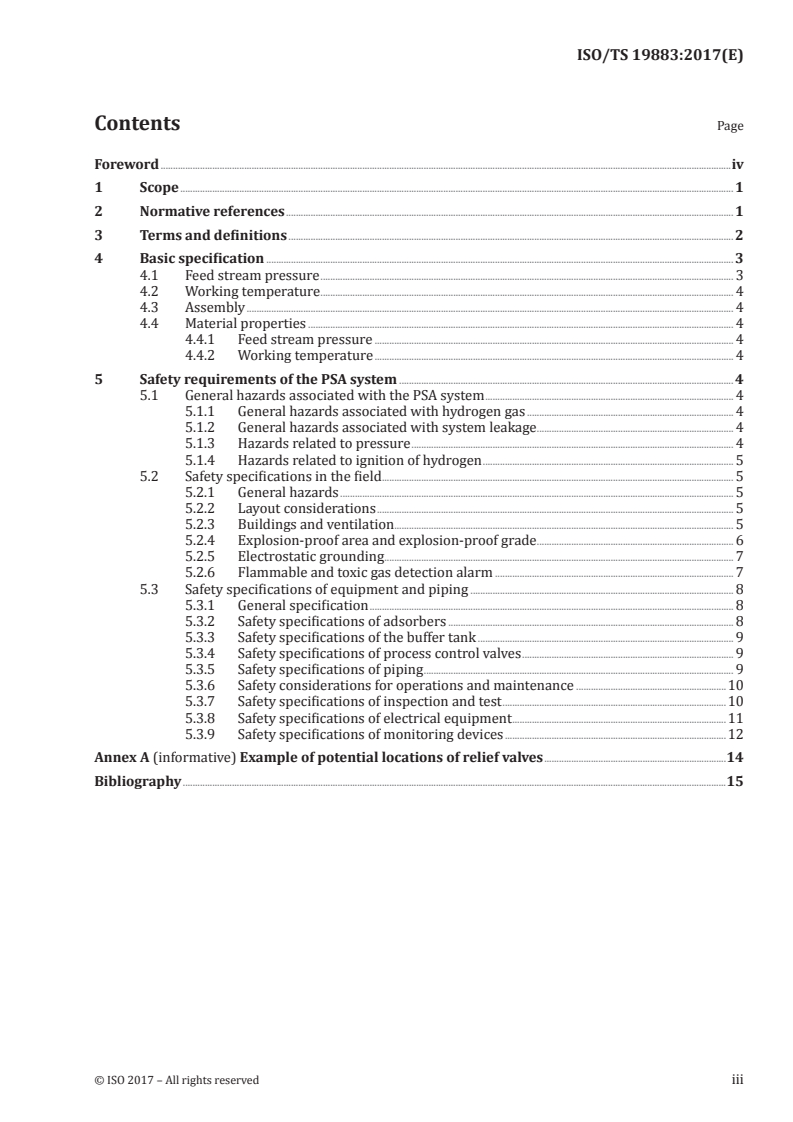
Contents Page
Foreword .iv
1 Scope . 1
2 Normative references . 1
3 Terms and definitions . 2
4 Basic specification . 3
4.1 Feed stream pressure . 3
4.2 Working temperature . 4
4.3 Assembly . 4
4.4 Material properties . 4
4.4.1 Feed stream pressure . 4
4.4.2 Working temperature . 4
5 Safety requirements of the PSA system . 4
5.1 General hazards associated with the PSA system . 4
5.1.1 General hazards associated with hydrogen gas . 4
5.1.2 General hazards associated with system leakage . 4
5.1.3 Hazards related to pressure . 4
5.1.4 Hazards related to ignition of hydrogen . 5
5.2 Safety specifications in the field . 5
5.2.1 General hazards . 5
5.2.2 Layout considerations . 5
5.2.3 Buildings and ventilation. 5
5.2.4 Explosion-proof area and explosion-proof grade . 6
5.2.5 Electrostatic grounding . . 7
5.2.6 Flammable and toxic gas detection alarm . 7
5.3 Safety specifications of equipment and piping . 8
5.3.1 General specification . 8
5.3.2 Safety specifications of adsorbers . 8
5.3.3 Safety specifications of the buffer tank . 9
5.3.4 Safety specifications of process control valves . 9
5.3.5 Safety specifications of piping . 9
5.3.6 Safety considerations for operations and maintenance .10
5.3.7 Safety specifications of inspection and test .10
5.3.8 Safety specifications of electrical equipment .11
5.3.9 Safety specifications of monitoring devices .12
Annex A (informative) Example of potential locations of relief valves .14
Bibliography .15
Foreword
ISO (the International Organization for Standardization) is a worldwide federation of national standards
bodies (ISO member bodies). The work of preparing International Standards is normally carried out
through ISO technical committees. Each member body interested in a subject for which a technical
committee has been established has the right to be represented on that committee. International
organizations, governmental and non-governmental, in liaison with ISO, also take part in the work.
ISO collaborates closely with the International Electrotechnical Commission (IEC) on all matters of
electrotechnical standardization.
The procedures used to develop this document and those intended for its further maintenance are
described in the ISO/IEC Directives, Part 1. In particular the different approval criteria needed for the
different types of ISO documents should be noted. This document was drafted in accordance with the
editorial rules of the ISO/IEC Directives, Part 2 (see www .iso .org/ directives).
Attention is drawn to the possibility that some of the elements of this document may be the subject of
patent rights. ISO shall not be held responsible for identifying any or all such patent rights. Details of
any patent rights identified during the development of the document will be in the Introduction and/or
on the ISO list of patent declarations received (see www .iso .org/ patents).
Any trade name used in this document is information given for the convenience of users and does not
constitute an endorsement.
For an explanation on the meaning of ISO specific terms and expressions related to conformity assessment,
as well as information about ISO’s adherence to the World Trade Organization (WTO) principles in the
Technical Barriers to Trade (TBT) see the following URL: www . i so .org/ iso/ foreword .html.
This document was prepared by Technical Committee ISO/TC 197, Hydrogen technologies.
iv © ISO 2017 – All rights reserved
TECHNICAL SPECIFICATION ISO/TS 19883:2017(E)
Safety of pressure swing adsorption systems for hydrogen
separation and purification
1 Scope
This document identifies safety measures and applicable design features that are used in the design,
commissioning, and operation of pressure swing adsorption systems for hydrogen separation and
purification. It applies to hydrogen pressure swing adsorption systems that process all kinds of impure
hydrogen streams as feed, including both stationary and skid-mounted pressure swing adsorption
systems for hydrogen separation and purification in commercial or industrial use. This document
also applies to small-scale PSA hydrogen system installed within containers, where allowed by local
regulations.
The scope of this document includes the equipment depicted within the dashed lines in Figure 1.
Figure 1 — Example of typical equipment in PSA system for hydrogen separation and
purification
2 Normative references
The following documents are referred to in the text in such a way that some or all of their content
constitutes requirements of this document. For dated references, only the edition cited applies. For
undated references, the latest edition of the referenced document (including any amendments) applies.
ISO 4126-1, Safety devices for protection against excessive pressure — Part 1: Safety valves
ISO 11114-1, Gas cylinders — Compatibility of cylinder and valve materials with gas contents — Part 1:
Metallic materials
ISO 11114-2, Gas cylinders — Compatibility of cylinder and valve materials with gas contents — Part 2:
Non-metallic materials
ISO 11114-4, Transportable gas cylinders - Compatibility of cylinder and valve materials with gas
contents — Part 4: Test methods for selecting metallic materials resistant to hydrogen embrittlement
IEC 60079-0, Explosive atmospheres — Part 0: Equipment — General requirements
IEC 60079-10-1, Explosive atmospheres — Part 10-1: Classification of areas — Explosive gas atmospheres
IEC 60079-14, Explosive atmospheres — Part 14: Electrical installations design, selection and erection
IEC 60204-1, Safety of machinery — Electrical equipment of machines — Part 1: General requirements
IEC 60529, Degrees of protection provided by enclosures (IP Code)
IEC 60364-4, Low-voltage electrical installations — Part 4: Protection for safety
NFPA 56, Standard for Fire and Explosion Prevention during Cleaning and Purging of Flammable Gas
Piping Systems
3 Terms and definitions
For the purposes of this document, the following terms and definitions apply.
ISO and IEC maintain terminological databases for use in standardization at the following addresses:
— IEC Electropedia: available at http:// www .electropedia .org/
— ISO Online browsing platform: available at http:// www .iso .org/ obp
3.1
pressure swing adsorption method
PSA method
gas separation method that takes advantage of the selective adsorption of a solid adsorbent (3.5) for
different gases and the ability of solid adsorbents to adsorb more impurities at high pressure and to
reject impurities at low pressure
Note 1 to entry: PSA, as practiced commercially, is a batch process utilizing multiple adsorbent-loaded vessels for
the continuous purification of a gas stream.
3.2
vacuum pressure swing adsorption
system for hydrogen separation and purification that relies on desorption at sub-atmospheric pressure
(achieved with vacuum pumps) to improve the performance of the system
3.3
pressure swing adsorption system for hydrogen separation and purification
hydrogen generation system that separates and purifies hydrogen from an impure hydrogen stream
through the pressure swing adsorption process
3.4
adsorber
vessel in which the adsorbent (3.5) used for hydrogen separation and purification is contained, which
can be vertical vessels
3.5
adsorbent
solid materials used to adsorb gas impurities from the impure hydrogen streams, thereby realizing the
separation of the hydrogen from the other gases
3.6
process control valves
operational devices that can open or close to regulate flow in response to a signal from the control
system (3.7)
3.7
control system
system that performs operations such as opening and closing process control valves (3.6), system
troubleshooting, product quality control, or optimization of process parameters
2 © ISO 2017 – All rights reserved
3.8
tail gas
gas remaining after the impure hydrogen mixture is purified through the PSA system
Note 1 to entry: Other names for tail gas are desorbed gas, purge gas, or off gas.
3.9
stationary PSA system for hydrogen separation and purification
PSA system in which all equipment and piping are permanently mounted to the equipment foundation(s)
and piping support structure
3.10
skid-mounted PSA system for hydrogen separation and purification
PSA system in which some or all of the equipment and piping are affixed to one or more skids, or
moveable bases
3.11
fire separation distance
distance between the PSA system and nearby buildings (3.15) that is required in order to prevent fire
from spreading from a PSA system to nearby buildings
3.12
buffer tank
vessel that receives the desorbed gas from the adsorbers (3.4) (PSA system) or from the vacuum pumps
(3.13) (VSA system) and minimizes the composition and pressure variation of the desorbed gas
Note 1 to entry: A buffer tank may also be referred to as a surge drum.
3.13
vacuum pump
device used for evacuating the adsorbers (3.4) during the desorption stage, allowing the adsorbents (3.5)
to be desorbed and regenerated at sub-atmospheric pressure to improve performance of a PSA system
3.14
container
enclosed construction or bracing structure fabricated to avoid the effects of specific environmental
and climatic conditions, or protect personnel and livestock from accidental contact with the dangerous
components of a small hydrogen PSA system
3.15
building
structure that has a roof and walls, with the similar function as a container (3.14) for a hydrogen PSA
system or the components of a hydrogen PSA system
3.16
hydrogen embrittlement
degradation of metal material properties due to the presence of a hydrogen environment
4 Basic specification
4.1 Feed stream pressure
PSA systems for hydrogen generation and purification typically have feed gas pressures ranging from
0,3 MPa to 6,0 MPa. The operating pressure cycles from full feed gas pressure during adsorption to
near atmospheric pressure (0,03 MPa) or vacuum (−0,09 MPa) during desorption.
4.2 Working temperature
The normal working temperature is between 5 °C and 40 °C for a PSA system for hydrogen separation
and purification.
4.3 Assembly
A PSA system for hydrogen separation and purification can be stationary or skid-mounted based on the
end use of the hydrogen product and on the hydrogen throughput. Small PSA systems may be installed
within containers, if allowed by local regulations.
4.4 Material properties
4.4.1 Feed stream pressure
Metallic and non-metallic materials used in the construction of internal or external parts of a PSA
system for hydrogen separation and purification should be suitable for all physical, chemical, and
thermal conditions, both test conditions and operating conditions, for the design lifetime of the
equipment. The compatibility of materials shall be evaluated to comply with ISO 11114-1, ISO 11114-2,
ISO/TR 15916 or local regulations.
4.4.2 Working temperature
When ferrous metal is used in a PSA system, adequate consideration and analysis shall be taken
according to ISO/TR 15916, ISO 11114-4 or the local regulations. For the non-metal materials contacting
with hydrogen, the hydrogen permeability shall be considered.
5 Safety requirements of the PSA system
5.1 General hazards associated with the PSA system
5.1.1 General hazards associated with hydrogen gas
Hydrogen is colourless, odourless, and highly flammable; it burns with a nearly invisible flame in
daylight. It can form an explosive mixture with air, and its lower and upper explosive limits in air are
4 % and 75 % (percent by volume) at atmospheric temperature and pressure.
Hydrogen in air will displace oxygen and may result in asphyxia if the partial pressure of oxygen in air
reduces due to high hydrogen concentration.
5.1.2 General hazards associated with system leakage
Due to its low molecular weight and small size, hydrogen leaks easily from flanges and other sealing
surfaces (e.g. vent valves). Hydrogen is highly buoyant due to its low specific gravity, and it can form
large areas of flammable or explosive gas. Because hydrogen is colourless, the extent of a flammable
area is not readily identifiable.
5.1.3 Hazards related to pressure
Normal pressure swings during the PSA process will cause alternating stress on the adsorbers, process
control valves, and piping, which could lead to cracks in the vessels or piping or to another failure mode.
The failure of hydrogen PSA equipment or piping can result in the rapid release of energy due to the
high pressure of the equipment. The resulting shock wave may damage surrounding equipment.
4 © ISO 2017 – All rights reserved
5.1.4 Hazards related to ignition of hydrogen
Ignition of hydrogen due to a leak to atmosphere from a hydrogen PSA system will cause energy/heat
release or explosion. As heat is released through combustion of hydrogen, the gas within the PSA system
will expand due to the increase in external temperature, and the material properties of the PSA system
may degrade. The combination of increasing temperature and pressure and degradation of the material
properties could cause piping or vessel failure.
5.2 Safety specifications in the field
5.2.1 General hazards
Feed gases of the PSA systems for hydrogen separation and purification include syn-gas generated from
natural gas, ammonia cracking gas, coal gas, coke oven gas, ammonia tail-gas, methanol off-gas, refinery
off-gas, etc., and the hydrogen content may be more than 25 %. The oxygen content in the feed stream
shall be restricted to ensure combustible gases, such as hydrogen, are away from their flammable limit.
PSA hydrogen systems shall be sited according to the requirements of the applicable national safety
standards and the construction and materials requirements shall be based on the partial pressure of
hydrogen. PSA designs shall account for all circumstances that are anticipated during the life of their
operation. The PSA control system should be designed to move the PSA to a safe state on detection of a
failure via the PSA control system.
A fire protection system shall be considered for a hydrogen PSA system. Possible fire protection
measures include a means to shut down the PSA quickly (either automatic or manual), a sprinkler
system, a deluge system, or a dry-chemical extinguishing system. Small fires may be extinguished by
dry-chemical extinguishers, carbon-dioxide extinguishers, nitrogen, or steam. Water may be used to
cool equipment adjacent to a hydrogen fire.
5.2.2 Layout considerations
The layout of equipment and buildings associated with a PSA system for hydrogen separation and
purification shall conform to local requirements for fire separation distance.
When a valve skid is designed such that the piping and valves are arranged in multiple levels that cover
a large horizontal area, platforms constructed of steel grating should be used to prevent a confined
space where hydrogen could build a flammable atmosphere.
A PSA hydrogen system installed within a container shall be designed and constructed to avoid any
reasonably foreseeable risk of fire or explosion posed by the system itself, or by the feed gas, product
gas, or tail gas.
The containers shall have the strength, stability, durability, resistance to corrosion, and other physical
properties to support and protect all PSA hydrogen system components and piping. Containers
should also meet the requirements of storage, transport, installation, and final location conditions in
accordance with ISO 16110-1 or other applicable national or local regulations.
Containers intended for indoor use shall be designed and tested to meet a minimum degree of protection
of IP 20 as per IEC 60529. The PSA hydrogen system used in outdoor locations shall be designed and
tested to meet a minimum degree of protection of IP 44 as per IEC 60529.
5.2.3 Buildings and ventilation
5.2.3.1 General
Small PSA systems for hydrogen separation and purification may be enclosed within a building. Other
equipment associated with hydrogen PSA systems may be enclosed within one or more standalone
buildings. Examples include valve skids, vacuum pump for desorbed gas, control systems, and analyzers.
5.2.3.2 Buildings
Buildings shall be designed to the appropriate hazardous area designation based on the potential for
hydrogen to be present due to leaks or other breakdown (e.g. Zone 2 per IEC 60079-10-1).
The distances between buildings, structures and equipment shall comply with local requirements for
fireproof distance.
Enclosed buildings, if utilized, shall be designed as explosion-proof type. Alternately, for non-explosion
proof buildings, the ratio between the pressure relief area and the building volume shall comply with
local regulations. The area used for pressure relief could be a light roof, a wall, a door, or a window.
5.2.3.3 Ventilation of buildings
Buildings shall be designed with ventilation equipment that is interlocked with flammable or toxic gas
detectors.
When the provided ventilation influences the type of area classification, that area should be purged
with a minimum of five air changes prior to energizing the devices. Alternatively, the system may be
provided with composition measurement capabilities that control the amount of purging required to
achieve levels below 25 % of the LEL.
Purging need not be performed if the atmosphere wi
...
TECHNICAL ISO/TS
SPECIFICATION 19883
First edition
2017-03
Safety of pressure swing adsorption
systems for hydrogen separation and
purification
Système d’adsorption modulée en pression pour la séparation et la
purification de l’hydrogène
Reference number
©
ISO 2017
© ISO 2017, Published in Switzerland
All rights reserved. Unless otherwise specified, no part of this publication may be reproduced or utilized otherwise in any form
or by any means, electronic or mechanical, including photocopying, or posting on the internet or an intranet, without prior
written permission. Permission can be requested from either ISO at the address below or ISO’s member body in the country of
the requester.
ISO copyright office
Ch. de Blandonnet 8 • CP 401
CH-1214 Vernier, Geneva, Switzerland
Tel. +41 22 749 01 11
Fax +41 22 749 09 47
copyright@iso.org
www.iso.org
ii © ISO 2017 – All rights reserved
Contents Page
Foreword .iv
1 Scope . 1
2 Normative references . 1
3 Terms and definitions . 2
4 Basic specification . 3
4.1 Feed stream pressure . 3
4.2 Working temperature . 4
4.3 Assembly . 4
4.4 Material properties . 4
4.4.1 Feed stream pressure . 4
4.4.2 Working temperature . 4
5 Safety requirements of the PSA system . 4
5.1 General hazards associated with the PSA system . 4
5.1.1 General hazards associated with hydrogen gas . 4
5.1.2 General hazards associated with system leakage . 4
5.1.3 Hazards related to pressure . 4
5.1.4 Hazards related to ignition of hydrogen . 5
5.2 Safety specifications in the field . 5
5.2.1 General hazards . 5
5.2.2 Layout considerations . 5
5.2.3 Buildings and ventilation. 5
5.2.4 Explosion-proof area and explosion-proof grade . 6
5.2.5 Electrostatic grounding . . 7
5.2.6 Flammable and toxic gas detection alarm . 7
5.3 Safety specifications of equipment and piping . 8
5.3.1 General specification . 8
5.3.2 Safety specifications of adsorbers . 8
5.3.3 Safety specifications of the buffer tank . 9
5.3.4 Safety specifications of process control valves . 9
5.3.5 Safety specifications of piping . 9
5.3.6 Safety considerations for operations and maintenance .10
5.3.7 Safety specifications of inspection and test .10
5.3.8 Safety specifications of electrical equipment .11
5.3.9 Safety specifications of monitoring devices .12
Annex A (informative) Example of potential locations of relief valves .14
Bibliography .15
Foreword
ISO (the International Organization for Standardization) is a worldwide federation of national standards
bodies (ISO member bodies). The work of preparing International Standards is normally carried out
through ISO technical committees. Each member body interested in a subject for which a technical
committee has been established has the right to be represented on that committee. International
organizations, governmental and non-governmental, in liaison with ISO, also take part in the work.
ISO collaborates closely with the International Electrotechnical Commission (IEC) on all matters of
electrotechnical standardization.
The procedures used to develop this document and those intended for its further maintenance are
described in the ISO/IEC Directives, Part 1. In particular the different approval criteria needed for the
different types of ISO documents should be noted. This document was drafted in accordance with the
editorial rules of the ISO/IEC Directives, Part 2 (see www .iso .org/ directives).
Attention is drawn to the possibility that some of the elements of this document may be the subject of
patent rights. ISO shall not be held responsible for identifying any or all such patent rights. Details of
any patent rights identified during the development of the document will be in the Introduction and/or
on the ISO list of patent declarations received (see www .iso .org/ patents).
Any trade name used in this document is information given for the convenience of users and does not
constitute an endorsement.
For an explanation on the meaning of ISO specific terms and expressions related to conformity assessment,
as well as information about ISO’s adherence to the World Trade Organization (WTO) principles in the
Technical Barriers to Trade (TBT) see the following URL: www . i so .org/ iso/ foreword .html.
This document was prepared by Technical Committee ISO/TC 197, Hydrogen technologies.
iv © ISO 2017 – All rights reserved
TECHNICAL SPECIFICATION ISO/TS 19883:2017(E)
Safety of pressure swing adsorption systems for hydrogen
separation and purification
1 Scope
This document identifies safety measures and applicable design features that are used in the design,
commissioning, and operation of pressure swing adsorption systems for hydrogen separation and
purification. It applies to hydrogen pressure swing adsorption systems that process all kinds of impure
hydrogen streams as feed, including both stationary and skid-mounted pressure swing adsorption
systems for hydrogen separation and purification in commercial or industrial use. This document
also applies to small-scale PSA hydrogen system installed within containers, where allowed by local
regulations.
The scope of this document includes the equipment depicted within the dashed lines in Figure 1.
Figure 1 — Example of typical equipment in PSA system for hydrogen separation and
purification
2 Normative references
The following documents are referred to in the text in such a way that some or all of their content
constitutes requirements of this document. For dated references, only the edition cited applies. For
undated references, the latest edition of the referenced document (including any amendments) applies.
ISO 4126-1, Safety devices for protection against excessive pressure — Part 1: Safety valves
ISO 11114-1, Gas cylinders — Compatibility of cylinder and valve materials with gas contents — Part 1:
Metallic materials
ISO 11114-2, Gas cylinders — Compatibility of cylinder and valve materials with gas contents — Part 2:
Non-metallic materials
ISO 11114-4, Transportable gas cylinders - Compatibility of cylinder and valve materials with gas
contents — Part 4: Test methods for selecting metallic materials resistant to hydrogen embrittlement
IEC 60079-0, Explosive atmospheres — Part 0: Equipment — General requirements
IEC 60079-10-1, Explosive atmospheres — Part 10-1: Classification of areas — Explosive gas atmospheres
IEC 60079-14, Explosive atmospheres — Part 14: Electrical installations design, selection and erection
IEC 60204-1, Safety of machinery — Electrical equipment of machines — Part 1: General requirements
IEC 60529, Degrees of protection provided by enclosures (IP Code)
IEC 60364-4, Low-voltage electrical installations — Part 4: Protection for safety
NFPA 56, Standard for Fire and Explosion Prevention during Cleaning and Purging of Flammable Gas
Piping Systems
3 Terms and definitions
For the purposes of this document, the following terms and definitions apply.
ISO and IEC maintain terminological databases for use in standardization at the following addresses:
— IEC Electropedia: available at http:// www .electropedia .org/
— ISO Online browsing platform: available at http:// www .iso .org/ obp
3.1
pressure swing adsorption method
PSA method
gas separation method that takes advantage of the selective adsorption of a solid adsorbent (3.5) for
different gases and the ability of solid adsorbents to adsorb more impurities at high pressure and to
reject impurities at low pressure
Note 1 to entry: PSA, as practiced commercially, is a batch process utilizing multiple adsorbent-loaded vessels for
the continuous purification of a gas stream.
3.2
vacuum pressure swing adsorption
system for hydrogen separation and purification that relies on desorption at sub-atmospheric pressure
(achieved with vacuum pumps) to improve the performance of the system
3.3
pressure swing adsorption system for hydrogen separation and purification
hydrogen generation system that separates and purifies hydrogen from an impure hydrogen stream
through the pressure swing adsorption process
3.4
adsorber
vessel in which the adsorbent (3.5) used for hydrogen separation and purification is contained, which
can be vertical vessels
3.5
adsorbent
solid materials used to adsorb gas impurities from the impure hydrogen streams, thereby realizing the
separation of the hydrogen from the other gases
3.6
process control valves
operational devices that can open or close to regulate flow in response to a signal from the control
system (3.7)
3.7
control system
system that performs operations such as opening and closing process control valves (3.6), system
troubleshooting, product quality control, or optimization of process parameters
2 © ISO 2017 – All rights reserved
3.8
tail gas
gas remaining after the impure hydrogen mixture is purified through the PSA system
Note 1 to entry: Other names for tail gas are desorbed gas, purge gas, or off gas.
3.9
stationary PSA system for hydrogen separation and purification
PSA system in which all equipment and piping are permanently mounted to the equipment foundation(s)
and piping support structure
3.10
skid-mounted PSA system for hydrogen separation and purification
PSA system in which some or all of the equipment and piping are affixed to one or more skids, or
moveable bases
3.11
fire separation distance
distance between the PSA system and nearby buildings (3.15) that is required in order to prevent fire
from spreading from a PSA system to nearby buildings
3.12
buffer tank
vessel that receives the desorbed gas from the adsorbers (3.4) (PSA system) or from the vacuum pumps
(3.13) (VSA system) and minimizes the composition and pressure variation of the desorbed gas
Note 1 to entry: A buffer tank may also be referred to as a surge drum.
3.13
vacuum pump
device used for evacuating the adsorbers (3.4) during the desorption stage, allowing the adsorbents (3.5)
to be desorbed and regenerated at sub-atmospheric pressure to improve performance of a PSA system
3.14
container
enclosed construction or bracing structure fabricated to avoid the effects of specific environmental
and climatic conditions, or protect personnel and livestock from accidental contact with the dangerous
components of a small hydrogen PSA system
3.15
building
structure that has a roof and walls, with the similar function as a container (3.14) for a hydrogen PSA
system or the components of a hydrogen PSA system
3.16
hydrogen embrittlement
degradation of metal material properties due to the presence of a hydrogen environment
4 Basic specification
4.1 Feed stream pressure
PSA systems for hydrogen generation and purification typically have feed gas pressures ranging from
0,3 MPa to 6,0 MPa. The operating pressure cycles from full feed gas pressure during adsorption to
near atmospheric pressure (0,03 MPa) or vacuum (−0,09 MPa) during desorption.
4.2 Working temperature
The normal working temperature is between 5 °C and 40 °C for a PSA system for hydrogen separation
and purification.
4.3 Assembly
A PSA system for hydrogen separation and purification can be stationary or skid-mounted based on the
end use of the hydrogen product and on the hydrogen throughput. Small PSA systems may be installed
within containers, if allowed by local regulations.
4.4 Material properties
4.4.1 Feed stream pressure
Metallic and non-metallic materials used in the construction of internal or external parts of a PSA
system for hydrogen separation and purification should be suitable for all physical, chemical, and
thermal conditions, both test conditions and operating conditions, for the design lifetime of the
equipment. The compatibility of materials shall be evaluated to comply with ISO 11114-1, ISO 11114-2,
ISO/TR 15916 or local regulations.
4.4.2 Working temperature
When ferrous metal is used in a PSA system, adequate consideration and analysis shall be taken
according to ISO/TR 15916, ISO 11114-4 or the local regulations. For the non-metal materials contacting
with hydrogen, the hydrogen permeability shall be considered.
5 Safety requirements of the PSA system
5.1 General hazards associated with the PSA system
5.1.1 General hazards associated with hydrogen gas
Hydrogen is colourless, odourless, and highly flammable; it burns with a nearly invisible flame in
daylight. It can form an explosive mixture with air, and its lower and upper explosive limits in air are
4 % and 75 % (percent by volume) at atmospheric temperature and pressure.
Hydrogen in air will displace oxygen and may result in asphyxia if the partial pressure of oxygen in air
reduces due to high hydrogen concentration.
5.1.2 General hazards associated with system leakage
Due to its low molecular weight and small size, hydrogen leaks easily from flanges and other sealing
surfaces (e.g. vent valves). Hydrogen is highly buoyant due to its low specific gravity, and it can form
large areas of flammable or explosive gas. Because hydrogen is colourless, the extent of a flammable
area is not readily identifiable.
5.1.3 Hazards related to pressure
Normal pressure swings during the PSA process will cause alternating stress on the adsorbers, process
control valves, and piping, which could lead to cracks in the vessels or piping or to another failure mode.
The failure of hydrogen PSA equipment or piping can result in the rapid release of energy due to the
high pressure of the equipment. The resulting shock wave may damage surrounding equipment.
4 © ISO 2017 – All rights reserved
5.1.4 Hazards related to ignition of hydrogen
Ignition of hydrogen due to a leak to atmosphere from a hydrogen PSA system will cause energy/heat
release or explosion. As heat is released through combustion of hydrogen, the gas within the PSA system
will expand due to the increase in external temperature, and the material properties of the PSA system
may degrade. The combination of increasing temperature and pressure and degradation of the material
properties could cause piping or vessel failure.
5.2 Safety specifications in the field
5.2.1 General hazards
Feed gases of the PSA systems for hydrogen separation and purification include syn-gas generated from
natural gas, ammonia cracking gas, coal gas, coke oven gas, ammonia tail-gas, methanol off-gas, refinery
off-gas, etc., and the hydrogen content may be more than 25 %. The oxygen content in the feed stream
shall be restricted to ensure combustible gases, such as hydrogen, are away from their flammable limit.
PSA hydrogen systems shall be sited according to the requirements of the applicable national safety
standards and the construction and materials requirements shall be based on the partial pressure of
hydrogen. PSA designs shall account for all circumstances that are anticipated during the life of their
operation. The PSA control system should be designed to move the PSA to a safe state on detection of a
failure via the PSA control system.
A fire protection system shall be considered for a hydrogen PSA system. Possible fire protection
measures include a means to shut down the PSA quickly (either automatic or manual), a sprinkler
system, a deluge system, or a dry-chemical extinguishing system. Small fires may be extinguished by
dry-chemical extinguishers, carbon-dioxide extinguishers, nitrogen, or steam. Water may be used to
cool equipment adjacent to a hydrogen fire.
5.2.2 Layout considerations
The layout of equipment and buildings associated with a PSA system for hydrogen separation and
purification shall conform to local requirements for fire separation distance.
When a valve skid is designed such that the piping and valves are arranged in multiple levels that cover
a large horizontal area, platforms constructed of steel grating should be used to prevent a confined
space where hydrogen could build a flammable atmosphere.
A PSA hydrogen system installed within a container shall be designed and constructed to avoid any
reasonably foreseeable risk of fire or explosion posed by the system itself, or by the feed gas, product
gas, or tail gas.
The containers shall have the strength, stability, durability, resistance to corrosion, and other physical
properties to support and protect all PSA hydrogen system components and piping. Containers
should also meet the requirements of storage, transport, installation, and final location conditions in
accordance with ISO 16110-1 or other applicable national or local regulations.
Containers intended for indoor use shall be designed and tested to meet a minimum degree of protection
of IP 20 as per IEC 60529. The PSA hydrogen system used in outdoor locations shall be designed and
tested to meet a minimum degree of protection of IP 44 as per IEC 60529.
5.2.3 Buildings and ventilation
5.2.3.1 General
Small PSA systems for hydrogen separation and purification may be enclosed within a building. Other
equipment associated with hydrogen PSA systems may be enclosed within one or more standalone
buildings. Examples include valve skids, vacuum pump for desorbed gas, control systems, and analyzers.
5.2.3.2 Buildings
Buildings shall be designed to the appropriate hazardous area designation based on the potential for
hydrogen to be present due to leaks or other breakdown (e.g. Zone 2 per IEC 60079-10-1).
The distances between buildings, structures and equipment shall comply with local requirements for
fireproof distance.
Enclosed buildings, if utilized, shall be designed as explosion-proof type. Alternately, for non-explosion
proof buildings, the ratio between the pressure relief area and the building volume shall comply with
local regulations. The area used for pressure relief could be a light roof, a wall, a door, or a window.
5.2.3.3 Ventilation of buildings
Buildings shall be designed with ventilation equipment that is interlocked with flammable or toxic gas
detectors.
When the provided ventilation influences the type of area classification, that area should be purged
with a minimum of five air changes prior to energizing the devices. Alternatively, the system may be
provided with composition measurement capabilities that control the amount of purging required to
achieve levels below 25 % of the LEL.
Purging need not be performed if the atmosphere wi
...