

ISO 19880-2:2025
(Main)Gaseous hydrogen — Fuelling stations — Part 2: Dispensers and dispensing systems
General Information
- Abstract
This document specifies safety requirements and test methods for the components and systems that enable the transfer of compressed hydrogen to a hydrogen vehicle, as addressed in ISO 19880-1, by a hydrogen dispenser with dispensing pressures up to the H70 pressure class designation. This document applies to a hydrogen dispensing system, referred to as a “dispenser”; the configuration of the dispenser can range from: a) a dispenser cabinet, located in the fuelling area, that can perform all of the functionality needed to deliver hydrogen to a vehicle, to b) a minimum set of components mounted in or on (as applicable) a dispenser cabinet or other supporting structure as appropriate, with the remaining functionality provided elsewhere in the hydrogen fuelling station. A dispensing system includes the user and vehicle interface and can include components starting from the hydrogen supply, such as a connection to the banking system, a cooling unit, a dispenser control system, a flow meter, a pressure sensor, a fuel temperature sensor, an ambient temperature sensor, user interface and a fuelling hose assembly. Not all dispensing system equipment has to be physically housed within the enclosure at the dispensing area, as long as the specification of component design or type and location are adequate to ensure that the overall process meets the requirements in this document. This document specifies the requirements for hydrogen dispensers and can provide specific references to other standards for individual components included in the hydrogen dispenser, such as valves (ISO 19880-3) and hoses (ISO 19880-5). This document specifies general requirements for supporting the fuelling protocol and directs the user to ISO 19880-1 for additional requirements and the test methods required to verify proper fuelling protocol implementation. This document does not specify the accuracy of flow meters that can be used to meter dispensed fuel.
- Status
- Published
- Publication Date
- 02-Feb-2025
- Technical Committee
- ISO/TC 197 - Hydrogen technologies
- Drafting Committee
- ISO/TC 197 - Hydrogen technologies
- Current Stage
- 6060 - International Standard published
- Start Date
- 03-Feb-2025
- Due Date
- 21-Dec-2025
- Completion Date
- 03-Feb-2025

Overview
ISO 19880-2:2025 focuses on the safety requirements and test methods for hydrogen dispensers and associated dispensing systems used in gaseous hydrogen fuelling stations. Developed by the International Organization for Standardization (ISO), this standard is an integral part of the ISO 19880 series, which establishes common safety and performance benchmarks for all elements of hydrogen fuelling infrastructure. ISO 19880-2:2025 covers dispensers designed for delivering compressed hydrogen to land vehicles, specifically supporting fuelling protocols up to the H70 pressure class.
By defining performance-based safety and testing requirements, ISO 19880-2:2025 enables manufacturers, operators, and regulators to ensure safe and consistent hydrogen refuelling worldwide. The standard also references relevant component standards, enabling compatibility and global harmonization across hydrogen vehicle fuelling technologies.
Key Topics
- Scope of Applicability: Outlines requirements for hydrogen dispensers with varying configurations, from fully integrated dispenser cabinets to distributed component systems, covering the entire process from hydrogen supply to vehicle interface.
- Component and System Safety: Specifies material, construction, assembly, overpressure protection, venting, and electrical criteria for all dispenser components.
- Functional Requirements: Addresses control systems, emergency shutdown systems, user interface, instrument calibration, fuelling hose assemblies, and protocols for operation.
- Testing Methods: Provides standardized procedures for pressure testing, leak checks, impact assessments, emergency shutdown evaluation, hose rupture/breakaway, electrical safety, EMC, ground continuity, and marking legibility.
- Marking and Product Literature: Details requirements for dispenser labelling, instructions, routine testing, installation, maintenance, and service documentation.
Applications
ISO 19880-2:2025 is crucial for a broad range of stakeholders in the hydrogen mobility sector:
- Fuelling Station Operators: Ensures safe dispenser operation and maintenance, improving reliability and reducing downtime.
- Equipment Manufacturers: Establishes guidelines for design, assembly, and testing, enabling production of globally accepted hydrogen dispensers and supporting interoperability.
- Regulators and Inspectors: Provides authoritative safety requirements for inspection, certification, and compliance activities related to compressed hydrogen dispensers.
- Vehicle Manufacturers and Integrators: Supports harmonized fuelling protocols, allowing vehicles to be reliably refuelled at any certified hydrogen station worldwide.
- Project Planners and Contractors: Facilitates risk assessments and system integration during station design, installation, and commissioning phases.
When applied, ISO 19880-2:2025 improves operator safety, supports safe hydrogen transfer to vehicles, and fosters public confidence in hydrogen fuelling infrastructure. Its global harmonization also streamlines approval procedures and speeds up deployment of hydrogen mobility solutions.
Related Standards
Implementing ISO 19880-2:2025 often involves reference to complementary standards within the ISO 19880 series and related safety, quality, and testing documents:
- ISO 19880-1: General requirements for gaseous hydrogen fuelling stations, including fuelling protocols and system-level safety.
- ISO 19880-3: Specifications for valves used in hydrogen dispensers.
- ISO 19880-5: Requirements for dispenser hoses and hose assemblies.
- ISO 14687: Specifications for hydrogen fuel quality.
- ISO 17268: Refuelling connection devices for land vehicles.
- IEC 60079 Series: Explosive atmospheres - relevant for electrical safety.
- ISO 3601 Series: O-rings and sealing components.
- IEC 60204-1, IEC 60529: Electrical equipment and encosure protection standards.
- SAE J2600 and SAE J2601: Fuelling connection devices and protocols for hydrogen vehicles.
Adhering to ISO 19880-2:2025 and its referenced standards ensures robust, interoperable, and safe hydrogen dispenser systems - a cornerstone for the advancement of clean hydrogen mobility worldwide.
Get Certified
Connect with accredited certification bodies for this standard

TÜV Rheinland
TÜV Rheinland is a leading international provider of technical services.

TÜV SÜD
TÜV SÜD is a trusted partner of choice for safety, security and sustainability solutions.

DEKRA Certification Inc.
DEKRA US certification services.
Sponsored listings
Frequently Asked Questions
ISO 19880-2:2025 is a standard published by the International Organization for Standardization (ISO). Its full title is "Gaseous hydrogen — Fuelling stations — Part 2: Dispensers and dispensing systems". This standard covers: This document specifies safety requirements and test methods for the components and systems that enable the transfer of compressed hydrogen to a hydrogen vehicle, as addressed in ISO 19880-1, by a hydrogen dispenser with dispensing pressures up to the H70 pressure class designation. This document applies to a hydrogen dispensing system, referred to as a “dispenser”; the configuration of the dispenser can range from: a) a dispenser cabinet, located in the fuelling area, that can perform all of the functionality needed to deliver hydrogen to a vehicle, to b) a minimum set of components mounted in or on (as applicable) a dispenser cabinet or other supporting structure as appropriate, with the remaining functionality provided elsewhere in the hydrogen fuelling station. A dispensing system includes the user and vehicle interface and can include components starting from the hydrogen supply, such as a connection to the banking system, a cooling unit, a dispenser control system, a flow meter, a pressure sensor, a fuel temperature sensor, an ambient temperature sensor, user interface and a fuelling hose assembly. Not all dispensing system equipment has to be physically housed within the enclosure at the dispensing area, as long as the specification of component design or type and location are adequate to ensure that the overall process meets the requirements in this document. This document specifies the requirements for hydrogen dispensers and can provide specific references to other standards for individual components included in the hydrogen dispenser, such as valves (ISO 19880-3) and hoses (ISO 19880-5). This document specifies general requirements for supporting the fuelling protocol and directs the user to ISO 19880-1 for additional requirements and the test methods required to verify proper fuelling protocol implementation. This document does not specify the accuracy of flow meters that can be used to meter dispensed fuel.
This document specifies safety requirements and test methods for the components and systems that enable the transfer of compressed hydrogen to a hydrogen vehicle, as addressed in ISO 19880-1, by a hydrogen dispenser with dispensing pressures up to the H70 pressure class designation. This document applies to a hydrogen dispensing system, referred to as a “dispenser”; the configuration of the dispenser can range from: a) a dispenser cabinet, located in the fuelling area, that can perform all of the functionality needed to deliver hydrogen to a vehicle, to b) a minimum set of components mounted in or on (as applicable) a dispenser cabinet or other supporting structure as appropriate, with the remaining functionality provided elsewhere in the hydrogen fuelling station. A dispensing system includes the user and vehicle interface and can include components starting from the hydrogen supply, such as a connection to the banking system, a cooling unit, a dispenser control system, a flow meter, a pressure sensor, a fuel temperature sensor, an ambient temperature sensor, user interface and a fuelling hose assembly. Not all dispensing system equipment has to be physically housed within the enclosure at the dispensing area, as long as the specification of component design or type and location are adequate to ensure that the overall process meets the requirements in this document. This document specifies the requirements for hydrogen dispensers and can provide specific references to other standards for individual components included in the hydrogen dispenser, such as valves (ISO 19880-3) and hoses (ISO 19880-5). This document specifies general requirements for supporting the fuelling protocol and directs the user to ISO 19880-1 for additional requirements and the test methods required to verify proper fuelling protocol implementation. This document does not specify the accuracy of flow meters that can be used to meter dispensed fuel.
ISO 19880-2:2025 is classified under the following ICS (International Classification for Standards) categories: 43.060.40 - Fuel systems; 71.100.20 - Gases for industrial application. The ICS classification helps identify the subject area and facilitates finding related standards.
ISO 19880-2:2025 is available in PDF format for immediate download after purchase. The document can be added to your cart and obtained through the secure checkout process. Digital delivery ensures instant access to the complete standard document.
Standards Content (Sample)
International
Standard
ISO 19880-2
First edition
Gaseous hydrogen — Fuelling
2025-02
stations —
Part 2:
Dispensers and dispensing systems
Carburant d'hydrogène gazeux — Stations de ravitaillement —
Partie 2: Dispositifs et systèmes de distribution
Reference number
© ISO 2025
All rights reserved. Unless otherwise specified, or required in the context of its implementation, no part of this publication may
be reproduced or utilized otherwise in any form or by any means, electronic or mechanical, including photocopying, or posting on
the internet or an intranet, without prior written permission. Permission can be requested from either ISO at the address below
or ISO’s member body in the country of the requester.
ISO copyright office
CP 401 • Ch. de Blandonnet 8
CH-1214 Vernier, Geneva
Phone: +41 22 749 01 11
Email: copyright@iso.org
Website: www.iso.org
Published in Switzerland
ii
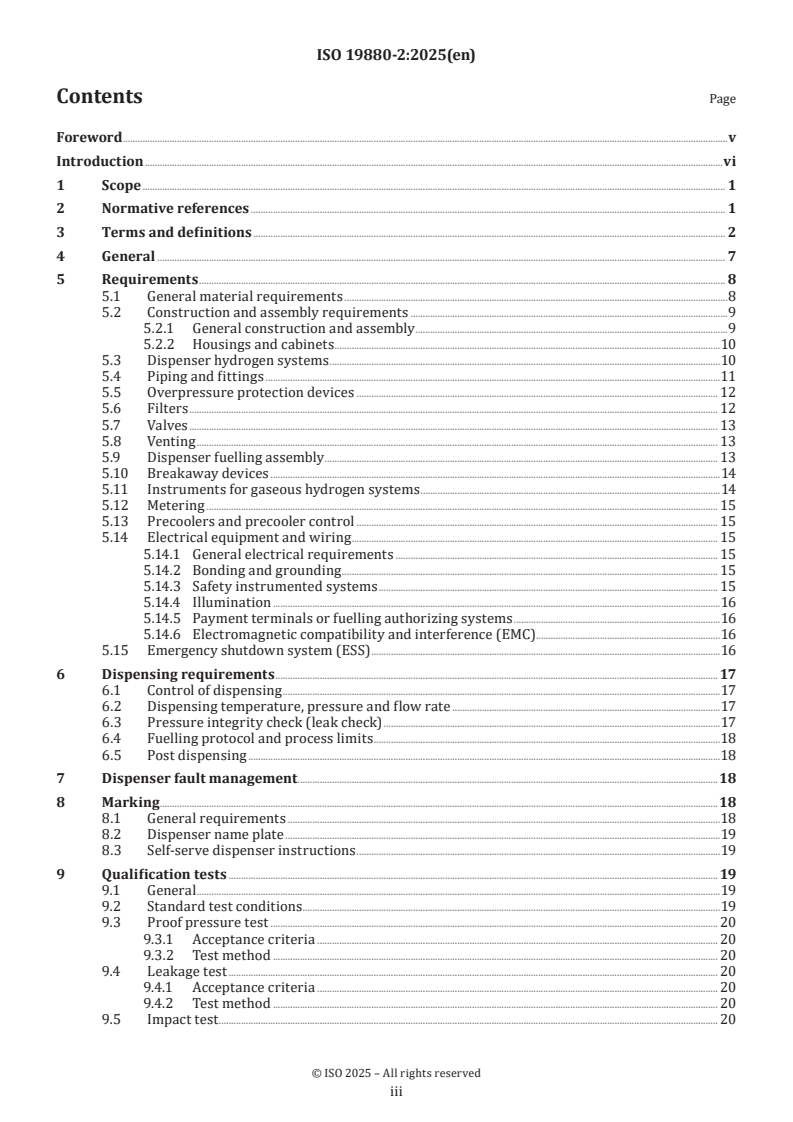
Contents Page
Foreword .v
Introduction .vi
1 Scope . 1
2 Normative references . 1
3 Terms and definitions . 2
4 General . 7
5 Requirements . 8
5.1 General material requirements .8
5.2 Construction and assembly requirements .9
5.2.1 General construction and assembly .9
5.2.2 Housings and cabinets . .10
5.3 Dispenser hydrogen systems .10
5.4 Piping and fittings .11
5.5 Overpressure protection devices . 12
5.6 Filters . 12
5.7 Valves . 13
5.8 Venting . 13
5.9 Dispenser fuelling assembly . 13
5.10 Breakaway devices .14
5.11 Instruments for gaseous hydrogen systems .14
5.12 Metering . 15
5.13 Precoolers and precooler control . 15
5.14 Electrical equipment and wiring . 15
5.14.1 General electrical requirements . 15
5.14.2 Bonding and grounding . 15
5.14.3 Safety instrumented systems . 15
5.14.4 Illumination .16
5.14.5 Payment terminals or fuelling authorizing systems .16
5.14.6 Electromagnetic compatibility and interference (EMC).16
5.15 Emergency shutdown system (ESS) .16
6 Dispensing requirements . 17
6.1 Control of dispensing .17
6.2 Dispensing temperature, pressure and flow rate .17
6.3 Pressure integrity check (leak check) .17
6.4 Fuelling protocol and process limits .18
6.5 Post dispensing .18
7 Dispenser fault management . .18
8 Marking . .18
8.1 General requirements .18
8.2 Dispenser name plate .19
8.3 Self-serve dispenser instructions .19
9 Qualification tests . 19
9.1 General .19
9.2 Standard test conditions . .19
9.3 Proof pressure test . 20
9.3.1 Acceptance criteria . 20
9.3.2 Test method . 20
9.4 Leakage test . 20
9.4.1 Acceptance criteria . 20
9.4.2 Test method . 20
9.5 Impact test . 20
iii
9.5.1 Acceptance criteria . 20
9.5.2 Test method .21
9.6 Dispenser shutdown test .21
9.6.1 Acceptance criteria .21
9.6.2 Test method .21
9.7 Hose rupture . 22
9.7.1 General . 22
9.7.2 Acceptance criteria . 22
9.7.3 Test method . 22
9.8 Hose breakaway test . 23
9.8.1 Acceptance criteria . 23
9.8.2 Test method . 23
9.9 Prevention of electrostatic discharge . 23
9.9.1 Acceptance criteria . 23
9.9.2 Test method . 23
9.10 Dispenser ground continuity test .24
9.10.1 Acceptance criteria .24
9.10.2 Test method .24
9.11 Dielectric voltage-withstand test .24
9.11.1 Acceptance criteria .24
9.11.2 Test method .24
9.12 Dispenser cabinet test . 25
9.12.1 Acceptance criteria . 25
9.12.2 Test method . 25
9.13 Marking material adhesion and legibility test . 25
9.13.1 Acceptance criteria . 25
9.13.2 Test method . 25
10 Routine tests .26
11 Product literature.26
11.1 General . 26
11.2 Installation . 26
11.3 Maintenance and service . 26
11.4 Operation .27
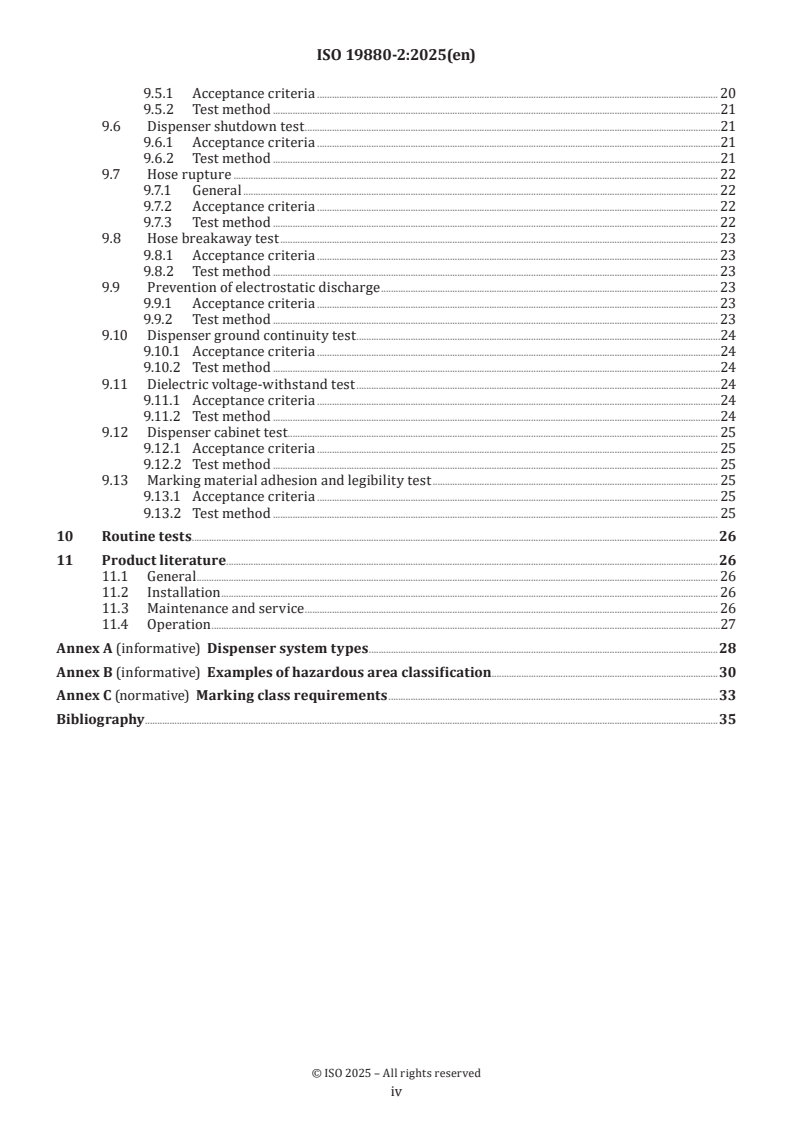
Annex A (informative) Dispenser system types .28
Annex B (informative) Examples of hazardous area classification .30
Annex C (normative) Marking class requirements .33
Bibliography .35
iv
Foreword
ISO (the International Organization for Standardization) is a worldwide federation of national standards
bodies (ISO member bodies). The work of preparing International Standards is normally carried out through
ISO technical committees. Each member body interested in a subject for which a technical committee
has been established has the right to be represented on that committee. International organizations,
governmental and non-governmental, in liaison with ISO, also take part in the work. ISO collaborates closely
with the International Electrotechnical Commission (IEC) on all matters of electrotechnical standardization.
The procedures used to develop this document and those intended for its further maintenance are described
in the ISO/IEC Directives, Part 1. In particular, the different approval criteria needed for the different types
of ISO document should be noted. This document was drafted in accordance with the editorial rules of the
ISO/IEC Directives, Part 2 (see www.iso.org/directives).
ISO draws attention to the possibility that the implementation of this document may involve the use of (a)
patent(s). ISO takes no position concerning the evidence, validity or applicability of any claimed patent
rights in respect thereof. As of the date of publication of this document, ISO had not received notice of (a)
patent(s) which may be required to implement this document. However, implementers are cautioned that
this may not represent the latest information, which may be obtained from the patent database available at
www.iso.org/patents. ISO shall not be held responsible for identifying any or all such patent rights.
Any trade name used in this document is information given for the convenience of users and does not
constitute an endorsement.
For an explanation of the voluntary nature of standards, the meaning of ISO specific terms and expressions
related to conformity assessment, as well as information about ISO's adherence to the World Trade
Organization (WTO) principles in the Technical Barriers to Trade (TBT), see www.iso.org/iso/foreword.html.
This document was prepared by Technical Committee ISO/TC 197, Hydrogen technologies.
A list of all parts in the ISO 19880 series can be found on the ISO website.
Any feedback or questions on this document should be directed to the user’s national standards body. A
complete listing of these bodies can be found at www.iso.org/members.html.
v
Introduction
The purpose of this document is to promote the implementation of hydrogen-powered land vehicles
through the creation of performance-based safety and testing requirements for compressed hydrogen fuel
dispensers. The successful commercialization of hydrogen land vehicle technologies requires codes and
standards pertaining to fuelling stations, vehicle fuel system components and the global homologation of
standards requirements for technologies with the same end use. This will allow manufacturers to achieve
economies of scale in production through the ability to manufacture one product for global use.
This document is a part of the ISO 19880 series for hydrogen fuelling stations with its scope limited to
compressed hydrogen dispensers for land vehicles that use hydrogen as fuel. Dispensers are a major
component of hydrogen fuelling stations, without which hydrogen vehicles will not become a significant
element of mobility in the future. This document includes requirements for manufacture, commissioning and
routine maintenance of dispensers in order to ensure the safe operation of dispensing hydrogen to vehicles.
Note Annex A has additional information about the range of options for dispenser systems.
vi
International Standard ISO 19880-2:2025(en)
Gaseous hydrogen — Fuelling stations —
Part 2:
Dispensers and dispensing systems
1 Scope
This document specifies safety requirements and test methods for the components and systems that enable
the transfer of compressed hydrogen to a hydrogen vehicle, as addressed in ISO 19880-1, by a hydrogen
dispenser with dispensing pressures up to the H70 pressure class designation.
This document applies to a hydrogen dispensing system, referred to as a “dispenser”; the configuration of
the dispenser can range from:
a) a dispenser cabinet, located in the fuelling area, that can perform all of the functionality needed to deliver
hydrogen to a vehicle, to
b) a minimum set of components mounted in or on (as applicable) a dispenser cabinet or other supporting
structure as appropriate, with the remaining functionality provided elsewhere in the hydrogen fuelling
station.
A dispensing system includes the user and vehicle interface and can include components starting from the
hydrogen supply, such as a connection to the banking system, a cooling unit, a dispenser control system,
a flow meter, a pressure sensor, a fuel temperature sensor, an ambient temperature sensor, user interface
and a fuelling hose assembly. Not all dispensing system equipment has to be physically housed within the
enclosure at the dispensing area, as long as the specification of component design or type and location are
adequate to ensure that the overall process meets the requirements in this document.
This document specifies the requirements for hydrogen dispensers and can provide specific references to
other standards for individual components included in the hydrogen dispenser, such as valves (ISO 19880-3)
and hoses (ISO 19880-5).
This document specifies general requirements for supporting the fuelling protocol and directs the user to
ISO 19880-1 for additional requirements and the test methods required to verify proper fuelling protocol
implementation.
This document does not specify the accuracy of flow meters that can be used to meter dispensed fuel.
2 Normative references
The following documents are referred to in the text in such a way that some or all of their content constitutes
requirements of this document. For dated references, only the edition cited applies. For undated references,
the latest edition of the referenced document (including any amendments) applies.
ISO 3601-1, Fluid power systems — O-rings — Part 1: Inside diameters, cross-sections, tolerances and
designation codes
ISO 3601-2, Fluid power systems — O-rings — Part 2: Housing dimensions for general applications
ISO 3601-3, Fluid power systems — O-rings — Part 3: Quality acceptance criteria
ISO 3864-2, Graphical symbols — Safety colours and safety signs — Part 2: Design principles for product safety labels
ISO 4126 (all parts), Safety devices for protection against excessive pressure
ISO 80079-36, Explosive atmospheres — Part 36: Non-electrical equipment for explosive atmospheres — Basic
method and requirements
ISO 80079-37, Explosive atmospheres — Part 37: Non-electrical equipment for explosive atmospheres — Non-
electrical type of protection constructional safety ''c'', control of ignition sources ''b'', liquid immersion ''k''
ISO 14687, Hydrogen fuel quality – Product specification
ISO 15649, Petroleum and natural gas industries — Piping
ISO 17268, Gaseous hydrogen land vehicle refuelling connection devices
ISO 19880-1:2020, Gaseous hydrogen — Fuelling stations — Part 1: General requirements
ISO 19880-3, Gaseous hydrogen — Fuelling stations — Part 3: Valves
ISO 19880-5, Gaseous hydrogen – Fuelling stations – Part 5: Dispenser hoses and hose assemblies
IEC 60079 (all parts), Explosive atmospheres
IEC 60204-1, Safety of machinery – Electrical equipment of machines – Part 1: General requirements
IEC 60364, Low-voltage electrical installations
IEC 60529, Degrees of protection provided by enclosures (IP Code)
SAE J2600, Compressed Hydrogen Surface Vehicle Fuelling Connection Devices
SAE J2601, Fuelling Protocols for Light Duty Gaseous Hydrogen Surface Vehicles
3 Terms and definitions
For the purposes of this document, the following terms and definitions apply.
ISO and IEC maintain terminology databases for use in standardization at the following addresses:
— ISO Online browsing platform: available at https:// www .iso .org/ obp
— IEC Electropedia: available at https:// www .electropedia .org/
3.1
breakaway device
device on the fuelling hose (3.11) that disconnects the hose from the dispenser (3.5) when a tension limit is
exceeded and blocks the flow of hydrogen from the dispenser (3.5), e.g. if the vehicle moves away with the
fuelling hose (3.11) connected to the vehicle
[SOURCE: ISO 19880-1:2020, 3.50]
3.2
component pressure rating
maximum pressure at which it is permissible to operate a component as specified by the manufacturer (3.15)
at a specified temperature
Note 1 to entry: Components designed with a maximum allowable pressure per the European PED represent the
component pressure rating by the manufacturer (3.15) as indicated by the value of “PS”.
Note 2 to entry: See Annex E of ISO 19880-1 for discussion of pressure terminology and its application to dispensing
systems (3.6).
Note 3 to entry: Unless otherwise specified, the pressure in this document is expressed in gauge pressure.
[SOURCE: ISO 19880-1:2020, 3.10 modified – Notes 2 to 4 to entry deleted with Note 5 to entry of the source
definition renumbered as Note 2 to entry.]
3.3
control system
system which responds to input signals from the process and/or from an operator and generates output
signals causing the process to operate in the desired manner
[SOURCE: ISO 19880-1:2020, 3.11 modified – Note 1 to entry deleted.]
3.4
flow coefficient
C
v
coefficient to represent the flow rate of fluid that a valve (3.28) is capable of handling
Note 1 to entry: C is the flow coefficient of a valve (3.28) with the fluid at 15,56 °C under a pressure difference of
v
6 894 N/m (= Pa)
3.5
dispenser
equipment in the dispensing system (3.6), including the dispenser cabinet(s) and supporting structure, that is
physically located in the fuelling area
Note 1 to entry: The hydrogen dispenser typically includes, as a minimum, the fuelling assembly (3.10), required
temperature and pressure instrumentation, filters and the user interface to conduct vehicle fuelling.
Note 2 to entry: The manufacturer (3.15) of the hydrogen dispenser can elect to include additional equipment in the
dispenser, including the possibility of all equipment in the dispensing system (3.6).
[SOURCE: ISO 19880-1:2020, 3.13]
3.6
dispensing system
system downstream of the hydrogen supply system comprising all equipment necessary to carry out the
vehicle fuelling operation, through which the compressed hydrogen is supplied to the vehicle
[SOURCE: ISO 19880-1:2020, 3.17]
3.7
emergency shutdown system
ESS
system which responds to automatic and/or manually activated emergency shutdown devices to stop
hazardous movements and operations such as the flow of hydrogen gas to the dispenser (3.5) and vehicle
3.8
enclosure
structure, protective housing (3.13), container, machine cabinet, etc., which encloses or partially encloses
equipment of a station that may have access for maintenance but is not intended to be occupied
Note 1 to entry: In this document the enclosure of the dispenser (3.5) is defined as a “dispenser cabinet”.
Note 2 to entry: Some hydrogen station manufacturers (3.15) may build an all-in-one fuelling station (3.12) where the
dispenser components are built into one side or end of the equipment enclosure without using a separate dispenser
cabinet.
Note 3 to entry: The use of an enclosure could be to protect equipment from the environment, provide noise attenuation
or provide safety to the areas surrounding the equipment.
[SOURCE: ISO 19880-1:2020, 3.18 modified – Notes 1 and 2 to entry are newly inserted, the original Note 1 to
entry is renumbered as Note 3 to entry and the original Note 2 to entry deleted.]
3.9
fitting
part or design feature on a component used to join (i.e., connect) any pressure-retaining components in
the system
[SOURCE: ISO 19880-1:2020, 3.24]
3.10
fuelling assembly
part of the dispenser (3.5) providing the interface between the hydrogen fuelling station (3.12) and the
vehicle — an assembly consisting of a breakaway device (3.1), a hose(s), a nozzle (3.19) and connections
between these components
Note 1 to entry: The fuelling assembly can include, or not include, a nozzle vent line (with hose breakaway device (3.1)
and hose) depending on the type of nozzle (3.19), and communications, if used.
[SOURCE: ISO 19880-1:2020, 3.26]
3.11
fuelling hose
flexible conduit used for dispensing gaseous hydrogen to vehicles through a fuelling nozzle (3.19)
[SOURCE: ISO 19880-1:2020, 3.27]
3.12
fuelling station
facility for the dispensing of compressed hydrogen vehicle fuel, often referred to as a hydrogen refuelling
station (HRS) or hydrogen filling station, including the supply of hydrogen, and hydrogen compression,
storage and dispensing systems (3.6)
[SOURCE: ISO 19880-1:2020, 3.29]
3.13
housing
guard or enclosure (3.8) for operating parts, control mechanisms, or other components that do not need to
be accessible during normal operation
Note 1 to entry: Housing may be synonymous with: enclosure (3.8), cabinet or frame.
[SOURCE: ISO 19880-1:2020, 3.40]
3.14
hydrogen service level
HSL
pressure level in MPa used to characterize the hydrogen service of the dispensing system (3.6) based on the
NWP rating of the vehicle
Note 1 to entry: The numerical value of HSL also matches the number after the “H” in pressure class (3.20) (see Table 1
in ISO 19880-1).
Note 2 to entry: See Annex E of ISO 19880-1 for application of pressure terminology to hydrogen-dispensing systems
and vehicles.
[SOURCE: ISO 19880-1:2020, 3.42]
3.15
manufacturer
person or organization responsible for the design and manufacturer of the equipment and components
3.16
maximum allowable working pressure
MAWP
maximum pressure permissible in a system at the temperature specified for the pressure
Note 1 to entry: The maximum allowable working pressure can also be defined as the design pressure, the maximum
allowable operating pressure, the maximum permissible working pressure or the maximum allowable pressure for
the rating of pressure vessels and equipment manufactured in accordance with national pressure vessel codes.
Note 2 to entry: See Annex E of ISO 19880-1 for a discussion of pressure terminology and the application to dispensing
systems (3.6) and fuelling stations (3.12) in general.
[SOURCE: ISO 19880-1:2020, 3.45]
3.17
maximum operating pressure
MOP
highest pressure that is expected for a component or system during normal operation, including anticipated
transients
Note 1 to entry: In the case of the dispensing system (3.6), the MOP is equivalent to the maximum fuelling pressure of
the vehicle.
Note 2 to entry: See Annex E of ISO 19880-1 for a discussion of pressure terminology and the application to dispensing
systems (3.6) and fuelling stations (3.12) in general.
[SOURCE: ISO 19880-1:2020, 3.47]
3.18
nominal working pressure
NWP
pressure of a vehicle compressed hydrogen storage system (CHSS) at 100 % SOC (3.27) at a gas temperature
of 15 °C
Note 1 to entry: For further guidance on pressure terminology and associated equipment ratings, see Annex E of
ISO 19880-1.
[SOURCE: ISO 19880-1:2020, 3.51 modified – Notes 1 to 4 to entry deleted and new Note 1 to entry inserted.]
3.19
nozzle
device connected to a fuel dispensing system (3.6) which permits the quick connect and disconnect of fuel
supply to the receptacle (3.22) of the vehicle or storage system
[SOURCE: ISO 17268: 2012, 3.11]
3.20
pressure class
non-dimensional rating of components designed to dispense hydrogen to road vehicles at the required
pressure
Note 1 to entry: The numbers following “H” in the pressure class are numerically the same as HSL, but the HSL identifies
only the level of the dispensing service whereas the pressure class designation shows that the component is fully
capable of meeting the pressure and temperature requirements for dispensing hydrogen at the indicated service level.
Note 2 to entry: See Annex E of ISO 19880-1 for a discussion of pressure terminology and its application to dispensing
systems (3.6) and fuelling stations (3.13) in general.
[SOURCE: ISO 19880-1:2020, 3.58 modified – Note 3 to entry deleted]
3.21
pressure relief device
PRD
safety device that releases gases or liquids above a specified pressure value in cases of emergency or
abnormal conditions
Note 1 to entry: PRDs can be activated by pressure or another parameter, such as temperature, and can be either re-
closing devices (such as valves (3.28)) or non-re-closing devices (such as rupture disks and fusible plugs). Common
designations for these specific types of PRDs are as follows:
— Pressure Safety Valve (PSV) – pressure-activated valve (3.28) that opens at a specified set point to protect a
system from overpressure and re-closes when the pressure falls below the set point requirements for PRVs used
in dispensing systems (3.6) can be found in 8.2.2.3 of ISO 19880-1. PSVs protecting the dispensing system (3.6) can
re-close above the MOP (3.17).
— Thermally-activated Pressure Relief Device (TPRD) – a PRD that opens at a specified temperature to protect a
system from rupture and remains open.
Note 2 to entry: See Annex E of ISO 19880-1 for discussion of pressure terminology and its application to pressure
protection of the dispensing system and fuelling stations (3.12) in general.
[SOURCE: ISO 19880-1:2020, 3.59]
3.22
receptacle
device connected to a vehicle storage system which receives the nozzle (3.19)
Note 1 to entry: This can also be referred to as a fuelling inlet or gas filling port in other documents.
[SOURCE: ISO 17268: 2020, 3.15]
3.23
risk assessment
determination of quantitative or qualitative value of risk related to a specific situation and a recognized
threat (also called hazard)
Note 1 to entry: Based on national requirements, a review of a risk analysis or a safety concept by third party is
sometimes required.
[SOURCE: ISO 19880-1:2020, 3.66]
3.24
safety function
function to be implemented by a safety-instrumented system, which is intended to achieve or maintain a
safe state for the process, with respect to a specific hazardous situation
Note 1 to entry: Other technologies or risk reduction measures have a safety function not achieved through a safety-
instrumented system, however validation of these measures is equally important.
[SOURCE: ISO 19880-1:2020, 3.71]
3.25
safety instrumented system
SIS
instrumented system used to implement one or more safety instrumented functions
Note 1 to entry: A safety instrumented system (SIS) is composed of any combination of sensors, logic solvers, and final
elements.
Note 2 to entry: A separate safety-instrumented system (SIS), typically with a greater reliability than the more basic
process control system, can be required, according to the manufacturer’s (3.15) risk assessment (3.23), to respond
solely to safety critical alarms. Further information is provided by IEC 61508 and IEC 61511.
[SOURCE: ISO 19880-1:2020, 3.72]
3.26
shutoff valve
on/off valve (3.28) for controlling the flow of gas, which is pneumatically or electrically actuated
3.27
state of charge
SOC
density (or mass) ratio of hydrogen in the compressed hydrogen storage system (CHSS) between the actual
CHSS condition and the capacity at nominal working pressure (3.18) when the system is equilibrated at 15 °C
Note 1 to entry: SOC is expressed as a percentage and is computed based on the gas density according to Formula (1).
Note 2 to entry: The accuracy of the NIST formula has been quantified to be within 0,01 % from 255 K to 1 000 K with
pressures to 120 MPa at the publishing of this document.
SOC (%) can be calculated as follows:
ρ
×100 (1)
ρ
where
ρ is the density of hydrogen under the specific gas conditions;
ρ is the density of hydrogen at the nominal working pressure (3.18) at a gas temperature of 15 °C.
The hydrogen densities at the two major nominal working pressures (3.18) are:
— density of H at 35 MPa and 15 °C and = 24,0 g/l
— density of H at 70 MPa and 15 °C and = 40,2 g/l
Note 3 to entry: The ρ function for hydrogen is available from the National Institute of Standards and Technology
(NIST) at https:// nvlpubs .nist .gov/ nistpubs/ jres/ 113/ 6/ V113 .N06 .A05 .pdf.
3.28
valve
device by which the flow of a fluid may be started, stopped or regulated, using a movable part which opens
or obstructs passage
[SOURCE: ISO 19880-3:2018, 3.8]
4 General
Figure 1 shows the main components of the dispenser integrated into one enclosure. Note that some
manufacturers may include the heat exchanger inside the dispenser cabinet. Examples in Annex A provide
many of the dispenser system components outside the dispenser cabinet, including the dispenser control
system, which can be located, for example, with the hydrogen fuelling station controls. The position of each
device in Figure 1 is also an example and may vary.
The components that shall be part of the dispenser cabinet are:
a) fuelling hose assembly with a nozzle and nozzle resting system;
b) fuel temperature and pressure sensors;
c) filter (downstream of shutoff valve);
d) user interface: start/stop sequence inputs and display of dispenser operation.
Key
1 H pipeline 2 MPa 10 filter 18 connection to the banking system
2 compressor 11 nozzle 19 pressure sensor (P1)
3 S-1 90 MPa 12 fuel cell vehicle 20 pressure sensor (P2)
4 S-2 90 MPa 13 cooling machine 21 gas temperature sensor (T1)
5 S-3 90 MPa 14 coolant loop 22 ambient temperature sensor (T2)
6 flow control valve 15 cascade panel
7 pressure safety valve 16 dispenser control system
8 flow meter 17 point of sale (POS)
9 shutoff valve
Figure 1 — Integrated dispenser system
Requirements contained herein are all the requirements to function as a whole system. If a whole system
is not available, then the sections of this document that are applicable shall be defined and the required
verification tests and analyses shall be performed for these applicable requirements.
NOTE Verification tests not performed based on the above are expected to be performed as part of integration of
the whole dispensing system.
5 Requirements
5.1 General material requirements
Materials shall comply with the following.
a) Materials exposed to hydrogen shall be compatible with hydrogen.
b) Materials used shall be rated for the temperature and pressure to which they will be exposed.
c) For non-metallic materials such as rubber or plastic, select those that are appropriate for the service
conditions, including environmental conditions, so that no failure will occur during the expected service life.
d) Materials and coatings shall be adequate for the service conditions.
e) Metallic materials, used where environmental degradation is expected, shall be selected based on
the service environment, or be coated to be protected from this environment for the duration of the
expected service life or to make them highly resistant to corrosion.
f) For electrical insulation, use materials appropriate for the application and environmental conditions
such as temperature extremes and moisture.
g) For the exterior cabinet of an outdoor dispenser, use materials with high weather resistance such as
metal with anticorrosion treatment or synthetic resin. Exterior materials, including synthetic resin,
shall not blister, crack or fracture under working conditions.
h) Select materials in accordance with local environment requirements, avoiding the use of materials that
do not comply with these requirements such as mercury, lead or asbestos.
NOTE ISO/TR 15916 gives guidance on typical material compatibility with hydrogen.
5.2 Construction and assembly requirements
5.2.1 General construction and assembly
A compressed hydrogen gas dispenser shall meet the following requirements.
a) Where the area, including the interior of equipment, enclosure, dispenser, housing and cabinet, is
classified as a hazardous area pursuant to IEC 60079-10-1, appropriate precautions shall be taken
against explosions in accordance with IEC 60079-0 (or other parts of the IEC 60079 series which
describe the protection level), IEC 60079 14 regarding selection, erection, installation and inspection,
and ISO 80079-36 and ISO 80079-37 for mechanical (non-electrical) level of protection.
NOTE The definition of “area” in IEC 60079-10-1:2020,3.3.1 refers to “a three-dimensional region or space.”
b) All components in a housing used in a dispenser shall be assembled in such a manner so as to be secure
against distortion, warping or other damage, and shall be supported to mainta
...