

ISO 19880-1:2020
(Main)Gaseous hydrogen — Fuelling stations — Part 1: General requirements
General Information
- Abstract
This document defines the minimum design, installation, commissioning, operation, inspection and maintenance requirements, for the safety, and, where appropriate, for the performance of public and non-public fuelling stations that dispense gaseous hydrogen to light duty road vehicles (e.g. fuel cell electric vehicles). This document is not applicable to the dispensing of cryogenic hydrogen, or hydrogen to metal hydride applications. Since this document is intended to provide minimum requirements for fuelling stations, manufacturers can take additional safety precautions as determined by a risk management methodology to address potential safety risks of specific designs and applications. While this document is targeted for the fuelling of light duty hydrogen road vehicles, requirements and guidance for fuelling medium and heavy duty road vehicles (e.g. buses, trucks) are also covered. Many of the generic requirements within this document are applicable to fuelling stations for other hydrogen applications, including but not limited to the following: — fuelling stations for motorcycles, fork-lift trucks, trams, trains, fluvial and marine applications; — fuelling stations with indoor dispensing; — residential applications to fuel land vehicles; — mobile fuelling stations; and — non-public demonstration fuelling stations. However, further specific requirements that can be necessary for the safe operation of such fuelling stations are not addressed in this document. This document provides requirements for and guidance on the following elements of a fuelling station (see Figure 1 and Figure 2): — hydrogen production/delivery system: — delivery of hydrogen by pipeline, trucked in gaseous and/or liquid hydrogen, or metal hydride storage trailers; — on-site hydrogen generators using water electrolysis process or hydrogen generators using fuel processing technologies; — liquid hydrogen storage; — hydrogen purification systems, as applicable; — compression: — gaseous hydrogen compression; — pumps and vaporizers; — gaseous hydrogen buffer storage; — pre-cooling device; — gaseous hydrogen dispensing systems.
- Status
- Published
- Publication Date
- 03-Mar-2020
- Technical Committee
- ISO/TC 197 - Hydrogen technologies
- Current Stage
- 9092 - International Standard to be revised
- Start Date
- 20-Jan-2026
- Completion Date
- 29-Aug-2026
Buy Documents

ISO 19880-1:2020 - Gaseous hydrogen -- Fuelling stations

ISO 19880-1:2020 - Gaseous hydrogen — Fuelling stations — Part 1: General requirements/4/2020
Overview
ISO 19880-1:2020 - Gaseous hydrogen - Fuelling stations - Part 1: General requirements provides the minimum requirements for the safe design, installation, commissioning, operation, inspection and maintenance of fuelling stations that dispense gaseous hydrogen to road vehicles (primarily light‑duty fuel cell electric vehicles). The standard covers public and non‑public stations and addresses hydrogen supply routes (pipeline, tube trailers, liquid delivery, on‑site generation), compression, storage, purification, dispensing and safety systems. It explicitly excludes cryogenic hydrogen dispensing and hydrogen‑to‑metal‑hydride applications, and allows manufacturers to apply additional safety measures based on risk assessments.
Key topics and technical requirements
ISO 19880-1 defines a broad set of technical and safety topics relevant to hydrogen fuelling stations, including:
- Risk management: requirements for hazard identification, risk assessment and mitigation strategies to reduce formation/ignition of flammable mixtures and to limit escalation.
- Hydrogen supply and generation: guidance for on‑site electrolysers or reformation equipment, gaseous and liquid hydrogen delivery (tube trailers, tankers), and pipeline interfaces.
- Compression, storage and vaporizers: recommendations for gaseous compression, buffer storage, pumps, vaporization and pre‑cooling devices.
- Dispensing systems: design, control, safety devices, dispenser housings, fuelling assemblies and installation of dispensers for vehicle fuelling.
- Equipment, materials and components: material compatibility, piping, valves, filters, compressors and instrumentation suitable for hydrogen service.
- Vent systems and hazardous areas: vent outlet siting, relief device considerations, hazardous area classification and equipment protection.
- Hydrogen quality and filtration: requirements to maintain fuel quality for fuel cell vehicles.
- Electrical and EMC: bonding/grounding, lightning protection, hazardous area electrical protection and electromagnetic compatibility.
- Operational topics: commissioning, maintenance, inspection, emergency egress and non‑hydrogen hazard protections (noise, cold exposure, asphyxiation).
Practical applications - who uses this standard
ISO 19880-1 is intended for:
- Station designers and engineering consultants specifying hydrogen station layouts and systems.
- Manufacturers and integrators of compressors, dispensers, storage vessels and control systems.
- Site owners, operators and fleet managers implementing safe operation, inspection and maintenance programs.
- Regulators and permitting authorities assessing compliance and safety cases for public and non‑public stations.
- Safety engineers and risk assessors developing mitigation measures and emergency response plans.
Related standards (if applicable)
- Other parts of the ISO 19880 series and national codes address complementary, more specific technical or operational requirements (e.g., material standards, vehicle interfaces, or cryogenic hydrogen). Users should combine ISO 19880-1 with local regulations and application‑specific guidance.
Keywords: ISO 19880-1, gaseous hydrogen, hydrogen fuelling stations, hydrogen safety, hydrogen dispensing, fuel cell electric vehicles, hydrogen station design.
Relations
- Effective Date
- 25-Aug-2026
- Effective Date
- 10-Feb-2026
- Effective Date
- 10-Feb-2026
- Effective Date
- 16-Jul-2016
Buy Documents
ISO 19880-1:2020 - Gaseous hydrogen -- Fuelling stations
ISO 19880-1:2020 - Gaseous hydrogen — Fuelling stations — Part 1: General requirements/4/2020
Get Certified
Connect with accredited certification bodies for this standard

TÜV Rheinland
TÜV Rheinland is a leading international provider of technical services.

TÜV SÜD
TÜV SÜD is a trusted partner of choice for safety, security and sustainability solutions.

DEKRA Certification Inc.
DEKRA US certification services.
Sponsored listings
Frequently Asked Questions
ISO 19880-1:2020 is a standard published by the International Organization for Standardization (ISO). Its full title is "Gaseous hydrogen — Fuelling stations — Part 1: General requirements". This standard covers: This document defines the minimum design, installation, commissioning, operation, inspection and maintenance requirements, for the safety, and, where appropriate, for the performance of public and non-public fuelling stations that dispense gaseous hydrogen to light duty road vehicles (e.g. fuel cell electric vehicles). This document is not applicable to the dispensing of cryogenic hydrogen, or hydrogen to metal hydride applications. Since this document is intended to provide minimum requirements for fuelling stations, manufacturers can take additional safety precautions as determined by a risk management methodology to address potential safety risks of specific designs and applications. While this document is targeted for the fuelling of light duty hydrogen road vehicles, requirements and guidance for fuelling medium and heavy duty road vehicles (e.g. buses, trucks) are also covered. Many of the generic requirements within this document are applicable to fuelling stations for other hydrogen applications, including but not limited to the following: — fuelling stations for motorcycles, fork-lift trucks, trams, trains, fluvial and marine applications; — fuelling stations with indoor dispensing; — residential applications to fuel land vehicles; — mobile fuelling stations; and — non-public demonstration fuelling stations. However, further specific requirements that can be necessary for the safe operation of such fuelling stations are not addressed in this document. This document provides requirements for and guidance on the following elements of a fuelling station (see Figure 1 and Figure 2): — hydrogen production/delivery system: — delivery of hydrogen by pipeline, trucked in gaseous and/or liquid hydrogen, or metal hydride storage trailers; — on-site hydrogen generators using water electrolysis process or hydrogen generators using fuel processing technologies; — liquid hydrogen storage; — hydrogen purification systems, as applicable; — compression: — gaseous hydrogen compression; — pumps and vaporizers; — gaseous hydrogen buffer storage; — pre-cooling device; — gaseous hydrogen dispensing systems.
This document defines the minimum design, installation, commissioning, operation, inspection and maintenance requirements, for the safety, and, where appropriate, for the performance of public and non-public fuelling stations that dispense gaseous hydrogen to light duty road vehicles (e.g. fuel cell electric vehicles). This document is not applicable to the dispensing of cryogenic hydrogen, or hydrogen to metal hydride applications. Since this document is intended to provide minimum requirements for fuelling stations, manufacturers can take additional safety precautions as determined by a risk management methodology to address potential safety risks of specific designs and applications. While this document is targeted for the fuelling of light duty hydrogen road vehicles, requirements and guidance for fuelling medium and heavy duty road vehicles (e.g. buses, trucks) are also covered. Many of the generic requirements within this document are applicable to fuelling stations for other hydrogen applications, including but not limited to the following: — fuelling stations for motorcycles, fork-lift trucks, trams, trains, fluvial and marine applications; — fuelling stations with indoor dispensing; — residential applications to fuel land vehicles; — mobile fuelling stations; and — non-public demonstration fuelling stations. However, further specific requirements that can be necessary for the safe operation of such fuelling stations are not addressed in this document. This document provides requirements for and guidance on the following elements of a fuelling station (see Figure 1 and Figure 2): — hydrogen production/delivery system: — delivery of hydrogen by pipeline, trucked in gaseous and/or liquid hydrogen, or metal hydride storage trailers; — on-site hydrogen generators using water electrolysis process or hydrogen generators using fuel processing technologies; — liquid hydrogen storage; — hydrogen purification systems, as applicable; — compression: — gaseous hydrogen compression; — pumps and vaporizers; — gaseous hydrogen buffer storage; — pre-cooling device; — gaseous hydrogen dispensing systems.
ISO 19880-1:2020 is classified under the following ICS (International Classification for Standards) categories: 43.060.40 - Fuel systems; 71.100.20 - Gases for industrial application. The ICS classification helps identify the subject area and facilitates finding related standards.
ISO 19880-1:2020 has the following relationships with other standards: It is inter standard links to CEN/CLC Guide 38:2021, EN IEC 62282-8-201:2024, EN IEC 62282-8-201:2020, ISO/TS 19880-1:2016. Understanding these relationships helps ensure you are using the most current and applicable version of the standard.
ISO 19880-1:2020 is available in PDF format for immediate download after purchase. The document can be added to your cart and obtained through the secure checkout process. Digital delivery ensures instant access to the complete standard document.
Standards Content (Sample)
INTERNATIONAL ISO
STANDARD 19880-1
First edition
2020-03
Gaseous hydrogen — Fuelling
stations —
Part 1:
General requirements
Carburant d'hydrogène gazeux — Stations-service —
Partie 1: Exigences générales
Reference number
©
ISO 2020
© ISO 2020
All rights reserved. Unless otherwise specified, or required in the context of its implementation, no part of this publication may
be reproduced or utilized otherwise in any form or by any means, electronic or mechanical, including photocopying, or posting
on the internet or an intranet, without prior written permission. Permission can be requested from either ISO at the address
below or ISO’s member body in the country of the requester.
ISO copyright office
CP 401 • Ch. de Blandonnet 8
CH-1214 Vernier, Geneva
Phone: +41 22 749 01 11
Fax: +41 22 749 09 47
Email: copyright@iso.org
Website: www.iso.org
Published in Switzerland
ii © ISO 2020 – All rights reserved
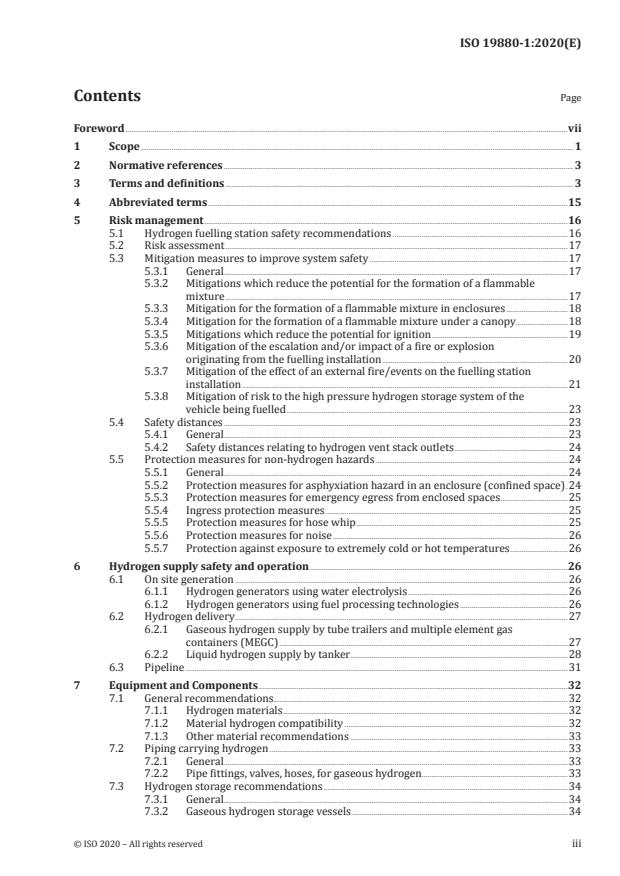
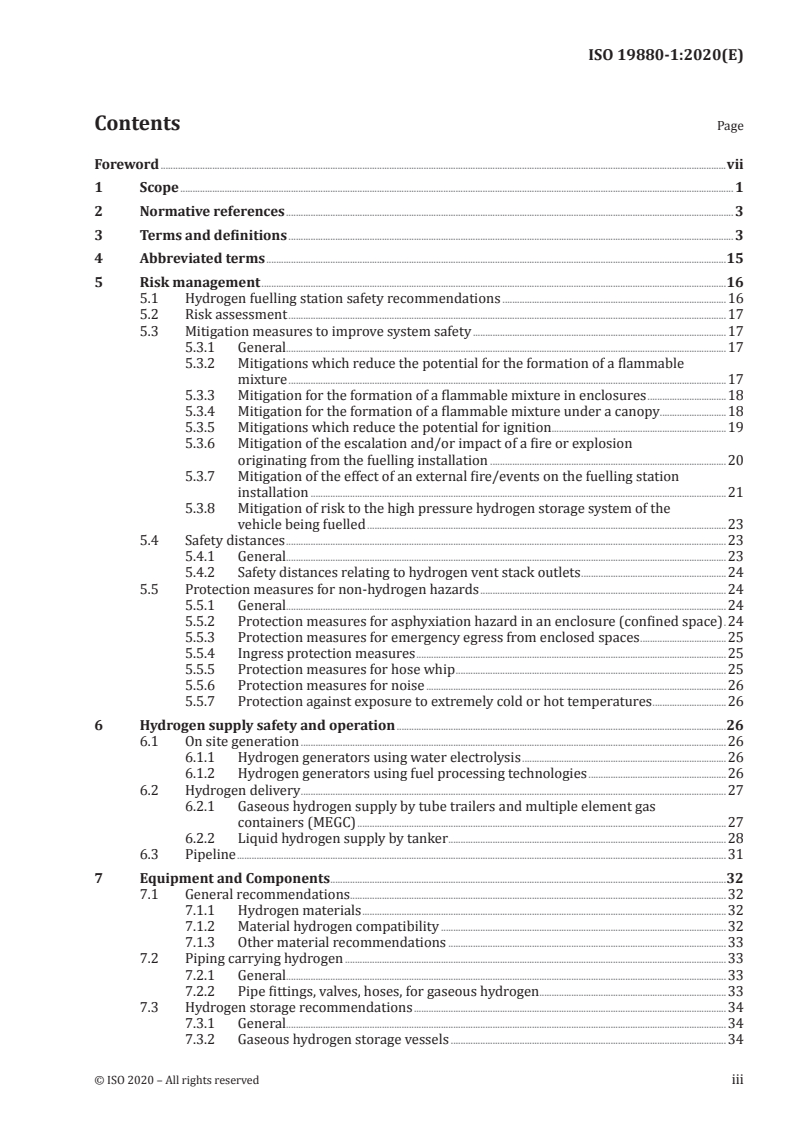
Contents Page
Foreword .vii
1 Scope . 1
2 Normative references . 3
3 Terms and definitions . 3
4 Abbreviated terms .15
5 Risk management .16
5.1 Hydrogen fuelling station safety recommendations .16
5.2 Risk assessment .17
5.3 Mitigation measures to improve system safety .17
5.3.1 General.17
5.3.2 Mitigations which reduce the potential for the formation of a flammable
mixture .17
5.3.3 Mitigation for the formation of a flammable mixture in enclosures .18
5.3.4 Mitigation for the formation of a flammable mixture under a canopy .18
5.3.5 Mitigations which reduce the potential for ignition .19
5.3.6 Mitigation of the escalation and/or impact of a fire or explosion
originating from the fuelling installation .20
5.3.7 Mitigation of the effect of an external fire/events on the fuelling station
installation .21
5.3.8 Mitigation of risk to the high pressure hydrogen storage system of the
vehicle being fuelled .23
5.4 Safety distances .23
5.4.1 General.23
5.4.2 Safety distances relating to hydrogen vent stack outlets .24
5.5 Protection measures for non-hydrogen hazards .24
5.5.1 General.24
5.5.2 Protection measures for asphyxiation hazard in an enclosure (confined space) .24
5.5.3 Protection measures for emergency egress from enclosed spaces .25
5.5.4 Ingress protection measures .25
5.5.5 Protection measures for hose whip .25
5.5.6 Protection measures for noise .26
5.5.7 Protection against exposure to extremely cold or hot temperatures .26
6 Hydrogen supply safety and operation .26
6.1 On site generation .26
6.1.1 Hydrogen generators using water electrolysis .26
6.1.2 Hydrogen generators using fuel processing technologies .26
6.2 Hydrogen delivery .27
6.2.1 Gaseous hydrogen supply by tube trailers and multiple element gas
containers (MEGC) .27
6.2.2 Liquid hydrogen supply by tanker .28
6.3 Pipeline .31
7 Equipment and Components .32
7.1 General recommendations.32
7.1.1 Hydrogen materials .32
7.1.2 Material hydrogen compatibility .32
7.1.3 Other material recommendations .33
7.2 Piping carrying hydrogen .33
7.2.1 General.33
7.2.2 Pipe fittings, valves, hoses, for gaseous hydrogen . .33
7.3 Hydrogen storage recommendations .34
7.3.1 General.34
7.3.2 Gaseous hydrogen storage vessels .34
7.3.3 Gaseous hydrogen storage siting recommendations .34
7.4 Hazardous areas (with potentially flammable mixtures) .36
7.4.1 General.36
7.4.2 Equipment in hazardous areas .37
7.5 Hydrogen compressors .37
7.5.1 General.37
7.5.2 Vibration and movement .38
7.5.3 Control and monitoring .38
7.6 Instruments for gaseous hydrogen systems .39
7.7 Filters for gaseous hydrogen .39
7.8 Gaseous hydrogen vent systems .40
7.8.1 General.40
7.8.2 Vent outlet .40
7.8.3 Vent sizing . .41
7.8.4 Multiple relief devices .42
7.9 Pneumatics and hydraulics .42
7.10 Hydrogen purifier .43
7.11 Enclosures and buildings containing hydrogen equipment .43
7.11.1 General design.43
7.11.2 Maintenance access and possible occupancy.43
7.11.3 Ventilation of enclosures and buildings containing hydrogen equipment .44
7.11.4 Use of enclosures or compartments within enclosures to control hazards areas 44
7.11.5 Electrical and mechanical equipment within enclosures and buildings
containing hydrogen equipment .45
7.11.6 Over-pressure protection of enclosures and buildings containing
hydrogen equipment .45
8 Dispensing systems .45
8.1 General requirements .45
8.2 Hydrogen vehicle fuelling .46
8.2.1 Dispensing system process control .46
8.2.2 Dispensing system safety devices .49
8.3 Dispensing systems .52
8.3.1 General design and assembly .52
8.3.2 Dispensing system hydrogen components .52
8.3.3 Dispenser housings and cabinets .55
8.3.4 Dispenser fuelling assembly .55
8.4 Dispenser installation .56
8.4.1 General.56
8.4.2 Location and protection of dispensers .56
8.4.3 Fuelling pad .57
8.4.4 Hazardous area around the dispenser .57
8.4.5 Installation of the fuelling assembly to prevent damage in service .57
8.4.6 Electrical continuity for bonding and grounding .57
8.5 Operating considerations.58
8.6 Maintenance and inspection .58
9 Hydrogen quality .58
9.1 General .58
9.2 Dispensing system fuel filters .58
10 Electrical .59
10.1 General electrical .59
10.1.1 Components .59
10.1.2 Site (interconnections to and/or between equipment assemblies) .59
10.1.3 Electrical bonding and grounding.60
10.1.4 Lightning protection .60
10.2 Hazardous areas (potentially flammable mixtures) .60
10.2.1 General.60
10.2.2 Protection requirements for electrical equipment within hazardous areas .60
iv © ISO 2020 – All rights reserved
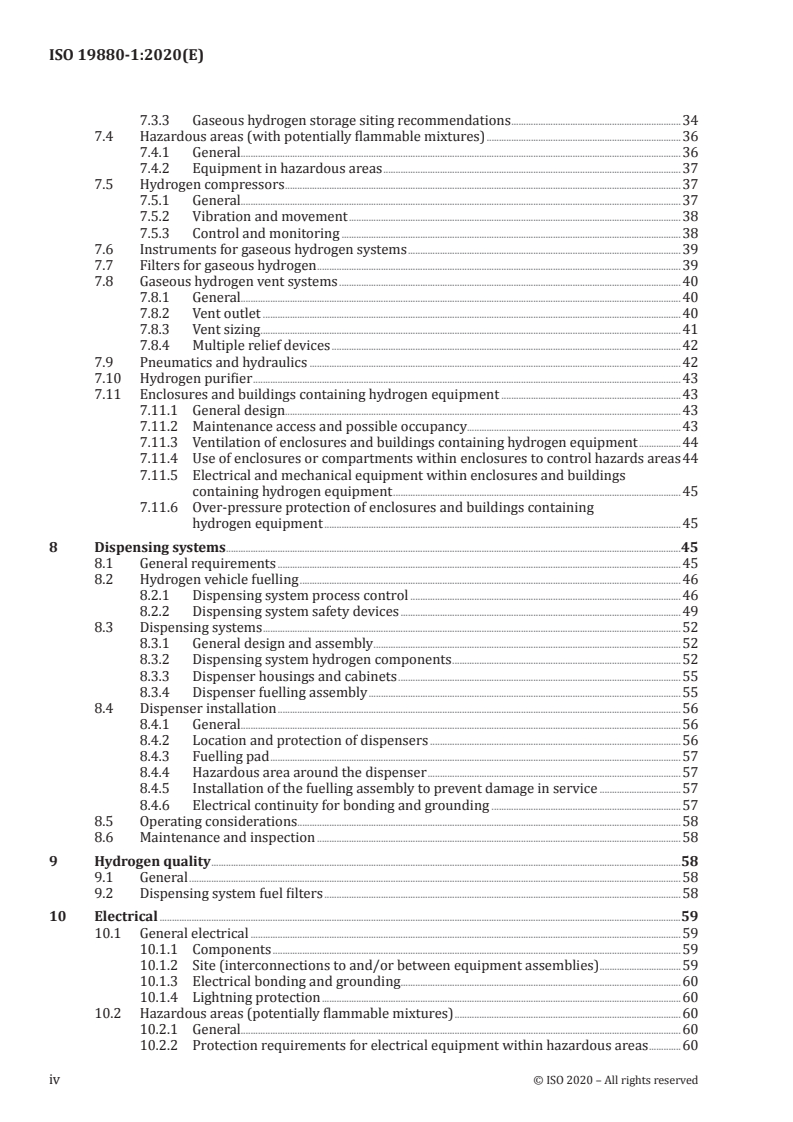
10.2.3 Protection from ignition due to accumulation of static charge .60
10.3 Electromagnetic compatibility and interference (EMC) .62
10.3.1 General.62
10.3.2 Industrial (EMC) Environments .62
10.3.3 Residential, Commercial, and Light-Industrial (EMC) Environments .62
11 Instrumentation and control system .62
11.1 General .62
11.2 Emergency shutdown functionality .63
11.2.1 General.63
11.2.2 Manually actuated emergency stop devices .64
11.2.3 Hydrogen detection systems .64
11.3 Remote system control .65
11.4 Modifications to control system .66
12 Station inspection and tests .66
12.1 General .66
12.2 Pressure test .66
12.3 Leak test .67
12.4 Electrical testing .67
12.5 Fuelling safety and performance functional testing .68
12.5.1 General.68
12.5.2 Fuelling protocol test .68
12.5.3 Test procedure .69
12.5.4 Site acceptance testing options .69
12.5.5 Additional performance considerations for fuelling .71
12.6 Hydrogen quality testing .72
12.7 Station inspection and tests following modifications .72
13 Operation .72
13.1 General .72
13.2 Warning signs .72
13.3 Dispenser operational instructions .73
13.4 Functional identification .74
13.5 Marking of equipment (data plate) .74
13.6 Reference designations .75
13.7 Training .75
13.8 Emergency response plan .75
13.9 Emergency contact information .76
14 Technical documentation .76
14.1 General .76
14.2 Information to be provided .76
14.3 Recommendations applicable to all documentation .78
14.4 Installation documents .78
14.4.1 General.78
14.4.2 Installation documentation for hazardous areas .79
14.4.3 Venting documentation .79
14.4.4 Seismic documentation .79
14.4.5 Handling and lifting documentation .79
14.5 Overview diagrams and function diagrams .80
14.6 Circuit diagrams .80
14.7 Flow (P&ID) diagrams .80
14.8 Fuelling station operating manual .81
14.9 Maintenance and service manuals .81
14.10 Parts list .81
15 Inspection and maintenance .82
15.1 Inspection and maintenance program.82
15.2 Maintenance and testing frequency of gas detection .83
15.3 Maintenance and inspection frequency of filters .83
15.4 Maintenance of pressure relief devices .84
15.5 Hot work .84
15.6 Modifications to the hydrogen fuelling station and associated equipment.84
Annex A (informative) Safety methodologies and risk assessment .85
Annex B (informative) Further guidance on risk management.107
Annex C (informative) Hydrogen dispensing and examples of fuelling and communications
protocols, and corresponding verification testing .113
Annex D (informative) Reference fuelling limits of hydrogen and fuel cell vehicles .131
Annex E (informative) Pressure level application to design verification requirements for
hydrogen dispensing systems and compressed hydrogen storage systems .132
Annex F (informative) Countermeasures for unsuitable hydrogen fuelling protocols .137
Annex G (informative) Recommendations for, and example of, vehicular impact protection
measures .138
Annex H (informative) Example for leakage testing of hydrogen fuelling system .141
Annex I (informative) Minimum fuelling station acceptance inspection, testing and
validation checklist .142
Annex J (informative) Hydrogen station testing apparatus (HSTA) .149
Annex K (informative) Sampling procedures and hardware for hydrogen fuel quality analysis .151
Bibliography .167
vi © ISO 2020 – All rights reserved
Foreword
ISO (the International Organization for Standardization) is a worldwide federation of national standards
bodies (ISO member bodies). The work of preparing International Standards is normally carried out
through ISO technical committees. Each member body interested in a subject for which a technical
committee has been established has the right to be represented on that committee. International
organizations, governmental and non-governmental, in liaison with ISO, also take part in the work.
ISO collaborates closely with the International Electrotechnical Commission (IEC) on all matters of
electrotechnical standardization.
The procedures used to develop this document and those intended for its further maintenance are
described in the ISO/IEC Directives, Part 1. In particular, the different approval criteria needed for the
different types of ISO documents should be noted. This document was drafted in accordance with the
editorial rules of the ISO/IEC Directives, Part 2 (see www .iso .org/ directives).
Attention is drawn to the possibility that some of the elements of this document may be the subject of
patent rights. ISO shall not be held responsible for identifying any or all such patent rights. Details of
any patent rights identified during the development of the document will be in the Introduction and/or
on the ISO list of patent declarations received (see www .iso .org/ patents).
Any trade name used in this document is information given for the convenience of users and does not
constitute an endorsement.
For an explanation of the voluntary nature of standards, the meaning of ISO specific terms and
expressions related to conformity assessment, as well as information about ISO's adherence to the
World Trade Organization (WTO) principles in the Technical Barriers to Trade (TBT) see www .iso .org/
iso/ foreword .html.
This document was prepared by Technical Committee ISO/TC 197, Hydrogen technologies.
This first edition cancels and replaces ISO/TS 19880-1:2016, which has been technically revised.
The main changes compared to the ISO/TS 19880-1:2016 are as follows:
— where appropriate, guidance information from the TS was converted to requirements;
— the difference between the risk assessment and the design requirement clauses were clarified and
references were added to ensure that the appropriate clauses were linked;
— Annex A from the TS on safety distances was removed;
— Annex C from the TS on hydrogen quality control was removed to ISO 19880-8;
— the presentation of the information was improved and much of the guidance information was moved
to informative annexes.
A list of all parts in the ISO 19880 series can be found on the ISO website.
Any feedback or questions on this document should be directed to the user’s national standards body. A
complete listing of these bodies can be found at www .iso .org/ members .html.
INTERNATIONAL STANDARD ISO 19880-1:2020(E)
Gaseous hydrogen — Fuelling stations —
Part 1:
General requirements
1 Scope
This document defines the minimum design, installation, commissioning, operation, inspection and
maintenance requirements, for the safety, and, where appropriate, for the performance of public and
non-public fuelling stations that dispense gaseous hydrogen to light duty road vehicles (e.g. fuel cell
electric vehicles).
This document is not applicable to the dispensing of cryogenic hydrogen, or hydrogen to metal hydride
applications.
Since this document is intended to provide minimum requirements for fuelling stations, manufacturers
can take additional safety precautions as determined by a risk management methodology to address
potential safety risks of specific designs and applications.
While this document is targeted for the fuelling of light duty hydrogen road vehicles, requirements and
guidance for fuelling medium and heavy duty road vehicles (e.g. buses, trucks) are also covered.
Many of the generic requirements within this document are applicable to fuelling stations for other
hydrogen applications, including but not limited to the following:
— fuelling stations for motorcycles, fork-lift trucks, trams, trains, fluvial and marine applications;
— fuelling stations with indoor dispensing;
— residential applications to fuel land vehicles;
— mobile fuelling stations; and
— non-public demonstration fuelling stations.
However, further specific requirements that can be necessary for the safe operation of such fuelling
stations are not addressed in this document.
This document provides requirements for and guidance on the following elements of a fuelling station
(see Figure 1 and Figure 2):
— hydrogen production/delivery system:
— delivery of hydrogen by pipeline, trucked in gaseous and/or liquid hydrogen, or metal hydride
storage trailers;
— on-site hydrogen generators using water electrolysis process or hydrogen generators using fuel
processing technologies;
— liquid hydrogen storage;
— hydrogen purification systems, as applicable;
— compression:
— gaseous hydrogen compression;
— pumps and vaporizers;
— gaseous hydrogen buffer storage;
— pre-cooling device;
— gaseous hydrogen dispensing systems.
a
May include a buffer vessel (or accumulator) for dampening or adjusting flow of compressor suction inlet.
Figure 1 — Example of typical elements that a fuelling station consists of, including
hydrogen supply
Figure 2 — Image of an example hydrogen fuelling station
2 © ISO 2020 – All rights reserved
2 Normative references
The following documents are referred to in the text in such a way that some or all of their content
constitutes requirements of this document. For dated references, only the edition cited applies. For
undated references, the latest edition of the referenced document (including any amendments) applies
ISO 13850, Safety of machinery — Emergency stop function — Principles for design
ISO 14687, Hydrogen fuel — Product specification
ISO 15649, Petroleum and natural gas industries — Piping
ISO 17268, Gaseous hydrogen land vehicle refuelling connection devices
ISO 19880-8, Gaseous hydrogen — Fuelling stations — Part 8: Hydrogen quality control
ISO 21013-1, Cryogenic vessels — Pressure-relief accessories for cryogenic service — Part 1: Reclosable
pressure-relief valves
ISO 21013-2, Cryogenic vessels — Pressure-relief accessories for cryogenic service — Part 2: Non-reclosable
pressure-relief devices
ISO 21013-3, Cryogenic vessels — Pressure-relief accessories for cryogenic service — Part 3: Sizing and
capacity determination
ISO 22734, Hydrogen generators using water electrolysis
ISO/IEC 80079 (all parts), Explosive atmospheres
IEC 60079 (all parts), Explosive atmospheres
IEC 60204-1:2005, Safety of machinery — Electrical equipment of machines — Part 1: General requirements
IEC 60529, Degrees of protection provided by enclosures (IP Code)
IEC 62282-3-100, Fuel cell technologies. Stationary fuel cell power systems. Safety
EN 13445-5, Unfired pressure vessels. Inspection and testing
SAE J2600: 2015-08, Compressed Hydrogen Surface Vehicle Fuelling Connection Devices
3 Terms and definitions
For the purposes of this document, the following terms and definitions apply.
ISO and IEC maintain terminological databases for use in standardization at the following addresses:
— ISO Online browsing platform: available at https:// www .iso .org/ obp
— IEC Electropedia: available at http:// www .electropedia .org/
3.1
acceptance criteria
acceptable level of risk or harm (3.34), locally defined as:
— a tolerable risk value; or
— a specified harm level; or
— requirements in a prescriptive document
3.2
accessory
device with an operational function
3.3
bleed
intentional expiration of a fluid from a fluid system
3.4
basic process control system
BPCS
system which responds to input signals from the process, its associated equipment, other programmable
systems and/or an operator and generates output signals causing the process and its associated
equipment to operate in the desired manner but which does not perform any safety-instrumented
functions with a claimed SIL (3.73) ≥ 1
[SOURCE: IEC 61511-1:2004, 3.2.3]
3.5
breakaway device
device on the fuelling hose (3.27) that disconnects the hose from the dispenser (3.13) when a tension
limit is exceeded and blocks the flow of hydrogen from the dispenser, e.g. if the vehicle moves away
with the fuelling hose connected to the vehicle
3.6
buffer storage vessels
pressure vessels designed for the purpose of storing compressed hydrogen, which can be located
between a hydrogen generator and a compressor for an even flow of gas to the compressor or between
the compressor and dispensing system (3.17) for accumulation of pressurized gas supply for vehicle
fuelling
3.7
building
structure, usually enclosed by walls and a roof, constructed to provide support or shelter for intended
occupancy
3.8
canopy
roof, overhead shelter, or hood which affords a degree of weather protection
3.9
compressed hydrogen storage system
CHSS
hydrogen storage on-board vehicle, as defined in the GTR#13
3.10
component pressure rating
maximum pressure at which it is permissible to operate a component as specified by the manufacturer
at a specified temperature
Note 1 to entry: Components designed with a maximum allowable pressure per the European PED represent the
component pressure rating by the manufacturer that as indicated by the value of “PS”.
Note 2 to entry: This is sometimes referred to as the maximum allowable working pressure (3.45) for the
component, for example for vessels.
Note 3 to entry: In addition to the specification of the maximum temperature, the manufacturer can define an
allowable minimum temperature or temperature range expected for service. For additional thermal conditions
and risks potentially experiences during fires (3.23), see 5.3.6.4.
4 © ISO 2020 – All rights reserved
Note 4 to entry: Pressures up to 10 % above the rating can occur during fault management by PSV. See E.3
regarding limited cycle testing to 110 % of the rating as part of verification testing to demonstrate capability of
the component.
Note 5 to entry: See Annex E for discussion of pressure terminology and its application to dispensing systems
(3.17) and fuelling stations (3.29) in general.
3.11
control system
system which responds to input signals from the process and/or from an operator and generates output
signals causing the process to operate in the desired manner
Note 1 to entry: Also see safety-instrumented system (SIS) (3.72) and basic process control system (BPCS) (3.4).
3.12
connector
matching parts (such as male and female parts) that can be put together to form a "connection" which
permits the transfer of fluids, electric power, or control signals
Note 1 to entry: Fittings (3.24) are a type of connector used in piping systems.
Note 2 to entry: Examples of connectors commonly used in hydrogen systems are as follows:
a) The fuelling nozzle (3.53) “connector” mates with the receptacle (3.64) “connector” on the vehicle to form
the connection for transfer of compressed hydrogen between the dispenser (3.13) and the vehicle, as defined
in ISO 17268 for this specific application;
b) The hose assemblies have connectors on each end that allow coupling to the hoses and connection to the
piping system, e.g. hose breakaway device (3.5) or fuelling nozzle;
c) Control systems (3.11) often use electrical connectors to allow rapid and secure assembly or replacement.
3.13
dispenser
equipment in the dispensing system (3.17), including the dispenser cabinet(s) (3.14) and support
structure, that is physically located in the fuelling area
Note 1 to entry: The hydrogen dispenser typically includes, as a minimum, the fuelling assembly (3.26), required
temperature and pressure instrumentation, filters, and the user interface to conduct vehicle fuelling.
Note 2 to entry: The manufacturer of the hydrogen dispenser can elect to include additional equipment in the
dispenser, including the possibility of all equipment in the dispensing system.
3.14
dispenser cabinet
protective housing (3.40) that encloses process piping and can also enclose measurement, control and
ancillary dispenser (3.13) equipment
3.15
dispenser fuel pressure
pressure of the hydrogen gas supplied to the vehicle by the station
Note 1 to entry: See Annex E for discussion of pressure terminology and its application to dispen
...
INTERNATIONAL ISO
STANDARD 19880-1
First edition
2020-03
Gaseous hydrogen — Fuelling
stations —
Part 1:
General requirements
Carburant d'hydrogène gazeux — Stations-service —
Partie 1: Exigences générales
Reference number
©
ISO 2020
© ISO 2020
All rights reserved. Unless otherwise specified, or required in the context of its implementation, no part of this publication may
be reproduced or utilized otherwise in any form or by any means, electronic or mechanical, including photocopying, or posting
on the internet or an intranet, without prior written permission. Permission can be requested from either ISO at the address
below or ISO’s member body in the country of the requester.
ISO copyright office
CP 401 • Ch. de Blandonnet 8
CH-1214 Vernier, Geneva
Phone: +41 22 749 01 11
Fax: +41 22 749 09 47
Email: copyright@iso.org
Website: www.iso.org
Published in Switzerland
ii © ISO 2020 – All rights reserved
Contents Page
Foreword .vii
1 Scope . 1
2 Normative references . 3
3 Terms and definitions . 3
4 Abbreviated terms .15
5 Risk management .16
5.1 Hydrogen fuelling station safety recommendations .16
5.2 Risk assessment .17
5.3 Mitigation measures to improve system safety .17
5.3.1 General.17
5.3.2 Mitigations which reduce the potential for the formation of a flammable
mixture .17
5.3.3 Mitigation for the formation of a flammable mixture in enclosures .18
5.3.4 Mitigation for the formation of a flammable mixture under a canopy .18
5.3.5 Mitigations which reduce the potential for ignition .19
5.3.6 Mitigation of the escalation and/or impact of a fire or explosion
originating from the fuelling installation .20
5.3.7 Mitigation of the effect of an external fire/events on the fuelling station
installation .21
5.3.8 Mitigation of risk to the high pressure hydrogen storage system of the
vehicle being fuelled .23
5.4 Safety distances .23
5.4.1 General.23
5.4.2 Safety distances relating to hydrogen vent stack outlets .24
5.5 Protection measures for non-hydrogen hazards .24
5.5.1 General.24
5.5.2 Protection measures for asphyxiation hazard in an enclosure (confined space) .24
5.5.3 Protection measures for emergency egress from enclosed spaces .25
5.5.4 Ingress protection measures .25
5.5.5 Protection measures for hose whip .25
5.5.6 Protection measures for noise .26
5.5.7 Protection against exposure to extremely cold or hot temperatures .26
6 Hydrogen supply safety and operation .26
6.1 On site generation .26
6.1.1 Hydrogen generators using water electrolysis .26
6.1.2 Hydrogen generators using fuel processing technologies .26
6.2 Hydrogen delivery .27
6.2.1 Gaseous hydrogen supply by tube trailers and multiple element gas
containers (MEGC) .27
6.2.2 Liquid hydrogen supply by tanker .28
6.3 Pipeline .31
7 Equipment and Components .32
7.1 General recommendations.32
7.1.1 Hydrogen materials .32
7.1.2 Material hydrogen compatibility .32
7.1.3 Other material recommendations .33
7.2 Piping carrying hydrogen .33
7.2.1 General.33
7.2.2 Pipe fittings, valves, hoses, for gaseous hydrogen . .33
7.3 Hydrogen storage recommendations .34
7.3.1 General.34
7.3.2 Gaseous hydrogen storage vessels .34
7.3.3 Gaseous hydrogen storage siting recommendations .34
7.4 Hazardous areas (with potentially flammable mixtures) .36
7.4.1 General.36
7.4.2 Equipment in hazardous areas .37
7.5 Hydrogen compressors .37
7.5.1 General.37
7.5.2 Vibration and movement .38
7.5.3 Control and monitoring .38
7.6 Instruments for gaseous hydrogen systems .39
7.7 Filters for gaseous hydrogen .39
7.8 Gaseous hydrogen vent systems .40
7.8.1 General.40
7.8.2 Vent outlet .40
7.8.3 Vent sizing . .41
7.8.4 Multiple relief devices .42
7.9 Pneumatics and hydraulics .42
7.10 Hydrogen purifier .43
7.11 Enclosures and buildings containing hydrogen equipment .43
7.11.1 General design.43
7.11.2 Maintenance access and possible occupancy.43
7.11.3 Ventilation of enclosures and buildings containing hydrogen equipment .44
7.11.4 Use of enclosures or compartments within enclosures to control hazards areas 44
7.11.5 Electrical and mechanical equipment within enclosures and buildings
containing hydrogen equipment .45
7.11.6 Over-pressure protection of enclosures and buildings containing
hydrogen equipment .45
8 Dispensing systems .45
8.1 General requirements .45
8.2 Hydrogen vehicle fuelling .46
8.2.1 Dispensing system process control .46
8.2.2 Dispensing system safety devices .49
8.3 Dispensing systems .52
8.3.1 General design and assembly .52
8.3.2 Dispensing system hydrogen components .52
8.3.3 Dispenser housings and cabinets .55
8.3.4 Dispenser fuelling assembly .55
8.4 Dispenser installation .56
8.4.1 General.56
8.4.2 Location and protection of dispensers .56
8.4.3 Fuelling pad .57
8.4.4 Hazardous area around the dispenser .57
8.4.5 Installation of the fuelling assembly to prevent damage in service .57
8.4.6 Electrical continuity for bonding and grounding .57
8.5 Operating considerations.58
8.6 Maintenance and inspection .58
9 Hydrogen quality .58
9.1 General .58
9.2 Dispensing system fuel filters .58
10 Electrical .59
10.1 General electrical .59
10.1.1 Components .59
10.1.2 Site (interconnections to and/or between equipment assemblies) .59
10.1.3 Electrical bonding and grounding.60
10.1.4 Lightning protection .60
10.2 Hazardous areas (potentially flammable mixtures) .60
10.2.1 General.60
10.2.2 Protection requirements for electrical equipment within hazardous areas .60
iv © ISO 2020 – All rights reserved
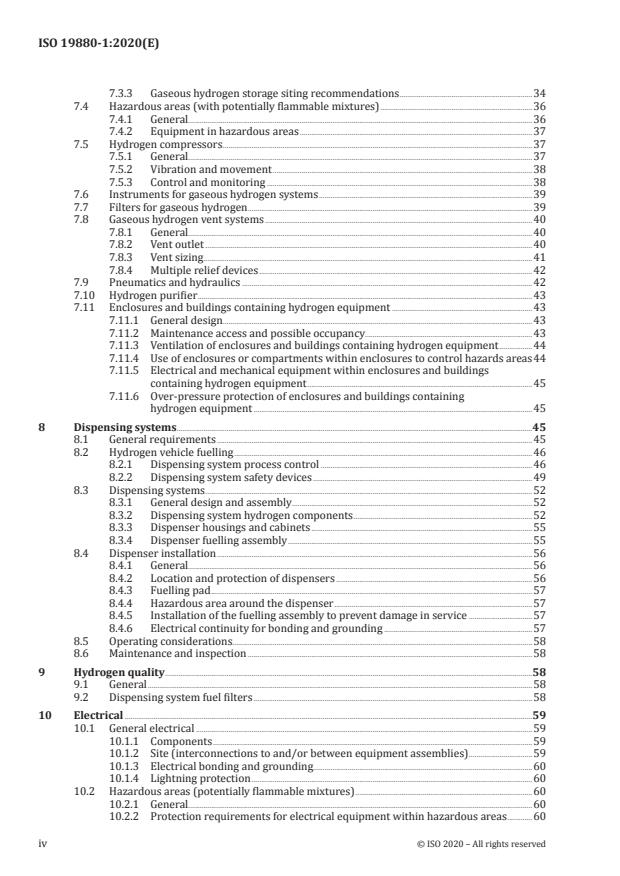
10.2.3 Protection from ignition due to accumulation of static charge .60
10.3 Electromagnetic compatibility and interference (EMC) .62
10.3.1 General.62
10.3.2 Industrial (EMC) Environments .62
10.3.3 Residential, Commercial, and Light-Industrial (EMC) Environments .62
11 Instrumentation and control system .62
11.1 General .62
11.2 Emergency shutdown functionality .63
11.2.1 General.63
11.2.2 Manually actuated emergency stop devices .64
11.2.3 Hydrogen detection systems .64
11.3 Remote system control .65
11.4 Modifications to control system .66
12 Station inspection and tests .66
12.1 General .66
12.2 Pressure test .66
12.3 Leak test .67
12.4 Electrical testing .67
12.5 Fuelling safety and performance functional testing .68
12.5.1 General.68
12.5.2 Fuelling protocol test .68
12.5.3 Test procedure .69
12.5.4 Site acceptance testing options .69
12.5.5 Additional performance considerations for fuelling .71
12.6 Hydrogen quality testing .72
12.7 Station inspection and tests following modifications .72
13 Operation .72
13.1 General .72
13.2 Warning signs .72
13.3 Dispenser operational instructions .73
13.4 Functional identification .74
13.5 Marking of equipment (data plate) .74
13.6 Reference designations .75
13.7 Training .75
13.8 Emergency response plan .75
13.9 Emergency contact information .76
14 Technical documentation .76
14.1 General .76
14.2 Information to be provided .76
14.3 Recommendations applicable to all documentation .78
14.4 Installation documents .78
14.4.1 General.78
14.4.2 Installation documentation for hazardous areas .79
14.4.3 Venting documentation .79
14.4.4 Seismic documentation .79
14.4.5 Handling and lifting documentation .79
14.5 Overview diagrams and function diagrams .80
14.6 Circuit diagrams .80
14.7 Flow (P&ID) diagrams .80
14.8 Fuelling station operating manual .81
14.9 Maintenance and service manuals .81
14.10 Parts list .81
15 Inspection and maintenance .82
15.1 Inspection and maintenance program.82
15.2 Maintenance and testing frequency of gas detection .83
15.3 Maintenance and inspection frequency of filters .83
15.4 Maintenance of pressure relief devices .84
15.5 Hot work .84
15.6 Modifications to the hydrogen fuelling station and associated equipment.84
Annex A (informative) Safety methodologies and risk assessment .85
Annex B (informative) Further guidance on risk management.107
Annex C (informative) Hydrogen dispensing and examples of fuelling and communications
protocols, and corresponding verification testing .113
Annex D (informative) Reference fuelling limits of hydrogen and fuel cell vehicles .131
Annex E (informative) Pressure level application to design verification requirements for
hydrogen dispensing systems and compressed hydrogen storage systems .132
Annex F (informative) Countermeasures for unsuitable hydrogen fuelling protocols .137
Annex G (informative) Recommendations for, and example of, vehicular impact protection
measures .138
Annex H (informative) Example for leakage testing of hydrogen fuelling system .141
Annex I (informative) Minimum fuelling station acceptance inspection, testing and
validation checklist .142
Annex J (informative) Hydrogen station testing apparatus (HSTA) .149
Annex K (informative) Sampling procedures and hardware for hydrogen fuel quality analysis .151
Bibliography .167
vi © ISO 2020 – All rights reserved
Foreword
ISO (the International Organization for Standardization) is a worldwide federation of national standards
bodies (ISO member bodies). The work of preparing International Standards is normally carried out
through ISO technical committees. Each member body interested in a subject for which a technical
committee has been established has the right to be represented on that committee. International
organizations, governmental and non-governmental, in liaison with ISO, also take part in the work.
ISO collaborates closely with the International Electrotechnical Commission (IEC) on all matters of
electrotechnical standardization.
The procedures used to develop this document and those intended for its further maintenance are
described in the ISO/IEC Directives, Part 1. In particular, the different approval criteria needed for the
different types of ISO documents should be noted. This document was drafted in accordance with the
editorial rules of the ISO/IEC Directives, Part 2 (see www .iso .org/ directives).
Attention is drawn to the possibility that some of the elements of this document may be the subject of
patent rights. ISO shall not be held responsible for identifying any or all such patent rights. Details of
any patent rights identified during the development of the document will be in the Introduction and/or
on the ISO list of patent declarations received (see www .iso .org/ patents).
Any trade name used in this document is information given for the convenience of users and does not
constitute an endorsement.
For an explanation of the voluntary nature of standards, the meaning of ISO specific terms and
expressions related to conformity assessment, as well as information about ISO's adherence to the
World Trade Organization (WTO) principles in the Technical Barriers to Trade (TBT) see www .iso .org/
iso/ foreword .html.
This document was prepared by Technical Committee ISO/TC 197, Hydrogen technologies.
This first edition cancels and replaces ISO/TS 19880-1:2016, which has been technically revised.
The main changes compared to the ISO/TS 19880-1:2016 are as follows:
— where appropriate, guidance information from the TS was converted to requirements;
— the difference between the risk assessment and the design requirement clauses were clarified and
references were added to ensure that the appropriate clauses were linked;
— Annex A from the TS on safety distances was removed;
— Annex C from the TS on hydrogen quality control was removed to ISO 19880-8;
— the presentation of the information was improved and much of the guidance information was moved
to informative annexes.
A list of all parts in the ISO 19880 series can be found on the ISO website.
Any feedback or questions on this document should be directed to the user’s national standards body. A
complete listing of these bodies can be found at www .iso .org/ members .html.
INTERNATIONAL STANDARD ISO 19880-1:2020(E)
Gaseous hydrogen — Fuelling stations —
Part 1:
General requirements
1 Scope
This document defines the minimum design, installation, commissioning, operation, inspection and
maintenance requirements, for the safety, and, where appropriate, for the performance of public and
non-public fuelling stations that dispense gaseous hydrogen to light duty road vehicles (e.g. fuel cell
electric vehicles).
This document is not applicable to the dispensing of cryogenic hydrogen, or hydrogen to metal hydride
applications.
Since this document is intended to provide minimum requirements for fuelling stations, manufacturers
can take additional safety precautions as determined by a risk management methodology to address
potential safety risks of specific designs and applications.
While this document is targeted for the fuelling of light duty hydrogen road vehicles, requirements and
guidance for fuelling medium and heavy duty road vehicles (e.g. buses, trucks) are also covered.
Many of the generic requirements within this document are applicable to fuelling stations for other
hydrogen applications, including but not limited to the following:
— fuelling stations for motorcycles, fork-lift trucks, trams, trains, fluvial and marine applications;
— fuelling stations with indoor dispensing;
— residential applications to fuel land vehicles;
— mobile fuelling stations; and
— non-public demonstration fuelling stations.
However, further specific requirements that can be necessary for the safe operation of such fuelling
stations are not addressed in this document.
This document provides requirements for and guidance on the following elements of a fuelling station
(see Figure 1 and Figure 2):
— hydrogen production/delivery system:
— delivery of hydrogen by pipeline, trucked in gaseous and/or liquid hydrogen, or metal hydride
storage trailers;
— on-site hydrogen generators using water electrolysis process or hydrogen generators using fuel
processing technologies;
— liquid hydrogen storage;
— hydrogen purification systems, as applicable;
— compression:
— gaseous hydrogen compression;
— pumps and vaporizers;
— gaseous hydrogen buffer storage;
— pre-cooling device;
— gaseous hydrogen dispensing systems.
a
May include a buffer vessel (or accumulator) for dampening or adjusting flow of compressor suction inlet.
Figure 1 — Example of typical elements that a fuelling station consists of, including
hydrogen supply
Figure 2 — Image of an example hydrogen fuelling station
2 © ISO 2020 – All rights reserved
2 Normative references
The following documents are referred to in the text in such a way that some or all of their content
constitutes requirements of this document. For dated references, only the edition cited applies. For
undated references, the latest edition of the referenced document (including any amendments) applies
ISO 13850, Safety of machinery — Emergency stop function — Principles for design
ISO 14687, Hydrogen fuel — Product specification
ISO 15649, Petroleum and natural gas industries — Piping
ISO 17268, Gaseous hydrogen land vehicle refuelling connection devices
ISO 19880-8, Gaseous hydrogen — Fuelling stations — Part 8: Hydrogen quality control
ISO 21013-1, Cryogenic vessels — Pressure-relief accessories for cryogenic service — Part 1: Reclosable
pressure-relief valves
ISO 21013-2, Cryogenic vessels — Pressure-relief accessories for cryogenic service — Part 2: Non-reclosable
pressure-relief devices
ISO 21013-3, Cryogenic vessels — Pressure-relief accessories for cryogenic service — Part 3: Sizing and
capacity determination
ISO 22734, Hydrogen generators using water electrolysis
ISO/IEC 80079 (all parts), Explosive atmospheres
IEC 60079 (all parts), Explosive atmospheres
IEC 60204-1:2005, Safety of machinery — Electrical equipment of machines — Part 1: General requirements
IEC 60529, Degrees of protection provided by enclosures (IP Code)
IEC 62282-3-100, Fuel cell technologies. Stationary fuel cell power systems. Safety
EN 13445-5, Unfired pressure vessels. Inspection and testing
SAE J2600: 2015-08, Compressed Hydrogen Surface Vehicle Fuelling Connection Devices
3 Terms and definitions
For the purposes of this document, the following terms and definitions apply.
ISO and IEC maintain terminological databases for use in standardization at the following addresses:
— ISO Online browsing platform: available at https:// www .iso .org/ obp
— IEC Electropedia: available at http:// www .electropedia .org/
3.1
acceptance criteria
acceptable level of risk or harm (3.34), locally defined as:
— a tolerable risk value; or
— a specified harm level; or
— requirements in a prescriptive document
3.2
accessory
device with an operational function
3.3
bleed
intentional expiration of a fluid from a fluid system
3.4
basic process control system
BPCS
system which responds to input signals from the process, its associated equipment, other programmable
systems and/or an operator and generates output signals causing the process and its associated
equipment to operate in the desired manner but which does not perform any safety-instrumented
functions with a claimed SIL (3.73) ≥ 1
[SOURCE: IEC 61511-1:2004, 3.2.3]
3.5
breakaway device
device on the fuelling hose (3.27) that disconnects the hose from the dispenser (3.13) when a tension
limit is exceeded and blocks the flow of hydrogen from the dispenser, e.g. if the vehicle moves away
with the fuelling hose connected to the vehicle
3.6
buffer storage vessels
pressure vessels designed for the purpose of storing compressed hydrogen, which can be located
between a hydrogen generator and a compressor for an even flow of gas to the compressor or between
the compressor and dispensing system (3.17) for accumulation of pressurized gas supply for vehicle
fuelling
3.7
building
structure, usually enclosed by walls and a roof, constructed to provide support or shelter for intended
occupancy
3.8
canopy
roof, overhead shelter, or hood which affords a degree of weather protection
3.9
compressed hydrogen storage system
CHSS
hydrogen storage on-board vehicle, as defined in the GTR#13
3.10
component pressure rating
maximum pressure at which it is permissible to operate a component as specified by the manufacturer
at a specified temperature
Note 1 to entry: Components designed with a maximum allowable pressure per the European PED represent the
component pressure rating by the manufacturer that as indicated by the value of “PS”.
Note 2 to entry: This is sometimes referred to as the maximum allowable working pressure (3.45) for the
component, for example for vessels.
Note 3 to entry: In addition to the specification of the maximum temperature, the manufacturer can define an
allowable minimum temperature or temperature range expected for service. For additional thermal conditions
and risks potentially experiences during fires (3.23), see 5.3.6.4.
4 © ISO 2020 – All rights reserved
Note 4 to entry: Pressures up to 10 % above the rating can occur during fault management by PSV. See E.3
regarding limited cycle testing to 110 % of the rating as part of verification testing to demonstrate capability of
the component.
Note 5 to entry: See Annex E for discussion of pressure terminology and its application to dispensing systems
(3.17) and fuelling stations (3.29) in general.
3.11
control system
system which responds to input signals from the process and/or from an operator and generates output
signals causing the process to operate in the desired manner
Note 1 to entry: Also see safety-instrumented system (SIS) (3.72) and basic process control system (BPCS) (3.4).
3.12
connector
matching parts (such as male and female parts) that can be put together to form a "connection" which
permits the transfer of fluids, electric power, or control signals
Note 1 to entry: Fittings (3.24) are a type of connector used in piping systems.
Note 2 to entry: Examples of connectors commonly used in hydrogen systems are as follows:
a) The fuelling nozzle (3.53) “connector” mates with the receptacle (3.64) “connector” on the vehicle to form
the connection for transfer of compressed hydrogen between the dispenser (3.13) and the vehicle, as defined
in ISO 17268 for this specific application;
b) The hose assemblies have connectors on each end that allow coupling to the hoses and connection to the
piping system, e.g. hose breakaway device (3.5) or fuelling nozzle;
c) Control systems (3.11) often use electrical connectors to allow rapid and secure assembly or replacement.
3.13
dispenser
equipment in the dispensing system (3.17), including the dispenser cabinet(s) (3.14) and support
structure, that is physically located in the fuelling area
Note 1 to entry: The hydrogen dispenser typically includes, as a minimum, the fuelling assembly (3.26), required
temperature and pressure instrumentation, filters, and the user interface to conduct vehicle fuelling.
Note 2 to entry: The manufacturer of the hydrogen dispenser can elect to include additional equipment in the
dispenser, including the possibility of all equipment in the dispensing system.
3.14
dispenser cabinet
protective housing (3.40) that encloses process piping and can also enclose measurement, control and
ancillary dispenser (3.13) equipment
3.15
dispenser fuel pressure
pressure of the hydrogen gas supplied to the vehicle by the station
Note 1 to entry: See Annex E for discussion of pressure terminology and its application to dispen
...