

ISO 19880-7:2025
(Main)Gaseous hydrogen — Fuelling stations — Part 7: Rubber O-rings
General Information
- Abstract
This document specifies the requirements for rubber O-rings and their housing dimensions, which seal gaseous hydrogen, in high-pressure hydrogen devices for gaseous hydrogen fuelling stations, such as valves, filters, joints, breakaways and other such devices. This document is applicable to O-rings suitable for sealing hydrogen gas of up to 70 MPa nominal working pressure, in the operating temperature range of −40 °C to 65 °C. This document contains safety requirements for the design of O-rings and their housing dimensions, compound design, and test methods for seal systems. This document applies to newly manufactured O-rings for hydrogen gas seal in high-pressure hydrogen devices used in hydrogen fuelling stations. NOTE 1 This document was developed using the ISO 3601 series. NOTE 2 This document was developed based on several temperature classes of rubber O-rings suitable for use with high-pressure hydrogen seals in devices for gaseous hydrogen stations. NOTE 3 The operating temperature is not a temperature of the hydrogen gas to be sealed by the O-ring gas seal system. Regardless of the operating temperature, the hydrogen gas temperature to be sealed can rise up to 180 °C. NOTE 4 The O-ring seal system for the high-pressure hydrogen devices are designed by the device manufacturers. The detailed specifications of the O-rings and design of static or non-static high-pressure hydrogen seal systems for the high-pressure hydrogen devices are determined as agreed upon between the interested parties by referring to this document.
- Status
- Published
- Publication Date
- 05-Aug-2025
- Technical Committee
- ISO/TC 197 - Hydrogen technologies
- Drafting Committee
- ISO/TC 197 - Hydrogen technologies
- Current Stage
- 6060 - International Standard published
- Start Date
- 06-Aug-2025
- Due Date
- 15-Jun-2025
- Completion Date
- 06-Aug-2025

Overview
ISO 19880-7:2025 - "Gaseous hydrogen - Fuelling stations - Part 7: Rubber O-rings" specifies requirements for rubber O-rings and their housings used to seal gaseous hydrogen in high‑pressure fuelling station devices (valves, filters, joints, breakaways, etc.). The standard applies to newly manufactured O-rings for gaseous hydrogen service up to 70 MPa nominal working pressure and an operating temperature range of −40 °C to 65 °C. It also highlights that the hydrogen gas temperature being sealed can rise up to 180 °C and that device manufacturers are responsible for final seal-system design.
Key topics and technical requirements
- O-ring geometry and tolerances: Toroidal shape with inside and cross‑section diameters referenced to ISO 3601‑1; measurement methods for receiving inspection are provided.
- Housing dimensions and fill: Groove and housing design follow ISO 3601‑2. Housing fill must not exceed 85% (adjusted for O‑ring volume inflation due to hydrogen exposure); the standard includes procedures to calculate corrected fill using a volume inflation ratio determined by Annex A exposure tests.
- Material and compound design: Lists suitable rubber materials and curing systems for high‑pressure hydrogen seals; allows addition of new materials through amendment. Detailed mechanical and exposure requirements are included (hardness, compression set, low‑temperature behaviour).
- Testing and inspection: Safety and quality acceptance criteria reference ISO 3601‑3; includes hydrogen exposure testing (Annex A), appearance criteria after exposure (Annex B), and stress/strain and compression set guidance (Annex C).
- Anti‑extrusion (back‑up) rings: Selection in line with ISO 3601‑4 where required.
- Design guidance: Ambient basis for calculations is 30 ± 3 °C unless otherwise agreed; the standard provides designation and identification codes plus instruction‑manual requirements.
Applications and who should use it
ISO 19880-7 is essential for:
- Hydrogen fuelling station equipment manufacturers designing valves, filters, breakaways and joints.
- Seal and elastomer designers selecting O‑ring compounds and groove geometries for high‑pressure hydrogen.
- Component suppliers and procurement teams specifying compliant O‑rings for hydrogen applications.
- Test laboratories and quality engineers performing acceptance and hydrogen exposure testing.
- Safety and certification professionals ensuring seal systems meet hydrogen service requirements.
Practical benefits include improved seal reliability under high‑pressure hydrogen, reduced risk of extrusion or swelling, standardized inspection, and clearer supplier requirements.
Related standards
- ISO 3601 series (O‑rings: dimensions, housings, quality, back‑up rings)
- ISO 19880‑1 (Gaseous hydrogen fuelling stations - General requirements)
- ISO 14687 (Hydrogen fuel quality)
- ASTM D1414 (Rubber O‑ring test methods)
Keywords: ISO 19880-7, rubber O-rings, gaseous hydrogen, hydrogen fuelling stations, high-pressure hydrogen, O-ring housing dimensions, seal systems, 70 MPa.
Get Certified
Connect with accredited certification bodies for this standard

TÜV Rheinland
TÜV Rheinland is a leading international provider of technical services.

TÜV SÜD
TÜV SÜD is a trusted partner of choice for safety, security and sustainability solutions.

DEKRA Certification Inc.
DEKRA US certification services.
Sponsored listings
Frequently Asked Questions
ISO 19880-7:2025 is a standard published by the International Organization for Standardization (ISO). Its full title is "Gaseous hydrogen — Fuelling stations — Part 7: Rubber O-rings". This standard covers: This document specifies the requirements for rubber O-rings and their housing dimensions, which seal gaseous hydrogen, in high-pressure hydrogen devices for gaseous hydrogen fuelling stations, such as valves, filters, joints, breakaways and other such devices. This document is applicable to O-rings suitable for sealing hydrogen gas of up to 70 MPa nominal working pressure, in the operating temperature range of −40 °C to 65 °C. This document contains safety requirements for the design of O-rings and their housing dimensions, compound design, and test methods for seal systems. This document applies to newly manufactured O-rings for hydrogen gas seal in high-pressure hydrogen devices used in hydrogen fuelling stations. NOTE 1 This document was developed using the ISO 3601 series. NOTE 2 This document was developed based on several temperature classes of rubber O-rings suitable for use with high-pressure hydrogen seals in devices for gaseous hydrogen stations. NOTE 3 The operating temperature is not a temperature of the hydrogen gas to be sealed by the O-ring gas seal system. Regardless of the operating temperature, the hydrogen gas temperature to be sealed can rise up to 180 °C. NOTE 4 The O-ring seal system for the high-pressure hydrogen devices are designed by the device manufacturers. The detailed specifications of the O-rings and design of static or non-static high-pressure hydrogen seal systems for the high-pressure hydrogen devices are determined as agreed upon between the interested parties by referring to this document.
This document specifies the requirements for rubber O-rings and their housing dimensions, which seal gaseous hydrogen, in high-pressure hydrogen devices for gaseous hydrogen fuelling stations, such as valves, filters, joints, breakaways and other such devices. This document is applicable to O-rings suitable for sealing hydrogen gas of up to 70 MPa nominal working pressure, in the operating temperature range of −40 °C to 65 °C. This document contains safety requirements for the design of O-rings and their housing dimensions, compound design, and test methods for seal systems. This document applies to newly manufactured O-rings for hydrogen gas seal in high-pressure hydrogen devices used in hydrogen fuelling stations. NOTE 1 This document was developed using the ISO 3601 series. NOTE 2 This document was developed based on several temperature classes of rubber O-rings suitable for use with high-pressure hydrogen seals in devices for gaseous hydrogen stations. NOTE 3 The operating temperature is not a temperature of the hydrogen gas to be sealed by the O-ring gas seal system. Regardless of the operating temperature, the hydrogen gas temperature to be sealed can rise up to 180 °C. NOTE 4 The O-ring seal system for the high-pressure hydrogen devices are designed by the device manufacturers. The detailed specifications of the O-rings and design of static or non-static high-pressure hydrogen seal systems for the high-pressure hydrogen devices are determined as agreed upon between the interested parties by referring to this document.
ISO 19880-7:2025 is classified under the following ICS (International Classification for Standards) categories: 43.060.40 - Fuel systems; 71.100.20 - Gases for industrial application. The ICS classification helps identify the subject area and facilitates finding related standards.
ISO 19880-7:2025 is available in PDF format for immediate download after purchase. The document can be added to your cart and obtained through the secure checkout process. Digital delivery ensures instant access to the complete standard document.
Standards Content (Sample)
International
Standard
ISO 19880-7
First edition
Gaseous hydrogen — Fuelling
2025-08
stations —
Part 7:
Rubber O-rings
Carburant d'hydrogène gazeux — Stations-service —
Partie 7: Joints toriques en caoutchouc
Reference number
© ISO 2025
All rights reserved. Unless otherwise specified, or required in the context of its implementation, no part of this publication may
be reproduced or utilized otherwise in any form or by any means, electronic or mechanical, including photocopying, or posting on
the internet or an intranet, without prior written permission. Permission can be requested from either ISO at the address below
or ISO’s member body in the country of the requester.
ISO copyright office
CP 401 • Ch. de Blandonnet 8
CH-1214 Vernier, Geneva
Phone: +41 22 749 01 11
Email: copyright@iso.org
Website: www.iso.org
Published in Switzerland
ii
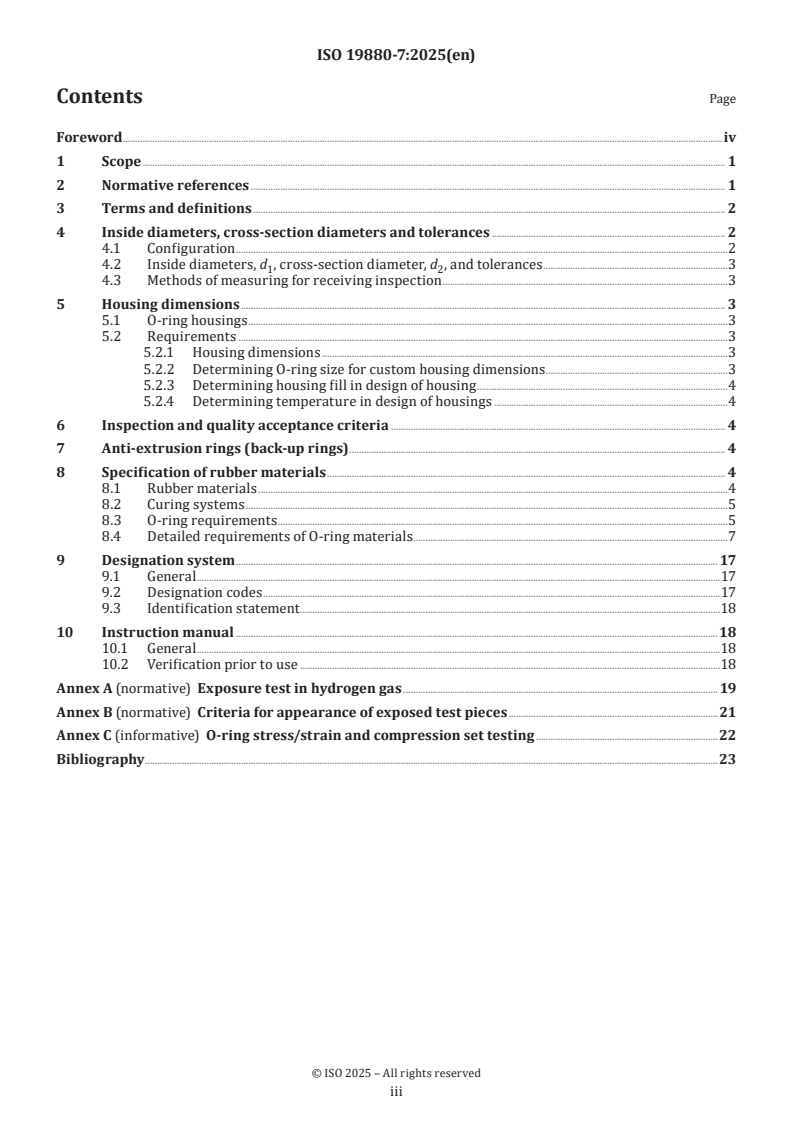
Contents Page
Foreword .iv
1 Scope . 1
2 Normative references . 1
3 Terms and definitions . 2
4 Inside diameters, cross-section diameters and tolerances . 2
4.1 Configuration .2
4.2 Inside diameters, d , cross-section diameter, d , and tolerances .3
1 2
4.3 Methods of measuring for receiving inspection .3
5 Housing dimensions . 3
5.1 O-ring housings .3
5.2 Requirements .3
5.2.1 Housing dimensions .3
5.2.2 Determining O-ring size for custom housing dimensions .3
5.2.3 Determining housing fill in design of housing .4
5.2.4 Determining temperature in design of housings .4
6 Inspection and quality acceptance criteria . 4
7 Anti-extrusion rings (back-up rings) . 4
8 Specification of rubber materials . 4
8.1 Rubber materials .4
8.2 Curing systems .5
8.3 O-ring requirements .5
8.4 Detailed requirements of O-ring materials .7
9 Designation system . 17
9.1 General .17
9.2 Designation codes .17
9.3 Identification statement .18
10 Instruction manual .18
10.1 General .18
10.2 Verification prior to use .18
Annex A (normative) Exposure test in hydrogen gas . 19
Annex B (normative) Criteria for appearance of exposed test pieces .21
Annex C (informative) O-ring stress/strain and compression set testing .22
Bibliography .23
iii
Foreword
ISO (the International Organization for Standardization) is a worldwide federation of national standards
bodies (ISO member bodies). The work of preparing International Standards is normally carried out through
ISO technical committees. Each member body interested in a subject for which a technical committee
has been established has the right to be represented on that committee. International organizations,
governmental and non-governmental, in liaison with ISO, also take part in the work. ISO collaborates closely
with the International Electrotechnical Commission (IEC) on all matters of electrotechnical standardization.
The procedures used to develop this document and those intended for its further maintenance are described
in the ISO/IEC Directives, Part 1. In particular, the different approval criteria needed for the different types
of ISO document should be noted. This document was drafted in accordance with the editorial rules of the
ISO/IEC Directives, Part 2 (see www.iso.org/directives).
ISO draws attention to the possibility that the implementation of this document may involve the use of (a)
patent(s). ISO takes no position concerning the evidence, validity or applicability of any claimed patent rights
in respect thereof. As of the date of publication of this document, ISO had not received notice of (a) patent(s)
which may be required to implement this document. However, implementers are cautioned that this may not
represent the latest information, which may be obtained from the patent database available at www.iso.org/
patents. ISO shall not be held responsible for identifying any or all such patent rights.
Any trade name used in this document is information given for the convenience of users and does not
constitute an endorsement. For an explanation of the voluntary nature of standards, the meaning of ISO
specific terms and expressions related to conformity assessment, as well as information about ISO's
adherence to the World Trade Organization (WTO) principles in the Technical Barriers to Trade (TBT), see
www.iso.org/iso/foreword.html.
This document was prepared by Technical Committee ISO/TC 197, Hydrogen technologies.
A list of all parts in the ISO 19880 series can be found on the ISO website.
Any feedback or questions on this document should be directed to the user’s national standards body. A
complete listing of these bodies can be found at www.iso.org/members.html.
iv
International Standard ISO 19880-7:2025(en)
Gaseous hydrogen — Fuelling stations —
Part 7:
Rubber O-rings
1 Scope
This document specifies the requirements for rubber O-rings and their housing dimensions, which seal gaseous
hydrogen, in high-pressure hydrogen devices for gaseous hydrogen fuelling stations, such as valves, filters,
joints, breakaways and other such devices. This document is applicable to O-rings suitable for sealing hydrogen
gas of up to 70 MPa nominal working pressure, in the operating temperature range of −40 °C to 65 °C.
This document contains safety requirements for the design of O-rings and their housing dimensions,
compound design, and test methods for seal systems. This document applies to newly manufactured O-rings
for hydrogen gas seal in high-pressure hydrogen devices used in hydrogen fuelling stations.
NOTE 1 This document was developed using the ISO 3601 series.
NOTE 2 This document was developed based on several temperature classes of rubber O-rings suitable for use with
high-pressure hydrogen seals in devices for gaseous hydrogen stations.
NOTE 3 The operating temperature is not a temperature of the hydrogen gas to be sealed by the O-ring gas seal
system. Regardless of the operating temperature, the hydrogen gas temperature to be sealed can rise up to 180 °C.
NOTE 4 The O-ring seal system for the high-pressure hydrogen devices are designed by the device manufacturers.
The detailed specifications of the O-rings and design of static or non-static high-pressure hydrogen seal systems for
the high-pressure hydrogen devices are determined as agreed upon between the interested parties by referring to
this document.
2 Normative references
The following documents are referred to in the text in such a way that some or all of their content constitutes
requirements of this document. For dated references, only the edition cited applies. For undated references,
the latest edition of the referenced document (including any amendments) applies.
ISO 37, Rubber, vulcanized or thermoplastic — Determination of tensile stress-strain properties
ISO 48-2:2018, Rubber, vulcanized or thermoplastic — Determination of hardness — Part 2: Hardness between
10 IRHD and 100 IRHD
ISO 188, Rubber, vulcanized or thermoplastic — Accelerated ageing and heat resistance tests
ISO 815-1:2019, Rubber, vulcanized or thermoplastic — Determination of compression set — Part 1: At ambient
or elevated temperatures
ISO 1382, Rubber — Vocabulary
ISO 1629, Rubber and latices — Nomenclature
ISO 2921, Rubber, vulcanized — Determination of low-temperature characteristics — Temperature-retraction
procedure (TR test)
ISO 3601-1:2012, Fluid power systems — O-rings — Part 1: Inside diameters, cross-sections, tolerances and
designation codes
ISO 3601-1, Fluid power systems — O-rings — Part 1: Inside diameters, cross-sections, tolerances and
designation codes
ISO 3601-2:2016, Fluid power systems — O-rings — Part 2: Housing dimensions for general applications
ISO 3601-2, Fluid power systems — O-rings — Part 2: Housing dimensions for general applications
ISO 3601-3, Fluid power systems — O-rings — Part 3: Quality acceptance criteria
ISO 3601-4, Fluid power systems — O-rings — Part 4: Anti-extrusion rings (back-up rings)
ISO 5598, Fluid power systems and components — Vocabulary
ISO 14687:2019, Hydrogen fuel quality — Product specification
ISO 18899, Rubber — Guide to the calibration of test equipment
ISO 19880-1, Gaseous hydrogen — Fuelling stations — Part 1: General requirements
ASTM D1414, Standard Test Methods for Rubber O-Rings
ASTM D1414-15, Standard Test Methods for Rubber O-rings
3 Terms and definitions
For the purposes of this document, the terms and definitions given in ISO 1382, ISO 5598 and ISO 19880-1
and the following apply.
ISO and IEC maintain terminology databases for use in standardization at the following addresses:
— ISO Online browsing platform: available at https:// www .iso .org/ obp
— IEC Electropedia: available at https:// www .electropedia .org/
3.1
operating temperature
environmental temperature in which a device equipped with an O-ring gas seal system operates
4 Inside diameters, cross-section diameters and tolerances
4.1 Configuration
The shape of the O-ring shall be toroidal, as shown in Figure 1.
d
Key
d inside diameter
d cross-section diameter
Figure 1 — Typical O-ring configuration
4.2 Inside diameters, d , cross-section diameter, d , and tolerances
1 2
The typical combinations of inside diameters, d , cross-section diameters, d are shown in ISO 3601-1:2012,
1 2
Tables 1 - 11. The inside diameter and cross-section diameter of O-rings for the high-pressure hydrogen
devices are determined by reference to ISO 3601-1:2012, Tables 1 - 11.
4.3 Methods of measuring for receiving inspection
When it is necessary to inspect O-rings that conform to this document at the time of customer receipt, it is
the responsibility of the interested parties to decide the inspection procedure. ISO 3601-1:2012, Annex B
provides possible methods for such a procedure for information.
5 Housing dimensions
5.1 O-ring housings
O-ring housing shall be designed in accordance with ISO 3601-2.
NOTE The applicable International Standard for each high-pressure hydrogen device provides the requirements
for the performance of seal systems of the device that incorporates the O-ring and its housing.
Rubber O-rings are sometimes used as a sealing material for the joint of two high-pressure hydrogen devices.
In this case, the two devices are joined via an O-ring, and it is necessary for the O-ring groove at the joint to
conform to this document when completed. If the devices to be joined cannot be specified, i.e. if the state in
which the O-ring groove is completed cannot be defined, it is outside the scope of this document.
5.2 Requirements
5.2.1 Housing dimensions
Housing dimensions shall be designed in accordance with ISO 3601-2:2016, 6.1.
5.2.2 Determining O-ring size for custom housing dimensions
For hardware dimensions not listed in ISO 3601-2:2016, Tables 1 - 7, ISO 3601-2:2016, Annex B provides a
procedure for identifying the proper O-ring for use in housings for specific hardware.
d
5.2.3 Determining housing fill in design of housing
It is important to determine the housing fill or occupancy of the installed O-ring to avoid detrimental effects
on radial sealing performance. Housing fill of the installed O-ring shall not be more than 85 % to allow for
possible O-ring thermal expansion, volume swell due to fluid exposure and effects of tolerances. To apply the
housing design listed in ISO 3601-2, the housing fill shall be corrected in terms of volume inflation ratio of
rubber material during hydrogen compression and decompression cycle.
Corrected housing fill is described by Formula (1)
(1)
where
F is the housing fill by volume inflation of rubber material, in (%);
F is the corrected housing fill by volume inflation of rubber material, in (%);
corrected
V is the volume of installed O-ring;
OR
V is the volume of the housing;
housing
b is the volume inflation ratio. Measurement method of rubber materials shall be in accordance
with Annex A.
NOTE The volume inflation ratio after hydrogen exposure is determined by the composition of the rubber
composites, regardless the mechanical properties. The volume inflation ratio after hydrogen exposure of rubber
composites which shows similar mechanical properties can show the difference each other. It is important for
designing the O-ring housing to determine the precise volume inflation ratio of the O-ring material and to adjust the
housing fill in terms of the volume inflation ratio.
5.2.4 Determining temperature in design of housings
It is important to note there are significant differences in the coefficients of thermal expansion and
contraction between the O-ring material and the housing materials. Rubbers can have coefficients of
expansion several times higher than that of metals, such as steel. The calculations used in this document
shall be based upon an ambient temperature of (30 ± 3) °C. The ambient temperature of 30 °C may be changed
by the agreement of the interested parties. However, the tolerance of ± 3 °C shall remain unchanged.
6 Inspection and quality acceptance criteria
Inspection shall be carried out with the quality acceptance criteria in accordance with ISO 3601-3.
7 Anti-extrusion rings (back-up rings)
If required, anti-extrusion rings (backup-rings) shall be selected in accordance with ISO 3601-4.
8 Specification of rubber materials
8.1 Rubber materials
The materials listed in Table 1 are rubber materials for high-pressure hydrogen gas seal O-rings.
The listed materials in Table 1 are not exhaustive.
The newly developed or selected materials can be added to the tables in Clause 8, as an amendment to or
revision of this document, if required.
[1]
Specification of elastomeric materials for industrial application of O-rings can be found in ISO 3601-5 .
Table 1 — Rubber materials for high-pressure hydrogen gas seal O-ring
Nominal hardness (IRHD)
b
a
Code Basic rubber Curing system
[° ]
NBR S Acrylonitrile-butadiene Sulfur 70, 80, 90
NBR P Acrylonitrile-butadiene Peroxide 70, 80, 90
c
FKM Fluorocarbon Sulfur free 70, 80, 90
EPDM P Ethylene-propylene-diene Peroxide 70, 80, 90
c
VMQ Vinyl methyl silicone rubber Sulfur free 70, 80
HNBR P Hydrogenated acrylonitrile Peroxide 80, 90
butadiene
d
PU Polyurethane N/A 95
a
Codes shall be determined based on the basic polymers and curing system in accordance with ISO 1629.
b
See ISO 48-2:2018, Method CM.
c
Special "Sulfur free" curing system corresponding to the basic polymers is selected.
d
Thermoplastic rubber.
[2]
NOTE ISO 11114-2 also describes the compatibility to hydrogen of non-metallic materials.
8.2 Curing systems
An important process in moulding operations to make O-rings is vulcanization. Vulcanization is a chemical
process for converting rubber or related polymers into more durable and, in case of rubber, more elastic
materials through the addition of sulfur or other equivalent “curatives”. These additives modify the polymer
by forming cross-links between individual polymer chains. The curing systems used depends on the polymer
type and the desired properties. Two of the most widely and often used systems are sulfur (S) and peroxide
(P) curing systems. Generally, sulfur contaminants in the gaseous hydrogen in fuelling stations shall be
strictly controlled and meet the requirements for Grade D fuel in ISO 14687:2019, Table 2. In particular,
sulfur compounds in the Grade D fuel at the dispenser nozzle is limited at 0,004 μmol/mol. A sulfur curing
system shall be carefully used for this purpose.
NOTE Not all curing systems are suitable for all rubber.
8.3 O-ring requirements
The O-ring made from the rubbers in Table 1 shall meet the requirements specified in Table 2. Table 2 can be
used for the inspection of production parts, incoming goods, or in case of complaints.
The frequency and condition of the lot testing shall be agreed between interested parties.
Annex C provides information on stress/strain and compression set testing of O-rings.
Table 2 — O-ring requirements
Test
Unit NBR S NBR P FKM EPDM P VMQ HNBR PU meth-
od
Hardness
° 70 80 90 70 80 90 70 80 90 70 80 90 70 80 80 90 95
(IRHD)
ISO
Toler- d
2 ≥
° +5/-5 +5/-5 +5/-5 +5/-5 +5/-5 +5/-5 +5/-5 +5/-5 +5/-5 +5/-5 +5/-5 +5/-5 +5/-5 +5/-5 +5/-5 +5/-5 +5/-5
48-
ance
1,60 mm
2:2018,
in
hard-
Meth-
d
ness
2 < od CM
° +5/-8 +5/-8 5/-8 +5/-8 +5/-8 +5/-8 +5/-8 +5/-8 +5/-8 +5/-8 +5/-8 +5/-8 +5/-8 +5/-8 +5/-8 +5/-8 +5/-8
1,60 mm
Com-
pres-
sion
Set,
max.
% 50 50 50 50 50 50 45 50 50 35 35 40 35 35 50 50 45
for d2
2,62
mm
h
At
tem-
°C 100 100 100 100 100 100 200 200 200 125 125 125 150 150 125 125 100
ISO
pera-
815-
ture
1:2019,
Com-
Meth-
pres-
od A
sion
Set,
max.
% 50 50 50 50 55 60 45 50 50 35 35 40 45 45 50 50 45
for d2
<2,62
mm
h
At
tem-
°C 100 100 100 100 100 100 200 200 200 125 125 125 150 150 125 125 80
pera-
ture
NOTE For all values d < 1 mm, no reliable measurement procedures have been developed.
8.4 Detailed requirements of O-ring materials
O-ring materials shall be selected taking operating conditions of the devices and the testing conditions in
Table 2 into consideration. Therefore, users should determine the compatibility of the O-ring material with
the operational parameters (e.g. temperature, pressure) of the application.
The detailed requirements of O-ring materials according to Table 1 are specified in Table 3 to Table 9. These
tables shall be used to qualify O-ring materials.
The detailed specifications of the O-rings and design of static or non-static high-pressure hydrogen seal
systems for the high-pressure hydrogen devices are determined as agreed upon between the interested
parties by referring to this document.
Table 3 — O-ring material NBR (sulfur cured)
NBR S
Test speci-
Properties Unit Test method
men
70 80 90
ISO 48-
Hardness
° 2 mm sheet 70 ± 5 80 ± 5 90 ± 5 2:2018,
(IRHD)
Method M
ISO 48-
Hardness
a
° O-ring 70 ± 5 80 ± 5 90 ± 5 2:2018,
(IRHD)
Metod CM
Tensile
MPa 2 mm sheet 12 12 10 ISO 37
strength, min.
Tensile
a b
MPa O-ring 10 10 8 ASTM D1414
strength, min.
Mechanical
Elongation at
% 2 mm sheet 250 200 125 ISO 37
properties
break, min.
Elongation at
a b
% O-ring 200 160 100 ASTM D1414
break, min.
Button type
Compression
ISO 815-
B
set, max.
1:2019,
% 40 40 40
φ 13 mm×6,3
Method A
h at 100°C
mm
Compression
ISO 815-
set, max. a
1:2019,
% O-ring 50 50 50
Method A
h at 100°C
a
An O-ring with cross-section diameter d = 3,53 mm or between 1,5 mm and 4 mm shall be selected from ISO 3601-1.
b
The latest version of the specification is applicable.
c
Test piece inflates uniformly without any obvious surface cracks and blisters. See Annex B.
TTabablele 3 3 ((ccoonnttiinnueuedd))
NBR S
Test speci-
Properties Unit Test method
men
70 80 90
ISO 48-
Hardness
° 2 mm sheet +10 +10 +10 2:2018,
change, max.
Method M
ISO 48-
Hardness
a
° O-ring +10 +10 +10 2:2018,
change, max.
Method CM
Heat aging,
Change of ten-
sile strength, % 2 mm sheet -15 -20 -25 ISO 37
h at
max.
100°C
ISO 188
Change of ten-
a b
sile strength, % O-ring -15 -20 -30 ASTM D1414
max.
Change of elon-
gation at break, % 2 mm sheet -45 -50 -55 ISO 37
max.
Change of elon-
a b
gation at break, % O-ring -55 -60 -65 ASTM D1414
max.
Cold flexibility TR10 (Colder
°C 2 mm sheet −20 -20 −18 ISO 2921
than)
disc
Appearance of
c c c
exposed test − pass pass pass Annex B
φ 13 mm×2
pieces
mm
disc
Volume change,
% 60 60 60 Annex A
Exposure φ 13 mm×2
max.
test in hydro- mm
gen gas
Volume change,
a
% O-ring 60 60 60 Annex A
h at 30 max.
°C
disc
ISO 48-
Hardness
Annex A
° ±5 ±5 ±5 2:2018,
φ 13 mm×2
change
Method M
mm
ISO 48-
Hardness
a
° O-ring ±5 ±5 ±5 2:2018,
change
Method CM
NOTE Variations of physical properties (particularly hardness, see ISO 48-2:2018), can occur between test sheets and
O-rings made from the same compound. For qualification either test specimen (sheet or O-ring) is acceptable.
a
An O-ring with cross-section diameter d = 3,53 mm or between 1,5 mm and 4 mm shall be selected from ISO 3601-1.
b
The latest version of the specification is applicable.
c
Test piece inflates uniformly without any obvious surface cracks and blisters. See Annex B.
Table 4 — O-ring material NBR (peroxide cured)
NBR P
Test speci-
Properties Unit Test method
men
70 80 90
ISO 48-
Hardness
° 2 mm sheet 70 ± 5 80 ± 5 90 ± 5 2:2018,
(IRHD)
Method M
ISO 48-
Hardness
a
° O-ring 70 ± 5 80 ± 5 90 ± 5 2:2018,
(IRHD)
Method CM
Tensile
MPa 2 mm sheet 12 12 10 ISO 37
strength, min.
Tensile
a b
MPa O-ring 10 10 8 ASTM D1414
strength, min.
Elongation at
Mechanical
% 2 mm sheet 200 150 90 ISO 37
break, min.
properties
Elongation at
a b
% O-ring 200 150 90 ASTM D1414
break, min.
Compression
Button type
ISO 815-
set, max.
B
1:2019,
% 40 40 40
φ 13 mm×6,3
h at
Method A
mm
100°C
Compression
ISO 815-
set, max.
a
1:2019,
% O-ring 50 50 50
h at
Method A
100°C
ISO 48-
Hardness
° 2 mm sheet +10 +10 +10 2:2018,
change, max.
Method M
ISO 48-
Hardness
a
° O-ring +10 +10 +10 2:2018,
change, max.
Method CM
Change of ten-
Heat aging,
sile strength, % 2 mm sheet -15 -15 -25 ISO 37
max.
h at
100°C
Change of ten-
a b
sile strength, % O-ring -15 -15 -30 ASTM D1414
ISO 188
max.
Change of
elongation at % 2 mm sheet -45 -45 -55 ISO 37
break, max.
Change of
a b
elongation at % O-ring -55 -55 -65 ASTM D1414
break, max.
Cold flexibility TR10 (Colder
°C 2 mm sheet -20 −20 −18 ISO 2921
than)
a
An O-ring with cross-section diameter d = 3,53 mm or between 1,5 mm and 4 mm shall be selected from ISO 3601-1. If the
O-ring with cross-section diameter d < 2,62 mm, the criteria for compression set max are changed according to the Table 2.
b
The latest version of the specification is applicable.
c
Test piece inflates uniformly without any obvious surface cracks and blisters. See Annex B.
TTabablele 4 4 ((ccoonnttiinnueuedd))
NBR P
Test speci-
Properties Unit Test method
men
70 80 90
disc
Appearance of
c c c
exposed test − pass pass pass Annex B
φ 13 mm×2
pieces
mm
disc
Volume
Exposure % 60 60 60 Annex A
φ 13 mm×2
change
test in Hy-
mm
drogen gas
Volume
a
% O-ring 60 60 60 Annex A
h
change, max.
at 30 °C
disc
ISO 48-
Hardness
Annex A
° ±5 ±5 ±5 2:2018,
φ 13 mm×2
change, max.
Method M
mm
ISO 48-
Hardness
a
° O-ring ±5 ±5 ±5 2:2018,
change
Method CM
NOTE Variation
...