

ISO 19880-3:2018
(Main)Gaseous hydrogen — Fuelling stations — Part 3: Valves
General Information
- Abstract
This document provides the requirements and test methods for the safety performance of high pressure gas valves that are used in gaseous hydrogen stations of up to the H70 designation. This document covers the following gas valves: - check valve; - excess flow valve; - flow control valve; - hose breakaway device; - manual valve; - pressure safety valve; - shut-off valve.
- Status
- Published
- Publication Date
- 10-Jun-2018
- Technical Committee
- ISO/TC 197 - Hydrogen technologies
- Drafting Committee
- ISO/TC 197 - Hydrogen technologies
- Current Stage
- 9093 - International Standard confirmed
- Start Date
- 29-Feb-2024
- Completion Date
- 29-Aug-2026
Buy Documents

ISO 19880-3:2018 - Gaseous hydrogen -- Fuelling stations
ISO 19880-3:2018 - Gaseous hydrogen — Fuelling stations — Part 3: Valves/11/2018
Overview
ISO 19880-3:2018 - Gaseous hydrogen - Fuelling stations - Part 3: Valves defines safety performance requirements and test methods for high-pressure gas valves used in gaseous hydrogen fuelling stations (up to the H70 designation). The standard addresses a range of valve types used across hydrogen refuelling systems, including:
- Check valve
- Excess flow valve
- Flow control valve
- Hose breakaway device
- Manual valve
- Pressure safety valve
- Shut-off valve
ISO 19880-3:2018 focuses on material selection, product quality, and a comprehensive test program to verify valve integrity, leakage performance, mechanical strength and safe operation under hydrogen service and high-pressure cycles.
Key topics and requirements
The standard organizes technical requirements and test methods into general and valve-specific sections. Major technical topics include:
- General requirements: intended use, material requirements, and product quality controls for valves in hydrogen service.
- Test methods: defined procedures and test conditions for validating valve safety and performance, such as:
- Hydrogen gas pressure cycle test (endurance under cyclic pressurization)
- External and internal leakage tests
- Worst-case fault pressure cycle test
- Proof pressure and hydrostatic strength tests
- Excess torque resistance and bending moment tests
- Non-metallic materials testing
- Cold gas in warm valve test
- Valve-specific tests and criteria: additional tests for particular valve types - e.g., classification and operational tests for excess flow valves, separation and impact/drop/twist tests for hose breakaway devices, and maximum flow shut-off and operation cycle tests for manual valves.
- Safety features: containment or controlled relieving of hydrogen on separation, electrical conductivity for hose breakaways, and requirements for reliable shut-off and pressure relief.
Practical applications and who would use this standard
ISO 19880-3:2018 is intended for professionals involved in the design, manufacture, testing, installation and regulation of hydrogen fuelling infrastructure. Typical users include:
- Valve manufacturers and component designers for hydrogen refuelling stations
- Hydrogen fuelling station OEMs and system integrators
- Test laboratories and certification bodies performing conformity and type testing
- Safety engineers, regulators and asset owners/operators establishing procurement and maintenance criteria
- Standards writers and consultants working on hydrogen infrastructure projects
Adoption of ISO 19880-3 helps ensure valve reliability, reduce leakage risk, and support safe, compliant hydrogen fuelling operations.
Related standards (if applicable)
ISO 19880-3 is part of the broader ISO guidance for gaseous hydrogen fuelling stations. Users should also consider other ISO and industry standards covering hydrogen station design, pressure equipment and material compatibility to build a complete compliance and safety program.
Relations
- Consolidated By
ISO 505:2017 - Conveyor belts — Method for the determination of the tear propagation resistance of textile conveyor belts - Effective Date
- 06-Jun-2022
Buy Documents
ISO 19880-3:2018 - Gaseous hydrogen -- Fuelling stations
ISO 19880-3:2018 - Gaseous hydrogen — Fuelling stations — Part 3: Valves/11/2018
Get Certified
Connect with accredited certification bodies for this standard

TÜV Rheinland
TÜV Rheinland is a leading international provider of technical services.

TÜV SÜD
TÜV SÜD is a trusted partner of choice for safety, security and sustainability solutions.

DEKRA Certification Inc.
DEKRA US certification services.
Sponsored listings
Frequently Asked Questions
ISO 19880-3:2018 is a standard published by the International Organization for Standardization (ISO). Its full title is "Gaseous hydrogen — Fuelling stations — Part 3: Valves". This standard covers: This document provides the requirements and test methods for the safety performance of high pressure gas valves that are used in gaseous hydrogen stations of up to the H70 designation. This document covers the following gas valves: - check valve; - excess flow valve; - flow control valve; - hose breakaway device; - manual valve; - pressure safety valve; - shut-off valve.
This document provides the requirements and test methods for the safety performance of high pressure gas valves that are used in gaseous hydrogen stations of up to the H70 designation. This document covers the following gas valves: - check valve; - excess flow valve; - flow control valve; - hose breakaway device; - manual valve; - pressure safety valve; - shut-off valve.
ISO 19880-3:2018 is classified under the following ICS (International Classification for Standards) categories: 43.060.40 - Fuel systems; 71.100.20 - Gases for industrial application. The ICS classification helps identify the subject area and facilitates finding related standards.
ISO 19880-3:2018 has the following relationships with other standards: It is inter standard links to ISO 505:2017. Understanding these relationships helps ensure you are using the most current and applicable version of the standard.
ISO 19880-3:2018 is available in PDF format for immediate download after purchase. The document can be added to your cart and obtained through the secure checkout process. Digital delivery ensures instant access to the complete standard document.
Standards Content (Sample)
INTERNATIONAL ISO
STANDARD 19880-3
First edition
2018-06
Gaseous hydrogen — Fuelling
stations —
Part 3:
Valves
Carburant d'hydrogène gazeux — Stations-service —
Partie 3: Vannes
Reference number
©
ISO 2018
© ISO 2018
All rights reserved. Unless otherwise specified, or required in the context of its implementation, no part of this publication may
be reproduced or utilized otherwise in any form or by any means, electronic or mechanical, including photocopying, or posting
on the internet or an intranet, without prior written permission. Permission can be requested from either ISO at the address
below or ISO’s member body in the country of the requester.
ISO copyright office
CP 401 • Ch. de Blandonnet 8
CH-1214 Vernier, Geneva
Phone: +41 22 749 01 11
Fax: +41 22 749 09 47
Email: copyright@iso.org
Website: www.iso.org
Published in Switzerland
ii © ISO 2018 – All rights reserved
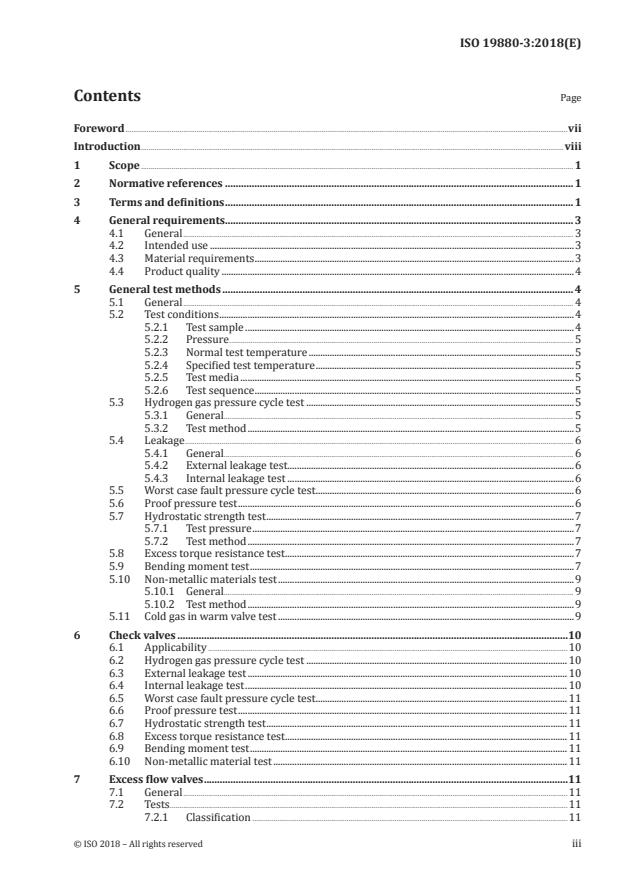
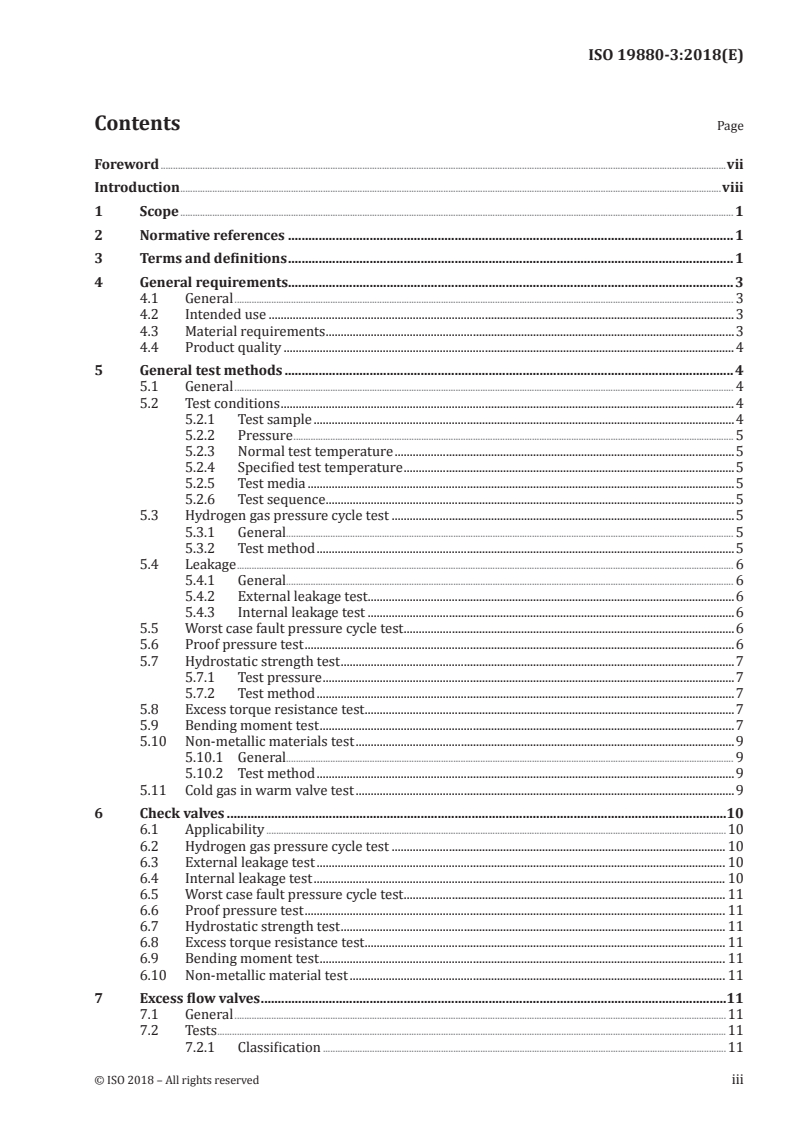
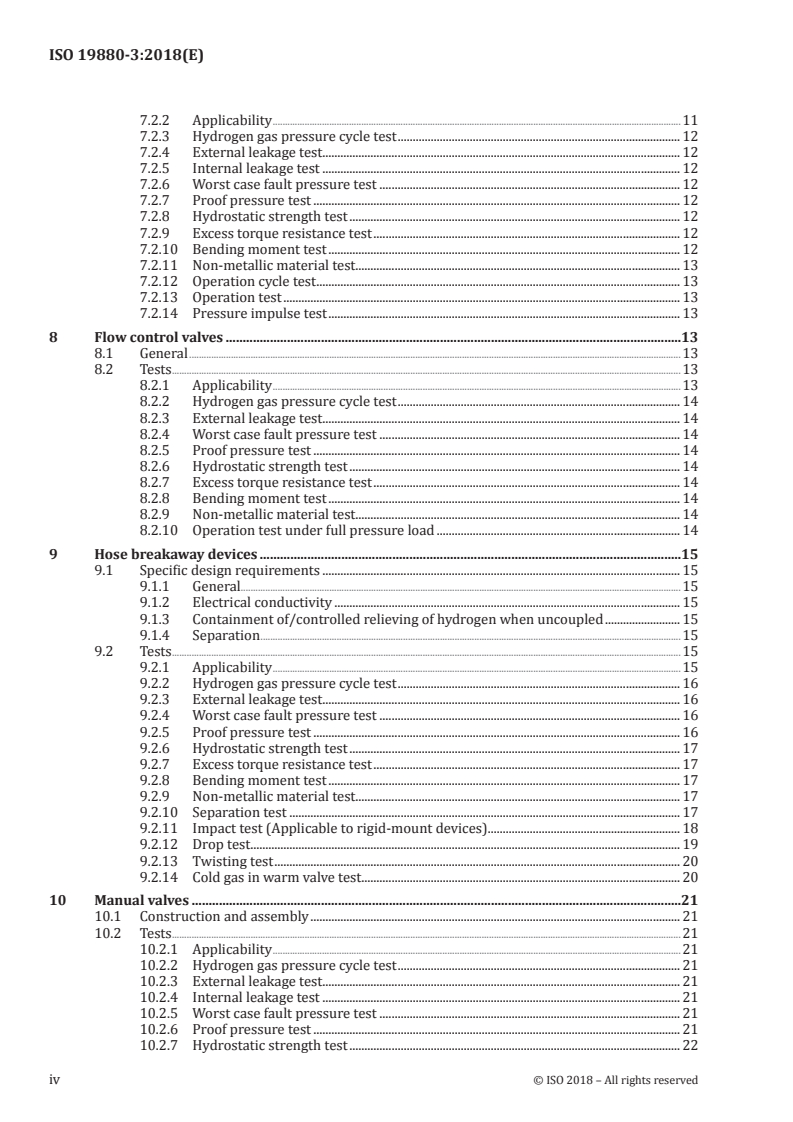
Contents Page
Foreword .vii
Introduction .viii
1 Scope . 1
2 Normative references . 1
3 Terms and definitions . 1
4 General requirements . 3
4.1 General . 3
4.2 Intended use .3
4.3 Material requirements .3
4.4 Product quality .4
5 General test methods . 4
5.1 General . 4
5.2 Test conditions .4
5.2.1 Test sample .4
5.2.2 Pressure . 5
5.2.3 Normal test temperature .5
5.2.4 Specified test temperature .5
5.2.5 Test media .5
5.2.6 Test sequence .5
5.3 Hydrogen gas pressure cycle test .5
5.3.1 General. 5
5.3.2 Test method .5
5.4 Leakage . 6
5.4.1 General. 6
5.4.2 External leakage test . . .6
5.4.3 Internal leakage test .6
5.5 Worst case fault pressure cycle test .6
5.6 Proof pressure test .6
5.7 Hydrostatic strength test .7
5.7.1 Test pressure .7
5.7.2 Test method .7
5.8 Excess torque resistance test .7
5.9 Bending moment test .7
5.10 Non-metallic materials test .9
5.10.1 General. 9
5.10.2 Test method .9
5.11 Cold gas in warm valve test .9
6 Check valves .10
6.1 Applicability .10
6.2 Hydrogen gas pressure cycle test . 10
6.3 External leakage test . 10
6.4 Internal leakage test . 10
6.5 Worst case fault pressure cycle test . 11
6.6 Proof pressure test . 11
6.7 Hydrostatic strength test . 11
6.8 Excess torque resistance test . 11
6.9 Bending moment test . 11
6.10 Non-metallic material test . 11
7 Excess flow valves .11
7.1 General .11
7.2 Tests .11
7.2.1 Classification .11
7.2.2 Applicability .11
7.2.3 Hydrogen gas pressure cycle test . 12
7.2.4 External leakage test . . . 12
7.2.5 Internal leakage test . 12
7.2.6 Worst case fault pressure test . 12
7.2.7 Proof pressure test . 12
7.2.8 Hydrostatic strength test . 12
7.2.9 Excess torque resistance test . 12
7.2.10 Bending moment test . 12
7.2.11 Non-metallic material test . . 13
7.2.12 Operation cycle test . 13
7.2.13 Operation test . 13
7.2.14 Pressure impulse test . 13
8 Flow control valves .13
8.1 General .13
8.2 Tests .13
8.2.1 Applicability .13
8.2.2 Hydrogen gas pressure cycle test . 14
8.2.3 External leakage test . . . 14
8.2.4 Worst case fault pressure test . 14
8.2.5 Proof pressure test . 14
8.2.6 Hydrostatic strength test . 14
8.2.7 Excess torque resistance test . 14
8.2.8 Bending moment test . 14
8.2.9 Non-metallic material test . . 14
8.2.10 Operation test under full pressure load . 14
9 Hose breakaway devices .15
9.1 Specific design requirements . 15
9.1.1 General.15
9.1.2 Electrical conductivity . 15
9.1.3 Containment of/controlled relieving of hydrogen when uncoupled . 15
9.1.4 Separation .15
9.2 Tests .15
9.2.1 Applicability .15
9.2.2 Hydrogen gas pressure cycle test . 16
9.2.3 External leakage test . . . 16
9.2.4 Worst case fault pressure test . 16
9.2.5 Proof pressure test . 16
9.2.6 Hydrostatic strength test . 17
9.2.7 Excess torque resistance test . 17
9.2.8 Bending moment test . 17
9.2.9 Non-metallic material test . . 17
9.2.10 Separation test . 17
9.2.11 Impact test (Applicable to rigid-mount devices) . 18
9.2.12 Drop test. 19
9.2.13 Twisting test . 20
9.2.14 Cold gas in warm valve test . 20
10 Manual valves .21
10.1 Construction and assembly . 21
10.2 Tests .21
10.2.1 Applicability .21
10.2.2 Hydrogen gas pressure cycle test . 21
10.2.3 External leakage test . . . 21
10.2.4 Internal leakage test . 21
10.2.5 Worst case fault pressure test . 21
10.2.6 Proof pressure test . 21
10.2.7 Hydrostatic strength test . 22
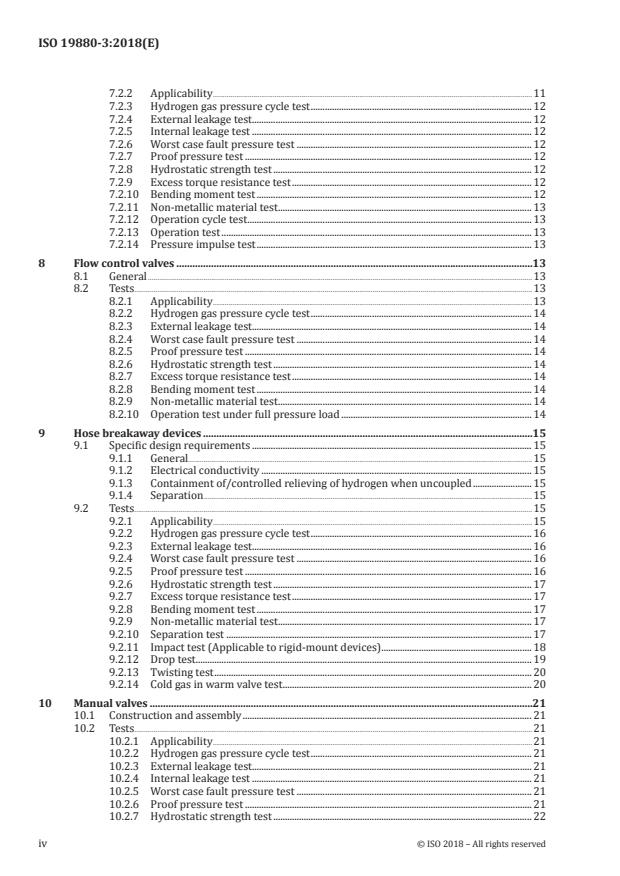
iv © ISO 2018 – All rights reserved
10.2.8 Excess torque resistance test . 22
10.2.9 Bending moment test . 22
10.2.10 Non-metallic material test . . 22
10.2.11 Maximum flow shut-off test. 22
10.2.12 Operation test . 22
10.2.13 Excess torque operation test . 22
11 Pressure safety valves (PSV) .23
11.1 Applicability .23
11.2 Hydrogen gas pressure cycle test . 23
11.3 PSV leakage tests . 23
11.3.1 External leakage test . . . 23
11.3.2 Seat leakage test . 23
11.4 Worst case fault pressure test . 24
11.5 Proof pressure test . 24
11.6 Hydrostatic strength test . 24
11.7 Excess torque resistance test . 24
11.8 Bending moment test . 24
11.9 Non-metallic material test . 24
11.10 Operation test . 24
12 Shut-off valves .25
12.1 Classification .25
12.2 Construction and assembly . 25
12.3 Tests .25
12.3.1 Applicability .25
12.3.2 Hydrogen gas pressure cycle test . 26
12.3.3 External leakage test . . . 26
12.3.4 Internal leakage test . 26
12.3.5 Worst case fault pressure test . 26
12.3.6 Proof pressure test . 26
12.3.7 Hydrostatic strength test . 27
12.3.8 Excess torque resistance test . 27
12.3.9 Bending moment test . 27
12.3.10 Non-metallic material test . . 27
12.3.11 Operation test under full pressure load . 27
12.3.12 Maximum flow shut-off test. 27
12.3.13 Cold gas in warm valve test . 27
13 Marking .28
13.1 Marking information . 28
13.2 Marking method . 28
14 Component literature .28
Bibliography .30
Foreword
ISO (the International Organization for Standardization) is a worldwide federation of national standards
bodies (ISO member bodies). The work of preparing International Standards is normally carried out
through ISO technical committees. Each member body interested in a subject for which a technical
committee has been established has the right to be represented on that committee. International
organizations, governmental and non-governmental, in liaison with ISO, also take part in the work.
ISO collaborates closely with the International Electrotechnical Commission (IEC) on all matters of
electrotechnical standardization.
The procedures used to develop this document and those intended for its further maintenance are
described in the ISO/IEC Directives, Part 1. In particular the different approval criteria needed for the
different types of ISO documents should be noted. This document was drafted in accordance with the
editorial rules of the ISO/IEC Directives, Part 2 (see www .iso .org/directives).
Attention is drawn to the possibility that some of the elements of this document may be the subject of
patent rights. ISO shall not be held responsible for identifying any or all such patent rights. Details of
any patent rights identified during the development of the document will be in the Introduction and/or
on the ISO list of patent declarations received (see www .iso .org/patents).
Any trade name used in this document is information given for the convenience of users and does not
constitute an endorsement.
For an explanation on the voluntary nature of standards, the meaning of ISO specific terms and
expressions related to conformity assessment, as well as information about ISO's adherence to the
World Trade Organization (WTO) principles in the Technical Barriers to Trade (TBT) see the following
URL: www .iso .org/iso/foreword .html.
This document was prepared by ISO/TC 197, Hydrogen technologies.
A list of all parts in the ISO 19880 series can be found on the ISO website.
vi © ISO 2018 – All rights reserved
Introduction
Over the course of several years, international efforts have been initiated for the development of
regulations, codes and standards that are required for the introduction of hydrogen energy systems.
Hydrogen has unique properties and therefore presents unique safety concerns.
One of the many hydrogen energy applications is the automobile sector for which commercialization
begun recently. For the success of this application, however, hydrogen infrastructure for fuelling
vehicles is as essential as the hydrogen vehicles themselves. Thus, the development of safety standards
for fuelling stations and components is of paramount importance.
This document provides safety performance requirements and test methods for valves to be used in
gaseous hydrogen environment. Valves are critical to the safety of hydrogen fuelling stations, because
they control the flow of gaseous hydrogen, shut it down in an emergency and, at the same time, may
become a potential source of hydrogen release or leakage.
This document will facilitate the development of hydrogen infrastructure that is needed to pave
a way for the widespread deployment of hydrogen-fuelled vehicles. Benefits to be gained by the
implementation of this document include: the establishment of a certain level of safety performance
for valves, a safety-critical component; the streamlining of the design and construction processes for
fuelling stations by providing standardized components; and the promotion of public acceptance of
hydrogen stations through the transparency of the international standardization processes.
This document is based on the Canadian Standards Association references CSA HGV3.1-2013, ANSI/
CSA HGV 4.4-2013, ANSI/CSA HGV 4.6-2013 and ANSI/CSA HGV 4.7-2013.
This document is not intended to exclude any specific technologies that meet the performance
requirements herein.
This document is to be applied in conjunction with other International Standards relevant to hydrogen
fuelling stations and components.
INTERNATIONAL STANDARD ISO 19880-3:2018(E)
Gaseous hydrogen — Fuelling stations —
Part 3:
Valves
1 Scope
This document provides the requirements and test methods for the safety performance of high pressure
gas valves that are used in gaseous hydrogen stations of up to the H70 designation.
This document covers the following gas valves:
— check valve;
— excess flow valve;
— flow control valve;
— hose breakaway device;
— manual valve;
— pressure safety valve;
— shut-off valve.
2 Normative references
The following documents are referred to in the text in such a way that some or all of their content
constitutes requirements of this document. For dated references, only the edition cited applies. For
undated references, the latest edition of the referenced document (including any amendments) applies.
IEC 60079-0, Explosive atmospheres — Part 0: Equipment — General requirements
3 Terms and definitions
For the purpose of this document, the following terms and definitions apply.
ISO and IEC maintain terminological databases for use in standardization at the following addresses:
— IEC Electropedia: available at http: //www .electropedia .org/
— ISO Online browsing platform: available at https: //www .iso .org/obp
3.1
allowable temperature range
minimum and maximum temperatures for which the manufacturer has designed the equipment (or any
part to which the term is referred) when handling the specified fluid at the specified pressure
3.2
component pressure rating
maximum allowable pressure at which it is permissible to operate a component as specified by the
manufacturer at a specified temperature
Note 1 to entry: Further guidance on dispenser pressure terminology is found in ISO 19880-1.
3.3
Cv value
coefficient to represent the flow rate of fluid that a valve is capable of handling
Note 1 to entry: Cv is the flow coefficient of a valve with the fluid at 15,56 °C under a pressure difference of
6 894 N/m .
Note 2 to entry: There are different types of flow coefficients including Cv, Kv and Av.
3.4
dispenser
system downstream of the hydrogen supply system comprising all equipment necessary to carry out
the vehicle fuelling operation, through which the compressed hydrogen is supplied to the vehicle
Note 1 to entry: As an example, the dispenser can include a dispenser cabinet, gas flow meter, a fuelling hose and
fuelling nozzle attachments.
3.5
hydrogen service level
HSL
pressure level in MPa used to characterize the hydrogen service of the dispenser based on the NWP
rating of the vehicleNote 1 to entry: The numerical value of HSL also matches the number after the “H”
in Pressure Class.
Note 1 to entry: Hydrogen service level is expressed in MPa.
3.6
maximum allowable working pressure
MAWP
maximum pressure permissible in a system at the temperature specified for the pressure
Note 1 to entry: The maximum allowable working pressure may also be defined as the design pressure, the
maximum allowable operating pressure, the maximum permissible working pressure, or the maximum allowable
pressure for the rating of pressure vessels and equipment manufactured in accordance with national pressure
vessel codes.
3.7
maximum operating pressure
MOP
highest pressure that is expected for a component or system during normal operation
3.8
valve
device by which the flow of a fluid may be started, stopped or regulated, using a movable part which
opens or obstructs passage
3.8.1
check valve
valve which allows gas to flow in only one direction
3.8.2
excess flow valve
valve which automatically shuts off or limits the gas flow when the flow exceeds a set design value
3.8.3
flow control valve
gas flow restricting device, installed downstream of a pressure regulator, which controls gas flow
2 © ISO 2018 – All rights reserved
3.8.4
breakaway device
device on the fuelling hose that disconnects the hose from the dispenser when a tension limit is
exceeded and blocks the flow of hydrogen from the dispenser, e.g. if the vehicle moves away with the
fuelling hose connected to the vehicle
Note 1 to entry: This device is treated as a type of valve according to 3.8.
3.8.5
manual valve
hand-operated device for controlling the flow of gas
3.8.6
pressure safety valve
PSV
pressure activated valve that opens at a specified set point to protect the system from burst and
recloses when the pressure falls below the set point
3.8.7
shut-off valve
on/off valve for controlling the flow of gas, which is pneumatically or electrically actuated
4 General requirements
4.1 General
This document defines proof of design (type) tests for valves, designed and manufactured under
existing standards that are intended for use in hydrogen fuelling stations.
The requirements contained within this document are intended to provide performance-based tests to
verify capability of valves for high pressure hydrogen service but not to prevent alternative methods to
demonstrate acceptable capability. Valves that have extensive, successful service at comparable design
conditions with similarly proportioned components made of the same or like material are not required
to perform verification tests defined in Clauses 5 through 12 of this document if allowed by applicable
codes and regulations.
Components shall comply with all construction specifications set forth herein, or their construction
shall demonstrate at least equivalent performance.
4.2 Intended use
The quality of hydrogen fuel dispensed to vehicles is defined in ISO 14687. The design, manufacture and
operation of valves constructed in accordance with this document shall not introduce contamination to
the hydrogen passing through or in contact with them.
4.3 Material requirements
Resistance to chloride stress corrosion cracking shall be taken under consideration if selecting stainless
steel materials. Resistance to sustained load cracking shall be taken under consideration if selecting
aluminum materials.
Materials normally in contact with hydrogen shall be determined to be acceptable in hydrogen service,
with particular attention to hydrogen embrittlement and hydrogen accelerated fatigue. Materials and
design shall be such that there will be no significant change in the functioning of the device, deformation
or mechanical change in the device, and no harmful corrosion, deformation or deterioration of the
materials.
Non-metallic materials normally in contact with hydrogen shall be determined to be acceptable
in hydrogen service. Consideration shall be given to the fact that hydrogen diffuses through these
materials much more easily than through metals; therefore, the suitability of materials shall be verified.
Non-metallic materials shall retain their mechanical stability with respect to strength (fatigue
properties, endurance limit, creep strength) when exposed to the full range of service conditions and
lifetime as specified by the manufacturer.
Materials shall be sufficiently resistant to the chemical and physical action of the fluids that they
contain and to environmental degradation.
The material chemical and physical properties necessary for operational safety shall not be significantly
affected within the scheduled lifetime of the equipment unless replacement is foreseen.
When selecting materials and manufacturing methods, due account shall be taken of:
— material’s corrosion and wear resistance;
— electrical conductivity;
— impact strength;
— aging resistance;
— effects of temperature variations;
— effects arising when materials are combined (for example, galvanic corrosion);
— effects of ultraviolet radiation;
— degradation effects of hydrogen on the mechanical performance of a material.
Guidance to account for the degradation effects of hydrogen on the mechanical performance of a
material can be found in ISO/TR 15916.
4.4 Product quality
The manufacturer shall establish production processes with quality control measures to ensure that
production valve(s) meet requirements established in this document. As part of this requirement, a
hydraulic proof pressure test at 150 % and a gas leak test at 100 % of the component pressure rating
shall be conducted. Alternatively a gas leak test at 125 % of the component pressure rating may be
conducted.
5 General test methods
5.1 General
General test requirements for all valves are outlined in 5.2 to 5.11. Where additional test requirements
exist for specific types of valves, these are included in Clauses 6 to 12.
Any component to be installed downstream of the precool system shall be subject to a cold gas in warm
valve test.
5.2 Test conditions
5.2.1 Test sample
A new valve may be used for each test specified. When a series of valves that differ in size only is to be
evaluated, three representative samples shall be chosen. At a minimum the smallest, largest and one
intermediate size valves shall be evaluated.
4 © ISO 2018 – All rights reserved
5.2.2 Pressure
Unless otherwise stated, all pressures noted within this document are gauge pressure. For general
applications, the component pressure rating of the valve to be tested shall be used as is. Since the
component pressure rating is to be greater or equal to the system MAWP, the following is permitted:
a) For dispenser applications, the component pressure rating of the valve may be replaced with the
MAWP of the dispenser system in which the valve is to be used.
b) For applications in other pressure systems, the component pressure rating of the valve may be the
MAWP of such a pressure system.
5.2.3 Normal test temperature
Unless otherwise stated, any test at room temperature shall be conducted at 20 °C (± 5) °C.
5.2.4 Specified test temperature
The tests in these requirements shall be conducted at −40 °C (+0 °C, −3 °C) and at 85 °C (+3 °C, −0 °C)
where the valve is used in a dispenser. If the manufacturer specifies the temperature range for use, the
test temperatures are the minimum and the maximum of the range.
5.2.5 Test media
Test media as specified in these requirements shall be:
a) hydrogen for leak tests;
b) hydrogen for permeation;
c) hydrogen for gas pressure cycle test;
d) liquids (e.g., water or oil) for hydrostatic strength tests;
e) hydrogen, helium, nitrogen or dry air for all other tests.
5.2.6 Test sequence
For any valve type, the tests described in 5.3, 5.4, 5.5, 5.6 and 5.7 shall be performed in this sequence
using the same test sample.
5.3 Hydrogen gas pressure cycle test
5.3.1 General
For the details of test methods for particular valves, see the applicable part of this document.
The method specified in this clause is general in nature and applicable even to miscellaneous valves.
A valve shall withstand 102 000 hydrogen gas pressure cycles without damage or leakage. The
replacement of valve seals shall be acceptable at intervals of 16 000 cycles. Prior to conducting this test
the valve shall comply with 5.4 at room temperature only.
5.3.2 Test method
The outlet of the valve shall be plugged and the inlet shall be attached to hydrogen pressure supply.
The valve shall be in the open position unless otherwise provided in the clause applicable to a specific
valve to be tested. Cycling shall be between less than 5 % of the component pressure rating and the
component pressure rating (+3 %, −0 %) within a period of not less than 6 s (10 cycles per minute).
100 000 cycles shall be completed at room temperature, with additional 1 000 cycles at an ambient
temperature of −40 °C (+0 °C, −3 °C) and 1 000 cycles at an ambient temperature of 85 °C (+3 °C, −0 °C).
If the manufacturer specifies the temperature range for operation, apply the minimum temperature
instead of –40 °C and the maximum temperature instead of 85 °C.
5.4 Leakage
5.4.1 General
Prior to conditioning, purge the valve with nitrogen and then seal it at approximately 30 % of component
pressure rating.
Conduct all tests while the valve is continuously exposed to the specified test temperatures. The device
shall either be bubble-free or have a leakage rate of less than 10 cm /h (normal) of hydrogen gas using
the following test method. This criterion is applicable to all general and specific leakage tests.
This test shall be conducted for 1 min each at two temperature conditions: −40 °C (+0 °C, −3 °C) and
85 °C (+3 °C, −0 °C). If the manufacturer specifies the temperature range for use, the test temperatures
are the minimum and the maximum of the range.
5.4.2 External leakage test
The valve under test and the test gas (hydrogen) shall be maintained at the required test temperature
for 1 h prior to and during the test.
The test pressure shall be at least 100 % of the component pressure rating. A flow measuring device or
other method capable of indicating the allowable leak rate shall be used.
5.4.3 Internal leakage test
The internal leakage test is applicable only to valves having a closed position. The aim of this test is to
check the pressure tightness of the closed system.
Connect the inlet or outlet (as applicable) of a valve, with the appropriate mating connection, while
leaving the opposite connection or connections open.
The valve under test and the test gas (hydrogen) shall be maintained at the required test temperature
for 1 h prior to and during the test.
The pressure for the high pressure test shall be at least 100 % of component pressure rating, and
the pressure for the low pressure test shall be 2,5 % or less of the component pressure rating. A flow
measuring device capable of indicating the allowable leak rate shall be used.
5.5 Worst case fault pressure cycle test
Valves shall be capable of withstanding the pressure expected to occur in a fault condition of the system.
This test shall be conducted at room temperature only. The test media should be hydrogen.
The inlet of the valve shall be connected to a source capable of supplying the necessary test pressure
with the outlet closed. Follow the test method of the hydrogen gas cycle test for the valve. Cycling shall
be between 5 % or less of 110 % of the component pressure rating and at least 110 % of the compo
...
INTERNATIONAL ISO
STANDARD 19880-3
First edition
2018-06
Gaseous hydrogen — Fuelling
stations —
Part 3:
Valves
Carburant d'hydrogène gazeux — Stations-service —
Partie 3: Vannes
Reference number
©
ISO 2018
© ISO 2018
All rights reserved. Unless otherwise specified, or required in the context of its implementation, no part of this publication may
be reproduced or utilized otherwise in any form or by any means, electronic or mechanical, including photocopying, or posting
on the internet or an intranet, without prior written permission. Permission can be requested from either ISO at the address
below or ISO’s member body in the country of the requester.
ISO copyright office
CP 401 • Ch. de Blandonnet 8
CH-1214 Vernier, Geneva
Phone: +41 22 749 01 11
Fax: +41 22 749 09 47
Email: copyright@iso.org
Website: www.iso.org
Published in Switzerland
ii © ISO 2018 – All rights reserved
Contents Page
Foreword .vii
Introduction .viii
1 Scope . 1
2 Normative references . 1
3 Terms and definitions . 1
4 General requirements . 3
4.1 General . 3
4.2 Intended use .3
4.3 Material requirements .3
4.4 Product quality .4
5 General test methods . 4
5.1 General . 4
5.2 Test conditions .4
5.2.1 Test sample .4
5.2.2 Pressure . 5
5.2.3 Normal test temperature .5
5.2.4 Specified test temperature .5
5.2.5 Test media .5
5.2.6 Test sequence .5
5.3 Hydrogen gas pressure cycle test .5
5.3.1 General. 5
5.3.2 Test method .5
5.4 Leakage . 6
5.4.1 General. 6
5.4.2 External leakage test . . .6
5.4.3 Internal leakage test .6
5.5 Worst case fault pressure cycle test .6
5.6 Proof pressure test .6
5.7 Hydrostatic strength test .7
5.7.1 Test pressure .7
5.7.2 Test method .7
5.8 Excess torque resistance test .7
5.9 Bending moment test .7
5.10 Non-metallic materials test .9
5.10.1 General. 9
5.10.2 Test method .9
5.11 Cold gas in warm valve test .9
6 Check valves .10
6.1 Applicability .10
6.2 Hydrogen gas pressure cycle test . 10
6.3 External leakage test . 10
6.4 Internal leakage test . 10
6.5 Worst case fault pressure cycle test . 11
6.6 Proof pressure test . 11
6.7 Hydrostatic strength test . 11
6.8 Excess torque resistance test . 11
6.9 Bending moment test . 11
6.10 Non-metallic material test . 11
7 Excess flow valves .11
7.1 General .11
7.2 Tests .11
7.2.1 Classification .11
7.2.2 Applicability .11
7.2.3 Hydrogen gas pressure cycle test . 12
7.2.4 External leakage test . . . 12
7.2.5 Internal leakage test . 12
7.2.6 Worst case fault pressure test . 12
7.2.7 Proof pressure test . 12
7.2.8 Hydrostatic strength test . 12
7.2.9 Excess torque resistance test . 12
7.2.10 Bending moment test . 12
7.2.11 Non-metallic material test . . 13
7.2.12 Operation cycle test . 13
7.2.13 Operation test . 13
7.2.14 Pressure impulse test . 13
8 Flow control valves .13
8.1 General .13
8.2 Tests .13
8.2.1 Applicability .13
8.2.2 Hydrogen gas pressure cycle test . 14
8.2.3 External leakage test . . . 14
8.2.4 Worst case fault pressure test . 14
8.2.5 Proof pressure test . 14
8.2.6 Hydrostatic strength test . 14
8.2.7 Excess torque resistance test . 14
8.2.8 Bending moment test . 14
8.2.9 Non-metallic material test . . 14
8.2.10 Operation test under full pressure load . 14
9 Hose breakaway devices .15
9.1 Specific design requirements . 15
9.1.1 General.15
9.1.2 Electrical conductivity . 15
9.1.3 Containment of/controlled relieving of hydrogen when uncoupled . 15
9.1.4 Separation .15
9.2 Tests .15
9.2.1 Applicability .15
9.2.2 Hydrogen gas pressure cycle test . 16
9.2.3 External leakage test . . . 16
9.2.4 Worst case fault pressure test . 16
9.2.5 Proof pressure test . 16
9.2.6 Hydrostatic strength test . 17
9.2.7 Excess torque resistance test . 17
9.2.8 Bending moment test . 17
9.2.9 Non-metallic material test . . 17
9.2.10 Separation test . 17
9.2.11 Impact test (Applicable to rigid-mount devices) . 18
9.2.12 Drop test. 19
9.2.13 Twisting test . 20
9.2.14 Cold gas in warm valve test . 20
10 Manual valves .21
10.1 Construction and assembly . 21
10.2 Tests .21
10.2.1 Applicability .21
10.2.2 Hydrogen gas pressure cycle test . 21
10.2.3 External leakage test . . . 21
10.2.4 Internal leakage test . 21
10.2.5 Worst case fault pressure test . 21
10.2.6 Proof pressure test . 21
10.2.7 Hydrostatic strength test . 22
iv © ISO 2018 – All rights reserved
10.2.8 Excess torque resistance test . 22
10.2.9 Bending moment test . 22
10.2.10 Non-metallic material test . . 22
10.2.11 Maximum flow shut-off test. 22
10.2.12 Operation test . 22
10.2.13 Excess torque operation test . 22
11 Pressure safety valves (PSV) .23
11.1 Applicability .23
11.2 Hydrogen gas pressure cycle test . 23
11.3 PSV leakage tests . 23
11.3.1 External leakage test . . . 23
11.3.2 Seat leakage test . 23
11.4 Worst case fault pressure test . 24
11.5 Proof pressure test . 24
11.6 Hydrostatic strength test . 24
11.7 Excess torque resistance test . 24
11.8 Bending moment test . 24
11.9 Non-metallic material test . 24
11.10 Operation test . 24
12 Shut-off valves .25
12.1 Classification .25
12.2 Construction and assembly . 25
12.3 Tests .25
12.3.1 Applicability .25
12.3.2 Hydrogen gas pressure cycle test . 26
12.3.3 External leakage test . . . 26
12.3.4 Internal leakage test . 26
12.3.5 Worst case fault pressure test . 26
12.3.6 Proof pressure test . 26
12.3.7 Hydrostatic strength test . 27
12.3.8 Excess torque resistance test . 27
12.3.9 Bending moment test . 27
12.3.10 Non-metallic material test . . 27
12.3.11 Operation test under full pressure load . 27
12.3.12 Maximum flow shut-off test. 27
12.3.13 Cold gas in warm valve test . 27
13 Marking .28
13.1 Marking information . 28
13.2 Marking method . 28
14 Component literature .28
Bibliography .30
Foreword
ISO (the International Organization for Standardization) is a worldwide federation of national standards
bodies (ISO member bodies). The work of preparing International Standards is normally carried out
through ISO technical committees. Each member body interested in a subject for which a technical
committee has been established has the right to be represented on that committee. International
organizations, governmental and non-governmental, in liaison with ISO, also take part in the work.
ISO collaborates closely with the International Electrotechnical Commission (IEC) on all matters of
electrotechnical standardization.
The procedures used to develop this document and those intended for its further maintenance are
described in the ISO/IEC Directives, Part 1. In particular the different approval criteria needed for the
different types of ISO documents should be noted. This document was drafted in accordance with the
editorial rules of the ISO/IEC Directives, Part 2 (see www .iso .org/directives).
Attention is drawn to the possibility that some of the elements of this document may be the subject of
patent rights. ISO shall not be held responsible for identifying any or all such patent rights. Details of
any patent rights identified during the development of the document will be in the Introduction and/or
on the ISO list of patent declarations received (see www .iso .org/patents).
Any trade name used in this document is information given for the convenience of users and does not
constitute an endorsement.
For an explanation on the voluntary nature of standards, the meaning of ISO specific terms and
expressions related to conformity assessment, as well as information about ISO's adherence to the
World Trade Organization (WTO) principles in the Technical Barriers to Trade (TBT) see the following
URL: www .iso .org/iso/foreword .html.
This document was prepared by ISO/TC 197, Hydrogen technologies.
A list of all parts in the ISO 19880 series can be found on the ISO website.
vi © ISO 2018 – All rights reserved
Introduction
Over the course of several years, international efforts have been initiated for the development of
regulations, codes and standards that are required for the introduction of hydrogen energy systems.
Hydrogen has unique properties and therefore presents unique safety concerns.
One of the many hydrogen energy applications is the automobile sector for which commercialization
begun recently. For the success of this application, however, hydrogen infrastructure for fuelling
vehicles is as essential as the hydrogen vehicles themselves. Thus, the development of safety standards
for fuelling stations and components is of paramount importance.
This document provides safety performance requirements and test methods for valves to be used in
gaseous hydrogen environment. Valves are critical to the safety of hydrogen fuelling stations, because
they control the flow of gaseous hydrogen, shut it down in an emergency and, at the same time, may
become a potential source of hydrogen release or leakage.
This document will facilitate the development of hydrogen infrastructure that is needed to pave
a way for the widespread deployment of hydrogen-fuelled vehicles. Benefits to be gained by the
implementation of this document include: the establishment of a certain level of safety performance
for valves, a safety-critical component; the streamlining of the design and construction processes for
fuelling stations by providing standardized components; and the promotion of public acceptance of
hydrogen stations through the transparency of the international standardization processes.
This document is based on the Canadian Standards Association references CSA HGV3.1-2013, ANSI/
CSA HGV 4.4-2013, ANSI/CSA HGV 4.6-2013 and ANSI/CSA HGV 4.7-2013.
This document is not intended to exclude any specific technologies that meet the performance
requirements herein.
This document is to be applied in conjunction with other International Standards relevant to hydrogen
fuelling stations and components.
INTERNATIONAL STANDARD ISO 19880-3:2018(E)
Gaseous hydrogen — Fuelling stations —
Part 3:
Valves
1 Scope
This document provides the requirements and test methods for the safety performance of high pressure
gas valves that are used in gaseous hydrogen stations of up to the H70 designation.
This document covers the following gas valves:
— check valve;
— excess flow valve;
— flow control valve;
— hose breakaway device;
— manual valve;
— pressure safety valve;
— shut-off valve.
2 Normative references
The following documents are referred to in the text in such a way that some or all of their content
constitutes requirements of this document. For dated references, only the edition cited applies. For
undated references, the latest edition of the referenced document (including any amendments) applies.
IEC 60079-0, Explosive atmospheres — Part 0: Equipment — General requirements
3 Terms and definitions
For the purpose of this document, the following terms and definitions apply.
ISO and IEC maintain terminological databases for use in standardization at the following addresses:
— IEC Electropedia: available at http: //www .electropedia .org/
— ISO Online browsing platform: available at https: //www .iso .org/obp
3.1
allowable temperature range
minimum and maximum temperatures for which the manufacturer has designed the equipment (or any
part to which the term is referred) when handling the specified fluid at the specified pressure
3.2
component pressure rating
maximum allowable pressure at which it is permissible to operate a component as specified by the
manufacturer at a specified temperature
Note 1 to entry: Further guidance on dispenser pressure terminology is found in ISO 19880-1.
3.3
Cv value
coefficient to represent the flow rate of fluid that a valve is capable of handling
Note 1 to entry: Cv is the flow coefficient of a valve with the fluid at 15,56 °C under a pressure difference of
6 894 N/m .
Note 2 to entry: There are different types of flow coefficients including Cv, Kv and Av.
3.4
dispenser
system downstream of the hydrogen supply system comprising all equipment necessary to carry out
the vehicle fuelling operation, through which the compressed hydrogen is supplied to the vehicle
Note 1 to entry: As an example, the dispenser can include a dispenser cabinet, gas flow meter, a fuelling hose and
fuelling nozzle attachments.
3.5
hydrogen service level
HSL
pressure level in MPa used to characterize the hydrogen service of the dispenser based on the NWP
rating of the vehicleNote 1 to entry: The numerical value of HSL also matches the number after the “H”
in Pressure Class.
Note 1 to entry: Hydrogen service level is expressed in MPa.
3.6
maximum allowable working pressure
MAWP
maximum pressure permissible in a system at the temperature specified for the pressure
Note 1 to entry: The maximum allowable working pressure may also be defined as the design pressure, the
maximum allowable operating pressure, the maximum permissible working pressure, or the maximum allowable
pressure for the rating of pressure vessels and equipment manufactured in accordance with national pressure
vessel codes.
3.7
maximum operating pressure
MOP
highest pressure that is expected for a component or system during normal operation
3.8
valve
device by which the flow of a fluid may be started, stopped or regulated, using a movable part which
opens or obstructs passage
3.8.1
check valve
valve which allows gas to flow in only one direction
3.8.2
excess flow valve
valve which automatically shuts off or limits the gas flow when the flow exceeds a set design value
3.8.3
flow control valve
gas flow restricting device, installed downstream of a pressure regulator, which controls gas flow
2 © ISO 2018 – All rights reserved
3.8.4
breakaway device
device on the fuelling hose that disconnects the hose from the dispenser when a tension limit is
exceeded and blocks the flow of hydrogen from the dispenser, e.g. if the vehicle moves away with the
fuelling hose connected to the vehicle
Note 1 to entry: This device is treated as a type of valve according to 3.8.
3.8.5
manual valve
hand-operated device for controlling the flow of gas
3.8.6
pressure safety valve
PSV
pressure activated valve that opens at a specified set point to protect the system from burst and
recloses when the pressure falls below the set point
3.8.7
shut-off valve
on/off valve for controlling the flow of gas, which is pneumatically or electrically actuated
4 General requirements
4.1 General
This document defines proof of design (type) tests for valves, designed and manufactured under
existing standards that are intended for use in hydrogen fuelling stations.
The requirements contained within this document are intended to provide performance-based tests to
verify capability of valves for high pressure hydrogen service but not to prevent alternative methods to
demonstrate acceptable capability. Valves that have extensive, successful service at comparable design
conditions with similarly proportioned components made of the same or like material are not required
to perform verification tests defined in Clauses 5 through 12 of this document if allowed by applicable
codes and regulations.
Components shall comply with all construction specifications set forth herein, or their construction
shall demonstrate at least equivalent performance.
4.2 Intended use
The quality of hydrogen fuel dispensed to vehicles is defined in ISO 14687. The design, manufacture and
operation of valves constructed in accordance with this document shall not introduce contamination to
the hydrogen passing through or in contact with them.
4.3 Material requirements
Resistance to chloride stress corrosion cracking shall be taken under consideration if selecting stainless
steel materials. Resistance to sustained load cracking shall be taken under consideration if selecting
aluminum materials.
Materials normally in contact with hydrogen shall be determined to be acceptable in hydrogen service,
with particular attention to hydrogen embrittlement and hydrogen accelerated fatigue. Materials and
design shall be such that there will be no significant change in the functioning of the device, deformation
or mechanical change in the device, and no harmful corrosion, deformation or deterioration of the
materials.
Non-metallic materials normally in contact with hydrogen shall be determined to be acceptable
in hydrogen service. Consideration shall be given to the fact that hydrogen diffuses through these
materials much more easily than through metals; therefore, the suitability of materials shall be verified.
Non-metallic materials shall retain their mechanical stability with respect to strength (fatigue
properties, endurance limit, creep strength) when exposed to the full range of service conditions and
lifetime as specified by the manufacturer.
Materials shall be sufficiently resistant to the chemical and physical action of the fluids that they
contain and to environmental degradation.
The material chemical and physical properties necessary for operational safety shall not be significantly
affected within the scheduled lifetime of the equipment unless replacement is foreseen.
When selecting materials and manufacturing methods, due account shall be taken of:
— material’s corrosion and wear resistance;
— electrical conductivity;
— impact strength;
— aging resistance;
— effects of temperature variations;
— effects arising when materials are combined (for example, galvanic corrosion);
— effects of ultraviolet radiation;
— degradation effects of hydrogen on the mechanical performance of a material.
Guidance to account for the degradation effects of hydrogen on the mechanical performance of a
material can be found in ISO/TR 15916.
4.4 Product quality
The manufacturer shall establish production processes with quality control measures to ensure that
production valve(s) meet requirements established in this document. As part of this requirement, a
hydraulic proof pressure test at 150 % and a gas leak test at 100 % of the component pressure rating
shall be conducted. Alternatively a gas leak test at 125 % of the component pressure rating may be
conducted.
5 General test methods
5.1 General
General test requirements for all valves are outlined in 5.2 to 5.11. Where additional test requirements
exist for specific types of valves, these are included in Clauses 6 to 12.
Any component to be installed downstream of the precool system shall be subject to a cold gas in warm
valve test.
5.2 Test conditions
5.2.1 Test sample
A new valve may be used for each test specified. When a series of valves that differ in size only is to be
evaluated, three representative samples shall be chosen. At a minimum the smallest, largest and one
intermediate size valves shall be evaluated.
4 © ISO 2018 – All rights reserved
5.2.2 Pressure
Unless otherwise stated, all pressures noted within this document are gauge pressure. For general
applications, the component pressure rating of the valve to be tested shall be used as is. Since the
component pressure rating is to be greater or equal to the system MAWP, the following is permitted:
a) For dispenser applications, the component pressure rating of the valve may be replaced with the
MAWP of the dispenser system in which the valve is to be used.
b) For applications in other pressure systems, the component pressure rating of the valve may be the
MAWP of such a pressure system.
5.2.3 Normal test temperature
Unless otherwise stated, any test at room temperature shall be conducted at 20 °C (± 5) °C.
5.2.4 Specified test temperature
The tests in these requirements shall be conducted at −40 °C (+0 °C, −3 °C) and at 85 °C (+3 °C, −0 °C)
where the valve is used in a dispenser. If the manufacturer specifies the temperature range for use, the
test temperatures are the minimum and the maximum of the range.
5.2.5 Test media
Test media as specified in these requirements shall be:
a) hydrogen for leak tests;
b) hydrogen for permeation;
c) hydrogen for gas pressure cycle test;
d) liquids (e.g., water or oil) for hydrostatic strength tests;
e) hydrogen, helium, nitrogen or dry air for all other tests.
5.2.6 Test sequence
For any valve type, the tests described in 5.3, 5.4, 5.5, 5.6 and 5.7 shall be performed in this sequence
using the same test sample.
5.3 Hydrogen gas pressure cycle test
5.3.1 General
For the details of test methods for particular valves, see the applicable part of this document.
The method specified in this clause is general in nature and applicable even to miscellaneous valves.
A valve shall withstand 102 000 hydrogen gas pressure cycles without damage or leakage. The
replacement of valve seals shall be acceptable at intervals of 16 000 cycles. Prior to conducting this test
the valve shall comply with 5.4 at room temperature only.
5.3.2 Test method
The outlet of the valve shall be plugged and the inlet shall be attached to hydrogen pressure supply.
The valve shall be in the open position unless otherwise provided in the clause applicable to a specific
valve to be tested. Cycling shall be between less than 5 % of the component pressure rating and the
component pressure rating (+3 %, −0 %) within a period of not less than 6 s (10 cycles per minute).
100 000 cycles shall be completed at room temperature, with additional 1 000 cycles at an ambient
temperature of −40 °C (+0 °C, −3 °C) and 1 000 cycles at an ambient temperature of 85 °C (+3 °C, −0 °C).
If the manufacturer specifies the temperature range for operation, apply the minimum temperature
instead of –40 °C and the maximum temperature instead of 85 °C.
5.4 Leakage
5.4.1 General
Prior to conditioning, purge the valve with nitrogen and then seal it at approximately 30 % of component
pressure rating.
Conduct all tests while the valve is continuously exposed to the specified test temperatures. The device
shall either be bubble-free or have a leakage rate of less than 10 cm /h (normal) of hydrogen gas using
the following test method. This criterion is applicable to all general and specific leakage tests.
This test shall be conducted for 1 min each at two temperature conditions: −40 °C (+0 °C, −3 °C) and
85 °C (+3 °C, −0 °C). If the manufacturer specifies the temperature range for use, the test temperatures
are the minimum and the maximum of the range.
5.4.2 External leakage test
The valve under test and the test gas (hydrogen) shall be maintained at the required test temperature
for 1 h prior to and during the test.
The test pressure shall be at least 100 % of the component pressure rating. A flow measuring device or
other method capable of indicating the allowable leak rate shall be used.
5.4.3 Internal leakage test
The internal leakage test is applicable only to valves having a closed position. The aim of this test is to
check the pressure tightness of the closed system.
Connect the inlet or outlet (as applicable) of a valve, with the appropriate mating connection, while
leaving the opposite connection or connections open.
The valve under test and the test gas (hydrogen) shall be maintained at the required test temperature
for 1 h prior to and during the test.
The pressure for the high pressure test shall be at least 100 % of component pressure rating, and
the pressure for the low pressure test shall be 2,5 % or less of the component pressure rating. A flow
measuring device capable of indicating the allowable leak rate shall be used.
5.5 Worst case fault pressure cycle test
Valves shall be capable of withstanding the pressure expected to occur in a fault condition of the system.
This test shall be conducted at room temperature only. The test media should be hydrogen.
The inlet of the valve shall be connected to a source capable of supplying the necessary test pressure
with the outlet closed. Follow the test method of the hydrogen gas cycle test for the valve. Cycling shall
be between 5 % or less of 110 % of the component pressure rating and at least 110 % of the compo
...