


ISO 1629:1976
(Main)Rubbers and latices — Nomenclature
Rubbers and latices — Nomenclature
Caoutchouc et latex de caoutchouc — Nomenclature
General Information
- Status
- Withdrawn
- Publication Date
- 30-Sep-1976
- Withdrawal Date
- 30-Sep-1976
- Technical Committee
- ISO/TC 45 - Rubber and rubber products
- Drafting Committee
- ISO/TC 45 - Rubber and rubber products
- Current Stage
- 9599 - Withdrawal of International Standard
- Start Date
- 01-Nov-1987
- Completion Date
- 12-Feb-2026
Relations
- Effective Date
- 15-Apr-2008

Get Certified
Connect with accredited certification bodies for this standard

Smithers Quality Assessments
US management systems and product certification.

DIN CERTCO
DIN Group product certification.
Sponsored listings
Frequently Asked Questions
ISO 1629:1976 is a standard published by the International Organization for Standardization (ISO). Its full title is "Rubbers and latices — Nomenclature". This standard covers: Rubbers and latices — Nomenclature
Rubbers and latices — Nomenclature
ISO 1629:1976 is classified under the following ICS (International Classification for Standards) categories: 01.040.83 - Rubber and plastics industries (Vocabularies); 83.040.10 - Latex and raw rubber; 83.060 - Rubber. The ICS classification helps identify the subject area and facilitates finding related standards.
ISO 1629:1976 has the following relationships with other standards: It is inter standard links to ISO 1629:1987. Understanding these relationships helps ensure you are using the most current and applicable version of the standard.
ISO 1629:1976 is available in PDF format for immediate download after purchase. The document can be added to your cart and obtained through the secure checkout process. Digital delivery ensures instant access to the complete standard document.
Standards Content (Sample)
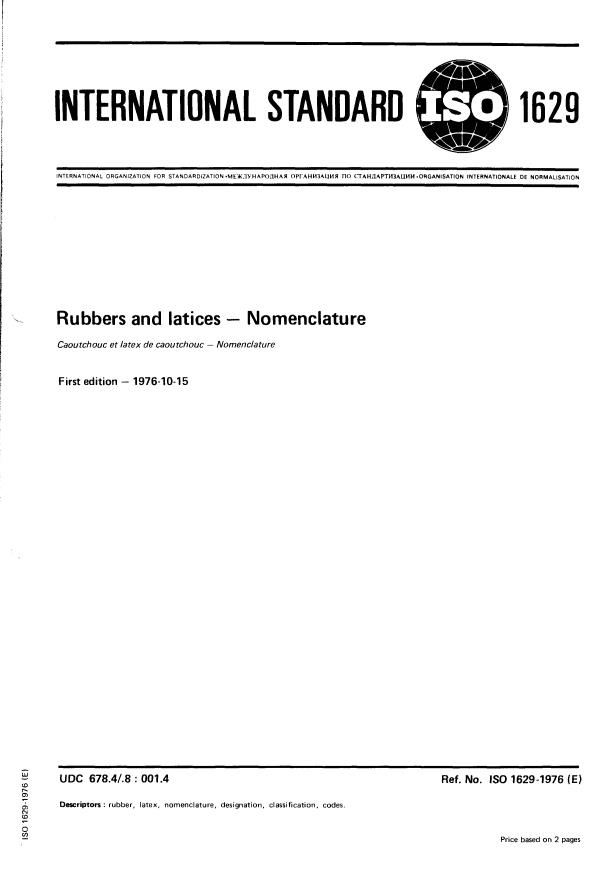
INTERNATIONAL STANDARD 1629
INTERNATIONAL ORGANIZATION FOR STANDARDIZATION aMEXJYHAPOLIHAR OPrAHM3AUHR no CTAHLIAPTM3AUMH *ORGANISATION INTERNATIONALE DE NORMALISATION
Rubbers and latices - Nomenclature
Caoutchouc et latex de caoutchouc - Nomenclature
First edition - 1976-10-15
I
Lu
-
UDC 678.4/.8 : 001.4 Ref. NO. IS0 1629-1976 (E)
a
pi
Descriptors : rubber, latex, nomenclature, designation. classification, codes
m
N
Price based on 2 pages
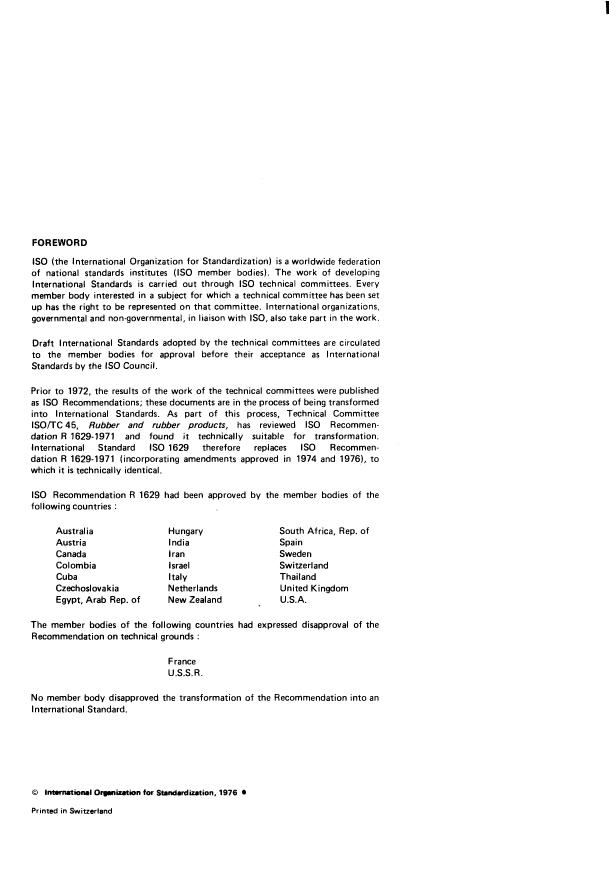
FOREWORD
IS0 (the International Organization for Standardization) is a worldwide federation
of national standards institutes (IS0 member bodies). The work of developing
International Standards is carried out through IS0 technical committees. Every
member body interested in a subject for which a technical committee has been set
up has the right to be represented on that committee. International organizations,
governmental and non-governmental, in liaison with ISO, also take part in the work.
Draft International Standards adopted by the technical committees are circulated
to the member bodies for approval before their acceptance as International
Standards by the IS0 Council.
Prior to 1972, the results of the work of the technical committees were published
as IS0 Recommendations; these documents are in the process of being transformed
into International Standards. As part of this process, Technical Committee
ISOflC 45, Rubber and rubber products, has reviewed IS0 Recommen-
R 1629-1971 and found it technically suitable for transformation.
dation
International Standard IS0 1629 therefore replaces IS0 Recommen-
dation R 1629-1971 (incorporating amendments approved in 1974 and 19761, to
which it is technically identical.
IS0 Recommendation R 1629 had been approved by the member bodies of the
following countries :
Australia Hungary South Africa, Rep. of
Austria India Spain
Sweden
Canada I ran
Colombia Israel Switzerland
Cuba Thailand
Italy
Czechoslovakia Netherlands United Kingdom
Egypt, Arab Rep. of New Zealand U.S.A.
The member bodies of the following countries had expressed disapproval of the
:
Recommendation on technical grounds
France
U.S.S. R.
No member body disapproved the transformation of the Recommendation into an
International Standard.
O Inbnutioiul Orgmniution for Standardization, 1976
Printed in Switzerland
INTERNATIONAL STANDARD IS0 1629-1976 (E)
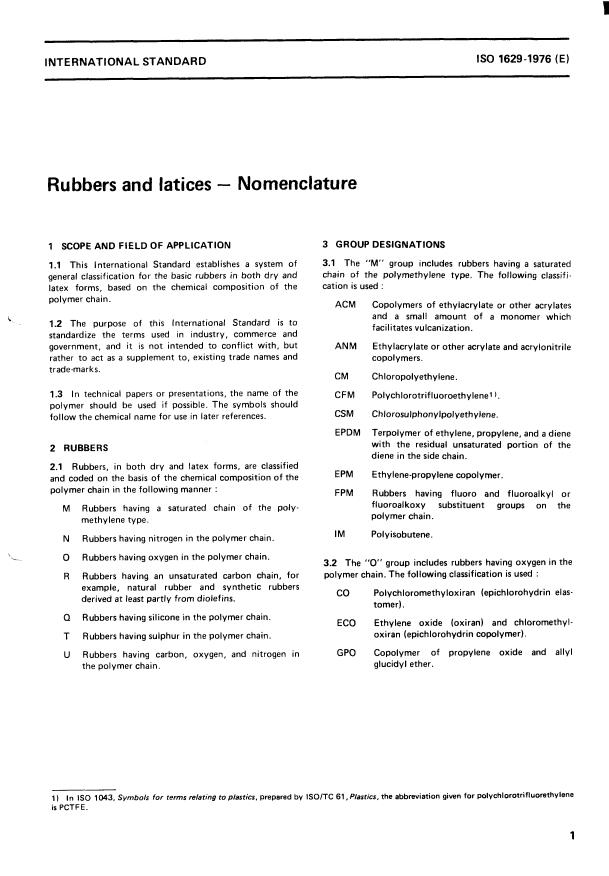
Rubbers and latices - Nomenclature
3 GROUP DESIGNATIONS
SCOPE AND FIELD OF APPLICATION
3.1 The "M" group includes rubbers having a saturated
1.1 This International Standard establishes a system of
chain of the polymethylene type. The following classifi-
general classification for the basic rubbers in both dry and
cation is used :
latex forms, based on the chemical composition of the
polymer chain.
ACM Copolymers of ethylacrylate or other acrylates
and a small amount of a monomer which
1.2 The purpose of this International Standard is to
facilitates vulcanization.
standardize the terms used in industry, commerce and
government, and it is not intended to conflict with, but ANM
Ethylacrylate or other acrylate and acrylonitrile
rather to act as a supplement to, existing trade names and copolymers.
trade -marks.
CM Chloropolyethylene.
1.3 In technical papers or presentations, the name of the
CFM Polychlorotrifluoroethylenel ).
polymer should be used if possible. The symbols should
CSM Chlorosulphonylpolyethylene.
follow the chemical name for use in later references.
EPDM
Terpolymer of ethylene, propylene, and a diene
with the residual unsaturated portion of the
2 RUBBERS
diene in the side chain.
2.1 Rubbers, in both dry
...
Questions, Comments and Discussion
Ask us and Technical Secretary will try to provide an answer. You can facilitate discussion about the standard in here.
Loading comments...