

ISO 25175:2026
(Main)Marine technology — Standard test methods for performance of reverse osmosis (RO) and nanofiltration (NF) membrane elements
- Abstract
This document provides test methods for determining air tightness and separation performance (permeation and salt rejection) of reverse osmosis (RO) and nanofiltration (NF) membrane elements.
- Status
- Published
- Publication Date
- 24-Jun-2026
- Technical Committee
- ISO/TC 8/SC 13 - Marine technology
- Drafting Committee
- ISO/TC 8/SC 13/WG 3 - Seawater desalination
- Current Stage
- 6060 - International Standard published
- Start Date
- 25-Jun-2026
- Due Date
- 08-Jul-2027
- Completion Date
- 25-Jun-2026
ISO 25175:2026 is an International Standard from ISO for marine technology. It specifies test methods for checking the air tightness and separation performance of reverse osmosis (RO) and nanofiltration (NF) membrane elements. It is written for people who test, compare, select, or report on membrane elements used in seawater desalination and related water treatment work.
What does ISO 25175:2026 specify?
ISO 25175:2026 specifies how to test RO and NF membrane elements for air tightness and for separation performance, including permeation and salt rejection. The document gives the test conditions, equipment, calculations, and reporting items needed to make results comparable.
The document is organized into these main parts:
- Clause 1 - scope
- Clause 2 - normative references
- Clause 3 - terms and definitions
- Clause 4 - RO and NF membrane elements types
- Clause 5 - membrane elements air tightness test
- Clause 6 - membrane elements performance test
- Clause 7 - calculation
- Clause 8 - test report
- Annex A - example of a test report
- Bibliography - related standards and guidance
Clause 4 covers the membrane element types in scope: SWRO, BWRO, LPRO, and NF, with spiral wound and hollow fibre configurations. That matters because the test conditions are not the same for every element type.
What are the key requirements of ISO 25175:2026?
ISO 25175:2026 separates the work into a leak check first, then a performance test. It also fixes the operating conditions and data handling so that results can be compared across different membrane elements and laboratories.
Air tightness test before performance testing
Clause 5 requires the membrane performance test to be done only after the element passes the air tightness test. The air tightness method uses vacuum decay testing (VDT) on spiral wound membrane elements, with a defined vacuum range and a leak criterion based on vacuum loss. In practice, this is a screening step for leakage before any performance result is trusted.
Controlled apparatus and materials
Clause 6.1 specifies the test apparatus for separation performance, including a circulating tank, temperature control, pumps, filters, valves, flowmeters, and sampling points. It also requires stainless steel or plastics for the tank, pump, pipeline, and valves, and excludes reactive piping materials such as plain carbon steel, galvanized, or cast-iron materials. In practice, this reduces contamination and protects the membrane element during testing.
Defined test solution for each element type
Clause 6.2 uses different feed solutions for SWRO, BWRO, LPRO, and NF elements, and distinguishes spiral wound from hollow fibre elements. For NF, the solution uses magnesium sulfate and calcium chloride, while the RO cases use sodium chloride. This is what makes the test reflect the intended service condition of the element type being evaluated.
Fixed operating conditions during the test
Clause 6.3 requires the feed temperature, pH, operating pressure, and recovery to be held at the recommended conditions in Table 2. The pH is adjusted with NaOH and HCl and measured in accordance with ISO 10523. In practice, the test operator has to keep the system stable enough that the results are not distorted by changing temperature, pH, pressure, or recovery.
Data recording and stability criteria
Clause 6.3 requires recording feed, permeate, and concentrate flow, pressure, and sample data at 10 minute intervals. The test data are accepted only when the relative error is below 5% and held for 10 minutes, and adjustments may be followed by a 30 minute stabilization period. This matters because the reported performance is meant to represent steady operation, not start-up behavior.
Calculations and reporting
Clause 7 defines how to calculate water production, membrane permeation, salt rejection, and average salt rejection. Clause 8 then requires the report to identify the membrane element, the edition of the standard used, the method used, the test conditions, the results, any deviations, and any unusual features observed. Annex A gives a worked example of the report structure.
What terms does ISO 25175:2026 define?
- Reverse osmosis (RO) - A membrane process covered by this standard for evaluating element performance in desalination service.
- Nanofiltration (NF) - A membrane process covered by this standard for separation-performance testing of NF elements.
- Seawater desalination RO (SWRO) - RO elements intended for seawater desalination testing conditions.
- Brackish water RO (BWRO) - RO elements intended for brackish water testing conditions.
- Low pressure RO (LPRO) - RO elements tested under lower operating pressure conditions.
- Vacuum decay test (VDT) - The air tightness method used in Clause 5 to detect leakage by monitoring vacuum loss.
- Total dissolved solids (TDS) - A measured sample property used in the salt rejection calculations.
- pH - The acidity/alkalinity measure used in the feed solution and measured in accordance with ISO 10523.
Who uses ISO 25175:2026?
ISO 25175:2026 is used by membrane manufacturers, test laboratories, desalination engineers, researchers, and buyers or quality managers who need comparable performance data. It is relevant in seawater desalination and related water treatment applications, especially when different brands or membrane configurations need to be assessed on the same basis.
Which standards are used with ISO 25175:2026?
- ISO 10523 - Used for measuring pH in the test solution.
- ASTM D5907 - Cited for measuring TDS in the samples used for salt rejection calculations.
- ISO 13205 - Provides seawater desalination vocabulary.
- ISO 20468-5 - Gives guidance for performance evaluation of membrane filtration in water reuse systems.
- ISO 23043 - Covers evaluation methods for industrial wastewater treatment reuse processes.
- ISO 23446 - Gives guidance on product water quality for seawater RO desalination.
- ASTM D3923 - Related leak detection practice for RO and NF devices.
- ASTM D4194 - Related operating characteristics test methods for RO and NF devices.
- ASTM D6161 - Related terminology for membrane processes including NF and RO.
- ASTM D6908 - Related integrity testing practice for water filtration membrane systems.
- HY/T 107-2017 - Related test method for spiral wound RO membrane element characteristics.
- HY/T 054.2 - Related testing method for hollow fiber RO modules.
What does the ISO 25175:2026 document contain?
ISO 25175:2026 contains apparatus diagrams, test workflows, calculation formulas, and a reporting template. Figure 1 shows the vacuum decay test setup, and Figure 2 shows the separation-performance test setup for spiral wound and hollow fibre elements.
The document also includes:
- Table 1 - test solutions by membrane element type
- Table 2 - recommended operating conditions by membrane element type
- Annex A - an example test report with fields for element identification, test conditions, results, and notes
These parts are used for testing, evaluation, and reporting so that results can be checked and compared consistently.
Get Certified
Connect with accredited certification bodies for this standard

CIS Institut d.o.o.
Personal Protective Equipment (PPE) certification body. Notified Body NB-2890 for EU Regulation 2016/425 PPE.

Kiwa BDA Testing
Building and construction product certification.
Kmetijski inštitut Slovenije
Agricultural Institute of Slovenia. Soil testing, plant health, agricultural product analysis.
Sponsored listings
Frequently Asked Questions
ISO 25175:2026 is a standard published by the International Organization for Standardization (ISO). Its full title is "Marine technology — Standard test methods for performance of reverse osmosis (RO) and nanofiltration (NF) membrane elements". This standard covers: This document provides test methods for determining air tightness and separation performance (permeation and salt rejection) of reverse osmosis (RO) and nanofiltration (NF) membrane elements.
This document provides test methods for determining air tightness and separation performance (permeation and salt rejection) of reverse osmosis (RO) and nanofiltration (NF) membrane elements.
ISO 25175:2026 is classified under the following ICS (International Classification for Standards) categories: 13.060.20 - Drinking water. The ICS classification helps identify the subject area and facilitates finding related standards.
ISO 25175:2026 is available in PDF format for immediate download after purchase. The document can be added to your cart and obtained through the secure checkout process. Digital delivery ensures instant access to the complete standard document.
Standards Content (Sample)
International
Standard
ISO 25175
First edition
Marine technology — Standard test
2026-06
methods for performance of reverse
osmosis (RO) and nanofiltration
(NF) membrane elements
Technologie maritime — Méthodes d’essai normalisées pour les
performances des éléments de membranes d’osmose inverse (OI)
et de nanofiltration (NF)
Reference number
© ISO 2026
All rights reserved. Unless otherwise specified, or required in the context of its implementation, no part of this publication may
be reproduced or utilized otherwise in any form or by any means, electronic or mechanical, including photocopying, or posting on
the internet or an intranet, without prior written permission. Permission can be requested from either ISO at the address below
or ISO’s member body in the country of the requester.
ISO copyright office
CP 401 • Ch. de Blandonnet 8
CH-1214 Vernier, Geneva
Phone: +41 22 749 01 11
Email: copyright@iso.org
Website: www.iso.org
Published in Switzerland
ii
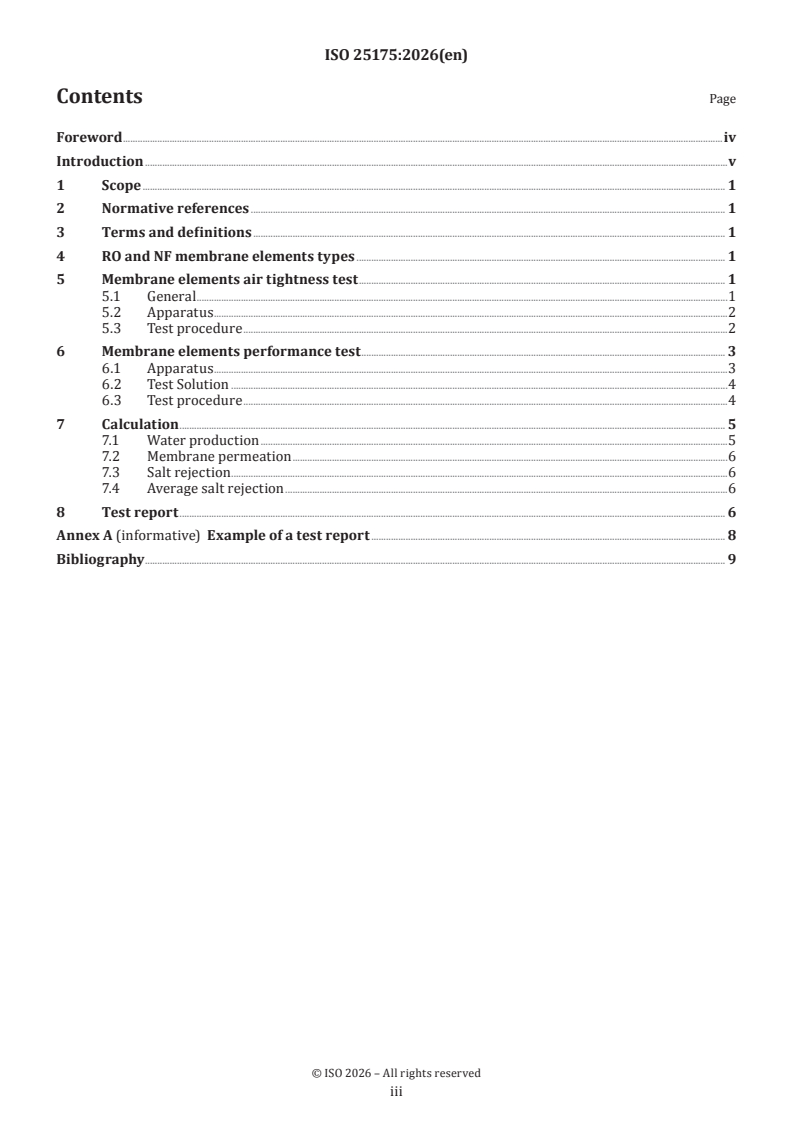
Contents Page
Foreword .iv
Introduction .v
1 Scope . 1
2 Normative references . 1
3 Terms and definitions . 1
4 RO and NF membrane elements types . 1
5 Membrane elements air tightness test . 1
5.1 General .1
5.2 Apparatus .2
5.3 Test procedure .2
6 Membrane elements performance test . 3
6.1 Apparatus .3
6.2 Test Solution .4
6.3 Test procedure .4
7 Calculation . 5
7.1 Water production .5
7.2 Membrane permeation .6
7.3 Salt rejection .6
7.4 Average salt rejection .6
8 Test report . 6
Annex A (informative) Example of a test report . 8
Bibliography . 9
iii
Foreword
ISO (the International Organization for Standardization) is a worldwide federation of national standards
bodies (ISO member bodies). The work of preparing International Standards is normally carried out through
ISO technical committees. Each member body interested in a subject for which a technical committee
has been established has the right to be represented on that committee. International organizations,
governmental and non-governmental, in liaison with ISO, also take part in the work. ISO collaborates closely
with the International Electrotechnical Commission (IEC) on all matters of electrotechnical standardization.
The procedures used to develop this document and those intended for its further maintenance are described
in the ISO/IEC Directives, Part 1. In particular, the different approval criteria needed for the different types
of ISO document should be noted. This document was drafted in accordance with the editorial rules of the
ISO/IEC Directives, Part 2 (see www.iso.org/directives).
ISO draws attention to the possibility that the implementation of this document may involve the use of (a)
patent(s). ISO takes no position concerning the evidence, validity or applicability of any claimed patent
rights in respect thereof. As of the date of publication of this document, ISO had not received notice of (a)
patent(s) which may be required to implement this document. However, implementers are cautioned that
this may not represent the latest information, which may be obtained from the patent database available at
www.iso.org/patents. ISO shall not be held responsible for identifying any or all such patent rights.
Any trade name used in this document is information given for the convenience of users and does not
constitute an endorsement.
For an explanation of the voluntary nature of standards, the meaning of ISO specific terms and expressions
related to conformity assessment, as well as information about ISO's adherence to the World Trade
Organization (WTO) principles in the Technical Barriers to Trade (TBT), see www.iso.org/iso/foreword.html.
This document was prepared by Technical Committee ISO/TC 8, Ships and marine technology, Subcommittee
SC 13, Marine technology.
Any feedback or questions on this document should be directed to the user’s national standards body. A
complete listing of these bodies can be found at www.iso.org/members.html.
iv
Introduction
Membrane elements are key components in seawater desalination. The diversity of application scenarios
and the complexity of feed-water quality in seawater desalination give rise to requirements for the flexibility
and diversity of membrane elements. Therefore, there are currently many types of membrane elements on
the market. The comparison and use of membrane components mainly refer to the product manual, but
the testing methods for membrane elements of different brands are not the same, which inevitably brings
obstacles to the users and researchers. For instance, performance evaluations of the same type of membrane
elements are obtained from different testing methods, making the comparison of these membrane elements
inaccurate.
To solve this problem, this document establishes test methods for evaluating the performance of membrane
elements used in seawater desalination, with a focus on reverse osmosis (RO) and nanofiltration (NF)
elements. It specifies the types of membrane elements to be tested and standardizes the corresponding
testing conditions. The document also covers the required test equipment, procedures, and data processing
methods. By providing a uniform benchmark, it serves as a standard reference for users in desalination
and related industrial applications, particularly in water treatment. This aims to facilitate the selection of
membrane elements and enhances clarity in technical communication.
v
International Standard ISO 25175:2026(en)
Marine technology — Standard test methods for performance
of reverse osmosis (RO) and nanofiltration (NF) membrane
elements
1 Scope
This document provides test methods for determining air tightness and separation performance (permeation
and salt rejection) of reverse osmosis (RO) and nanofiltration (NF) membrane elements.
2 Normative references
The following documents are referred to in the text in such a way that some or all of their content constitutes
requirements of this document. For dated references, only the edition cited applies. For undated references,
the latest edition of the referenced document (including any amendments) applies.
ISO 10523, Water quality — Determination of pH
3 Terms and definitions
No terms and definitions are listed in this document.
ISO and IEC maintain terminology databases for use in standardization at the following addresses:
— ISO Online browsing platform: available at https:// www .iso .org/ obp
— IEC Electropedia: available at https:// www .electropedia .org/
4 RO and NF membrane elements types
The following membrane elements are covered in this document.
— Seawater desalination RO (SWRO) membrane elements
— Brackish water RO (BWRO) membrane elements
— Low pressure RO (LPRO) membrane elements
— NF membrane elements
This includes membrane elements with the following configurations.
— Spiral wound
— Hollow fibre
5 Membrane elements air tightness test
5.1 General
The membrane performance test shall be performed after passing the air tightness test.
5.2 Apparatus
Air tightness of the membrane elements shall be tested using the vacuum decay test (VDT) method. A
diagram of the apparatus is depicted in Figure 1.
Key
1 stopper
2 membrane element
3 valve A
4 valve B
5 vacuum pressure gauge
6 valve C
7 water trap
8 vacuum pump
vacuum degree
Figure 1 — Apparatus for testing air tightness of membrane elements
5.3 Test procedure
The following steps apply for testing spiral wound membrane elements.
a) Fully wet the membrane.
b) Open valve A to drain the water trapped in membrane element, then seal one end of the permeate
collection tube and close valve A.
c) Connect the other end of the membrane element to the vacuum pressure gauge, open valve B and valve C
and start the vacuum pump.
d) Close val
...