

ISO 4917-1:2024
(Main)Design of nuclear power plants against seismic events — Part 1: Principles
General Information
- Abstract
This document applies to nuclear power plants with water cooled reactors and, in particular, to the design of components and civil structures against seismic events in order to meet the safety objectives. For other nuclear facilities the applicability of the document is checked in advance, before it might be applied correspondingly. Seismic isolation is not adressed in the series of ISO 4917. The following safety objectives are defined in order to ensure the protection of people and the environment against radiation risks: a) controlling reactivity; b) cooling fuel assemblies; c) confining radioactive substances; d) limiting radiation exposure.
- Status
- Published
- Publication Date
- 21-Feb-2024
- Technical Committee
- ISO/TC 85/SC 6 - Reactor technology
- Current Stage
- 6060 - International Standard published
- Start Date
- 22-Feb-2024
- Due Date
- 15-Feb-2024
- Completion Date
- 22-Feb-2024


Overview
ISO 4917-1:2024 - Design of nuclear power plants against seismic events - Part 1: Principles sets out the fundamental principles for seismic design of nuclear power plants with water-cooled reactors. It defines the safety objectives and the general framework for protecting people and the environment from radiation risks caused by earthquakes. The standard is intended for use where site geology and tectonics have been investigated and the site is considered suitable for a nuclear installation. Note: seismic isolation is not addressed in this series.
Key topics and requirements
- Safety objectives: ensuring control of reactivity, cooling of fuel assemblies, confinement of radioactive substances, and limiting radiation exposure.
- Design basis earthquake (DBE): definition and specification (DBE is equivalent to SL‑2 as per IAEA SSG-67 or some national safe‑shutdown earthquake (SSE) definitions).
- DBE determination methods: deterministic and probabilistic approaches (including probabilistic seismic hazard analysis / PSHA and use of ground motion prediction equations - GMPEs).
- Seismic-engineering parameters: response spectra, peak ground acceleration, strong motion duration and other parameters required for design input.
- Classification and verification: design basis classification of components and civil structures; verification of DBE safety for both structural and non‑structural elements.
- Combination of actions: rules for combining seismic loads with other loads and operational conditions.
- Analysis and modeling: requirements for modeling, modal combination (e.g., CQC), acceleration time histories and accepted analysis methods.
- Instrumentation, inspection and post‑seismic measures: seismic instrumentation, inspection level earthquakes, and actions after an event.
- Secondary effects and beyond‑design events: treatment of ground displacements, fault activity, and considerations for beyond‑design‑basis earthquakes.
Applications and users
ISO 4917-1:2024 is practical for:
- Nuclear design engineers and seismic engineers preparing plant and component designs.
- Structural and civil engineers assessing buildings and support structures at nuclear sites.
- Licensing authorities, regulators and safety assessors reviewing seismic aspects of nuclear plant design and operation.
- Site evaluators and geotechnical specialists performing seismic hazard and paleoseismology studies.
- Project managers and QA teams implementing verification, instrumentation and post‑event inspection programs.
Keywords: ISO 4917-1:2024, seismic design, nuclear power plants, design basis earthquake, DBE, PSHA, GMPE, water-cooled reactors, seismic instrumentation, safety objectives.
Related standards
- IAEA Safety Standards Series No. SSG-67, Seismic Design for Nuclear Installations (referenced normative guidance).
- IAEA safety requirements (e.g., SSR‑2/1) for protective measures against seismic events.
- Other parts of the ISO 4917 series (see ISO website for the complete list).
Get Certified
Connect with accredited certification bodies for this standard

DNV
DNV is an independent assurance and risk management provider.

Lloyd's Register
Lloyd's Register is a global professional services organisation specialising in engineering and technology.

DIBt (Deutsches Institut für Bautechnik)
German Institute for Building Technology.
Sponsored listings
Frequently Asked Questions
ISO 4917-1:2024 is a standard published by the International Organization for Standardization (ISO). Its full title is "Design of nuclear power plants against seismic events — Part 1: Principles". This standard covers: This document applies to nuclear power plants with water cooled reactors and, in particular, to the design of components and civil structures against seismic events in order to meet the safety objectives. For other nuclear facilities the applicability of the document is checked in advance, before it might be applied correspondingly. Seismic isolation is not adressed in the series of ISO 4917. The following safety objectives are defined in order to ensure the protection of people and the environment against radiation risks: a) controlling reactivity; b) cooling fuel assemblies; c) confining radioactive substances; d) limiting radiation exposure.
This document applies to nuclear power plants with water cooled reactors and, in particular, to the design of components and civil structures against seismic events in order to meet the safety objectives. For other nuclear facilities the applicability of the document is checked in advance, before it might be applied correspondingly. Seismic isolation is not adressed in the series of ISO 4917. The following safety objectives are defined in order to ensure the protection of people and the environment against radiation risks: a) controlling reactivity; b) cooling fuel assemblies; c) confining radioactive substances; d) limiting radiation exposure.
ISO 4917-1:2024 is classified under the following ICS (International Classification for Standards) categories: 27.120.20 - Nuclear power plants. Safety; 91.120.25 - Seismic and vibration protection. The ICS classification helps identify the subject area and facilitates finding related standards.
ISO 4917-1:2024 is available in PDF format for immediate download after purchase. The document can be added to your cart and obtained through the secure checkout process. Digital delivery ensures instant access to the complete standard document.
Standards Content (Sample)
International
Standard
ISO 4917-1
First edition
Design of nuclear power plants
2024-02
against seismic events —
Part 1:
Principles
Conception parasismique des installations nucléaires —
Partie 1: Principes
Reference number
© ISO 2024
All rights reserved. Unless otherwise specified, or required in the context of its implementation, no part of this publication may
be reproduced or utilized otherwise in any form or by any means, electronic or mechanical, including photocopying, or posting on
the internet or an intranet, without prior written permission. Permission can be requested from either ISO at the address below
or ISO’s member body in the country of the requester.
ISO copyright office
CP 401 • Ch. de Blandonnet 8
CH-1214 Vernier, Geneva
Phone: +41 22 749 01 11
Email: copyright@iso.org
Website: www.iso.org
Published in Switzerland
ii
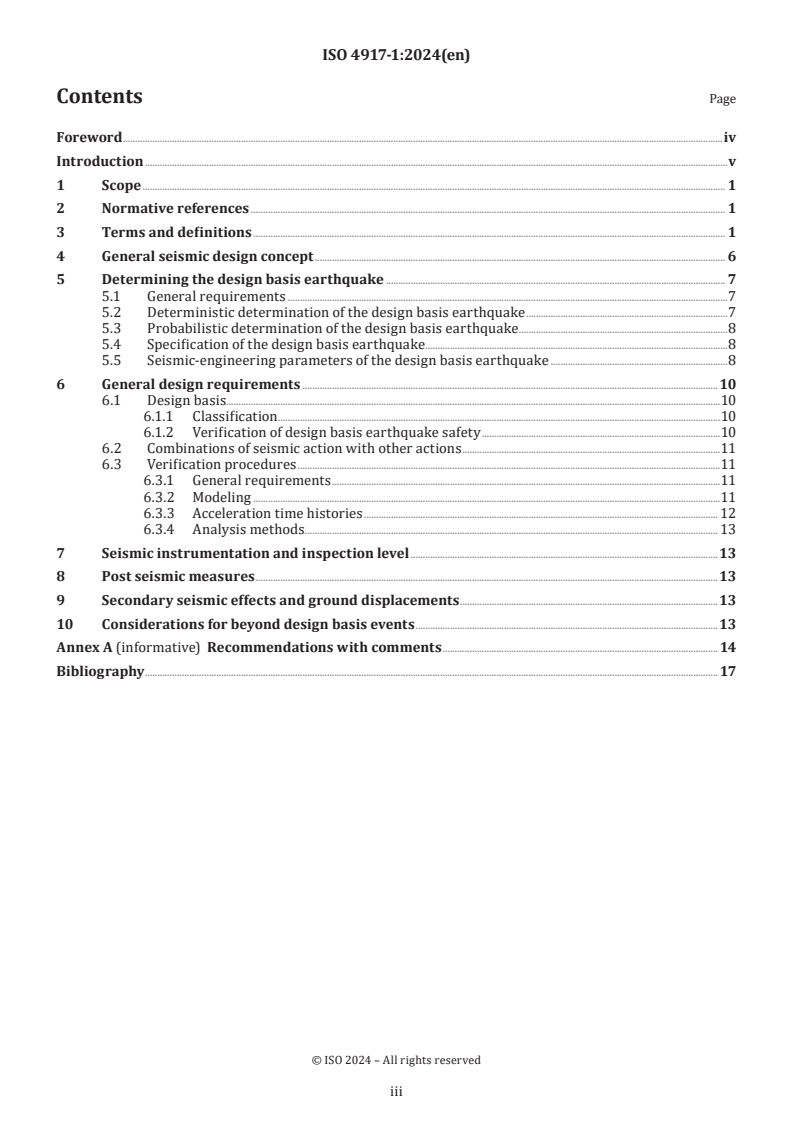
Contents Page
Foreword .iv
Introduction .v
1 Scope . 1
2 Normative references . 1
3 Terms and definitions . 1
4 General seismic design concept . 6
5 Determining the design basis earthquake . 7
5.1 General requirements .7
5.2 Deterministic determination of the design basis earthquake .7
5.3 Probabilistic determination of the design basis earthquake .8
5.4 Specification of the design basis earthquake .8
5.5 Seismic-engineering parameters of the design basis earthquake .8
6 General design requirements .10
6.1 Design basis.10
6.1.1 Classification . .10
6.1.2 Verification of design basis earthquake safety .10
6.2 Combinations of seismic action with other actions .11
6.3 Verification procedures .11
6.3.1 General requirements .11
6.3.2 Modeling .11
6.3.3 Acceleration time histories . 12
6.3.4 Analysis methods . . . 13
7 Seismic instrumentation and inspection level .13
8 Post seismic measures .13
9 Secondary seismic effects and ground displacements .13
10 Considerations for beyond design basis events .13
Annex A (informative) Recommendations with comments . 14
Bibliography . 17
iii
Foreword
ISO (the International Organization for Standardization) is a worldwide federation of national standards
bodies (ISO member bodies). The work of preparing International Standards is normally carried out through
ISO technical committees. Each member body interested in a subject for which a technical committee
has been established has the right to be represented on that committee. International organizations,
governmental and non-governmental, in liaison with ISO, also take part in the work. ISO collaborates closely
with the International Electrotechnical Commission (IEC) on all matters of electrotechnical standardization.
The procedures used to develop this document and those intended for its further maintenance are described
in the ISO/IEC Directives, Part 1. In particular, the different approval criteria needed for the different types
of ISO document should be noted. This document was drafted in accordance with the editorial rules of the
ISO/IEC Directives, Part 2 (see www.iso.org/directives).
ISO draws attention to the possibility that the implementation of this document may involve the use of (a)
patent(s). ISO takes no position concerning the evidence, validity or applicability of any claimed patent
rights in respect thereof. As of the date of publication of this document, ISO had/had not received notice of
(a) patent(s) which may be required to implement this document. However, implementers are cautioned that
this may not represent the latest information, which may be obtained from the patent database available at
www.iso.org/patents. ISO shall not be held responsible for identifying any or all such patent rights.
Any trade name used in this document is information given for the convenience of users and does not
constitute an endorsement.
For an explanation of the voluntary nature of standards, the meaning of ISO specific terms and expressions
related to conformity assessment, as well as information about ISO's adherence to the World Trade
Organization (WTO) principles in the Technical Barriers to Trade (TBT), see www.iso.org/iso/foreword.html.
This document was prepared by Technical Committee ISO/TC 85, Nuclear energy, nuclear technologies, and
radiological protection, Subcommittee SC 6, Reactor technology.
A list of all parts in the ISO 4917 series can be found on the ISO website.
Any feedback or questions on this document should be directed to the user’s national standards body. A
complete listing of these bodies can be found at www.iso.org/members.html.
iv
Introduction
In accordance with IAEA Safety Standards Series No. SSR-2/1, protective measures against seismic events
are required, provided earthquakes are taken into consideration.
Earthquakes comprise that group of design basis external events that requires taking preventive plant
engineering measures against damage and which are relevant with respect to radiological effects on the
environment.
This document will be applied under the presumption that the geology and tectonics of the plant site have
been investigated with special emphasis on the existence of active geological faults and lasting geological
ground displacements, and that the site has been deemed suitable for a nuclear installation.
v
International Standard ISO 4917-1:2024(en)
Design of nuclear power plants against seismic events —
Part 1:
Principles
1 Scope
This document applies to nuclear power plants with water cooled reactors and, in particular, to the design
of components and civil structures against seismic events in order to meet the safety objectives. For
other nuclear facilities the applicability of the document is checked in advance, before it might be applied
correspondingly. Seismic isolation is not adressed in the series of ISO 4917.
The following safety objectives are defined in order to ensure the protection of people and the environment
against radiation risks:
a) controlling reactivity;
b) cooling fuel assemblies;
c) confining radioactive substances;
d) limiting radiation exposure.
2 Normative references
The following documents are referred to in the text in such a way that some or all of their content constitutes
requirements of this document. For dated references, only the edition cited applies. For undated references,
the latest edition of the referenced document (including any amendments) applies.
IAEA Safety Standards Series No., SSG-67, Seismic Design for Nuclear Installations, INTERNATIONAL ATOMIC
ENERGY AGENCY VIENNA, (2021)
3 Terms and definitions
For the purposes of this document, the following terms and definitions apply.
ISO and IEC maintain terminology databases for use in standardization at the following addresses:
— ISO Online browsing platform: available at https:// www .iso .org/ obp
— IEC Electropedia: available at https:// www .electropedia .org/
3.1
action
impact of an external force (e.g. seismic action)
3.2
action effect
internal force inside a structure (e.g. force, moment)
3.3
active geological fault
fault showing evidence of past movements (e.g. recent seismicity or geological evidence) within such a period
that it is reasonable to assume that further movements can occur
Note 1 to entry: For areas of low seismicity evidence of last movements in the Quaternary (until ≈ 2,6 ∙ 10 a) or
including Pliocene (until ≈ 5,3 ∙ 10 a) can be appropriate to consider. For higher seismic areas shorter periods can be
considered.
Note 2 to entry: A geological fault need also to be considered active if a structural relationship with a known active
geological fault is demonstrated or likely. In this case the movement of one fault can cause the movement of the other.
[5]
Note 3 to entry: The definition is equivalent to “capable fault” in IAEA Glossary (2018) .
3.4
beyond design basis earthquake
decisive level of ground motion which exceeds the design basis earthquake
3.5
civil structure
building structure that is connected to the ground and consists of structural and non-structural elements
(building materials and structural members)
Note 1 to entry: It may be necessary to perform the verification of earthquake safety for “civil structures” in their
entirety as well as for the individual parts (“structural members”).
3.6
complete quadratic combination
CQC
stochastically based superposition relationship for oscillating systems in order to take account of the
coupling of eigenmodes in modal analyses
3.7
component
electrical, instrumentation and control, and mechanical equipment that ensures the operation of the nuclear
facility, including distribution systems and their support structures
Note 1 to entry: This definition is necessary for the differentiation between “plant component” and “civil structures
(3.5) or building structures”. In mechanical engineering, a component is one that is manufactured from product forms
and represents the smallest part of a subassembly.
3.8
correlation coefficient
ρ
xy
coefficient of two seismic time histories, x(t) and y(t), defined by the covariance σ of x(t) and y(t) divided by
xy
the product of the related standard deviations s and s of the two time histories
x y
3.9
damping ratio
D
dimensionless characteristic value of a (velocity proportional) damped oscillating single-degree-of-freedom
system, in percentage of critical damping
3.10
deaggregation
quantification of the relative contributions from earthquakes of different sizes and at different distances to
the seismic hazard at a site
Note 1 to entry: Usually calculated for discrete ground motion levels from the probabilistic seismic hazard analysis
(PSHA) and for intervals of magnitude (3.24) and distance or for seismic sources.
3.11
design basis earthquake
decisive level of ground motion for the design against seismic events
Note 1 to entry: The design basis earthquake (DBE) is equivalent to SL-2 earthquake as per IAEA SSG-67 or safe
shutdown earthquake (SSE) in some national guidelines. It represents the seismic impact at the site, at least expressed
in terms of ground acceleration response spectra (3.17) and strong motion duration (3.38).
3.12
epistemic uncertainty
aleatoric variability
epistemic uncertainty, based on uncertainty of the state of knowledge, (e.g. regarding models or parameters)
and aleatoric variability, inherently connected with stochastic phenomena or processes (e.g. decrease of
acceleration amplitudes with increasing distance)
Note 1 to entry: Epistemic uncertainties can be reduced by additional data, information or improved modeling (e.g.
uncertainty in specifying the source region). Aleatoric variabilities usually cannot be reduced.
Note 2 to entry: Epistemic uncertainty and aleatoric variability is equivalent to “Epistemic uncertainty” and “aleatoric
[5]
uncertainty” in IAEA Glossary (2018) .
3.13
external event
event unconnected with the operation of a facility or the conduct of an activity that could have an effect on
the safety of the facility or activity
Note 1 to entry: These events having either natural causes (e.g. high water, earthquake) or civilizational causes (e.g.
aircraft crash, pressure wave from explosions).
3.14
focal depth
depth of the hypocenter beneath the surface of the earth
3.15
free field
location at or near the surface, where vibratory ground motion is not affected by structures and facilities
3.16
functionality
ability of a system or component (3.7) to fulfill its designated safety functions during and after the seismic
event
Note 1 to entry: This definition is specific to components. In the case of civil structures (3.5), the adequate term would
be “serviceability”.
3.17
ground acceleration response spectrum
response spectrum derived from a ground motion related to free field (3.15) or a reference horizon at depth
3.18
ground motion prediction equation
GMPE
function (typically empirical) for the prediction of ground motion
Note 1 to entry: Input parameters are magnitude (3.24), source to site distance, local site conditions and other
parameters.
3.19
inspection level earthquake
level of ground motion that, if exceeded, causes a plant inspection
3.20
integrity
ability of a plant component (3.7) to fulfill its functions with regard to leak tightness or deformation
restrictions
3.21
(macroseismic) intensity
classification of the strength of ground motion, based on the observed effects within a limited area, e.g. a
village
Note 1 to entry: Basis for determining the intensity are phenomenological descriptions of the effects on humans,
objects, buildings and the earths surface. The intensity is a robust measure for strength classification; the
[11]
corresponding macroseismic classification scales (e.g. EMS 98 ) define twelve intensity levels.
3.22
internal event
event or group of events that result from failures of systems, structures or components (3.7) (SSC) or human
failures originating within a nuclear power plant that cause an initiating event directly or indirectly and
may challenge safety functions to achieve its safety objectives
Note 1 to entry: These are exceptional events caused by plant internal incidents (e.g. differential pressures, jet
impingement and reaction forces, plant internal flooding due to breakage or leakage of pressurized components, load
crash)
3.23
load-bearing capacity
ability of components (3.7) and civil structures (3.5), based on their material strength, stability and secure
positioning, to withstand the impact from events
3.24
magnitude
measure of the size of an earthquake, approximately related to the energy released in the form of seismic
waves
Note 1 to entry: The classic definition of seismic magnitude is the logarithm of the maximum amplitude of recorded
seismograms taking the distance to the hypocenter (seismic focus center) into account. Different types of seismic
magnitudes are, e.g. local magnitude, body wave magnitude, surface wave magnitude and moment magnitude.
3.25
operating basis earthquake
decisive level of ground motion that is likely to occur and affect the plant during its operating lifetime
3.26
paleoseismology
method used to search for indications of prehistoric earthquakes in geological sediments and rock for-
mations and includes estimation of their magnitude (3.24) and of the age of the deformations due to
earthquakes
Note 1 to entry: Paleoseismology serves to extend earthquake findings into the younger geological times.
Paleoseismology is generally restricted to geological terrains of continuous sedimentation of the past ten thousands
of years.
3.27
peak ground acceleration
maximum amplitude (absolute value) of the horizontal or vertical ground acceleration components (3.7) of
the earthquake time history (accelerogram)
Note 1 to entry: It corresponds to the rigid-body acceleration of the ground acceleration response spectrum (3.17).
3.28
probability of exceedance
probability that a certain ground motion (e.g. peak acceleration, spectral value of acceleration) is reached or
exceeded at a site within a specified time period (usually one year)
Note 1 to entry: The reciprocal of the annual probability of exceedance is often termed as average return period.
3.29
response spectrum
largest oscillation amplitudes (values) of a damped single-degree-of-freedom oscillator (accelerations,
velocities, displacements) with various eigenfrequencies and a constant damping ratio (3.9) in response to
an excitation described by a time history at the base point
Note 1 to entry: Unless indicated otherwise, the response spectrum in this document relates to acceleration (spectral
acceleration) and relates to an elastic oscillator that includes no effects from ductile deformations.
3.30
rigid-body acceleration
value of the response spectrum (3.29) in the high frequency range where the seismic response shows no
further significant increase (corresponding to maximum absolute amplitude of the acceleration time history)
3.31
seismic-engineering parameter
parameter, such as response spectrum (3.29), strong motion duration (3.38) and further parameters
characterizing the ground motion at the site
3.32
seismic hazard curve
graphic representation of the per annum probability that a specific parameter of the earthquake ground
motion is reached or exceeded at the plant site
Note 1 to entry: Seismic hazard curves are determined by the probabilistic seismic hazard analysis (PSHA), usually
expressed in spectral accelerations and peak ground acceleration (3.27).
3.33
seismic source region
zone (area of diffuse seismicity) or line (associated with a fault) on which a uniformly distributed seismicity
is assumed
Note 1 to entry: Zoning of seismic source regions (seismic source zones) are established mainly based on seismicity,
geologic and tectonic development and, in particular, regarding neotectonic conditions.
3.34
seismogram
graphic display (or digital data) of the ground motion (proportional to displacement, velocity or acceleration)
at a certain location during the earthquake
Note 1 to entry: It is also called earthquake record or earthquake time history and is usually recorded in three
orthogonal directions, two of these in the horizontal plane.
Note 2 to entry: An earthquake record proportional to the ground acceleration is called an accelerogram.
3.35
serviceability
ability of civil structures (3.5) to enable the designated use even under the impact of events that are assumed
to occur
3.36
soil
loose or firm ground material
3.37
spectral matched time history
recorded time history, adjusted by the spectral machting technique to be compatible to the site response
spectrum (3.29)
3.38
strong motion duration
length of time of the seismic strong ground motion at a site, calculated by a certain definition
Note 1 to entry: Strong motion duration may be defined as the time interval between the 95th and 5th percentiles of
the integral of the mean square value of the acceleration or other definition; a consistent definition of duration should
be used throughout the evaluation.
3.39
structural member
structural part of the civil structure (3.5)
Note 1 to entry: Some documents use the term "building structures" instead of "civil structures".
3.40
subsoil
layers of weathered material below the earth surface
3.41
tectonics
science of the structure, forces, motions and deformations of the earth’s crust and parts of the earth’s mantle
Note 1 to entry: Tectonics considers global, regional and local aspects. Neotectonics considers the tectonics of the
more recent geological past (Quaternary period).
3.42
time history envelope function
typical average envelope over the relevant time span of seismograms (3.34)
Note 1 to entry: It is characterized by its increasing phase, its strong ground motion phase and its decreasing phase; it
is used for generating artificial seismograms that are compatible with a ground response spectrum.
Note 2 to entry: The strong motion duration (3.38) is the total duration of the increasing phase, the strong ground
motion phase and the decreasing phase of the time history envelope function.
3.43
time history set
set of three acceleration time histories, for each of the three orthogonal directions of motion, that act
simultaneously
3.44
uniform hazard response spectrum
response spectrum (3.29) from a probabilistic seismic hazard assessment with an equal probability of
exceedance (3.28) for each of its spectral ordinates
4 General seismic design concept
In this document the following seismic events (seismic levels) are considered:
— Design basis earthquake (DBE), equivalent to SL-2 earthquake as per IAEA SSG-67 or safe shutdown
earthquake (SSE) in some national guidelines;
— Inspection level earthquake, if exceeded a plant shutdown inspection shall be performed, and the plant
shall be shut down (see ISO 4917-6);
— Operating basis earthquake (OBE), equivalent to SL-1 earthquake in IAEA SSG-67;
— Beyond design basis earthquake, according to IAEA SSG 67.
NOTE Details of the beyond design earthquake could be specified country specific and are not covered by this
standard.
5 Determining the design basis earthquake
5.1 General requirements
The design basis earthquake (DBE) is described by the seismic action at the location of the site that is
characterized by ground motions. The design basis earthquake shall be specified by evaluating probabilistic
and/or deterministic analyses. The analyses should be performed in accordance with IAEA SSG-9. However,
it is recommended to perform probabilistic and deterministic analyses to the extent reasonable. The design
basis earthquake is equivalent to the SL-2 earthquake in IAEA SSG-67. The considered surrounding area of
the site shall be large enough to incorporate all seismic sources that could affect the nuclear installation.
Examples of typical areas in km are given in Annex A. Seismic sources (e.g. seismic source region) shall not
be cut by the defined radius. The design basis earthquake is the basis for the specification of the seismic-
engineering parameters. The design basis earthquake may be understood either as being a combination of a
number of decisive earthquakes (e.g. deterministic scenarios) or as being the governing ground motions at
the site of the facility (e.g. expressed as a uniform hazard response spectrum).
An operating basis earthquake (OBE) can be defined in addition to ensure the possibility of continued
operation in the event of less severe, but more probable, earthquakes. The operating basis earthquake
is equivalent to the SL-1 earthquake in IAEA SSG-67. It shall be based on a defined annual probability of
exceedance and a corresponding hazard fractile or mean hazard value. Alternatively, its acceleration
response spectra can be calculated from the design basis earthquake by a constant factor. Annex A contains
criteria for the definition of the operating basis earthquake.
The deterministic approach to specify the design basis earthquake shall be based on historic and recent
earthquakes and magnitude estimations for active geological faults. The approach considers the largest
credible seismic action at the site using current scientific knowledge.
The probabilistic approach to specify the design basis earthquake shall be based on a defined annual
probability of exceedance and a corresponding hazard fractile or mean hazard value. Recommended design
values can be found in the Annex A.
The design basis earthquake shall be specified with a minimum horizontal peak ground acceleration value
of 0,1 g.
If anthropogenic impacts (e.g. induced seismicity) may cause significant ground motion at the site, their
impacts shall be assessed.
5.2 Deterministic determination of the design basis earthquake
The strongest earthquakes that may occur within the surrounding area of the site, up to the radius specified
in 5.1, shall form the basis for the deterministic determination of the design basis earthquake. The location
of geological structures, in particular those which can be considered as active geological faults, shall be
examined. Findings from paleoseismology shall be taken into account. Seismic sources are represented by
areal seismic zones with diffuse seismicity and active geological faults. In accordance with IAEA SSG-9, the
following principles apply to determine the vibratory ground motion hazard at the site:
a) For each active geological fault, it shall be assumed that an earthquake with the potential maximum
magnitude occurs closest to the site, considering the physical dimensions of the fault. If the fault is
within the site vicinity and its location and extent cannot be determined with sufficient accuracy, the
earthquake shall be assumed to occur beneath the site. It shall be ensured that active geological faults
shall not fall within the site area.
b) For seismic source regions that do not include the site, the associated potential maximum magnitude
earthquake shall be assumed to occur at the point of the region closest to the site.
c) For the seismic source region that includes the site, the potential maximum magnitude earthquake shall
be assumed to occur at some identified specific horizontal and vertical distance from the site (typically
le
...