

ISO 4917-4:2024
(Main)Design of nuclear power plants against seismic events — Part 4: Components
General Information
- Abstract
This document applies to nuclear power plants with water cooled reactors. For other nuclear facilities check the applicability of the document in advance, before it might be applied correspondingly. This document specifies the requirements for the earthquake safety of components. The operation-specific safety-related requirements for each component, e.g. load-bearing capacity (stability), integrity and functionality (see 4.1) are not the subject of this document. With regard to analysing the mechanical behaviour of the individual components and verifying the fulfillment of their safety related functions, additionally, the respective component-specific standards need to be consulted. In this document, the term "mechanical components" refers to components such as vessels, heat exchangers, pumps, valves, lifting gear, distribution systems and pipe lines including their support structures in as far as these components are not considered to be civil structures in accordance with ISO 4917-3. Liners, crane runways, platforms and scaffoldings are not considered as being part of these mechanical components. In this document, the term electrical components refers to the combination of electrical devices including all electrical connections and their support structures (e.g. cabinets, frames, consoles, brackets, suspensions or supports). Supplementary to this document the seismic qualification of electrical components is reported in IEC/IEEE 60980-344. NOTE This document is independent of national standards. Recommendations, given in Annex A, are mainly based on the Eurocodes-Design-Philosophy and European Standards. Alternatively other equivalent standards or regulations can be used in case the general requirements given in this document together with Annex A can be met.
- Status
- Published
- Publication Date
- 06-Mar-2024
- Technical Committee
- ISO/TC 85/SC 6 - Reactor technology
- Current Stage
- 6060 - International Standard published
- Start Date
- 07-Mar-2024
- Due Date
- 15-Feb-2024
- Completion Date
- 07-Mar-2024



Overview
ISO 4917-4:2024 - Design of nuclear power plants against seismic events - Part 4: Components specifies requirements for demonstrating earthquake safety of components in nuclear power plants with water-cooled reactors. It covers the seismic verification scope, modelling and analysis approaches, and testing/qualification principles for mechanical and electrical components (including their support structures). The document complements structural requirements in ISO 4917-3 and the principles in ISO 4917-1.
Key topics and technical requirements
- Scope and component types
- Applies to mechanical components such as vessels, heat exchangers, pumps, valves, lifting gear, distribution systems, pipelines and supports (excluding civil structures per ISO 4917-3). Liners, crane runways, platforms and scaffoldings are excluded.
- Defines electrical components as devices plus their electrical connections and support structures (cabinets, frames, brackets).
- Verification methods
- Verification by analysis: response spectrum, time-history, quasi-static and non-linear time-history methods; modelling of fluids, system characteristics, decoupling and relative displacements.
- Verification by testing: requirements for test objects and excitations (base excitation, single/multiple-frequency, centre-of-gravity and multi-axis considerations), and test-analysis correlation.
- Verification by analogy and by plausibility considerations are also addressed.
- Seismic inputs and modelling
- Use of design spectra, demand response spectra, and considerations for modal damping, center of gravity, and the behaviour coefficient q (reducing linear-analysis forces to account for dissipation).
- Limits of the document
- Does not set operation-specific safety performance criteria (load-bearing capacity, integrity, functionality); component-specific standards must be consulted for those checks.
- Guidance and references
- Annex A provides recommendations largely based on Eurocode design philosophy; equivalent standards are acceptable if they meet the general requirements.
Practical applications - who uses this standard
- Seismic and structural engineers designing or evaluating components for nuclear power plants (water-cooled reactors).
- Component manufacturers and suppliers performing seismic qualification and documentation.
- Test laboratories conducting seismic tests (shake-table, base excitation) and dynamic characterization.
- Nuclear safety assessors, plant operators and regulators verifying compliance with seismic design requirements.
- Consultants integrating component-level verification into plant-level seismic safety cases.
Related standards
- ISO 4917-1:2024 - Principles (series foundation)
- ISO 4917-3 - Structural components (civil structures)
- IEC/IEEE 60980-344 - Seismic qualification of electrical components (supplementary)
Keywords: ISO 4917-4:2024, seismic design, nuclear power plant components, seismic qualification, response spectrum, time history analysis, seismic testing, water-cooled reactors, component verification.
Get Certified
Connect with accredited certification bodies for this standard

DNV
DNV is an independent assurance and risk management provider.

Lloyd's Register
Lloyd's Register is a global professional services organisation specialising in engineering and technology.

DIBt (Deutsches Institut für Bautechnik)
German Institute for Building Technology.
Sponsored listings
Frequently Asked Questions
ISO 4917-4:2024 is a standard published by the International Organization for Standardization (ISO). Its full title is "Design of nuclear power plants against seismic events — Part 4: Components". This standard covers: This document applies to nuclear power plants with water cooled reactors. For other nuclear facilities check the applicability of the document in advance, before it might be applied correspondingly. This document specifies the requirements for the earthquake safety of components. The operation-specific safety-related requirements for each component, e.g. load-bearing capacity (stability), integrity and functionality (see 4.1) are not the subject of this document. With regard to analysing the mechanical behaviour of the individual components and verifying the fulfillment of their safety related functions, additionally, the respective component-specific standards need to be consulted. In this document, the term "mechanical components" refers to components such as vessels, heat exchangers, pumps, valves, lifting gear, distribution systems and pipe lines including their support structures in as far as these components are not considered to be civil structures in accordance with ISO 4917-3. Liners, crane runways, platforms and scaffoldings are not considered as being part of these mechanical components. In this document, the term electrical components refers to the combination of electrical devices including all electrical connections and their support structures (e.g. cabinets, frames, consoles, brackets, suspensions or supports). Supplementary to this document the seismic qualification of electrical components is reported in IEC/IEEE 60980-344. NOTE This document is independent of national standards. Recommendations, given in Annex A, are mainly based on the Eurocodes-Design-Philosophy and European Standards. Alternatively other equivalent standards or regulations can be used in case the general requirements given in this document together with Annex A can be met.
This document applies to nuclear power plants with water cooled reactors. For other nuclear facilities check the applicability of the document in advance, before it might be applied correspondingly. This document specifies the requirements for the earthquake safety of components. The operation-specific safety-related requirements for each component, e.g. load-bearing capacity (stability), integrity and functionality (see 4.1) are not the subject of this document. With regard to analysing the mechanical behaviour of the individual components and verifying the fulfillment of their safety related functions, additionally, the respective component-specific standards need to be consulted. In this document, the term "mechanical components" refers to components such as vessels, heat exchangers, pumps, valves, lifting gear, distribution systems and pipe lines including their support structures in as far as these components are not considered to be civil structures in accordance with ISO 4917-3. Liners, crane runways, platforms and scaffoldings are not considered as being part of these mechanical components. In this document, the term electrical components refers to the combination of electrical devices including all electrical connections and their support structures (e.g. cabinets, frames, consoles, brackets, suspensions or supports). Supplementary to this document the seismic qualification of electrical components is reported in IEC/IEEE 60980-344. NOTE This document is independent of national standards. Recommendations, given in Annex A, are mainly based on the Eurocodes-Design-Philosophy and European Standards. Alternatively other equivalent standards or regulations can be used in case the general requirements given in this document together with Annex A can be met.
ISO 4917-4:2024 is classified under the following ICS (International Classification for Standards) categories: 27.120.20 - Nuclear power plants. Safety; 91.120.25 - Seismic and vibration protection. The ICS classification helps identify the subject area and facilitates finding related standards.
ISO 4917-4:2024 is available in PDF format for immediate download after purchase. The document can be added to your cart and obtained through the secure checkout process. Digital delivery ensures instant access to the complete standard document.
Standards Content (Sample)
International
Standard
ISO 4917-4
First edition
Design of nuclear power plants
2024-03
against seismic events —
Part 4:
Components
Conception parasismique des installations nucléaires —
Partie 4: Composants
Reference number
© ISO 2024
All rights reserved. Unless otherwise specified, or required in the context of its implementation, no part of this publication may
be reproduced or utilized otherwise in any form or by any means, electronic or mechanical, including photocopying, or posting on
the internet or an intranet, without prior written permission. Permission can be requested from either ISO at the address below
or ISO’s member body in the country of the requester.
ISO copyright office
CP 401 • Ch. de Blandonnet 8
CH-1214 Vernier, Geneva
Phone: +41 22 749 01 11
Email: copyright@iso.org
Website: www.iso.org
Published in Switzerland
ii
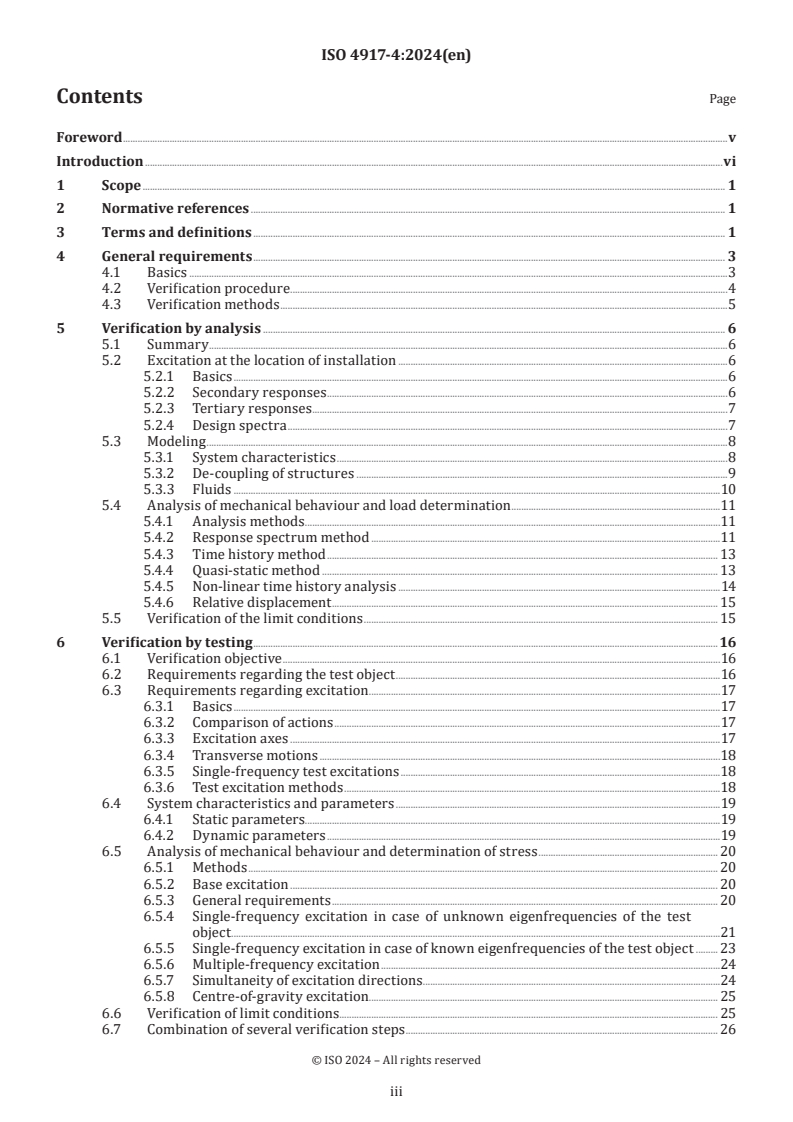
Contents Page
Foreword .v
Introduction .vi
1 Scope . 1
2 Normative references . 1
3 Terms and definitions . 1
4 General requirements . 3
4.1 Basics .3
4.2 Verification procedure . . .4
4.3 Verification methods .5
5 Verification by analysis . 6
5.1 Summary .6
5.2 Excitation at the location of installation .6
5.2.1 Basics .6
5.2.2 Secondary responses .6
5.2.3 Tertiary responses . .7
5.2.4 Design spectra .7
5.3 Modeling .8
5.3.1 System characteristics .8
5.3.2 De-coupling of structures .9
5.3.3 Fluids .10
5.4 Analysis of mechanical behaviour and load determination .11
5.4.1 Analysis methods . . .11
5.4.2 Response spectrum method .11
5.4.3 Time history method . 13
5.4.4 Quasi-static method . 13
5.4.5 Non-linear time history analysis .14
5.4.6 Relative displacement . 15
5.5 Verification of the limit conditions . 15
6 Verification by testing .16
6.1 Verification objective .16
6.2 Requirements regarding the test object .16
6.3 Requirements regarding excitation .17
6.3.1 Basics .17
6.3.2 Comparison of actions .17
6.3.3 Excitation axes .17
6.3.4 Transverse motions .18
6.3.5 Single-frequency test excitations .18
6.3.6 Test excitation methods .18
6.4 System characteristics and parameters .19
6.4.1 Static parameters.19
6.4.2 Dynamic parameters .19
6.5 Analysis of mechanical behaviour and determination of stress . 20
6.5.1 Methods . 20
6.5.2 Base excitation . 20
6.5.3 General requirements . 20
6.5.4 Single-frequency excitation in case of unknown eigenfrequencies of the test
object . .21
6.5.5 Single-frequency excitation in case of known eigenfrequencies of the test object . 23
6.5.6 Multiple-frequency excitation .24
6.5.7 Simultaneity of excitation directions .24
6.5.8 Centre-of-gravity excitation. 25
6.6 Verification of limit conditions . 25
6.7 Combination of several verification steps . 26
iii
6.8 Documentation . 26
7 Verification by analogy .27
8 Verification by plausibility considerations .27
Annex A (informative) Recommendations with comments .29
Bibliography .36
iv
Foreword
ISO (the International Organization for Standardization) is a worldwide federation of national standards
bodies (ISO member bodies). The work of preparing International Standards is normally carried out through
ISO technical committees. Each member body interested in a subject for which a technical committee
has been established has the right to be represented on that committee. International organizations,
governmental and non-governmental, in liaison with ISO, also take part in the work. ISO collaborates closely
with the International Electrotechnical Commission (IEC) on all matters of electrotechnical standardization.
The procedures used to develop this document and those intended for its further maintenance are described
in the ISO/IEC Directives, Part 1. In particular, the different approval criteria needed for the different types
of ISO document should be noted. This document was drafted in accordance with the editorial rules of the
ISO/IEC Directives, Part 2 (see www.iso.org/directives).
ISO draws attention to the possibility that the implementation of this document may involve the use of (a)
patent(s). ISO takes no position concerning the evidence, validity or applicability of any claimed patent
rights in respect thereof. As of the date of publication of this document, ISO had not received notice of (a)
patent(s) which may be required to implement this document. However, implementers are cautioned that
this may not represent the latest information, which may be obtained from the patent database available at
www.iso.org/patents. ISO shall not be held responsible for identifying any or all such patent rights.
Any trade name used in this document is information given for the convenience of users and does not
constitute an endorsement.
For an explanation of the voluntary nature of standards, the meaning of ISO specific terms and expressions
related to conformity assessment, as well as information about ISO's adherence to the World Trade
Organization (WTO) principles in the Technical Barriers to Trade (TBT), see www.iso.org/iso/foreword.html.
This document was prepared by Technical Committee ISO/TC 85, Nuclear energy, nuclear technologies, and
radiological protection, Subcommittee SC 6, Reactor technology.
A list of all parts in the ISO 4917 series can be found on the ISO website.
Any feedback or questions on this document should be directed to the user’s national standards body. A
complete listing of these bodies can be found at www.iso.org/members.html.
v
Introduction
In accordance with IAEA Safety Standards Series No. SSR-2/1, protective measures against seismic events
are required, provided earthquakes should be taken into consideration. Earthquakes comprise that group
of design basis events that requires taking preventive plant engineering measures against damage and
which are relevant with respect to radiological effects on the environment. The basic requirements of these
precautionary measures are dealt with in ISO 4917-1.
ISO 4917-4 presents the basis for fulfilling the requirements regarding the verification of the site-specific
earthquake safety of components.
vi
International Standard ISO 4917-4:2024(en)
Design of nuclear power plants against seismic events —
Part 4:
Components
1 Scope
This document applies to nuclear power plants with water cooled reactors. For other nuclear facilities check
the applicability of the document in advance, before it might be applied correspondingly.
This document specifies the requirements for the earthquake safety of components. The operation-
specific safety-related requirements for each component, e.g. load-bearing capacity (stability), integrity
and functionality (see 4.1) are not the subject of this document. With regard to analysing the mechanical
behaviour of the individual components and verifying the fulfillment of their safety related functions,
additionally, the respective component-specific standards need to be consulted.
In this document, the term "mechanical components" refers to components such as vessels, heat exchangers,
pumps, valves, lifting gear, distribution systems and pipe lines including their support structures in as far
as these components are not considered to be civil structures in accordance with ISO 4917-3. Liners, crane
runways, platforms and scaffoldings are not considered as being part of these mechanical components.
In this document, the term electrical components refers to the combination of electrical devices including all
electrical connections and their support structures (e.g. cabinets, frames, consoles, brackets, suspensions or
supports).
Supplementary to this document the seismic qualification of electrical components is reported in
IEC/IEEE 60980-344.
NOTE This document is independent of national standards. Recommendations, given in Annex A, are mainly
based on the Eurocodes-Design-Philosophy and European Standards. Alternatively other equivalent standards or
regulations can be used in case the general requirements given in this document together with Annex A can be met.
2 Normative references
The following documents are referred to in the text in such a way that some or all of their content constitutes
requirements of this document. For dated references, only the edition cited applies. For undated references,
the latest edition of the referenced document (including any amendments) applies.
ISO 4917-1:2024, Design of nuclear power plants against seismic events— Part 1: Principles
ISO 4917-3, Design of nuclear power plants against seismic events — Part 3: Design of structural components
3 Terms and definitions
For the purposes of this document, the terms and definitions given in ISO 4917-1 and the following apply.
ISO and IEC maintain terminology databases for use in standardization at the following addresses:
— ISO Online browsing platform: available at https:// www .iso .org/ obp
— IEC Electropedia: available at https:// www .electropedia .org/
3.1
behaviour coefficient
q
reduction coefficient applied to the force magnitude determined by linear analysis of earthquake events
Note 1 to entry: The coefficient, q, takes the dissipative effects into account that arise from the materials used, from
the support structure and from the structural design.
3.2
centre of gravity
point of action of gravity, which can be considered as the point on the approximated single
degree of freedom model of a structure, at which the acceleration is equal to the respective value of the
response spectrum
3.3
damping
damping ratio of the respective eigenmode in mechanical systems
3.4
demand response spectrum
response spectrum that is specified for the design verification or qualification of structures, systems or
components and that is usually obtained by multiplying the design response spectrum by safety factors and
test-signal specific magnification factors
Note 1 to entry: Demand response spectra may also be created as an enveloping curve of the response spectra at the
various places of installation.
3.5
design spectrum
enveloping, widened and smoothed single-degree-of-freedom response spectrum that is used as the basis
for the seismic design
Note 1 to entry: In this context, it is differentiated between ground acceleration response spectrum (primary
spectrum), building response spectrum (secondary spectrum) and component response spectrum (tertiary spectrum).
3.6
non-linearity
nonlinear relationship between the quantities of action and reaction resulting from
the equilibrium and kinematic analyses of a system
Note 1 to entry: A physical nonlinearity is the nonlinear relationship between stresses and distortions resulting from
a nonlinear material behaviour.
Note 2 to entry: A geometric nonlinearity is defined by a change of dynamic behaviour due to a change of shape, closing
or opening of gaps, uplifting or sliding of a component.
3.7
primary system
heavy structure that supports one or more lighter-weight secondary systems (3.8)
3.8
secondary system
lighter-weight partial system that is supported by a heavy primary system (3.7)
3.9
single-frequency excitation
frequency, which has a time history in which at every point in time only a single excitation frequency (e.g.
sine sweep, fixed frequency) occurs
3.10
test response spectrum
response spectrum determined based on the actual motion of the shaking table
3.11
upper limit frequency
frequency above which no significant seismic response in mechanical components would occur
Note 1 to entry: The upper limit frequency may be specified as the cut-off frequency of the excitation spectrum.
4 General requirements
4.1 Basics
The general design requirements for components are specified in ISO 4917-1:2024, 5.1. They include
classification of the components, i.e. their assignment to seismic category 1, seismic category 2, or seismic
category 3, as well as the general requirements regarding the verification of their earthquake safety.
The design of components and civil structures against seismic events should meet the objectives specified
in ISO 4917-1.
It shall be verified for all seismic category 1 components that they are able to fulfill their safety related
functions in the case of seismic events. The safety related functions shall be specified for each component.
Typical safety related functions are:
a) Load-bearing capacity (stability):
— The load-bearing capacity is the capability of components to withstand the loads to be assumed on
account of their strength, stability and secure positioning (e.g. their protection against falling over,
against dropping down, against impermissible slipping).
— The load-bearing capacity shall be verified for the component and its support. The building structure
interaction loads shall be specified.
b) Integrity:
— Integrity is the ability of a plant component to fulfill its requirements with regard to leak tightness
or deformation restrictions.
— The integrity of the components shall be verified based on requirements in accordance with the
component-specific standards.
c) Functionality:
— Functionality is the ability of a system or component to fulfill its designated safety functions during
and after the seismic event.
— In this context, it shall be differentiated between whether the functionality of the component shall
be achieved
— after the earthquake, or
— during and after the earthquake.
— Furthermore, it shall be differentiated between active and passive functionalities.
— An active functionality of a component ensures that the specified movements (relative
movements between individual parts) can be performed (closing of clearances, creating or
changing of friction forces) and that the electrical functions are maintained.
— A passive functionality of a component means that permissible deformations and movements
are not exceeded. Also, false signals should not appear in electrical equipment.
For all seismic category 2 components it is required to be verified that on account of earthquakes they
will not adversely affect the seismic category 1 components and civil structures in a way that these would
no longer be able to fulfill their safety related functions. In this context, it is generally sufficient to verify
the load-bearing capacity. In certain cases, it may be necessary to verify that limit deformations are not
exceeded or that integrity (risk of flooding) is upheld.
Ageing effects that might influence the verification objective shall be taken into account.
NOTE Details regarding ageing effects are dealt with in IAEA Nuclear Energy Series No. NP-T-3.24.
In this document the verifications required for the mechanical and electrical components including their
support structures are broken down into individual verification steps, i.e.
1) determining the excitation at the place of installation,
2) modeling and the determination of parameters,
3) analysing the seismic behaviour with respect to the safety requirement,
4) verifying the limit conditions.
These verification steps are dealt with for each of the four possible verification methods, i.e.
i) verification by analysis,
ii) verification by testing,
iii) verification by analogy considerations,
iv) verification by plausibility considerations.
The latter two methods are to be understood as indirect methods according to IAEA SSG-67.
The earthquake safety of a component may be verified on the basis of an individual verification method or
on the basis of a combination of various verification methods.
4.2 Verification procedure
The individual procedural steps of the verification procedure are shown in Figure 1.
Depending on the verification objective, individual steps of the verification procedure may be combined,
provided, the model is detailed enough. Intermediate results do not need to be determined.
The site excitation parameters to be applied shall be the seismo-engineering parameters of the design basis
earthquake in accordance with ISO 4917-1:2024, 5.5, (i.e. ground acceleration response spectrum, reference
horizon, directional components, strong motion duration).
The modeling principles in accordance with ISO 4917-1:2024, 6.3.2, shall be applied. Additional requirements
dependent on the respective verification methods are specified below in Clause 5 to Clause 8.
Figure 1 — Procedural steps of the verification procedure
In case of a linear system behaviour, the mechanical behaviour may be analysed separately for the seismic
actions and for the other continuous and non-continuous actions. The design quantities shall then be
determined by superposition. The effects of seismic actions in each direction and on each single mode may
also be determined separately. The design quantity can then be determined by combination of these modal
and directional contributions. Superposition shall generally be in accordance with ISO 4917-1:2024, 6.3.1.
In case of a non-linear analysis of the system, all actions having a significant influence on the dynamic
behaviour of the component shall be applied with safety margins and combination factors simultaneously.
NOTE Detailed approaches for addressing margins and combination factors can be found in the recommendations
in Annex A and in the documents listed in the bibliography.
For the verification of the limit states, the determined design values of the actions are to be compared with
the allowable capacities in the appropriate design codes.
4.3 Verification methods
The following verification methods are permissible either individually or in combination with each other:
a) verification by analysis (see Clause 5);
b) verification by testing (see Clause 6);
c) verification by analogy (see Clause 7);
d) verification by plausibility considerations (see Clause 8).
The verification methods to be applied shall be specified for each component regarding its respective task.
NOTE 1 In case of the verification of the functionality of electrotechnical components (e.g. contactors, relays, circuit
breakers), preference is given to experimental verification methods.
NOTE 2 Verifications by analogy and by plausibility considerations are in line with IAEA SSG-67 indirect methods.
5 Verification by analysis
5.1 Summary
The basic requirements regarding verification by analysis are specified in ISO 4917-1:2024, 6.3. This
concerns the combination of excitation directions, the modeling, the determination and application of the
acceleration time histories as well as superordinate aspects of the analysis methods.
The dynamic analysis procedures specified in 5.4.1 shall be applied to the verification by analysis. In well
substantiated cases, simplified procedures are permissible.
For pipes or other distributed systems for which design guidelines exist and include seismic load provisions
that adequately cover site conditions, it is sufficient that the pipes or distributed system be designed in
accordance with those guidelines. Pipes and distributed systems can also be grouped by geometries and
material properties, and entire groups can be verified at once using envelope configurations of the existing
layouts.
5.2 Excitation at the location of installation
5.2.1 Basics
The excitation at the location of installation shall be determined by one of the following methods:
a) as response time histories of the structural components or building response spectra (secondary
responses in accordance with ISO 4917-3);
b) as response time histories or response spectra of the component (tertiary responses as specified in 5.2.3);
c) as artificial time histories which, in accordance with ISO 4917-1:2024, 6.3.3, shall be compatible with the
response spectra and the other seismo-engineering parameters of the building structure or component,
d) as response spectra for tertiary responses with the substitution method, see A.1.
Suitable excitations shall be selected for each direction at the place of installation where the response
spectra will cover the secondary (or tertiary) design response spectra in the essential frequency range of
the component or its substructure. The selection shall be substantiated.
Appropriate load scenarios shall be formed from the selected or the artificial time histories, taking into
account the directional assignment, with which the component (or structure with component) is to be
excited. The formation of the load scenarios shall be substantiated.
NOTE Details regarding the minimum number of action combinations that are analysed can be found in
ISO 4917-1:2024, Clause 6.
Alternatively, the components may be integrated into the model of the superstructure (e.g. building
structure) and, thus, may be analysed within the overall model.
Aside from the methods involving time histories or the substitution method for determining the excitation
at the place of installation, other mathematical procedures may be applied if they offer equivalent results.
5.2.2 Secondary responses
The responses of the building structure – i.e. the (secondary) response time histories and the (secondary)
response spectra – shall be determined within the framework of analysing the structural components in
accordance with ISO 4917-3.
The mathematical engineering model provided for the structural components in accordance with ISO 4917-3
shall be expanded by the component as specified in 5.3 if the responses of this component shall be determined
directly as a secondary response and not as a tertiary response.
The determined response time histories shall be provided in their digital form and the determined design
spectra shall be provided both in their graphical and digital form.
5.2.3 Tertiary responses
The responses of a component supporting a sub-component– i.e. the tertiary response time histories and
the tertiary response spectra – shall be determined by applying the secondary response excitations to a
suitable mathematical engineering model of the component as specified in 5.3.
If the component behaviour is linear, the generation of tertiary response spectra may be obtained by
calculations either in the time or in the frequency domain. Modal superposition methods and modal
damping may be used. Alternatively, in the case of sufficiently homogeneous primary systems without any
significantly oscillating partial systems, the response spectra (design spectra) for the place of installation of
the secondary system may be determined by the substitution method presented in A.1.
The local behaviour of the component at the point of attachement of the sub-component, where tertiary
response is generated, shall be adequately represented. Typically, some modes with low participating factors
can have large local influence and may not be excluded from the analysis.
If the component behaviour is non-linear, the non-linearity shall be represented in the model. And the
tertiary response shall be generated by time integration. The selected damping model shall be substantiated.
The determined response time histories shall be provided in their digital form. The response spectra shall
be converted into design spectra as specified in 5.2.4.
For components that have undergone a seismic test qualification, it is permissible to use the results of this
qualification to generate tertiary response.
Finally, some envelope qualification codes and standards provide generic tertiary response spectra
applicable for the verification of sub-components. If applicable for the site, these generic tertiary response
spectra may be used.
5.2.4 Design spectra
Analytically determined tertiary response spectra for the respective place of installation of the sub-
components shall be converted to a design spectra in their respective direction that will ensure a robust
design of the components, i.e. one that is insensitive to imprecisions of the parameters.
Creating the design spectra from analytically determined response spectra shall comprise the following steps:
a) Evaluation of the imprecisions of the substructure model. If necessary, these imprecisions shall be
accounted for within the framework of item e).
b) Averaging the results from the different time history sets.
c) Optional: clipping of spectrum peaks. Only spectrum peaks that are not wider than 15 % of the
respective centre frequency should be clipped.
d) Optional: widening spectra. It is recommended to widen the spectra by a value that has been validated
after considering uncertainties, e.g. ±10%.
e) Optional: smoothing of the resulting response spectra by applying simplified polygon contours.
NOTE The recommendation under item e) is, generally, met if spectrum valleys with a base width of less than
20 % of the respective centre frequency are surrounded by a plateau originating from the lower peak.
f) Presentation of the response spectra in graphical form for visual inspection (quality assurance) and
their provision in digital form for further processing.
The substitution method of A.1 provides the design spectra as immediate result. Therefore, these steps
are not applicable to the spectra generated by the substitution method. The spectra generated by the
substitution method are directly applicable.
5.3 Modeling
5.3.1 System characteristics
In order to be able to analyse its mechanical behaviour, the component shall be projected onto a suitable
mathematical model. This model shall allow describing the essential eigenmodes up to the upper limit
frequency of the excitation spectra.
The results of complex models should be checked based on global observations or simplified calculations.
In non-linear models where impacts are induced by the earthquake, the model shall also represent the modes
that are excited by such impacts. The corresponding model shall describe adequately the action phases and
their consequences.
The stiffness values should preferably be determined on the assumption of a linear-elastic material
behaviour. As alternative in well substantiated cases, it is permissible to take advantage of the non-linear
material behaviour.
With regard to system behaviour, the non-linearity due to geometry or mechanical design shall be taken
into account.
In well substantiated cases, non-linearities may be linearized.
Linearization is allowed if response parameters (loads, displacements, stresses) in the linear model are
inside tolerance gap relative to non-linear model response parameters. The recommended value for the
tolerance gap is ±10 %.
The mass of the individual component to be applied is the mass corresponding to the analysed operating
condition. In accordance with ISO 4917-1:2024, 6.3.2, short-term masses or masses rarely occurring during
operation do not need to be applied. Accordingly, the masses from variable loads may be accounted for with
¼ of their actual value unless more detailed requirements have been specified. In the case that the operating
conditions during the earthquake case cannot be clearly defined, appropriate bounding cases with respect
to the masses shall be analysed.
The damping ratios – in percent of critical damping – needed for verifying the load-bearing capacity
and integrity and for determining the tertiary spectra that may be applied should be as listed in column
A of Table A.1. In the case of mechanically active components for which the functionality is verified by a
deformation analysis, the damping ratios to be applied may be as listed in column B of Table A.1.
Larger damping ratios than the ones listed in Table A.1 may be applied, provided, they are verified.
The degree of utilization under the seismic action combination of the considered structure shall be taken
into account when selecting damping values. In areas of low seismicity, the seismic action combination is
often not determinant for the design, so that the degree of utilization under this action combination is low.
For this case, small damping values should be selected.
In the case of non-linear analyses with hysteresis effects, the viscous damping ratios to be applied should
also be as listed in column B of Table A.1.
In analyses where energy dissipation within the material or at the connection and boundary conditions are
explicitly considered in the modeling, it shall be ensured that damping is not applied twice by adding an
additional equivalent damping in the model.
Factors due to modeling of the components that have an influence on the results of the analysis shall be
identified and their influence on the results shall be evaluated.
NOTE Uncertainties on the stiffness and mass modeling of the components are usually already adequately
covered by the variation of the excitation coming from the variations of the model of the primary structures (building
structure, subsoil).
5.3.2 De-coupling of structures
Structures may be analysed in a de-coupled maner if the interaction between the substructures is taken into
account or if neither the oscillation behaviour nor the loads are inadmissibly modified. This is the case if one
of the following conditions is met:
a) The relevant design quantities calculated for the de-coupled system shall not be more than 10 % lower
than the respective values before its de-coupling. A larger decrease is permissible if special reasons
prevail (e.g. low utilization factor).
b) The ratio of component mass, M , over the mass of the responding part of the structure (e.g. building,
C
floor, shear wall), M , and the ratio of the main component frequency, F , over the frequency of the
S C
responding part of the structure, F , meet one of the following criteria (see also ISO 4917-1):
S
1) M /M <0,01
C S
2) M /M <0,1 and F /F < 0,80
C S C S
3) M /M <0,1 and F /F > 1,25
C S C S
A larger deviation is permissible if special reasons prevail (e.g. low utilization factor).
If de-coupling is permissible, then in the case of low tuning of the secondary system, its resonating masses
can be neglected in the model of the primary system as a first approximation, while in the case of high
tuning, they shall be added to the primary system as a first approximation.
Pipe systems may be de-coupled by the method of overlapping. The overlapping pipe region shall cover at
least one axial stop and two radial bearings in the two perpendicular directions.
NOTE 2 The method of overlapping is a way of modeling pipe systems where partial systems to be de-coupled are
included in the model of the pipe system to be analysed to such an extent that their impact on the pipe system to be
analysed is sufficiently accounted for.
In the case of pipe system the secondary pipe lines may be de-coupled if Formula (1) applies:
I
N
≤0,01 (1)
I
H
where
I is the planar moment of inertia of the secondary pipeline to be de-coupled;
N
I is the planar moment of inertia of the primary system to be analysed.
H
NOTE 3 The limit value 0,01 mentioned in Formula (1) is a general recommendation, from which deviations are
allowed in justified cases and on a national level.
Analysis of de-coupled secondary pipelines should consider the displacements of the primary pipeline. These
displacements should be treated as “seismic anchor motion” load.
5.3.3 Fluids
5.3.3.1 Fluids inside components
In the case of components with a variable fluid level, the most unfavorable fluid level existing more than
30 days per annum shall be assumed.
The fluid in a completely filled component may be assumed as being a rigid mass oscillating together with
the component.
In the case of partially filled components, the method used may be as follows:
a) Analysis of the load-bearing capacity assuming that the fluid is a rigid mass oscillating together with
the component. The sloshing effects of the fluid on the component and built-in components shall be
evaluated separately.
b) Application of the method of substitute masses for horizontal oscillations to account for oscillations of
the fluid relative to the component (sloshing). In this method, the mass of the fluid may be de-coupled
into the “mass at rest” that is rigidly coupled to the component and a “sloshing mass” that can swing
freely relative to the component. The damping ratio to be applied for the fluid oscillations should be as
listed in Table A.1.
c) Components with geometries for which no simple solutions are available may be projected onto
equivalent substitute geometries. In the case of a cylindrical vessel oscillating in the horizontal
direction, the fluid mass may be regarded as a rigid pendulum mass.
d) Direct modelling of fluid inside component by appropriate numerical methods (e.g finite element
methods or methods from computation fluid dynamics as smoothed particle hydrodynamics).
For the vertical direction of oscillation, the liquid may always be assumed as a rigid mass together with the
oscillating component.
Alternative approaches are referenced in A.2.
5.3.3.2 Fluid outside component
The seismic response of a component immersed into a large volume of fluid is affected by
a) the pressure field inside the fluid, which integrated effect on the surface component tend to decrease
the seismic excitation, and
b) the fluid displacement around the component, which inertia effect tend to decrease the response
frequencies of the component.
NOTE A large volume of fluid means that the inertial coupling between the component and the fluid container can
be neglected, the movements of the component does not produce a fluid motion in the vicinity of the container. If this is
not the case, see 5.3.3.3.
The fluid outside the component may be represented in the analytical model of the component by
— simple added mass based on the quantity of displaced fluid that can be related to the component
immersed section,
— simple added mass and a decrease of the applied excitation due to the pressure field effect, and
— full finite element or computational fluid dynamic CFD representation of the fluid.
5.3.3.3 Fluid between two components
A fluid separating two components might induce a coupling in the seismic response of these two components
and significantl
...