

ISO 4917-3:2024
(Main)Design of nuclear power plants against seismic events — Part 3: Civil structures
General Information
- Abstract
This document applies to civil structures of nuclear power plants with water cooled reactors in order to achieve the safety objectives given in ISO 4917-1. For other nuclear facilities the applicability of the document needs to be checked in advance, before it might be applied correspondingly. This document specifies the requirements for civil structures for the verification of their load-bearing capacity in case of a seismic event. Additionally, requirements are specified pertaining to the verification of the serviceability of civil structures as far as necessary for maintaining their safety-related function in case of a seismic event (e.g. deformation and crack-width limitations). This document will be applied under the presumption that the geology and tectonics of the plant site have been investigated with special emphasis on the existence of active geological faults and lasting geological ground displacements, and that the site has been deemed suitable for a nuclear installation. To achieve these goals, this document deals with the requirements specific to the seismic design of civil structures above and beyond their conventional design. The basic requirements of these precautionary measures are dealt with in ISO 4917-1. This document does not apply to cranes, to detachment devices for lifting equipment nor to the supporting and mounting constructions of components. This document is independent of national standards. Recommendations, given in Annex A, are mainly based on the KTA Design-Philosophy and European standards. Alternatively other equivalent standards or regulations can be used in case the general requirements given in this document can be met. NOTE The term civil structures as used in this document comprise buildings and structural members made of reinforced concrete, pre-stressed concrete, steel, as well as steel composite structures and masonry. Among others, these include the containment, crane runways, platforms, fastening constructions and canals.
- Status
- Published
- Publication Date
- 21-Feb-2024
- Technical Committee
- ISO/TC 85/SC 6 - Reactor technology
- Current Stage
- 6060 - International Standard published
- Start Date
- 22-Feb-2024
- Due Date
- 15-Feb-2024
- Completion Date
- 22-Feb-2024



Overview
ISO 4917-3:2024 - Design of nuclear power plants against seismic events - Part 3: Civil structures specifies requirements for the seismic design and verification of civil structures in nuclear power plants with water-cooled reactors. The standard focuses on ensuring load-bearing capacity and serviceability (e.g., deformation and crack-width limits) during seismic events. It assumes the site geology and tectonics have been investigated and found suitable and excludes equipment cranes, lifting detachment devices, and component mounting supports.
Key topics and technical requirements
- Scope and applicability
- Applies to buildings and structural members (reinforced/pre‑stressed concrete, steel, steel‑composite, masonry) including containment, platforms, crane runways and canals.
- Independent of national codes; Annex A provides recommendations based on KTA and European standards.
- Seismic event definition and design philosophy
- Aligned with the safety objectives in ISO 4917-1 and nuclear seismic protection principles (IAEA guidance referenced).
- Structure analysis and modeling
- Requirements for geotechnical parameters, dynamic subsoil properties, material characteristics, effective stiffness, contributing masses and damping.
- Treatment of hydrodynamic effects for fluid‑containing structures.
- Analysis methods
- Permitted analysis approaches: response spectrum, time history, frequency‑domain and simplified methods, with guidelines for building response spectra and acceleration time‑history derivation.
- Soil–structure interaction
- Kinematic and inertial interaction considerations, impedance functions and dynamic foundation behavior.
- Seismic verification concept
- Ultimate Limit State (ULS) and Serviceability Limit State (SLS) verifications, load combinations, ductility concepts, equilibrium checks, deformation and crack controls.
- Requirements for foundations and beyond‑design considerations.
- Structure‑type specific verifications
- Verification approaches for reinforced/pre‑stressed concrete, steel structures, masonry, steel‑composite systems, fastening constructions, buried pipelines and support structures.
Practical applications and users
ISO 4917-3:2024 is intended for:
- Structural and seismic engineers designing nuclear civil structures
- Nuclear plant designers and engineering contractors
- Site evaluators and geotechnical engineers
- Regulatory authorities, licensing bodies and safety assessors
- Consultants preparing seismic verification reports and design documentation
Use cases include seismic design checks for containment buildings, foundation design accounting for soil–structure interaction, verification of deformation/crack limits for safety‑related functions, and development of time‑history or response‑spectrum analyses for licensing submittals.
Related standards
- ISO 4917-1:2024 - Principles (safety objectives and overarching requirements)
- ISO 4917-4:2024 - Components
- IAEA SSG-67 (Seismic Design for Nuclear Installations)
- Annex A (informative) - recommendations based on KTA and European standards
Keywords: ISO 4917-3:2024, seismic design, nuclear power plants, civil structures, seismic verification, soil‑structure interaction, response spectrum, time history.
Get Certified
Connect with accredited certification bodies for this standard

DNV
DNV is an independent assurance and risk management provider.

Lloyd's Register
Lloyd's Register is a global professional services organisation specialising in engineering and technology.

DIBt (Deutsches Institut für Bautechnik)
German Institute for Building Technology.
Sponsored listings
Frequently Asked Questions
ISO 4917-3:2024 is a standard published by the International Organization for Standardization (ISO). Its full title is "Design of nuclear power plants against seismic events — Part 3: Civil structures". This standard covers: This document applies to civil structures of nuclear power plants with water cooled reactors in order to achieve the safety objectives given in ISO 4917-1. For other nuclear facilities the applicability of the document needs to be checked in advance, before it might be applied correspondingly. This document specifies the requirements for civil structures for the verification of their load-bearing capacity in case of a seismic event. Additionally, requirements are specified pertaining to the verification of the serviceability of civil structures as far as necessary for maintaining their safety-related function in case of a seismic event (e.g. deformation and crack-width limitations). This document will be applied under the presumption that the geology and tectonics of the plant site have been investigated with special emphasis on the existence of active geological faults and lasting geological ground displacements, and that the site has been deemed suitable for a nuclear installation. To achieve these goals, this document deals with the requirements specific to the seismic design of civil structures above and beyond their conventional design. The basic requirements of these precautionary measures are dealt with in ISO 4917-1. This document does not apply to cranes, to detachment devices for lifting equipment nor to the supporting and mounting constructions of components. This document is independent of national standards. Recommendations, given in Annex A, are mainly based on the KTA Design-Philosophy and European standards. Alternatively other equivalent standards or regulations can be used in case the general requirements given in this document can be met. NOTE The term civil structures as used in this document comprise buildings and structural members made of reinforced concrete, pre-stressed concrete, steel, as well as steel composite structures and masonry. Among others, these include the containment, crane runways, platforms, fastening constructions and canals.
This document applies to civil structures of nuclear power plants with water cooled reactors in order to achieve the safety objectives given in ISO 4917-1. For other nuclear facilities the applicability of the document needs to be checked in advance, before it might be applied correspondingly. This document specifies the requirements for civil structures for the verification of their load-bearing capacity in case of a seismic event. Additionally, requirements are specified pertaining to the verification of the serviceability of civil structures as far as necessary for maintaining their safety-related function in case of a seismic event (e.g. deformation and crack-width limitations). This document will be applied under the presumption that the geology and tectonics of the plant site have been investigated with special emphasis on the existence of active geological faults and lasting geological ground displacements, and that the site has been deemed suitable for a nuclear installation. To achieve these goals, this document deals with the requirements specific to the seismic design of civil structures above and beyond their conventional design. The basic requirements of these precautionary measures are dealt with in ISO 4917-1. This document does not apply to cranes, to detachment devices for lifting equipment nor to the supporting and mounting constructions of components. This document is independent of national standards. Recommendations, given in Annex A, are mainly based on the KTA Design-Philosophy and European standards. Alternatively other equivalent standards or regulations can be used in case the general requirements given in this document can be met. NOTE The term civil structures as used in this document comprise buildings and structural members made of reinforced concrete, pre-stressed concrete, steel, as well as steel composite structures and masonry. Among others, these include the containment, crane runways, platforms, fastening constructions and canals.
ISO 4917-3:2024 is classified under the following ICS (International Classification for Standards) categories: 27.120.20 - Nuclear power plants. Safety; 91.120.25 - Seismic and vibration protection. The ICS classification helps identify the subject area and facilitates finding related standards.
ISO 4917-3:2024 is available in PDF format for immediate download after purchase. The document can be added to your cart and obtained through the secure checkout process. Digital delivery ensures instant access to the complete standard document.
Standards Content (Sample)
International
Standard
ISO 4917-3
First edition
Design of nuclear power plants
2024-02
against seismic events —
Part 3:
Civil structures
Conception parasismique des installations nucléaires —
Partie 3: Ouvrages de génie civil
Reference number
© ISO 2024
All rights reserved. Unless otherwise specified, or required in the context of its implementation, no part of this publication may
be reproduced or utilized otherwise in any form or by any means, electronic or mechanical, including photocopying, or posting on
the internet or an intranet, without prior written permission. Permission can be requested from either ISO at the address below
or ISO’s member body in the country of the requester.
ISO copyright office
CP 401 • Ch. de Blandonnet 8
CH-1214 Vernier, Geneva
Phone: +41 22 749 01 11
Email: copyright@iso.org
Website: www.iso.org
Published in Switzerland
ii
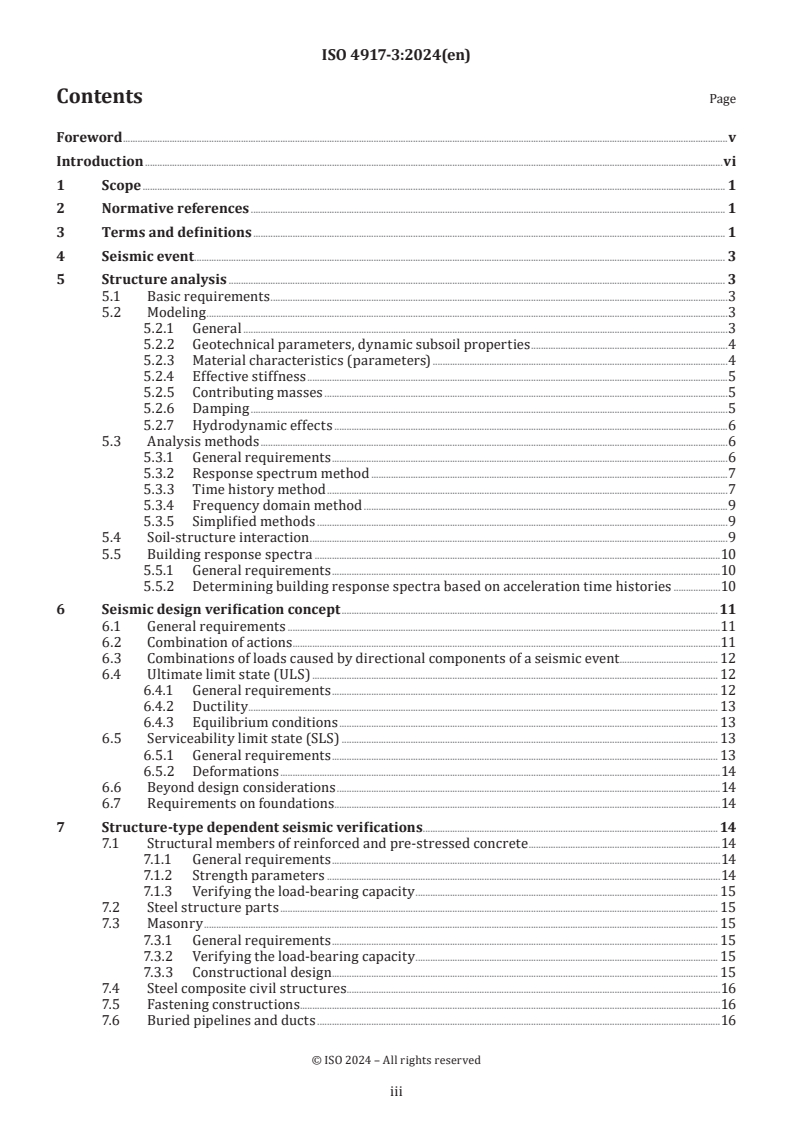
Contents Page
Foreword .v
Introduction .vi
1 Scope . 1
2 Normative references . 1
3 Terms and definitions . 1
4 Seismic event . 3
5 Structure analysis . 3
5.1 Basic requirements .3
5.2 Modeling .3
5.2.1 General .3
5.2.2 Geotechnical parameters, dynamic subsoil properties .4
5.2.3 Material characteristics (parameters) .4
5.2.4 Effective stiffness .5
5.2.5 Contributing masses .5
5.2.6 Damping .5
5.2.7 Hydrodynamic effects .6
5.3 Analysis methods .6
5.3.1 General requirements .6
5.3.2 Response spectrum method .7
5.3.3 Time history method .7
5.3.4 Frequency domain method .9
5.3.5 Simplified methods .9
5.4 Soil-structure interaction .9
5.5 Building response spectra .10
5.5.1 General requirements .10
5.5.2 Determining building response spectra based on acceleration time histories .10
6 Seismic design verification concept .11
6.1 General requirements .11
6.2 Combination of actions . .11
6.3 Combinations of loads caused by directional components of a seismic event . 12
6.4 Ultimate limit state (ULS) . 12
6.4.1 General requirements . 12
6.4.2 Ductility . 13
6.4.3 Equilibrium conditions . 13
6.5 Serviceability limit state (SLS) . 13
6.5.1 General requirements . 13
6.5.2 Deformations .14
6.6 Beyond design considerations .14
6.7 Requirements on foundations.14
7 Structure-type dependent seismic verifications . 14
7.1 Structural members of reinforced and pre-stressed concrete .14
7.1.1 General requirements .14
7.1.2 Strength parameters .14
7.1.3 Verifying the load-bearing capacity . 15
7.2 Steel structure parts . 15
7.3 Masonry . 15
7.3.1 General requirements . 15
7.3.2 Verifying the load-bearing capacity . 15
7.3.3 Constructional design . . . 15
7.4 Steel composite civil structures.16
7.5 Fastening constructions . .16
7.6 Buried pipelines and ducts .16
iii
7.7 Support structures .16
Annex A (informative) Recommendations with comments . 17
Annex B (informative) Simplified method for approximating building response spectra .21
Bibliography .23
iv
Foreword
ISO (the International Organization for Standardization) is a worldwide federation of national standards
bodies (ISO member bodies). The work of preparing International Standards is normally carried out through
ISO technical committees. Each member body interested in a subject for which a technical committee
has been established has the right to be represented on that committee. International organizations,
governmental and non-governmental, in liaison with ISO, also take part in the work. ISO collaborates closely
with the International Electrotechnical Commission (IEC) on all matters of electrotechnical standardization.
The procedures used to develop this document and those intended for its further maintenance are described
in the ISO/IEC Directives, Part 1. In particular, the different approval criteria needed for the different types
of ISO document should be noted. This document was drafted in accordance with the editorial rules of the
ISO/IEC Directives, Part 2 (see www.iso.org/directives).
ISO draws attention to the possibility that the implementation of this document may involve the use of (a)
patent(s). ISO takes no position concerning the evidence, validity or applicability of any claimed patent
rights in respect thereof. As of the date of publication of this document, ISO had/had not received notice of
(a) patent(s) which may be required to implement this document. However, implementers are cautioned that
this may not represent the latest information, which may be obtained from the patent database available at
www.iso.org/patents. ISO shall not be held responsible for identifying any or all such patent rights.
Any trade name used in this document is information given for the convenience of users and does not
constitute an endorsement.
For an explanation of the voluntary nature of standards, the meaning of ISO specific terms and expressions
related to conformity assessment, as well as information about ISO's adherence to the World Trade
Organization (WTO) principles in the Technical Barriers to Trade (TBT), see www.iso.org/iso/foreword.html.
This document was prepared by Technical Committee ISO/TC 85, Nuclear energy, nuclear technologies, and
radiological protection, Subcommittee SC 6, Reactor technology.
A list of all parts in the ISO 4917 series can be found on the ISO website.
Any feedback or questions on this document should be directed to the user’s national standards body. A
complete listing of these bodies can be found at www.iso.org/members.html.
v
Introduction
In accordance with IAEA Safety Standards Series No. SSR-2/1 protective measures against seismic events
are required, provided earthquakes is taken into consideration.
Earthquakes belong to the group of design basis events that requires taking preventive plant engineering
measures against damage and which are relevant with respect to radiological effects on the environment.
vi
International Standard ISO 4917-3:2024(en)
Design of nuclear power plants against seismic events —
Part 3:
Civil structures
1 Scope
This document applies to civil structures of nuclear power plants with water cooled reactors in order to
achieve the safety objectives given in ISO 4917-1. For other nuclear facilities the applicability of the document
needs to be checked in advance, before it might be applied correspondingly.
This document specifies the requirements for civil structures for the verification of their load-bearing
capacity in case of a seismic event. Additionally, requirements are specified pertaining to the verification of
the serviceability of civil structures as far as necessary for maintaining their safety-related function in case
of a seismic event (e.g. deformation and crack-width limitations).
This document will be applied under the presumption that the geology and tectonics of the plant site have
been investigated with special emphasis on the existence of active geological faults and lasting geological
ground displacements, and that the site has been deemed suitable for a nuclear installation.
To achieve these goals, this document deals with the requirements specific to the seismic design of civil
structures above and beyond their conventional design. The basic requirements of these precautionary
measures are dealt with in ISO 4917-1.
This document does not apply to cranes, to detachment devices for lifting equipment nor to the supporting
and mounting constructions of components.
This document is independent of national standards. Recommendations, given in Annex A, are mainly
based on the KTA Design-Philosophy and European standards. Alternatively other equivalent standards or
regulations can be used in case the general requirements given in this document can be met.
NOTE The term civil structures as used in this document comprise buildings and structural members made of
reinforced concrete, pre-stressed concrete, steel, as well as steel composite structures and masonry. Among others,
these include the containment, crane runways, platforms, fastening constructions and canals.
2 Normative references
The following documents are referred to in the text in such a way that some or all of their content constitutes
requirements of this document. For dated references, only the edition cited applies. For undated references,
the latest edition of the referenced document (including any amendments) applies.
ISO 4917-1:2024, Design of nuclear power plants against seismic events— Part 1: Principles
ISO 4917-4:2024, Design of nuclear power plants against seismic events — Part 4: Components
IAEA Safety Standards Series No, SSG-67, Seismic Design for Nuclear Installations, INTERNATIONAL ATOMIC
ENERGY AGENCY VIENNA (2021)
3 Terms and definitions
For the purposes of this document, the following terms and definitions apply.
ISO and IEC maintain terminology databases for use in standardization at the following addresses:
— ISO Online browsing platform: available at https:// www .iso .org/ obp
— IEC Electropedia: available at https:// www .electropedia .org/
3.1
structural member damping
damping of a structural member (e.g. plate, beam) including bordering influences and effects from secondary
elements (screeds, floor coverings, etc.)
Note 1 to entry: For equal load levels, structural element damping is larger than material damping.
3.2
geometric non-linearity
non-linear relationship between force and path values caused by equilibrium and kinematic considerations
for the deformed system
3.3
homogenous soil
rock
soil or rock with a near constant shear-wave velocity throughout its stratum thickness and a ratio of a
stratum thickness-to-foundation-radius larger than 4
Note 1 to entry: In case of squared foundations, the radius of an area equivalent circle applies.
3.4
soil-structure interaction
interaction relationship between local soil or rock conditions and the vibration behaviour of the building via
its foundation
Note 1 to entry: This interaction comprises the kinematic interaction and the interaction due to the inertial forces of
the structure.
3.5
impedance functions
complex frequency dependent foundation stiffness values in the subsoil; their real and imaginary parts
characterize stiffness and damping
3.6
interaction
interaction of the foundation with the subsoil, whereby the foundation is assumed as being
massless and rigid
3.7
material damping
damping caused by internal micro-plastic deformations
Note 1 to entry: The material damping is measured in the laboratory excluding bordering influences and the like; it is
dependent on the load level.
3.8
material non-linearity
non-linear relationship between stresses and strains caused by a non-linear material behaviour
3.9
radiation damping
damping due to energy being radiated into an adjacent medium, e.g. from one structural member to a
bordering member or from foundation to the subsoil
3.10
Rayleigh damping
damping defined by a matrix, C, that is a linear combination of the mass matrix, M, and the stiffness matrix,
K
3.11
overall building damping
damping of the total building or partial building structures made of many structural and nonstructural
members, including the influence from, e.g. non-load-bearing components, interaction with equipment,
friction in connections and effects from energy dissipation
Note 1 to entry: For equal load levels, overall damping is significantly higher than structural member damping.
3.12
upper limit frequency
frequency above which no significant seismic response in structures and sub-systems would occur
3.13
load bearing capacity
resistance of a structure or a structural component for forces that produce stresses or deformations
3.14
building response spectrum
response spectrum at a specific point or level of the building structure (it
corresponds to floor response spectrum)
4 Seismic event
The seismic event to be assumed for the design basis earthquake shall comprise
a) ground response spectra both in horizontal and vertical direction together with the rigid-body
accelerations and the strong motion duration specified in ISO 4917-1:2024, 5.5, or
b) artificial acceleration time histories compatible with the ground response spectra specified in
ISO 4917-1:2024, 6.3.3, or
c) recorded acceleration time histories as specified in ISO 4917-1:2024, 5.5.
The excitation to be applied and superposed shall be as specified in ISO 4917-1:2024, 6.3.1.
5 Structure analysis
5.1 Basic requirements
The structure analyses shall be performed and documented in a transparent fashion. The load-bearing
behaviour of the structure shall be described in the documentation.
The range of variation of the analysis assumptions, in particular with regard to stiffness values, load support
conditions, mass distributions and the vibration model, shall be documented and, if so required, estimated
on the basis of limit value considerations.
5.2 Modeling
5.2.1 General
The basic requirements regarding modeling are specified in ISO 4917-1:2024, 6.3.2. Regarding modeling of
civil structures, the requirements under this clause shall additionally be complied with.
Provided all decisive influences from torsion and eccentricities between the centers of gravity and the
centers of stiffness are taken into account as given in ISO 4917-1:2024, 6.3.2, any torsions coming from
unplanned scattering of masses and their distribution on a floor may be neglected.
NOTE In the case of decisive torsional effects coming from the excitation due to non-vertical propagating waves,
incoherent waves or phase-lag between waves an approximation with an accidental torsion approach is possible
(additional eccentricity between center of mass and stiffness).
Any modeling by equivalent beams subjected to axial and torsional loads shall take into account the influence
from torsion and eccentricities between the centers of gravity and the centers of stiffness. Furthermore,
existing deformabilities of individual structural members not accounted for in the beam model that would,
however, have a relevant influence on their structural behaviour or that of connected components shall be
taken into account in verifying the earthquake safety of structural members and components.
5.2.2 Geotechnical parameters, dynamic subsoil properties
In the dynamic analysis of a building the influence of the subsoil and foundation on the vibration behaviour
shall be considered. The mechanical properties of the subsoil under dynamic loading shall be taken into
account.
NOTE The mechanical properties of the subsoil under dynamic loading are significantly different from those
under static loading. The main influencing factors are the shear strain amplitude and the number of loading cycles, the
omnidirectional mean static pressure under the foundation as well as the void ratio and degree of saturation of the
soil.
The design of nuclear power plants against seismic events shall be based on geotechnical assessments and
investigations. The procedures chosen to be applied for determining the dynamic subsoil properties shall be
in accordance with the specific subsoil conditions. In-situ procedures and laboratory tests should be applied.
The whole process of assessment and determination of subsoil properties is not covered by this code. More
detailed requirements may be found e.g. in IAEA NS-G 3.6.C, KTA 2201.2.
Possible changes of the subsoil that might occur as a result of earthquakes should be adressed. These are
mainly the permanent vertical deformations resulting from soil compaction and reduction of the shear
strength due to changes in the soil grain structure.
The following data on dynamic subsoil properties for the individual soil layers should be defined as the basis
of a dynamic analysis:
— dynamic shear modulus, G , supplemented by appropriate upper and lower limit values;
— Poisson ratio, ν;
— material damping in terms of the damping ratio, D;
— mass density, ρ;
— shear wave velocity, v , and compression wave velocity, v , for small shear strains (if Poisson’s ratio is
s p
given, v is not needed);
p
— relationships for the dynamic shear modulus reduction and the material damping to shear strains.
5.2.3 Material characteristics (parameters)
Regarding concrete, reinforcing steel, pre-stressing steel, structural steel and masonry, the material
characteristics (parameters) to be used in the analysis model for static loads may be as specified in the
relevant national documents.
NOTE If no national standard is available for a sufficient definition of material parameters information can be
found in the European standards EN 1992-1-1, EN 1993-1-1, EN 1994-1-1 and EN 1996-1-1.
5.2.4 Effective stiffness
The stiffness values of structural members may basically be determined under the assumption of a linear-
elastic behaviour of the structural material without any stiffness reduction.
A possible stiffness reduction due to cracking shall be taken into account for reinforced or pre-stressed
concrete structural members, if this may have a significantly adversely effect on the vibration behaviour
of the respective building structures and resulting loads of the structural members. The stiffening effect
of not-load-bearing structural members, e.g. the infilling of masonry, shall be considered in the building
models, provided, this has a significantly adversely effect on the vibration behaviour.
NOTE 1 In particular the torsional stiffness of reinforced concrete structural members can be reduced due to
cracking and can strongly influence the design results.
NOTE 2 The contribution of non-load bearing elements can lead to an additional eccentricity between the centre
of mass and stiffness. If their contribution does not vanish due to e.g. cracking it can decisively impair the overall
dynamic behaviour of the building.
Stiffness values and eccentricities of connections in steel structures and their supports shall be taken
into account, if they may have a significantly adversely effect on the vibration behaviour of the respective
building structures and on the resulting loading of structural members. The stiffness values may be varied
to account for the flexibility of, for example, framework corners or bolt connections.
5.2.5 Contributing masses
The building structure analysis shall account for the seismic masses derived from the permanent masses
(building structure and components), the masses of quasi-permanent live loads and the ratio of variable live
loads existing during operation. Recommended ratios of variable live loads that should be considered are
given in Table A.2.
The building analysis may be simplified by considering the components as being decoupled from the building,
provided, the masses of the components are included in the mass of the building and the uncoupling criteria
according to ISO 4917-1:2024, A.5 are satisfied.
In stick models the rotary inertias shall explicitly be considered.
NOTE In 3D models the rotary inertia is generally implicitly considered.
5.2.6 Damping
Damping may be assumed to be a viscous (velocity dependent) effect. It should be distinguished between
the dynamic analyses of buildings (associated with "overall building damping”) and of individual structural
members (associated with “structural member damping”).
NOTE 1 The overall building damping includes besides the material damping and the damping of structural
members in particular the damping due to interactions with non-load-bearing components and equipment, too.
In the dynamic analysis, the different damping of the building structure and of the subsoil shall be considered.
The damping behaviour of buildings and partial building structures is in general largely determined by
the overall building damping. Therefore, the analyses for verifying the ultimate limit state (ULS) and the
serviceability limit state (SLS) and for determining building response spectra may be based on high damping
ratios. Recommended values are given in column A of Table A.1.
For-buildings whose damping behaviour is exclusively determined by material damping and structural
member damping, the verification of the serviceability limit state (SLS) and the determination of the building
response spectra shall be based on reduced damping ratios without the effect of overall building-damping.
Recommended values are given in column B of Table A.1.
In cases where it is proven that significant energy absorbing effects like e.g. concrete cracking and steel
yielding will be expected all over the building, column A of Table A.1 may be applied for the verification of
the serviceability limit state (SLS) and the generation of response spectra, too.
NOTE 1 In the verification of the ultimate limit state (ULS) it is justified to assume high energy dissipation due
to e.g. cracking and steel yielding. This is because when damping is overestimated due to small utilization of the
structure the real acting loads and hence the utilization automatically increases (self-regulating system). This is not
the case in the verification of the serviceability limit state (SLS) and the generation of response spectra.
For the verification of the load-bearing capacity of individual structural members damping ratios as
specified in column A of Table A.1 may be applied. In case of additional requirements, reduced damping
ratios shall be applied. Recommended values are specified in column B of Table A.1. The use of differing
values shall be well substantiated.
NOTE 2 Additional requirements can be serviceability limit state (SLS), leak tightness requirements or crackwidth
limitation requirements for fastenings.
Regarding the subsoil, the hysteresis related damping and the energy-radiation related damping shall be
assumed in accordance with the subsoil and foundation conditions.
For oscillations of fluids, only a small damping shall be assumed. Annex A contains a recommended value of
damping ratio for oscillations of fluids.
5.2.7 Hydrodynamic effects
Fluid masses may be regarded as rigidly swinging with the building structure or may be visualized by a
hydrodynamic model. The effect of the sloshing liquid on structural elements shall be considered separately.
Oscillations of fluids relative to structural elements occurring in the horizontal direction may be considered
using the equivalent-mass method. In this context, the liquid mass may be separated into one mass rigidly
coupled to the structure and one mass swaying relative to the structure.
In the case of open pools, the spillover may be calculated as a function of the spectral deflection of the
sloshing mass under consideration of the geometry of the pool.
The loading force on the pool walls shall be determined based on a hydrodynamic model.
The horizontally effective liquid masses may be considered as being constant over the entire height of the
structure.
In the vertical direction, the liquid mass shall be considered as being rigidly coupled to the base of the
structure.
5.3 Analysis methods
5.3.1 General requirements
The analysis may be based on one of the following analysis methods:
a) response spectrum method specified in 5.3.2;
b) time history method specified in 5.3.3;
c) frequency domain method specified in 5.3.4;
d) simplified method specified in 5.3.5.
The ultimate limit state (ULS) shall basically be verified taking geometric non-linearities into account. This
requirement may be waived, provided, the requirement in A.2 is met.
The load of structural members whose vibration behaviour does not influence the overall behaviour may be
determined based on building response spectra (see 5.5).
Non-linear analysis methods are permitted and, in individual cases, required.
NOTE The application of non-linear analysis methods requires in-depth knowledge and sufficient experience.
5.3.2 Response spectrum method
Based on calculated eigen- (or natural) frequencies and eigenforms, the response spectrum method shall be
used to determine the maximum action effects from the superposition of the contributions of the individual
eigenmodes (modal analysis). If a temporal sequence of the response is required, a time history method shall
be applied (see 5.3.3).
NOTE The multiple spectrum method can be used, too. This is defined in 4.3.5 b) of ASCE 4 or in ASME Boiler and
Pressure Vessel Code (BVPC).
The individual loads from an eigenform shall be determined based on a design response spectrum.
Basically, eigenfrequencies up to the upper limit frequency shall be considered. The eigenmodes with higher
frequencies shall be applied as rigid body contribution as given in ISO 4917-4:2024, 5.4.2.
Basically, all modal response parameters shall be combined by the Complete Quadratic Combination (CQC) or
Gupta or Lindley-Yow methods. Provided, all eigenforms meet Formula (1) the modal response parameters
may be combined using the square root of sum of squares (SSRS) method.
ff> 1,35 (1)
ii−1
where
f is the eigenfrequency of the eigenform i;
i
i is 1, …, n, with n equal to the number of eigenforms.
The use of any other superposition method shall be well substantiated. To accurately represent the
acceleration in the base regions, the rigid-body contribution shall be accounted for in the response spectrum
method as given in ISO 4917-4:2024, 5.4.2.
The factor 1,35 in Formula (1) applies to a damping ratio of 7 %. Smaller damping ratios lead to smaller
factors, e.g. a factor of 1,2 applies to a damping ratio of 4 % and a factor of 1,1 to a damping ratio of 2 %.
Application of the classical modal analysis requires differentiating between a proportionally and a non-
proportionally dampened system.
In the case of a proportionally dampened system, the eigenvectors of the undampened system can be
used for decoupling the equation system. This is the case when damping is distributed all over the system.
Systems with local concentrated damping e.g. systems with seismic dampers (non-proportional dampened
systems) require specific considerations e.g. coupling of several eigenmodes together.
5.3.3 Time history method
5.3.3.1 General requirements
Regarding the time history method, the acceleration time history (or displacement time history) shall
be applied as excitation for the entire vibrating system. The time histories of the movement and stress
resultants and their maximum values shall be determined in the dynamic analysis by a modal analysis or by
a direct integration of the time histories.
The acceleration time history shall either be generated from the design response spectrum or taken from
the recorded time histories of the seismological expert report.
NOTE The number and generation method of the time histories as well as details regarding recorded time
histories can be found in ISO 4917-1.
In well substantiated cases the modal analysis may be used as a simplified method for non-linear problems.
5.3.3.2 Modal time history method
In case of extreme damping, the solution for the undampened system may only be applied if this is well
substantiated. The maximum modal damping of oscillations coming from soil-structure interaction shall
be limited if not well substantiated for the individual case. Recommended values are given for the different
degrees of freedom in A.3.
It is recommended to limit the modal damping of the building structures. Recommended values are specified
in Table A.1 (see also 5.2.5) for the significant frequencies.
Modern non-classical modal time history methods use a complete modal damping matrix or count damping
forces in a right-hand part of an equation system. These methods have no limitations in modal damping
values.
In analogy to the response spectrum method (see 5.3.2), the rigid-body contribution shall be accounted for.
5.3.3.3 Direct integration
The time increment for the direct integration shall be sufficiently small such that the vibration response
at the maximum frequency of interest is accounted for to a sufficient accuracy and that the convergence
and stability of the numeric integration is ensured. It is recommended to set the time step to no more than
0,1 times the reciprocal of the upper limit frequency. When a time step of more than 0,1 times the reciprocal
of the upper limit frequency is used, it should be well substantiated.
NOTE 1 This value is based on the Newmark integration scheme but it is also a good reference value for other
integration schemes.
NOTE 2 The time increment is sufficiently low if the results with 2 times lower time increment changes the results
less than 10 %.
If the damping ratios are approximated by proportional damping (Rayleigh damping), two support points in
the Rayleigh damping diagram are needed for the calculation of α and β. They shall be chosen appropriately
so that the damping in the relevant frequency range is equal or less than the target damping ratio.
The Rayleigh damping of frequency-independent soil models shall be limited. Recommended values are
given for the different degrees of freedom in A.3.
It is recommended to limit the Rayleigh damping of the building structures. Recommended values are
specified in Table A.1 (see also 5.2.5) for the significant frequencies.
The Rayleigh damping defined by a matrix, C, that is a linear combination of the mass matrix, M, and the
stiffness matrix, K, using the Rayleigh parameters α and β according to Formula (2):
CM=⋅αβ+⋅K (2)
Formula (2) leads to the respective damping ratio, D, in Formula (3), as a function of the angular frequency,
ω.
D=⋅αω//22 +⋅βω (3)
() ()
In the case of nonlinear analyses with hysteresis effects, the viscous damping ratios should be further
limited because one portion of energy dissipation is considered in the model already. Recommended values
are specified in columns B of Table A.1. However, any alternate damping values can be used with proper
justification.
For structures with significant rigid body motion (for example due to sliding or isolation system), the α
coefficient of the Rayleigh damping should be taken equal to 0 or procedures shall be set in place to avoid
that the Rayleigh damping contribute to artificially damping these modes.
5.3.4 Frequency domain method
The transfer function shall be calculated for a sufficient number of frequencies. In this context, it shall be
ensured that they cover the entire frequency spectrum of the excitation as well as the eigenfrequencies of
the analyzed structures up to the upper limit frequency.
The sensitivity of the results to different frequency discretization shall be examined basically using
transfer functions analysis. The additional frequency support points required for applying the Fast-Fourier-
Transformation (FFT) may be interpolated.
5.3.5 Simplified methods
In well substantiated cases simplified methods may be applied for buildings and individual structural
members, provided, the horizontal and vertical excitations are accounted for.
NOTE Simplified methods (quasi-static methods) for structures are detailed under consideration of the
application limits, e.g. in ISO 4917-4:2024, 5.4.4.
5.4 Soil-structure interaction
The influence of the interaction between the building and the subsoil on the dynamic behaviour of the
building shall be determined. In the case of embedded buildings, the kinematic interaction shall basically be
considered. The kinematic interaction may be waived for buildings that are, or are assumed, to be surface
founded.
It is permissible to assume a rigid foundation for the building, when it is well provided, that the subsoil has
no relevant influence on the dynamic behaviour of the building. This may be assumed if a rigid foundation
assumption changes the results less than 10 % compared to a model with soil-structure-interaction.
In general, the subsoil is approximately stratified which makes specific analyses methods necessary, e.g.
analysis methods in the frequency domain that consider the frequency dependent stiffness characteristics
of the foundation (impedance functions). The same applies to special foundation concepts (e.g. pile
foundations).
It is permissible to recalculate the ground response spectra specified as the seismic event to other subsoil
horizons by deconvolution of seismic motion.
NOTE 1 It is important, that the seismological report clearly defines the soil layer or level of foundation that
corresponds to the given design response spectrum.
A homogenous subsoil may be represented by a dampened spring-mass model. The parameters for this model
may be determined based on the elastic half-space theory. In this case, the nonlinear load-bearing behaviour
may be accounted for by limit state considerations with adapted soil or rock characteristics (secant stiffness
values). In the case of rigid circular or rectangular foundations with a dimensionless frequency, a , smaller
than 2 for horizontal vibrations and smaller than 1 for vertical vibrations and for tilting movements, it is
permissible for the sake of simplification to assume the static rigidity and damping determined from half-
space equations to be frequency independent. In the case of strip foundations or non-rigid foundations,
special considerations are required.
The dimensionless frequency, a , is defined by Formula (4) as follows:
ar=⋅ω /v (4)
()
00 s
where
ω is the angular frequency;
r is the substitute radius determined from the condition of equality of areas for translatory degrees
of freedom or from the moments of inertia for rotatory degrees of freedom;
v is the shear-wave velocity of a half space model that represents the real soil conditions. The value
s
shall be estimated on engineering judgement.
NOTE 2 The static rigidity corresponds to the rigidity at the frequency above zero. The damping determined from
half-space approximation equations corresponds to the damping at resonance frequencies.
The possibility of a mutual subsoil related interference of neighbouring buildings (structure-soil-structure
interaction) shall be evaluated.
NOTE 3 This interference is generally covered by varying the average value of the subsoil stiffness upward by
multiplying it by a variation factor and downward by dividing it by a variation factor as specified in ISO 4917-1:2024,
6.3.2.
In the case of low frequencies (frequency is lower than the eigenfrequency of the subsoil stratum) and
application of the modal method, energy-radiation related damping (radiation damping) may not b
...