


ISO 4125:1991
(Main)Dry fruits and dried fruits — Definitions and nomenclature
Dry fruits and dried fruits — Definitions and nomenclature
Specifies terms and definitions in English, French and Russian. This second edition cancels and replaces the first edition (1979). Annex A is for information only.
Fruits secs et fruits déshydratés — Définitions et nomenclature
General Information
- Status
- Published
- Publication Date
- 21-Aug-1991
- Technical Committee
- ISO/TC 34/SC 3 - Fruits and vegetables and their derived products
- Drafting Committee
- ISO/TC 34/SC 3 - Fruits and vegetables and their derived products
- Current Stage
- 9093 - International Standard confirmed
- Start Date
- 26-Aug-2024
- Completion Date
- 12-Feb-2026
Overview
ISO 4125:1991 - "Dry fruits and dried fruits - Definitions and nomenclature" is an international vocabulary standard that defines terms and sets common names for the most commonly traded dry fruits and dried fruits. Published by ISO/TC 34 (Agricultural food products), this second edition (1991) cancels and replaces the 1979 edition. The standard provides definitions in English, French and Russian, includes tables of commonly traded items, and an informative Annex A with botanists’ names and author abbreviations.
Key topics
- Clear definitions
- Dry fruits: Fruits with a naturally low moisture content in the edible part.
- Dried fruits: Fruits at appropriate maturity subjected to natural or artificial drying to remove a major part of water (to extend shelf life or prepare for specific uses).
- Multilingual nomenclature
- Common names provided in English, French and Russian to support international trade and regulatory consistency.
- Indexed commodity lists
- Table 1: List of commonly traded dry fruits (nuts, kernels, drupes, legumes, etc.).
- Table 2: List of commonly traded dried fruits (fig, date, raisin, prune, apricot, etc.).
- Botanical name guidance
- Botanical names shown; some are marked as not yet stabilized by ISTA (International Seed Testing Association). Annex A lists botanists’ full names and standard abbreviations.
- Edition note
- Second edition revises tables 1 and 2 from the 1979 version; Annex A is informative only.
Applications and practical value
ISO 4125 is practical for anyone needing consistent terminology across languages and markets:
- Food manufacturers and packers: consistent product naming on specification sheets and labels.
- Importers/exporters and traders: harmonized commodity names for contracts, invoices and market reports.
- Regulators and customs authorities: clear vocabulary for classification, inspection and labelling enforcement.
- Standards developers and industry associations: reference vocabulary when drafting product standards, specifications or labelling guidelines.
- Translators and technical writers: authoritative tri-lingual names for communications and documentation.
Who should use it
- Agrifood businesses dealing with nuts and dried fruit commodities
- Quality managers, regulatory affairs professionals, and labeling specialists
- Trade associations, certification bodies and standardization committees
Related standards (if applicable)
This standard complements other ISO work on agricultural and food product terminology produced by ISO/TC 34, and topics such as food labelling, commodity classification and product specifications. For cross-references, consult other ISO food vocabulary and labelling standards relevant to your jurisdiction.
Keywords: ISO 4125, dry fruits, dried fruits, definitions and nomenclature, food standards, multilingual vocabulary, agricultural products, fruit trade, labelling.
Get Certified
Connect with accredited certification bodies for this standard

BSI Group
BSI (British Standards Institution) is the business standards company that helps organizations make excellence a habit.

Bureau Veritas
Bureau Veritas is a world leader in laboratory testing, inspection and certification services.

DNV
DNV is an independent assurance and risk management provider.
Sponsored listings
Frequently Asked Questions
ISO 4125:1991 is a standard published by the International Organization for Standardization (ISO). Its full title is "Dry fruits and dried fruits — Definitions and nomenclature". This standard covers: Specifies terms and definitions in English, French and Russian. This second edition cancels and replaces the first edition (1979). Annex A is for information only.
Specifies terms and definitions in English, French and Russian. This second edition cancels and replaces the first edition (1979). Annex A is for information only.
ISO 4125:1991 is classified under the following ICS (International Classification for Standards) categories: 01.040.67 - Food technology (Vocabularies); 67.080.10 - Fruits and derived products. The ICS classification helps identify the subject area and facilitates finding related standards.
ISO 4125:1991 is available in PDF format for immediate download after purchase. The document can be added to your cart and obtained through the secure checkout process. Digital delivery ensures instant access to the complete standard document.
Standards Content (Sample)
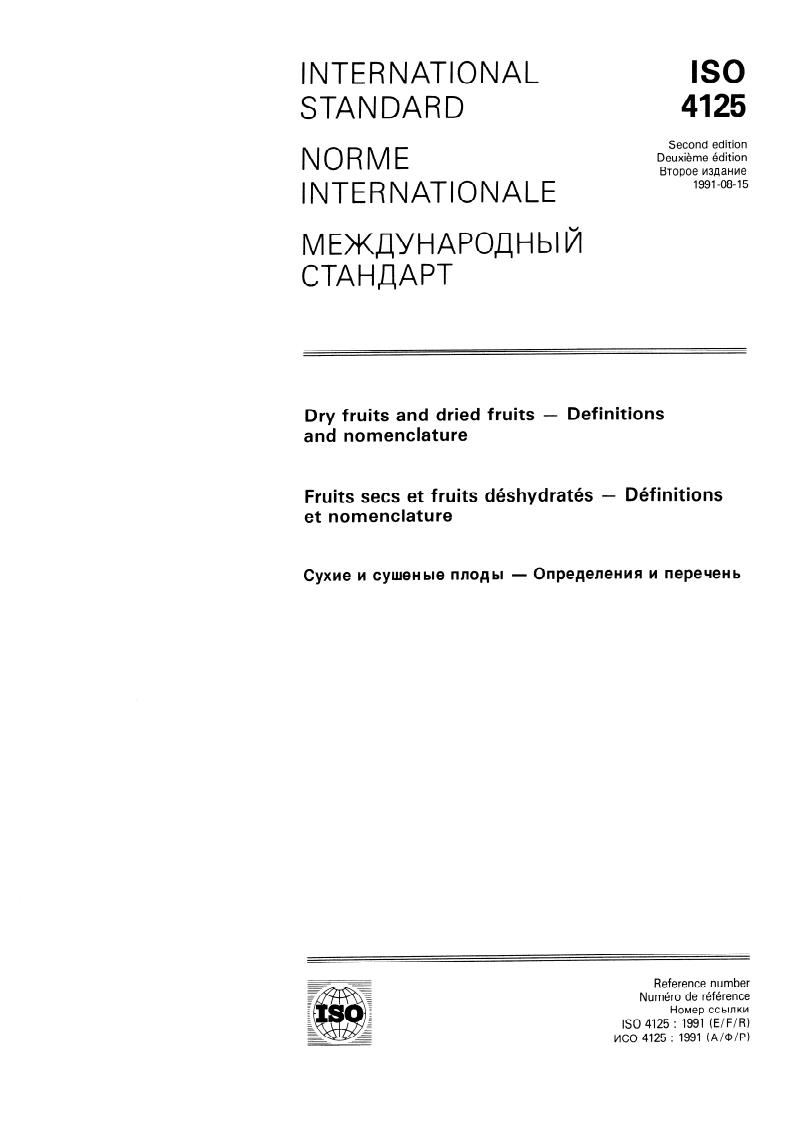
ISO
INTERNATIONAL
STANDARD
Second edition
Deuxieme Edition
NORME
BTopoe i43Aatwe
1991-08-15
INTERNATIONALE
MEX,IJYHAPOAHblm
CTAHDAPT
Dry fruits and dried fruits - Definitions
and nomenclature
Fruits secs et fruits dbhydratb - Definitions
et nomenclature
- Onpe~eneHm M nepereHb
CyxMe M CyweH ble flJIOAbl
Reference number
Numkro de refkrence
HoMep CC blJl KL4
ISO 4125 : 1991 (E/F/R)
1/1Co 4125 : 1991 (A/Q>/P)
ISO 4125 : 1991 (E/F/R)
MC0 4125 : 1991 (A/@/P)
Foreword
ISO (the International Organization for Standardization) is a worldwide federation of
national Standards bodies (ISO member bodies). The work of preparing International
Standards is normally carried out through ISO technical committees. Esch member
body interested in a subject for which a technical committee has been established has
the right to be represented on that committee. International organizations, govern-
mental and non-governmental, in liaison with ISO, also take part in the work. ISO
collaborates closely with the International Electrotechnical Commission (IEC) on all
matters of electrotechnical standardization.
Draft International Standards adopted by the technical committees are circulated to
the member bodies for voting. Publication as an International Standard requires
approval by at least 75 % of the member bodies casting a vote.
International Standard ISO 4125 was prepared by Technical Committee ISO/TC 34,
Agricultural food products.
This second edition cancels and replaces the first edition (ISO 4125 : 1979), tables 1
and 2 of which have been technically revised.
Annex A of this International Standard is for information only.
0 ISO 1991
All rights reserved. No part of this publication may be reproduced or utilized in any form or by any
means, electronie or mechanical, including photocopying and microfilm, without Permission in
writing from the publisher./Droits de reproduction reserves. Aucune Partie de cette publication
ne peut etre reproduite ni utilisee sous quelque forme que ce soit et par aucun procede, electroni-
que ou mecanique, y compris Ia photocopie et les microfilms, sans I’accord ecrit de I’editeur.
International Organization for Standardization
Case postale 56 l CH-1211 Geneve 20 l Switzerland
Printed in Switzerland/lmprime en Suisse
ii
ISO 4125 : 1991 (E/F/R)
MC0 4125 : 1991 (A/@/P)
Avant-propos
L’ISO (Organisation internationale de normalisation) est une federation mondiale
d’organismes nationaux de normalisation (comit6s membres de I’ISO). L’elaboration
des Normes internationales est en g6n&al confiee aux comitks techniques de I’ISO.
Chaque comit6 membre intkresse par une etude a Ie droit de faire Partie du comite
technique cr-66 a cet effet. Les organisations internationales, gouvernementales et non
gouvernementales, en liaison avec I’ISO participent egalement aux travaux. L’ISO col-
labere ktroitement avec Ia Commission electrotechnique internationale (GEI) en ce qui
concerne Ia normalisation electrotechnique.
Les projets de Normes internationales adoptes par les comites techniques sont soumis
aux comites membres pour vote. Leur publication comme Normes internationales
requiert I’approbation de 75 % au moins des comit6s membres votants.
La Norme internationale ISO 4125 a et6 elaboree par Ie comite technique ISO/TC 34,
Produits agricoles a firnen taires.
Cette deuxieme Edition annule et remplace Ia Premiere Edition (ISO 4125 : 1979), dont
les tableaux 1 et 2 ont fait I’objet d’une Gvision technique.
L’annexe A de Ia presente Norme internationale est uniquement a titre d’infor-
mation.
MC0 (MePKAyHapOAHaFl OpraHkl3a~klR l-l0 CTaHAapTM3al-/UH) f4BJlfIeTCFI BCeMMpHOti
@e,LjepaLJkleh HaqVlOHan bH blX OpraHVl3aqVlti l-IO CTaHflapTVl3a~l’Wl (KOMMTeTOB-WeHOB
MCO). Pa3pa6OTKa MeIKflyHapOJJHblX CTaHflapTOB OCy~eCTBnfieTCFl TeXHMqeCKMMM
KOMLlTeTaMVl L/1co. KaxAblti KOMPlTeT-WeH, 3auiHTepeCOBaHHblti B AeflTenbHOCTM,
AflF1 KOTOpOti 6bin C03AaH TeXHWieCKVlti KOMMTeT, MMeeT flpaB0 6blTb npe/JCTaBneH-
HblM B 3TOM KOML’lTeTe. MexAyHapOp,Hble IlpaBHTenbCTBeHHble kl HenpaBlATenb-
CTBeHHble OpraHl43a4VlW, lAMetOur,He CBR3L4 C 1/1co, TaKxe llpPlHVIMatOT yiraCTlAe B
pa6oTax. YTO KacaeTcR cTaHjJapTvI3aqm B 06naCTIA SIeKTpOTexHMKM, VlCO pa60TaeT
B TeCHOM COTpyAHWeCTBe C Me~JJyHapOp,HOIiI 3neKTpOTeXHl’l~eCKOti KOMucc~eti
(M3K).
npOeKTbl MeIK,Q’HapO~HblX CTaHaapTOB, llpVlHF1Tble TeXHL’lLleCKMMkl KOMMTeTaMM,
paccblnatoTm KOMklTeTaM-clneHaM Ha ronocoBaHMe. L/lX OI-iy6nPIKOBaHl4e B KaCleCTBe
MexgyHapop,HblX CTaHAapTOB Tpe6ye-r o,qo6peHWi l-l0 MeHbUJeti Mepe 75 % KOMVlTe-
TOB-WeHOB, npMHvlMatolqlAx yYacTue B ronocoBaHm.
Me>ccp,yHapOgHblti CTaHAapT MC0 4125 6bin pa3pa60TaH TeXHlNeCWlM KOMMTeTOM
VlCO/TK 34, CW7bCKOX03FIüCmBeHHble flUU@Bble l-lpOdyKf?lbI.
tiacTofqee BTopoe vI3AaHvIe aHHynI4pye-r PI 3aMeHReT nepeoe vI3AaHvIe (MC0 4125 :
1979), B KOTOPOM Ta6JWIqbl 1 Vl 2 RBL’lnMCb llpe,4MeTOM TeXHWeCKOti peBl43Wl.
flpVlnOIKeHl/le A HaCTOfiUl,erO Me>i
MaLqvl.
. . .
Ill
This page intentionally left blank
INTERNATIONAL STANDARD
ISO 4125 : 1991 (E/F/R)
NORME INTERNATIONALE
MC0 4125 : 1991 (A/@/P)
MEXAYHAPOAHbllil CTAHAAPT
Dry fruits and dried Fruits secs et fruits Cyxbde M cywetible
fruits - Definitions deshydrates - llJlOAbl - Onpe~enetiwi
and nomenclature Dbfinitions et M nepeLiei=ib
nomenclature
1 Scope Domaine d’application 06nacTb npPlMeHeHWl
t-iacTowq!dI Me>ccJJyHapOJJH blti CTaHAapT
This International Standard gives La presente Norme internationale donne les
definitions des termes «fruits secs» et AaeT 0npeAeneHMfi repMr4Hoe ,,cyxr4e nno-
definitions of the terms “dry fruits” and
“dried f ruits”, together with the «fruits deshydrates)) ainsi que les noms, P,bl“ Vl ,,CyUleHble l-lnO~bl“ BMeCTe C HaMMe-
HOBaHWIMVI, Ha aHrnlAwcKoM, @paHqy3-
common names, in English, French and en anglais, francais et russe, des fruits les
consommes dans Ie CK~M VI pyCc~0~ fi3blKax, @~YKT~B, u.w
Russian, of the most common fruits plus couramment
grown commercially in the world for monde et trouves sur les marches locaux, pOK0 yllOTpe6nFleMblX B MlApe ld FIBnfltO-
qr/rxc~ npefiMeToM ToproBnvr pervioHan b-
human consumption; these fruits are nationaux ou internationaux.
marketed in local, national and inter- H blX, HaqVlOHan bH blX Vl MexAyHapOJJH blX
national markets. Elle donne, en annexe A, Ia liste des noms pbIHKOB.
des botanistes et des abreviations utilisees
Annex A gives a list of the full names of dans Ia presente Norme internationale. B npMnoxeHvw A npHeeAeti cnwoK 6oTa-
HVlKOB M l-lpVlMeHFIeMblX COKpa~eHPlti VlX
botanists and the abbreviations used in
this International Standard. VlMeH.
2 Definitions and Definitions et nomenclature OnpeAenetww H neperetib
nomenclature
2.1 dry fruits: Fruits having a fruits secs: Fruits comportant naturel- flIl0~ bl CyXLle : i%lOAbl B eCTeCTBeHHOM CO-
naturally low moisture content in their lement peu d’humidite dans leur Partie CT~~~HI/~M c HM~KMM coAepxaHi4eM Bnarvi B
edible part. consommable. cae~o6Hoti clac-rM.
NOTES
NOTES
1 Les fruits secs peuvent etre certains noyaux 1 K CyXMM l-lJlO/JaM OTHOCFITCFI Hf?KOTOpbie Ope-
1 Dry fruits tan be certain nuts or kernels,
drupes, legumes, capsules and/or follicles. ou noix, drupes, Iegumes, capsules et/ou XI/1 LInM RApa, 6o6bl, KOCTOqKOBbIe llJlO~bl, I-IJ-IO-
follicules. Abi-KOP060’4KVl l4Jll.l CTpycCKkl.
2 The most commonly traded dry fruits are
listed in table 1. 2 Les fruits secs les plus courants dans Ie 2 HauGonee paCllpOCTPaHeHHble B TOPr0BJ-E
commerce figurent dans Ie tableau 1. cyxuie nnop,bl yKa3aHbl B Ta6nMqe 1.
ISO 4125 : 1991 (E/F/R)
MC0 4125 : 1991 (A/@/P)
Tableau 1 - Liste des fruits secs Ta6mqa 1 - nepecieti b Hau6onee
Table 1 - List of the most commonly
paCflpOCTpaHf2HH blX B TOpPOBJle CYXHX
traded dry fruits les plus courants dans le commerce
nno/qos
Nom commun du fruit
OGkyenpwtifwoe HaWMeHoBatwe nnoAa
Nom botanique de Ia plante11
6OTaHWlt?CKOe HaMMeHOBaHH@
Amygdalus communis L.
syn. Prunus tenela Batsch
Peanut, Groundnut Cacahuete, Arachide de ApaxMc, 3eiwnRt-roti opex
Arachis hypogaea L.
6pa3WlbCKPl ti OpeX
Brazil nut, Para nut,
* Canarium ovatum Engelm.
* Canarium commune L. Java almond, Pili, Pilaway Amande de Java FIBCKIA 12 Ml4HAal-l b
+ Carya ilfinoiensis
(Wangenh.) K. Koch
* Carya a/ba (L.) Nutt. S hagbark hickory Noix blanche d’Amerique
KapMokap MacI-‘lPlL(HbIL;1
* Caryocar nuciferum L. Souari nut, Butternut
Chestnut, Sweet chestnut Chataigne, Marron
Castanea sativa Miller
Cera tonia siliqua L . UaperpaAcku 0 ~0x0~
Noix de coco KOKOCOBblti OpeX
Cocos nucifera L.
l-lazelnut, Cob-nut
Corylus avellana L.
Corylus maxima Miller
Eiaeagnus angustifolia L. Oleaster, Russian Olive Olive de Russie flOX Y3KOJWlCTblti
* L ecythis unsitata L.
* L e
...
Questions, Comments and Discussion
Ask us and Technical Secretary will try to provide an answer. You can facilitate discussion about the standard in here.
Loading comments...