

ISO 4254-1:2013
(Main)Agricultural machinery — Safety — Part 1: General requirements
General Information
- Abstract
ISO 4254-1:2013 specifies the safety requirements and the means of their verification for the design and construction of self-propelled ride-on machines, mounted, semi-mounted and trailed machines used in agriculture in order to deal with the hazards which are typical for most of the machines. In addition, it specifies the type of information on safe working practices including information about residual risks to be provided by the manufacturer. This document deals with significant hazards, hazardous situations and events relevant to this agricultural machinery when used as intended and under the conditions of misuse foreseeable by the manufacturer during normal operation and service. ISO 4254-1:2013 is not applicable to ? agricultural or forestry tractors, ? aircraft and air-cushion vehicles used in agriculture, ? lawn and garden equipment, ? machine-specific components or functions (e.g. working tools and/or processes). ISO 4254-1:2013 is not applicable to hazards related to periodic service, machine conversion and repairs intended to be carried out by professional service personnel, environmental hazards, road safety (e.g. steering, braking), or to the power take-off (PTO) drive shaft; neither is it applicable to guards of moving parts for power transmission except for strength requirements for guards and barriers. ISO 4254-1:2013 is not applicable to machines which are manufactured before the date of its publication. Not all of the hazards dealt with by ISO 4254-1:2013 are necessarily present on a particular machine. A risk assessment should be carried out by the manufacturer to determine the hazards that are applicable and any hazards in addition to those dealt with by this part or a relevant machine-specific part. The requirements of a machine-specific part of ISO 4254 take precedence over the requirements of this part.
- Status
- Published
- Publication Date
- 17-Apr-2013
- Technical Committee
- ISO/TC 23/SC 3 - Safety and comfort
- Drafting Committee
- ISO/TC 23/SC 3 - Safety and comfort
- Current Stage
- 9093 - International Standard confirmed
- Start Date
- 24-Apr-2026
- Completion Date
- 29-Aug-2026
Buy Documents
ISO 4254-1:2013 - Agricultural machinery — Safety — Part 1: General requirements Released:4/18/2013
ISO 4254-1:2013 - Matériel agricole — Sécurité — Partie 1: Exigences générales Released:4/18/2013
Overview
ISO 4254-1:2013 - Agricultural machinery - Safety - Part 1: General requirements defines safety requirements and verification methods for the design and construction of most agricultural machines: self‑propelled ride‑on machines, plus mounted, semi‑mounted and trailed implements. It addresses typical hazards during intended use and foreseeable misuse, and specifies the information manufacturers must supply (safe working practices and residual risks). This is a type‑C standard and complements machine‑specific parts of the ISO 4254 series.
Key topics and technical requirements
ISO 4254-1:2013 focuses on practical safety measures across multiple domains. Major topics include:
- Hazard identification and risk assessment - manufacturers must determine which hazards apply to each machine; machine‑specific parts take precedence.
- Protection from moving parts - guards, barriers and related strength requirements.
- Controls and operator interfaces - ergonomics, symbols and control behaviour (including automatic modes).
- Operator stations and seating - safe layout, access and protection (including foldable elements and operator restraint considerations).
- Noise and vibration - measurement and limits; noise test code is included (Annex B).
- Electrical, hydraulic and pneumatic systems - safety rules for components and connections.
- Operating fluids and hot surfaces - risk reduction for burns, leaks and contamination.
- Emergency stop and safety-related control systems - requirements and verification.
- Roll‑over and tip‑over protection - measures to reduce severity of rollover events.
- Verification and testing - strength tests (Annex C), stability considerations (Annex D), and procedures for verifying compliance.
- Information for use - operator’s manual content, safety signs, markings and information about residual risks.
Excluded topics (not covered) include agricultural/forestry tractors, lawn/garden equipment, road safety (steering/braking), PTO drive shaft hazards (except guard strength), periodic professional servicing, environmental hazards, and machines manufactured before publication.
Applications and users
ISO 4254-1:2013 is intended for:
- Manufacturers and product designers developing agricultural machinery and implements.
- Safety engineers and compliance teams conducting risk assessments and verification tests.
- Test laboratories and certification bodies evaluating conformity to safety requirements.
- Technical writers and training teams preparing operator’s manuals and safety instructions.
- Procurement and fleet managers specifying safer machine designs.
Practical uses include design validation, hazard mitigation, development of user manuals, pre‑market conformity assessment and integration with machine‑specific ISO 4254 parts.
Related standards
- ISO 12100 (general principles of machine safety / type‑C standard relationship)
- Other ISO 4254 parts (Parts 5, 6, 7, 8, 9, 10, 11, 12, 13) for machine‑specific requirements
- Normative references cited within ISO 4254‑1 (e.g., ISO 3600, ISO 10975, ISO 4413/4414)
Keywords: ISO 4254-1:2013, agricultural machinery safety, safety requirements, risk assessment, operator’s manual, guards, emergency stop, noise and vibration.
Relations
- Effective Date
- 01-Jul-2026
- Effective Date
- 09-Feb-2026
- Referred By
EN ISO 4254-14:2016 - Agricultural machinery - Safety - Part 14: Bale wrappers (ISO 4254-14:2016) - Effective Date
- 09-Feb-2026
- Effective Date
- 09-Feb-2026
- Effective Date
- 09-Feb-2026
- Effective Date
- 09-Feb-2026
- Effective Date
- 09-Feb-2026
- Effective Date
- 09-Feb-2026
- Effective Date
- 09-Feb-2026
- Referred By
EN ISO 3991:2025 - Agricultural machinery - Robotic feed systems - Safety (ISO 3991:2025) - Effective Date
- 09-Feb-2026
- Effective Date
- 09-Feb-2026
- Effective Date
- 09-Feb-2026
- Referred By
EN ISO 4254-9:2018 - Agricultural machinery - Safety - Part 9: Seed drills (ISO 4254-9:2018) - Effective Date
- 09-Feb-2026
- Effective Date
- 09-Feb-2026
- Consolidates
EN ISO 4254-1:2013 - Agricultural machinery - Safety - Part 1: General requirements (ISO 4254-1:2013) - Effective Date
- 12-Feb-2026
Buy Documents
ISO 4254-1:2013 - Agricultural machinery — Safety — Part 1: General requirements Released:4/18/2013
ISO 4254-1:2013 - Matériel agricole — Sécurité — Partie 1: Exigences générales Released:4/18/2013
Get Certified
Connect with accredited certification bodies for this standard

Control Union Certifications
Global certification for agriculture and sustainability.

ECOCERT
Organic and sustainability certification.

FSC International
Forest Stewardship Council certification.
Sponsored listings
Frequently Asked Questions
ISO 4254-1:2013 is a standard published by the International Organization for Standardization (ISO). Its full title is "Agricultural machinery — Safety — Part 1: General requirements". This standard covers: ISO 4254-1:2013 specifies the safety requirements and the means of their verification for the design and construction of self-propelled ride-on machines, mounted, semi-mounted and trailed machines used in agriculture in order to deal with the hazards which are typical for most of the machines. In addition, it specifies the type of information on safe working practices including information about residual risks to be provided by the manufacturer. This document deals with significant hazards, hazardous situations and events relevant to this agricultural machinery when used as intended and under the conditions of misuse foreseeable by the manufacturer during normal operation and service. ISO 4254-1:2013 is not applicable to ? agricultural or forestry tractors, ? aircraft and air-cushion vehicles used in agriculture, ? lawn and garden equipment, ? machine-specific components or functions (e.g. working tools and/or processes). ISO 4254-1:2013 is not applicable to hazards related to periodic service, machine conversion and repairs intended to be carried out by professional service personnel, environmental hazards, road safety (e.g. steering, braking), or to the power take-off (PTO) drive shaft; neither is it applicable to guards of moving parts for power transmission except for strength requirements for guards and barriers. ISO 4254-1:2013 is not applicable to machines which are manufactured before the date of its publication. Not all of the hazards dealt with by ISO 4254-1:2013 are necessarily present on a particular machine. A risk assessment should be carried out by the manufacturer to determine the hazards that are applicable and any hazards in addition to those dealt with by this part or a relevant machine-specific part. The requirements of a machine-specific part of ISO 4254 take precedence over the requirements of this part.
ISO 4254-1:2013 specifies the safety requirements and the means of their verification for the design and construction of self-propelled ride-on machines, mounted, semi-mounted and trailed machines used in agriculture in order to deal with the hazards which are typical for most of the machines. In addition, it specifies the type of information on safe working practices including information about residual risks to be provided by the manufacturer. This document deals with significant hazards, hazardous situations and events relevant to this agricultural machinery when used as intended and under the conditions of misuse foreseeable by the manufacturer during normal operation and service. ISO 4254-1:2013 is not applicable to ? agricultural or forestry tractors, ? aircraft and air-cushion vehicles used in agriculture, ? lawn and garden equipment, ? machine-specific components or functions (e.g. working tools and/or processes). ISO 4254-1:2013 is not applicable to hazards related to periodic service, machine conversion and repairs intended to be carried out by professional service personnel, environmental hazards, road safety (e.g. steering, braking), or to the power take-off (PTO) drive shaft; neither is it applicable to guards of moving parts for power transmission except for strength requirements for guards and barriers. ISO 4254-1:2013 is not applicable to machines which are manufactured before the date of its publication. Not all of the hazards dealt with by ISO 4254-1:2013 are necessarily present on a particular machine. A risk assessment should be carried out by the manufacturer to determine the hazards that are applicable and any hazards in addition to those dealt with by this part or a relevant machine-specific part. The requirements of a machine-specific part of ISO 4254 take precedence over the requirements of this part.
ISO 4254-1:2013 is classified under the following ICS (International Classification for Standards) categories: 65.060.01 - Agricultural machines and equipment in general. The ICS classification helps identify the subject area and facilitates finding related standards.
ISO 4254-1:2013 has the following relationships with other standards: It is inter standard links to EN ISO 20650:2026, EN ISO 4254-20:2025, EN ISO 4254-14:2016, EN ISO 4254-5:2018, EN ISO 19472-2:2022, EN ISO 16231-1:2013, EN ISO 18497-1:2024, EN ISO 18497:2018, EN ISO 4254-7:2017, EN ISO 3991:2025, EN ISO 4254-8:2018, EN ISO 4254-6:2020, EN ISO 4254-9:2018, EN ISO 4254-17:2022, EN ISO 4254-1:2013. Understanding these relationships helps ensure you are using the most current and applicable version of the standard.
ISO 4254-1:2013 is available in PDF format for immediate download after purchase. The document can be added to your cart and obtained through the secure checkout process. Digital delivery ensures instant access to the complete standard document.
Standards Content (Sample)
INTERNATIONAL ISO
STANDARD 4254-1
Fifth edition
2013-05-01
Agricultural machinery — Safety —
Part 1:
General requirements
Matériel agricole — Sécurité —
Partie 1: Exigences générales
Reference number
©
ISO 2013
© ISO 2013
All rights reserved. Unless otherwise specified, no part of this publication may be reproduced or utilized otherwise in any form
or by any means, electronic or mechanical, including photocopying, or posting on the internet or an intranet, without prior
written permission. Permission can be requested from either ISO at the address below or ISO’s member body in the country of
the requester.
ISO copyright office
Case postale 56 • CH-1211 Geneva 20
Tel. + 41 22 749 01 11
Fax + 41 22 749 09 47
E-mail copyright@iso.org
Web www.iso.org
Published in Switzerland
ii © ISO 2013 – All rights reserved
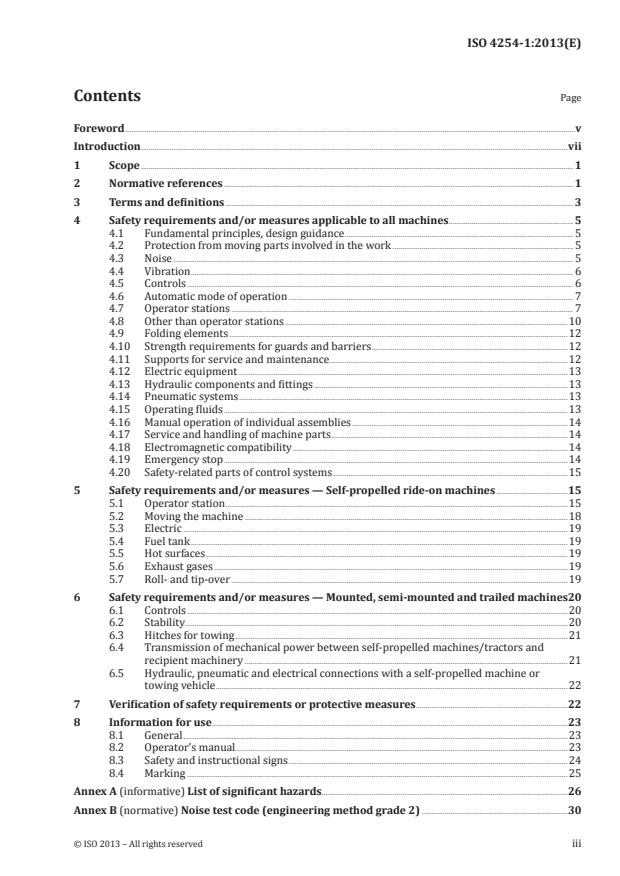
Contents Page
Foreword .v
Introduction .vii
1 Scope . 1
2 Normative references . 1
3 Terms and definitions . 3
4 Safety requirements and/or measures applicable to all machines.5
4.1 Fundamental principles, design guidance . 5
4.2 Protection from moving parts involved in the work . 5
4.3 Noise . 5
4.4 Vibration . 6
4.5 Controls . 6
4.6 Automatic mode of operation . 7
4.7 Operator stations . 7
4.8 Other than operator stations .10
4.9 Folding elements .12
4.10 Strength requirements for guards and barriers .12
4.11 Supports for service and maintenance.12
4.12 Electric equipment .13
4.13 Hydraulic components and fittings .13
4.14 Pneumatic systems .13
4.15 Operating fluids .13
4.16 Manual operation of individual assemblies .14
4.17 Service and handling of machine parts .14
4.18 Electromagnetic compatibility .14
4.19 Emergency stop .14
4.20 Safety-related parts of control systems .15
5 Safety requirements and/or measures — Self-propelled ride-on machines .15
5.1 Operator station .15
5.2 Moving the machine .18
5.3 Electric .19
5.4 Fuel tank .19
5.5 Hot surfaces .19
5.6 Exhaust gases .19
5.7 Roll- and tip-over .19
6 Safety requirements and/or measures — Mounted, semi-mounted and trailed machines 20
6.1 Controls .20
6.2 Stability .20
6.3 Hitches for towing .21
6.4 Transmission of mechanical power between self-propelled machines/tractors and
recipient machinery .21
6.5 Hydraulic, pneumatic and electrical connections with a self-propelled machine or
towing vehicle .22
7 Verification of safety requirements or protective measures .22
8 Information for use .23
8.1 General .23
8.2 Operator’s manual.23
8.3 Safety and instructional signs .24
8.4 Marking .25
Annex A (informative) List of significant hazards.26
Annex B (normative) Noise test code (engineering method grade 2) .30
Annex C (normative) Strength tests.34
Annex D (informative) Stability of tractor machine combinations .36
Bibliography .38
iv © ISO 2013 – All rights reserved
Foreword
ISO (the International Organization for Standardization) is a worldwide federation of national standards
bodies (ISO member bodies). The work of preparing International Standards is normally carried out
through ISO technical committees. Each member body interested in a subject for which a technical
committee has been established has the right to be represented on that committee. International
organizations, governmental and non-governmental, in liaison with ISO, also take part in the work.
ISO collaborates closely with the International Electrotechnical Commission (IEC) on all matters of
electrotechnical standardization.
The procedures used to develop this document and those intended for its further maintenance are
described in the ISO/IEC Directives, Part 1. In particular the different approval criteria needed for the
different types of ISO documents should be noted. This document was drafted in accordance with the
editorial rules of the ISO/IEC Directives, Part 2. www.iso.org/directives
Attention is drawn to the possibility that some of the elements of this document may be the subject of
patent rights. ISO shall not be held responsible for identifying any or all such patent rights. Details of
any patent rights identified during the development of the document will be in the Introduction and/or
on the ISO list of patent declarations received. www.iso.org/patents
Any trade name used in this document is information given for the convenience of users and does not
constitute an endorsement.
The committee responsible for this document is ISO/TC 23, Tractors and machinery for agriculture and
forestry, Subcommittee SC 3, Safety and comfort.
This fifth edition of ISO 4254-1 cancels and replaces the fourth edition (ISO 4254-1:2008), which has
been technically revised. In particular, requirements relating to the following have been introduced:
— vibrations;
— protection of moving parts;
— operation of machine parts;
— operating fluids;
— foldable barriers;
— PTO drive shaft guard clearance;
— emergency stop controls;
— safety related parts of control systems;
— roll-over and tip-over hazards.
ISO 4254 consists of the following parts, under the general title Agricultural machinery — Safety:
— Part 1: General requirements
— Part 5: Power-driven soil-working machines
— Part 6: Sprayers and liquid fertilizer distributors
— Part 7: Combine harvesters, forage harvesters and cotton harvesters
— Part 8: Solid fertilizer distributors
— Part 9: Seed drills
— Part 10: Rotary tedders and rakes
— Part 11: Pick-up balers
— Part 12: Rotary disc and drum mowers and flail mowers
— Part 13: Large rotary mowers
ISO 4254-2, Anhydrous ammonia applicators, has been withdrawn.
ISO 4254-3, Tractors, has been cancelled and replaced by ISO 26322 (all parts), Tractors for agriculture
and forestry — Safety.
ISO 4254-4, Tractors and machinery for agriculture and forestry — Technical means for providing safety —
Part 4: Forestry winches, has been cancelled and replaced by ISO 19472, Machinery for forestry —
Winches — Dimensions, performance and safety.
vi © ISO 2013 – All rights reserved
Introduction
This document is a type-C standard as stated in ISO 12100.
The machinery concerned and the extent to which hazards, hazardous situations and events are covered
are indicated in the scope of this document.
When requirements of this type-C standard are different from those which are stated in type-A or
type-B standards, the requirements of this type-C standard take precedence over the requirements of
the other standards for machines that have been designed and built according to the requirements of
this type-C standard.
INTERNATIONAL STANDARD ISO 4254-1:2013(E)
Agricultural machinery — Safety —
Part 1:
General requirements
1 Scope
This part of ISO 4254 specifies the safety requirements and the means of their verification for the design
and construction of self-propelled ride-on machines, mounted, semi-mounted and trailed machines used
in agriculture in order to deal with the hazards which are typical for most of the machines. In addition,
it specifies the type of information on safe working practices including information about residual risks
to be provided by the manufacturer.
This document deals with significant hazards, hazardous situations and events, as listed in Annex A,
relevant to this agricultural machinery when used as intended and under the conditions of misuse
foreseeable by the manufacturer during normal operation and service.
This part of ISO 4254 is not applicable to
— agricultural or forestry tractors,
— aircraft and air-cushion vehicles used in agriculture,
— lawn and garden equipment,
— machine-specific components or functions (e.g. working tools and/or processes).
This part of ISO 4254 is not applicable to hazards related to periodic service, machine conversion and
repairs intended to be carried out by professional service personnel, environmental hazards, road safety
(e.g. steering, braking), or to the power take-off (PTO) drive shaft; neither is it applicable to guards of
moving parts for power transmission except for strength requirements for guards and barriers.
This part of ISO 4254 is not applicable to machines which are manufactured before the date of its publication.
Not all of the hazards dealt with by this part of ISO 4254 are necessarily present on a particular machine.
A risk assessment should be carried out by the manufacturer to determine the hazards that are applicable
and any hazards in addition to those dealt with by this part or a relevant machine-specific part. The
requirements of a machine-specific part of ISO 4254 take precedence over the requirements of this part.
2 Normative references
The following referenced documents, in whole or in part, are normatively referenced in this document
and are indispensable for its application. For dated references, only the edition cited applies. For undated
references, the latest edition of the referenced document (including any amendments) applies.
ISO 3600:1996, Tractors, machinery for agriculture and forestry, powered lawn and garden equipment —
Operator’s manuals — Content and presentation
ISO 3744:2010, Acoustics — Determination of sound power levels and sound energy levels of noise sources
using sound pressure — Engineering methods for an essentially free field over a reflecting plane
ISO 3767-1:1998, Tractors, machinery for agriculture and forestry, powered lawn and garden equipment —
Symbols for operator controls and other displays — Part 1: Common symbols
ISO 3767-2:2008, Tractors, machinery for agriculture and forestry, powered lawn and garden equipment —
Symbols for operator controls and other displays — Part 2: Symbols for agricultural tractors and machinery
ISO 3776-1:2006, Tractors and machinery for agriculture — Seat belts — Part 1: Anchorage location requirements
ISO 3776-2:2013, Tractors and machinery for agriculture — Seat belts — Part 2: Anchorage strength requirements
ISO 3776-3:2009, Tractors and machinery for agriculture — Seat belts — Part 3: Requirements for assemblies
ISO 3795:1989, Road vehicles, and tractors and machinery for agriculture and forestry — Determination of
burning behaviour of interior materials
ISO 4253:1993, Agricultural tractors — Operator’s seating accommodation — Dimensions
ISO 4413:2010, Hydraulic fluid power — General rules and safety requirements for systems and their components
ISO 4414:2010, Pneumatic fluid power — General rules and safety requirements for systems and their components
ISO 5008:2002, Agricultural wheeled tractors and field machinery — Measurement of whole-body vibration
of the operator
ISO 5353:1995, Earth-moving machinery, and tractors and machinery for agriculture and forestry —
Seat index point
ISO 10975:2009, Tractors and machinery for agriculture — Auto-guidance systems for operator-controlled
tractors and self-propelled machines — Safety requirements
ISO 11201:2010, Acoustics — Noise emitted by machinery and equipment — Determination of emission
sound pressure levels at a work station and at other specified positions in an essentially free field over a
reflecting plane with negligible environmental corrections
ISO 11204:2010, Acoustics — Noise emitted by machinery and equipment — Determination of emission sound
pressure levels at a work station and at other specified positions applying accurate environmental corrections
ISO 11684:1995, Tractors, machinery for agriculture and forestry, powered lawn and garden equipment —
Safety signs and hazard pictorials — General principles
ISO/TR 11688-1:1995, Acoustics — Recommended practice for the design of low-noise machinery and
equipment — Part 1: Planning
ISO 12100:2010, Safety of machinery — General principles for design — Risk assessment and risk reduction
ISO 13849-1:2006, Safety of machinery — Safety-related parts of control systems — Part 1: General
principles for design
ISO 13849-2:2012, Safety of machinery — Safety-related parts of control systems — Part 2: Validation
ISO 13850:2006, Safety of machinery — Emergency stop — Principles for design
ISO 13857:2008, Safety of machinery — Safety distances to prevent hazard zones being reached by upper
and lower limbs
ISO 14982:1998, Agricultural and forestry machinery — Electromagnetic compatibility — Test methods
and acceptance criteria
ISO 15077:2008, Tractors and self-propelled machinery for agriculture — Operator controls — Actuating
forces, displacement, location and method of operation
ISO 16231-1:2013, Self-propelled agricultural machinery — Assessment of stability — Part 1: Principles
ISO 25119-1:2010, Tractors and machinery for agriculture and forestry — Safety-related parts of control
systems — Part 1: General principles for design and development
2 © ISO 2013 – All rights reserved
ISO 25119-2:2010, Tractors and machinery for agriculture and forestry — Safety-related parts of control
systems — Part 2: Concept phase
ISO 25119-3:2010, Tractors and machinery for agriculture and forestry — Safety-related parts of control
systems — Part 3: Series development, hardware and software
ISO 25119-4:2010, Tractors and machinery for agriculture and forestry — Safety-related parts of control
systems — Part 4: Production, operation, modification and supporting processes
3 Terms and definitions
For the purposes of this document, the terms and definitions given in ISO 12100 and the following apply.
3.1
normal operation
use of the machine for the purpose intended by the manufacturer by an operator familiar with the
machine characteristics and complying with the information for operation, and safe practices, as
specified by the manufacturer in the operator’s manual and by signs on the machine
Note 1 to entry: Normal operation includes the preparation and storage of the machine, such as
— mounting and dismounting,
— swinging components into work position and vice versa,
— adding or removing ballast and picking up and setting down attachments,
— filling substances and materials that are needed and consumed during the use of the machine (such as twine
spools, seed, fertilizers, water and plant protection products),
— the adjustment and setting of the machine, or the combination tractor–machine for the specific condition of
the field and/or the crop, and
— clearing of blockages in the crop flow or clearing accumulation of debris.
3.2
service
activities to be done as required and/or at regular intervals by an operator familiar with the machine
characteristics and complying with the information for service and safe practices, as specified by the
manufacturer in the operator’s manual and by signs on the machine, in order to maintain the proper
function of the machine
Note 1 to entry: Service includes activities such as fuelling, cleaning, washing, topping up fluid levels, greasing,
adjusting (e.g. belts and chains) and the replacement of consumable articles such as light bulbs and fast-wearing
parts (e.g. cutting elements).
3.3
three-point contact support
system which permits a person to simultaneously use two hands and a foot or two feet and one hand
when boarding, or dismounting from, a machine
3.4
inadvertent contact
unplanned exposure of a person to a hazard resulting from the person’s action during normal operation
and service of the machine
3.5
hand and foot reach
3.5.1
hand and foot reach
reach defined for hands by a sphere of 1 000 mm radius, centred on
the seat centreline, 60 mm in front of and 580 mm above the seat index point (SIP) as defined
in ISO 5353 and for feet by a hemisphere of 800 mm radius, centred on the seat centreline at
the front edge of the cushion and extending downwards, with the seat in its central position
See Figure 1.
Dimensions in millimetres
Key
1 SIP (seat index point)
a
Hemisphere radius (feet).
b
Sphere radius (hands).
Figure 1 — Hand and foot reach
3.5.2
hand and foot reach
reach defined for hands by those portions, lying within the cab, of a sphere of
1 000 mm radius, centred on the seat centreline, 60 mm in front of and 580 mm above the seat index
point (SIP) as defined in ISO 5353, and for feet by those portions, lying within the cab, of a hemisphere of
800 mm radius centred on the seat centreline at the front edge of the cushion and extending downwards,
with the seat in its central position
3.6
normal access
access for operators for process control and adjusting, during normal operation or service, according to
the intended use of the machine
3.7
automatic mode
machine function that consists of either repetitive work cycles or a single work cycle that, once initiated by
the intentional actuation of a control by the operator or by the machine itself, either repeats a cycle or comes
to stop at the completion of a cycle without operator intervention as a part of normal machine operation
4 © ISO 2013 – All rights reserved
3.8
work cycle
series of machine-functional events that recur in succession and that either lead back to the starting
point (e.g. a bale knotter system) or come to a predetermined stopping point (e.g. folding or unfolding of
an implement wing)
3.9
stationary operation
application of the machine while the machine is not travelling in any direction as the equipment
performs its function
4 Safety requirements and/or measures applicable to all machines
4.1 Fundamental principles, design guidance
4.1.1 The machinery shall comply with the safety requirements and/or protective measures of Clauses 4
and 5 or 6. In addition, the machinery shall be designed according to the principles of ISO 12100:2010 for
relevant but not significant hazards, which are not dealt with by this document.
Not all of the hazards dealt with by this part of ISO 4254 are necessarily present on a particular
machine. A risk assessment should be carried out by the manufacturer to determine the hazards that
are applicable and any hazards in addition to those dealt with by this part or a relevant machine-specific
part. The manufacturer is responsible for the specification and provision of safety measures to deal
with additional hazards. The requirements of a machine-specific part of ISO 4254 take precedence over
the requirements of this part.
4.1.2 Unless otherwise specified in this part of ISO 4254, safety distances shall comply with the
requirements given in ISO 13857:2008, Table 1, 3, 4 or 6, as appropriate.
4.1.3 Functional components which need to be exposed for proper function, drainage or cleaning shall
be guarded without causing other hazards, for example risk of fire due to the accumulation of organic
material during the intended use, and without interfering with the proper function, drainage or cleaning.
4.2 Protection from moving parts involved in the work
Within the intended use and reasonably foreseeable misuse of the machine, if guards cannot be used
to prevent inadvertent contact with moving parts involved in the machine’s work process, then other
appropriate measures to prevent inadvertent contact shall be provided.
During the risk assessment process selection of such appropriate measures shall take into consideration
the strategies for risk reduction specified in ISO 12100:2010, and shall consider both normal operation
and service operations as specified in the operator’s manual.
An example of an appropriate measure is safety distance guarding through the use of a barrier.
4.3 Noise
4.3.1 The technical information given in ISO/TR 11688-1 shall be used as means to design low-
noise machinery.
[3]
NOTE 1 ISO/TR 11688-2 (see Reference ) also gives useful information on noise-generation mechanisms
in machinery.
NOTE 2 Noise generation can vary considerably between machinery types. Noise reduction measures are
therefore dealt with in product-specific standards.
4.3.2 Noise emission values, if required to be declared, shall be determined in accordance with Annex B.
4.4 Vibration
4.4.1 If vibration emission values are required to be declared, then the weighted root-mean-square
acceleration value and the measuring method shall be determined according to
— ISO 5008:2002,
— a relevant machine-specific part to this standard, or
— a measuring method that shall be described in the operator’s manual.
Vibration measurements are unnecessary for machines that do not require a ride-on operator.
4.4.2 Mechanical vibrations are caused by the unevenness of the travelling surface and the unbalanced
movement of machine-related components such as engine, gearbox, drives and working tools. Technical
measures for the reduction of vibrations are, for example, isolators, dampening or suspension systems.
As the origin of vibrations depends on the machine type and the individual design, detailed specifications
for vibration reduction measures are specified by the machine-specific parts of ISO 4254.
4.5 Controls
4.5.1 The function of control devices and their different positions shall be identified at the operating
position and explained in the operator’s manual [see 8.2.3 d)]. Symbols shall be in accordance with
ISO 3767-1:1998 and ISO 3767-2:2008.
4.5.2 Pedals shall have a slip-resistant surface and be easy to clean.
4.5.3 Hand-operated controls requiring an actuating force ≥ 100 N shall have a minimum clearance,
a, of 50 mm between the outer contours or from adjacent parts of the machine (see Figure 2). Controls
requiring an actuating force < 100 N shall have a minimum clearance of 25 mm. This requirement does
not apply to fingertip operation controls (e.g. push-buttons, electric switches).
4.5.4 For requirements pertaining to machine-specific controls, see the relevant part(s) of ISO 4254.
Key
1 hand-operated control
2 adjacent part
a minimum clearance
Figure 2 — Clearance around hand-operated controls
4.5.5 Unless specified otherwise in 4.5.3 and 4.9.1, actuating forces, displacement, location and the
method of operation shall be in accordance with ISO 15077:2008.
6 © ISO 2013 – All rights reserved
4.5.6 Controls shall be located outside the hazard zones. This requirement is also applicable to
machine components (e.g. hydraulic valves) which need to be manually operated or controlled in case of
malfunction of the primary control system.
4.6 Automatic mode of operation
Machinery functioning in automatic mode shall bring itself automatically to a safe state when the
work cycle is involuntarily stopped or interrupted (e.g. blockage, overload, malfunction). Following an
involuntary stop or interruption, a re-start of the work cycle shall be possible only after an intentional
actuation of a control located outside the hazard zone.
4.7 Operator stations
4.7.1 Boarding means
4.7.1.1 General
4.7.1.1.1 If the vertical height of the operator station floor above ground level exceeds 550 mm,
measured on level ground and with the specified tyres with the maximum diameter at specified inflation
pressure [see 8.2.3 w)], or specified tracks, a boarding means shall be provided. The dimensions shall be
as shown in Figure 3.
4.7.1.1.2 Whenever the boarding means is located directly in line and forward of a wheel or track (i.e.
within the track of the machine), provision shall be made for a guardrail to be located on the wheel or
track side. This does not apply when the machine is in the transport configuration.
Shielding shall be provided on the back of steps or ladders whenever a protruding hand or foot can
contact a hazardous part of the machine, e.g. wheel.
4.7.1.2 Steps and ladders
4.7.1.2.1 The height of the first step shall be achieved with the specified tyres and with the maximum
diameter at specified inflation pressure [see 8.2.3 w)]. The vertical distance between successive steps
shall be equal within a tolerance of ± 20 mm. Each step shall have a slip-resistant surface, a lateral stop
at each end and be so designed (e.g. mudguards, perforated steps) that an accumulation of mud and/or
snow is minimized under normal work conditions.
A flexible connection(s) between the first and second steps is permitted.
4.7.1.2.2 Dimensions for ladders and steps used as boarding means for operator stations shall be in
accordance with Table 1 and Figure 3.
Table 1 — Dimensions for boarding means for operator stations
Ladders Steps
α 70° to 90° 20° to 70°
A + D min 150 150
B max 300 300
C min 120 120
D min 50 150
2B + G max - 800
W min 300 300
Dimensions in millimetres
Key
A toe clearance
B vertical distance between tread surface of successive steps
C minimum clearance between successive steps
D tread depth
G horizontal distance between leading edge of successive steps
W width of step or rung
α angle of inclination
Figure 3 — Dimensions of boarding means for operator stations
4.7.1.2.3 If parts of the boarding means are moveable, the operating force shall not exceed 200 N as the
average value when moving from the start position to the stop position. The peak(s) shall not exceed 400 N.
4.7.1.2.4 When moving the boarding means, there shall be no shearing, pinching or uncontrollable
movement hazards to the operator.
4.7.1.2.5 Where, on tracked machines, the track shoes and track pad surfaces are intended to be used
as access steps, three-point contact support shall be provided to ensure safe boarding for the operator.
4.7.1.3 Handrails/handhold
4.7.1.3.1 Handrails or handholds shall be provided on both sides of the boarding means and shall
be so designed that the operator can maintain three-point contact support at all times. The width of
the handrail/handhold cross section shall be between 25 mm and 38 mm. The lower end of the
handrail/handhold shall be located no higher than 1 500 mm from the ground surface. A minimum
clearance of 50 mm shall be provided for hand clearance between the handrail/handhold and the adjacent
parts except at attaching points.
4.7.1.3.2 A handrail/handhold shall be provided above the uppermost step/rung of the boarding means
at a height between 850 mm and 1 100 mm above the uppermost step/rung. The handhold shall be at
least 150 mm long.
4.7.2 Platforms
4.7.2.1 Platforms shall be flat and have a slip-resistant surface and, if necessary, provision for drainage.
8 © ISO 2013 – All rights reserved
4.7.2.2 Platforms — except those only used when the machine is stationary and which are less than
1 000 mm above the ground — shall be equipped with a foot guard, hand rail and intermediate rail around
the edge of the platform with the dimensions shown in Figure 4. No foot guard shall be provided at the
entrance of the platform.
In addition, if static machine components are used as a foot guard, handrail and/or intermediate rail, the
requirements given in 4.7.1.3.1 and 4.7.1.3.2 shall be fulfilled.
Dimensions in millimetres
Key
r radius 50 mm max
1 platform
2 foot guard
3 intermediate rail
4 handrail
Figure 4 — Platform foot guard and hand rail
4.7.2.3 If the boarding means of platforms and cabs are made movable for transport purposes, provision
shall be made for railing off access to the platform or cab. For cabs equipped with a door, the cab door
satisfies this requirement.
4.7.3 Operator seat
Machines shall be provided with a seat for each ride-on driver and operator.
When for technical reasons or due to the function, the driver or operator needs to stand upright on
the machine, this exemption and relevant specific hazards may be dealt with in the machine-specific
standard of the machine concerned.
4.8 Other than operator stations
4.8.1 General
Service locations that are more than 2 000 mm above the ground, or 1 500 mm for those locations involving
filling or topping up of fluids or bulk materials, shall be provided with a suitable place for the operator to
stand and, if the place to stand is more than 550 mm above the ground, with a boarding means.
4.8.2 Place to stand
4.8.2.1 A place provided for standing shall have sufficient space for both of the operator’s feet, be flat
and have a slip-resistant surface. Depending on the machine configuration, it may consist of two separate
surfaces and may use machine components. It shall be positioned so the operator can maintain stability
while carrying out the service required and be on the same height level with a tolerance of ± 50 mm.
4.8.2.2 Handhold(s) and/or railings shall be provided in order to allow three-point contact. Parts of the
machine can be considered to fulfil this requirement.
4.8.2.3 When access is needed above or next to the PTO (power take-off) drive shaft, an adequate place
to stand and boarding means shall be provided in order to eliminate the need to use the PTO drive shaft
or its guard as a step or a place to stand.
4.8.3 Boarding means
4.8.3.1 If the place to stand for service is more than 550 mm above the ground (or the operator
platform), a boarding means shall be provided.
4.8.3.2 Boarding means shall be provided with foot supports (e.g. rungs or steps) and handholds.
If static machine components are used as foot supports and/or handholds, the requirements given in
4.7.1.2.1 and 4.7.1.3.1 and 4.7.1.3.2 shall be fulfilled.
4.8.3.3 Boarding means shall comprise a series of steps as shown in Figure 5 and shall be in accordance
with a) or b) or c) as follows.
a) The inclination α shall be between 70° and 90° from the horizontal (see Figure 5). Each step shall
have a slip-resistant surface, a lateral stop at each end and be so designed that any accumulation
of mud and/or snow is minimized in the normal conditions of work. The vertical and horizontal
distance between successive steps shall be within a tolerance of ± 20 mm.
b) The boarding means shall be a ladder. The top side of each rung shall have a horizontal slip-resistant
surface at least 30 mm from front to back. If rungs can be used as handholds, then rectangular
section rungs shall have corner radii ≥ 5 mm.
10 © ISO 2013 – All rights reserved
c) The boarding means shall be in accordance with 4.7.1.2.
4.8.3.4 If boarding means are located such that there is the hazard of inadvertent contact with the PTO
drive shaft guard or PIC guard by reaching through the boarding means with foot or hand, shielding shall
be provided on the rear of the boarding means.
4.8.3.5 By design, PTO drive shafts and their guards shall not be considered as steps.
Dimensions in millimetres
Key
1 place to stand
2 step
3 ladder
4 rung
Figure 5 — Dimensions of boarding means for other than operator stations
4.9 Folding elements
4.9.1 Handle(s) located at least 300 mm from the nearest articulation shall be provided for manually
folding/unfolding elements. The handle(s) may be integral parts of the machine provided they are suitably
designed and clearly identified. The force required for the manual folding/unfolding processes shall not
exceed 250 N as an average value when moving from the start to the stop position. The peak(s) shall not
exceed 400 N. There shall be no shearing, pinching or uncontrollable movement hazards to the operator
during folding/unfolding.
4.9.2 Folded elements designed to reduce transport width and/or height shall have a means of retention
in the transport position, either a positive mechanical lock or by other means (e.g. hydraulically, gravity).
The means of retention shall be sufficient to retain the folded element in the transport position during
travel. The change from transport position to working position and vice versa shall be possible without
exposing the operator to crushing and pinching.
In the case of mechanical or hydraulic locking devices, the unlocking and unfolding of the elements shall
be controlled by means of separate actions by the operator.
4.9.3 Barriers which exceed the transport width may be folded from the functional/protection position
into a transport position. If folding of the barrier(s) exposes hazards, caused by working tools, operation
of the hazardous components shall be prevented with the barrier(s) folded (for example by reducing the
function or performance of the machine component in this situation).
4.10 Strength requirements for guards and barriers
4.10.1 Guards and barriers, and in particular barriers with a vertical height from the ground of up to
550 mm, whose use as access steps during normal use is not intended by the manufacturer but cannot be
prevented, shall be designed so that they can withstand a vertical load of 1 200 N. Conformance with this
requirement shall be checked using the test given in Annex C or an equivalent method which fulfils the
same test acceptance criteria.
4.10.2 Barriers used as protection against hazards related to moving working parts shall withstand the
following horizontal loads:
— 1 000 N, up to 400 mm from the ground in the working position;
— 600 N, above 400 mm from the ground in the working position.
Conformance with these requirements shall be checked using the test given in Annex C or an
equivalent method.
4.11 Supports for service and maintenance
4.11.1 General
4.11.1.1 When it is necessary for the operator to work under raised parts of the machine in order to
carry out maintenance or service, mechanical supports or hydraulic locking devices shall be provided to
prevent inadvertent lowering.
Means other than mechanical or hydraulic devices are acceptable, provided an equal or greater level of
safety is ensured.
4.11.1.2 It shall be possible to engage and release hydraulic locking devices, mechanical supports and
other forms of support from outside the hazard zones.
12 © ISO 2013 – All rights reserved
4.11.1.3 Mechanical supports and hydraulic locking devices shall be identified by use of a colour that contrasts
with the overall machine colour or by a safety sign located either on, or in close proximity to, the device.
4.11.1.4 When the supports or hydraulic devices are controlled manually, their method of operation
shall be explained in the operator’s manual [see 8.2.3 k)] and, if such operation is not intuitive, on the
machine itself using either a safety or informational sign.
4.11.2 Mechanical supports
4.11.2.1 Mechanical supporting devices shall withstand a load of 1,5 times the maximum static load to
be supported.
4.11.2.2 Detachable mechanical supports shall be retained in position on the machine. If this is not
practicable, they shall have a dedicated and clearly visible and identifiable storage position on the machine
allowing the safe storage of the support.
4.11.3 Hydraulic locking devices
Hydraulic locking devices shall be located on the hydraulic cylinder or connected to the hydraulic cylinder
by rigid or flexible lines. In the latter case, the lines connecting the locking device to the hydraulic cylinder
shall be designed to withstand a pressure at least four times the rated maximum hydraulic pressure.
This rated maximum hydraulic pressure shall be specified in the operator’s manual. The conditions for
the replacement of such flexible lines shall also be given in the operator’s manual [see 8.2.3 l)].
Inadvertently unlocking shall be avoided by design, location, etc. of the control.
4.12 Electric equipment
4.12.1 Electrical cables shall be protected if located in potentially abrasive contact with surfaces and
shall be resistant to, or protected against, contact with lubricant or fuel. Electrical cables shall be located
so that no portion is in contact with the exhaust system, moving parts or sharp
...
NORME ISO
INTERNATIONALE 4254-1
Cinquième édition
2013-05-01
Matériel agricole — Sécurité —
Partie 1:
Exigences générales
Agricultural machinery — Safety —
Part 1: General requirements
Numéro de référence
©
ISO 2013
DOCUMENT PROTÉGÉ PAR COPYRIGHT
© ISO 2013
Droits de reproduction réservés. Sauf indication contraire, aucune partie de cette publication ne peut être reproduite ni utilisée
sous quelque forme que ce soit et par aucun procédé, électronique ou mécanique, y compris la photocopie, l’affichage sur
l’internet ou sur un Intranet, sans autorisation écrite préalable. Les demandes d’autorisation peuvent être adressées à l’ISO à
l’adresse ci-après ou au comité membre de l’ISO dans le pays du demandeur.
ISO copyright office
Case postale 56 • CH-1211 Geneva 20
Tel. + 41 22 749 01 11
Fax + 41 22 749 09 47
E-mail copyright@iso.org
Web www.iso.org
Publié en Suisse
ii © ISO 2013 – Tous droits réservés
Sommaire Page
Avant-propos .v
Introduction .vii
1 Domaine d’application . 1
2 Références normatives . 1
3 Termes et définitions . 3
4 Exigences et/ou mesures de sécurité applicables à toutes les machines .5
4.1 Principes fondamentaux, guide de conception . 5
4.2 Protection des éléments mobiles concourant au travail . 5
4.3 Bruit . 6
4.4 Vibrations . 6
4.5 Commandes . 6
4.6 Mode de fonctionnement automatique. 7
4.7 Poste de l’opérateur . 7
4.8 Autres emplacements que le poste de l’opérateur .10
4.9 Éléments repliables.12
4.10 Exigences de résistance des protecteurs et des barres d’éloignement .13
4.11 Supports pour l’entretien et la maintenance .13
4.12 Équipement électrique .14
4.13 Composants et accessoires hydrauliques .14
4.14 Circuits pneumatiques .14
4.15 Liquides de service .14
4.16 Actionnement manuel d’éléments de machines .15
4.17 Entretien et manutention des parties de la machine .15
4.18 Compatibilité électromagnétique .15
4.19 Arrêt d’urgence .15
4.20 Parties des systèmes de commande relatives à la sécurité .16
5 Exigences et/ou mesures de sécurité — Machines automotrices à conducteur porté .16
5.1 Poste de l’opérateur .16
5.2 Déplacement de la machine .19
5.3 Alimentation électrique .20
5.4 Réservoir de carburant .20
5.5 Surfaces chaudes .20
5.6 Gaz d’échappement .21
5.7 Retournement et basculement .21
6 Exigences et/ou mesures de sécurité — Machines portées, semi-portées et traînées .21
6.1 Commandes .21
6.2 Stabilité .21
6.3 Attelages pour le remorquage .22
6.4 Transmission de puissance mécanique entre des machines automotrices/tracteurs et une
machine réceptrice .23
6.5 Liaisons hydrauliques, pneumatiques et électriques avec une machine automotrice ou
véhicule tracteur .23
7 Vérifications des exigences de sécurité ou des mesures de protection .24
8 Informations pour l’utilisation .25
8.1 Généralités .25
8.2 Manuel de l’opérateur .25
8.3 Signaux de sécurité et d’information .26
8.4 Marquage .26
Annexe A (informative) Liste des phénomènes dangereux significatifs .28
Annexe B (normative) Code d’essai acoustique (méthode d’expertise de classe 2) .33
Annexe C (normative) Essais de résistance .37
Annexe D (informative) Stabilité des combinaisons tracteur-machine .39
Bibliographie .41
iv © ISO 2013 – Tous droits réservés
Avant-propos
L’ISO (Organisation internationale de normalisation) est une fédération mondiale d’organismes
nationaux de normalisation (comités membres de l’ISO). L’élaboration des Normes internationales est
en général confiée aux comités techniques de l’ISO. Chaque comité membre intéressé par une étude
a le droit de faire partie du comité technique créé à cet effet. Les organisations internationales,
gouvernementales et non gouvernementales, en liaison avec l’ISO participent également aux travaux.
L’ISO collabore étroitement avec la Commission électrotechnique internationale (CEI) en ce qui concerne
la normalisation électrotechnique.
Les procédures utilisées pour élaborer le présent document et celles destinées à sa mise à jour sont
décrites dans les Directives ISO/CEI, Partie 1. Il convient, en particulier de prendre note des différents
critères d’approbation requis pour les différents types de documents ISO. Le présent document a été
rédigé conformément aux règles de rédaction données dans les Directives ISO/CEI, Partie 2, www.iso.
org/directives.
L’attention est appelée sur le fait que certains des éléments du présent document peuvent faire l’objet de
droits de propriété intellectuelle ou de droits analogues. L’ISO ne saurait être tenue pour responsable
de ne pas avoir identifié de tels droits de propriété et averti de leur existence. Les détails concernant les
références aux droits de propriété intellectuelle ou autres droits analogues identifiés lors de l’élaboration
du document sont indiqués dans l’Introduction et/ou sur la liste ISO des déclarations de brevets reçues,
www.iso.org/patents.
Les éventuelles appellations commerciales utilisées dans le présent document sont données pour
information à l’intention des utilisateurs et ne constituent pas une approbation ou une recommandation.
Le comité chargé de l’élaboration du présent document est l’ISO/TC 23, Tracteurs et matériels agricoles et
forestiers, sous-comité SC 3, Sécurité et confort.
Cette cinquième édition annule et remplace la quatrième édition (ISO 4254-1:2008), qui a fait l’objet
d’une révision technique. En particulier, des exigences ont été ajoutées concernant ce qui suit:
— vibrations;
— protection des parties mobiles;
— fonctionnement des parties de la machine;
— liquides de service;
— barres d’éloignement repliables;
— dégagement du protecteur de l’arbre de transmission à cardans de prise de force;
— commandes d’arrêt d’urgence;
— parties des systèmes de commande relatives à la sécurité;
— risques de retournement et de basculement.
L’ISO 4254 comprend les parties suivantes, présentées sous le titre général Matériel agricole — Sécurité:
— Partie 1: Exigences générales
— Partie 5: Machines de travail du sol à outils animés
— Partie 6: Pulvérisateurs et distributeurs d’engrais liquides
— Partie 7: Moissonneuses-batteuses, récolteuses-hacheuses-chargeuses de fourrage et récolteuses de coton
— Partie 8: Distributeurs d’engrais solides
— Partie 9: Semoirs
— Partie 10: Faneuses et andaineuses rotatives
— Partie 11: Ramasseuses-presses
— Partie 12: Faucheuses rotatives à disques, faucheuses rotatives à tambours et faucheuses-broyeuses
— Partie 13: Grandes faucheuses rotatives
L’ISO 4254-2, Applicateurs d’ammoniac anhydre, a été annulée.
L’ISO 4254-3, Tracteurs, a été annulée et remplacée par l’ISO 26322 (toutes les parties), Tracteurs agricoles
et forestiers — Sécurité.
L’ISO 4254-4, Tracteurs et matériels agricoles et forestiers — Dispositifs techniques permettant d’assurer
la sécurité — Partie 4:Treuils pour matériel forestier et de sylviculture, a été annulée et remplacée par
l’ISO 19472, Matériel forestier — Treuils — Dimensions, performance et sécurité.
vi © ISO 2013 – Tous droits réservés
Introduction
Le présent document est une norme de type C telle que définie dans l’ISO 12100.
Les machines concernées et l’étendue des phénomènes dangereux, des situations dangereuses et des
événements dangereux couverts sont indiqués dans le domaine d’application du présent document.
Lorsque des dispositions de la présente norme de type C sont différentes de celles mentionnées dans
des normes de type A ou B, les dispositions de la présente norme de type C prennent le pas sur celles des
autres normes, pour les machines conçues et fabriquées conformément aux dispositions de la présente
norme de type C.
NORME INTERNATIONALE ISO 4254-1:2013(F)
Matériel agricole — Sécurité —
Partie 1:
Exigences générales
1 Domaine d’application
La présente partie de l’ISO 4254 spécifie les exigences de sécurité et les moyens pour leur vérification pour
la conception et la construction des machines automotrices, portées, semi-portées et traînées utilisées
en agriculture afin de traiter des phénomènes dangereux typiques pour la plupart des machines. En
outre, elle spécifie le type d’informations sur les pratiques d’utilisation sûre, y compris les informations
relatives aux risques résiduels que le fabricant doit donner.
Le présent document traite de tous les phénomènes dangereux, des situations et des événements
dangereux significatifs, tels que listés dans l’Annexe A, applicables aux matériels agricoles lorsqu’ils
sont utilisés normalement et dans les conditions de mauvais usage prévisibles par le fabricant pendant
le fonctionnement normal et l’entretien.
La présente partie de l’ISO 4254 n’est pas applicable
— aux tracteurs agricoles ou forestiers,
— aux aéronefs et aux véhicules sur coussin d’air utilisés en agriculture,
— aux matériels de jardinage ou horticole, et
— aux composants ou fonctions spécifiques des machines (par exemple outils de travail et/ou processus).
La présente partie de l’ISO 4254 ne couvre pas les phénomènes dangereux liés à l’entretien périodique,
à la modification et aux réparations prévus pour être réalisés par des professionnels de l’entretien, à
l’environnement, à la sécurité routière (par exemple direction, freinage), ni aux arbres de transmission
à cardans de prise de force; elle n’est pas non plus applicable aux protecteurs des parties mobiles de
transmission de puissance, exception faite des exigences de résistance des protecteurs et des barres
d’éloignement.
La présente partie de l’ISO 4254 ne s’applique pas aux machines fabriquées avant sa date de publication.
Les phénomènes dangereux couverts par la présente partie de l’ISO 4254 ne sont pas nécessairement
tous présents sur une machine spécifique. Il convient que le fabriquant effectue une évaluation du risque
pour déterminer les phénomènes dangereux qui sont applicables et tout phénomène dangereux en
supplément de ceux traités par la présente partie, ou par une partie spécifique applicable. Les exigences
d’une partie de l’ISO 4254 spécifique à une machine prennent le pas sur celles de la présente partie.
2 Références normatives
Les documents suivants, en totalité ou en partie, sont référencés de manière normative dans le présent
document et sont indispensables pour son application. Pour les références datées, seule l’édition citée
s’applique. Pour les références non datées, la dernière édition du document de référence s’applique (y
compris les éventuels amendements).
ISO 3600:1996, Tracteurs, matériels agricoles et forestiers, matériel à moteur pour jardins et pelouses —
Manuels d’utilisation — Contenu et présentation
ISO 3744:2010, Acoustique — Détermination des niveaux de puissance acoustique et des niveaux d’énergie
acoustique émis par les sources de bruit à partir de la pression acoustique — Méthodes d’expertise pour des
conditions approchant celles du champ libre sur plan réfléchissant
ISO 3767-1:1998, Tracteurs, matériels agricoles et forestiers, matériel à moteur pour jardins et pelouses —
Symboles pour les commandes de l’opérateur et autres indications — Partie 1: Symboles communs
ISO 3767-2:2008, Tracteurs, matériels agricoles et forestiers, matériel à moteur pour jardins et pelouses —
Symboles pour les commandes de l’opérateur et autres indications — Partie 2: Symboles pour tracteurs et
machines agricoles
ISO 3776-1:2006, Tracteurs et matériels agricoles — Ceintures de sécurité — Partie 1: Exigences relatives
à l’emplacement des ancrages
ISO 3776-2:2013, Tracteurs et matériels agricoles — Ceintures de sécurité — Partie 2: Exigences relatives
à la résistance des ancrages
ISO 3776-3:2009, Tracteurs et matériels agricoles — Ceintures de sécurité — Partie 3: Exigences relatives
aux assemblages
ISO 3795:1989, Véhicules routiers et tracteurs et matériels agricoles et forestiers — Détermination des
caractéristiques de combustion des matériaux intérieurs
ISO 4253:1993, Tracteurs agricoles — Poste de conduite pour conducteur assis — Dimensions
ISO 4413:2010, Transmissions hydrauliques — Règles générales et exigences de sécurité relatives aux
systèmes et leurs composants
ISO 4414:2010, Transmissions pneumatiques — Règles générales et exigences de sécurité pour les systèmes
et leurs composants
ISO 5008:2002, Tracteurs et matériels agricoles à roues — Mesurage des vibrations globales du corps
du conducteur
ISO 5353:1995, Engins de terrassement, et tracteurs et matériels agricoles et forestiers — Point repère du siège
ISO 10975:2009, Tracteurs et matériels agricoles — Systèmes d’autoguidage pour tracteurs commandés
par opérateur et pour machines automotrices — Exigences de sécurité
ISO 11201:2010, Acoustique — Bruit émis par les machines et équipements — Détermination des niveaux
de pression acoustique d’émission au poste de travail et en d’autres positions spécifiées dans des conditions
approchant celles du champ libre sur plan réfléchissant avec des corrections d’environnement négligeables
ISO 11204:2010, Acoustique — Bruit émis par les machines et équipements — Détermination des niveaux
de pression acoustique d’émission au poste de travail et en d’autres positions spécifiées en appliquant des
corrections d’environnement exactes
ISO 11684:1995, Tracteurs et matériels agricoles et forestiers, matériels à moteur pour jardins et pelouses —
Signaux de sécurité et de danger — Principes généraux
ISO/TR 11688-1:1995, Acoustique — Pratique recommandée pour la conception de machines et
d’équipements à bruit réduit — Partie 1: Planification
ISO 12100:2010, Sécurité des machines — Principes généraux de conception — Appréciation du risque et
réduction du risque
ISO 13849-1:2006, Sécurité des machines — Parties des systèmes de commande relatives à la sécurité —
Partie 1: Principes généraux de conception
ISO 13849-2:2012, Sécurité des machines — Parties des systèmes de commande relatives à la sécurité —
Partie 2: Validation
ISO 13850:2006, Sécurité des machines — Arrêt d’urgence — Principes de conception
2 © ISO 2013 – Tous droits réservés
ISO 13857:2008, Sécurité des machines — Distances de sécurité empêchant les membres supérieurs et
inférieurs d’atteindre les zones dangereuses
ISO 14982:1998, Machines agricoles et forestières — Compatibilité électromagnétique — Méthodes d’essai
et critères d’acceptation
ISO 15077:2008, Tracteurs et machines agricoles automotrices — Commandes de l’opérateur — Forces de
manœuvre, déplacements, emplacements et modes de fonctionnement
ISO 16231-1:2013, Machines agricoles automotrices — Évaluation de la stabilité — Partie 1: Principes
ISO 25119-1:2010, Tracteurs et matériels agricoles et forestiers — Parties des systèmes de commande
relatives à la sécurité — Partie 1: Principes généraux pour la conception et le développement
ISO 25119-2:2010, Tracteurs et matériels agricoles et forestiers — Parties des systèmes de commande
relatives à la sécurité — Partie 2: Phase de projet
ISO 25119-3:2010, Tracteurs et matériels agricoles et forestiers — Parties des systèmes de commande
relatives à la sécurité — Partie 3: Développement en série, matériels et logiciels
ISO 25119-4:2010, Tracteurs et matériels agricoles et forestiers — Parties des systèmes de commande
relatives à la sécurité — Partie 4: Procédés de production, de fonctionnement, de modification et d’entretien
3 Termes et définitions
Pour les besoins du présent document, les termes et définitions donnés dans l’ISO 12100 ainsi que les
suivants s’appliquent.
3.1
fonctionnement normal
utilisation de la machine, pour le besoin prévu par le fabricant, par un opérateur familier avec les
caractéristiques de la machine et satisfaisant aux informations en ce qui concerne le fonctionnement
et les pratiques sûres, telles que spécifiées par le fabricant dans le manuel de l’opérateur et à l’aide de
signaux sur la machine
Note 1 à l’article: Le fonctionnement normal inclut la préparation et le remisage de la machine, tels que
— l’attelage et la dépose,
— le pivotement de composants en position de travail et vice-versa,
— l’ajout ou le retrait de lestage et l’attelage et la dépose des accessoires,
— le remplissage de substances et de matériaux nécessaires et consommés pendant l’utilisation de la machine
(tels que bobines de ficelle, semence, engrais, eau et produits phytosanitaires),
— le réglage et le paramétrage de la machine ou de la combinaison tracteur-machine pour la condition spécifique
du champ et/ou de la culture, et
— la suppression des bourrages dans le flux de fourrage ou la suppression de l’accumulation de débris.
3.2
entretien
activités devant être effectuées lorsque cela est nécessaire et/ou à des intervalles réguliers par un
opérateur familier avec les caractéristiques de la machine et satisfaisant aux informations en ce qui
concerne l’entretien et les pratiques sûres, telles que spécifiées par le fabricant dans le manuel de
l’opérateur et à l’aide de signaux sur la machine, afin de maintenir le bon fonctionnement de la machine
Note 1 à l’article: L’entretien comprend des activités telles que l’approvisionnement en carburant, le nettoyage,
le lavage, la mise à niveau des liquides, le graissage, le réglage (par exemple des courroies et des chaînes) et le
remplacement des articles consommables tels que les ampoules et les pièces qui s’usent rapidement (par exemple
les éléments de coupe).
3.3
support à trois points de contact
système permettant à une personne d’utiliser simultanément deux mains et un pied ou deux pieds et
une main lors de la montée, ou de la descente, d’une machine
3.4
contact par inadvertance
exposition non prévue d’une personne à un phénomène dangereux suite à une intervention de ladite
personne pendant le fonctionnement normal et l’entretien de la machine
3.5
zone d’atteinte des mains et des pieds
3.5.1
zone d’atteinte des mains et des pieds
zone définie, pour les mains, par une sphère de rayon égal à 1 000 mm,
dont le centre est situé sur l’axe longitudinal du siège, à 60 mm en avant et à 580 mm au-dessus du
point repère du siège (SIP), tel que défini dans l’ISO 5353 et, pour les pieds, par un hémisphère
de rayon égal à 800 mm, dont le centre est situé sur l’axe longitudinal du siège au niveau du
bord avant du coussin et se prolongeant vers le bas, lorsque le siège est dans la position centrale
Voir la Figure 1.
Dimensions en millimètres
Légende
1 SIP (point de repère du siège)
a
Rayon de l’hémisphère (pieds).
b Rayon de l’hémisphère (mains).
Figure 1 — Zone d’atteinte des mains et des pieds
3.5.2
zone d’atteinte des mains et des pieds
zone définie, pour les mains, par les portions, au sein de la cabine, d’une
sphère de rayon égal à 1 000 mm, dont le centre est situé sur l’axe longitudinal du siège, à 60 mm en
avant et à 580 mm au-dessus du point repère du siège (SIP), tel que défini dans l’ISO 5353, et, pour les
pieds, par les portions, au sein de la cabine, d’un hémisphère de rayon égal à 800 mm, dont le centre est
situé sur l’axe longitudinal du siège au niveau du bord avant du coussin et se prolongeant vers le bas,
lorsque le siège est dans la position centrale
4 © ISO 2013 – Tous droits réservés
3.6
accès normal
accès pour les opérateurs afin d’assurer les tâches de contrôle et de réglage, pendant le fonctionnement
normal ou l’entretien selon l’utilisation prévue de la machine
3.7
mode automatique
fonction de la machine constituée de cycles de travail répétitifs ou d’un cycle de travail unique qui, une
fois démarré par l’actionnement intentionnel d’une commande par l’opérateur ou par la machine elle-
même, répète un cycle ou s’arrête à la fin d’un cycle sans intervention de l’opérateur dans le cadre du
fonctionnement normal de la machine
3.8
cycle de travail
série d’événements fonctionnels de la machine qui se répètent et qui retournent au point de départ (par
exemple un système de nouage de balles) ou s’arrêtent à un point d’arrêt prédéterminé (par exemple
pliage ou dépliage du bras d’une machine)
3.9
fonctionnement en mode stationnaire
utilisation de la machine telle que la machine ne se déplace dans aucune direction pendant que
l’équipement exécute sa fonction
4 Exigences et/ou mesures de sécurité applicables à toutes les machines
4.1 Principes fondamentaux, guide de conception
4.1.1 Les machines doivent satisfaire aux exigences de sécurité et/ou aux mesures de protection des
Articles 4 et 5 ou 6. De plus, les machines doivent être conçues selon les principes de l’ISO 12100:2010, pour
les phénomènes dangereux pertinents, mais non significatifs qui ne sont pas traités dans le présent document.
Les phénomènes dangereux couverts par la présente partie de l’ISO 4254 ne sont pas nécessairement
tous présents sur une machine spécifique. Il convient que le fabricant effectue une évaluation du risque
pour déterminer les phénomènes dangereux qui sont applicables et tout phénomène dangereux en
supplément de ceux traités par la présente partie de norme ou par une partie spécifique applicable. Le
fabricant est responsable des spécifications et de la fourniture des mesures de protection en rapport
avec ces phénomènes dangereux supplémentaires. Les exigences d’une partie de l’ISO 4254 spécifique à
une machine prennent le pas sur celles de la présente partie.
4.1.2 Sauf spécification contraire dans la présente partie de l’ISO 4254, les distances de sécurité doivent
être conformes aux exigences appropriées données dans l’ISO 13857:2008, Tableau 1, 3, 4 ou 6.
4.1.3 Les composants fonctionnels, qui nécessitent d’être exposés pour le bon fonctionnement,
l’écoulement de liquides ou le nettoyage, doivent être protégés de façon à ne pas engendrer d’autres
phénomènes dangereux, par exemple risque d’incendie lié à l’accumulation de matériaux organiques durant
l’utilisation prévue et sans interférer avec le bon fonctionnement, l’écoulement de liquides ou le nettoyage.
4.2 Protection des éléments mobiles concourant au travail
Dans le cadre de l’utilisation prévue et du mauvais usage raisonnablement prévisible de la machine, si
des protecteurs ne peuvent pas être utilisés pour empêcher le contact par inadvertance avec les éléments
mobiles concourant au travail de la machine, alors d’autres mesures appropriées doivent être fournies
pour empêcher tout contact par inadvertance.
Pendant le processus d’évaluation du risque, le choix de ces mesures appropriées doit tenir compte des
stratégies de réduction des risques spécifiées dans l’ISO 12100:2010 et doit considérer le fonctionnement
normal ainsi que les opérations d’entretien tels que spécifiés dans le manuel de l’opérateur.
La protection par une distance de sécurité à l’aide d’une barre d’éloignement constitue un exemple de
mesure appropriée.
4.3 Bruit
4.3.1 Les informations techniques données dans l’ISO/TR 11688-1 doivent être utilisées comme moyen
de concevoir des machines peu bruyantes.
NOTE 1 L’ISO/TR 11688-2 (voir Référence [3]) donne également des informations utiles sur les mécanismes de
génération de bruit sur les machines.
NOTE 2 La façon dont le bruit est engendré peut varier considérablement entre différents types de machine.
Par conséquent, les méthodes de réduction du bruit sont traitées dans les normes spécifiques de produits.
4.3.2 Les valeurs d’émission sonore, s’il est nécessaire de les déclarer, doivent être déterminées
conformément à l’Annexe B.
4.4 Vibrations
4.4.1 Si les valeurs d’émission des vibrations doivent être déclarées, alors la valeur de l’accélération
moyenne quadratique pondérée et la méthode de mesure doivent être déterminées conformément
— à l’ISO 5008:2002,
— à une partie appropriée de l’ISO 4254 spécifique à la machine, ou
— à une méthode de mesure qui doit être décrite dans le manuel de l’opérateur.
Les mesurages des vibrations ne sont pas nécessaires pour les machines qui ne nécessitent pas
d’opérateur porté.
4.4.2 Les vibrations mécaniques sont causées par l’irrégularité de la surface de déplacement et par
le mouvement des composants en relation avec la machine, tels que le moteur, la boîte de vitesses, la
transmission et les outils. Les mesures techniques pour la réduction des vibrations sont, par exemple, des
isolateurs, des amortisseurs et des systèmes de suspension.
Étant donné que l’origine des vibrations dépend du type de machine et de la conception spécifique, des
spécifications détaillées sur les mesures de réduction des vibrations sont spécifiées dans les parties de
l’ISO 4254 spécifiques aux machines concernées.
4.5 Commandes
4.5.1 Les fonctions des dispositifs de commande et leurs différentes positions doivent être identifiées
au poste de l’opérateur et expliquées dans le manuel de l’opérateur [voir 8.2.3 d)]. Les symboles doivent
être conformes à l’ISO 3767-1:1998 et à l’ISO 3767-2:2008.
4.5.2 Les pédales doivent présenter une surface antidérapante et être faciles à nettoyer.
4.5.3 Les commandes actionnées à la main nécessitant pour les actionner une force ≥ 100 N doivent
être placées de manière à prévoir un espace libre minimal, a, de 50 mm, entre les contours extérieurs
ou par rapport aux parties adjacentes de la machine (voir la Figure 2). Pour les commandes nécessitant
pour les actionner une force < 100 N, cet espace libre doit être d’au moins 25 mm. Cette exigence ne
s’applique pas aux commandes actionnées du bout des doigts (par exemple les boutons poussoirs ou les
interrupteurs électriques).
4.5.4 Pour les exigences relatives aux commandes spécifiques à des machines, voir la (les) partie(s)
pertinente(s) de l’ISO 4254.
6 © ISO 2013 – Tous droits réservés
Légende
1 commande actionnée à la main
2 partie adjacente
a espace libre
Figure 2 — Espace libre autour des commandes actionnées à la main
4.5.5 Sauf spécification contraire en 4.5.3 et 4.9.1, les forces d’actionnement, le déplacement,
l’emplacement et le mode de fonctionnement des commandes doivent être conformes à l’ISO 15077:2008.
4.5.6 Les commandes doivent être situées en dehors des zones dangereuses. Cette exigence est
également applicable aux composants de la machine (par exemple les vannes hydrauliques) devant être
actionnés manuellement ou commandés en cas de défaillance du système de commande principal.
4.6 Mode de fonctionnement automatique
Les machines fonctionnant en mode automatique doivent se mettre automatiquement dans un état sûr
lorsque le cycle de travail est involontairement arrêté ou interrompu (par exemple blocage, surcharge
ou dysfonctionnement). Après un arrêt ou une interruption involontaire de la machine, un redémarrage
du cycle de travail ne doit être possible qu’après l’actionnement intentionnel d’une commande située en
dehors de la zone dangereuse.
4.7 Poste de l’opérateur
4.7.1 Moyens d’accès
4.7.1.1 Généralités
4.7.1.1.1 Lorsque la hauteur verticale du plancher du poste de l’opérateur au-dessus du sol dépasse
550 mm, mesurée par rapport au niveau du sol et avec les pneumatiques spécifiés à diamètre maximal et
à pression de gonflage spécifiée [voir 8.2.3 w)], ou avec les chenilles spécifiées, un moyen d’accès doit être
prévu. Ses dimensions doivent être conformes à celles illustrées à la Figure 3.
4.7.1.1.2 Chaque fois qu’un moyen d’accès est directement situé dans l’alignement d’une roue ou d’une
chenille et en avant de celle-ci (c’est-à-dire dans les limites de la voie de la machine), des dispositions
doivent être prises pour la mise en place d’un garde-corps qu’il faut situer côté roues ou chenilles. Cette
disposition ne s’applique pas lorsque la machine est en configuration de transport.
Un écran de protection doit être prévu à l’arrière des marches ou des échelles, chaque fois qu’une main
ou un pied risque de dépasser et d’entrer ainsi en contact avec une partie dangereuse de la machine, par
exemple une roue.
4.7.1.2 Marches et échelles
4.7.1.2.1 La hauteur de la première marche doit être déterminée par rapport aux pneumatiques
spécifiés, à diamètre maximal et à pression de gonflage spécifiée [voir 8.2.3 w)]. La distance verticale
entre marches successives doit être la même avec une tolérance de ±20 mm. Chaque marche doit avoir
une surface antidérapante, comporter une butée latérale de chaque côté et être conçue (par exemple
garde-boue, caillebotis) de manière à réduire au minimum l’accumulation de boue et/ou de neige dans
les conditions normales de travail.
Une (des) liaison(s) souple(s) entre la première et la seconde marche est (sont) autorisée(s).
4.7.1.2.2 Les dimensions pour les échelles et les marches servant de moyen d’accès au poste de
l’opérateur doivent être conformes au Tableau 1 et à la Figure 3.
Tableau 1 — Dimensions des moyens d’accès au poste de l’opérateur
Paramètre Échelles Marches
α 70° à 90° 20° à 70°
A + D min. 150 mm 150 mm
B max. 300 mm 300 mm
C min. 120 mm 120 mm
D min. 50 mm 150 mm
2B + G max. — 800 mm
W min. 300 mm 300 mm
Légende
A dégagement pour les orteils
B hauteur de marche (distance verticale entre les girons de marches successives)
C contremarche (hauteur libre minimale entre des marches successives)
D profondeur de marche
G giron (distance horizontale entre les nez de marches successives)
W emmarchement (largeur de marche ou d’échelon)
α angle d’inclinaison
Figure 3 — Dimensions des moyens d’accès au poste de l’opérateur
8 © ISO 2013 – Tous droits réservés
4.7.1.2.3 Lorsque le moyen d’accès comporte des parties pliables/escamotables, leur force
d’actionnement ne doit pas dépasser 200 N comme valeur moyenne pour le passage de la position de
départ à la position d’arrêt. La (les) valeur(s) maximale(s) ne doi(ven)t pas dépasser 400 N.
4.7.1.2.4 Lors du pliage du moyen d’accès, l’opérateur ne doit pas être exposé à des phénomènes
dangereux ni de cisaillement, ni de pincement, ni de mouvements intempestifs.
4.7.1.2.5 Quand, sur les machines à chenilles, les surfaces des patins et semelles de chenille sont
destinées à être utilisées comme marche d’accès, un support à trois points de contact doit être fourni
pour garantir un accès sûr à l’opérateur.
4.7.1.3 Mains courantes et poignées
4.7.1.3.1 Des mains courantes ou des poignées doivent être prévues des deux côtés du moyen d’accès et
doivent être conçues de sorte que l’opérateur, à tout moment, puisse maintenir un support à trois points de
contact. La largeur de la section des mains courantes/poignées doit être comprise entre 25 mm et 38 mm.
L’extrémité inférieure des mains courantes/poignées ne doit pas se situer à plus de 1 500 mm au-dessus
du sol. Un espace libre d’au moins 50 mm doit être prévu pour la main entre les mains courantes/poignées
et les parties adjacentes, sauf aux points de fixation.
4.7.1.3.2 Une main courante/poignée doit être prévue au-dessus de la marche/de l’échelon la/le
plus élevé(e) du moyen d’accès et à une hauteur comprise entre 850 mm et 1 100 mm au-dessus de la
marche/l’échelon supérieur. La poignée doit avoir une longueur d’au moins 150 mm.
4.7.2 Plates-formes
4.7.2.1 Les plates-formes doivent être plates, comporter une surface antidérapante et disposer, si
nécessaire, d’un dispositif d’évacuation des eaux.
4.7.2.2 À l’exception de celles utilisées uniquement lorsque la machine est stationnaire et situées à
moins de 1 000 mm au-dessus du sol, les plates-formes doivent être équipées d’une plinthe, d’une main
courante et d’une lisse intermédiaire situées autour du bord de la plate-forme, les dimensions devant être
conformes à celles de la Figure 4. L’entrée de la plate-forme ne doit être munie d’aucune plinthe.
De plus, si des composants statiques de la machine sont utilisés comme plinthe, main courante et/ou
lisse intermédiaire, les exigences données en 4.7.1.3.1 et 4.7.1.3.2 doivent être satisfaites.
4.7.2.3 Si pour des besoins de transport, les moyens d’accès aux plates-formes et aux cabines sont
rendus repliables/escamotables, des dispositions doivent être prises pour fermer avec une clôture ou
une barrière l’accès à la plate-forme ou à la cabine. Pour les machines équipées d’une cabine, la porte de
la cabine satisfait à cette exigence.
4.7.3 Siège de l’opérateur
Les machines doivent être équipées d’un siège pour chaque conducteur ou opérateur porté.
Lorsque, pour des raisons techniques ou fonctionnelles, le conducteur ou l’opérateur doit se tenir debout
sur la machine, cette exemption et les phénomènes dangereux spécifiques correspondants peuvent être
traités dans la norme spécifique pour la machine concernée.
Dimensions en millimètres
Légende
r rayon de 50 mm max
1 plate-forme
2 plinthe
3 lisse intermédiaire
4 main courante
Figure 4 — Plinthe et main courante de la plate-forme
4.8 Autres emplacements que le poste de l’opérateur
4.8.1 Généralités
Les emplacements pour l’entretien qui se trouvent à plus de 2 000 mm au-dessus du sol ou de 1 500 mm
pour les emplacements impliquant le remplissage ou la mise à niveau de liquides ou matériaux en vrac,
doivent être équipés d’un espace approprié permettant à l’opérateur de se tenir debout et, si cet espace
pour se tenir debout se trouve à plus de 550 mm au-dessus du sol, il doit comporter un moyen d’accès.
10 © ISO 2013 – Tous droits réservés
4.8.2 Espace pour se tenir debout
4.8.2.1 Un emplacement pour se tenir debout doit comporter suffisamment d’espace pour les deux
pieds de l’opérateur, être plat et présenter une surface antidérapante. Il peut s’agir de deux surfaces
séparées ou d’un ou plusieurs composants de la machine, en fonction de la configuration de la machine,
mais il doit être placé de sorte que l’opérateur puisse rester stable pendant les opérations d’entretien
requises et être à la même hauteur avec une tolérance de ±50 mm.
4.8.2.2 Une ou plusieurs poignées et/ou rampes doivent être fournies afin de permettre trois points de
contact. Des parties de la machine peuvent être prises en compte pour satisfaire à cette exigence.
4.8.2.3 En cas de nécessité d’accès aux parties situées au-dessus ou à proximité de l’arbre de
transmission à cardans de prise de force, un espace pour se tenir debout et un moyen d’accès appropriés
doivent être prévus afin de ne pas être obligé d’utiliser l’arbre de transmission à cardans de prise de force
ou son protecteur comme marche ou espace pour se tenir debout.
4.8.3 Moyens d’accès
4.8.3.1 Si l’espace pour se tenir debout pour l’entretien se trouve à plus de 550 mm au-dessus du sol
(ou de la plate-forme de l’opérateur), un moyen d’accès doit être fourni.
4.8.3.2 Les moyens d’accès doivent être équipés de repose-pieds (par exemple barreaux ou marches)
et de poignées.
Si des composants statiques de la machine sont utilisés comme repose-pieds et/ou poignées, les exigences
données en 4.7.1.2.1 et 4.7.1.3.1 et 4.7.1.3.2 doivent être satisfaites.
4.8.3.3 Les moyens d’accès doivent comporter une série de marches telle que présentée à la Figure 5 et
doivent être conformes à a) ou b) ou c) comme suit.
a) L’inclinaison, α, doit être comprise entre 70° et 90° par rapport à l’horizontale (voir la Figure 5).
Chaque marche doit avoir une surface antidérapante, comporter une butée latérale de chaque côté
et être conçue de manière à réduire au minimum l’accumulation de boue et/ou de neige dans les
conditions normales de travail. Les distances verticale et horizontale entre marches successives
doivent avoir une tolérance de ±20 mm.
b) Le moyen d’accès doit être une échelle. La partie supérieure de chaque échelon doit avoir une surface
horizontale antidérapante d’au moins 30 mm depuis l’avant jusqu’à l’arrière. Lorsque les échelons
peuvent être utilisés comme des poignées, la section rectangulaire de ces échelons doit avoir des
angles arrondis avec un rayon ≥ 5 mm.
c) Le moyen d’accès doit être conforme à 4.7.1.2.
4.8.3.4 Lorsque des moyens d’accès sont positionnés de telle manière qu’il existe un phénomène
dangereux de contact par inadvertance entre le protecteur de l’arbre de transmission à cardans de prise
de force, ou le protecteur de l’arbre récepteur de la machine, et le pied ou la main à travers le moyen
d’accès, des protections doivent être fournies à l’arrière du moyen d’accès.
4.8.3.5 Les arbres de transmission à cardans de prise de force et leurs protecteurs ne doivent pas, par
conception, être considérés comme des marches.
Dime
...