

ISO 16231-1:2013
(Main)Self-propelled agricultural machinery — Assessment of stability — Part 1: Principles
General Information
- Abstract
ISO 16231-1:2013 specifies principles for the assessment of stability with respect to the design and construction of self-propelled ride-on machines used in agriculture and the hazard of rolling over or tipping over, or both when the machine is used as intended and under the conditions foreseeable by the manufacturer. In addition, it specifies the type of information on safe working practices (including residual risks) to be provided by the manufacturer. ISO 16231-1:2013 is not applicable to ? machines with an unladen mass lower than 400 kg; ? machines covered by other machine specific standards dealing with the protection against rollover and tip-over (e.g. agricultural tractors, forestry tractors); ? hazards associated with road transport operations; ? free fall events; ? rollover as a result of impact collisions. ISO 16231-1:2013 is not applicable to machines manufactured before the date of its publication.
- Status
- Published
- Publication Date
- 17-Apr-2013
- Technical Committee
- ISO/TC 23/SC 3 - Safety and comfort
- Drafting Committee
- ISO/TC 23/SC 3 - Safety and comfort
- Current Stage
- 9093 - International Standard confirmed
- Start Date
- 28-Sep-2026
- Completion Date
- 03-Oct-2026
Buy Documents
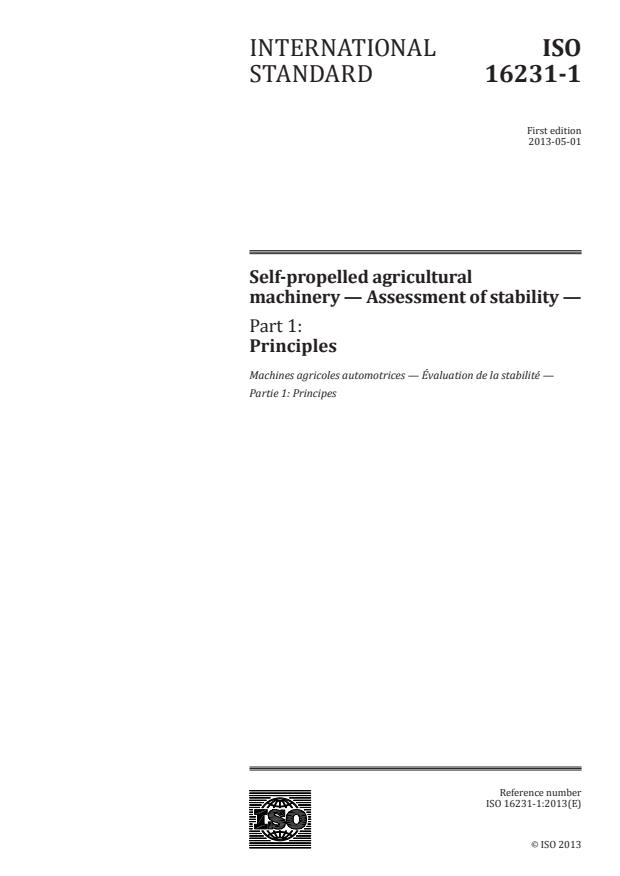
ISO 16231-1:2013 - Self-propelled agricultural machinery — Assessment of stability — Part 1: Principles Released:4/18/2013
ISO 16231-1:2013 - Machines agricoles automotrices — Évaluation de la stabilité — Partie 1: Principes Released:4/18/2013
Overview
ISO 16231-1:2013, developed by the International Organization for Standardization (ISO), establishes essential principles for assessing the stability of self-propelled agricultural machinery. This standard targets ride-on machines used in agriculture and focuses on the risks of rollover and tip-over during intended operations under foreseeable conditions. It guides manufacturers on designing stable machinery and mandates the provision of safety information regarding operational risks.
The standard specifically excludes machines with an unladen mass below 400 kg, machines covered by other rollover-specific standards (like agricultural or forestry tractors), hazards from road transport, free fall events, and rollover resulting from collisions. ISO 16231-1 is applicable only to machinery manufactured after its publication date.
Key Topics
Risk Assessment
ISO 16231-1 requires a comprehensive risk assessment considering:- Intended machine use and specific agricultural operations
- Typical operating environments including slope and ground conditions
- Machine physical characteristics under working conditions
- Operator qualifications such as training and experience
- Machine limits and stability parameters
Protective Measures
When a rollover or tip-over hazard is identified, the standard mandates implementation of protective measures including:- Designing machines to have a Static Overturning Angle (SOA) equal or greater than the Required Static Stability Angle (RSSA), incorporating a safety factor
- Using Self-Protective Devices (SPD) such as attachments that improve mass distribution or shape
- Installing Automatic Protective Systems (APS) that control machine functions to prevent instability
- Providing deflection limiting volumes by implementing robust self-protective or roll-over protective structures (ROPS)
- Equipping operators with restraint systems like seat belts following ISO 3776
Information for Use
The manufacturer must supply comprehensive safety information in the operator's manual concerning:- Rollover hazards linked to terrain such as embankments or weak bridge sections
- Effects on stability from raised or extended machine components
- Limits on operating slopes, including warnings not to exceed specified angles
- Proper use of operator restraint systems
- Recommendations on speed, maneuvering, and ballasting techniques to enhance stability
- Instructions for secure attachment of devices that support stability
Verification Requirements
Safety requirements and protective measures must be verified through inspection, measurement, or functional testing as per the procedures outlined in the standard. This includes evaluating machine angles, structural integrity, and effectiveness of automatic safety systems.
Applications
ISO 16231-1:2013 is critical for manufacturers, designers, and safety engineers involved with self-propelled ride-on agricultural machinery such as combine harvesters, sprayers, and loaders. Applying this standard helps:
- Enhance machine design to minimize rollover risks on varying terrain
- Define safety thresholds and test procedures to ensure operational stability
- Inform operators with clear guidelines on safe operation and hazard awareness
- Support compliance with occupational safety regulations and reduce accident rates
- Facilitate the integration of advanced protective technologies, improving operator protection
This standard serves as the foundational document within the ISO 16231 series, complementing forthcoming parts that detail calculations and test procedures for stability assessment.
Related Standards
For comprehensive safety and stability evaluation in agricultural machinery, ISO 16231-1 is associated with:
- ISO 3776 Series – Specifies requirements for seat belts and anchorage strength in tractors and machinery, crucial for operator restraint systems
- ISO 4254-1:2013 – Covers general safety requirements for agricultural machinery, providing broader safety context
- Machine-specific standards – For example, standards addressing rollover protection for agricultural and forestry tractors not covered by ISO 16231-1
Together, these standards form an integrated framework to ensure the stability and operator safety of agricultural machinery under real-world operating conditions.
Keywords: ISO 16231-1, agricultural machinery stability, self-propelled ride-on machines, rollover protection, tip-over risk assessment, machine safety standards, roll-over protective structure, operator restraint system, ISO agricultural safety standards, machinery design principles, protective systems in agriculture.
Relations
- Effective Date
- 11-Feb-2026
- Effective Date
- 09-Feb-2026
- Effective Date
- 09-Feb-2026
- Effective Date
- 09-Feb-2026
- Effective Date
- 12-Feb-2026
Buy Documents
ISO 16231-1:2013 - Self-propelled agricultural machinery — Assessment of stability — Part 1: Principles Released:4/18/2013
ISO 16231-1:2013 - Machines agricoles automotrices — Évaluation de la stabilité — Partie 1: Principes Released:4/18/2013
Get Certified
Connect with accredited certification bodies for this standard

Control Union Certifications
Global certification for agriculture and sustainability.

ECOCERT
Organic and sustainability certification.

FSC International
Forest Stewardship Council certification.
Sponsored listings
Frequently Asked Questions
ISO 16231-1:2013 is a standard published by the International Organization for Standardization (ISO). Its full title is "Self-propelled agricultural machinery — Assessment of stability — Part 1: Principles". This standard covers: ISO 16231-1:2013 specifies principles for the assessment of stability with respect to the design and construction of self-propelled ride-on machines used in agriculture and the hazard of rolling over or tipping over, or both when the machine is used as intended and under the conditions foreseeable by the manufacturer. In addition, it specifies the type of information on safe working practices (including residual risks) to be provided by the manufacturer. ISO 16231-1:2013 is not applicable to ? machines with an unladen mass lower than 400 kg; ? machines covered by other machine specific standards dealing with the protection against rollover and tip-over (e.g. agricultural tractors, forestry tractors); ? hazards associated with road transport operations; ? free fall events; ? rollover as a result of impact collisions. ISO 16231-1:2013 is not applicable to machines manufactured before the date of its publication.
ISO 16231-1:2013 specifies principles for the assessment of stability with respect to the design and construction of self-propelled ride-on machines used in agriculture and the hazard of rolling over or tipping over, or both when the machine is used as intended and under the conditions foreseeable by the manufacturer. In addition, it specifies the type of information on safe working practices (including residual risks) to be provided by the manufacturer. ISO 16231-1:2013 is not applicable to ? machines with an unladen mass lower than 400 kg; ? machines covered by other machine specific standards dealing with the protection against rollover and tip-over (e.g. agricultural tractors, forestry tractors); ? hazards associated with road transport operations; ? free fall events; ? rollover as a result of impact collisions. ISO 16231-1:2013 is not applicable to machines manufactured before the date of its publication.
ISO 16231-1:2013 is classified under the following ICS (International Classification for Standards) categories: 65.060.01 - Agricultural machines and equipment in general. The ICS classification helps identify the subject area and facilitates finding related standards.
ISO 16231-1:2013 has the following relationships with other standards: It is inter standard links to EN ISO 4254-1:2015, EN ISO 4254-1:2013, EN ISO 16231-2:2015, EN ISO 4254-20:2025, EN ISO 16231-1:2013. Understanding these relationships helps ensure you are using the most current and applicable version of the standard.
ISO 16231-1:2013 is available in PDF format for immediate download after purchase. The document can be added to your cart and obtained through the secure checkout process. Digital delivery ensures instant access to the complete standard document.
Standards Content (Sample)
INTERNATIONAL ISO
STANDARD 16231-1
First edition
2013-05-01
Self-propelled agricultural
machinery — Assessment of stability —
Part 1:
Principles
Machines agricoles automotrices — Évaluation de la stabilité —
Partie 1: Principes
Reference number
©
ISO 2013
© ISO 2013
All rights reserved. Unless otherwise specified, no part of this publication may be reproduced or utilized otherwise in any form
or by any means, electronic or mechanical, including photocopying, or posting on the internet or an intranet, without prior
written permission. Permission can be requested from either ISO at the address below or ISO’s member body in the country of
the requester.
ISO copyright office
Case postale 56 • CH-1211 Geneva 20
Tel. + 41 22 749 01 11
Fax + 41 22 749 09 47
E-mail copyright@iso.org
Web www.iso.org
Published in Switzerland
ii © ISO 2013 – All rights reserved
Contents Page
Foreword .iv
Introduction .v
1 Scope . 1
2 Normative references . 1
3 Terms and definitions . 1
4 Principles . 3
4.1 Risk assessment . 3
4.2 Protective measures . 3
4.3 Information for use . 3
5 Verification of safety requirements and/or protective measures .3
6 Operator’s manual . 4
Foreword
ISO (the International Organization for Standardization) is a worldwide federation of national standards
bodies (ISO member bodies). The work of preparing International Standards is normally carried out
through ISO technical committees. Each member body interested in a subject for which a technical
committee has been established has the right to be represented on that committee. International
organizations, governmental and non-governmental, in liaison with ISO, also take part in the work.
ISO collaborates closely with the International Electrotechnical Commission (IEC) on all matters of
electrotechnical standardization.
The procedures used to develop this document and those intended for its further maintenance are
described in the ISO/IEC Directives, Part 1. In particular the different approval criteria needed for the
different types of ISO documents should be noted. This document was drafted in accordance with the
editorial rules of the ISO/IEC Directives, Part 2. www.iso.org/directives
Attention is drawn to the possibility that some of the elements of this document may be the subject of
patent rights. ISO shall not be held responsible for identifying any or all such patent rights. Details of
any patent rights identified during the development of the document will be in the Introduction and/or
on the ISO list of patent declarations received. www.iso.org/patents
Any trade name used in this document is information given for the convenience of users and does not
constitute an endorsement.
The committee responsible for this document is ISO/TC 23, Tractors and machinery for agriculture and
forestry, Subcommittee SC 3, Safety and comfort.
ISO 16231 consists of the following parts, under the general title Self-propelled agricultural machinery —
Assessment of stability:
— Part 1: Principles
The following part is under preparation:
— Part 2: Calculations and test procedures
iv © ISO 2013 – All rights reserved
Introduction
Self-propelled agricultural machinery with a ride-on operator (driver) can expose the operator to the
hazard of rolling or tipping over during the intended operation. A risk assessment should determine
whether this hazard applies to a particular machine and, when appropriate, the protective measures to
be used in order to avoid or minimize this hazard for the ride-on operator. For many machines, this risk
assessment will be reflected in the requirements of a machine-specific standard.
The risk assessment should consider the operating conditions in which the machine is intended to be
used, the physical properties of the machine and the required skills to operate the machine as well as
any other parameter which can have an impact on the risk for rollover or tip-over.
INTERNATIONAL STANDARD ISO 16231-1:2013(E)
Self-propelled agricultural machinery — Assessment of
stability —
Part 1:
Principles
1 Scope
This part of ISO 16231 specifies principles for the assessment of stability with respect to the design
and construction of self-propelled ride-on machines used in agriculture and the hazard of rolling over
or tipping over, or both, when the machine is used as intended and under the conditions foreseeable by
the manufacturer. In addition, it specifies the type of information on safe working practices (including
residual risks) to be provided by the manufacturer.
This part of ISO 16231 is not applicable to:
— machines with an unladen mass lower than 400 kg;
— machines covered by other machine specific standards dealing with the protection against rollover
and tip-over (e.g. agricultural tractors, forestry tractors);
— hazards associated with road transport operations;
— free fall events;
— rollover as a result of impact collisions.
This part of ISO 16231 is not applicable to machines manufactured before the date of its publication.
2 Normative references
The following documents, in whole or in part, are normatively referenced in this document and are
indispensable for its application. For dated references, only the edition cited applies. For undated
referen
...
NORME ISO
INTERNATIONALE 16231-1
Première édition
2013-05-01
Machines agricoles automotrices —
Évaluation de la stabilité —
Partie 1:
Principes
Self-propelled agricultural machinery — Assessment of stability —
Part 1: Principles
Numéro de référence
©
ISO 2013
DOCUMENT PROTÉGÉ PAR COPYRIGHT
© ISO 2013
Droits de reproduction réservés. Sauf indication contraire, aucune partie de cette publication ne peut être reproduite ni utilisée
sous quelque forme que ce soit et par aucun procédé, électronique ou mécanique, y compris la photocopie, l’affichage sur
l’internet ou sur un Intranet, sans autorisation écrite préalable. Les demandes d’autorisation peuvent être adressées à l’ISO à
l’adresse ci-après ou au comité membre de l’ISO dans le pays du demandeur.
ISO copyright office
Case postale 56 • CH-1211 Geneva 20
Tel. + 41 22 749 01 11
Fax + 41 22 749 09 47
E-mail copyright@iso.org
Web www.iso.org
Publié en Suisse
ii © ISO 2013 – Tous droits réservés
Sommaire Page
Avant-propos .iv
Introduction .v
1 Domaine d’application . 1
2 Références normatives . 1
3 Termes et définitions . 1
4 Principes . 3
4.1 Appréciation du risque . 3
4.2 Mesures de protection . 3
4.3 Informations relatives à l’utilisation . 3
5 Vérification des exigences de sécurité et/ou mesures de protection .3
6 Manuel de l’opérateur . 4
Avant-propos
L’ISO (Organisation internationale de normalisation) est une fédération mondiale d’organismes
nationaux de normalisation (comités membres de l’ISO). L’élaboration des Normes internationales est
en général confiée aux comités techniques de l’ISO. Chaque comité membre intéressé par une étude
a le droit de faire partie du comité technique créé à cet effet. Les organisations internationales,
gouvernementales et non gouvernementales, en liaison avec l’ISO participent également aux travaux.
L’ISO collabore étroitement avec la Commission électrotechnique internationale (CEI) en ce qui concerne
la normalisation électrotechnique.
Les procédures utilisées pour élaborer le présent document et celles destinées à sa mise à jour sont
décrites dans les Directives ISO/CEI, Partie 1. Il convient, en particulier de prendre note des différents
critères d’approbation requis pour les différents types de documents ISO. Le présent document a été
rédigé conformément aux règles de rédaction données dans les Directives ISO/CEI, Partie 2, www.iso.
org/directives.
L’attention est appelée sur le fait que certains des éléments du présent document peuvent faire l’objet de
droits de propriété intellectuelle ou de droits analogues. L’ISO ne saurait être tenue pour responsable
de ne pas avoir identifié de tels droits de propriété et averti de leur existence. Les détails concernant les
références aux droits de propriété intellectuelle ou autres droits analogues identifiés lors de l’élaboration
du document sont indiqués dans l’Introduction et/ou sur la liste ISO des déclarations de brevets reçues,
www.iso.org/patents.
Les éventuelles appellations commerciales utilisées dans le présent document sont données pour
information à l’intention des utilisateurs et ne constituent pas une approbation ou une recommandation.
Le comité chargé de l’élaboration du présent document est l’ISO/TC 23, Tracteurs et matériels agricoles et
forestiers, sous-comité SC 3, Sécurité et confort.
L’ISO 16231 comprend les parties suivantes, présentées sous le titre général Machines agricoles
automotrices — Évaluation de la stabilité:
— Partie 1: Généralités
La partie suivante est en cours d’élaboration:
— Partie 2: Calculs et modes opératoires d’essai
iv © ISO 2013 – Tous droits réservés
Introduction
Les machines agricoles automotrices conduites par un opérateur (conducteur) porté peuvent exposer ce
dernier à des risques de retournement ou de renversement pendant le fonctionnement pour lequel elle
est prévue. Pour une machine spécifique, il convient de déterminer par une appréciation du risque si ce
risque s’applique et, le cas échéant de définir les mesures de protection à utiliser pour éviter ou réduire
au minimum ledit risque pour l’opérateur porté. Pour de nombreuses machines, cette appréciation du
risque se traduira par des spécifications dans une norme spécifique à chacune de ces machines.
L’appréciation du risque tient compte des conditions de fonctionnement prévues de la machine, de
ses propriétés physiques, des compétences requises pour la faire fonctionner, ainsi que de tout autre
paramètre pouvant avoir un impact sur le risque de retournement ou de renversement.
NORME INTERNATIONALE ISO 16231-1:2013(F)
Machines agricoles automotrices — Évaluation de la
stabilité —
Partie 1:
Principes
1 Domaine d’application
La présente partie de l’ISO 16231 fixe les principes de l’évaluation de la stabilité au regard de la
conception et de la fabrication des machines automotrices à conducteur porté utilisées dans le domaine
agricole ainsi que de l’appréciation du risque de retournement ou de renversement, ou de la combinaison
de ces deux risques, lorsque la machine est utilisée comme prévu et dans les conditions prévisibles par
le fabricant. En outre, la présente partie de l’ISO 16231 précise le type d’informations sur les pratiques
de travail sûres (y compris les risques résiduels) à fournir par le fabricant.
La présente partie de l’ISO 16231 n’est pas applicable:
— aux machines de masse à vide inférieure à 400 kg;
— aux machines traitées dans d’autres normes spécifiques relatives à la protection contre le
retournement et le renversement (par exemple tracteurs agricoles ou forestiers);
— aux risques liés aux opérations de transport sur route;
— aux cas de chute libre;
— au retournement à la suite de collisions.
La présente partie de l’ISO 16231 n’est pas applicable aux machines construites avant la date de sa publication.
2 Références normatives
Les documents suivants, en tout ou partie, sont référencés de manière normative dans le présent
document et sont indispensables pour son application. Pour les références datées, seule l’édition citée
s’applique. Pour les références non datées, la dernière édition du document de référence s’applique (y
compris les éventuels amendements).
ISO 3776-1:2006, Tracteurs et matériels agricoles — Ceintures de sécurité — Partie 1: Exigences relatives
à l’emplacement
...