

IEC TR 62935:2016
(Main)Measurement methods - High dynamic range video
General Information
- Abstract
IEC TR 62935:2016(E) introduces the concept of High Dynamic Range (HDR) video, lists some of the related standards and activities, provides information about HDR in the marketplace, and proposes areas of HDR measurement that could be standardized.
- Status
- Published
- Publication Date
- 17-Jul-2016
- Current Stage
- PPUB - Publication issued
- Start Date
- 18-Jul-2016
- Completion Date
- 15-Oct-2016
Overview
IEC TR 62935:2016 - Measurement methods – High dynamic range video - is a Technical Report from the International Electrotechnical Commission (IEC) that introduces the concept of High Dynamic Range (HDR) video, surveys related standards and marketplace activity, and proposes areas of HDR measurement that could be standardized. As a TR (informative, non‑normative), it sets the groundwork for future measurement methods and test‑signal definitions for HDR video systems, rather than specifying mandatory test procedures.
Key topics
- HDR fundamentals: definition of HDR vs SDR, scene vs display ranges, required higher bit depth and transfer functions to preserve extended dark-to‑bright spans.
- Historical context: evolution from film and analogue video through HD and Ultra‑HD to HDR-capable systems.
- Measurement focus areas (proposed for standardization):
- Peak luminance / peak white measurement on HDR displays
- Full‑screen black and low‑level noise floor assessment
- Contrast ratio measurement across extended ranges
- Colour gamut verification (WCG) and colour volume considerations
- White point specification and measurement
- Other display and signal related parameters that affect HDR presentation
- Related standards & activities: summary of industry work relevant to HDR (SMPTE study groups and ST 2084/ST 2086/ST 2036‑1, CEA‑861.3, HDMI 2.0a, ITU‑R BT.2020, ICDM, etc.).
- Market considerations: HDR content sources (cinema, Ultra HD Blu‑ray, streaming, broadcast) and ecosystem implications for measurement.
Practical applications & who uses it
IEC TR 62935 is useful to organizations preparing for or participating in HDR measurement standardization and testing:
- Display manufacturers - for defining test plans and validating HDR performance (peak luminance, black level, contrast, gamut).
- Test labs and certification bodies - to develop HDR measurement protocols and compare devices.
- Content creators & mastering facilities - to understand HDR display targets and measurement metrics for mastering and QC.
- Broadcasters and streaming services - to specify delivery requirements and verify playback devices.
- Standards developers and systems integrators - to coordinate measurement definitions across multiple standards.
Related standards
IEC TR 62935 references and summarizes relevant industry work including:
- SMPTE (ST 2084, ST 2086, ST 2036‑1 and HDR ecosystem activities)
- CEA‑861.3, HDMI 2.0a
- ITU‑R (including BT.2020)
- ICDM and other ecosystem contributors
IEC TR 62935:2016 is primarily a roadmap describing measurement needs and standardization opportunities for HDR video - a practical starting point for anyone involved in HDR testing, specification or product development.
Get Certified
Connect with accredited certification bodies for this standard

ANCE
Mexican certification and testing association.

Intertek Slovenia
Intertek testing, inspection, and certification services in Slovenia.

LNE (Laboratoire National de Métrologie et d'Essais)
French national laboratory for metrology and testing.
Sponsored listings
Frequently Asked Questions
IEC TR 62935:2016 is a technical report published by the International Electrotechnical Commission (IEC). Its full title is "Measurement methods - High dynamic range video". This standard covers: IEC TR 62935:2016(E) introduces the concept of High Dynamic Range (HDR) video, lists some of the related standards and activities, provides information about HDR in the marketplace, and proposes areas of HDR measurement that could be standardized.
IEC TR 62935:2016(E) introduces the concept of High Dynamic Range (HDR) video, lists some of the related standards and activities, provides information about HDR in the marketplace, and proposes areas of HDR measurement that could be standardized.
IEC TR 62935:2016 is classified under the following ICS (International Classification for Standards) categories: 33.160.40 - Video systems. The ICS classification helps identify the subject area and facilitates finding related standards.
IEC TR 62935:2016 is available in PDF format for immediate download after purchase. The document can be added to your cart and obtained through the secure checkout process. Digital delivery ensures instant access to the complete standard document.
Standards Content (Sample)
IEC TR 62935 ®
Edition 1.0 2016-07
TECHNICAL
REPORT
Measurement methods – High dynamic range video
All rights reserved. Unless otherwise specified, no part of this publication may be reproduced or utilized in any form
or by any means, electronic or mechanical, including photocopying and microfilm, without permission in writing from
either IEC or IEC's member National Committee in the country of the requester. If you have any questions about IEC
copyright or have an enquiry about obtaining additional rights to this publication, please contact the address below or
your local IEC member National Committee for further information.
IEC Central Office Tel.: +41 22 919 02 11
3, rue de Varembé Fax: +41 22 919 03 00
CH-1211 Geneva 20 info@iec.ch
Switzerland www.iec.ch
About the IEC
The International Electrotechnical Commission (IEC) is the leading global organization that prepares and publishes
International Standards for all electrical, electronic and related technologies.
About IEC publications
The technical content of IEC publications is kept under constant review by the IEC. Please make sure that you have the
latest edition, a corrigenda or an amendment might have been published.
IEC Catalogue - webstore.iec.ch/catalogue Electropedia - www.electropedia.org
The stand-alone application for consulting the entire The world's leading online dictionary of electronic and
bibliographical information on IEC International Standards, electrical terms containing 20 000 terms and definitions in
Technical Specifications, Technical Reports and other English and French, with equivalent terms in 15 additional
documents. Available for PC, Mac OS, Android Tablets and languages. Also known as the International Electrotechnical
iPad. Vocabulary (IEV) online.
IEC publications search - www.iec.ch/searchpub IEC Glossary - std.iec.ch/glossary
The advanced search enables to find IEC publications by a 65 000 electrotechnical terminology entries in English and
variety of criteria (reference number, text, technical French extracted from the Terms and Definitions clause of
committee,…). It also gives information on projects, replaced IEC publications issued since 2002. Some entries have been
and withdrawn publications. collected from earlier publications of IEC TC 37, 77, 86 and
CISPR.
IEC Just Published - webstore.iec.ch/justpublished
Stay up to date on all new IEC publications. Just Published IEC Customer Service Centre - webstore.iec.ch/csc
details all new publications released. Available online and If you wish to give us your feedback on this publication or
also once a month by email. need further assistance, please contact the Customer Service
Centre: csc@iec.ch.
IEC TR 62935 ®
Edition 1.0 2016-07
TECHNICAL
REPORT
Measurement methods – High dynamic range video
INTERNATIONAL
ELECTROTECHNICAL
COMMISSION
ICS 33.160.40 ISBN 978-2-8322-3517-1
– 2 – IEC TR 62935:2016 © IEC 2016
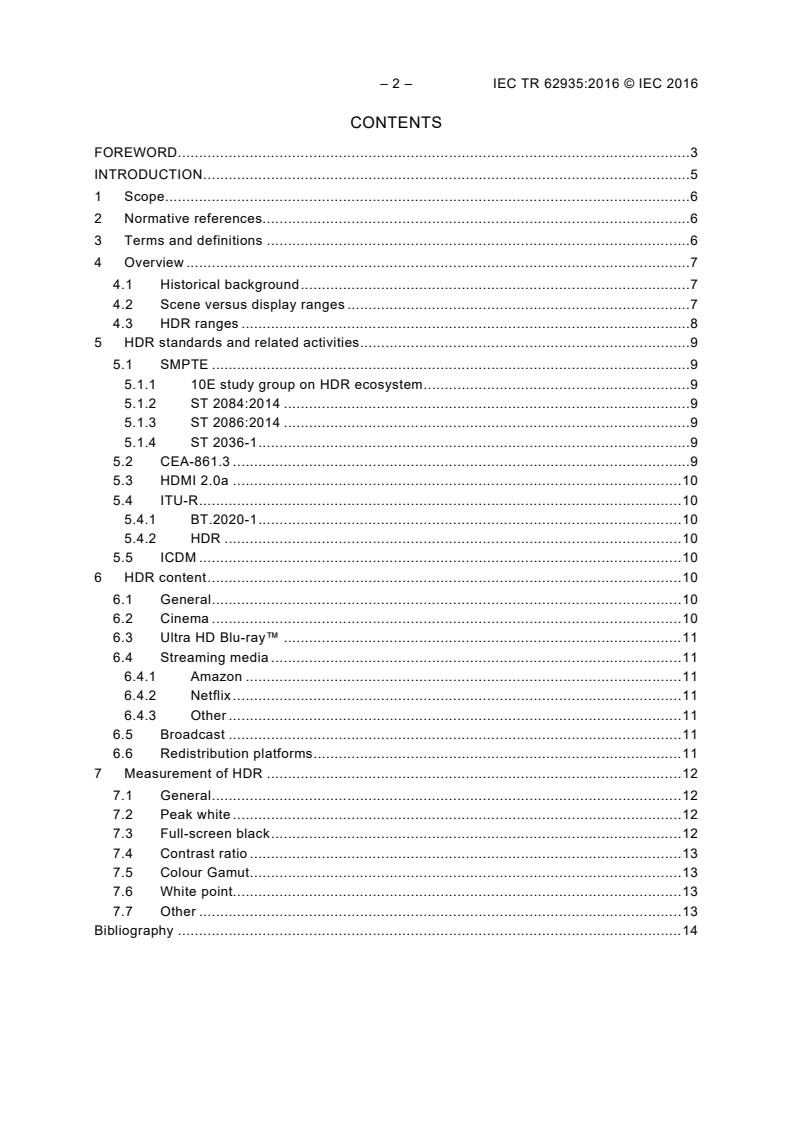
CONTENTS
FOREWORD . 3
INTRODUCTION . 5
1 Scope . 6
2 Normative references. 6
3 Terms and definitions . 6
4 Overview . 7
4.1 Historical background . 7
4.2 Scene versus display ranges . 7
4.3 HDR ranges . 8
5 HDR standards and related activities . 9
5.1 SMPTE . 9
5.1.1 10E study group on HDR ecosystem . 9
5.1.2 ST 2084:2014 . 9
5.1.3 ST 2086:2014 . 9
5.1.4 ST 2036-1 . 9
5.2 CEA-861.3 . 9
5.3 HDMI 2.0a . 10
5.4 ITU-R . 10
5.4.1 BT.2020-1 . 10
5.4.2 HDR . 10
5.5 ICDM . 10
6 HDR content . 10
6.1 General . 10
6.2 Cinema . 10
6.3 Ultra HD Blu-ray™ . 11
6.4 Streaming media . 11
6.4.1 Amazon . 11
6.4.2 Netflix . 11
6.4.3 Other . 11
6.5 Broadcast . 11
6.6 Redistribution platforms . 11
7 Measurement of HDR . 12
7.1 General . 12
7.2 Peak white . 12
7.3 Full-screen black . 12
7.4 Contrast ratio . 13
7.5 Colour Gamut . 13
7.6 White point. 13
7.7 Other . 13
Bibliography . 14
INTERNATIONAL ELECTROTECHNICAL COMMISSION
____________
MEASUREMENT METHODS –
HIGH DYNAMIC RANGE VIDEO
FOREWORD
1) The International Electrotechnical Commission (IEC) is a worldwide organization for standardization comprising
all national electrotechnical committees (IEC National Committees). The object of IEC is to promote
international co-operation on all questions concerning standardization in the electrical and electronic fields. To
this end and in addition to other activities, IEC publishes International Standards, Technical Specifications,
Technical Reports, Publicly Available Specifications (PAS) and Guides (hereafter referred to as “IEC
Publication(s)”). Their preparation is entrusted to technical committees; any IEC National Committee interested
in the subject dealt with may participate in this preparatory work. International, governmental and non-
governmental organizations liaising with the IEC also participate in this preparation. IEC collaborates closely
with the International Organization for Standardization (ISO) in accordance with conditions determined by
agreement between the two organizations.
2) The formal decisions or agreements of IEC on technical matters express, as nearly as possible, an international
consensus of opinion on the relevant subjects since each technical committee has representation from all
interested IEC National Committees.
3) IEC Publications have the form of recommendations for international use and are accepted by IEC National
Committees in that sense. While all reasonable efforts are made to ensure that the technical content of IEC
Publications is accurate, IEC cannot be held responsible for the way in which they are used or for any
misinterpretation by any end user.
4) In order to promote international uniformity, IEC National Committees undertake to apply IEC Publications
transparently to the maximum extent possible in their national and regional publications. Any divergence
between any IEC Publication and the corresponding national or regional publication shall be clearly indicated in
the latter.
5) IEC itself does not provide any attestation of conformity. Independent certification bodies provide conformity
assessment services and, in some areas, access to IEC marks of conformity. IEC is not responsible for any
services carried out by independent certification bodies.
6) All users should ensure that they have the latest edition of this publication.
7) No liability shall attach to IEC or its directors, employees, servants or agents including individual experts and
members of its technical committees and IEC National Committees for any personal injury, property damage or
other damage of any nature whatsoever, whether direct or indirect, or for costs (including legal fees) and
expenses arising out of the publication, use of, or reliance upon, this IEC Publication or any other IEC
Publications.
8) Attention is drawn to the Normative references cited in this publication. Use of the referenced publications is
indispensable for the correct application of this publication.
9) Attention is drawn to the possibility that some of the elements of this IEC Publication may be the subject of
patent rights. IEC shall not be held responsible for identifying any or all such patent rights.
The main task of IEC technical committees is to prepare International Standards. However, a
technical committee may propose the publication of a technical report when it has collected
data of a different kind from that which is normally published as an International Standard, for
example "state of the art".
IEC TR 62935, which is a technical report, has been prepared by IEC technical committee 100:
Audio, video and multimedia systems and equipment.
The text of this technical report is based on the following documents:
Enquiry draft Report on voting
100/2642/DTR 100/2703/RVC
Full information on the voting for the approval of this technical report can be found in the
report on voting indicated in the above table.
This publication has been drafted in accordance with the ISO/IEC Directives, Part 2.
– 4 – IEC TR 62935:2016 © IEC 2016
The committee has decided that the contents of this publication will remain unchanged until
the stability date indicated on the IEC website under "http://webstore.iec.ch" in the data
related to the specific publication. At this date, the publication will be
• reconfirmed,
• withdrawn,
• replaced by a revised edition, or
• amended.
A bilingual version of this publication may be issued at a later date.
INTRODUCTION
The market for the production and delivery of moving images has transitioned from film
through analogue standard-definition video through digital HD video and now to 4K Ultra HD
video. As the increase in resolution continues to 8K, the opportunity exists to increase the
dynamic range of the video, including brighter peak luminance levels. This, in conjunction with
wide colour gamut, increases the volume of possible levels and colours, resulting in more
realistic and hyper-realistic presentations.
IEC TC 100 AGS SS9 (HDR) has identified a standardization opportunity related to
measurement methods and test signals for HDR video. This Technical Report sets the
groundwork for such an activity.
– 6 – IEC TR 62935:2016 © IEC 2016
MEASUREMENT METHODS –
HIGH DYNAMIC RANGE VIDEO
1 Scope
This document introduces the concept of High Dynamic Range (HDR) video, lists some of the
related standards and activities, provides information about HDR in the marketplace, and
proposes areas of HDR measurement that could be standardized.
2 Normative references
The following documents are referred to in the text in such a way that some or all of their
content constitutes requirements of this document. For dated references, only the edition
cited applies. For undated references, the latest edition of the referenced document (including
any amendments) applies.
There are no normative references in this document.
3 Terms and definitions
For the purposes of this document, the following terms and definitions apply.
ISO and IEC maintain terminological databases for use in standardization at the following
addresses:
• IEC Electropedia: available at http://www.electropedia.org/
• ISO Online browsing platform: available at http://www.iso.org/obp
3.1
high dynamic range
HDR
span of image luminances that is larger than normally possible for standard, high definition,
and ultra HD video
3.2
standard dynamic range
SDR
span of image luminances that is normally possible for standard and high definition video
Note 1 to entry: Standard definition, high definition, and ultra HD video systems are normally capable of
producing luminances of 10 times that of an average mid-tone at the top (white) end of the range, and of 0,01 times
that of an average mid-tone at the bottom (black) end of the range.
3.3
wide colour gamut
WCG
range of colours in a colour space that covers a large percentage of visible colours
EXAMPLE ITU-R BT.2020 [2] is considered to provide WCG while BT.709 [3] does not.
___________
Numbers in square brackets refer to the Bibliography.
4 Overview
4.1 Historical background
Still and moving pictures were initially captured and displayed with chemical processes,
typically on film. The dynamic range varied by process and was limited by the maximum
density achievable on the reproduction medium for representation of dark areas and by the
minimum density achievable on the reproduction medium in representation of bright areas.
Though there are hard limits with this technology, the processes involved resulted in the limits
being approached gradually, with dynamic range expansion in the mid-tones, and dynamic
range compression at the extremes.
Electronic images were initially captured and displayed using analogue means. Electronic
noise limits the representation of dark areas and defined limits can clip the bright areas.
Though a wire can carry much more than a 1 V signal (which represents 100 % white in some
systems), various equipment in the processing chain might apply a hard clip. There is no
natural compression as the signal approaches the white limit. Dynamic range compression is
generally performed in the camera or in post-production with specialized equipment.
Today, most image capture, storage, and processing is based on digital technology. Dark
details are limited by the noise and quantization error. White levels have a hard limit at the
defined maximum white code value. Similar to analogue electronic techniques, dynamic range
expansion in the mid-tones and compression at the extremes is performed by in-camera
processing or in post-production.
Picture levels were standardized during the analogue time frame. Peak white for displays was
2 2
for the cinema and 100 cd/m for video presentation in mastering suites
defined as 48 cd/m
under controlled, low-level lighting conditions. These standardized levels were retained during
and after the transition from analogue to digital equipment and techniques.
NOTE Consumer televisions have higher peak luminance, typically around 350 cd/m , in order to allow for bright
viewing conditions.
In order to optimize the use of signal levels, a gamma curve is applied between signal and
display. This was done naturally by cathode ray tube displays and is done electronically in
typical flat panel displays. The gamma equation is as follows:
γ
V = AV
out in
ITU-R Recommendation BT.1886 [1] defines gamma (γ) as 2.4 and screen luminance for
white as 100 cd/m for standard dynamic range high definition video.
4.2 Scene versus display ranges
Images are captured in a variety of conditions – from the dark reaches of Pluto to the intense
light levels of the sun. The captured ranges of these images are normalized by controlling
exposure levels. The high dynamic range system covered by this document is not intended to
capture Pluto and the Sun at a single exposure image; however, an HDR system allows the
captured range of those two separate images to include deeper black levels above the noise
level and brighter white levels without clipping. An HDR system preserves those larger ranges
through display to the viewer. This requires higher bit-depths, displays capable of higher
luminance peaks, and carefully designed transfer functions to optimi
...