

IEC 61966-2-4:2006
(Main)Multimedia systems and equipment - Colour measurement and management - Part 2-4: Colour management - Extended-gamut YCC colour space for video applications - xvYCC
General Information
- Abstract
IEC 61966-2-4:2006 is applicable to the encoding and communication of YCC colours used in video systems and similar applications by defining encoding transformations for use in defined reference capturing conditions. If actual conditions differ from the reference conditions, additional rendering transformations may be required. Such additional rendering transformations are beyond the scope of this standard. This bilingual version (2013-02) corresponds to the monolingual English version, published in 2006-01.
- Status
- Published
- Publication Date
- 12-Jul-2021
- Technical Committee
- TC 100 - Audio, video and multimedia systems and equipment
- Current Stage
- PPUB - Publication issued
- Start Date
- 17-Jan-2006
- Completion Date
- 28-Feb-2006
Buy Documents
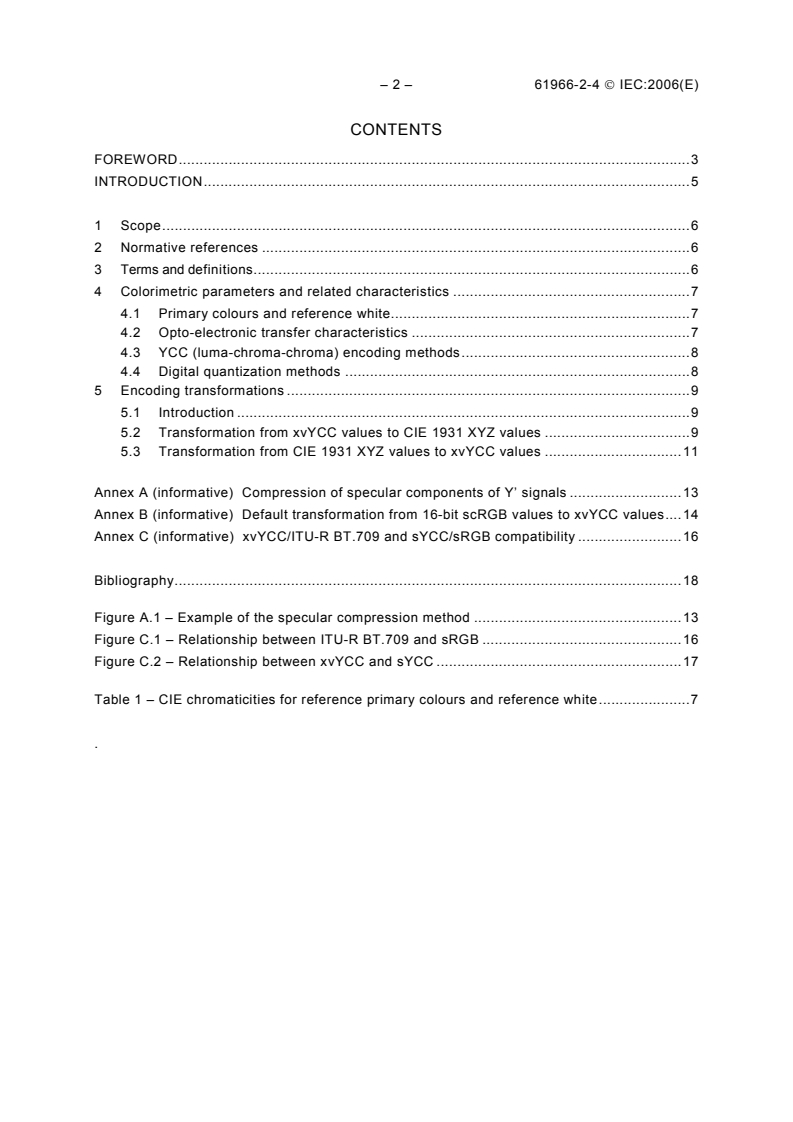
IEC 61966-2-4:2006 - Multimedia systems and equipment - Colour measurement and management - Part 2-4: Colour management - Extended-gamut YCC colour space for video applications - xvYCC Released:1/17/2006


IEC 61966-2-4:2006+AMD1:2016+AMD2:2021 CSV - Multimedia systems and equipment - Colour measurement and management - Part 2-4: Colour management - Extended-gamut YCC colour space for video applications - xvYCC Released:7/13/2021
IEC 61966-2-4:2006 - Multimedia systems and equipment - Colour measurement and management - Part 2-4: Colour management - Extended-gamut YCC colour space for video applications - xvYCC Released:1/17/2006

IEC 61966-2-4:2006+AMD1:2016 CSV - Multimedia systems and equipment - Colour measurement and management- Part 2-4: Colour management - Extended-gamut YCC colour space for video applications - xvYCC Released:4/28/2016
Overview
IEC 61966-2-4:2006 (xvYCC) specifies an extended‑gamut YCC colour space for video applications. It defines the colourimetric parameters, opto‑electronic transfer characteristics (OETF), digital quantization and the encoding transformations needed to convert between xvYCC, RGB primaries and CIE 1931 XYZ. The standard is intended for encoding and communicating YCC colours in video systems under defined reference capturing conditions; if actual capture or display conditions differ, additional rendering is outside the scope.
Keywords: IEC 61966-2-4, xvYCC, extended‑gamut YCC, colour management, video colour encoding, YCC, colour gamut.
Key topics
- Reference primaries and white point: CIE chromaticities for red, green, blue primaries and D65 white - identical to ITU‑R BT.709.
- Opto‑electronic transfer characteristics (OETF): A piecewise non‑linear transfer function (compatible with existing video practice) for converting camera/scene voltages to non‑linear R′G′B′ signals.
- YCC encoding methods: Definition of Y′, Cb, Cr derivation from non‑linear primaries and inverse transforms.
- Transformations to/from CIE XYZ: Mathematical procedures for mapping xvYCC values to CIE 1931 XYZ and back - enabling colour‑accurate workflows.
- Digital quantization: Guidance on bit depths and quantization for reliable encoding and transport of extended‑gamut signals.
- Informative annexes: Practical guidance including specular component compression, a default scRGB→xvYCC mapping, compatibility notes with sYCC/sRGB and recommended use of IEC 61966‑12‑2 metadata. Annex E describes an xvYCCext method for encoding extended luminance regions.
Applications
IEC 61966-2-4 (xvYCC) is used where wider colour gamuts than standard sRGB are required while retaining video‑industry YCC workflows:
- Display manufacturers implementing wide‑gamut TVs, monitors and projectors.
- Video codecs and middleware engineers implementing colour encoding/decoding and color management pipelines.
- Broadcast and streaming systems transporting extended‑gamut content while maintaining compatibility with existing YCC infrastructures.
- Post‑production and color‑grading workflows that need precise transforms to/from CIE XYZ for colour accurate rendering.
- Camera and capture system designers who provide scene‑referred or output‑referred YCC encodings.
Who should use this standard
- Colour scientists, video systems architects, codec developers, broadcast engineers, and display integrators who require standardized, interoperable methods for extended‑gamut YCC encoding.
Related standards
- IEC 61966‑2‑1 (sRGB) - default RGB colour space
- IEC 61966‑2‑2 (scRGB) - extended RGB colour space
- IEC 61966‑12‑2 - simple metadata for colour gamut identification
- ITU‑R BT.709 - HDTV primaries and parameter values
IEC 61966‑2‑4 provides a practical bridge between familiar YCC video workflows and extended‑gamut colour management, enabling wider‑gamut content creation, delivery and display with standardized transforms and metadata guidance.
Relations
- Effective Date
- 05-Sep-2023
- Effective Date
- 05-Sep-2023
- Effective Date
- 05-Sep-2023
Buy Documents
IEC 61966-2-4:2006 - Multimedia systems and equipment - Colour measurement and management - Part 2-4: Colour management - Extended-gamut YCC colour space for video applications - xvYCC Released:1/17/2006
IEC 61966-2-4:2006+AMD1:2016+AMD2:2021 CSV - Multimedia systems and equipment - Colour measurement and management - Part 2-4: Colour management - Extended-gamut YCC colour space for video applications - xvYCC Released:7/13/2021
IEC 61966-2-4:2006 - Multimedia systems and equipment - Colour measurement and management - Part 2-4: Colour management - Extended-gamut YCC colour space for video applications - xvYCC Released:1/17/2006
IEC 61966-2-4:2006+AMD1:2016 CSV - Multimedia systems and equipment - Colour measurement and management- Part 2-4: Colour management - Extended-gamut YCC colour space for video applications - xvYCC Released:4/28/2016
Get Certified
Connect with accredited certification bodies for this standard

ANCE
Mexican certification and testing association.

Intertek Slovenia
Intertek testing, inspection, and certification services in Slovenia.

LNE (Laboratoire National de Métrologie et d'Essais)
French national laboratory for metrology and testing.
Sponsored listings
Frequently Asked Questions
IEC 61966-2-4:2006 is a standard published by the International Electrotechnical Commission (IEC). Its full title is "Multimedia systems and equipment - Colour measurement and management - Part 2-4: Colour management - Extended-gamut YCC colour space for video applications - xvYCC". This standard covers: IEC 61966-2-4:2006 is applicable to the encoding and communication of YCC colours used in video systems and similar applications by defining encoding transformations for use in defined reference capturing conditions. If actual conditions differ from the reference conditions, additional rendering transformations may be required. Such additional rendering transformations are beyond the scope of this standard. This bilingual version (2013-02) corresponds to the monolingual English version, published in 2006-01.
IEC 61966-2-4:2006 is applicable to the encoding and communication of YCC colours used in video systems and similar applications by defining encoding transformations for use in defined reference capturing conditions. If actual conditions differ from the reference conditions, additional rendering transformations may be required. Such additional rendering transformations are beyond the scope of this standard. This bilingual version (2013-02) corresponds to the monolingual English version, published in 2006-01.
IEC 61966-2-4:2006 is classified under the following ICS (International Classification for Standards) categories: 33.160.40 - Video systems. The ICS classification helps identify the subject area and facilitates finding related standards.
IEC 61966-2-4:2006 has the following relationships with other standards: It is inter standard links to IEC 61966-2-4:2006/AMD1:2016, IEC 61966-2-4:2006/AMD2:2021, IEC 61966-2-4:2006/COR1:2006. Understanding these relationships helps ensure you are using the most current and applicable version of the standard.
IEC 61966-2-4:2006 is available in PDF format for immediate download after purchase. The document can be added to your cart and obtained through the secure checkout process. Digital delivery ensures instant access to the complete standard document.
Standards Content (Sample)
IEC 61966-2-4
Edition 1.0 2006-01
INTERNATIONAL
STANDARD
Multimedia systems and equipment – Colour measurement and management –
Part 2-4: Colour management – Extended-gamut YCC colour space for video
applications – xvYCC
All rights reserved. Unless otherwise specified, no part of this publication may be reproduced or utilized in any form
or by any means, electronic or mechanical, including photocopying and microfilm, without permission in writing from
either IEC or IEC's member National Committee in the country of the requester.
If you have any questions about IEC copyright or have an enquiry about obtaining additional rights to this publication,
please contact the address below or your local IEC member National Committee for further information.
IEC Central Office
3, rue de Varembé
CH-1211 Geneva 20
Switzerland
Email: inmail@iec.ch
Web: www.iec.ch
About the IEC
The International Electrotechnical Commission (IEC) is the leading global organization that prepares and publishes
International Standards for all electrical, electronic and related technologies.
About IEC publications
The technical content of IEC publications is kept under constant review by the IEC. Please make sure that you have the
latest edition, a corrigenda or an amendment might have been published.
ƒ Catalogue of IEC publications: www.iec.ch/searchpub
The IEC on-line Catalogue enables you to search by a variety of criteria (reference number, text, technical committee,…).
It also gives information on projects, withdrawn and replaced publications.
ƒ IEC Just Published: www.iec.ch/online_news/justpub
Stay up to date on all new IEC publications. Just Published details twice a month all new publications released. Available
on-line and also by email.
ƒ Electropedia: www.electropedia.org
The world's leading online dictionary of electronic and electrical terms containing more than 20 000 terms and definitions
in English and French, with equivalent terms in additional languages. Also known as the International Electrotechnical
Vocabulary online.
ƒ Customer Service Centre: www.iec.ch/webstore/custserv
If you wish to give us your feedback on this publication or need further assistance, please visit the Customer Service
Centre FAQ or contact us:
Email: csc@iec.ch
Tel.: +41 22 919 02 11
Fax: +41 22 919 03 00
IEC 61966-2-4
Edition 1.0 2006-01
INTERNATIONAL
STANDARD
Multimedia systems and equipment – Colour measurement and management –
Part 2-4: Colour management – Extended-gamut YCC colour space for video
applications – xvYCC
INTERNATIONAL
ELECTROTECHNICAL
COMMISSION
PRICE CODE
R
ICS 33.160.40 ISBN 2-8318-8426-8
– 2 – 61966-2-4 IEC:2006(E)
CONTENTS
FOREWORD.3
INTRODUCTION.5
1 Scope.6
2 Normative references .6
3 Terms and definitions.6
4 Colorimetric parameters and related characteristics .7
4.1 Primary colours and reference white.7
4.2 Opto-electronic transfer characteristics .7
4.3 YCC (luma-chroma-chroma) encoding methods.8
4.4 Digital quantization methods .8
5 Encoding transformations .9
5.1 Introduction .9
5.2 Transformation from xvYCC values to CIE 1931 XYZ values .9
5.3 Transformation from CIE 1931 XYZ values to xvYCC values .11
Annex A (informative) Compression of specular components of Y’ signals .13
Annex B (informative) Default transformation from 16-bit scRGB values to xvYCC values.14
Annex C (informative) xvYCC/ITU-R BT.709 and sYCC/sRGB compatibility .16
Bibliography.18
Figure A.1 – Example of the specular compression method .13
Figure C.1 – Relationship between ITU-R BT.709 and sRGB .16
Figure C.2 – Relationship between xvYCC and sYCC .17
Table 1 – CIE chromaticities for reference primary colours and reference white.7
.
61966-2-4 IEC:2006(E) – 3 –
INTERNATIONAL ELECTROTECHNICAL COMMISSION
___________
MULTIMEDIA SYSTEMS AND EQUIPMENT –
COLOUR MEASUREMENT AND MANAGEMENT –
Part 2-4: Colour management –
Extended-gamut YCC colour space
for video applications – xvYCC
FOREWORD
1) The International Electrotechnical Commission (IEC) is a worldwide organization for standardization comprising
all national electrotechnical committees (IEC National Committees). The object of IEC is to promote
international co-operation on all questions concerning standardization in the electrical and electronic fields. To
this end and in addition to other activities, IEC publishes International Standards, Technical Specifications,
Technical Reports, Publicly Available Specifications (PAS) and Guides (hereafter referred to as “IEC
Publication(s)”). Their preparation is entrusted to technical committees; any IEC National Committee interested
in the subject dealt with may participate in this preparatory work. International, governmental and non-
governmental organizations liaising with the IEC also participate in this preparation. IEC collaborates closely
with the International Organization for Standardization (ISO) in accordance with conditions determined by
agreement between the two organizations.
2) The formal decisions or agreements of IEC on technical matters express, as nearly as possible, an international
consensus of opinion on the relevant subjects since each technical committee has representation from all
interested IEC National Committees.
3) IEC Publications have the form of recommendations for international use and are accepted by IEC National
Committees in that sense. While all reasonable efforts are made to ensure that the technical content of IEC
Publications is accurate, IEC cannot be held responsible for the way in which they are used or for any
misinterpretation by any end user.
4) In order to promote international uniformity, IEC National Committees undertake to apply IEC Publications
transparently to the maximum extent possible in their national and regional publications. Any divergence
between any IEC Publication and the corresponding national or regional publication shall be clearly indicated in
the latter.
5) IEC provides no marking procedure to indicate its approval and cannot be rendered responsible for any
equipment declared to be in conformity with an IEC Publication.
6) All users should ensure that they have the latest edition of this publication.
7) No liability shall attach to IEC or its directors, employees, servants or agents including individual experts and
members of its technical committees and IEC National Committees for any personal injury, property damage or
other damage of any nature whatsoever, whether direct or indirect, or for costs (including legal fees) and
expenses arising out of the publication, use of, or reliance upon, this IEC Publication or any other IEC
Publications.
8) Attention is drawn to the Normative references cited in this publication. Use of the referenced publications is
indispensable for the correct application of this publication.
9) Attention is drawn to the possibility that some of the elements of this IEC Publication may be the subject of
patent rights. IEC shall not be held responsible for identifying any or all such patent rights.
International Standard IEC 61966-2-4 has been prepared by IEC technical committee 100:
Audio, video and multimedia systems and equipment.
The text of this standard is based on the following documents:
CDV Report on voting
100/967/CDV 100/1026/RVC
Full information on the voting for the approval of this standard can be found in the report on
voting indicated in the above table.
This publication has been drafted in accordance with the ISO/IEC Directives, Part 2.
– 4 – 61966-2-4 © IEC:2006(E)
IEC 61966 consists of the following parts, under the general title Multimedia systems and
equipment – Colour measurement and management:
Part 2-1: Colour management – Default RGB colour space – sRGB
Part 2-2: Colour management – Extended RGB colour space – scRGB
Part 2-4: Colour management – Extended-gamut YCC colour space for video applications –
xvYCC
Part 2-5: Colour management – Optional RGB colour space – opRGB (under consideration)
Part 3: Equipment using cathode ray tubes
Part 4: Equipment using liquid crystal display panels
Part 5: Equipment using plasma display panels
Part 6: Front projection displays
Part 7-1: Colour printers – Reflective prints – RGB inputs
Part 7-2: Colour printers – Reflective prints – CMYK inputs (proposed work item)
Part 8: Multimedia colour scanners
Part 9: Digital cameras
Part 10: Quality assessment (proposed work item)
Part 11: Quality assessment – Impaired video in network systems (proposed work item)
The committee has decided that the contents of this publication will remain unchanged until
the maintenance result date indicated on the IEC web site under "http://webstore.iec.ch" in
the data related to the specific publication. At this date, the publication will be
• reconfirmed;
• withdrawn;
• replaced by a revised edition, or
• amended.
A bilingual version of this publication may be issued at a later date.
The contents of the corrigendum of November 2006 have been included in this copy.
61966-2-4 IEC:2006(E) – 5 –
INTRODUCTION
After the publication of IEC 61966-2-1, Amendment 1, the sYCC colour encoding was used to
capture, store and print extended colour gamut for still image applications. Users received
pleasant benefit by exchanging and reproducing wide-gamut colour images.
Recently, various kinds of displays that are capable of producing a wider gamut of colour than
the conventional CRT-based displays are emerging. However, most of the current video
contents that are displayed on conventional displays, are rendered for the sRGB-gamut.
Users of wide-gamut displays could benefit from wide-gamut colour images by video colour
encoding that supports a larger colour gamut.
This standard defines the “extended-gamut YCC colour space for video applications”. It is
based on the current implementation of YCC colour encoding that is used in the video industry
(namely ITU-R BT.709-5) and extends its definition to the wider gamut of colour range.
– 6 – 61966-2-4 IEC:2006(E)
MULTIMEDIA SYSTEMS AND EQUIPMENT –
COLOUR MEASUREMENT AND MANAGEMENT –
Part 2-4: Colour management –
Extended-gamut YCC colour space
for video applications – xvYCC
1 Scope
This part of IEC 61966 is applicable to the encoding and communication of YCC colours used
in video systems and similar applications by defining encoding transformations for use in
defined reference capturing conditions. If actual conditions differ from the reference conditions,
additional rendering transformations may be required. Such additional rendering trans-
formations are beyond the scope of this standard.
2 Normative references
The following referenced documents are indispensable for the application of this document.
For dated references, only the edition cited applies. For undated references, the latest edition
of the referenced document (including any amendments) applies.
IEC 60050-845:1987, International Electrotechnical Vocabulary (IEV) – Part 845: Lighting
ITU-R Recommendation BT.601-5:1995, Studio encoding parameters of digital television for
standard 4:3 and wide-screen 16:9 aspect ratios
ITU-R Recommendation BT.709-5:2002, Parameter values for the HDTV standards for
production and international programme exchange
3 Terms and definitions
For the purposes of this document, the following terms and definitions, as well as those
concerning illuminance, luminance, tristimulus, and other related lighting terms given in
IEC 60050-845, apply.
3.1
scene-referred colour encoding
representation of estimated colour-space coordinates of the elements of an original scene,
where a scene is defined to be the relative spectral radiance
3.2
output-referred colour encoding
representation of estimated colour-space coordinates of image data that are appropriate for
specified output device and viewing conditions
3.3
extended gamut
colour gamut extending outside that of the standard sRGB CRT display defined in IEC 61966-
2-1
61966-2-4 IEC:2006(E) – 7 –
3.4
luma
luminance signal as defined by SMPTE/EG28:1993
NOTE 1 To avoid interdisciplinary confusion resulting from the two distinct definitions of luminance, it has been
proposed that the video documents use “luma” for “luminance, television” (i.e., the luminance signal).
NOTE 2 Video systems approximate the lightness response of vision by computing a luma component Y' as a
weighted sum of non-linear (or gamma-corrected) R'G'B' primary components. Luma is often carelessly referred to
as luminance.
4 Colorimetric parameters and related characteristics
This clause defines colorimetric parameters and the related characteristics of reference
capturing devices.
4.1 Primary colours and reference white
The CIE chromaticities for the reference red, green, and blue primary colours, and for
reference white CIE standard illuminant D65, are given in Table 1. These primaries and white
point values are identical to those of ITU-R BT.709-5.
Table 1 – CIE chromaticities for reference primary colours and reference white
Red Green Blue White/D65
x 0,640 0 0,300 0 0,150 0 0,312 7
y 0,330 0 0,600 0 0,060 0 0,329 0
z
0,030 0 0,100 0 0,790 0 0,358 3
4.2 Opto-electronic transfer characteristics
Opto-electronic transfer characteristics are defined as follows.
If R,G,B ≤ −0,018 ,
0,45
′
R = −1,099 ×()− R + 0,099
0,45
′
G = −1,099 ×()− G + 0,099 (1)
0,45
B′ = −1,099 ×()− B + 0,099
If −0,018 < R,G, B < 0,018 ,
′
R = 4,50 × R
′
G = 4,50 × G (2)
′
B = 4,50 × B
If R,G,B ≥ 0,018 ,
0,45
R′ = 1,099 × ()R − 0,099
0,45
′
G = 1,099 ×()G − 0,099 (3)
0,45
′
B = 1,099 × ()B − 0,099
– 8 – 61966-2-4 © IEC:2006(E)
R,G, B is a voltage normalized by reference white level and proportional to the implicit
where
light intensity that would be detected with a reference camera colour channel; R′,G′, B′ is the
resulting non-linear primary signal.
4.3 YCC (luma-chroma-chroma) encoding methods
′ ′ ′
The encoding equations from the primary RGB (red-green-blue) signal: R ,G , B to the YCC
(luma-chroma-chroma) signal: Y ′,Cb′,Cr′ is defined by the following two methods. It is
important to follow one of the encodings in the specified application.
xvYCC , which is implemented mainly in the SDTV (standard-definition television)
applications as defined in ITU-R BT. 601-5, is defined as follows:
′ ′
⎡ Y ⎤ ⎡ 0,299 0 0,587 0 0,114 0⎤⎡R⎤
⎢
...
IEC 61966-2-4 ®
Edition 1.2 2021-07
CONSOLIDATED VERSION
INTERNATIONAL
STANDARD
colour
inside
Multimedia systems and equipment – Colour measurement and management –
Part 2-4: Colour management – Extended-gamut YCC colour space for video
applications – xvYCC
All rights reserved. Unless otherwise specified, no part of this publication may be reproduced or utilized in any form
or by any means, electronic or mechanical, including photocopying and microfilm, without permission in writing from
either IEC or IEC's member National Committee in the country of the requester. If you have any questions about IEC
copyright or have an enquiry about obtaining additional rights to this publication, please contact the address below or
your local IEC member National Committee for further information.
IEC Central Office Tel.: +41 22 919 02 11
3, rue de Varembé info@iec.ch
CH-1211 Geneva 20 www.iec.ch
Switzerland
About the IEC
The International Electrotechnical Commission (IEC) is the leading global organization that prepares and publishes
International Standards for all electrical, electronic and related technologies.
About IEC publications
The technical content of IEC publications is kept under constant review by the IEC. Please make sure that you have the
latest edition, a corrigendum or an amendment might have been published.
IEC publications search - webstore.iec.ch/advsearchform IEC online collection - oc.iec.ch
The advanced search enables to find IEC publications by a Discover our powerful search engine and read freely all the
variety of criteria (reference number, text, technical publications previews. With a subscription you will always
committee, …). It also gives information on projects, replaced have access to up to date content tailored to your needs.
and withdrawn publications.
Electropedia - www.electropedia.org
IEC Just Published - webstore.iec.ch/justpublished
The world's leading online dictionary on electrotechnology,
Stay up to date on all new IEC publications. Just Published
containing more than 22 000 terminological entries in English
details all new publications released. Available online and
and French, with equivalent terms in 18 additional languages.
once a month by email.
Also known as the International Electrotechnical Vocabulary
(IEV) online.
IEC Customer Service Centre - webstore.iec.ch/csc
If you wish to give us your feedback on this publication or
need further assistance, please contact the Customer Service
Centre: sales@iec.ch.
IEC 61966-2-4 ®
Edition 1.2 2021-07
CONSOLIDATED VERSION
INTERNATIONAL
STANDARD
colour
inside
Multimedia systems and equipment – Colour measurement and management –
Part 2-4: Colour management – Extended-gamut YCC colour space for video
applications – xvYCC
INTERNATIONAL
ELECTROTECHNICAL
COMMISSION
ICS 00.000 ISBN 978-2-8322-5042-6
IEC 61966-2-4 ®
Edition 1.2 2021-07
CONSOLIDATED VERSION
REDLINE VERSION
colour
inside
Multimedia systems and equipment – Colour measurement and management –
Part 2-4: Colour management – Extended-gamut YCC colour space for video
applications – xvYCC
– 2 – IEC 61966-2-4:2006+AMD1:2016
+AMD2:2021 CSV IEC 2021
CONTENTS
FOREWORD . 3
INTRODUCTION . 5
1 Scope . 6
2 Normative references . 6
3 Terms and definitions . 6
4 Colorimetric parameters and related characteristics . 7
4.1 Primary colours and reference white. 7
4.2 Opto-electronic transfer characteristics . 7
4.3 YCC (luma-chroma-chroma) encoding methods . 8
4.4 Digital quantization methods . 8
5 Encoding transformations . 9
5.1 Introduction . 9
5.2 Transformation from xvYCC values to CIE 1931 XYZ values . 9
5.3 Transformation from CIE 1931 XYZ values to xvYCC values . 10
Annex A (informative) Compression of specular components of Y’ signals . 13
Annex B (informative) Default transformation from 16-bit scRGB values to xvYCC
values . 14
B.1 Introduction . 14
B.2 Transformation from scRGB values to 8-bit xvYCC . 14
Annex C (informative) xvYCC/ITU-R BT.709 and sYCC/sRGB compatibility . 16
Annex D (informative) Recommended usage of IEC 61966-12-2 for this standard . 18
Annex E (informative) xvYCCext – a method for encoding extended luminance signal . 19
E.1 General . 19
E.2 Extended opto-electronic transfer characteristics . 19
E.3 Extended electro-optical transfer characteristics . 23
E.4 Digital quantization methods . 24
E.5 Image processing consideration . 24
Bibliography . 25
Figure C.1 – Relationship between ITU-R BT.709 and sRGB . 16
Figure C.2 – Relationship between xvYCC and sYCC . 17
Figure A.1 – Example of the specular compression method . 13
Figure E.1 – High luminance region of OETF for the variation of the reference white
2 2
luminance from 100 cd/m to 1 000 cd/m . 21
Figure E.2 – Approximation error of OETF . 22
Figure E.3 – Approximated gamma values in function of reference white luminance . 22
Figure E.4 – Encoderable luminance in multiples of SDR-white luminance . 23
Table 1 – CIE chromaticities for reference primary colours and reference white . 7
+AMD2:2021 CSV IEC 2021
INTERNATIONAL ELECTROTECHNICAL COMMISSION
___________
MULTIMEDIA SYSTEMS AND EQUIPMENT –
COLOUR MEASUREMENT AND MANAGEMENT –
Part 2-4: Colour management –
Extended-gamut YCC colour space
for video applications – xvYCC
FOREWORD
1) The International Electrotechnical Commission (IEC) is a worldwide organization for standardization comprising
all national electrotechnical committees (IEC National Committees). The object of IEC is to promote
international co-operation on all questions concerning standardization in the electrical and electronic fields. To
this end and in addition to other activities, IEC publishes International Standards, Technical Specifications,
Technical Reports, Publicly Available Specifications (PAS) and Guides (hereafter referred to as “IEC
Publication(s)”). Their preparation is entrusted to technical committees; any IEC National Committee interested
in the subject dealt with may participate in this preparatory work. International, governmental and non-
governmental organizations liaising with the IEC also participate in this preparation. IEC collaborates closely
with the International Organization for Standardization (ISO) in accordance with conditions determined by
agreement between the two organizations.
2) The formal decisions or agreements of IEC on technical matters express, as nearly as possible, an international
consensus of opinion on the relevant subjects since each technical committee has representation from all
interested IEC National Committees.
3) IEC Publications have the form of recommendations for international use and are accepted by IEC National
Committees in that sense. While all reasonable efforts are made to ensure that the technical content of IEC
Publications is accurate, IEC cannot be held responsible for the way in which they are used or for any
misinterpretation by any end user.
4) In order to promote international uniformity, IEC National Committees undertake to apply IEC Publications
transparently to the maximum extent possible in their national and regional publications. Any divergence
between any IEC Publication and the corresponding national or regional publication shall be clearly indicated in
the latter.
5) IEC itself does not provide any attestation of conformity. Independent certification bodies provide conformity
assessment services and, in some areas, access to IEC marks of conformity. IEC is not responsible for any
services carried out by independent certification bodies.
6) All users should ensure that they have the latest edition of this publication.
7) No liability shall attach to IEC or its directors, employees, servants or agents including individual experts and
members of its technical committees and IEC National Committees for any personal injury, property damage or
other damage of any nature whatsoever, whether direct or indirect, or for costs (including legal fees) and
expenses arising out of the publication, use of, or reliance upon, this IEC Publication or any other IEC
Publications.
8) Attention is drawn to the Normative references cited in this publication. Use of the referenced publications is
indispensable for the correct application of this publication.
9) Attention is drawn to the possibility that some of the elements of this IEC Publication may be the subject of
patent rights. IEC shall not be held responsible for identifying any or all such patent rights.
This consolidated version of the official IEC Standard and its amendments has been
prepared for user convenience.
IEC 61966-2-4 edition 1.2 contains the first edition (2006-01) [documents 100/967/CDV
and 100/1026/RVC] and its corrigendum 1 (2006-11), its amendment 1 (2016-04)
[documents 100/2457A/CDV and 100/2601/RVC] and its amendment 2 (2021-07)
[documents 100/3535/CDV and 100/3597/RVC].
In this Redline version, a vertical line in the margin shows where the technical content
is modified by amendments 1 and 2. Additions and deletions are displayed in red, with
deletions being struck through. A separate Final version with all changes accepted is
available in this publication.
– 4 – IEC 61966-2-4:2006+AMD1:2016
+AMD2:2021 CSV IEC 2021
International Standard IEC 61966-2-4 has been prepared by IEC technical committee 100:
Audio, video and multimedia systems and equipment.
The French version of this standard has not been voted upon.
This publication has been drafted in accordance with the ISO/IEC Directives, Part 2.
IEC 61966 consists of the following parts, under the general title Multimedia systems and
equipment – Colour measurement and management:
Part 2-1: Colour management – Default RGB colour space – sRGB
Part 2-2: Colour management – Extended RGB colour space – scRGB
Part 2-4: Colour management – Extended-gamut YCC colour space for video applications –
xvYCC
Part 2-5: Colour management – Optional RGB colour space – opRGB (under consideration)
Part 3: Equipment using cathode ray tubes
Part 4: Equipment using liquid crystal display panels
Part 5: Equipment using plasma display panels
Part 6: Front projection displays
Part 7-1: Colour printers – Reflective prints – RGB inputs
Part 7-2: Colour printers – Reflective prints – CMYK inputs (proposed work item)
Part 8: Multimedia colour scanners
Part 9: Digital cameras
Part 10: Quality assessment (proposed work item)
Part 11: Quality assessment – Impaired video in network systems (proposed work item)
Part 12-1: Metadata for identification of colour gamut (Gamut ID)
Part 12-2: Simple Metadata format for identification of colour gamut
The committee has decided that the contents of the base publication and its amendments will
remain unchanged until the stability date indicated on the IEC web site under
"http://webstore.iec.ch" in the data related to the specific publication. At this date, the
publication will be
• reconfirmed,
• withdrawn,
• replaced by a revised edition, or
• amended.
IMPORTANT – The 'colour inside' logo on the cover page of this publication indicates
that it contains colours which are considered to be useful for the correct
understanding of its contents. Users should therefore print this document using a
colour printer.
+AMD2:2021 CSV IEC 2021
INTRODUCTION
After the publication of IEC 61966-2-1, Amendment 1, the sYCC colour encoding was used to
capture, store and print extended colour gamut for still image applications. Users received
pleasant benefit by exchanging and reproducing wide-gamut colour images.
Recently, various kinds of displays that are capable of producing a wider gamut of colour than
the conventional CRT-based displays are emerging. However, most of the current video
contents that are displayed on conventional displays, are rendered for the sRGB-gamut.
Users of wide-gamut displays could benefit from wide-gamut colour images by video colour
encoding that supports a larger colour gamut.
This standard defines the “extended-gamut YCC colour space for video applications”. It is
based on the current implementation of YCC colour encoding that is used in the video industry
(namely ITU-R BT.709-5) and extends its definition to the wider gamut of colour range.
– 6 – IEC 61966-2-4:2006+AMD1:2016
+AMD2:2021 CSV IEC 2021
MULTIMEDIA SYSTEMS AND EQUIPMENT –
COLOUR MEASUREMENT AND MANAGEMENT –
Part 2-4: Colour management –
Extended-gamut YCC colour space
for video applications – xvYCC
1 Scope
This part of IEC 61966 is applicable to the encoding and communication of YCC colours used
in video systems and similar applications by defining encoding transformations for use in
defined reference capturing conditions. If actual conditions differ from the reference conditions,
additional rendering transformations may be required. Such additional rendering trans-
formations are beyond the scope of this standard.
2 Normative references
The following referenced documents are indispensable for the application of this document.
For dated references, only the edition cited applies. For undated references, the latest edition
of the referenced document (including any amendments) applies.
IEC 60050-845:1987, International Electrotechnical Vocabulary (IEV) – Part 845: Lighting
ITU-R Recommendation BT.601-5:1995, Studio encoding parameters of digital television for
standard 4:3 and wide-screen 16:9 aspect ratios
ITU-R Recommendation BT.709-5:2002, Parameter values for the HDTV standards for
production and international programme exchange
3 Terms and definitions
For the purposes of this document, the following terms and definitions, as well as those
concerning illuminance, luminance, tristimulus, and other related lighting terms given in
IEC 60050-845, apply.
3.1
scene-referred colour encoding
representation of estimated colour-space coordinates of the elements of an original scene,
where a scene is defined to be the relative spectral radiance
3.2
output-referred colour encoding
representation of estimated colour-space coordinates of image data that are appropriate for
specified output device and viewing conditions
3.3
extended gamut
colour gamut extending outside that of the standard sRGB CRT display defined in
IEC 61966-2-1
+AMD2:2021 CSV IEC 2021
3.4
luma
luminance signal as defined by SMPTE/EG28:1993
NOTE 1 To avoid interdisciplinary confusion resulting from the two distinct definitions of luminance, it has been
proposed that the video documents use “luma” for “luminance, television” (i.e., the luminance signal).
NOTE 2 Video systems approximate the lightness response of vision by computing a luma component Y' as a
weighted sum of non-linear (or gamma-corrected) R'G'B' primary components. Luma is often carelessly referred to
as luminance.
4 Colorimetric parameters and related characteristics
This clause defines colorimetric parameters and the related characteristics of reference
capturing devices.
4.1 Primary colours and reference white
The CIE chromaticities for the reference red, green, and blue primary colours, and for
reference white CIE standard illuminant D65, are given in Table 1. These primaries and white
point values are identical to those of ITU-R BT.709-5.
Table 1 – CIE chromaticities for reference primary colours and reference white
Red Green Blue White/D65
x
0,640 0 0,300 0 0,150 0 0,312 7
y 0,330 0 0,600 0 0,060 0 0,329 0
z 0,030 0 0,100 0 0,790 0 0,358 3
4.2 Opto-electronic transfer characteristics
Opto-electronic transfer characteristics are defined as follows.
If R,G,B≤−0,018 ,
0,45
′
R =−1,099×(− R) + 0,099
0,45
G′=−1,099×(− G) + 0,099 (1)
0,45
B′=−1,099×(− B) + 0,099
If −0,018< R,G,B< 0,018 ,
′
R = 4,50× R
′
G = 4,50× G (2)
′
B = 4,50× B
If R,G,B≥ 0,018 ,
0,45
′
R = 1,099×(R) − 0,099
0,45
′
G = 1,099×(G) − 0,099 (3)
0,45
B′= 1,099×(B) − 0,099
– 8 – IEC 61966-2-4:2006+AMD1:2016
+AMD2:2021 CSV IEC 2021
where R,G, B is a voltage normalized by reference white level and proportional to the implicit
′ ′ ′
light intensity that would be detected with a reference camera colour channel; R ,G , B is the
resulting non-linear primary signal.
4.3 YCC (luma-chroma-chroma) encoding methods
′ ′ ′
The encoding equations from the primary RGB (red-green-blue) signal: R ,G , B to the YCC
′ ′ ′
(luma-chroma-chroma) signal: Y ,Cb,Cr is defined by the following two methods. It is
important to follow one of the encodings in the specified application.
, which is implemented mainly in the SDTV (standard-definition television)
xvYCC601
applications as defined in ITU-R BT. 601-5, is defined as follows:
Y′ 0,299 0 0,587 0 0,114 0 R′
Cb′ = − 0,168 7 − 0,331 3 0,500 0 G′ (4)
Cr′ 0,500 0 − 0,418 7 − 0,081 3 B′
601
NOTE The coefficients in equation (4) are from ITU-R BT.601-5 which defines Y’ of YCC to the three decimal
place accuracy. An additional decimal place is defined above to be consistent with the other matrix coefficients
defined in this standard.
xvYCC , which is implemented mainly in the HDTV (high-definition television) applications
as defined in ITU-R BT. 709-5, is defined as follows:
′ ′
Y 0,212 6 0,715 2 0,072 2R
′ ′
Cb = − 0,114 6 − 0,385 4 0,500 0 G (5)
′ ′
Cr 0,500 0 − 0,454 2 − 0,045 8 B
4.4 Digital quantization methods
Quantization of YCC (luma-chroma-chroma) signal: Y′,Cb′,Cr′ is defined as follows.
For 8-bit representation:
′
Y = round[219× Y + 16]
xvYCC(8)
′ (6)
Cb = round[224× Cb + 128]
xvYCC(8)
Cr = round[224× Cr′+ 128]
xvYCC(8)
For n-bit (n > 8) representation:
n−8
′
Y = round[(219× Y + 16)× 2 ]
xvYCC(N )
n−8
[( ′ ) ] (7)
Cb = round 224× Cb + 128× 2
xvYCC(N )
n−8
Cr = round[(224× Cr′+ 128)× 2 ]
xvYCC(N )
N-8 N-8 N
NOTE Bit levels “from 0 to 2 -1” and “from 255 × 2 to 2 -1” (0 and 255, for the case of 8-bit encoding) are
N-8 N-8
used exclusively for synchronization and are not allowed for storing colour values. Levels from “2 ” to “255 × 2 -
1” (from 1 to 254, for the case of 8-bit encoding) are available.
+AMD2:2021 CSV IEC 2021
5 Encoding transformations
5.1 Introduction
The encoding transformations between xvYCC values and CIE 1931 XYZ values provide
unambiguous methods to represent optimum image colorimetry of the captured scene. Scene
colorimetry is defined as relative to the white objects, assuming that the exposure is properly
controlled. It should be noted that dynamic range compression is needed when storing the
wide dynamic range images (see Annex A for descriptions). Additionally, if the condition of the
capturing device deviates from the ideal condition defined in Clause 4, operations such as
colour compensation, colour correction and a certain degree of colour rendering can be
performed. However, the methods for these operations are beyond the scope of this standard.
5.2 Transformation from xvYCC values to CIE 1931 XYZ values
For 24-bit encoding (8-bit/channel), the relationship between 8-bit values and Y′,Cb′,Cr′ is
defined as:
′
Y =(Y − 16) 219
xvYCC(8)
′ (8)
Cb =(Cb − 128) 224
xvYCC(8)
Cr′=(Cr − 128) 224
xvYCC(8)
For N-bit/channel ( N> 8 ) encoding, the relationship between N-bit values and Y′,Cb′,Cr′ is
defined as:
Y
xvYCC(N )
Y′= − 16 219
N−8
Cb
xvYCC(N )
Cb′= − 128 224 (9)
N−8
Cr
xvYCC(N )
′
Cr = − 128 224
N−8
′ ′ ′
For xvYCC601 encoding, the non-linear Y ,Cb,Cr values are transformed to the non-linear
′ ′ ′
R ,G , B values as follows:
′ ′
R 1,000 0 0,000 0 1,402 0 Y
′ ′
G = 1,000 0 − 0,344 1 − 0,714 1 Cb (10)
′ ′
B 1,000 0 1,772 0 0,000 0 Cr
NOTE The possible range for non-linear R’G’B’ calculated from, for example, equation (10) will be between
(601)
-1,0732 and 2,0835.
For xvYCC encoding, the non-linear Y′,Cb′,Cr′ values are transformed to the non-linear
R′,G′, B′ values as follows:
R′ 1,000 0 0,000 0 1,574 8 Y′
G′ = 1,000 0 − 0,187 3 − 0,468 1 Cb′ (11)
B′ 1,000 0 1,855 6 0,000 0 Cr′
709
NOTE The possible range for non-linear R’G’B’ calculated from, for example, equation (11) will be between
(709)
-1,1206 and 2,1305.
– 10 – IEC 61966-2-4:2006+AMD1:2016
+AMD2:2021 CSV IEC 2021
′ ′ ′
The non-linear R ,G , B values are then transformed to linear R,G, B values as follows.
′ ′ ′
If R ,G , B ≤−0,081
′
R − 0,099 0,45
R=−
− 1,099
G′− 0,099
0,45
G=− (12)
− 1,099
B′− 0,099
0,45
B=−
− 1,099
′ ′ ′
If −0,081< R ,G , B <0,081
′
R= R 4,50
′
G= G 4,50 (13)
′
B= B 4,50
′ ′ ′
If R ,G , B ≥0,081
R′+ 0,099
0,45
R=
1,099
G′+ 0,099
0,45
G= (14)
1,099
B′+ 0,099
0,45
B=
1,099
The linear R,G, B values are transformed to CIE 1931 XYZ values as follows:
X 0,412 4 0,357 6 0,180 5R
Y = 0,212 6 0,715 2 0,072 2 G (15)
Z 0,019 3 0,119 2 0,950 5 B
NOTE When the capturing device performs dynamic range compression of the brighter-than-white (for example,
specular) components, the compressed colours will be displayed at the top-end range of the "reference" display as
described in Annex C. In this case, the XYZ tristimulus values of the compressed components represent the
colorimetry of the rendered scene, not the colorimetry of the original scene.
5.3 Transformation from CIE 1931 XYZ values to xvYCC values
The CIE 1931 XYZ values can be transformed to linear R,G, B values as follows:
R 3,241 0 −1,537 4 − 0,498 6 X
G = − 0,969 2 1,876 0 0,041 6 Y (16)
B 0,055 6 − 0,204 0 1,057 0 Z
+AMD2:2021 CSV IEC 2021
In the xvYCC encoding process, negative RGB tristimulus values and RGB tristimulus values
greater than 1,0 are retained.
′ ′ ′
The linear R,G, B values are then transformed to non-linear R ,G , B values as follows.
If R,G,B≤−0,018 ,
0,45
R′=−1,099×(− R) + 0,099
0,45
′
G =−1,099×(− G) + 0,099 (17)
0,45
′
B =−1,099×(− B) + 0,099
If −0,018< R,G,B< 0,018 ,
′
R = 4,50× R
′
G = 4,50× G (18)
′
B = 4,50× B
If R,G, B≥0,018 ,
0,45
′ ( )
R = 1,099× R − 0,099
0,45
′
G = 1,099×(G) − 0,099 (19)
0,45
′
B = 1,099×(B) − 0,099
′ ′ ′
The relationship between non-linear R ,G , B and xvYCC601 is defined as follows:
′ ′
Y 0,299 0 0,587 0 0,114 0R
′ ′
Cb = − 0,168 7 − 0,331 3 0,500 0 G (20)
′ ′
Cr 0,500 0 − 0,418 7 − 0,081 3 B
′ ′ ′
The relationship between non-linear R ,G , B and xvYCC709 is defined as follows:
′ ′
Y 0,212 6 0,715 2 0,072 2R
′ ′
Cb = − 0,114 6 − 0,385 4 0,500 0 G (21)
′ ′
Cr 0,500 0 − 0,454 2 − 0,045 8 B
NOTE If the capturing device is capable of storing Y’ greater than 238/219 (or 1,086 758), dynamic range
compression can be performed at this stage. Please refer to Annex A for the descriptions.
and quantization for xvYCC for 24-bit encoding (8-bit/channel) is defined as:
[ ′ ]
Y = round 219× Y + 16
xvYCC(8)
Cb = round[224× Cb′+ 128] (22)
xvYCC(8)
Cr = round[224× Cr′+ 128]
xvYCC(8)
For 24-bit encoding, the xvYCC values shall be limited to a range from 1 to 254 according to
equation (22).
For N-bit/channel ( N>8 ) encoding, the relationship is defined as:
– 12 – IEC 61966-2-4:2006+AMD1:2016
+AMD2:2021 CSV IEC 2021
n−8
′
Y = round[(219× Y + 16)× 2 ]
xvYCC(N )
n−8
Cb = round[(224× Cb′+ 128)× 2 ] (23)
xvYCC(N )
n−8
′
Cr = round[(224× Cr + 128)× 2 ]
xvYCC(N )
N-8
For N-bit/channel encoding, the xvYCC values shall be limited to a range from “2 ” to “254 ×
N-8
2 ” according to equation (23).
+AMD2:2021 CSV IEC 2021
Annex A
(informative)
Compression of specular components of Y’ signals
This annex describes an example method for the dynamic range compression of the specular
components that are brighter than white in Y′ (or Luma) signal.
In xvYCC colour encoding, linear R,G, B values after equation (8), or non-linear R′,G′, B′
values after equations (9) to (11) are not limited between 0 and 1. After the YCC quantization
(equation (14)), the value range will be limited as follows:
Y′ signal: -15/219 to +238/219 (or -0,068 493 to +1,086 758)
′ ′ signal: -127/224 to +126/224 (or -0,566 964 to +0,562 500)
Cb,Cr
For the surface colours, Y′ signals shall be in the range of 0 and 1, while over-ranged values
′ ′
(greater than 1,0 or smaller than 0,0) in Cb and Cr are used for storing saturated colours.
However, if the specular components that are brighter than white exist in a captured image,
′
there will be pixels with Y signals greater than “1”. These components should be compressed
(or clipped) into the given quantization range. An example for the specular compression
method is provided in Figure A.1.
NOTE Different proprietary compression methods in either Y’ components or R’G’B’ components are used in
practice.
Figure A.1 – Example of the specular compression method
YY
xxvvYYCC(CC(88))
– 14 – IEC 61966-2-4:2006+AMD1:2016
+AMD2:2021 CSV IEC 2021
Annex B
(informative)
Default transformation from 16-bit scRGB values to xvYCC values
B.1 Introduction
This annex describes the default transformation from scRGB (as defined in IEC 61966-2-2) to
xvYCC. Since the dynamic range of scRGB is wider than that of xvYCC, dynamic range
compression (or clipping) for brighter than white colours is needed in the transformation (see
Annex A for details).
B.2 Transformation from scRGB values to 8-bit xvYCC
The relationship between 16-bit scRGB values and linear R ,G , B values is
scRGB scRGB scRGB
defined as follows:
R =(R ÷ 8192,0)− 0,5
scRGB scRGB
(16)
G =(G ÷ 8192,0)− 0,5 (B.1)
scRGB scRGB
(16)
B =(B ÷ 8192,0)− 0,5
scRGB scRGB
(16)
The linear R ,G , B values are then transformed to non-linear R′,G′, B′ values as
scRGB scRGB scRGB
follows.
If R ,G , B <−0,018
scRGB scRGB scRGB
0,45
R′=−1,099×(− R ) + 0,099
scRGB
0,45
′
G =−1,099×(− G ) + 0,099 (B.2)
scRGB
0,45
′
B =−1,099×(− B ) + 0,099
scRGB
If −0,018≤ R ,G , B ≤0,018 ,
scRGB scRGB scRGB
′
R = 4,50× R
scRGB
′
G = 4,50× G (B.3)
scRGB
B′= 4,50× B
scRGB
If R ,G , B >0,018,
scRGB scRGB scRGB
0,45
R′= 1,099×(R ) − 0,099
scRGB
0,45
′
G = 1,099×(G ) − 0,099 (B.4)
scRGB
0,45
′
B = 1,099×(B ) − 0,099
scRGB
The relationship between non-linear ′ ′ ′ and xvYCC is defined as follows:
R ,G , B 601
+AMD2:2021 CSV IEC 2021
′ ′
Y 0,299 0 0,587 0 0,114 0R
′ ′
Cb = − 0,168 7 − 0,331 3 0,500 0 G (B.5)
′ ′
Cr 0,500 0 − 0,418 7 − 0,081 3 B
′ ′ ′
The relationship between non-linear R ,G , B and xvYCC709 is defined as follows:
′ ′
Y 0,212 6 0,715 2 0,072 2R
′ ′
Cb = − 0,114 6 − 0,385 4 0,500 0 G (B.6)
′ ′
Cr 0,500 0 − 0,454 2 − 0,045 8 B
NOTE If the capturing device is capable of storing Y’ greater than 238/219 (or 1,086 758), dynamic range
compression can be performed at this stage. See Annex A for the descriptions.
and quantization for xvYCC for 24-bit encoding (8-bit/channel) is defined as:
′
Y = round[219× Y + 16]
xvYCC(8)
Cb = round[224× Cb′+ 128] (B.7)
xvYCC(8)
Cr = round[224× Cr′+ 128]
xvYCC(8)
For 24-bit encoding, the xvYCC values shall be limited to a range from 1 to 254 according to
equation (22).
For N-bit/channel ( N>8 ) encoding, the relationship is defined as:
n−8
Y = round[(219× Y′+ 16)× 2 ]
xvYCC(N )
n−8
′ (B.7’)
Cb = round[(224× Cb + 128)× 2 ]
xvYCC(N )
n−8
Cr = round[(224× Cr′+ 128)× 2 ]
xvYCC(N )
N-8
For N-bit/channel encoding, the xvYCC values shall be limited to a range from “2 ” to “254 ×
N-8
2 ” according to equation (23).
– 16 – IEC 61966-2-4:2006+AMD1:2016
+AMD2:2021 CSV IEC 2021
Annex C
(informative)
xvYCC/ITU-R BT.709 and sYCC/sRGB compatibility
Annex B of IEC 61966-2-1 provides an explanation for the compatibility between sRGB and
ITU-R BT.709. ITU-R BT.709 specifically describes the encoding of the “reference” video
camera, which will produce an “excellent” image when the resulting image is viewed on a
“reference” display. IEC 61966-2-1 provides a clear and well-defined “reference” display for a
dim viewing environment.
Figure C.1 illustrates both the sRGB colour space and the extraction of the reference display
specifications (with its viewing conditions) implicit in ITU-R BT.709. By building on this system,
the sRGB colour space provides a display definition that can be used independently from ITU-
R BT.709 while maintaining compatibility. The tree, first arrow, camera, second arrow and
circled display represent the same concepts as in Figure C.1. The bottom display is identical
to the targeted ITU display and is intended to show that sRGB is simply the targeted display
of the ITU capture/display system, independent of the capture encoding space.
ITU-R BT.709
sRGB
IEC 2666/05
Figure C.1 – Relationship between ITU-R BT.709 and sRGB
However, this system was based on the CRT displays whose RGB chromaticity is within a
certain tolerance of the sRGB specification. With the emergence of novel displays based on
other technologies (for example, LCDs, PDPs, etc.) that are capable of displaying wider
colour gamut, the demands for extended-gamut colour space encoding increased.
IEC 61966-2-1, Amendment 1, was published to answer those needs for storing and
exchanging out-of-sRGB-gamut saturated colours between devices. This sYCC colour space
is adopted in the Exif file format (JEITA CP-3451) and is now in widespread use in still
imaging applications.
On the other hand, ITU-R BT.709 colour space is utilized for storing and exchanging in most
of the video applications. Therefore, this standard is intended to provide a solution for
extending the gamut of ITU-R BT.709, like sYCC colour space extended the gamut of sRGB
colour space.
Figure C.2 illustrates the same flow as Figure C.1, but ITU-R BT.709 is now replaced by
extended-gamut colour space: xvYCC, and sRGB is replaced by sYCC.
+AMD2:2021 CSV IEC 2021
xvYCC
ITU-R BT.709-3
sYCC
sRGB
IEC 2667/05
Figure C.2 – Relationship between xvYCC and sYCC
– 18 – IEC 61966-2-4:2006+AMD1:2016
+AMD2:2021 CSV IEC 2021
Annex D
(informative)
Recommended usage of IEC 61966-12-2 for this standard
While this standard provides wider colour gamut for consumer electronic (CE) imaging
devices, it does not specify the target gamut in which captured and/or computer-generated
video contents are rendered, stored, transmitted and then displayed. IEC 61966-12-2 provides
a very useful scheme for describing the target gamut for video contents exchange between
CE imaging devices.
Usually CE imaging devices render video contents into a “standard” target display, which is
widely used by general users. In most cases, those target display devices can be described
by the IEC 61966-12-2’s structure. The scope of IEC 61966-12-2 is based on a unique profile
of additive three-primary-colour type displays. Therefore, IEC 61966-12-2 is recommended for
the use in video exchange in CE imaging devices.
On the other hand, IEC 61966-12-1 has much higher flexibility with three classes of profiles
(full, medium and simple). However, as written in the introduction of IEC 61966-12-2, it will be
a limitation for CE devices, if a sender device and a receiver device are "based on the
IEC 61966-12-1 standard", but cannot understand and interpret the structure of all three
classes of profiles, as specified below:
a) the receiver device cannot handle the Gamut ID of incoming contents, if the sender device
sends only full or medium profile;
b) the sender device should convert a full profile to a simple one for CE-devices, if the
receiver can receive the simple profile only. But the conversion is not possible for all the
cases.
NOTE Items a) and b) have been copied from the introduction of IEC 61966-12-2.
Informative notes on other extended-gamut colour spaces:
Recently, some other extended-gamut colour spaces have been proposed, such as
ITU-R BT.2020 or SMPTE ST 428-1 (XYZ), which have much wider gamut than generally used
displays, or sometimes primary colours are defined outside of existing colours (i.e. virtual
colours). In most cases, the gamut of generally used displays in the market is different from
the very wide gamut of those recently proposed extended gamut colour spaces. The reflection
exposed above can also be applied, in such cases.
+AMD2:2021 CSV IEC 2021
Annex E
(informative)
xvYCCext – a method for encoding extended luminance signal
E.1 General
Recently, video standards for wide colour gamut and high dynamic range (HDR) colour space
encoding, such as ITU-R BT.2020 (UHDTV) and ITU-R BT.2100 (HDR), were established. In
contrast to the previous colour spaces, such as ITU-R BT.709 (high definition television) and
IEC 61966-2-4 (xvYCC), it is a very demanding challenge for the display industry to realize
wide colour gamut and/or high luminance displays. Therefore, recent mass produced displays
for consumer electronics covered only a certain range of wide colour gamuts and high-
luminance image contents.
To address this issue, the IEC standard xvYCC (IEC 61966-2-4) specified the extended wide
colour gamut region in 2006. In addition, this annex specifies the extended high-luminance
signal using the overhead region of xvYCC. This extended high-luminance region is able to
encode and reproduce the high-luminance signal up to two times more than luminance of the
reference white (R = G = B = 1) of the standard dynamic range (SDR) (i.e. SDR-white).
As written in Annex A of this document, specular components can be recorded using a
vendor-specific specular compression method for xvYCC signals. This Annex E describes a
method of encoding an extended luminance signal, called xvYCCext. This coding can be used
to exchange extended luminance signals. When both the encoder and the decoder use this
same encoding method (xvYCCext), specular components will be recovered as defined.
E.2 Extended opto-electronic transfer characteristics
SDR range (R, G, B ≤ 1) of the opto-electronic transfer function (OETF) is already defined in
Formulas (1) to (3). The expanded high-luminance signals are additionally encoded by the
following Formulas (E.1) to (E.4), where R, G, B is the light linear signal that is normalized by
reference white luminance, and R′, G′, B′ is the resulting non-linear signal.
If t (=1) ≤ R, G, B ≤ t (= 1,2),
1 2
R' = d · ln(R – e) + f
G' = d · ln(G – e) + f (E.1)
B' = d · ln(B – e) + f
NOTE ln(.) is the natural logarithm.
c
γL a+b /L ,
( )
ww
with a=0,106535, b=−1,07359, c=1,08025
γL
( )
w
γL t t −t γL t −1
( ) ( ) ( )( )
w 21 w2
with dtfor 1 (E.2)
γL 1−γL
0,55 ( ) ( )
ww
t − 2,202204γL t t t − 2,202204γL
( ) ( )
2w w
12 2
ed1− 2,202204
0,45
f=1,099t − 0,099− dln(te−=) 1− d ln(1− e) for t=1
11
1
=
===
=
– 20 – IEC 61966-2-4:2006+AMD1:2016
+AMD2:2021 CSV IEC 2021
As a first step, the SDR-white luminance (L in cd/m ) dependent gamma values γ(L ) will be
w w
determined using given constants (a, b, and c) and a given L . Then, the further required
w
values (d, e, and f) are determined by Formula (E.2). With these obtained values, the
intermediate functions given in Formula (E.1) are calculated.
If R, G, B > t (= 1,2),
γL
( )
w
′
R OL( )+R
w
γL( )
w
G′ OL+G (E.3)
( )
w
γL
( )
w
′
B OL( )+B
w
γ(L )
w
, withOL =f−t +dlnt−e (E.4)
( ) ( )
w2 2
Formula (E.3) is an approximation function in a certain luminance range of the PQ-OETF of
ITU-R.BT.2100 and depends on a luminance of SDR-white (L ) and the offset O(L ).
w w
Figure E.1 shows an example of the high luminance region of xvYCCext. Over the reference
γL
( )
w
white (E = 1), the gamma function E is applied in order to include high-luminance colours
such as specular and fluorescence, called "Super-white" [24].
NOTE E denotes linear R, G, B and E’ denotes non-linear R’, G’, B’.
Formulas (E.1) and (E.3) are the approximation to OETF of ITU-R.BT.2100. The purpose of
the first small region (1 < E < 1,2(= t )) described by the smoothing function (Formula (E.1)) is
to maintain smooth transitions between SDR-OETF and the extended high-luminance OETF
(Formula (E.3)). Formula (E.1) fulfils the same derivative values with the neighbour OETFs
Formula (3) and Formula (E.3) at the boundaries E = 1 and E = 1,2 (= t ).
a) Range for E = (0, 2,2)
=
=
=
+AMD2:2021 CSV IEC 2021
b) high luminance range for E = (1, 2,2)
Figure E.1 – High luminance region of OETF for the variation of
2 2
the reference white luminance from 100 cd/m to 1 000 cd/m
In the display industry, the relative signal mapping is usual because white luminances of
displays are individual. In contrast, PQ-OETF of ITU-R.BT.2100 is the function of the absolute
luminance. With varying luminance of the reference white, the shape of OETF in the extended
region (1 < E' ≤ 1,09475) for "Super-white" will be changed accordingly, where E’ = 1,094 75
denotes a maximum non-linear signal of encoding, considering upper headroom of xvYCC for
the full range of HDR-10bit system.
The complex equation of OETF of ITU-R.BT.2100 is approximated by the gamma function
γL( )
w
E considering of luminance L of the reference white at E = 1.
w
The fitting coefficients (a, b, c) are so optimized that the sufficient average error
γL( )
w
Mean OETF E −+O L E of the approximation below 0,054 percent for
( ) ( )
PQ ( w )
L = 2 000 cd/m (0,55 levels for 10-bit encoding and 2,2 levels for 12-bit encoding). Figure
w
E.2 shows the approximation error in dependence of the reference white luminance from
2 2
100 cd/m to 2 000 cd/m . The mean error increases slightly in proportion to the reference
white luminance.
– 22 – IEC 61966-2-4:2006+AMD1:2016
+AMD2:2021 CSV IEC 2021
Figure E.2 – Approximation error of OETF
Figure E.3 shows the result of the fitted gamma values in dependence of the white luminance
2 2
for the range of 100 cd/m to 2 000 cd/m . The gamma values are changed from 0,090 8 to
0,106 2.
Figure E.3 – Approximated gamma values in function of reference white luminance
The expanded OETF is able to encode the high-luminance signal to a value of more than two
times that of the SDR-white luminance. This factor is shown in Figure E.4 for the range of
2 2
100 cd/m to 2 000 cd/m as a typical luminance range of displays on the market.
+AMD2:2021 CSV IEC 2021
Figure E.4 – Encoderable luminance in multiples of SDR-white luminance
E.3 Extended electro-optical transfer characteristics
EOTF conversion for the SDR range (R’, G’, B’ ≤ 1) is described in Formula (12) to
Formula (14). EOTF conversion for the extended high-luminance region is as follows.
If 1 ≤ R’, G’, B’ ≤ 1,035 91 (= E'(t = 1,2)),
′
R Exp R− fd/ + e
(( ) )
′
G Exp G− fd/ + e (E.5)
(( ) )
′
B Exp(B− fd) / + e
( )
If R’, G’, B’ > 1,035 91,
1/γL
( )
w
′
R= R−OL
( ( ))
w
1/γL
( )
w
′
G= G−OL (E.6)
( ( ))
w
1/γL
( )
w
B= B′−OL
( )
( )
w
NOTE For proper encoding and decoding of xvYCC with the extended high-luminance signal, the metadata of
IEC 61966-12-1 and IEC 61966-12-2 can be used.
=
=
=
– 24 – IEC 61966-2-4:2006+AMD1:2016
+AMD2:2021 CSV IEC 2021
E.4 Digital quantization methods
Signal conversion between the nonlinear R’G’B’ and xvYCC signal is defined in Clause 4 and
Clause 5. And the n-bits digitalization of xvYCC is also defined in these clauses. For proper
encoding of the extended range of the high-luminance signals, more than 10 bits are required.
E.5 Image processing consideration
The xvYCCext would be used for signal coding with extended luminance. If the luminance (Y)
in the xvYCCext domain changes significantly for a given constant chroma, the hue can shift
in the YCbCr domain owing to the enormous compression of signals by OETF.
...
IEC 61966-2-4 ®
Edition 1.0 2006-01
INTERNATIONAL
STANDARD
NORME
INTERNATIONALE
colour
inside
Multimedia systems and equipment – Colour measurement and management –
Part 2-4: Colour management – Extended-gamut YCC colour space for video
applications – xvYCC
Systèmes et appareils multimédia – Mesure et gestion de la couleur –
Partie 2-4: Gestion de la couleur – Extension de gamme de l'espace chromatique
YCC pour applications vidéo – xvYCC
All rights reserved. Unless otherwise specified, no part of this publication may be reproduced or utilized in any form
or by any means, electronic or mechanical, including photocopying and microfilm, without permission in writing from
either IEC or IEC's member National Committee in the country of the requester.
If you have any questions about IEC copyright or have an enquiry about obtaining additional rights to this publication,
please contact the address below or your local IEC member National Committee for further information.
Droits de reproduction réservés. Sauf indication contraire, aucune partie de cette publication ne peut être reproduite ni
utilisée sous quelque forme que ce soit et par aucun procédé, électronique ou mécanique, y compris la photocopie et les
microfilms, sans l'accord écrit de la CEI ou du Comité national de la CEI du pays du demandeur.
Si vous avez des questions sur le copyright de la CEI ou si vous désirez obtenir des droits supplémentaires sur cette
publication, utilisez les coordonnées ci-après ou contactez le Comité national de la CEI de votre pays de résidence.
IEC Central Office Tel.: +41 22 919 02 11
3, rue de Varembé Fax: +41 22 919 03 00
CH-1211 Geneva 20 info@iec.ch
Switzerland www.iec.ch
About the IEC
The International Electrotechnical Commission (IEC) is the leading global organization that prepares and publishes
International Standards for all electrical, electronic and related technologies.
About IEC publications
The technical content of IEC publications is kept under constant review by the IEC. Please make sure that you have the
latest edition, a corrigenda or an amendment might have been published.
Useful links:
IEC publications search - www.iec.ch/searchpub Electropedia - www.electropedia.org
The advanced search enables you to find IEC publications The world's leading online dictionary of electronic and
by a variety of criteria (reference number, text, technical electrical terms containing more than 30 000 terms and
committee,…). definitions in English and French, with equivalent terms in
It also gives information on projects, replaced and additional languages. Also known as the International
withdrawn publications. Electrotechnical Vocabulary (IEV) on-line.
IEC Just Published - webstore.iec.ch/justpublished Customer Service Centre - webstore.iec.ch/csc
Stay up to date on all new IEC publications. Just Published If you wish to give us your feedback on this publication
details all new publications released. Available on-line and or need further assistance, please contact the
also once a month by email. Customer Service Centre: csc@iec.ch.
A propos de la CEI
La Commission Electrotechnique Internationale (CEI) est la première organisation mondiale qui élabore et publie des
Normes internationales pour tout ce qui a trait à l'électricité, à l'électronique et aux technologies apparentées.
A propos des publications CEI
Le contenu technique des publications de la CEI est constamment revu. Veuillez vous assurer que vous possédez
l’édition la plus récente, un corrigendum ou amendement peut avoir été publié.
Liens utiles:
Recherche de publications CEI - www.iec.ch/searchpub Electropedia - www.electropedia.org
La recherche avancée vous permet de trouver des Le premier dictionnaire en ligne au monde de termes
publications CEI en utilisant différents critères (numéro de électroniques et électriques. Il contient plus de 30 000
référence, texte, comité d’études,…). termes et définitions en anglais et en français, ainsi que
Elle donne aussi des informations sur les projets et les les termes équivalents dans les langues additionnelles.
publications remplacées ou retirées. Egalement appelé Vocabulaire Electrotechnique
International (VEI) en ligne.
Just Published CEI - webstore.iec.ch/justpublished
Service Clients - webstore.iec.ch/csc
Restez informé sur les nouvelles publications de la CEI.
Just Published détaille les nouvelles publications parues. Si vous désirez nous donner des commentaires sur
Disponible en ligne et aussi une fois par mois par email. cette publication ou si vous avez des questions
contactez-nous: csc@iec.ch.
IEC 61966-2-4 ®
Edition 1.0 2006-01
INTERNATIONAL
STANDARD
NORME
INTERNATIONALE
colour
inside
Multimedia systems and equipment – Colour measurement and management –
Part 2-4: Colour management – Extended-gamut YCC colour space for video
applications – xvYCC
Systèmes et appareils multimédia – Mesure et gestion de la couleur –
Partie 2-4: Gestion de la couleur – Extension de gamme de l'espace chromatique
YCC pour applications vidéo – xvYCC
INTERNATIONAL
ELECTROTECHNICAL
COMMISSION
COMMISSION
ELECTROTECHNIQUE
PRICE CODE
INTERNATIONALE
CODE PRIX R
ICS 33.160.40 ISBN 978-2-83220-610-2
– 2 – 61966-2-4 IEC:2006
CONTENTS
FOREWORD . 3
INTRODUCTION . 5
1 Scope . 6
2 Normative references . 6
3 Terms and definitions. 6
4 Colorimetric parameters and related characteristics . 7
4.1 Primary colours and reference white. 7
4.2 Opto-electronic transfer characteristics . 7
4.3 YCC (luma-chroma-chroma) encoding methods . 8
4.4 Digital quantization methods . 8
5 Encoding transformations . 9
5.1 Introduction . 9
5.2 Transformation from xvYCC values to CIE 1931 XYZ values . 9
5.3 Transformation from CIE 1931 XYZ values to xvYCC values . 11
Annex A (informative) Compression of specular components of Y’ signals . 13
Annex B (informative) Default transformation from 16-bit scRGB values to xvYCC values . 14
Annex C (informative) xvYCC/ITU-R BT.709 and sYCC/sRGB compatibility . 16
Bibliography . 18
Figure A.1 – Example of the specular compression method . 13
Figure C.1 – Relationship between ITU-R BT.709 and sRGB . 16
Figure C.2 – Relationship between xvYCC and sYCC . 17
Table 1 – CIE chromaticities for reference primary colours and reference white . 7
61966-2-4 IEC:2006 – 3 –
INTERNATIONAL ELECTROTECHNICAL COMMISSION
___________
MULTIMEDIA SYSTEMS AND EQUIPMENT –
COLOUR MEASUREMENT AND MANAGEMENT –
Part 2-4: Colour management –
Extended-gamut YCC colour space
for video applications – xvYCC
FOREWORD
1) The International Electrotechnical Commission (IEC) is a worldwide organization for standardization comprising
all national electrotechnical committees (IEC National Committees). The object of IEC is to promote
international co-operation on all questions concerning standardization in the electrical and electronic fields. To
this end and in addition to other activities, IEC publishes International Standards, Technical Specifications,
Technical Reports, Publicly Available Specifications (PAS) and Guides (hereafter referred to as “IEC
Publication(s)”). Their preparation is entrusted to technical committees; any IEC National Committee interested
in the subject dealt with may participate in this preparatory work. International, governmental and non-
governmental organizations liaising with the IEC also participate in this preparation. IEC collaborates closely
with the International Organization for Standardization (ISO) in accordance with conditions determined by
agreement between the two organizations.
2) The formal decisions or agreements of IEC on technical matters express, as nearly as possible, an international
consensus of opinion on the relevant subjects since each technical committee has representation from all
interested IEC National Committees.
3) IEC Publications have the form of recommendations for international use and are accepted by IEC National
Committees in that sense. While all reasonable efforts are made to ensure that the technical content of IEC
Publications is accurate, IEC cannot be held responsible for the way in which they are used or for any
misinterpretation by any end user.
4) In order to promote international uniformity, IEC National Committees undertake to apply IEC Publications
transparently to the maximum extent possible in their national and regional publications. Any divergence
between any IEC Publication and the corresponding national or regional publication shall be clearly indicated in
the latter.
5) IEC provides no marking procedure to indicate its approval and cannot be rendered responsible for any
equipment declared to be in conformity with an IEC Publication.
6) All users should ensure that they have the latest edition of this publication.
7) No liability shall attach to IEC or its directors, employees, servants or agents including individual experts and
members of its technical committees and IEC National Committees for any personal injury, property damage or
other damage of any nature whatsoever, whether direct or indirect, or for costs (including legal fees) and
expenses arising out of the publication, use of, or reliance upon, this IEC Publication or any other IEC
Publications.
8) Attention is drawn to the Normative references cited in this publication. Use of the referenced publications is
indispensable for the correct application of this publication.
9) Attention is drawn to the possibility that some of the elements of this IEC Publication may be the subject of
patent rights. IEC shall not be held responsible for identifying any or all such patent rights.
International Standard IEC 61966-2-4 has been prepared by IEC technical committee 100:
Audio, video and multimedia systems and equipment.
This bilingual version (2013-03) corresponds to the monolingual English version, published in
2006-01.
The text of this standard is based on the following documents:
CDV Report on voting
100/967/CDV 100/1026/RVC
Full information on the voting for the approval of this standard can be found in the report on
voting indicated in the above table.
The French version of this standard has not been voted upon.
– 4 – 61966-2-4 IEC:2006
This publication has been drafted in accordance with the ISO/IEC Directives, Part 2.
IEC 61966 consists of the following parts, under the general title Multimedia systems and
equipment – Colour measurement and management:
Part 2-1: Colour management – Default RGB colour space – sRGB
Part 2-2: Colour management – Extended RGB colour space – scRGB
Part 2-4: Colour management – Extended-gamut YCC colour space for video applications –
xvYCC
Part 2-5: Colour management – Optional RGB colour space – opRGB (under consideration)
Part 3: Equipment using cathode ray tubes
Part 4: Equipment using liquid crystal display panels
Part 5: Equipment using plasma display panels
Part 6: Front projection displays
Part 7-1: Colour printers – Reflective prints – RGB inputs
Part 7-2: Colour printers – Reflective prints – CMYK inputs (proposed work item)
Part 8: Multimedia colour scanners
Part 9: Digital cameras
Part 10: Quality assessment (proposed work item)
Part 11: Quality assessment – Impaired video in network systems (proposed work item)
The committee has decided that the contents of this publication will remain unchanged until
the maintenance result date indicated on the IEC web site under "http://webstore.iec.ch" in
the data related to the specific publication. At this date, the publication will be
• reconfirmed;
• withdrawn;
• replaced by a revised edition, or
• amended.
The contents of the corrigendum of November 2006 have been included in this copy.
IMPORTANT – The 'colour inside' logo on the cover page of this publication indicates
that it contains colours which are considered to be useful for the correct
understanding of its contents. Users should therefore print this document using a
colour printer.
61966-2-4 IEC:2006 – 5 –
INTRODUCTION
After the publication of IEC 61966-2-1, Amendment 1, the sYCC colour encoding was used to
capture, store and print extended colour gamut for still image applications. Users received
pleasant benefit by exchanging and reproducing wide-gamut colour images.
Recently, various kinds of displays that are capable of producing a wider gamut of colour than
the conventional CRT-based displays are emerging. However, most of the current video
contents that are displayed on conventional displays, are rendered for the sRGB-gamut.
Users of wide-gamut displays could benefit from wide-gamut colour images by video colour
encoding that supports a larger colour gamut.
This standard defines the “extended-gamut YCC colour space for video applications”. It is
based on the current implementation of YCC colour encoding that is used in the video industry
(namely ITU-R BT.709-5) and extends its definition to the wider gamut of colour range.
– 6 – 61966-2-4 IEC:2006
MULTIMEDIA SYSTEMS AND EQUIPMENT –
COLOUR MEASUREMENT AND MANAGEMENT –
Part 2-4: Colour management –
Extended-gamut YCC colour space
for video applications – xvYCC
1 Scope
This part of IEC 61966 is applicable to the encoding and communication of YCC colours used
in video systems and similar applications by defining encoding transformations for use in
defined reference capturing conditions. If actual conditions differ from the reference conditions,
additional rendering transformations may be required. Such additional rendering trans-
formations are beyond the scope of this standard.
2 Normative references
The following referenced documents are indispensable for the application of this document.
For dated references, only the edition cited applies. For undated references, the latest edition
of the referenced document (including any amendments) applies.
IEC 60050-845:1987, International Electrotechnical Vocabulary (IEV) – Part 845: Lighting
ITU-R Recommendation BT.601-5:1995, Studio encoding parameters of digital television for
standard 4:3 and wide-screen 16:9 aspect ratios
ITU-R Recommendation BT.709-5:2002, Parameter values for the HDTV standards for
production and international programme exchange
3 Terms and definitions
For the purposes of this document, the following terms and definitions, as well as those
concerning illuminance, luminance, tristimulus, and other related lighting terms given in
IEC 60050-845, apply.
3.1
scene-referred colour encoding
representation of estimated colour-space coordinates of the elements of an original scene,
where a scene is defined to be the relative spectral radiance
3.2
output-referred colour encoding
representation of estimated colour-space coordinates of image data that are appropriate for
specified output device and viewing conditions
3.3
extended gamut
colour gamut extending outside that of the standard sRGB CRT display defined in
IEC 61966-2-1
61966-2-4 IEC:2006 – 7 –
3.4
luma
luminance signal as defined by SMPTE/EG28:1993
NOTE 1 To avoid interdisciplinary confusion resulting from the two distinct definitions of luminance, it has been
proposed that the video documents use “luma” for “luminance, television” (i.e., the luminance signal).
NOTE 2 Video systems approximate the lightness response of vision by computing a luma component Y' as a
weighted sum of non-linear (or gamma-corrected) R'G'B' primary components. Luma is often carelessly referred to
as luminance.
4 Colorimetric parameters and related characteristics
This clause defines colorimetric parameters and the related characteristics of reference
capturing devices.
4.1 Primary colours and reference white
The CIE chromaticities for the reference red, green, and blue primary colours, and for
reference white CIE standard illuminant D65, are given in Table 1. These primaries and white
point values are identical to those of ITU-R BT.709-5.
Table 1 – CIE chromaticities for reference primary colours and reference white
Red Green Blue White/D65
x 0,640 0 0,300 0 0,150 0 0,312 7
y 0,330 0 0,600 0 0,060 0 0,329 0
z 0,030 0 0,100 0 0,790 0 0,358 3
4.2 Opto-electronic transfer characteristics
Opto-electronic transfer characteristics are defined as follows.
If R,G,B ≤ −0,018 ,
0,45
′
R = −1,099×(− R) + 0,099
0,45
′
G = −1,099×(− G) + 0,099 (1)
0,45
B′ = −1,099×(− B) + 0,099
If −0,018 < R,G,B < 0,018 ,
′
R = 4,50× R
′
G = 4,50× G (2)
′
B = 4,50× B
If R,G,B ≥ 0,018 ,
0,45
′
R = 1,099×(R) − 0,099
0,45
′
G = 1,099×(G) − 0,099 (3)
0,45
B′ = 1,099×(B) − 0,099
– 8 – 61966-2-4 IEC:2006
where R,G, B is a voltage normalized by reference white level and proportional to the implicit
′ ′ ′
light intensity that would be detected with a reference camera colour channel; R ,G , B is the
resulting non-linear primary signal.
4.3 YCC (luma-chroma-chroma) encoding methods
′ ′ ′
The encoding equations from the primary RGB (red-green-blue) signal: R ,G , B to the YCC
′ ′ ′
(luma-chroma-chroma) signal: Y ,Cb ,Cr is defined by the following two methods. It is
important to follow one of the encodings in the specified application.
xvYCC , which is implemented mainly in the SDTV (standard-definition television)
applications as defined in ITU-R BT. 601-5, is defined as follows:
Y′ 0,299 0 0,587 0 0,114 0 R′
Cb′ = − 0,168 7 − 0,331 3 0,500 0 G′ (4)
Cr′ 0,500 0 − 0,418 7 − 0,081 3 B′
601
NOTE The coefficients in equation (4) are from ITU-R BT.601-5 which defines Y’ of YCC to the three decimal
place accuracy. An additional decimal place is defined above to be consistent with the other matrix coefficients
defined in this standard.
xvYCC , which is implemented mainly in the HDTV (high-definition television) applications
as defined in ITU-R BT. 709-5, is defined as follows:
′ ′
Y 0,212 6 0,715 2 0,072 2 R
′ ′
Cb = − 0,114 6 − 0,385 4 0,500 0 G (5)
′ ′
Cr 0,500 0 − 0,454 2 − 0,045 8 B
4.4 Digital quantization methods
Quantization of YCC (luma-chroma-chroma) signal: Y′,Cb′,Cr′ is defined as follows.
For 8-bit representation:
′
Y = round[219× Y + 16]
xvYCC(8)
Cb = round[224× Cb′ + 128] (6)
xvYCC(8)
Cr = round[224× Cr′ + 128]
xvYCC(8)
For n-bit (n > 8) representation:
n−8
′
Y = round[(219× Y + 16)× 2 ]
xvYCC(N )
n−8
Cb = round[(224× Cb′+ 128)× 2 ] (7)
xvYCC(N )
n−8
Cr = round[(224× Cr′+ 128)× 2 ]
xvYCC(N )
N-8 N-8 N
NOTE Bit levels “from 0 to 2 -1” and “from 255 × 2 to 2 -1” (0 and 255, for the case of 8-bit encoding) are
N-8 N-8
used exclusively for synchronization and are not allowed for storing colour values. Levels from “2 ” to “255 × 2 -
1” (from 1 to 254, for the case of 8-bit encoding) are available.
61966-2-4 IEC:2006 – 9 –
5 Encoding transformations
5.1 Introduction
The encoding transformations between xvYCC values and CIE 1931 XYZ values provide
unambiguous methods to represent optimum image colorimetry of the captured scene. Scene
colorimetry is defined as relative to the white objects, assuming that the exposure is properly
controlled. It should be noted that dynamic range compression is needed when storing the
wide dynamic range images (see Annex A for descriptions). Additionally, if the condition of the
capturing device deviates from the ideal condition defined in Clause 4, operations such as
colour compensation, colour correction and a certain degree of colour rendering can be
performed. However, the methods for these operations are beyond the scope of this standard.
5.2 Transformation from xvYCC values to CIE 1931 XYZ values
For 24-bit encoding (8-bit/channel), the relationship between 8-bit values and Y′,Cb′,Cr′ is
defined as:
′
Y = (Y − 16) 219
xvYCC(8)
′ ( 128) 224 (8)
Cb = Cb −
xvYCC(8)
Cr′ = (Cr − 128) 224
xvYCC(8)
For N-bit/channel ( N > 8 ) encoding, the relationship between N-bit values and Y′,Cb′,Cr′ is
defined as:
Y
xvYCC(N )
Y′ = − 16 219
N−8
Cb
xvYCC(N )
Cb′ = − 128 224 (9)
N−8
Cr
xvYCC(N )
Cr′ = − 128 224
N−8
′ ′ ′
For xvYCC encoding, the non-linear Y ,Cb ,Cr values are transformed to the non-linear
′ ′ ′
R ,G , B values as follows:
′ ′
R 1,000 0 0,000 0 1,402 0 Y
′ ′
G = 1,000 0 − 0,344 1 − 0,714 1 Cb (10)
′ ′
B 1,000 0 1,772 0 0,000 0 Cr
NOTE The possible range for non-linear R’G’B’ calculated from, for example, equation (10) will be between
(601)
-1,0732 and 2,0835.
′ ′ ′
For xvYCC encoding, the non-linear Y ,Cb ,Cr values are transformed to the non-linear
′ ′ ′
R ,G , B values as follows:
R′ 1,000 0 0,000 0 1,574 8 Y′
G′ = 1,000 0 − 0,187 3 − 0,468 1 Cb′ (11)
B′ 1,000 0 1,855 6 0,000 0 Cr′
709
NOTE The possible range for non-linear R’G’B’ calculated from, for example, equation (11) will be between
(709)
-1,1206 and 2,1305.
– 10 – 61966-2-4 IEC:2006
′ ′ ′
The non-linear R ,G , B values are then transformed to linear R,G, B values as follows.
′ ′ ′
If R ,G , B ≤ −0,081
R′− 0,099
0,45
R = −
− 1,099
G′− 0,099
0,45
G = − (12)
− 1,099
B′− 0,099
0,45
B = −
− 1,099
′ ′ ′
If − 0,081< R ,G , B < 0,081
′
R = R 4,50
′
G = G 4,50 (13)
′
B = B 4,50
′ ′ ′
If R ,G , B ≥ 0,081
′ 0,099
R + 0,45
R =
1,099
G′+ 0,099
0,45
G = (14)
1,099
B′+ 0,099
0,45
B =
1,099
The linear R,G, B values are transformed to CIE 1931 XYZ values as follows:
X 0,412 4 0,357 6 0,180 5 R
Y = 0,212 6 0,715 2 0,072 2 G (15)
Z 0,019 3 0,119 2 0,950 5 B
NOTE When the capturing device performs dynamic range compression of the brighter-than-white (for example,
specular) components, the compressed colours will be displayed at the top-end range of the "reference" display as
described in Annex C. In this case, the XYZ tristimulus values of the compressed components represent the
colorimetry of the rendered scene, not the colorimetry of the original scene.
61966-2-4 IEC:2006 – 11 –
5.3 Transformation from CIE 1931 XYZ values to xvYCC values
The CIE 1931 XYZ values can be transformed to linear R,G, B values as follows:
R 3,241 0 −1,537 4 − 0,498 6 X
G = − 0,969 2 1,876 0 0,041 6 Y (16)
B 0,055 6 − 0,204 0 1,057 0 Z
In the xvYCC encoding process, negative RGB tristimulus values and RGB tristimulus values
greater than 1,0 are retained.
The linear R,G, B values are then transformed to non-linear R′,G′, B′ values as follows.
If R,G,B ≤ −0,018 ,
0,45
′
R = −1,099×(− R) + 0,099
0,45
G′ = −1,099×(− G) + 0,099 (17)
0,45
B′ = −1,099×(− B) + 0,099
If −0,018 < R,G,B < 0,018 ,
′
R = 4,50× R
′
G = 4,50× G (18)
′
B = 4,50× B
If R,G, B ≥ 0,018 ,
0,45
′
R = 1,099×(R) − 0,099
0,45
′
G = 1,099×(G) − 0,099 (19)
0,45
B′ = 1,099×(B) − 0,099
′ ′ ′
The relationship between non-linear R ,G , B and xvYCC is defined as follows:
′ ′
Y 0,299 0 0,587 0 0,114 0 R
′ ′
Cb = − 0,168 7 − 0,331 3 0,500 0 G (20)
′ ′
Cr 0,500 0 − 0,418 7 − 0,081 3 B
601
′ ′ ′
The relationship between non-linear R ,G , B and xvYCC is defined as follows:
′ ′
Y 0,212 6 0,715 2 0,072 2 R
′ ′
Cb = − 0,114 6 − 0,385 4 0,500 0 G (21)
′ ′
Cr 0,500 0 − 0,454 2 − 0,045 8 B
709
NOTE If the capturing device is capable of storing Y’ greater than 238/219 (or 1,086 758), dynamic range
compression can be performed at this stage. Please refer to Annex A for the descriptions.
and quantization for xvYCC for 24-bit encoding (8-bit/channel) is defined as:
– 12 – 61966-2-4 IEC:2006
′
Y = round[219× Y + 16]
xvYCC(8)
Cb = round[224× Cb′+ 128] (22)
xvYCC(8)
Cr = round[224× Cr′+ 128]
xvYCC(8)
For 24-bit encoding, the xvYCC values shall be limited to a range from 1 to 254 according to
equation (22).
For N-bit/channel ( N > 8 ) encoding, the relationship is defined as:
n−8
Y = round[(219× Y′+ 16)× 2 ]
xvYCC(N )
n−8
′ (23)
Cb = round[(224× Cb + 128)× 2 ]
xvYCC(N )
n−8
[( ′ ) ]
Cr = round 224× Cr + 128 × 2
xvYCC(N )
N-8
For N-bit/channel encoding, the xvYCC values shall be limited to a range from “2 ” to “254 ×
N-8
2 ” according to equation (23).
61966-2-4 IEC:2006 – 13 –
Annex A
(informative)
Compression of specular components of Y’ signals
This annex describes an example method for the dynamic range compression of the specular
components that are brighter than white in Y′ (or Luma) signal.
In xvYCC colour encoding, linear R,G, B values after equation (8), or non-linear R′,G′, B′
values after equations (9) to (11) are not limited between 0 and 1. After the YCC quantization
(equation (14)), the value range will be limited as follows:
Y′ signal: -15/219 to +238/219 (or -0,068 493 to +1,086 758)
′ ′ signal: -127/224 to +126/224 (or -0,566 964 to +0,562 500)
Cb ,Cr
For the surface colours, Y′ signals shall be in the range of 0 and 1, while over-ranged values
(greater than 1,0 or smaller than 0,0) in ′ and ′ are used for storing saturated colours.
Cb Cr
However, if the specular components that are brighter than white exist in a captured image,
′
there will be pixels with Y signals greater than “1”. These components should be compressed
(or clipped) into the given quantization range. An example for the specular compression
method is provided in Figure A.1.
NOTE Different proprietary compression methods in either Y’ components or R’G’B’ components are used in
practice.
Figure A.1 – Example of the specular compression method
YY
xxvvYYCC(CC(88))
– 14 – 61966-2-4 IEC:2006
Annex B
(informative)
Default transformation from 16-bit scRGB values to xvYCC values
B.1 Introduction
This annex describes the default transformation from scRGB (as defined in IEC 61966-2-2) to
xvYCC. Since the dynamic range of scRGB is wider than that of xvYCC, dynamic range
compression (or clipping) for brighter than white colours is needed in the transformation (see
Annex A for details).
B.2 Transformation from scRGB values to 8-bit xvYCC
The relationship between 16-bit scRGB values and linear R ,G , B values is
scRGB scRGB scRGB
defined as follows:
R = (R ÷ 8192,0)− 0,5
scRGB scRGB
(16)
G = (G ÷ 8192,0)− 0,5 (B.1)
scRGB scRGB
(16)
B = (B ÷ 8192,0)− 0,5
scRGB scRGB
(16)
The linear R ,G , B values are then transformed to non-linear R′,G′, B′ values as
scRGB scRGB scRGB
follows.
If R ,G , B < −0,018
scRGB scRGB scRGB
0,45
R′ = −1,099×(− R ) + 0,099
scRGB
0,45
′
G = −1,099×(− G ) + 0,099 (B.2)
scRGB
0,45
′
B = −1,099×(− B ) + 0,099
scRGB
If − 0,018≤ R ,G , B ≤ 0,018 ,
scRGB scRGB scRGB
R′ = 4,50× R
scRGB
′
G = 4,50× G (B.3)
scRGB
B′ = 4,50× B
scRGB
If R ,G , B > 0,018,
scRGB scRGB scRGB
0,45
R′ = 1,099×(R ) − 0,099
scRGB
0,45
′
G = 1,099×(G ) − 0,099 (B.4)
scRGB
0,45
′
B = 1,099×(B ) − 0,099
scRGB
61966-2-4 IEC:2006 – 15 –
′ ′ ′
The relationship between non-linear R ,G , B and xvYCC is defined as follows:
′ ′
Y 0,299 0 0,587 0 0,114 0 R
′ ′
Cb = − 0,168 7 − 0,331 3 0,500 0 G (B.5)
′ ′
Cr 0,500 0 − 0,418 7 − 0,081 3 B
′ ′ ′
The relationship between non-linear R ,G , B and xvYCC is defined as follows:
′ ′
Y 0,212 6 0,715 2 0,072 2 R
′ ′
Cb = − 0,114 6 − 0,385 4 0,500 0 G (B.6)
′ ′
Cr 0,500 0 − 0,454 2 − 0,045 8 B
NOTE If the capturing device is capable of storing Y’ greater than 238/219 (or 1,086 758), dynamic range
compression can be performed at this stage. See Annex A for the descriptions.
and quantization for xvYCC for 24-bit encoding (8-bit/channel) is defined as:
[ ′ ]
Y = round 219× Y + 16
xvYCC(8)
Cb = round[224× Cb′+ 128] (B.7)
xvYCC(8)
Cr = round[224× Cr′+ 128]
xvYCC(8)
For 24-bit encoding, the xvYCC values shall be limited to a range from 1 to 254 according to
equation (22).
For N-bit/channel ( N > 8 ) encoding, the relationship is defined as:
n−8
′
Y = round[(219× Y + 16)× 2 ]
xvYCC(N )
n−8
′ (B.7’)
Cb = round[(224× Cb + 128)× 2 ]
xvYCC(N )
n−8
Cr = round[(224× Cr′+ 128)× 2 ]
xvYCC(N )
N-8
For N-bit/channel encoding, the xvYCC values shall be limited to a range from “2 ” to “254 ×
N-8
2 ” according to equation (23).
– 16 – 61966-2-4 IEC:2006
Annex C
(informative)
xvYCC/ITU-R BT.709 and sYCC/sRGB compatibility
Annex B of IEC 61966-2-1 provides an explanation for the compatibility between sRGB and
ITU-R BT.709. ITU-R BT.709 specifically describes the encoding of the “reference” video
camera, which will produce an “excellent” image when the resulting image is viewed on a
“reference” display. IEC 61966-2-1 provides a clear and well-defined “reference” display for a
dim viewing environment.
Figure C.1 illustrates both the sRGB colour space and the extraction of the reference display
specifications (with its viewing conditions) implicit in ITU-R BT.709. By building on this system,
the sRGB colour space provides a display definition that can be used independently from ITU-
R BT.709 while maintaining compatibility. The tree, first arrow, camera, second arrow and
circled display represent the same concepts as in Figure C.1. The bottom display is identical
to the targeted ITU display and is intended to show that sRGB is simply the targeted display
of the ITU capture/display system, independent of the capture encoding space.
ITU-R BT.709
sRGB
IEC 2666/05
Figure C.1 – Relationship between ITU-R BT.709 and sRGB
However, this system was based on the CRT displays whose RGB chromaticity is within a
certain tolerance of the sRGB specification. With the emergence of novel displays based on
other technologies (for example, LCDs, PDPs, etc.) that are capable of displaying wider
colour gamut, the demands for extended-gamut colour space encoding increased.
IEC 61966-2-1, Amendment 1, was published to answer those needs for storing and
exchanging out-of-sRGB-gamut saturated colours between devices. This sYCC colour space
is adopted in the Exif file format (JEITA CP-3451) and is now in widespread use in still
imaging applications.
On the other hand, ITU-R BT.709 colour space is utilized for storing and exchanging in most
of the video applications. Therefore, this standard is intended to provide a solution for
extending the gamut of ITU-R BT.709, like sYCC colour space extended the gamut of sRGB
colour space.
Figure C.2 illustrates the same flow as Figure C.1, but ITU-R BT.709 is now replaced by
extended-gamut colour space: xvYCC, and sRGB is replaced by sYCC.
61966-2-4 IEC:2006 – 17 –
xvYCC
ITU-R BT.709-3
sYCC
sRGB
IEC 2667/05
Figure C.2 – Relationship between xvYCC and sYCC
– 18 – 61966-2-4 IEC:2006
Bibliography
[1] IEC 61966-2-1:1999, Multimedia systems and equipment – Colour measurement and
management – Part 2-1: Colour management – Default RGB colour space – sRGB
Amendment 1 (2003)
[2] IEC 61966-2-2:2003, Multimedia systems and equipment – Colour measurement and
management – Part 2-2: Colour management – Extended RGB colour space – scRGB
[3] ITU-R BT.470-5:1998, Conventional television systems
[4] ITU-R BT.1361:1998, Worldwide unified colorimetry and related characteristics of future
television and imaging systems
[5] SMPTE EG28:1993, Annotated Glossary of Essential Terms for Electronic Production
[6] SMPTE RP 177:1993, Derivation of Basic Television Color Equations (R1997)
[7] CIE168:2005, Criteria for the evaluation of extended-gamut colour encodings
[8] JEITA CP-3451:2002, Exchangeable image file format for digital still cameras, Exif
Version 2.2
[9] Pointer, MR., The gamut of real surface colours, Colour Research and Applications,
1980, Vol.5, p.145-155
[10] Kumada, J. and Nishizawa, T., Reproducible colour gamut of television systems,
SMPTE Journal, 1992, Vol.101, p.559-567
[11] Katoh, N. and Deguchi, T., Reconsideration of CRT Monitor Characteristics, Proc.
IS&T/SID Fifth Color Imaging Conference: Color Science, Systems and Applications,
1997, p.33-40
[12] Katoh, N., Extended colour space for capturing devices (invited paper), Proc. 10th
Congress of the International Colour Association: AIC Colour 05, Granada, Spain, 2005.
p. 647-652
[13] Poynton, C., Digital Video and HDTV: Algorithms and Interfaces, Morgan Kaufman
Publishers, 2002
[14] Poynton, C. A., A Technical Introduction to Digital Video, John Wiley and Sons, 1996
[15] Sproson, WN., Colour Science in Television and Display Systems, Adam Hilger Ltd.,
Bristol, 1983
[17] Giorgianni, EG., and Madden, TE., Digital Color Management: Encoding Solutions,
Addison Wesley, 1998
[18] Hunt, R WG., The Reproduction of Colour, 5th Ed., Fountain Press, England, 1995
___________
– 20 – 61966-2-4 CEI:2006
SOMMAIRE
AVANT-PROPOS . 21
INTRODUCTION . 23
1 Domaine d’application . 24
2 Références normatives . 24
3 Termes et définitions . 24
4 Paramètres colorimétriques et caractéristiques associées . 25
4.1 Couleurs primaires et blanc de référence . 25
4.2 Caractéristiques de transfert optoélectronique . 25
4.3 Méthodes de codage YCC (luma-chroma-chroma) . 26
4.4 Méthodes de quantification numérique . 26
5 Transformations des codages . 27
5.1 Introduction . 27
5.2 Transformation des valeurs xvYCC en valeurs CIE 1931 XYZ . 27
5.3 Transformation des valeurs CIE 1931 XYZ en valeurs xvYCC . 29
Annexe A (informative) Compression des composantes spéculaires des signaux Y’ . 31
Annexe B (informative) Transformation par défaut des valeurs scRVB sur 16 bits en
valeur xvYCC . 32
Annexe C (informative) Compatibilité entre xvYCC/UIT-R BT.709 et sYCC/sRVB . 34
Bibliographie . 36
Figure A.1 – Exemple de méthode de compression spéculaire . 31
Figure C.1 – Relation entre l’UIT-R BT.709 et le sRVB . 34
Figure C.2 – Relation entre xvYCC et sYCC . 35
Tableau 1 – Chromaticités CIE pour les couleurs primaires de référence et le blanc de
référence . 25
61966-2-4 CEI:2006 – 21 –
COMMISSION ÉLECTROTECHNIQUE INTERNATIONALE
___________
SYSTÈMES ET APPAREILS MULTIMÉDIA –
MESURE ET GESTION DE LA COULEUR –
Partie 2-4: Gestion de la couleur –
Extension de gamme de l'espace chromatique YCC
pour applications vidéo – xvYCC
AVANT-PROPOS
1) La Commission Electrotechnique Internationale (CEI) est une organisation mondiale de normalisation
composée de l'ensemble des comités électrotechniques nationaux (Comités nationaux de la CEI). La CEI a
pour objet de favoriser la coopération internationale pour toutes les questions de normalisation dans les
domaines de l'électricité et de l'électronique. A cet effet, la CEI – entre autres activités – publie des Normes
internationales, des Spécifications techniques, des Rapports techniques, des Spécifications accessibles au
public (PAS) et des Guides (ci-après dénommés "Publication(s) de la CEI"). Leur élaboration est confiée à des
comités d'études, aux travaux desquels tout Comité national intéressé par le sujet traité peut participer. Les
organisations internationales, gouvernementales et non gouvernementales, en liaison avec la CEI, participent
également aux travaux. La CEI collabore étroitement avec l'Organisation Internationale de Normalisation (ISO),
selon des conditions fixées par accord entre les deux organisations.
2) Les décisions ou accords officiels de la CEI concernant les questions techniques représentent, dans la mesure
du possible, un accord international sur les sujets étudiés, étant donné que les Comités nationaux de la CEI
intéressés sont représentés dans chaque comité d’études.
3) Les Publications de la CEI se présentent sous la forme de recommandations internationales et sont agréées
comme telles par les Comités nationaux de la CEI. Tous les efforts raisonnables sont entrepris afin que la CEI
s'assure de l'exactitude du contenu technique de ses publications; la CEI ne peut pas être tenue responsable
de l'éventuelle mauvaise utilisation ou interprétation qui en est faite par un quelconque utilisateur final.
4) Dans le but d'encourager l'uniformité internationale, les Comités nationaux de la CEI s'engagent, dans toute la
mesure possible, à appliquer de façon transparente les Publications de la CEI dans leurs publications
nationales et régionales. Toutes divergences entre toutes Publications de la CEI et toutes publications
nationales ou régionales correspondantes doivent être indiquées en termes clairs dans ces dernières.
5) La CEI n’a prévu aucune procédure de marquage valant indication d’approbation et n'engage pas sa
responsabilité pour les équipements déclarés conformes à une de ses Publications.
6) Tous les utilisateurs doivent s'assurer qu'ils sont en possession de la dernière édition de cette publication.
7) Aucune responsabilité ne doit être imputée à la CEI, à ses administrateurs, employés, auxiliaires ou
mandataires, y compris ses experts particuliers et les membres de ses comités d'études et des Comités
nationaux de la CEI, pour tout préjudice causé en cas de dommages corporels et matériels, ou de tout autre
dommage de quelque nature que ce soit, directe ou indirecte, ou pour supporter les coûts (y compris les frais
de justice) et les dépenses découlant de la publication ou de l'utilisation de cette Publication de la CEI ou de
toute autre Publication de la CEI, ou au crédit qui lui est accordé.
8) L'attention est attirée sur les références normatives citées dans cette publication. L'utilisation de publications
référencées est obligatoire pour une application correcte de la présente publication.
9) L’attention est attirée sur le fait que certains des éléments de la présente Publication de la CEI peuvent faire
l’objet de droits de propriété intellectuelle ou de droits analogues. La CEI ne saurait être tenue pour
responsable de ne pas avoir identifié de tels droits de propriété et de ne pas avoir signalé leur existence.
La Norme internationale CEI 61966-2-4 a été établie par le comité d'études 100 de la CEI:
Systèmes et appareils audio, vidéo et multimédia.
La présente version bilingue (2013-03) correspond à la version anglaise monolingue publiée
en 2006-01.
Le texte anglais de cette norme est issu des documents 100/967/CDV et 100/1026/RVC.
Le rapport de vote 100/1026/RVC donne toute information sur le vote ayant abouti à
l’approbation de cette norme.
La version française de cette norme n’a pas été soumise au vote.
– 22 – 61966-2-4 CEI:2006
Cette publication a été rédigée selon les Directives ISO/CEI, Partie 2.
La CEI 61966 comprend les parties suivantes, regroupées sous le titre général: Systèmes et
appareils multimédia – Mesure et gestion de la couleur:
Partie 2-1: Gestion de la couleur – Espace chromatique RVB par défaut – sRVB
Partie 2-2: Gestion de la couleur – Espace chromatique RVB étendu – scRVB
Partie 2-4: Gestion de la couleur – Extension de gamme de l'espace chromatique YCC pour
applications vidéo – xvYCC
Partie 2-5: Gestion de la couleur – Espace chromatique RVB optionnel – opRVB (à l'étude)
Partie 3: Appareils utilisant des tubes cathodiques
Partie 4: Appareils utilisant des afficheurs à cristaux liquides
Partie 5: Appareils utilisant des afficheurs à plasma
Partie 6: Ecrans de projection frontale
Partie 7-1: Imprimantes couleur – Imprimés à réflexion – Entrées RVB
Partie 7-2: Imprimantes couleur – Imprimés à réflexion – Entrées CMYK (sujet de travail
proposé)
Partie 8: Scanner couleur multimédia
Partie 9: Appareils numériques de prise de vue
Partie 10: Assurance de la qualité (sujet de travail proposé)
Partie 11: Assurance de la qualité – Vidéo dégradée da
...
IEC 61966-2-4 ®
Edition 1.1 2016-04
CONSOLIDATED VERSION
INTERNATIONAL
STANDARD
NORME
INTERNATIONALE
colour
inside
Multimedia systems and equipment – Colour measurement and management –
Part 2-4: Colour management – Extended-gamut YCC colour space for video
applications – xvYCC
Systèmes et appareils multimédia – Mesure et gestion de la couleur –
Partie 2-4: Gestion de la couleur – Extension de gamme de l'espace chromatique
YCC pour applications vidéo – xvYCC
All rights reserved. Unless otherwise specified, no part of this publication may be reproduced or utilized in any form
or by any means, electronic or mechanical, including photocopying and microfilm, without permission in writing from
either IEC or IEC's member National Committee in the country of the requester. If you have any questions about IEC
copyright or have an enquiry about obtaining additional rights to this publication, please contact the address below or
your local IEC member National Committee for further information.
Droits de reproduction réservés. Sauf indication contraire, aucune partie de cette publication ne peut être reproduite
ni utilisée sous quelque forme que ce soit et par aucun procédé, électronique ou mécanique, y compris la photocopie
et les microfilms, sans l'accord écrit de l'IEC ou du Comité national de l'IEC du pays du demandeur. Si vous avez des
questions sur le copyright de l'IEC ou si vous désirez obtenir des droits supplémentaires sur cette publication, utilisez
les coordonnées ci-après ou contactez le Comité national de l'IEC de votre pays de résidence.
IEC Central Office Tel.: +41 22 919 02 11
3, rue de Varembé Fax: +41 22 919 03 00
CH-1211 Geneva 20 info@iec.ch
Switzerland www.iec.ch
About the IEC
The International Electrotechnical Commission (IEC) is the leading global organization that prepares and publishes
International Standards for all electrical, electronic and related technologies.
About IEC publications
The technical content of IEC publications is kept under constant review by the IEC. Please make sure that you have the
latest edition, a corrigenda or an amendment might have been published.
IEC Catalogue - webstore.iec.ch/catalogue Electropedia - www.electropedia.org
The stand-alone application for consulting the entire The world's leading online dictionary of electronic and
bibliographical information on IEC International Standards, electrical terms containing 20 000 terms and definitions in
Technical Specifications, Technical Reports and other English and French, with equivalent terms in 15 additional
documents. Available for PC, Mac OS, Android Tablets and languages. Also known as the International Electrotechnical
iPad. Vocabulary (IEV) online.
IEC publications search - www.iec.ch/searchpub IEC Glossary - std.iec.ch/glossary
The advanced search enables to find IEC publications by a 65 000 electrotechnical terminology entries in English and
variety of criteria (reference number, text, technical French extracted from the Terms and Definitions clause of
committee,…). It also gives information on projects, replaced IEC publications issued since 2002. Some entries have been
and withdrawn publications. collected from earlier publications of IEC TC 37, 77, 86 and
CISPR.
IEC Just Published - webstore.iec.ch/justpublished
Stay up to date on all new IEC publications. Just Published IEC Customer Service Centre - webstore.iec.ch/csc
details all new publications released. Available online and If you wish to give us your feedback on this publication or
also once a month by email. need further assistance, please contact the Customer Service
Centre: csc@iec.ch.
A propos de l'IEC
La Commission Electrotechnique Internationale (IEC) est la première organisation mondiale qui élabore et publie des
Normes internationales pour tout ce qui a trait à l'électricité, à l'électronique et aux technologies apparentées.
A propos des publications IEC
Le contenu technique des publications IEC est constamment revu. Veuillez vous assurer que vous possédez l’édition la
plus récente, un corrigendum ou amendement peut avoir été publié.
Catalogue IEC - webstore.iec.ch/catalogue Electropedia - www.electropedia.org
Application autonome pour consulter tous les renseignements
Le premier dictionnaire en ligne de termes électroniques et
bibliographiques sur les Normes internationales,
électriques. Il contient 20 000 termes et définitions en anglais
Spécifications techniques, Rapports techniques et autres
et en français, ainsi que les termes équivalents dans 15
documents de l'IEC. Disponible pour PC, Mac OS, tablettes
langues additionnelles. Egalement appelé Vocabulaire
Android et iPad.
Electrotechnique International (IEV) en ligne.
Recherche de publications IEC - www.iec.ch/searchpub
Glossaire IEC - std.iec.ch/glossary
La recherche avancée permet de trouver des publications IEC
65 000 entrées terminologiques électrotechniques, en anglais
en utilisant différents critères (numéro de référence, texte,
et en français, extraites des articles Termes et Définitions des
comité d’études,…). Elle donne aussi des informations sur les
publications IEC parues depuis 2002. Plus certaines entrées
projets et les publications remplacées ou retirées.
antérieures extraites des publications des CE 37, 77, 86 et
CISPR de l'IEC.
IEC Just Published - webstore.iec.ch/justpublished
Restez informé sur les nouvelles publications IEC. Just Service Clients - webstore.iec.ch/csc
Published détaille les nouvelles publications parues. Si vous désirez nous donner des commentaires sur cette
Disponible en ligne et aussi une fois par mois par email. publication ou si vous avez des questions contactez-nous:
csc@iec.ch.
IEC 61966-2-4 ®
Edition 1.1 2016-04
CONSOLIDATED VERSION
INTERNATIONAL
STANDARD
NORME
INTERNATIONALE
colour
inside
Multimedia systems and equipment – Colour measurement and management –
Part 2-4: Colour management – Extended-gamut YCC colour space for video
applications – xvYCC
Systèmes et appareils multimédia – Mesure et gestion de la couleur –
Partie 2-4: Gestion de la couleur – Extension de gamme de l'espace
chromatique YCC pour applications vidéo – xvYCC
INTERNATIONAL
ELECTROTECHNICAL
COMMISSION
COMMISSION
ELECTROTECHNIQUE
INTERNATIONALE
ICS 33.160.40 ISBN 978-2-8322-3369-6
IEC 61966-2-4 ®
Edition 1.1 2016-04
CONSOLIDATED VERSION
REDLINE VERSION
VERSION REDLINE
colour
inside
Multimedia systems and equipment – Colour measurement and management –
Part 2-4: Colour management – Extended-gamut YCC colour space for video
applications – xvYCC
Systèmes et appareils multimédia – Mesure et gestion de la couleur –
Partie 2-4: Gestion de la couleur – Extension de gamme de l'espace chromatique
YCC pour applications vidéo – xvYCC
– 2 – IEC 61966-2-4:2006+AMD1:2016 CSV
IEC 2016
CONTENTS
FOREWORD. 3
INTRODUCTION . 5
1 Scope . 6
2 Normative references . 6
3 Terms and definitions . 6
4 Colorimetric parameters and related characteristics . 7
4.1 Primary colours and reference white . 7
4.2 Opto-electronic transfer characteristics . 7
4.3 YCC (luma-chroma-chroma) encoding methods . 8
4.4 Digital quantization methods . 8
5 Encoding transformations . 9
5.1 Introduction . 9
5.2 Transformation from xvYCC values to CIE 1931 XYZ values . 9
5.3 Transformation from CIE 1931 XYZ values to xvYCC values . 10
Annex A (informative) Compression of specular components of Y’ signals . 13
Annex B (informative) Default transformation from 16-bit scRGB values to xvYCC
values . 14
Annex C (informative) xvYCC/ITU-R BT.709 and sYCC/sRGB compatibility . 16
Annex D (informative) Recommended usage of IEC 61966-12-2 for this standard . 18
Bibliography . 19
Figure A.1 – Example of the specular compression method . 13
Figure C.1 – Relationship between ITU-R BT.709 and sRGB . 16
Figure C.2 – Relationship between xvYCC and sYCC . 17
Table 1 – CIE chromaticities for reference primary colours and reference white . 7
© IEC 2016
INTERNATIONAL ELECTROTECHNICAL COMMISSION
___________
MULTIMEDIA SYSTEMS AND EQUIPMENT –
COLOUR MEASUREMENT AND MANAGEMENT –
Part 2-4: Colour management –
Extended-gamut YCC colour space
for video applications – xvYCC
FOREWORD
1) The International Electrotechnical Commission (IEC) is a worldwide organization for standardization comprising
all national electrotechnical committees (IEC National Committees). The object of IEC is to promote
international co-operation on all questions concerning standardization in the electrical and electronic fields. To
this end and in addition to other activities, IEC publishes International Standards, Technical Specifications,
Technical Reports, Publicly Available Specifications (PAS) and Guides (hereafter referred to as “IEC
Publication(s)”). Their preparation is entrusted to technical committees; any IEC National Committee interested
in the subject dealt with may participate in this preparatory work. International, governmental and non-
governmental organizations liaising with the IEC also participate in this preparation. IEC collaborates closely
with the International Organization for Standardization (ISO) in accordance with conditions determined by
agreement between the two organizations.
2) The formal decisions or agreements of IEC on technical matters express, as nearly as possible, an international
consensus of opinion on the relevant subjects since each technical committee has representation from all
interested IEC National Committees.
3) IEC Publications have the form of recommendations for international use and are accepted by IEC National
Committees in that sense. While all reasonable efforts are made to ensure that the technical content of IEC
Publications is accurate, IEC cannot be held responsible for the way in which they are used or for any
misinterpretation by any end user.
4) In order to promote international uniformity, IEC National Committees undertake to apply IEC Publications
transparently to the maximum extent possible in their national and regional publications. Any divergence
between any IEC Publication and the corresponding national or regional publication shall be clearly indicated in
the latter.
5) IEC itself does not provide any attestation of conformity. Independent certification bodies provide conformity
assessment services and, in some areas, access to IEC marks of conformity. IEC is not responsible for any
services carried out by independent certification bodies.
6) All users should ensure that they have the latest edition of this publication.
7) No liability shall attach to IEC or its directors, employees, servants or agents including individual experts and
members of its technical committees and IEC National Committees for any personal injury, property damage or
other damage of any nature whatsoever, whether direct or indirect, or for costs (including legal fees) and
expenses arising out of the publication, use of, or reliance upon, this IEC Publication or any other IEC
Publications.
8) Attention is drawn to the Normative references cited in this publication. Use of the referenced publications is
indispensable for the correct application of this publication.
9) Attention is drawn to the possibility that some of the elements of this IEC Publication may be the subject of
patent rights. IEC shall not be held responsible for identifying any or all such patent rights.
This consolidated version of the official IEC Standard and its amendment has been
prepared for user convenience.
IEC 61966-2-4 edition 1.1 contains the first edition (2006-01) [documents 100/967/CDV
and 100/1026/RVC], its corrigendum 1 (November 2006) and its amendment 1 (2016-04)
[documents 100/2457A/CDV and 100/2601/RVC].
In this Redline version, a vertical line in the margin shows where the technical content
is modified by amendment 1. Additions are in green text, deletions are in strikethrough
red text. A separate Final version with all changes accepted is available in this
publication.
– 4 – IEC 61966-2-4:2006+AMD1:2016 CSV
IEC 2016
International Standard IEC 61966-2-4 has been prepared by IEC technical committee
100: Audio, video and multimedia systems and equipment.
The French version of this standard has not been voted upon.
This publication has been drafted in accordance with the ISO/IEC Directives, Part 2.
IEC 61966 consists of the following parts, under the general title Multimedia systems and
equipment – Colour measurement and management:
Part 2-1: Colour management – Default RGB colour space – sRGB
Part 2-2: Colour management – Extended RGB colour space – scRGB
Part 2-4: Colour management – Extended-gamut YCC colour space for video applications –
xvYCC
Part 2-5: Colour management – Optional RGB colour space – opRGB (under consideration)
Part 3: Equipment using cathode ray tubes
Part 4: Equipment using liquid crystal display panels
Part 5: Equipment using plasma display panels
Part 6: Front projection displays
Part 7-1: Colour printers – Reflective prints – RGB inputs
Part 7-2: Colour printers – Reflective prints – CMYK inputs (proposed work item)
Part 8: Multimedia colour scanners
Part 9: Digital cameras
Part 10: Quality assessment (proposed work item)
Part 11: Quality assessment – Impaired video in network systems (proposed work item)
Part 12-1: Metadata for identification of colour gamut (Gamut ID)
Part 12-2: Simple Metadata format for identification of colour gamut
The committee has decided that the contents of the base publication and its amendment will
remain unchanged until the stability date indicated on the IEC web site under
"http://webstore.iec.ch" in the data related to the specific publication. At this date, the
publication will be
• reconfirmed,
• withdrawn,
• replaced by a revised edition, or
• amended.
IMPORTANT – The 'colour inside' logo on the cover page of this publication indicates
that it contains colours which are considered to be useful for the correct
understanding of its contents. Users should therefore print this document using a
colour printer.
IEC 2016
INTRODUCTION
After the publication of IEC 61966-2-1, Amendment 1, the sYCC colour encoding was used to
capture, store and print extended colour gamut for still image applications. Users received
pleasant benefit by exchanging and reproducing wide-gamut colour images.
Recently, various kinds of displays that are capable of producing a wider gamut of colour than
the conventional CRT-based displays are emerging. However, most of the current video
contents that are displayed on conventional displays, are rendered for the sRGB-gamut.
Users of wide-gamut displays could benefit from wide-gamut colour images by video colour
encoding that supports a larger colour gamut.
This standard defines the “extended-gamut YCC colour space for video applications”. It is
based on the current implementation of YCC colour encoding that is used in the video industry
(namely ITU-R BT.709-5) and extends its definition to the wider gamut of colour range.
– 6 – IEC 61966-2-4:2006+AMD1:2016 CSV
IEC 2016
MULTIMEDIA SYSTEMS AND EQUIPMENT –
COLOUR MEASUREMENT AND MANAGEMENT –
Part 2-4: Colour management –
Extended-gamut YCC colour space
for video applications – xvYCC
1 Scope
This part of IEC 61966 is applicable to the encoding and communication of YCC colours used
in video systems and similar applications by defining encoding transformations for use in
defined reference capturing conditions. If actual conditions differ from the reference conditions,
additional rendering transformations may be required. Such additional rendering trans-
formations are beyond the scope of this standard.
2 Normative references
The following referenced documents are indispensable for the application of this document.
For dated references, only the edition cited applies. For undated references, the latest edition
of the referenced document (including any amendments) applies.
IEC 60050-845:1987, International Electrotechnical Vocabulary (IEV) – Part 845: Lighting
ITU-R Recommendation BT.601-5:1995, Studio encoding parameters of digital television for
standard 4:3 and wide-screen 16:9 aspect ratios
ITU-R Recommendation BT.709-5:2002, Parameter values for the HDTV standards for
production and international programme exchange
3 Terms and definitions
For the purposes of this document, the following terms and definitions, as well as those
concerning illuminance, luminance, tristimulus, and other related lighting terms given in
IEC 60050-845, apply.
3.1
scene-referred colour encoding
representation of estimated colour-space coordinates of the elements of an original scene,
where a scene is defined to be the relative spectral radiance
3.2
output-referred colour encoding
representation of estimated colour-space coordinates of image data that are appropriate for
specified output device and viewing conditions
3.3
extended gamut
colour gamut extending outside that of the standard sRGB CRT display defined in
IEC 61966-2-1
IEC 2016
3.4
luma
luminance signal as defined by SMPTE/EG28:1993
NOTE 1 To avoid interdisciplinary confusion resulting from the two distinct definitions of luminance, it has been
proposed that the video documents use “luma” for “luminance, television” (i.e., the luminance signal).
NOTE 2 Video systems approximate the lightness response of vision by computing a luma component Y' as a
weighted sum of non-linear (or gamma-corrected) R'G'B' primary components. Luma is often carelessly referred to
as luminance.
4 Colorimetric parameters and related characteristics
This clause defines colorimetric parameters and the related characteristics of reference
capturing devices.
4.1 Primary colours and reference white
The CIE chromaticities for the reference red, green, and blue primary colours, and for
reference white CIE standard illuminant D65, are given in Table 1. These primaries and white
point values are identical to those of ITU-R BT.709-5.
Table 1 – CIE chromaticities for reference primary colours and reference white
Red Green Blue White/D65
x 0,640 0 0,300 0 0,150 0 0,312 7
y 0,330 0 0,600 0 0,060 0 0,329 0
z 0,030 0 0,100 0 0,790 0 0,358 3
4.2 Opto-electronic transfer characteristics
Opto-electronic transfer characteristics are defined as follows.
If R,G,B≤−0,018 ,
0,45
′
R =−1,099×(− R) + 0,099
0,45
′
G =−1,099×(− G) + 0,099 (1)
0,45
B′=−1,099×(− B) + 0,099
If −0,018< R,G,B< 0,018 ,
′
R = 4,50× R
′
G = 4,50× G (2)
′
B = 4,50× B
If R,G,B≥ 0,018 ,
0,45
′ ( )
R = 1,099× R − 0,099
0,45
′
G = 1,099×(G) − 0,099 (3)
0,45
′
B = 1,099×(B) − 0,099
– 8 – IEC 61966-2-4:2006+AMD1:2016 CSV
IEC 2016
where R,G, B is a voltage normalized by reference white level and proportional to the implicit
′ ′ ′
light intensity that would be detected with a reference camera colour channel; R ,G , B is the
resulting non-linear primary signal.
4.3 YCC (luma-chroma-chroma) encoding methods
′ ′ ′
The encoding equations from the primary RGB (red-green-blue) signal: R ,G , B to the YCC
′ ′ ′
(luma-chroma-chroma) signal: Y ,Cb ,Cr is defined by the following two methods. It is
important to follow one of the encodings in the specified application.
xvYCC , which is implemented mainly in the SDTV (standard-definition television)
applications as defined in ITU-R BT. 601-5, is defined as follows:
Y′ 0,299 0 0,587 0 0,114 0 R′
Cb′ = − 0,168 7 − 0,331 3 0,500 0 G′ (4)
′ ′
Cr 0,500 0 − 0,418 7 − 0,081 3 B
601
NOTE The coefficients in equation (4) are from ITU-R BT.601-5 which defines Y’ of YCC to the three decimal
place accuracy. An additional decimal place is defined above to be consistent with the other matrix coefficients
defined in this standard.
xvYCC , which is implemented mainly in the HDTV (high-definition television) applications
as defined in ITU-R BT. 709-5, is defined as follows:
′ ′
Y 0,212 6 0,715 2 0,072 2R
′ ′
Cb = − 0,114 6 − 0,385 4 0,500 0 G (5)
′ ′
Cr 0,500 0 − 0,454 2 − 0,045 8 B
4.4 Digital quantization methods
′ ′ ′
Quantization of YCC (luma-chroma-chroma) signal: Y ,Cb ,Cr is defined as follows.
For 8-bit representation:
′
Y = round[219× Y + 16]
xvYCC(8)
Cb = round[224× Cb′+ 128] (6)
xvYCC(8)
Cr = round[224× Cr′+ 128]
xvYCC(8)
For n-bit (n > 8) representation:
n−8
′
Y = round[(219× Y + 16)× 2 ]
xvYCC(N )
n−8
Cb = round[(224× Cb′+ 128)× 2 ] (7)
xvYCC(N )
n−8
Cr = round[(224× Cr′+ 128)× 2 ]
xvYCC(N )
N-8 N-8 N
NOTE Bit levels “from 0 to 2 -1” and “from 255 × 2 to 2 -1” (0 and 255, for the case of 8-bit encoding) are
N-8 N-8
used exclusively for synchronization and are not allowed for storing colour values. Levels from “2 ” to “255 × 2 -
1” (from 1 to 254, for the case of 8-bit encoding) are available.
IEC 2016
5 Encoding transformations
5.1 Introduction
The encoding transformations between xvYCC values and CIE 1931 XYZ values provide
unambiguous methods to represent optimum image colorimetry of the captured scene. Scene
colorimetry is defined as relative to the white objects, assuming that the exposure is properly
controlled. It should be noted that dynamic range compression is needed when storing the
wide dynamic range images (see Annex A for descriptions). Additionally, if the condition of the
capturing device deviates from the ideal condition defined in Clause 4, operations such as
colour compensation, colour correction and a certain degree of colour rendering can be
performed. However, the methods for these operations are beyond the scope of this standard.
5.2 Transformation from xvYCC values to CIE 1931 XYZ values
For 24-bit encoding (8-bit/channel), the relationship between 8-bit values and Y′,Cb′,Cr′ is
defined as:
′
Y =(Y − 16) 219
xvYCC(8)
Cb′=(Cb − 128) 224 (8)
xvYCC(8)
Cr′=(Cr − 128) 224
xvYCC(8)
For N-bit/channel ( N> 8 ) encoding, the relationship between N-bit values and Y′,Cb′,Cr′ is
defined as:
Y
xvYCC(N )
Y′= − 16 219
N−8
Cb
xvYCC(N )
Cb′= − 128 224 (9)
N−8
Cr
xvYCC(N )
Cr′= − 128 224
N−8
′ ′ ′
For xvYCC encoding, the non-linear Y ,Cb ,Cr values are transformed to the non-linear
′ ′ ′
R ,G , B values as follows:
′ ′
R 1,000 0 0,000 0 1,402 0 Y
′ ′
G = 1,000 0 − 0,344 1 − 0,714 1 Cb (10)
′ ′
B 1,000 0 1,772 0 0,000 0 Cr
NOTE The possible range for non-linear R’G’B’ calculated from, for example, equation (10) will be between
(601)
-1,0732 and 2,0835.
′ ′ ′
For xvYCC encoding, the non-linear Y ,Cb ,Cr values are transformed to the non-linear
′ ′ ′
R ,G , B values as follows:
R′ 1,000 0 0,000 0 1,574 8 Y′
G′ = 1,000 0 − 0,187 3 − 0,468 1 Cb′ (11)
B′ 1,000 0 1,855 6 0,000 0 Cr′
709
NOTE The possible range for non-linear R’G’B’ calculated from, for example, equation (11) will be between
(709)
-1,1206 and 2,1305.
– 10 – IEC 61966-2-4:2006+AMD1:2016 CSV
IEC 2016
′ ′ ′
The non-linear R ,G , B values are then transformed to linear R,G, B values as follows.
′ ′ ′
If R ,G , B ≤−0,081
R′− 0,099
0,45
R=−
− 1,099
G′− 0,099
0,45
G=− (12)
− 1,099
B′− 0,099
0,45
B=−
− 1,099
′ ′ ′
If − 0,081< R ,G , B < 0,081
′
R= R 4,50
′
G= G 4,50 (13)
′
B= B 4,50
′ ′ ′
If R ,G , B ≥ 0,081
R′+ 0,099
0,45
R=
1,099
G′+ 0,099
0,45
G= (14)
1,099
B′+ 0,099
0,45
B=
1,099
The linear R,G, B values are transformed to CIE 1931 XYZ values as follows:
X 0,412 4 0,357 6 0,180 5R
Y = 0,212 6 0,715 2 0,072 2 G (15)
Z 0,019 3 0,119 2 0,950 5 B
NOTE When the capturing device performs dynamic range compression of the brighter-than-white (for example,
specular) components, the compressed colours will be displayed at the top-end range of the "reference" display as
described in Annex C. In this case, the XYZ tristimulus values of the compressed components represent the
colorimetry of the rendered scene, not the colorimetry of the original scene.
5.3 Transformation from CIE 1931 XYZ values to xvYCC values
The CIE 1931 XYZ values can be transformed to linear R,G, B values as follows:
R 3,241 0 −1,537 4 − 0,498 6X
G = − 0,969 2 1,876 0 0,041 6 Y (16)
B 0,055 6 − 0,204 0 1,057 0 Z
IEC 2016
In the xvYCC encoding process, negative RGB tristimulus values and RGB tristimulus values
greater than 1,0 are retained.
′ ′ ′
The linear R,G, B values are then transformed to non-linear R ,G , B values as follows.
If ,
R,G,B≤−0,018
0,45
R′=−1,099×(− R) + 0,099
0,45
′ ( )
G =−1,099×− G + 0,099 (17)
0,45
′
B =−1,099×(− B) + 0,099
If ,
−0,018< R,G,B< 0,018
′
R = 4,50× R
′ (18)
G = 4,50× G
′
B = 4,50× B
If R,G, B≥ 0,018 ,
0,45
R′= 1,099×(R) − 0,099
0,45
G′= 1,099×(G) − 0,099 (19)
0,45
′
B = 1,099×(B) − 0,099
The relationship between non-linear ′ ′ ′ and xvYCC is defined as follows:
R ,G , B
Y′ 0,299 0 0,587 0 0,114 0 R′
Cb′ = − 0,168 7 − 0,331 3 0,500 0 G′ (20)
Cr′ 0,500 0 − 0,418 7 − 0,081 3 B′
′ ′ ′ and xvYCC is defined as follows:
The relationship between non-linear R ,G , B
′ ′
Y 0,212 6 0,715 2 0,072 2R
′ ′ (21)
Cb = − 0,114 6 − 0,385 4 0,500 0 G
′ ′
Cr 0,500 0 − 0,454 2 − 0,045 8 B
NOTE If the capturing device is capable of storing Y’ greater than 238/219 (or 1,086 758), dynamic range
compression can be performed at this stage. Please refer to Annex A for the descriptions.
and quantization for xvYCC for 24-bit encoding (8-bit/channel) is defined as:
Y = round[219× Y′+ 16]
xvYCC(8)
Cb = round[224× Cb′+ 128] (22)
xvYCC(8)
′
Cr = round[224× Cr + 128]
xvYCC(8)
For 24-bit encoding, the xvYCC values shall be limited to a range from 1 to 254 according to
equation (22).
For N-bit/channel ( N> 8 ) encoding, the relationship is defined as:
– 12 – IEC 61966-2-4:2006+AMD1:2016 CSV
IEC 2016
n−8
[( ′ ) ]
Y = round 219× Y + 16× 2
xvYCC(N )
n−8
Cb = round[(224× Cb′+ 128)× 2 ] (23)
xvYCC(N )
n−8
′
Cr = round[(224× Cr + 128)× 2 ]
xvYCC(N )
N-8
For N-bit/channel encoding, the xvYCC values shall be limited to a range from “2 ” to “254 ×
N-8
2 ” according to equation (23).
IEC 2016
Annex A
(informative)
Compression of specular components of Y’ signals
This annex describes an example method for the dynamic range compression of the specular
′
components that are brighter than white in Y (or Luma) signal.
In xvYCC colour encoding, linear R,G, B values after equation (8), or non-linear R′,G′, B′
values after equations (9) to (11) are not limited between 0 and 1. After the YCC quantization
(equation (14)), the value range will be limited as follows:
′
Y signal: -15/219 to +238/219 (or -0,068 493 to +1,086 758)
Cb′,Cr′ signal: -127/224 to +126/224 (or -0,566 964 to +0,562 500)
For the surface colours, Y′ signals shall be in the range of 0 and 1, while over-ranged values
(greater than 1,0 or smaller than 0,0) in Cb′ and Cr′ are used for storing saturated colours.
However, if the specular components that are brighter than white exist in a captured image,
′
there will be pixels with Y signals greater than “1”. These components should be compressed
(or clipped) into the given quantization range. An example for the specular compression
method is provided in Figure A.1.
NOTE Different proprietary compression methods in either Y’ components or R’G’B’ components are used in
practice.
Figure A.1 – Example of the specular compression method
YY
xxvvYYCC(CC(88))
– 14 – IEC 61966-2-4:2006+AMD1:2016 CSV
IEC 2016
Annex B
(informative)
Default transformation from 16-bit scRGB values to xvYCC values
B.1 Introduction
This annex describes the default transformation from scRGB (as defined in IEC 61966-2-2) to
xvYCC. Since the dynamic range of scRGB is wider than that of xvYCC, dynamic range
compression (or clipping) for brighter than white colours is needed in the transformation (see
Annex A for details).
B.2 Transformation from scRGB values to 8-bit xvYCC
The relationship between 16-bit scRGB values and linear R ,G , B values is
scRGB scRGB scRGB
defined as follows:
R =(R ÷ 8192,0)− 0,5
scRGB scRGB
(16)
G =(G ÷ 8192,0)− 0,5 (B.1)
scRGB scRGB
(16)
B =(B ÷ 8192,0)− 0,5
scRGB scRGB
(16)
The linear R ,G , B values are then transformed to non-linear R′,G′, B′ values as
scRGB scRGB scRGB
follows.
If R ,G , B <−0,018
scRGB scRGB scRGB
0,45
R′=−1,099×(− R ) + 0,099
scRGB
0,45
′
G =−1,099×(− G ) + 0,099 (B.2)
scRGB
0,45
′ ( )
B =−1,099×− B + 0,099
scRGB
If − 0,018≤ R ,G , B ≤ 0,018 ,
scRGB scRGB scRGB
R′= 4,50× R
scRGB
′
G = 4,50× G (B.3)
scRGB
B′= 4,50× B
scRGB
If R ,G , B > 0,018,
scRGB scRGB scRGB
0,45
R′= 1,099×(R ) − 0,099
scRGB
0,45
′
G = 1,099×(G ) − 0,099 (B.4)
scRGB
0,45
′
B = 1,099×(B ) − 0,099
scRGB
The relationship between non-linear R′,G′, B′ and xvYCC is defined as follows:
IEC 2016
′ ′
Y 0,299 0 0,587 0 0,114 0R
′ ′
Cb = − 0,168 7 − 0,331 3 0,500 0 G (B.5)
′ ′
Cr 0,500 0 − 0,418 7 − 0,081 3 B
′ ′ ′
The relationship between non-linear R ,G , B and xvYCC is defined as follows:
′ ′
Y 0,212 6 0,715 2 0,072 2R
′ ′
Cb = − 0,114 6 − 0,385 4 0,500 0 G (B.6)
′ ′
Cr 0,500 0 − 0,454 2 − 0,045 8 B
NOTE If the capturing device is capable of storing Y’ greater than 238/219 (or 1,086 758), dynamic range
compression can be performed at this stage. See Annex A for the descriptions.
and quantization for xvYCC for 24-bit encoding (8-bit/channel) is defined as:
Y = round[219× Y′+ 16]
xvYCC(8)
Cb = round[224× Cb′+ 128] (B.7)
xvYCC(8)
′
Cr = round[224× Cr + 128]
xvYCC(8)
For 24-bit encoding, the xvYCC values shall be limited to a range from 1 to 254 according to
equation (22).
For N-bit/channel ( N> 8 ) encoding, the relationship is defined as:
n−8
′
Y = round[(219× Y + 16)× 2 ]
xvYCC(N )
n−8
′ (B.7’)
Cb = round[(224× Cb + 128)× 2 ]
xvYCC(N )
n−8
Cr = round[(224× Cr′+ 128)× 2 ]
xvYCC(N )
N-8
For N-bit/channel encoding, the xvYCC values shall be limited to a range from “2 ” to “254 ×
N-8
2 ” according to equation (23).
– 16 – IEC 61966-2-4:2006+AMD1:2016 CSV
IEC 2016
Annex C
(informative)
xvYCC/ITU-R BT.709 and sYCC/sRGB compatibility
Annex B of IEC 61966-2-1 provides an explanation for the compatibility between sRGB and
ITU-R BT.709. ITU-R BT.709 specifically describes the encoding of the “reference” video
camera, which will produce an “excellent” image when the resulting image is viewed on a
“reference” display. IEC 61966-2-1 provides a clear and well-defined “reference” display for a
dim viewing environment.
Figure C.1 illustrates both the sRGB colour space and the extraction of the reference display
specifications (with its viewing conditions) implicit in ITU-R BT.709. By building on this system,
the sRGB colour space provides a display definition that can be used independently from ITU-
R BT.709 while maintaining compatibility. The tree, first arrow, camera, second arrow and
circled display represent the same concepts as in Figure C.1. The bottom display is identical
to the targeted ITU display and is intended to show that sRGB is simply the targeted display
of the ITU capture/display system, independent of the capture encoding space.
ITU-R BT.709
sRGB
IEC 2666/05
Figure C.1 – Relationship between ITU-R BT.709 and sRGB
However, this system was based on the CRT displays whose RGB chromaticity is within a
certain tolerance of the sRGB specification. With the emergence of novel displays based on
other technologies (for example, LCDs, PDPs, etc.) that are capable of displaying wider
colour gamut, the demands for extended-gamut colour space encoding increased.
IEC 61966-2-1, Amendment 1, was published to answer those needs for storing and
exchanging out-of-sRGB-gamut saturated colours between devices. This sYCC colour space
is adopted in the Exif file format (JEITA CP-3451) and is now in widespread use in still
imaging applications.
On the other hand, ITU-R BT.709 colour space is utilized for storing and exchanging in most
of the video applications. Therefore, this standard is intended to provide a solution for
extending the gamut of ITU-R BT.709, like sYCC colour space extended the gamut of sRGB
colour space.
Figure C.2 illustrates the same flow as Figure C.1, but ITU-R BT.709 is now replaced by
extended-gamut colour space: xvYCC, and sRGB is replaced by sYCC.
IEC 2016
xvYCC
ITU-R BT.709-3
sYCC
sRGB
IEC 2667/05
Figure C.2 – Relationship between xvYCC and sYCC
– 18 – IEC 61966-2-4:2006+AMD1:2016 CSV
IEC 2016
Annex D
(informative)
Recommended usage of IEC 61966-12-2 for this standard
While this standard provides wider colour gamut for consumer electronic (CE) imaging
devices, it does not specify the target gamut in which captured and/or computer-generated
video contents are rendered, stored, transmitted and then displayed. IEC 61966-12-2 provides
a very useful scheme for describing the target gamut for video contents exchange between
CE imaging devices.
Usually CE imaging devices render video contents into a “standard” target display, which is
widely used by general users. In most cases, those target display devices can be described
by the IEC 61966-12-2’s structure. The scope of IEC 61966-12-2 is based on a unique profile
of additive three-primary-colour type displays. Therefore, IEC 61966-12-2 is recommended for
the use in video exchange in CE imaging devices.
On the other hand, IEC 61966-12-1 has much higher flexibility with three classes of profiles
(full, medium and simple). However, as written in the introduction of IEC 61966-12-2, it will be
a limitation for CE devices, if a sender device and a receiver device are "based on the
IEC 61966-12-1 standard", but cannot understand and interpret the structure of all three
classes of profiles, as specified below:
a) the receiver device cannot handle the Gamut ID of incoming contents, if the sender device
sends only full or medium profile;
b) the sender device should convert a full profile to a simple one for CE-devices, if the
receiver can receive the simple profile only. But the conversion is not possible for all the
cases.
NOTE Items a) and b) have been copied from the introduction of IEC 61966-12-2.
Informative notes on other extended-gamut colour spaces:
Recently, some other extended-gamut colour spaces have been proposed, such as
ITU-R BT.2020 or SMPTE ST 428-1 (XYZ), which have much wider gamut than generally used
displays, or sometimes primary colours are defined outside of existing colours (i.e. virtual
colours). In most cases, the gamut of generally used displays in the market is different from
the very wide gamut of those recently proposed extended gamut colour spaces. The reflection
exposed above can also be applied, in such cases.
IEC 2016
Bibliography
[1] IEC 61966-2-1:1999, Multimedia systems and equipment – Colour measurement and
management – Part 2-1: Colour management – Default RGB colour space – sRGB
Amendment 1 (2003)
[2] IEC 61966-2-2:2003, Multimedia systems and equipment – Colour measurement and
management – Part 2-2: Colour management – Extended RGB colour space – scRGB
[3] ITU-R BT.470-5:1998, Conventional television systems
[4] ITU-R BT.1361:1998, Worldwide unified colorimetry and related characteristics of
future television and imaging systems
[5] SMPTE EG28:1993, Annotated Glossary of Essential Terms for Electronic Production
[6] SMPTE RP 177:1993, Derivation of Basic Television Color Equations (R1997)
[7] CIE168:2005, Criteria for the evaluation of extended-gamut colour encodings
[8] JEITA CP-3451:2002, Exchangeable image file format for digital still cameras, Exif
Version 2.2
[9] Pointer, MR., The gamut of real surface colours, Colour Research and Applications,
1980, Vol.5, p.145-155
[10] Kumada, J. and Nishizawa, T., Reproducible colour gamut of television systems,
SMPTE Journal, 1992, Vol.101, p.559-567
[11] Katoh, N. and Deguchi, T., Reconsideration of CRT Monitor Characteristics, Proc.
IS&T/SID Fifth Color Imaging Conference: Color Science, Systems and Applications,
1997, p.33-40
[12] Katoh, N., Extended colour space for capturing devices (invited paper), Proc. 10th
Congress of the International Colour Association: AIC Colour 05, Granada, Spain,
2005. p. 647-652
[13] Poynton, C., Digital Video and HDTV: Algorithms and Interfaces, Morgan Kaufman
Publishers, 2002
[14] Poynton, C. A., A Technical Introduction to Digital Video, John Wiley and Sons, 1996
[15] Sproson, WN., Colour Science in Television and Display Systems, Adam Hilger Ltd.,
Bristol, 1983
[17] Giorgianni, EG., and Madden, TE., Digital Color Management: Encoding Solutions,
Addison Wesley, 1998
[18] Hunt, R WG., The Reproduction of Colour, 5th Ed., Fountain Press, England, 1995
[19] IEC 61966-12-1:2011, Multimedia systems and equipment – Colour measurement
and management – Part 12-1: Metadata for identification of colour gamut (Gamut ID)
[20] IEC 61966-12-2:2014, Multimedia systems and equipment – Colour measurement
and management – Part 12-2: Simple metadata format for identification of colour
gamut
[21] Recommendation ITU-R BT.2020-1 (2014-06), Parameter values for ultra-high
definition television systems for production and international programme exchange
[22] SMPTE 428-1-2006 (2006-09), D-Cinema Distribution Master (DCDM) – Image
Characteristics
– 20 – IEC 61966-2-4:2006+AMD1:2016 CSV
IEC 2016
[23] SMPTE ST 2086-2014 (2014-10), Mastering Display Color Volume Metadata
Supporting High Luminance and Wide Color Gamut images
___________
– 22 – IEC 61966-2-4:2006+AMD1:2016 CSV
IEC 2016
SOMMAIRE
AVANT-PROPOS . 23
INTRODUCTION . 25
1 Domaine d’application . 26
2 Références normatives . 26
3 Termes et définitions . 26
4 Paramètres colorimétriques et caractéristiques associées . 27
4.1 Couleurs primaires et blanc de référence . 27
4.2 Caractéristiques de transfert optoélectronique . 27
4.3 Méthodes de codage YCC (luma-chroma-chroma) . 28
4.4 Méthodes de quantification numérique . 28
5 Transformations des codages . 29
5.1 Introduction . 29
5.2 Transformation des valeurs xvYCC en valeurs CIE 1931 XYZ . 29
5.3 Transformation des valeurs CIE 1931 XYZ en valeurs xvYCC . 30
Annexe A (informative) Compression des composantes spéculaires des signaux Y’ . 33
Annexe B (informative) Transformation par défaut des valeurs scRVB sur 16 bits en
valeur xvYCC . 34
Annexe C (informative) Compatibilité entre xvYCC/UIT-R BT.709 et sYCC/sRVB . 36
Annexe D (informative) Usage recommandé de l’IEC 61966-12-2 (Simple metadata
format for identification of colour gamut) pour l’IEC 61966-2-4 (xvYCC) . 38
Bibliographie . 39
Figure A.1 – Exemple de méthode de compression spéculaire . 33
Figure C.1 – Relation entre l’UIT-R BT.709 et le sRVB . 36
Figure C.2 – Relation entre xvYCC et sYCC .
...