

IEC TR 63583-1:2025
(Main)Multimedia systems and equipment for vehicles - Compact Driving Simulator (CDS) - Part 1: General
General Information
- Abstract
IEC TR 63583-1:2025, which is a technical report, specifies the system overview of the compact driving simulator (CDS), which is a virtual education and training system and a compact version of a driving simulator.
- Status
- Published
- Publication Date
- 29-Apr-2025
- Technical Committee
- TA 17 - Multimedia systems and equipment for vehicles
Overview
IEC TR 63583-1:2025 is an International Electrotechnical Commission (IEC) Technical Report that provides a comprehensive system overview of the Compact Driving Simulator (CDS). Designed as a multimedia system and equipment for vehicles, the CDS is a compact version of standard driving simulators aimed at virtual education and training. This document outlines the general configuration, functionality, and typical installation environment for CDS, supporting its role in driver education, research, and operational training.
As a technical report, IEC TR 63583-1 contributes to the harmonization of standards for vehicle multimedia systems, particularly for virtual driving simulation and interactive learning platforms.
Key Topics
- System Structure: Covers both hardware and software components of compact driving simulators, including their integration to simulate real-world driving experiences.
- Simulation Software: Describes the essential modules such as real-time operation software, visual databases, vehicle dynamics, and simulation engines, all coordinated to create immersive virtual environments.
- Simulation Hardware: Defines the visual system (monitors, projectors, VR peripherals), sound systems, control loading systems (steering, pedals), car dashboards, and cabin setup.
- Components Integration: Details how hardware and software interfaces cooperate to simulate driving scenarios, emphasizing ease of operation and educational value.
- Installation Environment: Offers guidelines for deploying CDS, focusing on spatial requirements, environmental controls (temperature, humidity, soundproofing), and safety considerations.
- Cabin and User Interface: Explains driver compartment design, controls, seating arrangement, and user interaction elements.
- Example Systems: Provides an informative annex featuring a product example (SIMREX), illustrating typical system configurations and specifications.
Applications
Compact driving simulators offer significant value in several key domains:
- Driver Education and Training: CDS units provide customizable, repeatable, and safe environments for novice drivers to practice critical skills, including hazard perception, traffic regulation compliance, and emergency procedures without real-world risks.
- Professional Development: Offers continual learning for fleet drivers, public transportation operators, and emergency services personnel through scenario-based modules.
- Automotive Research and Development: Supports testing of new vehicle systems, human factors studies, and in-vehicle interface evaluation under controlled, simulated driving conditions.
- Health and Safety Studies: Enables the study of driver behavior, attention, and physical or cognitive responses in a repeatable, measurable environment.
- Facility Optimization: With compact size, the CDS is ideal for institutions with limited space, including driver training centers, schools, research labs, and corporate training facilities.
Related Standards
IEC TR 63583-1:2025 is part of a broader standardization landscape for simulation and multimedia systems, and may be referenced alongside:
- IEC TR 63583-2 (under development): Will address XR-based compact driving simulators, expanding on immersive and augmented reality features.
- ISO/IEC Guidelines for VR and AR Education and Training: Provides foundational principles for the development and deployment of virtual learning platforms.
- IEC 60335-2-82:2024: Specifies safety requirements for amusement machines and personal service machines, relevant to the design and operation environments for simulators.
- Relevant IEC technical committees: Especially those focused on audio, video, and multimedia systems for vehicles (IEC TC 100).
Conclusion
The IEC TR 63583-1:2025 standard serves as a foundational reference for the design, implementation, and deployment of compact driving simulators within vehicle multimedia systems. By outlining accepted practices for system integration, environmental setup, and operational interfaces, this technical report advances the practical use of driving simulation technology for education, research, and advanced driver training. Embracing the guidelines in this report ensures compatibility, reliability, and improved user experience within the evolving landscape of virtual driver education and multimedia automotive systems.
Get Certified
Connect with accredited certification bodies for this standard

ANCE
Mexican certification and testing association.

Intertek Slovenia
Intertek testing, inspection, and certification services in Slovenia.

LNE (Laboratoire National de Métrologie et d'Essais)
French national laboratory for metrology and testing.
Sponsored listings
Frequently Asked Questions
IEC TR 63583-1:2025 is a technical report published by the International Electrotechnical Commission (IEC). Its full title is "Multimedia systems and equipment for vehicles - Compact Driving Simulator (CDS) - Part 1: General". This standard covers: IEC TR 63583-1:2025, which is a technical report, specifies the system overview of the compact driving simulator (CDS), which is a virtual education and training system and a compact version of a driving simulator.
IEC TR 63583-1:2025, which is a technical report, specifies the system overview of the compact driving simulator (CDS), which is a virtual education and training system and a compact version of a driving simulator.
IEC TR 63583-1:2025 is classified under the following ICS (International Classification for Standards) categories: 33.160.40 - Video systems. The ICS classification helps identify the subject area and facilitates finding related standards.
IEC TR 63583-1:2025 is available in PDF format for immediate download after purchase. The document can be added to your cart and obtained through the secure checkout process. Digital delivery ensures instant access to the complete standard document.
Standards Content (Sample)
IEC TR 63583-1 ®
Edition 1.0 2025-04
TECHNICAL
REPORT
Multimedia systems and equipment for vehicles – Compact Driving Simulator
(CDS) –
Part 1: General
All rights reserved. Unless otherwise specified, no part of this publication may be reproduced or utilized in any form
or by any means, electronic or mechanical, including photocopying and microfilm, without permission in writing from
either IEC or IEC's member National Committee in the country of the requester. If you have any questions about IEC
copyright or have an enquiry about obtaining additional rights to this publication, please contact the address below or
your local IEC member National Committee for further information.
IEC Secretariat Tel.: +41 22 919 02 11
3, rue de Varembé info@iec.ch
CH-1211 Geneva 20 www.iec.ch
Switzerland
About the IEC
The International Electrotechnical Commission (IEC) is the leading global organization that prepares and publishes
International Standards for all electrical, electronic and related technologies.
About IEC publications
The technical content of IEC publications is kept under constant review by the IEC. Please make sure that you have the
latest edition, a corrigendum or an amendment might have been published.
IEC publications search - webstore.iec.ch/advsearchform IEC Products & Services Portal - products.iec.ch
The advanced search enables to find IEC publications by a Discover our powerful search engine and read freely all the
variety of criteria (reference number, text, technical publications previews, graphical symbols and the glossary.
committee, …). It also gives information on projects, replaced With a subscription you will always have access to up to date
and withdrawn publications. content tailored to your needs.
IEC Just Published - webstore.iec.ch/justpublished
Electropedia - www.electropedia.org
Stay up to date on all new IEC publications. Just Published
The world's leading online dictionary on electrotechnology,
details all new publications released. Available online and once
containing more than 22 500 terminological entries in English
a month by email.
and French, with equivalent terms in 25 additional languages.
Also known as the International Electrotechnical Vocabulary
IEC Customer Service Centre - webstore.iec.ch/csc
(IEV) online.
If you wish to give us your feedback on this publication or need
further assistance, please contact the Customer Service
Centre: sales@iec.ch.
IEC TR 63583-1 ®
Edition 1.0 2025-04
TECHNICAL
REPORT
Multimedia systems and equipment for vehicles – Compact Driving Simulator
(CDS) –
Part 1: General
INTERNATIONAL
ELECTROTECHNICAL
COMMISSION
ICS 33.160.40 ISBN 978-2-8327-0377-9
– 2 – IEC TR 63583-1:2025 © IEC 2025
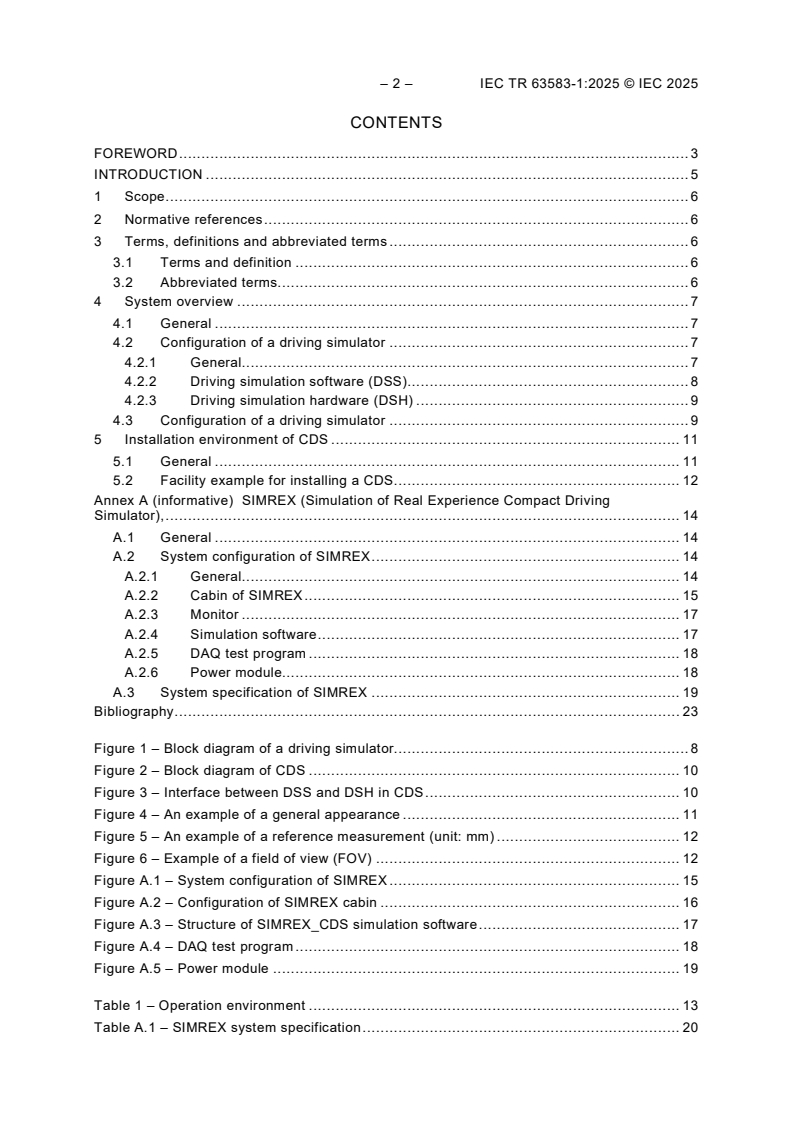
CONTENTS
FOREWORD . 3
INTRODUCTION . 5
1 Scope . 6
2 Normative references . 6
3 Terms, definitions and abbreviated terms . 6
3.1 Terms and definition . 6
3.2 Abbreviated terms. 6
4 System overview . 7
4.1 General . 7
4.2 Configuration of a driving simulator . 7
4.2.1 General. 7
4.2.2 Driving simulation software (DSS). 8
4.2.3 Driving simulation hardware (DSH) . 9
4.3 Configuration of a driving simulator . 9
5 Installation environment of CDS . 11
5.1 General . 11
5.2 Facility example for installing a CDS . 12
Annex A (informative) SIMREX (Simulation of Real Experience Compact Driving
Simulator), . 14
A.1 General . 14
A.2 System configuration of SIMREX . 14
A.2.1 General. 14
A.2.2 Cabin of SIMREX . 15
A.2.3 Monitor . 17
A.2.4 Simulation software . 17
A.2.5 DAQ test program . 18
A.2.6 Power module. 18
A.3 System specification of SIMREX . 19
Bibliography . 23
Figure 1 – Block diagram of a driving simulator. 8
Figure 2 – Block diagram of CDS . 10
Figure 3 – Interface between DSS and DSH in CDS . 10
Figure 4 – An example of a general appearance . 11
Figure 5 – An example of a reference measurement (unit: mm) . 12
Figure 6 – Example of a field of view (FOV) . 12
Figure A.1 – System configuration of SIMREX . 15
Figure A.2 – Configuration of SIMREX cabin . 16
Figure A.3 – Structure of SIMREX_CDS simulation software . 17
Figure A.4 – DAQ test program . 18
Figure A.5 – Power module . 19
Table 1 – Operation environment . 13
Table A.1 – SIMREX system specification . 20
INTERNATIONAL ELECTROTECHNICAL COMMISSION
____________
MULTIMEDIA SYSTEMS AND EQUIPMENT FOR VEHICLES –
COMPACT DRIVING SIMULATOR (CDS) –
Part 1: General
FOREWORD
1) The International Electrotechnical Commission (IEC) is a worldwide organization for standardization comprising
all national electrotechnical committees (IEC National Committees). The object of IEC is to promote international
co-operation on all questions concerning standardization in the electrical and electronic fields. To this end and
in addition to other activities, IEC publishes International Standards, Technical Specifications, Technical Reports,
Publicly Available Specifications (PAS) and Guides (hereafter referred to as "IEC Publication(s)"). Their
preparation is entrusted to technical committees; any IEC National Committee interested in the subject dealt with
may participate in this preparatory work. International, governmental and non-governmental organizations liaising
with the IEC also participate in this preparation. IEC collaborates closely with the International Organization for
Standardization (ISO) in accordance with conditions determined by agreement between the two organizations.
2) The formal decisions or agreements of IEC on technical matters express, as nearly as possible, an international
consensus of opinion on the relevant subjects since each technical committee has representation from all
interested IEC National Committees.
3) IEC Publications have the form of recommendations for international use and are accepted by IEC National
Committees in that sense. While all reasonable efforts are made to ensure that the technical content of IEC
Publications is accurate, IEC cannot be held responsible for the way in which they are used or for any
misinterpretation by any end user.
4) In order to promote international uniformity, IEC National Committees undertake to apply IEC Publications
transparently to the maximum extent possible in their national and regional publications. Any divergence between
any IEC Publication and the corresponding national or regional publication shall be clearly indicated in the latter.
5) IEC itself does not provide any attestation of conformity. Independent certification bodies provide conformity
assessment services and, in some areas, access to IEC marks of conformity. IEC is not responsible for any
services carried out by independent certification bodies.
6) All users should ensure that they have the latest edition of this publication.
7) No liability shall attach to IEC or its directors, employees, servants or agents including individual experts and
members of its technical committees and IEC National Committees for any personal injury, property damage or
other damage of any nature whatsoever, whether direct or indirect, or for costs (including legal fees) and
expenses arising out of the publication, use of, or reliance upon, this IEC Publication or any other IEC
Publications.
8) Attention is drawn to the Normative references cited in this publication. Use of the referenced publications is
indispensable for the correct application of this publication.
9) IEC draws attention to the possibility that the implementation of this document may involve the use of (a)
patent(s). IEC takes no position concerning the evidence, validity or applicability of any claimed patent rights in
respect thereof. As of the date of publication of this document, IEC had not received notice of (a) patent(s), which
may be required to implement this document. However, implementers are cautioned that this may not represent
the latest information, which may be obtained from the patent database available at https://patents.iec.ch. IEC
shall not be held responsible for identifying any or all such patent rights.
IEC TR 63583-1 has been prepared by technical area 17: Multimedia systems and equipment
for vehicles, of IEC technical committee 100: Audio, video and multimedia systems and
equipment. It is a Technical Report.
The text of this Technical Report is based on the following documents:
Draft Report on voting
100/4266/DTR 100/4324/RVDTR
Full information on the voting for its approval can be found in the report on voting indicated in
the above table.
The language used for the development of this Technical Report is English.
– 4 – IEC TR 63583-1:2025 © IEC 2025
This document was drafted in accordance with ISO/IEC Directives, Part 2, and developed in
accordance with ISO/IEC Directives, Part 1 and ISO/IEC Directives, IEC Supplement, available
at www.iec.ch/members_experts/refdocs. The main document types developed by IEC are
described in greater detail at www.iec.ch/publications.
A list of all parts in the IEC 63583 series, published under the general title Multimedia systems
and equipment for vehicles – Compact driving simulator (CDS), can be found on the IEC website.
The committee has decided that the contents of this document will remain unchanged until the
stability date indicated on the IEC website under webstore.iec.ch in the data related to the
specific document. At this date, the document will be
• reconfirmed,
• withdrawn, or
• revised.
INTRODUCTION
A driving simulator is a simulator for the driving of cars and other ground vehicles.
Driving simulators are used for entertainment as well as in the training of driver's education
courses taught in educational institutions and private businesses. They are also used for
research purposes in the area of human factors and medical research, to monitor driver
behaviour, performance, and attention. In the car industry, they are used to design and evaluate
new vehicles or new advanced driver assistance systems.
There are many kinds of simulators, such as ambulance simulators, car simulators, modular-
design simulators, multi-station driving simulators, truck simulators, bus simulators, and
physical simulators. This document focuses on the car simulator, which is used to train and test
novice drivers in all the skills required to pass a driver's license road test as well as hazard
perception and crash risk mitigation. A driving simulator is one of the representative areas for
the application of systems integration technology. It includes computer-simulated education and
training processes and provides for repetitive and empirical learning in immersive virtual
environments.
There are several kinds of driving simulators, such as mini-driving simulators (MDS), compact
driving simulators (CDS), and VR-based driving simulators (VDS).
The IEC 63583 series consists of two parts:
Part 1: General
Part 2: XR-based CDS .
In this document, a general description of CDS is given.
___________
Under development.
– 6 – IEC TR 63583-1:2025 © IEC 2025
MULTIMEDIA SYSTEMS AND EQUIPMENT FOR VEHICLES –
COMPACT DRIVING SIMULATOR (CDS) –
Part 1: General
1 Scope
This part of IEC TR 63583, which is a technical report, specifies the system overview of the
compact driving simulator (CDS), which is a virtual education and training system and a
compact version of a driving simulator.
2 Normative references
There are no normative references in this document.
3 Terms, definitions and abbreviated terms
3.1 Terms and definition
3.1.1
driving simulator
simulator for the driving of cars and other ground vehicles
3.1.2
compact driving simulator
compact version of a driving simulator, which is a small-sized simulator that reproduces only
the driver's seat of a vehicle
3.1.3
cabin
driver's compartment constructed with components mirroring those of an actual carand which
aims to provide a driver with a real driving environment with a control system and seat
3.2 Abbreviated terms
ASWS active steering wheel system
CD car dashboard
CDS compact driving simulator
CLS control loading system
DAQ data acquisition
DSH driving simulation hardware
DSS driving simulation software
FOV field of view
GUI graphic user interface
LCD liquid crystal display
MDS mini-driving simulator
MS motion system
RPM revolutions per minute
RTOS real-time operation software
SE simulation engine
SS sound system
VD visual database
VDS vehicle-dynamic software
VR-HMD virtual reality head-mounted display
VS visual system
4 System overview
4.1 General
The concept of virtual education and training systems is introduced in the white paper
"Guidelines for Developing VR and AR Based Education and Training Systems" of
ISO/IEC JTC 1/VR AR for Education Ad Hoc Group in which was published in 2019 [1] . It
provides guidelines for developing VR- and AR-based education and training systems but
excludes device hardware technology for virtual education and training systems.
The publication IEC e-tech introduced some TCs/SCs dealing with hardware and software used
in the simulation technology in their 'Behind the virtual wheel' issue titled "Simulation technology
helps advance autonomous vehicles and intelligent transport", published on 21 May 2017 [2].
A driving simulator is a type of virtual reality system that simulates the steering, accelerator,
and decelerator pedal operations that a driver performs while driving a vehicle in a driving
simulator, predicting the motion of the vehicle and delivering feedback results to the driver
through kinetic, visual, and sound signals. It is a virtual reality system that makes drivers feel
as though they are driving a vehicle, even in a driving simulator.
This document introduces a hardware technology for driving simulators. The issue of safety is
out of scope of this document.
NOTE Safety-related issues are dealt with
...