

IEC TS 62861:2017
(Main)Guidelines for principal component reliability testing for LED light sources and LED luminaires
General Information
- Abstract
IEC TS 62861:2017(E) This Technical Specification provides guidelines for establishing confidence in product reliability using principal component testing for LED light sources and LED luminaires for general lighting. It includes methods and criteria using initial qualification tests and accelerated stress tests of the principal components. The performance of any principal component will influence the performance of the final product.
Techniques to validate full lifetime claims and lumen maintenance projection are outside the scope of this Technical Specification. The following principal components are included in the testing if they are used as an integral part for the LED light source or LED luminaire:
- LED package and interconnects;
- optical materials;
- electronic subassemblies;
- cooling systems, both active (e.g. fans) and passive (e.g. thermal interface material);
- construction materials.
This Technical Specification is not recommended for use as a normative reference to the LED product performance standards.
- Status
- Published
- Publication Date
- 02-Mar-2017
- Technical Committee
- SC 34A - Electric light sources
- Current Stage
- PPUB - Publication issued
- Start Date
- 03-Mar-2017
- Completion Date
- 13-Mar-2017
Overview
IEC TS 62861:2017 - Guidelines for principal component reliability testing for LED light sources and LED luminaires - is a Technical Specification from the IEC that provides structured guidance for establishing confidence in product reliability through principal component testing. The document focuses on initial qualification tests and accelerated stress tests (AST) of the main components that determine final product performance. It explicitly excludes techniques for validating full lifetime claims and lumen maintenance projection.
Key topics and technical requirements
- Scope of components: testing of integral principal components such as LED packages and interconnects, optical materials, electronic subassemblies, active and passive cooling systems, and construction materials.
- Test strategy: combination of initial qualification tests and accelerated stress tests to detect failure modes that influence product reliability.
- Sampling and production requirements: guidance on sampling, production-representative test articles, and moisture preconditioning before tests.
- Measurement and acceptance: pre- and post-stress electrical, photometric and visual inspections; defined failure criteria for each component class.
- Component-specific tests:
- LED packages: thermal characteristics, solderability/RSH (reflow) testing, ESD (HBM), thermo-mechanical and humidity stresses.
- Optical materials: adhesion, humidity/boiling/oven water exposure, temperature and light exposure.
- Electronics: temperature/humidity with operation (PTC/HOT), electrical performance checks.
- Cooling systems: thermal resistance, cooling performance, dust and life tests for active/passive solutions.
- Construction materials: mechanical interfaces and chemical interactions.
- Modeling & prediction: Annex B lists acceleration models (Arrhenius, Eyring, Coffin–Manson, Norris–Landzberg, Peck, inverse power law, generalized Eyring) and sample-size guidance for AST.
- System reliability methods: Annex C covers reliability modeling approaches (block diagrams, fault trees, Markov chains, Bayesian networks).
- Documentation: Annex F provides a template for a principal component test report; Annex D contains qualification flowcharts.
Applications and practical value
- Use this specification to design robust reliability test programs for LED components used in general lighting products.
- Helps manufacturers and test labs identify vulnerable components and select appropriate accelerated stress tests to shorten time-to-decision.
- Supports product development, supplier qualification, and risk reduction for thermal, mechanical, optical, and electronic failure modes.
- Facilitates consistent reporting and traceability of component-level reliability evidence.
Who should use this standard
- LED and luminaire manufacturers, reliability engineers, component suppliers, test laboratories, and product compliance teams seeking structured guidance for LED reliability testing of principal components.
Related standards
- IEC TS 62861:2017 is a Technical Specification and is not recommended as a normative reference for LED product performance standards; it is intended to be used alongside applicable LED performance and safety standards to support reliability validation.
Get Certified
Connect with accredited certification bodies for this standard

IMQ S.p.A. (Certification)
Italian electrical product certification.

SLG Prüf- und Zertifizierungs GmbH
German testing and certification body.

UL Solutions
Global safety science company with testing, inspection and certification.
Sponsored listings
Frequently Asked Questions
IEC TS 62861:2017 is a technical specification published by the International Electrotechnical Commission (IEC). Its full title is "Guidelines for principal component reliability testing for LED light sources and LED luminaires". This standard covers: IEC TS 62861:2017(E) This Technical Specification provides guidelines for establishing confidence in product reliability using principal component testing for LED light sources and LED luminaires for general lighting. It includes methods and criteria using initial qualification tests and accelerated stress tests of the principal components. The performance of any principal component will influence the performance of the final product. Techniques to validate full lifetime claims and lumen maintenance projection are outside the scope of this Technical Specification. The following principal components are included in the testing if they are used as an integral part for the LED light source or LED luminaire: - LED package and interconnects; - optical materials; - electronic subassemblies; - cooling systems, both active (e.g. fans) and passive (e.g. thermal interface material); - construction materials. This Technical Specification is not recommended for use as a normative reference to the LED product performance standards.
IEC TS 62861:2017(E) This Technical Specification provides guidelines for establishing confidence in product reliability using principal component testing for LED light sources and LED luminaires for general lighting. It includes methods and criteria using initial qualification tests and accelerated stress tests of the principal components. The performance of any principal component will influence the performance of the final product. Techniques to validate full lifetime claims and lumen maintenance projection are outside the scope of this Technical Specification. The following principal components are included in the testing if they are used as an integral part for the LED light source or LED luminaire: - LED package and interconnects; - optical materials; - electronic subassemblies; - cooling systems, both active (e.g. fans) and passive (e.g. thermal interface material); - construction materials. This Technical Specification is not recommended for use as a normative reference to the LED product performance standards.
IEC TS 62861:2017 is classified under the following ICS (International Classification for Standards) categories: 01 - GENERALITIES. TERMINOLOGY. STANDARDIZATION. DOCUMENTATION; 29.140.99 - Other standards related to lamps. The ICS classification helps identify the subject area and facilitates finding related standards.
IEC TS 62861:2017 is available in PDF format for immediate download after purchase. The document can be added to your cart and obtained through the secure checkout process. Digital delivery ensures instant access to the complete standard document.
Standards Content (Sample)
IEC TS 62861 ®
Edition 1.0 2017-03
TECHNICAL
SPECIFICATION
Guidelines for principal component reliability testing for LED light sources and
LED luminaires
All rights reserved. Unless otherwise specified, no part of this publication may be reproduced or utilized in any form
or by any means, electronic or mechanical, including photocopying and microfilm, without permission in writing from
either IEC or IEC's member National Committee in the country of the requester. If you have any questions about IEC
copyright or have an enquiry about obtaining additional rights to this publication, please contact the address below or
your local IEC member National Committee for further information.
IEC Central Office Tel.: +41 22 919 02 11
3, rue de Varembé Fax: +41 22 919 03 00
CH-1211 Geneva 20 info@iec.ch
Switzerland www.iec.ch
About the IEC
The International Electrotechnical Commission (IEC) is the leading global organization that prepares and publishes
International Standards for all electrical, electronic and related technologies.
About IEC publications
The technical content of IEC publications is kept under constant review by the IEC. Please make sure that you have the
latest edition, a corrigenda or an amendment might have been published.
IEC Catalogue - webstore.iec.ch/catalogue Electropedia - www.electropedia.org
The stand-alone application for consulting the entire The world's leading online dictionary of electronic and
bibliographical information on IEC International Standards, electrical terms containing 20 000 terms and definitions in
Technical Specifications, Technical Reports and other English and French, with equivalent terms in 16 additional
documents. Available for PC, Mac OS, Android Tablets and languages. Also known as the International Electrotechnical
iPad. Vocabulary (IEV) online.
IEC publications search - www.iec.ch/searchpub IEC Glossary - std.iec.ch/glossary
The advanced search enables to find IEC publications by a 65 000 electrotechnical terminology entries in English and
variety of criteria (reference number, text, technical French extracted from the Terms and Definitions clause of
committee,…). It also gives information on projects, replaced IEC publications issued since 2002. Some entries have been
and withdrawn publications. collected from earlier publications of IEC TC 37, 77, 86 and
CISPR.
IEC Just Published - webstore.iec.ch/justpublished
Stay up to date on all new IEC publications. Just Published IEC Customer Service Centre - webstore.iec.ch/csc
details all new publications released. Available online and If you wish to give us your feedback on this publication or
also once a month by email. need further assistance, please contact the Customer Service
Centre: csc@iec.ch.
IEC TS 62861 ®
Edition 1.0 2017-03
TECHNICAL
SPECIFICATION
Guidelines for principal component reliability testing for LED light sources and
LED luminaires
INTERNATIONAL
ELECTROTECHNICAL
COMMISSION
ICS 29.140.99 ISBN 978-2-8322-4017-5
– 2 – IEC TS 62861:2017 © IEC 2017
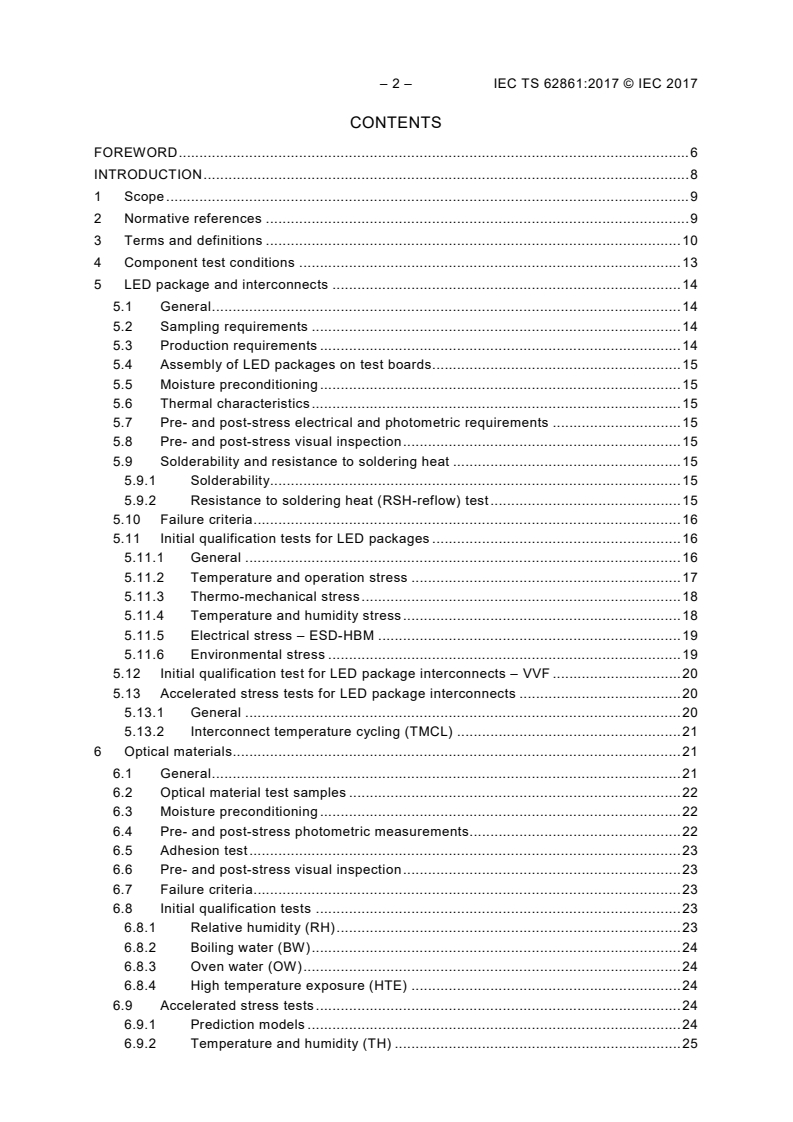
CONTENTS
FOREWORD . 6
INTRODUCTION . 8
1 Scope . 9
2 Normative references . 9
3 Terms and definitions . 10
4 Component test conditions . 13
5 LED package and interconnects . 14
5.1 General . 14
5.2 Sampling requirements . 14
5.3 Production requirements . 14
5.4 Assembly of LED packages on test boards. 15
5.5 Moisture preconditioning . 15
5.6 Thermal characteristics . 15
5.7 Pre- and post-stress electrical and photometric requirements . 15
5.8 Pre- and post-stress visual inspection . 15
5.9 Solderability and resistance to soldering heat . 15
5.9.1 Solderability. 15
5.9.2 Resistance to soldering heat (RSH-reflow) test . 15
5.10 Failure criteria . 16
5.11 Initial qualification tests for LED packages . 16
5.11.1 General . 16
5.11.2 Temperature and operation stress . 17
5.11.3 Thermo-mechanical stress . 18
5.11.4 Temperature and humidity stress . 18
5.11.5 Electrical stress – ESD-HBM . 19
5.11.6 Environmental stress . 19
5.12 Initial qualification test for LED package interconnects – VVF . 20
5.13 Accelerated stress tests for LED package interconnects . 20
5.13.1 General . 20
5.13.2 Interconnect temperature cycling (TMCL) . 21
6 Optical materials. 21
6.1 General . 21
6.2 Optical material test samples . 22
6.3 Moisture preconditioning . 22
6.4 Pre- and post-stress photometric measurements . 22
6.5 Adhesion test . 23
6.6 Pre- and post-stress visual inspection . 23
6.7 Failure criteria . 23
6.8 Initial qualification tests . 23
6.8.1 Relative humidity (RH) . 23
6.8.2 Boiling water (BW) . 24
6.8.3 Oven water (OW) . 24
6.8.4 High temperature exposure (HTE) . 24
6.9 Accelerated stress tests . 24
6.9.1 Prediction models . 24
6.9.2 Temperature and humidity (TH) . 25
6.9.3 Temperature and light exposure (TL) . 25
6.10 Light-transmitting materials . 26
6.11 Light-reflecting materials . 26
6.11.1 Dichroic-coated glass and aluminium-coated glass . 26
6.11.2 Aluminium-coated plastic . 26
6.11.3 White plastic/non-coated plastic . 26
6.12 Optical converters . 27
7 Electronic subassemblies . 27
7.1 General . 27
7.2 Sampling requirements . 27
7.3 Production requirements . 27
7.4 Pre- and post-stress electrical requirements . 28
7.5 Pre- and post-stress visual inspection . 28
7.6 Failure criteria . 28
7.7 Initial qualification tests . 28
7.7.1 Temperature and operation stress (PTC) . 28
7.7.2 Humidity and operation stress (HOT) . 29
7.8 Accelerated stress tests . 29
7.8.1 Prediction models . 29
7.8.2 Temperature, humidity and operation stress (sequential ALT) . 29
8 Active and passive cooling systems . 30
8.1 General . 30
8.2 Cooling system test samples . 31
8.3 Moisture preconditioning . 32
8.4 Thermal resistance test . 32
8.5 Performance parameter test . 32
8.6 Pre- and post-stress cooling performance requirements . 32
8.7 Pre- and post-stress visual inspection . 32
8.8 Failure criteria . 32
8.9 Initial qualification tests . 33
8.9.1 General . 33
8.9.2 Dust. 33
8.10 Accelerated stress tests . 34
8.10.1 General . 34
8.10.2 Cyclic temperature test (CT) with humidity and with/without operational
stress . 34
8.10.3 Temperature life test (TLT) passive cooling system . 34
8.10.4 Temperature life test (TLT) active cooling system . 35
9 Construction materials . 35
9.1 General . 35
9.2 Mechanical components and interconnects . 36
9.3 Mechanical interfaces between different components . 36
9.4 Chemical interactions . 37
10 Final product testing . 38
10.1 General . 38
10.2 Principal component reliability in the final product . 38
10.3 Minimum validated AST time . 39
10.4 Final product qualification for reliability . 40
11 Product updates . 40
– 4 – IEC TS 62861:2017 © IEC 2017
Annex A (informative) Application profiles . 42
Annex B (informative) Acceleration models . 43
B.1 General . 43
B.2 Arrhenius model . 43
B.3 Eyring model . 44
B.4 Coffin-Manson model . 44
B.5 Norris-Landzberg model . 44
B.6 (Inverse) power law. 45
B.7 Peck model . 45
B.8 Generalized Eyring model . 45
B.9 Sample size calculation . 46
B.10 Basic guidelines . 47
B.11 Example. 47
Annex C (informative) System reliability . 49
C.1 General . 49
C.2 Basic principles . 49
C.3 Testing on the system level . 49
C.4 System reliability prediction . 50
C.4.1 General . 50
C.4.2 Block diagrams . 50
C.4.3 Fault tree . 51
C.4.4 Markov chains . 51
C.4.5 Bayesian networks . 51
C.4.6 Chi-square . 52
Annex D (informative) Qualification flowcharts . 54
D.1 General . 54
D.2 Qualification flowcharts of principal components . 54
Annex E (informative) Physical analysis for principal components . 59
E.1 General . 59
E.2 DPA for LED packages and interconnects . 59
E.3 DPA for optical materials . 60
E.4 PA for electronics . 60
E.5 PA for active and passive cooling systems . 61
E.6 DPA for mechanical . 61
Annex F (normative) Principal component test report . 62
Bibliography . 64
Figure D.1 – Qualification flowchart for LED package and interconnects . 54
Figure D.2 – Qualification flowchart for optical materials . 55
Figure D.3 – Qualification flowchart for electronic subassemblies . 56
Figure D.4 – Qualification flowchart for active and passive cooling systems . 57
Figure D.5 – Qualification flowchart for construction materials . 58
Table 1 – Mapping the LED package interconnects qualification tests to the useable
acceleration model with typical range of the acceleration factor . 20
Table 2 – Duration (cycles) of temperature application . 21
Table 3 – Mapping of the optical-material related accelerated stress tests . 24
Table 4 – Mapping the electronic subassembly qualification tests to the useable
acceleration model with typical range of the acceleration factor . 29
Table 5 – Example ALT profile for an electronic subassembly . 30
Table 6 – Examples of stressors, affected part of the cooling systems and its reliability
effect. . 31
Table 7 – Mapping the cooling system qualification tests to the useable acceleration
model with typical range of the acceleration factor . 34
Table 8 – List of undesired chemicals in LED products for general lighting. . 38
Table 9 – Influence of the principal components on the final product. . 39
Table 10 – Example list of validated AST times. . 40
Table 11 – Minor and major change list per principal component. . 41
Table A.1 – Example of two application profiles . 42
Table B.1 – Sample sizes versus confidence and reliability level assuming L = T × AF . 47
Table B.2 – Example of calculated acceleration factors . 48
Table C.1 – Example test scheme and results for Chi-square. 53
Table F.1 – Example overview reporting format . 63
– 6 – IEC TS 62861:2017 © IEC 2017
INTERNATIONAL ELECTROTECHNICAL COMMISSION
____________
GUIDELINES FOR PRINCIPAL COMPONENT RELIABILITY
TESTING FOR LED LIGHT SOURCES AND LED LUMINAIRES
FOREWORD
1) The International Electrotechnical Commission (IEC) is a worldwide organization for standardization comprising
all national electrotechnical committees (IEC National Committees). The object of IEC is to promote
international co-operation on all questions concerning standardization in the electrical and electronic fields. To
this end and in addition to other activities, IEC publishes International Standards, Technical Specifications,
Technical Reports, Publicly Available Specifications (PAS) and Guides (hereafter referred to as “IEC
Publication(s)”). Their preparation is entrusted to technical committees; any IEC National Committee interested
in the subject dealt with may participate in this preparatory work. International, governmental and non-
governmental organizations liaising with the IEC also participate in this preparation. IEC collaborates closely
with the International Organization for Standardization (ISO) in accordance with conditions determined by
agreement between the two organizations.
2) The formal decisions or agreements of IEC on technical matters express, as nearly as possible, an international
consensus of opinion on the relevant subjects since each technical committee has representation from all
interested IEC National Committees.
3) IEC Publications have the form of recommendations for international use and are accepted by IEC National
Committees in that sense. While all reasonable efforts are made to ensure that the technical content of IEC
Publications is accurate, IEC cannot be held responsible for the way in which they are used or for any
misinterpretation by any end user.
4) In order to promote international uniformity, IEC National Committees undertake to apply IEC Publications
transparently to the maximum extent possible in their national and regional publications. Any divergence
between any IEC Publication and the corresponding national or regional publication shall be clearly indicated in
the latter.
5) IEC itself does not provide any attestation of conformity. Independent certification bodies provide conformity
assessment services and, in some areas, access to IEC marks of conformity. IEC is not responsible for any
services carried out by independent certification bodies.
6) All users should ensure that they have the latest edition of this publication.
7) No liability shall attach to IEC or its directors, employees, servants or agents including individual experts and
members of its technical committees and IEC National Committees for any personal injury, property damage or
other damage of any nature whatsoever, whether direct or indirect, or for costs (including legal fees) and
expenses arising out of the publication, use of, or reliance upon, this IEC Publication or any other IEC
Publications.
8) Attention is drawn to the Normative references cited in this publication. Use of the referenced publications is
indispensable for the correct application of this publication.
9) Attention is drawn to the possibility that some of the elements of this IEC Publication may be the subject of
patent rights. IEC shall not be held responsible for identifying any or all such patent rights.
The main task of IEC technical committees is to prepare International Standards. In
exceptional circumstances, a technical committee may propose the publication of a technical
specification when
• the required support cannot be obtained for the publication of an International Standard,
despite repeated efforts, or
• the subject is still under technical development or where, for any other reason, there is the
future but no immediate possibility of an agreement on an International Standard.
Technical specifications are subject to review within three years of publication to decide
whether they can be transformed into International Standards.
IEC TS 62861, which is a Technical Specification, has been prepared by subcommittee 34A:
Lamps, of IEC technical committee 34: Lamps and related equipment.
The text of this Technical Specification is based on the following documents:
Enquiry draft Report on voting
34A/1884/DTS 34A/1966/RVDTS
Full information on the voting for the approval of this technical specification can be found in
the report on voting indicated in the above table.
This document has been drafted in accordance with the ISO/IEC Directives, Part 2.
The committee has decided that the contents of this publication will remain unchanged until
the stability date indicated on the IEC website under "http://webstore.iec.ch" in the data
related to the specific publication. At this date, the publication will be
• transformed into an International standard,
• reconfirmed,
• withdrawn,
• replaced by a revised edition, or
• amended.
A bilingual version of this publication may be issued at a later date.
– 8 – IEC TS 62861:2017 © IEC 2017
INTRODUCTION
LED products depend generally on how balanced its principal components are in terms of
their reliability. It is not only the LED components that determine product performance, but
also other parts of the LED product play an equally important role. For instance, electronic
subassemblies, optics, mechanics and the involved cooling method play such a role.
This Technical Specification envisions a methodology, which addresses separate
subcomponent reliability data, to provide a basis for statistical system reliability design.
Standardized reporting formats and flowcharts are presented.
Next, protocols based on accelerated methods are given to estimate system reliability of the
final product using subcomponent data.
Verification of LED product lifetime is based on a ‘test to pass’ principle, which means the
components of the product under test are evaluated to give equivalent reliability confidence to
that which would be achieved by real-time life testing of the complete LED product. The tests
described in this Technical Specification are divided into: initial qualification tests (IQT) giving
confidence of basic component robustness, but not linked to any specific lifetime projection,
and accelerated stress tests (AST) giving confidence of reliability to a specific lifetime (within
the specified constraints of the test).
Since the approach foreseen in this Technical Specification covers a generic methodology, it
can be seen as guidance related to relevant product performance standards, such as the LED
lamp performance standard IEC 62612, the LED module performance standard IEC 62717
and LED luminaire performance standard IEC 62722-2-1. This Technical Specification is not
recommended for use as a normative reference to the LED product performance standards.
This Technical Specification addresses the need for a document giving guidance that is
developed according to consensus procedures and in itself is normative in nature, while at the
same time recognizing that LED technology for lighting products is still in an emerging phase.
This Technical Specification approaches an International standard in terms of detail and
completeness.
GUIDELINES FOR PRINCIPAL COMPONENT RELIABILITY
TESTING FOR LED LIGHT SOURCES AND LED LUMINAIRES
1 Scope
This Technical Specification provides guidelines for establishing confidence in product
reliability using principal component testing for LED light sources and LED luminaires for
general lighting. It includes methods and criteria using initial qualification tests and
accelerated stress tests of the principal components. The performance of any principal
component will influence the performance of the final product.
Techniques to validate full lifetime claims and lumen maintenance projection are outside the
scope of this Technical Specification.
The following principal components are included in the testing if they are used as an integral
part for the LED light source or LED luminaire:
• LED package and interconnects;
• optical materials;
• electronic subassemblies;
• cooling systems, both active (e.g. fans) and passive (e.g. thermal interface material);
• construction materials.
This Technical Specification is not recommended for use as a normative reference to the LED
product performance standards.
2 Normative references
The following documents are referred to in the text in such a way that some or all of their
content constitutes requirements of this document. For dated references, only the edition
cited applies. For undated references, the latest edition of the referenced document (including
any amendments) applies.
IEC 60068-2-20:2008, Environmental testing – Part 2-20: Tests – Test T: Test methods for
solderability and resistance to soldering heat of devices with leads
IEC 60068-2-27:2008, Basic environmental testing procedures – Part 2: Tests – Test Ea and
guidance: Shock
IEC 60068-2-30:2005, Environmental testing – Part 2-30: Tests – Test Db: Damp heat, cyclic
(12 h + 12 h cycle)
IEC 60068-2-42:2003, Environmental testing – Part 2-42: Tests – Test Kc: Sulphur dioxide
test for contacts and connections
IEC 60068-2-43:2003, Environmental testing – Part 2-43: Tests – Test Kd: Hydrogen sulphide
test for contacts and connections
IEC 60068-2-58:2015, Environmental testing – Part 2-58: Tests – Test Td: Test methods for
solderability, resistance to dissolution of metallization and to soldering heat of surface
mounting devices (SMD)
– 10 – IEC TS 62861:2017 © IEC 2017
IEC 60068-2-60:2015, Environmental testing – Part 2-60: Tests – Test Ke: Flowing mixed gas
corrosion test
IEC 60529:2013, Degrees of protection provided by enclosures (IP Code)
IEC 60929:2011, AC and/or DC-supplied electronic control gear for tubular fluorescent lamps
– Performance requirements
IEC 60929:2011/AMD1:2015
IEC 62504, General lighting – Light emitting diode (LED) products and related equipment –
Terms and definitions
ANSI/ESDA/JEDEC JS-001-2014, Electrostatic discharge sensitivity testing human body
model (HBM) – Component level
ASTM D5470 – 12, Standard test method for thermal transmission properties of thermally
conductive electrical insulation materials
ASTM D7027 – 13, Standard test method for evaluation of scratch resistance of polymeric
coatings and plastics using an instrumented scratch machine
ASTM E595 – 07, Standard test method for total mass loss and collected volatile condensable
materials from outgassing in a vacuum environment
IPC-9591, Performance parameters (mechanical, electrical, environmental and
quality/reliability) for air moving devices
J-STD-002D, Solderability tests for component leads, terminations, lugs, terminals and wires
J-STD-020E, Moisture/reflow sensitivity classification for nonhermetic surface mount devices
JESD22-A101C, Steady-state temperature humidity bias life test
JESD22-A104D, Temperature cycling
JESD22-A108D, Temperature, bias, and operating life
JESD22-A113F, Preconditioning of plastic surface mount devices prior to reliability testing
JESD22-B103B, Vibration, variable frequency
JESD51-51, Implementation of the electrical test method (static test method) for the
measurement of the real thermal resistance and impedance of light emitting diodes with
exposed cooling surface
MIL-C-48497A, Durability requirements for coating, single or multilayer, interference
3 Terms and definitions
For the purposes of this document, the terms and definitions given in IEC 62504 and the
following apply.
ISO and IEC maintain terminological databases for use in standardization at the following
addresses:
• IEC Electropedia: available at http://www.electropedia.org/
• ISO Online browsing platform: available at http://www.iso.org/obp
3.1
acceleration factor
AF
ratio of the time it takes for a certain fraction of the population to fail, following application of
one stress or use condition, to the corresponding time at a more severe stress or use
condition
Note 1 to entry: The failure mode and the type of the failure distribution (lognormal, Weibull, exponential or alike)
within the two stress conditions should be identical.
Note 2 to entry: Acceleration factors can be calculated for several stresses that can affect the reliability of the unit
under test, such as temperature, electrical, mechanical loads, light exposure, chemical, moisture or other stresses.
Annex B presents commonly known acceleration models.
3.2
activation energy
E
a
excess free energy over the ground state that is required in order that a particular process
occurs
Note 1 to entry: The activation energy is used in the Arrhenius equation for the thermal acceleration.
3.3
Boltzmann’s constant
k
B
−23 −5
J/K or 8,617 × 10 eV/K
constant equal to 1,381 × 10
Note 1 to entry: Boltzmann’s constant is used in the Arrhenius equation.
3.4
failure mechanism
process that leads to failure
Note 1 to entry: The process may be physical, chemical, logical, or a combination thereof.
[SOURCE: IEC 60050-192:2015, 192-03-12.]
3.5
failure mode
manner in which failure occurs
Note 1 to entry: A failure mode may be defined by the function lost or other state transition that occurred.
[SOURCE: IEC 60050-192:2015, 192-03-17, modified – do not use the wording
“DEPRECATED: fault mode”.]
3.6
failure rate
probability that a system will fail during the next specified time increment, given that it has
survived up to the current point in time
Note 1 to entry: The failure rate of a system usually depends on time, with the rate varying over the lifecycle of
the system.
Note 2 to entry: Failure rate is expressed in % failures per time unit.
– 12 – IEC TS 62861:2017 © IEC 2017
3.7
application profile
mission profile
user profile
profile describing the environmental loads that are imposed upon the product under normal
operation conditions
Note 1 to entry: Annex A presents two example application profiles.
3.8
mean time to failure
MTTF
average period of time for a system to operate without failure
3.9
power factor
ratio of the real power flowing to the load to the apparent power in the circuit
3.10
reliability
ability to perform as required, without failure, for a given time interval, under
given conditions
Note 1 to entry: The time interval duration may be expressed in units appropriate to the item concerned (e.g.
calendar time, operating cycles, distance run) and the units should always be clearly stated.
Note 2 to entry: Given conditions include aspects that affect reliability, such as: mode of operation, stress levels,
environmental conditions, and maintenance.
Note 3 to entry: Reliability may be quantified using measures defined in Section 192-05, Reliability related
concepts: measures.
[SOURCE: IEC 60050-192:2015, 192-01-24.]
3.11
sample size
representative quantity of units under test extracted from a batch of reference units
3.12
system
set of interacting or interdependent components forming an integrated whole
3.13
system reliability
probability that a system, including all hardware, firmware, and software, will satisfactorily
perform the task for which it was designed or intended, for a specified time and in a specified
environment
3.14
solder point temperature
t
s
temperature of the point near the LED package interconnect as specified by the manufacturer
of the package
3.15
cooling performance
function of a device providing cooling in an amount to maintain the performance of the
component to which it pertains
3.16
Weibull distribution
continuous probability distribution described by two parameters: scale parameter α and shape
parameter β
3.17
accelerated stress test
AST
test for which a reliability model exists for assessing reliability over a shorter time period than
a test under normal application conditions by applying an accelerating stress factor
Note 1 to entry: The reliability model can apply to components and materials.
3.18
initial qualification test
IQT
test to demonstrate a basic level of robustness by applying a non-accelerating stress factor
Note 1 to entry: An IQT is employed when an accelerated reliability model is not appropriate.
3.19
validated AST time
mathematical product of the AST duration used for validation and the acceleration factor
4 Component test conditions
Clauses 5, 6, 7, 8 and 9 specify minimum stress-test driven qualification and reliability
requirements for the principal components of LED products. It includes references to test
conditions for each component. The purpose is to give guidance for establishing a level of
reliability for which a product is specified. What the exact level is depends on the product
specification and depends on the application profile. Stress test qualification of the principal
components is defined as successful completion of the test requirements outlined in each
clause for each principal component. Each clause specifies a set of qualification tests that
shall be considered for new LED product qualifications. In case of requalification associated
with a design or process change, a limited set of qualification tests may be considered.
This Technical Specification describes two types of qualification tests. A test for which a
reliability model exists is called an accelerated stress test (AST) for assessing reliability
results over a much shorter test time period. When a reliability model is not appropriate, then
the test is termed an initial qualification test (IQT) and used to demonstrate a basic level of
robustness. Tests in this Technical Specification are classified as either IQT or AST. The
stressors or loads that are imposed upon LED products in two example environmental
conditions are described in Annex A. These stressors also apply to the principal components.
NOTE In general, it is assumed that passing the harsher test conditions implies that the more relaxed conditions
would also be passed.
For principal components that have failed the acceptance criteria of tests required by this
Technical Specification, it is recommended to understand the failure mechanism, determine
the root cause and take corrective actions. To confirm that the failure mechanism is
understood and contained, and appropriate corrective and preventive actions are effective, it
is recommended to repeat the applicable qualification test(s) successfully.
This Technical Specification makes reference to other IEC standards or standards from other
organizations. Where relevant, further details on the tests can be found in these documents.
Test conditions in this document may deviate from test conditions in the reference documents.
In such a case, further specifications in the reference document should still be applied as
appropriate.
– 14 – IEC TS 62861:2017 © IEC 2017
5 LED package and interconnects
5.1 General
The purpose of Clause 5 is to determine that an LED package is capable of passing the
specified stress tests and thus can be expected to give a certain level of reliability in general
lighting applications. LED packages and interconnects of different types exist. There is
currently no official LED classification; they can be classified by colour (red, orange, blue,
green), mechanical outline (round, square, rectangular, surface), by materials used (full epoxy
resin packaging, metal base, ceramic base epoxy resin packaging and glass packaging)
and/or by luminous intensity (general, high-brightness, ultra-high brightness). While it is not
the intention of this Technical Specification to specify an LED classification, the following are
different common types of LED packages:
• high-power LEDs (includes high-brightness):
– wire-bonded types;
– flip-chip types;
– wafer level chip types.
• mid-power LEDs:
– mainly wire-bonded types;
– chip-on-board types (usually not reflow or wave soldering but mechanically mounted).
• lower-power LEDs:
– mainly wire-bonded types.
Subclauses 5.11, 5.12 and 5.13 specify a set of qualification tests that shall be considered for
new LED package and interconnects qualifications. Where appropriate, family qualifications
can be done, according to:
• same chip technology in different LED packages;
• same phosphor systems in different LED packages;
• same package footprint in different LED packages.
An example qualification flowchart is depicted in Figure D.1.
5.2 Sampling requirements
Unless specified otherwise, a total of at least 30 LED packages taken from three different
batches of 10 each shall be used. For family qualification, the three different batches shall be
considered to represent the variety of the qualification family.
Exceptions to the specified sample size shall be noted with the reasoning that justifies
equivalent reliability still being demonstrated. This may be appropriate where multiple
LED dies are incorporated in the package, for example chip-on-board devices.
5.3 Production requirements
All qualification LED packages shall be produced on tooling and processes representative for
those that will be used to support LED package deliveries at projected production volumes.
Sample details shall be reported in the principal component test report (Annex F).
___________
Adapted from source: LEDinside, with the permission of the author(s).
5.4 Assembly of LED packages on test boards
LED packages may need to be assembled on test boards. An appropriate choice of test
board, interconnect material and process shall be made by the manufacturer. The choice of
test board, interconnect material and process shall be documented for each individual test in
the principal component te
...