


IEC 61189-6:2006
(Main)Test methods for electrical materials, interconnection structures and assemblies - Part 6: Test methods for materials used in manufacturing electronic assemblies
General Information
- Abstract
IEC 61189-6:2006 is a catalogue of test methods representing methodologies and procedures that can be applied to materials used in manufacturing electronic assemblies.
- Status
- Withdrawn
- Publication Date
- 23-Jul-2006
- Withdrawal Date
- 28-Mar-2024
- Technical Committee
- TC 91 - Electronics assembly technology
- Drafting Committee
- WG 3 - TC 91/WG 3
- Current Stage
- WPUB - Publication withdrawn
- Start Date
- 02-Apr-2024
- Completion Date
- 29-Mar-2024
Buy Documents
IEC 61189-6:2006 - Test methods for electrical materials, interconnection structures and assemblies - Part 6: Test methods for materials used in manufacturing electronic assemblies Released:7/24/2006
IEC 61189-6:2006 - Test methods for electrical materials, interconnection structures and assemblies - Part 6: Test methods for materials used in manufacturing electronic assemblies Released:7/24/2006
Relations
- Effective Date
- 05-Sep-2023
- Effective Date
- 05-Sep-2023
Buy Documents
IEC 61189-6:2006 - Test methods for electrical materials, interconnection structures and assemblies - Part 6: Test methods for materials used in manufacturing electronic assemblies Released:7/24/2006
IEC 61189-6:2006 - Test methods for electrical materials, interconnection structures and assemblies - Part 6: Test methods for materials used in manufacturing electronic assemblies Released:7/24/2006
Frequently Asked Questions
IEC 61189-6:2006 is a standard published by the International Electrotechnical Commission (IEC). Its full title is "Test methods for electrical materials, interconnection structures and assemblies - Part 6: Test methods for materials used in manufacturing electronic assemblies". This standard covers: IEC 61189-6:2006 is a catalogue of test methods representing methodologies and procedures that can be applied to materials used in manufacturing electronic assemblies.
IEC 61189-6:2006 is a catalogue of test methods representing methodologies and procedures that can be applied to materials used in manufacturing electronic assemblies.
IEC 61189-6:2006 is classified under the following ICS (International Classification for Standards) categories: 31.180 - Printed circuits and boards. The ICS classification helps identify the subject area and facilitates finding related standards.
IEC 61189-6:2006 has the following relationships with other standards: It is inter standard links to IEC 61189-5-501:2021, IEC 61189-5-502:2021. Understanding these relationships helps ensure you are using the most current and applicable version of the standard.
IEC 61189-6:2006 is available in PDF format for immediate download after purchase. The document can be added to your cart and obtained through the secure checkout process. Digital delivery ensures instant access to the complete standard document.
Standards Content (Sample)
INTERNATIONAL IEC
STANDARD 61189-6
First edition
2006-07
Test methods for electrical materials,
interconnection structures and assemblies –
Part 6:
Test methods for materials used
in manufacturing electronic assemblies
Reference number
Publication numbering
As from 1 January 1997 all IEC publications are issued with a designation in the
60000 series. For example, IEC 34-1 is now referred to as IEC 60034-1.
Consolidated editions
The IEC is now publishing consolidated versions of its publications. For example,
edition numbers 1.0, 1.1 and 1.2 refer, respectively, to the base publication, the
base publication incorporating amendment 1 and the base publication incorporating
amendments 1 and 2.
Further information on IEC publications
The technical content of IEC publications is kept under constant review by the IEC,
thus ensuring that the content reflects current technology. Information relating to
this publication, including its validity, is available in the IEC Catalogue of
publications (see below) in addition to new editions, amendments and corrigenda.
Information on the subjects under consideration and work in progress undertaken
by the technical committee which has prepared this publication, as well as the list
of publications issued, is also available from the following:
• IEC Web Site (www.iec.ch)
• Catalogue of IEC publications
The on-line catalogue on the IEC web site (www.iec.ch/searchpub) enables you to
search by a variety of criteria including text searches, technical committees
and date of publication. On-line information is also available on recently issued
publications, withdrawn and replaced publications, as well as corrigenda.
• IEC Just Published
This summary of recently issued publications (www.iec.ch/online_news/ justpub)
is also available by email. Please contact the Customer Service Centre (see
below) for further information.
• Customer Service Centre
If you have any questions regarding this publication or need further assistance,
please contact the Customer Service Centre:
Email: custserv@iec.ch
Tel: +41 22 919 02 11
Fax: +41 22 919 03 00
INTERNATIONAL IEC
STANDARD 61189-6
First edition
2006-07
Test methods for electrical materials,
interconnection structures and assemblies –
Part 6:
Test methods for materials used
in manufacturing electronic assemblies
IEC 2006 Copyright - all rights reserved
No part of this publication may be reproduced or utilized in any form or by any means, electronic or
mechanical, including photocopying and microfilm, without permission in writing from the publisher.
International Electrotechnical Commission, 3, rue de Varembé, PO Box 131, CH-1211 Geneva 20, Switzerland
Telephone: +41 22 919 02 11 Telefax: +41 22 919 03 00 E-mail: inmail@iec.ch Web: www.iec.ch
PRICE CODE
Commission Electrotechnique Internationale X
International Electrotechnical Commission
МеждународнаяЭлектротехническаяКомиссия
For price, see current catalogue
– 2 – 61189-6 IEC:2006(E)
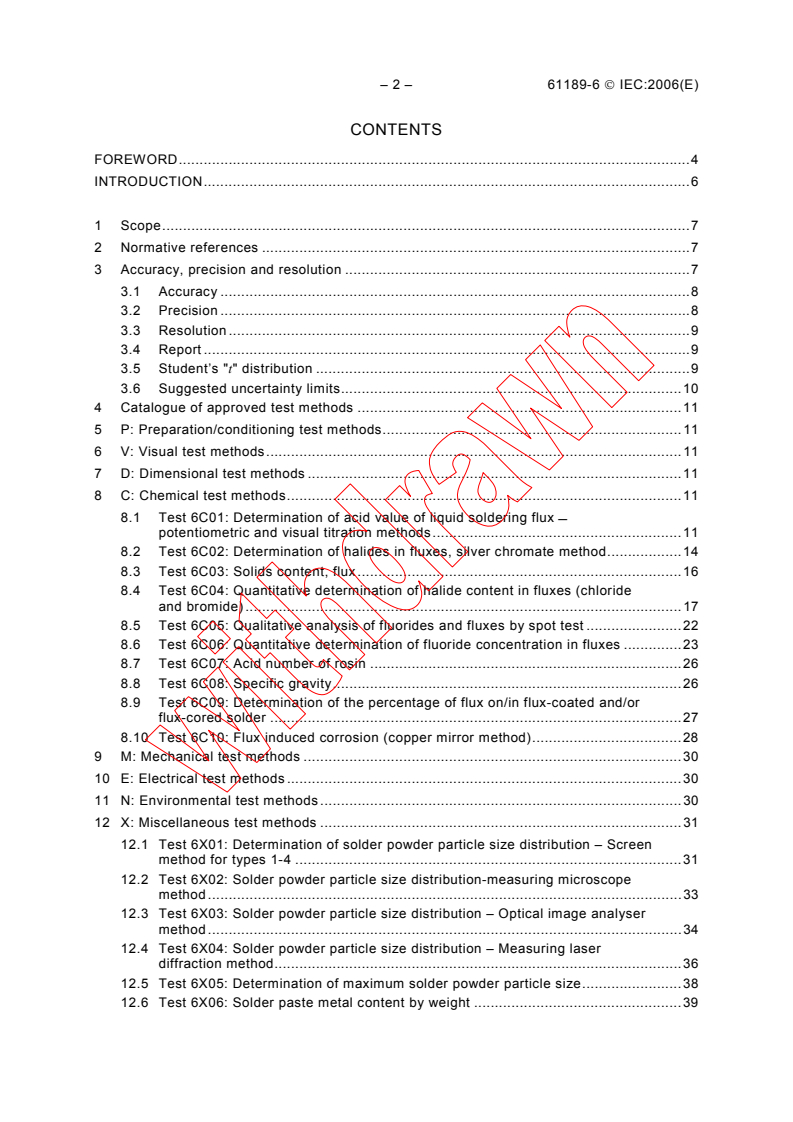
CONTENTS
FOREWORD.4
INTRODUCTION.6
1 Scope.7
2 Normative references .7
3 Accuracy, precision and resolution .7
3.1 Accuracy .8
3.2 Precision .8
3.3 Resolution .9
3.4 Report .9
3.5 Student’s "t" distribution .9
3.6 Suggested uncertainty limits.10
4 Catalogue of approved test methods .11
5 P: Preparation/conditioning test methods.11
6 V: Visual test methods.11
7 D: Dimensional test methods .11
8 C: Chemical test methods.11
8.1 Test 6C01: Determination of acid value of liquid soldering flux
potentiometric and visual titration methods.11
8.2 Test 6C02: Determination of halides in fluxes, silver chromate method.14
8.3 Test 6C03: Solids content, flux .16
8.4 Test 6C04: Quantitative determination of halide content in fluxes (chloride
and bromide) .17
8.5 Test 6C05: Qualitative analysis of fluorides and fluxes by spot test .22
8.6 Test 6C06: Quantitative determination of fluoride concentration in fluxes .23
8.7 Test 6C07: Acid number of rosin .26
8.8 Test 6C08: Specific gravity.26
8.9 Test 6C09: Determination of the percentage of flux on/in flux-coated and/or
flux-cored solder .27
8.10 Test 6C10: Flux induced corrosion (copper mirror method).28
9 M: Mechanical test methods .30
10 E: Electrical test methods .30
11 N: Environmental test methods.30
12 X: Miscellaneous test methods .31
12.1 Test 6X01: Determination of solder powder particle size distribution – Screen
method for types 1-4 .31
12.2 Test 6X02: Solder powder particle size distribution-measuring microscope
method.33
12.3 Test 6X03: Solder powder particle size distribution – Optical image analyser
method.34
12.4 Test 6X04: Solder powder particle size distribution – Measuring laser
diffraction method.36
12.5 Test 6X05: Determination of maximum solder powder particle size.38
12.6 Test 6X06: Solder paste metal content by weight .39
61189-6 IEC:2006(E) – 3 –
Figure 1 – Chlorides and/or bromides test results .16
Figure 2 – Test equipment of specific gravity (hydrometer reading).26
Figure 3 – Flux type classification by copper mirror test.30
Table 1 – Student’s "t" distribution .10
Table 2 – Relation between halide content and mass of specimen .20
Table 3 – Mixing ratio from specimen size to water quantity.23
Table 4 – Specimen size to chloroform mixture .24
Table 5 – Screen opening .32
Table 6 – Portions of particle sizes by weight % – nominal values .32
Table 7 – Powder particle size distribution record .32
Table 8 – Powder particle size distribution record .34
Table 9 – Powder particle size distribution record (optical analysis) .36
Table 10 – Powder particle size distribution record .37
Table 11 – Acceptance of powders by particle sizes .38
Table 12 – Test report on solder paste.39
Table 13 – Test report on solder paste.41
– 4 – 61189-6 IEC:2006(E)
INTERNATIONAL ELECTROTECHNICAL COMMISSION
___________
TEST METHODS FOR ELECTRICAL MATERIALS,
INTERCONNECTION STRUCTURES AND ASSEMBLIES –
Part 6: Test methods for materials used
in manufacturing electronic assemblies
FOREWORD
1) The International Electrotechnical Commission (IEC) is a worldwide organization for standardization comprising
all national electrotechnical committees (IEC National Committees). The object of IEC is to promote
international co-operation on all questions concerning standardization in the electrical and electronic fields. To
this end and in addition to other activities, IEC publishes International Standards, Technical Specifications,
Technical Reports, Publicly Available Specifications (PAS) and Guides (hereafter referred to as “IEC
Publication(s)”). Their preparation is entrusted to technical committees; any IEC National Committee interested
in the subject dealt with may participate in this preparatory work. International, governmental and non-
governmental organizations liaising with the IEC also participate in this preparation. IEC collaborates closely
with the International Organization for Standardization (ISO) in accordance with conditions determined by
agreement between the two organizations.
2) The formal decisions or agreements of IEC on technical matters express, as nearly as possible, an international
consensus of opinion on the relevant subjects since each technical committee has representation from all
interested IEC National Committees.
3) IEC Publications have the form of recommendations for international use and are accepted by IEC National
Committees in that sense. While all reasonable efforts are made to ensure that the technical content of IEC
Publications is accurate, IEC cannot be held responsible for the way in which they are used or for any
misinterpretation by any end user.
4) In order to promote international uniformity, IEC National Committees undertake to apply IEC Publications
transparently to the maximum extent possible in their national and regional publications. Any divergence
between any IEC Publication and the corresponding national or regional publication shall be clearly indicated in
the latter.
5) IEC provides no marking procedure to indicate its approval and cannot be rendered responsible for any
equipment declared to be in conformity with an IEC Publication.
6) All users should ensure that they have the latest edition of this publication.
7) No liability shall attach to IEC or its directors, employees, servants or agents including individual experts and
members of its technical committees and IEC National Committees for any personal injury, property damage or
other damage of any nature whatsoever, whether direct or indirect, or for costs (including legal fees) and
expenses arising out of the publication, use of, or reliance upon, this IEC Publication or any other IEC
Publications.
8) Attention is drawn to the Normative references cited in this publication. Use of the referenced publications is
indispensable for the correct application of this publication.
9) Attention is drawn to the possibility that some of the elements of this IEC Publication may be the subject of
patent rights. IEC shall not be held responsible for identifying any or all such patent rights.
International Standard IEC 61189-6 has been prepared by IEC technical committee 91:
Electronic assembly technology.
The text of this standard is based on the following documents:
FDIS Report on voting
91/593/FDIS 91/610/RVD
Full information on the voting for the approval of this standard can be found in the report on
voting indicated in the above table.
61189-6 IEC:2006(E) – 5 –
This publication has been drafted in accordance with the ISO/IEC Directives, Part 2.
This standard should be used in conjunction with the following parts of IEC 61189, under the
main title Test methods for electrical materials, interconnection structures and assemblies:
Part 1: General test methods and methodology
Part 2: Test methods for materials for interconnection structures
Part 3: Test methods for interconnection structures (printed boards)
Part 4: Test methods for electronic components assembling characteristics
Part 5: Test methods for printed board assemblies,
and also the following standard:
IEC 60068: Environmental testing
The committee has decided that the contents of this publication will remain unchanged until
the maintenance result date indicated on the IEC web site under "http://webstore.iec.ch" in
the data related to the specific publication. At this date, the publication will be
• reconfirmed;
• withdrawn;
• replaced by a revised edition, or
• amended.
A bilingual version of this publication may be issued at a later date.
– 6 – 61189-6 IEC:2006(E)
INTRODUCTION
IEC 61189 relates to test methods for printed boards and printed board assemblies, as well as
related materials or component robustness, irrespective of their method of manufacture.
The IEC 61189 series is divided into separate parts, covering information for the designer and
the test methodology engineer or technician. Each part has a specific focus; methods are
grouped according to their application and numbered sequentially as they are developed and
released.
In some instances test methods developed by other TCs (e.g. TC 104) have been reproduced
from existing IEC standards in order to provide the reader with a comprehensive set of test
methods. When this situation occurs, it will be noted on the specific test method; if the test
method is reproduced with minor revision, those paragraphs that are different are identified.
This part of IEC 61189 contains test methods for evaluating materials used in manufacturing
electronic assemblies. The methods are self-contained, with sufficient detail and description
so as to achieve uniformity and reproducibility in the procedures and test methodologies.
The tests shown in this standard are grouped according to the following principles:
P: preparation/conditioning methods
V: visual test methods
D: dimensional test methods
C: chemical test methods
M: mechanical test methods
E: electrical test methods
N: environmental test methods
X: miscellaneous test methods
To facilitate reference to the tests, to retain consistency of presentation, and to provide for
future expansion, each test is identified by a number (assigned sequentially) added to the
prefix (group code) letter showing the group to which the test method belongs.
The test method numbers have no significance with respect to an eventual test sequence; that
responsibility rests with the relevant specification that calls for the method being performed.
The relevant specification, in most instances, also describes pass/fail criterion.
The letter and number combinations are for reference purposes, to be used by the relevant
specification. Thus "6C02" represents the s chemical test method described in this “Part 6” of
IEC 61189. In this example, 6 is the part of IEC standard (61189-6), C is the group of
methods, and 02 is the test number.
61189-6 IEC:2006(E) – 7 –
TEST METHODS FOR ELECTRICAL MATERIALS,
INTERCONNECTION STRUCTURES AND ASSEMBLIES –
Part 6: Test methods for materials used
in manufacturing electronic assemblies
1 Scope
This part of IEC 61189 is a catalogue of test methods representing methodologies and
procedures that can be applied to materials used in manufacturing electronic assemblies.
2 Normative references
The following referenced documents are indispensable for the application of this document.
For dated references, only the edition cited applies. For undated references, the latest edition
of the referenced document (including any amendments) applies.
IEC 60068-1:1988, Environmental testing – Part 1: General and guidance
IEC 61189-1, Test methods for electrical materials, interconnection structures and assemblies
– Part 1: General test methods and methodology
IEC 61190-1-1, Attachment materials for electronic assembly – Part 1-1: Requirements for
soldering fluxes for high-quality interconnections in electronics assembly
IEC 61190-1-3, Attachment materials for electronic assembly – Part 1-3: Requirements for
electronic grade solder alloys and fluxed and non-fluxed solid solders for electronic soldering
applications
ISO 9001, Quality management systems – Requirements
ISO 9455 (all parts), Soft soldering fluxes – Test methods
3 Accuracy, precision and resolution
Errors and uncertainties are inherent in all measurement processes. The information given
below enables valid estimates of the amount of error and uncertainty to be taken into account.
Test data serve a number of purposes which include:
– monitoring a process;
– enhancing confidence in quality conformance;
– arbitrating between customer and supplier.
In any of these circumstances, it is essential that confidence can be placed upon the test data
in terms of
– accuracy; calibration of the test instruments and/or system,
– precision; the repeatability and uncertainty of the measurement,
– resolution; the suitability of the test instrument and/or system.
– 8 – 61189-6 IEC:2006(E)
3.1 Accuracy
The regime by which routine calibration of the test equipment is undertaken shall be clearly
stated in the quality documentation of the supplier or agency conducting the test, and shall
meet the requirements of ISO 9001.
The calibration shall be conducted by an agency having accreditation to a national or
international measurement standard institute. There should be an uninterrupted chain of
calibration to a national or international standard.
Where calibration to a national or international standard is not possible, “round robin"
techniques may be used and documented to enhance confidence in measurement accuracy.
The calibration interval shall normally be one year. Equipment consistently found to be
outside acceptable limits of accuracy shall be subject to shortened calibration intervals.
Equipment consistently found to be well within acceptable limits may be subject to relaxed
calibration intervals.
A record of the calibration and maintenance history shall be maintained for each instrument.
These records should state the uncertainty of the calibration technique (in ± % deviation) in
order that uncertainties of measurement can be aggregated and determined.
A procedure shall be implemented to resolve any situation where an instrument is found to be
outside calibration limits.
3.2 Precision
The uncertainty budget of any measurement technique is made up of both systematic and
random uncertainties. All estimates shall be based upon a single confidence level, the
minimum being 95 %.
Systematic uncertainties are usually the predominant contributor, and will include all
uncertainties not subject to random fluctuation. These include:
– calibration uncertainties;
– errors due to the use of an instrument under conditions which differ from those under
which it was calibrated;
– errors in the graduation of a scale of an analogue meter (scale shape error).
Random uncertainties result from numerous sources but can be deduced from repeated
measurement of a standard item. Therefore, it is not necessary to isolate the individual
contributions. These may include:
– random fluctuations such as those due to the variation of an influence parameter.
Typically, changes in atmospheric conditions reduce the repeatability of a measurement;
– uncertainty in discrimination, such as setting a pointer to a fiducial mark, or interpolating
between graduations on an analogue scale.
Aggregation of uncertainties: geometric addition (root-sum-square) of uncertainties may be
used in most cases. Interpolation error is normally added separately and may be accepted as
being 20 % of the difference between the finest graduations of the scale of the instrument:
2 2
U = ± (U + U ) + U
t s r i
where
U is the total uncertainty;
t
U is the systematic uncertainty;
s
61189-6 IEC:2006(E) – 9 –
U is the random uncertainty;
r
U is the interpolation error.
i
Determination of random uncertainties: random uncertainty can be determined by repeated
measurement of a parameter, and subsequent statistical manipulation of the measured data.
The technique assumes that the data exhibits a normal (Gaussian) distribution:
t × σ
U =
r
n
where
U is random uncertainty;
r
n is the specimen size;
t is the percentage point of the "t" distribution from 3.5, statistical tables;
σ is the standard deviation (σ ).
n–1
3.3 Resolution
It is paramount that the test equipment used is capable of sufficient resolution. Measurement
systems used should be capable of resolving 10 % (or better) of the test limit tolerance.
It is accepted that some technologies will place a physical limitation upon resolution (e.g.
optical resolution).
3.4 Report
In addition to requirements detailed in the test specification, the report shall detail:
a) the test method used;
b) the identity of the specimen(s);
c) the test instrumentation;
d) the specified limit(s);
e) an estimate of measurement uncertainty, and resultant working limit(s) for the test;
f) the detailed test results;
g) the test date, and operators’ signature.
3.5 Student’s "t" distribution
Table 1 gives values of the factor "t" for 95 % and 99 % confidence levels, as a function of the
number of measurements. It is sufficient to use a 95 % limit, as in the case of the worked
examples shown in Annex A.
– 10 – 61189-6 IEC:2006(E)
Table 1 – Student’s "t" distribution
Specimen Specimen
t value t value t value t value
size size
95 % 99 % 95 % 99 %
2 12,7 63,7 14 2,16 3,01
3 4,3 9,92 15 2,14 2,98
4 3,18 5,84 16 2,13 2,95
5 2,78 4,6 17 2,12 2,92
6 2,57 4,03 18 2,11 2,9
7 2,45 3,71 19 2,1 2,88
8 2,36 3,5 20 2,09 2,86
9 2,31 3,36 21 2,08 2,83
10 2,26 3,25 22 2,075 2,82
11 2,23 3,17 23 2,07 v2,81
12 2,2 3,11 24 2,065 2,8
13 2,18 3,05 25 2,06 2,79
3.6 Suggested uncertainty limits
The following target uncertainties are suggested:
a) voltage <1 kV: ±1,5 %
b) voltage >1 kV: ±2,5 %
c) current <20 A: ±1,5 %
d) current >20 A: ±2,5 %
Resistance
e) earth and continuity: ±10 %
f) insulation: ±10 %
g) frequency: ±0,2 %
Time
h) interval <60 s: ±1 s
i) interval >60 s: ±2 %
j) mass <10 g: ±0,5 %
k) mass (10 – 100) g: ±1 %
l) mass >100 g: ±2 %
m) force: ±2 %
n) dimension <25 mm: ±0,5 %
o) dimension >25 mm: ±0,1 mm
p) temperature <100 °C: ±1,5 %
q) temperature >100 °C: ±3,5 %
r) humidity (30 – 75) % RH: ±5 % RH
61189-6 IEC:2006(E) – 11 –
Plating thicknesses
s) backscatter method: ±10 %
t) microsection: ±2 microns
u) ionic contamination: ±10 %
4 Catalogue of approved test methods
This standard provides specific test methods in complete detail to permit implementation with
minimal cross-referencing to other specific procedures. The use of generic conditioning
exposures is accomplished in the methods by reference, for example those described in
IEC 61189-1 and IEC 60068-1 and, when applicable, is a mandatory part of the test method
standard.
Each method has its own title, number and revision status to accommodate updating and
improving the methods as industry requirements change or demand new methodology. The
methods are organized into test method groups and individual tests.
5 P: Preparation/conditioning test methods
Under consideration.
6 V: Visual test methods
Under consideration.
7 D: Dimensional test methods
Under consideration.
8 C: Chemical test methods
8.1 Test 6C01: Determination of acid value of liquid soldering flux Potentiometric
and visual titration methods
8.1.1 Object
This test method specifies two methods for the determination of the acid value of a flux of
types L, M. or H.
Method A is a potentiometric titration method and is to be considered as the reference
method.
Method B is an alternative, visual end-point, titration method.
See ISO 9455 for reference.
8.1.2 Test specimen
A minimum of 2,0 g of liquid flux, 10 g of solder paste, 150 g of cored wire or 10 g of solder
preforms.
– 12 – 61189-6 IEC:2006(E)
8.1.3 Apparatus and reagents
8.1.3.1 General
a) Use only reagents of recognized analytical quality and only distilled or deionized water.
b) Ordinary laboratory apparatus.
c) The term “M” represents molarity of a solution and is calculated by taking the moles of
solute and dividing by the litres of solution, i.e. 1,00 mole of sucrose (about 342,3 g)
mixed into a litre of water equals 1,00 M (1,00 mol/l).
8.1.3.2 Potentiometric titration method (Method A)
a) Tetrabutyl ammonium hydroxide. 0,1 M (0,1 mol/l). Use a commercially available standard
solution or one prepared from a commercially available concentrated standard solution by
dilution with propan-2-ol. Standardize this solution against an accurately weighed amount
of benzoic acid (about 0,5 g) dissolved in dimethylformamide, previously neutralized to
thymol blue.
b) Propan-2-ol: neutralized with tetrabutyl ammonium hydroxide solution to a faint pink colour
using phenolphthalein as an indicator.
c) Ethanol 96% by volume: neutralized with tetrabutyl ammonium hydroxide solution to a
faint pink colour using phenolphthalein as an indicator.
d) Toluene: neutralized with tetrabutyl ammonium hydroxide solution to a faint pink colour
using phenolphthalein as an indicator.
e) Ethanol/toluene mixture: mix equal volumes of the ethanol 96 % by volume and toluene.
f) Millivoltmeter or pH meter.
g) Glass electrode.
h) Saturated calomel, or silver chloride/silver, electrode.
i) Magnetic or mechanical stirrer with variable speed drive.
8.1.3.3 Titration with visual end-point (Method B)
a) Ethanol 96 % by volume: neutralized with potassium hydroxide, 0,1 M in alcohol, to a faint
pink colour using phenolphthalein as an indicator.
b) Toluene: neutralized with potassium hydroxide, 0,1 M in alcohol, to a faint pink colour
using phenolphthalein as an indicator.
c) Ethanol/toluene mixture: mix equal volumes of the ethanol 96 % by volume and toluene.
d) Propan-2-ol: neutralized with potassium hydroxide, 0,1 M in alcohol, to a faint pink colour
using phenolphthalein as an indicator.
e) Potassium hydroxide solution: 0,1 M in alcohol. Use a commercially available standard
solution or one prepared from a commercially available concentrated standard solution by
dilution with ethanol. Standardize this solution against an accurately weighed amount of
benzoic acid (about 0,5 g) dissolved in ethanol.
f) Phenolphthalein indicator solution: Add 1 g of phenolphthalein to approximately 50 ml
methanol and mix. When dissolved, dilute to 100 ml with methanol and mix.
8.1.4 Procedures
8.1.4.1 Potentiometric titration (Method A)
a) By preliminary experiments, determine whether the specimen is soluble in propan-2-ol,
ethanol 96 % by volume, toluene or the ethanol/toluene mixture. If it is not completely
soluble in any of these solvents, select the one in which it appears to be the most soluble.
If it is equally soluble in all four solvents then use propan-2-ol.
61189-6 IEC:2006(E) – 13 –
b) Carry out the following procedure, in triplicate, on the flux specimen.
c) Weigh, to the nearest 0,001 g, 2,0 g to 5,0 g of the liquid flux specimen taking steps to
prevent loss of volatile matter during the weighing. The larger size specimen is required
for very low solids fluxes. Transfer the weighed specimen to a 250 ml low form beaker.
d) Dilute specimen to 100 ml with propan-2-ol, or the selected solvent, according to the
solubility characteristics of the flux. Cover with a watch glass and dissolve the flux by
gentle agitation.
e) Place the beaker on the stand of the titration assembly with the electrodes, stirrer and
burette in position. Adjust the speed of the stirrer to give vigorous stirring without
splashing. Titrate with the tetrabutyl ammonium hydroxide solution, adding 1 ml portions
and recording the pH, or mV meter readings after each addition. As the end point is
approached, reduce the additions of titrant to 0,1 ml and continue titrating past the end
point.
f) Plot the pH, or potential values against the volume of titrant added to obtain the titration
curve. The point of inflection of the curve corresponds to the end-point of the titration.
g) Carry out a blank determination, using all reagents, for comparison purposes.
8.1.4.2 Visual titration (Method B)
a) By preliminary experiments, determine whether the specimen is soluble in propan-2-ol,
ethanol 96 % by volume, toluene or the ethanol/toluene mixture. If it is not completely
soluble in any of these solvents, select the one in which it appears to be the most soluble.
If it is equally soluble in all four solvents then use ethanol as the selected solvent.
b) Carry out the following procedure, in triplicate, on the flux specimen.
c) Weigh, to the nearest 0,001 g sufficient of the flux specimen to correspond to
approximately 1 g of non-volatile matter in accordance with test method 6C03, taking
steps in the case of liquid flux specimens to prevent loss of volatile matter during the
weighing.
d) Transfer the weighed specimen to a suitable flask or beaker and add 100 ml of the
selected solvent. Stir until the specimen has dissolved as completely as possible. Do not
heat.
e) Add 3 drops of phenolphthalein indicator and titrate with the potassium hydroxide (8.1.3.3)
until a faint pink colour persists throughout the titrated solution for 15 s.
f) Carry out blank determination, using all reagents, for comparison purposes.
8.1.4.3 Calculation of results
a) The acid value is expressed in milligrams of potassium hydroxide per gram of non-volatile
matter, regardless of the alkali used to perform the titration.
b) The acid value (expressed in milligrams of potassium hydroxide per gram of non-volatile
matter) is given by:
56,11VM
mS
where
V is the volume, in ml, of alkali used (tetrabutyl ammonium hydroxide for method A,
potassium hydroxide for method B);
M is the molarity of the alkali used;
m is the mass, in grams of the specimen taken;
S is the percentage non-volatile matter determined as described in test method 6C03 of
this standard.
– 14 – 61189-6 IEC:2006(E)
The acid value (expressed in milligrams of potassium hydroxide per gram of flux) is given by:
56,11VM
m
The acid value of the flux under test is calculated as the mean of the results obtained on each
of the three test specimens.
8.1.5 Additional information
Safety: operator should be trained and familiar with the hazards inherent to the chemicals
being used and analysed. Proper personal safety equipment, such as safety glasses, gloves
and splash apron, as well as adequate ventilation, should be used.
8.2 Test 6C02: Determination of halides in fluxes, silver chromate method
8.2.1 Object
This test method is designed to determine the presence of chlorides and bromides in
soldering flux by visual examination after placement of the flux on test paper.
8.2.2 Test specimen
The test specimen shall consist of a minimum of 100 ml of liquid flux, a representative
container of solder paste, paste flux for reflow soldering, extracted solder preform flux or
extracted flux-cored wire.
8.2.3 Apparatus and reagents
a) Six pieces of silver chromate test paper 51 mm × 51 mm.
b) 0,25 l of reagent grade (highly pure, without contamination) propan-2-ol.
8.2.4 Procedure
8.2.4.1 Preparation
a) The silver chromate paper is extremely light sensitive and must be stored in a closed
container away from light until used for testing.
b) To avoid contamination, the paper shall be handled with forceps and must never be
touched with bare hands.
8.2.4.2 Test for liquid flux or flux extract solution
a) Place one drop of test flux or flux extract (approximately 0,05 ml) on each piece of silver
chromate test paper. Allow the droplet to remain on each test paper for a minimum of 15 s.
b) After the 15 s, immediately immerse each test paper in clean propan-2-ol to remove the
residual organic materials.
c) Allow each test paper to dry for 10 min, then examine for colour change.
8.2.4.3 Test for paste flux or solder paste flux as obtained from the supplier
a) Clean a glass microscope slide with propan-2-ol and air dry.
b) Moisten a piece of silver chromate reagent paper of suitable size with deionized water.
c) Apply the wet paper to the glass slide and remove the excess water with blotting paper.
d) Using a spatula, apply a thin coating of the paste flux or solder paste flux directly to the
moist reagent paper.
61189-6 IEC:2006(E) – 15 –
e) Allow the paste flux or solder paste flux to remain in contact with the paper for 1 min, then
remove the flux with propan-2-ol without disturbing the paper.
8.2.5 Evaluation
Carefully examine each test sheet for possible colour change. A change to off-white or yellow-
white indicates the presence of chlorides or bromides (see Figure 1).
Interferences:
a) A number of chemicals may cause test failures. (Representative examples are, but are not
limited to, amines, cyanides, isocyanates, etc.)
b) Certain acidic solutions may react with the reagent paper to provide a colour change
similar to that obtained with chlorides and bromides. When a colour change is observed, it
is advisable to check the acidity of the affected area by means of a pH indicating paper. If
pH values of less than 3 are obtained, the presence of chlorides and bromides should be
verified by other analytical means.
8.2.6 Additional information
Safety: Observe all appropriate precautions on the material safety data sheets (MSDS) for
chemicals involved in this test method.
Source for silver chromate test paper:
Quantek, PO Box 136, Lyndhurst, NJ 07071, (201) 935-4103
– 16 – 61189-6 IEC:2006(E)
PASS
FAIL IEC 1330/06
Figure 1 – Chlorides and/or bromides test results
8.3 Test 6C03: Solids content, flux
8.3.1 Object
This test method is designed to determine the residual solids content of the liquid flux after
evaporation of the volatile chemicals from the liquid flux; typically 15 % by weight minimum.
8.3.2 Test specimen
The test specimen shall consist of a minimum of 6 g per test of liquid flux or flux extracted
from solder paste, solder preforms or flux-cored wire.
8.3.3 Apparatus and reagents
a) a circulating air drying oven capable of maintaining (110 ± 5) °C;
b) analytical balance capable of weighing 0,000 1 g;
c) glass pipettes;
d) glass petri dishes, 30 ml capacity;
e) silica gel desiccant, or equivalent, in a glass desiccator.
61189-6 IEC:2006(E) – 17 –
8.3.4 Procedures
Carry out the following procedures in triplicate.
8.3.4.1 Preparation
a) Dry three empty glass petri dishes in the drying oven, then cool in the desiccator to room
temperature.
b) Weigh each dish to the nearest 0,001 g.
8.3.4.2 Test
a) Pipette approximately 6 g of test flux specimen into each specimen dish and weigh to the
nearest 0,001 g.
b) Heat in the drying oven for 1 h, then re-weigh after allowing the specimen to come to room
temperature.
c) Repeat heating and drying procedure until the weight is constant to within 0,005 g.
8.3.5 Evaluation
Calculate the residual solids as follows:
100× m
C =
s
m
where
m is the mass of residual after drying, in g;
m is the mass of original test flux specimen, in g.
8.3.6 Additional information
8.3.6.1 Specimen size
Larger specimen sizes may be required to obtain accurate data on low solids (<15 %) fluxes.
8.3.6.2 Safety
Observe all appropriate precautions on the material safety data sheets (MSDS) for chemicals
involved in this test method.
8.4 Test 6C04: Quantitative determination of halide content in fluxes (chloride and
bromide)
8.4.1 Object
This test method is designed to determine the halide content of fluxes attributable to chlorides
and bromides. The halide content is reported as the weight percentage of chloride to the solid
(non-volatile) portion of the flux or as milliequivalent per gram of flux solids. A specimen of
flux or flux extract is titrated to an end-point and the percentage chloride or meq/g of halides
is calculated.
Method A is an alternative, visual end- point, titration method.
Method B is a potentiometric titration method.
– 18 – 61189-6 IEC:2006(E)
8.4.2 Test specimen
8.4.2.1 Visual titration (Method A)
A minimum of 100 ml of liquid flux, 10-50 ml flux extract of known solids content from solder
paste, solder preforms or flux-cored wire.
8.4.2.2 Potentiometric titration method (Method B)
A minimum of 200 ml of liquid flux ,containing (5,0 ± 0,1) g flux extracted of known solids
content from solder paste, solder preforms or flux-cored wire.
8.4.3 Apparatus and reagents
8.4.3.1 General
a) Use only reagents of recognized analytical quality and only distilled or deionized water.
b) Ordinary laboratory apparatus.
c) The term “M” represents molarity of a solution and is calculated by taking the moles of
solute and dividing by the litres of solution, i.e. 1,00 mole of sucrose (about 342,3 g)
mixed into a litre of water equals 1,00 M (1,00 mol/l).
A normal solution (N) contains 1 g of solute per litre of solution.
A molar solution (M) contains 1 mole of solute per litre of solution.
Examples:
A 0,2 M solution of NaCl contains 0,2 moles of NaCl per litre.
A 3 N solution of NaCl contains 3 moles of NaCl per litre.
8.4.3.2 Visual titration (Method A)
a) Hot plate with magnetic stirrer.
b) Analytical balance capable of reading to 0,001 g.
c) Pipettes.
d) Burettes.
e) 100 ml beakers, pyrex.
f) 125 ml separatory funnel.
g) 125 ml Erlenmeyer flasks.
h) 1 000 ml volumetric flasks.
i) 0,1 N silver nitrate, standardized: dissolve 17,000 g silver nitrate in deionized water and
dilute to 1 000 ml in a volumetric flask.
j) 1 M (1 mol/l) sodium hydroxide: 40.0 g of sodium hydroxide diluted to 1 000 ml with
deionized water in a volumetric flask.
k) 0,2 M (0,2 mol/l) nitric acid: add 12,6 ml concentrated (16M) nitric acid to deionized water
and dilute to 1 000 ml in a volumetric flask.
l) 1 M (1 mol/l) potassium chromate:194 g diluted to 1 000 ml using deionized water in a
volumetric flask.
m) 0,03 M (0,03 mol/l) phenolphthalein solution (reagent grade).
n) Chloroform (reagent grade).
o) Deionized water.
61189-6 IEC:2006(E) – 19 –
8.4.3.3 Potentiometric titration (Method B)
a) Millivolt meter.
b) Electrode potassium hydroxide – platinum, platinum-platinum, or silver nitrate-silver
electrodes.
c) Magnetic stirrer – number of revolutions adjustable.
d) Dryer, adjustable to a temperature of (100 ± 5) °C and able to maintain this temperature
within the tolerance limits.
e) Balance with sensitivity of 0,000 1 g.
f) General purpose experimental device.
g) General purpose goods – only analysis reagent and deionized water.
h) Propan-2-ol (reagent grade).
i) Standard silver nitrate solution N/20 (0,05 M) available on market or a solution made as
follows: 8,494 g silver nitrate highly pure shall be measured and poured into a 1000 ml .
8.4.4 Procedure
8.4.4.1 Visual titration (Method A)
8.4.4.1.1 Rosin/resin fluxes specimen preparation
a) In a tared 100 ml beaker, accurately weigh about 3 g – 5 g of flux specimen on an
analytical balance.
b) Quantitatively transfer the flux specimen to a 125 ml separatory funnel using three 10 ml
aliquots of chloroform.
c) Add 15 ml of deionized water to the funnel and shake the funnel for 10 s.
d) Allow the funnel to stand until the layers completely separate.
e) Draw off the bottom (chloroform) layer into a beaker and save for the next extraction.
f) Transfer the top (water) layer to a 125 ml Erlenmeyer flask.
g) Transfer the chloroform layer from the beaker to the funnel and repeat the extraction with
15 ml of water two more times, each time adding the water extract portion to the flask.
h) Heat the water extract in the Erlenmeyer flask using a steam bath to expel any chloroform
which may be present.
i) Do not heat above 80 °C. Allow for solution to cool to room temperature.
8.4.4.1.2 Organic and inorganic flux specimen preparation
a) In a tared 125 ml Erlenmeyer flask, accurately weigh about 3 g - 5 g of flux specimen on
analytical balance.
b) Add 50 ml of deionized water.
c) Add two drops of 0,03 M phenolphthalein solution to the Erlenmeyer flask
d) Add 1 M sodium hydroxide until the solution turns red. Add 0,2 M nitric acid dropwise until
the red colour is just completely discharged.
e) Dilute to about 60 ml with deionized water.
f) Add six drops of 1 M potassium chromate and titrate with standardized 0,1N silver nitrate
to the red-brown end point.
– 20 – 61189-6 IEC:2006(E)
8.4.4.2 Potentiometric titration method (Method B)
8.4.4.2.1 Resin flux cored solder procedure of test
a) Use the dried pro
...
IEC 61189-6
Edition 1.0 2006-07
INTERNATIONAL
STANDARD
NORME
INTERNATIONALE
Test methods for electrical materials, interconnection structures and
assemblies –
Part 6: Test methods for materials used in manufacturing electronic assemblies
Méthodes d'essai pour les matériaux électriques, les structures d'interconnexion
et les ensembles –
Partie 6: Méthodes d'essai des matériaux utilisés dans la fabrication des
assemblages électroniques
All rights reserved. Unless otherwise specified, no part of this publication may be reproduced or utilized in any form or by
any means, electronic or mechanical, including photocopying and microfilm, without permission in writing from either IEC or
IEC's member National Committee in the country of the requester.
If you have any questions about IEC copyright or have an enquiry about obtaining additional rights to this publication,
please contact the address below or your local IEC member National Committee for further information.
Droits de reproduction réservés. Sauf indication contraire, aucune partie de cette publication ne peut être reproduite
ni utilisée sous quelque forme que ce soit et par aucun procédé, électronique ou mécanique, y compris la photocopie
et les microfilms, sans l'accord écrit de la CEI ou du Comité national de la CEI du pays du demandeur.
Si vous avez des questions sur le copyright de la CEI ou si vous désirez obtenir des droits supplémentaires sur cette
publication, utilisez les coordonnées ci-après ou contactez le Comité national de la CEI de votre pays de résidence.
IEC Central Office
3, rue de Varembé
CH-1211 Geneva 20
Switzerland
Email: inmail@iec.ch
Web: www.iec.ch
About the IEC
The International Electrotechnical Commission (IEC) is the leading global organization that prepares and publishes
International Standards for all electrical, electronic and related technologies.
About IEC publications
The technical content of IEC publications is kept under constant review by the IEC. Please make sure that you have the
latest edition, a corrigenda or an amendment might have been published.
ƒ Catalogue of IEC publications: www.iec.ch/searchpub
The IEC on-line Catalogue enables you to search by a variety of criteria (reference number, text, technical committee,…).
It also gives information on projects, withdrawn and replaced publications.
ƒ IEC Just Published: www.iec.ch/online_news/justpub
Stay up to date on all new IEC publications. Just Published details twice a month all new publications released. Available
on-line and also by email.
ƒ Electropedia: www.electropedia.org
The world's leading online dictionary of electronic and electrical terms containing more than 20 000 terms and definitions
in English and French, with equivalent terms in additional languages. Also known as the International Electrotechnical
Vocabulary online.
ƒ Customer Service Centre: www.iec.ch/webstore/custserv
If you wish to give us your feedback on this publication or need further assistance, please visit the Customer Service
Centre FAQ or contact us:
Email: csc@iec.ch
Tel.: +41 22 919 02 11
Fax: +41 22 919 03 00
A propos de la CEI
La Commission Electrotechnique Internationale (CEI) est la première organisation mondiale qui élabore et publie des
normes internationales pour tout ce qui a trait à l'électricité, à l'électronique et aux technologies apparentées.
A propos des publications CEI
Le contenu technique des publications de la CEI est constamment revu. Veuillez vous assurer que vous possédez
l’édition la plus récente, un corrigendum ou amendement peut avoir été publié.
ƒ Catalogue des publications de la CEI: www.iec.ch/searchpub/cur_fut-f.htm
Le Catalogue en-ligne de la CEI vous permet d’effectuer des recherches en utilisant différents critères (numéro de référence,
texte, comité d’études,…). Il donne aussi des informations sur les projets et les publications retirées ou remplacées.
ƒ Just Published CEI: www.iec.ch/online_news/justpub
Restez informé sur les nouvelles publications de la CEI. Just Published détaille deux fois par mois les nouvelles
publications parues. Disponible en-ligne et aussi par email.
ƒ Electropedia: www.electropedia.org
Le premier dictionnaire en ligne au monde de termes électroniques et électriques. Il contient plus de 20 000 termes et
définitions en anglais et en français, ainsi que les termes équivalents dans les langues additionnelles. Egalement appelé
Vocabulaire Electrotechnique International en ligne.
ƒ Service Clients: www.iec.ch/webstore/custserv/custserv_entry-f.htm
Si vous désirez nous donner des commentaires sur cette publication ou si vous avez des questions, visitez le FAQ du
Service clients ou contactez-nous:
Email: csc@iec.ch
Tél.: +41 22 919 02 11
Fax: +41 22 919 03 00
IEC 61189-6
Edition 1.0 2006-07
INTERNATIONAL
STANDARD
NORME
INTERNATIONALE
Test methods for electrical materials, interconnection structures and
assemblies –
Part 6: Test methods for materials used in manufacturing electronic assemblies
Méthodes d'essai pour les matériaux électriques, les structures d'interconnexion
et les ensembles –
Partie 6: Méthodes d'essai des matériaux utilisés dans la fabrication des
assemblages électroniques
INTERNATIONAL
ELECTROTECHNICAL
COMMISSION
COMMISSION
ELECTROTECHNIQUE
PRICE CODE
INTERNATIONALE
X
CODE PRIX
ICS 31.180 ISBN 2-8318-9716-5
– 2 – 61189-6 © IEC:2006
CONTENTS
FOREWORD.4
INTRODUCTION.6
1 Scope.7
2 Normative references .7
3 Accuracy, precision and resolution .7
3.1 Accuracy .8
3.2 Precision .8
3.3 Resolution .9
3.4 Report .9
3.5 Student’s "t" distribution .9
3.6 Suggested uncertainty limits.10
4 Catalogue of approved test methods .11
5 P: Preparation/conditioning test methods.11
6 V: Visual test methods.11
7 D: Dimensional test methods .11
8 C: Chemical test methods.11
8.1 Test 6C01: Determination of acid value of liquid soldering flux
Potentiometric and visual titration methods .11
8.2 Test 6C02: Determination of halides in fluxes, silver chromate method.14
8.3 Test 6C03: Solids content, flux .16
8.4 Test 6C04: Quantitative determination of halide content in fluxes (chloride
and bromide) .17
8.5 Test 6C05: Qualitative analysis of fluorides and fluxes by spot test .22
8.6 Test 6C06: Quantitative determination of fluoride concentration in fluxes .23
8.7 Test 6C07: Acid number of rosin .26
8.8 Test 6C08: Specific gravity.26
8.9 Test 6C09: Determination of the percentage of flux on/in flux-coated and/or
flux-cored solder .27
8.10 Test 6C10: Flux induced corrosion (copper mirror method).28
9 M: Mechanical test methods .30
10 E: Electrical test methods .30
11 N: Environmental test methods.30
12 X: Miscellaneous test methods .31
12.1 Test 6X01: Determination of solder powder particle size distribution –
Screen method for types 1-4 .31
12.2 Test 6X02: Solder powder particle size distribution – Measuring microscope
method.33
12.3 Test 6X03: Solder powder particle size distribution – Optical image analyser
method.34
12.4 Test 6X04: Solder powder particle size distribution – Measuring laser
diffraction method.36
12.5 Test 6X05: Determination of maximum solder powder particle size.37
12.6 Test 6X06: Solder paste metal content by weight .39
61189-6 © IEC:2006 – 3 –
Figure 1 – Chlorides and/or bromides test results .16
Figure 2 – Test equipment of specific gravity (hydrometer reading).26
Figure 3 – Flux type classification by copper mirror test.30
Table 1 – Student’s "t" distribution .10
Table 2 – Relation between halide content and mass of specimen .20
Table 3 – Mixing ratio from specimen size to water quantity.23
Table 4 – Specimen size to chloroform mixture .24
Table 5 – Screen opening .32
Table 6 – Portions of particle sizes by weight % – nominal values .32
Table 7 – Powder particle size distribution record .32
Table 8 – Powder particle size distribution record .34
Table 9 – Powder particle size distribution record (optical analysis) .36
Table 10 – Powder particle size distribution record .37
Table 11 – Acceptance of powders by particle sizes .38
Table 12 – Test report on solder paste.39
Table 13 – Test report on solder paste.41
– 4 – 61189-6 © IEC:2006
INTERNATIONAL ELECTROTECHNICAL COMMISSION
___________
TEST METHODS FOR ELECTRICAL MATERIALS,
INTERCONNECTION STRUCTURES AND ASSEMBLIES –
Part 6: Test methods for materials used
in manufacturing electronic assemblies
FOREWORD
1) The International Electrotechnical Commission (IEC) is a worldwide organization for standardization comprising
all national electrotechnical committees (IEC National Committees). The object of IEC is to promote
international co-operation on all questions concerning standardization in the electrical and electronic fields. To
this end and in addition to other activities, IEC publishes International Standards, Technical Specifications,
Technical Reports, Publicly Available Specifications (PAS) and Guides (hereafter referred to as “IEC
Publication(s)”). Their preparation is entrusted to technical committees; any IEC National Committee interested
in the subject dealt with may participate in this preparatory work. International, governmental and non-
governmental organizations liaising with the IEC also participate in this preparation. IEC collaborates closely
with the International Organization for Standardization (ISO) in accordance with conditions determined by
agreement between the two organizations.
2) The formal decisions or agreements of IEC on technical matters express, as nearly as possible, an international
consensus of opinion on the relevant subjects since each technical committee has representation from all
interested IEC National Committees.
3) IEC Publications have the form of recommendations for international use and are accepted by IEC National
Committees in that sense. While all reasonable efforts are made to ensure that the technical content of IEC
Publications is accurate, IEC cannot be held responsible for the way in which they are used or for any
misinterpretation by any end user.
4) In order to promote international uniformity, IEC National Committees undertake to apply IEC Publications
transparently to the maximum extent possible in their national and regional publications. Any divergence
between any IEC Publication and the corresponding national or regional publication shall be clearly indicated in
the latter.
5) IEC provides no marking procedure to indicate its approval and cannot be rendered responsible for any
equipment declared to be in conformity with an IEC Publication.
6) All users should ensure that they have the latest edition of this publication.
7) No liability shall attach to IEC or its directors, employees, servants or agents including individual experts and
members of its technical committees and IEC National Committees for any personal injury, property damage or
other damage of any nature whatsoever, whether direct or indirect, or for costs (including legal fees) and
expenses arising out of the publication, use of, or reliance upon, this IEC Publication or any other IEC
Publications.
8) Attention is drawn to the Normative references cited in this publication. Use of the referenced publications is
indispensable for the correct application of this publication.
9) Attention is drawn to the possibility that some of the elements of this IEC Publication may be the subject of
patent rights. IEC shall not be held responsible for identifying any or all such patent rights.
International Standard IEC 61189-6 has been prepared by IEC technical committee 91:
Electronic assembly technology.
This bilingual version, published in 2008-05, corresponds to the English version.
The text of this standard is based on the following documents:
FDIS Report on voting
91/593/FDIS 91/610/RVD
Full information on the voting for the approval of this standard can be found in the report on
voting indicated in the above table.
The French version of this standard has not been voted upon.
61189-6 © IEC:2006 – 5 –
This publication has been drafted in accordance with the ISO/IEC Directives, Part 2.
This standard should be used in conjunction with the following parts of IEC 61189, under the
main title Test methods for electrical materials, interconnection structures and assemblies:
Part 1: General test methods and methodology
Part 2: Test methods for materials for interconnection structures
Part 3: Test methods for interconnection structures (printed boards)
Part 4: Test methods for electronic components assembling characteristics (under
consideration)
Part 5: Test methods for printed board assemblies
and also the following standard:
IEC 60068 series: Environmental testing
The committee has decided that the contents of this publication will remain unchanged until
the maintenance result date indicated on the IEC web site under "http://webstore.iec.ch" in
the data related to the specific publication. At this date, the publication will be
• reconfirmed;
• withdrawn;
• replaced by a revised edition, or
• amended.
– 6 – 61189-6 © IEC:2006
INTRODUCTION
IEC 61189 relates to test methods for printed boards and printed board assemblies, as well as
related materials or component robustness, irrespective of their method of manufacture.
The IEC 61189 series is divided into separate parts, covering information for the designer and
the test methodology engineer or technician. Each part has a specific focus; methods are
grouped according to their application and numbered sequentially as they are developed and
released.
In some instances test methods developed by other TCs (e.g. TC 104) have been reproduced
from existing IEC standards in order to provide the reader with a comprehensive set of test
methods. When this situation occurs, it will be noted on the specific test method; if the test
method is reproduced with minor revision, those paragraphs that are different are identified.
This part of IEC 61189 contains test methods for evaluating materials used in manufacturing
electronic assemblies. The methods are self-contained, with sufficient detail and description
so as to achieve uniformity and reproducibility in the procedures and test methodologies.
The tests shown in this standard are grouped according to the following principles:
P: preparation/conditioning methods
V: visual test methods
D: dimensional test methods
C: chemical test methods
M: mechanical test methods
E: electrical test methods
N: environmental test methods
X: miscellaneous test methods
To facilitate reference to the tests, to retain consistency of presentation, and to provide for
future expansion, each test is identified by a number (assigned sequentially) added to the
prefix (group code) letter showing the group to which the test method belongs.
The test method numbers have no significance with respect to an eventual test sequence; that
responsibility rests with the relevant specification that calls for the method being performed.
The relevant specification, in most instances, also describes pass/fail criterion.
The letter and number combinations are for reference purposes, to be used by the relevant
specification. Thus "6C02" represents the second chemical test method described in this “Part
6” of IEC 61189. In this example, 6 is the part of IEC standard (61189-6), C is the group of
methods, and 02 is the test number.
61189-6 © IEC:2006 – 7 –
TEST METHODS FOR ELECTRICAL MATERIALS,
INTERCONNECTION STRUCTURES AND ASSEMBLIES –
Part 6: Test methods for materials used
in manufacturing electronic assemblies
1 Scope
This part of IEC 61189 is a catalogue of test methods representing methodologies and
procedures that can be applied to materials used in manufacturing electronic assemblies.
2 Normative references
The following referenced documents are indispensable for the application of this document.
For dated references, only the edition cited applies. For undated references, the latest edition
of the referenced document (including any amendments) applies.
IEC 60068-1:1988, Environmental testing – Part 1: General and guidance
IEC 61189-1, Test methods for electrical materials, interconnection structures and assemblies
– Part 1: General test methods and methodology
IEC 61190-1-1, Attachment materials for electronic assembly – Part 1-1: Requirements for
soldering fluxes for high-quality interconnections in electronics assembly
IEC 61190-1-3, Attachment materials for electronic assembly – Part 1-3: Requirements for
electronic grade solder alloys and fluxed and non-fluxed solid solders for electronic soldering
applications
ISO 9001, Quality management systems – Requirements
ISO 9455 (all parts), Soft soldering fluxes – Test methods
3 Accuracy, precision and resolution
Errors and uncertainties are inherent in all measurement processes. The information given
below enables valid estimates of the amount of error and uncertainty to be taken into account.
Test data serve a number of purposes which include:
– monitoring a process;
– enhancing confidence in quality conformance;
– arbitrating between customer and supplier.
In any of these circumstances, it is essential that confidence can be placed upon the test data
in terms of
– accuracy; calibration of the test instruments and/or system,
– precision; the repeatability and uncertainty of the measurement,
– resolution; the suitability of the test instrument and/or system.
– 8 – 61189-6 © IEC:2006
3.1 Accuracy
The regime by which routine calibration of the test equipment is undertaken shall be clearly
stated in the quality documentation of the supplier or agency conducting the test, and shall
meet the requirements of ISO 9001.
The calibration shall be conducted by an agency having accreditation to a national or
international measurement standard institute. There should be an uninterrupted chain of
calibration to a national or international standard.
Where calibration to a national or international standard is not possible, “round robin"
techniques may be used and documented to enhance confidence in measurement accuracy.
The calibration interval shall normally be one year. Equipment consistently found to be
outside acceptable limits of accuracy shall be subject to shortened calibration intervals.
Equipment consistently found to be well within acceptable limits may be subject to relaxed
calibration intervals.
A record of the calibration and maintenance history shall be maintained for each instrument.
These records should state the uncertainty of the calibration technique (in ± % deviation) in
order that uncertainties of measurement can be aggregated and determined.
A procedure shall be implemented to resolve any situation where an instrument is found to be
outside calibration limits.
3.2 Precision
The uncertainty budget of any measurement technique is made up of both systematic and
random uncertainties. All estimates shall be based upon a single confidence level, the
minimum being 95 %.
Systematic uncertainties are usually the predominant contributor, and will include all
uncertainties not subject to random fluctuation. These include:
– calibration uncertainties;
– errors due to the use of an instrument under conditions which differ from those under
which it was calibrated;
– errors in the graduation of a scale of an analogue meter (scale shape error).
Random uncertainties result from numerous sources but can be deduced from repeated
measurement of a standard item. Therefore, it is not necessary to isolate the individual
contributions. These may include:
– random fluctuations such as those due to the variation of an influence parameter.
Typically, changes in atmospheric conditions reduce the repeatability of a measurement;
– uncertainty in discrimination, such as setting a pointer to a fiducial mark, or interpolating
between graduations on an analogue scale.
Aggregation of uncertainties: geometric addition (root-sum-square) of uncertainties may be
used in most cases. Interpolation error is normally added separately and may be accepted as
being 20 % of the difference between the finest graduations of the scale of the instrument:
2 2
U = ± (U + U ) + U
t s r i
where
U is the total uncertainty;
t
U is the systematic uncertainty;
s
61189-6 © IEC:2006 – 9 –
U is the random uncertainty;
r
U is the interpolation error.
i
Determination of random uncertainties: random uncertainty can be determined by repeated
measurement of a parameter, and subsequent statistical manipulation of the measured data.
The technique assumes that the data exhibits a normal (Gaussian) distribution:
t × σ
U =
r
n
where
U is random uncertainty;
r
n is the specimen size;
t is the percentage point of the "t" distribution from 3.5, statistical tables;
σ is the standard deviation (σ ).
n–1
3.3 Resolution
It is paramount that the test equipment used is capable of sufficient resolution. Measurement
systems used should be capable of resolving 10 % (or better) of the test limit tolerance.
It is accepted that some technologies will place a physical limitation upon resolution (e.g.
optical resolution).
3.4 Report
In addition to requirements detailed in the test specification, the report shall detail:
a) the test method used;
b) the identity of the specimen(s);
c) the test instrumentation;
d) the specified limit(s);
e) an estimate of measurement uncertainty, and resultant working limit(s) for the test;
f) the detailed test results;
g) the test date, and operators’ signature.
3.5 Student’s "t" distribution
Table 1 gives values of the factor "t" for 95 % and 99 % confidence levels, as a function of the
number of measurements. It is sufficient to use a 95 % limit, as in the case of the worked
examples shown in Annex A of IEC 61189-1.
– 10 – 61189-6 © IEC:2006
Table 1 – Student’s "t" distribution
Specimen Specimen
t value t value t value t value
size size
95 % 99 % 95 % 99 %
2 12,7 63,7 14 2,16 3,01
3 4,3 9,92 15 2,14 2,98
4 3,18 5,84 16 2,13 2,95
5 2,78 4,6 17 2,12 2,92
6 2,57 4,03 18 2,11 2,9
7 2,45 3,71 19 2,1 2,88
8 2,36 3,5 20 2,09 2,86
9 2,31 3,36 21 2,08 2,83
10 2,26 3,25 22 2,075 2,82
11 2,23 3,17 23 2,07 2,81
12 2,2 3,11 24 2,065 2,8
13 2,18 3,05 25 2,06 2,79
3.6 Suggested uncertainty limits
The following target uncertainties are suggested:
a) voltage <1 kV: ±1,5 %
b) voltage >1 kV: ±2,5 %
c) current <20 A: ±1,5 %
d) current >20 A: ±2,5 %
Resistance
e) earth and continuity: ±10 %
f) insulation: ±10 %
g) frequency: ±0,2 %
Time
h) interval <60 s: ±1 s
i) interval >60 s: ±2 %
j) mass <10 g: ±0,5 %
k) mass (10 – 100) g: ±1 %
l) mass >100 g: ±2 %
m) force: ±2 %
n) dimension <25 mm: ±0,5 %
o) dimension >25 mm: ±0,1 mm
p) temperature <100 °C: ±1,5 %
q) temperature >100 °C: ±3,5 %
r) humidity (30 – 75) % RH: ±5 % RH
61189-6 © IEC:2006 – 11 –
Plating thicknesses
s) backscatter method: ±10 %
t) microsection: ±2 microns
u) ionic contamination: ±10 %
4 Catalogue of approved test methods
This standard provides specific test methods in complete detail to permit implementation with
minimal cross-referencing to other specific procedures. The use of generic conditioning
exposures is accomplished in the methods by reference, for example those described in
IEC 61189-1 and IEC 60068-1 and, when applicable, is a mandatory part of the test method
standard.
Each method has its own title, number and revision status to accommodate updating and
improving the methods as industry requirements change or demand new methodology. The
methods are organized into test method groups and individual tests.
5 P: Preparation/conditioning test methods
Under consideration.
6 V: Visual test methods
Under consideration.
7 D: Dimensional test methods
Under consideration.
8 C: Chemical test methods
8.1 Test 6C01: Determination of acid value of liquid soldering flux Potentiometric
and visual titration methods
8.1.1 Object
This test method specifies two methods for the determination of the acid value of a flux of
types L, M or H.
Method A is a potentiometric titration method and is to be considered as the reference
method.
Method B is an alternative, visual end-point, titration method.
See ISO 9455 for reference.
8.1.2 Test specimen
A minimum of 2,0 g of liquid flux, 10 g of solder paste, 150 g of cored wire or 10 g of solder
preforms.
– 12 – 61189-6 © IEC:2006
8.1.3 Apparatus and reagents
8.1.3.1 General
a) Use only reagents of recognized analytical quality and only distilled or deionized water.
b) Ordinary laboratory apparatus.
c) The term “M” represents molarity of a solution and is calculated by taking the moles of
solute and dividing by the litres of solution, i.e. 1,00 mole of sucrose (about 342,3 g)
mixed into a litre of water equals 1,00 M (1,00 mol/l).
8.1.3.2 Potentiometric titration method (Method A)
a) Tetrabutyl ammonium hydroxide. 0,1 M (0,1 mol/l). Use a commercially available standard
solution or one prepared from a commercially available concentrated standard solution by
dilution with propan-2-ol. Standardize this solution against an accurately weighed amount
of benzoic acid (about 0,5 g) dissolved in dimethylformamide, previously neutralized to
thymol blue.
b) Propan-2-ol: neutralized with tetrabutyl ammonium hydroxide solution to a faint pink colour
using phenolphthalein as an indicator.
c) Ethanol 96% by volume: neutralized with tetrabutyl ammonium hydroxide solution to a
faint pink colour using phenolphthalein as an indicator.
d) Toluene: neutralized with tetrabutyl ammonium hydroxide solution to a faint pink colour
using phenolphthalein as an indicator.
e) Ethanol/toluene mixture: mix equal volumes of the ethanol 96 % by volume and toluene.
f) Millivoltmeter or pH meter.
g) Glass electrode.
h) Saturated calomel, or silver chloride/silver, electrode.
i) Magnetic or mechanical stirrer with variable speed drive.
8.1.3.3 Titration with visual end-point (Method B)
a) Ethanol 96 % by volume: neutralized with potassium hydroxide, 0,1 M in alcohol, to a faint
pink colour using phenolphthalein as an indicator.
b) Toluene: neutralized with potassium hydroxide, 0,1 M in alcohol, to a faint pink colour
using phenolphthalein as an indicator.
c) Ethanol/toluene mixture: mix equal volumes of the ethanol 96 % by volume and toluene.
d) Propan-2-ol: neutralized with potassium hydroxide, 0,1 M in alcohol, to a faint pink colour
using phenolphthalein as an indicator.
e) Potassium hydroxide solution: 0,1 M in alcohol. Use a commercially available standard
solution or one prepared from a commercially available concentrated standard solution by
dilution with ethanol. Standardize this solution against an accurately weighed amount of
benzoic acid (about 0,5 g) dissolved in ethanol.
f) Phenolphthalein indicator solution: Add 1 g of phenolphthalein to approximately 50 ml
methanol and mix. When dissolved, dilute to 100 ml with methanol and mix.
8.1.4 Procedures
8.1.4.1 Potentiometric titration (Method A)
a) By preliminary experiments, determine whether the specimen is soluble in propan-2-ol,
ethanol 96 % by volume, toluene or the ethanol/toluene mixture. If it is not completely
soluble in any of these solvents, select the one in which it appears to be the most soluble.
If it is equally soluble in all four solvents then use propan-2-ol.
61189-6 © IEC:2006 – 13 –
b) Carry out the following procedure, in triplicate, on the flux specimen.
c) Weigh, to the nearest 0,001 g, 2,0 g to 5,0 g of the liquid flux specimen taking steps to
prevent loss of volatile matter during the weighing. The larger size specimen is required
for very low solids fluxes. Transfer the weighed specimen to a 250 ml low form beaker.
d) Dilute specimen to 100 ml with propan-2-ol, or the selected solvent, according to the
solubility characteristics of the flux. Cover with a watch glass and dissolve the flux by
gentle agitation.
e) Place the beaker on the stand of the titration assembly with the electrodes, stirrer and
burette in position. Adjust the speed of the stirrer to give vigorous stirring without
splashing. Titrate with the tetrabutyl ammonium hydroxide solution, adding 1 ml portions
and recording the pH, or mV meter readings after each addition. As the end point is
approached, reduce the additions of titrant to 0,1 ml and continue titrating past the end
point.
f) Plot the pH, or potential values against the volume of titrant added to obtain the titration
curve. The point of inflection of the curve corresponds to the end-point of the titration.
g) Carry out a blank determination, using all reagents, for comparison purposes.
8.1.4.2 Visual titration (Method B)
a) By preliminary experiments, determine whether the specimen is soluble in propan-2-ol,
ethanol 96 % by volume, toluene or the ethanol/toluene mixture. If it is not completely
soluble in any of these solvents, select the one in which it appears to be the most soluble.
If it is equally soluble in all four solvents then use ethanol as the selected solvent.
b) Carry out the following procedure, in triplicate, on the flux specimen.
c) Weigh, to the nearest 0,001 g sufficient of the flux specimen to correspond to
approximately 1 g of non-volatile matter in accordance with test method 6C03, taking
steps in the case of liquid flux specimens to prevent loss of volatile matter during the
weighing.
d) Transfer the weighed specimen to a suitable flask or beaker and add 100 ml of the
selected solvent. Stir until the specimen has dissolved as completely as possible. Do not
heat.
e) Add 3 drops of phenolphthalein indicator and titrate with the potassium hydroxide (8.1.3.3)
until a faint pink colour persists throughout the titrated solution for 15 s.
f) Carry out blank determination, using all reagents, for comparison purposes.
8.1.4.3 Calculation of results
a) The acid value is expressed in milligrams of potassium hydroxide per gram of non-volatile
matter, regardless of the alkali used to perform the titration.
b) The acid value (expressed in milligrams of potassium hydroxide per gram of non-volatile
matter) is given by:
56,11VM
mS
where
V is the volume, in ml, of alkali used (tetrabutyl ammonium hydroxide for method A,
potassium hydroxide for method B);
M is the molarity of the alkali used;
m is the mass, in grams of the specimen taken;
S is the percentage non-volatile matter determined as described in test method 6C03 of
this standard.
– 14 – 61189-6 © IEC:2006
The acid value (expressed in milligrams of potassium hydroxide per gram of flux) is given by:
56,11VM
m
The acid value of the flux under test is calculated as the mean of the results obtained on each
of the three test specimens.
8.1.5 Additional information
Safety: operator should be trained and familiar with the hazards inherent to the chemicals
being used and analysed. Proper personal safety equipment, such as safety glasses, gloves
and splash apron, as well as adequate ventilation, should be used.
8.2 Test 6C02: Determination of halides in fluxes, silver chromate method
8.2.1 Object
This test method is designed to determine the presence of chlorides and bromides in
soldering flux by visual examination after placement of the flux on test paper.
8.2.2 Test specimen
The test specimen shall consist of a minimum of 100 ml of liquid flux, a representative
container of solder paste, paste flux for reflow soldering, extracted solder preform flux or
extracted flux-cored wire.
8.2.3 Apparatus and reagents
a) Six pieces of silver chromate test paper 51 mm × 51 mm.
b) 0,25 l of reagent grade (highly pure, without contamination) propan-2-ol.
8.2.4 Procedure
8.2.4.1 Preparation
a) The silver chromate paper is extremely light sensitive and must be stored in a closed
container away from light until used for testing.
b) To avoid contamination, the paper shall be handled with forceps and must never be
touched with bare hands.
8.2.4.2 Test for liquid flux or flux extract solution
a) Place one drop of test flux or flux extract (approximately 0,05 ml) on each piece of silver
chromate test paper. Allow the droplet to remain on each test paper for a minimum of 15 s.
b) After the 15 s, immediately immerse each test paper in clean propan-2-ol to remove the
residual organic materials.
c) Allow each test paper to dry for 10 min, then examine for colour change.
8.2.4.3 Test for paste flux or solder paste flux as obtained from the supplier
a) Clean a glass microscope slide with propan-2-ol and air dry.
b) Moisten a piece of silver chromate reagent paper of suitable size with deionized water.
c) Apply the wet paper to the glass slide and remove the excess water with blotting paper.
d) Using a spatula, apply a thin coating of the paste flux or solder paste flux directly to the
moist reagent paper.
61189-6 © IEC:2006 – 15 –
e) Allow the paste flux or solder paste flux to remain in contact with the paper for 1 min, then
remove the flux with propan-2-ol without disturbing the paper.
8.2.5 Evaluation
Carefully examine each test sheet for possible colour change. A change to off-white or yellow-
white indicates the presence of chlorides or bromides (see Figure 1).
Interferences:
a) A number of chemicals may cause test failures. (Representative examples are, but are not
limited to, amines, cyanides, isocyanates, etc.)
b) Certain acidic solutions may react with the reagent paper to provide a colour change
similar to that obtained with chlorides and bromides. When a colour change is observed, it
is advisable to check the acidity of the affected area by means of a pH indicating paper. If
pH values of less than 3 are obtained, the presence of chlorides and bromides should be
verified by other analytical means.
8.2.6 Additional information
Safety: Observe all appropriate precautions on the material safety data sheets (MSDS) for
chemicals involved in this test method.
Source for silver chromate test paper:
Quantek, PO Box 136, Lyndhurst, NJ 07071, (201) 935-4103
– 16 – 61189-6 © IEC:2006
PASS
FAIL IEC 1330/06
Figure 1 – Chlorides and/or bromides test results
8.3 Test 6C03: Solids content, flux
8.3.1 Object
This test method is designed to determine the residual solids content of the liquid flux after
evaporation of the volatile chemicals from the liquid flux; typically 15 % by weight minimum.
8.3.2 Test specimen
The test specimen shall consist of a minimum of 6 g per test of liquid flux or flux extracted
from solder paste, solder preforms or flux-cored wire.
8.3.3 Apparatus and reagents
a) a circulating air drying oven capable of maintaining (110 ± 5) °C;
b) analytical balance capable of weighing 0,000 1 g;
c) glass pipettes;
d) glass petri dishes, 30 ml capacity;
e) silica gel desiccant, or equivalent, in a glass desiccator.
61189-6 © IEC:2006 – 17 –
8.3.4 Procedures
Carry out the following procedures in triplicate.
8.3.4.1 Preparation
a) Dry three empty glass petri dishes in the drying oven, then cool in the desiccator to room
temperature.
b) Weigh each dish to the nearest 0,001 g.
8.3.4.2 Test
a) Pipette approximately 6 g of test flux specimen into each specimen dish and weigh to the
nearest 0,001 g.
b) Heat in the drying oven for 1 h, then re-weigh after allowing the specimen to come to room
temperature.
c) Repeat heating and drying procedure until the weight is constant to within 0,005 g.
8.3.5 Evaluation
Calculate the residual solids as follows:
100×m
C =
s
m
where
m is the mass of residual after drying, in g;
m is the mass of original test flux specimen, in g.
8.3.6 Additional information
8.3.6.1 Specimen size
Larger specimen sizes may be required to obtain accurate data on low solids (<15 %) fluxes.
8.3.6.2 Safety
Observe all appropriate precautions on the material safety data sheets (MSDS) for chemicals
involved in this test method.
8.4 Test 6C04: Quantitative determination of halide content in fluxes (chloride and
bromide)
8.4.1 Object
This test method is designed to determine the halide content of fluxes attributable to chlorides
and bromides. The halide content is reported as the weight percentage of chloride to the solid
(non-volatile) portion of the flux or as milliequivalent per gram of flux solids. A specimen of
flux or flux extract is titrated to an end-point and the percentage chloride or meq/g of halides
is calculated.
Method A is an alternative, visual end- point, titration method.
Method B is a potentiometric titration method.
– 18 – 61189-6 © IEC:2006
8.4.2 Test specimen
8.4.2.1 Visual titration (Method A)
A minimum of 100 ml of liquid flux, 10 ml to 50 ml flux extract of known solids content from
solder paste, solder preforms or flux-cored wire.
8.4.2.2 Potentiometric titration method (Method B)
A minimum of 200 ml of liquid flux ,containing (5,0 ± 0,1) g flux extracted of known solids
content from solder paste, solder preforms or flux-cored wire.
8.4.3 Apparatus and reagents
8.4.3.1 General
a) Use only reagents of recognized analytical quality and only distilled or deionized water.
b) Ordinary laboratory apparatus.
c) The term “M” represents molarity of a solution and is calculated by taking the moles of
solute and dividing by the litres of solution, i.e. 1,00 mole of sucrose (about 342,3 g)
mixed into a litre of water equals 1,00 M (1,00 mol/l).
A normal solution (N) contains 1 g of solute per litre of solution.
A molar solution (M) contains 1 mole of solute per litre of solution.
Examples:
A 0,2 M solution of NaCl contains 0,2 moles of NaCl per litre.
A 3 N solution of NaCl contains 3 moles of NaCl per litre.
8.4.3.2 Visual titration (Method A)
a) Hot plate with magnetic stirrer.
b) Analytical balance capable of reading to 0,001 g.
c) Pipettes.
d) Burettes.
e) 100 ml beakers, pyrex.
f) 125 ml separatory funnel.
g) 125 ml Erlenmeyer flasks.
h) 1 000 ml volumetric flasks.
i) 0,1 N silver nitrate, standardized: dissolve 17,000 g silver nitrate in deionized water and
dilute to 1 000 ml in a volumetric flask.
j) 1 M (1 mol/l) sodium hydroxide: 40,0 g of sodium hydroxide diluted to 1 000 ml with
deionized water in a volumetric flask.
k) 0,2 M (0,2 mol/l) nitric acid: add 12,6 ml concentrated (16 M) nitric acid to deionized water
and dilute to 1 000 ml in a volumetric flask.
l) 1 M (1 mol/l) potassium chromate:194 g diluted to 1 000 ml using deionized water in a
volumetric flask.
m) 0,03 M (0,03 mol/l) phenolphthalein solution (reagent grade).
n) Chloroform (reagent grade).
o) Deionized water.
61189-6 © IEC:2006 – 19 –
8.4.3.3 Potentiometric titration (Method B)
a) Millivolt meter.
b) Electrode potassium hydroxide – platinum, platinum-platinum, or silver nitrate-silver
electrodes.
c) Magnetic stirrer – number of revolutions adjustable.
d) Dryer, adjustable to a temperature of (100 ± 5) °C and able to maintain this temperature
within the tolerance limits.
e) Balance with sensitivity of 0,000 1 g.
f) General purpose experimental device.
g) General purpose goods – only analysis reagent and deionized water.
h) Propan-2-ol (reagent grade).
i) Standard silver nitrate solution N/20 (0,05 M) available on market or a solution made as
follows: 8,494 g silver nitrate highly pure shall be measured and poured into a 1 000 ml .
8.4.4 Procedure
8.4.4.1 Visual titration (Method A)
8.4.4.1.1 Rosin/resin fluxes specimen preparation
a) In a tared 100 ml
...