

IEC 63318:2022
(Main)Specifications for SELV DC systems conforming to the ESMAP multi-tier framework tier 2 and tier 3 requirements for household electricity supply
General Information
- Abstract
IEC 63318:2022 This document specifies electrical systems that are intended to be used for electricity access and not connected to a public network such as product kits up to 35 V DC as specified in IEC 62257-9-5 and IEC 62257-9-8 for Tier 2 of the ESMAP Muti-Tier Framework for household electricity supply; and/or 48 V DC fixed installations, for Tier 3 of the ESMAP Muti-Tier Framework for household electricity supply. This document applies to Tier 2 and Tier 3 installations using SELV DC systems.
- Status
- Published
- Publication Date
- 16-Jun-2022
- Technical Committee
- SyC LVDC - Low Voltage Direct Current and Low Voltage Direct Current for Electricity Access
- Drafting Committee
- WG 1 - SyC LVDC/WG 1
- Current Stage
- PPUB - Publication issued
- Start Date
- 17-Jun-2022
- Completion Date
- 25-Jul-2022
Overview
IEC 63318:2022 is an international standard issued by the International Electrotechnical Commission (IEC) that specifies requirements for Safety Extra-Low Voltage (SELV) DC electrical systems designed to support household electricity supply under the Energy Sector Management Assistance Program (ESMAP) Multi-Tier Framework (MTF). This standard targets Tier 2 and Tier 3 levels, addressing off-grid electricity access solutions that provide sustainable, reliable, and safe power without connection to public networks.
The document covers specifications for product kits with output up to 35 V DC (Tier 2) as per IEC 62257-9-5 and IEC 62257-9-8, and fixed 48 V DC installations (Tier 3), facilitating basic to enhanced household electrification. By defining essential functional, safety, and system architecture requirements for SELV DC systems, IEC 63318:2022 supports global energy access initiatives aligned with Sustainable Development Goal 7 (SDG 7).
Key Topics
Scope and Application
Defines electrical system specifications for isolated DC systems delivering safe, reliable household energy access in alignment with ESMAP’s multi-tier framework for basic (Tier 2) and more advanced (Tier 3) residential setups.System Architecture and Use Cases
Illustrates typical configurations for kits and fixed installations including shared household systems. Provides guidance on system elements such as photovoltaic (PV) panels, battery storage, load converters, wiring, and connectors.Electrical Safety and Performance
Emphasizes the importance of SELV operation limits, battery safety, over-current protection, and supply disconnection mechanisms to ensure user safety and system reliability in low-voltage DC environments.Component Specifications
Details on PV panel capacity, battery sizing and compartmentalization, load converter standards, wiring color coding, and socket-outlet requirements enhance interoperability and ease of use.Compliance with Multi-Tier Framework Attributes
Supports attributes of electricity access including adequacy, availability, quality, reliability, convenience, affordability, and safety as set by ESMAP to achieve scalable sustainable energy services.
Applications
Off-grid Residential Electrification
Enables deployment of certified SELV DC systems in households lacking grid access to provide essential electricity for lighting, communication devices, and small appliances in a safe, reliable, and standardized manner.Renewable Energy Systems
Supports integration of solar PV and battery storage systems meeting defined capacity and safety requirements, advancing renewable energy adoption consistent with global targets for increased clean energy share.Energy Access Programs and Microgrids
Provides a robust technical foundation for energy access initiatives by governments, NGOs, and private sector entities delivering electrification solutions at Tier 2 and Tier 3 levels through product kits and fixed installations.Product Development and Certification
Guides manufacturers and testing agencies in the design and validation of SELV DC electrical kits and installations to conform with international standards ensuring market acceptance and safety compliance.
Related Standards
IEC 62257 Series
Sets specifications for off-grid resilience and design of energy access systems including product kits up to 35 V DC, referenced in Tier 2 system definitions within IEC 63318:2022.IEC 60364 Series
Provides general electrical installation standards that complement SELV DC system design principles and safety requirements for residential applications.IEC 60950 and IEC 62368
Supply safety requirements for electrical equipment and information technology systems relevant to components such as load converters and electronic devices used in SELV DC systems.ESMAP Multi-Tier Framework (MTF)
A non-IEC framework that defines qualitative and quantitative metrics for progressive levels of household electricity access, forming the basis for compliance levels detailed in IEC 63318.
IEC 63318:2022 is a critical standard for advancing safe, reliable, and affordable household energy access worldwide, facilitating modular and scalable deployment of DC electricity supply systems aligned with global sustainable development goals. This comprehensive standard supports manufacturers, system integrators, and policymakers in achieving high-quality electrification solutions under the ESMAP multi-tier model.
Get Certified
Connect with accredited certification bodies for this standard

DIBt (Deutsches Institut für Bautechnik)
German Institute for Building Technology.
DIN CERTCO
DIN Group product certification.

Aboma Certification B.V.
Specialized in construction, metal, and transport sectors.
Sponsored listings
Frequently Asked Questions
IEC 63318:2022 is a standard published by the International Electrotechnical Commission (IEC). Its full title is "Specifications for SELV DC systems conforming to the ESMAP multi-tier framework tier 2 and tier 3 requirements for household electricity supply". This standard covers: IEC 63318:2022 This document specifies electrical systems that are intended to be used for electricity access and not connected to a public network such as product kits up to 35 V DC as specified in IEC 62257-9-5 and IEC 62257-9-8 for Tier 2 of the ESMAP Muti-Tier Framework for household electricity supply; and/or 48 V DC fixed installations, for Tier 3 of the ESMAP Muti-Tier Framework for household electricity supply. This document applies to Tier 2 and Tier 3 installations using SELV DC systems.
IEC 63318:2022 This document specifies electrical systems that are intended to be used for electricity access and not connected to a public network such as product kits up to 35 V DC as specified in IEC 62257-9-5 and IEC 62257-9-8 for Tier 2 of the ESMAP Muti-Tier Framework for household electricity supply; and/or 48 V DC fixed installations, for Tier 3 of the ESMAP Muti-Tier Framework for household electricity supply. This document applies to Tier 2 and Tier 3 installations using SELV DC systems.
IEC 63318:2022 is classified under the following ICS (International Classification for Standards) categories: 91.140.50 - Electricity supply systems. The ICS classification helps identify the subject area and facilitates finding related standards.
IEC 63318:2022 is available in PDF format for immediate download after purchase. The document can be added to your cart and obtained through the secure checkout process. Digital delivery ensures instant access to the complete standard document.
Standards Content (Sample)
IEC 63318 ®
Edition 1.0 2022-06
INTERNATIONAL
STANDARD
NORME
INTERNATIONALE
colour
inside
Specifications for SELV DC systems conforming to the ESMAP multi-tier
framework tier 2 and tier 3 requirements for household electricity supply
Spécifications applicables aux schémas TBTS en courant continu conformes
aux exigences de niveau 2 et de niveau 3 du cadre multiniveaux de L'ESMAP
pour l'alimentation en électricité domestique
All rights reserved. Unless otherwise specified, no part of this publication may be reproduced or utilized in any form
or by any means, electronic or mechanical, including photocopying and microfilm, without permission in writing from
either IEC or IEC's member National Committee in the country of the requester. If you have any questions about IEC
copyright or have an enquiry about obtaining additional rights to this publication, please contact the address below or
your local IEC member National Committee for further information.
Droits de reproduction réservés. Sauf indication contraire, aucune partie de cette publication ne peut être reproduite
ni utilisée sous quelque forme que ce soit et par aucun procédé, électronique ou mécanique, y compris la photocopie
et les microfilms, sans l'accord écrit de l'IEC ou du Comité national de l'IEC du pays du demandeur. Si vous avez des
questions sur le copyright de l'IEC ou si vous désirez obtenir des droits supplémentaires sur cette publication, utilisez
les coordonnées ci-après ou contactez le Comité national de l'IEC de votre pays de résidence.
IEC Secretariat Tel.: +41 22 919 02 11
3, rue de Varembé info@iec.ch
CH-1211 Geneva 20 www.iec.ch
Switzerland
About the IEC
The International Electrotechnical Commission (IEC) is the leading global organization that prepares and publishes
International Standards for all electrical, electronic and related technologies.
About IEC publications
The technical content of IEC publications is kept under constant review by the IEC. Please make sure that you have the
latest edition, a corrigendum or an amendment might have been published.
IEC publications search - webstore.iec.ch/advsearchform IEC Products & Services Portal - products.iec.ch
The advanced search enables to find IEC publications by a Discover our powerful search engine and read freely all the
variety of criteria (reference number, text, technical publications previews. With a subscription you will always
committee, …). It also gives information on projects, replaced have access to up to date content tailored to your needs.
and withdrawn publications.
Electropedia - www.electropedia.org
IEC Just Published - webstore.iec.ch/justpublished
The world's leading online dictionary on electrotechnology,
Stay up to date on all new IEC publications. Just Published
containing more than 22 300 terminological entries in English
details all new publications released. Available online and
and French, with equivalent terms in 19 additional languages.
once a month by email.
Also known as the International Electrotechnical Vocabulary
(IEV) online.
IEC Customer Service Centre - webstore.iec.ch/csc
If you wish to give us your feedback on this publication or
need further assistance, please contact the Customer Service
Centre: sales@iec.ch.
A propos de l'IEC
La Commission Electrotechnique Internationale (IEC) est la première organisation mondiale qui élabore et publie des
Normes internationales pour tout ce qui a trait à l'électricité, à l'électronique et aux technologies apparentées.
A propos des publications IEC
Le contenu technique des publications IEC est constamment revu. Veuillez vous assurer que vous possédez l’édition la
plus récente, un corrigendum ou amendement peut avoir été publié.
Recherche de publications IEC - IEC Products & Services Portal - products.iec.ch
webstore.iec.ch/advsearchform Découvrez notre puissant moteur de recherche et consultez
La recherche avancée permet de trouver des publications IEC gratuitement tous les aperçus des publications. Avec un
en utilisant différents critères (numéro de référence, texte, abonnement, vous aurez toujours accès à un contenu à jour
comité d’études, …). Elle donne aussi des informations sur adapté à vos besoins.
les projets et les publications remplacées ou retirées.
Electropedia - www.electropedia.org
IEC Just Published - webstore.iec.ch/justpublished
Le premier dictionnaire d'électrotechnologie en ligne au
Restez informé sur les nouvelles publications IEC. Just
monde, avec plus de 22 300 articles terminologiques en
Published détaille les nouvelles publications parues.
anglais et en français, ainsi que les termes équivalents dans
Disponible en ligne et une fois par mois par email.
19 langues additionnelles. Egalement appelé Vocabulaire
Electrotechnique International (IEV) en ligne.
Service Clients - webstore.iec.ch/csc
Si vous désirez nous donner des commentaires sur cette
publication ou si vous avez des questions contactez-nous:
sales@iec.ch.
IEC 63318 ®
Edition 1.0 2022-06
INTERNATIONAL
STANDARD
NORME
INTERNATIONALE
colour
inside
Specifications for SELV DC systems conforming to the ESMAP multi-tier
framework tier 2 and tier 3 requirements for household electricity supply
Spécifications applicables aux schémas TBTS en courant continu conformes
aux exigences de niveau 2 et de niveau 3 du cadre multiniveaux de L'ESMAP
pour l'alimentation en électricité domestique
INTERNATIONAL
ELECTROTECHNICAL
COMMISSION
COMMISSION
ELECTROTECHNIQUE
INTERNATIONALE
ICS 91.140.50 ISBN 978-2-8322-3926-1
– 2 – IEC 63318:2022 © IEC 2022
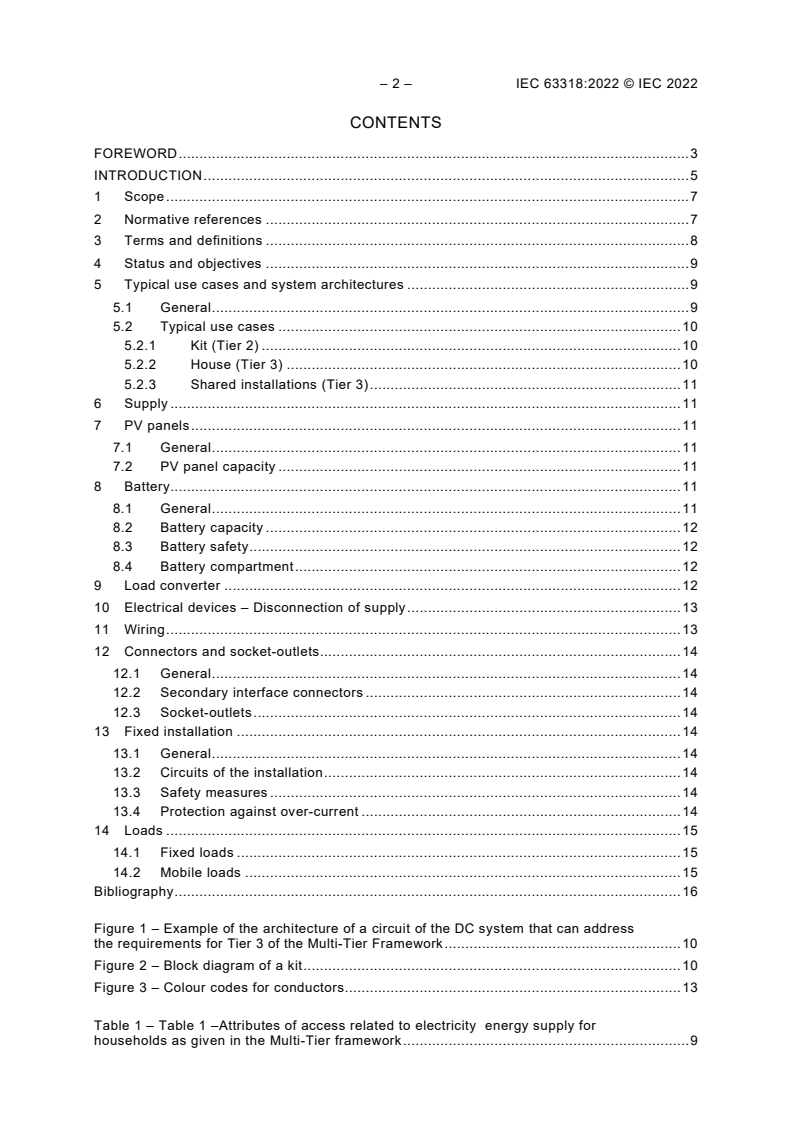
CONTENTS
FOREWORD . 3
INTRODUCTION . 5
1 Scope . 7
2 Normative references . 7
3 Terms and definitions . 8
4 Status and objectives . 9
5 Typical use cases and system architectures . 9
5.1 General . 9
5.2 Typical use cases . 10
5.2.1 Kit (Tier 2) . 10
5.2.2 House (Tier 3) . 10
5.2.3 Shared installations (Tier 3) . 11
6 Supply . 11
7 PV panels . 11
7.1 General . 11
7.2 PV panel capacity . 11
8 Battery. 11
8.1 General . 11
8.2 Battery capacity . 12
8.3 Battery safety . 12
8.4 Battery compartment . 12
9 Load converter . 12
10 Electrical devices – Disconnection of supply . 13
11 Wiring . 13
12 Connectors and socket-outlets . 14
12.1 General . 14
12.2 Secondary interface connectors . 14
12.3 Socket-outlets . 14
13 Fixed installation . 14
13.1 General . 14
13.2 Circuits of the installation . 14
13.3 Safety measures . 14
13.4 Protection against over-current . 14
14 Loads . 15
14.1 Fixed loads . 15
14.2 Mobile loads . 15
Bibliography . 16
Figure 1 – Example of the architecture of a circuit of the DC system that can address
the requirements for Tier 3 of the Multi-Tier Framework . 10
Figure 2 – Block diagram of a kit . 10
Figure 3 – Colour codes for conductors . 13
Table 1 – Table 1 –Attributes of access related to electricity energy supply for
households as given in the Multi-Tier framework . 9
INTERNATIONAL ELECTROTECHNICAL COMMISSION
____________
SPECIFICATIONS FOR SELV DC SYSTEMS CONFORMING TO
THE ESMAP MULTI-TIER FRAMEWORK TIER 2 AND TIER 3
REQUIREMENTS FOR HOUSEHOLD ELECTRICITY SUPPLY
FOREWORD
1) The International Electrotechnical Commission (IEC) is a worldwide organization for standardization comprising
all national electrotechnical committees (IEC National Committees). The object of IEC is to promote international
co-operation on all questions concerning standardization in the electrical and electronic fields. To this end and
in addition to other activities, IEC publishes International Standards, Technical Specifications, Technical Reports,
Publicly Available Specifications (PAS) and Guides (hereafter referred to as "IEC Publication(s)"). Their
preparation is entrusted to technical committees; any IEC National Committee interested in the subject dealt with
may participate in this preparatory work. International, governmental and non-governmental organizations liaising
with the IEC also participate in this preparation. IEC collaborates closely with the International Organization for
Standardization (ISO) in accordance with conditions determined by agreement between the two organizations.
2) The formal decisions or agreements of IEC on technical matters express, as nearly as possible, an international
consensus of opinion on the relevant subjects since each technical committee has representation from all
interested IEC National Committees.
3) IEC Publications have the form of recommendations for international use and are accepted by IEC National
Committees in that sense. While all reasonable efforts are made to ensure that the technical content of IEC
Publications is accurate, IEC cannot be held responsible for the way in which they are used or for any
misinterpretation by any end user.
4) In order to promote international uniformity, IEC National Committees undertake to apply IEC Publications
transparently to the maximum extent possible in their national and regional publications. Any divergence between
any IEC Publication and the corresponding national or regional publication shall be clearly indicated in the latter.
5) IEC itself does not provide any attestation of conformity. Independent certification bodies provide conformity
assessment services and, in some areas, access to IEC marks of conformity. IEC is not responsible for any
services carried out by independent certification bodies.
6) All users should ensure that they have the latest edition of this publication.
7) No liability shall attach to IEC or its directors, employees, servants or agents including individual experts and
members of its technical committees and IEC National Committees for any personal injury, property damage or
other damage of any nature whatsoever, whether direct or indirect, or for costs (including legal fees) and
expenses arising out of the publication, use of, or reliance upon, this IEC Publication or any other IEC
Publications.
8) Attention is drawn to the Normative references cited in this publication. Use of the referenced publications is
indispensable for the correct application of this publication.
9) Attention is drawn to the possibility that some of the elements of this IEC Publication may be the subject of patent
rights. IEC shall not be held responsible for identifying any or all such patent rights.
IEC 63318 has been prepared by IEC systems committee LVDC: Low voltage direct current and
low voltage direct current for electricity access. It is an International Standard.
The text of this International Standard is based on the following documents:
Draft Report on voting
SyCLVDC/104/CDV SyCLVDC/118/RVC
Full information on the voting for its approval can be found in the report on voting indicated in
the above table.
The language used for the development of this International Standard is English.
This document was drafted in accordance with ISO/IEC Directives, Part 2, and developed in
accordance with ISO/IEC Directives, Part 1 and ISO/IEC Directives, IEC Supplement, available
at www.iec.ch/members_experts/refdocs. The main document types developed by IEC are
described in greater detail at www.iec.ch/standardsdev/publications.
– 4 – IEC 63318:2022 © IEC 2022
"ESMAP" and the "Energy Sector Management Assistance Program" are proprietary names of
the World Bank, which has neither endorsed nor sponsored IEC 63318. These proprietary
names are provided for reasons of public interest or public safety. This information is given for
the convenience of users of this document and does not constitute an endorsement by IEC.
The committee has decided that the contents of this document will remain unchanged until the
stability date indicated on the IEC website under webstore.iec.ch in the data related to the
specific document. At this date, the document will be
• reconfirmed,
• withdrawn,
• replaced by a revised edition, or
• amended.
IMPORTANT – The "colour inside" logo on the cover page of this document indicates
that it contains colours which are considered to be useful for the correct understanding
of its contents. Users should therefore print this document using a colour printer.
INTRODUCTION
0.1 Electricity access initiatives
Access to electricity still remains a major challenge for a significant percentage of the human
population. It is a key enabler of socio-economic development. United Nations' (UN)
Sustainable Development Goal 7 attempts to "Ensure access to affordable, sustainable, reliable
and modern energy for all" and a time-bound target for delivery is specifically stated in Target
7.1 which declares that "By 2030, ensure universal access to affordable, reliable and modern
energy services".
The UN also recognises that access to energy is not just limited to an electricity supply
connection, but rather the usability is indispensable and has mandated that such usability of
the energy supply supporting energy access needs to have several technology-neutral
attributes: it needs to be adequate in quantity, available when needed, of good quality, reliable,
convenient, affordable, legal, healthy, and safe. In addition, the SE4ALL initiative under the UN
delivering the SDG-7 goals has established a Multi-Tier framework which includes these
attributes not just for quantifying access but also providing a basis for scaling electricity
availability.
In addition, Target 7.2 declares that "By 2030, increase substantially the share of renewable
energy in the global energy mix" and Target 7.3 states that "By 2030, double the global rate of
improvement in energy efficiency". It is therefore obvious that technology is going to be the
main driver for delivery of Target 7.2 and 7.3. While the Multi-Tier Framework attempts to be
technology-agnostic, the delivery of the afore-mentioned targets ensures that technology
cannot be ignored.
0.2 Motivation
The IEC is an advocate of safe electricity supply and has helped to ensure affordable and
sustainable electricity supply through its multiple standards. Standards ensure delivery of an
electrical eco-system that is well understood in the marketplace, provides acceptable level of
service and availability, ensures sustainability and at the same time enables affordability
through competing products in the market place and economies of scale.
Standards are applied in many countries throughout the world. IEC International Standards are
used routinely in legislation and regulation and are used to support public policy initiatives.
0.3 IEC's role and philosophy
Considering IEC's role as a standards developer with experts in standards and technology, it is
imperative that IEC present a framework for electricity access which will provide a set of minimal
requirements that ensure that all the attributes associated with electricity supply are addressed.
This will help in adoption of solutions that are affordable, scalable and sustainable besides
providing support for legislation and regulation. It is hoped that this will also help with
investments in this sector to enable delivery of the targets faster than envisioned.
From a standards perspective, the technical committees of IEC are responsible for preparing
the required standards. However, a broader solution such as the delivery of energy access
based on the Multi-Tier framework is beyond the scope of a single committee within IEC and
needs a systems committee to work with technical committees and create a Systems Reference
Deliverable which will draw upon the standards of multiple technical committees and call out
those particular aspects of a standard that are relevant to a related use case. The resulting
document will reflect the accumulated expertise of all the relevant technical committees but
restricted to specific use cases. This will help in identifying gaps and creating standards
enabling delivery and future amendments easier and faster.
– 6 – IEC 63318:2022 © IEC 2022
This document is framed in such a manner to include renewable energy and enable higher
energy efficiency by adopting a purely DC-based approach rather than conventional AC-based
approaches for power delivery and therefore this document will also address Target 2 and
Target 3 of SDG-7 goals. With the use of distributed energy sources such as photovoltaics and
wind, DC power is naturally made available and loads are increasingly DC based (e.g. LED
lamps and TVs). Further, storage using batteries is also inherently DC. Enabling the
interconnection of DC sources, storage and loads driven with DC power using a purely DC-
based system is a natural and efficient alternative to conventional AC-based approaches. A
pure DC-based approach can be deployed much faster, is scalable and can be easily integrated
into the utility grid infrastructure when it eventually becomes available.
IEC is constantly developing standards that respond to market needs. This document collates
all the relevant standards from IEC technical committees and subcommittees in a coherent
manner. This document provides international funding agencies with a reference International
Standard, which is a critical need for developing economies struggling with electricity access.
SPECIFICATIONS FOR SELV DC SYSTEMS CONFORMING TO
THE ESMAP MULTI-TIER FRAMEWORK TIER 2 AND TIER 3
REQUIREMENTS FOR HOUSEHOLD ELECTRICITY SUPPLY
1 Scope
This document specifies electrical systems that are intended to be used for electricity access
and not connected to a public network such as product kits up to 35 V DC as specified in
IEC 62257-9-5 and IEC 62257-9-8 for Tier 2 of the ESMAP Muti-Tier Framework for household
electricity supply; and/or 48 V DC fixed installations, for Tier 3 of the ESMAP Muti-Tier
Framework for household electricity supply.
This document applies to Tier 2 and Tier 3 installations using SELV DC systems.
2 Normative references
The following documents are referred to in the text in such a way that some or all of their content
constitutes requirements of this document. For dated references, only the edition cited applies.
For undated references, the latest edition of the referenced document (including any
amendments) applies.
IEC 60364 (all parts), Low-voltage electrical installations
IEC 60364-4-43, Low-voltage electrical installations – Part 4-43: Protection for safety – Protection
against overcurrent
IEC 60445, Basic and safety principles for man-machine interface, marking and identification –
Identification of equipment terminals, conductor terminations and conductors
IEC 60884-2-4, Plugs and socket-outlets for household and similar purposes – Part 2-4:
Particular requirements for plugs and socket-outlets for SELV
IEC 60906-3, IEC System of plugs and socket-outlets for household and similar purposes –
Part 3: SELV plugs and socket-outlets, 16 A 6 V, 12 V, 24 V, 48 V, a.c. and d.c.
IEC 61056-1, General purpose lead-acid batteries (valve-regulated types) – Part 1: General
requirements, functional characteristics – Methods of test
IEC TS 61200-101, Electrical installation guide – Part 101: Application guidelines on extra low-
voltage direct current electrical installations not intended to be connected to a public distribution
network
IEC 61215 (all parts), Terrestrial photovoltaic (PV) modules – Design qualification and type
approval
IEC 61427-1, Secondary cells and batteries for renewable energy storage – General
requirements and methods of test – Part 1: Photovoltaic off-grid application
IEC 61951-2, Secondary cells and batteries containing alkaline or other non acid electrolytes –
Secondary sealed cells and batteries for portable applications – Part 2: Nickel-metal hydride
– 8 – IEC 63318:2022 © IEC 2022
IEC 61960-3, Secondary cells and batteries containing alkaline or other non-acid electrolytes –
Secondary lithium cells and batteries for portable applications – Part 3: Prismatic and cylindrical
lithium secondary cells and batteries made from them
IEC TS 62257-9-5, Recommendations for renewable energy and hybrid systems for rural
electrification – Part 9-5: Integrated systems – Laboratory evaluation of stand-alone renewable
energy products for rural electrification
IEC TS 62257-9-8, Renewable energy and hybrid systems for rural electrification – Part 9-8:
Integrated systems – Requirements for stand-alone renewable energy products with power
ratings less than or equal to 350 W
3 Terms and definitions
For the purposes of this document, the following terms and definitions apply.
ISO and IEC maintain terminological databases for use in standardization at the following
addresses:
• IEC Electropedia: available at https://www.electropedia.org/
• ISO Online browsing platform: available at https://www.iso.org/obp
3.1
rated voltage
rated value of the voltage assigned by the manufacturer to a component, device or equipment
and to which operation and performance characteristics are referred
Note 1 to entry: Equipment may have more than one rated voltage value or may have a rated voltage range.
[SOURCE: IEC 60050-442:2014, 442-09-10, modified – Note 2 to entry has been deleted.]
3.2
enclosure
housing affording the type and degree of protection suitable for the intended application
[SOURCE: IEC 60050-151:2001, 151-13-08]
3.3
extra-low voltage
ELV
voltage not exceeding the relevant voltage limit of band I specified in IEC 61140 but not
exceeding 60 V DC
[SOURCE: IEC 60050-826:2004, 826-12-30, modified – The words "IEC 60449" have been
replaced with "IEC 61140 but not exceeding 60 V DC".]
3.4
kit
series of components needed to make a set that performs a defined function
3.5
SELV system
electric system in which the voltage cannot exceed the value of extra-low voltage:
– under normal conditions and
– under single-fault conditions, including earth faults in other electric circuits
Note 1 to entry: SELV is the abbreviation for safety extra-low voltage.
[SOURCE: IEC 60050-195:2021, 195-06-28]
4 Status and objectives
The content of this document is dedicated to Tier 2 and Tier 3 use cases of ESMAP Multi-Tier
Framework. Statements and requirements are based on technology known at the date of its
development.
The generic requirements for ESMAP tiers and attributes are shown in Table 1.
Table 1 – Attributes of access related to electricity energy supply for households as
given in the Multi-Tier framework
Attribute Tier 2 Tier 3
Power capacity ratings (W or daily Minimum peak power delivery of Minimum peak power delivery of
Wh ) 50 W 200 W
Minimum energy delivery of Minimum energy delivery of
200 Wh per day 1 000 Wh per day
Availability (duration) Minimum 4 h per day; minimum 2 h Minimum 8 h per day; minimum 3 h
in the evening in the evening
Reliability No stated requirement No stated requirement
Quality IEC Standards on EMC shall be IEC Standards on EMC shall be
applied applied
Cost of standard consumption
Affordability No stated requirement
package of 365 kWh per year
should be less than 5 % of
household income
Legality No stated requirement No stated requirement
Health and Safety No stated requirement No stated requirement
5 Typical use cases and system architectures
5.1 General
The system has distributed energy source(s) using a PV panel and/or battery for storage. The
power conversion sub-system is designed such that the voltage levels at each of the interfaces
to the PV panel, storage and the delivery interfaces, are operated at the correct voltages.
Figure 1 shows example of the architecture of a circuit of the DC system that can address the
requirements for Tier 3 of the Multi-Tier Framework.
– 10 – IEC 63318:2022 © IEC 2022
Figure 1 – Example of the architecture of a circuit of the DC system that can address
the requirements for Tier 3 of the Multi-Tier Framework
5.2 Typical use cases
5.2.1 Kit (Tier 2)
All the different blocks are typically packaged together and supplied as a single unit. The power
control, conversion and storage are typically assembled in a single enclosure and loads are
supplied through connectors, flexible cables or socket-outlets. In some cases, the loads can be
integral to the enclosure or can be mounted directly on the enclosure (see Figure 2).
Figure 2 – Block diagram of a kit
5.2.2 House (Tier 3)
For a house, a distribution system is required as the loads are distributed across multiple rooms.
Power conversion can be required to supply the individual loads.
5.2.3 Shared installations (Tier 3)
Multiple houses can share resources. For example, one house owner can invest in solar panels
and another in batteries, and the loads can be shared by other houses that may not have a
panel or a battery. Solar panels can be invested by one house owner and batteries can be
invested by another and the loads can be shared by other houses that may not have a panel or
battery.
6 Supply
For Tier 2, for safety of humans and in accordance with IEC 62257-9-5, the maximum DC
voltage at any point in the electrical circuit shall be 35 V DC for stand-alone renewable energy
products.
For Tier 3, the recommended nominal DC supply voltage used for the system is 48 V ± 9,6 V.
The maximum voltage limit of the supply shall be in accordance with IEC TS 61200-101
(60 V max.).
The end-to-end voltage drop in the conductors (from the battery to the load terminals) shall be
less than 5 % when delivering maximum rated power.
7 PV panels
7.1 General
The requirements, characteristics and installation of PV panels shall be in accordance with
IEC 61215 (all parts).
7.2 PV panel capacity
The minimum panel capacity shall be calculated as follows (assuming 20 % end-end losses and
three sun-hours per day on average):
E− out
day
C 1,2×
panel
where
C is the panel capacity;
panel
E-out is the energy delivery/day.
day
Recommended sizes of panels for Tier 2 and Tier 3 are given below:
– Tier 2: as specified in IEC 62257-9-5.
– Tier 3: minimum 400 Wp (watt-peak) and maximum 1 600 Wp.
8 Battery
8.1 General
The requirements detailed in IEC 61427-1, IEC 61951-2, IEC 61960-3, IEC 61056-1, and
IEC 62257-9-5 as appropriate to the battery technology, shall apply.
=
– 12 – IEC 63318:2022 © IEC 2022
8.2 Battery capacity
The required minimum battery capacity shall be calculated as follows:
E− cap
day
C 1,2×
min-battery
D
max
where
is the minimum battery capacity;
C
min-battery
E-cap is the energy capacity/day;
day
D is the maximum depth of discharge.
max
The maximum depth of discharge of the battery or battery bank depends on the battery
technology, as detailed above. The maximum depth of discharge also depends on other factors
such as temperature, rate of charging and discharging. These factors also affect battery life.
8.3 Battery safety
Supply systems and equipment containing batteries shall be designed to reduce the risk of fire,
explosion and chemical leaks under normal conditions and after a single fault in the equipment
including a fault in circuitry within the equipment battery pack. For user-replaceable batteries,
the design shall reduce the likelihood of reverse polarity connection. Battery chemicals are
corrosive and during charging they can release hydrogen that can cause an explosion (see
IEC 60950-1).
If a battery contains liquid or gel electrolyte, a battery tray shall be provided to retain any liquid
that could leak as a result of internal pressure build-up in the battery. The requirement to
provide a battery tray does not apply if the construction of the battery is such that leakage of
the electrolyte from the battery is unlikely.
If a battery tray is required, its capacity shall be at least equal to the volume of electrolyte of
the battery, or the volume of a single cell if the design of the battery is such that simultaneous
leakage from multiple cells is unlikely.
8.4 Battery compartment
Access to a battery compartment containing bare conductive parts of circuits is permitted if all
the following conditions are met:
a) the compartment has a door that requires a deliberate technique to open, such as the use
of a tool or latching device; and
b) there is a marking next to the door, or on the door if the door is secured to the equipment,
with instructions for protection of the user once the door is opened; and
c) the electrical circuit is not accessible when the door is closed.
The access shall be limited to an operator who is at least an instructed person.
9 Load converter
If the appliance rated voltage is less than 48 V, an appropriate converter shall be used.
=
10 Electrical devices – Disconnection of supply
A suitably rated disconnection device shall be provided at the following locations for attending
to system faults, maintenance and servicing:
– between the panel and the converter;
– between the converter and battery bank.
Both the lines to the battery shall be provided with a disconnection device.
The disconnection device shall have a contact separation at least equal to the minimum
clearance for basic insulation.
Examples of disconnection devices are the following:
a) a circuit-breaker;
b) an isolating switch;
c) an appliance coupler;
d) plug of the power supply cord;
e) plug that is part of direct plug-in equipment;
f) a removable fuse;
g) any approved equivalent device.
Parts on the supply side of a disconnection device (installed in the equipment) which remain
energized when the disconnection device is switched off shall be insulated so as to reduce
the likelihood of accidental contact by a service person.
11 Wiring
The supply shall be a two-conductor system. The colours of the insulation shall be in
accordance with IEC 60445 (see Figure 3):
– one conductor for positive polarity with red colour insulation; and
– one conductor for negative polarity with white colour insulation.
Figure 3 – Colour codes for conductors
– 14 – IEC 63318:2022 © IEC 2022
12 Connectors and socket-outlets
12.1 General
Some loads can be directly connected to the DC supply, for example LED lights and DC fans,
whereas others would need a DC-DC converter to convert to a different voltage to allow the
load to operate as designed.
The loads that operate at a different voltage shall not have the same physical interface as that
of the loads that operate directly from the supply voltage. The loads that are connected directly
to the circuit are termed generally as "circuit connectors" and those that are operated through
a DC-DC converter are called "appliance connectors". Standardization of voltages for
appliances is needed and corresponding to these, the connectors shall be differentiated so that
the possibility of interchanging interfaces whose voltages are incompatible is rendered
impossible.
NOTE The term "coupler" can be used instead of "connectors".
12.2 Secondary interface connectors
Standards for appliance connectors for voltages of 12 V, 24 V and 36 V are under development.
USB-A can be considered an appliance connector for 5 V operation.
NOTE The term "coupler" can be used instead of "connectors".
12.3 Socket-outlets
Socket-outlets shall conform with IEC 60884-2-4 and IEC 60906-3.
13 Fixed installation
13.1 General
The installation shall be in accordance with the IEC 60364 series.
13.2 Circuits of the installation
Each final circuit shall be limited to 240 W.
13.3 Safety measures
The installation shall conform with the safety requirements of IEC TS 61200-101.
All conductors shall have basic insulation.
The installation shall not include a PE conductor, and socket-outlets shall not include an earth
pin.
The DC supply shall not be earthed.
13.4 Protection against over-current
Protection against overload and protection against short circuit shall be provided in accordance
with IEC 60364-4-43.
NOTE Conductors are considered to be protected against overload and short-circuit currents where they are
supplied from a source incapable of supplying a current exceeding the current carrying capacity of the conductors.
14 Loads
14.1 Fixed loads
Fixed loads may be driven directly from the nominal voltage supply. If the load voltage
requirements are different from that provided by the supply, a DC-DC converter integral to the
load can be provided. An external DC-DC converter is not recommended unless the voltage is
12 V, 24 V or 36 V, for which standards for connectors and sockets are under development.
14.2 Mobile loads
Mobile loads shall be supplied using a socket-outlet.
– 16 – IEC 63318:2022 © IEC 2022
Bibliography
IEC 60050-151, International Electrotechnical Vocabulary (IEV) – Part 151: Electrical and
magnetic devices, available at www.electropedia.org
IEC 60050-442, International Electrotechnical Vocabulary (IEV) – Part 442: Electrical
accessories
IEC 60050-826, International Electrotechnical Vocabulary (IEV) – Part 826: Electrical
installations, available at www.electropedia.org
IEC 60068-2-6, Environmental testing – Part 2-6: Tests – Test Fc: Vibration (sinusoidal)
IEC 60269-6, Low-voltage fuses – Part 6: Supplementary requirements for fuse-links for the
protection of solar photovoltaic energy systems
IEC 60335-1, Household and similar electrical appliances – Safety – Part 1: General
requirements
IEC 60529, Degrees of protection provided by enclosures (IP Code)
IEC 60898-2, Electrical accessories – Circuit-breakers for overcurrent protection for household
and similar installations – Part 2: Circuit-breakers for AC and DC operation
IEC 60898-3:2019, Electrical accessories – Circuit-breakers for overcurrent protection for
household and similar installations – Part 3: Circuit-breakers for DC operation
IEC 60904-1:2020, Photovoltaic devices – Part 1: Measurement of photovoltaic current-voltage
characteristics
IEC 60947-2, Low-voltage switchgear and controlgear – Part 2: Circuit-breakers
IEC 60950-1, Information technology equipment – Safety – Part 1: General requirements
IEC 61215-2, Terrestrial photovoltaic (PV) modules – Design qualification and type approval –
Part 2: Test procedures
IEC TS 62257-5, Recommendations for renewable energy and hybrid systems for rural
electrification – Part 5: Protection against electrical hazards
IEC TS 62257-8-1, Recommendations for renewable energy and hybrid systems for rural
electrification – Part 8-1: Selection of batteries and battery management systems for stand-
alone electrification systems – Specific case of automotive flooded lead-acid batteries available
in developing countries
IEC TS 62257-12-1, Recommendations for renewable energy and hybrid systems for rural
electrification – Part 12-1: Laboratory evaluation of lamps and lighting appliances for off-grid
electricity systems
IEC 62509:2010, Battery charge controllers for photovoltaic systems – Performance and
functioning
___________
– 18 – IEC 63318:2022 © IEC 2022
SOMMAIRE
AVANT-PROPOS . 19
INTRODUCTION . 21
1 Domaine d’application . 23
2 Références normatives . 23
3 Termes et définitions . 24
4 Statut et objectifs. 25
5 Cas d'utilisation types et architectures de systèmes . 25
5.1 Généralités . 25
5.2 Cas d'utilisation types . 26
5.2.1 Kit (Niveau 2) . 26
5.2.2 Maison (Niveau 3) . 26
5.2.3 Installations partagées (Niveau 3). 27
6 Alimentation . 27
7 Panneaux photovoltaïques. 27
7.1 Généralités . 27
7.2 Capacité du panneau photovoltaïque . 27
8 Batterie . 27
8.1 Généralités . 27
8.2 Capacité de la batterie . 28
8.3 Sécurité de la batterie . 28
8.4 Compartiment de batterie . 28
9 Convertisseur de charge . 28
10 Appareils électriques – Dispositifs de coupure de l'alimentati . 29
11 Câblage . 29
12 Connecteurs et socles de prises de courant . 30
12.1 Généralités . 30
12.2 Connecteurs d'interface secondaire . 30
12.3 Socles de prises de courant . 30
13 Installation fixe . 30
13.1 Généralités . 30
13.2 Circuits de l'installation . 30
13.3 Mesures de sécurité . 30
13.4 Protection c
...