

IEC TS 62786-42:2026
(Main)Distributed energy resources connection with the grid - Part 42: Technical requirements for voltage measurement used to control DER and loads
General Information
- Abstract
IEC TS 62786-42:2026 defines minimum requirements for AC voltage measurement used to control distributed energy resources (DER) and loads connected to distribution networks.
This document specifies the characteristics of voltage magnitude measurement to evaluate their performances (including voltage and frequency measuring range, accuracy, voltage and frequency operating range, resolution, etc).
This document describes the main use cases of voltage measurement, with associated level of performances.
This document describes the principle of functional tests to evaluate the specified characteristics and defines the influencing factors that affect these performances, under steady state or dynamic conditions.
This document defines the functional requirements applicable to voltage measurement which can be embedded inside DER or loads controller or performed as an external control system. In the case of DER, this document is a subpart of requirements which are defined in the other parts of the IEC 62786 series.
This document is applicable to DER and loads regardless of voltage level at the point of connection to the distribution grid.
This document does not specify hardware, software or a method for voltage measurement. It does not specify tests linked to environmental conditions associated to hardware devices (climatic, mechanical stress, electromagnetic compatibility test, etc).
- Status
- Published
- Publication Date
- 29-Jan-2026
- Technical Committee
- TC 8 - System aspects of electrical energy supply
- Drafting Committee
- JWG 12 - TC 8/JWG 12
- Current Stage
- PPUB - Publication issued
- Start Date
- 30-Jan-2026
- Completion Date
- 05-Dec-2025
Buy Documents
IEC TS 62786-42:2026 - Distributed energy resources connection with the grid - Part 42: Technical requirements for voltage measurement used to control DER and loads Released:1/30/2026
Overview
IEC TS 62786-42:2026, published by the International Electrotechnical Commission (IEC), establishes the minimum technical requirements for AC voltage measurement used in the control of distributed energy resources (DER) and loads connected to distribution networks. This standard defines the characteristics, functional requirements, and performance indicators for voltage measurement functions embedded within DERs, loads controllers, or external control systems. IEC TS 62786-42:2026 applies to DER and loads regardless of voltage level at the connection point, ensuring consistent and reliable voltage measurement practices essential for modern power grids that increasingly feature diverse, distributed generation and demand-side resources.
Key Topics
IEC TS 62786-42:2026 covers comprehensive aspects of voltage measurement relevant to DER integration and load control. Key focus areas include:
Voltage Measurement Performance Characteristics
- Measuring range and operating range for both voltage and frequency
- Accuracy and maximum relative error declarations
- Resolution and reporting rates of measurement
- Delay time and settling time metrics
Functional Requirements
- Applicable to voltage measurement embedded inside DER or load controllers, or performed via external systems
- Contribution to grid stability and operation under both steady-state and dynamic conditions
Use Cases and Performance Levels
- Typical DER and grid control functions where precise voltage measurement is critical, e.g., secondary voltage control, ride-through events, rapid voltage fluctuation response, anti-islanding protection, and rooftop photovoltaic voltage management
Functional Test Principles
- Standardized functional tests to verify declared performance specifications such as delay time, resolution, measuring range, and accuracy
- Definition of influencing factors affecting measurement reliability and consistency
Scope Limitations
- This technical specification does not prescribe hardware/software implementations or test requirements for environmental factors (e.g., climatic or EMC testing)
- Time-stamped voltage measurement and protection relay voltage measurements are addressed by other standards
Applications
IEC TS 62786-42:2026 is practically valuable to stakeholders involved with grid-connected DERs and loads, including manufacturers, grid operators, and compliance engineers. Specific applications include:
DER Integration and Management
- Ensures consistent, accurate voltage measurement necessary for grid-connected renewable energy sources, inverter-based resources, and energy storage systems
Load Control and Automated Demand Response
- Enables reliable monitoring and control of loads that respond to real-time grid voltage, supporting demand-side management and load shedding
Grid Stability and Quality of Supply
- Provides criteria for voltage measurement functions that underpin secondary voltage control, ride-through capabilities, and rapid grid event responses
System Design and Compliance
- Assists device manufacturers in declaring and verifying voltage measurement characteristics, facilitating market access and regulatory conformity
Organizations implementing voltage measurement for DER and load controllers benefit from standardized testing principles, supporting robust performance claims and interoperability within diverse grid environments.
Related Standards
For a comprehensive approach to voltage measurement and DER-grid integration, IEC TS 62786-42:2026 is used alongside companion standards, including:
- IEC 62786 Series: Defines general connection requirements for DERs with the grid
- IEC/IEEE 60255-118-1: Covers time-stamped voltage measurements
- IEC 60255-127: Specifies requirements for voltage measurement in protection relays
- IEC 60050 and IEC 61000 Series: Provide reference terminology and power quality concepts
Adopting IEC TS 62786-42:2026 supports harmonized voltage measurement standards, advancing grid reliability and efficiency in the era of distributed energy resources and smart grid deployment. For the latest updates and detailed application notes, users should consult the IEC’s official publications and related normative references.
Buy Documents
IEC TS 62786-42:2026 - Distributed energy resources connection with the grid - Part 42: Technical requirements for voltage measurement used to control DER and loads Released:1/30/2026
Get Certified
Connect with accredited certification bodies for this standard

DIBt (Deutsches Institut für Bautechnik)
German Institute for Building Technology.
DIN CERTCO
DIN Group product certification.

IMQ S.p.A. (Certification)
Italian electrical product certification.
Sponsored listings
Frequently Asked Questions
IEC TS 62786-42:2026 is a technical specification published by the International Electrotechnical Commission (IEC). Its full title is "Distributed energy resources connection with the grid - Part 42: Technical requirements for voltage measurement used to control DER and loads". This standard covers: IEC TS 62786-42:2026 defines minimum requirements for AC voltage measurement used to control distributed energy resources (DER) and loads connected to distribution networks. This document specifies the characteristics of voltage magnitude measurement to evaluate their performances (including voltage and frequency measuring range, accuracy, voltage and frequency operating range, resolution, etc). This document describes the main use cases of voltage measurement, with associated level of performances. This document describes the principle of functional tests to evaluate the specified characteristics and defines the influencing factors that affect these performances, under steady state or dynamic conditions. This document defines the functional requirements applicable to voltage measurement which can be embedded inside DER or loads controller or performed as an external control system. In the case of DER, this document is a subpart of requirements which are defined in the other parts of the IEC 62786 series. This document is applicable to DER and loads regardless of voltage level at the point of connection to the distribution grid. This document does not specify hardware, software or a method for voltage measurement. It does not specify tests linked to environmental conditions associated to hardware devices (climatic, mechanical stress, electromagnetic compatibility test, etc).
IEC TS 62786-42:2026 defines minimum requirements for AC voltage measurement used to control distributed energy resources (DER) and loads connected to distribution networks. This document specifies the characteristics of voltage magnitude measurement to evaluate their performances (including voltage and frequency measuring range, accuracy, voltage and frequency operating range, resolution, etc). This document describes the main use cases of voltage measurement, with associated level of performances. This document describes the principle of functional tests to evaluate the specified characteristics and defines the influencing factors that affect these performances, under steady state or dynamic conditions. This document defines the functional requirements applicable to voltage measurement which can be embedded inside DER or loads controller or performed as an external control system. In the case of DER, this document is a subpart of requirements which are defined in the other parts of the IEC 62786 series. This document is applicable to DER and loads regardless of voltage level at the point of connection to the distribution grid. This document does not specify hardware, software or a method for voltage measurement. It does not specify tests linked to environmental conditions associated to hardware devices (climatic, mechanical stress, electromagnetic compatibility test, etc).
IEC TS 62786-42:2026 is classified under the following ICS (International Classification for Standards) categories: 29.240.01 - Power transmission and distribution networks in general; 91.140.50 - Electricity supply systems. The ICS classification helps identify the subject area and facilitates finding related standards.
IEC TS 62786-42:2026 is available in PDF format for immediate download after purchase. The document can be added to your cart and obtained through the secure checkout process. Digital delivery ensures instant access to the complete standard document.
Standards Content (Sample)
IEC TS 62786-42 ®
Edition 1.0 2026-01
TECHNICAL
SPECIFICATION
Distributed energy resources connection with the grid -
Part 42: Technical requirements for voltage measurement used to control DER
and loads
ICS 91.140.50; 29.240.01 ISBN 978-2-8327-0961-0
All rights reserved. Unless otherwise specified, no part of this publication may be reproduced or utilized in any form or
by any means, electronic or mechanical, including photocopying and microfilm, without permission in writing from either
IEC or IEC's member National Committee in the country of the requester. If you have any questions about IEC copyright
or have an enquiry about obtaining additional rights to this publication, please contact the address below or your local
IEC member National Committee for further information.
IEC Secretariat Tel.: +41 22 919 02 11
3, rue de Varembé info@iec.ch
CH-1211 Geneva 20 www.iec.ch
Switzerland
About the IEC
The International Electrotechnical Commission (IEC) is the leading global organization that prepares and publishes
International Standards for all electrical, electronic and related technologies.
About IEC publications
The technical content of IEC publications is kept under constant review by the IEC. Please make sure that you have the
latest edition, a corrigendum or an amendment might have been published.
IEC publications search - IEC Products & Services Portal - products.iec.ch
webstore.iec.ch/advsearchform Discover our powerful search engine and read freely all the
The advanced search enables to find IEC publications by a
publications previews, graphical symbols and the glossary.
variety of criteria (reference number, text, technical With a subscription you will always have access to up to date
committee, …). It also gives information on projects, content tailored to your needs.
replaced and withdrawn publications.
Electropedia - www.electropedia.org
IEC Just Published - webstore.iec.ch/justpublished The world's leading online dictionary on electrotechnology,
Stay up to date on all new IEC publications. Just Published containing more than 22 500 terminological entries in English
details all new publications released. Available online and and French, with equivalent terms in 25 additional languages.
once a month by email. Also known as the International Electrotechnical Vocabulary
(IEV) online.
IEC Customer Service Centre - webstore.iec.ch/csc
If you wish to give us your feedback on this publication or
need further assistance, please contact the Customer
Service Centre: sales@iec.ch.
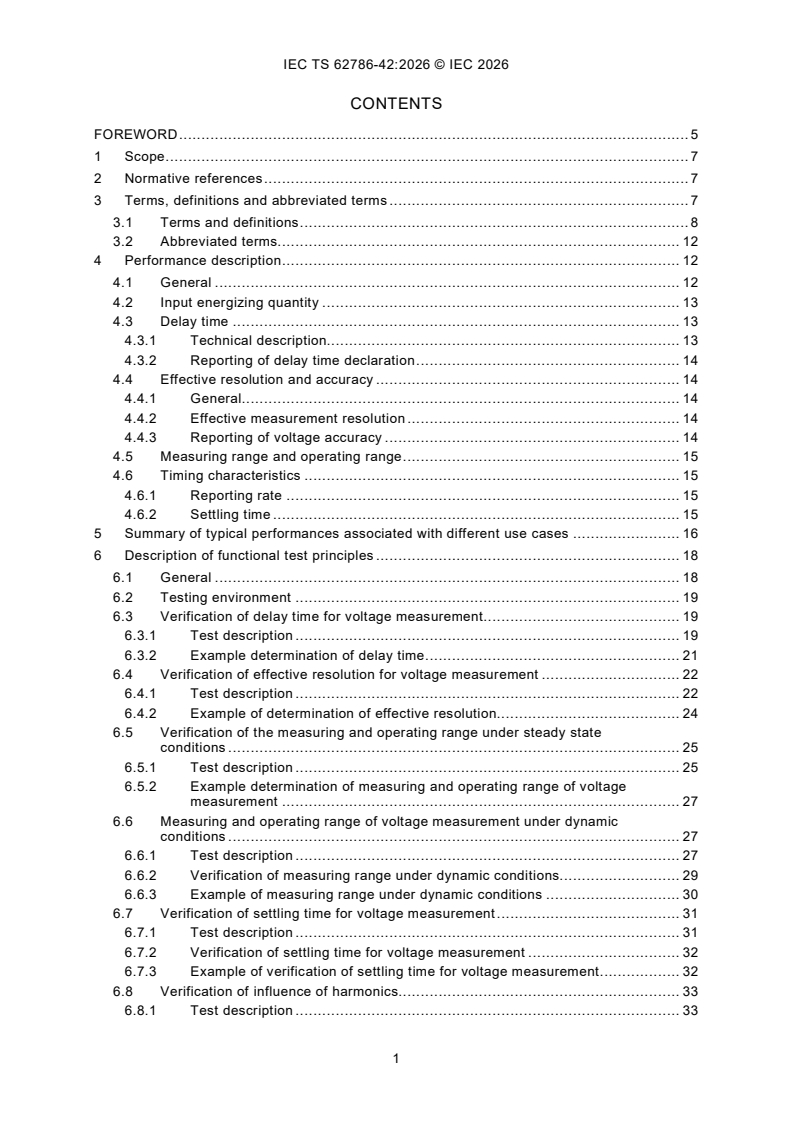
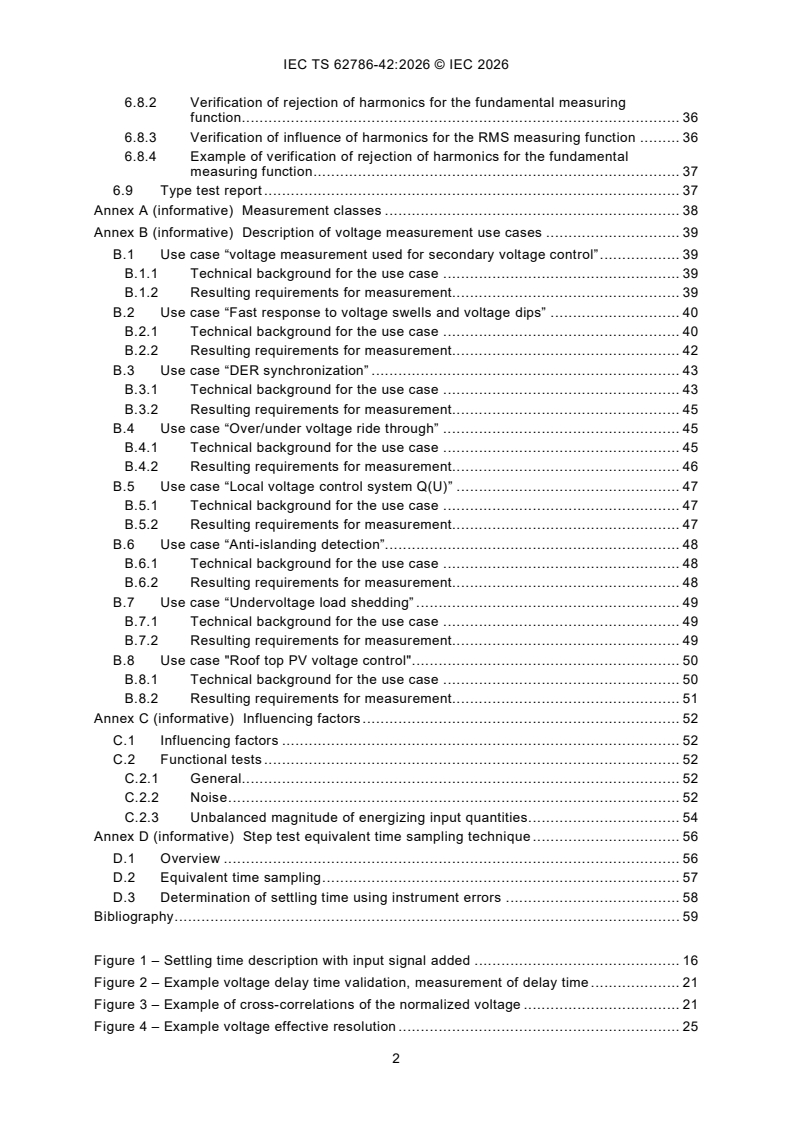
CONTENTS
FOREWORD . 5
1 Scope . 7
2 Normative references . 7
3 Terms, definitions and abbreviated terms . 7
3.1 Terms and definitions . 8
3.2 Abbreviated terms. 12
4 Performance description . 12
4.1 General . 12
4.2 Input energizing quantity . 13
4.3 Delay time . 13
4.3.1 Technical description. 13
4.3.2 Reporting of delay time declaration . 14
4.4 Effective resolution and accuracy . 14
4.4.1 General. 14
4.4.2 Effective measurement resolution . 14
4.4.3 Reporting of voltage accuracy . 14
4.5 Measuring range and operating range . 15
4.6 Timing characteristics . 15
4.6.1 Reporting rate . 15
4.6.2 Settling time . 15
5 Summary of typical performances associated with different use cases . 16
6 Description of functional test principles . 18
6.1 General . 18
6.2 Testing environment . 19
6.3 Verification of delay time for voltage measurement. 19
6.3.1 Test description . 19
6.3.2 Example determination of delay time . 21
6.4 Verification of effective resolution for voltage measurement . 22
6.4.1 Test description . 22
6.4.2 Example of determination of effective resolution. 24
6.5 Verification of the measuring and operating range under steady state
conditions . 25
6.5.1 Test description . 25
6.5.2 Example determination of measuring and operating range of voltage
measurement . 27
6.6 Measuring and operating range of voltage measurement under dynamic
conditions . 27
6.6.1 Test description . 27
6.6.2 Verification of measuring range under dynamic conditions. . 29
6.6.3 Example of measuring range under dynamic conditions . 30
6.7 Verification of settling time for voltage measurement . 31
6.7.1 Test description . 31
6.7.2 Verification of settling time for voltage measurement . 32
6.7.3 Example of verification of settling time for voltage measurement . 32
6.8 Verification of influence of harmonics. 33
6.8.1 Test description . 33
6.8.2 Verification of rejection of harmonics for the fundamental measuring
function . 36
6.8.3 Verification of influence of harmonics for the RMS measuring function . 36
6.8.4 Example of verification of rejection of harmonics for the fundamental
measuring function . 37
6.9 Type test report . 37
Annex A (informative) Measurement classes . 38
Annex B (informative) Description of voltage measurement use cases . 39
B.1 Use case “voltage measurement used for secondary voltage control” . 39
B.1.1 Technical background for the use case . 39
B.1.2 Resulting requirements for measurement. 39
B.2 Use case “Fast response to voltage swells and voltage dips” . 40
B.2.1 Technical background for the use case . 40
B.2.2 Resulting requirements for measurement. 42
B.3 Use case “DER synchronization” . 43
B.3.1 Technical background for the use case . 43
B.3.2 Resulting requirements for measurement. 45
B.4 Use case “Over/under voltage ride through” . 45
B.4.1 Technical background for the use case . 45
B.4.2 Resulting requirements for measurement. 46
B.5 Use case “Local voltage control system Q(U)” . 47
B.5.1 Technical background for the use case . 47
B.5.2 Resulting requirements for measurement. 47
B.6 Use case “Anti-islanding detection”. 48
B.6.1 Technical background for the use case . 48
B.6.2 Resulting requirements for measurement. 48
B.7 Use case “Undervoltage load shedding” . 49
B.7.1 Technical background for the use case . 49
B.7.2 Resulting requirements for measurement. 49
B.8 Use case "Roof top PV voltage control" . 50
B.8.1 Technical background for the use case . 50
B.8.2 Resulting requirements for measurement. 51
Annex C (informative) Influencing factors . 52
C.1 Influencing factors . 52
C.2 Functional tests . 52
C.2.1 General. 52
C.2.2 Noise . 52
C.2.3 Unbalanced magnitude of energizing input quantities . 54
Annex D (informative) Step test equivalent time sampling technique . 56
D.1 Overview . 56
D.2 Equivalent time sampling . 57
D.3 Determination of settling time using instrument errors . 58
Bibliography . 59
Figure 1 – Settling time description with input signal added . 16
Figure 2 – Example voltage delay time validation, measurement of delay time . 21
Figure 3 – Example of cross-correlations of the normalized voltage . 21
Figure 4 – Example voltage effective resolution . 25
Figure 5 – Example verification of measurement bandwidth under steady state
conditions . 27
Figure 6 – Results of tests for measurement range under dynamic conditions . 31
Figure 7 – Verification of voltage settling time using positive 0,1 U step in voltage . 33
r
Figure 8 – Verification of voltage settling time using negative 0,2 U step in voltage . 33
r
Figure 9 – Waveforms with superimposed harmonics with φ = 0° (blue) and
k
φ = 180° (red) . 35
k
Figure 10 – Three-phase harmonic test signals with 0° and 180° harmonic phases. 36
Figure 11 – Example of verification of rejection of harmonics . 37
Figure B.1 – Example of system diagram of centralised voltage control with SVR . 39
Figure B.2 – Principle of secondary voltage regulations . 40
Figure B.3 – Location of a DVR . 41
Figure B.4 – Voltage dip caused by motor starting . 41
Figure B.5 – Typical volt-var response curve . 42
Figure B.6 – Example of system diagram of a three-phase PV system for voltage
control and synchronization . 43
Figure B.7 – Doubly-fed wind turbine grid-connected . 44
Figure B.8 – Example of undervoltage ride through capability . 46
Figure B.9 – Schematic of a typical Q(U) control . 47
Figure B.10 – Example of system diagram of a PV system for voltage control . 51
Figure C.1 – Voltage errors from noise tests. 54
Figure C.2 – Voltage relative error due to unbalanced input signal magnitude . 55
Figure D.1 – Example of reports during step response . 56
Figure D.2 – Example of reports during step response with higher resolution . 57
Figure D.3 – Example of reports during step response with higher resolution . 58
Table 1 – Performance characteristics presented Clause 4 . 12
Table 2 – Example of delay time . 14
Table 3 – An example of voltage measurement resolution and maximum error . 14
Table 4 – Examples of measuring range and operating range for voltage measurement . 15
Table 5 – Reporting of settling time and reporting rate . 15
Table 6 – List of use cases and associated requirements . 17
Table 7 – Voltage measurement requirements using modulated test signals at tested
power frequency f f . 30
=
m nominal
Table 8 – Input signal harmonic magnitude . 34
Table A.1 – Measurement classes by voltage measurement steady state accuracy . 38
Table A.2 – Measurement classes by measurement instrument steady state
settling time . 38
Table B.1 – Requirements for voltage measurement – Use case “voltage measurement
used for secondary voltage control” . 40
Table B.2 – Volt watt mode parameters (example) . 42
Table B.3 – Requirements for voltage measurement – Use case “Fast response to a
voltage swell and dip” . 43
Table B.4 – Requirements for voltage measurement – Use case “synchronization” . 45
Table B.5 – Requirements for voltage measurement – Use case “Over/under voltage
ride through” . 47
Table B.6 – Voltage measurement requirement – Use case “Local voltage control
system Q(U)” . 48
Table B.7 – Requirement for voltage measurement – Use case “Anti-islanding
detection” . 49
Table B.8 – Requirements for voltage measurement – Use case “Voltage measurement
used for undervoltage load shedding” . 50
Table B.9 – Requirements for voltage measurement – Use case “voltage measurement
used for Rooftop PV voltage control” . 51
Table C.1 – Influencing factors of voltage measurements . 52
Table C.2 – Magnitudes and phase angles for three phase voltages . 54
INTERNATIONAL ELECTROTECHNICAL COMMISSION
____________
Distributed energy resources connection with the grid -
Part 42: Technical requirements for voltage measurement
used to control DER and loads
FOREWORD
1) The International Electrotechnical Commission (IEC) is a worldwide organization for standardization comprising
all national electrotechnical committees (IEC National Committees). The object of IEC is to promote international
co-operation on all questions concerning standardization in the electrical and electronic fields. To this end and
in addition to other activities, IEC publishes International Standards, Technical Specifications, Technical Reports,
Publicly Available Specifications (PAS) and Guides (hereafter referred to as “IEC Publication(s)”). Their
preparation is entrusted to technical committees; any IEC National Committee interested in the subject dealt with
may participate in this preparatory work. International, governmental and non-governmental organizations liaising
with the IEC also participate in this preparation. IEC collaborates closely with the International Organization for
Standardization (ISO) in accordance with conditions determined by agreement between the two organizations.
2) The formal decisions or agreements of IEC on technical matters express, as nearly as possible, an international
consensus of opinion on the relevant subjects since each technical committee has representation from all
interested IEC National Committees.
3) IEC Publications have the form of recommendations for international use and are accepted by IEC National
Committees in that sense. While all reasonable efforts are made to ensure that the technical content of IEC
Publications is accurate, IEC cannot be held responsible for the way in which they are used or for any
misinterpretation by any end user.
4) In order to promote international uniformity, IEC National Committees undertake to apply IEC Publications
transparently to the maximum extent possible in their national and regional publications. Any divergence between
any IEC Publication and the corresponding national or regional publication shall be clearly indicated in the latter.
5) IEC itself does not provide any attestation of conformity. Independent certification bodies provide conformity
assessment services and, in some areas, access to IEC marks of conformity. IEC is not responsible for any
services carried out by independent certification bodies.
6) All users should ensure that they have the latest edition of this publication.
7) No liability shall attach to IEC or its directors, employees, servants or agents including individual experts and
members of its technical committees and IEC National Committees for any personal injury, property damage or
other damage of any nature whatsoever, whether direct or indirect, or for costs (including legal fees) and
expenses arising out of the publication, use of, or reliance upon, this IEC Publication or any other IEC
Publications.
8) Attention is drawn to the Normative references cited in this publication. Use of the referenced publications is
indispensable for the correct application of this publication.
9) IEC draws attention to the possibility that the implementation of this document may involve the use of (a)
patent(s). IEC takes no position concerning the evidence, validity or applicability of any claimed patent rights in
respect thereof. As of the date of publication of this document, IEC had not received notice of (a) patent(s), which
may be required to implement this document. However, implementers are cautioned that this may not represent
the latest information, which may be obtained from the patent database available at https://patents.iec.ch. IEC
shall not be held responsible for identifying any or all such patent rights.
IEC TS 62786-42 has been prepared by IEC technical committee 8: System aspects for
electrical energy supply. It is a Technical Specification.
The text of this Technical Specification is based on the following documents:
Draft Report on voting
8/1755/DTS 8/1786/RVDTS
Full information on the voting for its approval can be found in the report on voting indicated in
the above table.
The language used for the development of this Technical Specification is English.
This document was drafted in accordance with ISO/IEC Directives, Part 2, and developed in
accordance with ISO/IEC Directives, Part 1 and ISO/IEC Directives, IEC Supplement, available
at www.iec.ch/members_experts/refdocs. The main document types developed by IEC are
described in greater detail at www.iec.ch/publications.
A list of all parts in the IEC 62786 series, published under the general title Distributed energy
resources connection with the grid, can be found on the IEC website.
The committee has decided that the contents of this document will remain unchanged until the
stability date indicated on the IEC website under webstore.iec.ch in the data related to the
specific document. At this date, the document will be
– reconfirmed,
– withdrawn, or
– revised.
1 Scope
This document defines minimum requirements for AC voltage measurement used to control
distributed energy resources (DER) and loads connected to distribution networks.
This document specifies the characteristics of voltage magnitude measurement to evaluate their
performances (including voltage and frequency measuring range, accuracy, voltage and
frequency operating range, resolution, etc).
This document describes the main use cases of voltage measurement, with associated level of
performances.
This document describes the principle of functional tests to evaluate the specified
characteristics and defines the influencing factors that affect these performances, under steady
state or dynamic conditions.
This document defines the functional requirements applicable to voltage measurement which
can be embedded inside DER or loads controller or performed as an external control system.
In the case of DER, this document is a subpart of requirements which are defined in the other
parts of the IEC 62786 series.
This document is applicable to DER and loads regardless of voltage level at the point of
connection to the distribution grid.
This document does not specify hardware, software or a method for voltage measurement. It
does not specify tests linked to environmental conditions associated to hardware devices
(climatic, mechanical stress, electromagnetic compatibility test, etc).
Voltage measurements associated with time stamping are not in the scope of this document.
These measurements are covered by IEC/IEEE 60255-118-1 [1] .
Voltage measurement associated to protection functions or protection relays are not in the
scope of this document. These requirements are covered by IEC 60255-127 [2].
NOTE As defined in the first paragraph, this document is focused on voltage measurements used to control DER
and loads. But the technical requirements defined in this document, with the list of declared characteristics and their
associated functional tests, can also be applicable for other uses (e.g. small or large generators of power substations
connected to transmission or distribution grids, power meter devices, power quality instruments, etc).
2 Normative references
There are no normative references in this document.
3 Terms, definitions and abbreviated terms
For the purposes of this document, the following terms and definitions apply.
ISO and IEC maintain terminology databases for use in standardization at the following
addresses:
– IEC Electropedia: available at https://www.electropedia.org/
– ISO Online browsing platform: available at https://www.iso.org/obp
___________
Numbers in square brackets refer to the Bibliography.
3.1 Terms and definitions
3.1.1
instrument
device or measurement function which performs the voltage
measurement alone or in conjunction with supplementary devices
Note 1 to entry: As the voltage measuring functions can be performed inside different types of devices or systems
(e.g. control system of distributed energy resources, power system loads, protection relays, metering devices, etc.),
the term “instrument” is used in this document to design voltage measuring device or function which shall be
characterized and tested.
3.1.2
phase
instantaneous phase
argument of the cosine function in the representation of a sinusoidal quantity
Note 1 to entry: The term "instantaneous phase" is only used when the independent variable is time.
Note 2 to entry: For the quantity a(t) = Âcos(wt + 𝜗𝜗0) the phase is wt + 𝜗𝜗 .
Note 3 to entry: The definition is different from that in TS 62786-41 because it is only used in this document to
describe the test conditions and not the phase measurements used to define the frequency.
[SOURCE: IEC 60050-103:2010, 103-07-04 modified – Note 3 to entry has been added.]
3.1.3
dynamic condition
condition where voltage amplitude, phase, or frequency is changing
3.1.4
steady state condition
condition where voltage amplitude, phase and frequency as well as harmonic interference
remain unchanging
3.1.5
power frequency
f
n
value of frequency used in the electricity supply systems
Note 1 to entry: In conventional power systems, nominal frequency is normally 50 Hz or 60 Hz.
[SOURCE: IEC 60050-601:1985, 601-01-05 modified – The term “conventionally” has been
removed and Note 1 to entry has been added.]
3.1.6
settling time
for a step response the duration of the time interval between the instant of the step change of
an input variable and the instant, when the difference between the step response and their
steady-state value remains smaller than the transient value tolerance
[SOURCE: IEC 60050-351, 351-45-37 modified – Figure 5 inside the definition has been
replaced by the figure 3 inside 4.6.2 and Note 1 to entry has been deleted.]
3.1.7
measuring range
range defined by two boundary values of the measurand, or quantity to be supplied, within
which the limits of accuracy are specified
[SOURCE: IEC 60050-311:2001, 311-03-12, modified – In the definition, "boundary" has been
added and "uncertainty of the measuring instrument" has been replaced by "accuracy”. The
note has been deleted.]
3.1.8
operating range
range defined by two boundary values of the measurand, or quantity to be supplied, within
which the instrument performs its intended measurement without entering in any kind of
saturation mode that requires a recovery time when the input returns into the measuring range
3.1.9
effective resolution
practical lower limit of a measurement due to inherent noise and errors
3.1.10
distributed energy resources
DER
generators, including loads having a generating mode (such as electrical energy storage
systems) connected to the low or medium voltage distribution network, with their auxiliaries,
protection and connection equipment
[SOURCE: IEC TS 62786-1:2023 3.3, modified – The term has been made plural.]
3.1.11
input energizing quantity
energizing quantity that by itself constitutes the characteristic quantity, or helps to constitute it
Note 1 to entry: For the voltage measurement, the input characteristic quantity is voltage, which could be phase-
to-earth, phase-to-phase, phase-to-neutral point voltage.
[SOURCE: IEC 60050-447:2020, 447-03-02, modified – The two notes to entry have been
replaced by a new Note 1 to entry. The examples have been removed.]
3.1.12
harmonic component
sinusoidal component of the Fourier series of a periodic quantity, the harmonic order of which
is an integer number greater than one
th
Note 1 to entry: A component of harmonic order n (with n > 1) is generally designated "n harmonic".
[SOURCE: IEC 60050-103:2009, 103-07-25 – The second sentence of Note 1 to entry has been
deleted.]
3.1.13
measurand
quantity subject to measurement
[SOURCE: ISO/IEC Guide 99:2007, 2.3]
3.1.14
total harmonic ratio
total harmonic distortion
THD
ratio of the RMS value of the harmonic content to the RMS value of the fundamental component
or the reference fundamental component of an alternating quantity
Note 1 to entry: The total harmonic ratio depends on the choice of the fundamental component. If it is not clear from
the context which one is used an indication should be given.
Note 2 to entry: The total harmonic ratio may be restricted to a certain harmonic order. This is to be stated.
[SOURCE: IEC 60050-551:2001, 551-20-13]
3.1.15
white noise
flat random noise
random noise which has a continuous spectrum and a constant power spectral density in the
frequency band considered
[SOURCE: IEC 60050-702:1992, 702-08-39]
3.1.16
interfering signal
signal that impairs the reception of a wanted signal
[SOURCE: IEC 60050-161:2018, 161-01-04]
3.1.17
RMS value
root-mean-square value
for a time-dependent quantity, positive square root of the mean value of the square of the
quantity taken over a given time interval
[SOURCE: IEC 60050-103:2017, 103-02-03, modified – The notes to entry have been removed.]
3.1.18
instantaneous value
value, at a given instant, of a time-dependent quantity
[SOURCE: IEC 60050-103:2009, 103-05-12]
3.1.19
absolute error
algebraic difference between the indicated value and a comparison value
Note 1 to entry: This term is used in the "true value" approach.
Note 2 to entry: The comparison value should be a true value of the quantity but, since a true value cannot be
determined, in general, a conventional true value is used.
Note 3 to entry: This term is expressed as ∆x=X- 𝑋𝑋, where X is indicated value, and 𝑋𝑋 is comparison value
[SOURCE: IEC 60050-311:2001, 311-01-05 – Note 3 to entry has been added.]
3.1.20
relative error
ratio of the absolute error to a comparison value. It can be expressed as E =∆xX/ , where E
r r
is the relative error, ∆x is absolute error, and X is comparison value
Note 1 to entry: This term is used in the "true value" approach.
Note 2 to entry: The comparison value should be a true value of the quantity but, since a true value cannot be
determined, in general, a conventional true value is used.
Note 3 to entry: Relative error is a dimensionless quantity and would commonly be expressed as a percentage of
the comparison value.
[SOURCE: IEC 60050-311:2001, 311-01-17, modified – an equation has been added on how
relative error is calculated. Note 3 to entry has been added.]
3.1.21
accuracy
quality which characterizes the ability of a measuring instrument to provide an indicated value
close to a true value of the measurand
Note 1 to entry: For voltage measurement, the accuracy is expressed by the maximum relative error of the reading
under steady state or dynamic operating conditions.
[SOURCE: IEC 60050-311:2001, 311-06-08, modified – Note 1 to entry has been replaced. Note
2 to entry has been deleted.]
3.1.22
rated voltage
U
r
voltage value assigned by a manufacturer or other entity for a specified
operating condition of a component, device or equipment
Note 1 to entry: The value for the rated voltage of high voltage equipment is generally assigned from the list of
highest voltages for equipment in Tables 3, 4 and 5 of IEC 60038:2009.
Note 2 to entry: The value for the rated voltage of low voltage equipment is generally assigned from the list of
nominal voltages in Tables 1 and 6 of IEC 60038:2009.
Note 3 to entry: Equipment may have more than one rated voltage value or may have a rated voltage range.
[SOURCE: IEC 60050-614:2016, 614-03-09]
3.1.23
voltage dip
temporary reduction of the voltage magnitude at a point in the electrical system below a
threshold
[SOURCE: IEC 61000-4-30:2021, 3.34, modified – The notes to entry have been deleted.]
3.1.24
voltage swell
temporary increase of the voltage magnitude at a point in the electrical system above a
threshold.
[SOURCE: IEC 61000-4-30:2021, 3.35, modified – The notes to entry have been deleted.]
3.2 Abbreviated terms
AC alternating current
AVR automatic voltage regulator
DC direct current
DER distributed energy resources
DVR dynamic voltage restorer
ETS equivalent time sampling
LVRT low voltage ride through
MPP maximum power point
MPPT maximum power point tracking
OLTC on-load tap changer
POC point of connection
PLL phase locking loop
PV photovoltaic
PVR primary voltage regulations or control
RMS root mean squared
SCADA supervisory control and data acquisition
STATCOM static synchronous compensator
SVR secondary voltage regulations or control
SVC static var compensator
TVR tertiary voltage regulations or control
4 Performance description
4.1 General
Voltage measurement performances shall be described with the characteristics presented in
Clause 4 and listed in Table 1.
Table 1 – Performance characteristics presented Clause 4
Items Units
Input energizing quantity V (volt)
Delay time s (second)
Resolution (declared as % of maximum value of voltage %
measurement range)
Accuracy (declared via maximum relative error) %
Voltage measuring range V (volt)
Voltage operating range V (volt)
Settling time s (second)
Reporting rate 1/s (1/second)
Frequency measuring range Hz
Frequency operating range Hz
All these characteristics shall be declared by the manufacturer and verified by functional tests
which are described in Clause 6.
These characteristics are affected by different factors, which are delineated Clause 4. The
specific influences of these factors on voltage measurement performance are described in
Annex C.
4.2 Input energizing quantity
Voltage measurement applies to both single-phase and three-phase AC systems. It can be
necessary to measure the phase-to-neutral point, phase-to-phase, phase-to-earth or neutral
point-to-earth voltage.
The input energizing quantity is the measurement signal of voltage measurement functions. The
manufacturer shall state the type of input energizing quantities used by the measurement
function. Examples are:
– single input energizing quantity:
• single phase-to-earth voltage measurement,
• single phase-to-neutral point voltage measurement,
• neutral point-to-earth voltage measurement,
• single phase-to-phase voltage measurement,
– multiple input energizing quantity:
• multiple phase-to-earth voltage measurement,
• multiple phase-to-neutral point voltage measurement,
• multiple phase-to-phase voltage measurement.
The voltage measurement can be obtained from signal processing applied to these input
energizing quantities or derived signals from multiple input energizing quantities, such as
positive sequence voltage or calculated phase-to-phase voltage.
In addition to input energizing quantities, the manufacturer shall state the characteristic quantity
used by the measurement function, for example:
th
– RMS value of voltage signal on a declared frequency bandwidth (e.g. up to 15 harmonic);
– RMS value of the fundamental component (e.g. signal processing based on Fourier filtering
to extract H1 component);
– RMS value of positive (or negative) sequence voltage magnitude.
The declared characteristic quantity has an impact on functional test results regarding the
influence of harmonics, as described in 6.8.
4.3 Delay time
4.3.1 Technical description
The delay time is the time taken for an instrument to report the voltage values of the input
energizing quantities. Instruments typically sample the input, process the input to determine the
measurement, then output the value of the instrument reading at an output port. The time
difference between the value given at the input port and the instrument reading presented at
the output port is the delay time. Delay times for voltage shall be declared by the manufacturer
for voltage measurement and published in accordance with the format shown in Table 2.
NOTE 1 The purpose of the delay time parameter is to inform the user of the instrument delay time in reporting a
change in voltage magnitude. This delay includes instrument hardware and software signal processing delays.
NOTE 2 Delay time is essential to all of the validation methods described in Clause 6. For this reason, delay time
is described first.
4.3.2 Reporting of delay time declaration
The value of delay time shown in Table 2 is given as an example of the format that shall be
used to publish the declared value. In general, the actual value declared by the manufacturer
can be different to that shown in Table 2.
Table 2 – Example of delay time
Items Delay Time (second)
Voltage 0,247 s
4.4 Effective resolution and accuracy
4.4.1 General
The accuracy of the voltage measurement shall be declared by the manufacturer as the
maximum value of voltage relative error and published in accordance with the format shown in
Table 3. Depending on the type of instrument and voltage measuring technology, the range can
differ from that given in Table 3, where the value is shown as an example to indicate the format
of the data.
The effective resolution of voltage measurement shall be verified across the entire measuring
range. Accuracy is verified under steady state and dynamic conditions in 6.5 and 6.6.
4.4.2 Effective measurement resolution
The manufacturer shall declare the effective measurement resolution considering the noise
within the instrument. The declared effective measurement resolution by the manufacturer
should be determined by validating the resolution of the stable part of the measurement result
when the instrument inputs are connected to amplitude modulated cosine wave voltage source.
The effective resolution of voltage measurement shall be verified across the entire measuring
range according to functional test conditions defined in 6.4.
An example of voltage measurement resolution is given in Table 3.
4.4.3 Reporting of voltage accuracy
The voltage measurement accuracy is reported as a measurement error.
The manufacturer shall declare the maximum relative error for voltage under steady state and
dynamic operating conditions, as per the example shown in steady-state and dynamic-state
maximum relative error columns of Table 3. This is the relative value of the worst-case
measurement error allowed by the instrument operating within its voltage and frequency
measuring range. Voltage measurement relative error is verified according to the method given
in 6.5 and 6.6.
Table 3 – An example of voltage measurement resolution and maximum error
Effective resolution of Steady-state maximum Dynamic maximum relative
Quantity
measurement relative error error
Voltage 0,05 % ±0,5 % ±3 %
NOTE the manufacturer can declare multiple ranges with different accuracies and resolutions.
4.5 Measuring range and operating range
The measuring range of the instrument is that range of voltage and frequency for which the
instrument maintains less than or equal to its maximum relative error of the voltage specification.
The operating range of the instrument is extended beyond the measuring range, to ensure input
voltage in the operating range does not cause the instrument to enter any form of saturation
mode that requires a recovery time when the input returns into the measuring range.
The manufacturer shall declare the measuring and operating ranges of input energizing
quantities of the measuring signals which are used to perform the voltage measurement. The
instrument documentation shall also state the type of input energizing quantities used, as
required in 4.2. The measuring range and operating range are verified according to the method
given in 6.5 and 6.6.
The measuring and operating ranges of the instrument shall be declared by the manufacturer.
The range can differ from that given in Table 4, where the values are given as an example to
indicate the format of the data.
Table 4 – Examples of measuring range and operating range for voltage measurement
Quantity Measuring range Operating range
Voltage 0,3 U to 1,2 U 0,2 U to 1,4 U
r r r r
Power frequency 45 Hz to 55 Hz for f = 50 Hz 40 Hz to 60 Hz for f = 50 Hz
n n
55 Hz to 65 Hz for f = 60 Hz 50 Hz to 70 Hz for f = 60 Hz
n n
As an example, an instrument with the maximum relative errors shown in Table 3 of 4.4 can
declare a voltage measuring range of 0,3 U to 1,2 U and frequency measuring range of 45 Hz
r r
to 55 Hz for f = 50 Hz with ±0,5 % error for steady state and ±3 % error for dynamic conditions.
n
Voltage operating range would be 0,2 U to 1,4 U , and frequency operating range could be
r r
40 Hz to 60 Hz for f = 50 Hz.
n
The manufacturer can flag the measurement results when the measurand is outside the
measuring range or an exceptional condition has been detected.
4.6 Timing characteristics
4.6.1 Reporting rate
The reporting rate is defined as the number of readings per second that the instrument
...