

IEC TR 62786-102:2025
(Main)Distributed energy resources connection with the grid - Part 102: CAES connection to the grid
General Information
- Abstract
IEC TR 62786-102:2025 provides principles and technical needs for the interconnection of the compressed air energy storage (CAES) system to the distribution network. It is suitable for the planning, design, operation and testing of CAES system interconnection to distribution networks. It includes the additional needs for the CAES system, such as connection scheme, grid-connected process and needs, response characteristics of active power to frequency, response characteristics of active power to current, response characteristics of active power to injecting mass flow, response characteristics of active power to pressure, selection of the point of connection (POC), electromagnetic compatibility (EMC) and power quality, communication and automation, monitoring and protection, immunity to disturbances, grid-connected testing needs, etc. This document will report response of active power to frequency, response of active power to current, response of active power to injecting mass flow, response of active power to pressure, response of reactive power to voltage, and grid-connected testing for distributed CAES system, as a supplement for IEC TS 62786-1:2023. This document reports the interface needs for connecting CAES system to distribution network operating at a nominal frequency of 50 Hz or 60 Hz.
- Status
- Published
- Publication Date
- 21-Jul-2025
- Technical Committee
- TC 8 - System aspects of electrical energy supply
- Drafting Committee
- JWG 10 - TC 8/JWG 10
Overview
IEC TR 62786-102:2025 - Distributed energy resources connection with the grid, Part 102: CAES connection to the grid - defines principles and technical needs for interconnecting compressed air energy storage (CAES) systems to distribution networks. Intended as a practical companion to IEC TS 62786-1:2023, this Technical Report covers planning, design, operation and testing of CAES interconnection for networks operating at 50 Hz or 60 Hz. It addresses the unique interface, control and test requirements that ensure safe, reliable grid integration of CAES as a distributed energy resource (DER).
Key topics and technical requirements
- Grid-connected process and connection scheme: recommended POC selection, startup/shutdown sequences for charging and discharging, and state transition management.
- Active/reactive power response characteristics: documented response of active power to frequency, current, injecting mass flow, and pressure; reactive power response to voltage. Includes characteristic curves and operating envelopes.
- Power quality and EMC: interface considerations to meet distribution network power quality and electromagnetic compatibility requirements.
- Communication, automation and controls: interoperability, telemetry and control needs to integrate CAES with distribution automation and grid operators.
- Monitoring and protection: protections, disturbance immunity and supervisory functions tailored to CAES subsystems (compressors, turbines, storage).
- Grid-connected testing needs: tests for voltage/reactive power response, power-generation control, charging/discharging timing, rated energy, and conversion efficiency.
- CAES system types and subsystems: informative annexes describe supplementary/non‑supplementary combustion CAES architectures, storage options (salt caverns, chambers, pipes), compressors, turbines and heat storage elements.
Practical applications and who uses this standard
This TR is practical for organizations involved in CAES projects and DER grid integration:
- Utility planners and distribution network operators assessing POC and interconnection requirements.
- Plant designers, CAES manufacturers and system integrators specifying control and protection schemes.
- Commissioning and test laboratories performing grid‑connected validation and performance tests.
- Regulators and grid-code authors defining performance and safety requirements for storage assets.
- Engineering consultants evaluating CAES for grid services (frequency response, peak shaving, renewable firming).
Related standards
- IEC TS 62786-1:2023 - Baseline technical specification for distributed energy resources connection; this TR acts as a supplement specific to CAES.
- IEC series on DER interconnection and grid codes (see IEC catalogue for latest editions).
Keywords: IEC TR 62786-102:2025, CAES, compressed air energy storage, grid connection, distribution network, DER, point of connection, power quality, EMC, reactive power, active power response, grid-connected testing.
Get Certified
Connect with accredited certification bodies for this standard

DIBt (Deutsches Institut für Bautechnik)
German Institute for Building Technology.
DIN CERTCO
DIN Group product certification.

IMQ S.p.A. (Certification)
Italian electrical product certification.
Sponsored listings
Frequently Asked Questions
IEC TR 62786-102:2025 is a technical report published by the International Electrotechnical Commission (IEC). Its full title is "Distributed energy resources connection with the grid - Part 102: CAES connection to the grid". This standard covers: IEC TR 62786-102:2025 provides principles and technical needs for the interconnection of the compressed air energy storage (CAES) system to the distribution network. It is suitable for the planning, design, operation and testing of CAES system interconnection to distribution networks. It includes the additional needs for the CAES system, such as connection scheme, grid-connected process and needs, response characteristics of active power to frequency, response characteristics of active power to current, response characteristics of active power to injecting mass flow, response characteristics of active power to pressure, selection of the point of connection (POC), electromagnetic compatibility (EMC) and power quality, communication and automation, monitoring and protection, immunity to disturbances, grid-connected testing needs, etc. This document will report response of active power to frequency, response of active power to current, response of active power to injecting mass flow, response of active power to pressure, response of reactive power to voltage, and grid-connected testing for distributed CAES system, as a supplement for IEC TS 62786-1:2023. This document reports the interface needs for connecting CAES system to distribution network operating at a nominal frequency of 50 Hz or 60 Hz.
IEC TR 62786-102:2025 provides principles and technical needs for the interconnection of the compressed air energy storage (CAES) system to the distribution network. It is suitable for the planning, design, operation and testing of CAES system interconnection to distribution networks. It includes the additional needs for the CAES system, such as connection scheme, grid-connected process and needs, response characteristics of active power to frequency, response characteristics of active power to current, response characteristics of active power to injecting mass flow, response characteristics of active power to pressure, selection of the point of connection (POC), electromagnetic compatibility (EMC) and power quality, communication and automation, monitoring and protection, immunity to disturbances, grid-connected testing needs, etc. This document will report response of active power to frequency, response of active power to current, response of active power to injecting mass flow, response of active power to pressure, response of reactive power to voltage, and grid-connected testing for distributed CAES system, as a supplement for IEC TS 62786-1:2023. This document reports the interface needs for connecting CAES system to distribution network operating at a nominal frequency of 50 Hz or 60 Hz.
IEC TR 62786-102:2025 is classified under the following ICS (International Classification for Standards) categories: 29.240.01 - Power transmission and distribution networks in general; 91.140.50 - Electricity supply systems. The ICS classification helps identify the subject area and facilitates finding related standards.
IEC TR 62786-102:2025 is available in PDF format for immediate download after purchase. The document can be added to your cart and obtained through the secure checkout process. Digital delivery ensures instant access to the complete standard document.
Standards Content (Sample)
IEC TR 62786-102 ®
Edition 1.0 2025-07
TECHNICAL
REPORT
Distributed energy resources connection with the grid -
Part 102: CAES connection to the grid
ICS 91.140.50; 29.240.01 ISBN 978-2-8327-0557-5
All rights reserved. Unless otherwise specified, no part of this publication may be reproduced or utilized in any form or
by any means, electronic or mechanical, including photocopying and microfilm, without permission in writing from either
IEC or IEC's member National Committee in the country of the requester. If you have any questions about IEC copyright
or have an enquiry about obtaining additional rights to this publication, please contact the address below or your local
IEC member National Committee for further information.
IEC Secretariat Tel.: +41 22 919 02 11
3, rue de Varembé info@iec.ch
CH-1211 Geneva 20 www.iec.ch
Switzerland
About the IEC
The International Electrotechnical Commission (IEC) is the leading global organization that prepares and publishes
International Standards for all electrical, electronic and related technologies.
About IEC publications
The technical content of IEC publications is kept under constant review by the IEC. Please make sure that you have the
latest edition, a corrigendum or an amendment might have been published.
IEC publications search - IEC Products & Services Portal - products.iec.ch
webstore.iec.ch/advsearchform Discover our powerful search engine and read freely all the
The advanced search enables to find IEC publications by a publications previews, graphical symbols and the glossary.
variety of criteria (reference number, text, technical With a subscription you will always have access to up to date
committee, …). It also gives information on projects, content tailored to your needs.
replaced and withdrawn publications.
Electropedia - www.electropedia.org
The world's leading online dictionary on electrotechnology,
IEC Just Published - webstore.iec.ch/justpublished
Stay up to date on all new IEC publications. Just Published containing more than 22 500 terminological entries in English
details all new publications released. Available online and and French, with equivalent terms in 25 additional languages.
once a month by email. Also known as the International Electrotechnical Vocabulary
(IEV) online.
IEC Customer Service Centre - webstore.iec.ch/csc
If you wish to give us your feedback on this publication or
need further assistance, please contact the Customer
Service Centre: sales@iec.ch.
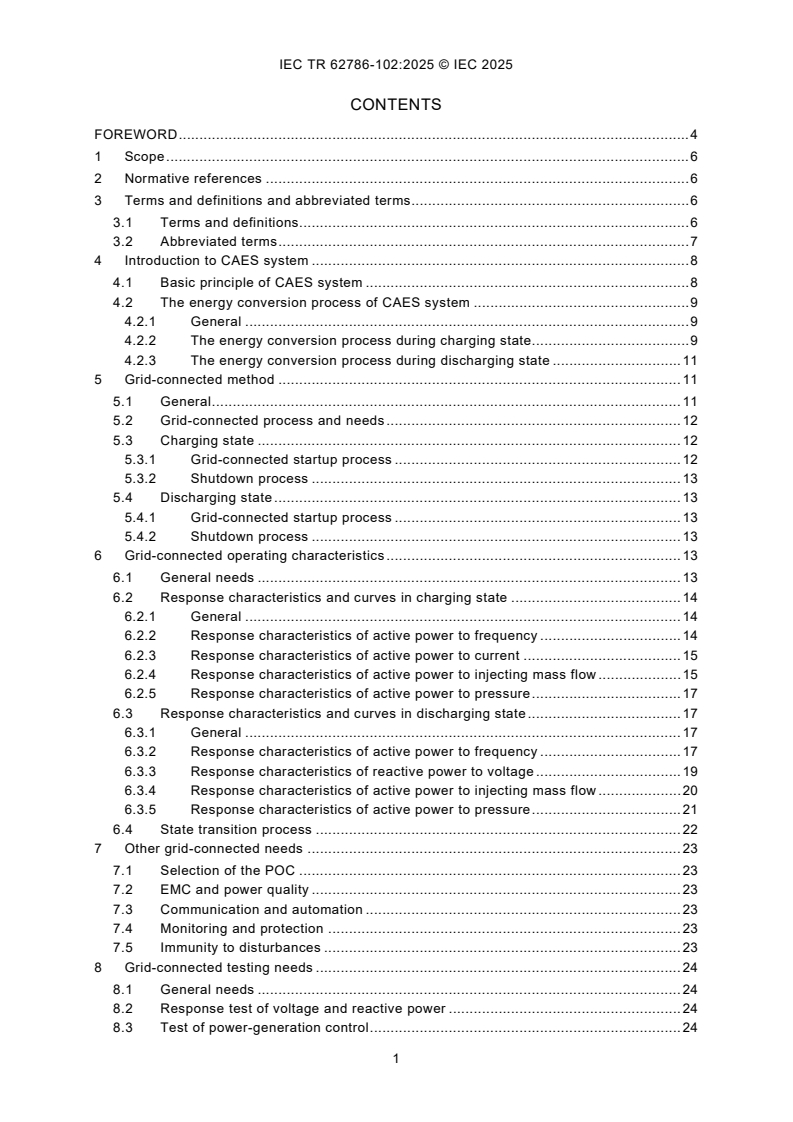
CONTENTS
FOREWORD . 4
1 Scope . 6
2 Normative references . 6
3 Terms and definitions and abbreviated terms . 6
3.1 Terms and definitions. 6
3.2 Abbreviated terms . 7
4 Introduction to CAES system . 8
4.1 Basic principle of CAES system . 8
4.2 The energy conversion process of CAES system . 9
4.2.1 General . 9
4.2.2 The energy conversion process during charging state. 9
4.2.3 The energy conversion process during discharging state . 11
5 Grid-connected method . 11
5.1 General . 11
5.2 Grid-connected process and needs . 12
5.3 Charging state . 12
5.3.1 Grid-connected startup process . 12
5.3.2 Shutdown process . 13
5.4 Discharging state . 13
5.4.1 Grid-connected startup process . 13
5.4.2 Shutdown process . 13
6 Grid-connected operating characteristics . 13
6.1 General needs . 13
6.2 Response characteristics and curves in charging state . 14
6.2.1 General . 14
6.2.2 Response characteristics of active power to frequency . 14
6.2.3 Response characteristics of active power to current . 15
6.2.4 Response characteristics of active power to injecting mass flow . 15
6.2.5 Response characteristics of active power to pressure . 17
6.3 Response characteristics and curves in discharging state . 17
6.3.1 General . 17
6.3.2 Response characteristics of active power to frequency . 17
6.3.3 Response characteristics of reactive power to voltage . 19
6.3.4 Response characteristics of active power to injecting mass flow . 20
6.3.5 Response characteristics of active power to pressure . 21
6.4 State transition process . 22
7 Other grid-connected needs . 23
7.1 Selection of the POC . 23
7.2 EMC and power quality . 23
7.3 Communication and automation . 23
7.4 Monitoring and protection . 23
7.5 Immunity to disturbances . 23
8 Grid-connected testing needs . 24
8.1 General needs . 24
8.2 Response test of voltage and reactive power . 24
8.3 Test of power-generation control . 24
8.4 Test of charging and discharging time . 24
8.5 Test of rated energy . 24
8.6 Efficiency test of energy conversion . 24
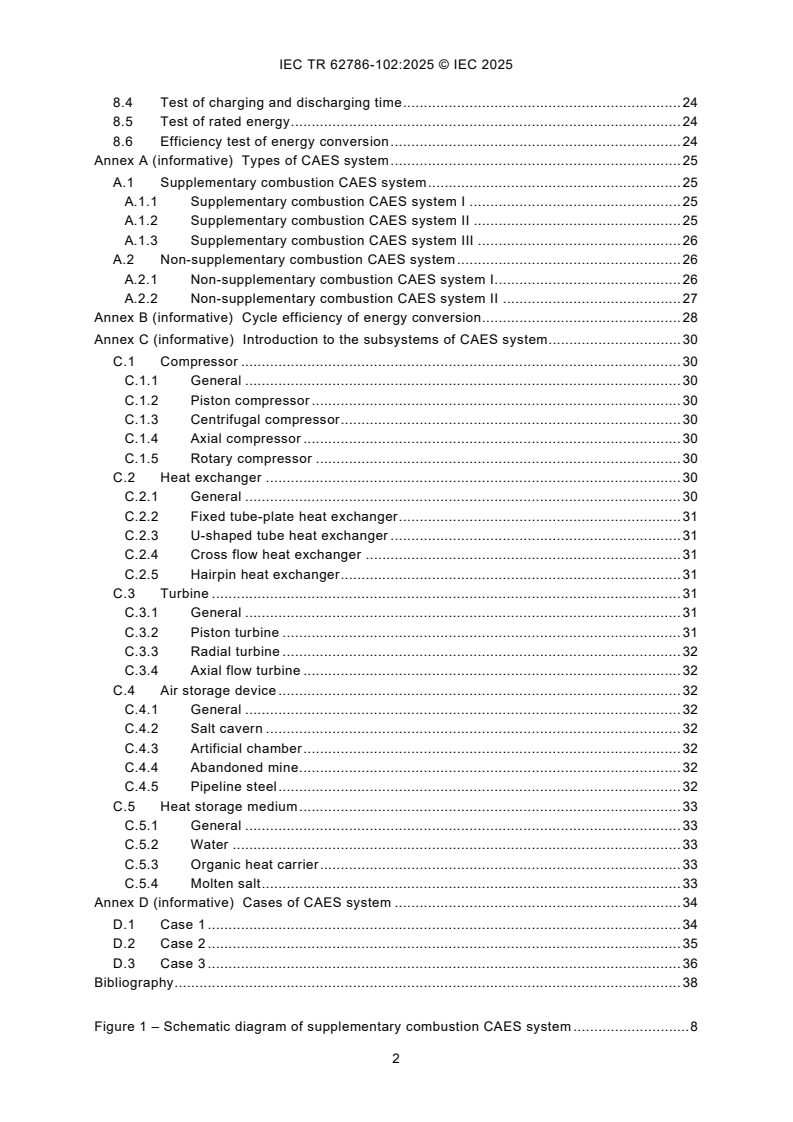
Annex A (informative) Types of CAES system . 25
A.1 Supplementary combustion CAES system . 25
A.1.1 Supplementary combustion CAES system I . 25
A.1.2 Supplementary combustion CAES system II . 25
A.1.3 Supplementary combustion CAES system III . 26
A.2 Non-supplementary combustion CAES system . 26
A.2.1 Non-supplementary combustion CAES system I. 26
A.2.2 Non-supplementary combustion CAES system II . 27
Annex B (informative) Cycle efficiency of energy conversion . 28
Annex C (informative) Introduction to the subsystems of CAES system . 30
C.1 Compressor . 30
C.1.1 General . 30
C.1.2 Piston compressor . 30
C.1.3 Centrifugal compressor . 30
C.1.4 Axial compressor . 30
C.1.5 Rotary compressor . 30
C.2 Heat exchanger . 30
C.2.1 General . 30
C.2.2 Fixed tube-plate heat exchanger . 31
C.2.3 U-shaped tube heat exchanger . 31
C.2.4 Cross flow heat exchanger . 31
C.2.5 Hairpin heat exchanger . 31
C.3 Turbine . 31
C.3.1 General . 31
C.3.2 Piston turbine . 31
C.3.3 Radial turbine . 32
C.3.4 Axial flow turbine . 32
C.4 Air storage device . 32
C.4.1 General . 32
C.4.2 Salt cavern . 32
C.4.3 Artificial chamber . 32
C.4.4 Abandoned mine . 32
C.4.5 Pipeline steel . 32
C.5 Heat storage medium . 33
C.5.1 General . 33
C.5.2 Water . 33
C.5.3 Organic heat carrier . 33
C.5.4 Molten salt . 33
Annex D (informative) Cases of CAES system . 34
D.1 Case 1 . 34
D.2 Case 2 . 35
D.3 Case 3 . 36
Bibliography . 38
Figure 1 – Schematic diagram of supplementary combustion CAES system . 8
Figure 2 – Schematic diagram of non-supplementary combustion CAES system . 8
Figure 3 – The schematic diagram of the CAES system connected to a network . 12
Figure 4 - The grid-connected process of the CAES system in charging state . 14
Figure 5 - Response curve of active power to injecting mass flow in charging state . 16
Figure 6 – Response curve of active power in charging state with changes in final-
level pressure . 17
Figure 7 – Response curve of active power in discharging state . 18
Figure 8 – Typical active power and frequency response curve . 19
Figure 9 – Response curve of active power to injecting mass flow in discharging state . 21
Figure 10 – Response curve of active power to pressure in discharging state . 22
Figure A.1 – Architecture of supplementary combustion CAES system I . 25
Figure A.2 – Architecture of Supplementary Combustion CAES System II . 26
Figure A.3 – Architecture of supplementary combustion CAES system III. 26
Figure A.4 – Architecture of non-complementary combustion CAES system I . 27
Figure A.5 – Architecture of non-complementary combustion CAES system II . 27
Figure D.1 – Panoramic view of Case 1 . 34
Figure D.2 – Panoramic view of Case 2 . 35
Figure D.3 – Panoramic view of Case 3 . 36
Table 1 – Active power in charging state of the CAES system . 15
Table 2 – Active power and injecting mass flow of the CAES system in stable charging
state . 16
Table 3 – The final-level pressure and charging active power during the stable
charging stage . 17
Table 4 – Operating frequency needs of the CAES system . 18
Table 5 – Active power of the CAES system in discharging state . 18
Table 6 – Response needs of reactive power to voltage . 20
Table 7 – The outlet pressure and active power in discharging state of the CAES
system . 22
INTERNATIONAL ELECTROTECHNICAL COMMISSION
____________
Distributed energy resources connection with the grid -
Part 102: CAES connection to the grid
FOREWORD
1) The International Electrotechnical Commission (IEC) is a worldwide organization for standardization comprising
all national electrotechnical committees (IEC National Committees). The object of IEC is to promote international
co-operation on all questions concerning standardization in the electrical and electronic fields. To this end and
in addition to other activities, IEC publishes International Standards, Technical Specifications, Technical Reports,
Publicly Available Specifications (PAS) and Guides (hereafter referred to as "IEC Publication(s)"). Their
preparation is entrusted to technical committees; any IEC National Committee interested in the subject dealt with
may participate in this preparatory work. International, governmental and non-governmental organizations liaising
with the IEC also participate in this preparation. IEC collaborates closely with the International Organization for
Standardization (ISO) in accordance with conditions determined by agreement between the two organizations.
2) The formal decisions or agreements of IEC on technical matters express, as nearly as possible, an international
consensus of opinion on the relevant subjects since each technical committee has representation from all
interested IEC National Committees.
3) IEC Publications have the form of recommendations for international use and are accepted by IEC National
Committees in that sense. While all reasonable efforts are made to ensure that the technical content of IEC
Publications is accurate, IEC cannot be held responsible for the way in which they are used or for any
misinterpretation by any end user.
4) In order to promote international uniformity, IEC National Committees undertake to apply IEC Publications
transparently to the maximum extent possible in their national and regional publications. Any divergence between
any IEC Publication and the corresponding national or regional publication shall be clearly indicated in the latter.
5) IEC itself does not provide any attestation of conformity. Independent certification bodies provide conformity
assessment services and, in some areas, access to IEC marks of conformity. IEC is not responsible for any
services carried out by independent certification bodies.
6) All users should ensure that they have the latest edition of this publication.
7) No liability shall attach to IEC or its directors, employees, servants or agents including individual experts and
members of its technical committees and IEC National Committees for any personal injury, property damage or
other damage of any nature whatsoever, whether direct or indirect, or for costs (including legal fees) and
expenses arising out of the publication, use of, or reliance upon, this IEC Publication or any other IEC
Publications.
8) Attention is drawn to the Normative references cited in this publication. Use of the referenced publications is
indispensable for the correct application of this publication.
9) IEC draws attention to the possibility that the implementation of this document may involve the use of (a)
patent(s). IEC takes no position concerning the evidence, validity or applicability of any claimed patent rights in
respect thereof. As of the date of publication of this document, IEC had not received notice of (a) patent(s), which
may be required to implement this document. However, implementers are cautioned that this may not represent
the latest information, which may be obtained from the patent database available at https://patents.iec.ch. IEC
shall not be held responsible for identifying any or all such patent rights.
IEC TR 62786-102 has been prepared by IEC Technical Committee 8: System aspects of
electrical energy supply. It is a Technical Report.
The text of this Technical Report is based on the following documents:
Draft Report on voting
8/1745/DTR 8/1749/RVDTR
Full information on the voting for its approval can be found in the report on voting indicated in
the above table.
The language used for the development of this Technical Report is English.
This document was drafted in accordance with ISO/IEC Directives, Part 2, and developed in
accordance with ISO/IEC Directives, Part 1 and ISO/IEC Directives, IEC Supplement, available
at www.iec.ch/members_experts/refdocs. The main document types developed by IEC are
described in greater detail at www.iec.ch/publications.
A list of all parts in the IEC 62786 series, published under the general title Distributed energy
resources connection with the grid, can be found on the IEC website.
The committee has decided that the contents of this document will remain unchanged until the
stability date indicated on the IEC website under webstore.iec.ch in the data related to the
specific document. At this date, the document will be
– reconfirmed,
– withdrawn, or
– revised.
1 Scope
This part of IEC 62786, which is a technical report, provides principles and technical needs for
the interconnection of the compressed air energy storage (CAES) system to the distribution
network. It is suitable for the planning, design, operation and testing of CAES system
interconnection to distribution networks. It includes the additional needs for the CAES system,
such as connection scheme, grid-connected process and needs, response characteristics of
active power to frequency, response characteristics of active power to current, response
characteristics of active power to injecting mass flow, response characteristics of active power
to pressure, selection of the point of connection (POC), electromagnetic compatibility (EMC)
and power quality, communication and automation, monitoring and protection, immunity to
disturbances, grid-connected testing needs, etc.
The CAES systems considered within the scope of this document include supplementary
combustion CAES system and non-supplementary combustion CAES system, interconnected
to medium voltage (MV) or low voltage (LV) distribution networks in the form of electric motors
and generators. This document will report response of active power to frequency, response of
active power to current, response of active power to injecting mass flow, response of active
power to pressure, response of reactive power to voltage, and grid-connected testing for
distributed CAES system, as a supplement for IEC TS 62786-1:2023 [1] .
This document reports the interface needs for connecting CAES system to distribution network
operating at a nominal frequency of 50 Hz or 60 Hz.
2 Normative references
There are no normative references in this document.
3 Terms and definitions and abbreviated terms
3.1 Terms and definitions
For the purposes of this document, the following terms and definitions apply.
ISO and IEC maintain terminology databases for use in standardization at the following
addresses:
– IEC Electropedia: available at https://www.electropedia.org/
– ISO Online browsing platform: available at https://www.iso.org/obp
3.1.1
CAES system
system using compressed air as an energy storage carrier to achieve charging, discharging,
and utilization of energy, generally including compressors, air storage devices, heat storage
and exchange devices, turbines, generators, etc
3.1.2
compressor
device used to increase air pressure and temperature by compressing air
___________
Numbers in square brackets refer to the Bibliography.
3.1.3
turbine
device that uses compressed air expansion to convert air internal energy and potential energy
into mechanical energy
3.1.4
heat exchanger
device that transfers part of heat from hot fluid to cold fluid
3.1.5
air storage device
device for the injection, storage and extraction of compressed air using artificial pressure
vessels or geological space
3.1.6
thermal storage device
device that uses media such as water, thermal oil, and molten salt to absorb, store, and release
heat
3.1.7
charging process
process in which the motor drives the compressor to compress the air to a high-temperature
and high-pressure state, which converts the electrical energy into the internal energy and
potential energy of the compressed air
3.1.8
discharging process
process sin which the high-pressure air is released from the air storage device into the turbine
to expand and work, driving the generator to produce electricity, which converts the internal
energy and potential energy contained in the compressed air back into electrical energy
3.1.9
point of connection
POC
reference point on the electric power system where the user's electrical device is connected
[SOURCE: IEC 60050-617:2009, 617-04-01]
3.1.10
surging state
vibration state of a compressor under abnormal working conditions when the mass flow
decreases to a certain extent
3.1.11
choking state
working state in which the compressor is unable to operate normally due to internal blockage
3.2 Abbreviated terms
CAES compressed air energy storage
EMC electromagnetic compatibility
PMU power management unit
POC point of connection
MV medium voltage
LV low voltage
AVC automatic voltage control
4 Introduction to CAES system
4.1 Basic principle of CAES system
According to whether the CAES system is heated during the expansion process, it is generally
divided into a supplementary combustion CAES system and a non-supplementary combustion
CAES system (see Annex A).
The schematic diagram of the supplementary combustion CAES system is shown in Figure 1,
while the schematic diagram of the non-supplementary combustion CAES system is shown in
Figure 2. When storing energy, off-peak electricity and green electricity generated by wind
farms, photovoltaic power stations, etc., are used to drive the compressor, compressing the air
to a high-temperature and high-pressure state. After cooling, the high-pressure air approaches
the normal temperature state and is stored in the air storage device. When releasing energy,
high-pressure air is released from the air storage device to drive the turbines and generators
to produce electricity.
The supplementary combustion CAES system uses natural gas, fossil fuels, and other
supplementary heat sources to heat the compressed air during power generation. The
non-supplementary combustion CAES system does not require supplementary heat sources
during power generation. Heat produced through the compression process is collected and
released in the expansion process to meet the heating needs.
Figure 1 – Schematic diagram of supplementary combustion CAES system
Figure 2 – Schematic diagram of non-supplementary combustion CAES system
The CAES system generally includes the main components below (see Annex C):
a) compressor, which is generally a multi-stage compressor with inter-stage cooling device.
b) turbine, generally multi-stage turbine with inter-stage reheat equipment.
c) motor/generator, connecting with the compressor and turbine through the clutch
respectively.
d) air storage device, such as underground caves or above-ground pressure vessels.
e) control systems and auxiliary equipment, including control systems, fuel devices,
mechanical transmission systems, pipelines and accessories.
f) heat exchanger, used for the recovery of waste heat.
g) heat storage system, used to absorb and store the heat of compressed air, heating the
compressed air during power generation process.
h) burner, a device in which fuel is burned to heat the compressed air.
4.2 The energy conversion process of CAES system
4.2.1 General
Although the supplementary combustion CAES system needs external heat sources, its
operation mode is relatively flexible, and the comprehensive economic benefits of this type are
generally higher in areas close to heat sources or natural gas pipeline coverage. The compact
and simple structure of the non-supplementary CAES system eliminates the dependence on
external heat sources and fossil fuels and can achieve zero greenhouse gas emission. However,
the unit-price investment of the non-supplementary CAES system is usually higher, and the
further improvement of the capacity of the power station is limited by the development of the
compressor, storage device and heat exchange system. From the perspective of
comprehensive energy supply, both types of CAES systems have the capability of providing
electricity, heating and cooling at the same time, so as to have higher comprehensive efficiency
(see Annex B).
4.2.2 The energy conversion process during charging state
The CAES system generally divides the entire charging and compressing stage into two parts:
steady-state compression of level 1 to (N-1) and non-steady-state compression of the final stage.
The expressions for the power consumption of steady-state compression at levels 1 to (N-1)
and non-steady-state compression at level N are as follows:
k−1
c0
i
kT⋅−V Ω Ω
( )
i in,i s s s
k
c
i
W Ω α−1
( ) (1)
i s i
η kT−1
( )
csi
21kk−−21
NN
kk
NN
Ω Ω
c0s s
W Ω HH− −−Ω Ω
( ) (2)
N s 1 2s( s)
cc
Ω Ω
in,NNin,
where
c 2 c
TV k Ω
in,N s N in,N
H = (3)
Tk21k −−1
( )( )
s NN
c
TV k
inN, s N
H = (4)
T k −1
( )
s N
=
=
where
c
W Ω is the power consumption for steady-state compression of level 1 to (N-1),
( )
i s
c
is the power consumption for N-level non-steady-state compression,
W (Ω )
N s
Ω
s
is the pressure of the air storage device,
Ω is the initial working pressure of the air storage device,
s
i is the number of compressor levels, taken as 1~(N-1),
ɑ is the pressure ratio of the i-stage compressor,
i
T is the temperature of the air storage device,
s
c
is the inlet temperature of the i-level compressor,
T
in,i
k is the polytropic index of the i-level compressor,
i
k is the polytropic index of the Nth level compressor,
N
η is the compressor efficiency,
c
V
s
is the ideal gas constant,
c
Ω is the inlet pressure of the Nth level compressor,
in,N
c
T is the inlet temperature of the Nth level compressor.
in,N
During the compressing process, the relationship between the energy absorbed from the grid
and the pressure of the air storage device E Ω can be expressed as:
( )
c s
N−1
c c
(5)
E (Ω ) W (Ω )+W (Ω )
c s ∑ iNs s
i=1
E Ω
The total energy absorbed from the grid in the entire compressing process is:
c( s)
N−1
1 c 11c
E Ω W Ω+W Ω (6)
c( s) ∑ iN( s) ( s)
i=1
where
is the maximum working pressure of the air storage device.
Ω
s
=
=
4.2.3 The energy conversion process during discharging state
During the discharging stage, the high-pressure gas in the air storage device passes through
the heat exchanger or burner to elevate the temperature, driving the turbine and generator
which are connected together through the shaft and supplying electrical power. The relationship
between the energy released by each level of turbine and the pressure of the air storage device
is as follows:
μ −1
j
t 1
T μ Ω −Ω V
( )
in,j j s ss
μ
t j
W Ω 1 φ ,j 1,,N
( ) (7)
j stj
t
η μ −1 T
( )
jj s
where
φ is the pressure ratio of the jth level turbine,
j
t
T is the inlet temperature of the jth level turbine,
in,j
µ is the variable index of the jth level turbine,
j
t
is the efficiency of the turbine,
η
j
j is the number of levels for the turbine, taken as 1, ., N .
t
The total electrical energy E Ω provided to the grid throughout the entire power-generation
( )
ts
stage is:
N
0 t t0
E Ω = W Ω
(8)
ts( ) ∑ j( s)
i=1
where
is the total electrical energy provided by the CAES system to the grid throughout the
E Ω
ts( )
entire power-generation stage.
5 Grid-connected method
5.1 General
The schematic diagram of the CAES system connected to a network is shown in Figure 3. The
motor and generator are connected to the buses through switches, while the compressor and
turbine are connected to the motor and generator through shaft respectively.
−= =
Figure 3 – The schematic diagram of the CAES system connected to a network
5.2 Grid-connected process and needs
The CAES system, as a kind of flexible regulating resource, usually operates in charging state
during periods of low electricity consumption or periods of high renewable energy generation
based on scheduling instructions. During periods of medium electricity consumption, the CAES
system can shut down and maintain off-grid state, while it can startup and switch to discharging
state depending on the necessity of the grid.
The CAES system consumes electricity from the grid during charging state and compresses the
air through motors, converting electrical energy into internal energy and potential energy of the
compressed air. Generally, the internal energy is stored in the high-temperature thermal media,
while the potential energy is stored in the high-pressure air in the air storage device. During
discharging state, the compressed air expands and works in the turbine, which drives the
generator to produce electricity.
The motor and generator in the CAES system generally share a set of main transformers. The
motor inlet and generator outlet are connected to the low-voltage side of the main transformer
through their respective switches, and the two switches cannot be closed simultaneously. In
this case, when the CAES system transfers between charging and discharging states according
to the scheduling instructions, a process of shutting down, leaving the grid, and then
reconnecting to the grid is required. If the motor and generator use different main transformers,
the CAES system does not need to be shut down and disconnected from the grid during the
charging and discharging state transition, therefore operating continuously.
5.3 Charging state
5.3.1 Grid-connected startup process
Firstly, start the operation of the motor and compressor. Static frequency converters can be
used to avoid excessive motor speed and large surge current.
Secondly, adjust the injecting mass flow and outlet pressure to avoid the compressor from
operating in surging state. When increasing the outlet pressure at low injecting mass flow, the
CAES system exceeds the surging operating point until the outlet pressure of the compressor
is slightly higher than that of the air storage device.
Then, increase the power of the final-level compressor and then the injecting mass flow of the
air storage device is quickly raised. When the injecting mass flow of the air storage device
reaches the rated value, the CAES system enters a stable compressing state.
Finally, the mass flow of the final-level compressor is adjusted with the pressure rise of the
compressed air until the end of the energy storage process. The heat generated during the
compressing process is stored in the heat storage media through the heat exchanger, used for
heating the cold compressed air during the power generation process.
5.3.2 Shutdown process
When the pressure of the compressed air reaches the rated value, slowly reduce the mass flow
of the final-level compressor. Close the outlet valve of the final-level compressor and open the
pressure relief valve of each-level compressor when the mass flow of the final-level compressor
drops to zero. When the outlet pressure of the final-level compressor drops to a certain value
(such as 1 MPa), the switches will be opened and the motors of each-level compressor will be
stopped.
5.4 Discharging state
5.4.1 Grid-connected startup process
Firstly, open the isolation valve of the compressed air at the outlet of the air storage device to
start the impulse rotation, ensuring that the pressure at the air inlet of the turbine is not less
than the minimum limit of the air storage device.
Secondly, before entering the turbine, compressed air is suggested to be heated to the inlet
temperature, which utilizes the heat stored during the compressing process or gained by
burning fuels.
Finally, when the mass flow of the turbine reaches the rated value, the exciting and
synchronizing devices are put into operation for grid-connected power generation.
5.4.2 Shutdown process
When the discharging task is completed, the pressure of the air storage device is reduced to
the bottom value in the case of full discharge, and the heat stored in the thermal media has
been used up. When the output current drops to a certain range (such as 10 % of the rated
value), the operating button can be pressed to disconnect the generator. Meanwhile, the high-
pressure main valve, regulating valve and other valves are all suggested to be closed.
6 Grid-connected operating characteristics
6.1 General needs
The voltage harmonic distortion, voltage imbalance, voltage fluctuation and flicker at the POC
of the CAES system are suggested to meet the needs of IEC 60038 [2].
The withstand voltage and insulation strength of the CAES system are suggested to meet the
needs of IEC 60071-1 [3].
The grounding devices for lightning protection of CAES system are suggested to comply with
the needs of IEC 62305-3 [4], IEC 62561-1 [5], and IEC 62561-5 [6].
The identification of the CAES system is suggested to comply with the needs of ISO 7010 [7].
6.2 Response characteristics and curves in charging state
6.2.1 General
In the charging state of the CAES system, the compressor is driven by the motor to store
electrical energy and the motor is suggested to meet the response needs of active power and
frequency, active power and current, active power and injecting mass flow, active power and
pressure.
6.2.2 Response characteristics of active power to frequency
a) The operating range and response characteristics of frequency
The motor of the CAES system is suggested to be able to operate with the capability of
tolerating the rate of change of frequency, considering the scheduling instructions and
standards.
b) Response characteristics of active power
In practical CAES systems, the time intervals between discharging and charging states are
generally long (such as several hours). Thus, the CAES systems are mostly cold started,
with longer start time than hot start.
When the charging power of the CAES system needs to be adjusted according to the
scheduling instructions, it is suggested to be able to adjust the charging power within the
specified time, as shown in Figure 4.
The grid-connected process of the CAES system in charging state includes three stages. In
the first stage (t ~t ), the motor and compressor are put into operation, and the isolation
0 2
door of the compressed air starts to rotate and preheat. The charging power increases from
zero to P , which is maintained for avoiding the surging state during the t ~t period.
1 1 2
Subsequently, adjust the injecting mass flow and the outlet pressure to ensure that the
compressor avoids the surging state at different mass flows. By increasing the pressure at
low injecting mass flow, the surging operating point can be avoided until the outlet pressure
of the compressor is slightly higher than the pressure of the air storage device. In the second
~t ), increase the speed of the final-level compressor and the injecting mass flow,
stage (t
2 3
then the charging power increases from P to P . In the third stage (t ~t ), the compressor
1 2 3 4
reaches a stable state at the rated mass flow, the charging power increases from P to P .
2 3
Figure 4 - The grid-connected process of the CAES system in charging state
P , P , and P in Figure 4 show the active power of the motor in charging state of the CAES
1 2 3
system.
Table 1 – Active power in charging state of the CAES system
The maximum active power reached during the first stage of starting and charging the
P
CAES system, with a value of approximately 10 % of the rated power P
The maximum active power reached in the second stage of starting and charging the
P
CAES system, with a value of approximately 90 % of the rated power P
Rated active power during the starting and charging stage of the CAES system
P
The CAES systems connected to the MV and LV public grid are suggested to have the
function of automatically executing the scheduling instructions. The CAES system in Case 3
(as shown in Annex D) can be connected to the grid in about 24 minutes. In the first stage,
the charging power increases from zero to 6 MW in 3 minutes. In the second stage, the
charging power rises from 6 MW to 54 MW in 18 minutes. In the third stage, the charging
power increases from 54 MW to 60 MW in 3 minutes. The time period t ~t usually takes
1 2
zero to several minutes.
c) Response of active power to frequency deviation
According to system requirements, all CAES systems connected to the MV and LV networks
are suggested to control the active power during the charging stage, and adjust the active
power based on the frequency deviation (power-frequency response) to ensure the safe
operation of the network.
6.2.3 Response characteristics of active power to current
The relationship between the active power and current of the motor in charging state of the
CAES system is suggested to meet the needs of IEC 60034-16-1 [8].
6.2.4 Response characteristics of active power to injecting mass flow
The expression of charging active power and injecting mass flow is as follows:
kk
i N
cc
N−1
k R qT k R qT
i g c in,i kk−−11N g c in,N
i N (9)
P (α−+1) (α−1)
∑
c i N
η (k −−1) η (k 1)
cciN
i=1
[SOURCE: [9]]
where
c
Ω
out,i
α =
(10)
i
c
Ω
in,i
where
P is the active power in charging state,
c
R is the ideal gas constant,
g
q is the mass flow of injecting air,
c
i is the level number of the compressor, taken as 1~(N-1),
ɑ is the pressure ratio of the i-level compressor,
i
=
c
T is the inlet temperature of the i-level compressor,
in,i
k is the polytropic index of the i-level compressor,
i
k is the polytropic index of the N-level compressor,
N
η is the compressor efficiency,
c
c
is the inlet pressure of the N-level compressor,
Ω
in,N
c
T is the inlet temperature of the N-level compressor,
in,N
c
Ω is the outlet pressure of the i-level compressor,
out,i
c
Ω is the inlet pressure of the i-level compressor.
in,i
When the ideal gas constant, efficiency, polytropic index and boost ratio of pressure at every
level are unchanged, the charging power of the CAES system is directly proportional to the
injecting mass flow.
The response curve of charging active power to injecting mass flow in charging state is
suggested to meet the needs shown in Figure 5. The charging active power is directly
proportional to frequency, w
...