

IEC 61291-5-2:2017
(Main)Optical amplifiers - Part 5-2: Qualification specifications - Reliability qualification for optical fibre amplifiers
General Information
- Abstract
IEC 61291-5-2:2017 applies to optical amplifiers (OAs) and optically amplified, elementary sub-systems for terrestrial applications, using active fibres (optical fibre amplifiers (OFAs)) containing rare-earth dopants, which are commercially available. The black box approach is used in this document. The black box approach is adopted in order to give product specifications which are independent of OA implementation details. For reliability qualification purposes, some information about the internal components is needed; these internal parts are themselves treated as black boxes. This document gives requirements for the evaluation of OA reliability by combining the reliability of such internal black boxes. The object of this document is to specify the minimum list of reliability qualification tests, requirements on failure criteria during testing and on reliability predictions, and give the relevant normative references to establish a standard method for the assessment of the reliability of OFA devices and sub-systems in order to minimize risks and to promote product development and reliability qualification. This second edition cancels and replaces the first edition published in 2002. It constitutes a technical revision. This edition includes the following significant technical changes with respect to the previous edition:
a) removal of the contents on the relating quality management system from scope, terms and definitions, and the reliability requirements;
b) moving fit-rate calculation to Annex B (informative);
c) change of requirements for shock test;
d) amendment of abbreviations related to changes a) and b).
The contents of the corrigendum of May 2019 have been included in this copy.
- Status
- Published
- Publication Date
- 23-Feb-2026
- Technical Committee
- SC 86C - Fibre optic systems, sensing and active devices
- Drafting Committee
- WG 3 - TC 86/SC 86C/WG 3
- Current Stage
- PPUB - Publication issued
- Start Date
- 25-Jan-2017
- Completion Date
- 23-Feb-2017
Buy Documents
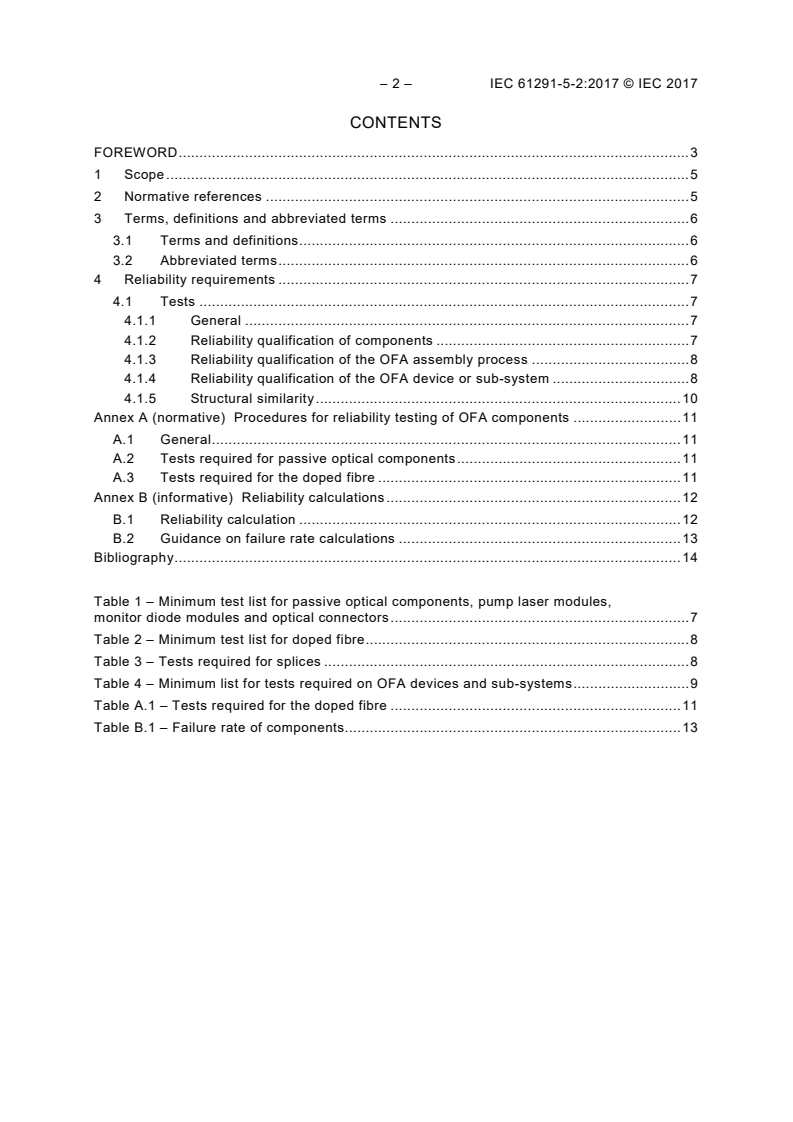
IEC 61291-5-2:2017 - Optical amplifiers - Part 5-2: Qualification specifications - Reliability qualification for optical fibre amplifiers Released:1/25/2017
IEC 61291-5-2:2017+AMD1:2026 CSV - Optical amplifiers - Part 5-2: Qualification specifications - Reliability qualification for optical fibre amplifiers
IEC 61291-5-2:2017 - Optical amplifiers - Part 5-2: Qualification specifications - Reliability qualification for optical fibre amplifiers Released:1/25/2017
Overview - IEC 61291-5-2:2017 (Optical amplifiers, Reliability qualification)
IEC 61291-5-2:2017 defines a standardized method to assess the reliability of optical fibre amplifiers (OFAs) and optically amplified elementary sub-systems for terrestrial applications. Using a black box approach, the standard specifies the minimum list of reliability qualification tests, failure criteria for testing, and requirements for reliability predictions (FIT rates). This second edition (2017, corrigendum May 2019) replaces the 2002 edition and updates shock testing, fit-rate placement (Annex B, informative), and removes quality‑management content from the scope.
Key topics and technical requirements
- Black box methodology: OFAs and internal parts are treated as black boxes so product specifications remain independent of implementation details; the OFA failure rate is derived by combining FIT rates of internal black boxes.
- Minimum test lists: Normative guidance on baseline tests for:
- Passive optical components, pump modules, monitor diodes and connectors
- Doped fibres (proof test, hydrogen aging, coating strip force where applicable)
- Splices and the fibre‑assembly process
- Assembly-process qualification: Emphasis on qualifying fibre winding, splice processes and assembly as critical contributors to overall reliability.
- Reliability calculations: Annex B (informative) provides guidance on combining component FIT rates to predict OFA reliability; manufacturers must declare internal black boxes and their FIT values.
- Environmental and stress tests referenced: Uses established environmental test standards (IEC 60068 series) for dry heat, temperature cycling, shock, damp heat and related procedures.
- Documentation and normative references: Cross-references to IEC 61291-1 (generic spec), IEC 62005 parts, IEC 61300 series and other test procedures.
Practical applications
- Design validation: Integrate standardized reliability testing early in OFA product development to find design margins and reduce field failures.
- Qualification for production: Use the minimum test lists and assembly‑process qualification to define acceptance criteria for manufacturing and incoming components.
- Procurement and supplier evaluation: Buyers can require conformity to IEC 61291-5-2:2017 to ensure consistent, auditable reliability claims from suppliers.
- Reliability prediction & risk management: Combine component FIT data per Annex B to support MTBF estimates, service planning and warranty analysis.
Who should use this standard
- OFA manufacturers and subsystem vendors
- Reliability and test engineers in fibre‑optic product development
- Test laboratories and conformity assessment bodies
- Network operators, system integrators and procurement teams specifying amplifier reliability
Related standards
- IEC 61291-1 (Optical fibre amplifiers - Generic specification)
- IEC 60068 series (environmental testing)
- IEC 62005-9-1 / 9-2 (reliability of passive optical components and connectors)
- IEC 61300 series, TIA 455-11 (component test procedures)
Keywords: IEC 61291-5-2:2017, optical amplifiers, optical fibre amplifiers, reliability qualification, OFA, black box approach, FIT rates, doped fibre, component qualification, reliability testing.
Relations
- Effective Date
- 29-Nov-2024
- Effective Date
- 05-Sep-2023
- Effective Date
- 05-Sep-2023
Buy Documents
IEC 61291-5-2:2017 - Optical amplifiers - Part 5-2: Qualification specifications - Reliability qualification for optical fibre amplifiers Released:1/25/2017
IEC 61291-5-2:2017+AMD1:2026 CSV - Optical amplifiers - Part 5-2: Qualification specifications - Reliability qualification for optical fibre amplifiers
IEC 61291-5-2:2017 - Optical amplifiers - Part 5-2: Qualification specifications - Reliability qualification for optical fibre amplifiers Released:1/25/2017
Get Certified
Connect with accredited certification bodies for this standard

ANCE
Mexican certification and testing association.

Intertek Slovenia
Intertek testing, inspection, and certification services in Slovenia.

LNE (Laboratoire National de Métrologie et d'Essais)
French national laboratory for metrology and testing.
Sponsored listings
Frequently Asked Questions
IEC 61291-5-2:2017 is a standard published by the International Electrotechnical Commission (IEC). Its full title is "Optical amplifiers - Part 5-2: Qualification specifications - Reliability qualification for optical fibre amplifiers". This standard covers: IEC 61291-5-2:2017 applies to optical amplifiers (OAs) and optically amplified, elementary sub-systems for terrestrial applications, using active fibres (optical fibre amplifiers (OFAs)) containing rare-earth dopants, which are commercially available. The black box approach is used in this document. The black box approach is adopted in order to give product specifications which are independent of OA implementation details. For reliability qualification purposes, some information about the internal components is needed; these internal parts are themselves treated as black boxes. This document gives requirements for the evaluation of OA reliability by combining the reliability of such internal black boxes. The object of this document is to specify the minimum list of reliability qualification tests, requirements on failure criteria during testing and on reliability predictions, and give the relevant normative references to establish a standard method for the assessment of the reliability of OFA devices and sub-systems in order to minimize risks and to promote product development and reliability qualification. This second edition cancels and replaces the first edition published in 2002. It constitutes a technical revision. This edition includes the following significant technical changes with respect to the previous edition: a) removal of the contents on the relating quality management system from scope, terms and definitions, and the reliability requirements; b) moving fit-rate calculation to Annex B (informative); c) change of requirements for shock test; d) amendment of abbreviations related to changes a) and b). The contents of the corrigendum of May 2019 have been included in this copy.
IEC 61291-5-2:2017 applies to optical amplifiers (OAs) and optically amplified, elementary sub-systems for terrestrial applications, using active fibres (optical fibre amplifiers (OFAs)) containing rare-earth dopants, which are commercially available. The black box approach is used in this document. The black box approach is adopted in order to give product specifications which are independent of OA implementation details. For reliability qualification purposes, some information about the internal components is needed; these internal parts are themselves treated as black boxes. This document gives requirements for the evaluation of OA reliability by combining the reliability of such internal black boxes. The object of this document is to specify the minimum list of reliability qualification tests, requirements on failure criteria during testing and on reliability predictions, and give the relevant normative references to establish a standard method for the assessment of the reliability of OFA devices and sub-systems in order to minimize risks and to promote product development and reliability qualification. This second edition cancels and replaces the first edition published in 2002. It constitutes a technical revision. This edition includes the following significant technical changes with respect to the previous edition: a) removal of the contents on the relating quality management system from scope, terms and definitions, and the reliability requirements; b) moving fit-rate calculation to Annex B (informative); c) change of requirements for shock test; d) amendment of abbreviations related to changes a) and b). The contents of the corrigendum of May 2019 have been included in this copy.
IEC 61291-5-2:2017 is classified under the following ICS (International Classification for Standards) categories: 33.180.30 - Optic amplifiers. The ICS classification helps identify the subject area and facilitates finding related standards.
IEC 61291-5-2:2017 has the following relationships with other standards: It is inter standard links to IEC 61291-5-2:2017/AMD1:2026, IEC 61291-5-2:2017/COR1:2019, IEC 61291-5-2:2002. Understanding these relationships helps ensure you are using the most current and applicable version of the standard.
IEC 61291-5-2:2017 is available in PDF format for immediate download after purchase. The document can be added to your cart and obtained through the secure checkout process. Digital delivery ensures instant access to the complete standard document.
Standards Content (Sample)
IEC 61291-5-2 ®
Edition 2.0 2017-01
INTERNATIONAL
STANDARD
Optical amplifiers –
Part 5-2: Qualification specifications – Reliability qualification for optical fibre
amplifiers
All rights reserved. Unless otherwise specified, no part of this publication may be reproduced or utilized in any form
or by any means, electronic or mechanical, including photocopying and microfilm, without permission in writing from
either IEC or IEC's member National Committee in the country of the requester. If you have any questions about IEC
copyright or have an enquiry about obtaining additional rights to this publication, please contact the address below or
your local IEC member National Committee for further information.
IEC Central Office Tel.: +41 22 919 02 11
3, rue de Varembé Fax: +41 22 919 03 00
CH-1211 Geneva 20 info@iec.ch
Switzerland www.iec.ch
About the IEC
The International Electrotechnical Commission (IEC) is the leading global organization that prepares and publishes
International Standards for all electrical, electronic and related technologies.
About IEC publications
The technical content of IEC publications is kept under constant review by the IEC. Please make sure that you have the
latest edition, a corrigenda or an amendment might have been published.
IEC Catalogue - webstore.iec.ch/catalogue Electropedia - www.electropedia.org
The stand-alone application for consulting the entire The world's leading online dictionary of electronic and
bibliographical information on IEC International Standards, electrical terms containing 20 000 terms and definitions in
Technical Specifications, Technical Reports and other English and French, with equivalent terms in 16 additional
documents. Available for PC, Mac OS, Android Tablets and languages. Also known as the International Electrotechnical
iPad. Vocabulary (IEV) online.
IEC publications search - www.iec.ch/searchpub IEC Glossary - std.iec.ch/glossary
The advanced search enables to find IEC publications by a 65 000 electrotechnical terminology entries in English and
variety of criteria (reference number, text, technical French extracted from the Terms and Definitions clause of
committee,…). It also gives information on projects, replaced IEC publications issued since 2002. Some entries have been
and withdrawn publications. collected from earlier publications of IEC TC 37, 77, 86 and
CISPR.
IEC Just Published - webstore.iec.ch/justpublished
Stay up to date on all new IEC publications. Just Published IEC Customer Service Centre - webstore.iec.ch/csc
details all new publications released. Available online and If you wish to give us your feedback on this publication or
also once a month by email. need further assistance, please contact the Customer Service
Centre: csc@iec.ch.
IEC 61291-5-2 ®
Edition 2.0 2017-01
INTERNATIONAL
STANDARD
Optical amplifiers –
Part 5-2: Qualification specifications – Reliability qualification for optical fibre
amplifiers
INTERNATIONAL
ELECTROTECHNICAL
COMMISSION
ICS 33.180.30 ISBN 978-2-8322-3855-4
– 2 – IEC 61291-5-2:2017 © IEC 2017
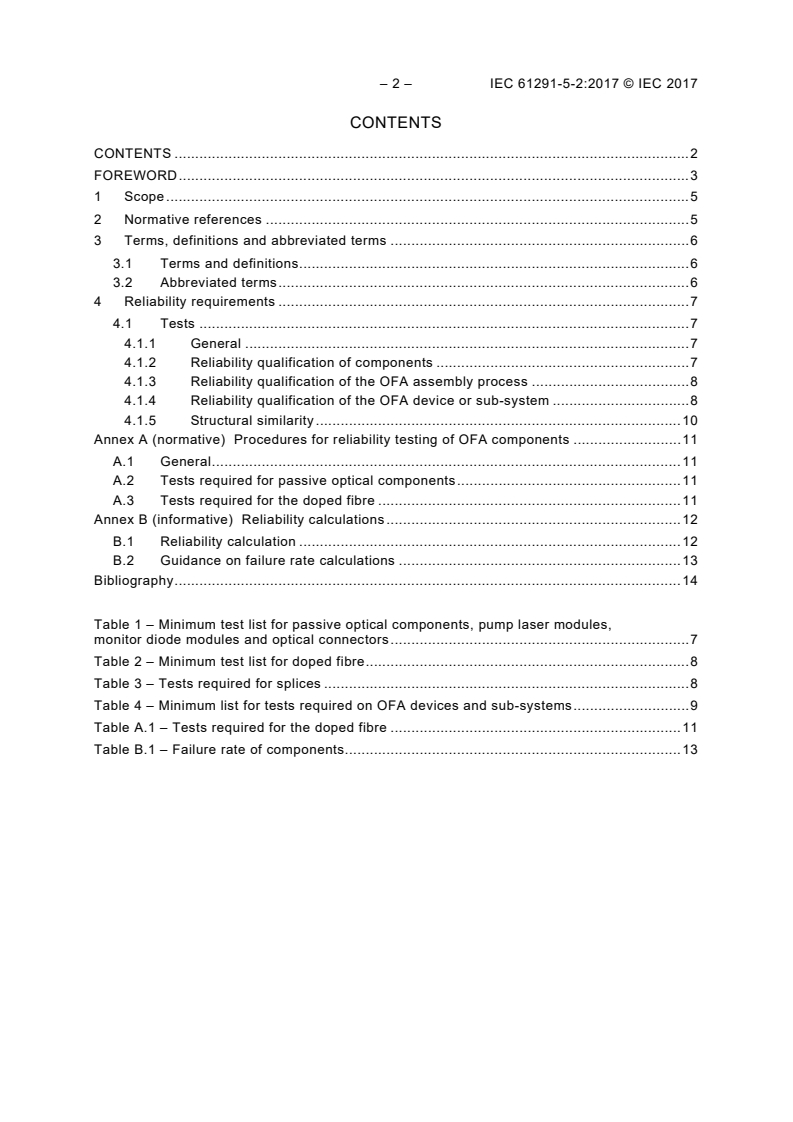
CONTENTS
FOREWORD . 3
1 Scope . 5
2 Normative references . 5
3 Terms, definitions and abbreviated terms . 6
3.1 Terms and definitions . 6
3.2 Abbreviated terms . 6
4 Reliability requirements . 7
4.1 Tests . 7
4.1.1 General . 7
4.1.2 Reliability qualification of components . 7
4.1.3 Reliability qualification of the OFA assembly process . 8
4.1.4 Reliability qualification of the OFA device or sub-system . 8
4.1.5 Structural similarity . 10
Annex A (normative) Procedures for reliability testing of OFA components . 11
A.1 General . 11
A.2 Tests required for passive optical components . 11
A.3 Tests required for the doped fibre . 11
Annex B (informative) Reliability calculations . 12
B.1 Reliability calculation . 12
B.2 Guidance on failure rate calculations . 13
Bibliography . 14
Table 1 – Minimum test list for passive optical components, pump laser modules,
monitor diode modules and optical connectors . 7
Table 2 – Minimum test list for doped fibre . 8
Table 3 – Tests required for splices . 8
Table 4 – Minimum list for tests required on OFA devices and sub-systems . 9
Table A.1 – Tests required for the doped fibre . 11
Table B.1 – Failure rate of components . 13
INTERNATIONAL ELECTROTECHNICAL COMMISSION
____________
OPTICAL AMPLIFIERS –
Part 5-2: Qualification specifications – Reliability qualification
for optical fibre amplifiers
FOREWORD
1) The International Electrotechnical Commission (IEC) is a worldwide organization for standardization comprising
all national electrotechnical committees (IEC National Committees). The object of IEC is to promote
international co-operation on all questions concerning standardization in the electrical and electronic fields. To
this end and in addition to other activities, IEC publishes International Standards, Technical Specifications,
Technical Reports, Publicly Available Specifications (PAS) and Guides (hereafter referred to as “IEC
Publication(s)”). Their preparation is entrusted to technical committees; any IEC National Committee interested
in the subject dealt with may participate in this preparatory work. International, governmental and non-
governmental organizations liaising with the IEC also participate in this preparation. IEC collaborates closely
with the International Organization for Standardization (ISO) in accordance with conditions determined by
agreement between the two organizations.
2) The formal decisions or agreements of IEC on technical matters express, as nearly as possible, an international
consensus of opinion on the relevant subjects since each technical committee has representation from all
interested IEC National Committees.
3) IEC Publications have the form of recommendations for international use and are accepted by IEC National
Committees in that sense. While all reasonable efforts are made to ensure that the technical content of IEC
Publications is accurate, IEC cannot be held responsible for the way in which they are used or for any
misinterpretation by any end user.
4) In order to promote international uniformity, IEC National Committees undertake to apply IEC Publications
transparently to the maximum extent possible in their national and regional publications. Any divergence
between any IEC Publication and the corresponding national or regional publication shall be clearly indicated in
the latter.
5) IEC itself does not provide any attestation of conformity. Independent certification bodies provide conformity
assessment services and, in some areas, access to IEC marks of conformity. IEC is not responsible for any
services carried out by independent certification bodies.
6) All users should ensure that they have the latest edition of this publication.
7) No liability shall attach to IEC or its directors, employees, servants or agents including individual experts and
members of its technical committees and IEC National Committees for any personal injury, property damage or
other damage of any nature whatsoever, whether direct or indirect, or for costs (including legal fees) and
expenses arising out of the publication, use of, or reliance upon, this IEC Publication or any other IEC
Publications.
8) Attention is drawn to the Normative references cited in this publication. Use of the referenced publications is
indispensable for the correct application of this publication.
9) Attention is drawn to the possibility that some of the elements of this IEC Publication may be the subject of
patent rights. IEC shall not be held responsible for identifying any or all such patent rights.
International Standard IEC 61291-5-2 has been prepared by subcommittee 86C: Fibre optic
systems and active devices, of IEC technical committee 86: Fibre optics.
This second edition cancels and replaces the first edition published in 2002. It constitutes a
technical revision.
This edition includes the following significant technical changes with respect to the previous
edition:
a) removal of the contents on the relating quality management system from scope, terms and
definitions, and the reliability requirements;
b) moving fit-rate calculation to Annex B (informative);
c) change of requirements for shock test;
d) amendment of abbreviations related to changes a) and b).
– 4 – IEC 61291-5-2:2017 © IEC 2017
The text of this International Standard is based on the following documents:
CDV Report on voting
86C/1376/CDV 86C/1426/RVC
Full information on the voting for the approval of this International Standard can be found in
the report on voting indicated in the above table.
This document has been drafted in accordance with the ISO/IEC Directives, Part 2.
A list of all parts in the IEC 61291 series, published under the general title Optical amplifiers,
can be found on the IEC website.
The committee has decided that the contents of this document will remain unchanged until the
stability date indicated on the IEC website under "http://webstore.iec.ch" in the data related to
the specific document. At this date, the document will be
• reconfirmed,
• withdrawn,
• replaced by a revised edition, or
• amended.
A bilingual version of this publication may be issued at a later date.
The contents of the corrigendum of May 2019 have been included in this copy.
OPTICAL AMPLIFIERS –
Part 5-2: Qualification specifications – Reliability qualification
for optical fibre amplifiers
1 Scope
This part of IEC 61291 applies to optical amplifiers (OAs) and optically amplified, elementary
sub-systems for terrestrial applications, using active fibres (optical fibre amplifiers (OFAs))
containing rare-earth dopants, which are commercially available.
The black box approach is used in this document. The black box approach is adopted in order
to give product specifications which are independent of OA implementation details. For
reliability qualification purposes, some information about the internal components is needed;
these internal parts are themselves treated as black boxes. This document gives
requirements for the evaluation of OA reliability by combining the reliability of such internal
black boxes.
The object of this document is to specify the minimum list of reliability qualification tests,
requirements on failure criteria during testing and on reliability predictions, and give the
relevant normative references to establish a standard method for the assessment of the
reliability of OFA devices and sub-systems in order to minimize risks and to promote product
development and reliability qualification.
2 Normative references
The following documents are referred to in the text in such a way that some or all of their
content constitutes requirements of this document. For dated references, only the edition
cited applies. For undated references, the latest edition of the referenced document (including
any amendments) applies.
IEC 60050-731, International Electrotechnical Vocabulary – Chapter 731: Optical fibre
communication
IEC 60068-2-2:2007, Environmental testing – Part 2-2: Tests – Test B: Dry heat
IEC 60068-2-14, Environmental testing – Part 2-14: Tests – Test N: Change of temperature
IEC 60068-2-21, Environmental testing – Part 2-21: Tests – Test U: Robustness of
terminations and integral mounting devices
IEC 60068-2-27, Environmental testing – Part 2-27: Tests – Test Ea and guidance: Shock
IEC 60068-2-31, Tests – Test Ec: Rough handling shocks, primarily for equipment-type
specimens
IEC 60068-2-78, Environmental testing – Part 2-78: Tests – Test Cab: Damp heat, steady
state
IEC 61291-1, Optical fibre amplifiers – Part 1: Generic specification
– 6 – IEC 61291-5-2:2017 © IEC 2017
IEC 61300-2-4, Fibre optic interconnecting devices and passive components – Basic test and
measurement procedures – Part 2-4: Tests – Fibre/cable retention
IEC 62005-9-1, Fibre optic interconnecting devices and passive components – Reliability –
Part 9-1: Qualification of passive optical components
IEC 62005-9-2, Reliability of fibre optic interconnecting devices and passive optical
components – Part 9-2: Reliability qualification for single fibre optic connector sets – Single
mode
TIA 455-11, FOTP-11 Vibration Test Procedure for Fiber Optic Components and Cables
3 Terms, definitions and abbreviated terms
3.1 Terms and definitions
For the purposes of this document, the terms and definitions given in IEC 61291-1,
IEC 60050-731 and the following apply.
ISO and IEC maintain terminological databases for use in standardization at the following
addresses:
• IEC Electropedia: available at http://www.electropedia.org/
• ISO Online browsing platform: available at http://www.iso.org/obp
3.1.1
failure
non-compliance to product specification or change in parameters as agreed by the customer
and supplier
3.1.2
OFA manufacturer
OFAM
manufacturer who provides optical fibre amplifier (OFA) devices or subsystems meeting the
requirements of the applicable product specification (PS)
Note 1 to entry PS includes the reliability requirement.
3.2 Abbreviated terms
EDFF erbium doped fluoride fibre
EDSFA erbium doped silica fibre amplifier
EDTF erbium doped tellurite fibre
FIT failure in time
FFS for further study
OA optical amplifier
OFA optical fibre amplifier
OFAM optical amplifier manufacturer
OFAM optical fibre amplifier manufacturer
PDFF praseodymium doped fluoride fibre
PS product specification
RH relative humidity
DFF thulium doped fluoride fibre
UCL upper confidence level
4 Reliability requirements
4.1 Tests
4.1.1 General
An optical fibre amplifier (OFA) device or sub-system is an assembly of various parts and
components of different nature. A main point in the reliability testing of the OFA device or sub-
system is to ensure the reliability of each part and basic manufacturing process used and to
provide a route that may result in an understanding of design margins. For the purpose of this
document, each internal part shall be seen as a black box.
This document is based on the assumption that the reliability of an optical amplifier (OA) can
be evaluated with sufficient confidence from the failure in time (FIT) rates of its internal black
boxes when the assembly process of the constituents has been qualified.
The procedures to qualify the assembly process are described in 4.1.3.
The reliability assurance is confirmed by the test procedure described in 4.1.4 carried out o
...
IEC 61291-5-2 ®
Edition 2.1 2026-02
INTERNATIONAL
STANDARD
CONSOLIDATED VERSION
Optical amplifiers -
Part 5-2: Qualification specifications - Reliability qualification for optical fibre
amplifiers
ICS 33.180.30 ISBN 978-2-8327-1106-4
All rights reserved. Unless otherwise specified, no part of this publication may be reproduced or utilized in any form or
by any means, electronic or mechanical, including photocopying and microfilm, without permission in writing from either
IEC or IEC's member National Committee in the country of the requester. If you have any questions about IEC copyright
or have an enquiry about obtaining additional rights to this publication, please contact the address below or your local
IEC member National Committee for further information.
IEC Secretariat Tel.: +41 22 919 02 11
3, rue de Varembé info@iec.ch
CH-1211 Geneva 20 www.iec.ch
Switzerland
About the IEC
The International Electrotechnical Commission (IEC) is the leading global organization that prepares and publishes
International Standards for all electrical, electronic and related technologies.
About IEC publications
The technical content of IEC publications is kept under constant review by the IEC. Please make sure that you have the
latest edition, a corrigendum or an amendment might have been published.
IEC publications search - IEC Products & Services Portal - products.iec.ch
webstore.iec.ch/advsearchform Discover our powerful search engine and read freely all the
The advanced search enables to find IEC publications by a publications previews, graphical symbols and the glossary.
variety of criteria (reference number, text, technical With a subscription you will always have access to up to date
committee, …). It also gives information on projects, content tailored to your needs.
replaced and withdrawn publications.
Electropedia - www.electropedia.org
The world's leading online dictionary on electrotechnology,
IEC Just Published - webstore.iec.ch/justpublished
Stay up to date on all new IEC publications. Just Published containing more than 22 500 terminological entries in English
details all new publications released. Available online and and French, with equivalent terms in 25 additional languages.
once a month by email. Also known as the International Electrotechnical Vocabulary
(IEV) online.
IEC Customer Service Centre - webstore.iec.ch/csc
If you wish to give us your feedback on this publication or
need further assistance, please contact the Customer
Service Centre: sales@iec.ch.
CONTENTS
FOREWORD . 2
1 Scope . 4
2 Normative references . 4
3 Terms, definitions and abbreviated terms . 5
3.1 Terms and definitions. 5
3.2 Abbreviated terms . 5
4 Reliability requirements . 5
4.1 Tests . 5
4.1.1 General . 5
4.1.2 Reliability qualification of components . 6
4.1.3 Reliability qualification of the OFA assembly process . 7
4.1.4 Reliability qualification of the OFA device or sub-system . 7
4.1.5 Structural similarity . 10
Annex A (normative) Procedures for reliability testing of OFA components . 11
A.1 General . 11
A.2 Tests required for passive optical components . 11
A.3 Tests required for the doped fibre . 11
Annex B (informative) Reliability calculations . 12
B.1 Reliability calculation . 12
B.2 Guidance on failure rate calculations . 13
Bibliography . 14
Table 1 – Minimum test list for passive optical components, pump laser modules,
monitor diode modules and optical connectors . 6
Table 2 – Minimum test list for doped fibre . 6
Table 3 – Tests required for splices . 7
Table 4 – Minimum list for tests required on OFA devices and sub-systems . 8
Table A.1 – Tests required for the doped fibre . 11
Table B.1 – Failure rate of components. 13
INTERNATIONAL ELECTROTECHNICAL COMMISSION
____________
Optical amplifiers -
Part 5-2: Qualification specifications -
Reliability qualification for optical fibre amplifiers
FOREWORD
1) The International Electrotechnical Commission (IEC) is a worldwide organization for standardization comprising
all national electrotechnical committees (IEC National Committees). The object of IEC is to promote
international co-operation on all questions concerning standardization in the electrical and electronic fields. To
this end and in addition to other activities, IEC publishes International Standards, Technical Specifications,
Technical Reports, Publicly Available Specifications (PAS) and Guides (hereafter referred to as "IEC
Publication(s)"). Their preparation is entrusted to technical committees; any IEC National Committee interested
in the subject dealt with may participate in this preparatory work. International, governmental and non-
governmental organizations liaising with the IEC also participate in this preparation. IEC collaborates closely
with the International Organization for Standardization (ISO) in accordance with conditions determined by
agreement between the two organizations.
2) The formal decisions or agreements of IEC on technical matters express, as nearly as possible, an international
consensus of opinion on the relevant subjects since each technical committee has representation from all
interested IEC National Committees.
3) IEC Publications have the form of recommendations for international use and are accepted by IEC National
Committees in that sense. While all reasonable efforts are made to ensure that the technical content of IEC
Publications is accurate, IEC cannot be held responsible for the way in which they are used or for any
misinterpretation by any end user.
4) In order to promote international uniformity, IEC National Committees undertake to apply IEC Publications
transparently to the maximum extent possible in their national and regional publications. Any divergence
between any IEC Publication and the corresponding national or regional publication shall be clearly indicated in
the latter.
5) IEC itself does not provide any attestation of conformity. Independent certification bodies provide conformity
assessment services and, in some areas, access to IEC marks of conformity. IEC is not responsible for any
services carried out by independent certification bodies.
6) All users should ensure that they have the latest edition of this publication.
7) No liability shall attach to IEC or its directors, employees, servants or agents including individual experts and
members of its technical committees and IEC National Committees for any personal injury, property damage or
other damage of any nature whatsoever, whether direct or indirect, or for costs (including legal fees) and
expenses arising out of the publication, use of, or reliance upon, this IEC Publication or any other IEC
Publications.
8) Attention is drawn to the Normative references cited in this publication. Use of the referenced publications is
indispensable for the correct application of this publication.
9) IEC draws attention to the possibility that the implementation of this document may involve the use of (a)
patent(s). IEC no position concerning the evidence, validity or applicability of any claimed patent rights in
respect thereof. As of the date of publication of this document, IEC had not received notice of (a) patent(s),
which may be required to implement this document. However, implementers are cautioned that this may not
represent the latest information, which may be obtained from the patent database available at
https://patents.iec.ch. IEC shall not be held responsible for identifying any or all such patent rights.
This consolidated version of the official IEC Standard and its amendment has been prepared
for user convenience.
IEC 61291-5-2 edition 2.1 contains the second edition (2017-01) [documents 86C/1376/CDV
and 86C/1426/RVC], its corrigendum 1 (2019-05) and its amendment 1 (2026-02) [documents
86C/2005/FDIS and 86C/2010/RVD].
In this Redline version, a vertical line in the margin shows where the technical content is
modified by amendment 1. Additions are in green text, deletions are in strikethrough red text.
A separate Final version with all changes accepted is available in this publication.
International Standard IEC 61291-5-2 has been prepared by subcommittee 86C: Fibre optic
systems and active devices, of IEC technical committee 86: Fibre optics.
This second edition cancels and replaces the first edition published in 2002. It constitutes a
technical revision.
This edition includes the following significant technical changes with respect to the previous
edition:
a) removal of the contents on the relating quality management system from scope, terms and
definitions, and the reliability requirements;
b) moving fit-rate calculation to Annex B (informative);
c) change of requirements for shock test;
d) amendment of abbreviations related to changes a) and b).
The text of this International Standard is based on the following documents:
CDV Report on voting
86C/1376/CDV 86C/1426/RVC
Full information on the voting for the approval of this International Standard can be found in
the report on voting indicated in the above table.
This document has been drafted in accordance with the ISO/IEC Directives, Part 2.
A list of all parts in the IEC 61291 series, published under the general title Optical amplifiers,
can be found on the IEC website.
The committee has decided that the contents of this document and its amendment will remain
unchanged until the stability date indicated on the IEC website under webstore.iec.ch in the
data related to the specific document. At this date, the document will be
– reconfirmed,
– withdrawn, or
– revised.
1 Scope
This part of IEC 61291 applies to optical amplifiers (OAs) and optically amplified, elementary
sub-systems for terrestrial applications, using active fibres (optical fibre amplifiers (OFAs))
containing rare-earth dopants, which are commercially available.
The black box approach is used in this document. The black box approach is adopted in order
to give product specifications which are independent of OA implementation details. For
reliability qualification purposes, some information about the internal components is needed;
these internal parts are themselves treated as black boxes. This document gives
requirements for the evaluation of OA reliability by combining the reliability of such internal
black boxes.
The object of this document is to specify the minimum list of reliability qualification tests,
requirements on failure criteria during testing and on reliability predictions, and give the
relevant normative references to establish a standard method for the assessment of the
reliability of OFA devices and sub-systems in order to minimize risks and to promote product
development and reliability qualification.
2 Normative references
The following documents are referred to in the text in such a way that some or all of their
content constitutes requirements of this document. For dated references, only the edition
cited applies. For undated references, the latest edition of the referenced document (including
any amendments) applies.
IEC 60050-731, International Electrotechnical Vocabulary – Chapter 731: Optical fibre
communication
IEC 60068-2-2:2007, Environmental testing – Part 2-2: Tests – Test B: Dry heat
IEC 60068-2-14, Environmental testing – Part 2-14: Tests – Test N: Change of temperature
IEC 60068-2-21, Environmental testing – Part 2-21: Tests – Test U: Robustness of
terminations and integral mounting devices
IEC 60068-2-27, Environmental testing – Part 2-27: Tests – Test Ea and guidance: Shock
IEC 60068-2-31, Tests – Test Ec: Rough handling shocks, primarily for equipment-type
specimens
IEC 60068-2-78, Environmental testing – Part 2-78: Tests – Test Cab: Damp heat, steady
state
IEC 61291-1, Optical fibre amplifiers – Part 1: Generic specification
IEC 61300-2-4, Fibre optic interconnecting devices and passive components – Basic test and
measurement procedures – Part 2-4: Tests – Fibre/cable retention
IEC 62005-9-1, Fibre optic interconnecting devices and passive components – Reliability –
Part 9-1: Qualification of passive optical components
IEC 62005-9-2, Reliability of fibre optic interconnecting devices and passive optical
components – Part 9-2: Reliability qualification for single fibre optic connector sets – Single
mode
TIA 455-11, FOTP-11 Vibration Test Procedure for Fiber Optic Components and Cables
3 Terms, definitions and abbreviated terms
3.1 Terms and definitions
For the purposes of this document, the terms and definitions given in IEC 61291-1,
IEC 60050-731 and the following apply.
ISO and IEC maintain terminological databases for use in standardization at the following
addresses:
• IEC Electropedia: available at http://www.electropedia.org/
• ISO Online browsing platform: available at http://www.iso.org/obp
3.1.1
failure
non-compliance to product specification or change in parameters as agreed by the customer
and supplier
3.1.2
OFA manufacturer
OFAM
manufacturer who provides optical fibre amplifier (OFA) devices or subsystems meeting the
requirements of the applicable product specification (PS)
Note 1 to entry PS includes the reliability requirement.
3.2 Abbreviated terms
EDFF erbium doped fluoride fibre
EDSFA erbium doped silica fibre amplifier
EDTF erbium doped tellurite fibre
FIT failure in time
FFS for further study
OA optical amplifier
OFA optical fibre amplifier
OFAM optical amplifier manufacturer
OFAM optical fibre amplifier manufacturer
PDFF praseodymium doped fluoride fibre
PS product specification
RH relative humidity
DFF thulium doped fluoride fibre
UCL upper confidence level
4 Reliability requirements
4.1 Tests
4.1.1 General
An optical fibre amplifier (OFA) device or sub-system is an assembly of various parts and
components of different nature. A main point in the reliability testing of the OFA device or sub-
system is to ensure the reliability of each part and basic manufacturing process used and to
provide a route that may result in an understanding of design margins. For the purpose of this
document, each internal part shall be seen as a black box.
This document is based on the assumption that the reliability of an optical amplifier (OA) can
be evaluated with sufficient confidence from the failure in time (FIT) rates of its internal black
boxes when the assembly process of the constituents has been qualified.
The procedures to qualify the assembly process are described in 4.1.3.
The reliability assurance is confirmed by the test procedure described in 4.1.4 carried out on
the OFA device or sub-system as a whole.
The basic parts usually constituting an OFA are listed below:
• passive optical components;
• opto-electronic components;
• doped fibres or doped fibre modules;
• optical connectors;
• electronics;
• others (to be specified);
• mechanical packaging.
The OFA manufacturer (OFAM) should declare the number and type of the internal black
boxes constituting the OFA and give the failure rates (in FIT) for each of them.
The OFA failure rate should be calculated by suitably combining the FIT rates of its internal
parts, as described in Annex B.
4.1.2 Reliability qualification of components
Table 1 and Table 2 give the minimum list of tests to be performed on the various parts,
where used, constituting the OFA in order to guarantee the claimed reliability level. Normative
references for tests and test conditions are given in Annex A.
Table 1 – Minimum test list for passive optical components, pump laser modules,
monitor diode modules and optical connectors
Component Reference
Pump laser diode IEC 62572-3 (informative)
Photo diode To be defined
Passive optical components IEC 62005-9-1
Optical connectors IEC 62005-9-2
Variable optical attenuators To be defined
Table 2 – Minimum test list for doped fibre
Test
Proof test
Hydrogen aging
Fibre coating strip force (for non-hermetic fibre only)
A set of test conditions suitable to the test lists in Table 1 and Table 2 to assess the reliability
of OFA components (seen as black boxes) is given for reference in Annex A. These test
conditions specify the common practice in the OFA manufacturing industry.
4.1.3 Reliability qualification of the OFA assembly process
Fibre arrangement and assembly of the optical and electrical components are very important
aspects for assessing the reliability of an OFA. In particular, the fibre winding and splice
process is one of the most critical steps in the OFA assembly process.
The splice process shall be qualified according to the relevant fibre and coating material.
Table 3 indicates the tests required on splices.
Table 3 – Tests required for splices
Tests Conditions Reference
+85 °C
High temperature storage IEC 60068-2-2, Tests B
2 000 h
-40 °C /+85 °C
Change of temperature 2 °C/min
IEC 60068-2-14
a
(Thermal cycling) Q = 100 cycles
I = 500 cycles
40 °C 93 % RH 500 h
b
Damp heat IEC 60068-2-78
85 ºC 85 % RH 500 h
1 000 m/s
Shock 6 ms IEC 60068-2-27
6 times/axis
5 Hz to 50 Hz, 15 m/s
50 Hz to 500 Hz, 30 m/s TIA 455-11
Vibrations
3 axis
Duration 15 sweeps
Robustness test 5 N
IEC 60068-2-21
(Pull test) 10 s
a
Q: data for qualification, I: data for information.
b
Damp heat: the damp heat test at 85 °C 85 % RH has been advocated by some manufacturers, as justified by
observations of conditions within peculiar environments. These test conditions shall be used for splices within
OFAs to be deployed in very harsh environments (such as optical fibre communication systems). Otherwise,
the damp heat test at 40 °C 93 % RH shall be used.
The number of samples is to be agreed between customer and supplier according to the level
of confidence and the level of reliability required.
4.1.4 Reliability qualification of the OFA device or sub-system
A reliability qualification procedure related to the complete OFA device or sub-system is
described in Table 4. It gives the minimum list of tests to be performed on OFA devices and
sub-systems in order to assure reliability. Normative references, where tests and test
conditions are specified, are given in Annex A.
The purpose of the testing is to assess the prediction of the failure rate of the complete OFA
performed according to the procedure of 4.1.2.
On the basis of the reliability assurance required for the reliability tests for the OFA internal
black boxes, the sampling level is generally low (for example a few samples for each amplifier
type).
In some specific cases (for example, non-silica glass OFAs), the use of adhesives in the OFA
can be considered as a critical process and shall be qualified separately. Depending on the
possible function of the adhesive (mechanical anchoring, splice protection, index matching,
etc.), the different failure modes shall be addressed and supported by reliability data.
Table 4 – Minimum list for tests required on OFA devices and sub-systems
Test Condition Duration Operating Samples
Temperature storage T /T 72 h - 3
stg,min stg,max
b
Q = 100 cycles Y -
T /T
stg,min stg,max
a
Temperature cycling 3
Ramp > 1 ºC/min I = 500 cycles
b
-
85 ºC to 85 % RH
Q = 500 h
c
Damp heat 3
I = 1 000 h
40 ºC to 93 % RH
5 shocks per -
3 000 m/s 3 ms pulse direction,
Shock
cd 6 directions
(≤ 0,225 Kg)
de cd
See table below See table below -
5 shocks per -
500 m/s , 11 ms pulse direction,
Shock
6 directions
cd
(> 0,225 Kg)
de cd
See table below See table below -
Shock: circuit -
de cd
pack, blades See table below See table below 3
cd
and racks
200 m/s , 20 Hz to -
Mechanical
2 000 Hz to 20 Hz
Vibration (≤ 1
test
4 mins/cycle 3
Kg)
3-axis, 4 cycles per
axis, 2 h/axis
5 Hz to 50 Hz, 15 m/s 0,1 oct/min -
Vibration
50 Hz to 500 Hz, 0,25 oct/min
30 m/s
(> 1 Kg)
3-axis
Vibration: -
5 Hz to 100 Hz to
circuit pack,
5 Hz, 10 m/s
0,25 oct/min 3
blades and
3-axis
racks
2 N, 5 N, 10 N and -
ef
Pull
≥ 12
d
100 N , or 50 N
Q = 1 000 h Y
a
Endurance T /P 3
op, max nom
I = 2 000 h
Test Condition Duration Operating Samples
No failures are allowed.
Tests may be performed sequentially or in parallel.
If the storage temperature is lower than the specified humidity temperature, another test at T and RH ≥ 85
stg,max
% is done.
If the maximum storage temperature is similar to the maximum operating temperature, the storage test at
T is not required and is replaced by the endurance test. The endurance test is performed at fixed pump
stg,max
current, output power or pump monitor current (nominal values given in the product specification (PS)). To check
any drift of the amplifier, relevant parameters [such as output power, pump parameters (if accessible) etc.] may
be measured during the test.
A reference to the temperature cycle test method is provided in Annex B.
T is the OFA minimum storage temperature;
stg,min
T is the OFA maximum storage temperature;
stg,max
T is the OFA maximum operating temperature;
op,max
P is the OFA nominal output power.
nom
a
Q: qualification, I: information.
b
A sufficiently long dwell time at both high and low temperature extremes is essential to ensure thermal
equilibrium and stress the device under test. The duration of dwell time can vary depending on factors such
as the thermal mass of the device and the ramp rate. In practice, a soak period is applied to support
sufficient thermal stabilization.
bc
Damp heat: the damp heat test at 85 °C /85 % RH has been advocated by some manufacturers, as justified
by observations of conditions within peculiar environments. These test conditions may shall be used for
OFAs to be deployed in very hard harsh environments (such as optical fibre communication systems).
Otherwise, the damp heat test at 40 °C /93 % RH may shall be used.
cd
Either controlled shock test or drop test can be applied.
de
Mechanical test: shock (free drop, IEC 60068-2-27 and IEC 60068-2-31)
Mass Drop height
kg mm
0 ≤ mass < 10 100
10 ≤ mass < 25 75
ef
Pigtail testing – pull test (the first figure in each row below is the outer diameter of the buffered or cabled
fibre to which the specified test conditions do apply) Pull test
reinforced fibre: 20 N to 100 N, 3 times,
5 s pulls
secondary coated fibre: 10 N, 3 times, 5 s
pulls
primary coated fibre: 5 N, 3 times, 5 s
pulls
Cable
retention IEC 61300-2-4
50 N, 60 s for externally accessible cables
(pull)
with aramid yarn strength members for
end-users
10 N, 60 s for tubes or cables
5 N, 60 s for buffered fibres
2 N, 60 s for primary coated fibres
It is essential that the evaluated OFA devices or sub-systems are entirely representative of
standard production and have passed all the production procedures and/or specified (where
applicable in the DS) burn-in and screening procedures.
Aspects of the test conditions not provided in this document are given in the relevant PS.
4.1.5 Structural similarity
Where a range of optical amplifier modules is produced by an OFAM, there can be some
significant structural similarity between different type codes. A combination of results from
different test programmes, where appropriate, is therefore permitted. Although an
understanding of similarity is necessary, it is also important to provide an assessment of
differences. All assessments should be compared on a test-by-test basis.
Consideration should be given to the fact that minor differences in technology or processing
can have a major impact on reliability, whilst not being apparent during quality assessment.
Evidence should be presented which demonstrates that all results are directly relevant.
Annex A
(normative)
Procedures for reliability testing of OFA components
A.1 General
This normative annex contains test lists and test conditions suitable to assess the reliability of
OFA components (seen as black boxes). These lists reflect the common practice in the OFA
manufacturing industry and are given as a reference, together with the relevant published IEC
documents, for OFA customers.
NOTE IEC references included in Clause A.2 are subject to updating to include new documents as they are
published.
A.2 Tests required for passive optical components
IEC 62005-9-1 describes the tests required for passive optical components used in the OFA
device or sub-system in controlled environment and in outside plant environment.
Refer to IEC 62005-9-2 for definition of the tests required on optical connectors.
A.3 Tests required for the doped fibre
Table A.1 indicates the tests required for the doped fibre.
Table A.1 – Tests required for the doped fibre
Test Condition
Proof test Proof test based on deployment condition
Hydrogen aging See note below
Fibre strip force (for non-hermetic fibre only) Mechanical stripping
Hydrogen aging: Regardless of hydrogen protection, the OFA maker shall be able to demonstrate that the OFA
will meet this requirement in the presence of as much as 10-2 atmosphere of hydrogen over the life of the
device. This should be done by exposing the fibre to accelerating temperatures and pressures. The proper
choice of accelerating temperature and pressure varies by fibre design and method of manufacture. The applied
test method shall be agreed upon between the OFAM and user.
The bending tests on the doped fibre are performed with bending radii similar to those encountered in the
conditions of use; the test conditions shall be specified (bare fibre, fibre tested on a bobbin or mandrel, etc.).
The tests are performed preferentially on the fibre as supplied; if needed, additional tests on the fibre in a sub-
assembly can be performed. The test method on the fibre in a sub-assembly is for further study (FFS).
Temperature and humidity impacts are currently under study by the suppliers of doped fibre.
Here, the doped fibre is intended to be a silica-based fibre such as that used in erbium doped silica fibre
amplifier (EDSFAs). On the other hand, non-silica-based fibres comprising, for example, erbium doped fluoride
fibre (EDFFs), erbium doped tellurite fibre (EDTFs), praseodymium doped fluoride fibre (PDFFs), and thulium
doped fluoride fibre (TDFFs), usually need to be housed in a sealed package to avoid moisture damage.
Therefore, the sealed package is treated as a doped fibre module and qualified separately taking into account
the peculiarity of its mechanical properties.
Annex B
(informative)
Reliability calculations
B.1 Reliability calculation
A reliability prediction regarding the complete OFA device or sub-system is provided by the
OFAM, based on the failure rates [in FIT (failure in time)] of the internal black boxes
composing the OFA.
The failure rates of the internal black boxes shall be given by the OFAM taking into account
the basic values issued from the cumulated component-hours issued from the different
components included in the amplifier. The calculations for each internal black box shall be
based on the current standards regarding reliability calculations.
The reliability calculations will also include the wear-out failures, which mainly concern the
pump laser module for the optical fibre amplifier. The FIT figures given for each internal black
box shall take into account all expected failure modes.
The FIT figures of the internal black boxes shall be combined to give the failure rate of the
OFA as explained in Table B.1.
Table B.1 – Failure rate of components
Number of
Element Measured value (UCL 60 %)
elements
Doped fibre n A FIT (random failure)
1 1
Splice n A FIT (random failure)
2 2
Optical connector n A FIT (random failure)
3 3
Electronics n A FIT (random failure)
4 4
Pump laser module type 1 n A FIT (random and wear-out failure)
(4+1) (4+1)
Pump laser module type 2 n A ) FIT (random and wear-out failure)
(4+2) (4+2
………………………………………… …………………………………………………
Pump laser module type m n A FIT (random and wear-out failure)
(4+m) (4+m)
Monitor diode module type 1 n A FIT (random failure)
(4+m+1) (4+m+1)
Monitor diode module type 2 n A FIT (random failure)
(4+m+2) (4+m+2)
Monitor diode module type h n A FIT (random failure)
(4+m+h) (4+m+h)
Passive optical component type 1 n A FIT (random failure)
(4+m+h+1) (4+m+h+1)
Passive optical component type 2 n A FIT (random failure)
(4+m+h+2) (4+m+h+2)
………………………………………… ……………………………….
Passive optical component type k n A FIT (wear-out failure)
(4+m+h+k) ( 4+m+h+k)
Variable optical attenuator type 1 n A ) FIT (random failure)
(4+m+h+k + 1) ( 4+m+h+k+1
Variable optical attenuator type 2 n( A FIT (random failure)
4+m+h+k + 2) ( 4+m+h+k+2)
………………………………………… ……………………………….
Variable optical attenuator type I n A FIT (random failure)
(4+m+h+k + l) ( 4+m+h+k+I)
Total optical amplifier ∑ A *n
i i i
NOTE 1 n is the number of components of each type included in the OFA.
i
NOTE 2 If there is some redundancy in the pump source configuration, the FIT rate to be declared is that of the
pump module as a whole (i.e. taking into account that a secondary laser is turned on when the primary laser
fails).
NOTE 3 60 % UCL is common; however, 90 % can be used if deemed necessary.
The wear-out failure rate for the pump laser module is calculated according to the real
end-of-life criteria of the optical amplifier, which may be more stringent than the current
reliability model for other laser modules. The random failure rate will be inferred for other
components from tests performed for reliability qualification or from field data (that is, splices,
optical connectors).
B.2 Guidance on failure rate calculations
Refer to IEC 62005-2.
Bibliography
IEC 60068-2-1, Environmental testing – Part 2-1: Tests – Test A: Cold
IEC 60068-2-6, Environmental testing – Part 2-6: Tests – Test Fc: Vibration (sinusoidal)
IEC 61300-2-1, Fibre optic interconnecting devices and passive components – Basic test and
measurement procedures – Part 2-1: Tests – Vibration (sinusoidal)
IEC 61300-2-2, Fibre optic interconnecting devices and passive components – Basic test and
measurement procedures – Part 2-2: Tests – Mating durability
IEC 61300-2-5, Fibre optic interconnecting devices and passive components – Basic test and
measurement procedures – Part 2-5: Tests – Torsion
IEC 61300-2-9, Fibre optic interconnecting devices and passive components – Basic test and
measurement procedures – Part 2-9: Tests – Shock
IEC 61300-2-18, Fibre optic interconnecting devices and passive components – Basic test
and measurement procedures – Part 2-18: Tests – Dry heat – High temperature endurance
IEC 61300-2-19, Fibre optic interconnecting devices and passive components – Basic test
and measurement procedures – Part 2-19: Tests – Damp heat (steady state)
IEC 61300-2-22, Fibre optic interconnecting devices and passive components – Basic test
and measurement procedures – Part 2-22: Tests – Change of temperature
IEC 61300-2-42, Fibre optic interconnecting devices and passive components – Basic test
and measurement procedures – Part 2-42: Tests – Static side load for strain relief
IEC 61300-2-44, Fibre optic interconnecting devices and passive components – Basic test
and measurement procedures – Part 2-44: Tests – Flexing of the strain relief of fibre optic
devices
IEC 62005-2, Reliability of fibre optic interconnecting devices and passive components –
Part 2: Quantitative assessment of reliability based on accelerated ageing test – Temperature
and humidity; steady state
IEC 62343-2, Dynamic modules – Part 2: Reliability qualification
IEC TR 62572-2:2008, Fibre optic active components and devices – Reliability standards –
Part 2: Laser module degradation
IEC 62572-3, Fibre optic active components and devices – Reliability standards – Part 3:
Laser modules used for telecommunication
IEC TR 62721, Reliability of devices used in fibre optic systems – General and guidance
ITU-T G.661, Definition and test methods for the relevant generic parameters of optical
amplifier devices and subsystems
ITU-T G.662, Generic characteristics of optical fibre amplifier devices and subsystems
CECC 00 804 ISSUE 2, Guidance Document: Interpretation of "EN ISO 9000:1994" Reliability
Aspects for Electronic Components
___________
CONTENTS
FOREWORD . 2
1 Scope . 4
2 Normative references . 4
3 Terms, definitions and abbreviated terms . 5
3.1 Terms and definitions. 5
3.2 Abbreviated terms . 5
4 Reliability requirements . 5
4.1 Tests . 5
4.1.1 General . 5
4.1.2 Reliability qualification of components . 6
4.1.3 Reliability qualification of the OFA assembly process . 7
4.1.4 Reliability qualification of the OFA device or sub-system . 7
4.1.5 Structural similarity . 9
Annex A (normative) Procedures for reliability testing of OFA components . 11
A.1 General . 11
A.2 Tests required for passive optical components . 11
A.3 Tests required for the doped fibre . 11
Annex B (informative) Reliability calculations . 12
B.1 Reliability calculation . 12
B.2 Guidance on failure rate calculations . 13
Bibliography . 14
Table 1 – Minimum test list for passive optical components, pump laser modules,
monitor diode modules and optical connectors . 6
Table 2 – Minimum test list for doped fibre . 6
Table 3 – Tests required for splices . 7
Table 4 – Minimum list for tests required on OFA devices and sub-systems . 8
Table A.1 – Tests required for the doped fibre . 11
Table B.1 – Failure rate of components. 13
INTERNATIONAL ELECTROTECHNICAL COMMISSION
____________
Optical amplifiers -
Part 5-2: Qualification specifications -
Reliability qualification for optical fibre amplifiers
FOREWORD
1) The International Electrotechnical Commission (IEC) is a worldwide organization for standardization comprising
all national electrotechnical committees (IEC National Committees). The object of IEC is to promote
international co-operation on all questions concerning standardization in the electrical and electronic fields. To
this end and in addition to other activities, IEC publishes International Standards, Technical Specifications,
Technical Reports, Publicly Available Specifications (PAS) and Guides (hereafter referred to as "IEC
Publication(s)"). Their preparation is entrusted to technical committees; any IEC National Committee interested
in the subject dealt with may participate in this preparatory work. International, governmental and non-
governmental organizations liaising with the IEC also participate in this preparation. IEC collaborates closely
with the International Organization for Standardization (ISO) in accordance with conditions determined by
agreement between the two organizations.
2) The formal decisions or agreements of IEC on technical matters express, as nearly as possible, an international
consensus of opinion on the relevant subjects since each technical committee has representation from all
interested IEC National Committees.
3) IEC Publications have the form of recommendations for international use and are accepted by IEC National
Committees in that sense. While all reasonable efforts are made to ensure that the technical content of IEC
Publications is accurate, IEC cannot be held responsible for the way in which they are used or for any
misinterpretation by any end user.
4) In order to promote international uniformity, IEC National Committees undertake to apply IEC Publications
transparently to the maximum extent possible in their national and regional publications. Any divergence
between any IEC Publication and the corresponding national or regional publication shall be clearly indicated in
the latter.
5) IEC itself does not provide any attestation of conformity. Independent certification bodies provide conformity
assessment services and, in some areas, access to IEC marks of conformity. IEC is not responsible for any
services carried out by independent certification bodies.
6) All users should ensure that they have the latest edition of this publication.
7) No liability shall attach to IEC or its directors, employees, servants or agents including individual experts and
members of its technical committees and IEC National Committees for any personal injury, property damage or
other damage of any nature whatsoever, whether direct or indirect, or for costs (including legal fees) and
expenses arising out of the publication, use of, or reliance upon, this IEC Publication or any other IEC
Publications.
8) Attention is drawn to the Normative references cited in this publication. Use of the referenced publications is
indispensable for the correct application of this publication.
9) IEC draws attention to the possibility that the implementation of this document may involve the use of (a)
patent(s). IEC no position concerning the evidence, validity or applicability of any claimed patent rights in
respect thereof. As of the date of publication of this document, IEC had not received notice of (a) patent(s),
which may be required to implement this document. However, implementers are cautioned that this may not
represent the latest information, which may be obtained from the patent database available at
https://patents.iec.ch. IEC shall not be held responsible for identifying any or all such patent rights.
This consolidated version of the official IEC Standard and its amendment has been prepared
for user convenience.
IEC 61291-5-2 edition 2.1 contains the second edition (2017-01) [documents 86C/1376/CDV
and 86C/1426/RVC], its corrigendum 1 (2019-05) and its amendment 1 (2026-02) [documents
86C/2005/FDIS and 86C/2010/RVD].
This Final version does not show where the technical content is modified by amendment 1. A
separate Redline version with all changes highlighted is available in this publication.
International Standard IEC 61291-5-2 has been prepared by subcommittee 86C: Fibre optic
systems and active devices, of IEC technical committee 86: Fibre optics.
This se
...
IEC 61291-5-2 ®
Edition 2.0 2017-01
INTERNATIONAL
STANDARD
NORME
INTERNATIONALE
Optical amplifiers –
Part 5-2: Qualification specifications – Reliability qualification for optical fibre
amplifiers
Amplificateurs optiques –
Partie 5-2: Spécifications de qualification – Qualification de fiabilité pour
amplificateurs à fibres optiques
All rights reserved. Unless otherwise specified, no part of this publication may be reproduced or utilized in any form
or by any means, electronic or mechanical, including photocopying and microfilm, without permission in writing from
either IEC or IEC's member National Committee in the country of the requester. If you have any questions about IEC
copyright or have an enquiry about obtaining additional rights to this publication, please contact the address below or
your local IEC member National Committee for further information.
Droits de reproduction réservés. Sauf indication contraire, aucune partie de cette publication ne peut être reproduite
ni utilisée sous quelque forme que ce soit et par aucun procédé, électronique ou mécanique, y compris la photocopie
et les microfilms, sans l'accord écrit de l'IEC ou du Comité national de l'IEC du pays du demandeur. Si vous avez des
questions sur le copyright de l'IEC ou si vous désirez obtenir des droits supplémentaires sur cette publication, utilisez
les coordonnées ci-après ou contactez le Comité national de l'IEC de votre pays de résidence.
IEC Central Office Tel.: +41 22 919 02 11
3, rue de Varembé info@iec.ch
CH-1211 Geneva 20 www.iec.ch
Switzerland
About the IEC
The International Electrotechnical Commission (IEC) is the leading global organization that prepares and publishes
International Standards for all electrical, electronic and related technologies.
About IEC publications
The technical content of IEC publications is kept under constant review by the IEC. Please make sure that you have the
latest edition, a corrigendum or an amendment might have been published.
IEC publications search - webstore.iec.ch/advsearchform IEC online collection - oc.iec.ch
The advanced search enables to find IEC publications by a Discover our powerful search engine and read freely all the
variety of criteria (reference number, text, technical publications previews. With a subscription you will always
committee, …). It also gives information on projects, replaced have access to up to date content tailored to your needs.
and withdrawn publications.
Electropedia - www.electropedia.org
IEC Just Published - webstore.iec.ch/justpublished
The world's leading online dictionary on electrotechnology,
Stay up to date on all new IEC publications. Just Published
containing more than 22 000 terminological entries in English
details all new publications released. Available online and
and French, with equivalent terms in 18 additional languages.
once a month by email.
Also known as the International Electrotechnical Vocabulary
(IEV) online.
IEC Customer Service Centre - webstore.iec.ch/csc
If you wish to give us your feedback on this publication or
need further assistance, please contact the Customer Service
Centre: sales@iec.ch.
A propos de l'IEC
La Commission Electrotechnique Internationale (IEC) est la première organisation mondiale qui élabore et publie des
Normes internationales pour tout ce qui a trait à l'électricité, à l'électronique et aux technologies apparentées.
A propos des publications IEC
Le contenu technique des publications IEC est constamment revu. Veuillez vous assurer que vous possédez l’édition la
plus récente, un corrigendum ou amendement peut avoir été publié.
Recherche de publications IEC - IEC online collection - oc.iec.ch
webstore.iec.ch/advsearchform Découvrez notre puissant moteur de recherche et consultez
La recherche avancée permet de trouver des publications IEC gratuitement tous les aperçus des publications. Avec un
en utilisant différents critères (numéro de référence, texte, abonnement, vous aurez toujours accès à un contenu à jour
comité d’études, …). Elle donne aussi des informations sur adapté à vos besoins.
les projets et les publications remplacées ou retirées.
Electropedia - www.electropedia.org
IEC Just Published - webstore.iec.ch/justpublished
Le premier dictionnaire d'électrotechnologie en ligne au
Restez informé sur les nouvelles publications IEC. Just
monde, avec plus de 22 000 articles terminologiques en
Published détaille les nouvelles publications parues.
anglais et en français, ainsi que les termes équivalents dans
Disponible en ligne et une fois par mois par email.
16 langues additionnelles. Egalement appelé Vocabulaire
Electrotechnique International (IEV) en ligne.
Service Clients - webstore.iec.ch/csc
Si vous désirez nous donner des commentaires sur cette
publication ou si vous avez des questions contactez-nous:
sales@iec.ch.
IEC 61291-5-2 ®
Edition 2.0 2017-01
INTERNATIONAL
STANDARD
NORME
INTERNATIONALE
Optical amplifiers –
Part 5-2: Qualification specifications – Reliability qualification for optical fibre
amplifiers
Amplificateurs optiques –
Partie 5-2: Spécifications de qualification – Qualification de fiabilité pour
amplificateurs à fibres optiques
INTERNATIONAL
ELECTROTECHNICAL
COMMISSION
COMMISSION
ELECTROTECHNIQUE
INTERNATIONALE
ICS 33.180.30 ISBN 978-2-8322-9361-4
– 2 – IEC 61291-5-2:2017 © IEC 2017
CONTENTS
CONTENTS . 2
FOREWORD . 3
1 Scope . 5
2 Normative references . 5
3 Terms, definitions and abbreviated terms . 6
3.1 Terms and definitions . 6
3.2 Abbreviated terms . 6
4 Reliability requirements . 7
4.1 Tests . 7
4.1.1 General . 7
4.1.2 Reliability qualification of components . 7
4.1.3 Reliability qualification of the OFA assembly process . 8
4.1.4 Reliability qualification of the OFA device or sub-system . 8
4.1.5 Structural similarity . 10
Annex A (normative) Procedures for reliability testing of OFA components . 11
A.1 General . 11
A.2 Tests required for passive optical components . 11
A.3 Tests required for the doped fibre . 11
Annex B (informative) Reliability calculations . 12
B.1 Reliability calculation . 12
B.2 Guidance on failure rate calculations . 13
Bibliography . 14
Table 1 – Minimum test list for passive optical components, pump laser modules,
monitor diode modules and optical connectors . 7
Table 2 – Minimum test list for doped fibre . 8
Table 3 – Tests required for splices . 8
Table 4 – Minimum list for tests required on OFA devices and sub-systems . 9
Table A.1 – Tests required for the doped fibre . 11
Table B.1 – Failure rate of components . 13
INTERNATIONAL ELECTROTECHNICAL COMMISSION
____________
OPTICAL AMPLIFIERS –
Part 5-2: Qualification specifications – Reliability qualification
for optical fibre amplifiers
FOREWORD
1) The International Electrotechnical Commission (IEC) is a worldwide organization for standardization comprising
all national electrotechnical committees (IEC National Committees). The object of IEC is to promote
international co-operation on all questions concerning standardization in the electrical and electronic fields. To
this end and in addition to other activities, IEC publishes International Standards, Technical Specifications,
Technical Reports, Publicly Available Specifications (PAS) and Guides (hereafter referred to as “IEC
Publication(s)”). Their preparation is entrusted to technical committees; any IEC National Committee interested
in the subject dealt with may participate in this preparatory work. International, governmental and non-
governmental organizations liaising with the IEC also participate in this preparation. IEC collaborates closely
with the International Organization for Standardization (ISO) in accordance with conditions determined by
agreement between the two organizations.
2) The formal decisions or agreements of IEC on technical matters express, as nearly as possible, an international
consensus of opinion on the relevant subjects since each technical committee has representation from all
interested IEC National Committees.
3) IEC Publications have the form of recommendations for international use and are accepted by IEC National
Committees in that sense. While all reasonable efforts are made to ensure that the technical content of IEC
Publications is accurate, IEC cannot be held responsible for the way in which they are used or for any
misinterpretation by any end user.
4) In order to promote international uniformity, IEC National Committees undertake to apply IEC Publications
transparently to the maximum extent possible in their national and regional publications. Any divergence
between any IEC Publication and the corresponding national or regional publication shall be clearly indicated in
the latter.
5) IEC itself does not provide any attestation of conformity. Independent certification bodies provide conformity
assessment services and, in some areas, access to IEC marks of conformity. IEC is not responsible for any
services carried out by independent certification bodies.
6) All users should ensure that they have the latest edition of this publication.
7) No liability shall attach to IEC or its directors, employees, servants or agents including individual experts and
members of its technical committees and IEC National Committees for any personal injury, property damage or
other damage of any nature whatsoever, whether direct or indirect, or for costs (including legal fees) and
expenses arising out of the publication, use of, or reliance upon, this IEC Publication or any other IEC
Publications.
8) Attention is drawn to the Normative references cited in this publication. Use of the referenced publications is
indispensable for the correct application of this publication.
9) Attention is drawn to the possibility that some of the elements of this IEC Publication may be the subject of
patent rights. IEC shall not be held responsible for identifying any or all such patent rights.
International Standard IEC 61291-5-2 has been prepared by subcommittee 86C: Fibre optic
systems and active devices, of IEC technical committee 86: Fibre optics.
This second edition cancels and replaces the first edition published in 2002. It constitutes a
technical revision.
This edition includes the following significant technical changes with respect to the previous
edition:
a) removal of the contents on the relating quality management system from scope, terms and
definitions, and the reliability requirements;
b) moving fit-rate calculation to Annex B (informative);
c) change of requirements for shock test;
d) amendment of abbreviations related to changes a) and b).
– 4 – IEC 61291-5-2:2017 © IEC 2017
The text of this International Standard is based on the following documents:
CDV Report on voting
86C/1376/CDV 86C/1426/RVC
Full information on the voting for the approval of this International Standard can be found in
the report on voting indicated in the above table.
This document has been drafted in accordance with the ISO/IEC Directives, Part 2.
A list of all parts in the IEC 61291 series, published under the general title Optical amplifiers,
can be found on the IEC website.
The committee has decided that the contents of this document will remain unchanged until the
stability date indicated on the IEC website under "http://webstore.iec.ch" in the data related to
the specific document. At this date, the document will be
• reconfirmed,
• withdrawn,
• replaced by a revised edition, or
• amended.
OPTICAL AMPLIFIERS –
Part 5-2: Qualification specifications – Reliability qualification
for optical fibre amplifiers
1 Scope
This part of IEC 61291 applies to optical amplifiers (OAs) and optically amplified, elementary
sub-systems for terrestrial applications, using active fibres (optical fibre amplifiers (OFAs))
containing rare-earth dopants, which are commercially available.
The black box approach is used in this document. The black box approach is adopted in order
to give product specifications which are independent of OA implementation details. For
reliability qualification purposes, some information about the internal components is needed;
these internal parts are themselves treated as black boxes. This document gives
requirements for the evaluation of OA reliability by combining the reliability of such internal
black boxes.
The object of this document is to specify the minimum list of reliability qualification tests,
requirements on failure criteria during testing and on reliability predictions, and give the
relevant normative references to establish a standard method for the assessment of the
reliability of OFA devices and sub-systems in order to minimize risks and to promote product
development and reliability qualification.
2 Normative references
The following documents are referred to in the text in such a way that some or all of their
content constitutes requirements of this document. For dated references, only the edition
cited applies. For undated references, the latest edition of the referenced document (including
any amendments) applies.
IEC 60050-731, International Electrotechnical Vocabulary – Chapter 731: Optical fibre
communication
IEC 60068-2-2:2007, Environmental testing – Part 2-2: Tests – Test B: Dry heat
IEC 60068-2-14, Environmental testing – Part 2-14: Tests – Test N: Change of temperature
IEC 60068-2-21, Environmental testing – Part 2-21: Tests – Test U: Robustness of
terminations and integral mounting devices
IEC 60068-2-27, Environmental testing – Part 2-27: Tests – Test Ea and guidance: Shock
IEC 60068-2-31, Tests – Test Ec: Rough handling shocks, primarily for equipment-type
specimens
IEC 60068-2-78, Environmental testing – Part 2-78: Tests – Test Cab: Damp heat, steady
state
IEC 61291-1, Optical fibre amplifiers – Part 1: Generic specification
– 6 – IEC 61291-5-2:2017 © IEC 2017
IEC 61300-2-4, Fibre optic interconnecting devices and passive components – Basic test and
measurement procedures – Part 2-4: Tests – Fibre/cable retention
IEC 62005-9-1, Fibre optic interconnecting devices and passive components – Reliability –
Part 9-1: Qualification of passive optical components
IEC 62005-9-2, Reliability of fibre optic interconnecting devices and passive optical
components – Part 9-2: Reliability qualification for single fibre optic connector sets – Single
mode
TIA 455-11, FOTP-11 Vibration Test Procedure for Fiber Optic Components and Cables
3 Terms, definitions and abbreviated terms
3.1 Terms and definitions
For the purposes of this document, the terms and definitions given in IEC 61291-1,
IEC 60050-731 and the following apply.
ISO and IEC maintain terminological databases for use in standardization at the following
addresses:
• IEC Electropedia: available at http://www.electropedia.org/
• ISO Online browsing platform: available at http://www.iso.org/obp
3.1.1
failure
non-compliance to product specification or change in parameters as agreed by the customer
and supplier
3.1.2
OFA manufacturer
OFAM
manufacturer who provides optical fibre amplifier (OFA) devices or subsystems meeting the
requirements of the applicable product specification (PS)
Note 1 to entry PS includes the reliability requirement.
3.2 Abbreviated terms
EDFF erbium doped fluoride fibre
EDSFA erbium doped silica fibre amplifier
EDTF erbium doped tellurite fibre
FIT failure in time
FFS for further study
OA optical amplifier
OFA optical fibre amplifier
OFAM optical amplifier manufacturer
OFAM optical fibre amplifier manufacturer
PDFF praseodymium doped fluoride fibre
PS product specification
RH relative humidity
DFF thulium doped fluoride fibre
UCL upper confidence level
4 Reliability requirements
4.1 Tests
4.1.1 General
An optical fibre amplifier (OFA) device or sub-system is an assembly of various parts and
components of different nature. A main point in the reliability testing of the OFA device or sub-
system is to ensure the reliability of each part and basic manufacturing process used and to
provide a route that may result in an understanding of design margins. For the purpose of this
document, each internal part shall be seen as a black box.
This document is based on the assumption that the reliability of an optical amplifier (OA) can
be evaluated with sufficient confidence from the failure in time (FIT) rates of its internal black
boxes when the assembly process of the constituents has been qualified.
The procedures to qualify the assembly process are described in 4.1.3.
The reliability assurance is confirmed by the test procedure described in 4.1.4 carried out on
the OFA device or sub-system as a whole.
The basic parts usually constituting an OFA are listed below:
• passive optical components;
• opto-electronic components;
• doped fibres or doped fibre modules;
• optical connectors;
• electronics;
• others (to be specified);
• mechanical packaging.
The OFA manufacturer (OFAM) should declare the number and type of the internal black
boxes constituting the OFA and give the failure rates (in FIT) for each of them.
The OFA failure rate should be calculated by suitably combining the FIT rates of its internal
parts, as described in Annex B.
4.1.2 Reliability qualification of components
Table 1 and Table 2 give the minimum list of tests to be performed on the various parts,
where used, constituting the OFA in order to guarantee the claimed reliability level. Normative
references for tests and test conditions are given in Annex A.
Table 1 – Minimum test list for passive optical components, pump laser modules,
monitor diode modules and optical connectors
Component Reference
Pump laser diode IEC 62572-3 (informative)
Photo diode To be defined
Passive optical components IEC 62005-9-1
Optical connectors IEC 62005-9-2
Variable optical attenuators To be defined
– 8 – IEC 61291-5-2:2017 © IEC 2017
Table 2 – Minimum test list for doped fibre
Test
Proof test
Hydrogen aging
Fibre coating strip force (for non-hermetic fibre only)
A set of test conditions suitable to the test lists in Table 1 and Table 2 to assess the reliability
of OFA components (seen as black boxes) is given for reference in Annex A. These test
conditions specify the common practice in the OFA manufacturing industry.
4.1.3 Reliability qualification of the OFA assembly process
Fibre arrangement and assembly of the optical and electrical components are very important
aspects for assessing the reliability of an OFA. In particular, the fibre winding and splice
process is one of the most critical steps in the OFA assembly process.
The splice process shall be qualified according to the relevant fibre and coating material.
Table 3 indicates the tests required on splices.
Table 3 – Tests required for splices
Tests Conditions Reference
+85 °C
High temperature storage IEC 60068-2-2, Tests B
2 000 h
-40 °C /+85 °C
Change of temperature 2 °C/min
IEC 60068-2-14
a
(Thermal cycling) Q = 100 cycles
I = 500 cycles
Damp heat 40 °C 93 % RH 500 h IEC 60068-2-78
1 000 m/s
Shock 6 ms IEC 60068-2-27
6 times/axis
5 Hz to 50 Hz, 15 m/s
50 Hz to 500 Hz, 30 m/s TIA 455-11
Vibrations
3 axis
Duration 15 sweeps
Robustness test 5 N
IEC 60068-2-21
(Pull test) 10 s
a
Q: data for qualification, I: data for information.
The number of samples is to be agreed between customer and supplier according to the level
of confidence and the level of reliability required.
4.1.4 Reliability qualification of the OFA device or sub-system
A reliability qualification procedure related to the complete OFA device or sub-system is
described in Table 4. It gives the minimum list of tests to be performed on OFA devices and
sub-systems in order to assure reliability. Normative references, where tests and test
conditions are specified, are given in Annex A.
The purpose of the testing is to assess the prediction of the failure rate of the complete OFA
performed according to the procedure of 4.1.2.
On the basis of the reliability assurance required for the reliability tests for the OFA internal
black boxes, the sampling level is generally low (for example a few samples for each amplifier
type).
In some specific cases (for example, non-silica glass OFAs), the use of adhesives in the OFA
can be considered as a critical process and shall be qualified separately. Depending on the
possible function of the adhesive (mechanical anchoring, splice protection, index matching,
etc.), the different failure modes shall be addressed and supported by reliability data.
Table 4 – Minimum list for tests required on OFA devices and sub-systems
Test Condition Duration Operating Samples
Temperature storage T /T 72 h - 3
stg,min stg,max
T /T Q = 100 cycles Y
stg,min stg,max
a
Temperature cycling 3
Ramp > 1 ºC/min I = 500 cycles
b
85 ºC to 85 % RH Q = 500 h -
Damp heat 3
I = 1 000 h
5 shocks per -
3 000 m/s 3 ms pulse direction,
Shock
6 directions
c
(≤ 0,225 Kg)
d c
See table below See table below -
5 shocks per -
500 m/s , 11 ms pulse direction,
Shock
c 6 directions
(> 0,225 Kg)
d c
See table below See table below -
Shock: circuit -
d c
pack, blades See table below See table below 3
c
and racks
200 m/s , 20 Hz to -
Mechanical test
2 000 Hz to 20 Hz
Vibration
4 mins/cycle 3
(≤ 1 Kg)
3-axis, 4 cycles per
axis, 2 h/axis
5 Hz to 50 Hz, 15 m/s 0,1 oct/min -
Vibration
50 Hz to 500 Hz, 0,25 oct/min
30 m/s
(> 1 Kg)
3-axis
Vibration: -
5 Hz to 100 Hz to
circuit pack,
5 Hz, 10 m/s
0,25 oct/min 3
blades and
3-axis
racks
e d
Pull 5 N, 10 N and 100 N - ≥ 12
Q = 1 000 h Y
a
Endurance T /P 3
op, max nom
I = 2 000 h
– 10 – IEC 61291-5-2:2017 © IEC 2017
Test Condition Duration Operating Samples
No failures are allowed
Tests may be performed sequentially or in parallel.
If the storage temperature is lower than the specified humidity temperature, another test at T and RH ≥ 85
stg,max
% is done.
If the maximum storage temperature is similar to the maximum operating temperature, the storage test at
T is not required and is replaced by the endurance test. The endurance test is performed at fixed pump
stg,max
current, output power or pump monitor current (nominal values given in the product specification (PS)). To check
any drift of the amplifier, relevant parameters [such as output power, pump parameters (if accessible) etc.] may
be measured during the test.
A reference to the temperature cycle test method is provided in Annex B.
T is the OFA minimum storage temperature;
stg,min
T is the OFA maximum storage temperature;
stg,max
T is the OFA maximum operating temperature;
op,max
P is the OFA nominal output power.
nom
a
Q: qualification, I: information.
b
Damp heat: the damp heat test at 85 °C/85 % RH has been advocated by some manufacturers, as justified
by observations of conditions within peculiar environments. These test conditions may be used for OFAs to
be deployed in very hard environments. Otherwise, the damp heat test at 40 °C/93 % RH may be used.
c
Either controlled shock test or drop test can be applied.
d
Mechanical test: shock (free drop, IEC 60068-2-27 and IEC 60068-2-31)
Mass Drop height
kg mm
0 ≤ mass < 10 100
10 ≤ mass < 25
e
Pigtail testing – pull test (the first figure in each row below is the outer diameter of the buffered or cabled
fibre to which the specified test conditions do apply)
reinforced fibre: 20 N to 100 N, 3 times,
5 s pulls
Cable
secondary coated fibre: 10 N, 3 times, 5 s
retention IEC 61300-2-4
pulls
(pull)
primary coated fibre: 5 N, 3 times, 5 s
pulls
It is essential that the evaluated OFA devices or sub-systems are entirely representative of
standard production and have passed all the production procedures and/or specified (where
applicable in the DS) burn-in and screening procedures.
Aspects of the test conditions not provided in this document are given in the relevant PS.
4.1.5 Structural similarity
Where a range of optical amplifier modules is produced by an OFAM, there can be some
significant structural similarity between different type codes. A combination of results from
different test programmes, where appropriate, is therefore permitted. Although an
understanding of similarity is necessary, it is also important to provide an assessment of
differences. All assessments should be compared on a test-by-test basis.
Consideration should be given to the fact that minor differences in technology or processing
can have a major impact on reliability, whilst not being apparent during quality assessment.
Evidence should be presented which demonstrates that all results are directly relevant.
Annex A
(normative)
Procedures for reliability testing of OFA components
A.1 General
This normative annex contains test lists and test conditions suitable to assess the reliability of
OFA components (seen as black boxes). These lists reflect the common practice in the OFA
manufacturing industry and are given as a reference, together with the relevant published IEC
documents, for OFA customers.
NOTE IEC references included in Clause A.2 are subject to updating to include new documents as they are
published.
A.2 Tests required for passive optical components
IEC 62005-9-1 describes the tests required for passive optical components used in the OFA
device or sub-system in controlled environment and in outside plant environment.
Refer to IEC 62005-9-2 for definition of the tests required on optical connectors.
A.3 Tests required for the doped fibre
Table A.1 indicates the tests required for the doped fibre.
Table A.1 – Tests required for the doped fibre
Test Condition
Proof test Proof test based on deployment condition
Hydrogen aging See note below
Fibre strip force (for non-hermetic fibre only) Mechanical stripping
Hydrogen aging: Regardless of hydrogen protection, the OFA maker shall be able to demonstrate that the OFA
will meet this requirement in the presence of as much as 10-2 atmosphere of hydrogen over the life of the
device. This should be done by exposing the fibre to accelerating temperatures and pressures. The proper
choice of accelerating temperature and pressure varies by fibre design and method of manufacture. The applied
test method shall be agreed upon between the OFAM and user.
The bending tests on the doped fibre are performed with bending radii similar to those encountered in the
conditions of use; the test conditions shall be specified (bare fibre, fibre tested on a bobbin or mandrel, etc.).
The tests are performed preferentially on the fibre as supplied; if needed, additional tests on the fibre in a sub-
assembly can be performed. The test method on the fibre in a sub-assembly is for further study (FFS).
Temperature and humidity impacts are currently under study by the suppliers of doped fibre.
Here, the doped fibre is intended to be a silica-based fibre such as that used in erbium doped silica fibre
amplifier (EDSFAs). On the other hand, non-silica-based fibres comprising, for example, erbium doped fluoride
fibre (EDFFs), erbium doped tellurite fibre (EDTFs), praseodymium doped fluoride fibre (PDFFs), and thulium
doped fluoride fibre (TDFFs), usually need to be housed in a sealed package to avoid moisture damage.
Therefore, the sealed package is treated as a doped fibre module and qualified separately taking into account
the peculiarity of its mechanical properties.
– 12 – IEC 61291-5-2:2017 © IEC 2017
Annex B
(informative)
Reliability calculations
B.1 Reliability calculation
A reliability prediction regarding the complete OFA device or sub-system is provided by the
OFAM, based on the failure rates [in FIT (failure in time)] of the internal black boxes
composing the OFA.
The failure rates of the internal black boxes shall be given by the OFAM taking into account
the basic values issued from the cumulated component-hours issued from the different
components included in the amplifier. The calculations for each internal black box shall be
based on the current standards regarding reliability calculations.
The reliability calculations will also include the wear-out failures, which mainly concern the
pump laser module for the optical fibre amplifier. The FIT figures given for each internal black
box shall take into account all expected failure modes.
The FIT figures of the internal black boxes shall be combined to give the failure rate of the
OFA as explained in Table B.1.
Table B.1 – Failure rate of components
Number of
Element Measured value (UCL 60 %)
elements
Doped fibre n A FIT (random failure)
1 1
Splice n A FIT (random failure)
2 2
Optical connector n A FIT (random failure)
3 3
Electronics n A FIT (random failure)
4 4
Pump laser module type 1 n A FIT (random and wear-out failure)
(4+1) (4+1)
Pump laser module type 2 n A ) FIT (random and wear-out failure)
(4+2) (4+2
………………………………………… …………………………………………………
Pump laser module type m n A FIT (random and wear-out failure)
(4+m) (4+m)
Monitor diode module type 1 n A FIT (random failure)
(4+m+1) (4+m+1)
Monitor diode module type 2 n A FIT (random failure)
(4+m+2) (4+m+2)
Monitor diode module type h n A FIT (random failure)
(4+m+h) (4+m+h)
Passive optical component type 1 n A FIT (random failure)
(4+m+h+1) (4+m+h+1)
Passive optical component type 2 n A FIT (random failure)
(4+m+h+2) (4+m+h+2)
………………………………………… ……………………………….
Passive optical component type k n A FIT (wear-out failure)
(4+m+h+k) ( 4+m+h+k)
Variable optical attenuator type 1 n A ) FIT (random failure)
(4+m+h+k + 1) ( 4+m+h+k+1
Variable optical attenuator type 2 n( A FIT (random failure)
4+m+h+k + 2) ( 4+m+h+k+2)
………………………………………… ……………………………….
Variable optical attenuator type I n A FIT (random failure)
(4+m+h+k + l) ( 4+m+h+k+I)
Total optical amplifier ∑ A *n
i i i
NOTE 1 n is the number of components of each type included in the OFA.
i
NOTE 2 If there is some redundancy in the pump source configuration, the FIT rate to be declared is that of the
pump module as a whole (i.e. taking into account that a secondary laser is turned on when the primary laser
fails).
NOTE 3 60 % UCL is common; however, 90 % can be used if deemed necessary.
The wear-out failure rate for the pump laser module is calculated according to the real
end-of-life criteria of the optical amplifier, which may be more stringent than the current
reliability model for other laser modules. The random failure rate will be inferred for other
components from tests performed for reliability qualification or from field data (that is, splices,
optical connectors).
B.2 Guidance on failure rate calculations
Refer to IEC 62005-2.
– 14 – IEC 61291-5-2:2017 © IEC 2017
Bibliography
IEC 60068-2-1, Environmental testing – Part 2-1: Tests – Test A: Cold
IEC 60068-2-6, Environmental testing – Part 2-6: Tests – Test Fc: Vibration (sinusoidal)
IEC 61300-2-1, Fibre optic interconnecting devices and passive components – Basic test and
measurement procedures – Part 2-1: Tests – Vibration (sinusoidal)
IEC 61300-2-2, Fibre optic interconnecting devices and passive components – Basic test and
measurement procedures – Part 2-2: Tests – Mating durability
IEC 61300-2-5, Fibre optic interconnecting devices and passive components – Basic test and
measurement procedures – Part 2-5: Tests – Torsion
IEC 61300-2-9, Fibre optic interconnecting devices and passive components – Basic test and
measurement procedures – Part 2-9: Tests – Shock
IEC 61300-2-18, Fibre optic interconnecting devices and passive components – Basic test
and measurement procedures – Part 2-18: Tests – Dry heat – High temperature endurance
IEC 61300-2-19, Fibre optic interconnecting devices and passive components – Basic test
and measurement procedures – Part 2-19: Tests – Damp heat (steady state)
IEC 61300-2-22, Fibre optic interconnecting devices and passive components – Basic test
and measurement procedures – Part 2-22: Tests – Change of temperature
IEC 61300-2-42, Fibre optic interconnecting devices and passive components – Basic test
and measurement procedures – Part 2-42: Tests – Static side load for strain relief
IEC 61300-2-44, Fibre optic interconnecting devices and passive components – Basic test
and measurement procedures – Part 2-44: Tests – Flexing of the strain relief of fibre optic
devices
IEC 62005-2, Reliability of fibre optic interconnecting devices and passive components –
Part 2: Quantitative assessment of reliability based on accelerated ageing test – Temperature
and humidity; steady state
IEC 62343-2, Dynamic modules – Part 2: Reliability qualification
IEC TR 62572-2:2008, Fibre optic active components and devices – Reliability standards –
Part 2: Laser module degradation
IEC 62572-3, Fibre optic active components and devices – Reliability standards – Part 3:
Laser modules used for telecommunication
IEC TR 62721, Reliability of devices used in fibre optic systems – General and guidance
ITU-T G.661, Definition and test methods for the relevant generic parameters of optical
amplifier devices and subsystems
ITU-T G.662, Generic characteristics of optical fibre amplifier devices and subsystems
CECC 00 804 ISSUE 2, Guidance Document: Interpretation of "EN ISO 9000:1994" Reliability
Aspects for Electronic Components
___________
– 16 – IEC 61291-5-2:2017 © IEC 2017
SOMMAIRE
AVANT-PROPOS . 17
1 Domaine d’application . 19
2 Références normatives . 19
3 Termes, définitions et termes abrégés . 20
3.1 Termes et définitions . 20
3.2 Termes abrégés . 20
4 Exigences de fiabilité . 21
4.1 Essais . 21
4.1.1 Généralités . 21
4.1.2 Qualification de fiabilité des composants . 21
4.1.3 Qualification de fiabilité du procédé d’assemblage de l’AFO . 22
4.1.4 Qualification de fiabilité du module ou sous-système AFO . 23
4.1.5 Similarité structurelle . 25
Annexe A (normative) Procédures pour les essais de fiabilité des composants AFO . 26
A.1 Généralités . 26
A.2 Essais exigés pour des composants optiques passifs . 26
A.3 Essais exigés pour la fibre dopée . 26
Annexe B (informative) Calculs de fiabilité . 27
B.1 Calculs de fiabilité. 27
B.2 Recommandations concernant les calculs du taux de défaillance . 28
Bibliographie . 29
Tableau 1 – Liste d’essais minimaux pour composants optiques passifs, modules de
laser à pompe, modules à diode de contrôle et connecteurs optiques . 22
Tableau 2 – Liste d'essais minimaux pour fibre dopée . 22
Tableau 3 – Essais exigés pour les épissures . 23
Tableau 4 – Liste minimale pour essais exigés sur modules et sous-systèmes AFO . 24
Tableau A.1 – Essais exigés pour la fibre dopée . 26
Tableau B.1 – Taux de défaillance des composants . 28
COMMISSION ÉLECTROTECHNIQUE INTERNATIONALE
____________
AMPLIFICATEURS OPTIQUES –
Partie 5-2: Spécifications de qualification –
Qualification de fiabilité pour amplificateurs à fibres optiques
AVANT-PROPOS
1) La Commission Electrotechnique Internationale (IEC) est une organisation mondiale de normalisation composée
de l'ensemble des comités électrotechniques nationaux (Comités nationaux de l’IEC). L’IEC a pour objet de
favoriser la coopération internationale pour toutes les questions de normalisation dans les domaines de
l'électricité et de l'électronique. A cet effet, l’IEC – entre autres activités – publie des Normes internationales,
des Spécifications techniques, des Rapports techniques, des Spécifications accessibles au public (PAS) et des
Guides (ci-après dénommés « Publication(s) de l’IEC »). Leur élaboration est confiée à des comités d'études,
aux travaux desquels tout Comité national intéressé par le sujet traité peut participer. Les organisations
internationales, gouvernementales et non gouvernementales, en liaison avec l’IEC, participent également aux
travaux. L’IEC collabore étroitement avec l'Organisation Internationale de Normalisation (ISO), selon des
conditions fixées par accord entre les deux organisations.
2) Les décisions ou accords officiels de l’IEC concernant les questions techniques représentent, dans la mesure du
possible, un accord international sur les sujets étudiés, étant donné que les Comités nationaux de l’IEC intéressés
sont représentés dans chaque comité d’études.
3) Les Publications de l’IEC se présentent sous la forme de recommandations internationales et sont agréées
comme telles par les Comités nationaux de l’IEC. Tous les efforts raisonnables sont entrepris afin que l’IEC
s'assure de l'exactitude du contenu technique de ses publications; l’IEC ne peut pas être tenue responsable de
l'éventuelle mauvaise utilisation ou interprétation qui en est faite par un quelconque utilisateur final.
4) Dans le but d'encourager l'uniformité internationale, les Comités nationaux de l’IEC s'engagent, dans toute la
mesure possible, à appliquer de façon transparente les Publications de l’IEC dans leurs publications nationales
et régionales. Toutes divergences entre toutes Publications de l’IEC et toutes publications nationales ou
régionales correspondantes doivent être indiquées en termes clairs dans ces dernières.
5) L’IEC elle-même ne fournit aucune attestation de conformité. Des organismes de certification indépendants
fournissent des services d'évaluation de conformité et, dans certains secteurs, accèdent aux marques de
conformité de l’IEC. L’IEC n'est responsable d'aucun des services effectués par les organismes de certification
indépendants.
6) Tous les utilisateurs doivent s'assurer qu'ils sont en possession de la dernière édition de cette publication.
7) Aucune responsabilité ne doit être imputée à l’IEC, à ses administrateurs, employés, auxiliaires ou mandataires,
y compris ses experts particuliers et les membres de ses comités d'études et des Comités nationaux de l’IEC,
pour tout préjudice causé en cas de dommages corporels et matériels, ou de tout autre dommage de quelque
nature que ce soit, directe ou indirecte, ou pour supporter les coûts (y compris les frais de justice) et les dépenses
découlant de la publication ou de l'utilisation de cette Publication de l’IEC ou de toute autre Publication de l’IEC,
ou au crédit qui lui est accordé.
8) L'attention est attirée sur les références normatives citées dans cette publication. L'utilisation de publications
référencées est obligatoire pour une application correcte de la présente publication.
9) L’attention est attirée sur le fait que certains des éléments de la présente Publication de l’IEC peuvent faire l’objet
de droits de brevet. L’IEC ne saurait être tenue pour responsable de ne pas av
...