

IEC TR 61292-9:2023
(Main)Optical amplifiers - Part 9: Semiconductor optical amplifiers (SOAs)
General Information
- Abstract
IEC TR 61292-9:2023 which is a Technical Report, describes the characteristic features of semiconductor optical amplifiers (SOAs), including the specific features of gain ripple and polarization dependent gain (PDG). This document focuses on amplifying applications of SOAs. Other applications, such as modulation, switching and non-linear functions, are not covered. Potential applications of SOAs, such as reflective SOAs (RSOAs) for the seeded wavelength division multiplexing passive optical network (WDM-PON), are reviewed in Annex A. This third edition cancels and replaces the second edition published in 2017. This edition constitutes a technical revision. This edition includes the following significant technical changes with respect to the previous edition:
- revised definitions for SOAs in 3.1;
- added more theoretical background on gain ripple measurements using amplified spontaneous emission (ASE) spectrum in 4.3;
- removed the formerly preferred set-up for output power and PDG measurements in Clause 5.
- Status
- Published
- Publication Date
- 10-Jan-2023
- Technical Committee
- SC 86C - Fibre optic systems, sensing and active devices
- Drafting Committee
- WG 3 - TC 86/SC 86C/WG 3
- Current Stage
- PPUB - Publication issued
- Start Date
- 11-Jan-2023
- Completion Date
- 02-Feb-2023
Buy Documents
IEC TR 61292-9:2023 - Optical amplifiers - Part 9: Semiconductor optical amplifiers (SOAs) Released:1/11/2023
IEC TR 61292-9:2023 RLV - Optical amplifiers - Part 9: Semiconductor optical amplifiers (SOAs) Released:1/11/2023
Overview - IEC TR 61292-9:2023 (Semiconductor optical amplifiers / SOAs)
IEC TR 61292-9:2023 is the third-edition Technical Report from the IEC 61292 series that describes the characteristic features and measurement considerations for semiconductor optical amplifiers (SOAs). The report focuses on SOAs used for amplifying applications and explains key performance issues such as gain ripple and polarization dependent gain (PDG). Annex A reviews potential and emerging SOA uses (for example, reflective SOAs (RSOAs) in seeded WDM‑PON). This edition updates definitions and measurement guidance and supersedes the 2017 edition.
Key topics and technical highlights
- Scope and focus
- Emphasis on SOAs as optical amplifiers; modulation, switching and nonlinear uses are out of scope.
- Specific SOA features explained
- Gain ripple: origins and effects on amplified signals; theoretical background for measuring gain ripple using amplified spontaneous emission (ASE) spectra.
- Polarization dependent gain (PDG): concepts and implications for polarization-sensitive links; notes on polarization‑insensitive SOA designs.
- Noise figure (NF), carrier lifetime and nonlinear effects: presented as part of SOA behaviour (descriptive, not prescriptive).
- Measurement guidance
- Recommended approaches for measuring SOA output power and PDG, including discussion of narrow‑band vs broadband sources.
- The report adds theoretical material on ASE-based gain ripple measurement and removes the formerly preferred set‑up for some output/PDG measurements to reflect updated practice.
- Technical revisions in 2023 edition
- Revised definitions for SOAs (Clause 3.1).
- Expanded theoretical background on gain ripple using ASE (Clause 4.3).
- Removal of a previously preferred measurement set‑up in Clause 5.
Practical applications and who uses this report
IEC TR 61292-9:2023 is useful for:
- SOA designers and component manufacturers - to understand characteristic behaviors (gain ripple, PDG) that affect device design and qualification.
- Test laboratories and QA engineers - to align measurement approaches for output power, PDG and ASE‑based analyses.
- System architects and network equipment vendors - evaluating SOAs for use as pre‑amplifiers, reach extenders (e.g., GPON/seeded WDM‑PON with RSOAs), and 100 Gbit Ethernet transceiver subsystems.
- Standards developers and researchers - providing background and harmonization points with existing OA test standards.
Related standards (for reference)
- IEC 61292 series - Optical amplifiers (general series).
- IEC TR 61292-3 - Classification, characteristics and applications of OAs (includes SOAs).
- IEC 61290-1-1:2020 - Test methods for power and gain parameters of optical amplifiers (references gain ripple measurement methods).
- IEC 61291-2 - Related harmonization referenced in the TR.
Keywords: IEC TR 61292-9:2023, semiconductor optical amplifiers, SOA, gain ripple, polarization dependent gain, PDG, ASE spectrum, RSOA, WDM‑PON, optical amplifier measurement.
Relations
- Effective Date
- 05-Sep-2023
Buy Documents
IEC TR 61292-9:2023 - Optical amplifiers - Part 9: Semiconductor optical amplifiers (SOAs) Released:1/11/2023
IEC TR 61292-9:2023 RLV - Optical amplifiers - Part 9: Semiconductor optical amplifiers (SOAs) Released:1/11/2023
Get Certified
Connect with accredited certification bodies for this standard

ANCE
Mexican certification and testing association.

Intertek Slovenia
Intertek testing, inspection, and certification services in Slovenia.

LNE (Laboratoire National de Métrologie et d'Essais)
French national laboratory for metrology and testing.
Sponsored listings
Frequently Asked Questions
IEC TR 61292-9:2023 is a technical report published by the International Electrotechnical Commission (IEC). Its full title is "Optical amplifiers - Part 9: Semiconductor optical amplifiers (SOAs)". This standard covers: IEC TR 61292-9:2023 which is a Technical Report, describes the characteristic features of semiconductor optical amplifiers (SOAs), including the specific features of gain ripple and polarization dependent gain (PDG). This document focuses on amplifying applications of SOAs. Other applications, such as modulation, switching and non-linear functions, are not covered. Potential applications of SOAs, such as reflective SOAs (RSOAs) for the seeded wavelength division multiplexing passive optical network (WDM-PON), are reviewed in Annex A. This third edition cancels and replaces the second edition published in 2017. This edition constitutes a technical revision. This edition includes the following significant technical changes with respect to the previous edition: - revised definitions for SOAs in 3.1; - added more theoretical background on gain ripple measurements using amplified spontaneous emission (ASE) spectrum in 4.3; - removed the formerly preferred set-up for output power and PDG measurements in Clause 5.
IEC TR 61292-9:2023 which is a Technical Report, describes the characteristic features of semiconductor optical amplifiers (SOAs), including the specific features of gain ripple and polarization dependent gain (PDG). This document focuses on amplifying applications of SOAs. Other applications, such as modulation, switching and non-linear functions, are not covered. Potential applications of SOAs, such as reflective SOAs (RSOAs) for the seeded wavelength division multiplexing passive optical network (WDM-PON), are reviewed in Annex A. This third edition cancels and replaces the second edition published in 2017. This edition constitutes a technical revision. This edition includes the following significant technical changes with respect to the previous edition: - revised definitions for SOAs in 3.1; - added more theoretical background on gain ripple measurements using amplified spontaneous emission (ASE) spectrum in 4.3; - removed the formerly preferred set-up for output power and PDG measurements in Clause 5.
IEC TR 61292-9:2023 is classified under the following ICS (International Classification for Standards) categories: 33.160.10 - Amplifiers; 33.180.30 - Optic amplifiers. The ICS classification helps identify the subject area and facilitates finding related standards.
IEC TR 61292-9:2023 has the following relationships with other standards: It is inter standard links to IEC TR 61292-9:2017. Understanding these relationships helps ensure you are using the most current and applicable version of the standard.
IEC TR 61292-9:2023 is available in PDF format for immediate download after purchase. The document can be added to your cart and obtained through the secure checkout process. Digital delivery ensures instant access to the complete standard document.
Standards Content (Sample)
IEC TR 61292-9 ®
Edition 3.0 2023-01
TECHNICAL
REPORT
colour
inside
Optical amplifiers –
Part 9: Semiconductor optical amplifiers (SOAs)
All rights reserved. Unless otherwise specified, no part of this publication may be reproduced or utilized in any form
or by any means, electronic or mechanical, including photocopying and microfilm, without permission in writing from
either IEC or IEC's member National Committee in the country of the requester. If you have any questions about IEC
copyright or have an enquiry about obtaining additional rights to this publication, please contact the address below or
your local IEC member National Committee for further information.
IEC Secretariat Tel.: +41 22 919 02 11
3, rue de Varembé info@iec.ch
CH-1211 Geneva 20 www.iec.ch
Switzerland
About the IEC
The International Electrotechnical Commission (IEC) is the leading global organization that prepares and publishes
International Standards for all electrical, electronic and related technologies.
About IEC publications
The technical content of IEC publications is kept under constant review by the IEC. Please make sure that you have the
latest edition, a corrigendum or an amendment might have been published.
IEC publications search - webstore.iec.ch/advsearchform IEC Products & Services Portal - products.iec.ch
The advanced search enables to find IEC publications by a Discover our powerful search engine and read freely all the
variety of criteria (reference number, text, technical publications previews. With a subscription you will always have
committee, …). It also gives information on projects, replaced access to up to date content tailored to your needs.
and withdrawn publications.
Electropedia - www.electropedia.org
IEC Just Published - webstore.iec.ch/justpublished
The world's leading online dictionary on electrotechnology,
Stay up to date on all new IEC publications. Just Published
containing more than 22 300 terminological entries in English
details all new publications released. Available online and once
and French, with equivalent terms in 19 additional languages.
a month by email.
Also known as the International Electrotechnical Vocabulary
(IEV) online.
IEC Customer Service Centre - webstore.iec.ch/csc
If you wish to give us your feedback on this publication or need
further assistance, please contact the Customer Service
Centre: sales@iec.ch.
IEC TR 61292-9 ®
Edition 3.0 2023-01
TECHNICAL
REPORT
colour
inside
Optical amplifiers –
Part 9: Semiconductor optical amplifiers (SOAs)
INTERNATIONAL
ELECTROTECHNICAL
COMMISSION
ICS 33.160.10; 33.180.30 ISBN 978-2-8322-6344-0
– 2 – IEC TR 61292-9:2023 © IEC 2023
CONTENTS
FOREWORD . 4
INTRODUCTION . 6
1 Scope . 7
2 Normative references . 7
3 Terms, definitions, abbreviated terms and symbols . 7
3.1 Terms and definitions . 7
3.2 Abbreviated terms . 8
3.3 Symbols . 9
4 Specific features of SOAs . 9
4.1 SOA chips . 9
4.2 Gain ripple . 12
4.2.1 General . 12
4.2.2 Theoretical calculation of gain ripple . 14
4.3 Polarization dependent gain (PDG) . 17
4.3.1 General . 17
4.3.2 Polarization insensitive SOAs . 17
4.4 Noise figure (NF) . 18
4.5 Lifetime of carriers . 18
4.6 Nonlinear effects . 18
5 Measurement of SOA output power and PDG . 18
5.1 Narrow-band versus broadband light source . 18
5.2 Examples of measurement results . 19
Annex A (informative) Applications of SOAs . 23
A.1 General . 23
A.2 Polarization mode of SOAs . 23
A.3 Reach extender for GPON . 23
A.4 Pre-amplifier in transceivers for 100 Gbit Ethernet . 23
A.5 Monolithic integration of SOAs . 24
A.6 Reflective SOAs (RSOAs) . 25
Bibliography . 26
Figure 1 – Schematic diagram of the typical SOA chip . 10
Figure 2 – Example of gain dependency of an SOA chip on forward current . 10
Figure 3 – Schematic top view of a typical SOA chip with and without an angled
waveguide structure . 11
Figure 4 – Schematic top view of a typical SOA module . 12
Figure 5 – Schematic diagram of the optical feedback inside the SOA chip . 13
Figure 6 – Schematic diagram of gain ripple . 13
Figure 7 – Illustrated model of a Fabry-Perot type SOA . 14
Figure 8 – Illustrated model of ASE output from an SOA . 15
Figure 9 – SOA output power and PDG dependence on wavelength . 19
Figure 10 – Optical power spectra of three different SOA chips. 20
Figure 11 – Output power and PDG of SOA chip sample 1 as a function of I . 21
F
Figure 12 – Output power and PDG of SOA chip sample 2 as a function of I . 21
F
Figure 13 – Output power and PDG of SOA chip sample 3 as a function of I . 22
F
Figure A.1 – Schematic diagram of the receiver section of SOA-incorporated CFP
transceivers . 24
Figure A.2 – Schematic diagram of the DFB-LDs-array type wavelength tuneable LD . 25
Figure A.3 – Schematic diagram of a seeded WDM-PON system . 25
– 4 – IEC TR 61292-9:2023 © IEC 2023
INTERNATIONAL ELECTROTECHNICAL COMMISSION
____________
OPTICAL AMPLIFIERS –
Part 9: Semiconductor optical amplifiers (SOAs)
FOREWORD
1) The International Electrotechnical Commission (IEC) is a worldwide organization for standardization comprising
all national electrotechnical committees (IEC National Committees). The object of IEC is to promote international
co-operation on all questions concerning standardization in the electrical and electronic fields. To this end and
in addition to other activities, IEC publishes International Standards, Technical Specifications, Technical Reports,
Publicly Available Specifications (PAS) and Guides (hereafter referred to as “IEC Publication(s)”). Their
preparation is entrusted to technical committees; any IEC National Committee interested in the subject dealt with
may participate in this preparatory work. International, governmental and non-governmental organizations liaising
with the IEC also participate in this preparation. IEC collaborates closely with the International Organization for
Standardization (ISO) in accordance with conditions determined by agreement between the two organizations.
2) The formal decisions or agreements of IEC on technical matters express, as nearly as possible, an international
consensus of opinion on the relevant subjects since each technical committee has representation from all
interested IEC National Committees.
3) IEC Publications have the form of recommendations for international use and are accepted by IEC National
Committees in that sense. While all reasonable efforts are made to ensure that the technical content of IEC
Publications is accurate, IEC cannot be held responsible for the way in which they are used or for any
misinterpretation by any end user.
4) In order to promote international uniformity, IEC National Committees undertake to apply IEC Publications
transparently to the maximum extent possible in their national and regional publications. Any divergence between
any IEC Publication and the corresponding national or regional publication shall be clearly indicated in the latter.
5) IEC itself does not provide any attestation of conformity. Independent certification bodies provide conformity
assessment services and, in some areas, access to IEC marks of conformity. IEC is not responsible for any
services carried out by independent certification bodies.
6) All users should ensure that they have the latest edition of this publication.
7) No liability shall attach to IEC or its directors, employees, servants or agents including individual experts and
members of its technical committees and IEC National Committees for any personal injury, property damage or
other damage of any nature whatsoever, whether direct or indirect, or for costs (including legal fees) and
expenses arising out of the publication, use of, or reliance upon, this IEC Publication or any other IEC
Publications.
8) Attention is drawn to the Normative references cited in this publication. Use of the referenced publications is
indispensable for the correct application of this publication.
9) Attention is drawn to the possibility that some of the elements of this IEC Publication may be the subject of patent
rights. IEC shall not be held responsible for identifying any or all such patent rights.
IEC TR 61292-9 has been prepared by subcommittee 86C: Fibre optic systems and active
devices, of IEC technical committee 86: Fibre optics. It is a Technical Report.
This third edition cancels and replaces the second edition published in 2017. This edition
constitutes a technical revision.
This edition includes the following significant technical changes with respect to the previous
edition:
a) revised definitions for SOAs in 3.1;
b) added more theoretical background on gain ripple measurements using amplified
spontaneous emission (ASE) spectrum in 4.3;
c) removed the formerly preferred set-up for output power and PDG measurements in
Clause 5.
The text of this Technical Report is based on the following documents:
Draft Report on voting
86C/1820/DTR 86C/1830/RVDTR
Full information on the voting for its approval can be found in the report on voting indicated in
the above table.
The language used for the development of this Technical Report is English.
This document was drafted in accordance with ISO/IEC Directives, Part 2, and developed in
accordance with ISO/IEC Directives, Part 1 and ISO/IEC Directives, IEC Supplement, available
at www.iec.ch/members_experts/refdocs. The main document types developed by IEC are
described in greater detail at www.iec.ch/publications.
A list of all parts in the IEC 61292 series, published under the general title Optical amplifiers,
can be found on the IEC website.
The committee has decided that the contents of this document will remain unchanged until the
stability date indicated on the IEC website under webstore.iec.ch in the data related to the
specific document. At this date, the document will be
• reconfirmed,
• withdrawn,
• replaced by a revised edition, or
• amended.
IMPORTANT – The "colour inside" logo on the cover page of this document indicates that it
contains colours which are considered to be useful for the correct understanding of its
contents. Users should therefore print this document using a colour printer.
– 6 – IEC TR 61292-9:2023 © IEC 2023
INTRODUCTION
Optical amplifiers (OAs) are essential components for fibre optic communication systems,
where they serve as booster amplifiers, in-line amplifiers, and pre-amplifiers. Numerous
standards have been published for OAs (e.g., the IEC 61290 series and IEC 61291 series).
However, most of these standards focus on optical fibre amplifiers (OFAs) because these are
commonly deployed in commercial fibre optic networks. Recently, semiconductor optical
amplifiers (SOAs) have attracted attention for applications in Gbit passive optical networks
(GPONs) and Gbit Ethernet (GbE) systems, which operate at line rates of 100 Gbit/s and beyond.
SOA chips are as small as laser diodes (LDs) and are directly driven by an electrical current.
Although SOAs operating in the 1 310 nm or 1 550 nm wavelength bands have been extensively
studied since the 1980s, SOAs have mostly been used in laboratories or in field trials. This is
due to certain performance limitations of SOAs, such as gain ripple and polarization dependent
gain (PDG). As a result, there are few IEC documents addressing SOAs. One exception is
IEC TR 61292-3, which is a Technical Report on classification, characteristics, and applications
of OAs including SOAs. However, IEC TR 61292-3 presents only general information on SOAs
and does not contain detailed information on test methods for measuring the particular
performance parameters of SOAs.
IEC 61290-1-1:2020 describes test methods for power and gain parameters of OAs, which
includes a method for gain ripple measurements on SOAs. This document has been revised to
harmonize its content with IEC 61290-1-1 and with IEC 61291-2.
This document provides more detailed descriptions of the specific features of SOAs, including
information on gain ripple and PDG.
OPTICAL AMPLIFIERS –
Part 9: Semiconductor optical amplifiers (SOAs)
1 Scope
This part of IEC 61292, which is a Technical Report, describes the characteristic features of
semiconductor optical amplifiers (SOAs), including the specific features of gain ripple and
polarization dependent gain (PDG).
This document focuses on amplifying applications of SOAs. Other applications, such as
modulation, switching and non-linear functions, are not covered.
Potential applications of SOAs, such as reflective SOAs (RSOAs) for the seeded wavelength
division multiplexing passive optical network (WDM-PON), are reviewed in Annex A.
2 Normative references
The following documents are referred to in the text in such a way that some or all of their content
constitutes requirements of this document. For dated references, only the edition cited applies.
For undated references, the latest edition of the referenced document (including any
amendments) applies.
IEC 61291-1:2018, Optical amplifiers – Part 1: Generic specification
IEC 61291-2:2016, Optical amplifiers – Part 2: Single channel applications – Performance
specification template
3 Terms, definitions, abbreviated terms and symbols
3.1 Terms and definitions
For the purposes of this document, the terms and definitions given in IEC 61291-1:2018,
IEC 61291-2:2016, and the following apply.
ISO and IEC maintain terminological databases for use in standardization at the following
addresses:
• IEC Electropedia: available at http://www.electropedia.org/
• ISO Online browsing platform: available at http://www.iso.org/obp
3.1.1
SOA
semiconductor optical amplifier
optical amplifier in which the active optical waveguide is formed by a semiconductor laser diode
structure, which is electrically pumped
Note 1 to entry: SOAs have a similar structure to Fabry-Perot semiconductor laser diodes but with anti-reflection
elements at the end surfaces. The optical signal is amplified through the stimulated emission phenomenon in the
gain medium.
[SOURCE: IEC 61291-2:2016, 3.1.3, modified – Note 1 to entry has been added.]
– 8 – IEC TR 61292-9:2023 © IEC 2023
3.1.2
SOA chip
semiconductor chip that is the active component of the SOA module
3.1.3
SOA module
fibre-pigtailed optical component that consists of the SOA chip, lenses, optical isolators (if
necessary), a thermoelectric cooler (TEC), a thermistor, a package, and optical fibre(s)
3.1.4
population inversion factor
n
sp
where the
ratio of the injected carrier density N to the subtraction of the carrier density N
stimulated emission is equal to the stimulated absorption from N
N
n =
sp
NN−
Note 1 to entry: In the semiconductor optical amplifier (SOA) field, the population inversion factor is composed of
not only carrier density parameters but also combination of the confinement factor Γ, the optical gain g, and internal
optical losses α of the optical waveguide of SOA chip. It is defined as:
NgΓ×
n ×
sp
NN− Γ×−g α
Note 2 to entry: The carrier density N at which the stimulated emission is equal to the stimulated absorption is
often called "transparent carrier density".
3.2 Abbreviated terms
AR anti-reflection
ASE amplified spontaneous emission
BPF band pass filter
CFP 100 G form factor pluggable
CW continuous wave
DEMUX demultiplexer
DFB distributed feedback
EDFA erbium-doped fibre amplifier
FWM four-wave mixing
GbE gigabit Ethernet
GPON gigabit capable passive optical network
LD laser diode
MSA multi-source agreement
MMI multi-mode interference
MQWs multiple quantum wells
NF noise figure
OA optical amplifier
OFA optical fibre amplifier
OLT optical line termination
ONU optical network unit
=
PC polarization controller
PD photodiode
PDCE polarization dependence of coupling efficiency
PDG polarization dependent gain
PIC photonic integrated circuit
POL polarizer
PON passive optical network
RSOA reflective semiconductor optical amplifier
SMF single-mode fibre
SOA semiconductor optical amplifier
TE transverse electric
TEC thermoelectric cooler
TIA transimpedance amplifier
TM transverse magnetic
VOA variable optical attenuator
WDM wavelength division multiplexing
XGM cross gain modulation
XPM cross phase modulation
3.3 Symbols
G optical gain
I forward current
F
L chip length
n effective refractive index
eff
n population inversion factor
sp
PDG polarization dependence of active layer gain
active
PDG total polarization dependence of single pass gain
total
R reflectivity
∆G peak to peak amplitude of gain ripple
ripple
∆λ period of gain ripple
ripple
Γ TE mode confinement factor
TE
Γ TM mode confinement factor
TM
λ wavelength
4 Specific features of SOAs
4.1 SOA chips
Figure 1 shows the schematic diagram of a typical SOA chip. Similar to LDs, SOA chips are
less than 1,5 mm in length, 0,5 mm in width, and 0,2 mm in height. Since SOA chips are made
of III-V compound semiconductor materials and developed based on the technologies used for
laser diodes (LDs), the basic physical mechanisms of generating optical gain in SOA chips are
the same as those in LDs. Therefore, the population inversion inside the SOA chip is
implemented by a forward current (I ), and the input optical signals are amplified by the
F
stimulated emission of photons in the active layer of the chip. The cross section of a typical
active layer is 1,5 μm in width and 0,1 μm in thickness (height).
– 10 – IEC TR 61292-9:2023 © IEC 2023
Figure 1 – Schematic diagram of the typical SOA chip
Figure 2 shows an example of the dependency of the SOA gain on the forward current I . The
F
current is injected into the chip through electrodes at the top and bottom of the SOA chip, as
shown in Figure 1. The gain of the SOA chip can be varied by adjusting the forward current. As
shown in Figure 2, by increasing I to values greater than 150 mA, typical SOA chips can
F
provide optical gain greater than 20 dB at an input optical power of around –20 dBm.
Figure 2 – Example of gain dependency of an SOA chip on forward current
Compared with LDs, the most distinctive feature of SOAs is that the SOA chip has anti-reflection
(AR) coatings on both facets to avoid optical feedback between the facets. Since semiconductor
materials have a much higher refractive index (> 3 is typical) than air, a facet without
anti-reflection coating has a reflectivity of 30 % or above. This feature is suitable for establishing
a laser cavity but not for the SOA chip, for which the facet has to have a reflectivity of less than
0,1 % over a wavelength range of greater than 30 nm. To achieve such a low reflectivity, AR
coatings are employed on both facets of the SOA chip, as shown in Figure 3. Figure 3 a) and
Figure 3 b) show schematic top views of a conventional SOA chip and an SOA chip with an
angled waveguide structure, respectively. As shown in Figure 3 a), a conventional SOA chip
has a straight stripe, which is normal to the two facets where AR coating is applied. The AR
coating consists of a multiple-layer thin film. The thickness (e.g., quarter wavelength) of each
film layer is controlled to within ±4 %. The residual reflectivity will cause intra-cavity interference
between the facets, which leads to gain ripple or even laser oscillation. When the angle θ
between the active stripe layer and the facet is 90°, the reflected light is readily coupled back
into the stripe, thus leading to multiple reflections between the facets. One of the best ways to
suppress intra-cavity feedback is the introduction of an angled waveguide structure, as shown
in Figure 3 b). The reflected light cannot encounter significant multiple reflections when using
an angled stripe with θ = 7°. This approach reduces the facet reflectivity to about 0,2 %, and to
less than 0,1 % when combined with AR coatings.
a) Conventional SOA chip
b) SOA chip with angled waveguide structure
Figure 3 – Schematic top view of a typical SOA chip with
and without an angled waveguide structure
– 12 – IEC TR 61292-9:2023 © IEC 2023
Another specific feature of SOAs is that the gain wavelength band of SOA chips can be varied
by changing the composition of the semiconductor materials using mature LD technologies (i.e.,
by a band engineering technique). For example, long-wavelength (1 300 nm to 1 600 nm) SOA
chips typically use an InGaAsP active layer on an InP substrate, and the peak wavelength of
the gain is adjusted by changing the relative concentrations of In, Ga, As and P in the InGaAsP
layer. The typical gain wavelength range of SOA chips is greater than 40 nm.
Another specific feature of SOA chips is that they can be integrated with other semiconductor
devices, such as tuneable LDs, electro-absorption modulators and passive waveguides, on a
single chip. These integrated SOAs are used, for example, as booster amplifiers in tuneable
LDs and line amplifiers (loss compensators) in photonic integrated circuits (PICs).
In summary, SOAs have very different physical mechanisms for amplification and, hence,
device configuration than conventional optical fibre amplifiers (OFAs).
Figure 4 shows the schematic top view of the SOA module. An SOA chip, a TEC, and optical
lenses can be assembled in a butterfly package which has fibre pigtails for the input and output
ports. This is the most common package for SOA modules and its size is almost the same as
that of 14-pin butterfly LD modules. The use of optical isolators (input and/or output) depends
on the application. For example, optical isolators are not employed in SOA modules for
bidirectional amplification. The TEC is used to stabilize the temperature of the SOA chip, since
more than 100 mA of electric current injected into the SOA chip will cause significant heating
inside the chip, which can affect its polarization characteristics. Similar to LD modules, SOA
modules are also hermetically sealed with N gas.
Figure 4 – Schematic top view of a typical SOA module
4.2 Gain ripple
4.2.1 General
Optical feedback inside the
...
IEC TR 61292-9 ®
Edition 3.0 2023-01
REDLINE VERSION
TECHNICAL
REPORT
colour
inside
Optical amplifiers –
Part 9: Semiconductor optical amplifiers (SOAs)
All rights reserved. Unless otherwise specified, no part of this publication may be reproduced or utilized in any form
or by any means, electronic or mechanical, including photocopying and microfilm, without permission in writing from
either IEC or IEC's member National Committee in the country of the requester. If you have any questions about IEC
copyright or have an enquiry about obtaining additional rights to this publication, please contact the address below or
your local IEC member National Committee for further information.
IEC Secretariat Tel.: +41 22 919 02 11
3, rue de Varembé info@iec.ch
CH-1211 Geneva 20 www.iec.ch
Switzerland
About the IEC
The International Electrotechnical Commission (IEC) is the leading global organization that prepares and publishes
International Standards for all electrical, electronic and related technologies.
About IEC publications
The technical content of IEC publications is kept under constant review by the IEC. Please make sure that you have the
latest edition, a corrigendum or an amendment might have been published.
IEC publications search - webstore.iec.ch/advsearchform IEC Products & Services Portal - products.iec.ch
The advanced search enables to find IEC publications by a Discover our powerful search engine and read freely all the
variety of criteria (reference number, text, technical publications previews. With a subscription you will always have
committee, …). It also gives information on projects, replaced access to up to date content tailored to your needs.
and withdrawn publications.
Electropedia - www.electropedia.org
IEC Just Published - webstore.iec.ch/justpublished
The world's leading online dictionary on electrotechnology,
Stay up to date on all new IEC publications. Just Published
containing more than 22 300 terminological entries in English
details all new publications released. Available online and once
and French, with equivalent terms in 19 additional languages.
a month by email.
Also known as the International Electrotechnical Vocabulary
(IEV) online.
IEC Customer Service Centre - webstore.iec.ch/csc
If you wish to give us your feedback on this publication or need
further assistance, please contact the Customer Service
Centre: sales@iec.ch.
IEC TR 61292-9 ®
Edition 3.0 2023-01
REDLINE VERSION
TECHNICAL
REPORT
colour
inside
Optical amplifiers –
Part 9: Semiconductor optical amplifiers (SOAs)
INTERNATIONAL
ELECTROTECHNICAL
COMMISSION
ICS 33.160.10; 33.180.30 ISBN 978-2-8322-6367-9
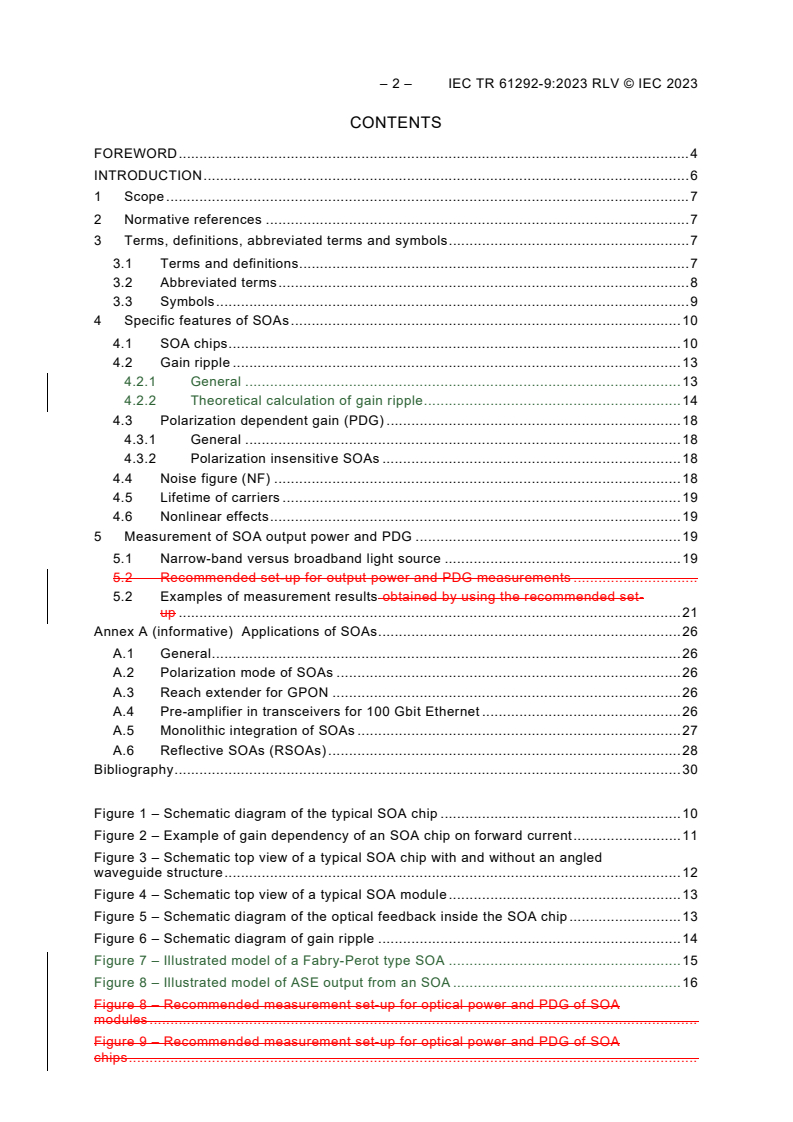
– 2 – IEC TR 61292-9:2023 RLV © IEC 2023
CONTENTS
FOREWORD . 4
INTRODUCTION . 6
1 Scope . 7
2 Normative references . 7
3 Terms, definitions, abbreviated terms and symbols . 7
3.1 Terms and definitions . 7
3.2 Abbreviated terms . 8
3.3 Symbols . 9
4 Specific features of SOAs . 10
4.1 SOA chips . 10
4.2 Gain ripple . 13
4.2.1 General . 13
4.2.2 Theoretical calculation of gain ripple . 14
4.3 Polarization dependent gain (PDG) . 18
4.3.1 General . 18
4.3.2 Polarization insensitive SOAs . 18
4.4 Noise figure (NF) . 18
4.5 Lifetime of carriers . 19
4.6 Nonlinear effects . 19
5 Measurement of SOA output power and PDG . 19
5.1 Narrow-band versus broadband light source . 19
5.2 Recommended set-up for output power and PDG measurements .
5.2 Examples of measurement results obtained by using the recommended set-
up . 21
Annex A (informative) Applications of SOAs . 26
A.1 General . 26
A.2 Polarization mode of SOAs . 26
A.3 Reach extender for GPON . 26
A.4 Pre-amplifier in transceivers for 100 Gbit Ethernet . 26
A.5 Monolithic integration of SOAs . 27
A.6 Reflective SOAs (RSOAs) . 28
Bibliography . 30
Figure 1 – Schematic diagram of the typical SOA chip . 10
Figure 2 – Example of gain dependency of an SOA chip on forward current . 11
Figure 3 – Schematic top view of a typical SOA chip with and without an angled
waveguide structure . 12
Figure 4 – Schematic top view of a typical SOA module . 13
Figure 5 – Schematic diagram of the optical feedback inside the SOA chip . 13
Figure 6 – Schematic diagram of gain ripple . 14
Figure 7 – Illustrated model of a Fabry-Perot type SOA . 15
Figure 8 – Illustrated model of ASE output from an SOA . 16
Figure 8 – Recommended measurement set-up for optical power and PDG of SOA
modules .
Figure 9 – Recommended measurement set-up for optical power and PDG of SOA
chips .
Figure 9 – SOA output power and PDG dependence on wavelength . 20
Figure 10 – Optical power spectra of three different SOA chips. 22
Figure 11 – Output power and PDG of SOA chip sample 1 as a function of I . 23
F
Figure 12 – Output power and PDG of SOA chip sample 2 as a function of I . 23
F
Figure 13 – Output power and PDG of SOA chip sample 3 as a function of I . 24
F
Figure A.1 – Schematic diagram of the receiver section of SOA-incorporated CFP
transceivers . 27
Figure A.2 – Schematic diagram of the DFB-LDs-array type wavelength tuneable LD . 28
Figure A.3 – Schematic diagram of a seeded WDM-PON system . 29
– 4 – IEC TR 61292-9:2023 RLV © IEC 2023
INTERNATIONAL ELECTROTECHNICAL COMMISSION
____________
OPTICAL AMPLIFIERS –
Part 9: Semiconductor optical amplifiers (SOAs)
FOREWORD
1) The International Electrotechnical Commission (IEC) is a worldwide organization for standardization comprising
all national electrotechnical committees (IEC National Committees). The object of IEC is to promote international
co-operation on all questions concerning standardization in the electrical and electronic fields. To this end and
in addition to other activities, IEC publishes International Standards, Technical Specifications, Technical Reports,
Publicly Available Specifications (PAS) and Guides (hereafter referred to as “IEC Publication(s)”). Their
preparation is entrusted to technical committees; any IEC National Committee interested in the subject dealt with
may participate in this preparatory work. International, governmental and non-governmental organizations liaising
with the IEC also participate in this preparation. IEC collaborates closely with the International Organization for
Standardization (ISO) in accordance with conditions determined by agreement between the two organizations.
2) The formal decisions or agreements of IEC on technical matters express, as nearly as possible, an international
consensus of opinion on the relevant subjects since each technical committee has representation from all
interested IEC National Committees.
3) IEC Publications have the form of recommendations for international use and are accepted by IEC National
Committees in that sense. While all reasonable efforts are made to ensure that the technical content of IEC
Publications is accurate, IEC cannot be held responsible for the way in which they are used or for any
misinterpretation by any end user.
4) In order to promote international uniformity, IEC National Committees undertake to apply IEC Publications
transparently to the maximum extent possible in their national and regional publications. Any divergence between
any IEC Publication and the corresponding national or regional publication shall be clearly indicated in the latter.
5) IEC itself does not provide any attestation of conformity. Independent certification bodies provide conformity
assessment services and, in some areas, access to IEC marks of conformity. IEC is not responsible for any
services carried out by independent certification bodies.
6) All users should ensure that they have the latest edition of this publication.
7) No liability shall attach to IEC or its directors, employees, servants or agents including individual experts and
members of its technical committees and IEC National Committees for any personal injury, property damage or
other damage of any nature whatsoever, whether direct or indirect, or for costs (including legal fees) and
expenses arising out of the publication, use of, or reliance upon, this IEC Publication or any other IEC
Publications.
8) Attention is drawn to the Normative references cited in this publication. Use of the referenced publications is
indispensable for the correct application of this publication.
9) Attention is drawn to the possibility that some of the elements of this IEC Publication may be the subject of patent
rights. IEC shall not be held responsible for identifying any or all such patent rights.
This redline version of the official IEC Standard allows the user to identify the changes
made to the previous edition IEC TR 61292-9:2017. A vertical bar appears in the margin
wherever a change has been made. Additions are in green text, deletions are in
strikethrough red text.
IEC TR 61292-9 has been prepared by subcommittee 86C: Fibre optic systems and active
devices, of IEC technical committee 86: Fibre optics. It is a Technical Report.
This third edition cancels and replaces the second edition published in 2017. This edition
constitutes a technical revision.
This edition includes the following significant technical changes with respect to the previous
edition:
a) revised definitions for SOAs in 3.1;
b) added more theoretical background on gain ripple measurements using amplified
spontaneous emission (ASE) spectrum in 4.3;
c) removed the formerly preferred set-up for output power and PDG measurements in
Clause 5.
The text of this Technical Report is based on the following documents:
Draft Report on voting
86C/1820/DTR 86C/1830/RVDTR
Full information on the voting for its approval can be found in the report on voting indicated in
the above table.
The language used for the development of this Technical Report is English.
This document was drafted in accordance with ISO/IEC Directives, Part 2, and developed in
accordance with ISO/IEC Directives, Part 1 and ISO/IEC Directives, IEC Supplement, available
at www.iec.ch/members_experts/refdocs. The main document types developed by IEC are
described in greater detail at www.iec.ch/publications.
A list of all parts in the IEC 61292 series, published under the general title Optical amplifiers,
can be found on the IEC website.
The committee has decided that the contents of this document will remain unchanged until the
stability date indicated on the IEC website under webstore.iec.ch in the data related to the
specific document. At this date, the document will be
• reconfirmed,
• withdrawn,
• replaced by a revised edition, or
• amended.
IMPORTANT – The "colour inside" logo on the cover page of this document indicates that it
contains colours which are considered to be useful for the correct understanding of its
contents. Users should therefore print this document using a colour printer.
– 6 – IEC TR 61292-9:2023 RLV © IEC 2023
INTRODUCTION
Optical amplifiers (OAs) are necessary components as booster, line and pre-amplifiers for
current optical network systems. IEC TC 86/SC 86C has published many standards for OAs,
and most of them are focused on optical fibre amplifiers (OFAs), which are commonly deployed
in commercial optical network systems. Recently, semiconductor optical amplifiers (SOAs) have
attracted attention for applications in gigabit passive optical network (GPON) and 100 Gbit
Ethernet (GbE) systems. This is because SOA chips are as small as laser diodes (LDs) and
only require an electrical current.
Although SOAs for the 1 310 nm or 1 550 nm bands have been extensively studied since the
1980s, the use of SOAs is still limited to laboratories or field trials. This is due to specific
performance features of SOAs such as gain ripple and polarization dependent gain (PDG). Thus,
there are very few IEC standards addressing SOAs. One example is IEC TR 61292-3, which is
a Technical Report for classification, characteristics and applications of OAs including SOAs.
However, it only deals with general information on SOAs and does not contain the detail
information on test methods that are necessary to measure precisely the particular parameters
of SOAs.
This part of IEC 61292 provides a better understanding of specific features of SOAs as well as
information on measuring gain and PDG. It is anticipated that future standards will address
performance and test methodology.
Optical amplifiers (OAs) are essential components for fibre optic communication systems,
where they serve as booster amplifiers, in-line amplifiers, and pre-amplifiers. Numerous
standards have been published for OAs (e.g., the IEC 61290 series and IEC 61291 series).
However, most of these standards focus on optical fibre amplifiers (OFAs) because these are
commonly deployed in commercial fibre optic networks. Recently, semiconductor optical
amplifiers (SOAs) have attracted attention for applications in Gbit passive optical networks
(GPONs) and Gbit Ethernet (GbE) systems, which operate at line rates of 100 Gbit/s and beyond.
SOA chips are as small as laser diodes (LDs) and are directly driven by an electrical current.
Although SOAs operating in the 1 310 nm or 1 550 nm wavelength bands have been extensively
studied since the 1980s, SOAs have mostly been used in laboratories or in field trials. This is
due to certain performance limitations of SOAs, such as gain ripple and polarization dependent
gain (PDG). As a result, there are few IEC documents addressing SOAs. One exception is
IEC TR 61292-3, which is a Technical Report on classification, characteristics, and applications
of OAs including SOAs. However, IEC TR 61292-3 presents only general information on SOAs
and does not contain detailed information on test methods for measuring the particular
performance parameters of SOAs.
IEC 61290-1-1:2020 describes test methods for power and gain parameters of OAs, which
includes a method for gain ripple measurements on SOAs. This document has been revised to
harmonize its content with IEC 61290-1-1 and with IEC 61291-2.
This document provides more detailed descriptions of the specific features of SOAs, including
information on gain ripple and PDG.
OPTICAL AMPLIFIERS –
Part 9: Semiconductor optical amplifiers (SOAs)
1 Scope
This part of IEC 61292, which is a Technical Report, focuses on semiconductor optical
amplifiers (SOAs), especially the specific features and measurement of gain and polarization
dependent gain (PDG) describes the characteristic features of semiconductor optical amplifiers
(SOAs), including the specific features of gain ripple and polarization dependent gain (PDG).
This document focuses on amplifying applications of SOAs. Other applications, such as
modulation, switching and non-linear functions, are not covered.
Potential applications of SOAs, such as reflective SOAs (RSOAs) for the seeded wavelength
division multiplexing passive optical network (WDM-PON), are reviewed in Annex A.
2 Normative references
There are no normative references in this document.
The following documents are referred to in the text in such a way that some or all of their content
constitutes requirements of this document. For dated references, only the edition cited applies.
For undated references, the latest edition of the referenced document (including any
amendments) applies.
IEC 61291-1:2018, Optical amplifiers – Part 1: Generic specification
IEC 61291-2:2016, Optical amplifiers – Part 2: Single channel applications – Performance
specification template
3 Terms, definitions, abbreviated terms and symbols
3.1 Terms and definitions
For the purposes of this document, the terms and definitions given in IEC 61291-1:2018,
IEC 61291-2:2016, and the following apply.
ISO and IEC maintain terminological databases for use in standardization at the following
addresses:
• IEC Electropedia: available at http://www.electropedia.org/
• ISO Online browsing platform: available at http://www.iso.org/obp
3.1.1
SOA
semiconductor optical amplifier
semiconductor optical amplifier that includes the "SOA chip" and the "SOA module"
optical amplifier in which the active optical waveguide is formed by a semiconductor laser diode
structure, which is electrically pumped
– 8 – IEC TR 61292-9:2023 RLV © IEC 2023
Note 1 to entry: SOAs have a similar structure to Fabry-Perot semiconductor laser diodes but with anti-reflection
elements at the end surfaces. The optical signal is amplified through the stimulated emission phenomenon in the
gain medium.
[SOURCE: IEC 61291-2:2016, 3.1.3, modified – Note 1 to entry has been added.]
3.1.2
SOA chip
semiconductor chip that is the active component of the SOA module
3.1.3
SOA module
fibre-pigtailed optical component that consists of the SOA chip, lenses, optical isolators (if
necessary), a thermoelectric cooler (TEC), a thermistor, a package, and optical fibre(s)
3.1.4
population inversion factor
n
sp
ratio of the injected carrier density N to the subtraction of the carrier density N where the
stimulated emission is equal to the stimulated absorption from N
N
n =
sp
NN−
Note 1 to entry: In the semiconductor optical amplifier (SOA) field, the population inversion factor is composed of
not only carrier density parameters but also combination of the confinement factor Γ, the optical gain g, and internal
optical losses α of the optical waveguide of SOA chip. It is defined as:
NgΓ×
n ×
sp
NN− Γ×−g α
Note 2 to entry: The carrier density N at which the stimulated emission is equal to the stimulated absorption may
be is often called "transparent carrier density".
3.2 Abbreviated terms
AR anti-reflection
ASE amplified spontaneous emission
BPF band pass filter
CFP 100 G form factor pluggable
CW continuous wave
DEMUX demultiplexer
DFB distributed feedback
EDFA erbium-doped fibre amplifier
FWM four-wave mixing
GbE gigabit Ethernet
GPON gigabit capable passive optical network
LD laser diode
MSA multi-source agreement
MMI multi-mode interference
MQWs multiple quantum wells
NF noise figure
OA optical amplifier
=
OFA optical fibre amplifier
OLT optical line termination
ONU optical network unit
OPM optical power meter
PC polarization controller
PD photodiode
PDCE polarization dependence of coupling efficiency
PDG polarization dependent gain
PIC photonic integrated circuit
POL polarizer
PON passive optical network
RSOA reflective semiconductor optical amplifier
SLD superluminescent diode
SMF single-mode fibre
SOA semiconductor optical amplifier
TE transverse electric
TEC thermoelectric cooler
TIA transimpedance amplifier
TM transverse magnetic
VOA variable optical attenuator
WDM wavelength division multiplexing
XGM cross gain modulation
XPM cross phase modulation
3.3 Symbols
G optical gain
forward current
I
F
L chip length
n effective refractive index
eff
NF noise figure
n population inversion factor
sp
PDCE polarization dependence of coupling efficiency
PDG polarization dependence of active layer gain
active
PDG total polarization dependence of single pass gain
total
R reflectivity
∆G peak to peak amplitude of gain ripple
ripple
∆λ period of gain ripple
ripple
Γ TE mode confinement factor
TE
Γ TM mode confinement factor
TM
λ wavelength
– 10 – IEC TR 61292-9:2023 RLV © IEC 2023
4 Specific features of SOAs
4.1 SOA chips
Figure 1 shows the schematic diagram of a typical SOA chip. Similar to LDs, SOA chips are
less than 1,5 mm in length, 0,5 mm in width, and 0,2 mm in height. Since SOA chips are made
of III-V compound semiconductor materials and developed based on the technologies used for
laser diodes (LDs), the basic physical mechanisms of generating optical gain in SOA chips are
the same as those in LDs. Therefore, the population inversion inside the SOA chip is
implemented by a forward current (I ), and the input optical signals are amplified by the
F
stimulated emission of photons in the active layer of the chip. The cross section of a typical
active layer is 1,5 μm in width and 0,1 μm in thickness (height).
Figure 1 – Schematic diagram of the typical SOA chip
Figure 2 shows the gain dependency on I , which is injected into electrodes at the top and
F
bottom of the SOA chip as shown in Figure 1. The gain of the SOA chip is obtained and adjusted
by simply applying the current. Figure 2 shows an example of the dependency of the SOA gain
on the forward current I . The current is injected into the chip through electrodes at the top and
F
bottom of the SOA chip, as shown in Figure 1. The gain of the SOA chip can be varied by
adjusting the forward current. As shown in Figure 2, by increasing I to values greater than 150
F
mA, typical SOA chips can provide optical gain greater than 20 dB at an input optical power of
around –20 dBm.
Figure 2 – Example of gain dependency of an SOA chip on forward current
Compared with LDs, the most distinctive feature of SOAs is that the SOA chip has anti-reflection
(AR) coatings on both facets to avoid optical feedback between the facets. Since semiconductor
materials have a much higher refractive index (> 3 is typical) than air, a facet without
anti-reflection coating has a reflectivity of 30 % or above. This feature is suitable for establishing
a laser cavity but not for the SOA chip, for which requires the facet has to have a reflectivity of
less than 0,1 % over a wavelength range of greater than 30 nm. To achieve such a low
reflectivity, AR coatings are employed on both facets of the SOA chip, as shown in Figure 3.
Figure 3 a) and Figure 3 b) show schematic top views of a conventional SOA chip and an SOA
chip with an angled waveguide structure, respectively. As shown in Figure 3 a), a conventional
SOA chip has a straight stripe, which is normal to the two facets where AR coating is applied.
The AR coating consists of a multiple-layer thin film. Each thickness (a quarter wavelength, for
example) of the film is controlled within ±4 %. The residual reflectivity will cause intra-cavity
interference between the facets, which leads to gain ripple or laser oscillation. This is because
the reflected light is easily coupled with the multiple reflections between the facets, since the
angle (θ) between the stripe and the facet is 90°. The thickness (e.g., quarter wavelength) of
each film layer is controlled to within ±4 %. The residual reflectivity will cause intra-cavity
interference between the facets, which leads to gain ripple or even laser oscillation. When the
angle θ between the active stripe layer and the facet is 90°, the reflected light is readily coupled
back into the stripe, thus leading to multiple reflections between the facets. One of the best
ways to suppress intra-cavity feedback is the introduction of an angled waveguide structure, as
shown in Figure 3 b). The reflected light cannot be coupled by encounter significant multiple
reflections when using an angled stripe with θ = 7°. This approach enables the SOA chip to
have a low facet reflectivity of reduces the facet reflectivity to about 0,2 %, and to less than
0,1 % when combined with AR coatings.
– 12 – IEC TR 61292-9:2023 RLV © IEC 2023
a) Conventional SOA chip
b) SOA chip with angled waveguide structure
Figure 3 – Schematic top view of a typical SOA chip with
and without an angled waveguide structure
Another specific feature of SOAs is that the gain wavelength band of SOA chips can be varied
by only changing the composition of the semiconductor materials using mature LD technologies
(i.e., by a band engineering technique). For example, long-wavelength (1 300 nm to 1 600 nm)
SOA chips have typically use an InGaAsP active layer on an InP substrate, and the peak
wavelength of the gain is adjusted by changing the respective relative concentrations of In, Ga,
As and P in the InGaAsP layer. The typical gain wavelength band range of SOA chips is greater
than 40 nm.
Another specific feature of SOA chips is their integration that they can be integrated with other
semiconductor devices, such as tuneable LDs, electro-absorption modulators and passive
waveguides, on a single chip. These integrated SOAs are used, for example, as booster
amplifiers in tuneable LDs and line amplifiers (loss compensators) in photonic integrated circuits
(PICs).
In summary, SOAs have completely different physical mechanisms for amplification and for the
configuration of the device compared to OFAs.
SOA modules
In summary, SOAs have very different physical mechanisms for amplification and, hence,
device configuration than conventional optical fibre amplifiers (OFAs).
Figure 4 shows the schematic top view of the SOA module. An SOA chip, a TEC, and optical
lenses may can be assembled in a butterfly package which has fibre pigtails for the input and
output ports. This is the most common package for SOA modules and its size is almost the
same as that of 14-pin butterfly LD modules. The use of optical isolators (input and/or output)
may depend depends on the application. For example, optical isolators are not employed in
SOA modules for bidirectional amplification. The TEC is used to stabilize the temperature of
the SOA chip, since more than 100 mA of electric current injected into the SOA chip will cause
significant heating inside the chip to, which can affect its polarization characteristics. Similar to
LD modules, SOA modules are also hermetically sealed with N gas.
Figure 4 – Schematic top view of a typical SOA module
4.2 Gain ripple
4.2.1 General
Optical feedback inside the SOA chip, which is the resulting from residual reflections from at
the chip facets, may can lead to round-trip resonances when an input optical signal is launched
into the chip, as shown in Figure 5.
Figure 5 – Schematic diagram of the optical feedback inside the SOA chip
The amplified light from the various round-trip paths will can interfere constructively or
destructively depending on the wavelength of the signal light. As a result, the SOA gain
becomes wavelength dependent, as shown in Figure 6. This gain dependence on wavelength
is called gain ripple, as shown in Figure 6.
– 14 – IEC TR 61292-9:2023 RLV © IEC 2023
Figure 6 – Schematic diagram of gain ripple
With chip gain G and facet reflectivity R, the peak-to-peak amplitude of the gain ripple ∆G
ripple
is given by Formula (1).
(1+×GR)
ΔG =
(1)
ripple
1− GR×
( )
At signal wavelength λ, chip length L, and effective refractive index n , the period of the gain
eff
ripple ∆λ is derived can be calculated from Formula (2).
ripple
λ
Δλ =
(2)
ripple
2nL
eff
At λ = 1 550 nm, for example, ∆λ is approximately 0,29 nm for an SOA chip with n = 3,4
ripple eff
and L = 1,2 mm. Since an SOA chip has the birefringence between the parallel transverse
electric (TE) and orthogonal transverse magnetic (TM) directions to the chip substrate
waveguide typically exhibits birefringence between the transverse electric (TE) and
orthogonally polarized transverse magnetic (TM) waves (relative to the chip substrate), ∆λ
ripple
depends on the polarization mode state of the input light.
4.2.2 Theoretical calculation of gain ripple
4.2.2.1 SOA gain and gain ripple
Figure 7 shows the simplified model of a Fabry-Perot type SOA, which represents a typical SOA
structure of length L and power reflectivities R and R , respectively.
1 2
Assuming a uniform gain profile, the output electric field E in the presence of multiple
out
reflections in the SOA cavity is given by Formula (3).
E = 1−−R 1 R GE exp− jβL
( )( ) ( )
out 1 2 s in z
× 1+ RR G exp −2 jβL +RR G exp − 4jβL + ⋅⋅⋅
( ) ( )
12 s z 12 s z
(3)
1−−R 1 R GE exp − jβL
( )( ) ( )
1 2 s in z
=
1−−RR G exp 2 jβL
( )
12 s z
where
E is the amplitude of the input optical signal (E in Figure 1);
in input
G is the single pass power gain;
s
β
is the (longitudinal) propagation constant of the field in the cavity.
z
Figure 7 – Illustrated model of a Fabry-Perot type SOA
Then the overall SOA gain G is given by Formula (4).
11−−R RG
E ( )( )
1 2s
out
G
(4)
E
input
1−+G RR 4G RR sin (βL)
( s 12 ) s 12 z
βL
Depending on the value of , the SOA gain G calculated from Formula (4) varies between
z
maximum and minimum values. When is zero in Formula (4), the wavelength of the
sin βL
( )
z
input signal is equal to a multiple of the cavity resonance frequency, and G assumes its
maximum value G , which is given by Formula (5).
max
11−−R RG
( )( )
1 2s
G =
max
(5)
1− G RR
( )
s 12
In contrast, G is minimum when 2 is equal to 1, which represents a phase mismatch
sin (βL)
z
of π between the input signal and the cavity resonance frequency. The minimum gain G is
min
given by Formula (6).
==
– 16 – IEC TR 61292-9:2023 RLV © IEC 2023
11−−R RG
( )( )
1 2s
G =
min
(6)
1+ G RR
( )
s 12
The gain ripple ∆G is defined as the ratio of G to G , which can be readily calculated
ripple max min
from Formulae (5) and (6), as shown in Formula (7).
1+ G RR
( s 12 )
G
max
ΔG
(7)
ripple
G
min
1− G RR
( s 12 )
4.2.2.2 SOA gain ripple derivation from ASE spectrum measurement
If there is no optical input signal, the output of an SOA is ASE light only. Figure 8 illustrates this
situation for the same Fabry-Perot structure as shown in Figure 1, having length L, power
reflectivities R and R , and single pass power gain G . The only difference to Figure 1 is the
1 2 s
absence of an optical input signal.
Figure 8 – Illustrated model of ASE output from an SOA
Similar to the case discussed in 4.2.2.1, the output electric field of the ASE, E , is
out-ASE
impacted by multiple reflections in the SOA cavity. This can be calculated by assuming a
uniform gain profile.
Letting E denote the amplitude of the initial ASE electric field, the ASE output field E is
0 out-ASE
given by Formula (8).
E =(1−−R )G E exp( jβL)
out-ASE 2 s 0 z
× 1+ RR G exp −2 jβL +RR G exp −4jβL + ⋅⋅⋅
( ) ( )
12 s z 12 s z
(8)
1−−R G E exp jβL
( ) ( )
2 s0 z
=
1−−RR G exp 2 jβL
( )
12 s z
Then the ASE output power is given by Formula (9).
==
1− R GE
( )
2s
E =
out-ASE (9)
1− RR G + 4 RR G sin (βL)
( 12 s ) 12 s z
Moreover, the ASE gain G is given by Formula (10).
ASE
1− RG
( )
E 2s
out-ASE
G
ASE
(10)
E 2
1−+G RR 4G RR sin (βL)
( s 12 ) s 12 z
Similar to the SOA signal gain G, discussed in 4.2.2.1, the ASE gain G in Formula (10)
ASE
and a minimum value G , depending on the
varies between a maximum value G
ASE-max ASE-min
value of . G and G are given by Formulae (11) and (12).
βL
ASE-max ASE-min
z
1− RG
( )
2s
G =
ASE-max
(11)
1− G RR
( )
s 12
1− RG
( )
2s
G =
ASE-min
(12)
1+ G RR
( )
s 12
Hence, the ripple ∆G observed in the ASE gain is given by Formula (13).
ripple-ASE
1+ G RR
( )
s 12
G
ASE-max
ΔG
(13)
ripple-ASE
G
ASE-min
1− G RR
( )
s 12
A comparison shows that Formula (13) is identical to Formula (7), which was derived from signal
gain calculations. It follows that the gain ripple of an SOA can be determined from a ripple
measurement in the ASE output spectrum measurement, even if the gain characteristics of the
SOA are unknown.
1 RR
However, Formulae (3) and (4) are valid only if the value of G is less than . In addition,
s
the calculations above assume a uniform gain profile in the SOA. If the device and/or
measurement conditions do not meet these criteria, the gain ripple cannot be determined from
the ASE spectrum.
==
==
– 18 – IEC TR 61292-9:2023 RLV © IEC 2023
4.3 Polarization dependent gain (PDG)
4.3.1 General
The PDG of SOAs is mainly caused by the difference in the confinement factors of the TE and
TM modes. Generally, the cross-section of the active layer has an anisotropic structure
geometry because the thickness of the active layer (e.g., 0,1 μm) is smaller than its width
(e.g., 1,5 μm). This results in a larger confinement factor for the TE mode (Γ ) than for the TM
TE
mode (Γ ), which means that the gain for the TE mode is larger than that for the TM mode.
TM
PDG is one of the most significant characteristics of SOA modules. The total polarization
dependence of the single pass gain in SOAs, PDG , is known to be the sum of the polarization
total
) in SOA chips and the polarization dependence
dependence of the active layer gain (PDG
active
of the coupling efficiency (PDCE) between fibre and facet at both input and output ports of the
SOA module.
In general, SOA chips have an elliptical mode field, so the PDCE is not zero. Therefore, unless
a specific design is implemented for the PDCE, SOA modules might have a certain amount of
PDG even if the PDG is zero.
total active
4.3.2 Polarization insensitive SOAs
4.3.2.1 General
As described in 4.3.1, the polarization sensitivity of SOA chips is mainly caused by the
difference between Γ and Γ . To achieve polarization insensitivity, decreasing or
TE TM
compensation of the difference will be needed it is necessary to decrease or compensate this
difference. It has been reported that the techniques outlined in 4.3.2.2 and 4.3.2.3 can yield
PDG of less than 0,5 dB.
total
4.3.2.2 Bulk active layer with square cross-section waveguide structure
To reduce the difference between Γ and Γ , the thickness of the bulk active layer of the
TE TM
SOA chip is increased to obtain an isotropic cross-section waveguide structure in the active
layer. This structure enables SOA chips to have not only low PDG but also low PDCE.
active
However, the isotropic waveguide structure results in a high large total confinement factor,
which in turn results in low saturation output power. The saturation output power is defined as
the output power at which the gain decreases by 3 dB from the linear regime.
4.3.2.3 Active layer with strained multiple quantum wells (MQWs)
To compensate for the difference in Γ and Γ , the TM gain coefficients will can be controlled
TE TM
by using strained MQWs in the active layer. The introduction of tensile strained MQWs into the
active layer leads to a higher TM gain coefficient than the TE gain coefficient. This technique
enables SOA chips to have an overall reduction in PDG . Since the total confinement factor
total
of this structure is smaller than that in an isotropic bulk active layer, the saturation output power
is higher compared with SOA chips with isotropic bulk active layers.
4.4 Noise figure (NF)
Generally, the noise figure (NF) of SOAs depends on the population inversion factor n and
sp
the coupling efficiency between the input fibre and the SOA. If the coupling efficiency is 100 %
and n = 1, the noise factor is equal to 2n and consequently resulted in equal to 2, namely
sp sp
yielding an NF of 3 dB in the ideal case. The n of practical SOA chips is more higher than
sp
unity because of the incomplete population inversion and the internal optical loss. In addition,
the optical coupling between the SOA chip facet and fibre is achieved by using a two-lens
system, which leads to the optical coupling loss of typically a few decibels because of the
anisotropic structure of the active layer of the SOA chips (e.g., 1,5 μm in width and 0,1 μm in
thickness). Therefore, the NF of SOA modules is typically more than 6 dB.
Since the NF depends on the coupling efficiency at the input, the NF of SOA modules with
PDG = 0 have high polarization dependence unless PDG is zero.
active total
4.5 Lifetime of carriers
The lifetime of carriers in SOA chips is in the order of nanoseconds, leading to effects such as
cross gain modulation (XGM) and a type of signal distortion called the "pattern effect" when
used in gigabit-class optical signal systems.
4.6 Nonlinear effects
The SOA has nonlinear effects, such as cross phase modulation (XPM) and four-wave mixing
(FWM). These effects are mainly caused by the carrier dynamics of SOA chips and lead to
additional applications including wavelength conversion and wavelength demultiplexing. Since
this document focuses on the amplification application, further details of these nonlinear effects
are not addressed in this document.
5 Measurement of SOA output power and PDG
5.1 Narrow-band versus broadband light source
It is usually difficult to measure SOA output power and gain using a narrow-band light source
for the input signal because of the gain ripple. Gain ripple causes measurement errors in optical
output power and polarization dependence. Since signal gain depends on temperature, input
optical power, signal wavelength and forward current, measurement results may suffer from the
lack of reproducibility are sometimes not reproducible. In this case, the use of a wide-band
optical light source has advantages. By averaging the signal gain in the SOA over a wide
wavelength range, the optical power or polarization dependence can be accurately estimated,
because the influence of gain ripple on the measurement results is drastically reduced.
Figure 9 shows an example of the wavelength dependence of output power and polarization
dependence on the wavelength of the for an SOA with a gain ripple of about 3 dB. The upper
graph shows the optical power dependence on wavelength, measured by using a distributed
feedback (DFB) LD as the input light source. The red and blue lines are the TE and TM mode
gains of the SOA, respectively. The gain ripple is clearly observed because the DFB-LD has a
linewidth much narrower than the period of the gain ripple. As shown in Figure 9, the amplitude
of the gain ripple of the TE and TM modes are 3,2 dB and 3,0 dB, respectively, and the period
of each mode is 0,8 nm and 0,7 nm, respectively. The bottom graph shows the PDG dependence
on wavelength for the SOA. The green and black lines are for the DFB-LD and the amplified
spontaneous emission (ASE) light source, respectively. Whereas the use of measurement with
the DFB-LD showed a large PDG of more than ±2 dB, the PDG measured by using the ASE
light source was as only 0,2 dB.
NOTE An ASE source is one example of a broadband light source.
– 20 – IEC TR 61292-9:2023 RLV © IEC 2023
Figure 9 – SOA output power and PDG dependence on wavelength
The gain ripple can be estimated using an optical spectrum analyser. Since the gain ripple
depends on several parameters, an accurate measurement is very difficult in terms of
reproducibility. Including the information on the wavelength (frequency) resolution of the
analyzer is preferable in the test report of gain ripple. It is good practice to document the
wavelength (frequency) resolution of the analyser in the test report for the gain ripple
measurement.
5.2 Recommended set-up for output power and PDG measurements
Subclause 5.2 describes a measurement method for output power and PDG of SOAs by using
a broadband light source and describes how the results will be different from those using a
narrow-band light source (DFB-LD).
Figure 8 shows a recommended measurement set-up for SOA modules that incorporates a
broadband light source. The broadband light source emits a continuous wave with a wavelength
bandwidth (the full width at half maximum, FWHM), which shall be wider th
...