

IEC 61788-17:2021
(Main)Superconductivity - Part 17: Electronic characteristic measurements - Local critical current density and its distribution in large-area superconducting films
General Information
- Abstract
IEC 61788-17:2021 specifies the measurements of the local critical current density (Jc) and its distribution in large-area high-temperature superconducting (HTS) films by an inductive method using third-harmonic voltages. The most important consideration for precise measurements is to determine Jc at liquid nitrogen temperatures by an electric-field criterion and obtain current-voltage characteristics from its frequency dependence. Although it is possible to measure Jc in applied DC magnetic fields [20] [21], the scope of this document is limited to the measurement without DC magnetic fields. This technique intrinsically measures the critical sheet current that is the product of Jc and the film thickness d. The range and measurement resolution for Jcd of HTS films are as follows.
- Jcd: from 200 A/m to 32 kA/m (based on results, not limitation).
- Measurement resolution: 100 A/m (based on results, not limitation).
- Status
- Published
- Publication Date
- 27-Apr-2021
- Technical Committee
- TC 90 - Superconductivity
- Drafting Committee
- WG 8 - TC 90/WG 8
- Current Stage
- PPUB - Publication issued
- Start Date
- 28-Apr-2021
- Completion Date
- 07-May-2021
Buy Documents
IEC 61788-17:2021 - Superconductivity - Part 17: Electronic characteristic measurements - Local critical current density and its distribution in large-area superconducting films Released:4/28/2021
IEC 61788-17:2021 RLV - Superconductivity - Part 17: Electronic characteristic measurements - Local critical current density and its distribution in large-area superconducting films Released:4/28/2021
IEC 61788-17:2021 - Superconductivity - Part 17: Electronic characteristic measurements - Local critical current density and its distribution in large-area superconducting films Released:4/28/2021
Overview
IEC 61788-17:2021 - Superconductivity Part 17 specifies an inductive, non‑destructive method to measure the local critical current density (Jc) and its distribution in large‑area high‑temperature superconducting (HTS) films. The method uses third‑harmonic voltages generated by an AC drive coil to determine the local critical sheet current (Jc × film thickness d) at liquid‑nitrogen temperatures. The standard limits its scope to measurements without applied DC magnetic fields and emphasizes determining Jc from an electric‑field criterion and extracting current–voltage characteristics via frequency dependence.
Key topics and requirements
- Measurement principle: Inductive detection of third‑harmonic voltage (U3) as a function of drive current and frequency to infer local Jc and E–J behaviour.
- Electric‑field criterion: Jc must be defined using a specified E‑field threshold; frequency scaling is used to obtain I–V characteristics.
- Apparatus: Sample drive coil configurations, coil‑to‑film positioning, and calibration wafers to determine the experimental coil coefficient (k′).
- Coil coefficients: Procedures to calculate theoretical coil coefficient (k) and determine the experimental k′ used in converting measured voltages to Jc.
- Measurement range & resolution: Reported Jcd (Jc × d) typically from 200 A/m to 32 kA/m, with measurement resolution around 100 A/m (based on experimental results).
- Uncertainty and errors: Guidance on major systematic effects, coil distance sensitivity, edge effects, and an uncertainty budget (Annex C).
- Test reporting: Required specimen identification, measured J values, n‑values, and test conditions for reproducible results.
- Informative annexes: Theory of third‑harmonic generation, induced electric‑field calculations, optional two‑coil/ noise‑reduction systems, and uncertainty evaluation.
Applications
- Quality control and mapping of large‑area HTS films used in microwave filters, superconducting fault current limiters (SFCLs), persistent‑current switches, and other HTS devices.
- R&D and process optimization for thin‑film deposition (YBCO and similar HTS materials) where spatial Jc uniformity affects device performance.
- Acceptance testing and traceable measurement of Jc distributions for product qualification.
Who should use this standard
- Test laboratories and metrology institutes performing nondestructive Jc mapping.
- HTS film manufacturers and production QA teams.
- Researchers and engineers in superconductivity device development.
- Standards committees and compliance assessors working on HTS material characterization.
Related standards
- Other parts of the IEC 61788 series on superconductivity (see IEC catalogue for related measurement and characterization parts).
- Internal references and normative citations within IEC 61788‑17 address measurement practice and uncertainty evaluation.
Keywords: IEC 61788-17:2021, superconductivity, local critical current density, Jc, HTS films, third-harmonic voltages, inductive measurement, coil coefficient, liquid nitrogen, measurement uncertainty.
Relations
- Effective Date
- 05-Sep-2023
Buy Documents
IEC 61788-17:2021 - Superconductivity - Part 17: Electronic characteristic measurements - Local critical current density and its distribution in large-area superconducting films Released:4/28/2021
IEC 61788-17:2021 RLV - Superconductivity - Part 17: Electronic characteristic measurements - Local critical current density and its distribution in large-area superconducting films Released:4/28/2021
IEC 61788-17:2021 - Superconductivity - Part 17: Electronic characteristic measurements - Local critical current density and its distribution in large-area superconducting films Released:4/28/2021
Get Certified
Connect with accredited certification bodies for this standard

IMQ S.p.A. (Certification)
Italian electrical product certification.

SLG Prüf- und Zertifizierungs GmbH
German testing and certification body.

UL Solutions
Global safety science company with testing, inspection and certification.
Sponsored listings
Frequently Asked Questions
IEC 61788-17:2021 is a standard published by the International Electrotechnical Commission (IEC). Its full title is "Superconductivity - Part 17: Electronic characteristic measurements - Local critical current density and its distribution in large-area superconducting films". This standard covers: IEC 61788-17:2021 specifies the measurements of the local critical current density (Jc) and its distribution in large-area high-temperature superconducting (HTS) films by an inductive method using third-harmonic voltages. The most important consideration for precise measurements is to determine Jc at liquid nitrogen temperatures by an electric-field criterion and obtain current-voltage characteristics from its frequency dependence. Although it is possible to measure Jc in applied DC magnetic fields [20] [21], the scope of this document is limited to the measurement without DC magnetic fields. This technique intrinsically measures the critical sheet current that is the product of Jc and the film thickness d. The range and measurement resolution for Jcd of HTS films are as follows. - Jcd: from 200 A/m to 32 kA/m (based on results, not limitation). - Measurement resolution: 100 A/m (based on results, not limitation).
IEC 61788-17:2021 specifies the measurements of the local critical current density (Jc) and its distribution in large-area high-temperature superconducting (HTS) films by an inductive method using third-harmonic voltages. The most important consideration for precise measurements is to determine Jc at liquid nitrogen temperatures by an electric-field criterion and obtain current-voltage characteristics from its frequency dependence. Although it is possible to measure Jc in applied DC magnetic fields [20] [21], the scope of this document is limited to the measurement without DC magnetic fields. This technique intrinsically measures the critical sheet current that is the product of Jc and the film thickness d. The range and measurement resolution for Jcd of HTS films are as follows. - Jcd: from 200 A/m to 32 kA/m (based on results, not limitation). - Measurement resolution: 100 A/m (based on results, not limitation).
IEC 61788-17:2021 is classified under the following ICS (International Classification for Standards) categories: 17.220.20 - Measurement of electrical and magnetic quantities; 29.050 - Superconductivity and conducting materials. The ICS classification helps identify the subject area and facilitates finding related standards.
IEC 61788-17:2021 has the following relationships with other standards: It is inter standard links to IEC 61788-17:2013. Understanding these relationships helps ensure you are using the most current and applicable version of the standard.
IEC 61788-17:2021 is available in PDF format for immediate download after purchase. The document can be added to your cart and obtained through the secure checkout process. Digital delivery ensures instant access to the complete standard document.
Standards Content (Sample)
IEC 61788-17 ®
Edition 2.0 2021-04
INTERNATIONAL
STANDARD
colour
inside
Superconductivity –
Part 17: Electronic characteristic measurements – Local critical current density
and its distribution in large-area superconducting films
All rights reserved. Unless otherwise specified, no part of this publication may be reproduced or utilized in any form
or by any means, electronic or mechanical, including photocopying and microfilm, without permission in writing from
either IEC or IEC's member National Committee in the country of the requester. If you have any questions about IEC
copyright or have an enquiry about obtaining additional rights to this publication, please contact the address below or
your local IEC member National Committee for further information.
IEC Central Office Tel.: +41 22 919 02 11
3, rue de Varembé info@iec.ch
CH-1211 Geneva 20 www.iec.ch
Switzerland
About the IEC
The International Electrotechnical Commission (IEC) is the leading global organization that prepares and publishes
International Standards for all electrical, electronic and related technologies.
About IEC publications
The technical content of IEC publications is kept under constant review by the IEC. Please make sure that you have the
latest edition, a corrigendum or an amendment might have been published.
IEC publications search - webstore.iec.ch/advsearchform IEC online collection - oc.iec.ch
The advanced search enables to find IEC publications by a Discover our powerful search engine and read freely all the
variety of criteria (reference number, text, technical publications previews. With a subscription you will always
committee, …). It also gives information on projects, replaced have access to up to date content tailored to your needs.
and withdrawn publications.
Electropedia - www.electropedia.org
IEC Just Published - webstore.iec.ch/justpublished
The world's leading online dictionary on electrotechnology,
Stay up to date on all new IEC publications. Just Published
containing more than 22 000 terminological entries in English
details all new publications released. Available online and
and French, with equivalent terms in 18 additional languages.
once a month by email.
Also known as the International Electrotechnical Vocabulary
(IEV) online.
IEC Customer Service Centre - webstore.iec.ch/csc
If you wish to give us your feedback on this publication or
need further assistance, please contact the Customer Service
Centre: sales@iec.ch.
IEC 61788-17 ®
Edition 2.0 2021-04
INTERNATIONAL
STANDARD
colour
inside
Superconductivity –
Part 17: Electronic characteristic measurements – Local critical current density
and its distribution in large-area superconducting films
INTERNATIONAL
ELECTROTECHNICAL
COMMISSION
ICS 17.220.20; 29.050 ISBN 978-2-8322-9663-9
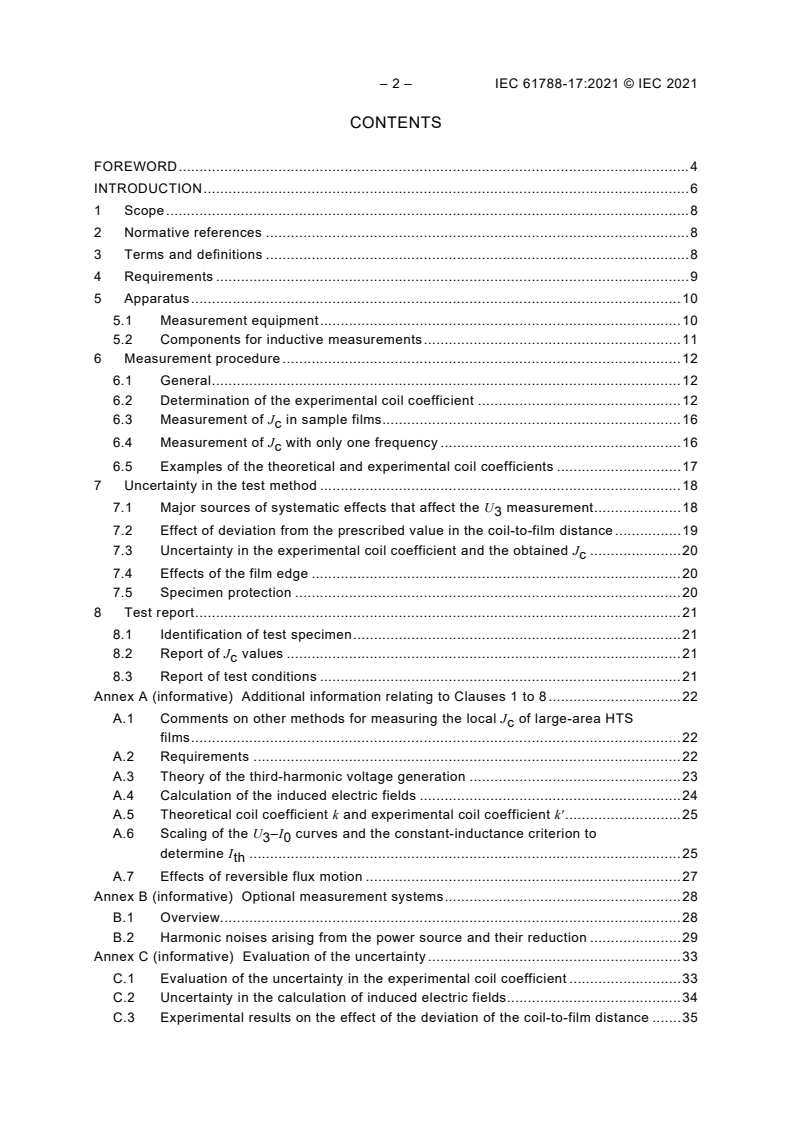
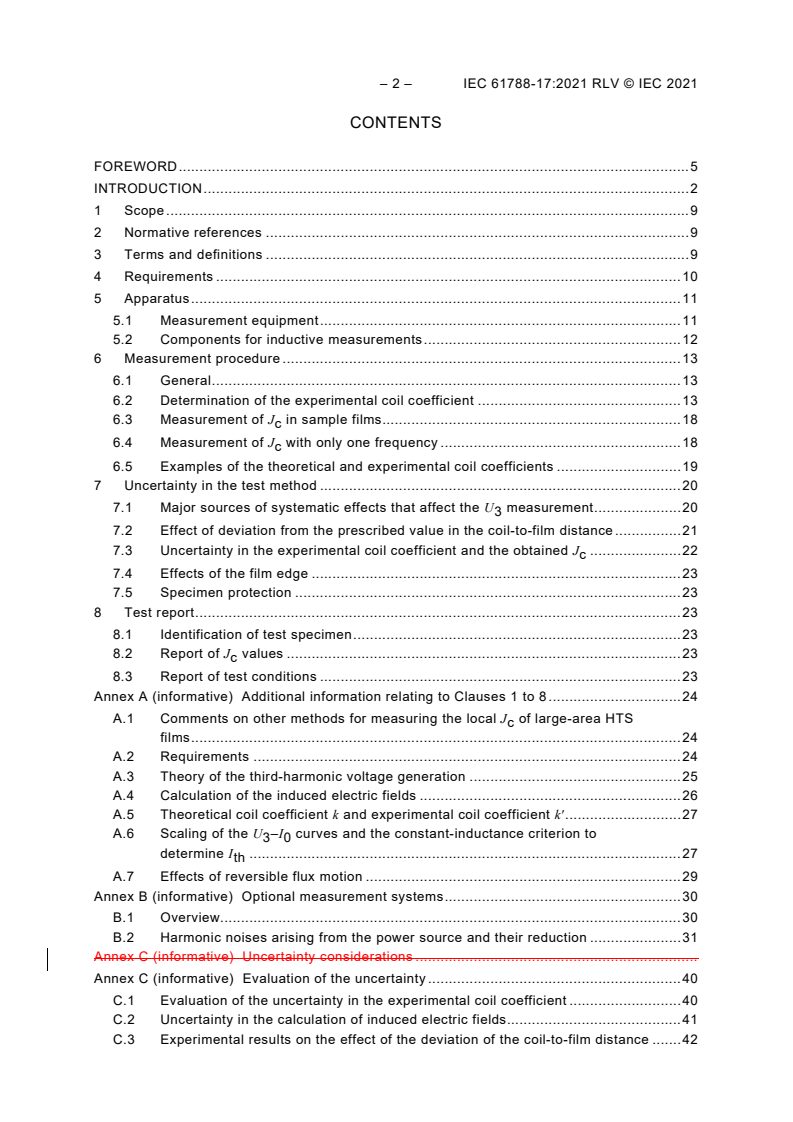
– 2 – IEC 61788-17:2021 © IEC 2021
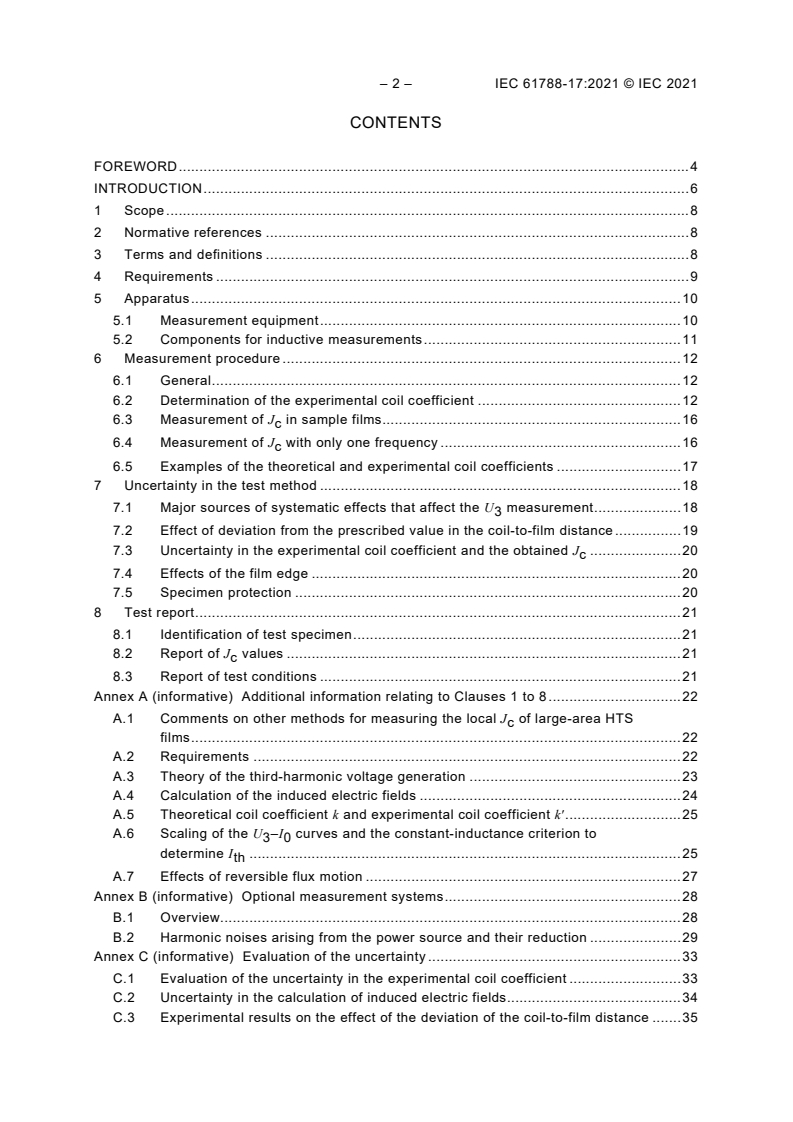
CONTENTS
FOREWORD . 4
INTRODUCTION . 6
1 Scope . 8
2 Normative references . 8
3 Terms and definitions . 8
4 Requirements . 9
5 Apparatus . 10
5.1 Measurement equipment . 10
5.2 Components for inductive measurements . 11
6 Measurement procedure . 12
6.1 General . 12
6.2 Determination of the experimental coil coefficient . 12
6.3 Measurement of J in sample films. 16
c
6.4 Measurement of J with only one frequency . 16
c
6.5 Examples of the theoretical and experimental coil coefficients . 17
7 Uncertainty in the test method . 18
7.1 Major sources of systematic effects that affect the U measurement . 18
7.2 Effect of deviation from the prescribed value in the coil-to-film distance . 19
7.3 Uncertainty in the experimental coil coefficient and the obtained J . 20
c
7.4 Effects of the film edge . 20
7.5 Specimen protection . 20
8 Test report . 21
8.1 Identification of test specimen . 21
8.2 Report of J values . 21
c
8.3 Report of test conditions . 21
Annex A (informative) Additional information relating to Clauses 1 to 8 . 22
A.1 Comments on other methods for measuring the local J of large-area HTS
c
films . 22
A.2 Requirements . 22
A.3 Theory of the third-harmonic voltage generation . 23
A.4 Calculation of the induced electric fields . 24
A.5 Theoretical coil coefficient k and experimental coil coefficient k′ . 25
A.6 Scaling of the U –I curves and the constant-inductance criterion to
3 0
determine I . 25
th
A.7 Effects of reversible flux motion . 27
Annex B (informative) Optional measurement systems . 28
B.1 Overview. 28
B.2 Harmonic noises arising from the power source and their reduction . 29
Annex C (informative) Evaluation of the uncertainty . 33
C.1 Evaluation of the uncertainty in the experimental coil coefficient . 33
C.2 Uncertainty in the calculation of induced electric fields. 34
C.3 Experimental results on the effect of the deviation of the coil-to-film distance . 35
C.4 Examples of the Type-A uncertainties of J and n-values, originating from
c
the experimental uncertainty in the U measurement . 35
C.5 Evaluation of the uncertainty in the obtained J . 36
c
C.6 Experimental results that reveal the effect of the film edge . 37
Bibliography . 39
Figure 1 – Diagram for an electric circuit used for inductive J measurement
c
of HTS films . 10
Figure 2 – Illustration showing techniques to press the sample coil to HTS films . 11
Figure 3 – Example of a calibration wafer used to determine the coil coefficient . 12
Figure 4 – Illustration of the sample coil and the magnetic field during measurement . 13
Figure 5 – Illustration of the sample coil and its magnetic field generation . 14
Figure 6 – E-J characteristics measured by a transport method and the U inductive
method . 16
Figure 7 – Illustration of coils 1 and 3 in Table 2 . 17
Figure 8 – The coil-factor function F(r) = 2H /I calculated for the three coils. 18
0 0
Figure 9 – The coil-to-film distance Z dependence of the theoretical coil coefficient k . 19
Figure A.1 – Illustration of the sample coil and the magnetic field during measurement . 24
Figure A.2 – U and U /I plotted against I in a YBCO thin film measured in applied
3 3 0 0
DC magnetic fields, and the scaling observed when normalized by I (insets) . 26
th
Figure A.3 – Example of the normalized third-harmonic voltages (U /fI ) measured
3 0
with various frequencies . 26
Figure B.1 – Schematic diagram for the variable-RL-cancel circuit . 29
Figure B.2 – Diagram for an electrical circuit used for the two-coil method . 29
Figure B.3 – Harmonic noises arising from the power source . 30
Figure B.4 – Noise reduction using a cancel coil with a superconducting film . 30
Figure B.5 – Normalized harmonic noises (U /fI ) arising from the power source . 31
3 0
Figure B.6 – Normalized noise voltages after the reduction using a cancel coil with a
superconducting film . 31
Figure B.7 – Normalized noise voltages after the reduction using a cancel coil without
a superconducting film . 32
Figure B.8 – Normalized noise voltages with the two-coil system shown in Figure B.2 . 32
Figure C.1 – Effect of the coil position against a superconducting thin film on the
measured J values . 38
c
Table 1 – Specifications and theoretical coil coefficients k of sample coils . 14
Table 2 – Specifications and coil coefficients of typical sample coils . 17
Table C.1 – Uncertainty budget table for the experimental coil coefficient k′ . 34
Table C.2 – Examples of repeated measurements of J and n-values . 36
c
– 4 – IEC 61788-17:2021 © IEC 2021
INTERNATIONAL ELECTROTECHNICAL COMMISSION
____________
SUPERCONDUCTIVITY –
Part 17: Electronic characteristic measurements –
Local critical current density and its distribution
in large-area superconducting films
FOREWORD
1) The International Electrotechnical Commission (IEC) is a worldwide organization for standardization comprising
all national electrotechnical committees (IEC National Committees). The object of IEC is to promote international
co-operation on all questions concerning standardization in the electrical and electronic fields. To this end and
in addition to other activities, IEC publishes International Standards, Technical Specifications, Technical Reports,
Publicly Available Specifications (PAS) and Guides (hereafter referred to as “IEC Publication(s)”). Their
preparation is entrusted to technical committees; any IEC National Committee interested in the subject dealt with
may participate in this preparatory work. International, governmental and non-governmental organizations liaising
with the IEC also participate in this preparation. IEC collaborates closely with the International Organization for
Standardization (ISO) in accordance with conditions determined by agreement between the two organizations.
2) The formal decisions or agreements of IEC on technical matters express, as nearly as possible, an international
consensus of opinion on the relevant subjects since each technical committee has representation from all
interested IEC National Committees.
3) IEC Publications have the form of recommendations for international use and are accepted by IEC National
Committees in that sense. While all reasonable efforts are made to ensure that the technical content of IEC
Publications is accurate, IEC cannot be held responsible for the way in which they are used or for any
misinterpretation by any end user.
4) In order to promote international uniformity, IEC National Committees undertake to apply IEC Publications
transparently to the maximum extent possible in their national and regional publications. Any divergence between
any IEC Publication and the corresponding national or regional publication shall be clearly indicated in the latter.
5) IEC itself does not provide any attestation of conformity. Independent certification bodies provide conformity
assessment services and, in some areas, access to IEC marks of conformity. IEC is not responsible for any
services carried out by independent certification bodies.
6) All users should ensure that they have the latest edition of this publication.
7) No liability shall attach to IEC or its directors, employees, servants or agents including individual experts and
members of its technical committees and IEC National Committees for any personal injury, property damage or
other damage of any nature whatsoever, whether direct or indirect, or for costs (including legal fees) and
expenses arising out of the publication, use of, or reliance upon, this IEC Publication or any other IEC
Publications.
8) Attention is drawn to the Normative references cited in this publication. Use of the referenced publications is
indispensable for the correct application of this publication.
9) Attention is drawn to the possibility that some of the elements of this IEC Publication may be the subject of patent
rights. IEC shall not be held responsible for identifying any or all such patent rights.
IEC 61788-17 has been prepared by IEC technical committee 90: Superconductivity. It is an
International Standard.
This second edition cancels and replaces the first edition published in 2013. This edition
constitutes a technical revision.
This edition includes the following a significant technical change with respect to the previous
edition:
a) A simple method to calculate theoretical coil coefficient k is described in 6.2.1.
The text of this International Standard is based on the following documents:
FDIS Report on voting
90/462/FDIS 90/464/RVD
Full information on the voting for the approval of this International Standard can be found in the
report on voting indicated in the above table.
The language used for the development of this International Standard is English.
This document was drafted in accordance with ISO/IEC Directives, Part 2, and developed in
accordance with ISO/IEC Directives, Part 1 and ISO/IEC Directives, IEC Supplement, available
at www.iec.ch/members_experts/refdocs. The main document types developed by IEC are
described in greater detail at www.iec.ch/standardsdev/publications.
A list of all the parts of the IEC 61788 series, published under the general title Superconductivity,
can be found on the IEC website.
The committee has decided that the contents of this document will remain unchanged until the
stability date indicated on the IEC website under "http://webstore.iec.ch" in the data related to
the specific document. At this date, the document will be
• reconfirmed,
• withdrawn,
• replaced by a revised edition, or
• amended.
IMPORTANT – The 'colour inside' logo on the cover page of this publication indicates that it
contains colours which are considered to be useful for the correct understanding of its
contents. Users should therefore print this document using a colour printer.
– 6 – IEC 61788-17:2021 © IEC 2021
INTRODUCTION
Over thirty years after their discovery in 1986, high-temperature superconductors are now
finding their way into products and technologies that will revolutionize information transmission,
transportation, and energy. Among them, high-temperature superconducting (HTS) microwave
filters, which exploit the extremely low surface resistance of superconductors, have already
been commercialized. They have two major advantages over conventional non-superconducting
filters, namely: low insertion loss (low noise characteristics) and high frequency selectivity
(sharp cut) [1] . These advantages enable a reduced number of base stations, improved speech
quality, more efficient use of frequency bandwidths, and reduced unnecessary radio wave noise.
Large-area superconducting thin films have been developed for use in microwave devices [2].
They are also considered for use in emerging superconducting power devices, such as resistive-
type superconducting fault-current limiters (SFCLs) [3] [4] [5], superconducting fault detectors
used for superconductor-triggered fault current limiters [6] [7] and persistent-current switches
used for persistent-current HTS magnets [8] [9]. The critical current density J is one of the key
c
parameters that describe the quality of large-area HTS films. Nondestructive, AC inductive
methods are widely used to measure J and its distribution for large-area HTS films [10] [11]
c
cos(3ωt + θ) is the most
[12] [13], among which the method utilizing third-harmonic voltages U
popular [10] [11], where ω, t and θ denote the angular frequency, time, and initial phase,
respectively. However, these conventional methods are not accurate because they have not
considered the electric-field E criterion of the J measurement [14] [15] and sometimes use an
c
inappropriate criterion to determine the threshold current I from which J is calculated [16]. A
th c
conventional method can obtain J values that differ from the accurate values by 10 % to 20 %
c
[15]. It is thus important to establish standard test methods to precisely measure the local
critical current density and its distribution, to which all involved in the HTS filter industry can
refer for quality control of the HTS films. Background knowledge on the inductive J
c
measurements of HTS thin films is summarized in Annex A.
In these inductive methods, AC magnetic fields are generated with AC currents I cosωt in a
small coil mounted just above the film, and J is calculated from the threshold coil current I ,
c th
at which full penetration of the magnetic field to the film is achieved [17]. For the inductive
method using third-harmonic voltages U , U is measured as a function of I , and the I is
3 3 0 th
determined as the coil current I at which U starts to emerge. The induced electric fields E in
0 3
the superconducting film at I = I , which are proportional to the frequency f of the AC current,
0 th
can be estimated by a simple Bean model [14]. A standard method has been proposed to
precisely measure J with an electric-field criterion by detecting U and obtaining the n-value
c 3
(index of the power-law E-J characteristics) by measuring I precisely at various frequencies
th
[14] [15] [18] [19]. This method not only obtains precise J values, but also facilitates the
c
detection of degraded parts in inhomogeneous specimens, because the decline of n-value is
more noticeable than the decrease of J in such parts [15]. It is noted that this standard method
c
is excellent for assessing homogeneity in large-area HTS films, although the relevant parameter
for designing microwave devices is not J , but the surface resistance. For application of large-
c
area superconducting thin films to SFCLs, knowledge on J distribution is vital, because J
c c
distribution significantly affects quench distribution in SFCLs during faults.
The International Electrotechnical Commission (IEC) draws attention to the fact that it is claimed
that compliance with this document may involve the use of a patent. IEC takes no position
concerning the evidence, validity, and scope of this patent right.
___________
Numbers in square brackets refer to the Bibliography.
The holder of this patent right has assured IEC that s/he is willing to negotiate licences under
reasonable and non-discriminatory terms and conditions with applicants throughout the world.
In this respect, the statement of the holder of this patent right is registered with IEC. Information
may be obtained from the patent database available at http://patents.iec.ch.
Attention is drawn to the possibility that some of the elements of this document may be the
subject of patent rights other than those in the patent database. IEC shall not be held
responsible for identifying any or all such patent rights.
– 8 – IEC 61788-17:2021 © IEC 2021
SUPERCONDUCTIVITY –
Part 17: Electronic characteristic measurements –
Local critical current density and its distribution
in large-area superconducting films
1 Scope
This part of IEC 61788 specifies the measurements of the local critical current density (J ) and
c
its distribution in large-area high-temperature superconducting (HTS) films by an inductive
method using third-harmonic voltages. The most important consideration for precise
measurements is to determine J at liquid nitrogen temperatures by an electric-field criterion
c
and obtain current-voltage characteristics from its frequency dependence. Although it is
possible to measure J in applied DC magnetic fields [20] [21], the scope of this document is
c
limited to the measurement without DC magnetic fields.
This technique intrinsically measures the critical sheet current that is the product of J and the
c
film thickness d. The range and measurement resolution for J d of HTS films are as follows.
c
– J d: from 200 A/m to 32 kA/m (based on results, not limitation).
c
– Measurement resolution: 100 A/m (based on results, not limitation).
2 Normative references
The following documents are referred to in the text in such a way that some or all of their content
constitutes requirements of this document. For dated references, only the edition cited applies.
For undated references, the latest edition of the referenced document (including any
amendments) applies.
IEC 60050-815, International Electrotechnical Vocabulary – Part 815: Superconductivity
(available at )
3 Terms and definitions
For the purposes of this document, the terms and definitions given in IEC 60050-815 apply,
some of which are repeated here for convenience.
ISO and IEC maintain terminological databases for use in standardization at the following
addresses:
• IEC Electropedia: available at http://www.electropedia.org/
• ISO Online browsing platform: available at http://www.iso.org/obp
3.1
critical current
I
c
maximum direct current that can be regarded as flowing without resistance practically
Note 1 to entry: I is a function of magnetic field strength, temperature and strain.
c
[SOURCE: IEC 60050-815:2015, 815-12-01]
3.2
critical current criterion
I criterion
c
criterion to determine the critical current, I , based on the electric field strength, E, or the
c
resistivity, ρ
-14
Note 1 to entry: E = 10 µV/m or E = 100 µV/m is often used as electric field criterion, and ρ = 10 Ω · m or
-13
ρ = 10 Ω · m is often used as resistivity criterion.
[SOURCE: IEC 60050-815:2015, 815-12-02]
3.3
critical current density
J
c
electric current density at the critical current using either the cross-section of the whole
conductor (overall) or of the non-stabilizer part of the conductor if there is a stabilizer
Note 1 to entry: The overall current density is called engineering current density (symbol: J ).
e
[SOURCE: IEC 60050-815:2015, 815-12-03]
3.4
transport critical current density
J
ct
critical current density obtained by a resistivity or a voltage measurement
[SOURCE: IEC 60050-815:2015, 815-12-04]
3.5
n-value
exponent obtained in a specific range of electric field strength or resistivity
n
when the voltage/current U (I) curve is approximated by the equation
UI∝
[SOURCE: IEC 60050-815:2015, 815-12-10]
4 Requirements
The critical current density J is one of the most fundamental parameters that describe the
c
quality of large-area HTS films. In this document, J and its distribution are measured non-
c
destructively via an inductive method by detecting third-harmonic voltages U cos(3ωt + θ). A
small coil, which is used both to generate AC magnetic fields and detect third-harmonic voltages,
is mounted just above the HTS film and used to scan the measuring area. To measure J
c
precisely with an electric-field criterion, the threshold coil currents I , at which U starts to
th 3
emerge, are measured repeatedly at different frequencies and the E-J characteristics are
determined from their frequency dependencies.
The target relative combined standard uncertainty in the method used to determine the absolute
value of J is less than 10 %. However, the target uncertainty is less than 5 % for the purpose
c
of evaluating the homogeneity of J distribution in large-area superconducting thin films.
c
– 10 – IEC 61788-17:2021 © IEC 2021
5 Apparatus
5.1 Measurement equipment
Figure 1 shows a schematic diagram of a typical electric circuit used for the third-harmonic
voltage measurements. This circuit is comprised of a signal generator, power amplifier, digital
multimeter (DMM) to measure the coil current, band-ejection filter to reduce the fundamental
wave signals and lock-in amplifier to measure the third-harmonic signals. It involves the single-
coil approach in which the coil is used to generate an AC magnetic field and detect the inductive
voltage. This method can also be applied to double-sided superconducting thin films with no
obstacles. In the methods proposed here, however, there is an additional system to reduce
harmonic noise voltages generated from the signal generator and the power amplifier [14]. In
an example of Figure 1, a cancel coil of specification being the same as the sample coil is used
for cancelling. The sample coil is mounted just above the superconducting film, and a
superconducting film with a J d sufficiently larger than that of the sample film is placed below
c
the cancel coil to adjust its inductance to that of the sample coil. Note that the inductance of
the sample coil decreases by 20 % to 30 % due to the superconducting shielding current when
it is mounted on a superconducting film. Both coils and superconducting films are immersed in
liquid nitrogen (a broken line in Figure 1). Other optional measurement systems are described
in Annex B.
NOTE In this circuit, coil currents of about 0,1 A (RMS) and power source voltages of > 6 V (RMS) are needed to
measure the superconducting film of J d ≈ 10 kA/m while using coil 1 or 2 of Table 2. A precision power amplifier
c
with sufficiently high power is used to supply such large currents and voltages.
NOTE The broken line surrounds elements immersed in liquid nitrogen.
Figure 1 – Diagram for an electric circuit used
for inductive J measurement of HTS films
c
5.2 Components for inductive measurements
5.2.1 Coils
Currently available large-area HTS films are deposited on areas as large as about 25 cm in
diameter, while films about 5 cm in diameter are commercially used to prepare microwave
filters [22]. Larger YBa Cu O (YBCO) films, about 10 cm in diameter and 2,7 cm × 20 cm, were
2 3 7
used to fabricate fault current limiter modules [3] [4] [5]. For the J measurements of such films,
c
the appropriate outer diameter of the sample coils ranges from 2 mm to 5 mm. The requirement
for the sample coil is to generate as high a magnetic field as possible at the upper surface of
the superconducting film, for which flat coil geometry is suitable. Typical specifications are as
follows.
a) Inner winding diameter D : 0,9 mm, outer diameter D : 4,2 mm, height h: 1,0 mm, 400 turns
1 2
of a 50 μm diameter copper wire.
b) D : 0,8 mm, D : 2,2 mm, h: 1,0 mm, 200 turns of a 50 µm diameter copper wire.
1 2
5.2.2 Spacer film
Typically, a polyimide film with a thickness of 50 μm to 125 μm is used to protect the HTS films.
The coil has generally some protection layer below the coil winding, which also insulates the
thin film from Joule heat in the coil. The typical thickness is 100 μm to 150 μm, and the coil-to-
film distance Z is kept to be 200 μm.
5.2.3 Mechanism for the set-up of the coil
To maintain a prescribed value for the spacing Z between the bottom of the coil winding and
the film surface, the sample coil should be pressed to the film with sufficient pressure, typically
exceeding about 0,2 MPa [18]. Techniques to achieve this are to use a weight or spring, as
shown in Figure 2. The system schematically shown in the figure left is used to scan a wide
area of the film. Before the U measurement the coil is initially raised up to some distance,
moved laterally to the target position, and then lowered down and pressed to the film. An
appropriate pressure should be determined so that too high pressure does not damage the
bobbin, coil, HTS thin film or the substrate. It is reported that the YBCO deposited on biaxially-
textured pure Ni substrate was degraded by transverse compressive stress of about 20 MPa
[23].
Figure 2 – Illustration showing techniques to press the sample coil to HTS films
– 12 – IEC 61788-17:2021 © IEC 2021
5.2.4 Calibration wafer
A calibration wafer is used to determine the experimental coil coefficient k′ described in
Clause 6. It is made by using a homogeneous large-area (typically about 5 cm diameter) YBCO
thin film. It consists of bridges for transport measurement and an inductive measurement area
(Figure 3). Typical dimensions of the transport bridges are 20 μm to 70 μm wide and 1 mm to
2 mm long, which were prepared either by UV photolithography technique or by laser
etching [24]. In the transport bridge area shown in Figure 3, a transport current can be passed
from current terminal 1 to another current terminal 3 through the bridge "a". In this case,
terminals 2 and 12 are used as voltage terminals. Similarly, a transport current can be passed
from current terminal 1 to another current terminal (5, 7, 9 or 11) through the bridge "b", "c", "d"
or "e". In this case, terminals 4, 6, 8 or 10, and 12 are used as voltage terminals.
Figure 3 – Example of a calibration wafer used to determine the coil coefficient
6 Measurement procedure
6.1 General
The procedures used to determine the experimental coil coefficient k′ and measure the J of the
c
films under test are described as follows, with the meaning of k′ expressed in Clause A.5.
6.2 Determination of the experimental coil coefficient
6.2.1 Calculation of the theoretical coil coefficient k
Calculate the theoretical coil coefficient k = J d/I from
c th
k = F , (1)
m
where F is the maximum of F(r) that is a function of r, the distance from the central axis of the
m
coil whose inner diameter is D , outer diameter is D and height is h (Figure 4). The coil-factor
1 2
function F(r) = −2H (r, t)/I cosωt = 2H /I is obtained by
r 0 0 0
RZ2π
22 ′
N rz cosθ
′
Fr( ) = dr ddθz , (2)
2 2 2 32/
∫ ∫∫
RZ0
2π S ′′
11 ()z ++r r − 2rr cosθ
where H (r, t) is the radial component of the magnetic field generated by the sample coil at a
r
upper surface of the superconducting film, N is the number of turns in the sample coil, R = D /2
1 1
is the inner radius, R = D /2 is the outer radius of the coil, S = (R – R )h is the cross-sectional
2 2 2 1
area, Z is the coil-to-film distance, and Z = Z + h [17]. The explanation of Equations (1) and
1 2 1
(2) is given in Clause A.3.
A simple method to obtain k is as follows.
a) Calculate the magnetic-field amplitude H (r) = H (r, t = 0) as a function of r at a position
0 r
below the coil with a distance Z when a current of I = 1 mA is passed in the sample coil
1 0
(Figure 5).
b) Obtain the (local) maximum value of H (r) when r is changed near r ≈ (R + R )/2.
0 1 2
c) The maximum value of H (r) should have a unit of A/m, then the doubled value divided by
I (= 1 mA) becomes k (unit: 1/mm). Note that the magnetic field arising from the image coil
(i.e. from the shielding current flowing in the superconducting film) cancels out the
perpendicular component H , and the parallel component H doubles. The image coil and
z r
its magnetic field generation are shown by the broken lines in Figure 5.
d) For the calculation of coil magnetic fields, a free web site may be used; for example,
http://www.sc.kyushu-u.ac.jp/~kajikawa/javascript/field_and_potential-e.html
(the calculation of this site is based on a paper entitled "Calculation of Magnetic Field
Distribution of Solenoid Coil by Computer" [25].
Some examples of the theoretical coil coefficient k for typical sample coils are shown in Table 1
with the specifications.
Figure 4 – Illustration of the sample coil and the magnetic field during measurement
___________
This information is given for the convenience of users of this document and does not constitute an endorsement
by IEC.
– 14 – IEC 61788-17:2021 © IEC 2021
NOTE The image coil and its magnetic field generation are shown by the broken line.
Figure 5 – Illustration of the sample coil and its magnetic field generation
Table 1 – Specifications and theoretical coil coefficients k of sample coils
D D h Turns k r at F(r) =
1 2
F
m
mm mm mm 1/mm mm
A1 0,8 2,2 1,0 200 62,9 0,74
A2 0,9 2,9 1,0 300 92,2 0,95
A3 1,0 3,6 1,0 400 117,4 1,15
A4 1,0 4,3 1,0 500 135,2 1,35
A5 1,0 4,9 1,0 600 151,5 1,52
A6 1,0 3,6 1,5 600 136,0 1,17
B1 1,0 4,3 1,0 150 34,4 1,35
B2 1,0 5,4 1,0 200 41,9 1,67
B3 1,0 6,5 1,0 250 47,9 1,98
B4 1,0 7,6 1,0 300 52,6 2,31
B5 1,5 5,4 1,5 300 51,5 1,68
Coils A1 to A6 are made of 50-μm-diameter copper wires (coil-to-film distance
Z = 0,2 mm), and coils B1 to B5 are made of 100-μm-diameter copper wires (coil-
to-film distance Z = 0,33 mm).
6.2.2 Transport measurements of bridges in the calibration wafer
a) Measure the E-J characteristics of the transport bridges of the calibration wafer by a four-
probe method, and obtain the power-law E-J characteristics,
n
E = A × J . (3)
t 0t
b) Repeat the measurement for at least three different bridges. Three sets of data (n = 20,5 to
23,8) measured for three bridges are shown in the upper (high-E) part of Figure 6.
6.2.3 U measurements of the calibration wafer
a) Measure U in the inductive measurement area of the calibration wafer as a function of the
coil current with three or four frequencies, and obtain the experimental I using a constant-
th
inductance criterion; namely, U /fI = 2πL . The criterion L should be as small as possible
3 th c c
within the range with sufficiently large signal-to-noise (S/N) ratios, in order to use the simple
Equation (4) for the electric-field calculation (7.1 c) and Clause C.2).
b) Repeat the measurement for at least three different points of the film.
6.2.4 Calculation of the E-J characteristics from frequency-dependent I data
th
a) Calculate J (= kI /d) and the average E induced in the superconducting film at the full
c0 th
penetration threshold (when J = J ) by
c c0
, (4)
E ≈=2,,04μ fd J 2 04μkfdI
avg-U 0 c 0 th
from the obtained I at each frequency using the theoretical coefficient k calculated in 6.2.1.
th
The derivation of Equation (4) is described in Clause A.4.
b) Obtain the E-J characteristics, and the electric fields E induced in the superconducting film
i
can be approximated as
n
E = A × J , (5)
i 0i
from the relation between E and J , and plot them in the same figure where the
avg-U c0
transport E-J characteristics data were plotted. Broken lines in Figure 6 show three sets of
data measured at different points of the film. Transport data and U inductive data do not
yet match at this stage.
6.2.5 Determination of the k′ from J and J values for an appropriate E
ct c0
a) Choose an appropriate electric field that is within (or near to) both the transport E-J curves
and the inductive E-J curves, such as 200 μV/m in Figure 6.
b) At this electric field, calculate both the transport critical current densities J and the
ct
inductive J values from Equation (3) and Equation (5), respectively.
c0
c) Determine the experimental coil coefficient k′ by k′ = (J /J )k, where J and J indicate
ct c0 ct c0
the average values of obtained J and J values, respectively. If the J (= k′I /d) values
ct c0 c th
are plotted against E = 2,04μkfdI , the E-J characteristics from the U measurement
avg-U 0 th
match the transport data well (Figure 6).
– 16 – IEC 61788-17:2021 © IEC 2021
NOTE Broken lines show three sets of data measured at different points of the film.
Figure 6 – E-J characteristics measured by a transport method
and the U inductive method
6.3 Measurement of J in sample films
c
a) Measure U with two, three or four frequencies in sample films, and obtain I with the same
3 th
criterion L as used in 6.2.3.
c
b) Use the obtained experimental coil coefficient k′ to calculate J (= k′I /d) at each frequency,
c th
E
and obtain the relation between J and (= 2,04µ kfdI ) using k because of the
avg-U
c 0 th
underestimation as mentioned in 7.1 c). An example of the E-J characteristics is also shown
in Figure 6, measured for a sample film (TH052Au, solid symbols) with n-values (36,0 and
40,4) exceeding those of the calibration wafer (n = 28,0 to 28,6).
c) From the obtained E-J characteristics, calculate the J value with an appropriate electric-
c
field criterion, such as E = 100 µV/m.
c
d) Measurement with three or four frequencies is beneficial to check the validity of the
measurement and sample by checking the power-law E-J characteristics. Measurement with
two frequencies can be used for routine samples in the interests of time.
6.4 Measurement of J with only one frequency
c
As mentioned in Clause 1 and Clause 3, it is recommended to determine J with a constant
c
electric-field criterion using a multi-frequency approach through procedures described in 6.2
and 6.3, because a supercurrent flowing in a superconductor is a function of electric field.
However, one frequency measurement is sometimes desired for simplicity and inexpensiveness.
In this case, the J values are determined with variable electric-field criteria as specified in the
c
following procedures.
a) Calculate the theoretical coil coefficient k as described in 6.2.1.
b) Obtain the E-J characteristics of the transport bridges of the calibration wafer (Equation (3))
through the procedures of 6.2.2.
c) Measure U in the inductive measurement area of the calibration wafer as a function of the
coil current with one frequency, and obtain the experimental I using a constant-inductance
th
criterion; namely, U /fI = 2πL . The criterion L should be as small as possible within the
3 0 c c
range with sufficiently large S/N ratios, in order to use the simple Equation (4) in 6.2.4 for
the electric-field calculation. Calculate J (= kI /d) and the average E induced in the
c0 th
superconducting film at the full penetration threshold by Equation (4). Repeat the
measurement for at least three different points of the film, and obtain average J and E
c0 avg-U
for the average E
d) Using the transport E-J characteristics of Equation (3), calculate J
ct avg-U
obtained in c).
e) Determine the experimental coil coefficient k′ by k′ = (J /J )k.
ct c0
f) Measure U with the same frequency in sample films, and obtain I with the same criterion
3 th
as used in c). Calculate J (= k′I /d) using the obtained experimental coil coefficient k′.
L
c c th
Calculate also E with Equation (4), and this value should be accompanied by each
avg-U
J value.
c
6.5 Examples of the theoretical and experimental coil coefficients
Some examples of the theoretical and experimental coil coefficients (k and k′) for typical sample
coils are shown in Table 2 with the specifications and recommended criteria for the I
th
determination, 2πL = U /fI . Note that the k′ depends on the criterion L . Coils 1 and 2 are
c 3 0 c
wound with a 50 μm diameter, polyurethane enamelled round copper winding wire, and coil 3
is wound with a 50 μm diameter, self-bonding polyurethane enamelled round copper winding
wire. Measured resistances at 77,3 K and calculated self-inductances when a superconducting
film is placed below the coil are also shown. The coil-to-film distance Z is fixed at 0,2 mm. The
images of coils 1 and 3 are shown in Figure 7, and the coil-factor functions F(r) for the three
coils show that the peak magnetic field occurs near the mean coil radius (Figure 8).
Table 2 – Specifications and coil coefficients of typical sample coils
D D h Turns k k′ U /fI R L
1 2 3 0
mm mm mm 1/mm 1/mm μΩ·s Ω mH
1 0,8 2,2 1,0 200 62,9 47,0 0,6 1,6 0,028
2 1,0 3,6 1,0 400 117,4 89,1 2 3,4 0,163
3 0,9 4,2 1,0 400 106,6 82,2 2 4,1 0,165
Figure 7 – Illustration of coils 1 and 3 in Table 2
– 18 – IEC 61788-17:2021 © IEC 2021
Figure 8 – The coil-factor function F(r) = 2H /I calculated for the three coils
0 0
7 Uncertainty in the test method
7.1 Major sources of systematic effects that affect the U measurement
The most significant systematic effect on the U measurement is due to the deviation of the
coil-to-film distance Z from the prescribed value. Because the measured value J d in this
1 c
technique is directly proportional to the magnetic field at the upper surface of the
superconducting film, the deviation of the spacing Z directly affects the measurement. The key
origins of the uncertainty are listed in a) to c) below.
a) Inadequate pressing of the coil to the film
As the measurement is performed in liquid nitrogen, th
...
IEC 61788-17 ®
Edition 2.0 2021-04
REDLINE VERSION
INTERNATIONAL
STANDARD
colour
inside
Superconductivity –
Part 17: Electronic characteristic measurements – Local critical current density
and its distribution in large-area superconducting films
All rights reserved. Unless otherwise specified, no part of this publication may be reproduced or utilized in any form
or by any means, electronic or mechanical, including photocopying and microfilm, without permission in writing from
either IEC or IEC's member National Committee in the country of the requester. If you have any questions about IEC
copyright or have an enquiry about obtaining additional rights to this publication, please contact the address below or
your local IEC member National Committee for further information.
IEC Central Office Tel.: +41 22 919 02 11
3, rue de Varembé info@iec.ch
CH-1211 Geneva 20 www.iec.ch
Switzerland
About the IEC
The International Electrotechnical Commission (IEC) is the leading global organization that prepares and publishes
International Standards for all electrical, electronic and related technologies.
About IEC publications
The technical content of IEC publications is kept under constant review by the IEC. Please make sure that you have the
latest edition, a corrigendum or an amendment might have been published.
IEC publications search - webstore.iec.ch/advsearchform IEC online collection - oc.iec.ch
The advanced search enables to find IEC publications by a Discover our powerful search engine and read freely all the
variety of criteria (reference number, text, technical publications previews. With a subscription you will always
committee, …). It also gives information on projects, replaced have access to up to date content tailored to your needs.
and withdrawn publications.
Electropedia - www.electropedia.org
IEC Just Published - webstore.iec.ch/justpublished
The world's leading online dictionary on electrotechnology,
Stay up to date on all new IEC publications. Just Published
containing more than 22 000 terminological entries in English
details all new publications released. Available online and
and French, with equivalent terms in 18 additional languages.
once a month by email.
Also known as the International Electrotechnical Vocabulary
(IEV) online.
IEC Customer Service Centre - webstore.iec.ch/csc
If you wish to give us your feedback on this publication or
need further assistance, please contact the Customer Service
Centre: sales@iec.ch.
IEC 61788-17 ®
Edition 2.0 2021-04
REDLINE VERSION
INTERNATIONAL
STANDARD
colour
inside
Superconductivity –
Part 17: Electronic characteristic measurements – Local critical current density
and its distribution in large-area superconducting films
INTERNATIONAL
ELECTROTECHNICAL
COMMISSION
ICS 17.220.20; 29.050 ISBN 978-2-8322-9765-0
– 2 – IEC 61788-17:2021 RLV © IEC 2021
CONTENTS
FOREWORD . 5
INTRODUCTION . 2
1 Scope . 9
2 Normative references . 9
3 Terms and definitions . 9
4 Requirements . 10
5 Apparatus . 11
5.1 Measurement equipment . 11
5.2 Components for inductive measurements . 12
6 Measurement procedure . 13
6.1 General . 13
6.2 Determination of the experimental coil coefficient . 13
6.3 Measurement of J in sample films. 18
c
6.4 Measurement of J with only one frequency . 18
c
6.5 Examples of the theoretical and experimental coil coefficients . 19
7 Uncertainty in the test method . 20
7.1 Major sources of systematic effects that affect the U measurement . 20
7.2 Effect of deviation from the prescribed value in the coil-to-film distance . 21
7.3 Uncertainty in the experimental coil coefficient and the obtained J . 22
c
7.4 Effects of the film edge . 23
7.5 Specimen protection . 23
8 Test report . 23
8.1 Identification of test specimen . 23
8.2 Report of J values . 23
c
8.3 Report of test conditions . 23
Annex A (informative) Additional information relating to Clauses 1 to 8 . 24
A.1 Comments on other methods for measuring the local J of large-area HTS
c
films . 24
A.2 Requirements . 24
A.3 Theory of the third-harmonic voltage generation . 25
A.4 Calculation of the induced electric fields . 26
A.5 Theoretical coil coefficient k and experimental coil coefficient k′ . 27
A.6 Scaling of the U –I curves and the constant-inductance criterion to
3 0
determine I . 27
th
A.7 Effects of reversible flux motion . 29
Annex B (informative) Optional measurement systems . 30
B.1 Overview. 30
B.2 Harmonic noises arising from the power source and their reduction . 31
Annex C (informative) Uncertainty considerations .
Annex C (informative) Evaluation of the uncertainty . 40
C.1 Evaluation of the uncertainty in the experimental coil coefficient . 40
C.2 Uncertainty in the calculation of induced electric fields. 41
C.3 Experimental results on the effect of the deviation of the coil-to-film distance . 42
C.4 Examples of the Type-A uncertainties of J and n-values, originating from
c
the experimental uncertainty in the U measurement . 42
C.5 Evaluation of the uncertainty in the obtained J . 43
c
C.6 Experimental results that reveal the effect of the film edge . 44
Bibliography . 46
Figure 1 – Diagram for an electric circuit used for inductive J measurement
c
of HTS films . 11
Figure 2 – Illustration showing techniques to press the sample coil to HTS films . 12
Figure 3 – Example of a calibration wafer used to determine the coil coefficient . 13
Figure 4 – Illustration of the sample coil and the magnetic field during measurement . 15
Figure 5 – Illustration of the sample coil and its magnetic field generation . 15
Figure 6 –Example of the normalized third-harmonic voltages (U /fI ) measured with
3 0
various frequencies .
Figure 6 – E-J characteristics measured by a transport method and the U inductive
method . 17
Figure 7 – Illustration of coils 1 and 3 in Table 2 . 20
Figure 8 – The coil-factor function F(r) = 2H /I calculated for the three coils. 20
0 0
Figure 9 – The coil-to-film distance Z dependence of the theoretical coil coefficient k . 22
Figure A.1 – Illustration of the sample coil and the magnetic field during measurement . 26
Figure A.2 – U and U /I plotted against I in a YBCO thin film measured in applied
3 3 0 0
DC magnetic fields, and the scaling observed when normalized by I (insets) . 28
th
Figure A.3 – Example of the normalized third-harmonic voltages (U /fI ) measured
3 0
with various frequencies . 28
Figure B.1 – Schematic diagram for the variable-RL-cancel circuit . 31
Figure B.2 – Diagram for an electrical circuit used for the two-coil method . 31
Figure B.3 – Harmonic noises arising from the power source . 32
Figure B.4 – Noise reduction using a cancel coil with a superconducting film . 32
Figure B.5 – Normalized harmonic noises (U /fI ) arising from the power source . 33
3 0
Figure B.6 – Normalized noise voltages after the reduction using a cancel coil with a
superconducting film . 33
Figure B.7 – Normalized noise voltages after the reduction using a cancel coil without
a superconducting film . 34
Figure B.8 – Normalized noise voltages with the two-coil system shown in Figure B.2 . 34
Figure C.1 – Effect of the coil position against a superconducting thin film on the
measured J values . 45
c
Table 1 – Specifications and theoretical coil coefficients k of sample coils . 16
Table 2 – Specifications and coil coefficients of typical sample coils . 19
Table C.1 – Output signals from two nominally identical extensometers .
Table C.2 – Mean values of two output signals .
Table C.3 – Experimental standard deviations of two output signals .
Table C.4 – Standard uncertainties of two output signals .
Table C.5 – Coefficient of variations of two output signals .
– 4 – IEC 61788-17:2021 RLV © IEC 2021
Table C.1 – Uncertainty budget table for the experimental coil coefficient k′ . 41
Table C.2 – Examples of repeated measurements of J and n-values . 43
c
INTERNATIONAL ELECTROTECHNICAL COMMISSION
____________
SUPERCONDUCTIVITY –
Part 17: Electronic characteristic measurements –
Local critical current density and its distribution
in large-area superconducting films
FOREWORD
1) The International Electrotechnical Commission (IEC) is a worldwide organization for standardization comprising
all national electrotechnical committees (IEC National Committees). The object of IEC is to promote international
co-operation on all questions concerning standardization in the electrical and electronic fields. To this end and
in addition to other activities, IEC publishes International Standards, Technical Specifications, Technical Reports,
Publicly Available Specifications (PAS) and Guides (hereafter referred to as “IEC Publication(s)”). Their
preparation is entrusted to technical committees; any IEC National Committee interested in the subject dealt with
may participate in this preparatory work. International, governmental and non-governmental organizations liaising
with the IEC also participate in this preparation. IEC collaborates closely with the International Organization for
Standardization (ISO) in accordance with conditions determined by agreement between the two organizations.
2) The formal decisions or agreements of IEC on technical matters express, as nearly as possible, an international
consensus of opinion on the relevant subjects since each technical committee has representation from all
interested IEC National Committees.
3) IEC Publications have the form of recommendations for international use and are accepted by IEC National
Committees in that sense. While all reasonable efforts are made to ensure that the technical content of IEC
Publications is accurate, IEC cannot be held responsible for the way in which they are used or for any
misinterpretation by any end user.
4) In order to promote international uniformity, IEC National Committees undertake to apply IEC Publications
transparently to the maximum extent possible in their national and regional publications. Any divergence between
any IEC Publication and the corresponding national or regional publication shall be clearly indicated in the latter.
5) IEC itself does not provide any attestation of conformity. Independent certification bodies provide conformity
assessment services and, in some areas, access to IEC marks of conformity. IEC is not responsible for any
services carried out by independent certification bodies.
6) All users should ensure that they have the latest edition of this publication.
7) No liability shall attach to IEC or its directors, employees, servants or agents including individual experts and
members of its technical committees and IEC National Committees for any personal injury, property damage or
other damage of any nature whatsoever, whether direct or indirect, or for costs (including legal fees) and
expenses arising out of the publication, use of, or reliance upon, this IEC Publication or any other IEC
Publications.
8) Attention is drawn to the Normative references cited in this publication. Use of the referenced publications is
indispensable for the correct application of this publication.
9) Attention is drawn to the possibility that some of the elements of this IEC Publication may be the subject of patent
rights. IEC shall not be held responsible for identifying any or all such patent rights.
This redline version of the official IEC Standard allows the user to identify the changes made to
the previous edition IEC 61788-17:2013. A vertical bar appears in the margin wherever a change
has been made. Additions are in green text, deletions are in strikethrough red text.
– 6 – IEC 61788-17:2021 RLV © IEC 2021
IEC 61788-17 has been prepared by IEC technical committee 90: Superconductivity. It is an
International Standard.
This second edition cancels and replaces the first edition published in 2013. This edition
constitutes a technical revision.
This edition includes the following a significant technical change with respect to the previous
edition:
a) A simple method to calculate theoretical coil coefficient k is described in 6.2.1.
The text of this International Standard is based on the following documents:
FDIS Report on voting
90/462/FDIS 90/464/RVD
Full information on the voting for the approval of this International Standard can be found in the
report on voting indicated in the above table.
The language used for the development of this International Standard is English.
This document was drafted in accordance with ISO/IEC Directives, Part 2, and developed in
accordance with ISO/IEC Directives, Part 1 and ISO/IEC Directives, IEC Supplement, available
at www.iec.ch/members_experts/refdocs. The main document types developed by IEC are
described in greater detail at www.iec.ch/standardsdev/publications.
A list of all the parts of the IEC 61788 series, published under the general title Superconductivity,
can be found on the IEC website.
The committee has decided that the contents of this document will remain unchanged until the
stability date indicated on the IEC website under "http://webstore.iec.ch" in the data related to
the specific document. At this date, the document will be
• reconfirmed,
• withdrawn,
• replaced by a revised edition, or
• amended.
IMPORTANT – The 'colour inside' logo on the cover page of this publication indicates that it
contains colours which are considered to be useful for the correct understanding of its
contents. Users should therefore print this document using a colour printer.
INTRODUCTION
Over thirty years after their discovery in 1986, high-temperature superconductors are now
finding their way into products and technologies that will revolutionize information transmission,
transportation, and energy. Among them, high-temperature superconducting (HTS) microwave
filters, which exploit the extremely low surface resistance of superconductors, have already
been commercialized. They have two major advantages over conventional non-superconducting
filters, namely: low insertion loss (low noise characteristics) and high frequency selectivity
(sharp cut) [1] . These advantages enable a reduced number of base stations, improved speech
quality, more efficient use of frequency bandwidths, and reduced unnecessary radio wave noise.
Large-area superconducting thin films have been developed for use in microwave devices [2].
They are also used considered for use in emerging superconducting power devices, such as
resistive-type superconducting fault-current limiters (SFCLs) [3] [4] [5], superconducting fault
detectors used for superconductor-triggered fault current limiters [6] [7] and persistent-current
switches used for persistent-current HTS magnets [8] [9]. The critical current density J is one
c
of the key parameters that describe the quality of large-area HTS films. Nondestructive, AC
inductive methods are widely used to measure J and its distribution for large-area HTS films
c
cos(3ωt + θ) is
[10] [11] [12] [13], among which the method utilizing third-harmonic voltages U
the most popular [10] [11], where ω, t and θ denote the angular frequency, time, and initial
phase, respectively. However, these conventional methods are not accurate because they have
not considered the electric-field E criterion of the J measurement [14] [15] and sometimes use
c
an inappropriate criterion to determine the threshold current I from which J is calculated [16].
th c
A conventional method can obtain J values that differ from the accurate values by 10 % to 20 %
c
[15]. It is thus necessary important to establish standard test methods to precisely measure the
local critical current density and its distribution, to which all involved in the HTS filter industry
can refer for quality control of the HTS films. Background knowledge on the inductive J
c
measurements of HTS thin films is summarized in Annex A.
In these inductive methods, AC magnetic fields are generated with AC currents I cosωt in a
small coil mounted just above the film, and J is calculated from the threshold coil current I ,
c th
at which full penetration of the magnetic field to the film is achieved [17]. For the inductive
method using third-harmonic voltages U , U is measured as a function of I , and the I is
3 3 0 th
determined as the coil current I at which U starts to emerge. The induced electric fields E in
0 3
the superconducting film at I = I , which are proportional to the frequency f of the AC current,
0 th
can be estimated by a simple Bean model [14]. A standard method has been proposed to
precisely measure J with an electric-field criterion by detecting U and obtaining the n-value
c 3
(index of the power-law E-J characteristics) by measuring I precisely at various frequencies
th
[14] [15] [18] [19]. This method not only obtains precise J values, but also facilitates the
c
detection of degraded parts in inhomogeneous specimens, because the decline of n-value is
more remarkable noticeable than the decrease of J in such parts [15]. It is noted that this
c
standard method is excellent for assessing homogeneity in large-area HTS films, although the
relevant parameter for designing microwave devices is not J , but the surface resistance. For
c
application of large-area superconducting thin films to SFCLs, knowledge on J distribution is
c
vital, because J distribution significantly affects quench distribution in SFCLs during faults.
c
The International Electrotechnical Commission (IEC) draws attention to the fact that it is claimed
that compliance with this document may involve the use of a patent concerning the
determination of the E-J characteristics by inductive J measurements as a function of
c
frequency, given in the Introduction, Clause 1, Clause 4 and 5.1. IEC takes no position
concerning the evidence, validity, and scope of this patent right.
___________
Numbers in square brackets refer to the Bibliography.
– 8 – IEC 61788-17:2021 RLV © IEC 2021
The holder of this patent right has assured IEC that s/he is willing to negotiate licences free of
charge under reasonable and non-discriminatory terms and conditions with applicants
throughout the world. In this respect, the statement of the holder of this patent right is registered
with IEC. Information may be obtained from the patent database available at
http://patents.iec.ch.
Name of holder of patent right:
National Institute of Advanced Industrial Science and Technology
Address:
Intellectual Property Planning Office, Intellectual Property Department
1-1-1, Umezono, Tsukuba, Ibaraki Prefecture, Japan
Attention is drawn to the possibility that some of the elements of this document may be the
in the patent database. IEC shall not
subject of patent rights other than those identified above
be held responsible for identifying any or all such patent rights.
ISO (www.iso.org/patents) and IEC (http://patents.iec.ch) maintain on-line data bases of
patents relevant to their standards. Users are encouraged to consult the data bases for the
most up to date information concerning patents.
SUPERCONDUCTIVITY –
Part 17: Electronic characteristic measurements –
Local critical current density and its distribution
in large-area superconducting films
1 Scope
This part of IEC 61788 describes specifies the measurements of the local critical current density
(J ) and its distribution in large-area high-temperature superconducting (HTS) films by an
c
inductive method using third-harmonic voltages. The most important consideration for precise
measurements is to determine J at liquid nitrogen temperatures by an electric-field criterion
c
and obtain current-voltage characteristics from its frequency dependence. Although it is
possible to measure J in applied DC magnetic fields [20] [21], the scope of this document is
c
limited to the measurement without DC magnetic fields.
This technique intrinsically measures the critical sheet current that is the product of J and the
c
film thickness d. The range and measurement resolution for J d of HTS films are as follows.
c
– J d: from 200 A/m to 32 kA/m (based on results, not limitation).
c
– Measurement resolution: 100 A/m (based on results, not limitation).
2 Normative references
The following documents are referred to in the text in such a way that some or all of their content
constitutes requirements of this document. For dated references, only the edition cited applies.
For undated references, the latest edition of the referenced document (including any
amendments) applies.
IEC 60050 (all parts), International Electrotechnical Vocabulary (available at
http://www.electropedia.org)
IEC 60050-815, International Electrotechnical Vocabulary – Part 815: Superconductivity
(available at )
3 Terms and definitions
For the purposes of this document, the terms and definitions given in IEC 60050-815:2000 apply,
some of which are repeated here for convenience.
ISO and IEC maintain terminological databases for use in standardization at the following
addresses:
• IEC Electropedia: available at http://www.electropedia.org/
• ISO Online browsing platform: available at http://www.iso.org/obp
3.1
critical current
I
c
maximum direct current that can be regarded as flowing without resistance practically
– 10 – IEC 61788-17:2021 RLV © IEC 2021
Note 1 to entry: I is a function of magnetic field strength, temperature and strain.
c
[SOURCE: IEC 60050-815:20002015, 815-0312-01]
3.2
critical current criterion
I criterion
c
criterion to determine the critical current, I , based on the electric field strength, E, or the
c
resistivity, ρ
-14
Note 1 to entry: E = 10 µV/m or E = 100 µV/m is often used as electric field criterion, and ρ = 10 Ω · m or
-13
ρ = 10 Ω · m is often used as resistivity criterion. (“E = 10 V/m or E = 100 V/m” in the current edition is mistaken
and is scheduled to be corrected in the second edition).
[SOURCE: IEC 60050-815:20002015, 815-0312-02]
3.3
critical current density
J
c
electric current density at the critical current using either the cross-section of the whole
conductor (overall) or of the non-stabilizer part of the conductor if there is a stabilizer
Note 1 to entry: The overall current density is called engineering current density (symbol: J ).
e
[SOURCE: IEC 60050-815:20002015, 815-0312-03]
3.4
transport critical current density
J
ct
critical current density obtained by a resistivity or a voltage measurement
[SOURCE: IEC 60050-815:20002015, 815-0312-04]
3.5
n-value
exponent obtained in a specific range of electric field strength or resistivity
n
when the voltage/current U (I) curve is approximated by the equation UI∝
[SOURCE: IEC 60050-815:20002015, 815-0312-10]
4 Requirements
The critical current density J is one of the most fundamental parameters that describe the
c
quality of large-area HTS films. In this document, J and its distribution are measured non-
c
destructively via an inductive method by detecting third-harmonic voltages U cos(3ωt + θ). A
small coil, which is used both to generate AC magnetic fields and detect third-harmonic voltages,
is mounted just above the HTS film and used to scan the measuring area. To measure J
c
precisely with an electric-field criterion, the threshold coil currents I , at which U starts to
th 3
emerge, are measured repeatedly at different frequencies and the E-J characteristics are
determined from their frequency dependencies.
The target relative combined standard uncertainty in the method used to determine the absolute
value of J is less than 10 %. However, the target uncertainty is less than 5 % for the purpose
c
of evaluating the homogeneity of J distribution in large-area superconducting thin films.
c
5 Apparatus
5.1 Measurement equipment
Figure 1 shows a schematic diagram of a typical electric circuit used for the third-harmonic
voltage measurements. This circuit is comprised of a signal generator, power amplifier, digital
multimeter (DMM) to measure the coil current, band-ejection filter to reduce the fundamental
wave signals and lock-in amplifier to measure the third-harmonic signals. It involves the single-
coil approach in which the coil is used to generate an AC magnetic field and detect the inductive
voltage. This method can also be applied to double-sided superconducting thin films without
hindrance with no obstacles. In the methods proposed here, however, there is an additional
system to reduce harmonic noise voltages generated from the signal generator and the power
amplifier [14]. In an example of Figure 1, a cancel coil of specification being the same as the
sample coil is used for cancelling. The sample coil is mounted just above the superconducting
film, and a superconducting film with a J d sufficiently larger than that of the sample film is
c
placed below the cancel coil to adjust its inductance to that of the sample coil. Note that the
inductance of the sample coil decreases by 20 % to 30 % due to the superconducting shielding
current when it is mounted on a superconducting film. Both coils and superconducting films are
immersed in liquid nitrogen (a broken line in Figure 1). Other optional measurement systems
are described in Annex B.
NOTE In this circuit, coil currents of about 0,1 A (RMS) and power source voltages of > 6 V (RMS) are needed to
measure the superconducting film of J d ≈ 10 kA/m while using coil 1 or 2 of Table 2. A precision power amplifier,
c
such as NF: HSA4011, with sufficiently high power is necessary used to supply such large currents and voltages.
NOTE The broken line surrounds elements immersed in liquid nitrogen.
Figure 1 – Diagram for an electric circuit used
for inductive J measurement of HTS films
c
– 12 – IEC 61788-17:2021 RLV © IEC 2021
5.2 Components for inductive measurements
5.2.1 Coils
Currently available large-area HTS films are deposited on areas as large as about 25 cm in
diameter, while films about 5 cm in diameter are commercially used to prepare microwave
filters [22]. Larger YBa Cu O (YBCO) films, about 10 cm in diameter and 2,7 cm × 20 cm, were
2 3 7
used to fabricate fault current limiter modules [3] [4] [5]. For the J measurements of such films,
c
the appropriate outer diameter of the sample coils ranges from 2 mm to 5 mm. The requirement
for the sample coil is to generate as high a magnetic field as possible at the upper surface of
the superconducting film, for which flat coil geometry is suitable. Typical specifications are as
follows.
a) Inner winding diameter D : 0,9 mm, outer diameter D : 4,2 mm, height h: 1,0 mm, 400 turns
1 2
of a 50 μm diameter copper wire.
b) D : 0,8 mm, D : 2,2 mm, h: 1,0 mm, 200 turns of a 50 µm diameter copper wire.
1 2
5.2.2 Spacer film
Typically, a polyimide film with a thickness of 50 μm to 125 μm is used to protect the HTS films.
The coil has generally some protection layer below the coil winding, which also insulates the
thin film from Joule heat in the coil. The typical thickness is 100 μm to 150 μm, and the coil-to-
film distance Z is kept to be 200 μm.
5.2.3 Mechanism for the set-up of the coil
To maintain a prescribed value for the spacing Z between the bottom of the coil winding and
the film surface, the sample coil should be pressed to the film with sufficient pressure, typically
exceeding about 0,2 MPa [18]. Techniques to achieve this are to use a weight or spring, as
shown in Figure 2. The system schematically shown in the figure left is used to scan a wide
area of the film. Before the U measurement the coil is initially moved raised up to some
distance, moved laterally to the target position, and then moved lowered down and pressed to
the film. An appropriate pressure should be determined so that too high pressure does not
damage the bobbin, coil, HTS thin film or the substrate. It is reported that the YBCO deposited
on biaxially-textured pure Ni substrate was degraded by transverse compressive stress of about
20 MPa [23].
Figure 2 – Illustration showing techniques to press the sample coil to HTS films
5.2.4 Calibration wafer
A calibration wafer is used to determine the experimental coil coefficient k′ described in
Clause 6. It is made by using a homogeneous large-area (typically about 5 cm diameter) YBCO
thin film. It consists of bridges for transport measurement and an inductive measurement area
(Figure 3). Typical dimensions of the transport bridges are 20 μm to 70 μm wide and 1 mm to
2 mm long, which were prepared either by UV photolithography technique or by laser
etching [24]. In the transport bridge area shown in Figure 3, a transport current can be passed
from current terminal 1 to another current terminal 3 through the bridge "a". In this case,
terminals 2 and 12 are used as voltage terminals. Similarly, a transport current can be passed
from current terminal 1 to another current terminal (5, 7, 9 or 11) through the bridge "b", "c", "d"
or "e". In this case, terminals 4, 6, 8 or 10, and 12 are used as voltage terminals.
Figure 3 – Example of a calibration wafer used to determine the coil coefficient
6 Measurement procedure
6.1 General
The procedures used to determine the experimental coil coefficient k′ and measure the J of the
c
films under test are described as follows, with the meaning of k′ expressed in Clause A.5.
6.2 Determination of the experimental coil coefficient
6.2.1 Calculation of the theoretical coil coefficient k
Calculate the theoretical coil coefficient k = J d/I from
c th
k = F , (1)
m
where F is the maximum of F(r) that is a function of r, the distance from the central axis of the
m
coil whose inner diameter is D , outer diameter is D and height is h (Figure 4). The coil-factor
1 2
function F(r) = −2H (r, t)/I cosωt = 2H /I is obtained by
r 0 0 0
RZ2π
N 22 rz′ cosθ
′ , (2)
Fr( ) = dr ddθz
∫ ∫∫ 2 2 2 32/
2π S RZ0
11 ()z ++r r′′− 2rr cosθ
– 14 – IEC 61788-17:2021 RLV © IEC 2021
where N is the number of windings, S = (R – R )h is the cross-sectional area, R = D /2 is the
2 1 1 1
inner radius, R = D /2 is the outer radius of the coil, Z is the coil-to-film distance, and Z = Z
2 2 1 2 1
+ h [17]. The derivation of the Equation (2) is described in A.3.
H (r, t) is the radial component of the magnetic field generated by the sample coil at a upper
r
surface of the superconducting film, N is the number of turns in the sample coil, R = D /2 is
1 1
the inner radius, R = D /2 is the outer radius of the coil, S = (R – R )h is the cross-sectional
2 2 2 1
area, Z is the coil-to-film distance, and Z = Z + h [17]. The explanation of Equations (1) and
1 2 1
(2) is given in Clause A.3.
A simple method to obtain k is as follows.
a) Calculate the magnetic-field amplitude H (r) = H (r, t = 0) as a function of r at a position
0 r
below the coil with a distance Z when a current of I = 1 mA is passed in the sample coil
1 0
(Figure 5).
b) Obtain the (local) maximum value of H (r) when r is changed near r ≈ (R + R )/2.
0 1 2
c) The maximum value of H (r) should have a unit of A/m, then the doubled value divided by
I (= 1 mA) becomes k (unit: 1/mm). Note that the magnetic field arising from the image coil
(i.e. from the shielding current flowing in the superconducting film) cancels out the
perpendicular component H , and the parallel component H doubles. The image coil and
z r
its magnetic field generation are shown by the broken lines in Figure 5.
d) For the calculation of coil magnetic fields, a free web site may be used; for example,
http://www.sc.kyushu-u.ac.jp/~kajikawa/javascript/field_and_potential-e.html
(the calculation of this site is based on a paper entitled "Calculation of Magnetic Field
Distribution of Solenoid Coil by Computer" [25].
Some examples of the theoretical coil coefficient k for typical sample coils are shown in Table 1
with the specifications.
___________
This information is given for the convenience of users of this document and does not constitute an endorsement
by IEC.
Figure 4 – Illustration of the sample coil and the magnetic field during measurement
NOTE The image coil and its magnetic field generation are shown by the broken line.
Figure 5 – Illustration of the sample coil and its magnetic field generation
– 16 – IEC 61788-17:2021 RLV © IEC 2021
Table 1 – Specifications and theoretical coil coefficients k of sample coils
D D h Turns k r at F(r) =
1 2
F
m
mm mm mm 1/mm mm
A1 0,8 2,2 1,0 200 62,9 0,74
A2 0,9 2,9 1,0 300 92,2 0,95
A3 1,0 3,6 1,0 400 117,4 1,15
A4 1,0 4,3 1,0 500 135,2 1,35
A5 1,0 4,9 1,0 600 151,5 1,52
A6 1,0 3,6 1,5 600 136,0 1,17
B1 1,0 4,3 1,0 150 34,4 1,35
B2 1,0 5,4 1,0 200 41,9 1,67
B3 1,0 6,5 1,0 250 47,9 1,98
B4 1,0 7,6 1,0 300 52,6 2,31
B5 1,5 5,4 1,5 300 51,5 1,68
Coils A1 to A6 are made of 50-μm-diameter copper wires (coil-to-film distance
Z = 0,2 mm), and coils B1 to B5 are made of 100-μm-diameter copper wires (coil-
to-film distance Z = 0,33 mm).
6.2.2 Transport measurements of bridges in the calibration wafer
a) Measure the E-J characteristics of the transport bridges of the calibration wafer by a four-
probe method, and obtain the power-law E-J characteristics,
n
E = A × J . (3)
t 0t
b) Repeat the measurement for at least three different bridges. Three sets of data (n = 20,5 to
23,8) measured for three bridges are shown in the upper (high-E) part of Figure 6.
6.2.3 U measurements of the calibration wafer
a) Measure U in the inductive measurement area of the calibration wafer as a function of the
coil current with three or four frequencies, and obtain the experimental I using a constant-
th
inductance criterion; namely, U /fI = 2πL U /fI = 2πL . The criterion L should be as small
3 0 c 3 th c c
as possible within the range with sufficiently large signal-to-noise (S/N) ratios, in order to
use the simple Equation (4) for the electric-field calculation (7.1 c) and Clause C.2). An
example of the measurement is shown in Figure 6 with 2πL = 2 µΩ•sec.
c
b) Repeat the measurement for at least three different points of the film.
6.2.4 Calculation of the E-J characteristics from frequency-dependent I data
th
a) Calculate J (= kI /d) and the average E induced in the superconducting film at the full
c0 th
penetration threshold (when J = J ) by
c c0
E ≈=2,,04μ fd J 2 04μkfdI E ≈ 2,04µ fd J = 2,04µ kfdI , (4)
avg-U 0 c 0 th
avg 0 c 0 th
from the obtained I at each frequency using the theoretical coefficient k calculated in 6.2.1.
th
The derivation of Equation (4) is described in Clause A.4.
b) Obtain the E-J characteristics, and the electric fields E induced in the superconducting film
i
can be approximated as
n
E = A × J , (5)
i 0i
from the relation between E E and J , and plot them in the same figure where the
avg-U
avg c0
transport E-J characteristics data were plotted. Broken lines in Figure 6 show three sets of
data measured at different points of the film. Transport data and U inductive data do not
yet match at this stage.
6.2.5 Determination of the k′ from J and J values for an appropriate E
ct c0
a) Choose an appropriate electric field that is within (or near to) both the transport E-J curves
and the inductive E-J curves, such as 200 μV/m in Figure 6.
b) At this electric field, calculate both the transport critical current densities J and the
ct
values from Equation (3) and Equation (5), respectively.
inductive J
c0
c) Determine the experimental coil coefficient k′ by k′ = (J /J )k, where J and J indicate
ct c0 ct c0
the average values of obtained J and J values, respectively. If the J (= k′I /d) values
ct c0 c th
= 2,04µ kfdI , the E-J characteristics from the
are plotted against E E = 2,04μkfdI
avg 0 th avg-U 0 th
U measurement match the transport data well (Figure 6).
NOTE Broken lines show three sets of data measured at different points of the film.
Figure 6 – E-J characteristics measured by a transport method
and the U inductive method
– 18 – IEC 61788-17:2021 RLV © IEC 2021
IEC 018/13
Figure 6 –Example of the normalized third-harmonic
voltages (U /fI ) measured with various frequencies
3 0
6.3 Measurement of J in sample films
c
a) Measure U with two, three or four frequencies in sample films, and obtain I with the same
3 th
criterion L as used in 6.2.3.
c
b) Use the obtained experimental coil coefficient k′ to calculate J (= k′I /d) at each frequency,
c th
and obtain the relation between J and E E (= 2,04µ kfdI ) using k because of the
avg-U
c av 0 th
underestimation as mentioned in 7.1 c). An example of the E-J characteristics is also shown
in Figure 6, measured for a sample film (TH052Au, solid symbols) with n-values (36,0 and
40,4) exceeding those of the calibration wafer (n = 28,0 to 28,6).
c) From the obtained E-J characteristics, calculate the J value with an appropriate electric-
c
field criterion, such as E = 100 µV/m.
c
d) Measurement with three or four frequencies is beneficial to check the validity of the
measurement and sample by checking the power-law E-J characteristics. Measurement with
two frequencies can be used for routine samples in the interests of time.
6.4 Measurement of J with only one frequency
c
As mentioned in Clause 1 and Clause 3, J is a function of electric field, and it is recommended
c
to determine J with a constant electric-field criterion using a multi-frequency approach through
c
procedures described in 6.2 and 6.3, because a supercurrent flowing in a superconductor is a
function of electric field. However, one frequency measurement is sometimes desired for
simplicity and inexpensiveness. In this case, the J values are determined with variable electric-
c
field criteria as specified in the following procedures.
a) Calculate the theoretical coil coefficient k as described in 6.2.1.
b) Obtain the E-J characteristics of the transport bridges of the calibration wafer (Equation (3))
through the procedures of 6.2.2.
c) Measure U in the inductive measurement area
...
IEC 61788-17 ®
Edition 2.0 2021-04
INTERNATIONAL
STANDARD
NORME
INTERNATIONALE
colour
inside
Superconductivity –
Part 17: Electronic characteristic measurements – Local critical current density
and its distribution in large-area superconducting films
Supraconductivité –
Partie 17: Mesurages de caractéristiques électroniques – Densité de courant
critique local et sa distribution dans les films supraconducteurs de grande
surface
All rights reserved. Unless otherwise specified, no part of this publication may be reproduced or utilized in any form
or by any means, electronic or mechanical, including photocopying and microfilm, without permission in writing from
either IEC or IEC's member National Committee in the country of the requester. If you have any questions about IEC
copyright or have an enquiry about obtaining additional rights to this publication, please contact the address below or
your local IEC member National Committee for further information.
Droits de reproduction réservés. Sauf indication contraire, aucune partie de cette publication ne peut être reproduite
ni utilisée sous quelque forme que ce soit et par aucun procédé, électronique ou mécanique, y compris la photocopie
et les microfilms, sans l'accord écrit de l'IEC ou du Comité national de l'IEC du pays du demandeur. Si vous avez des
questions sur le copyright de l'IEC ou si vous désirez obtenir des droits supplémentaires sur cette publication, utilisez
les coordonnées ci-après ou contactez le Comité national de l'IEC de votre pays de résidence.
IEC Central Office Tel.: +41 22 919 02 11
3, rue de Varembé info@iec.ch
CH-1211 Geneva 20 www.iec.ch
Switzerland
About the IEC
The International Electrotechnical Commission (IEC) is the leading global organization that prepares and publishes
International Standards for all electrical, electronic and related technologies.
About IEC publications
The technical content of IEC publications is kept under constant review by the IEC. Please make sure that you have the
latest edition, a corrigendum or an amendment might have been published.
IEC publications search - webstore.iec.ch/advsearchform IEC online collection - oc.iec.ch
The advanced search enables to find IEC publications by a Discover our powerful search engine and read freely all the
variety of criteria (reference number, text, technical publications previews. With a subscription you will always
committee, …). It also gives information on projects, replaced have access to up to date content tailored to your needs.
and withdrawn publications.
Electropedia - www.electropedia.org
IEC Just Published - webstore.iec.ch/justpublished
The world's leading online dictionary on electrotechnology,
Stay up to date on all new IEC publications. Just Published
containing more than 22 000 terminological entries in English
details all new publications released. Available online and
and French, with equivalent terms in 18 additional languages.
once a month by email.
Also known as the International Electrotechnical Vocabulary
(IEV) online.
IEC Customer Service Centre - webstore.iec.ch/csc
If you wish to give us your feedback on this publication or
need further assistance, please contact the Customer Service
Centre: sales@iec.ch.
A propos de l'IEC
La Commission Electrotechnique Internationale (IEC) est la première organisation mondiale qui élabore et publie des
Normes internationales pour tout ce qui a trait à l'électricité, à l'électronique et aux technologies apparentées.
A propos des publications IEC
Le contenu technique des publications IEC est constamment revu. Veuillez vous assurer que vous possédez l’édition la
plus récente, un corrigendum ou amendement peut avoir été publié.
Recherche de publications IEC - IEC online collection - oc.iec.ch
webstore.iec.ch/advsearchform Découvrez notre puissant moteur de recherche et consultez
La recherche avancée permet de trouver des publications IEC gratuitement tous les aperçus des publications. Avec un
en utilisant différents critères (numéro de référence, texte, abonnement, vous aurez toujours accès à un contenu à jour
comité d’études, …). Elle donne aussi des informations sur adapté à vos besoins.
les projets et les publications remplacées ou retirées.
Electropedia - www.electropedia.org
IEC Just Published - webstore.iec.ch/justpublished
Le premier dictionnaire d'électrotechnologie en ligne au
Restez informé sur les nouvelles publications IEC. Just
monde, avec plus de 22 000 articles terminologiques en
Published détaille les nouvelles publications parues.
anglais et en français, ainsi que les termes équivalents dans
Disponible en ligne et une fois par mois par email.
16 langues additionnelles. Egalement appelé Vocabulaire
Electrotechnique International (IEV) en ligne.
Service Clients - webstore.iec.ch/csc
Si vous désirez nous donner des commentaires sur cette
publication ou si vous avez des questions contactez-nous:
sales@iec.ch.
IEC 61788-17 ®
Edition 2.0 2021-04
INTERNATIONAL
STANDARD
NORME
INTERNATIONALE
colour
inside
Superconductivity –
Part 17: Electronic characteristic measurements – Local critical current density
and its distribution in large-area superconducting films
Supraconductivité –
Partie 17: Mesurages de caractéristiques électroniques – Densité de courant
critique local et sa distribution dans les films supraconducteurs de grande
surface
INTERNATIONAL
ELECTROTECHNICAL
COMMISSION
COMMISSION
ELECTROTECHNIQUE
INTERNATIONALE
ICS 17.220.20; 29.050 ISBN 978-2-8322-1022-0
– 2 – IEC 61788-17:2021 © IEC 2021
CONTENTS
FOREWORD . 4
INTRODUCTION . 6
1 Scope . 8
2 Normative references . 8
3 Terms and definitions . 8
4 Requirements . 9
5 Apparatus . 10
5.1 Measurement equipment . 10
5.2 Components for inductive measurements . 11
6 Measurement procedure . 12
6.1 General . 12
6.2 Determination of the experimental coil coefficient . 12
6.3 Measurement of J in sample films. 16
c
6.4 Measurement of J with only one frequency . 16
c
6.5 Examples of the theoretical and experimental coil coefficients . 17
7 Uncertainty in the test method . 18
7.1 Major sources of systematic effects that affect the U measurement . 18
7.2 Effect of deviation from the prescribed value in the coil-to-film distance . 19
7.3 Uncertainty in the experimental coil coefficient and the obtained J . 20
c
7.4 Effects of the film edge . 20
7.5 Specimen protection . 20
8 Test report . 21
8.1 Identification of test specimen . 21
8.2 Report of J values . 21
c
8.3 Report of test conditions . 21
Annex A (informative) Additional information relating to Clauses 1 to 8 . 22
A.1 Comments on other methods for measuring the local J of large-area HTS
c
films . 22
A.2 Requirements . 22
A.3 Theory of the third-harmonic voltage generation . 23
A.4 Calculation of the induced electric fields . 24
A.5 Theoretical coil coefficient k and experimental coil coefficient k′ . 25
A.6 Scaling of the U –I curves and the constant-inductance criterion to
3 0
determine I . 25
th
A.7 Effects of reversible flux motion . 27
Annex B (informative) Optional measurement systems . 28
B.1 Overview. 28
B.2 Harmonic noises arising from the power source and their reduction . 29
Annex C (informative) Evaluation of the uncertainty . 33
C.1 Evaluation of the uncertainty in the experimental coil coefficient . 33
C.2 Uncertainty in the calculation of induced electric fields. 34
C.3 Experimental results on the effect of the deviation of the coil-to-film distance . 35
C.4 Examples of the Type-A uncertainties of J and n-values, originating from
c
the experimental uncertainty in the U measurement . 35
C.5 Evaluation of the uncertainty in the obtained J . 36
c
C.6 Experimental results that reveal the effect of the film edge . 37
Bibliography . 39
Figure 1 – Diagram for an electric circuit used for inductive J measurement
c
of HTS films . 10
Figure 2 – Illustration showing techniques to press the sample coil to HTS films . 11
Figure 3 – Example of a calibration wafer used to determine the coil coefficient . 12
Figure 4 – Illustration of the sample coil and the magnetic field during measurement . 13
Figure 5 – Illustration of the sample coil and its magnetic field generation . 14
Figure 6 – E-J characteristics measured by a transport method and the U inductive
method . 16
Figure 7 – Illustration of coils 1 and 3 in Table 2 . 17
Figure 8 – The coil-factor function F(r) = 2H /I calculated for the three coils. 18
0 0
Figure 9 – The coil-to-film distance Z dependence of the theoretical coil coefficient k . 19
Figure A.1 – Illustration of the sample coil and the magnetic field during measurement . 24
Figure A.2 – U and U /I plotted against I in a YBCO thin film measured in applied
3 3 0 0
DC magnetic fields, and the scaling observed when normalized by I (insets) . 26
th
Figure A.3 – Example of the normalized third-harmonic voltages (U /fI ) measured
3 0
with various frequencies . 26
Figure B.1 – Schematic diagram for the variable-RL-cancel circuit . 29
Figure B.2 – Diagram for an electrical circuit used for the two-coil method . 29
Figure B.3 – Harmonic noises arising from the power source . 30
Figure B.4 – Noise reduction using a cancel coil with a superconducting film . 30
Figure B.5 – Normalized harmonic noises (U /fI ) arising from the power source . 31
3 0
Figure B.6 – Normalized noise voltages after the reduction using a cancel coil with a
superconducting film . 31
Figure B.7 – Normalized noise voltages after the reduction using a cancel coil without
a superconducting film . 32
Figure B.8 – Normalized noise voltages with the two-coil system shown in Figure B.2 . 32
Figure C.1 – Effect of the coil position against a superconducting thin film on the
measured J values . 38
c
Table 1 – Specifications and theoretical coil coefficients k of sample coils . 14
Table 2 – Specifications and coil coefficients of typical sample coils . 17
Table C.1 – Uncertainty budget table for the experimental coil coefficient k′ . 34
Table C.2 – Examples of repeated measurements of J and n-values . 36
c
– 4 – IEC 61788-17:2021 © IEC 2021
INTERNATIONAL ELECTROTECHNICAL COMMISSION
____________
SUPERCONDUCTIVITY –
Part 17: Electronic characteristic measurements –
Local critical current density and its distribution
in large-area superconducting films
FOREWORD
1) The International Electrotechnical Commission (IEC) is a worldwide organization for standardization comprising
all national electrotechnical committees (IEC National Committees). The object of IEC is to promote international
co-operation on all questions concerning standardization in the electrical and electronic fields. To this end and
in addition to other activities, IEC publishes International Standards, Technical Specifications, Technical Reports,
Publicly Available Specifications (PAS) and Guides (hereafter referred to as “IEC Publication(s)”). Their
preparation is entrusted to technical committees; any IEC National Committee interested in the subject dealt with
may participate in this preparatory work. International, governmental and non-governmental organizations liaising
with the IEC also participate in this preparation. IEC collaborates closely with the International Organization for
Standardization (ISO) in accordance with conditions determined by agreement between the two organizations.
2) The formal decisions or agreements of IEC on technical matters express, as nearly as possible, an international
consensus of opinion on the relevant subjects since each technical committee has representation from all
interested IEC National Committees.
3) IEC Publications have the form of recommendations for international use and are accepted by IEC National
Committees in that sense. While all reasonable efforts are made to ensure that the technical content of IEC
Publications is accurate, IEC cannot be held responsible for the way in which they are used or for any
misinterpretation by any end user.
4) In order to promote international uniformity, IEC National Committees undertake to apply IEC Publications
transparently to the maximum extent possible in their national and regional publications. Any divergence between
any IEC Publication and the corresponding national or regional publication shall be clearly indicated in the latter.
5) IEC itself does not provide any attestation of conformity. Independent certification bodies provide conformity
assessment services and, in some areas, access to IEC marks of conformity. IEC is not responsible for any
services carried out by independent certification bodies.
6) All users should ensure that they have the latest edition of this publication.
7) No liability shall attach to IEC or its directors, employees, servants or agents including individual experts and
members of its technical committees and IEC National Committees for any personal injury, property damage or
other damage of any nature whatsoever, whether direct or indirect, or for costs (including legal fees) and
expenses arising out of the publication, use of, or reliance upon, this IEC Publication or any other IEC
Publications.
8) Attention is drawn to the Normative references cited in this publication. Use of the referenced publications is
indispensable for the correct application of this publication.
9) Attention is drawn to the possibility that some of the elements of this IEC Publication may be the subject of patent
rights. IEC shall not be held responsible for identifying any or all such patent rights.
IEC 61788-17 has been prepared by IEC technical committee 90: Superconductivity. It is an
International Standard.
This second edition cancels and replaces the first edition published in 2013. This edition
constitutes a technical revision.
This edition includes the following a significant technical change with respect to the previous
edition:
a) A simple method to calculate theoretical coil coefficient k is described in 6.2.1.
The text of this International Standard is based on the following documents:
FDIS Report on voting
90/462/FDIS 90/464/RVD
Full information on the voting for the approval of this International Standard can be found in the
report on voting indicated in the above table.
The language used for the development of this International Standard is English.
This document was drafted in accordance with ISO/IEC Directives, Part 2, and developed in
accordance with ISO/IEC Directives, Part 1 and ISO/IEC Directives, IEC Supplement, available
at www.iec.ch/members_experts/refdocs. The main document types developed by IEC are
described in greater detail at www.iec.ch/standardsdev/publications.
A list of all the parts of the IEC 61788 series, published under the general title Superconductivity,
can be found on the IEC website.
The committee has decided that the contents of this document will remain unchanged until the
stability date indicated on the IEC website under "http://webstore.iec.ch" in the data related to
the specific document. At this date, the document will be
• reconfirmed,
• withdrawn,
• replaced by a revised edition, or
• amended.
IMPORTANT – The 'colour inside' logo on the cover page of this publication indicates that it
contains colours which are considered to be useful for the correct understanding of its
contents. Users should therefore print this document using a colour printer.
– 6 – IEC 61788-17:2021 © IEC 2021
INTRODUCTION
Over thirty years after their discovery in 1986, high-temperature superconductors are now
finding their way into products and technologies that will revolutionize information transmission,
transportation, and energy. Among them, high-temperature superconducting (HTS) microwave
filters, which exploit the extremely low surface resistance of superconductors, have already
been commercialized. They have two major advantages over conventional non-superconducting
filters, namely: low insertion loss (low noise characteristics) and high frequency selectivity
(sharp cut) [1] . These advantages enable a reduced number of base stations, improved speech
quality, more efficient use of frequency bandwidths, and reduced unnecessary radio wave noise.
Large-area superconducting thin films have been developed for use in microwave devices [2].
They are also considered for use in emerging superconducting power devices, such as resistive-
type superconducting fault-current limiters (SFCLs) [3] [4] [5], superconducting fault detectors
used for superconductor-triggered fault current limiters [6] [7] and persistent-current switches
used for persistent-current HTS magnets [8] [9]. The critical current density J is one of the key
c
parameters that describe the quality of large-area HTS films. Nondestructive, AC inductive
methods are widely used to measure J and its distribution for large-area HTS films [10] [11]
c
cos(3ωt + θ) is the most
[12] [13], among which the method utilizing third-harmonic voltages U
popular [10] [11], where ω, t and θ denote the angular frequency, time, and initial phase,
respectively. However, these conventional methods are not accurate because they have not
considered the electric-field E criterion of the J measurement [14] [15] and sometimes use an
c
inappropriate criterion to determine the threshold current I from which J is calculated [16]. A
th c
conventional method can obtain J values that differ from the accurate values by 10 % to 20 %
c
[15]. It is thus important to establish standard test methods to precisely measure the local
critical current density and its distribution, to which all involved in the HTS filter industry can
refer for quality control of the HTS films. Background knowledge on the inductive J
c
measurements of HTS thin films is summarized in Annex A.
In these inductive methods, AC magnetic fields are generated with AC currents I cosωt in a
small coil mounted just above the film, and J is calculated from the threshold coil current I ,
c th
at which full penetration of the magnetic field to the film is achieved [17]. For the inductive
method using third-harmonic voltages U , U is measured as a function of I , and the I is
3 3 0 th
determined as the coil current I at which U starts to emerge. The induced electric fields E in
0 3
the superconducting film at I = I , which are proportional to the frequency f of the AC current,
0 th
can be estimated by a simple Bean model [14]. A standard method has been proposed to
precisely measure J with an electric-field criterion by detecting U and obtaining the n-value
c 3
(index of the power-law E-J characteristics) by measuring I precisely at various frequencies
th
[14] [15] [18] [19]. This method not only obtains precise J values, but also facilitates the
c
detection of degraded parts in inhomogeneous specimens, because the decline of n-value is
more noticeable than the decrease of J in such parts [15]. It is noted that this standard method
c
is excellent for assessing homogeneity in large-area HTS films, although the relevant parameter
for designing microwave devices is not J , but the surface resistance. For application of large-
c
area superconducting thin films to SFCLs, knowledge on J distribution is vital, because J
c c
distribution significantly affects quench distribution in SFCLs during faults.
The International Electrotechnical Commission (IEC) draws attention to the fact that it is claimed
that compliance with this document may involve the use of a patent. IEC takes no position
concerning the evidence, validity, and scope of this patent right.
___________
Numbers in square brackets refer to the Bibliography.
The holder of this patent right has assured IEC that s/he is willing to negotiate licences under
reasonable and non-discriminatory terms and conditions with applicants throughout the world.
In this respect, the statement of the holder of this patent right is registered with IEC. Information
may be obtained from the patent database available at http://patents.iec.ch.
Attention is drawn to the possibility that some of the elements of this document may be the
subject of patent rights other than those in the patent database. IEC shall not be held
responsible for identifying any or all such patent rights.
– 8 – IEC 61788-17:2021 © IEC 2021
SUPERCONDUCTIVITY –
Part 17: Electronic characteristic measurements –
Local critical current density and its distribution
in large-area superconducting films
1 Scope
This part of IEC 61788 specifies the measurements of the local critical current density (J ) and
c
its distribution in large-area high-temperature superconducting (HTS) films by an inductive
method using third-harmonic voltages. The most important consideration for precise
measurements is to determine J at liquid nitrogen temperatures by an electric-field criterion
c
and obtain current-voltage characteristics from its frequency dependence. Although it is
possible to measure J in applied DC magnetic fields [20] [21], the scope of this document is
c
limited to the measurement without DC magnetic fields.
This technique intrinsically measures the critical sheet current that is the product of J and the
c
film thickness d. The range and measurement resolution for J d of HTS films are as follows.
c
– J d: from 200 A/m to 32 kA/m (based on results, not limitation).
c
– Measurement resolution: 100 A/m (based on results, not limitation).
2 Normative references
The following documents are referred to in the text in such a way that some or all of their content
constitutes requirements of this document. For dated references, only the edition cited applies.
For undated references, the latest edition of the referenced document (including any
amendments) applies.
IEC 60050-815, International Electrotechnical Vocabulary – Part 815: Superconductivity
(available at )
3 Terms and definitions
For the purposes of this document, the terms and definitions given in IEC 60050-815 apply,
some of which are repeated here for convenience.
ISO and IEC maintain terminological databases for use in standardization at the following
addresses:
• IEC Electropedia: available at http://www.electropedia.org/
• ISO Online browsing platform: available at http://www.iso.org/obp
3.1
critical current
I
c
maximum direct current that can be regarded as flowing without resistance practically
Note 1 to entry: I is a function of magnetic field strength, temperature and strain.
c
[SOURCE: IEC 60050-815:2015, 815-12-01]
3.2
critical current criterion
I criterion
c
criterion to determine the critical current, I , based on the electric field strength, E, or the
c
resistivity, ρ
-14
Note 1 to entry: E = 10 µV/m or E = 100 µV/m is often used as electric field criterion, and ρ = 10 Ω · m or
-13
ρ = 10 Ω · m is often used as resistivity criterion.
[SOURCE: IEC 60050-815:2015, 815-12-02]
3.3
critical current density
J
c
electric current density at the critical current using either the cross-section of the whole
conductor (overall) or of the non-stabilizer part of the conductor if there is a stabilizer
Note 1 to entry: The overall current density is called engineering current density (symbol: J ).
e
[SOURCE: IEC 60050-815:2015, 815-12-03]
3.4
transport critical current density
J
ct
critical current density obtained by a resistivity or a voltage measurement
[SOURCE: IEC 60050-815:2015, 815-12-04]
3.5
n-value
exponent obtained in a specific range of electric field strength or resistivity
n
when the voltage/current U (I) curve is approximated by the equation
UI∝
[SOURCE: IEC 60050-815:2015, 815-12-10]
4 Requirements
The critical current density J is one of the most fundamental parameters that describe the
c
quality of large-area HTS films. In this document, J and its distribution are measured non-
c
destructively via an inductive method by detecting third-harmonic voltages U cos(3ωt + θ). A
small coil, which is used both to generate AC magnetic fields and detect third-harmonic voltages,
is mounted just above the HTS film and used to scan the measuring area. To measure J
c
precisely with an electric-field criterion, the threshold coil currents I , at which U starts to
th 3
emerge, are measured repeatedly at different frequencies and the E-J characteristics are
determined from their frequency dependencies.
The target relative combined standard uncertainty in the method used to determine the absolute
value of J is less than 10 %. However, the target uncertainty is less than 5 % for the purpose
c
of evaluating the homogeneity of J distribution in large-area superconducting thin films.
c
– 10 – IEC 61788-17:2021 © IEC 2021
5 Apparatus
5.1 Measurement equipment
Figure 1 shows a schematic diagram of a typical electric circuit used for the third-harmonic
voltage measurements. This circuit is comprised of a signal generator, power amplifier, digital
multimeter (DMM) to measure the coil current, band-ejection filter to reduce the fundamental
wave signals and lock-in amplifier to measure the third-harmonic signals. It involves the single-
coil approach in which the coil is used to generate an AC magnetic field and detect the inductive
voltage. This method can also be applied to double-sided superconducting thin films with no
obstacles. In the methods proposed here, however, there is an additional system to reduce
harmonic noise voltages generated from the signal generator and the power amplifier [14]. In
an example of Figure 1, a cancel coil of specification being the same as the sample coil is used
for cancelling. The sample coil is mounted just above the superconducting film, and a
superconducting film with a J d sufficiently larger than that of the sample film is placed below
c
the cancel coil to adjust its inductance to that of the sample coil. Note that the inductance of
the sample coil decreases by 20 % to 30 % due to the superconducting shielding current when
it is mounted on a superconducting film. Both coils and superconducting films are immersed in
liquid nitrogen (a broken line in Figure 1). Other optional measurement systems are described
in Annex B.
NOTE In this circuit, coil currents of about 0,1 A (RMS) and power source voltages of > 6 V (RMS) are needed to
measure the superconducting film of J d ≈ 10 kA/m while using coil 1 or 2 of Table 2. A precision power amplifier
c
with sufficiently high power is used to supply such large currents and voltages.
NOTE The broken line surrounds elements immersed in liquid nitrogen.
Figure 1 – Diagram for an electric circuit used
for inductive J measurement of HTS films
c
5.2 Components for inductive measurements
5.2.1 Coils
Currently available large-area HTS films are deposited on areas as large as about 25 cm in
diameter, while films about 5 cm in diameter are commercially used to prepare microwave
filters [22]. Larger YBa Cu O (YBCO) films, about 10 cm in diameter and 2,7 cm × 20 cm, were
2 3 7
used to fabricate fault current limiter modules [3] [4] [5]. For the J measurements of such films,
c
the appropriate outer diameter of the sample coils ranges from 2 mm to 5 mm. The requirement
for the sample coil is to generate as high a magnetic field as possible at the upper surface of
the superconducting film, for which flat coil geometry is suitable. Typical specifications are as
follows.
a) Inner winding diameter D : 0,9 mm, outer diameter D : 4,2 mm, height h: 1,0 mm, 400 turns
1 2
of a 50 μm diameter copper wire.
b) D : 0,8 mm, D : 2,2 mm, h: 1,0 mm, 200 turns of a 50 µm diameter copper wire.
1 2
5.2.2 Spacer film
Typically, a polyimide film with a thickness of 50 μm to 125 μm is used to protect the HTS films.
The coil has generally some protection layer below the coil winding, which also insulates the
thin film from Joule heat in the coil. The typical thickness is 100 μm to 150 μm, and the coil-to-
film distance Z is kept to be 200 μm.
5.2.3 Mechanism for the set-up of the coil
To maintain a prescribed value for the spacing Z between the bottom of the coil winding and
the film surface, the sample coil should be pressed to the film with sufficient pressure, typically
exceeding about 0,2 MPa [18]. Techniques to achieve this are to use a weight or spring, as
shown in Figure 2. The system schematically shown in the figure left is used to scan a wide
area of the film. Before the U measurement the coil is initially raised up to some distance,
moved laterally to the target position, and then lowered down and pressed to the film. An
appropriate pressure should be determined so that too high pressure does not damage the
bobbin, coil, HTS thin film or the substrate. It is reported that the YBCO deposited on biaxially-
textured pure Ni substrate was degraded by transverse compressive stress of about 20 MPa
[23].
Figure 2 – Illustration showing techniques to press the sample coil to HTS films
– 12 – IEC 61788-17:2021 © IEC 2021
5.2.4 Calibration wafer
A calibration wafer is used to determine the experimental coil coefficient k′ described in
Clause 6. It is made by using a homogeneous large-area (typically about 5 cm diameter) YBCO
thin film. It consists of bridges for transport measurement and an inductive measurement area
(Figure 3). Typical dimensions of the transport bridges are 20 μm to 70 μm wide and 1 mm to
2 mm long, which were prepared either by UV photolithography technique or by laser
etching [24]. In the transport bridge area shown in Figure 3, a transport current can be passed
from current terminal 1 to another current terminal 3 through the bridge "a". In this case,
terminals 2 and 12 are used as voltage terminals. Similarly, a transport current can be passed
from current terminal 1 to another current terminal (5, 7, 9 or 11) through the bridge "b", "c", "d"
or "e". In this case, terminals 4, 6, 8 or 10, and 12 are used as voltage terminals.
Figure 3 – Example of a calibration wafer used to determine the coil coefficient
6 Measurement procedure
6.1 General
The procedures used to determine the experimental coil coefficient k′ and measure the J of the
c
films under test are described as follows, with the meaning of k′ expressed in Clause A.5.
6.2 Determination of the experimental coil coefficient
6.2.1 Calculation of the theoretical coil coefficient k
Calculate the theoretical coil coefficient k = J d/I from
c th
k = F , (1)
m
where F is the maximum of F(r) that is a function of r, the distance from the central axis of the
m
coil whose inner diameter is D , outer diameter is D and height is h (Figure 4). The coil-factor
1 2
function F(r) = −2H (r, t)/I cosωt = 2H /I is obtained by
r 0 0 0
RZ2π
22 ′
N rz cosθ
′
Fr( ) = dr ddθz , (2)
2 2 2 32/
∫ ∫∫
RZ0
2π S ′′
11 ()z ++r r − 2rr cosθ
where H (r, t) is the radial component of the magnetic field generated by the sample coil at a
r
upper surface of the superconducting film, N is the number of turns in the sample coil, R = D /2
1 1
is the inner radius, R = D /2 is the outer radius of the coil, S = (R – R )h is the cross-sectional
2 2 2 1
area, Z is the coil-to-film distance, and Z = Z + h [17]. The explanation of Equations (1) and
1 2 1
(2) is given in Clause A.3.
A simple method to obtain k is as follows.
a) Calculate the magnetic-field amplitude H (r) = H (r, t = 0) as a function of r at a position
0 r
below the coil with a distance Z when a current of I = 1 mA is passed in the sample coil
1 0
(Figure 5).
b) Obtain the (local) maximum value of H (r) when r is changed near r ≈ (R + R )/2.
0 1 2
c) The maximum value of H (r) should have a unit of A/m, then the doubled value divided by
I (= 1 mA) becomes k (unit: 1/mm). Note that the magnetic field arising from the image coil
(i.e. from the shielding current flowing in the superconducting film) cancels out the
perpendicular component H , and the parallel component H doubles. The image coil and
z r
its magnetic field generation are shown by the broken lines in Figure 5.
d) For the calculation of coil magnetic fields, a free web site may be used; for example,
http://www.sc.kyushu-u.ac.jp/~kajikawa/javascript/field_and_potential-e.html
(the calculation of this site is based on a paper entitled "Calculation of Magnetic Field
Distribution of Solenoid Coil by Computer" [25].
Some examples of the theoretical coil coefficient k for typical sample coils are shown in Table 1
with the specifications.
Figure 4 – Illustration of the sample coil and the magnetic field during measurement
___________
This information is given for the convenience of users of this document and does not constitute an endorsement
by IEC.
– 14 – IEC 61788-17:2021 © IEC 2021
NOTE The image coil and its magnetic field generation are shown by the broken line.
Figure 5 – Illustration of the sample coil and its magnetic field generation
Table 1 – Specifications and theoretical coil coefficients k of sample coils
D D h Turns k r at F(r) =
1 2
F
m
mm mm mm 1/mm mm
A1 0,8 2,2 1,0 200 62,9 0,74
A2 0,9 2,9 1,0 300 92,2 0,95
A3 1,0 3,6 1,0 400 117,4 1,15
A4 1,0 4,3 1,0 500 135,2 1,35
A5 1,0 4,9 1,0 600 151,5 1,52
A6 1,0 3,6 1,5 600 136,0 1,17
B1 1,0 4,3 1,0 150 34,4 1,35
B2 1,0 5,4 1,0 200 41,9 1,67
B3 1,0 6,5 1,0 250 47,9 1,98
B4 1,0 7,6 1,0 300 52,6 2,31
B5 1,5 5,4 1,5 300 51,5 1,68
Coils A1 to A6 are made of 50-μm-diameter copper wires (coil-to-film distance
Z = 0,2 mm), and coils B1 to B5 are made of 100-μm-diameter copper wires (coil-
to-film distance Z = 0,33 mm).
6.2.2 Transport measurements of bridges in the calibration wafer
a) Measure the E-J characteristics of the transport bridges of the calibration wafer by a four-
probe method, and obtain the power-law E-J characteristics,
n
E = A × J . (3)
t 0t
b) Repeat the measurement for at least three different bridges. Three sets of data (n = 20,5 to
23,8) measured for three bridges are shown in the upper (high-E) part of Figure 6.
6.2.3 U measurements of the calibration wafer
a) Measure U in the inductive measurement area of the calibration wafer as a function of the
coil current with three or four frequencies, and obtain the experimental I using a constant-
th
inductance criterion; namely, U /fI = 2πL . The criterion L should be as small as possible
3 th c c
within the range with sufficiently large signal-to-noise (S/N) ratios, in order to use the simple
Equation (4) for the electric-field calculation (7.1 c) and Clause C.2).
b) Repeat the measurement for at least three different points of the film.
6.2.4 Calculation of the E-J characteristics from frequency-dependent I data
th
a) Calculate J (= kI /d) and the average E induced in the superconducting film at the full
c0 th
penetration threshold (when J = J ) by
c c0
E ≈=2,,04μ fd J 2 04μkfdI , (4)
avg-U 0 c 0 th
from the obtained I at each frequency using the theoretical coefficient k calculated in 6.2.1.
th
The derivation of Equation (4) is described in Clause A.4.
b) Obtain the E-J characteristics, and the electric fields E induced in the superconducting film
i
can be approximated as
n
E = A × J , (5)
i 0i
from the relation between E and J , and plot them in the same figure where the
avg-U c0
transport E-J characteristics data were plotted. Broken lines in Figure 6 show three sets of
data measured at different points of the film. Transport data and U inductive data do not
yet match at this stage.
6.2.5 Determination of the k′ from J and J values for an appropriate E
ct c0
a) Choose an appropriate electric field that is within (or near to) both the transport E-J curves
and the inductive E-J curves, such as 200 μV/m in Figure 6.
b) At this electric field, calculate both the transport critical current densities J and the
ct
inductive J values from Equation (3) and Equation (5), respectively.
c0
c) Determine the experimental coil coefficient k′ by k′ = (J /J )k, where J and J indicate
ct c0 ct c0
the average values of obtained J and J values, respectively. If the J (= k′I /d) values
ct c0 c th
are plotted against E = 2,04μkfdI , the E-J characteristics from the U measurement
avg-U 0 th 3
match the transport data well (Figure 6).
– 16 – IEC 61788-17:2021 © IEC 2021
NOTE Broken lines show three sets of data measured at different points of the film.
Figure 6 – E-J characteristics measured by a transport method
and the U inductive method
6.3 Measurement of J in sample films
c
a) Measure U with two, three or four frequencies in sample films, and obtain I with the same
3 th
criterion L as used in 6.2.3.
c
b) Use the obtained experimental coil coefficient k′ to calculate J (= k′I /d) at each frequency,
c th
E
and obtain the relation between J and (= 2,04µ kfdI ) using k because of the
avg-U
c 0 th
underestimation as mentioned in 7.1 c). An example of the E-J characteristics is also shown
in Figure 6, measured for a sample film (TH052Au, solid symbols) with n-values (36,0 and
40,4) exceeding those of the calibration wafer (n = 28,0 to 28,6).
c) From the obtained E-J characteristics, calculate the J value with an appropriate electric-
c
field criterion, such as E = 100 µV/m.
c
d) Measurement with three or four frequencies is beneficial to check the validity of the
measurement and sample by checking the power-law E-J characteristics. Measurement with
two frequencies can be used for routine samples in the interests of time.
6.4 Measurement of J with only one frequency
c
As mentioned in Clause 1 and Clause 3, it is recommended to determine J with a constant
c
electric-field criterion using a multi-frequency approach through procedures described in 6.2
and 6.3, because a supercurrent flowing in a superconductor is a function of electric field.
However, one frequency measurement is sometimes desired for simplicity and inexpensiveness.
In this case, the J values are determined with variable electric-field criteria as specified in the
c
following procedures.
a) Calculate the theoretical coil coefficient k as described in 6.2.1.
b) Obtain the E-J characteristics of the transport bridges of the calibration wafer (Equation (3))
through the procedures of 6.2.2.
c) Measure U in the inductive measurement area of the calibration wafer as a function of the
coil current with one frequency, and obtain the experimental I using a constant-inductance
th
criterion; namely, U /fI = 2πL . The criterion L should be as small as possible within the
3 0 c c
range with suffici
...