

IEC TR 61788-20:2014
(Main)Superconductivity - Part 20: Superconducting wires - Categories of practical superconducting wires - General characteristics and guidance
General Information
- Abstract
IEC TR 61788:2014 which is a technical report, provides general characteristics and guidance on practical superconducting (SC) wires. Particular focus is given to the characteristics that are different from those of ordinary copper and aluminium wires, since practical SC wires have appearance nearly identical to common electrical wires and can be used interchangeably with them. On the other hand, the practical SC wires are typically composite materials consisting of several functional materials. Many forms of SC wires are described in Section 4 of IEC 60050-815, including single core wires, multi-filamentary superconducting wires, composite superconductors and coated conductors. These wires as well as others that might be described as monolithic composite superconducting wires will be the focus in this technical report. A wire is considered as being practical if it can be procured in sufficiently continuous lengths under ordinary commercial transactions to build devices. Conductors made of multiple wires, such as cables, for example, are not included in this scope. Since this report only addresses the characteristics of practical wires, other wires such as prototype, test sample and developmental wires are not included in the scope of this technical report. Key words: superconductivity, supraconductivité
- Status
- Published
- Publication Date
- 27-Jul-2014
- Technical Committee
- TC 90 - Superconductivity
- Drafting Committee
- WG 13 - TC 90/WG 13
- Current Stage
- PPUB - Publication issued
- Start Date
- 28-Jul-2014
- Completion Date
- 31-Oct-2014
Overview
IEC TR 61788-20:2014 is a technical report developed by the International Electrotechnical Commission (IEC) that provides comprehensive guidance on the general characteristics and categories of practical superconducting (SC) wires. The document distinguishes the unique attributes of superconducting wires in comparison to traditional copper and aluminum conductors, despite their similar appearance and interchangeable usage in electrical systems. As superconducting wires are crucial to the advancement of applications such as MRI magnets, research accelerators, and other high-technology devices, this report serves both producers and end-users in specifying, selecting, and utilizing these high-performance materials.
Key Topics
- Categories of Practical SC Wires: The standard classifies practical superconducting wires into main groups based on distinct SC materials, including Nb-Ti, Nb3Sn, MgB2, BSCCO, and REBCO, reflecting both low temperature superconductors (LTS) and high temperature superconductors (HTS).
- Composite Structure: Unlike ordinary conductors, practical SC wires are engineered as composites, comprising superconducting filaments, matrix materials, stabilizers, reinforcing members, and insulation. These functional components are designed to ensure both electric and mechanical integrity.
- General Characteristics:
- High current-carrying capacity, often hundreds of times greater than comparable copper wires.
- Multifilamentary architectures to enhance stability and minimize electromagnetic losses.
- Stabilization and reinforcement for safe operation under demanding conditions.
- Optional insulation and shape/display choices (flat or round cross-sections).
- Quality Assurance & Testing: The report highlights the importance of agreed product parameters such as dimensions, length, insulation, spooling type, labeling, and representative critical current values, along with recommended test methods and inspection procedures.
Applications
Superconducting wires play an enabling role in advanced electrical and electronic applications, including:
- Magnetic Resonance Imaging (MRI): Used in high-field magnets for medical diagnostics.
- Particle Accelerators & Scientific Research: Practical SC wires form part of powerful magnets and detectors in laboratories.
- Energy Sector: SC wires can enable more efficient power transmission and fault current limiting devices due to their unique properties.
- Emerging Technologies: With ongoing development in high-temperature superconductor materials, new applications are expected in areas where conventional conductors cannot match the performance or operational cost savings of SC wires.
Manufacturers and users benefit from having standardized guidance on the selection and characterization of wires to ensure device safety, operational efficiency, and straightforward procurement.
Related Standards
The following standards and references provide complementary information relevant to IEC TR 61788-20:2014:
- IEC 60050-815: International Electrotechnical Vocabulary - Superconductivity, which provides detailed terms and definitions referenced in the report.
- IEC 61788 Series: Additional parts of the IEC 61788 standard address testing methods and performance measurements for superconducting materials and devices.
- IEC Quality Assurance and Testing Protocols: Commonly used for assuring manufacturing and operational consistency in SC wire production and application.
Practical Value
By referencing IEC TR 61788-20:2014, stakeholders involved in the design, procurement, and application of superconducting wires can:
- Specify and procure SC wires more confidently by understanding categories, structural components, and quality control requirements.
- Ensure compatibility with international best practices and support the generalization of superconductivity technologies in industry.
- Minimize risk in device performance by following established guidelines on quality assurance, inspection, labeling, and shipment.
IEC TR 61788-20 is an essential resource for advancing the reliability and widespread adoption of superconducting technology across industrial, research, and medical fields.
Get Certified
Connect with accredited certification bodies for this standard

IMQ S.p.A. (Certification)
Italian electrical product certification.

SLG Prüf- und Zertifizierungs GmbH
German testing and certification body.

UL Solutions
Global safety science company with testing, inspection and certification.
Sponsored listings
Frequently Asked Questions
IEC TR 61788-20:2014 is a technical report published by the International Electrotechnical Commission (IEC). Its full title is "Superconductivity - Part 20: Superconducting wires - Categories of practical superconducting wires - General characteristics and guidance". This standard covers: IEC TR 61788:2014 which is a technical report, provides general characteristics and guidance on practical superconducting (SC) wires. Particular focus is given to the characteristics that are different from those of ordinary copper and aluminium wires, since practical SC wires have appearance nearly identical to common electrical wires and can be used interchangeably with them. On the other hand, the practical SC wires are typically composite materials consisting of several functional materials. Many forms of SC wires are described in Section 4 of IEC 60050-815, including single core wires, multi-filamentary superconducting wires, composite superconductors and coated conductors. These wires as well as others that might be described as monolithic composite superconducting wires will be the focus in this technical report. A wire is considered as being practical if it can be procured in sufficiently continuous lengths under ordinary commercial transactions to build devices. Conductors made of multiple wires, such as cables, for example, are not included in this scope. Since this report only addresses the characteristics of practical wires, other wires such as prototype, test sample and developmental wires are not included in the scope of this technical report. Key words: superconductivity, supraconductivité
IEC TR 61788:2014 which is a technical report, provides general characteristics and guidance on practical superconducting (SC) wires. Particular focus is given to the characteristics that are different from those of ordinary copper and aluminium wires, since practical SC wires have appearance nearly identical to common electrical wires and can be used interchangeably with them. On the other hand, the practical SC wires are typically composite materials consisting of several functional materials. Many forms of SC wires are described in Section 4 of IEC 60050-815, including single core wires, multi-filamentary superconducting wires, composite superconductors and coated conductors. These wires as well as others that might be described as monolithic composite superconducting wires will be the focus in this technical report. A wire is considered as being practical if it can be procured in sufficiently continuous lengths under ordinary commercial transactions to build devices. Conductors made of multiple wires, such as cables, for example, are not included in this scope. Since this report only addresses the characteristics of practical wires, other wires such as prototype, test sample and developmental wires are not included in the scope of this technical report. Key words: superconductivity, supraconductivité
IEC TR 61788-20:2014 is classified under the following ICS (International Classification for Standards) categories: 17.220.20 - Measurement of electrical and magnetic quantities; 29.050 - Superconductivity and conducting materials. The ICS classification helps identify the subject area and facilitates finding related standards.
IEC TR 61788-20:2014 is available in PDF format for immediate download after purchase. The document can be added to your cart and obtained through the secure checkout process. Digital delivery ensures instant access to the complete standard document.
Standards Content (Sample)
IEC TR 61788-20 ®
Edition 1.0 2014-07
TECHNICAL
REPORT
Superconductivity –
Part 20: Superconducting wires – Categories of practical superconducting
wires – General characteristics and guidance
All rights reserved. Unless otherwise specified, no part of this publication may be reproduced or utilized in any form
or by any means, electronic or mechanical, including photocopying and microfilm, without permission in writing from
either IEC or IEC's member National Committee in the country of the requester. If you have any questions about IEC
copyright or have an enquiry about obtaining additional rights to this publication, please contact the address below or
your local IEC member National Committee for further information.
IEC Central Office Tel.: +41 22 919 02 11
3, rue de Varembé Fax: +41 22 919 03 00
CH-1211 Geneva 20 info@iec.ch
Switzerland www.iec.ch
About the IEC
The International Electrotechnical Commission (IEC) is the leading global organization that prepares and publishes
International Standards for all electrical, electronic and related technologies.
About IEC publications
The technical content of IEC publications is kept under constant review by the IEC. Please make sure that you have the
latest edition, a corrigenda or an amendment might have been published.
IEC Catalogue - webstore.iec.ch/catalogue Electropedia - www.electropedia.org
The stand-alone application for consulting the entire The world's leading online dictionary of electronic and
bibliographical information on IEC International Standards, electrical terms containing more than 30 000 terms and
Technical Specifications, Technical Reports and other definitions in English and French, with equivalent terms in 14
documents. Available for PC, Mac OS, Android Tablets and additional languages. Also known as the International
iPad. Electrotechnical Vocabulary (IEV) online.
IEC publications search - www.iec.ch/searchpub IEC Glossary - std.iec.ch/glossary
The advanced search enables to find IEC publications by a More than 55 000 electrotechnical terminology entries in
variety of criteria (reference number, text, technical English and French extracted from the Terms and Definitions
committee,…). It also gives information on projects, replaced clause of IEC publications issued since 2002. Some entries
and withdrawn publications. have been collected from earlier publications of IEC TC 37,
77, 86 and CISPR.
IEC Just Published - webstore.iec.ch/justpublished
Stay up to date on all new IEC publications. Just Published IEC Customer Service Centre - webstore.iec.ch/csc
details all new publications released. Available online and If you wish to give us your feedback on this publication or
also once a month by email. need further assistance, please contact the Customer Service
Centre: csc@iec.ch.
IEC TR 61788-20 ®
Edition 1.0 2014-07
TECHNICAL
REPORT
Superconductivity –
Part 20: Superconducting wires – Categories of practical superconducting
wires – General characteristics and guidance
INTERNATIONAL
ELECTROTECHNICAL
COMMISSION
PRICE CODE
R
ICS 29.050 ISBN 978-2-8322-1779-5
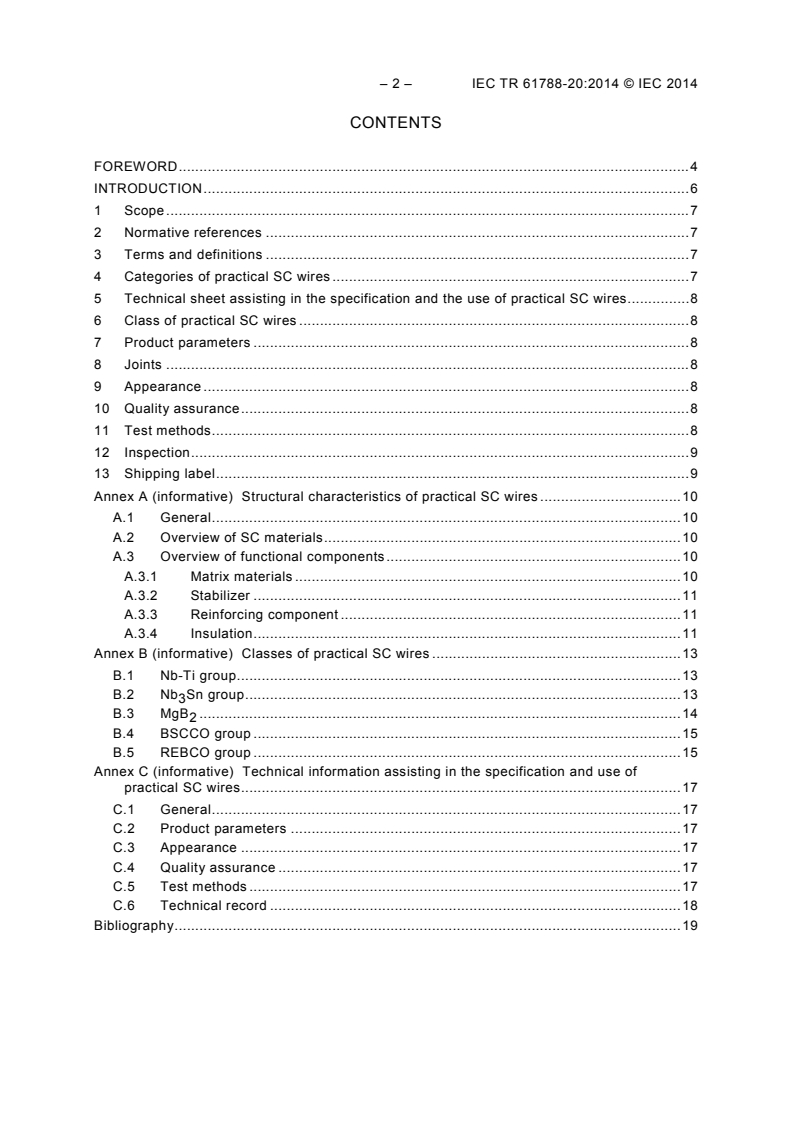
– 2 – IEC TR 61788-20:2014 © IEC 2014
CONTENTS
FOREWORD . 4
INTRODUCTION . 6
1 Scope . 7
2 Normative references . 7
3 Terms and definitions . 7
4 Categories of practical SC wires . 7
5 Technical sheet assisting in the specification and the use of practical SC wires. 8
6 Class of practical SC wires . 8
7 Product parameters . 8
8 Joints . 8
9 Appearance . 8
10 Quality assurance . 8
11 Test methods . 8
12 Inspection . 9
13 Shipping label . 9
Annex A (informative) Structural characteristics of practical SC wires . 10
A.1 General . 10
A.2 Overview of SC materials . 10
A.3 Overview of functional components . 10
A.3.1 Matrix materials . 10
A.3.2 Stabilizer . 11
A.3.3 Reinforcing component . 11
A.3.4 Insulation . 11
Annex B (informative) Classes of practical SC wires . 13
B.1 Nb-Ti group . 13
B.2 Nb Sn group . 13
B.3 MgB . 14
B.4 BSCCO group . 15
B.5 REBCO group . 15
Annex C (informative) Technical information assisting in the specification and use of
practical SC wires . 17
C.1 General . 17
C.2 Product parameters . 17
C.3 Appearance . 17
C.4 Quality assurance . 17
C.5 Test methods . 17
C.6 Technical record . 18
Bibliography . 19
Table B.1 – Constituents composing the Nb-Ti group SC wires . 13
Table B.2 – Constituents composing the Nb Sn group SC wires . 14
Table B.3 – Constituents composing the MgB SC wires . 14
Table B.4 – Constituents composing the BSCCO SC wires . 15
Table B.5 – Constituents composing REBCO SC wires . 16
– 4 – IEC TR 61788-20:2014 © IEC 2014
INTERNATIONAL ELECTROTECHNICAL COMMISSION
____________
SUPERCONDUCTIVITY –
Part 20: Superconducting wires –
Categories of practical superconducting wires –
General characteristics and guidance
FOREWORD
1) The International Electrotechnical Commission (IEC) is a worldwide organization for standardization comprising
all national electrotechnical committees (IEC National Committees). The object of IEC is to promote
international co-operation on all questions concerning standardization in the electrical and electronic fields. To
this end and in addition to other activities, IEC publishes International Standards, Technical Specifications,
Technical Reports, Publicly Available Specifications (PAS) and Guides (hereafter referred to as “IEC
Publication(s)”). Their preparation is entrusted to technical committees; any IEC National Committee interested
in the subject dealt with may participate in this preparatory work. International, governmental and non-
governmental organizations liaising with the IEC also participate in this preparation. IEC collaborates closely
with the International Organization for Standardization (ISO) in accordance with conditions determined by
agreement between the two organizations.
2) The formal decisions or agreements of IEC on technical matters express, as nearly as possible, an international
consensus of opinion on the relevant subjects since each technical committee has representation from all
interested IEC National Committees.
3) IEC Publications have the form of recommendations for international use and are accepted by IEC National
Committees in that sense. While all reasonable efforts are made to ensure that the technical content of IEC
Publications is accurate, IEC cannot be held responsible for the way in which they are used or for any
misinterpretation by any end user.
4) In order to promote international uniformity, IEC National Committees undertake to apply IEC Publications
transparently to the maximum extent possible in their national and regional publications. Any divergence
between any IEC Publication and the corresponding national or regional publication shall be clearly indicated in
the latter.
5) IEC itself does not provide any attestation of conformity. Independent certification bodies provide conformity
assessment services and, in some areas, access to IEC marks of conformity. IEC is not responsible for any
services carried out by independent certification bodies.
6) All users should ensure that they have the latest edition of this publication.
7) No liability shall attach to IEC or its directors, employees, servants or agents including individual experts and
members of its technical committees and IEC National Committees for any personal injury, property damage or
other damage of any nature whatsoever, whether direct or indirect, or for costs (including legal fees) and
expenses arising out of the publication, use of, or reliance upon, this IEC Publication or any other IEC
Publications.
8) Attention is drawn to the Normative references cited in this publication. Use of the referenced publications is
indispensable for the correct application of this publication.
9) Attention is drawn to the possibility that some of the elements of this IEC Publication may be the subject of
patent rights. IEC shall not be held responsible for identifying any or all such patent rights.
The main task of IEC technical committees is to prepare International Standards. However, a
technical committee may propose the publication of a technical report when it has collected
data of a different kind from that which is normally published as an International Standard, for
example "state of the art".
IEC 61788-20, which is a technical report, has been prepared by IEC technical committee
90: Superconductivity.
The text of this technical report is based on the following documents:
Enquiry draft Report on voting
90/335/DTR 90/344/RVC
Full information on the voting for the approval of this technical report can be found in the
report on voting indicated in the above table.
This publication has been drafted in accordance with the ISO/IEC Directives, Part 2.
A list of all parts of the IEC 61788-20 series, published under the general title
Superconductivity, can be found on the IEC website.
The committee has decided that the contents of this publication will remain unchanged until
the stability date indicated on the IEC web site under "http://webstore.iec.ch" in the data
related to the specific publication. At this date, the publication will be
• reconfirmed,
• withdrawn,
• replaced by a revised edition, or
• amended.
A bilingual version of this publication may be issued at a later date.
– 6 – IEC TR 61788-20:2014 © IEC 2014
INTRODUCTION
Superconducting (SC) wires are a central and often enabling technology of many important
industrial products. Consensus-based standards for SC wires greatly facilitate the creation of
procurement specifications, design and engineering of components, certification of quality,
description of operating devices, and generalization of use in industrial technologies.
The present technical report (TR IEC61788-20) provides a description of the general features
of practical SC wires. The practical low temperature superconducting (LTS) wires have been
used extensively in a variety of applications since the late 1960s. These applications include
magnetic resonance imaging magnets, research and accelerator magnets, and systems for
cutting-edge scientific research. High temperature superconductors (HTS), discovered in 1986,
allow operation of superconductor-based technologies with less expensive and more efficient
refrigeration systems. These new materials will provide wires that will enable new applications,
some of which may not be possible with LTS wires. Many fabrication routes and conductor
architectures are well established for superconducting wires, and these engineering routes
have a number of general characteristics that are fundamental to enabling industrial products.
Practical superconducting wires are those forms of SC wires that are nearly identical to other
common electrical conductors such as those made from copper or aluminium. The
appearance of low temperature superconductive wires is, for instance, very similar to
commercial electrical copper wires or tin-plated copper wires, because they are covered with
stabilization or reinforcing components consisting of metallic elements. Often practical SC
wires are supplied in long lengths on wire spools. As such, practical SC wires can be used in
products and applications almost interchangeably with common wires. The technical aspects
of superconductivity impose, however, certain considerations that might be taken into account
in specifications for procurement, design and engineering, testing and certification, quality
control, and other commerce. These aspects can be complicated, making practical SC wires
less accessible to the non-technical user despite the best efforts of SC wire suppliers to
market their products. This document intends to provide descriptions of the technical aspects
of practical SC wires in terms of simple general characteristics to assist in the specification
and use of superconducting wire products. It might be noted that this document gives some
general characteristics of practical SC wires at the present state, but not any type of
specifications for the wires or for the processing of the wire.
Thus the present technical report that provides general characteristics and guidance with
respect to practical SC wires is recommended as a first priority for both producers and users
of superconducting technology.
SUPERCONDUCTIVITY –
Part 20: Superconducting wires –
Categories of practical superconducting wires –
General characteristics and guidance
1 Scope
This part of IEC 61788, which is a technical report, provides general characteristics and
guidance on practical SC wires. Particular focus is given to the characteristics that are
different from those of ordinary copper and aluminium wires, since practical SC wires have
appearance nearly identical to common electrical wires and can be used interchangeably with
them. On the other hand, the practical SC wires are typically composite materials consisting
of several functional materials as described in Annex A.
Many forms of SC wires are described in Section 4 of IEC 60050-815, including single core
wires, multi-filamentary superconducting wires, composite superconductors and coated
conductors. These wires as well as others that might be described as monolithic composite
superconducting wires will be the focus in this technical report. A wire is considered as being
practical if it can be procured in sufficiently continuous lengths under ordinary commercial
transactions to build devices.
Conductors made of multiple wires, such as cables, for example, are not included in this
scope.
Since this report only addresses the characteristics of practical wires, other wires such as
prototype, test sample and developmental wires are not included in the scope of this technical
report.
2 Normative references
The following documents, in whole or in part, are normatively referenced in this document and
are indispensable for its application. For dated references, only the edition cited applies. For
undated references, the latest edition of the referenced document (including any
amendments) applies.
IEC 60050 (all parts), International Electrotechnical Vocabulary (available at:
)
3 Terms and definitions
For the purposes of this document, the terms and definitions given in IEC 60050-815 apply.
4 Categories of practical SC wires
Industrially available SC materials are classified into two categories by IEC 60050-815. The
low temperature superconductors have a critical temperature less than 25 K. They are
typically in the Nb-Ti group and Nb Sn group, which is an intermetallic compound. The other
category consists of high temperature superconductors such as BSCCO and REBCO and the
intermetallic compound MgB . In the present document, the five types of SC wire based on
the aforementioned five superconductor materials may be prescribed as practical SC wires, of
which the additional details are mentioned in Annexes A and B. When a new superconducting
– 8 – IEC TR 61788-20:2014 © IEC 2014
material is industrialized into wire form in the future, the current general requirements should
be modified by introducing it as a new practical SC wire.
5 Technical sheet assisting in the specification and the use of practical SC
wires
General items to agree between the supplier and the customer at the time of contract or
purchase order are listed as follows. Except the recommended items mentioned here,
additional items providing for the specification are described in Annex C. The technical sheet
may be executed.
6 Class of practical SC wires
One of the practical SC wires described in Clause 4 may be specified.
Additional informative items are mentioned in Annex B.
7 Product parameters
– Dimension may be settled in terms of the diameter of the round wire or the width /
thickness of the rectangular wire together with the tolerance.
– Length and/or weight may be definitely settled.
– The necessity of insulation may be designated.
– The type of spooling may be designated.
– The shipping label designated in Clause 13 may be attached on the shipped product.
Additional informative items are mentioned in Annex C.
8 Joints
Unless otherwise agreed upon by a customer and a supplier, no joints may be made in the
completed wire. If joints are permitted within the wire, the customer and supplier are required
to agree on the quantity and properties of the joints.
9 Appearance
The appearance of the wire should be free from any imperfection not consistent with
commercial practice.
Additional informative items are mentioned in Annex C.
10 Quality assurance
A representative critical current value may be designated together with tolerance.
Additional informative items are mentioned in Annex C.
11 Test methods
Tests to determine conformance to requirements on product parameter and quality may be
performed according to the instruction of the document (see Bibliography).
12 Inspection
Unless otherwise specified in the contract or purchase order, the supplier may be responsible
for the performance of all inspection and test requirements specified.
Unless otherwise
...