

IEC 61788-15:2026
(Main)Superconductivity - Part 15: Electronic characteristic measurements - Intrinsic surface impedance of superconductor films at microwave frequencies
General Information
- Abstract
IEC 61788-15:2026 describes measurements of the intrinsic surface impedance (Zs) of HTS films at microwave frequencies by a modified two-resonance mode dielectric resonator method. The object of measurement is to obtain the temperature dependence of the intrinsic Zs at the resonant frequency f0.
The frequency and thickness range and the measurement resolution for the Zs of HTS films are as follows:
- frequency: up to 40 GHz;
- film thickness: greater than 50 nm;
- measurement resolution: 0,01 mΩ at 10 GHz.
It is crucial that the Zs data at the measured frequency, and that scaled to 10 GHz be reported for comparison, assuming the f2 rule for the intrinsic surface resistance, Rs (f This edition includes the following significant technical changes with respect to the previous edition:
- informative Annex B, combined relative standard uncertainty in the intrinsic surface impedance is added;
- the terms, ‘precision and accuracy’, are replaced with uncertainty;
- results from a round robin test are added.
- Status
- Published
- Publication Date
- 22-Mar-2026
- Technical Committee
- TC 90 - Superconductivity
- Drafting Committee
- WG 8 - TC 90/WG 8
- Current Stage
- PPUB - Publication issued
- Start Date
- 23-Mar-2026
- Completion Date
- 27-Mar-2026
Buy Documents
REDLINE IEC 61788-15:2026 RLV - Superconductivity - Part 15: Electronic characteristic measurements - Intrinsic surface impedance of superconductor films at microwave frequencies
iec61788-15{ed2.0}en - Superconductivity - Part 15: Electronic characteristic measurements - Intrinsic surface impedance of superconductor films at microwave frequencies
iec61788-15{ed2.0}fr - Supraconductivité - Partie 15 : Mesurages des caractéristiques électroniques - Impédance de surface intrinseque de films supraconducteurs aux fréquences micro-ondes
Overview
IEC 61788-15:2026 is an international standard developed by the International Electrotechnical Commission (IEC), detailing methods for measuring the intrinsic surface impedance (Zs) of high-temperature superconductor (HTS) films at microwave frequencies. Targeted at professionals in superconductivity, microelectronics, and microwave engineering, this standard specifies procedures using a modified two-resonance mode dielectric resonator technique to assess the temperature dependence of the intrinsic surface impedance at the resonant frequency, f₀.
The standard supports measurements at frequencies up to 40 GHz, for film thicknesses greater than 50 nm, and provides a high measurement resolution (as fine as 0.01 mΩ at 10 GHz). Clear guidance is given on reporting results both at the measured frequency and normalized to 10 GHz, following the established frequency-scaling principles for surface resistance and reactance.
Key Topics
- Intrinsic Surface Impedance Measurement: Focuses on the accurate measurement of Zs in HTS films using dielectric resonators, vital for evaluating microwave losses and performance.
- Measurement Scope:
- Frequency range: up to 40 GHz.
- Minimum HTS film thickness: 50 nm.
- Measurement resolution: 0.01 mΩ at 10 GHz.
- Temperature Dependence: Emphasizes obtaining the temperature profile of Zs, crucial for understanding superconducting film performance in real-world applications.
- Uncertainty Evaluation: This edition introduces an updated approach, replacing "precision and accuracy" with "uncertainty" terminology and providing an informative annex on combined relative standard uncertainty.
- Best Practices for Measurement Configuration: Includes safety and quality considerations for cryogenic and high-frequency measurement environments.
Applications
IEC 61788-15:2026 addresses the needs of industries and research institutions working on:
- HTS-Based Microwave Components: Enabling reliable assessment of thin film superconductors used in resonators, filters, antennas, and delay lines, where low microwave loss and reproducibility are crucial.
- Material Development and Characterization: Supporting advanced R&D in superconducting materials by providing standardized, comparable testing results for surface impedance.
- Quality Assurance: Offering manufacturers and test labs a reference for ensuring products and materials meet stringent international standards regarding the electrical properties of HTS films.
- Interlaboratory Comparability: Results from round robin (comparative) tests are included, fostering international consistency and benchmarking of measurement methods.
Related Standards
For comprehensive superconductivity testing and terminology, the following standards complement IEC 61788-15:2026:
- IEC 60050-815:2024: International Electrotechnical Vocabulary - superconductivity terms and definitions.
- IEC 61788-7: Surface resistance measurement of superconductors using the two-resonator method (for thicker films).
- Other relevant materials and electromagnetic property measurement standards within the IEC 61788 series.
Practical Value
Adhering to IEC 61788-15:2026 ensures:
- Reliable and reproducible microwave surface impedance measurements for HTS films, essential for high-performance electronic and telecommunications applications.
- International harmonization of test methods and data reporting, making it easier to compare results across organizations and borders.
- Enhanced confidence in HTS material properties, supporting faster innovation cycles in next-generation electronic components.
By following this standard, engineers and researchers can ensure their testing methods for superconducting films at microwave frequencies meet globally recognized benchmarks, aiding faster market adoption and improved device performance.
Relations
- Effective Date
- 10-Jul-2024
Buy Documents
REDLINE IEC 61788-15:2026 RLV - Superconductivity - Part 15: Electronic characteristic measurements - Intrinsic surface impedance of superconductor films at microwave frequencies
iec61788-15{ed2.0}en - Superconductivity - Part 15: Electronic characteristic measurements - Intrinsic surface impedance of superconductor films at microwave frequencies
iec61788-15{ed2.0}fr - Supraconductivité - Partie 15 : Mesurages des caractéristiques électroniques - Impédance de surface intrinseque de films supraconducteurs aux fréquences micro-ondes
Get Certified
Connect with accredited certification bodies for this standard

IMQ S.p.A. (Certification)
Italian electrical product certification.

SLG Prüf- und Zertifizierungs GmbH
German testing and certification body.

UL Solutions
Global safety science company with testing, inspection and certification.
Sponsored listings
Frequently Asked Questions
IEC 61788-15:2026 is a standard published by the International Electrotechnical Commission (IEC). Its full title is "Superconductivity - Part 15: Electronic characteristic measurements - Intrinsic surface impedance of superconductor films at microwave frequencies". This standard covers: IEC 61788-15:2026 describes measurements of the intrinsic surface impedance (Zs) of HTS films at microwave frequencies by a modified two-resonance mode dielectric resonator method. The object of measurement is to obtain the temperature dependence of the intrinsic Zs at the resonant frequency f0. The frequency and thickness range and the measurement resolution for the Zs of HTS films are as follows: - frequency: up to 40 GHz; - film thickness: greater than 50 nm; - measurement resolution: 0,01 mΩ at 10 GHz. It is crucial that the Zs data at the measured frequency, and that scaled to 10 GHz be reported for comparison, assuming the f2 rule for the intrinsic surface resistance, Rs (f This edition includes the following significant technical changes with respect to the previous edition: - informative Annex B, combined relative standard uncertainty in the intrinsic surface impedance is added; - the terms, ‘precision and accuracy’, are replaced with uncertainty; - results from a round robin test are added.
IEC 61788-15:2026 describes measurements of the intrinsic surface impedance (Zs) of HTS films at microwave frequencies by a modified two-resonance mode dielectric resonator method. The object of measurement is to obtain the temperature dependence of the intrinsic Zs at the resonant frequency f0. The frequency and thickness range and the measurement resolution for the Zs of HTS films are as follows: - frequency: up to 40 GHz; - film thickness: greater than 50 nm; - measurement resolution: 0,01 mΩ at 10 GHz. It is crucial that the Zs data at the measured frequency, and that scaled to 10 GHz be reported for comparison, assuming the f2 rule for the intrinsic surface resistance, Rs (f This edition includes the following significant technical changes with respect to the previous edition: - informative Annex B, combined relative standard uncertainty in the intrinsic surface impedance is added; - the terms, ‘precision and accuracy’, are replaced with uncertainty; - results from a round robin test are added.
IEC 61788-15:2026 is classified under the following ICS (International Classification for Standards) categories: 17.220.20 - Measurement of electrical and magnetic quantities; 29.050 - Superconductivity and conducting materials. The ICS classification helps identify the subject area and facilitates finding related standards.
IEC 61788-15:2026 has the following relationships with other standards: It is inter standard links to IEC 61788-15:2011. Understanding these relationships helps ensure you are using the most current and applicable version of the standard.
IEC 61788-15:2026 is available in PDF format for immediate download after purchase. The document can be added to your cart and obtained through the secure checkout process. Digital delivery ensures instant access to the complete standard document.
Standards Content (Sample)
IEC 61788-15 ®
Edition 2.0 2026-03
INTERNATIONAL
STANDARD
REDLINE VERSION
Superconductivity -
Part 15: Electronic characteristic measurements - Intrinsic surface impedance of
superconductor films at microwave frequencies
ICS 17.220.20; 29.050 ISBN 978-2-8327-1167-5
All rights reserved. Unless otherwise specified, no part of this publication may be reproduced or utilized in any form or
by any means, electronic or mechanical, including photocopying and microfilm, without permission in writing from either
IEC or IEC's member National Committee in the country of the requester. If you have any questions about IEC copyright
or have an enquiry about obtaining additional rights to this publication, please contact the address below or your local
IEC member National Committee for further information.
IEC Secretariat Tel.: +41 22 919 02 11
3, rue de Varembé info@iec.ch
CH-1211 Geneva 20 www.iec.ch
Switzerland
About the IEC
The International Electrotechnical Commission (IEC) is the leading global organization that prepares and publishes
International Standards for all electrical, electronic and related technologies.
About IEC publications
The technical content of IEC publications is kept under constant review by the IEC. Please make sure that you have the
latest edition, a corrigendum or an amendment might have been published.
IEC publications search - IEC Products & Services Portal - products.iec.ch
webstore.iec.ch/advsearchform Discover our powerful search engine and read freely all the
The advanced search enables to find IEC publications by a publications previews, graphical symbols and the glossary.
variety of criteria (reference number, text, technical With a subscription you will always have access to up to date
committee, …). It also gives information on projects, content tailored to your needs.
replaced and withdrawn publications.
Electropedia - www.electropedia.org
The world's leading online dictionary on electrotechnology,
IEC Just Published - webstore.iec.ch/justpublished
Stay up to date on all new IEC publications. Just Published containing more than 22 500 terminological entries in English
details all new publications released. Available online and and French, with equivalent terms in 25 additional languages.
once a month by email. Also known as the International Electrotechnical Vocabulary
(IEV) online.
IEC Customer Service Centre - webstore.iec.ch/csc
If you wish to give us your feedback on this publication or
need further assistance, please contact the Customer
Service Centre: sales@iec.ch.
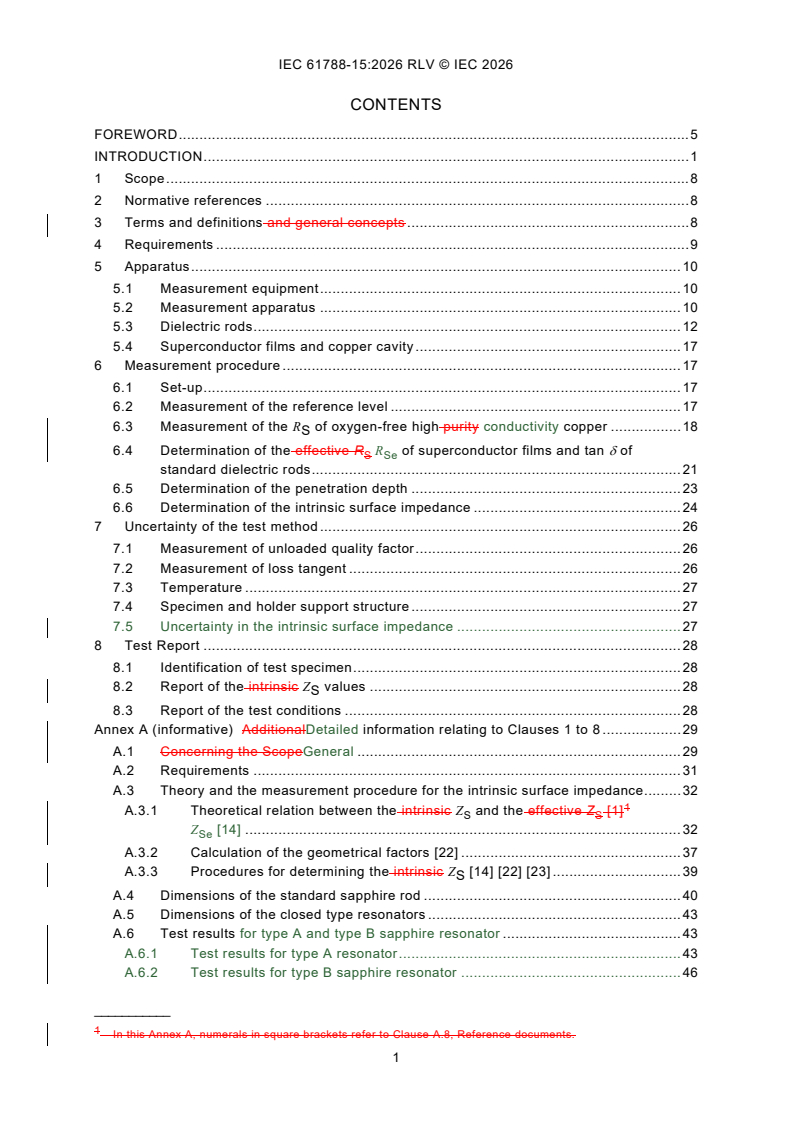
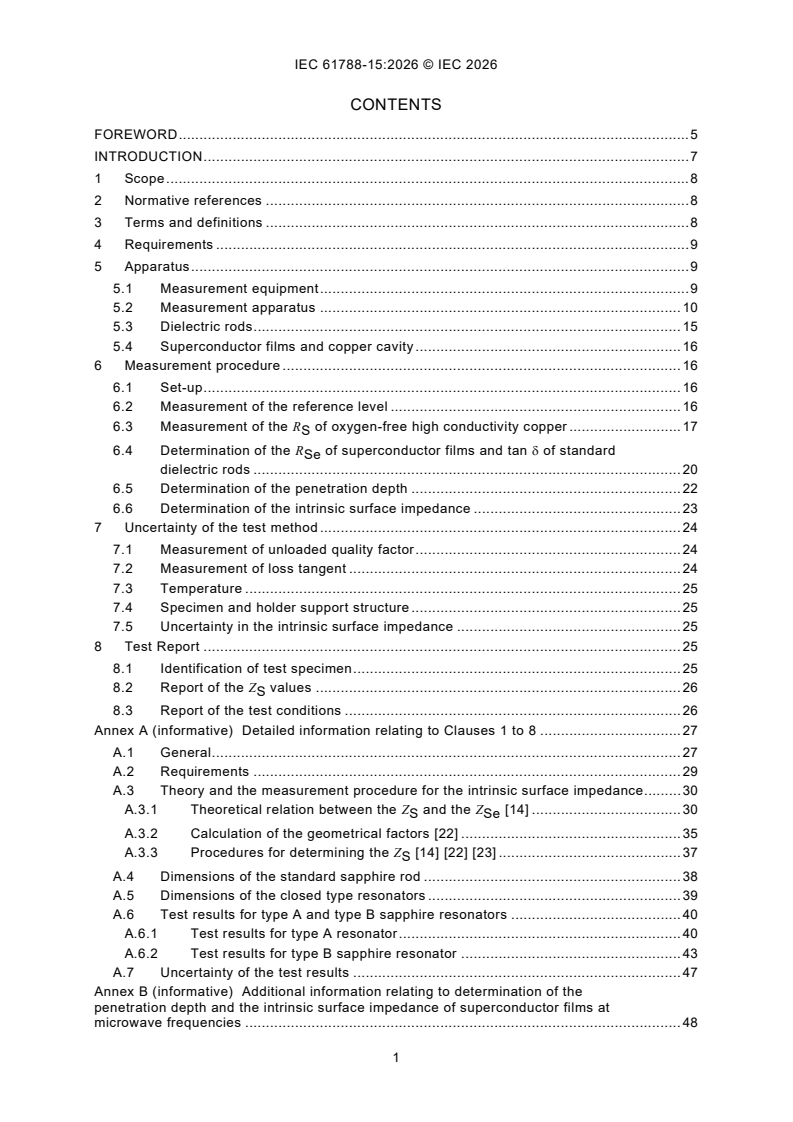
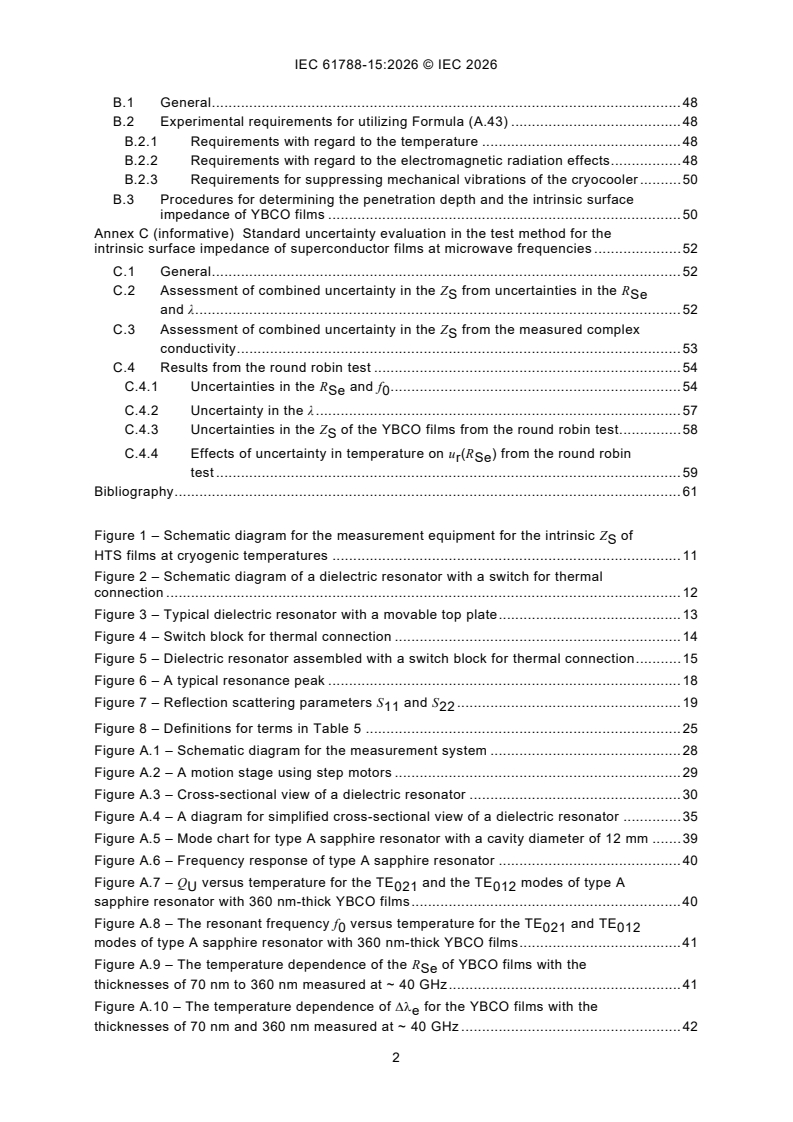
CONTENTS
FOREWORD . 5
INTRODUCTION . 1
1 Scope . 8
2 Normative references . 8
3 Terms and definitions and general concepts . 8
4 Requirements . 9
5 Apparatus . 10
5.1 Measurement equipment . 10
5.2 Measurement apparatus . 10
5.3 Dielectric rods . 12
5.4 Superconductor films and copper cavity . 17
6 Measurement procedure . 17
6.1 Set-up . 17
6.2 Measurement of the reference level . 17
6.3 Measurement of the R of oxygen-free high purity conductivity copper . 18
S
6.4 Determination of the effective R R of superconductor films and tan δ of
S Se
standard dielectric rods . 21
6.5 Determination of the penetration depth . 23
6.6 Determination of the intrinsic surface impedance . 24
7 Uncertainty of the test method . 26
7.1 Measurement of unloaded quality factor . 26
7.2 Measurement of loss tangent . 26
7.3 Temperature . 27
7.4 Specimen and holder support structure . 27
7.5 Uncertainty in the intrinsic surface impedance . 27
8 Test Report . 28
8.1 Identification of test specimen . 28
8.2 Report of the intrinsic Z values . 28
S
8.3 Report of the test conditions . 28
Annex A (informative) AdditionalDetailed information relating to Clauses 1 to 8 . 29
A.1 Concerning the ScopeGeneral . 29
A.2 Requirements . 31
A.3 Theory and the measurement procedure for the intrinsic surface impedance . 32
A.3.1 Theoretical relation between the intrinsic Z and the effective Z [1]
S S
Z [14] . 32
Se
A.3.2 Calculation of the geometrical factors [22] . 37
A.3.3 Procedures for determining the intrinsic Z [14] [22] [23] . 39
S
A.4 Dimensions of the standard sapphire rod . 40
A.5 Dimensions of the closed type resonators . 43
A.6 Test results for type A and type B sapphire resonator . 43
A.6.1 Test results for type A resonator . 43
A.6.2 Test results for type B sapphire resonator . 46
___________
In this Annex A, numerals in square brackets refer to Clause A.8, Reference documents.
A.7 Uncertainty of the test results . 50
A.8 Reference documents of Annex A .
Annex B (informative) Uncertainty considerations .
B.1 Overview .
B.2 Definitions .
B.3 Consideration of the uncertainty concept .
B.4 Uncertainty evaluation example for TC 90 standards .
B.5 Reference documents of Annex B .
Annex B (informative) Additional information relating to determination of the
penetration depth and the intrinsic surface impedance of superconductor films at
microwave frequencies . 59
B.1 General . 59
B.2 Experimental requirements for utilizing Formula (A.43) . 59
B.2.1 Requirements with regard to the temperature . 59
B.2.2 Requirements with regard to the electromagnetic radiation effects . 59
B.2.3 Requirements for suppressing mechanical vibrations of the cryocooler . 61
B.3 Procedures for determining the penetration depth and the intrinsic surface
impedance of YBCO films . 61
Annex C (informative) Standard uncertainty evaluation in the test method for the
intrinsic surface impedance of superconductor films at microwave frequencies . 63
C.1 General . 63
C.2 Assessment of combined uncertainty in the Z from uncertainties in the R
S Se
and λ . 63
C.3 Assessment of combined uncertainty in the Z from the measured complex
S
conductivity . 64
C.4 Results from the round robin test . 65
C.4.1 Uncertainties in the R and f . 65
Se 0
C.4.2 Uncertainty in the λ . 68
C.4.3 Uncertainties in the Z of the YBCO films from the round robin test . 69
S
C.4.4 Effects of uncertainty in temperature on u (R ) from the round robin
r Se
test . 70
Bibliography . 72
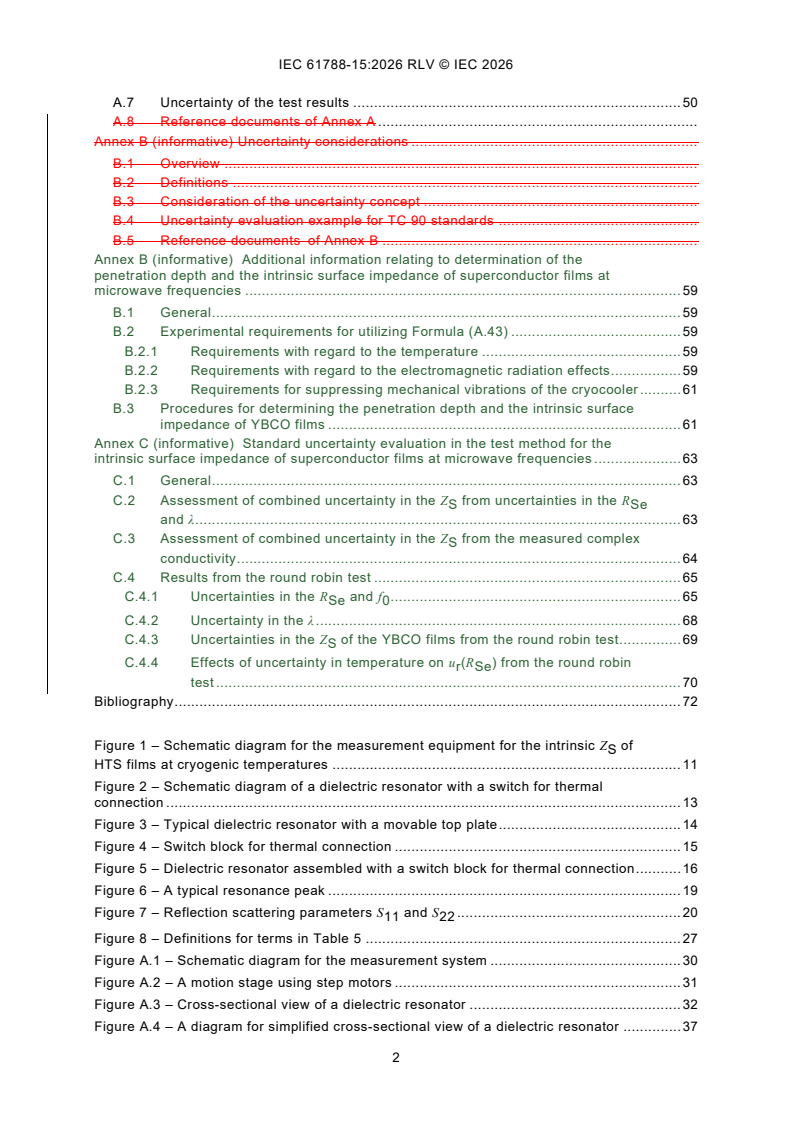
Figure 1 – Schematic diagram for the measurement equipment for the intrinsic Z of
S
HTS films at cryogenic temperatures . 11
Figure 2 – Schematic diagram of a dielectric resonator with a switch for thermal
connection . 13
Figure 3 – Typical dielectric resonator with a movable top plate . 14
Figure 4 – Switch block for thermal connection . 15
Figure 5 – Dielectric resonator assembled with a switch block for thermal connection . 16
Figure 6 – A typical resonance peak . 19
Figure 7 – Reflection scattering parameters S and S . 20
11 22
Figure 8 – Definitions for terms in Table 5 . 27
Figure A.1 – Schematic diagram for the measurement system . 30
Figure A.2 – A motion stage using step motors . 31
Figure A.3 – Cross-sectional view of a dielectric resonator . 32
Figure A.4 – A diagram for simplified cross-sectional view of a dielectric resonator . 37
Figure A.5 – Mode chart for type A sapphire resonator with a cavity diameter of 12 mm . 42
Figure A.6 – Frequency response of the type A sapphire resonator . 43
Figure A.7 – Q versus temperature for the TE and the TE modes of the type A
U 021 012
sapphire resonator with 360 nm-thick YBCO films . 44
Figure A.8 – The resonant frequency f versus temperature for the TE and TE
0 021 012
modes of the type A sapphire resonator with 360 nm-thick YBCO films . 44
Figure A.9 – The temperature dependence of the R of YBCO films with the
Se
thicknesses of 70 nm to 360 nm measured at ~ 40 GHz . 45
Figure A.10 – The temperature dependence of ∆λ for the YBCO films with the
e
thicknesses of 70 nm and 360 nm measured at ~ 40 GHz . 45
Figure A.11 – The temperature dependence of the penetration depth λ of the 360 nm-
thick YBCO film measured at 10 kHz using the mutual inductance method and at
~ 40 GHz using type A sapphire resonator . 46
Figure A.12 – The temperature dependence of the intrinsic surface resistance R of
S
YBCO films with the thicknesses of 70 nm to 360 nm measured at ~ 40 GHz . 46
Figure A.13 – Mode chart used for type B sapphire resonator with a cavity diameter of
15,78 mm. 47
Figure A.14 – Frequency response of type B sapphire resonator . 48
Figure A.15 – The temperature dependence of the R for the 300 nm-thick YBCO
se
films measured at ~ 38 GHz . 48
Figure A.16 – The temperature dependence of ∆λ for the 300 nm-thick YBCO film
e
measured at ~ 38 GHz . 49
Figure A.17 – The temperature dependence of σ for the 300 nm-thick YBCO films
measured at ~ 38 GHz . 49
Figure A.18 – The temperature dependence of the R for the 300 nm-thick YBCO films
S
measured at ~ 38 GHz . 50
Figure A.13 – Comparison of the temperature-dependent value of each term in
Equation (A.35) for the TE mode of the standard sapphire resonator .
Figure A.14 – Comparison of the temperature-dependent value of each term in
Equation (A.35) for the TE mode of the standard sapphire resonator .
Figure A.15 – Temperature dependence of uncertainty
in the measured intrinsic R of YBCO films .
S
Figure B.1 – A comparison between variations in the temperature of the top plate and
the rest of the sapphire resonator over time . 60
Figure B.2 – The temperature dependence of the ratio of Δf to f for type A sapphire
0 0
resonator having YBCO endplates for the gap distances of 0 μm (filled) and 10 μm
(open) . 60
Figure B.3 – The temperature dependence of TE -mode Q of type A sapphire
021 U
resonator for the gap distances of 0 μm (filled) and 10 μm (open) . 61
Figure C.1 – The temperature dependence of the measured TE -mode Q vs.
021 U
temperature data from the round robin test . 66
Figure C.2 – The temperature dependence of the measured resonant frequencies of
the TE mode for the sapphire resonator under the round robin test . 66
Figure C.3 – The temperature dependence of the relative uncertainty in the TE
mode Q and the TE mode Q from the round robin test . 67
U 012 U
Figure C.4 – The temperature dependence of the relative uncertainty in the TE
mode f vs. temperature data from the round robin test . 67
Figure C.5 – Comparison of the temperature dependence of the measured R at
Se
~ 38 GHz for the YBCO films under the round robin test . 68
Figure C.6 – The temperature dependence of the relative uncertainties in the R
Se
(open circle) and R (filled circle) at ~ 38 GHz for the YBCO films under the round
S
robin test . 69
Figure C.7 – The temperature dependence of the relative uncertainties in the TE -
mode Q from the RRT (open circle) and that due to the presumed uncertainty of 0,5 K
U
in the temperature (cross) at ~ 38 GHz for type B sapphire resonator . 71
Table 1 – Typical dimensions of a sapphire rod . 17
Table 2 – Typical dimensions of OFHC cavities and HTS films . 17
Table 3 – Geometrical factors and filling factors calculated for the standard sapphire
resonators . 21
Table 4 – Specifications of Vector Network Analyser . 26
Table 5 – Type B uncertainty for the specifications on the sapphire rod . 27
Table A.1 – Geometrical factors and filling factors calculated
for the standard sapphire resonator .
Table B.1 – Output signals from two nominally identical extensometers .
Table B.2 – Mean values of two output signals .
Table B.3 – Experimental standard deviations of two output signals.
Table B.4 – Standard uncertainties of two output signals .
Table B.5 – Coefficient of variations of two output signals.
Table C.1 – Values of ε , l, t, β , β , β , λ and coth(t/λ) at 30 K . 64
r4 4 z4 h
Table C.2 – The average values for the R and the R of the YBCO films from the
Se S
round robin test and the relative uncertainties in the R and the R . 70
Se S
INTERNATIONAL ELECTROTECHNICAL COMMISSION
____________
Superconductivity -
Part 15: Electronic characteristic measurements - Intrinsic surface
impedance of superconductor films at microwave frequencies
FOREWORD
1) The International Electrotechnical Commission (IEC) is a worldwide organization for standardization comprising
all national electrotechnical committees (IEC National Committees). The object of IEC is to promote international
co-operation on all questions concerning standardization in the electrical and electronic fields. To this end and
in addition to other activities, IEC publishes International Standards, Technical Specifications, Technical Reports,
Publicly Available Specifications (PAS) and Guides (hereafter referred to as “IEC Publication(s)”). Their
preparation is entrusted to technical committees; any IEC National Committee interested in the subject dealt with
may participate in this preparatory work. International, governmental and non-governmental organizations liaising
with the IEC also participate in this preparation. IEC collaborates closely with the International Organization for
Standardization (ISO) in accordance with conditions determined by agreement between the two organizations.
2) The formal decisions or agreements of IEC on technical matters express, as nearly as possible, an international
consensus of opinion on the relevant subjects since each technical committee has representation from all
interested IEC National Committees.
3) IEC Publications have the form of recommendations for international use and are accepted by IEC National
Committees in that sense. While all reasonable efforts are made to ensure that the technical content of IEC
Publications is accurate, IEC cannot be held responsible for the way in which they are used or for any
misinterpretation by any end user.
4) In order to promote international uniformity, IEC National Committees undertake to apply IEC Publications
transparently to the maximum extent possible in their national and regional publications. Any divergence between
any IEC Publication and the corresponding national or regional publication shall be clearly indicated in the latter.
5) IEC itself does not provide any attestation of conformity. Independent certification bodies provide conformity
assessment services and, in some areas, access to IEC marks of conformity. IEC is not responsible for any
services carried out by independent certification bodies.
6) All users should ensure that they have the latest edition of this publication.
7) No liability shall attach to IEC or its directors, employees, servants or agents including individual experts and
members of its technical committees and IEC National Committees for any personal injury, property damage or
other damage of any nature whatsoever, whether direct or indirect, or for costs (including legal fees) and
expenses arising out of the publication, use of, or reliance upon, this IEC Publication or any other IEC
Publications.
8) Attention is drawn to the Normative references cited in this publication. Use of the referenced publications is
indispensable for the correct application of this publication.
9) IEC draws attention to the possibility that the implementation of this document may involve the use of (a)
patent(s). IEC takes no position concerning the evidence, validity or applicability of any claimed patent rights in
respect thereof. As of the date of publication of this document, IEC had not received notice of (a) patent(s), which
may be required to implement this document. However, implementers are cautioned that this may not represent
the latest information, which may be obtained from the patent database available at https://patents.iec.ch. IEC
shall not be held responsible for identifying any or all such patent rights.
This redline version of the official IEC Standard allows the user to identify the changes made
to the previous edition IEC 61788-15:2011. A vertical bar appears in the margin wherever a
change has been made. Additions are in green text, deletions are in strikethrough red text.
IEC 61788-15 has been prepared by IEC technical committee 90: Superconductivity. It is an
International Standard.
This second edition cancels and replaces the first edition published in 2011. This edition
constitutes a technical revision.
This edition includes the following significant technical changes with respect to the previous
edition:
a) informative Annex B, combined relative standard uncertainty in the intrinsic surface
impedance is added;
b) the terms, ‘precision and accuracy’, are replaced with uncertainty;
c) results from a round robin test are added.
The text of this International Standard is based on the following documents:
Draft Report on voting
90/550/FDIS 90/556/RVD
Full information on the voting for its approval can be found in the report on voting indicated in
the above table.
The language used for the development of this International Standard is English.
This document was drafted in accordance with ISO/IEC Directives, Part 2, and developed in
accordance with ISO/IEC Directives, Part 1 and ISO/IEC Directives, IEC Supplement, available
at www.iec.ch/members_experts/refdocs. The main document types developed by IEC are
described in greater detail at www.iec.ch/publications.
A list of all parts in the IEC 61788 series, published under the general title Superconductivity,
can be found on the IEC website.
The committee has decided that the contents of this document will remain unchanged until the
stability date indicated on the IEC website under webstore.iec.ch in the data related to the
specific document. At this date, the document will be
– reconfirmed,
– withdrawn, or
– revised.
INTRODUCTION
Since the discovery of high T superconductors (HTS), extensive researches have been
C
performed worldwide on electronic applications and large-scale applications with HTS filter
subsystems based on YBa Cu O (YBCO) having already been commercialized [1] .
2 3 7-δ
Merits of using HTS films for microwave devices such as resonators, filters, antennas, delay
lines, etc., include i) microwave losses from HTS films could be extremely low and ii) no signal
dispersion on transmission lines made of HTS films due to extremely low microwave intrinsic
surface resistance (R ) [2] and frequency-independent penetration depth (λ) of HTS films,
S
respectively.
In this regard, when it comes to designing of HTS-based microwave devices, it is important to
measure the intrinsic surface impedance (Z ) of HTS films with Z = R + jX and X = ωμ λ
S S S S S 0
(here ω and μ denote the angular frequency and the permeability of vacuum, respectively, X ,
0 S
the intrinsic surface reactance, and X = ωμ λ is valid at temperatures not too close to the
S 0
critical temperature T of HTS films).
C
Various reports have been made on measuring the R of HTS films at microwave frequencies
S
with the typical R of HTS films as low as 1/100 to 1/50 of that of oxygen-free high-purity
S
conductivity copper (OFHC) at 77 K and 10 GHz. The R of conventional superconductors such
S
as niobium (Nb) could be easily measured by using Nb cavities by converting the resonator
quality factor (Q) to the R of Nb. However, such conventional measurement method could no
S
longer be applied to HTS films grown on dielectric substrates, with which it is basically
impossible to make all-HTS cavities. Instead, for measuring the R of HTS films, several other
S
methods have been useful, which include microstrip resonator method [3], coplanar microstrip
resonator method [4], parallel plate resonator method [5] and dielectric resonator method ([6]
to [11]). Among the stated methods, the dielectric resonator method has been very useful due
to the fact that the method enables to measure the R microwave surface resistance in a non-
S
invasive way and with accuracy. In 2002, the International Electrotechnical Commission (IEC)
published the dielectric resonator method as a measurement standard [12].
The test method given in this document enables to measure not only the intrinsic surface
resistance R but also the intrinsic surface reactance X of HTS films regardless of the film’s
S S
thickness by using single sapphire resonator, which differs from the existing IEC standard
(IEC 61788-7:2006) that is limited to measure the surface resistance of superconductor films
having the thicknesses of more than 3λ at the measured temperature by using two sapphire
resonators. In fact, the measured surface resistances of HTS films with different thicknesses of
less than 3λ mean effective values instead of intrinsic values, which cannot be used for directly
comparing the microwave properties of HTS films among one another [13], [14]. Use of a single
sapphire resonator as suggested in this document also enables to reduce uncertainty in the
measured surface resistance that might can result from using two sapphire resonators with
sapphire rods of even slightly different quality.
The test method given in this document can also be applied to HTS coated conductors, HTS
bulks and other superconductors having established models for the penetration depth.
This document is intended to provide an appropriate and agreeable technical base for the time
being to engineers working in the fields of electronics and superconductivity technology.
The test method covered in this document has been discussed at the VAMAS (Versailles Project
on Advanced Materials and Standards) TWA-16 meeting.
___________
Numbers in square brackets refer to the Bibliography.
1 Scope
This part of IEC 61788 describes measurements of the intrinsic surface impedance (Z ) of HTS
S
films at microwave frequencies by a modified two-resonance mode dielectric resonator method
[14], [15]. The object of measurement is to obtain the temperature dependence of the intrinsic
surface impedance, Z , at the resonant frequency f .
S 0
The frequency and thickness range and the measurement resolution for the intrinsic Z of HTS
S
films are as follows:
– frequency: up to 40 GHz;
– film thickness: greater than 50 nm;
– measurement resolution: 0,01 mΩ at 10 GHz.
It is crucial that the intrinsic Z data at the measured frequency, and that scaled to 10 GHz be
S
reported for comparison, assuming the f rule for the intrinsic surface resistance, R
S
(f < 40 GHz), and the f rule for the intrinsic surface reactance, X for comparison, shall be
S
reported.
2 Normative references
The following documents are referred to in the text in such a way that some or all of their content
constitutes requirements of this document. For dated references, only the edition cited applies.
For undated references, the latest edition of the referenced document (including any
amendments) applies.
IEC 60050-815:20002024, International Electrotechnical Vocabulary - Part 815:
Superconductivity
IEC 61788-7:2006, Superconductivity – Part 7: Electronic characteristic measurements –
Surface resistance of superconductors at microwave frequencies
3 Terms and definitions and general concepts
3.1 Terms and definitions
For the purposes of this document, the terms and definitions given in IEC 60050-815, one of
which is repeated here for convenience, and the following apply.
ISO and IEC maintain terminology databases for use in standardization at the following
addresses:
– IEC Electropedia: available at https://www.electropedia.org/
– ISO Online browsing platform: available at https://www.iso.org/obp
3.1
surface impedance
impedance of a material for highfrequency electromagnetic wave which is constrained to the
surface of the material in case of metals and superconductors
impedance of a metallic material or a superconductor when a high-frequency electromagnetic
wave is constrained to the surface
Note 1 to entry: The surface impedance governs the thermal losses of superconducting RF cavities.
Note 2 to entry: This entry was numbered 815-13-60 in IEC 60050-815:2015.
[SOURCE: IEC 60050-815:20242000, 815-04-62 815-22-33]
3.2 General concepts
3.2
intrinsic surface impedance
In general, the surface impedance Z of conductors, including superconductors, is defined as
S
the ratio of the tangential component of the electric field (E ) and that of the magnetic field (H )
t t
at a conductor surface:
E
t
Z = = R + jX . (1)
S S S
H
t
Here R denotes the surface resistance and X , the surface reactance. If the thickness of the
S S
conductor (or the superconductor) under test is sufficiently greater than the penetration depth
of electromagnetic fields, Z is expressed by
S
1 1
µ 2 jµ ω 2
Z = = (2)
S
ε σ
with ε and µ denoting the permittivity and the permeability of the conductor (or the
superconductor) under test, respectively, µ , the permeability of vacuum, σ, the conductivity of
the conductor (or the superconductor), and ω, the measured angular frequency, and is called
the intrinsic surface impedance. σ is real for the conductor and complex for the superconductor.
impedance of conductors (or superconductors) having the thicknesses sufficiently greater than
the skin depth (or the penetration depth), with the intrinsic surface impedance Z defined as
S
the ratio of the tangential component of the electric field (E ) and that of the magnetic field (H )
t t
at a conductor or a superconductor surface:
Z =E/=H R+ jX
(1)
S tt S S
3.3
effective surface impedance
If the thickness of the conductor (or the superconductor) under test is not sufficiently greater
than the penetration depth of electromagnetic fields, Z as defined by Equation (1) in 3.2.1
S
becomes significantly different from that defined by Equation (2) in 3.2.1. In this case, Z as
S
defined by Equation (1) is called the effective surface impedance Z with
Se
E
t
Z = = R + jX (3)
Se Se Se
H
t
Here R denotes the effective surface resistance and X , the effective surface reactance.
Se Se
impedance of conductors (or superconductors) having the thicknesses not sufficiently greater
than the skin depth (or the penetration depth) as defined by
Z E / H R + jX
(2)
Se t t Se Se
with Z being significantly different from Z in Formula (1).
Se S
= =
4 Requirements
The Z of HTS films shall be measured by applying a microwave signal to a dielectric resonator
S
with the superconductor specimen and then measuring the attenuation of the resonator at each
frequency. The frequency shall be swept around the resonant frequency as the centre, and the
attenuation – frequency characteristics as well as the scattering parameters shall be recorded
to obtain the Q-value, which corresponds to the loss.
The target relative uncertainty of this method is less than 10 20 % at temperatures of 30 K to
80 60 K.
It is the responsibility of the user of this document to consult and establish safety and health
practices and to determine the applicability of regulatory limitations prior to use.
Hazards exist in this type of measurement. The use of a cryogenic system is essential to cool
the superconductors to allow transition into the superconducting state. Direct contact of skin
with cold apparatus components can cause immediate freezing, as can direct contact with a
spilled cryogen. The use of an r.f.-generator is also essential to measure high-frequency
properties of materials. If its power is too high, direct exposure to human bodies can cause an
immediate burn.
5 Apparatus
5.1 Measurement equipment
Figure 1 shows a schematic diagram of the equipment required for the microwave measurement.
The equipment consists of a network analyser system for transmission measurements, a
measurement apparatus, and thermometers for monitoring the temperature of HTS films under
test.
An incident power generated from a suitable microwave source such as a synthesized sweeper
is applied to the dielectric resonator fixed in the measurement apparatus. The transmission
characteristics are shown on the display of the network analyser.
The measurement apparatus is fixed in a temperature-controlled cryostat. The cryostat consists
of a vacuum chamber and a cryocooler, the cold finger of which the measurement apparatus is
connected to. For the penetration depth measurements, vibrations from the cryocooler should
be dampened by using dampers between the vacuum chamber and the cryocooler. During
collection of resonance data as a function of temperature, the resonance signal should remain
stable at each temperature.
For measuring the Z of HTS films, a vector network analyser is recommended because it has
S
better measurement accuracy than a scalar network analyser due to its wider dynamic range.
5.2 Measurement apparatus
Figure 2 shows a schematic diagram of a typical measurement apparatus for the Z of HTS
S
films deposited on a substrate with a flat surface. The lower HTS film is pressed down by (by
the copper cavity) against a spring, which is made of beryllium copper. Use of a plate type
spring is recommended for the improvement of measurement uncertainty. This type of spring
reduces the friction between the spring and the other part of the apparatus and enables smooth
motion of HTS films in the course of thermal expansion/contraction of the dielectric-loaded
cavity. The upper HTS film is glued to the Cu plate at the top using adhesives with good thermal
conductivity.
The R R is measured with the upper HTS film being in contact with the top of the Cu cavity.
S Se
During measurements of the R R , the whole resonator is first cooled down to the lowest
S Se
temperature with the cryocooler turned on and then warmed up to higher temperatures with the
cryocooler turned off. Meanwhile, the X X is measured with a small gap between the upper
S Se
HTS film and the top of the Cu cavity. The gap distance shall be set to a value predetermined
at the room temperature by using either a micrometre or a step motor connected to the upper
superconductor film through a polytetrafluoroethylene rod. The real gap distances would be a
little longer at cryogenic temperatures than the corresponding predetermined ones due to
thermal contraction of the polytetrafluoroethylene rod. The gap distance should be small enough
not to cause significant radiation loss and large enough to enable control of the temperature of
the upper superconductor film. More detailed descriptions on a dielectric resonator with a
movable top plate are given in Figure 3, with Figure 4 and Figure 5 displaying a switch block
for thermal connection and the dielectric resonator assembled with the switch block,
respectively. Procedures for controlling the temperature of the upper HTS film for
are described in 6.6.
measurements of the X
S
Each of the two semi-rigid cables shall have a small loop at the end as shown in Figure 3. The
loop, shaped like a semicircle, is affixed to the cross-sectional part of the outer conductor via
soldering at its terminal point. The plane of the loop shall be set parallel to that of the HTS films
in order to suppress the unwanted TM modes. The coupling loops shall be carefully checked
mn0
prior to the measurements to keep the good coupling conditions. For measuring the Q values
as a function of temperature, these cables can move be moved to the right or to the left to adjust
maintain the insertion attenuation (IA) slightly higher than 20 dB at the lowest temperature, with
the vertical position of each loop fixed in the middle of the sapphire rod. The distance between
the loop and the sapphire rod should be adjusted to a smaller value if the resonant signal gets
too noisy at higher temperatures. In this adjustment, coupling of unwanted cavity modes to the
interested dielectric resonance mode shall be suppressed. Unwanted, parasitic coupling to the
other modes not only reduces the high-Q value of the TE mode resonator but also increases
uncertainty in the measured resonant frequency of the TE mode resonator, making it difficult to
measure changes in the resonant frequency vs. temperature data with accuracy. For collecting
the temperature dependence of the resonant frequency data, the distance between the loop
and the sapphire rod should not be changed during measurements. In this case, IA at the lowest
temperature can be lower than 20 dB.
For suppressing the parasitic coupling, dielectric resonators shall be designed in such a way
that the frequencies of the resonance modes of interest are well separated from those of nearby
parasitic modes. The dielectric rod should be fixed at the centre of the bottom superconductor
film by using low-loss epoxy glue. A small drop of glue applied to the surface of the bottom
superconductor is enough to attach the film to the dielectric rod. It is noted that effects of glue
on the measured Q-value should be negligible.
Figure 1 – Schematic diagram for the measurement equipment for the intrinsic Z of
S
HTS films at cryogenic temperatures
Gap
µm-control
IEC 2148/11
Key
1 polytetrafluoroethylene (PTFE) rod 7 superconductor (or metal) film
2 Cu plate 8 Be-Cu spring
3 superconductor (or metal) film 9 cold finger
4 Cu wire 10 Cu cavity
5 switch for thermal connection 11 dielectric rod
6 Cu plate
Key
1 polytetrafluoroethylene rod
2 Cu plate
3 superconductor (or metal) film
4 Cu wire
5 switch for thermal connection
6 Cu plate
7 superconductor (or metal) film
8 Be-Cu spring
9 cold finger
10 Cu cavity
11 dielectric rod
12 temperature sensor
Figure 2 – Schematic diagram of a dielectric resonator
with a switch for thermal connection
Key
1 acryl plate 6 dielectric rod 11 screw
2 z-axis stage 7 superconductor film 12 superconductor film
3 polytetrafluoroethylene screw 8 Cu plate 13 Cu plate
4 connector 9 Be-Cu spring 14 semi-rigid coaxial cable
5 screw 10 Cu plate
Figure 3 – Typical dielectric resonator with a movable top plate
Key
1 stainless steel rod
2 micrometre
3 Cu block
4 sliding guide
5 polytetrafluoroethylene plate
Figure 4 – Switch block for thermal connection
Key
1 screw 6 Cu braid 11 Cu block
2 Cu block 7 Cu plate 12 spring
3 Cu braid 8 screw 13 Cu cavity block
4 thermal switch block 9 Cu braid 14 Cu block
5 Cu block 10 screw 15 screw
Figure 5 – Dielectric resonator assembled with a switch block for thermal connection
5.3 Dielectric rods
Dielectric resonators shall be designed in such a way that the TE and the TE modes
021 012
appeared next to each other without being coupled to the other TM or HE modes. Furthermore,
the resonant frequencies of the two modes shall be close enough for reducing the measurement
uncertainty in Z and far enough not to cause any coupling between them. The difference
S
between the resonant frequencies of the TE and the TE modes shall be less than 400 MHz,
021 012
a value corresponding to ~ 1 % of each resonant frequency, and more than 80 MHz considering
reduced resonator Q at higher temperatures.
The dielectric rods shall have low tan δ and low temperature variation of the dielectric constants
to achieve the requisite measurement accuracy in R and X , respectiv
...
IEC 61788-15 ®
Edition 2.0 2026-03
INTERNATIONAL
STANDARD
Superconductivity -
Part 15: Electronic characteristic measurements - Intrinsic surface impedance of
superconductor films at microwave frequencies
ICS 17.220.20; 29.050 ISBN 978-2-8327-1113-2
All rights reserved. Unless otherwise specified, no part of this publication may be reproduced or utilized in any form or
by any means, electronic or mechanical, including photocopying and microfilm, without permission in writing from either
IEC or IEC's member National Committee in the country of the requester. If you have any questions about IEC copyright
or have an enquiry about obtaining additional rights to this publication, please contact the address below or your local
IEC member National Committee for further information.
IEC Secretariat Tel.: +41 22 919 02 11
3, rue de Varembé info@iec.ch
CH-1211 Geneva 20 www.iec.ch
Switzerland
About the IEC
The International Electrotechnical Commission (IEC) is the leading global organization that prepares and publishes
International Standards for all electrical, electronic and related technologies.
About IEC publications
The technical content of IEC publications is kept under constant review by the IEC. Please make sure that you have the
latest edition, a corrigendum or an amendment might have been published.
IEC publications search - IEC Products & Services Portal - products.iec.ch
webstore.iec.ch/advsearchform Discover our powerful search engine and read freely all the
The advanced search enables to find IEC publications by a publications previews, graphical symbols and the glossary.
variety of criteria (reference number, text, technical With a subscription you will always have access to up to date
committee, …). It also gives information on projects, content tailored to your needs.
replaced and withdrawn publications.
Electropedia - www.electropedia.org
The world's leading online dictionary on electrotechnology,
IEC Just Published - webstore.iec.ch/justpublished
Stay up to date on all new IEC publications. Just Published containing more than 22 500 terminological entries in English
details all new publications released. Available online and and French, with equivalent terms in 25 additional languages.
once a month by email. Also known as the International Electrotechnical Vocabulary
(IEV) online.
IEC Customer Service Centre - webstore.iec.ch/csc
If you wish to give us your feedback on this publication or
need further assistance, please contact the Customer
Service Centre: sales@iec.ch.
CONTENTS
FOREWORD . 5
INTRODUCTION . 7
1 Scope . 8
2 Normative references . 8
3 Terms and definitions . 8
4 Requirements . 9
5 Apparatus . 9
5.1 Measurement equipment . 9
5.2 Measurement apparatus . 10
5.3 Dielectric rods . 15
5.4 Superconductor films and copper cavity . 16
6 Measurement procedure . 16
6.1 Set-up . 16
6.2 Measurement of the reference level . 16
6.3 Measurement of the R of oxygen-free high conductivity copper . 17
S
6.4 Determination of the R of superconductor films and tan δ of standard
Se
dielectric rods . 20
6.5 Determination of the penetration depth . 22
6.6 Determination of the intrinsic surface impedance . 23
7 Uncertainty of the test method . 24
7.1 Measurement of unloaded quality factor . 24
7.2 Measurement of loss tangent . 24
7.3 Temperature . 25
7.4 Specimen and holder support structure . 25
7.5 Uncertainty in the intrinsic surface impedance . 25
8 Test Report . 25
8.1 Identification of test specimen . 25
8.2 Report of the Z values . 26
S
8.3 Report of the test conditions . 26
Annex A (informative) Detailed information relating to Clauses 1 to 8 . 27
A.1 General . 27
A.2 Requirements . 29
A.3 Theory and the measurement procedure for the intrinsic surface impedance . 30
A.3.1 Theoretical relation between the Z and the Z [14] . 30
S Se
A.3.2 Calculation of the geometrical factors [22] . 35
A.3.3 Procedures for determining the Z [14] [22] [23] . 37
S
A.4 Dimensions of the standard sapphire rod . 38
A.5 Dimensions of the closed type resonators . 39
A.6 Test results for type A and type B sapphire resonators . 40
A.6.1 Test results for type A resonator . 40
A.6.2 Test results for type B sapphire resonator . 43
A.7 Uncertainty of the test results . 47
Annex B (informative) Additional information relating to determination of the
penetration depth and the intrinsic surface impedance of superconductor films at
microwave frequencies . 48
B.1 General . 48
B.2 Experimental requirements for utilizing Formula (A.43) . 48
B.2.1 Requirements with regard to the temperature . 48
B.2.2 Requirements with regard to the electromagnetic radiation effects . 48
B.2.3 Requirements for suppressing mechanical vibrations of the cryocooler . 50
B.3 Procedures for determining the penetration depth and the intrinsic surface
impedance of YBCO films . 50
Annex C (informative) Standard uncertainty evaluation in the test method for the
intrinsic surface impedance of superconductor films at microwave frequencies . 52
C.1 General . 52
C.2 Assessment of combined uncertainty in the Z from uncertainties in the R
S Se
and λ . 52
C.3 Assessment of combined uncertainty in the Z from the measured complex
S
conductivity . 53
C.4 Results from the round robin test . 54
C.4.1 Uncertainties in the R and f . 54
Se 0
C.4.2 Uncertainty in the λ . 57
C.4.3 Uncertainties in the Z of the YBCO films from the round robin test . 58
S
C.4.4 Effects of uncertainty in temperature on u (R ) from the round robin
r Se
test . 59
Bibliography . 61
Figure 1 – Schematic diagram for the measurement equipment for the intrinsic Z of
S
HTS films at cryogenic temperatures . 11
Figure 2 – Schematic diagram of a dielectric resonator with a switch for thermal
connection . 12
Figure 3 – Typical dielectric resonator with a movable top plate . 13
Figure 4 – Switch block for thermal connection . 14
Figure 5 – Dielectric resonator assembled with a switch block for thermal connection . 15
Figure 6 – A typical resonance peak . 18
Figure 7 – Reflection scattering parameters S and S . 19
11 22
Figure 8 – Definitions for terms in Table 5 . 25
Figure A.1 – Schematic diagram for the measurement system . 28
Figure A.2 – A motion stage using step motors . 29
Figure A.3 – Cross-sectional view of a dielectric resonator . 30
Figure A.4 – A diagram for simplified cross-sectional view of a dielectric resonator . 35
Figure A.5 – Mode chart for type A sapphire resonator with a cavity diameter of 12 mm . 39
Figure A.6 – Frequency response of type A sapphire resonator . 40
Figure A.7 – Q versus temperature for the TE and the TE modes of type A
U 021 012
sapphire resonator with 360 nm-thick YBCO films . 40
Figure A.8 – The resonant frequency f versus temperature for the TE and TE
0 021 012
modes of type A sapphire resonator with 360 nm-thick YBCO films . 41
Figure A.9 – The temperature dependence of the R of YBCO films with the
Se
thicknesses of 70 nm to 360 nm measured at ~ 40 GHz . 41
Figure A.10 – The temperature dependence of ∆λ for the YBCO films with the
e
thicknesses of 70 nm and 360 nm measured at ~ 40 GHz . 42
Figure A.11 – The temperature dependence of the penetration depth λ of the 360 nm-
thick YBCO film measured at 10 kHz using the mutual inductance method and at
~ 40 GHz using type A sapphire resonator . 42
Figure A.12 – The temperature dependence of the R of YBCO films with the
S
thicknesses of 70 nm to 360 nm measured at ~ 40 GHz . 43
Figure A.13 – Mode chart used for type B sapphire resonator with a cavity diameter of
15,78 mm. 44
Figure A.14 – Frequency response of type B sapphire resonator . 45
Figure A.15 – The temperature dependence of the R for the 300 nm-thick YBCO
se
films measured at ~ 38 GHz . 45
Figure A.16 – The temperature dependence of ∆λ for the 300 nm-thick YBCO film
e
measured at ~ 38 GHz . 46
Figure A.17 – The temperature dependence of σ for the 300 nm-thick YBCO films
measured at ~ 38 GHz . 46
Figure A.18 – The temperature dependence of the R for the 300 nm-thick YBCO films
S
measured at ~ 38 GHz . 47
Figure B.1 – A comparison between variations in the temperature of the top plate and
the rest of the sapphire resonator over time . 49
Figure B.2 – The temperature dependence of the ratio of Δf to f for type A sapphire
0 0
resonator having YBCO endplates for the gap distances of 0 μm (filled) and 10 μm
(open) . 49
Figure B.3 – The temperature dependence of TE -mode Q of type A sapphire
021 U
resonator for the gap distances of 0 μm (filled) and 10 μm (open) . 50
Figure C.1 – The temperature dependence of the measured TE -mode Q vs.
021 U
temperature data from the round robin test . 55
Figure C.2 – The temperature dependence of the measured resonant frequencies of
the TE mode for the sapphire resonator under the round robin test . 55
Figure C.3 – The temperature dependence of the relative uncertainty in the TE
mode Q and the TE mode Q from the round robin test . 56
U 012 U
Figure C.4 – The temperature dependence of the relative uncertainty in the TE
mode f vs. temperature data from the round robin test . 56
Figure C.5 – Comparison of the temperature dependence of the measured R at
Se
~ 38 GHz for the YBCO films under the round robin test . 57
Figure C.6 – The temperature dependence of the relative uncertainties in the R
Se
(open circle) and R (filled circle) at ~ 38 GHz for the YBCO films under the round
S
robin test . 58
Figure C.7 – The temperature dependence of the relative uncertainties in the TE -
mode Q from the RRT (open circle) and that due to the presumed uncertainty of 0,5 K
U
in the temperature (cross) at ~ 38 GHz for type B sapphire resonator . 60
Table 1 – Typical dimensions of a sapphire rod . 16
Table 2 – Typical dimensions of OFHC cavities and HTS films . 16
Table 3 – Geometrical factors and filling factors calculated for the standard sapphire
resonators . 20
Table 4 – Specifications of Vector Network Analyser . 24
Table 5 – Type B uncertainty for the specifications on the sapphire rod . 24
Table C.1 – Values of ε , l, t, β , β , β , λ and coth(t/λ) at 30 K . 53
r4 4 z4 h
Table C.2 – The average values for the R and the R of the YBCO films from the
Se S
round robin test and the relative uncertainties in the R and the R . 59
Se S
INTERNATIONAL ELECTROTECHNICAL COMMISSION
____________
Superconductivity -
Part 15: Electronic characteristic measurements - Intrinsic surface
impedance of superconductor films at microwave frequencies
FOREWORD
1) The International Electrotechnical Commission (IEC) is a worldwide organization for standardization comprising
all national electrotechnical committees (IEC National Committees). The object of IEC is to promote international
co-operation on all questions concerning standardization in the electrical and electronic fields. To this end and
in addition to other activities, IEC publishes International Standards, Technical Specifications, Technical Reports,
Publicly Available Specifications (PAS) and Guides (hereafter referred to as “IEC Publication(s)”). Their
preparation is entrusted to technical committees; any IEC National Committee interested in the subject dealt with
may participate in this preparatory work. International, governmental and non-governmental organizations liaising
with the IEC also participate in this preparation. IEC collaborates closely with the International Organization for
Standardization (ISO) in accordance with conditions determined by agreement between the two organizations.
2) The formal decisions or agreements of IEC on technical matters express, as nearly as possible, an international
consensus of opinion on the relevant subjects since each technical committee has representation from all
interested IEC National Committees.
3) IEC Publications have the form of recommendations for international use and are accepted by IEC National
Committees in that sense. While all reasonable efforts are made to ensure that the technical content of IEC
Publications is accurate, IEC cannot be held responsible for the way in which they are used or for any
misinterpretation by any end user.
4) In order to promote international uniformity, IEC National Committees undertake to apply IEC Publications
transparently to the maximum extent possible in their national and regional publications. Any divergence between
any IEC Publication and the corresponding national or regional publication shall be clearly indicated in the latter.
5) IEC itself does not provide any attestation of conformity. Independent certification bodies provide conformity
assessment services and, in some areas, access to IEC marks of conformity. IEC is not responsible for any
services carried out by independent certification bodies.
6) All users should ensure that they have the latest edition of this publication.
7) No liability shall attach to IEC or its directors, employees, servants or agents including individual experts and
members of its technical committees and IEC National Committees for any personal injury, property damage or
other damage of any nature whatsoever, whether direct or indirect, or for costs (including legal fees) and
expenses arising out of the publication, use of, or reliance upon, this IEC Publication or any other IEC
Publications.
8) Attention is drawn to the Normative references cited in this publication. Use of the referenced publications is
indispensable for the correct application of this publication.
9) IEC draws attention to the possibility that the implementation of this document may involve the use of (a)
patent(s). IEC takes no position concerning the evidence, validity or applicability of any claimed patent rights in
respect thereof. As of the date of publication of this document, IEC had not received notice of (a) patent(s), which
may be required to implement this document. However, implementers are cautioned that this may not represent
the latest information, which may be obtained from the patent database available at https://patents.iec.ch. IEC
shall not be held responsible for identifying any or all such patent rights.
IEC 61788-15 has been prepared by IEC technical committee 90: Superconductivity. It is an
International Standard.
This second edition cancels and replaces the first edition published in 2011. This edition
constitutes a technical revision.
This edition includes the following significant technical changes with respect to the previous
edition:
a) informative Annex B, combined relative standard uncertainty in the intrinsic surface
impedance is added;
b) the terms, ‘precision and accuracy’, are replaced with uncertainty;
c) results from a round robin test are added.
The text of this International Standard is based on the following documents:
Draft Report on voting
90/550/FDIS 90/556/RVD
Full information on the voting for its approval can be found in the report on voting indicated in
the above table.
The language used for the development of this International Standard is English.
This document was drafted in accordance with ISO/IEC Directives, Part 2, and developed in
accordance with ISO/IEC Directives, Part 1 and ISO/IEC Directives, IEC Supplement, available
at www.iec.ch/members_experts/refdocs. The main document types developed by IEC are
described in greater detail at www.iec.ch/publications.
A list of all parts in the IEC 61788 series, published under the general title Superconductivity,
can be found on the IEC website.
The committee has decided that the contents of this document will remain unchanged until the
stability date indicated on the IEC website under webstore.iec.ch in the data related to the
specific document. At this date, the document will be
– reconfirmed,
– withdrawn, or
– revised.
INTRODUCTION
Since the discovery of high T superconductors (HTS), extensive researches have been
C
performed worldwide on electronic applications and large-scale applications with HTS filter
subsystems based on YBa Cu O (YBCO) having already been commercialized [1] .
2 3 7-δ
Merits of using HTS films for microwave devices such as resonators, filters, antennas, delay
lines, etc., include i) microwave losses from HTS films could be extremely low and ii) no signal
dispersion on transmission lines made of HTS films due to extremely low intrinsic surface
resistance (R ) [2] and frequency-independent penetration depth (λ) of HTS films, respectively.
S
In this regard, when it comes to designing of HTS-based microwave devices, it is important to
measure the intrinsic surface impedance (Z ) of HTS films with Z = R + jX and X = ωμ λ
S S S S S 0
denote the angular frequency and the permeability of vacuum, respectively, X ,
(here ω and μ
0 S
the intrinsic surface reactance, and X = ωμ λ is valid at temperatures not too close to the
S 0
critical temperature T of HTS films).
C
Various reports have been made on measuring the R of HTS films at microwave frequencies
S
with the typical R of HTS films as low as 1/100 to 1/50 of that of oxygen-free high conductivity
S
copper (OFHC) at 77 K and 10 GHz. The R of conventional superconductors such as niobium
S
(Nb) could be easily measured by using Nb cavities by converting the resonator quality factor
of Nb. However, such conventional measurement method could no longer be
(Q) to the R
S
applied to HTS films grown on dielectric substrates, with which it is basically impossible to make
all-HTS cavities. Instead, for measuring the R of HTS films, several other methods have been
S
useful, which include microstrip resonator method [3], coplanar microstrip resonator method [4],
parallel plate resonator method [5] and dielectric resonator method ([6] to [11]). Among the
stated methods, the dielectric resonator method has been very useful due to the fact that the
method enables to measure the microwave surface resistance in a non-invasive way and with
accuracy. In 2002, the International Electrotechnical Commission (IEC) published the dielectric
resonator method as a measurement standard [12].
The test method given in this document enables to measure not only the R but also the X of
S S
HTS films regardless of the film’s thickness by using single sapphire resonator, which differs
from the existing IEC standard (IEC 61788-7) that is limited to measure the surface resistance
of superconductor films having the thicknesses of more than 3λ at the measured temperature
by using two sapphire resonators. In fact, the measured surface resistances of HTS films with
different thicknesses of less than 3λ mean effective values instead of intrinsic values, which
cannot be used for directly comparing the microwave properties of HTS films among one
another [13], [14]. Use of a single sapphire resonator as suggested in this document also
enables to reduce uncertainty in the measured surface resistance that can result from using
two sapphire resonators with sapphire rods of different quality.
The test method given in this document can also be applied to HTS coated conductors, HTS
bulks and other superconductors having established models for the penetration depth.
This document is intended to provide an appropriate and agreeable technical base for the time
being to engineers working in the fields of electronics and superconductivity technology.
The test method covered in this document has been discussed at the VAMAS (Versailles Project
on Advanced Materials and Standards) TWA-16 meeting.
___________
Numbers in square brackets refer to the Bibliography.
1 Scope
This part of IEC 61788 describes measurements of the intrinsic surface impedance (Z ) of HTS
S
films at microwave frequencies by a modified two-resonance mode dielectric resonator method
[14], [15]. The object of measurement is to obtain the temperature dependence of the intrinsic
surface impedance, Z , at the resonant frequency f .
S 0
The frequency and thickness range and the measurement resolution for the Z of HTS films are
S
as follows:
– frequency: up to 40 GHz;
– film thickness: greater than 50 nm;
– measurement resolution: 0,01 mΩ at 10 GHz.
It is crucial that the Z data at the measured frequency, and that scaled to 10 GHz be reported
S
for comparison, assuming the f rule for the intrinsic surface resistance, R (f < 40 GHz), and
S
the f rule for the intrinsic surface reactance, X .
S
2 Normative references
The following documents are referred to in the text in such a way that some or all of their content
constitutes requirements of this document. For dated references, only the edition cited applies.
For undated references, the latest edition of the referenced document (including any
amendments) applies.
IEC 60050-815:2024, International Electrotechnical Vocabulary - Part 815: Superconductivity
3 Terms and definitions
For the purposes of this document, the terms and definitions given in IEC 60050-815 and the
following apply.
ISO and IEC maintain terminology databases for use in standardization at the following
addresses:
– IEC Electropedia: available at https://www.electropedia.org/
– ISO Online browsing platform: available at https://www.iso.org/obp
3.1
surface impedance
impedance of a metallic material or a superconductor when a high-frequency electromagnetic
wave is constrained to the surface
Note 1 to entry: The surface impedance governs the thermal losses of superconducting RF cavities.
Note 2 to entry: This entry was numbered 815-13-60 in IEC 60050-815:2015.
[SOURCE: IEC 60050-815:2024, 815-22-33]
3.2
intrinsic surface impedance
impedance of conductors (or superconductors) having the thicknesses sufficiently greater than
the skin depth (or the penetration depth), with the intrinsic surface impedance Z defined as
S
the ratio of the tangential component of the electric field (E ) and that of the magnetic field (H )
t t
at a conductor or a superconductor surface:
Z =E/=H R+ jX
(1)
S tt S S
3.3
effective surface impedance
impedance of conductors (or superconductors) having the thicknesses not sufficiently greater
than the skin depth (or the penetration depth) as defined by
Z E / H R + jX
(2)
Se t t Se Se
with Z being significantly different from Z in Formula (1).
Se S
4 Requirements
The Z of HTS films shall be measured by applying a microwave signal to a dielectric resonator
S
with the superconductor specimen and then measuring the attenuation of the resonator at each
frequency. The frequency shall be swept around the resonant frequency as the centre, and the
attenuation – frequency characteristics as well as the scattering parameters shall be recorded
to obtain the Q-value, which corresponds to the loss.
The target relative uncertainty of this method is less than 20 % at temperatures of 30 K to 60 K.
It is the responsibility of the user of this document to consult and establish safety and health
practices and to determine the applicability of regulatory limitations prior to use.
Hazards exist in this type of measurement. The use of a cryogenic system is essential to cool
the superconductors to allow transition into the superconducting state. Direct contact of skin
with cold apparatus components can cause immediate freezing, as can direct contact with a
spilled cryogen. The use of an r.f.-generator is also essential to measure high-frequency
properties of materials. If its power is too high, direct exposure to human bodies can cause an
immediate burn.
5 Apparatus
5.1 Measurement equipment
Figure 1 shows a schematic diagram of the equipment required for the microwave measurement.
The equipment consists of a network analyser system for transmission measurements, a
measurement apparatus, and thermometers for monitoring the temperature of HTS films under
test.
An incident power generated from a suitable microwave source such as a synthesized sweeper
is applied to the dielectric resonator fixed in the measurement apparatus. The transmission
characteristics are shown on the display of the network analyser.
= =
The measurement apparatus is fixed in a temperature-controlled cryostat. The cryostat consists
of a vacuum chamber and a cryocooler, the cold finger of which the measurement apparatus is
connected to. For the penetration depth measurements, vibrations from the cryocooler should
be dampened by using dampers between the vacuum chamber and the cryocooler. During
collection of resonance data as a function of temperature, the resonance signal should remain
stable at each temperature.
For measuring the Z of HTS films, a vector network analyser is recommended because it has
S
better measurement accuracy than a scalar network analyser due to its wider dynamic range.
5.2 Measurement apparatus
Figure 2 shows a schematic diagram of a typical measurement apparatus for the Z of HTS
S
films deposited on a substrate with a flat surface. The lower HTS film is pressed down (by the
copper cavity) against a spring, which is made of beryllium copper. Use of a plate type spring
is recommended for the improvement of measurement uncertainty. This type of spring reduces
the friction between the spring and the other part of the apparatus and enables smooth motion
of HTS films in the course of thermal expansion/contraction of the dielectric-loaded cavity. The
upper HTS film is glued to the Cu plate at the top using adhesives with good thermal conductivity.
The R is measured with the upper HTS film being in contact with the top of the Cu cavity.
Se
During measurements of the R , the whole resonator is first cooled down to the lowest
Se
temperature with the cryocooler turned on and then warmed up to higher temperatures with the
cryocooler turned off. Meanwhile, the X is measured with a small gap between the upper HTS
Se
film and the top of the Cu cavity. The gap distance shall be set to a value predetermined at the
room temperature by using either a micrometre or a step motor connected to the upper
superconductor film through a polytetrafluoroethylene rod. The real gap distances would be a
little longer at cryogenic temperatures than the corresponding predetermined ones due to
thermal contraction of the polytetrafluoroethylene rod. The gap distance should be small enough
not to cause significant radiation loss and large enough to enable control of the temperature of
the upper superconductor film. More detailed descriptions on a dielectric resonator with a
movable top plate are given in Figure 3, with Figure 4 and Figure 5 displaying a switch block
for thermal connection and the dielectric resonator assembled with the switch block,
respectively. Procedures for controlling the temperature of the upper HTS film for
measurements of the X are described in 6.6.
S
Each of the two semi-rigid cables shall have a small loop at the end as shown in Figure 3. The
loop, shaped like a semicircle, is affixed to the cross-sectional part of the outer conductor via
soldering at its terminal point. The plane of the loop shall be set parallel to that of the HTS films
in order to suppress the unwanted TM modes. The coupling loops shall be carefully checked
mn0
prior to the measurements to keep the good coupling conditions. For measuring the Q values
as a function of temperature, these cables can be moved to the right or to the left to maintain
the insertion attenuation (IA) slightly higher than 20 dB at the lowest temperature, with the
vertical position of each loop fixed in the middle of the sapphire rod. The distance between the
loop and the sapphire rod should be adjusted to a smaller value if the resonant signal gets too
noisy at higher temperatures. In this adjustment, coupling of unwanted cavity modes to the
interested dielectric resonance mode shall be suppressed. Unwanted, parasitic coupling to the
other modes not only reduces the high-Q value of the TE mode resonator but also increases
uncertainty in the measured resonant frequency of the TE mode resonator, making it difficult to
measure changes in the resonant frequency vs. temperature data with accuracy. For collecting
the temperature dependence of the resonant frequency data, the distance between the loop
and the sapphire rod should not be changed during measurements. In this case, IA at the lowest
temperature can be lower than 20 dB.
For suppressing the parasitic coupling, dielectric resonators shall be designed in such a way
that the frequencies of the resonance modes of interest are well separated from those of nearby
parasitic modes. The dielectric rod should be fixed at the centre of the bottom superconductor
film by using low-loss glue. A small drop of glue applied to the surface of the bottom
superconductor is enough to attach the film to the dielectric rod. It is noted that effects of glue
on the measured Q-value should be negligible.
Figure 1 – Schematic diagram for the measurement equipment for the intrinsic Z of
S
HTS films at cryogenic temperatures
Key
1 polytetrafluoroethylene rod
2 Cu plate
3 superconductor (or metal) film
4 Cu wire
5 switch for thermal connection
6 Cu plate
7 superconductor (or metal) film
8 Be-Cu spring
9 cold finger
10 Cu cavity
11 dielectric rod
12 temperature sensor
Figure 2 – Schematic diagram of a dielectric resonator
with a switch for thermal connection
Key
1 acryl plate 6 dielectric rod 11 screw
2 z-axis stage 7 superconductor film 12 superconductor film
3 polytetrafluoroethylene screw 8 Cu plate 13 Cu plate
4 connector 9 Be-Cu spring 14 semi-rigid coaxial cable
5 screw 10 Cu plate
Figure 3 – Typical dielectric resonator with a movable top plate
Key
1 stainless steel rod
2 micrometre
3 Cu block
4 sliding guide
5 polytetrafluoroethylene plate
Figure 4 – Switch block for thermal connection
Key
1 screw 6 Cu braid 11 Cu block
2 Cu block 7 Cu plate 12 spring
3 Cu braid 8 screw 13 Cu cavity block
4 thermal switch block 9 Cu braid 14 Cu block
5 Cu block 10 screw 15 screw
Figure 5 – Dielectric resonator assembled with a switch block for thermal connection
5.3 Dielectric rods
Dielectric resonators shall be designed in such a way that the TE and the TE modes
021 012
appeared next to each other without being coupled to the other TM or HE modes. Furthermore,
the resonant frequencies of the two modes shall be close enough for reducing the measurement
uncertainty in Z and far enough not to cause any coupling between them. The difference
S
between the resonant frequencies of the TE and the TE modes shall be less than 400 MHz,
021 012
a value corresponding to ~ 1 % of each resonant frequency.
The dielectric rods shall have low tan δ and low temperature variation of the dielectric constants
to achieve the requisite measurement accuracy in R and X , respectively. In this regard, c-cut
S S
sapphire rods are recommended for measuring the Z with accuracy (the relative permittivity
S
along the a-b plane ε ’ = 9,28 at 77 K for sapphire).
a-b
Designing schemes for the standard sapphire rod are described in Annex A.4 and A.5. Table 1
shows typical dimensions of the standard sapphire rod used for type A 40 GHz TE -mode
sapphire resonator and type B 38 GHz TE -mode sapphire resonator, respectively. The
resonant frequencies become lower if the dimensions are greater, for which, however, larger
HTS films are to be used to maintain the requisite measurement uncertainty. The resonant
-mode for type A and type B resonators are provided in Table 1, which
frequencies of the TE
are used during test to see if the respective resonators are installed correctly.
Table 1 – Typical dimensions of a sapphire rod
(Unit: GHz)
Resonator diameter height TE -mode TE -mode TE -mode frequency
011 012 021
type
frequency frequency
(mm) (mm) (GHz) (GHz) (GHz)
A 5,00 2,86 25,27 40,06 39,97
B 5,26 2,99 24,10 38,23 38,05
5.4 Superconductor films and copper cavity
Oxygen-free high conductivity copper (OFHC) shall be used for the surrounding wall of the
dielectric resonator. The diameter of the OFHC cavity shall be determined in such a way that
the requisite measurement uncertainty can be realized. Typical dimensions of OFHC cavities
and HTS films suggested for the standard sapphire rod are listed in Table 2.
Table 2 – Typical dimensions of OFHC cavities and HTS films
(Unit: GHz)
Sapphire rod OFHC cavity HTS films
Resonator type
Diameter Height Diameter Height Diameter
A 5,00 2,86 12,0 2,86 ≥ 14,0
B 5,26 2,99 15,8 2,99 ≥ 18,0
6 Measurement procedure
6.1 Set-up
The measurement equipment shall be set up as shown in Figure 1. The measurement apparatus,
standard dielectric rods, and HTS films shall be kept in a clean and dry state as dust and high
humidity can affect the measurement results.
6.2 Measurement of the reference level
The level of full transmission power (reference level) shall be measured prior to measurements
of the resonator Q-value as a function of temperature. The measurement procedure is as follows.
a) Fix the output power of the synthesized sweeper at a value below 10 mW (typically 1 mW)
because the measurement uncertainty depends on the measuring signal level.
b) Connect a reference line of semi-rigid cable between the input and output connectors. The
length of the reference line shall be the same as the sum of the lengths of the two semi-rigid
cables with a loop at each end as described in 5.2.
c) Measure the transmission power level over the frequency range and temperature range of
interest.
6.3 Measurement of the R of oxygen-free high conductivity copper
S
The surface resistance of OFHC which forms a cavity wall shall be measured as a function of
temperature prior to measurements of the surface resistance of superconductor films under test.
For this purpose, the loaded Q–value shall be measured through a transmission method with
the coupling loops placed near the bottom of the cavity. The coupling loops can be also placed
at the middle of the cavity for all the modes. In this case, the position of the coupling loops shall
be closer to the dielectric rod for the TE mode than for the TE mode due to the weaker
012 021
mode. The followings describe a way to measure temperature
coupling strength for the TE
dependences of the loaded TE mode Q-value and the corresponding unloaded Q-value.
a) Place the standard dielectric rod at the centre of the lower OFHC endplate and fix the
position using low-loss glue. The glue should not degrade the microwave properties of the
OFHC plate and the superconductor film and be easily removable by using acetone. The
OFHC endplates shall be larger than the HTS films under test with the surface of the OFHC
endplates being well polished and clean before being used for the test.
b) Connect the input and output connectors to the measurement apparatus (Figure 1) and set
the distance between the rod and each of the loops of the semi-rigid cables to be equal to
each other so that this transmission-type resonator can be under-coupled equally to both
loops.
c) Put down an upper OFHC endplate gently to touch the top of the OFHC cavity. For the type
B resonator, place a 45 μm-thick polytetrafluoroethylene ring with the respective inner and
outer diameters of 15,78 mm and 21,78 mm between the OFHC cavity and the upper OFHC
endplate for suppressing unwanted couplings between the TE mode and parasitic modes.
d) Evacuate and cool down the specimen chamber below the T of the superconductor film to
C
the lowest temperature.
e) Identify the TE mode resonance peak of this resonator using the calculated TE mode
021 021
resonant frequency.
f) Set the frequency span such that only the TE resonance peak is displayed (Figure 6) and
confirm that the insertion attenuation IA of this mode is greater than 20 dB from the
reference level at the lowest temperature. Conf
...
IEC 61788-15 ®
Edition 2.0 2026-03
NORME
INTERNATIONALE
Supraconductivité -
Partie 15: Mesurages des caractéristiques électroniques - Impédance de surface
intrinsèque de films supraconducteurs aux fréquences micro-ondes
ICS 17.220.20; 29.050 ISBN 978-2-8327-1113-2
Droits de reproduction réservés. Sauf indication contraire, aucune partie de cette publication ne peut être reproduite ni
utilisée sous quelque forme que ce soit et par aucun procédé, électronique ou mécanique, y compris la photocopie et
les microfilms, sans l'accord écrit de l'IEC ou du Comité national de l'IEC du pays du demandeur. Si vous avez des
questions sur le copyright de l'IEC ou si vous désirez obtenir des droits supplémentaires sur cette publication, utilisez
les coordonnées ci-après ou contactez le Comité national de l'IEC de votre pays de résidence.
IEC Secretariat Tel.: +41 22 919 02 11
3, rue de Varembé info@iec.ch
CH-1211 Geneva 20 www.iec.ch
Switzerland
A propos de l'IEC
La Commission Electrotechnique Internationale (IEC) est la première organisation mondiale qui élabore et publie des
Normes internationales pour tout ce qui a trait à l'électricité, à l'électronique et aux technologies apparentées.
A propos des publications IEC
Le contenu technique des publications IEC est constamment revu. Veuillez vous assurer que vous possédez l’édition la
plus récente, un corrigendum ou amendement peut avoir été publié.
Recherche de publications IEC - IEC Products & Services Portal - products.iec.ch
webstore.iec.ch/advsearchform Découvrez notre puissant moteur de recherche et consultez
La recherche avancée permet de trouver des publications gratuitement tous les aperçus des publications, symboles
IEC en utilisant différents critères (numéro de référence, graphiques et le glossaire. Avec un abonnement, vous aurez
texte, comité d’études, …). Elle donne aussi des toujours accès à un contenu à jour adapté à vos besoins.
informations sur les projets et les publications remplacées
ou retirées. Electropedia - www.electropedia.org
Le premier dictionnaire d'électrotechnologie en ligne au
IEC Just Published - webstore.iec.ch/justpublished monde, avec plus de 22 500 articles terminologiques en
Restez informé sur les nouvelles publications IEC. Just anglais et en français, ainsi que les termes équivalents
dans 25 langues additionnelles. Egalement appelé
Published détaille les nouvelles publications parues.
Disponible en ligne et une fois par mois par email. Vocabulaire Electrotechnique International (IEV) en ligne.
Service Clients - webstore.iec.ch/csc
Si vous désirez nous donner des commentaires sur cette
publication ou si vous avez des questions contactez-
nous: sales@iec.ch.
SOMMAIRE
AVANT-PROPOS . 5
INTRODUCTION . 7
1 Domaine d'application . 9
2 Références normatives . 9
3 Termes et définitions . 9
4 Exigences . 10
5 Appareillage . 10
5.1 Équipement de mesure . 10
5.2 Appareillage de mesure . 11
5.3 Tiges diélectriques . 16
5.4 Films supraconducteurs et cavité de cuivre . 17
6 Procédure de mesure . 17
6.1 Installation . 17
6.2 Mesurage du niveau de référence . 18
6.3 Mesurage de la résistance R du cuivre de haute conductivité sans oxygène . 18
S
6.4 Détermination de la résistance R des films supraconducteurs et de tan δ
Se
des tiges diélectriques normalisées. 22
6.5 Détermination de la profondeur de pénétration. 23
6.6 Détermination de l'impédance de surface intrinsèque . 25
7 Incertitude de la méthode d'essai . 25
7.1 Mesurage du facteur de qualité à l'état déchargé . 25
7.2 Mesurage de la tangente de perte . 26
7.3 Température . 26
7.4 Structure du support de l'éprouvette et du porte-éprouvette . 27
7.5 Incertitude de l'impédance de surface intrinsèque . 27
8 Rapport d'essai . 27
8.1 Identification de l'éprouvette . 27
8.2 Rapport relatif aux valeurs de l'impédance Z . 27
S
8.3 Rapport relatif aux conditions d'essai . 27
Annexe A (informative) Informations détaillées relatives aux Articles 1 à 8 . 28
A.1 Généralités . 28
A.2 Exigences . 30
A.3 Théorie et procédure de mesure relatives à l'impédance de surface
intrinsèque . 31
A.3.1 Relation théorique entre l'impédance Z et l'impédance Z [14] . 31
S Se
A.3.2 Calcul des facteurs géométriques [22] . 36
A.3.3 Procédures de détermination de l'impédance Z [14] [22] [23] . 38
S
A.4 Dimensions de la tige de saphir normalisée . 39
A.5 Dimensions des résonateurs du type fermé . 40
A.6 Résultats d'essai pour les résonateurs saphir de type A et de type B . 41
A.6.1 Résultats d'essai pour le résonateur de type A . 41
A.6.2 Résultats d'essai pour le résonateur saphir de type B . 45
A.7 Incertitude des résultats d'essai . 48
Annexe B (informative) Informations complémentaires relatives à la détermination de
la profondeur de pénétration et de l'impédance de surface intrinsèque des films
supraconducteurs aux fréquences micro-ondes . 49
B.1 Généralités . 49
B.2 Exigences expérimentales pour l'utilisation de la Formule (A.43) . 49
B.2.1 Exigences relatives à la température . 49
B.2.2 Exigences relatives aux effets des rayonnements électromagnétiques . 49
B.2.3 Exigences relatives à la suppression des vibrations mécaniques du
cryoréfrigérateur . 51
B.3 Procédures de détermination de la profondeur de pénétration et de
l'impédance de surface intrinsèque des films de YBCO . 52
Annexe C (informative) Évaluation de l'incertitude type dans la méthode d'essai pour
l'impédance de surface intrinsèque des films supraconducteurs aux fréquences
micro-ondes . 53
C.1 Généralités . 53
C.2 Évaluation de l'incertitude composée de Z à partir des incertitudes de R
S Se
et λ . 53
C.3 Évaluation de l'incertitude composée de Z à partir de la conductivité
S
complexe mesurée . 54
C.4 Résultats de l'essai comparatif interlaboratoire . 55
C.4.1 Incertitudes de R et f . 55
Se 0
C.4.2 Incertitude de λ . 58
C.4.3 Incertitudes de l'impédance Z des films de YBCO d'après l'essai
S
comparatif interlaboratoire . 59
C.4.4 Effets de l'incertitude de la température sur l'incertitude u (R ) de
r Se
l'essai comparatif interlaboratoire . 60
Bibliographie . 62
Figure 1 – Schéma de principe pour l'équipement de mesure de l'impédance
intrinsèque Z des films HTS aux températures cryogéniques . 12
S
Figure 2 – Schéma de principe d'un résonateur diélectrique avec un commutateur pour
connexion thermique . 13
Figure 3 – Résonateur diélectrique type avec une plaque supérieure mobile. 14
Figure 4 – Bloc-commutateurs pour connexion thermique . 15
Figure 5 – Résonateur diélectrique assemblé avec un bloc-commutateurs pour
connexion thermique . 16
Figure 6 – Crête de résonance type . 19
Figure 7 – Paramètres de dispersion en réflexion S et S . 20
11 22
Figure 8 – Définitions des termes utilisés dans le Tableau 5 . 26
Figure A.1 – Schéma de principe du système de mesure . 29
Figure A.2 – Étage de mouvement utilisant des moteurs pas-à-pas . 30
Figure A.3 – Vue en coupe d'un résonateur diélectrique . 31
Figure A.4 – Schéma pour une vue en coupe simplifiée d'un résonateur diélectrique . 36
Figure A.5 – Graphe de modes pour un résonateur saphir de type A avec un diamètre
de cavité de 12 mm. 40
Figure A.6 – Réponse en fréquence du résonateur saphir de type A . 41
Figure A.7 – Q en fonction de la température pour les modes TE et TE du
U 021 012
résonateur saphir de type A avec des films de YBCO de 360 nm d'épaisseur . 42
Figure A.8 – Fréquence de résonance f en fonction de la température pour les modes
TE et TE du résonateur saphir de type A avec des films de YBCO de 360 nm
021 012
d'épaisseur . 42
Figure A.9 – Dépendance vis-à-vis de la température de la résistance R des films de
Se
YBCO avec des épaisseurs de 70 nm à 360 nm, mesurée à environ 40 GHz . 43
Figure A.10 – Dépendance vis-à-vis de la température de ∆λ des films de YBCO avec
e
des épaisseurs de 70 nm et de 360 nm, mesurée à environ 40 GHz . 43
Figure A.11 – Dépendance vis-à-vis de la température de la profondeur de pénétration
λ des films de YBCO de 360 nm d'épaisseur, mesurée à 10 kHz en utilisant la méthode
de l'inductance mutuelle et à environ 40 GHz en utilisant un résonateur saphir de
type A . 44
Figure A.12 – Dépendance vis-à-vis de la température de la résistance R des films de
S
YBCO avec des épaisseurs de 70 nm à 360 nm, mesurée à environ 40 GHz . 44
Figure A.13 – Graphe de modes utilisé pour un résonateur saphir de type B avec un
diamètre de cavité de 15,78 mm . 45
Figure A.14 – Réponse en fréquence du résonateur saphir de type B . 46
Figure A.15 – Dépendance vis-à-vis de la température de la résistance R des films
Se
de YBCO de 300 nm d'épaisseur, mesurée à environ 38 GHz . 46
Figure A.16 – Dépendance vis-à-vis de la température de ∆λ des films de YBCO de
e
300 nm d'épaisseur, mesurée à environ 38 GHz . 47
Figure A.17 – Dépendance vis-à-vis de la température de σ des films de YBCO de
300 nm d'épaisseur, mesurée à environ 38 GHz . 47
Figure A.18 – Dépendance vis-à-vis de la température de la résistance R des films de
S
YBCO de 300 nm d'épaisseur, mesurée à environ 38 GHz . 48
Figure B.1 – Comparaison entre les variations de température de la plaque supérieure
et du reste du résonateur saphir dans le temps . 50
Figure B.2 – Dépendance vis-à-vis de la température du rapport de Δf à f pour un
0 0
résonateur saphir de type A avec des plaques d'extrémité de YBCO pour les distances
d'écartement de 0 μm (rempli) et 10 μm (ouvert) . 51
Figure B.3 – Dépendance vis-à-vis de la température de la valeur Q en mode TE
U 021
d'un résonateur saphir de type A pour les distances d'écartement de 0 μm (rempli) et
10 μm (ouvert) . 52
Figure C.1 – Dépendance vis-à-vis de la température des données mesurées de la
valeur Q en mode TE en fonction de la température issues de l'essai comparatif
U 021
interlaboratoire . 56
Figure C.2 – Dépendance vis-à-vis de la température des fréquences de résonance
mesurées du mode TE pour le résonateur saphir lors de l'essai comparatif
interlaboratoire . 56
Figure C.3 – Dépendance vis-à-vis de la température de l'incertitude relative de la
valeur Q en mode TE et de la valeur Q en mode TE issue de l'essai
U 021 U 012
comparatif interlaboratoire . 57
Figure C.4 – Dépendance vis-à-vis de la température de l'incertitude relative de la
valeur f en mode TE en fonction de la température issue de l'essai comparatif
0 021
interlaboratoire . 57
Figure C.5 – Comparaison de la dépendance vis-à-vis de la température de la
résistance R mesurée à environ 38 GHz pour les films YBCO lors de l'essai
Se
comparatif interlaboratoire . 58
Figure C.6 – Dépendance vis-à-vis de la température des incertitudes relatives de R
Se
(cercle ouvert) et de R (cercle rempli) à environ 38 GHz pour les films de YBCO
S
issues de l'essai comparatif interlaboratoire . 59
Figure C.7 – Dépendance vis-à-vis de la température des incertitudes relatives de la
valeur Q en mode TE d'après l'essai comparatif interlaboratoire (cercle ouvert) et
U 021
des incertitudes dues à l'incertitude présumée de 0,5 K de la température (croix) à
environ 38 GHz pour le résonateur saphir de type B . 61
Tableau 1 – Dimensions types d'une tige de saphir . 17
Tableau 2 – Dimensions types des cavités de cuivre OFHC et des films HTS . 17
Tableau 3 – Facteurs géométriques et facteurs de remplissage calculés pour les
résonateurs saphir normalisés . 21
Tableau 4 – Spécifications de l'analyseur de réseau vectoriel . 26
Tableau 5 – Incertitude de type B pour les spécifications relatives à la tige de saphir . 26
Tableau C.1 – Valeurs de ε , l, t, β , β , β , λ et coth(t/λ) à 30 K . 54
r4 4 z4 h
Tableau C.2 – Valeurs moyennes des résistances R et R des films de YBCO issues
Se S
de l'essai comparatif interlaboratoire et incertitudes relatives de R et R . 60
Se S
COMMISSION ÉLECTROTECHNIQUE INTERNATIONALE
____________
Supraconductivite -
Partie 15: Mesurages des caractéristiques électroniques -
Impédance de surface intrinsèque de films supraconducteurs
aux fréquences micro-ondes
AVANT-PROPOS
1) La Commission Électrotechnique Internationale (IEC) est une organisation mondiale de normalisation composée
de l'ensemble des comités électrotechniques nationaux (Comités nationaux de l'IEC). L'IEC a pour objet de
favoriser la coopération internationale pour toutes les questions de normalisation dans les domaines de
l'électricité et de l'électronique. À cet effet, l'IEC – entre autres activités – publie des Normes internationales,
des Spécifications techniques, des Rapports techniques, des Spécifications accessibles au public (PAS) et des
Guides (ci-après dénommés "Publication(s) de l'IEC"). Leur élaboration est confiée à des comités d'études, aux
travaux desquels tout Comité national intéressé par le sujet traité peut participer. Les organisations
internationales, gouvernementales et non gouvernementales, en liaison avec l'IEC, participent également aux
travaux. L'IEC collabore étroitement avec l'Organisation Internationale de Normalisation (ISO), selon des
conditions fixées par accord entre les deux organisations.
2) Les décisions ou accords officiels de l'IEC concernant les questions techniques représentent, dans la mesure du
possible, un accord international sur les sujets étudiés, étant donné que les Comités nationaux de l'IEC intéressés
sont représentés dans chaque comité d'études.
3) Les Publications de l'IEC se présentent sous la forme de recommandations internationales et sont agréées
comme telles par les Comités nationaux de l'IEC. Tous les efforts raisonnables sont entrepris afin que l'IEC
s'assure de l'exactitude du contenu technique de ses publications; l'IEC ne peut pas être tenue responsable de
l'éventuelle mauvaise utilisation ou interprétation qui en est faite par un quelconque utilisateur final.
4) Dans le but d'encourager l'uniformité internationale, les Comités nationaux de l'IEC s'engagent, dans toute la
mesure possible, à appliquer de façon transparente les Publications de l'IEC dans leurs publications nationales
et régionales. Toutes divergences entre toutes Publications de l'IEC et toutes publications nationales ou
régionales correspondantes doivent être indiquées en termes clairs dans ces dernières.
5) L'IEC elle-même ne fournit aucune attestation de conformité. Des organismes de certification indépendants
fournissent des services d'évaluation de conformité et, dans certains secteurs, accèdent aux marques de
conformité de l'IEC. L'IEC n'est responsable d'aucun des services effectués par les organismes de certification
indépendants.
6) Tous les utilisateurs doivent s'assurer qu'ils sont en possession de la dernière édition de cette publication.
7) Aucune responsabilité ne doit être imputée à l'IEC, à ses administrateurs, employés, auxiliaires ou mandataires,
y compris ses experts particuliers et les membres de ses comités d'études et des Comités nationaux de l'IEC,
pour tout préjudice causé en cas de dommages corporels et matériels, ou de tout autre dommage de quelque
nature que ce soit, directe ou indirecte, ou pour supporter les coûts (y compris les frais de justice) et les dépenses
découlant de la publication ou de l'utilisation de cette Publication de l'IEC ou de toute autre Publication de l'IEC,
ou au crédit qui lui est accordé.
8) L'attention est attirée sur les références normatives citées dans cette publication. L'utilisation de publications
référencées est obligatoire pour une application correcte de la présente publication.
9) L'IEC attire l'attention sur le fait que la mise en application du présent document peut entraîner l'utilisation d'un
ou de plusieurs brevets. L'IEC ne prend pas position quant à la preuve, à la validité et à l'applicabilité de tout
droit de brevet revendiqué à cet égard. À la date de publication du présent document, l'IEC n'avait pas reçu
notification qu'un ou plusieurs brevets pouvaient être nécessaires à sa mise en application. Toutefois, il y a lieu
d'avertir les responsables de la mise en application du présent document que des informations plus récentes
sont susceptibles de figurer dans la base de données de brevets, disponible à l'adresse https://patents.iec.ch.
L'IEC ne saurait être tenue pour responsable de ne pas avoir identifié tout ou partie de tels droits de brevet.
L'IEC 61788-15 a été établie par le comité d'études 90 de l'IEC: Supraconductivité. Il s'agit
d'une Norme internationale.
Cette deuxième édition annule et remplace la première édition parue en 2011. Cette édition
constitue une révision technique.
Cette édition inclut les modifications techniques majeures suivantes par rapport à l'édition
précédente:
a) l'Annexe B informative, concernant l'incertitude type relative composée de l'impédance de
surface intrinsèque, a été ajoutée;
b) les termes "fidélité" et "exactitude" ont été remplacés par "incertitude";
c) les résultats d'un essai comparatif interlaboratoire ont été ajoutés.
Le texte de cette Norme internationale est issu des documents suivants:
Projet Rapport de vote
90/550/FDIS 90/556/RVD
Le rapport de vote indiqué dans le tableau ci-dessus donne toute information sur le vote ayant
abouti à son approbation.
La langue employée pour l'élaboration de cette Norme internationale est l'anglais.
Ce document a été rédigé selon les Directives ISO/IEC, Partie 2, il a été développé selon les
Directives ISO/IEC, Partie 1 et les Directives ISO/IEC, Supplément IEC, disponibles sous
www.iec.ch/members_experts/refdocs. Les principaux types de documents développés par
l'IEC sont décrits plus en détail sous www.iec.ch/publications.
Une liste de toutes les parties de la série IEC 61788, publiées sous le titre général
Supraconductivité, se trouve sur le site web de l'IEC.
Le comité a décidé que le contenu de ce document ne sera pas modifié avant la date de stabilité
indiquée sur le site web de l'IEC sous webstore.iec.ch dans les données relatives au document
recherché. À cette date, le document sera
– reconduit,
– supprimé, ou
– révisé.
INTRODUCTION
Depuis la découverte de supraconducteurs à haute température critique T (HTS, High TC
C
Superconductors), des travaux de recherche approfondie ont été réalisés dans le monde entier
sur les applications électroniques et les applications à grande échelle avec les sous-systèmes
de filtres HTS à base de YBa Cu O (YBCO) déjà commercialisés [1] .
2 3 7-δ
Les avantages des films HTS pour les dispositifs micro-ondes tels que les résonateurs, filtres,
antennes, lignes à retard, etc., comprennent i) un niveau de pertes micro-ondes dans les films
HTS qui peut être extrêmement bas et ii) l'absence de dispersion de signal sur les lignes de
transmission fabriquées à partir de films HTS en raison de la résistance de surface intrinsèque
extrêmement faible (R ) [2] et de la profondeur de pénétration indépendante de la fréquence
S
(λ) des films HTS.
À cet égard, lorsqu'il s'agit de la conception des dispositifs micro-ondes à base de HTS, il est
important de mesurer l'impédance de surface intrinsèque (Z ) des films HTS avec Z = R + jX
S S S S
et X = ωμ λ (ici, ω et μ désignent respectivement la fréquence angulaire et la perméabilité du
S 0 0
vide, X désigne la réactance de surface intrinsèque, l'équation X = ωμ λ étant valide à des
S S 0
températures qui ne sont pas trop proches de la température critique T des films HTS).
C
Différentes communications ont été rapportées en ce qui concerne le mesurage de la résistance
R des films HTS aux fréquences micro-ondes, la résistance R type des films HTS ayant des
S S
valeurs-types aussi faibles que 1/100 à 1/50 de celle du cuivre de haute conductivité sans
oxygène (OFHC, Oxygen-Free High-Conductivity Copper) à 77 K et 10 GHz. La résistance R
S
des supraconducteurs conventionnels tels que le niobium (Nb) peut être facilement mesurée
en utilisant des cavités de Nb et en convertissant le facteur de qualité du résonateur (Q) en
résistance R du Nb. Cependant, une telle méthode de mesure conventionnelle ne peut plus
S
être appliquée à des films HTS cultivés sur des substrats diélectriques, avec lesquels il est en
fait impossible de pratiquer des cavités tout HTS. À la place, pour mesurer la résistance R des
S
films HTS, plusieurs autres méthodes se sont avérées utiles, notamment la méthode du
résonateur microruban [3], la méthode du résonateur microruban coplanaire [4], la méthode du
résonateur à plaques parallèles [5] et la méthode du résonateur diélectrique ([6] à [11]). Parmi
les méthodes énoncées, la méthode du résonateur diélectrique a été très utile, car elle permet
de mesurer la résistance de surface aux micro-ondes de manière non invasive et avec
exactitude. En 2002, la Commission Électrotechnique Internationale (IEC, International
Electrotechnical Commission) a publié la méthode du résonateur diélectrique comme une
norme de mesure [12].
La méthode d'essai donnée dans le présent document permet de mesurer non seulement la
résistance R , mais aussi la réactance X des films HTS, quelle que soit l'épaisseur de ces
S S
films, en utilisant un seul résonateur saphir, ce qui diffère de la norme IEC existante
(IEC 61788-7) qui se limite à mesurer la résistance de surface des films supraconducteurs
ayant une épaisseur de plus de 3λ à la température mesurée à l'aide de deux résonateurs saphir.
En fait, les résistances de surface mesurées des films HTS de différentes épaisseurs inférieures
à 3λ correspondent à des valeurs efficaces au lieu de valeurs intrinsèques, qui ne peuvent pas
être utilisées pour comparer directement les propriétés micro-ondes des films HTS les uns des
autres [13], [14]. L'utilisation d'un seul résonateur saphir comme cela est suggéré dans le
présent document permet aussi de réduire l'incertitude qui affecte la valeur mesurée de la
résistance de surface, qui peut résulter de l'utilisation de deux résonateurs saphir avec des
tiges de saphir de qualité différente.
___________
Les chiffres entre crochets renvoient à la Bibliographie.
La méthode d'essai donnée dans le présent document peut aussi être appliquée aux
conducteurs revêtus de HTS, aux substrats HTS et autres supraconducteurs qui ont des
modèles bien établis pour la profondeur de pénétration.
Le présent document vise à fournir une base technique appropriée et acceptable à l'heure
actuelle aux ingénieurs qui travaillent dans les domaines de l'électronique et de la technologie
de la supraconductivité.
La méthode d'essai couverte par le présent document a été débattue lors de la rencontre
VAMAS (Versailles Project on Advanced Materials and Standards) TWA-16.
1 Domaine d'application
La présente partie de l'IEC 61788 décrit les mesurages de l'impédance de surface
intrinsèque (Z ) des films HTS aux fréquences micro-ondes par une méthode modifiée du
S
résonateur diélectrique en mode deux résonances [14], [15]. L'objet du mesurage est d'obtenir
la dépendance vis-à-vis de la température de l'impédance de surface intrinsèque, Z , à la
S
fréquence de résonance f .
La plage de fréquences et d'épaisseurs et la résolution de mesure pour l'impédance Z des
S
films HTS sont les suivantes:
– fréquence: jusqu'à 40 GHz;
– épaisseur du film: supérieure à 50 nm;
– résolution de mesure: 0,01 mΩ à 10 GHz.
Il est crucial que les données Z à la fréquence mesurée et celles normalisées à 10 GHz soient
S
consignées à des fins de comparaison, en prenant pour hypothèse la règle f pour la résistance
de surface intrinsèque R (f < 40 GHz) et la règle f pour la réactance de surface intrinsèque X .
S S
2 Références normatives
Les documents suivants sont cités dans le texte de sorte qu'ils constituent, pour tout ou partie
de leur contenu, des exigences du présent document. Pour les références datées, seule
l'édition citée s'applique. Pour les références non datées, la dernière édition du document de
référence s'applique (y compris les éventuels amendements).
IEC 60050-815:2024, Vocabulaire électrotechnique international – Partie 815:
Supraconductivité
3 Termes et définitions
Pour les besoins du présent document, les termes et définitions de l'IEC 60050-815 ainsi que
les suivants s'appliquent.
L'ISO et l'IEC tiennent à jour des bases de données terminologiques destinées à être utilisées
en normalisation, consultables aux adresses suivantes:
– IEC Electropedia: disponible à l'adresse https://www.electropedia.org/
– ISO Online browsing platform: disponible à l'adresse https://www.iso.org/obp
3.1
impédance de surface
impédance d'un matériau métallique ou d'un supraconducteur lorsqu'une onde
électromagnétique de haute fréquence est confinée à la surface
Note 1 à l'article: L'impédance de surface contrôle les pertes thermiques des cavités radiofréquences
supraconductrices.
Note 2 à l'article: Cet article était numéroté 815-13-60 dans l'IEC 60050-815:2015.
[SOURCE: IEC 60050-815:2024, 815-22-33]
3.2
impédance de surface intrinsèque
impédance des conducteurs (ou supraconducteurs) dont l'épaisseur est suffisamment
supérieure à la profondeur de pénétration, l'impédance de surface intrinsèque Z étant définie
S
comme le rapport entre la composante tangentielle du champ électrique (E ) et celle du champ
t
magnétique (H ) à la surface d'un conducteur ou d'un supraconducteur:
t
Z =E/=H R+ jX (1)
S tt S S
3.3
impédance de surface efficace
impédance des conducteurs (ou supraconducteurs) dont l'épaisseur n'est pas suffisamment
supérieure à la profondeur de pénétration, et qui est définie par:
Z E / H R + jX (2)
Se t t Se Se
où Z est significativement différente de Z dans la Formule (1).
Se S
4 Exigences
L'impédance Z des films HTS doit être mesurée en appliquant un signal micro-onde au
S
résonateur diélectrique avec l'éprouvette de supraconducteur, puis en mesurant
l'affaiblissement du résonateur à chaque fréquence. La fréquence doit être balayée autour de
la fréquence de résonance comme centre et la caractéristique affaiblissement-fréquence ainsi
que les paramètres de dispersion doivent être enregistrés pour obtenir la valeur Q, qui
correspond à la perte.
L'incertitude relative cible de cette méthode est inférieure à 20 % aux températures de 30 K à
60 K.
Il est de la responsabilité de l'utilisateur du présent document de consulter et d'établir de
bonnes pratiques de sécurité et de santé et de déterminer l'applicabilité des limitations
réglementaires avant utilisation.
Des phénomènes dangereux existent dans ce type de mesurage. L'utilisation d'un système
cryogénique est essentielle pour refroidir les supraconducteurs afin de permettre le passage à
l'état supraconducteur. Un contact direct de la peau avec des composants froids de
l'appareillage peut entraîner un gel immédiat, tout comme le peut un contact direct avec du
liquide cryogénique déversé. L'utilisation d'un générateur de fréquences radioélectriques est
également essentielle pour mesurer les propriétés à hautes fréquences des matériaux. Si sa
puissance est trop élevée, une exposition directe aux corps humains peut entraîner une brûlure
immédiate.
5 Appareillage
5.1 Équipement de mesure
La Figure 1 représente un schéma de principe de l'équipement exigé pour le mesurage de
micro-ondes. L'équipement est constitué d'un système analyseur de réseau pour les mesurages
de transmission, d'un appareillage de mesure, et de thermomètres pour surveiller la
température des films HTS soumis à l'essai.
= =
La puissance incidente issue d'une source appropriée de micro-ondes, telle qu'un circuit de
balayage synthétisé, est appliquée au résonateur diélectrique fixé dans l'appareillage de
mesure. Les caractéristiques de transmission sont représentées sur l'affichage de l'analyseur
de réseau.
L'appareillage de mesure est fixé dans un cryostat à température régulée. Le cryostat est
constitué d'une chambre à vide et d'un cryoréfrigérateur, ainsi que du doigt réfrigérant auquel
l'appareil de mesure est relié. Pour les mesurages de la profondeur de pénétration, il convient
d'amortir les vibrations du cryoréfrigérateur en utilisant des amortisseurs entre la chambre à
vide et le cryoréfrigérateur. Pendant la collecte des données de résonance en fonction de la
température, il convient que le signal de résonance reste stable à chaque température.
Pour mesurer l'impédance Z des films HTS, un analyseur de réseau vectoriel est recommandé,
S
car il présente une meilleure exactitude de mesure qu'un analyseur de réseau scalaire en raison
de sa plus vaste plage dynamique.
5.2 Appareillage de mesure
La Figure 2 représente un schéma de principe d'un appareillage de mesure type pour
l'impédance Z des films HTS déposés sur un substrat ayant une surface plane. Le film HTS
S
inférieur est pressé vers le bas (par la cavité de cuivre) contre un ressort, qui est en cuivre au
béryllium. L'utilisation d'un ressort du type à lames est recommandée pour l'amélioration de
l'incertitude de mesure. Ce type de ressort diminue le frottement entre le ressort et l'autre partie
de l'appareillage, et il permet un mouvement lisse des films HTS au cours de la
dilatation/contraction thermique de la cavité chargée de diélectrique. Le film HTS supérieur est
collé à la plaque de Cu au niveau de la partie supérieure à l'aide d'adhésifs qui ont une bonne
conductivité thermique.
La résistance R est mesurée avec le film HTS supérieur en contact avec la partie supérieure
Se
, le résonateur tout entier est
de la cavité de Cu. Au cours des mesurages de la résistance R
Se
d'abord refroidi à la température la plus basse avec le cryoréfrigérateur mis sous tension, puis
il est réchauffé jusqu'aux plus hautes températures avec le cryoréfrigérateur mis hors tension.
Entre-temps, la réactance X est mesurée avec un petit écartement entre le film HTS supérieur
Se
et la partie supérieure de la cavité de Cu. La distance d'écartement doit être fixée à une valeur
prédéterminée à la température ambiante à l'aide d'un micromètre ou d'un moteur pas-à-pas
relié au film supraconducteur supérieur au moyen d'une tige de polytétrafluoroéthylène. Les
distances d'écartement réelles sont un peu plus grandes aux températures cryogéniques que
celles prédéterminées correspondantes en raison de la contraction thermique de la tige de
polytétrafluoroéthylène. Il convient que la distance d'écartement soit suffisamment faible pour
ne pas induire de pertes significatives de rayonnement et suffisamment grande pour permettre
le contrôle de la température du film supraconducteur supérieur. Pour des descriptions plus
détaillées, voir la Figure 3, la Figure 4 et la Figure 5 qui représentent un résonateur diélectrique
avec une plaque supérieure mobile, un bloc-commutateurs pour connexion thermique et le
résonateur diélectrique assemblé avec le bloc-commutateurs, respectivement. Des procédures
de régulation de la température du film HTS supérieur sont décrites au 6.6 pour les mesurages
de la réactance X .
S
Chacun des deux câbles semi-rigides doit avoir une petite boucle à son extrémité, comme cela
est représenté à la Figure 3. La boucle, en forme de demi-cercle, est fixée à la partie
transversale du conducteur extérieur par soudure en son point terminal. Le plan de la boucle
doit être réglé de manière à être parallèle aux films HTS afin de supprimer les modes TM
mn0
indésirables. Les boucles de couplage doivent être soigneusement vérifiées avant les
mesurages afin de conserver les bonnes conditions de couplage. Pour mesurer les valeurs Q
en fonction de la température, ces câbles peuvent être déplacés vers la droite ou vers la gauche
afin de maintenir l'affaiblissement d'insertion (IA) légèrement supérieur à 20 dB à la
température la plus basse, la position verticale de chaque boucle étant fixée au milieu de la
tige de saphir. Il convient de régler la distance entre la boucle et la tige de saphir à une valeur
plus faible si le signal de résonance devient trop bruyant à des températures plus élevées.
Dans ce réajustement, le couplage de modes de cavité indésirables au mode de résonance
diélectrique intéressé doit être supprimé. Le couplage parasite, indésirable, aux autres modes
réduit non seulement la valeur Q élevée du résonateur en mode TE, mais augmente aussi
l'incertitude de la fréquence de résonance mesurée du résonateur en mode TE, rendant ainsi
difficile le mesurage exact des modifications des données de la fréquence de résonance en
fonction de la température. Pour consigner la dépendance vis-à-vis de la température des
données de fréquence de résonance, il convient de ne pas modifier la distance entre la boucle
et la tige de saphir au cours des mesurages. Dans ce cas, l'affaiblissement (IA) à la température
la plus basse peut être inférieur à 20 dB.
Pour supprimer le couplage parasite, les résonateurs diélectriques doivent être conçus de façon
à bien séparer les fréquences des modes de résonance d'intérêt de celles des modes parasites
voisins. Il convient de fixer la tige diélectrique au centre du film supraconducteur inférieur en
utilisant une colle à faible affaiblissement. Une petite goutte de colle appliquée à la surface du
film supraconducteur inférieur suffit à fixer le film à la tige diélectrique. Noter qu'il convient que
les effets de la colle sur la valeur Q mesurée soient négligeables.
Figure 1 – Schéma de principe pour l'équipement de mesure de l'impédance
intrinsèque Z des films HTS aux températures cryogéniques
S
Légende
1 tige de polytétrafluoroéthylène
2 plaque de Cu
3 film supraconducteur (ou métallique)
4 fil de Cu
5 commutateur pour connexion thermique
6 plaque de Cu
7 film supraconducteur (ou métallique)
8 ressort au Be-Cu
9 doigt réfrigérant
10 cavité de Cu
11 tige diélectrique
12 capteur de température
Figure 2 – Schéma de principe d'un résonateur diélectrique
avec un commutateur pour connexion thermique
Légende
1 plaque acrylique 6 tige diélectrique 11 vis
2 étage à axe z 7 film supraconducteur 12 film supraconducteur
3 vis en polytétrafluoroéthylène 8 plaque de Cu 13 plaque de Cu
4 connecteur 9 ressort au Be-Cu 14 câble coaxial semi-rigide
5 vis 10 plaque de Cu
Figure 3 – Résonateur diélectrique type avec une plaque supérieure mobile
Légende
1 tige en acier inoxydable
2 micromètre
3 bloc de Cu
4 guide coulissant
5 plaque de polytétrafluoroéthylène
Figure 4 – Bloc-commutateurs pour connexion thermique
Légende
1 vis 6 tresse de Cu 11 bloc de Cu
2 bloc de Cu 7 plaque de Cu 12 ressort
3 tresse de Cu 8 vis 13 bloc à cavités de Cu
4 bloc-commutateurs pour 9 tresse de Cu 14 bloc de Cu
connexion thermique
5 bloc de Cu 10 vis 15 vis
Figure 5 – Résonateur diélectrique assemblé
avec un bloc-commutateurs pour connexion thermique
5.3 Tiges diélectriques
Les résonateurs diélectriques doivent être conçus de telle sorte que les modes TE et TE
021 012
apparaissent l'un à côté de l'autre sans être couplés aux autres modes TM ou HE. De plus, les
fréquences de résonance des deux modes doivent être suffisamment proches pour réduire
l'incertitude de mesure de Z , mais suffisamment éloignées pour ne pas induire de couplage
S
entre eux. La différence entre les fréquences de résonance des modes TE et TE doit être
021 012
inférieure à 400 MHz, valeur qui correspond à environ 1 % de chaque fréquence de résonance.
Les tiges diélectriques doivent présenter une faible valeur tan δ et une faible variation de
température de leurs constantes diélectriques pour obtenir l'exactitude de mesure exigée de R
S
et de X , respectivement. À cet égard, des tiges de saphir coupées suivant l'axe c sont
S
recommandées pour mesurer avec exactitude l'impédance Z (la permittivité relative suivant le
S
plan a-b ε ’ = 9,28 à 77 K pour le saphir).
a-b
Des plans de conception pour la tige de saphir normalisée sont décrits aux Articles A.4 et A.5.
Le Tableau 1 indique les dimensions types de la tige de saphir normalisée utilisée pour le
résonateur saphir de type A en mode TE à 40 GHz et pour celui de type B en mode TE à
021 021
...