

IEC 61000-6-4:2006
(Main)Electromagnetic compatibility (EMC) - Part 6-4: Generic standards - Emission standard for industrial environments
General Information
- Abstract
This part of IEC 61000 for EMC emission requirements applies to electrical and electronic apparatus intended for use in industrial environments as described below. Emission requirements in the frequency range 0 Hz to 400 GHz are covered. No measurement needs to be performed at frequencies where no requirement is specified. This generic EMC emission standard is applicable if no relevant dedicated product or product-family EMC emission standard exists. This standard applies to a apparatus intended to be connected to a power network supplied from a high or medium voltage transformer dedicated to the supply of an installation feeding manufacturing or similar plant, and intended to operate in or in proximity to industrial locations, as described below. This standard applies also to apparatus, which is battery operated and intended to be used in industrial locations. The environments encompassed by this standard are industrial, both indoor and outdoor. Industrial locations are in addition characterised by the existence of one or more of the following examples: - industrial, scientific and medical (ISM) apparatus; - heavy inductive or capacitive loads that are frequently switched; - high currents and associated magnetic fields. The object of this standard is to define the emission test requirements for apparatus defined in the scope in relation to continuous and transient, conducted and radiated disturbances. The emission requirements have been selected so as to ensure that disturbances generated by apparatus operating normally in industrial locations do not exceed a level that could prevent other apparatus from operating as intended. Fault conditions of apparatus are not taken into account. Not all disturbance phenomena have been included for testing purposes in this standard but only those considered as relevant for the equipment covered by this standard. These requirements represent essential electromagnetic compatibility emission requirements. Requirements are specified for each port considered.
- Status
- Published
- Publication Date
- 22-Feb-2011
- Technical Committee
- CIS/H - Limits for the protection of radio services
- Current Stage
- DELPUB - Deleted Publication
- Start Date
- 07-Feb-2018
- Completion Date
- 28-Aug-2026
Buy Documents

IEC 61000-6-4:2006 - Electromagnetic compatibility (EMC) - Part 6-4: Generic standards - Emission standard for industrial environments Released:7/10/2006
IEC 61000-6-4:2006 - Compatibilité électromagnétique (CEM) - Partie 6-4: Normes génériques - Norme sur l'émission pour les environnements industriels Released:7/10/2006

IEC 61000-6-4:2006 - Electromagnetic compatibility (EMC) - Part 6-4: Generic standards - Emission standard for industrial environments Released:7/10/2006
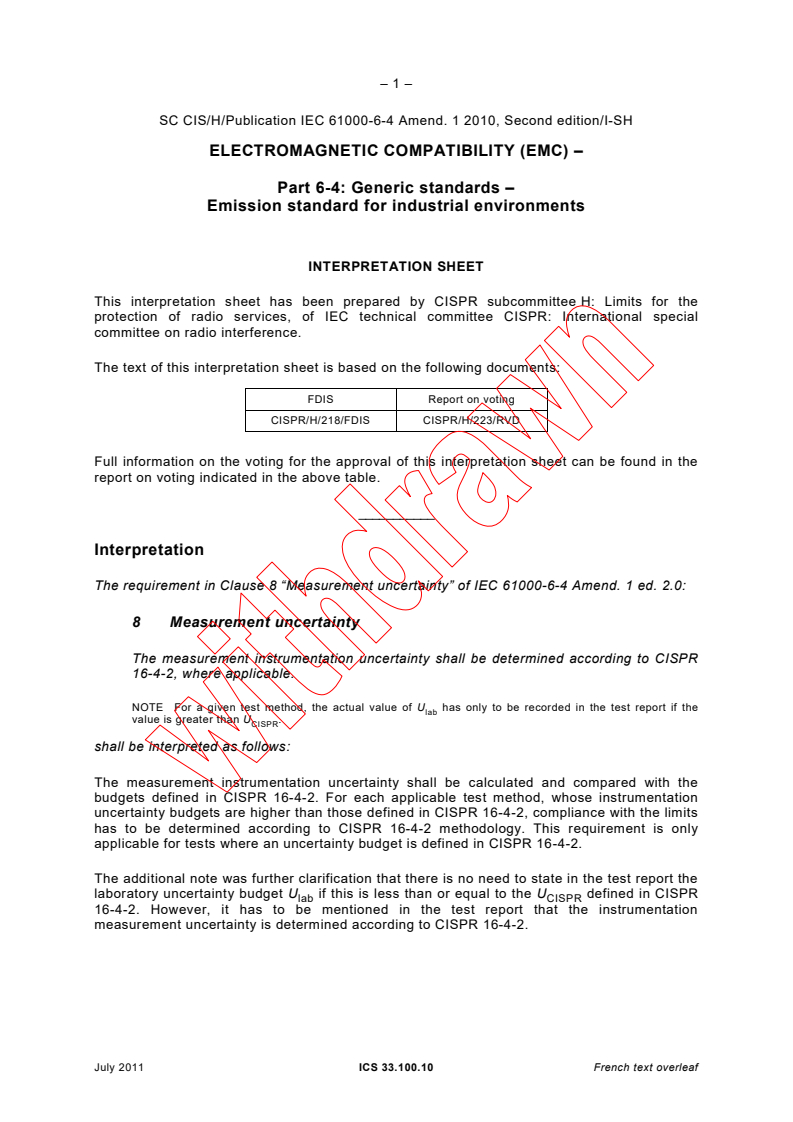
IEC 61000-6-4:2006+AMD1:2010 CSV - Electromagnetic compatibility (EMC) - Part 6-4: Generic standards - Emission standard for industrial environments Released:2/23/2011
Overview
IEC 61000-6-4:2006 is an international standard developed by the International Electrotechnical Commission (IEC) that defines electromagnetic compatibility (EMC) emission requirements for electrical and electronic apparatus used in industrial environments. It is a generic EMC emission standard applicable to devices connected to power networks served by high or medium voltage transformers, powering manufacturing plants or similar industrial installations, including battery-operated equipment. The standard comprehensively covers emissions in the frequency range from 0 Hz to 400 GHz, ensuring that equipment emissions in industrial settings do not interfere with the operation of other apparatus.
This standard applies when no product-specific or product-family EMC emission standards exist. It addresses both indoor and outdoor industrial environments characterized by features such as operating industrial, scientific, and medical (ISM) devices, frequent switching of heavy inductive or capacitive loads, and high currents with associated magnetic fields. Fault conditions are excluded, emphasizing emissions under normal operation.
Key Topics
Scope and Applicability
IEC 61000-6-4 applies to electrical and electronic apparatus intended for use within or near industrial locations powered by appropriate high or medium voltage transformers. It includes both mains-powered and battery-operated devices designed for harsh industrial electromagnetic environments.Emission Frequency Range
The standard specifies emission limits and test methods for disturbances from 0 Hz up to 400 GHz. Testing is only required for frequencies where emission requirements are specified.Types of Emissions Covered
- Conducted disturbances (both continuous and transient)
- Radiated disturbances due to electromagnetic fields
Industrial Environment Characteristics
These environments are marked by:- Presence of ISM apparatus generating electromagnetic noise
- Frequent switching of substantial inductive or capacitive loads
- High currents producing strong magnetic fields
Emission Limits and Testing
Emission levels are set to prevent interference that could impact other apparatus functioning as intended. Testing focuses on relevant disturbance phenomena critical for industrial equipment. Measurement uncertainty and testing of series-manufactured apparatus are also clearly defined.Ports and Access Points
Emission requirements apply to all apparatus ports, including:- Power supply interfaces (AC and DC)
- Signal and control connectors
- Telecommunication and network interfaces
Applications
IEC 61000-6-4:2006 is essential for manufacturers, testing laboratories, and compliance engineers involved with industrial equipment including:
Manufacturing and Process Control Equipment
Machinery and control systems used in factories must comply to avoid disrupting sensitive equipment.Heavy Electrical Loads and Power Electronics
Devices connected to industrial power networks, such as variable speed drives, welding machines, and large motors.Industrial Communication Systems
Equipment with telecommunication and network ports (Ethernet, ISDN, xDSL, etc.) used in industrial sites must meet emission standards to ensure reliable data transfer.Battery-Operated Industrial Devices
Portable or standalone devices functioning within industrial premises without direct mains connection.
Compliance with IEC 61000-6-4 helps in minimizing electromagnetic interference (EMI) risks, improving reliability, and reducing downtime caused by EMC-related issues in industrial settings. It supports systematic EMC design approaches and preparedness for regulatory certification.
Related Standards
IEC 61000-6-4 is part of the broader IEC 61000 series concerning electromagnetic compatibility. Related documents and standards include:
- IEC 61000-6-1: Generic immunity standard for residential, commercial, and light-industrial environments.
- CISPR 11: Emission requirements for industrial, scientific, and medical (ISM) radio frequency equipment.
- CISPR 16 Series: Specifies methods and apparatus for EMC testing and measurement techniques.
- CISPR 22: Limits and measurement methods for information technology equipment.
- IEC 60050(161): Electromagnetic compatibility terminology standard.
These standards complement IEC 61000-6-4 by addressing immunity, test methodology, terminology, and product-specific emission requirements, providing a comprehensive EMC compliance framework.
Keywords: IEC 61000-6-4, electromagnetic compatibility, EMC emission standard, industrial environments, EMC testing, emission limits, industrial equipment, conducted disturbances, radiated disturbances, industrial electromagnetic environment, IEC standards, EMC compliance, industrial power network, ISM apparatus.
Relations
- Referred By
EN ISO 16093:2017 - Machine tools - Safety - Sawing machines for cold metal (ISO 16093:2017) - Effective Date
- 09-Feb-2026
- Effective Date
- 09-Feb-2026
- Referred By
EN ISO 16089:2015 - Machine tools - Safety - Stationary grinding machines (ISO 16089:2015) - Effective Date
- 09-Feb-2026
- Effective Date
- 05-Sep-2023
- Effective Date
- 05-Sep-2023
- Effective Date
- 05-Sep-2023
- Effective Date
- 05-Sep-2023
Buy Documents
IEC 61000-6-4:2006 - Electromagnetic compatibility (EMC) - Part 6-4: Generic standards - Emission standard for industrial environments Released:7/10/2006
IEC 61000-6-4:2006 - Compatibilité électromagnétique (CEM) - Partie 6-4: Normes génériques - Norme sur l'émission pour les environnements industriels Released:7/10/2006
IEC 61000-6-4:2006 - Electromagnetic compatibility (EMC) - Part 6-4: Generic standards - Emission standard for industrial environments Released:7/10/2006
IEC 61000-6-4:2006+AMD1:2010 CSV - Electromagnetic compatibility (EMC) - Part 6-4: Generic standards - Emission standard for industrial environments Released:2/23/2011
Get Certified
Connect with accredited certification bodies for this standard

ANCE
Mexican certification and testing association.

Intertek Slovenia
Intertek testing, inspection, and certification services in Slovenia.

LNE (Laboratoire National de Métrologie et d'Essais)
French national laboratory for metrology and testing.
Sponsored listings
Frequently Asked Questions
IEC 61000-6-4:2006 is a standard published by the International Electrotechnical Commission (IEC). Its full title is "Electromagnetic compatibility (EMC) - Part 6-4: Generic standards - Emission standard for industrial environments". This standard covers: This part of IEC 61000 for EMC emission requirements applies to electrical and electronic apparatus intended for use in industrial environments as described below. Emission requirements in the frequency range 0 Hz to 400 GHz are covered. No measurement needs to be performed at frequencies where no requirement is specified. This generic EMC emission standard is applicable if no relevant dedicated product or product-family EMC emission standard exists. This standard applies to a apparatus intended to be connected to a power network supplied from a high or medium voltage transformer dedicated to the supply of an installation feeding manufacturing or similar plant, and intended to operate in or in proximity to industrial locations, as described below. This standard applies also to apparatus, which is battery operated and intended to be used in industrial locations. The environments encompassed by this standard are industrial, both indoor and outdoor. Industrial locations are in addition characterised by the existence of one or more of the following examples: - industrial, scientific and medical (ISM) apparatus; - heavy inductive or capacitive loads that are frequently switched; - high currents and associated magnetic fields. The object of this standard is to define the emission test requirements for apparatus defined in the scope in relation to continuous and transient, conducted and radiated disturbances. The emission requirements have been selected so as to ensure that disturbances generated by apparatus operating normally in industrial locations do not exceed a level that could prevent other apparatus from operating as intended. Fault conditions of apparatus are not taken into account. Not all disturbance phenomena have been included for testing purposes in this standard but only those considered as relevant for the equipment covered by this standard. These requirements represent essential electromagnetic compatibility emission requirements. Requirements are specified for each port considered.
This part of IEC 61000 for EMC emission requirements applies to electrical and electronic apparatus intended for use in industrial environments as described below. Emission requirements in the frequency range 0 Hz to 400 GHz are covered. No measurement needs to be performed at frequencies where no requirement is specified. This generic EMC emission standard is applicable if no relevant dedicated product or product-family EMC emission standard exists. This standard applies to a apparatus intended to be connected to a power network supplied from a high or medium voltage transformer dedicated to the supply of an installation feeding manufacturing or similar plant, and intended to operate in or in proximity to industrial locations, as described below. This standard applies also to apparatus, which is battery operated and intended to be used in industrial locations. The environments encompassed by this standard are industrial, both indoor and outdoor. Industrial locations are in addition characterised by the existence of one or more of the following examples: - industrial, scientific and medical (ISM) apparatus; - heavy inductive or capacitive loads that are frequently switched; - high currents and associated magnetic fields. The object of this standard is to define the emission test requirements for apparatus defined in the scope in relation to continuous and transient, conducted and radiated disturbances. The emission requirements have been selected so as to ensure that disturbances generated by apparatus operating normally in industrial locations do not exceed a level that could prevent other apparatus from operating as intended. Fault conditions of apparatus are not taken into account. Not all disturbance phenomena have been included for testing purposes in this standard but only those considered as relevant for the equipment covered by this standard. These requirements represent essential electromagnetic compatibility emission requirements. Requirements are specified for each port considered.
IEC 61000-6-4:2006 is classified under the following ICS (International Classification for Standards) categories: 33.100.10 - Emission. The ICS classification helps identify the subject area and facilitates finding related standards.
IEC 61000-6-4:2006 has the following relationships with other standards: It is inter standard links to EN ISO 16093:2017, EN ISO 16090-1:2018, EN ISO 16089:2015, IEC 61000-6-4:2006/AMD1:2010, IEC 61000-6-4:1997, IEC 61000-6-4:2018, IEC 61000-6-4:2006/AMD1:2010/ISH1:2011. Understanding these relationships helps ensure you are using the most current and applicable version of the standard.
IEC 61000-6-4:2006 is available in PDF format for immediate download after purchase. The document can be added to your cart and obtained through the secure checkout process. Digital delivery ensures instant access to the complete standard document.
Standards Content (Sample)
INTERNATIONAL
IEC
ELECTROTECHNICAL
61000-6-4
COMMISSION
Second edition
2006-07
INTERNATIONAL SPECIAL COMMITTEE ON RADIO INTERFERENCE
Electromagnetic compatibility (EMC) –
Part 6-4:
Generic standards –
Emission standard for industrial environments
This English-language version is derived from the original
bilingual publication by leaving out all French-language
pages. Missing page numbers correspond to the French-
language pages.
Reference number
Publication numbering
As from 1 January 1997 all IEC publications are issued with a designation in the
60000 series. For example, IEC 34-1 is now referred to as IEC 60034-1.
Consolidated editions
The IEC is now publishing consolidated versions of its publications. For example,
edition numbers 1.0, 1.1 and 1.2 refer, respectively, to the base publication, the
base publication incorporating amendment 1 and the base publication incorporating
amendments 1 and 2.
Further information on IEC publications
The technical content of IEC publications is kept under constant review by the IEC,
thus ensuring that the content reflects current technology. Information relating to
this publication, including its validity, is available in the IEC Catalogue of
publications (see below) in addition to new editions, amendments and corrigenda.
Information on the subjects under consideration and work in progress undertaken
by the technical committee which has prepared this publication, as well as the list
of publications issued, is also available from the following:
• IEC Web Site (www.iec.ch)
• Catalogue of IEC publications
The on-line catalogue on the IEC web site (www.iec.ch/searchpub) enables you to
search by a variety of criteria including text searches, technical committees
and date of publication. On-line information is also available on recently issued
publications, withdrawn and replaced publications, as well as corrigenda.
• IEC Just Published
This summary of recently issued publications (www.iec.ch/online_news/ justpub)
is also available by email. Please contact the Customer Service Centre (see
below) for further information.
• Customer Service Centre
If you have any questions regarding this publication or need further assistance,
please contact the Customer Service Centre:
Email: custserv@iec.ch
Tel: +41 22 919 02 11
Fax: +41 22 919 03 00
INTERNATIONAL
IEC
ELECTROTECHNICAL
61000-6-4
COMMISSION
Second edition
2006-07
INTERNATIONAL SPECIAL COMMITTEE ON RADIO INTERFERENCE
Electromagnetic compatibility (EMC) –
Part 6-4:
Generic standards –
Emission standard for industrial environments
© IEC 2006 Copyright - all rights reserved
No part of this publication may be reproduced or utilized in any form or by any means, electronic or mechanical,
including photocopying and microfilm, without permission in writing from the publisher.
International Electrotechnical Commission, 3, rue de Varembé, PO Box 131, CH-1211 Geneva 20, Switzerland
Telephone: +41 22 919 02 11 Telefax: +41 22 919 03 00 E-mail: inmail@iec.ch Web: www.iec.ch
PRICE CODE
Commission Electrotechnique Internationale L
International Electrotechnical Commission
Международная Электротехническая Комиссия
For price, see current catalogue
61000-6-4 IEC:2006 – 3 –
CONTENTS
FOREWORD.5
INTRODUCTION.9
1 Scope and object .11
2 Normative references.13
3 Terms and definitions .13
4 Conditions during testing.15
5 Product documentation .17
6 Applicability .17
7 Emission requirements .17
8 Application of limits in tests for conformity of equipment in series production.17
9 Measurement uncertainty.19
Bibliography .23
Figure 1 – Examples of ports.13
Table 1 − Emission.21
61000-6-4 IEC:2006 – 5 –
INTERNATIONAL ELECTROTECHNICAL COMMISSION
INTERNATIONAL SPECIAL COMMITTEE ON RADIO INTERFERENCE
___________
ELECTROMAGNETIC COMPATIBILITY (EMC) –
Part 6-4: Generic standards – Emission standard
for industrial environments
FOREWORD
1) The International Electrotechnical Commission (IEC) is a worldwide organization for standardization comprising
all national electrotechnical committees (IEC National Committees). The object of IEC is to promote
international co-operation on all questions concerning standardization in the electrical and electronic fields. To
this end and in addition to other activities, IEC publishes International Standards, Technical Specifications,
Technical Reports, Publicly Available Specifications (PAS) and Guides (hereafter referred to as “IEC
Publication(s)”). Their preparation is entrusted to technical committees; any IEC National Committee interested
in the subject dealt with may participate in this preparatory work. International, governmental and non-
governmental organizations liaising with the IEC also participate in this preparation. IEC collaborates closely
with the International Organization for Standardization (ISO) in accordance with conditions determined by
agreement between the two organizations.
2) The formal decisions or agreements of IEC on technical matters express, as nearly as possible, an international
consensus of opinion on the relevant subjects since each technical committee has representation from all
interested IEC National Committees.
3) IEC Publications have the form of recommendations for international use and are accepted by IEC National
Committees in that sense. While all reasonable efforts are made to ensure that the technical content of IEC
Publications is accurate, IEC cannot be held responsible for the way in which they are used or for any
misinterpretation by any end user.
4) In order to promote international uniformity, IEC National Committees undertake to apply IEC Publications
transparently to the maximum extent possible in their national and regional publications. Any divergence
between any IEC Publication and the corresponding national or regional publication shall be clearly indicated in
the latter.
5) IEC provides no marking procedure to indicate its approval and cannot be rendered responsible for any
equipment declared to be in conformity with an IEC Publication.
6) All users should ensure that they have the latest edition of this publication.
7) No liability shall attach to IEC or its directors, employees, servants or agents including individual experts and
members of its technical committees and IEC National Committees for any personal injury, property damage or
other damage of any nature whatsoever, whether direct or indirect, or for costs (including legal fees) and
expenses arising out of the publication, use of, or reliance upon, this IEC Publication or any other IEC
Publications.
8) Attention is drawn to the Normative references cited in this publication. Use of the referenced publications is
indispensable for the correct application of this publication.
9) Attention is drawn to the possibility that some of the elements of this IEC Publication may be the subject of
patent rights. IEC shall not be held responsible for identifying any or all such patent rights.
International Standard IEC 61000-6-4 has been prepared by CISPR subcommittee H: Limits for
the protection of radio services.
This second edition cancels and replaces the first edition published in 1997. It constitutes a
technical revision. The major changes in this edition are the inclusion of a clause on tests for
equipment in series production, a new clause on measurement uncertainty and the inclusion of
requirements on telecommunications ports. The informative annex has been deleted.
61000-6-4 IEC:2006 – 7 –
The text of this standard is based on the following documents:
FDIS Report on voting
CISPR/H/122/FDIS CISPR/H/125/RVD
Full information on the voting for the approval of this standard can be found in the report on
voting indicated in the above table.
This publication has been drafted in accordance with the ISO/IEC Directives, Part 2.
The committee has decided that the contents of this publication will remain unchanged until the
maintenance result date indicated on the IEC web site under "http://webstore.iec.ch" in the data
related to the specific publication. At this date, the publication will be
• reconfirmed,
• withdrawn,
• replaced by a revised edition, or
• amended.
61000-6-4 IEC:2006 – 9 –
INTRODUCTION
IEC 61000 is published in separate parts according to the following structure:
Part 1: General
General considerations (introduction, fundamental principles)
Definitions, terminology
Part 2: Environment
Description of the environment
Classification of the environment
Compatibility levels
Part 3: Limits
Emission limits
Immunity limits (insofar as they do not fall under the responsibility of the product
committees)
Part 4: Testing and measurement techniques
Measurement techniques
Testing techniques
Part 5: Installation and mitigation guidelines
Installation guidelines
Mitigation methods and devices
Part 6: Generic standards
Part 9: Miscellaneous
Each part is further subdivided into several parts published either as International Standards or
technical reports/specifications, some of which have already been published as sections.
Others will be published with the part number followed by a dash and a second number
identifying the subdivision (example: 61000-6-1).
61000-6-4 IEC:2006 – 11 –
ELECTROMAGNETIC COMPATIBILITY (EMC) –
Part 6-4: Generic standards – Emission standard
for industrial environments
1 Scope and object
This part of IEC 61000 for EMC emission requirements applies to electrical and electronic
apparatus intended for use in industrial environments as described below.
Emission requirements in the frequency range 0 Hz to 400 GHz are covered. No measurement
needs to be performed at frequencies where no requirement is specified.
This generic EMC emission standard is applicable if no relevant dedicated product or product-
family EMC emission standard exists.
This standard applies to a apparatus intended to be connected to a power network supplied
from a high or medium voltage transformer dedicated to the supply of an installation feeding
manufacturing or similar plant, and intended to operate in or in proximity to industrial locations,
as described below. This standard applies also to apparatus, which is battery operated and
intended to be used in industrial locations.
The environments encompassed by this standard are industrial, both indoor and outdoor.
Industrial locations are in addition characterised by the existence of one or more of the
following examples:
1)
– industrial, scientific and medical (ISM) ) apparatus;
– heavy inductive or capacitive loads that are frequently switched;
– high currents and associated magnetic fields.
The object of this standard is to define the emission test requirements for apparatus defined in
the scope in relation to continuous and transient, conducted and radiated disturbances.
The emission requirements have been selected so as to ensure that disturban
...
COMMISSION
CEI
ÉLECTROTECHNIQUE
61000-6-4
INTERNATIONALE
Deuxième édition
2006-07
COMITÉ INTERNATIONAL SPÉCIAL DES PERTURBATIONS RADIOÉLECTRIQUES
Compatibilité électromagnétique (CEM) –
Partie 6-4:
Normes génériques –
Norme sur l’émission pour les environnements
industriels
Cette version française découle de la publication d’origine
bilingue dont les pages anglaises ont été supprimées.
Les numéros de page manquants sont ceux des pages
supprimées.
Numéro de référence
CEI 61000-6-4:2006(F)
Numérotation des publications
Depuis le 1er janvier 1997, les publications de la CEI sont numérotées à partir de
60000. Ainsi, la CEI 34-1 devient la CEI 60034-1.
Editions consolidées
Les versions consolidées de certaines publications de la CEI incorporant les
amendements sont disponibles. Par exemple, les numéros d’édition 1.0, 1.1 et 1.2
indiquent respectivement la publication de base, la publication de base incorporant
l’amendement 1, et la publication de base incorporant les amendements 1 et 2
Informations supplémentaires sur les publications de la CEI
Le contenu technique des publications de la CEI est constamment revu par la CEI
afin qu'il reflète l'état actuel de la technique. Des renseignements relatifs à cette
publication, y compris sa validité, sont disponibles dans le Catalogue des
publications de la CEI (voir ci-dessous) en plus des nouvelles éditions, amende-
ments et corrigenda. Des informations sur les sujets à l’étude et l’avancement des
travaux entrepris par le comité d’études qui a élaboré cette publication, ainsi que la
liste des publications parues, sont également disponibles par l’intermédiaire de:
• Site web de la CEI (www.iec.ch)
• Catalogue des publications de la CEI
Le catalogue en ligne sur le site web de la CEI (www.iec.ch/searchpub) vous permet
de faire des recherches en utilisant de nombreux critères, comprenant des
recherches textuelles, par comité d’études ou date de publication. Des informations
en ligne sont également disponibles sur les nouvelles publications, les publications
remplacées ou retirées, ainsi que sur les corrigenda.
• IEC Just Published
Ce résumé des dernières publications parues (www.iec.ch/online_news/justpub)
est aussi disponible par courrier électronique. Veuillez prendre contact avec le
Service client (voir ci-dessous) pour plus d’informations.
• Service clients
Si vous avez des questions au sujet de cette publication ou avez besoin de
renseignements supplémentaires, prenez contact avec le Service clients:
Email: custserv@iec.ch
Tél: +41 22 919 02 11
Fax: +41 22 919 03 00
COMMISSION
CEI
ÉLECTROTECHNIQUE
61000-6-4
INTERNATIONALE
Deuxième édition
2006-07
COMITÉ INTERNATIONAL SPÉCIAL DES PERTURBATIONS RADIOÉLECTRIQUES
Compatibilité électromagnétique (CEM) –
Partie 6-4:
Normes génériques –
Norme sur l’émission pour les environnements
industriels
© IEC 2006 Droits de reproduction réservés
Aucune partie de cette publication ne peut être reproduite ni utilisée sous quelque forme que ce soit et par aucun
procédé, électronique ou mécanique, y compris la photocopie et les microfilms, sans l'accord écrit de l'éditeur.
International Electrotechnical Commission, 3, rue de Varembé, PO Box 131, CH-1211 Geneva 20, Switzerland
Telephone: +41 22 919 02 11 Telefax: +41 22 919 03 00 E-mail: inmail@iec.ch Web: www.iec.ch
CODE PRIX
Commission Electrotechnique Internationale L
International Electrotechnical Commission
Международная Электротехническая Комиссия
Pour prix, voir catalogue en vigueur
– 2 – 61000-6-4 CEI:2006
SOMMAIRE
AVANT-PROPOS .4
INTRODUCTION.8
1 Domaine d’application et objet .10
2 Références normatives .12
3 Termes et définitions .12
4 Conditions pendant l'essai .14
5 Documentation du produit .16
6 Applicabilité .16
7 Exigences pour l'émission.16
8 Application des limites dans les essais de conformité des appareils produits en
série .16
9 Incertitude de mesure .18
Bibliographie .22
Figure 1 – Exemples d'accès.12
Tableau 1 – Émission.20
– 4 – 61000-6-4 CEI:2006
COMMISSION ÉLECTROTECHNIQUE INTERNATIONALE
COMITÉ INTERNATIONAL SPÉCIAL DES PERTURBATIONS RADIOÉLECTRIQUES
___________
COMPATIBILITÉ ÉLECTROMAGNÉTIQUE (CEM) –
Partie 6-4: Normes génériques –
Norme sur l’émission pour les environnements industriels
AVANT-PROPOS
1) La Commission Electrotechnique Internationale (CEI) est une organisation mondiale de normalisation composée
de l'ensemble des comités électrotechniques nationaux (Comités nationaux de la CEI). La CEI a pour objet de
favoriser la coopération internationale pour toutes les questions de normalisation dans les domaines de
l'électricité et de l'électronique. A cet effet, la CEI – entre autres activités – publie des Normes internationales,
des Spécifications techniques, des Rapports techniques, des Spécifications accessibles au public (PAS) et des
Guides (ci-après dénommés "Publication(s) de la CEI"). Leur élaboration est confiée à des comités d'études,
aux travaux desquels tout Comité national intéressé par le sujet traité peut participer. Les organisations
internationales, gouvernementales et non gouvernementales, en liaison avec la CEI, participent également aux
travaux. La CEI collabore étroitement avec l'Organisation Internationale de Normalisation (ISO), selon des
conditions fixées par accord entre les deux organisations.
2) Les décisions ou accords officiels de la CEI concernant les questions techniques représentent, dans la mesure
du possible, un accord international sur les sujets étudiés, étant donné que les Comités nationaux de la CEI
intéressés sont représentés dans chaque comité d’études.
3) Les Publications de la CEI se présentent sous la forme de recommandations internationales et sont agréées
comme telles par les Comités nationaux de la CEI. Tous les efforts raisonnables sont entrepris afin que la CEI
s'assure de l'exactitude du contenu technique de ses publications; la CEI ne peut pas être tenue responsable de
l'éventuelle mauvaise utilisation ou interprétation qui en est faite par un quelconque utilisateur final.
4) Dans le but d'encourager l'uniformité internationale, les Comités nationaux de la CEI s'engagent, dans toute la
mesure possible, à appliquer de façon transparente les Publications de la CEI dans leurs publications
nationales et régionales. Toutes divergences entre toutes Publications de la CEI et toutes publications
nationales ou régionales correspondantes doivent être indiquées en termes clairs dans ces dernières.
5) La CEI n’a prévu aucune procédure de marquage valant indication d’approbation et n'engage pas sa
responsabilité pour les équipements déclarés conformes à une de ses Publications.
6) Tous les utilisateurs doivent s'assurer qu'ils sont en possession de la dernière édition de cette publication.
7) Aucune responsabilité ne doit être imputée à la CEI, à ses administrateurs, employés, auxiliaires ou
mandataires, y compris ses experts particuliers et les membres de ses comités d'études et des Comités
nationaux de la CEI, pour tout préjudice causé en cas de dommages corporels et matériels, ou de tout autre
dommage de quelque nature que ce soit, directe ou indirecte, ou pour supporter les coûts (y compris les frais
de justice) et les dépenses découlant de la publication ou de l'utilisation de cette Publication de la CEI ou de
toute autre Publication de la CEI, ou au crédit qui lui est accordé.
8) L'attention est attirée sur les références normatives citées dans cette publication. L'utilisation de publications
référencées est obligatoire pour une application correcte de la présente publication.
9) L’attention est attirée sur le fait que certains des éléments de la présente Publication de la CEI peuvent faire
l’objet de droits de propriété intellectuelle ou de droits analogues. La CEI ne saurait être tenue pour
responsable de ne pas avoir identifié de tels droits de propriété et de ne pas avoir signalé leur existence.
La norme internationale CEI 61000-6-4 a été préparée par le sous-comité H du CISPR: Limites
pour la protection des services radioélectriques.
Cette deuxième édition annule et remplace la première édition parue en 1997. Cette édition
constitue une révision technique. Les principaux changements introduits par cette nouvelle
édition consistent dans l’ajout de deux nouveaux articles, le premier sur les essais applicables
aux appareils produits en série, le second concernant l’incertitude de mesure, et dans
l’insertion d’exigences sur les accès d’alimentation en courant continu et les accès de
télécommunication. L’annexe informative a par ailleurs été supprimée.
– 6 – 61000-6-4 CEI:2006
Le texte de cette norme est issu des documents suivants:
FDIS Rapport de vote
CISPR/H/122/FDIS CISPR/H/125/RVD
Le rapport de vote indiqué dans le tableau ci-dessus donne toute information sur le vote ayant
abouti à l'approbation de cette norme.
Cette publication a été rédigée selon les Directives ISO/CEI, Partie 2.
Le comité a décidé que le contenu de cette publication ne sera pas modifié avant la date de
maintenance indiquée sur le site web de la CEI sous "http://webstore.iec.ch" dans les données
relatives à la publication recherchée. A cette date, la publication sera
• reconduite,
• supprimée,
• remplacée par une édition révisée, ou
• amendée.
– 8 – 61000-6-4 CEI:2006
INTRODUCTION
La CEI 61000 est publiée sous forme de plusieurs parties, conformément à la structure
suivante:
Partie 1: Généralités
Considérations générales (introduction, principes fondamentaux)
Définitions, terminologie
Partie 2: Environnement
Description de l'environnement
Classification de l'environnement
Niveaux de compatibilité
Partie 3: Limites
Limites d'émission
Limites d'immunité (dans la mesure où elles ne relèvent pas des comités de produit)
Partie 4: Techniques d’essai et de mesure
Techniques de mesure
Techniques d'essai
Partie 5: Directives d'installation et d'atténuation
Guides d'installation
Méthodes et dispositifs d'atténuation
Partie 6: Normes génériques
Partie 9: Divers
Chaque partie est à son tour subdivisée en parties qui sont publiées soit comme Normes
internationales, soit comme rapports techniques/spécifications techniques, certaines d'entre
elles ont déjà été publiées comme sections. D'autres seront publiées avec le numéro de la
partie suivi d’un tiret et complété d'un second chiffre identifiant la subdivision (exemple:
61000-6-1).
– 10 – 61000-6-4 CEI:2006
COMPATIBILITÉ ÉLECTROMAGNÉTIQUE (CEM) –
Partie 6-4: Normes génériques –
Norme sur l’émission pour les environnements industriels
1 Domaine d’application et objet
La présente partie de la CEI 61000 pour les exigences d’émissions CEM s’applique aux
appareils électriques et électroniques destinés à être utilisés dans des environnements
industriels, tels qu'ils sont décrits ci-dessous.
Les exigences d’émissions dans la gamme de fréquences de 0 kHz à 400 GHz sont couvertes.
Il n’est pas nécessaire de réaliser des mesures aux fréquences pour lesquelles aucune
exigence n’a été spécifiée.
Cette norme d’émission CEM générique s'applique en l'absence de norme applicable
d’émission CEM spécifique à un produit ou à une famille de produits.
Les appareils couverts par cette norme sont destinés à être raccordés à un réseau d'énergie
alimenté par un transformateur haute tension ou moyenne tension réservé à l'alimentation
d'une l'installation alimentant un site industriel ou analogue, et destinés à fonctionner à
l’intérieur ou à proximité des sites industriels, comme défini ci-dessous. Cette norme s'applique
également aux appareils qui sont alimentés par piles ou accumulateurs et qui sont destinés à
être utilisés dans des sites industriels.
Les environnements couverts par cette norme sont les environnements industriels, intérieurs et
extérieurs.
Les sites industriels sont en outre caractérisés par l’existence d’un ou plusieurs des exemples
suivants:
1)
– présence d'appareils industriels, scientifiques et médicaux (ISM) ;
– commutations fréquentes de charges inductives ou capacitives importantes;
– intensités et champs magnétiques associés importants.
L'objet de cette norme est de définir les exigences d'essais d’émissions aux perturbations
continues et transitoires, conduites et rayonnées, pour les appareils définis dans le domaine
d'application.
Les exigences des perturbations émises ont été choisies de manière à assurer que les
perturbations engendrées par l’appareil en fonctionnement normal, dans un environnement
industriel, ne dépassent pas un niveau qui pourrait empêcher d'autres appareils de fonctionner
comme prévu normalement. Les conditions de défaut de l’appareil ne sont pas prises en
...
IEC 61000-6-4
Edition 2.0 2006-07
INTERNATIONAL
STANDARD
NORME
INTERNATIONALE
INTERNATIONAL SPECIAL COMMITTEE ON RADIO INTERFERENCE
COMITÉ INTERNATIONAL SPÉCIAL DES PERTURBATIONS RADIOÉLECTRIQUES
Electromagnetic compatibility (EMC) –
Part 6-4: Generic standards – Emission standard for industrial environments
Compatibilité électromagnétique (CEM) –
Partie 6-4: Normes génériques – Norme sur l'émission pour les environnements
industriels
All rights reserved. Unless otherwise specified, no part of this publication may be reproduced or utilized in any form or by
any means, electronic or mechanical, including photocopying and microfilm, without permission in writing from either IEC or
IEC's member National Committee in the country of the requester.
If you have any questions about IEC copyright or have an enquiry about obtaining additional rights to this publication,
please contact the address below or your local IEC member National Committee for further information.
Droits de reproduction réservés. Sauf indication contraire, aucune partie de cette publication ne peut être reproduite
ni utilisée sous quelque forme que ce soit et par aucun procédé, électronique ou mécanique, y compris la photocopie
et les microfilms, sans l'accord écrit de la CEI ou du Comité national de la CEI du pays du demandeur.
Si vous avez des questions sur le copyright de la CEI ou si vous désirez obtenir des droits supplémentaires sur cette
publication, utilisez les coordonnées ci-après ou contactez le Comité national de la CEI de votre pays de résidence.
IEC Central Office
3, rue de Varembé
CH-1211 Geneva 20
Switzerland
Email: inmail@iec.ch
Web: www.iec.ch
About the IEC
The International Electrotechnical Commission (IEC) is the leading global organization that prepares and publishes
International Standards for all electrical, electronic and related technologies.
About IEC publications
The technical content of IEC publications is kept under constant review by the IEC. Please make sure that you have the
latest edition, a corrigenda or an amendment might have been published.
ƒ Catalogue of IEC publications: www.iec.ch/searchpub
The IEC on-line Catalogue enables you to search by a variety of criteria (reference number, text, technical committee,…).
It also gives information on projects, withdrawn and replaced publications.
ƒ IEC Just Published: www.iec.ch/online_news/justpub
Stay up to date on all new IEC publications. Just Published details twice a month all new publications released. Available
on-line and also by email.
ƒ Electropedia: www.electropedia.org
The world's leading online dictionary of electronic and electrical terms containing more than 20 000 terms and definitions
in English and French, with equivalent terms in additional languages. Also known as the International Electrotechnical
Vocabulary online.
ƒ Customer Service Centre: www.iec.ch/webstore/custserv
If you wish to give us your feedback on this publication or need further assistance, please visit the Customer Service
Centre FAQ or contact us:
Email: csc@iec.ch
Tel.: +41 22 919 02 11
Fax: +41 22 919 03 00
A propos de la CEI
La Commission Electrotechnique Internationale (CEI) est la première organisation mondiale qui élabore et publie des
normes internationales pour tout ce qui a trait à l'électricité, à l'électronique et aux technologies apparentées.
A propos des publications CEI
Le contenu technique des publications de la CEI est constamment revu. Veuillez vous assurer que vous possédez
l’édition la plus récente, un corrigendum ou amendement peut avoir été publié.
ƒ Catalogue des publications de la CEI: www.iec.ch/searchpub/cur_fut-f.htm
Le Catalogue en-ligne de la CEI vous permet d’effectuer des recherches en utilisant différents critères (numéro de référence,
texte, comité d’études,…). Il donne aussi des informations sur les projets et les publications retirées ou remplacées.
ƒ Just Published CEI: www.iec.ch/online_news/justpub
Restez informé sur les nouvelles publications de la CEI. Just Published détaille deux fois par mois les nouvelles
publications parues. Disponible en-ligne et aussi par email.
ƒ Electropedia: www.electropedia.org
Le premier dictionnaire en ligne au monde de termes électroniques et électriques. Il contient plus de 20 000 termes et
définitions en anglais et en français, ainsi que les termes équivalents dans les langues additionnelles. Egalement appelé
Vocabulaire Electrotechnique International en ligne.
ƒ Service Clients: www.iec.ch/webstore/custserv/custserv_entry-f.htm
Si vous désirez nous donner des commentaires sur cette publication ou si vous avez des questions, visitez le FAQ du
Service clients ou contactez-nous:
Email: csc@iec.ch
Tél.: +41 22 919 02 11
Fax: +41 22 919 03 00
IEC 61000-6-4
Edition 2.0 2006-07
INTERNATIONAL
STANDARD
NORME
INTERNATIONALE
INTERNATIONAL SPECIAL COMMITTEE ON RADIO INTERFERENCE
COMITÉ INTERNATIONAL SPÉCIAL DES PERTURBATIONS RADIOÉLECTRIQUES
Electromagnetic compatibility (EMC) –
Part 6-4: Generic standards – Emission standard for industrial environments
Compatibilité électromagnétique (CEM) –
Partie 6-4: Normes génériques – Norme sur l'émission pour les environnements
industriels
INTERNATIONAL
ELECTROTECHNICAL
COMMISSION
COMMISSION
ELECTROTECHNIQUE
PRICE CODE
INTERNATIONALE
L
CODE PRIX
ICS 33.100.10 ISBN 2-8318-8696-1
61000-6-4 IEC:2006 – 3 – – 2 – 61000-6-4 © IEC:2006
CONTENTS
FOREWORD.3
INTRODUCTION.5
1 Scope and object .6
2 Normative references.7
3 Terms and definitions .7
4 Conditions during testing.8
5 Product documentation .9
6 Applicability .9
7 Emission requirements .9
8 Application of limits in tests for conformity of equipment in series production.9
9 Measurement uncertainty.10
Bibliography .12
Figure 1 – Examples of ports.7
Table 1 − Emission.11
61000-6-4 © IEC:200661000-6-4 IEC:2006 – 5 – – 3 –
INTERNATIONAL ELECTROTECHNICAL COMMISSION
INTERNATIONAL SPECIAL COMMITTEE ON RADIO INTERFERENCE
___________
ELECTROMAGNETIC COMPATIBILITY (EMC) –
Part 6-4: Generic standards – Emission standard
for industrial environments
FOREWORD
1) The International Electrotechnical Commission (IEC) is a worldwide organization for standardization comprising
all national electrotechnical committees (IEC National Committees). The object of IEC is to promote
international co-operation on all questions concerning standardization in the electrical and electronic fields. To
this end and in addition to other activities, IEC publishes International Standards, Technical Specifications,
Technical Reports, Publicly Available Specifications (PAS) and Guides (hereafter referred to as “IEC
Publication(s)”). Their preparation is entrusted to technical committees; any IEC National Committee interested
in the subject dealt with may participate in this preparatory work. International, governmental and non-
governmental organizations liaising with the IEC also participate in this preparation. IEC collaborates closely
with the International Organization for Standardization (ISO) in accordance with conditions determined by
agreement between the two organizations.
2) The formal decisions or agreements of IEC on technical matters express, as nearly as possible, an international
consensus of opinion on the relevant subjects since each technical committee has representation from all
interested IEC National Committees.
3) IEC Publications have the form of recommendations for international use and are accepted by IEC National
Committees in that sense. While all reasonable efforts are made to ensure that the technical content of IEC
Publications is accurate, IEC cannot be held responsible for the way in which they are used or for any
misinterpretation by any end user.
4) In order to promote international uniformity, IEC National Committees undertake to apply IEC Publications
transparently to the maximum extent possible in their national and regional publications. Any divergence
between any IEC Publication and the corresponding national or regional publication shall be clearly indicated in
the latter.
5) IEC provides no marking procedure to indicate its approval and cannot be rendered responsible for any
equipment declared to be in conformity with an IEC Publication.
6) All users should ensure that they have the latest edition of this publication.
7) No liability shall attach to IEC or its directors, employees, servants or agents including individual experts and
members of its technical committees and IEC National Committees for any personal injury, property damage or
other damage of any nature whatsoever, whether direct or indirect, or for costs (including legal fees) and
expenses arising out of the publication, use of, or reliance upon, this IEC Publication or any other IEC
Publications.
8) Attention is drawn to the Normative references cited in this publication. Use of the referenced publications is
indispensable for the correct application of this publication.
9) Attention is drawn to the possibility that some of the elements of this IEC Publication may be the subject of
patent rights. IEC shall not be held responsible for identifying any or all such patent rights.
International Standard IEC 61000-6-4 has been prepared by CISPR subcommittee H: Limits for
the protection of radio services.
This second edition cancels and replaces the first edition published in 1997. It constitutes a
technical revision. The major changes in this edition are the inclusion of a clause on tests for
equipment in series production, a new clause on measurement uncertainty and the inclusion of
requirements on telecommunications ports. The informative annex has been deleted.
61000-6-4 IEC:2006 – 7 – – 4 – 61000-6-4 © IEC:2006
The text of this standard is based on the following documents:
FDIS Report on voting
CISPR/H/122/FDIS CISPR/H/125/RVD
Full information on the voting for the approval of this standard can be found in the report on
voting indicated in the above table.
This publication has been drafted in accordance with the ISO/IEC Directives, Part 2.
The committee has decided that the contents of this publication will remain unchanged until the
maintenance result date indicated on the IEC web site under "http://webstore.iec.ch" in the data
related to the specific publication. At this date, the publication will be
• reconfirmed,
• withdrawn,
• replaced by a revised edition, or
• amended.
61000-6-4 © IEC:200661000-6-4 IEC:2006 – 9 – – 5 –
INTRODUCTION
IEC 61000 is published in separate parts according to the following structure:
Part 1: General
General considerations (introduction, fundamental principles)
Definitions, terminology
Part 2: Environment
Description of the environment
Classification of the environment
Compatibility levels
Part 3: Limits
Emission limits
Immunity limits (insofar as they do not fall under the responsibility of the product
committees)
Part 4: Testing and measurement techniques
Measurement techniques
Testing techniques
Part 5: Installation and mitigation guidelines
Installation guidelines
Mitigation methods and devices
Part 6: Generic standards
Part 9: Miscellaneous
Each part is further subdivided into several parts published either as International Standards or
technical reports/specifications, some of which have already been published as sections.
Others will be published with the part number followed by a dash and a second number
identifying the subdivision (example: 61000-6-1).
61000-6-4 IEC:2006 – 11 – – 6 – 61000-6-4 © IEC:2006
ELECTROMAGNETIC COMPATIBILITY (EMC) –
Part 6-4: Generic standards – Emission standard
for industrial environments
1 Scope and object
This part of IEC 61000 for EMC emission requirements applies to electrical and electronic
apparatus intended for use in industrial environments as described below.
Emission requirements in the frequency range 0 Hz to 400 GHz are covered. No measurement
needs to be performed at frequencies where no requirement is specified.
This generic EMC emission standard is applicable if no relevant dedicated product or product-
family EMC emission standard exists.
This standard applies to a apparatus intended to be connected to a power network supplied
from a high or medium voltage transformer dedicated to the supply of an installation feeding
manufacturing or similar plant, and intended to operate in or in proximity to industrial locations,
as described below. This standard applies also to apparatus, which is battery operated and
intended to be used in industrial locations.
The environments encompassed by this standard are industrial, both indoor and outdoor.
Industrial locations are in addition characterised by the existence of one or more of the
following examples:
1)
– industrial, scientific and medical (ISM) ) apparatus;
– heavy inductive or capacitive loads that are frequently switched;
– high currents and associated magnetic fields.
The object of this standard is to define the emission test requirements for apparatus defined in
the scope in relation to continuous and transient, conducted and radiated disturbances.
The emission requirements have been selected so as to ensure that disturbances generated by
apparatus operating normally in industrial locations do not exceed a level that could prevent
other apparatus from operating as intended. Fault conditions of apparatus are not taken into
account. Not all disturbance phenomena have been included for testing purposes in this
standard but only those considered as relevant for the equipment covered by this standard.
These requirements represent essential electromagnetic compatibility emission requirements.
Requirements are specified for each port considered.
NOTE 1 Safety considerations are not covered by this standard.
NOTE 2 In special cases, situations will arise where the levels specified in this standard will not offer adequate
protection; for example where a sensitive receiver is used in close proximity to an apparatus. In these instances,
special mitigation measures may have to be employed.
__________
1)
As defined in CISPR 11.
61000-6-4 © IEC:200661000-6-4 IEC:2006 – 13 – – 7 –
2 Normative references
The following referenced documents are indispensable for the application of this document. For
dated references, only the edition cited applies. For undated references, the latest edition of
the referenced document (including any amendments) applies.
CISPR 11, Industrial, scientific and medical (ISM) radio-frequency equipment – Electro-
magnetic disturbance characteristics – Limits and methods of measurement
CISPR 16-1-2:2003, Specification for radio disturbance and immunity measuring apparatus and
methods – Part 1-2: Radio disturbance and immunity measuring apparatus – Ancillary
equipment – Conducted disturbances
CISPR 16-2-1:2003, Specification for radio disturbance and immunity measuring apparatus and
methods – Part 2-1: Methods of measurement of disturbances and immunity – Conducted
disturbance measurements
CISPR 16-2-3, Specification for radio disturbance and immunity measuring apparatus and
methods – Part 2-3: Methods of measurement of disturbances and immunity – Radiated
disturbance measurements
CISPR 16-4-2, Specification for radio disturbance and immunity measuring apparatus and
methods – Part 4-2: Uncertainties, statistics and limit modelling – Uncertainty in EMC
measurements
CISPR 22, Information technology equipment – Radio disturbance characteristics – Limits and
methods of measurement
3 Terms and definitions
For the purposes of this document, the following terms and definitions apply.
NOTE Definitions related to EMC and to relevant phenomena are given in IEC 60050-161 and in other IEC and
CISPR publications.
3.1
port
particular interface of the specified apparatus with the external electromagnetic environment
(see Figure 1)
Enclosure port
Low voltage a.c.
mains port
Apparatus
Telecommunications/ DC power port
network port
IEC 1091/06
Figure 1 – Examples of ports
61000-6-4 IEC:2006 – 15 – – 8 – 61000-6-4 © IEC:2006
3.2
enclosure port
physical boundary of the apparatus which electromagnetic fields may radiate through or
impinge on
3.3
cable port
port at which a conductor or a cable is connected to the apparatus
NOTE Examples are signal, control and power ports.
3.4
telecommunications/network port
point of connection for voice, data and signalling transfers intended to interconnect widely
dispersed systems via such means as direct connection to multi-user telecommunications
networks (e.g. public switched telecommunications networks (PSTN) integrated services digital
networks (ISDN), x-type digital subscriber lines (xDSL), etc.), local area networks (e.g.
Ethernet, Token Ring, etc.) and similar networks)
NOTE A port generally intended for interconnection of components of an ITE system under test (e.g. RS-232,RS-
485, field buses in the scope of IEC 61158, IEEE Standard 1284 (parallel printer), Universal Serial Bus (USB),
IEEE Standard 1394 (“Fire Wire”), etc.) and used in accordance with its functional specifications (e.g. for the
maximum length of cable connected to it), is not considered to be a telecommunications port.
3.5
power port
port at which a conductor or cable carrying the primary electrical power needed for the
operation (functioning) of an apparatus or associated apparatus is connected to the apparatus
3.6
public mains network
electricity lines to which all categories of consumers have access and which are operated by a
supply or distribution undertaking for the purpose of supplying electrical energy
3.7
low voltage
LV
low tension
voltage having a value below a conventionally adopted limit
[IEV 601-01-26 modified]
NOTE For the distribution of AC electric power, the upper limit is generally accepted to be 1 000 V.
4 Conditions during testing
The equipment under test (EUT) shall be tested in the operating mode producing the largest
emission in the frequency band being investigated, e.g. based on limited pre-tests and
consistent with normal applications. The configuration of the test sample shall be varied to
achieve maximum emission consistent with typical applications and installation practice.
If the apparatus is part of a system, or can be connected to auxiliary apparatus, the apparatus
shall be tested while connected to the minimum representative configuration of auxiliary
apparatus necessary to exercise the ports in a similar manner to that described in CISPR 11
and CISPR 22.
In cases where a manufacturer's specification requires external filtering and/or shielding
devices or measures that are clearly specified in the user's manual, the test requirements of
this standard shall be applied with the specified devices or measures in place.
61000-6-4 © IEC:200661000-6-4 IEC:2006 – 17 – – 9 –
The configuration and mode of operation during the measurements shall be precisely noted in
the test report. If the apparatus has a large number of similar ports or ports with many similar
connections, a sufficient number shall be selected to simulate actual operating conditions and
to ensure that all the different types of termination are covered.
The measurements shall be carried out at one single set of parameters within the operating
ranges of temperature, humidity and atmospheric pressure specified for the product and at the
rated supply voltage, unless otherwise indicated in the basic standard.
5 Product documentation
The purchaser/user shall be informed if special measures have to be taken to achieve
compliance, e.g. the use of shielded or special cables.
6 Applicability
The application of measurements for emission(s) depends on the particular apparatus, its
configuration, its ports, its technology and its operating conditions.
Measurements shall be applied to the relevant ports of the apparatus according to Table 1.
Measurements shall only be carried out where the relevant ports exist.
It may be determined from consideration of the electrical characteristics and usage of a
particular apparatus that some of the measurements are inappropriate and therefore
unnecessary. In such a case it is required that the decision and justification not to measure
shall be recorded in the test report.
7 Emission requirements
The emission requirements for apparatus covered by this standard are given on a port by port
basis.
Measurements shall be conducted in a well-defined and reproducible manner.
The measurements may be performed in any order.
The description of the measurement, the measurement instrumentation, the measurement
methods, and the measurement set-up to be used are given in the standards, which are
referred to in Table 1.
The contents of the standards referenced in the tables are not repeated here, however
modifications or additional information needed for the practical application of the
measurements are given in this standard.
8 Application of limits in tests for conformity of equipment in series
production
8.1 Tests shall be made:
– either on a sample of equipment of the type using the statistical method of evaluation set
out in 8.2,
– or, for simplicity’s sake, on one equipment only.
61000-6-4 IEC:2006 – 19 – – 10 – 61000-6-4 © IEC:2006
8.2 Statistically assessed compliance with limits shall be made as follows:
This test shall be performed on a sample of not less than five and not more than 12 items of
the type. If, in exceptional circumstances, five items are not available, a sample of four or three
shall be used. Compliance is judged from the following relationship:
x +kS ≤ L
n
where
x is the arithmetic mean of the measured value of n items in the sample
n
S = ()x −x ²
n i
∑
n−1
i=1
x is the value of the individual item
n
L is the appropriate limit
k is the factor derived from tables of the non-central t-distribution which assures with 80 %
confidence that 80 % of the type is below the limit; the value of k depends on the sample
size n and is stated below.
The quantities x , x , S and L are expressed logarithmically: dB(µV), dB(µV/m) or dB(pW).
n n
n 3 4 5 6 7 8 9 10 11 12
k 2,04 1,69 1,52 1,42 1,35 1,30 1,27 1,24 1,21 1,20
9 Measurement uncertainty
The results of measurements of emissions from ITE shall reference the measurement
instrumentation uncertainty considerations contained in CISPR 16-4-2.
Determining compliance with the limits in this standard shall be based on the results of the
compliance measurement, not taking into account measurement instrumentation uncertainty.
However measurement uncertainty of the measurement instrumentation and its associated
connections between the various instruments in the measurement chain shall be calculated
and both the measurement results and the calculated uncertainty shall appear in the test
report.
61000-6-4 IEC:2006 – 21 –
61000-6-4 © IEC:2006 – 11 –
Table 1 − Emission
Port Frequency range Limits Basic standard Applicability note Remarks
1) 30 MHz – 230 MHz 40 dB(µV/m) Quasi-peak at 10 m CISPR 16-2-3 See Note 1. May be measured at 30 m
Enclosure port – Open area 230 MHz – 1 000 MHz distance using the limits
47 dB(µV/m) Quasi-peak at 10 m
test site or semi-anechoic decreased by 10 dB.
method
2) 0,15 MHz – 0,5 MHz CISPR 16-2-1, 7.4.1 See Note 2.
79 dB(µV) quasi-peak
Low voltage AC mains port
CISPR 16-1-2, 4.3
66 dB(µV)average
0,5 MHz – 30 MHz
73 dB(µV) quasi-peak
60 dB(µV) average
3) 0,15 MHz – 0,5 MHz CISPR 22 See Notes 3, 4 and 5.
97 dB(µV) – 87 dB(µV) quasi-peak
Telecommunications/network
84 dB(µV) – 74 dB(µV) average
port
53 dB(µA) – 43 dB(µA) quasi-peak
40 dB(µA) – 30 dB(µA) average
0,5 MHz – 30 MHz 87 dB(µV) quasi-peak See Notes 3 and 5.
74 dB(µV) average
43 dB(µA) quasi-peak
30 dB(µA) average
NOTE 1 If the internal emission source(s) is operating at a frequency below 9 kHz then measurements need only to be performed up to 230 MHz.
NOTE 2 Impulse noise (clicks) which occur less than five times per minute is not considered. For clicks appearing more often than 30 times per minute the limits apply.
For clicks appearing between 5 and 30 times per minute, a relaxation of the limits is allowed of 20 log 30/N dB (where N is the number of clicks per minute). Criteria for
separated clicks may be found in CISPR 14-1.
NOTE 3 At transitional frequencies the lower limit applies.
NOTE 4 The limits decrease linearly with the logarithm of the frequency in the range 0,15 MHz to 0,5 MHz.
NOTE 5 The current and voltage disturbance limits are derived for use with an impedance stabilization network (ISN) wh
...
IEC 61000-6-4 ®
Edition 2.1 2011-02
INTERNATIONAL
STANDARD
NORME
INTERNATIONALE
colour
inside
INTERNATIONAL SPECIAL COMMITTEE ON RADIO INTERFERENCE
COMITÉ INTERNATIONAL SPÉCIAL DES PERTURBATIONS RADIOÉLECTRIQUES
Electromagnetic compatibility (EMC) –
Part 6-4: Generic standards – Emission standard for industrial environments
Compatibilité électromagnétique (CEM) –
Partie 6-4: Normes génériques – Norme sur l'émission pour les environnements
industriels
All rights reserved. Unless otherwise specified, no part of this publication may be reproduced or utilized in any form or by
any means, electronic or mechanical, including photocopying and microfilm, without permission in writing from either IEC or
IEC's member National Committee in the country of the requester.
If you have any questions about IEC copyright or have an enquiry about obtaining additional rights to this publication,
please contact the address below or your local IEC member National Committee for further information.
Droits de reproduction réservés. Sauf indication contraire, aucune partie de cette publication ne peut être reproduite
ni utilisée sous quelque forme que ce soit et par aucun procédé, électronique ou mécanique, y compris la photocopie
et les microfilms, sans l'accord écrit de la CEI ou du Comité national de la CEI du pays du demandeur.
Si vous avez des questions sur le copyright de la CEI ou si vous désirez obtenir des droits supplémentaires sur cette
publication, utilisez les coordonnées ci-après ou contactez le Comité national de la CEI de votre pays de résidence.
IEC Central Office
3, rue de Varembé
CH-1211 Geneva 20
Switzerland
Email: inmail@iec.ch
Web: www.iec.ch
About the IEC
The International Electrotechnical Commission (IEC) is the leading global organization that prepares and publishes
International Standards for all electrical, electronic and related technologies.
About IEC publications
The technical content of IEC publications is kept under constant review by the IEC. Please make sure that you have the
latest edition, a corrigenda or an amendment might have been published.
Catalogue of IEC publications: www.iec.ch/searchpub
The IEC on-line Catalogue enables you to search by a variety of criteria (reference number, text, technical committee,…).
It also gives information on projects, withdrawn and replaced publications.
IEC Just Published: www.iec.ch/online_news/justpub
Stay up to date on all new IEC publications. Just Published details twice a month all new publications released. Available
on-line and also by email.
Electropedia: www.electropedia.org
The world's leading online dictionary of electronic and electrical terms containing more than 20 000 terms and definitions
in English and French, with equivalent terms in additional languages. Also known as the International Electrotechnical
Vocabulary online.
Customer Service Centre: www.iec.ch/webstore/custserv
If you wish to give us your feedback on this publication or need further assistance, please visit the Customer Service
Centre FAQ or contact us:
Email: csc@iec.ch
Tel.: +41 22 919 02 11
Fax: +41 22 919 03 00
A propos de la CEI
La Commission Electrotechnique Internationale (CEI) est la première organisation mondiale qui élabore et publie des
normes internationales pour tout ce qui a trait à l'électricité, à l'électronique et aux technologies apparentées.
A propos des publications CEI
Le contenu technique des publications de la CEI est constamment revu. Veuillez vous assurer que vous possédez
l’édition la plus récente, un corrigendum ou amendement peut avoir été publié.
Catalogue des publications de la CEI: www.iec.ch/searchpub/cur_fut-f.htm
Le Catalogue en-ligne de la CEI vous permet d’effectuer des recherches en utilisant différents critères (numéro de référence,
texte, comité d’études,…). Il donne aussi des informations sur les projets et les publications retirées ou remplacées.
Just Published CEI: www.iec.ch/online_news/justpub
Restez informé sur les nouvelles publications de la CEI. Just Published détaille deux fois par mois les nouvelles
publications parues. Disponible en-ligne et aussi par email.
Electropedia: www.electropedia.org
Le premier dictionnaire en ligne au monde de termes électroniques et électriques. Il contient plus de 20 000 termes et
définitions en anglais et en français, ainsi que les termes équivalents dans les langues additionnelles. Egalement appelé
Vocabulaire Electrotechnique International en ligne.
Service Clients: www.iec.ch/webstore/custserv/custserv_entry-f.htm
Si vous désirez nous donner des commentaires sur cette publication ou si vous avez des questions, visitez le FAQ du
Service clients ou contactez-nous:
Email: csc@iec.ch
Tél.: +41 22 919 02 11
Fax: +41 22 919 03 00
IEC 61000-6-4 ®
Edition 2.1 2011-02
INTERNATIONAL
STANDARD
NORME
INTERNATIONALE
colour
inside
INTERNATIONAL SPECIAL COMMITTEE ON RADIO INTERFERENCE
COMITÉ INTERNATIONAL SPÉCIAL DES PERTURBATIONS RADIOÉLECTRIQUES
Electromagnetic compatibility (EMC) –
Part 6-4: Generic standards – Emission standard for industrial environments
Compatibilité électromagnétique (CEM) –
Partie 6-4: Normes génériques – Norme sur l'émission pour les environnements
industriels
INTERNATIONAL
ELECTROTECHNICAL
COMMISSION
COMMISSION
ELECTROTECHNIQUE
PRICE CODE
INTERNATIONALE
CF
CODE PRIX
ICS 33.100.10 ISBN 978-2-88912-337-7
– 1 –
SC CIS/H/Publication IEC 61000-6-4 Amend. 1 2010, Second edition/I-SH
ELECTROMAGNETIC COMPATIBILITY (EMC) –
Part 6-4: Generic standards –
Emission standard for industrial environments
INTERPRETATION SHEET
This interpretation sheet has been prepared by CISPR subcommittee H: Limits for the
protection of radio services, of IEC technical committee CISPR: International special
committee on radio interference.
The text of this interpretation sheet is based on the following documents:
FDIS Report on voting
CISPR/H/218/FDIS CISPR/H/223/RVD
Full information on the voting for the approval of this interpretation sheet can be found in the
report on voting indicated in the above table.
___________
Interpretation
The requirement in Clause 8 “Measurement uncertainty” of IEC 61000-6-4 Amend. 1 ed. 2.0:
8 Measurement uncertainty
The measurement instrumentation uncertainty shall be determined according to CISPR
16-4-2, where applicable.
NOTE For a given test method, the actual value of U has only to be recorded in the test report if the
lab
value is greater than U .
CISPR
shall be interpreted as follows:
The measurement instrumentation uncertainty shall be calculated and compared with the
budgets defined in CISPR 16-4-2. For each applicable test method, whose instrumentation
uncertainty budgets are higher than those defined in CISPR 16-4-2, compliance with the limits
has to be determined according to CISPR 16-4-2 methodology. This requirement is only
applicable for tests where an uncertainty budget is defined in CISPR 16-4-2.
The additional note was further clarification that there is no need to state in the test report the
laboratory uncertainty budget U if this is less than or equal to the U defined in CISPR
lab CISPR
16-4-2. However, it has to be mentioned in the test report that the instrumentation
measurement uncertainty is determined according to CISPR 16-4-2.
July 2011 ICS 33.100.10 French text overleaf
– 2 – 61000-6-4 © IEC:2006+A1:2010
CONTENTS
FOREWORD . 3
INTRODUCTION . 5
1 Scope and object . 6
2 Normative references . 7
3 Terms, definitions and abbreviations . 8
4 Conditions during testing . 9
5 Product documentation . 10
6 Applicability . 10
7 Emission requirements . 10
8 Application of limits in tests for conformity of equipment in series production
Measurement uncertainty . 11
9 Measurement uncertainty Application of limits in tests for conformity of equipment
in series production . 11
10 Compliance with this standard . 12
11 Emission test requirements . 14
Bibliography . 18
Figure 1 – Examples of ports Ports covered by Tables 1 to 3 . 8
Table 1 – Emission – Enclosure port . 14
Table 2 – Emission – Low voltage AC mains port . 16
Table 3 – Emission – Telecommunications/network port . 17
61000-6-4 © IEC:2006+A1:2010 – 3 –
INTERNATIONAL ELECTROTECHNICAL COMMISSION
INTERNATIONAL SPECIAL COMMITTEE ON RADIO INTERFERENCE
___________
ELECTROMAGNETIC COMPATIBILITY (EMC) –
Part 6-4: Generic standards – Emission standard
for industrial environments
FOREWORD
1) The International Electrotechnical Commission (IEC) is a worldwide organization for standardization comprising
all national electrotechnical committees (IEC National Committees). The object of IEC is to promote
international co-operation on all questions concerning standardization in the electrical and electronic fields. To
this end and in addition to other activities, IEC publishes International Standards, Technical Specifications,
Technical Reports, Publicly Available Specifications (PAS) and Guides (hereafter referred to as “IEC
Publication(s)”). Their preparation is entrusted to technical committees; any IEC National Committee interested
in the subject dealt with may participate in this preparatory work. International, governmental and non-
governmental organizations liaising with the IEC also participate in this preparation. IEC collaborates closely
with the International Organization for Standardization (ISO) in accordance with conditions determined by
agreement between the two organizations.
2) The formal decisions or agreements of IEC on technical matters express, as nearly as possible, an
international consensus of opinion on the relevant subjects since each technical committee has representation
from all interested IEC National Committees.
3) IEC Publications have the form of recommendations for international use and are accepted by IEC National
Committees in that sense. While all reasonable efforts are made to ensure that the technical content of IEC
Publications is accurate, IEC cannot be held responsible for the way in which they are used or for any
misinterpretation by any end user.
4) In order to promote international uniformity, IEC National Committees undertake to apply IEC Publications
transparently to the maximum extent possible in their national and regional publications. Any divergence
between any IEC Publication and the corresponding national or regional publication shall be clearly indicated in
the latter.
5) IEC itself does not provide any attestation of conformity. Independent certification bodies provide conformity
assessment services and, in some areas, access to IEC marks of conformity. IEC is not responsible for any
services carried out by independent certification bodies.
6) All users should ensure that they have the latest edition of this publication.
7) No liability shall attach to IEC or its directors, employees, servants or agents including individual experts and
members of its technical committees and IEC National Committees for any personal injury, property damage or
other damage of any nature whatsoever, whether direct or indirect, or for costs (including legal fees) and
expenses arising out of the publication, use of, or reliance upon, this IEC Publication or any other IEC
Publications.
8) Attention is drawn to the Normative references cited in this publication. Use of the referenced publications is
indispensable for the correct application of this publication.
9) Attention is drawn to the possibility that some of the elements of this IEC Publication may be the subject of
patent rights. IEC shall not be held responsible for identifying any or all such patent rights.
This consolidated version of IEC 61000-6-4 consists of the second edition (2006)
[documents CISPR/H/122/FDIS and CISPR/H/125/RVD] and its amendment 1 (2010)
[documents CISPR/H/205/FDIS and CISPR/H/209/RVD]. It bears the edition number 2.1.
The technical content is therefore identical to the base edition and its amendment and
has been prepared for user convenience. A vertical line in the margin shows where the
base publication has been modified by amendment 1. Additions and deletions are
displayed in red, with deletions being struck through.
– 4 – 61000-6-4 © IEC:2006+A1:2010
International Standard IEC 61000-6-4 has been prepared by CISPR subcommittee H: Limits
for the protection of radio services.
This publication has been drafted in accordance with the ISO/IEC Directives, Part 2.
The committee has decided that the contents of the base publication and its amendments will
remain unchanged until the stability date indicated on the IEC web site under
"http://webstore.iec.ch" in the data related to the specific publication. At this date, the
publication will be
• reconfirmed,
• withdrawn,
• replaced by a revised edition, or
• amended.
IMPORTANT – The “colour inside” logo on the cover page of this publication indicates
ful for the correct
that it contains colours which are considered to be use
understanding of its contents. Users should therefore print this publication using a
colour printer.
61000-6-4 © IEC:2006+A1:2010 – 5 –
INTRODUCTION
IEC 61000 is published in separate parts according to the following structure:
Part 1: General
General considerations (introduction, fundamental principles)
Definitions, terminology
Part 2: Environment
Description of the environment
Classification of the environment
Compatibility levels
Part 3: Limits
Emission limits
Immunity limits (insofar as they do not fall under the responsibility of the product
committees)
Part 4: Testing and measurement techniques
Measurement techniques
Testing techniques
Part 5: Installation and mitigation guidelines
Installation guidelines
Mitigation methods and devices
Part 6: Generic standards
Part 9: Miscellaneous
Each part is further subdivided into several parts published either as International Standards
or technical reports/specifications, some of which have already been published as sections.
Others will be published with the part number followed by a dash and a second number
identifying the subdivision (example: 61000-6-1).
– 6 – 61000-6-4 © IEC:2006+A1:2010
ELECTROMAGNETIC COMPATIBILITY (EMC) –
Part 6-4: Generic standards – Emission standard
for industrial environments
1 Scope and object
This part of IEC 61000 for EMC emission requirements applies to electrical and electronic
apparatus intended for use in industrial environments as described below.
Emission requirements in the frequency range 0 Hz to 400 GHz are covered. No
measurement needs to be performed at frequencies where no requirement is specified.
This generic EMC emission standard is applicable if no relevant dedicated product or
product-family EMC emission standard exists.
This standard applies to a apparatus intended to be connected to a power network supplied
from a high or medium voltage transformer dedicated to the supply of an installation feeding
manufacturing or similar plant, and intended to operate in or in proximity to industrial
locations, as described below. This standard applies also to apparatus, which is battery
operated and intended to be used in industrial locations.
The environments encompassed by this standard are industrial, both indoor and outdoor.
Industrial locations are in addition characterised by the existence of one or more of the
following examples:
1)
– industrial, scientific and medical (ISM) ) apparatus;
– heavy inductive or capacitive loads that are frequently switched;
– high currents and associated magnetic fields.
The object of this standard is to define the emission test requirements for apparatus defined
in the scope in relation to continuous and transient, conducted and radiated disturbances.
The emission requirements have been selected so as to ensure that disturbances generated
by apparatus operating normally in industrial locations do not exceed a level that could
prevent other apparatus from operating as intended. Fault conditions of apparatus are not
taken into account. Not all disturbance phenomena have been included for testing purposes
in this standard but only those considered as relevant for the equipment covered by this
standard. These requirements represent essential electromagnetic compatibility emission
requirements.
Requirements are specified for each port considered.
NOTE 1 Safety considerations are not covered by this standard.
NOTE 2 In special cases, situations will arise where the levels specified in this standard will not offer adequate
protection; for example where a sensitive receiver is used in close proximity to an apparatus. In these instances,
special mitigation measures may have to be employed.
__________
1)
As defined in CISPR 11.
61000-6-4 © IEC:2006+A1:2010 – 7 –
2 Normative references
The following referenced documents are indispensable for the application of this document.
For dated references, only the edition cited applies. For undated references, the latest edition
of the referenced document (including any amendments) applies.
IEC 60050-161, International Electrotechnical Vocabulary − Chapter 161: Electromagnetic
compatibility
IEC 61000-4-20:2010, Electromagnetic compatibility (EMC) – Part 4-20: Testing and
measurement techniques – Emission and immunity testing in transverse electromagnetic
(TEM) waveguide
CISPR 11:2009, Industrial, scientific and medical equipment – Radio-frequency disturbance
characteristics – Limits and methods of measurement
CISPR 14-1:2005, Electromagnetic compatibility – Requirements for household appliances,
electric tools and similar apparatus – Part 1: Emission
Amendment 1:2008
CISPR 16-1-1:2010, Specification for radio disturbance and immunity measuring apparatus
and methods – Part 1-1: Radio disturbance and immunity measuring apparatus - Measuring
apparatus
CISPR 16-1-2:2003, Specification for radio disturbance and immunity measuring apparatus
and methods – Part 1-2: Radio disturbance and immunity measuring apparatus – Ancillary
equipment – Conducted disturbances
CISPR 16-1-4:2007, Specification for radio disturbance and immunity measuring apparatus
and methods – Part 1-4: Radio disturbance and immunity measuring apparatus – Ancillary
equipment – Radiated disturbances
Amendment 1:2007
CISPR 16-2-1:2008, Specification for radio disturbance and immunity measuring apparatus
and methods – Part 2-1: Methods of measurement of disturbances and immunity – Conducted
disturbance measurements
CISPR 16-2-3:2006, Specification for radio disturbance and immunity measuring apparatus
and methods – Part 2-3: Methods of measurement of disturbances and immunity – Radiated
disturbance measurements
CISPR 16-4-2:2003, Specification for radio disturbance and immunity measuring apparatus
and methods – Part 4-2: Uncertainties, statistics and limit modelling – Uncertainty in EMC
measurements
CISPR 22:2008, Information technology equipment – Radio disturbance characteristics –
Limits and methods of measurement
– 8 – 61000-6-4 © IEC:2006+A1:2010
3 Terms, definitions and abbreviations
For the purposes of this document, the following terms and definitions apply.
NOTE Definitions related to EMC and to relevant phenomena are given in IEC 60050-161 and in other IEC and
CISPR publications.
3.1 Terms and definitions
For the purposes of this document, the terms and definitions given in IEC 60050-161, as well
as the following apply.
3.1.1
port
particular interface of the specified apparatus with the external electromagnetic environment
(see Figure 1)
Enclosure port
Low voltage a.c.
mains port
Apparatus
Telecommunications/ DC power port
network port
IEC 1091/06
Figure 1 – Examples of ports
Enclosure port
Telecommunications/ Low voltage a.c. mains port
network port
Apparatus
IEC 2581/10
Figure 1 – Ports covered by Tables 1 to 3
3.2 3.1.2
enclosure port
physical boundary of the apparatus which electromagnetic fields may radiate through or
impinge on
3.3 3.1.3
cable port
port at which a conductor or a cable is connected to the apparatus
NOTE Examples are signal, control and power ports.
3.4 3.1.4
telecommunications/network port
point of connection for voice, data and signalling transfers intended to interconnect widely
dispersed systems via such means as direct connection to multi-user telecommunications
networks (e.g. public switched telecommunications networks (PSTN) integrated services
61000-6-4 © IEC:2006+A1:2010 – 9 –
digital networks (ISDN), x-type digital subscriber lines (xDSL), etc.), local area networks (e.g.
Ethernet, Token Ring, etc.) and similar networks)
NOTE A port generally intended for interconnection of components of an ITE system under test (e.g. RS-232,RS-
485, field buses in the scope of IEC 61158, IEEE Standard 1284 (parallel printer), Universal Serial Bus (USB),
IEEE Standard 1394 (“Fire Wire”), etc.) and used in accordance with its functional specifications (e.g. for the
maximum length of cable connected to it), is not considered to be a telecommunications port.
3.5 3.1.5
power port
port at which a conductor or cable carrying the primary electrical power needed for the
operation (functioning) of an apparatus or associated apparatus is connected to the
apparatus
3.6 3.1.6
public mains network
electricity lines to which all categories of consumers have access and which are operated by
a supply or distribution undertaking for the purpose of supplying electrical energy
3.7 3.1.7
low voltage
LV
low tension
voltage having a value below a conventionally adopted limit
[IEV 601-01-26 modified]
NOTE For the distribution of AC electric power, the upper limit is generally accepted to be 1 000 V.
3.1.8
low voltage AC mains port
port used to connect to the low voltage AC mains supply network to power the equipment
NOTE Equipment with a DC power port is considered low voltage AC mains powered if it is powered from an
AC/DC power converter.
3.1.9
highest internal frequency
highest fundamental frequency generated or used within the EUT, or the highest frequency at
which it operates
3.2 Abbreviations
FAR Fully Anechoic Room
OATS Open Area Test Site
SAC Semi Anechoic Chamber
TEM Transverse Electromagnetic Mode
4 Conditions during testing
The equipment under test (EUT) shall be tested in the operating mode producing the largest
emission in the frequency band being investigated, e.g. based on limited pre-tests and
consistent with normal applications. The configuration of the test sample shall be varied to
achieve maximum emission consistent with typical applications and installation practice.
If the apparatus is part of a system, or can be connected to auxiliary apparatus, the
apparatus shall be tested while connected to the minimum representative configuration of
auxiliary apparatus necessary to exercise the ports in a similar manner to that described in
CISPR 11 and CISPR 22.
– 10 – 61000-6-4 © IEC:2006+A1:2010
If the apparatus is part of a system, or can be connected to auxiliary apparatus, the
apparatus shall be tested while connected to the minimum representative configuration of
auxiliary apparatus necessary to exercise the ports in a similar manner to that described in
CISPR 11 or CISPR 22.
In cases where a manufacturer's specification requires external filtering and/or shielding
devices or measures that are clearly specified in the user's manual, the test requirements of
this standard shall be applied with the specified devices or measures in place.
The configuration and mode of operation during the measurements shall be precisely noted in
the test report. If the apparatus has a large number of similar ports or ports with many similar
connections, a sufficient number shall be selected to simulate actual operating conditions and
to ensure that all the different types of termination are covered.
The measurements shall be carried out at one single set of parameters within the operating
ranges of temperature, humidity and atmospheric pressure specified for the product and at
the rated supply voltage, unless otherwise indicated in the basic standard.
Where applicable, additional information on EUT configuration can be found in the CISPR 16-
2 series and CISPR 11 or CISPR 22.
5 Product documentation
The purchaser/user shall be informed if special measures have to be taken to achieve
compliance, e.g. the use of shielded or special cables.
6 Applicability
The application of measurements for emission(s) depends on the particular apparatus, its
configuration, its ports, its technology and its operating conditions.
Measurements shall be applied to the relevant ports of the apparatus according to Tables 1 to 3.
Measurements shall only be carried out where the relevant ports exist.
It may be determined from consideration of the electrical characteristics and usage of a
particular apparatus that some of the measurements are inappropriate and therefore
unnecessary. In such a case it is required that the decision and justification not to measure
shall be recorded in the test report.
7 Emission requirements
The emission requirements for apparatus covered by this standard are given on a port by port
basis.
Measurements shall be conducted in a well-defined and reproducible manner.
The measurements may be performed in any order.
The emission requirements for apparatus covered by this standard are given on a port by port
basis. The requirements are stated in Tables 1 to 3.
The description of the measurement, the measurement instrumentation, the measurement
methods, and the measurement set-up to be used are given in the standards, which are
referred to in Tables 1 to 3.
61000-6-4 © IEC:2006+A1:2010 – 11 –
The contents of the standards referenced in the tables are not repeated here, however
modifications or additional information needed for the practical application of the
measurements are given in this standard.
8 Application of limits in tests for conformity of equipment in series
production Measurement uncertainty
8.1 Tests shall be made:
– either on a sample of equipment of the type using the statistical method of evaluation set
out in 8.2,
– or, for simplicity’s sake, on one equipment only.
8.2 Statistically assessed compliance with limits shall be made as follows:
This test shall be performed on a sample of not less than five and not more than 12 items of
the type. If, in exceptional circumstances, five items are not available, a sample of four or
three shall be used. Compliance is judged from the following relationship:
x + kS ≤ L
n
where
x is the arithmetic mean of the measured value of n items in the sample
n
S = (x − x)²
n i
∑
n−1
i=1
x is the value of the individual item
n
L is the appropriate limit
k is the factor derived from tables of the non-central t-distribution which assures with 80 %
confidence that 80 % of the type is below the limit; the value of k depends on the sample
size n and is stated below.
The quantities x , x , S and L are expressed logarithmically: dB(μV), dB(μV/m) or dB(pW).
n n
n 3 4 5 6 7 8 9 10 11 12
k 2,04 1,69 1,52 1,42 1,35 1,30 1,27 1,24 1,21 1,20
The measurement instrumentation uncertainty shall be determined according to CISPR 16-4-2,
where applicable.
NOTE For a given test method, the actual value of U has only to be recorded in the test report if the value is
lab
greater than U .
cispr
9 Measurement uncertainty Application of limits in tests for conformity of
equipment in series production
The results of measurements of emissions from ITE shall reference the measurement
instrumentation uncertainty considerations contained in CISPR 16-4-2.
Determining compliance with the limits in this standard shall be based on the results of the
compliance measurement, not taking into account measurement instrumentation uncertainty.
However measurement uncertainty of the measurement instrumentation and its associated
connections between the various instruments in the measurement chain shall be calculated and
both the measurement results and the calculated uncertainty shall appear in the test report.
– 12 – 61000-6-4 © IEC:2006+A1:2010
9.1 Tests shall be made:
– either on a sample of equipment of the type using the statistical method of evaluation set
out in 9.2,
– or, for simplicity’s sake, on one equipment only.
9.2 Statistically assessed compliance with limits shall be made as follows:
This test shall be performed on a sample of not less than five and not more than 12 items of
the type. If, in exceptional circumstances, five items are not available, a sample of four or
three shall be used. Compliance is judged from the following relationship:
x + kS ≤ L
n
where
x is the arithmetic mean of the measured value of n items in the sample
n
S = (x − x)²
n ∑ i
n−1
i=1
x is the value of the individual item
n
L is the appropriate limit
k is the factor derived from tables of the non-central t-distribution which assures with 80 %
confidence that 80 % of the type is below the limit; the value of k depends on the sample
size n and is stated below.
The quantities x , x , S and L are expressed logarithmically: dB(µV), dB(µV/m) or dB(pW).
n n
3 4 5 6 7 8 9 10 11 12
n
k 2,04 1,69 1,52 1,42 1,35 1,30 1,27 1,24 1,21 1,20
10 Compliance with this standard
Where this standard gives options for testing particular requirements with a choice of test
methods, compliance can be shown against any of the test methods, using the specific limits
with the restrictions provided in the relevant tables.
In any situation where it is necessary to retest the equipment the test method original chosen
should be used in order to ensure consistency of the results.
Equipment where the measurement result is less than or equal to the limit is deemed to be
compliant with the requirements of this standard. Measurement uncertainty shall not be taken
into account in the determination of compliance.
Equipment which fulfils the requirements across the frequency ranges specified in Tables 1 to
3 in this standard is deemed to fulfil the requirements in the entire frequency range from
9 kHz to 400 GHz.
Measurements do not need to be performed at frequencies where no limits are specified.
61000-6-4 © IEC:2006+A1:2010 – 13 –
Table 1 − Emission
Port Frequency range Limits Basic standard Applicability note Remarks
1) 30 MHz – 230 MHz CISPR 16-2-3 See Note 1. May be measured at 30 m
40 dB(μV/m) Quasi-peak at 10 m
Enclosure port – Open area 230 MHz – 1 000 MHz distance using the limits
47 dB(μV/m) Quasi-peak at 10 m
test site or semi-anechoic decreased by 10 dB.
method
2) 0,15 MHz – 0,5 MHz CISPR 16-2-1, 7.4.1 See Note 2.
79 dB(μV) quasi-peak
Low voltage AC mains port
CISPR 16-1-2, 4.3
66 dB(μV)average
0,5 MHz – 30 MHz 73 dB(μV) quasi-peak
60 dB(μV) average
3) 0,15 MHz – 0,5 MHz CISPR 22 See Notes 3, 4 and 5.
97 dB(μV) – 87 dB(μV) quasi-peak
Telecommunications/network
84 dB(μV) – 74 dB(μV) average
port
53 dB(μA) – 43 dB(μA) quasi-peak
40 dB(μA) – 30 dB(μA) average
0,5 MHz – 30 MHz 87 dB(μV) quasi-peak See Notes 3 and 5.
74 dB(μV) average
43 dB(μA) quasi-peak
30 dB(μA) average
NOTE 1 If the internal emission source(s) is operating at a frequency below 9 kHz then measurements need only to be performed up to 230 MHz.
NOTE 2 Impulse noise (clicks) which occur less than five times per minute is not considered. For clicks appearing more often than 30 times per minute the limits apply. For
clicks appearing between 5 and 30 times per minute, a relaxation of the limits is allowed of 20 log 30/N dB (where N is the number of clicks per minute). Criteria for
separated clicks may be found in CISPR 14-1.
NOTE 3 At transitional frequencies the lower limit applies.
NOTE 4 The limits decrease linearly with the logarithm of the frequency in the range 0,15 MHz to 0,5 MHz.
NOTE 5 The current and voltage disturbance limits are derived for use with an impedance stabilization network (ISN) which presents a common mode (asymmetric
mode) impedance of 150 Ω to the telecommunication port under test (conversion factor is 20 log 150 / l = 44 dB).
– 14 – 61000-6-4 © IEC:2006+A1:2010
11 Emission test requirements
Table 1 – Emission – Enclosure port
Table
Port Frequency range Limits Basic standard Applicability note Remarks
Clause
a, b and e
1.1 Enclosure 30 MHz to 230 MHz The measurement instrumentation See May be measured at 30 m
40 dB(μV/m) quasi-peak at 10 m
230 MHz to 1 000 MHz shall be as defined in 4 of distance using the limits
47 dB(μV/m) quasi-peak at 10 m
Test facility: CISPR 16-1-1. decreased by 10 dB.
OATS or SAC
The measuring antennas shall be as As stated in CISPR 16-2-3
defined in 4.4 of CISPR 16-1-4. the antenna height shall be
varied between 1 m to 4 m.
The measuring site shall be as
described in Clause 5 of
Additional guidance on the
CISPR 16-1-4.
test method can be found in
CISPR 16-2-3 clause 7.3
The measurement method shall be as
and clause 8.
specified in 7.2 of
CISPR 16-2-3.
a, b and e
1.2 Enclosure 30 MHz to 230 MHz The measurement instrumentation See May be measured at greater
52 dB(μV/m) to 45 dB(μV/m)
shall be as defined in 4 of distances with the limits
quasi-peak at 3 m
Only applicable to
Test facility: CISPR 16-1-1. decreased by 20 dB/decade
table top equipment
FAR (relative to distance)
Limit reducing linearly with the
The measuring antennas shall be as
logarithm of the frequency.
defined in 4.4 of CISPR 16-1-4. The limitations on EUT size
in CISPR 16-1-4 apply
The measuring site shall be as
230 MHz to 1 000 MHz
52 dB(μV/m) quasi-peak at 3 m
described in Clause 5.8 of
CISPR 16-1-4.
The measurement method shall be as
specified in 7.2.9.2 of CISPR 16-2-3.
1.3 Enclosure 30 MHz to 230 MHz IEC 61000-4-20 Only applicable to
40 dB(μV/m) quasi-peak
230 MHz to 1 000 MHz battery powered
47 dB(μV/m) quasi-peak
Test facility: equipment not
The small-EUT correction factor
TEM intended to have
given in A.4.3 of IEC 61000-4-20
Waveguide external cables
shall be used. The limit relates to
attached.
the OATS measurement distance
Restricted to
of 10 m
equipment complying
with the definition 6.2
in IEC61000-4-20.
a, b and e
See
61000-6-4 © IEC:2006+A1:2010 – 15 –
Table
Port Frequency range Limits Basic standard Applicability note Remarks
Clause
a, c, d e
1.4 Enclosure 1 GHz to 3 GHz The measurement instrumentation See and May be measured at greater
76 dB(μV/m) peak at 3 m
shall be as defined in 5 and 6 of distances with the limits
56 dB(μV/m) average at 3 m
Test facility: CISPR 16-1-1. decreased by 20 dB/decade
OATS, SAC or 3 GHz to 6 GHz (relative to distance)
80 dB(μV/m) peak at 3 m
The measuring antennas shall be as
FAR
60 dB(μV/m) average at 3 m
defined in 4.5 of CISPR 16-1-4. For SAC and OATS facilities
absorber may be required to
The measuring site shall be as
achieve free space
described in Clause 8 of CISPR 16-1-
conditions as defined in
4.
CISPR 16-1-4.
The measurement method shall be as
specified in 7.3 of
CISPR 16-2-3.
a
For apparatus containing devices operating at frequencies less than 9 kHz, measurements only need to be performed up to 230 MHz.
b
The apparatus is deemed to comply with the enclosure port requirement below 1 GHz if it meets the requirements defined in one or more of the table clauses 1.1, 1.2 or 1.3.
c
If the highest internal frequency of the EUT is less than 108 MHz, the measurement shall only be made up to 1 GHz.
If the highest internal frequency of the EUT is between 108 MHz and 500 MHz, the measurement shall only be made up to 2 GHz.
If the highest internal frequency of the EUT is between 500 MHz and 1 GHz, the measurement shall only be made up to 5 GHz.
If the highest internal frequency of the EUT is above 1 GHz, the measurement shall be made up to 6 GHz.
Where the highest internal frequency is not known, tests shall be performed up to 6 GHz.
d.
The peak detector limits shall not be applied to disturbances produced by arcs or sparks that are high voltage breakdown events. Such disturbances arise when devices contain or control mechanical
switches that control current in inductors, or when devices contain or control subsystems that create static electricity (such as paper handling devices). The average limits apply to disturbances from
arcs or sparks, and both peak and average limits will apply to other disturbances from such devices.
e
At transitional frequencies, the lower limit applies.
– 16 – 61000-6-4 © IEC:2006+A1:2010
Table 2 – Emission – Low voltage AC mains port
Table
Port Frequency range Limits Basic standard Applicability note Remarks
clause
a b
2.1 Low voltage AC mains 0,15 MHz to 0,5 MHz The measurement instrumentation See and
79 dB(μV) quasi-peak
shall be as defined in 4 and 6 of
66 dB(μV) average
CISPR 16-1-1.
0,5 MHz to 30 MHz
73 dB(μV) quasi-peak
The measuring networks shall be as
60 dB(μV) average
defined in 4 of CISPR 16-1-2.
The measurement set up and method
shall be as described in Clause 7 of
CISPR 16-2-1.
a
Impulse noise (clicks) which occur less than five times per minute is not considered. For clicks appearing more often than 30 times per minute, the limits apply. For clicks
appearing between 5 and 30 times per minute, a relaxation of the limits is allowed of 20 log 30/N dB (where N is the number of clicks per minute). Criteria for separated clicks may
be found in CISPR 14-1.
b
At transitional frequencies, the lower limit applies.
61000-6-4 © IEC:2006+A1:2010 – 17 –
Table 3 – Emission – Telecommunications/network port
Table
Port Frequency range Limits Basic standard Applicability note Remarks
clause
a and b
3.1 0,15 MHz to 0,5 MHz CISPR 22 See
Telecommunications/ 97 dB(μV) to 87 dB(μV) quasi-peak
network 84 dB(μV) to 74 dB(μV) average
53 dB(μA) to 43 dB(μA) quasi-peak
40 dB(μA) to 30 dB(μA) average
The limits decrease linearly with the
logarithm of the frequency
0,5 MHz to 30 MHz 87 dB(μV) quasi-peak
74 dB(μV) average
43 dB(μA) quasi-peak
30 dB(μA) average
a
The current and voltage disturbance limits are derived for use with an impedance stabilization network (ISN) which presents a common mode (asymmetric mode) impedance
of 150 Ω to the telecommunication port under test (conversion factor is 20 log 150 / l = 44 dB).
b
When performing measurement using an ISN, the EUT shall meet the voltage limits of this table. All elements within CISPR 22 shall be followed, including but not limited to
selection of test method, test configuration, cable characteristics.
– 18 – 61000-6-4 © IEC:2006+A1:2010
Bibliography
IEC 60050-161:1990, International Electrotechnical Vocabulary (IEV) − Chapter 161: Electro-
magnetic compatibility
IEC 60050-601:1985, International Electrotechnical Vocabulary (IEV) – Chapter 601: Genera-
tion, transmission and distribution of electricity – General
IEC 61000-6-1, Electromagnetic compatibility (EMC) – Part 6-1: Generic standards –
Immunity for residential, commercial and light-industrial environments
IEC 61000-6-3, Electromagnetic compatibility (EMC) – Part 6-3: Generic standards –
Emission standard for residential, commercial and light-industrial environments
CISPR 14-1, Electromagnetic compatibility – Requirements for household appliances, electric
tools and similar apparatus – Part 1: Emission
___________
– 2 –
SC CIS/H/Publication IEC 61000-6-4 Amend. 1 2010, Deuxième édition/I-SH
COMPATIBILITÉ ÉLECTROMAGNÉTIQUE (CEM) –
Partie 6-4: Normes génériques –
Norme sur l'émission pour les environnements industriels
FEUILLE D'INTERPRÉTATION
Cette feuille d’interprétation a été établie par le sous-comité H du CISPR: Limites pour la
protection des services radioélectriques, du comité d'études CISPR de la CEI: Comité
international spécial des perturbations radioélectriques.
Le texte de cette feuille d’interprétation est issu des documents suivants:
FDIS Rapport de vote
CISPR/H/218/FDIS CISPR/H/223/RVD
Le rapport de vote indiqué dans le tableau ci-dessus donne toute information sur le vote ayant
abouti à l'approbation de cette feuille d’interprétation.
___________
Interprétation
Les exigences de l’Article 8 “Incertitude de mesure” de la CEI 61000-6-4 Amend. 1 ed. 2.0:
8 Incertitude de mesure
L'incertitude de mesure instrumentale sera déterminée selon la CISPR 16-4-2, lorsque
cela est applicable.
NOTE Pour une méthode d'essai donnée, la valeur actuelle de U , doit seulement être enregistrée dans le
rapport d’essai si la valeur est supérieure au U .
CISPR
doivent être interprétées comme suit:
L'incertitude de mesure instrumentale doit être calculée et comparée avec les budgets définis
dans la CISPR 16-4-2. Pour chaque méthode d’essai applicable, dont les budgets
d'incertitude instrumentale sont plus élevés que ceux définis dans la CISPR
...