

IEC 60748-2-20:2008
(Main)Semiconductor devices - Integrated circuits - Part 2-20: Digital integrated circuits - Family specification - Low voltage integrated circuits
General Information
- Abstract
IEC 60748-2-20:2008 aims at giving DC interface specifications for various sets of values, where each comprises the nominal value of power supply voltage, its tolerance, and the worst-case limit values of the input and output voltages for low voltage integrated circuits. This second edition cancels and replaces the first edition published in 2000. This edition constitutes a technical revision. This edition includes the following significant changes with respect to the previous edition:
- Expansion of power supply voltages down to nominal 1,0 V
- Addition of Schmitt-trigger input specification.
- Status
- Published
- Publication Date
- 26-Feb-2008
- Technical Committee
- SC 47A - Integrated circuits
- Drafting Committee
- WG 2 - TC 47/SC 47A/WG 2
- Current Stage
- PPUB - Publication issued
- Start Date
- 27-Feb-2008
- Completion Date
- 31-May-2008
Overview
IEC 60748-2-20:2008 is an international standard developed by the International Electrotechnical Commission (IEC) focusing on digital low voltage integrated circuits within semiconductor devices. This part of the IEC 60748 series provides family specifications for DC interface parameters tailored to low voltage digital integrated circuit families. It establishes critical guidelines for nominal power supply voltages, including tolerances and worst-case input/output voltage limits, ensuring reliable and uniform design and operation across diverse semiconductor components.
This second edition, published in 2008, supersedes the 2000 first edition by expanding the power supply voltage range to nominal values as low as 1.0 V, reflecting advancements in semiconductor technology. Additionally, it introduces specifications for Schmitt-trigger inputs, which have become integral in modern low-voltage digital circuit designs to improve noise immunity and interface robustness.
Key Topics
Nominal Power Supply Voltages Below 3.3 V
The standard defines detailed DC interface specifications for several nominal voltage levels including 3.3 V, 2.5 V, 1.8 V, 1.5 V, 1.2 V, and newly added 1.0 V, encompassing normal and wide ranges of operating voltages.Absolute Maximum Continuous Ratings
Safety margins are specified to prevent device damage during voltage stress, covering continuous maximum ratings at each nominal voltage level.Input and Output Voltage Limits
Worst-case input and output voltage thresholds are rigorously defined to guarantee circuit compatibility and performance, especially critical in low voltage domains.Schmitt-Trigger Input Specifications
The inclusion of Schmitt-trigger input characteristics caters to designs requiring hysteresis and noise reduction capabilities, enhancing low voltage digital IC interface reliability.Technical Revisions and Enhancements
The 2008 update reflects significant industry trends such as the aggressive reduction of supply voltages to improve semiconductor device reliability and reduce electromagnetic interference (EMI).
Applications
IEC 60748-2-20:2008 is essential for manufacturers, designers, and engineers working with:
Battery-Powered Digital Devices
As portable electronics continue to dominate the market, the need for low voltage integrated circuit standards ensures devices operate effectively with optimized power consumption.Low Power and Energy-Efficient Systems
Systems utilizing supply voltages down to 1.0 V benefit from standardized electrical characteristics to enhance performance and reduce power dissipation.Semiconductor Fabrication and Quality Assurance
The standard guides semiconductor fabs in producing components that conform to international DC interface norms, enabling interoperability across suppliers and system integrators.High-Speed Digital Systems
With reduced voltage levels reducing electromagnetic interference, designs targeting higher clock frequencies leverage standardized operating and tolerance ranges for stability.Signal Integrity and Noise Immunity Enhancement
Implementing Schmitt-trigger input specifications helps to maintain signal clarity and mitigate noise-related issues in digital integrated circuits.
Related Standards
IEC 60748 Series – Semiconductor Devices – Integrated Circuits
This family includes other parts covering various digital and analog IC specifications, providing comprehensive guidelines across semiconductor technology.ISO/IEC Directives
IEC 60748-2-20 is prepared following ISO/IEC Directives, Part 2, ensuring consistency and harmonization with worldwide standardization practices.Electropedia (www.electropedia.org)
The IEC’s authoritative online dictionary delivers precise terminology referenced within the standard, aiding clear understanding and correct usage.Additional IEC Digital IC Standards
Complementary standards address specific technologies and interfaces, such as CMOS, TTL families, and mixed-signal integrated circuits, supporting integrated circuit design diversity and compliance.
Keywords: IEC 60748-2-20, low voltage integrated circuits, semiconductor devices, digital integrated circuits, DC interface specifications, power supply voltage, Schmitt-trigger input, nominal voltage 1.0 V, semiconductor standards, low power IC design, battery-powered electronics, noise immunity, electromagnetic interference, integrated circuit interface standards.
Relations
- Effective Date
- 05-Sep-2023
Frequently Asked Questions
IEC 60748-2-20:2008 is a standard published by the International Electrotechnical Commission (IEC). Its full title is "Semiconductor devices - Integrated circuits - Part 2-20: Digital integrated circuits - Family specification - Low voltage integrated circuits". This standard covers: IEC 60748-2-20:2008 aims at giving DC interface specifications for various sets of values, where each comprises the nominal value of power supply voltage, its tolerance, and the worst-case limit values of the input and output voltages for low voltage integrated circuits. This second edition cancels and replaces the first edition published in 2000. This edition constitutes a technical revision. This edition includes the following significant changes with respect to the previous edition: - Expansion of power supply voltages down to nominal 1,0 V - Addition of Schmitt-trigger input specification.
IEC 60748-2-20:2008 aims at giving DC interface specifications for various sets of values, where each comprises the nominal value of power supply voltage, its tolerance, and the worst-case limit values of the input and output voltages for low voltage integrated circuits. This second edition cancels and replaces the first edition published in 2000. This edition constitutes a technical revision. This edition includes the following significant changes with respect to the previous edition: - Expansion of power supply voltages down to nominal 1,0 V - Addition of Schmitt-trigger input specification.
IEC 60748-2-20:2008 is classified under the following ICS (International Classification for Standards) categories: 31.200 - Integrated circuits. Microelectronics. The ICS classification helps identify the subject area and facilitates finding related standards.
IEC 60748-2-20:2008 has the following relationships with other standards: It is inter standard links to IEC 60748-2-20:2000. Understanding these relationships helps ensure you are using the most current and applicable version of the standard.
IEC 60748-2-20:2008 is available in PDF format for immediate download after purchase. The document can be added to your cart and obtained through the secure checkout process. Digital delivery ensures instant access to the complete standard document.
Standards Content (Sample)
IEC 60748-2-20
Edition 2.0 2008-02
INTERNATIONAL
STANDARD
NORME
INTERNATIONALE
Semiconductor devices – Integrated circuits –
Part 2-20: Digital integrated circuits – Family specification – Low voltage
integrated circuits
Dispositifs à semiconducteurs – Circuits intégrés –
Partie 2-20: Circuits intégrés numériques – Spécification de famille – Circuits
intégrés basse tension
All rights reserved. Unless otherwise specified, no part of this publication may be reproduced or utilized in any form or by
any means, electronic or mechanical, including photocopying and microfilm, without permission in writing from either IEC or
IEC's member National Committee in the country of the requester.
If you have any questions about IEC copyright or have an enquiry about obtaining additional rights to this publication,
please contact the address below or your local IEC member National Committee for further information.
Droits de reproduction réservés. Sauf indication contraire, aucune partie de cette publication ne peut être reproduite
ni utilisée sous quelque forme que ce soit et par aucun procédé, électronique ou mécanique, y compris la photocopie
et les microfilms, sans l'accord écrit de la CEI ou du Comité national de la CEI du pays du demandeur.
Si vous avez des questions sur le copyright de la CEI ou si vous désirez obtenir des droits supplémentaires sur cette
publication, utilisez les coordonnées ci-après ou contactez le Comité national de la CEI de votre pays de résidence.
IEC Central Office
3, rue de Varembé
CH-1211 Geneva 20
Switzerland
Email: inmail@iec.ch
Web: www.iec.ch
About the IEC
The International Electrotechnical Commission (IEC) is the leading global organization that prepares and publishes
International Standards for all electrical, electronic and related technologies.
About IEC publications
The technical content of IEC publications is kept under constant review by the IEC. Please make sure that you have the
latest edition, a corrigenda or an amendment might have been published.
ƒ Catalogue of IEC publications: www.iec.ch/searchpub
The IEC on-line Catalogue enables you to search by a variety of criteria (reference number, text, technical committee,…).
It also gives information on projects, withdrawn and replaced publications.
ƒ IEC Just Published: www.iec.ch/online_news/justpub
Stay up to date on all new IEC publications. Just Published details twice a month all new publications released. Available
on-line and also by email.
ƒ Electropedia: www.electropedia.org
The world's leading online dictionary of electronic and electrical terms containing more than 20 000 terms and definitions
in English and French, with equivalent terms in additional languages. Also known as the International Electrotechnical
Vocabulary online.
ƒ Customer Service Centre: www.iec.ch/webstore/custserv
If you wish to give us your feedback on this publication or need further assistance, please visit the Customer Service
Centre FAQ or contact us:
Email: csc@iec.ch
Tel.: +41 22 919 02 11
Fax: +41 22 919 03 00
A propos de la CEI
La Commission Electrotechnique Internationale (CEI) est la première organisation mondiale qui élabore et publie des
normes internationales pour tout ce qui a trait à l'électricité, à l'électronique et aux technologies apparentées.
A propos des publications CEI
Le contenu technique des publications de la CEI est constamment revu. Veuillez vous assurer que vous possédez
l’édition la plus récente, un corrigendum ou amendement peut avoir été publié.
ƒ Catalogue des publications de la CEI: www.iec.ch/searchpub/cur_fut-f.htm
Le Catalogue en-ligne de la CEI vous permet d’effectuer des recherches en utilisant différents critères (numéro de référence,
texte, comité d’études,…). Il donne aussi des informations sur les projets et les publications retirées ou remplacées.
ƒ Just Published CEI: www.iec.ch/online_news/justpub
Restez informé sur les nouvelles publications de la CEI. Just Published détaille deux fois par mois les nouvelles
publications parues. Disponible en-ligne et aussi par email.
ƒ Electropedia: www.electropedia.org
Le premier dictionnaire en ligne au monde de termes électroniques et électriques. Il contient plus de 20 000 termes et
définitions en anglais et en français, ainsi que les termes équivalents dans les langues additionnelles. Egalement appelé
Vocabulaire Electrotechnique International en ligne.
ƒ Service Clients: www.iec.ch/webstore/custserv/custserv_entry-f.htm
Si vous désirez nous donner des commentaires sur cette publication ou si vous avez des questions, visitez le FAQ du
Service clients ou contactez-nous:
Email: csc@iec.ch
Tél.: +41 22 919 02 11
Fax: +41 22 919 03 00
IEC 60748-2-20
Edition 2.0 2008-02
INTERNATIONAL
STANDARD
NORME
INTERNATIONALE
Semiconductor devices – Integrated circuits –
Part 2-20: Digital integrated circuits – Family specification – Low voltage
integrated circuits
Dispositifs à semiconducteurs – Circuits intégrés –
Partie 2-20: Circuits intégrés numériques – Spécification de famille – Circuits
intégrés basse tension
INTERNATIONAL
ELECTROTECHNICAL
COMMISSION
COMMISSION
ELECTROTECHNIQUE
PRICE CODE
INTERNATIONALE
S
CODE PRIX
ICS 31.200 ISBN 2-8318-9642-8
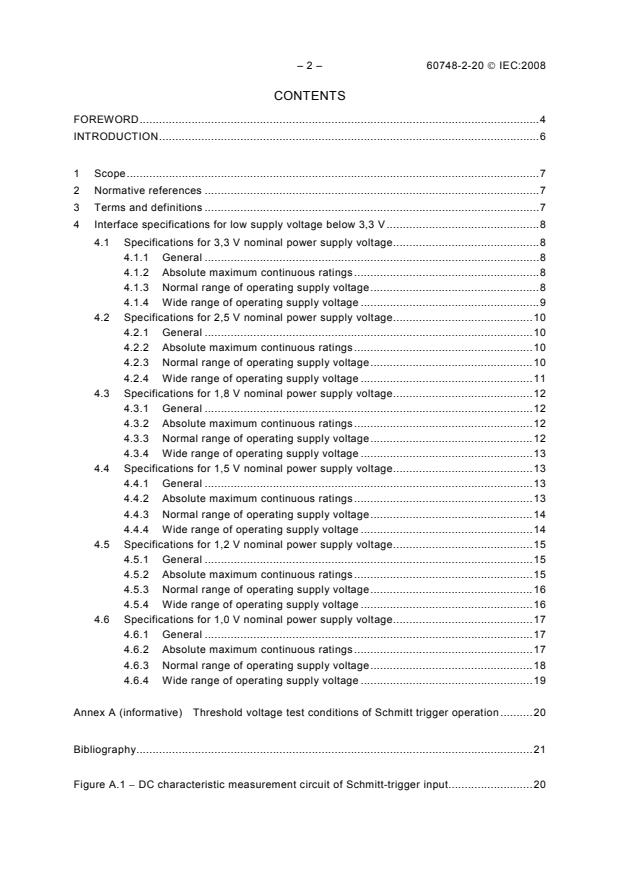
– 2 – 60748-2-20 © IEC:2008
CONTENTS
FOREWORD.4
INTRODUCTION.6
1 Scope.7
2 Normative references .7
3 Terms and definitions .7
4 Interface specifications for low supply voltage below 3,3 V .8
4.1 Specifications for 3,3 V nominal power supply voltage.8
4.1.1 General .8
4.1.2 Absolute maximum continuous ratings .8
4.1.3 Normal range of operating supply voltage.8
4.1.4 Wide range of operating supply voltage .9
4.2 Specifications for 2,5 V nominal power supply voltage.10
4.2.1 General .10
4.2.2 Absolute maximum continuous ratings .10
4.2.3 Normal range of operating supply voltage.10
4.2.4 Wide range of operating supply voltage .11
4.3 Specifications for 1,8 V nominal power supply voltage.12
4.3.1 General .12
4.3.2 Absolute maximum continuous ratings .12
4.3.3 Normal range of operating supply voltage.12
4.3.4 Wide range of operating supply voltage .13
4.4 Specifications for 1,5 V nominal power supply voltage.13
4.4.1 General .13
4.4.2 Absolute maximum continuous ratings .13
4.4.3 Normal range of operating supply voltage.14
4.4.4 Wide range of operating supply voltage .14
4.5 Specifications for 1,2 V nominal power supply voltage.15
4.5.1 General .15
4.5.2 Absolute maximum continuous ratings .15
4.5.3 Normal range of operating supply voltage.16
4.5.4 Wide range of operating supply voltage .16
4.6 Specifications for 1,0 V nominal power supply voltage.17
4.6.1 General .17
4.6.2 Absolute maximum continuous ratings .17
4.6.3 Normal range of operating supply voltage.18
4.6.4 Wide range of operating supply voltage .19
Annex A (informative) Threshold voltage test conditions of Schmitt trigger operation .20
Bibliography.21
Figure A.1 − DC characteristic measurement circuit of Schmitt-trigger input.20
60748-2-20 © IEC:2008 – 3 –
Table 1 – Absolute maximum continuous ratings for nominal 3,3 V .8
Table 2 – Operating conditions for 3,3 V normal range.8
Table 3 – Output characteristics for 3,3 V normal range.9
Table 4 – Operating conditions for 3,3 V wide range .9
Table 5 – Output characteristics for 3,3 V wide range .9
Table 6 – Absolute maximum continuous ratings for nominal 2,5 V .10
Table 7 – Operating conditions for 2,5 V normal range.10
Table 8 – Output characteristics for 2,5 V normal range.11
Table 9 – Operating conditions for 2,5 V wide range .11
Table 10 – Output characteristics for 2,5 V wide range .11
Table 11 – Absolute maximum continuous ratings for nominal 1,8 V .12
Table 12 – Operating conditions for 1,8 V normal range.12
Table 13 – Output characteristics for 1,8 V normal range.13
Table 14 – Operating conditions for 1,8 V wide range .13
Table 15 – Output characteristics for 1,8 V wide range .13
Table 16 – Absolute maximum continuous ratings for nominal 1,5 V .14
Table 17 – Operating conditions for 1,5 V normal range.14
Table 18 – Output characteristics for 1,5 V normal range.14
Table 19 – Operating conditions for 1,5 V wide range .15
Table 20 – Output characteristics for 1,5 V wide range .15
Table 21 – Absolute maximum continuous ratings for nominal 1,2 V .15
Table 22 – Operating conditions for 1,2 V normal range.16
Table 23 – Output characteristics for 1,2 V normal range.16
Table 24 – Operating conditions for 1,2 V wide range .17
Table 25 – Output characteristics for 1,2 V wide range .17
Table 26 – Absolute maximum continuous ratings for nominal 1,0 V .18
Table 27 – Operating conditions for 1,0 V normal range.18
Table 28 – Output characteristics for 1,0 V normal range.18
Table 29 – Operating conditions for 1,0 V wide range .19
Table 30 – Output characteristics for 1,0 V wide range .19
– 4 – 60748-2-20 © IEC:2008
INTERNATIONAL ELECTROTECHNICAL COMMISSION
____________
SEMICONDUCTOR DEVICES –
INTEGRATED CIRCUITS –
Part 2-20: Digital integrated circuits –
Family specification –
Low voltage integrated circuits
FOREWORD
1) The International Electrotechnical Commission (IEC) is a worldwide organization for standardization comprising
all national electrotechnical committees (IEC National Committees). The object of IEC is to promote
international co-operation on all questions concerning standardization in the electrical and electronic fields. To
this end and in addition to other activities, IEC publishes International Standards, Technical Specifications,
Technical Reports, Publicly Available Specifications (PAS) and Guides (hereafter referred to as “IEC
Publication(s)”). Their preparation is entrusted to technical committees; any IEC National Committee interested
in the subject dealt with may participate in this preparatory work. International, governmental and
non-governmental organizations liaising with the IEC also participate in this preparation. IEC collaborates
closely with the International Organization for Standardization (ISO) in accordance with conditions determined
by agreement between the two organizations.
2) The formal decisions or agreements of IEC on technical matters express, as nearly as possible, an international
consensus of opinion on the relevant subjects since each technical committee has representation from all
interested IEC National Committees.
3) IEC Publications have the form of recommendations for international use and are accepted by IEC National
Committees in that sense. While all reasonable efforts are made to ensure that the technical content of IEC
Publications is accurate, IEC cannot be held responsible for the way in which they are used or for any
misinterpretation by any end user.
4) In order to promote international uniformity, IEC National Committees undertake to apply IEC Publications
transparently to the maximum extent possible in their national and regional publications. Any divergence
between any IEC Publication and the corresponding national or regional publication shall be clearly indicated in
the latter.
5) IEC provides no marking procedure to indicate its approval and cannot be rendered responsible for any
equipment declared to be in conformity with an IEC Publication.
6) All users should ensure that they have the latest edition of this publication.
7) No liability shall attach to IEC or its directors, employees, servants or agents including individual experts and
members of its technical committees and IEC National Committees for any personal injury, property damage or
other damage of any nature whatsoever, whether direct or indirect, or for costs (including legal fees) and
expenses arising out of the publication, use of, or reliance upon, this IEC Publication or any other IEC
Publications.
8) Attention is drawn to the Normative references cited in this publication. Use of the referenced publications is
indispensable for the correct application of this publication.
9) Attention is drawn to the possibility that some of the elements of this IEC Publication may be the subject of
patent rights. IEC shall not be held responsible for identifying any or all such patent rights.
International Standard IEC 60748-2-20 has been prepared by subcommittee 47A: Integrated
circuits, of IEC technical committee 47: Semiconductor devices.
This second edition of IEC 60748-2-20 cancels and replaces the first edition published in
2000. This edition constitutes a technical revision.
This edition includes the following significant changes with respect to the previous edition:
– Expansion of power supply voltages down to nominal 1,0 V
– Addition of Schmitt-trigger input specification
60748-2-20 © IEC:2008 – 5 –
The text of this standard is based on the following documents:
CDV Report on voting
47A/770/CDV 47A/777A/RVC
Full information on the voting for the approval of this standard can be found in the report on
voting indicated in the above table.
This publication has been drafted in accordance with the ISO/IEC Directives, Part 2.
This standard is a family specification for low voltage integrated circuits.
A list of all the parts in the IEC 60748 series, under the general title Semiconductor devices –
Integrated circuits, can be found on the IEC website.
The committee has decided that the contents of this publication will remain unchanged until
the maintenance result date indicated on the IEC web site under "http://webstore.iec.ch" in
the data related to the specific publication. At this date, the publication will be
• reconfirmed,
• withdrawn,
• replaced by a revised edition, or
• amended.
– 6 – 60748-2-20 © IEC:2008
INTRODUCTION
The dimensions of integrated circuit devices are continuing to be reduced, both vertically and
horizontally, to obtain better performance and higher density. However, if the supply voltages
and interface levels are not reduced, the electric fields within the die (chip) will increase,
which leads to reduced reliability. These increased fields will also, together with the higher
system-clock rate, lead to increased electromagnetic interference and noise induced on the
supply leads and the ground plane, which leads to lower noise immunity and a higher
probability of malfunction. To continue this trend of scaling down the size of semiconductor
devices, lower power supply voltages are essential.
For systems operating at lower supply voltage, the tolerances on the supply voltage and the
input and output voltages must be specified more closely. Also, since the market for
battery-operated equipment is expected to grow considerably, it is important to include
specifications that cover this field. By setting standard values at this stage, manufacturing
costs can be reduced and users can design systems more economically.
After the publication of first edition of this standard, scaling of digital ICs has still been
drastically proceeding, and nowadays, state-of-the art digital ICs are operated at 1,2 V, and
Schmitt trigger interface is widely used. In light of the situation, this second edition expands
the specification of nominal power supply voltage down to 1,0 V and includes specifications of
Schmitt trigger interface.
60748-2-20 © IEC:2008 – 7 –
SEMICONDUCTOR DEVICES –
INTEGRATED CIRCUITS –
Part 2-20: Digital integrated circuits –
Family specification –
Low voltage integrated circuits
1 Scope
This standard aims at giving DC interface specifications for various sets of values, where
each comprises the nominal value of power supply voltage, its tolerance, and the worst-case
limit values of the input and output voltages for low voltage integrated circuits.
It also provides two categories of interface specification for each nominal supply voltage –
normal range and wide range. The normal range is based on the nominal industry standard
with typical tolerance of about 10 %. The wide range covers battery operation that extends the
lower limit to a practical value at which the battery will continue to operate.
2 Normative references
The following referenced documents are indispensable for the application of this document.
For dated references, only the edition cited applies. For undated references, the latest edition
of the referenced document (including any amendments) applies.
IEC 60748-2:1997, Semiconductor devices – Integrated circuits – Part 2: Digital integrated
circuits
3 Terms and definitions
For the purposes of this document, the following terms and definitions apply.
3.1
absolute maximum continuous ratings
conditions from which damage to the circuit may occur, if the circuit is exposed to such
conditions
3.2
operating conditions
conditions under which the circuit functions normally with appropriate degree of reliability
3.3
output characteristics
requirements for the circuit to fulfil under the operating condition
– 8 – 60748-2-20 © IEC:2008
4 Interface specifications for low supply voltage below 3,3 V
4.1 Specifications for 3,3 V nominal power supply voltage
4.1.1 General
These specifications apply to LVTTL- and LVCMOS-compatible circuits over the full operating
temperature range specified by manufacturer to be commercial, industrial, and/or military
grade.
4.1.2 Absolute maximum continuous ratings
Table 1 specifies absolute maximum continuous ratings of the circuits.
Table 1 – Absolute maximum continuous ratings for nominal 3,3 V
Parameters Symbol Min. Max. Unit
Power supply voltage V -0,5 4,6 V
DD
V + 0,5
DD
DC input voltage V -0,5 V
IN (4,6 V max)
V + 0,5
DD
DC output voltage V -0,5 V
OUT (4,6 V max)
a
Storage temperature range T — — °C
STG
a
Storage temperature range shall be specified by manufacturer for various purposes.
4.1.3 Normal range of operating supply voltage
Table 2 and Table 3 specify operating conditions and output characteristics for normal range
power supply, respectively.
Table 2 – Operating conditions for 3,3 V normal range
Parameters Symbol Min. Max. Unit
Power supply voltage V 3,0 3,6 V
DD
High-level input
V 2,0 V + 0,3 V
IH DD
voltage
Normal input
Low-level input
V -0,3 0,8 V
IL
voltage
Positive going
V 0,9 2,1 V
ITP
threshold voltage
Negative going
Schmitt trigger input
V 0,7 1,9 V
ITN
threshold voltage
Hysteresis voltage V 0,2 1,4 V
hys
a
Operating temperature range T — — °C
a
a
Operating temperature range shall be specified by manufacturer for various purposes.
60748-2-20 © IEC:2008 – 9 –
Table 3 – Output characteristics for 3,3 V normal range
LVTTL LVCMOS
Characteristics Symbol Condition Unit
Min. Max. Min. Max.
I = -2 mA 2,4 — — — V
OH
High-level output
V
OH
voltage
I = -100 μA — — V – 0,2 — V
OH DD
I = 2 mA — 0,4 — — V
OL
Low-level output
V
OL
voltage
I = 100 μA — — — 0,2 V
OL
4.1.4 Wide range of operating supply voltage
Table 4 and Table 5 specify operating conditions and output characteristics for wide range
power supply, respectively.
Table 4 – Operating conditions for 3,3 V wide range
Parameters Symbol Min. Max. Unit
Power supply voltage V 2,7 3,6 V
DD
High-level input
V 2,0 V + 0,3 V
IH DD
voltage
Normal input
Low-level input
V -0,3 0,8 V
IL
voltage
Positive going
V 0,9 2,1 V
ITP
threshold voltage
Negative going
Schmitt trigger input
V 0,7 1,9 V
ITN
threshold voltage
Hysteresis voltage V 0,2 1,4 V
hys
a
Operating temperature range T — — °C
a
a
Operating temperature range shall be specified by manufacturer for various purposes.
Table 5 – Output characteristics for 3,3 V wide range
LVCMOS
Characteristics Symbol Condition Unit
Min. Max.
High-level output voltage V I = -100 μA V – 0,2 — V
OH OH DD
Low-level output voltage V I = 100 μA — 0,2 V
OL OL
– 10 – 60748-2-20 © IEC:2008
4.2 Specifications for 2,5 V nominal power supply voltage
4.2.1 General
These specifications apply to CMOS-compatible circuits over the full operating temperature
range specified by manufacturer to be commercial, industrial, and/or military grade.
4.2.2 Absolute maximum continuous ratings
Table 6 specifies absolute maximum continuous ratings of the circuits.
Table 6 – Absolute maximum continuous ratings for nominal 2,5 V
Parameters Symbol Min. Max. Unit
Power supply voltage V -0,5 3,6 V
DD
V + 0,5
DD
DC input voltage V -0,5 V
IN
(3,6 V max)
V + 0,5
DD
DC output voltage V -0,5 V
OUT
(3,6 V max)
a
Storage temperature range T — — °C
STG
a
Storage temperature range shall be specified by manufacturer for various purposes.
4.2.3 Normal range of operating supply voltage
Table 7 and Table 8 specify operating conditions and output characteristics for normal range
power supply, respectively.
Table 7 – Operating conditions for 2,5 V normal range
Parameters Symbol Min. Max. Unit
Power supply voltage V 2,3 2,7 V
DD
High-level input
V 1,7 V + 0,3 V
IH DD
voltage
Normal input
Low-level input
V -0,3 0,7 V
IL
voltage
Positive going
V 0,9 1,7 V
ITP
threshold voltage
Schmitt trigger
Negative going
V 0,7 1,5 V
input
ITN
threshold voltage
Hysteresis voltage V 0,2 1,0 V
hys
a
Operating temperature range T — — °C
a
a
Operating temperature range shall be specified by manufacturer for various purposes.
60748-2-20 © IEC:2008 – 11 –
Table 8 – Output characteristics for 2,5 V normal range
Characteristics Symbol Condition Min. Max. Unit
2,1 — V
I = -100 μA
OH
High-level output voltage V
I = -1 mA 2,0 — V
OH
OH
I = -2 mA 1,7 — V
OH
I = 100 μA — 0,2 V
OL
Low-level output voltage V I = 1 mA — 0,4 V
OL OL
I = 2 mA — 0,7 V
OL
4.2.4 Wide range of operating supply voltage
Table 9 and Table 10 specify operating conditions and output characteristics for wide range
power supply, respectively.
Table 9 – Operating conditions for 2,5 V wide range
Parameters Symbol Min. Max. Unit
Power supply voltage V 1,8 2,7 V
DD
High-level input
V 0,7 x V V + 0,3 V
IH DD DD
voltage
Normal input
Low-level input
V -0,3 0,2 x V V
IL DD
voltage
Positive going
V 0,25 x V 0,75 x V V
ITP DD DD
threshold voltage
Negative going
Schmitt trigger input
V 0,15 x V 0,65 x V V
ITN DD DD
threshold voltage
Hysteresis voltage V 0,1 x V 0,6 x V V
hys DD DD
a
Operating temperature range T — — °C
a
a
Operating temperature range shall be specified by manufacturer for various purposes.
Table 10 – Output characteristics for 2,5 V wide range
Characteristics Symbol Condition Min. Max. Unit
High-level output voltage V I = -100 μA V – 0,2 — V
OH OH DD
Low-level output voltage V I = 100 μA — 0,2 V
OL OL
– 12 – 60748-2-20 © IEC:2008
4.3 Specifications for 1,8 V nominal power supply voltage
4.3.1 General
These specifications apply to CMOS-compatible circuits over the full operating temperature
range specified by manufacturer to be commercial, industrial, and/or military grade.
4.3.2 Absolute maximum continuous ratings
Table 11 specifies absolute maximum continuous ratings of the circuits.
Table 11 – Absolute maximum continuous ratings for nominal 1,8 V
Parameters Symbol Min. Max. Unit
Power supply voltage V -0,5 2,5 V
DD
V + 0,5
DD
DC input voltage V -0,5 V
IN
(2,5 V max)
V + 0,5
DD
DC output voltage V -0,5 V
OUT
(2,5 V max)
a
Storage temperature range T — — °C
STG
a
Storage temperature range shall be specified by manufacturer for various purposes.
4.3.3 Normal range of operating supply voltage
Table 12 and Table 13 specify operating conditions and output characteristics for normal
range power supply, respectively.
Table 12 – Operating conditions for 1,8 V normal range
Parameters Symbol Min. Max. Unit
Power supply voltage V 1,65 1,95 V
DD
High-level input
V 0,65 x V V + 0,3 V
IH DD DD
voltage
Normal input
Low-level input
V -0,3 0,35 x V V
IL DD
voltage
Positive going
V 0,4 x V 0,7 x V V
ITP DD DD
threshold voltage
Negative going
Schmitt trigger input
V 0,3 x V 0,6 x V V
ITN DD DD
threshold voltage
Hysteresis voltage V 0,1 x V 0,4 x V V
hys DD DD
a
Operating temperature range T — — °C
a
a
Operating temperature range shall be specified by manufacturer for various purposes.
60748-2-20 © IEC:2008 – 13 –
Table 13 – Output characteristics for 1,8 V normal range
Characteristics Symbol Condition Min. Max. Unit
High-level output voltage V I = -2 mA V – 0,45 — V
OH OH DD
Low-level output voltage V I = 2 mA — 0,45 V
OL OL
4.3.4 Wide range of operating supply voltage
Table 14 and Table 15 specify operating conditions and output characteristics for wide range
power supply, respectively.
Table 14 – Operating conditions for 1,8 V wide range
Parameters Symbol Min. Max. Unit
Power supply voltage V 1,2 1,95 V
DD
High-level input
V 0,7 x V V + 0,3 V
IH DD DD
voltage
Normal input
Low-level input
V -0,3 0,3 x V V
IL DD
voltage
Positive going
V 0,35 x V 0,75 x V V
ITP DD DD
threshold voltage
Negative going
Schmitt trigger input
V 0,25 x V 0,65 x V V
ITN DD DD
threshold voltage
Hysteresis voltage V 0,1 x V 0,5 x V V
hys DD DD
a
Operating temperature range T — — °C
a
a
Operating temperature range shall be specified by manufacturer for various purposes.
Table 15 – Output characteristics for 1,8 V wide range
Characteristics Symbol Condition Min. Max. Unit
High-level output voltage V I = -100 μA V – 0,2 - V
OH OH DD
Low-level output voltage V I = 100 μA — 0,2 V
OL OL
4.4 Specifications for 1,5 V nominal power supply voltage
4.4.1 General
These specifications apply to CMOS-compatible circuits over the full operating temperature
range specified by manufacturer to be commercial, industrial, and/or military grade.
4.4.2 Absolute maximum continuous ratings
Table 16 specifies absolute maximum continuous ratings of the circuits.
– 14 – 60748-2-20 © IEC:2008
Table 16 – Absolute maximum continuous ratings for nominal 1,5 V
Parameters Symbol Min. Max. Unit
Power supply voltage V -0,5 2,0 V
DD
V + 0,5
DD
DC input voltage V -0,5 V
IN
(2,0 V max)
V + 0,5
DD
DC output voltage V -0,5 V
OUT
(2,0 V max)
a
Storage temperature range T — — °C
STG
a
Storage temperature range shall be specified by manufacturer for various purposes.
4.4.3 Normal range of operating supply voltage
Table 17 and Table 18 specify operating conditions and output characteristics for normal
range power supply, respectively.
Table 17 – Operating conditions for 1,5 V normal range
Parameters Symbol Min. Max. Unit
Power supply voltage V 1,4 1,6 V
DD
High-level input
V 0,65 x V V + 0,3 V
IH DD DD
voltage
Normal input
Low-level input
V -0,3 0,35 x V V
IL DD
voltage
Positive going
V 0,4 x V 0,7 x V V
ITP DD DD
threshold voltage
Negative going
Schmitt trigger input
V 0,3 x V 0,6 x V V
ITN DD DD
threshold voltage
Hysteresis voltage V 0,1 x V 0,4 x V V
hys DD DD
a
Operating temperature range T — — °C
a
a
Operating temperature range shall be specified by manufacturer for various purposes.
Table 18 – Output characteristics for 1,5 V normal range
Characteristics Symbol Condition Min. Max. Unit
High-level output voltage V I = -2 mA 0,75 x V — V
OH OH DD
Low-level output voltage V I = 2 mA — 0,25 x V V
OL OL DD
4.4.4 Wide range of operating supply voltage
Table 19 and Table 20 specify operating conditions and output characteristics for wide range
power supply, respectively.
60748-2-20 © IEC:2008 – 15 –
Table 19 – Operating conditions for 1,5 V wide range
Parameters Symbol Min. Max. Unit
Power supply voltage V 0,9 1,6 V
DD
High-level input
V 0,7 x V V + 0,3 V
IH DD DD
voltage
Normal input
Low-level input
V -0,3 0,3 x V V
IL DD
voltage
Positive going
V 0,35 x V 0,75 x V V
ITP DD DD
threshold voltage
Negative going
Schmitt trigger input
V 0,25 x V 0,65 x V V
ITN DD DD
threshold voltage
Hysteresis voltage V 0,1 x V 0,5 x V V
hys DD DD
a
Operating temperature range T — — °C
a
a
Operating temperature range shall be specified by manufacturer for various purposes.
Table 20 – Output characteristics for 1,5 V wide range
Characteristics Symbol Condition Min. Max. Unit
High-level output voltage V V – 0,2 — V
I = -100 μA
OH DD
OH
Low-level output voltage V I = 100 μA — 0,2 V
OL OL
4.5 Specifications for 1,2 V nominal power supply voltage
4.5.1 General
These specifications apply to CMOS-compatible circuits over the full operating temperature
range specified by manufacturer to be commercial, industrial, and/or military grade.
4.5.2 Absolute maximum continuous ratings
Table 21 specifies absolute maximum continuous ratings of the circuits.
Table 21 – Absolute maximum continuous ratings for nominal 1,2 V
Parameters Symbol Min. Max. Unit
Power supply voltage V -0,5 1,8 V
DD
V + 0,5
DD
DC input voltage V -0,5 V
IN
(1,8 V max)
V + 0,5
DD
DC output voltage V -0,5 V
OUT
(1,8 V max)
a
Storage temperature range T — — °C
STG
a
Storage temperature range shall be specified by manufacturer for various purposes.
– 16 – 60748-2-20 © IEC:2008
4.5.3 Normal range of operating supply voltage
Table 22 and Table 23 specify operating conditions and output characteristics for normal
range power supply, respectively.
Table 22 – Operating conditions for 1,2 V normal range
Parameters Symbol Min. Max. Unit
Power supply voltage V 1,1 1,3 V
DD
High-level input
V 0,65 x V V + 0,3 V
IH DD DD
voltage
Normal input
Low-level input
V -0,3 0,35 x V V
IL DD
voltage
Positive going
V 0,4 x V 0,7 x V V
ITP DD DD
threshold voltage
Negative going
Schmitt trigger input
V 0,3 x V 0,6 x V V
ITN DD DD
threshold voltage
Hysteresis voltage V 0,1 x V 0,4 x V V
hys DD DD
a
Operating temperature range T — — °C
a
a
Operating temperature range shall be specified by manufacturer for various purposes.
Table 23 – Output characteristics for 1,2 V normal range
Characteristics Symbol Condition Min. Max. Unit
High-level output voltage V I = -2 mA 0,75 x V — V
OH OH DD
Low-level output voltage V I = 2 mA — 0,25 x V V
OL OL DD
4.5.4 Wide range of operating supply voltage
Table 24 and Table 25 specify operating conditions and output characteristics for wide range
power supply, respectively.
60748-2-20 © IEC:2008 – 17 –
Table 24 – Operating conditions for 1,2 V wide range
Parameters Symbol Min. Max. Unit
Power supply voltage V 0,8 1,3 V
DD
High-level input
V 0,7 x V V + 0,3 V
IH DD DD
voltage
Normal input
Low-level input
V -0,3 0,3 x V V
IL DD
voltage
Positive going
V 0,35 x V 0,75 x V V
ITP DD DD
threshold voltage
Negative going
Schmitt trigger input
V 0,25 x V 0,65 x V V
ITN DD DD
threshold voltage
Hysteresis voltage V 0,1 x V 0,5 x V V
hys DD DD
a
Operating temperature range T — — °C
a
a
Operating temperature range shall be specified by manufacturer for various purposes.
Table 25 – Output characteristics for 1,2 V wide range
Characteristics Symbol Condition Min. Max. Unit
High-level output voltage V V – 0,1 — V
I = -100 μA
OH DD
OH
Low-level output voltage V I = 100 μA — 0,1 V
OL OL
4.6 Specifications for 1,0 V nominal power supply voltage
4.6.1 General
These specifications apply to CMOS-compatible circuits over the full operating temperature
range specified by manufacturer to be commercial, industrial, and/or military grade.
4.6.2 Absolute maximum continuous ratings
Table 26 specifies absolute maximum continuous ratings of the circuits.
– 18 – 60748-2-20 © IEC:2008
Table 26 – Absolute maximum continuous ratings for nominal 1,0 V
Parameters Symbol Min. Max. Unit
a
Power supply voltage V -0,4 1,4 V
DD
V + 0,4
DD
DC input voltage V -0,4 V
IN
(1,4 V max)
V + 0,4
DD
DC output voltage V -0,4 V
OUT
(1,4 V max)
b
Storage temperature range T — — °C
STG
a
The maximum voltage allowed between any two signals (input, output or input/output) pins or any signal pin
and V shall be less than 1,6 V.
DD
b
Storage temperature range shall be specified by manufacturer for various purposes.
4.6.3 Normal range of operating supply voltage
Table 27 and Table 28 specify operating conditions and output characteristics for normal
range power supply, respectively.
Table 27 – Operating conditions for 1,0 V normal range
Parameters Symbol Min. Max. Unit
Power supply voltage V 0,9 1,1 V
DD
High-level input
V 0,65 x V V + 0,2 V
IH DD DD
voltage
Normal input
Low-level input
V -0,2 0,35 x V V
IL DD
voltage
Positive going
V 0,4 x V 0,7 x V V
ITP DD DD
threshold voltage
Negative going
Schmitt trigger input
V 0,3 x V 0,6 x V V
ITN DD DD
threshold voltage
Hysteresis voltage V 0,1 x V 0,4 x V V
hys DD DD
a
Operating temperature range T — — °C
a
a
Operating temperature range shall be specified by manufacturer for various purposes.
Table 28 – Output characteristics for 1,0 V normal range
Characteristics Symbol Condition Min. Max. Unit
High-level output voltage V I = -2 mA 0,75 x V — V
OH OH DD
Low-level output voltage V I = 2 mA — 0,25 x V V
OL OL DD
60748-2-20 © IEC:2008 – 19 –
4.6.4 Wide range of operating supply voltage
Table 29 and Table 30 specify operating conditions and output characteristics for wide range
power supply, respectively.
Table 29 – Operating conditions for 1,0 V wide range
Parameters Symbol Min. Max. Unit
Power supply voltage V 0,7 1,1 V
DD
High-level input
V 0,7 x V V + 0,2 V
IH DD DD
voltage
Normal input
Low-level input
V -0,2 0,3 x V V
IL DD
voltage
Positive going
V 0,35 x V 0,75 x V V
ITP DD DD
threshold voltage
Negative going
Schmitt trigger input
V 0,25 x V 0,65 x V V
ITN DD DD
threshold voltage
Hysteresis voltage V 0,1 x V 0,5 x V V
hys DD DD
a
Operating temperature range T — — °C
a
a
Operating temperature range shall be specified by manufacturer for various purposes.
Table 30 – Output characteristics for 1,0 V wide range
Characteristics Symbol Condition Min. Max. Unit
High-level output voltage V I = -100 μA V – 0,1 — V
OH OH DD
Low-level output voltage V = 100 μA — 0,1 V
I
OL OL
– 20 – 60748-2-20 © IEC:2008
Annex A
(informative)
Threshold voltage test conditions of Schmitt trigger operation
A.1 Introduction
This annex gives an example of measurement method for DC characteristics of Schmitt
trigger input. The DUT is a Schmitt trigger input IC with inverted output.
A.2 Threshold voltages: V V
,
ITP ITN
The input signal is raised from a ground level in the measurement circuit shown in Figure A.1,
and the input voltage value for which the output logic state changes is determined as V .
ITP
The input signal is dropped from a power supply voltage level in the measurement circuit
shown in Figure A.1, and the input voltage value for which the output logic state changes is
determined as V .
ITN
A.3 Hysteresis voltage: V
hys
The hysteresis voltage can be obtained only from calculation: V – V .
ITP ITN
The details are given in Chapter III of IEC 60748-2.
V
DD
Input Output
A
V
IEC 341/08
Figure A.1 − DC characteristic measurement circuit of Schmitt-trigger input
60748-2-20 © IEC:2008 – 21 –
Bibliography
JEDEC Standard JESD8-C, Interface Standard for Nominal 3 V/3.3 V Supply Digital
Integrated Circuits
JEDEC Standard JESD8-5A, 2.5 V ± 0.2 V (Normal Range) and 1.8 V − 2.7 V (Wide Range)
Power Supply Voltage and Interface Standard for Non-terminated Digital Integrated Circuits
JEDEC Standard JESD8-7A, 1.8 V ± 0.15 V (Normal Range) and 1.2 V − 1.95 V (Wide Range)
Power Supply Voltage and Interface Standard for Non-terminated Digital Integrated Circuits
JEDEC Standard JESD8-11A, 1.5 V ± 0.1 V (Normal Range) and 0.9 V − 1.6 V (Wide Range)
Power Supply Voltage and Interface Standard for Non-terminated Digital Integrated Circuits
JEDEC Standard JESD8-12A, 1.2 V ± 0.1 V (Normal Range) and 0.8 V − 1.3 V (Wide Range)
Power Supply Voltage and Interface Standard for Non-terminated Digital Integrated Circuits
JEDEC Standard JESD8-14A, 1.0 V ± 0.1 V (Normal Range) and 0.7 V − 1.1 V (Wide Range)
Power Supply Voltage and Interface Standard for Non-terminated Digital Integrated Circuits
___________
– 22 – 60748-2-20 © CEI:2008
SOMMAIRE
AVANT-PROPOS.24
INTRODUCTION.26
1 Domaine d’application .27
2 Références normatives.27
3 Termes et définitions .27
4 Spécifications d’interface pour une basse tension d’alimentation inférieure à 3,3 V .28
4.1 Spécifications pour une tension d’alimentation nominale de 3,3 V .28
4.1.1 Généralités.28
4.1.2 Caractéristiques en régime continu maximales absolues .28
4.1.3 Gamme normale de tensions d’alimentation de fonctionnement .28
4.1.4 Gamme étendue de tensions d’alimentation de fonctionnement .29
4.2 Spécifications pour une tension d’alimentation nominale de 2,5 V .30
4.2.1 Généralités.30
4.2.2 Caractéristiques en régime continu maximales absolues .30
4.2.3 Gamme normale de tensions d’alimentation de fonctionnement .30
4.2.4 Gamme étendue de tensions d’alimentation de fonctionnement .31
4.3 Spécifications pour une tension d’alimentation nominale de 1,8 V .32
4.3.1 Généralités.32
4.3.2 Caractéristiques en régime continu maximales absolues .32
4.3.3 Gamme normale de tensions d’alimentation de fonctionnement .32
4.3.4 Gamme étendue de tensions d’alimentation de fonctionnement .33
4.4 Spécifications pour une tension d’alimentation nominale de 1,5 V .33
4.4.1 Généralités.33
4.4.2 Caractéristiques en régime continu maximales absolues .33
4.4.3 Gamme normale de tensions d’alimentation de fonctionnement .34
4.4.4 Gamme étendue de tensions d’alimentation de fonctionnement .34
4.5 Spécifications pour une tension d’alimentation nominale de 1,2 V .35
4.5.1 Généralités.35
4.5.2 Caractéristiques en régime continu maximales absolues .35
4.5.3 Gamme normale de tensions d’alimentation de fonctionnement .36
4.5.4 Gamme étendue de tensions d’alimentation de fonctionnement .36
4.6 Spécifications pour une tension d’alimentation nominale de 1,0 V .37
4.6.1 Généralités.
...