

IEC 61967-8:2023
(Main)Integrated circuits - Measurement of electromagnetic emissions - Part 8: Measurement of radiated emissions - IC stripline method
General Information
- Abstract
IEC 61967-8:2023 defines a method for measuring the electromagnetic radiated emission from an integrated circuit (IC) using an IC stripline. The IC being evaluated is mounted on an EMC test board (PCB) between the active conductor and the ground plane of the IC stripline arrangement. This edition includes the following significant technical changes with respect to the previous edition:
a) frequency range of 150 kHz to 3 GHz was deleted from the scope;
b) extension of upper usable frequency to 6 GHz or higher as long as the defined requirements are fulfilled.
- Status
- Published
- Publication Date
- 02-May-2023
- Technical Committee
- SC 47A - Integrated circuits
- Drafting Committee
- WG 9 - TC 47/SC 47A/WG 9
- Current Stage
- PPUB - Publication issued
- Start Date
- 03-May-2023
- Completion Date
- 02-Jun-2023
Buy Documents
IEC 61967-8:2023 RLV - Integrated circuits - Measurement of electromagnetic emissions - Part 8: Measurement of radiated emissions - IC stripline method Released:5/3/2023
IEC 61967-8:2023 - Integrated circuits - Measurement of electromagnetic emissions - Part 8: Measurement of radiated emissions - IC stripline method Released:5/3/2023
Overview
IEC 61967-8:2023 - Integrated circuits - Measurement of electromagnetic emissions - Part 8: Measurement of radiated emissions - IC stripline method - defines a standardized method to measure radiated electromagnetic emissions from an integrated circuit (IC) using an IC stripline. The device-under-test (DUT) is mounted on an EMC test board (PCB) between the stripline active conductor and the ground plane. The 2023 edition removes the previously stated 150 kHz–3 GHz scope and extends the upper usable frequency to 6 GHz or higher where the defined requirements are satisfied.
Key topics and technical requirements
- Test principle: TEM waveguide measurement based on IEC 61000-4-20; the stripline guides a transverse electromagnetic (TEM) mode to produce a defined field between active conductor and ground.
- Test set-up: IC mounted on a standard EMC test board between active conductor and enlarged ground plane; optional shielded enclosure (open vs closed stripline).
- Equipment & measurements: RF measuring instruments, preamplifiers, 50 Ω terminations, and system gain verification are addressed to ensure repeatable radiated emission measurements.
- Test conditions: Defined supply voltage, ambient conditions, operational checks, and stripline RF characteristic verification prior to measurement.
- Frequency capability: Upper usable frequency extended to 6 GHz or above if stripline and test equipment meet the standard’s requirements.
- Reporting: Requirements for test reports, measurement conditions, and presentation of IC emissions reference levels.
- Annexes: Normative description of IC stripline geometry and characteristic impedance, plus informative guidance on emission level specification and result presentation.
Practical applications and who uses this standard
IEC 61967-8 is intended for:
- IC manufacturers performing radiated emission characterization and design-for-EMC checks.
- EMC test laboratories implementing repeatable, comparable stripline measurements for integrated circuits.
- Design and compliance engineers validating PCB/IC packaging interactions and pre-compliance testing.
- Regulatory and certification bodies requiring standardized, traceable measurement methods for IC-level emissions.
Benefits include reproducible IC-level radiated emission data, earlier EMC risk identification, and a standardized basis for comparing IC designs or process variations.
Related Standards (if applicable)
- IEC 61967-1 - Integrated circuits - Measurement of electromagnetic emissions - Part 1: General conditions and definitions
- IEC 61967-2 - Measurement of radiated emissions - TEM cell and wideband TEM cell method
- IEC 61000-4-20 - EMC - Emission and immunity testing in TEM waveguides
Keywords: IEC 61967-8, IC stripline, radiated emissions, integrated circuits, EMC test board, PCB, TEM waveguide, 6 GHz, EMC testing, radiated emission measurement.
Relations
- Effective Date
- 05-Sep-2023
Buy Documents
IEC 61967-8:2023 RLV - Integrated circuits - Measurement of electromagnetic emissions - Part 8: Measurement of radiated emissions - IC stripline method Released:5/3/2023
IEC 61967-8:2023 - Integrated circuits - Measurement of electromagnetic emissions - Part 8: Measurement of radiated emissions - IC stripline method Released:5/3/2023
Frequently Asked Questions
IEC 61967-8:2023 is a standard published by the International Electrotechnical Commission (IEC). Its full title is "Integrated circuits - Measurement of electromagnetic emissions - Part 8: Measurement of radiated emissions - IC stripline method". This standard covers: IEC 61967-8:2023 defines a method for measuring the electromagnetic radiated emission from an integrated circuit (IC) using an IC stripline. The IC being evaluated is mounted on an EMC test board (PCB) between the active conductor and the ground plane of the IC stripline arrangement. This edition includes the following significant technical changes with respect to the previous edition: a) frequency range of 150 kHz to 3 GHz was deleted from the scope; b) extension of upper usable frequency to 6 GHz or higher as long as the defined requirements are fulfilled.
IEC 61967-8:2023 defines a method for measuring the electromagnetic radiated emission from an integrated circuit (IC) using an IC stripline. The IC being evaluated is mounted on an EMC test board (PCB) between the active conductor and the ground plane of the IC stripline arrangement. This edition includes the following significant technical changes with respect to the previous edition: a) frequency range of 150 kHz to 3 GHz was deleted from the scope; b) extension of upper usable frequency to 6 GHz or higher as long as the defined requirements are fulfilled.
IEC 61967-8:2023 is classified under the following ICS (International Classification for Standards) categories: 31.200 - Integrated circuits. Microelectronics. The ICS classification helps identify the subject area and facilitates finding related standards.
IEC 61967-8:2023 has the following relationships with other standards: It is inter standard links to IEC 61967-8:2011. Understanding these relationships helps ensure you are using the most current and applicable version of the standard.
IEC 61967-8:2023 is available in PDF format for immediate download after purchase. The document can be added to your cart and obtained through the secure checkout process. Digital delivery ensures instant access to the complete standard document.
Standards Content (Sample)
IEC 61967-8 ®
Edition 2.0 2023-05
REDLINE VERSION
INTERNATIONAL
STANDARD
colour
inside
Integrated circuits – Measurement of electromagnetic emissions –
Part 8: Measurement of radiated emissions – IC stripline method
All rights reserved. Unless otherwise specified, no part of this publication may be reproduced or utilized in any form
or by any means, electronic or mechanical, including photocopying and microfilm, without permission in writing from
either IEC or IEC's member National Committee in the country of the requester. If you have any questions about IEC
copyright or have an enquiry about obtaining additional rights to this publication, please contact the address below or
your local IEC member National Committee for further information.
IEC Secretariat Tel.: +41 22 919 02 11
3, rue de Varembé info@iec.ch
CH-1211 Geneva 20 www.iec.ch
Switzerland
About the IEC
The International Electrotechnical Commission (IEC) is the leading global organization that prepares and publishes
International Standards for all electrical, electronic and related technologies.
About IEC publications
The technical content of IEC publications is kept under constant review by the IEC. Please make sure that you have the
latest edition, a corrigendum or an amendment might have been published.
IEC publications search - webstore.iec.ch/advsearchform IEC Products & Services Portal - products.iec.ch
The advanced search enables to find IEC publications by a Discover our powerful search engine and read freely all the
variety of criteria (reference number, text, technical publications previews. With a subscription you will always have
committee, …). It also gives information on projects, replaced access to up to date content tailored to your needs.
and withdrawn publications.
Electropedia - www.electropedia.org
IEC Just Published - webstore.iec.ch/justpublished
The world's leading online dictionary on electrotechnology,
Stay up to date on all new IEC publications. Just Published
containing more than 22 300 terminological entries in English
details all new publications released. Available online and once
and French, with equivalent terms in 19 additional languages.
a month by email.
Also known as the International Electrotechnical Vocabulary
(IEV) online.
IEC Customer Service Centre - webstore.iec.ch/csc
If you wish to give us your feedback on this publication or need
further assistance, please contact the Customer Service
Centre: sales@iec.ch.
IEC 61967-8 ®
Edition 2.0 2023-05
REDLINE VERSION
INTERNATIONAL
STANDARD
colour
inside
Integrated circuits – Measurement of electromagnetic emissions –
Part 8: Measurement of radiated emissions – IC stripline method
INTERNATIONAL
ELECTROTECHNICAL
COMMISSION
ICS 31.200 ISBN 978-2-8322-6986-2
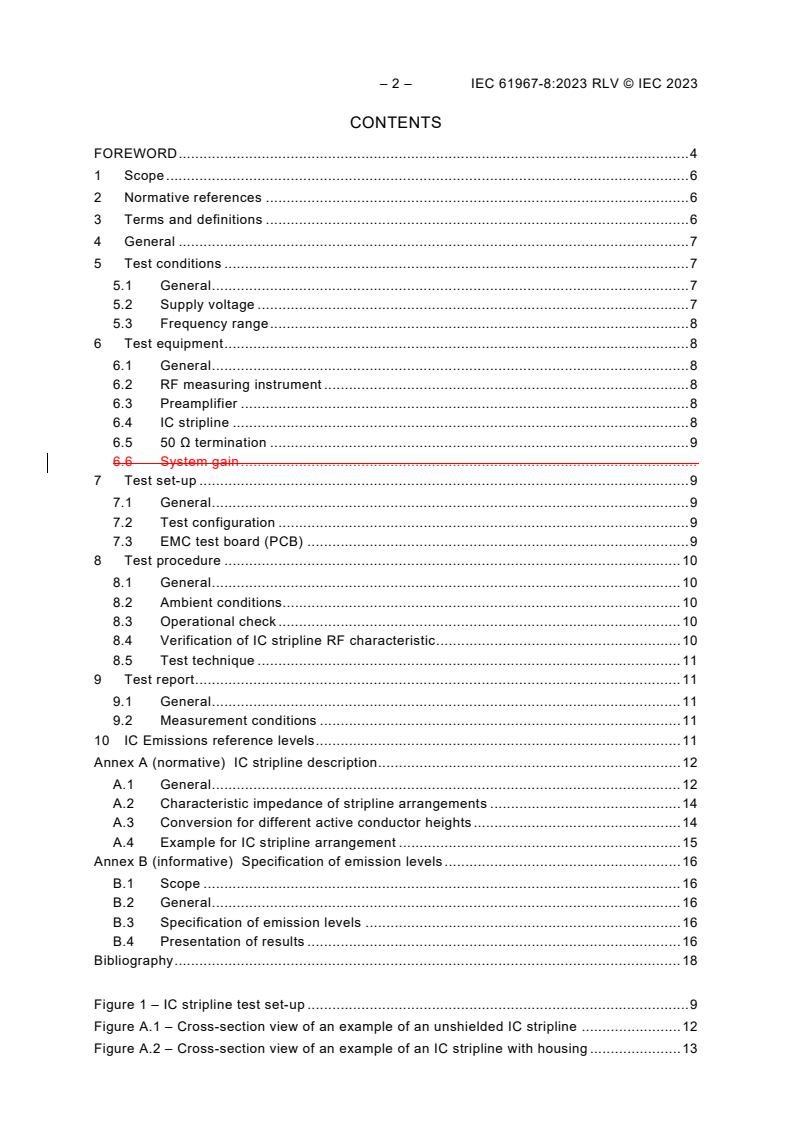
– 2 – IEC 61967-8:2023 RLV © IEC 2023
CONTENTS
FOREWORD . 4
1 Scope . 6
2 Normative references . 6
3 Terms and definitions . 6
4 General . 7
5 Test conditions . 7
5.1 General . 7
5.2 Supply voltage . 7
5.3 Frequency range . 8
6 Test equipment . 8
6.1 General . 8
6.2 RF measuring instrument . 8
6.3 Preamplifier . 8
6.4 IC stripline . 8
6.5 50 Ω termination . 9
6.6 System gain .
7 Test set-up . 9
7.1 General . 9
7.2 Test configuration . 9
7.3 EMC test board (PCB) . 9
8 Test procedure . 10
8.1 General . 10
8.2 Ambient conditions. 10
8.3 Operational check . 10
8.4 Verification of IC stripline RF characteristic . 10
8.5 Test technique . 11
9 Test report . 11
9.1 General . 11
9.2 Measurement conditions . 11
10 IC Emissions reference levels . 11
Annex A (normative) IC stripline description . 12
A.1 General . 12
A.2 Characteristic impedance of stripline arrangements . 14
A.3 Conversion for different active conductor heights . 14
A.4 Example for IC stripline arrangement . 15
Annex B (informative) Specification of emission levels . 16
B.1 Scope . 16
B.2 General . 16
B.3 Specification of emission levels . 16
B.4 Presentation of results . 16
Bibliography . 18
Figure 1 – IC stripline test set-up . 9
Figure A.1 – Cross-section view of an example of an unshielded IC stripline . 12
Figure A.2 – Cross-section view of an example of an IC stripline with housing . 13
Figure A.3 – Example of IC stripline with housing . 15
Figure B.1 – Emission characterization levels . 17
Table A.1 – Maximum DUT dimensions for 6,7 mm IC stripline open version. 13
Table A.2 – Maximum DUT dimensions for 6,7 mm IC stripline closed version . 14
– 4 – IEC 61967-8:2023 RLV © IEC 2023
INTERNATIONAL ELECTROTECHNICAL COMMISSION
____________
INTEGRATED CIRCUITS –
MEASUREMENT OF ELECTROMAGNETIC EMISSIONS –
Part 8: Measurement of radiated emissions –
IC stripline method
FOREWORD
1) The International Electrotechnical Commission (IEC) is a worldwide organization for standardization comprising
all national electrotechnical committees (IEC National Committees). The object of IEC is to promote international
co-operation on all questions concerning standardization in the electrical and electronic fields. To this end and
in addition to other activities, IEC publishes International Standards, Technical Specifications, Technical Reports,
Publicly Available Specifications (PAS) and Guides (hereafter referred to as "IEC Publication(s)"). Their
preparation is entrusted to technical committees; any IEC National Committee interested in the subject dealt with
may participate in this preparatory work. International, governmental and non-governmental organizations liaising
with the IEC also participate in this preparation. IEC collaborates closely with the International Organization for
Standardization (ISO) in accordance with conditions determined by agreement between the two organizations.
2) The formal decisions or agreements of IEC on technical matters express, as nearly as possible, an international
consensus of opinion on the relevant subjects since each technical committee has representation from all
interested IEC National Committees.
3) IEC Publications have the form of recommendations for international use and are accepted by IEC National
Committees in that sense. While all reasonable efforts are made to ensure that the technical content of IEC
Publications is accurate, IEC cannot be held responsible for the way in which they are used or for any
misinterpretation by any end user.
4) In order to promote international uniformity, IEC National Committees undertake to apply IEC Publications
transparently to the maximum extent possible in their national and regional publications. Any divergence between
any IEC Publication and the corresponding national or regional publication shall be clearly indicated in the latter.
5) IEC itself does not provide any attestation of conformity. Independent certification bodies provide conformity
assessment services and, in some areas, access to IEC marks of conformity. IEC is not responsible for any
services carried out by independent certification bodies.
6) All users should ensure that they have the latest edition of this publication.
7) No liability shall attach to IEC or its directors, employees, servants or agents including individual experts and
members of its technical committees and IEC National Committees for any personal injury, property damage or
other damage of any nature whatsoever, whether direct or indirect, or for costs (including legal fees) and
expenses arising out of the publication, use of, or reliance upon, this IEC Publication or any other IEC
Publications.
8) Attention is drawn to the Normative references cited in this publication. Use of the referenced publications is
indispensable for the correct application of this publication.
9) Attention is drawn to the possibility that some of the elements of this IEC Publication may be the subject of patent
rights. IEC shall not be held responsible for identifying any or all such patent rights.
This redline version of the official IEC Standard allows the user to identify the changes
made to the previous edition IEC 61967-8:2011. A vertical bar appears in the margin
wherever a change has been made. Additions are in green text, deletions are in
strikethrough red text.
IEC 61967-8 has been prepared by subcommittee 47A: Integrated circuits, of IEC technical
committee 47: Semiconductor devices. It is an International Standard.
This second edition cancels and replaces the first edition published in 2011. This edition
constitutes a technical revision.
This edition includes the following significant technical changes with respect to the previous
edition:
a) frequency range of 150 kHz to 3 GHz was deleted from the scope;
b) extension of upper usable frequency to 6 GHz or higher as long as the defined requirements
are fulfilled.
The text of this International Standard is based on the following documents:
Draft Report on voting
47A/1152/FDIS 47A/1153/RVD
Full information on the voting for its approval can be found in the report on voting indicated in
the above table.
The language used for the development of this International Standard is English.
This document was drafted in accordance with ISO/IEC Directives, Part 2, and developed in
accordance with ISO/IEC Directives, Part 1 and ISO/IEC Directives, IEC Supplement, available
at www.iec.ch/members_experts/refdocs. The main document types developed by IEC are
described in greater detail at www.iec.ch/publications.
A list of all parts of the IEC 61967 series, under the general title Integrated circuits –
Measurement of electromagnetic emissions can be found on the IEC website.
Future standards in this series will carry the new general title as cited above. Titles of existing
standards in this series will be updated at the time of the next edition.
The committee has decided that the contents of this document will remain unchanged until the
stability date indicated on the IEC website under webstore.iec.ch in the data related to the
specific document. At this date, the document will be
• reconfirmed,
• withdrawn,
• replaced by a revised edition, or
• amended.
IMPORTANT – The "colour inside" logo on the cover page of this document indicates that it
contains colours which are considered to be useful for the correct understanding of its
contents. Users should therefore print this document using a colour printer.
– 6 – IEC 61967-8:2023 RLV © IEC 2023
INTEGRATED CIRCUITS –
MEASUREMENT OF ELECTROMAGNETIC EMISSIONS –
Part 8: Measurement of radiated emissions –
IC stripline method
1 Scope
The measurement procedure of This part of IEC 61967 defines a method for measuring the
electromagnetic radiated emission from an integrated circuit (IC) using an IC stripline in the
frequency range of 150 kHz up to 3 GHz. The IC being evaluated is mounted on an EMC test
board (PCB) between the active conductor and the ground plane of the IC stripline arrangement.
2 Normative references
The following documents are referred to in the text in such a way that some or all of their content
constitutes requirements of this document. For dated references, only the edition cited applies.
For undated references, the latest edition of the referenced document (including any
amendments) applies.
IEC 60050-131, International Electrotechnical Vocabulary (IEV) – Part 131: Circuit theory
IEC 60050-161, International Electrotechnical Vocabulary (IEV) – Chapter 161: Electro-
magnetic compatibility
IEC 61967-1, Integrated circuits – Measurement of electromagnetic emissions, 150 kHz to
1 GHz – Part 1: General conditions and definitions
IEC 61967-2: Integrated circuits – Measurement of electromagnetic emissions, 150 kHz to
1 GHz – Part 2: Measurement of radiated emissions – TEM cell and wideband TEM cell method
IEC 61000-4-20, Electromagnetic compatibility (EMC) – Part 4-20: Testing and measurement
techniques – Emission and immunity testing in transverse electromagnetic (TEM) waveguides
3 Terms and definitions
For the purposes of this document, the terms and definitions given in IEC 61967-1,
IEC 60050-131 and IEC 60050-161, and the following apply.
ISO and IEC maintain terminology databases for use in standardization at the following
addresses:
• IEC Electropedia: available at https://www.electropedia.org/
• ISO Online browsing platform: available at https://www.iso.org/obp
3.1
transverse electromagnetic mode
TEM mode
waveguide mode in which the components of the electric and magnetic fields in the propagation
direction are much less than the primary field components across any transverse cross-section
3.2
TEM waveguide
open or closed transmission line system, in which a wave is propagating in the transverse
electromagnetic mode to produce a specified field for testing purposes
3.3
IC stripline
TEM waveguide, consisting of an active conductor placed on a defined spacing over an enlarged
ground plane, connected to a port structure on each either end and an optional shielded
enclosure
Note 1 to entry: This arrangement guides a wave propagation in the transverse electromagnetic mode to produce
a specific field for testing purposes between the active conductor and the enlarged ground plane. As enlarged ground
plane the ground plane of the standard EMC test board according to IEC 61967-1 should be used. An optional
shielding enclosure may be used for fixing the IC stripline configuration and for shielding purposes. This leads to a
closed version of the IC stripline in opposite to the open version without shielding enclosure. For further information,
see Annex A.
3.4
two-port TEM waveguide
TEM waveguide with input/output measurement ports at both ends
3.5
characteristic impedance
magnitude of the ratio of the voltage between the active conductor and the corresponding
ground plane to the current on either conductor for any constant phase wave-front
Note 1 to entry: The characteristic impedance is independent of the voltage/current magnitudes and depends only
on the cross-sectional geometry of the transmission line. TEM waveguides are typically designed to have a 50 Ω
characteristic impedance. For further information and equation to stripline arrangements, see Annex A.
3.6
primary (field) component
electric field component aligned with the intended test polarization
Note 1 to entry: For example, in IC stripline, the active conductor is parallel to the horizontal floor, and the primary
mode electric field vector is vertical at the transverse centre of the IC stripline.
4 General
This test method is based on the TEM wave guide measurement principle according to
IEC 61000-4-20. A stripline set-up is used to measure the RF emission of ICs. The RF voltage
at the stripline port is related to the electromagnetic radiation potential of the IC and will be
measured using a spectrum analyzer or measuring receiver. The intent of this test method is to
provide a quantitative measure of the RF emissions from ICs for comparison or other evaluation.
5 Test conditions
5.1 General
The test conditions shall meet the requirements as described in IEC 61967-1. In addition, the
following test conditions described in 5.2 and 5.3 shall apply.
5.2 Supply voltage
The supply voltage shall be as specified by the IC manufacturer. If the users of this procedure
agree to other values, they shall be documented in the test report.
– 8 – IEC 61967-8:2023 RLV © IEC 2023
5.3 Frequency range
The effective frequency range for the IC stripline is 150 kHz to 6 GHz in combination with the
VSWR characteristic ≤ 1,25 for f ≤ 3 GHz and ≤ 1,4 for f > 3 GHz. The range is limited by its
Voltage Standing Wave Ratio (VSWR) characteristics (≤ 1,25). The upper frequency can be
extended if the IC stripline does not exhibit significant higher order modes over the frequency
range being measured.
NOTE The given VSWR value of 1,4 is based on evolving technical solutions for IC striplines. For accuracy reasons
the VSWR value is targeted as low as possible (e.g. 1,3).
6 Test equipment
6.1 General
The test equipment shall meet the requirements as described in IEC 61967-1. In addition, the
test equipment requirements described in 6.2 to 6.5 shall apply.
6.2 RF measuring instrument
A spectrum analyzer or EMI receiver shall be used. The resolution bandwidth shall be 9 kHz for
EMI receivers or 10 kHz for spectrum analyzers in the frequency range from 150 kHz to 30 MHz
and respectively 120 kHz or 100 kHz above 30 MHz according to IEC 61967-1. Measurements
shall be made with a peak detector and presented in units of dBµV [for 50 Ω system: (dBm
readings) + 107 = dBµV]. For spectrum analyzers, the frequency band of interest shall be swept
in calibrated or coupled mode (auto sweep).
6.3 Preamplifier
Optionally, a 20 dB to 30 dB gain, low noise preamplifier might can be used. If used, the
preamplifier shall be connected directly to the measurement port of the IC stripline using the
appropriate 50 Ω coaxial adapter.
6.4 IC stripline
Two-port TEM waveguide, consisting of an active conductor placed on a defined spacing over
an enlarged ground plane, connected to a port structure on each either end and an optional
shielded enclosure. The spacing between active conductor and ground plane of the IC stripline
has a default value of 6,7 mm. Other spacing can be used but has to shall be noted in the test
report.
NOTE A conversion factor allows comparisons between IC stripline arrangements with different spacing between
active conductor and ground plane (see Annex A).
This IC stripline arrangement guides wave propagation in the transverse electromagnetic mode
to produce a specific field for testing purposes between the active conductor and the enlarged
ground plane which is preferably. As enlarged ground plane, the ground plane of the standard
EMC test board according to IEC 61967-1 should be used. The EMC test board controls the
geometry and orientation of the operating IC relative to the IC stripline and eliminates any
connecting leads within the IC stripline (these are on the backside of the board, which is
opposite to the IC stripline). An optional shielding enclosure may be used for fixing the IC
stripline configuration and for shielding purposes. This leads to a closed version of the IC
stripline as opposed to the open version without shielding enclosure.
For further information, see Annex A.
6.5 50 Ω termination
A 50 Ω termination with a VSWR less than 1,1 over the frequency range of measurement is
recommended for f ≤ 3 GHz and ≤ 1,2 for f > 3 GHz up to the maximum used frequency shall
be used for the IC stripline 50 Ω port not connected to the RF measuring instrument.
6.6 System gain
The gain (or attenuation) of the measuring equipment, without the IC stripline, shall be known
with an accuracy ±0,5 dB. The gain of the RF measurement system shall remain within a 6 dB
envelope for the frequency range of interest.
7 Test set-up
7.1 General
The test set-up shall meet the requirements as described in IEC 61967-1. In addition, the
following test set-up requirements shall apply.
7.2 Test configuration
See Figure 1 for IC stripline test configuration. One of the 50 Ω ports is terminated with a 50 Ω
load. The remaining 50 Ω port is connected to the spectrum analyzer through the optional
preamplifier.
Figure 1 – IC stripline test set-up
For further information and cross-section view of the IC stripline arrangement, see Annex A.
7.3 EMC test board (PCB)
The DUT shall be mounted on a PCB according to IEC 61967-1 and in this document. In cases
where IEC 61967-1 and this document are in conflict, the requirements of this document shall
apply.
The EMC test board is provided with the appropriate measurement or monitoring points to
ensure the correct DUT operation. It controls the geometry and orientation of the DUT relative
to the active conductor and eliminates in case of a closed version of the IC stripline, any
connecting leads within the housing (these are on the backside of the board, which is outside
the housing).
– 10 – IEC 61967-8:2023 RLV © IEC 2023
8 Test procedure
8.1 General
These default test conditions are intended to assure a consistent test environment. If the users
of this procedure agree to other conditions, they shall be documented in the test report.
8.2 Ambient conditions
The definitions for ambient temperature and general condition of IEC 61967-1 are valid.
The ambient RF noise level shall be verified to be at least 6 dB below the lowest emission
level(s) to be measured. The DUT shall be installed in the test set-up, as used for testing. The
DUT shall not be activated (e.g. power supply voltage disabled). A scan shall be made to
measure the ambient noise. A description of the ambient conditions shall be a part of the test
report.
If the measured noise floor is excessive, e.g. due to external ambient noises or the noise floor
of the measurement system itself, shielded enclosure should be used. The noise floor
measurement system can be improved by using a lower noise preamplifier.
8.3 Operational check
Energize the DUT and complete an operational check to assure proper function of the device
(i.e. Run IC test code).
8.4 Verification of IC stripline RF characteristic
For verification of the IC stripline RF characteristic, the VSWR value of the empty IC stripline
with 50 Ω load termination at the second port shall be measured and documented in the test
report. The value shall be lower than 1,25 in accordance with 5.3.
Optionally it is recommended to check the DUT-loaded IC stripline. In this case, the IC stripline
resonances shall be verified with unpowered DUT in accordance to IEC 61000-4-20.
In addition, it is recommended to check also the DUT loaded IC stripline. Before testing, the IC
stripline resonances should be determined in accordance with IEC 61000-4-20 with the test
set-up including DUT installed and powered off.
P P
refl output
A = 10×lg + ≤1dB
tloss
P P
fwd fwd
P
output
A 10×log ≤ 1 dB
tloss 10
(1)
PP−
fwd refl
where
A is the transmission loss of loaded IC stripline [dB];
tloss
P is the reflected power at input port [W];
refl
P is the forward power at input port [W];
fwd
P is the measured power at output port [W].
output
=
Measurements carried out at frequencies where the VSWR and transmission losses A
tloss
exceed the maximum tolerated values shall be ignored.
8.5 Test technique
With the EMC test board energized and the DUT being operated in the intended test mode,
measure the RF emissions over the desired frequency band.
When using a spectrum analyzer, enable the "Max Hold" function and allow the analyzer to
perform a minimum of three sweeps while the IC code loop executes. The sweep time shall be
greater than the IC code loop execution time.
NOTE The "Max Hold" setting on a spectrum analyzer maintains the maximum level of each trace data point and
updates each point if a new maximum level is detected in successive sweeps.
When using a receiver, the dwell time for each test frequency shall be greater than or equal to
two times the IC code loop execution time and record the maximum level detected.
Four separate emissions measurements are performed resulting in four sets of data. The first
measurement is made with the EMC test board mounted in an arbitrary orientation in the test
setup. The second measurement is made with the EMC test board rotated 90 degrees from the
orientation in the first measurement. For each of the third and fourth measurements, the EMC
test board is rotated again to ensure emissions are measured from all four possible orientations.
The four sets of data shall be documented in the test report.
9 Test report
9.1 General
The test report shall be in accordance with the requirements of IEC 61967-1. In addition, the
following test report requirements shall apply.
9.2 Measurement conditions
All measurement conditions shall be documented in the test report.
10 IC Emissions reference levels
IC emissions acceptance levels, if any, are to be agreed upon between the manufacturers and
the users of ICs and may be selected using the reference level scheme in Annex B. These
reference levels apply to measurements over the frequency range of 150 kHz to 3 GHz the
maximum used measurement frequency in units of dBµV.
– 12 – IEC 61967-8:2023 RLV © IEC 2023
Annex A
(normative)
IC stripline description
A.1 General
The IC stripline offers a broadband method of measuring either immunity of a DUT to fields
generated within the IC stripline or radiated emission from a DUT placed within the IC stripline.
It eliminates the use of conventional antennas with their inherent measurement limitations of
bandwidth, non-linear phase, directivity and polarization. The IC stripline is a special kind of
transmission line that propagates a TEM wave. This wave is characterized by transverse
orthogonal electric (E) and magnetic (H) fields, which are perpendicular to the direction of
propagation along the length of the IC stripline or transmission line. This field simulates a planar
field generated in free space with impedance of 377 Ω. The TEM mode has no low frequency
cut-off. This allows the IC stripline to be used at frequencies as low as desired. The TEM mode
also has linear phase and constant amplitude response as a function of frequency. This makes
it possible to use the IC stripline to generate or detect a field intensity in a defined way. The
upper useful frequency for an IC stripline is limited by distortion of the test signal caused by
resonances and multi-moding that occur within the IC stripline. These effects are a function of
the physical size and shape of the IC stripline.
The IC stripline is of a size and shape, with impedance matching at the input and output feed
points of the IC stripline that limits the VSWR to less than 1,25 up to its rated frequency the
values given in 5.3. In principle there are two versions of IC stripline possible – open and closed
version. The open version uses the common stripline configuration (Figure A.1). At the closed
version a shielding case is added (Figure A.2). The active conductor of the IC stripline is tapered
at each end to adapt to conventional 50 Ω coaxial connectors. The requested EMC test board
can be based on a TEM cell board according to IEC 61967-1. The first resonance is
demonstrated by a high VSWR over a narrow frequency range. An IC stripline verified for field
generation to a maximum frequency will also be suitable for emission measurements to this
frequency.
Figure A.1 – Cross-section view of an example of an unshielded IC stripline
DUT IC stripline
µ-stripline
EMC test
active conductor
RF connector
housing
board
IEC 1773/11
Figure A.2 – Cross-section view of an example of an IC stripline with housing
The maximum usable DUT size is limited by the IC stripline dimensions. The ratio of DUT
package height to IC stripline height is recommended to one third but shall not exceed one half
according to IEC 61000-4-20. In x-y dimension, the package shall not exceed the width of active
conductor by more than 10 %.
NOTE D field simulations have shown that an uniform field (not more than +0 dB and not less than -3 dB) is present
outside the active conductor width geometrical boundary up to a package size which exceeds the width of the active
conductor by 10 % at a half of active conductor height [1] .
The limitation values for the 6,7 mm IC stripline for example are given in Table A.1 and
Table A.2. The active conductor width for the closed version is dependent on the distance
between active conductor and housing. The complete setup has to shall fulfill the requirements
definitions of 8.4.
Table A.1 – Maximum DUT dimensions for 6,7 mm IC stripline open version
Active conductor 6,7 mm DUT
IC stripline open version
z dimension (height) 6,7 mm ≤ 3,35 mm
x-y dimension (width) 33 mm ≤ 36,3 mm
___________
Numbers in square brackets refer to the Bibliography.
– 14 – IEC 61967-8:2023 RLV © IEC 2023
Table A.2 – Maximum DUT dimensions for 6,7 mm IC stripline closed version
Active conductor 6,7 mm DUT
IC stripline closed
version
z dimension (height) 6,7 mm ≤ 3,35 mm
x-y dimension (width) 24 mm ≤ 26,4 mm
NOTE The 24 mm width of the closed version stripline is related to the stripline height and shielding design with
shape and distance to achieve the stripline characteristic defined in 8.4.
A.2 Characteristic impedance of stripline arrangements
The nominal, characteristic impedance of an open version of IC stripline can be calculated as
follows [1], if 1 < w/h ≤ 10:
120×π
Z =
w hh
(A.1)
+ 2,42−0,44× + 1−
h ww
where
Z is the characteristic impedance [Ω], typical 50 Ω;
w is the width [m] of active conductor;
h is the height [m] between the active conductor and ground plane.
For the closed version of the IC stripline, the influence of housing has to shall be taken into
account. This correction depends on the housing geometry. For spherical housing surface, an
analytical formula for the characteristic impedance cannot be provided, empirical investigations
are necessary. The characteristic impedance of those stripline arrangements have to shall be
verified by measurement.
A.3 Conversion for different active conductor heights
A conversion factor (X) to correlate measuring results of IC striplines with different heights to
the default IC stripline height of 6,7 mm can be calculated by:
h
X = 20×lg
h
2
h
X 20× log
(A.2)
h
2
where
X is the conversion factor [dB] to IC stripline 6,7 mm height type results;
h is the active conductor height of specific type;
h is the active conductor height of 6,7 mm type.
=
For example the conversion factor for an IC stripline with h = 8 mm is X = 1,54 dB. That means
1,54 dB has to shall be added to the measured voltage in dBµV at the measurement port of the
8 mm height IC stripline.
A.4 Example for IC stripline arrangement
An example for IC stripline with housing is given in Figure A.3. The housing x-y dimensions are
defined by the used EMC test board (IEC 61967-1: 100 mm × 100 mm). The housing in
z direction shall should be as far as possible from the active conductor but avoid resonances
and multi-moding in the frequency range of interest.
EMC test
board IC stripline
Optional housing
50 Ω port
(RF connector)
IEC 1774/11
Figure A.3 – Example of IC stripline with housing
– 16 – IEC 61967-8:2023 RLV © IEC 2023
Annex B
(informative)
Specification of emission levels
B.1 Scope
This Annex B provides a method of specifying the emission level profiles of integrated circuits.
B.2 General
This Annex B is not meant to be a product specification. However, using the concept described
in this document and by careful application and agreement between manufacturer and user, it
is possible to develop a description of the RF emissions behavior for a specific integrated circuit
in one of three (x-y-z) field orientations.
B.3 Specification of emission levels
The diagram in Figure B.1 represents a scheme that facilitates classification of emission levels
for ICs. In order to be able to use the classification as defined in IEC 61967-2 [3] values are to
be calculated using
h
IC Stripline
A = B + 20 ×lg
h
µTEM
h
ICstripline
A=B+×20 log
(B.1)
h
TEM
where
A is the converted result for comparison with reference levels;
B is the measurement result of spectrum analyzer or EMI receiver;
h h is the septum height µTEM cell of 45 mm (default);
µTEM TEM
h is the active conductor height of 6,7 mm (default).
IC stripline
B.4 Presentation of results
The typical description of the maximum emission level consists of two letters and one number
always following the same sequence. If one of the three slopes is not needed, the corresponding
letter or number will be omitted.
The first character shall be a capital letter indicating the position of the horizontal line with
zero dB/decade slope. The second character shall be a number indicating the position of
the -20 dB/decade slope. The third character shall be a small letter indicating the position of
the -40 dB/decade slope.
The capital letter is first and represents the position of the horizontal line with zero dB per
decade slope. Second is the number, which defines the position of the -20 dB per decade slope.
The third and small letter defines the position of the -40 dB per decade slope.
Such defined maximum emission levels with the described notation offer a standardized way to
communicate maximum emission levels unambiguously.
Figure B.1 – Emission characterization levels
– 18 – IEC 61967-8:2023 RLV © IEC 2023
Bibliography
[1] Körber, Klotz, Müller, Müllerwiebus, Trebeck: IC- Stripline for Susceptibility and Emission
Testing of ICs, EMC COMPO 20072009
[2] Körber, Mueller, Trebeck, IC- Streifenleitung – Neues Messverfahren zur Bewertung der
EMV- Eigenschaften von Halbleitern, EMV Düsseldorf 2008
[2] M. V. Schneider, "Microstrip Lines for Microwave Integrated Circuits" The Bell System
Technical Journal, vol. 48, pp. 1421–1444, May 1969
[3] IEC 61967-2, Integrated circuits – Measurement of electromagnetic emissions, 150 kHz
to 1 GHz – Part 2: Measurement of radiated emissions – TEM cell and wideband TEM cell
method
[4] Körber, Klotz, Müller, Müllerwiebus, Trebeck, IC- Stripline for Susceptibility and
Emission Testing of ICs, EMC COMPO 2009
___________
IEC 61967-8 ®
Edition 2.0 2023-05
INTERNATIONAL
STANDARD
NORME
INTERNATIONALE
colour
inside
Integrated circuits – Measurement of electromagnetic emissions –
Part 8: Measurement of radiated emissions – IC stripline method
Circuits intégrés – Mesure des émissions électromagnétiques –
Partie 8: Mesure des émissions rayonnées – Méthode de la ligne TEM à plaques
(stripline) pour circuit intégré
– 2 – IEC 61967-8:2023 © IEC 2023
CONTENTS
FOREWORD . 4
1 Scope . 6
2 Normative references . 6
3 Terms and definitions . 6
4 General . 7
5 Test conditions . 7
5.1 General . 7
5.2 Supply voltage . 7
5.3 Frequency range . 7
6 Test equipment . 8
6.1 General . 8
6.2 RF measuring instrument . 8
6.3 Preamplifier . 8
6.4 IC stripline . 8
6.5 50 Ω termination . 8
7 Test set-up . 8
7.1 General . 8
7.2 Test configuration . 9
7.3 EMC test board (PCB) . 9
8 Test procedure . 9
8.1 General . 9
8.2 Ambient conditions. 9
8.3 Operational check . 10
8.4 Verification of IC stripline RF characteristic . 10
8.5 Test technique . 10
9 Test report . 11
9.1 General . 11
9.2 Measurement conditions . 11
10 IC Emissions reference levels . 11
Annex A (normative) IC stripline description . 12
A.1 General . 12
A.2 Characteristic impedance of stripline arrangements . 13
A.3 Conversion for different active conductor heights . 14
A.4 Example for IC stripline arrangement . 14
Annex B (informative) Specification of emission levels . 15
B.1 Scope . 15
B.2 General .
...
IEC 61967-8 ®
Edition 2.0 2023-05
INTERNATIONAL
STANDARD
NORME
INTERNATIONALE
colour
inside
Integrated circuits – Measurement of electromagnetic emissions –
Part 8: Measurement of radiated emissions – IC stripline method
Circuits intégrés – Mesure des émissions électromagnétiques –
Partie 8: Mesure des émissions rayonnées – Méthode de la ligne TEM à plaques
(stripline) pour circuit intégré
All rights reserved. Unless otherwise specified, no part of this publication may be reproduced or utilized in any form
or by any means, electronic or mechanical, including photocopying and microfilm, without permission in writing from
either IEC or IEC's member National Committee in the country of the requester. If you have any questions about IEC
copyright or have an enquiry about obtaining additional rights to this publication, please contact the address below or
your local IEC member National Committee for further information.
Droits de reproduction réservés. Sauf indication contraire, aucune partie de cette publication ne peut être reproduite ni
utilisée sous quelque forme que ce soit et par aucun procédé, électronique ou mécanique, y compris la photocopie et
les microfilms, sans l'accord écrit de l'IEC ou du Comité national de l'IEC du pays du demandeur. Si vous avez des
questions sur le copyright de l'IEC ou si vous désirez obtenir des droits supplémentaires sur cette publication, utilisez
les coordonnées ci-après ou contactez le Comité national de l'IEC de votre pays de résidence.
IEC Secretariat Tel.: +41 22 919 02 11
3, rue de Varembé info@iec.ch
CH-1211 Geneva 20 www.iec.ch
Switzerland
About the IEC
The International Electrotechnical Commission (IEC) is the leading global organization that prepares and publishes
International Standards for all electrical, electronic and related technologies.
About IEC publications
The technical content of IEC publications is kept under constant review by the IEC. Please make sure that you have the
latest edition, a corrigendum or an amendment might have been published.
IEC publications search - webstore.iec.ch/advsearchform IEC Products & Services Portal - products.iec.ch
The advanced search enables to find IEC publications by a Discover our powerful search engine and read freely all the
variety of criteria (reference number, text, technical publications previews. With a subscription you will always have
committee, …). It also gives information on projects, replaced access to up to date content tailored to your needs.
and withdrawn publications.
Electropedia - www.electropedia.org
IEC Just Published - webstore.iec.ch/justpublished
The world's leading online dictionary on electrotechnology,
Stay up to date on all new IEC publications. Just Published
containing more than 22 300 terminological entries in English
details all new publications released. Available online and once
and French, with equivalent terms in 19 additional languages.
a month by email.
Also known as the International Electrotechnical Vocabulary
(IEV) online.
IEC Customer Service Centre - webstore.iec.ch/csc
If you wish to give us your feedback on this publication or need
further assistance, please contact the Customer Service
Centre: sales@iec.ch.
A propos de l'IEC
La Commission Electrotechnique Internationale (IEC) est la première organisation mondiale qui élabore et publie des
Normes internationales pour tout ce qui a trait à l'électricité, à l'électronique et aux technologies apparentées.
A propos des publications IEC
Le contenu technique des publications IEC est constamment revu. Veuillez vous assurer que vous possédez l’édition la
plus récente, un corrigendum ou amendement peut avoir été publié.
Recherche de publications IEC - Découvrez notre puissant moteur de recherche et consultez
webstore.iec.ch/advsearchform gratuitement tous les aperçus des publications. Avec un
La recherche avancée permet de trouver des publications IEC abonnement, vous aurez toujours accès à un contenu à jour
en utilisant différents critères (numéro de référence, texte, adapté à vos besoins.
comité d’études, …). Elle donne aussi des informations sur les
projets et les publications remplacées ou retirées. Electropedia - www.electropedia.org
Le premier dictionnaire d'électrotechnologie en ligne au monde,
IEC Just Published - webstore.iec.ch/justpublished
avec plus de 22 300 articles terminologiques en anglais et en
Restez informé sur les nouvelles publications IEC. Just
français, ainsi que les termes équivalents dans 19 langues
Published détaille les nouvelles publications parues.
additionnelles. Egalement appelé Vocabulaire
Disponible en ligne et une fois par mois par email.
Electrotechnique International (IEV) en ligne.
Service Clients - webstore.iec.ch/csc
Si vous désirez nous donner des commentaires sur cette
publication ou si vous avez des questions contactez-nous:
sales@iec.ch.
IEC Products & Services Portal - products.iec.ch
IEC 61967-8 ®
Edition 2.0 2023-05
INTERNATIONAL
STANDARD
NORME
INTERNATIONALE
colour
inside
Integrated circuits – Measurement of electromagnetic emissions –
Part 8: Measurement of radiated emissions – IC stripline method
Circuits intégrés – Mesure des émissions électromagnétiques –
Partie 8: Mesure des émissions rayonnées – Méthode de la ligne TEM à plaques
(stripline) pour circuit intégré
INTERNATIONAL
ELECTROTECHNICAL
COMMISSION
COMMISSION
ELECTROTECHNIQUE
INTERNATIONALE
ICS 31.200 ISBN 978-2-8322-6932-9
– 2 – IEC 61967-8:2023 © IEC 2023
CONTENTS
FOREWORD . 4
1 Scope . 6
2 Normative references . 6
3 Terms and definitions . 6
4 General . 7
5 Test conditions . 7
5.1 General . 7
5.2 Supply voltage . 7
5.3 Frequency range . 7
6 Test equipment . 8
6.1 General . 8
6.2 RF measuring instrument . 8
6.3 Preamplifier . 8
6.4 IC stripline . 8
6.5 50 Ω termination . 8
7 Test set-up . 8
7.1 General . 8
7.2 Test configuration . 9
7.3 EMC test board (PCB) . 9
8 Test procedure . 9
8.1 General . 9
8.2 Ambient conditions. 9
8.3 Operational check . 10
8.4 Verification of IC stripline RF characteristic . 10
8.5 Test technique . 10
9 Test report . 11
9.1 General . 11
9.2 Measurement conditions . 11
10 IC Emissions reference levels . 11
Annex A (normative) IC stripline description . 12
A.1 General . 12
A.2 Characteristic impedance of stripline arrangements . 13
A.3 Conversion for different active conductor heights . 14
A.4 Example for IC stripline arrangement . 14
Annex B (informative) Specification of emission levels . 15
B.1 Scope . 15
B.2 General . 15
B.3 Specification of emission levels . 15
B.4 Presentation of results . 15
Bibliography . 17
Figure 1 – IC stripline test set-up . 9
Figure A.1 – Cross-section view of an example of an unshielded IC stripline . 12
Figure A.2 – Cross-section view of an example of an IC stripline with housing . 12
Figure A.3 – Example of IC stripline with housing . 14
Figure B.1 – Emission characterization levels . 16
Table A.1 – Maximum DUT dimensions for 6,7 mm IC stripline open version. 13
Table A.2 – Maximum DUT dimensions for 6,7 mm IC stripline closed version . 13
– 4 – IEC 61967-8:2023 © IEC 2023
INTERNATIONAL ELECTROTECHNICAL COMMISSION
____________
INTEGRATED CIRCUITS –
MEASUREMENT OF ELECTROMAGNETIC EMISSIONS –
Part 8: Measurement of radiated emissions –
IC stripline method
FOREWORD
1) The International Electrotechnical Commission (IEC) is a worldwide organization for standardization comprising
all national electrotechnical committees (IEC National Committees). The object of IEC is to promote international
co-operation on all questions concerning standardization in the electrical and electronic fields. To this end and
in addition to other activities, IEC publishes International Standards, Technical Specifications, Technical Reports,
Publicly Available Specifications (PAS) and Guides (hereafter referred to as "IEC Publication(s)"). Their
preparation is entrusted to technical committees; any IEC National Committee interested in the subject dealt with
may participate in this preparatory work. International, governmental and non-governmental organizations liaising
with the IEC also participate in this preparation. IEC collaborates closely with the International Organization for
Standardization (ISO) in accordance with conditions determined by agreement between the two organizations.
2) The formal decisions or agreements of IEC on technical matters express, as nearly as possible, an international
consensus of opinion on the relevant subjects since each technical committee has representation from all
interested IEC National Committees.
3) IEC Publications have the form of recommendations for international use and are accepted by IEC National
Committees in that sense. While all reasonable efforts are made to ensure that the technical content of IEC
Publications is accurate, IEC cannot be held responsible for the way in which they are used or for any
misinterpretation by any end user.
4) In order to promote international uniformity, IEC National Committees undertake to apply IEC Publications
transparently to the maximum extent possible in their national and regional publications. Any divergence between
any IEC Publication and the corresponding national or regional publication shall be clearly indicated in the latter.
5) IEC itself does not provide any attestation of conformity. Independent certification bodies provide conformity
assessment services and, in some areas, access to IEC marks of conformity. IEC is not responsible for any
services carried out by independent certification bodies.
6) All users should ensure that they have the latest edition of this publication.
7) No liability shall attach to IEC or its directors, employees, servants or agents including individual experts and
members of its technical committees and IEC National Committees for any personal injury, property damage or
other damage of any nature whatsoever, whether direct or indirect, or for costs (including legal fees) and
expenses arising out of the publication, use of, or reliance upon, this IEC Publication or any other IEC
Publications.
8) Attention is drawn to the Normative references cited in this publication. Use of the referenced publications is
indispensable for the correct application of this publication.
9) Attention is drawn to the possibility that some of the elements of this IEC Publication may be the subject of patent
rights. IEC shall not be held responsible for identifying any or all such patent rights.
IEC 61967-8 has been prepared by subcommittee 47A: Integrated circuits, of IEC technical
committee 47: Semiconductor devices. It is an International Standard.
This second edition cancels and replaces the first edition published in 2011. This edition
constitutes a technical revision.
This edition includes the following significant technical changes with respect to the previous
edition:
a) frequency range of 150 kHz to 3 GHz was deleted from the scope;
b) extension of upper usable frequency to 6 GHz or higher as long as the defined requirements
are fulfilled.
The text of this International Standard is based on the following documents:
Draft Report on voting
47A/1152/FDIS 47A/1153/RVD
Full information on the voting for its approval can be found in the report on voting indicated in
the above table.
The language used for the development of this International Standard is English.
This document was drafted in accordance with ISO/IEC Directives, Part 2, and developed in
accordance with ISO/IEC Directives, Part 1 and ISO/IEC Directives, IEC Supplement, available
at www.iec.ch/members_experts/refdocs. The main document types developed by IEC are
described in greater detail at www.iec.ch/publications.
A list of all parts of the IEC 61967 series, under the general title Integrated circuits –
Measurement of electromagnetic emissions can be found on the IEC website.
Future standards in this series will carry the new general title as cited above. Titles of existing
standards in this series will be updated at the time of the next edition.
The committee has decided that the contents of this document will remain unchanged until the
stability date indicated on the IEC website under webstore.iec.ch in the data related to the
specific document. At this date, the document will be
• reconfirmed,
• withdrawn,
• replaced by a revised edition, or
• amended.
IMPORTANT – The "colour inside" logo on the cover page of this document indicates that it
contains colours which are considered to be useful for the correct understanding of its
contents. Users should therefore print this document using a colour printer.
– 6 – IEC 61967-8:2023 © IEC 2023
INTEGRATED CIRCUITS –
MEASUREMENT OF ELECTROMAGNETIC EMISSIONS –
Part 8: Measurement of radiated emissions –
IC stripline method
1 Scope
This part of IEC 61967 defines a method for measuring the electromagnetic radiated emission
from an integrated circuit (IC) using an IC stripline. The IC being evaluated is mounted on an
EMC test board (PCB) between the active conductor and the ground plane of the IC stripline
arrangement.
2 Normative references
The following documents are referred to in the text in such a way that some or all of their content
constitutes requirements of this document. For dated references, only the edition cited applies.
For undated references, the latest edition of the referenced document (including any
amendments) applies.
IEC 60050-131, International Electrotechnical Vocabulary (IEV) – Part 131: Circuit theory
IEC 60050-161, International Electrotechnical Vocabulary (IEV) – Chapter 161: Electro-
magnetic compatibility
IEC 61967-1, Integrated circuits – Measurement of electromagnetic emissions – Part 1: General
conditions and definitions
IEC 61000-4-20, Electromagnetic compatibility (EMC) – Part 4-20: Testing and measurement
techniques – Emission and immunity testing in transverse electromagnetic (TEM) waveguides
3 Terms and definitions
For the purposes of this document, the terms and definitions given in IEC 61967-1,
IEC 60050-131 and IEC 60050-161, and the following apply.
ISO and IEC maintain terminology databases for use in standardization at the following
addresses:
• IEC Electropedia: available at https://www.electropedia.org/
• ISO Online browsing platform: available at https://www.iso.org/obp
3.1
transverse electromagnetic mode
TEM mode
waveguide mode in which the components of the electric and magnetic fields in the propagation
direction are much less than the primary field components across any transverse cross-section
3.2
TEM waveguide
open or closed transmission line system, in which a wave is propagating in the transverse
electromagnetic mode to produce a specified field for testing purposes
3.3
IC stripline
TEM waveguide, consisting of an active conductor placed on a defined spacing over an enlarged
ground plane, connected to a port structure on either end and an optional shielded enclosure
Note 1 to entry: This arrangement guides a wave propagation in the transverse electromagnetic mode to produce
a specific field for testing purposes between the active conductor and the enlarged ground plane. As enlarged ground
plane the ground plane of the standard EMC test board according to IEC 61967-1 should be used. An optional
shielding enclosure may be used for fixing the IC stripline configuration and for shielding purposes. This leads to a
closed version of the IC stripline in opposite to the open version without shielding enclosure. For further information,
see Annex A.
3.4
two-port TEM waveguide
TEM waveguide with input/output measurement ports at both ends
3.5
characteristic impedance
magnitude of the ratio of the voltage between the active conductor and the corresponding
ground plane to the current on either conductor for any constant phase wave-front
Note 1 to entry: The characteristic impedance is independent of the voltage/current magnitudes and depends only
on the cross-sectional geometry of the transmission line. TEM waveguides are typically designed to have a 50 Ω
characteristic impedance. For further information and equation to stripline arrangements, see Annex A.
3.6
primary field component
electric field component aligned with the intended test polarization
Note 1 to entry: For example, in IC stripline, the active conductor is parallel to the horizontal floor, and the primary
mode electric field vector is vertical at the transverse centre of the IC stripline.
4 General
This test method is based on the TEM wave guide measurement principle according to
IEC 61000-4-20. A stripline set-up is used to measure the RF emission of ICs. The RF voltage
at the stripline port is related to the electromagnetic radiation potential of the IC and will be
measured using a spectrum analyzer or measuring receiver. The intent of this test method is to
provide a quantitative measure of the RF emissions from ICs for comparison or other evaluation.
5 Test conditions
5.1 General
The test conditions shall meet the requirements as described in IEC 61967-1. In addition, the
following test conditions described in 5.2 and 5.3 shall apply.
5.2 Supply voltage
The supply voltage shall be as specified by the IC manufacturer. If the users of this procedure
agree to other values, they shall be documented in the test report.
5.3 Frequency range
The effective frequency range for the IC stripline is 150 kHz to 6 GHz in combination with the
VSWR characteristic ≤ 1,25 for f ≤ 3 GHz and ≤ 1,4 for f > 3 GHz. The upper frequency can be
extended if the IC stripline does not exhibit significant higher order modes over the frequency
range being measured.
NOTE The given VSWR value of 1,4 is based on evolving technical solutions for IC striplines. For accuracy reasons
the VSWR value is targeted as low as possible (e.g. 1,3).
– 8 – IEC 61967-8:2023 © IEC 2023
6 Test equipment
6.1 General
The test equipment shall meet the requirements as described in IEC 61967-1. In addition, the
test equipment requirements described in 6.2 to 6.5 shall apply.
6.2 RF measuring instrument
A spectrum analyzer or EMI receiver shall be used. The resolution bandwidth shall be 9 kHz for
EMI receivers or 10 kHz for spectrum analyzers in the frequency range from 150 kHz to 30 MHz
and respectively 120 kHz or 100 kHz above 30 MHz according to IEC 61967-1. Measurements
shall be made with a peak detector and presented in units of dBµV [for 50 Ω system: (dBm
readings) + 107 = dBµV]. For spectrum analyzers, the frequency band of interest shall be swept
in calibrated or coupled mode (auto sweep).
6.3 Preamplifier
Optionally, a 20 dB to 30 dB gain, low noise preamplifier can be used. If used, the preamplifier
shall be connected directly to the measurement port of the IC stripline using the appropriate
50 Ω coaxial adapter.
6.4 IC stripline
Two-port TEM waveguide, consisting of an active conductor placed on a defined spacing over
an enlarged ground plane, connected to a port structure on either end and an optional shielded
enclosure. The spacing between active conductor and ground plane of the IC stripline has a
default value of 6,7 mm. Other spacing can be used but shall be noted in the test report.
NOTE A conversion factor allows comparisons between IC stripline arrangements with different spacing between
active conductor and ground plane (see Annex A).
This IC stripline arrangement guides wave propagation in the transverse electromagnetic mode
to produce a specific field for testing purposes between the active conductor and the enlarged
ground plane. As enlarged ground plane, the ground plane of the standard EMC test board
according to IEC 61967-1 should be used. The EMC test board controls the geometry and
orientation of the operating IC relative to the IC stripline and eliminates any connecting leads
within the IC stripline (these are on the backside of the board, which is opposite to the IC
stripline). An optional shielding enclosure may be used for fixing the IC stripline configuration
and for shielding purposes. This leads to a closed version of the IC stripline as opposed to the
open version without shielding enclosure.
For further information, see Annex A.
6.5 50 Ω termination
A 50 Ω termination with a VSWR less than 1,1 for f ≤ 3 GHz and ≤ 1,2 for f > 3 GHz up to the
maximum used frequency shall be used for the IC stripline 50 Ω port not connected to the RF
measuring instrument.
7 Test set-up
7.1 General
The test set-up shall meet the requirements as described in IEC 61967-1. In addition, the
following test set-up requirements shall apply.
7.2 Test configuration
See Figure 1 for IC stripline test configuration. One of the 50 Ω ports is terminated with a 50 Ω
load. The remaining 50 Ω port is connected to the spectrum analyzer through the optional
preamplifier.
Figure 1 – IC stripline test set-up
For further information and cross-section view of the IC stripline arrangement, see Annex A.
7.3 EMC test board (PCB)
The DUT shall be mounted on a PCB according to IEC 61967-1 and in this document. In cases
where IEC 61967-1 and this document are in conflict, the requirements of this document shall
apply.
The EMC test board is provided with the appropriate measurement or monitoring points to
ensure the correct DUT operation. It controls the geometry and orientation of the DUT relative
to the active conductor and eliminates in case of a closed version of the IC stripline, any
connecting leads within the housing (these are on the backside of the board, which is outside
the housing).
8 Test procedure
8.1 General
These default test conditions are intended to assure a consistent test environment. If the users
of this procedure agree to other conditions, they shall be documented in the test report.
8.2 Ambient conditions
The definitions for ambient temperature and general condition of IEC 61967-1 are valid.
The ambient RF noise level shall be verified to be at least 6 dB below the lowest emission
level(s) to be measured. The DUT shall be installed in the test set-up, as used for testing. The
DUT shall not be activated (e.g. power supply voltage disabled). A scan shall be made to
measure the ambient noise. A description of the ambient conditions shall be a part of the test
report.
– 10 – IEC 61967-8:2023 © IEC 2023
If the measured noise floor is excessive, e.g. due to external ambient noises or the noise floor
of the measurement system itself, shielded enclosure should be used. The noise floor
measurement system can be improved by using a lower noise preamplifier.
8.3 Operational check
Energize the DUT and complete an operational check to assure proper function of the device
(i.e. Run IC test code).
8.4 Verification of IC stripline RF characteristic
For verification of the IC stripline RF characteristic, the VSWR value of the empty IC stripline
with 50 Ω load termination at the second port shall be measured and documented in the test
report. The value shall be in accordance with 5.3.
In addition, it is recommended to check also the DUT loaded IC stripline. Before testing, the IC
stripline resonances should be determined in accordance with IEC 61000-4-20 with the test
set-up including DUT installed and powered off.
P
output
A 10×log ≤ 1 dB
tloss 10
(1)
PP−
fwd refl
where
A is the transmission loss of loaded IC stripline [dB];
tloss
P is the reflected power at input port [W];
refl
P is the forward power at input port [W];
fwd
P is the measured power at output port [W].
output
Measurements carried out at frequencies where the VSWR and transmission losses A
tloss
exceed the maximum tolerated values shall be ignored.
8.5 Test technique
With the EMC test board energized and the DUT being operated in the intended test mode,
measure the RF emissions over the desired frequency band.
When using a spectrum analyzer, enable the "Max Hold" function and allow the analyzer to
perform a minimum of three sweeps while the IC code loop executes. The sweep time shall be
greater than the IC code loop execution time.
NOTE The "Max Hold" setting on a spectrum analyzer maintains the maximum level of each trace data point and
updates each point if a new maximum level is detected in successive sweeps.
When using a receiver, the dwell time for each test frequency shall be greater than or equal to
two times the IC code loop execution time and record the maximum level detected.
Four separate emissions measurements are performed resulting in four sets of data. The first
measurement is made with the EMC test board mounted in an arbitrary orientation in the test
setup. The second measurement is made with the EMC test board rotated 90 degrees from the
orientation in the first measurement. For each of the third and fourth measurements, the EMC
test board is rotated again to ensure emissions are measured from all four possible orientations.
The four sets of data shall be documented in the test report.
=
9 Test report
9.1 General
The test report shall be in accordance with the requirements of IEC 61967-1. In addition, the
following test report requirements shall apply.
9.2 Measurement conditions
All measurement conditions shall be documented in the test report.
10 IC Emissions reference levels
IC emissions acceptance levels, if any, are to be agreed upon between the manufacturers and
the users of ICs and may be selected using the reference level scheme in Annex B. These
reference levels apply to measurements over the frequency range of 150 kHz to the maximum
used measurement frequency in units of dBµV.
– 12 – IEC 61967-8:2023 © IEC 2023
Annex A
(normative)
IC stripline description
A.1 General
The IC stripline offers a broadband method of measuring either immunity of a DUT to fields
generated within the IC stripline or radiated emission from a DUT placed within the IC stripline.
It eliminates the use of conventional antennas with their inherent measurement limitations of
bandwidth, non-linear phase, directivity and polarization. The IC stripline is a special kind of
transmission line that propagates a TEM wave. This wave is characterized by transverse
orthogonal electric (E) and magnetic (H) fields, which are perpendicular to the direction of
propagation along the length of the IC stripline or transmission line. This field simulates a planar
field generated in free space with impedance of 377 Ω. The TEM mode has no low frequency
cut-off. This allows the IC stripline to be used at frequencies as low as desired. The TEM mode
also has linear phase and constant amplitude response as a function of frequency. This makes
it possible to use the IC stripline to generate or detect a field intensity in a defined way. The
upper useful frequency for an IC stripline is limited by distortion of the test signal caused by
resonances and multi-moding that occur within the IC stripline. These effects are a function of
the physical size and shape of the IC stripline.
The IC stripline is of a size and shape, with impedance matching at the input and output feed
points of the IC stripline that limits the VSWR to the values given in 5.3. In principle there are
two versions of IC stripline possible – open and closed version. The open version uses the
common stripline configuration (Figure A.1). At the closed version a shielding case is added
(Figure A.2). The active conductor of the IC stripline is tapered at each end to adapt to
conventional 50 Ω coaxial connectors. The requested EMC test board can be based on a TEM
cell board according to IEC 61967-1. The first resonance is demonstrated by a high VSWR over
a narrow frequency range. An IC stripline verified for field generation to a maximum frequency
will also be suitable for emission measurements to this frequency.
Figure A.1 – Cross-section view of an example of an unshielded IC stripline
Figure A.2 – Cross-section view of an example of an IC stripline with housing
The maximum usable DUT size is limited by the IC stripline dimensions. The ratio of DUT
package height to IC stripline height is recommended to one third but shall not exceed one half
according to IEC 61000-4-20. In x-y dimension, the package shall not exceed the width of active
conductor by more than 10 %.
NOTE D field simulations have shown that an uniform field (not more than +0 dB and not less than -3 dB) is present
outside the active conductor width geometrical boundary up to a package size which exceeds the width of the active
conductor by 10 % at a half of active conductor height [1] .
The limitation values for the 6,7 mm IC stripline for example are given in Table A.1 and
Table A.2. The active conductor width for the closed version is dependent on the distance
between active conductor and housing. The complete setup shall fulfill the definitions of 8.4.
Table A.1 – Maximum DUT dimensions for 6,7 mm IC stripline open version
Active conductor 6,7 mm
DUT
IC stripline open version
z dimension (height) 6,7 mm ≤ 3,35 mm
x-y dimension (width) 33 mm ≤ 36,3 mm
Table A.2 – Maximum DUT dimensions for 6,7 mm IC stripline closed version
Active conductor 6,7 mm DUT
IC stripline closed
version
z dimension (height) 6,7 mm ≤ 3,35 mm
x-y dimension (width) 24 mm ≤ 26,4 mm
A.2 Characteristic impedance of stripline arrangements
The nominal, characteristic impedance of an open version of IC stripline can be calculated as
follows [1], if 1 < w/h ≤ 10:
120×π
Z=
w hh (A.1)
+2,42−0,44× + 1−
h ww
where
Z is the characteristic impedance [Ω], typical 50 Ω;
w is the width [m] of active conductor;
h is the height [m] between the active conductor and ground plane.
For the closed version of the IC stripline, the influence of housing shall be taken into account.
This correction depends on the housing geometry. For spherical housing surface, an analytical
formula for the characteristic impedance cannot be provided, empirical investigations are
necessary. The characteristic impedance of those stripline arrangements shall be verified by
measurement.
___________
Numbers in square brackets refer to the Bibliography.
– 14 – IEC 61967-8:2023 © IEC 2023
A.3 Conversion for different active conductor heights
A conversion factor (X) to correlate measuring results of IC striplines with different heights to
the default IC stripline height of 6,7 mm can be calculated by:
h
X 20× log
(A.2)
h
2
where
X is the conversion factor [dB] to IC stripline 6,7 mm height type results;
h is the active conductor height of specific type;
h is the active conductor height of 6,7 mm type.
For example the conversion factor for an IC stripline with h = 8 mm is X = 1,54 dB. That means
1,54 dB shall be added to the measured voltage in dBµV at the measurement port of the 8 mm
height IC stripline.
A.4 Example for IC stripline arrangement
An example for IC stripline with housing is given in Figure A.3. The housing x-y dimensions are
defined by the used EMC test board (IEC 61967-1: 100 mm × 100 mm). The housing in
z direction should be as far as possible from the active conductor but avoid resonances and
multi-moding in the frequency range of interest.
Figure A.3 – Example of IC stripline with housing
=
Annex B
(informative)
Specification of emission levels
B.1 Scope
This Annex B provides a method of specifying the emission level profiles of integrated circuits.
B.2 General
This Annex B is not meant to be a product specification. However, using the concept described
in this document and by careful application and agreement between manufacturer and user, it
is possible to develop a description of the RF emissions behavior for a specific integrated circuit
in one of three (x-y-z) field orientations.
B.3 Specification of emission levels
The diagram in Figure B.1 represents a scheme that facilitates classification of emission levels
for ICs. In order to be able to use the classification as defined in IEC 61967-2 [3] values are to
be calculated using
h
ICstripline
A=B+×20 log
(B.1)
h
TEM
where
A is the converted result for comparison with reference levels;
B is the measurement result of spectrum analyzer or EMI receiver;
h is the septum height TEM cell of 45 mm (default);
TEM
h is the active conductor height of 6,7 mm (default).
IC stripline
B.4 Presentation of results
The typical description of the maximum emission level consists of two letters and one number
always following the same sequence. If one of the three slopes is not needed, the corresponding
letter or number will be omitted.
The capital letter is first and represents the position of the horizontal line with zero dB per
decade slope. Second is the number, which defines the position of the -20 dB per decade slope.
The third and small letter defines the position of the -40 dB per decade slope.
Such defined maximum emission levels with the described notation offer a standardized way to
communicate maximum emission levels unambiguously.
– 16 – IEC 61967-8:2023 © IEC 2023
Figure B.1 – Emission characterization levels
Bibliography
[1] Körber, Klotz, Müller, Müllerwiebus, Trebeck: IC- Stripline for Susceptibility and
Emission Testing of ICs, EMC COMPO 2009
[2] M. V. Schneider, "Microstrip Lines for Microwave Integrated Circuits" The Bell System
Technical Journal, vol. 48, pp. 1421–1444, May 1969
[3] IEC 61967-2, Integrated circuits – Measurement of electromagnetic emissions, 150 kHz
to 1 GHz – Part 2: Measurement of radiated emissions – TEM cell and wideband TEM
cell method
___________
– 18 – IEC 61967-8:2023 © IEC 2023
SOMMAIRE
AVANT-PROPOS . 20
1 Domaine d’application . 22
2 Références normatives . 22
3 Termes et définitions . 22
4 Généralités . 23
5 Conditions d’essai . 23
5.1 Généralités . 23
5.2 Tension d’alimentation . 23
5.3 Plage de fréquences . 24
6 Appareillage d’essai . 24
6.1 Généralités . 24
6.2 Appareil de mesure RF . 24
6.3 Préamplificateur . 24
6.4 Stripline pour CI . 24
6.5 Terminaison de 50 Ω . 25
7 Montage d’essai . 25
7.1 Généralités . 25
7.2 Configuration d’essai . 25
7.3 Carte d’essai CEM (carte à circuit imprimé) . 25
8 Procédure d’essai . 26
8.1 Généralités . 26
8.2 Conditions ambiantes. 26
8.3 Vérification opérationnelle . 26
8.4 Vérification des caractéristiques RF de la stripline pour CI . 26
8.5 Technique d’essai . 27
9 Rapport d’essai . 27
9.1 Généralités . 27
9.2 Conditions de mesure . 27
10 Niveaux de référence des émissions du CI . 27
Annexe A (normative) Description de la stripline pour CI. 28
A.1 Généralités . 28
A.2 Impédance caractéristique des conceptions de stripline . 30
A.3 Conversion pour différentes hauteurs de conducteurs actifs . 30
A.4 Exemple de conception d’une stripline pour CI . 31
Annexe B (informative) Spécification des niveaux d’émission. 32
B.1 Domaine d’application . 32
B.2 Généralités . 32
B.3 Spécification des niveaux d’émission . 32
B.4 Présentation des résultats. 32
Bibliographie .
...