

IEC 62132-8:2026
(Main)Integrated circuits - Measurement of electromagnetic immunity - Part 8: Measurement of radiated immunity - IC stripline method
General Information
- Abstract
IEC 62132-8:2026 specifies a method for measuring the immunity of an integrated circuit (IC) to radio frequency (RF) radiated electromagnetic disturbances using an IC stripline.
This edition includes the following significant technical changes with respect to the previous edition:
a) frequency range of 150 kHz to 3 GHz was deleted from the scope;
b) extension of upper usable frequency to 6 GHz or higher as long as the defined requirements are fulfilled.
This part of IEC 62132 is to be read in conjunction with IEC 62132-1.
- Status
- Published
- Publication Date
- 11-Feb-2026
- Technical Committee
- SC 47A - Integrated circuits
- Drafting Committee
- WG 9 - TC 47/SC 47A/WG 9
- Current Stage
- PPUB - Publication issued
- Start Date
- 12-Feb-2026
- Completion Date
- 27-Feb-2026
Buy Documents
IEC 62132-8:2026 - Integrated circuits - Measurement of electromagnetic immunity - Part 8: Measurement of radiated immunity - IC stripline method/12/2026
REDLINE IEC 62132-8:2026 RLV - Integrated circuits - Measurement of electromagnetic immunity - Part 8: Measurement of radiated immunity - IC stripline method/12/2026
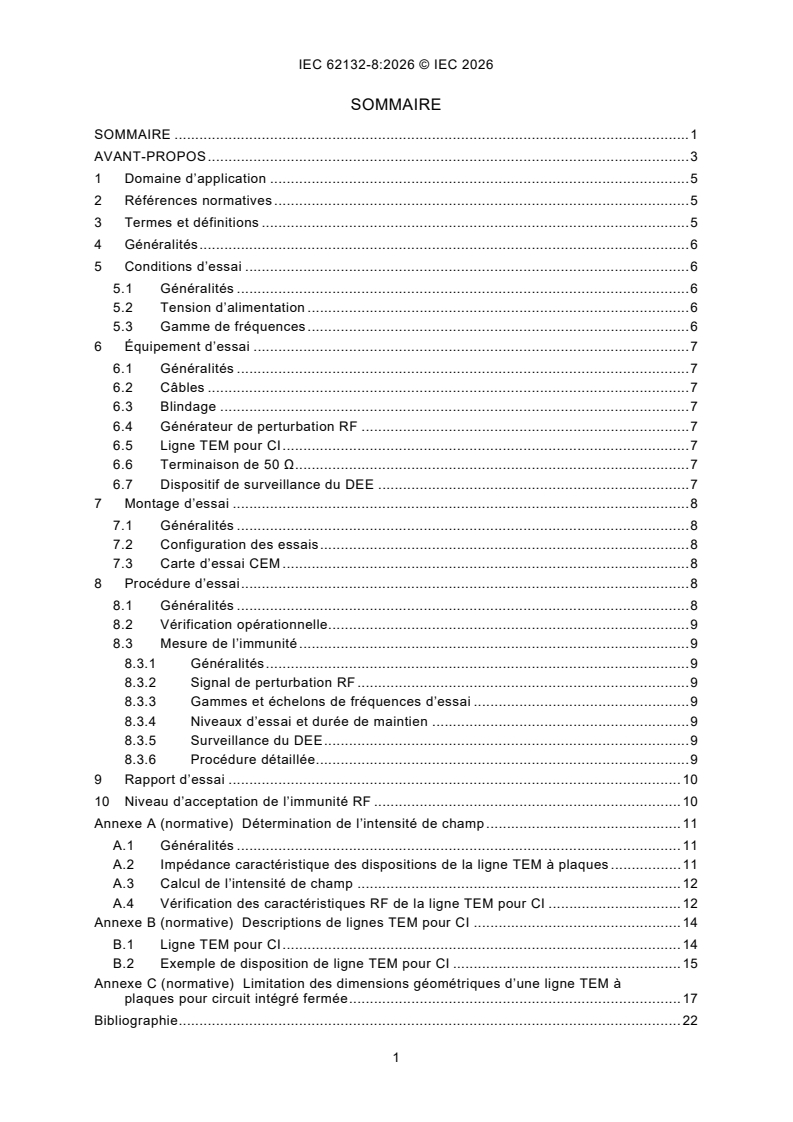
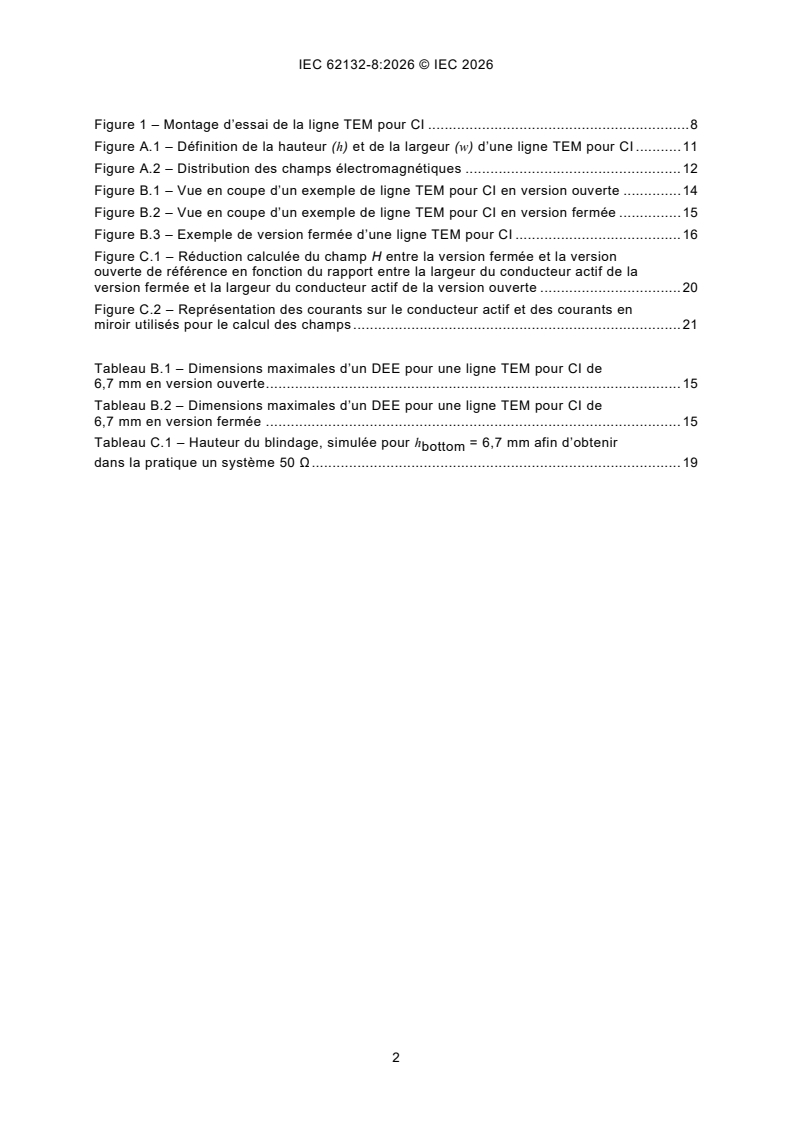
IEC 62132-8:2026 - Circuits intégrés - Mesure de l'immunité électromagnétique - Partie 8: Mesure de l'immunité rayonnée - Méthode de la ligne TEM à plaques pour circuit intégré/12/2026
IEC 62132-8:2026 - Integrated circuits - Measurement of electromagnetic immunity - Part 8: Measurement of radiated immunity - IC stripline method/12/2026
Overview
IEC 62132-8:2026 is an international standard developed by the International Electrotechnical Commission (IEC) for the measurement of electromagnetic immunity of integrated circuits (ICs) using the IC stripline method. This standard outlines a precise procedure to assess how well ICs resist radio frequency (RF) radiated electromagnetic disturbances. As the eighth part of the IEC 62132 series, it offers guidance for manufacturers, test laboratories, and engineers focused on electromagnetic compatibility (EMC) testing in the electronics industry.
The 2026 edition features notable updates:
- Removal of the frequency range 150 kHz to 3 GHz from its scope
- Extension of the upper frequency limit to 6 GHz or higher, provided the defined requirements are satisfied
IEC 62132-8 is designed to be used in conjunction with IEC 62132-1, which details general EMC test board requirements and definitions.
Key Topics
- IC Stripline Method: Describes the use of a stripline to create a well-controlled TEM wave environment for consistent RF immunity testing of ICs.
- Test Frequencies and Limits: Defines the applicable frequencies for immunity testing, now up to 6 GHz or more, expanding the scope for advanced integrated circuit designs.
- Test Equipment and Setup:
- Specifications for test boards, supply voltages, RF disturbance generators, and termination loads (typically 50 Ω).
- Guidance on both open and closed stripline configurations for diverse shielding requirements and laboratory setups.
- Immunity Measurement Procedure:
- Detailed instructions for operational checks, signal types (e.g., continuous wave, amplitude- or pulse-modulated signals), frequency step selection, and recording of results.
- Requirements for test orientation and repeatability to ensure comprehensive assessment across all possible IC orientations.
- Reporting and Acceptance: Standardizes documentation practices, including comprehensive test reports and guidelines for defining acceptance criteria in agreement between IC manufacturers and users.
Applications
IEC 62132-8:2026 is highly relevant in a variety of practical applications:
- Integrated Circuit Development: Semiconductor manufacturers use this standard to validate the RF immunity performance of their ICs, ensuring compliance and reliability in end-use environments.
- Electromagnetic Compatibility Testing: EMC test laboratories adopt the IC stripline method for standardized, repeatable, and internationally recognized immunity measurements.
- Automotive and Industrial Electronics: Sectors where IC reliability under electromagnetic interference is critical benefit from IEC 62132-8’s robust test methodology.
- Conformance and Quality Assurance: Assists in meeting regulatory requirements and supporting product certifications, especially in high-frequency applications.
The extension of the frequency range allows for future-proof testing of advanced components, including those used in wireless, high-speed communication, and automotive radar applications.
Related Standards
When applying IEC 62132-8:2026, it is important to consider related standards for comprehensive EMC testing and reporting:
- IEC 62132-1: Integrated circuits - Measurement of electromagnetic immunity - Part 1: General conditions and definitions. Essential for defining test boards and procedures.
- IEC 60050-161 and IEC 60050-131: International Electrotechnical Vocabulary for electromagnetic compatibility and circuit theory, respectively.
- IEC 61000-4-20: EMC testing using TEM waveguides, which provides foundational principles applicable in stripline-based immunity testing.
- Other Parts of IEC 62132: Additional guidance on alternative immunity measurement methods and general EMC practices for integrated circuits.
These standards collectively support a harmonized approach to EMC testing, enabling global interoperability and compliance across the electronics industry.
By following the procedures and guidance in IEC 62132-8:2026, manufacturers and testing organizations can ensure that integrated circuits exhibit robust electromagnetic immunity, helping to uphold product performance and safety standards in increasingly RF-rich environments.
Relations
- Effective Date
- 21-Jun-2024
Buy Documents
IEC 62132-8:2026 - Integrated circuits - Measurement of electromagnetic immunity - Part 8: Measurement of radiated immunity - IC stripline method/12/2026
REDLINE IEC 62132-8:2026 RLV - Integrated circuits - Measurement of electromagnetic immunity - Part 8: Measurement of radiated immunity - IC stripline method/12/2026
IEC 62132-8:2026 - Circuits intégrés - Mesure de l'immunité électromagnétique - Partie 8: Mesure de l'immunité rayonnée - Méthode de la ligne TEM à plaques pour circuit intégré/12/2026
IEC 62132-8:2026 - Integrated circuits - Measurement of electromagnetic immunity - Part 8: Measurement of radiated immunity - IC stripline method/12/2026
Frequently Asked Questions
IEC 62132-8:2026 is a standard published by the International Electrotechnical Commission (IEC). Its full title is "Integrated circuits - Measurement of electromagnetic immunity - Part 8: Measurement of radiated immunity - IC stripline method". This standard covers: IEC 62132-8:2026 specifies a method for measuring the immunity of an integrated circuit (IC) to radio frequency (RF) radiated electromagnetic disturbances using an IC stripline. This edition includes the following significant technical changes with respect to the previous edition: a) frequency range of 150 kHz to 3 GHz was deleted from the scope; b) extension of upper usable frequency to 6 GHz or higher as long as the defined requirements are fulfilled. This part of IEC 62132 is to be read in conjunction with IEC 62132-1.
IEC 62132-8:2026 specifies a method for measuring the immunity of an integrated circuit (IC) to radio frequency (RF) radiated electromagnetic disturbances using an IC stripline. This edition includes the following significant technical changes with respect to the previous edition: a) frequency range of 150 kHz to 3 GHz was deleted from the scope; b) extension of upper usable frequency to 6 GHz or higher as long as the defined requirements are fulfilled. This part of IEC 62132 is to be read in conjunction with IEC 62132-1.
IEC 62132-8:2026 is classified under the following ICS (International Classification for Standards) categories: 31.200 - Integrated circuits. Microelectronics. The ICS classification helps identify the subject area and facilitates finding related standards.
IEC 62132-8:2026 has the following relationships with other standards: It is inter standard links to IEC 62132-8:2012. Understanding these relationships helps ensure you are using the most current and applicable version of the standard.
IEC 62132-8:2026 is available in PDF format for immediate download after purchase. The document can be added to your cart and obtained through the secure checkout process. Digital delivery ensures instant access to the complete standard document.
Standards Content (Sample)
IEC 62132-8 ®
Edition 2.0 2026-02
INTERNATIONAL
STANDARD
Integrated circuits - Measurement of electromagnetic immunity -
Part 8: Measurement of radiated immunity - IC stripline method
ICS 31.200 ISBN 978-2-8327-1030-2
All rights reserved. Unless otherwise specified, no part of this publication may be reproduced or utilized in any form or
by any means, electronic or mechanical, including photocopying and microfilm, without permission in writing from either
IEC or IEC's member National Committee in the country of the requester. If you have any questions about IEC copyright
or have an enquiry about obtaining additional rights to this publication, please contact the address below or your local
IEC member National Committee for further information.
IEC Secretariat Tel.: +41 22 919 02 11
3, rue de Varembé info@iec.ch
CH-1211 Geneva 20 www.iec.ch
Switzerland
About the IEC
The International Electrotechnical Commission (IEC) is the leading global organization that prepares and publishes
International Standards for all electrical, electronic and related technologies.
About IEC publications
The technical content of IEC publications is kept under constant review by the IEC. Please make sure that you have the
latest edition, a corrigendum or an amendment might have been published.
IEC publications search - IEC Products & Services Portal - products.iec.ch
webstore.iec.ch/advsearchform Discover our powerful search engine and read freely all the
The advanced search enables to find IEC publications by a publications previews, graphical symbols and the glossary.
variety of criteria (reference number, text, technical With a subscription you will always have access to up to date
committee, …). It also gives information on projects, content tailored to your needs.
replaced and withdrawn publications.
Electropedia - www.electropedia.org
The world's leading online dictionary on electrotechnology,
IEC Just Published - webstore.iec.ch/justpublished
Stay up to date on all new IEC publications. Just Published containing more than 22 500 terminological entries in English
details all new publications released. Available online and and French, with equivalent terms in 25 additional languages.
once a month by email. Also known as the International Electrotechnical Vocabulary
(IEV) online.
IEC Customer Service Centre - webstore.iec.ch/csc
If you wish to give us your feedback on this publication or
need further assistance, please contact the Customer
Service Centre: sales@iec.ch.
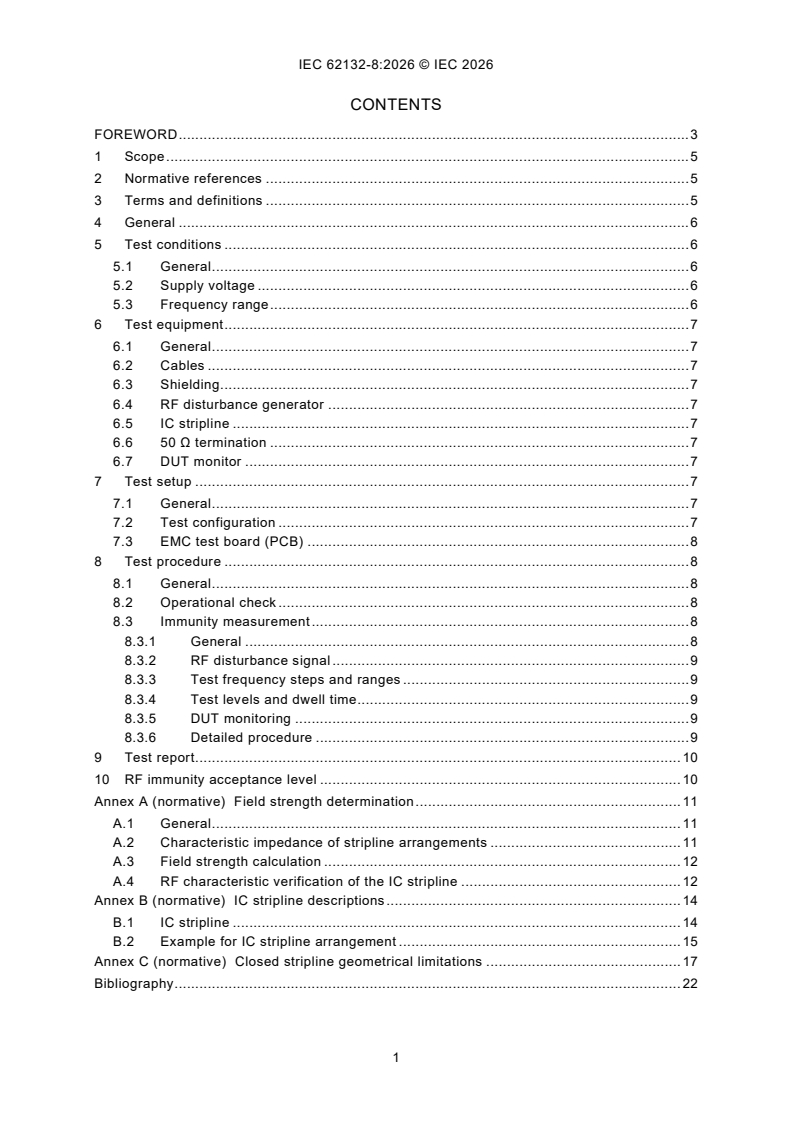
CONTENTS
FOREWORD . 3
1 Scope . 5
2 Normative references . 5
3 Terms and definitions . 5
4 General . 6
5 Test conditions . 6
5.1 General . 6
5.2 Supply voltage . 6
5.3 Frequency range . 6
6 Test equipment . 7
6.1 General . 7
6.2 Cables . 7
6.3 Shielding. 7
6.4 RF disturbance generator . 7
6.5 IC stripline . 7
6.6 50 Ω termination . 7
6.7 DUT monitor . 7
7 Test setup . 7
7.1 General . 7
7.2 Test configuration . 7
7.3 EMC test board (PCB) . 8
8 Test procedure . 8
8.1 General . 8
8.2 Operational check . 8
8.3 Immunity measurement . 8
8.3.1 General . 8
8.3.2 RF disturbance signal . 9
8.3.3 Test frequency steps and ranges . 9
8.3.4 Test levels and dwell time . 9
8.3.5 DUT monitoring . 9
8.3.6 Detailed procedure . 9
9 Test report . 10
10 RF immunity acceptance level . 10
Annex A (normative) Field strength determination . 11
A.1 General . 11
A.2 Characteristic impedance of stripline arrangements . 11
A.3 Field strength calculation . 12
A.4 RF characteristic verification of the IC stripline . 12
Annex B (normative) IC stripline descriptions . 14
B.1 IC stripline . 14
B.2 Example for IC stripline arrangement . 15
Annex C (normative) Closed stripline geometrical limitations . 17
Bibliography . 22
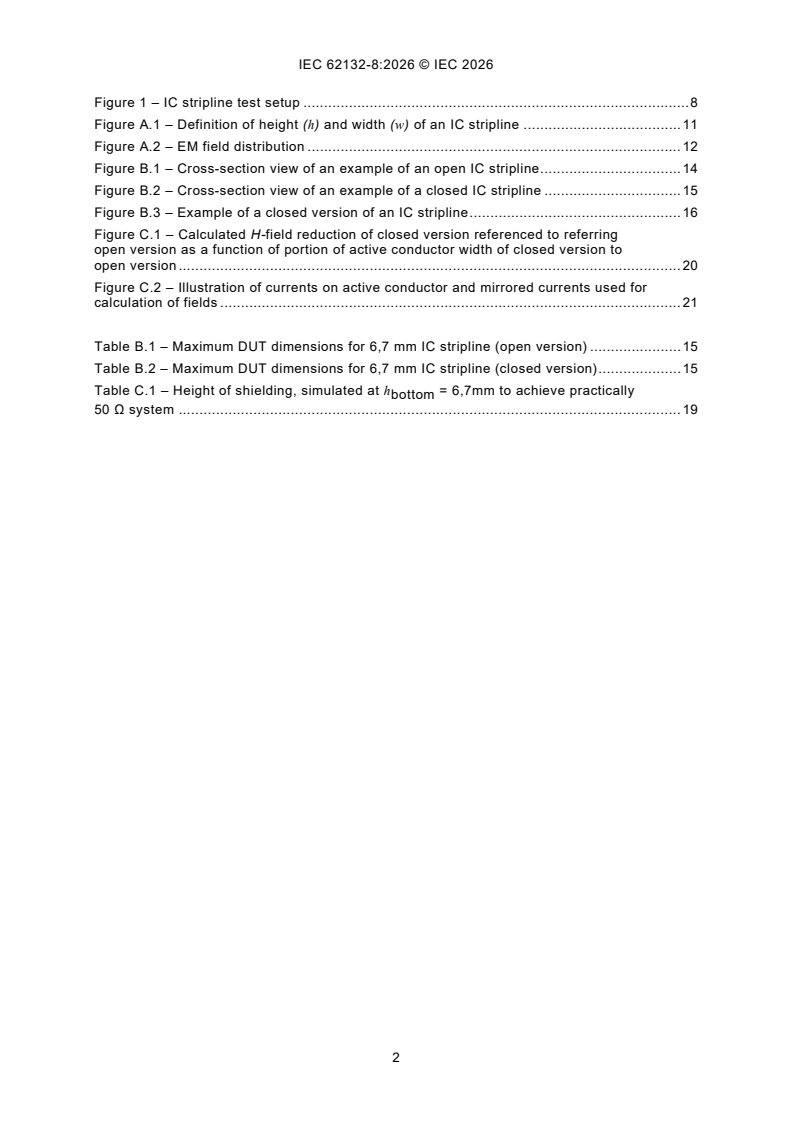
Figure 1 – IC stripline test setup . 8
Figure A.1 – Definition of height (h) and width (w) of an IC stripline . 11
Figure A.2 – EM field distribution . 12
Figure B.1 – Cross-section view of an example of an open IC stripline . 14
Figure B.2 – Cross-section view of an example of a closed IC stripline . 15
Figure B.3 – Example of a closed version of an IC stripline . 16
Figure C.1 – Calculated H-field reduction of closed version referenced to referring
open version as a function of portion of active conductor width of closed version to
open version . 20
Figure C.2 – Illustration of currents on active conductor and mirrored currents used for
calculation of fields . 21
Table B.1 – Maximum DUT dimensions for 6,7 mm IC stripline (open version) . 15
Table B.2 – Maximum DUT dimensions for 6,7 mm IC stripline (closed version) . 15
Table C.1 – Height of shielding, simulated at h = 6,7mm to achieve practically
bottom
50 Ω system . 19
INTERNATIONAL ELECTROTECHNICAL COMMISSION
____________
Integrated circuits - Measurement of electromagnetic immunity -
Part 8: Measurement of radiated immunity - IC stripline method
FOREWORD
1) The International Electrotechnical Commission (IEC) is a worldwide organization for
standardization comprising all national electrotechnical committees (IEC National Committees).
The object of IEC is to promote international co-operation on all questions concerning
standardization in the electrical and electronic fields. To this end and in addition to other
activities, IEC publishes International Standards, Technical Specifications, Technical Reports,
Publicly Available Specifications (PAS) and Guides (hereafter referred to as “IEC
Publication(s)”). Their preparation is entrusted to technical committees; any IEC National
Committee interested in the subject dealt with may participate in this preparatory work.
International, governmental and non-governmental organizations liaising with the IEC also
participate in this preparation. IEC collaborates closely with the International Organization for
Standardization (ISO) in accordance with conditions determined by agreement between the two
organizations.
2) The formal decisions or agreements of IEC on technical matters express, as nearly as
possible, an international consensus of opinion on the relevant subjects since each technical
committee has representation from all interested IEC National Committees.
3) IEC Publications have the form of recommendations for international use and are accepted
by IEC National Committees in that sense. While all reasonable efforts are made to ensure that
the technical content of IEC Publications is accurate, IEC cannot be held responsible for the
way in which they are used or for any misinterpretation by any end user.
4) In order to promote international uniformity, IEC National Committees undertake to apply IEC
Publications transparently to the maximum extent possible in their national and regional
publications. Any divergence between any IEC Publication and the corresponding national or
regional publication shall be clearly indicated in the latter.
5) IEC itself does not provide any attestation of conformity. Independent certification bodies
provide conformity assessment services and, in some areas, access to IEC marks of conformity.
IEC is not responsible for any services carried out by independent certification bodies.
6) All users should ensure that they have the latest edition of this publication.
7) No liability shall attach to IEC or its directors, employees, servants or agents including
individual experts and members of its technical committees and IEC National Committees for
any personal injury, property damage or other damage of any nature whatsoever, whether direct
or indirect, or for costs (including legal fees) and expenses arising out of the publication, use
of, or reliance upon, this IEC Publication or any other IEC Publications.
8) Attention is drawn to the Normative references cited in this publication. Use of the referenced
publications is indispensable for the correct application of this publication.
9) IEC draws attention to the possibility that the implementation of this document may involve
the use of (a) patent(s). IEC takes no position concerning the evidence, validity or applicability
of any claimed patent rights in respect thereof. As of the date of publication of this document,
IEC had not received notice of (a) patent(s), which may be required to implement this document.
However, implementers are cautioned that this may not represent the latest information, which
may be obtained from the patent database available at https://patents.iec.ch. IEC shall not be
held responsible for identifying any or all such patent rights.
IEC 62132-8 has been prepared by subcommittee 47A: Integrated circuits, of IEC technical
committee 47: Semiconductor devices. It is an International Standard.
This second edition cancels and replaces the first edition published in 2012. This edition
constitutes a technical revision.
This edition includes the following significant technical changes with respect to the previous
edition:
a) frequency range of 150 kHz to 3 GHz was deleted from the scope;
b) extension of upper usable frequency to 6 GHz or higher as long as the defined requirements
are fulfilled.
The text of this Internation Standard is based on the following documents:
FDIS Report on voting
47A/1205/FDIS 47A/1209/RVD
Full information on the voting for the approval of this International Standard can be found in the
report on voting indicated in the above table.
The language used for the development of this International Standard is English.
This part of IEC 62132 is to be read in conjunction with IEC 62132-1.
This document was drafted in accordance with ISO/IEC Directives, Part 2, and developed in
accordance with ISO/IEC Directives, Part 1 and ISO/IEC Directives, IEC Supplement, available
at www.iec.ch/members_experts/refdocs. The main document types developed by IEC are
described in greater detail at www.iec.ch/publications.
A list of all the parts in the IEC 62132 series, published under the general title Integrated circuits
- Measurement of electromagnetic immunity, can be found on the IEC website.
The committee has decided that the contents of this publication will remain unchanged until the
stability date indicated on the IEC web site under "http://webstore.iec.ch" in the data related to
the specific publication. At this date, the publication will be
– reconfirmed,
– withdrawn, or
– revised.
1 Scope
This part of IEC 62132 specifies a method for measuring the immunity of an integrated circuit
(IC) to radio frequency (RF) radiated electromagnetic disturbances using an IC stripline.
2 Normative references
The following documents are referred to in the text in such a way that some or all of their content
constitutes requirements of this document. For dated references, only the edition cited applies.
For undated references, the latest edition of the referenced document (including any
amendments) applies.
IEC 60050-131, International Electrotechnical Vocabulary (IEV) - Part 131: Circuit theory
IEC 60050-161, International Electrotechnical Vocabulary (IEV) - Part 161: Electromagnetic
compatibility
IEC 62132-1, Integrated circuits - Measurement of electromagnetic immunity - Part 1: General
conditions and definitions
3 Terms and definitions
For the purpose of this document, the terms and definitions given in IEC 62132-1, IEC 60050-
131 and IEC 60050-161, and the following, apply.
3.1
transverse electromagnetic mode
TEM mode
waveguide mode in which the components of the electric and magnetic fields in the propagation
direction are much less than the primary field components across any transverse cross-section
3.2
TEM waveguide
open or closed transmission line system, in which a wave is propagating in the transverse
electromagnetic mode to produce a specified field for testing purposes
3.3
IC stripline
TEM waveguide consisting of an active conductor placed on a defined spacing over an enlarged
ground plane, connected to a port structure on each end and an optional shielded enclosure
Note 1 to entry: This arrangement guides a wave propagation in the transverse electromagnetic mode to produce
a specific field for testing purposes between the active conductor and the enlarged ground plane. The ground plane
of the standard EMC test board, according to IEC 62132-1, is used. An optional shielding enclosure may be used to
shield the IC stripline. In contrast to the open version without a shielding enclosure, the shied leads to a closed
version of the IC stripline. For further information, see Annex A.
3.4
characteristic impedance
magnitude of the ratio of the voltage between the active conductor and the corresponding
ground plane to the current on either conductor for any constant phase wave-front
Note 1 to entry: The characteristic impedance is independent of the voltage/current magnitudes and depends only
on the cross sectional geometry of the transmission line. TEM waveguides are typically designed to have a 50 Ω
characteristic impedance. For further information and equation to stripline arrangements, see Annex A.
3.5
primary field component
electric field component aligned with the intended test polarization
Note 1 to entry: For example, in IC stripline, the active conductor is parallel to the horizontal floor, and the primary
mode electric field vector is vertical at the transverse centre of the IC stripline.
4 General
An IC to be evaluated for EMC performance is referred to as a device under test (DUT). The
DUT should be mounted on an EMC test board according to IEC 62132-1. The EMC test board
is provided with the appropriate measurement or monitoring points at which the DUT response
parameters can be measured. It controls the geometry and orientation of the DUT relative to
the active conductor and eliminates in the case of a closed version of the IC stripline any
connecting leads within the housing (these are on the non-DUT side of the board, which is
outside the housing).
For the IC stripline, one of the 50 Ω ports is terminated with a 50 Ω load. The other 50 Ω port
is connected to the output of an RF disturbance generator. The injected RF disturbance signal
exposes the DUT to an electromagnetic field determined by the injected power, the typical
impedance and the distance between the ground plane of the EMC test board and the active
conductor of the IC stripline. The relation is given in Annex A.
Rotating the EMC test board in the four possible orientations in the aperture to accept EMC test
board of the IC stripline will affect the sensitivity of the DUT. Dependent upon the DUT, the
response parameters of the DUT may vary (e.g. a change of current consumption, deterioration
in function performance, waveform jitter). The intent of this test method is to provide a
quantitative measure of the RF immunity of DUTs for comparison or other purposes.
For further information, see Annex A.
5 Test conditions
5.1 General
The test conditions shall meet the requirements as described in IEC 62132-1. In addition, the
following test conditions shall apply.
5.2 Supply voltage
The supply voltage shall be as specified by the IC manufacturer. If the users of this procedure
agree to other values, they shall be documented in the test report.
5.3 Frequency range
The effective frequency range of this radiated immunity procedure is 150 kHz to 6 GHz in
combination with the voltage standing wave ratio (VSWR) characteristic ≤ 1,25 for f ≤ 3 GHz
and ≤ 1,4 for f > 3 GHz. The upper frequency can be extended if the IC stripline does not exhibit
significant higher order modes over the frequency range being measured.
NOTE 1 The given VSWR value of 1,4 is based on evolving technical solutions for IC striplines. For accuracy
reasons, the VSWR value is targeted as low as possible (e.g. 1,3).
NOTE 2 Higher-order modes can affect the VSWR of the IC Striplines by interfering with the TEM mode and perturb
the desired field distribution.
6 Test equipment
6.1 General
The test equipment shall meet the requirements described in IEC 62132-1. In addition, the
following test equipment requirements shall apply.
6.2 Cables
Double shielded or semi-rigid coaxial cable, of 50 Ω characteristic impedance, can be required
to interface with the IC stripline.
6.3 Shielding
Testing in a shielded room is only necessary for the open IC stripline version. The closed
version of the IC stripline is shielded by its housing.
6.4 RF disturbance generator
An RF disturbance generator with sufficient power handling capabilities shall be used. The RF
disturbance generator can comprise of an RF signal generator with a modulation function, an
RF power amplifier and an optional attenuator. The VSWR at the output of the RF disturbance
generator shall be less than 1,5 over the frequency range being measured.
6.5 IC stripline
The IC stripline (open or closed version) used for this test procedure shall be fitted with an
aperture to mate with the EMC test board.
For further information as to field strength determination, IC stripline designs and the limitation
of geometrical dimensions of closed version, see Annex A, Annex B and Annex C.
6.6 50 Ω termination
A 50 Ω termination with a VSWR ≤ 1,1 for f ≤ 3 GHz and a VSWR ≤ 1,2 for f > 3 GHz up to the
maximum used frequency and sufficient power handling capabilities over the frequency range
of measurement is recommended for the IC stripline 50 Ω port not connected to the RF
disturbance generator.
6.7 DUT monitor
The performance of the DUT shall be monitored for indications of performance degradation.
The monitoring equipment shall not be adversely affected by the injected RF disturbance signal.
7 Test setup
7.1 General
A test setup shall meet the requirements described in IEC 62132-1. In addition, the following
test setup requirements shall apply.
7.2 Test configuration
See Figure 1 for IC stripline test configurations. One of the IC stripline 50 Ω ports is terminated
with a 50
...
IEC 62132-8 ®
Edition 2.0 2026-02
INTERNATIONAL
STANDARD
REDLINE VERSION
Integrated circuits - Measurement of electromagnetic immunity -
Part 8: Measurement of radiated immunity - IC stripline method
ICS 31.200 ISBN 978-2-8327-1083-8
All rights reserved. Unless otherwise specified, no part of this publication may be reproduced or utilized in any form or
by any means, electronic or mechanical, including photocopying and microfilm, without permission in writing from either
IEC or IEC's member National Committee in the country of the requester. If you have any questions about IEC copyright
or have an enquiry about obtaining additional rights to this publication, please contact the address below or your local
IEC member National Committee for further information.
IEC Secretariat Tel.: +41 22 919 02 11
3, rue de Varembé info@iec.ch
CH-1211 Geneva 20 www.iec.ch
Switzerland
About the IEC
The International Electrotechnical Commission (IEC) is the leading global organization that prepares and publishes
International Standards for all electrical, electronic and related technologies.
About IEC publications
The technical content of IEC publications is kept under constant review by the IEC. Please make sure that you have the
latest edition, a corrigendum or an amendment might have been published.
IEC publications search - IEC Products & Services Portal - products.iec.ch
webstore.iec.ch/advsearchform Discover our powerful search engine and read freely all the
The advanced search enables to find IEC publications by a publications previews, graphical symbols and the glossary.
variety of criteria (reference number, text, technical With a subscription you will always have access to up to date
committee, …). It also gives information on projects, content tailored to your needs.
replaced and withdrawn publications.
Electropedia - www.electropedia.org
The world's leading online dictionary on electrotechnology,
IEC Just Published - webstore.iec.ch/justpublished
Stay up to date on all new IEC publications. Just Published containing more than 22 500 terminological entries in English
details all new publications released. Available online and and French, with equivalent terms in 25 additional languages.
once a month by email. Also known as the International Electrotechnical Vocabulary
(IEV) online.
IEC Customer Service Centre - webstore.iec.ch/csc
If you wish to give us your feedback on this publication or
need further assistance, please contact the Customer
Service Centre: sales@iec.ch.
CONTENTS
FOREWORD . 3
1 Scope . 5
2 Normative references . 5
3 Terms and definitions . 5
4 General . 6
5 Test conditions . 6
5.1 General . 6
5.2 Supply voltage . 6
5.3 Frequency range . 7
6 Test equipment . 7
6.1 General . 7
6.2 Cables . 7
6.3 Shielding. 7
6.4 RF disturbance generator . 7
6.5 IC stripline . 7
6.6 50 Ω termination . 7
6.7 DUT monitor . 8
7 Test setup . 8
7.1 General . 8
7.2 Test configuration . 8
7.3 EMC test board (PCB) . 8
8 Test procedure . 8
8.1 General . 8
8.2 Operational check . 9
8.3 Immunity measurement . 9
8.3.1 General . 9
8.3.2 RF disturbance signal . 9
8.3.3 Test frequency steps and ranges . 9
8.3.4 Test levels and dwell time . 9
8.3.5 DUT monitoring . 10
8.3.6 Detailed procedure . 10
9 Test report . 10
10 RF immunity acceptance level . 10
Annex A (normative) Field strength determination . 11
A.1 General . 11
A.2 Characteristic impedance of stripline arrangements . 11
A.3 Field strength calculation . 12
A.4 RF characteristic verification of the IC stripline . 12
Annex B (normative) IC stripline descriptions . 14
B.1 IC stripline . 14
B.2 Example for IC stripline arrangement . 16
Annex C (informativenormative) Closed stripline geometrical limitations . 17
Bibliography . 23
Figure 1 – IC stripline test setup . 8
Figure A.1 – Definition of height (h) and width (w) of an IC stripline . 11
Figure A.2 – EM field distribution . 12
Figure B.1 – Cross-section view of an example of an open IC stripline . 14
Figure B.2 – Cross-section view of an example of a closed IC stripline . 15
Figure B.3 – Example of a closed version of an IC stripline with housing . 16
Figure C.1 – Calculated H-field reduction of closed version referenced to referring
open version as a function of portion of active conductor width of closed version to
open version . 21
Figure C.2 – Location Illustration of currents on active conductor and mirrored currents
at grounded planes used for calculation of fields . 22
Table 1 – Frequency step size versus frequency range .
Table B.1 – Maximum DUT dimensions for 6,7 mm IC stripline (open version) . 15
Table B.2 – Maximum DUT dimensions for 6,7 mm IC stripline (closed version) . 15
Table C.1 – Height of shielding, simulated at h = 6,7mm to achieve practically
bottom
50 Ω system . 20
INTERNATIONAL ELECTROTECHNICAL COMMISSION
____________
Integrated circuits - Measurement of electromagnetic immunity -
Part 8: Measurement of radiated immunity - IC stripline method
FOREWORD
1) The International Electrotechnical Commission (IEC) is a worldwide organization for
standardization comprising all national electrotechnical committees (IEC National Committees).
The object of IEC is to promote international co-operation on all questions concerning
standardization in the electrical and electronic fields. To this end and in addition to other
activities, IEC publishes International Standards, Technical Specifications, Technical Reports,
Publicly Available Specifications (PAS) and Guides (hereafter referred to as “IEC
Publication(s)”). Their preparation is entrusted to technical committees; any IEC National
Committee interested in the subject dealt with may participate in this preparatory work.
International, governmental and non-governmental organizations liaising with the IEC also
participate in this preparation. IEC collaborates closely with the International Organization for
Standardization (ISO) in accordance with conditions determined by agreement between the two
organizations.
2) The formal decisions or agreements of IEC on technical matters express, as nearly as
possible, an international consensus of opinion on the relevant subjects since each technical
committee has representation from all interested IEC National Committees.
3) IEC Publications have the form of recommendations for international use and are accepted
by IEC National Committees in that sense. While all reasonable efforts are made to ensure that
the technical content of IEC Publications is accurate, IEC cannot be held responsible for the
way in which they are used or for any misinterpretation by any end user.
4) In order to promote international uniformity, IEC National Committees undertake to apply IEC
Publications transparently to the maximum extent possible in their national and regional
publications. Any divergence between any IEC Publication and the corresponding national or
regional publication shall be clearly indicated in the latter.
5) IEC itself does not provide any attestation of conformity. Independent certification bodies
provide conformity assessment services and, in some areas, access to IEC marks of conformity.
IEC is not responsible for any services carried out by independent certification bodies.
6) All users should ensure that they have the latest edition of this publication.
7) No liability shall attach to IEC or its directors, employees, servants or agents including
individual experts and members of its technical committees and IEC National Committees for
any personal injury, property damage or other damage of any nature whatsoever, whether direct
or indirect, or for costs (including legal fees) and expenses arising out of the publication, use
of, or reliance upon, this IEC Publication or any other IEC Publications.
8) Attention is drawn to the Normative references cited in this publication. Use of the referenced
publications is indispensable for the correct application of this publication.
9) IEC draws attention to the possibility that the implementation of this document may involve
the use of (a) patent(s). IEC takes no position concerning the evidence, validity or applicability
of any claimed patent rights in respect thereof. As of the date of publication of this document,
IEC had not received notice of (a) patent(s), which may be required to implement this document.
However, implementers are cautioned that this may not represent the latest information, which
may be obtained from the patent database available at https://patents.iec.ch. IEC shall not be
held responsible for identifying any or all such patent rights.
This redline version of the official IEC Standard allows the user to identify the changes made
to the previous edition IEC 62132-8:2012. A vertical bar appears in the margin wherever a
change has been made. Additions are in green text, deletions are in strikethrough red text.
IEC 62132-8 has been prepared by subcommittee 47A: Integrated circuits, of IEC technical
committee 47: Semiconductor devices. It is an International Standard.
This second edition cancels and replaces the first edition published in 2012. This edition
constitutes a technical revision.
This edition includes the following significant technical changes with respect to the previous
edition:
a) frequency range of 150 kHz to 3 GHz was deleted from the scope;
b) extension of upper usable frequency to 6 GHz or higher as long as the defined requirements
are fulfilled.
The text of this Internation Standard is based on the following documents:
FDIS Report on voting
47A/1205/FDIS 47A/1209/RVD
Full information on the voting for the approval of this International Standard can be found in the
report on voting indicated in the above table.
The language used for the development of this International Standard is English.
This part of IEC 62132 is to be read in conjunction with IEC 62132-1.
This document was drafted in accordance with ISO/IEC Directives, Part 2, and developed in
accordance with ISO/IEC Directives, Part 1 and ISO/IEC Directives, IEC Supplement, available
at www.iec.ch/members_experts/refdocs. The main document types developed by IEC are
described in greater detail at www.iec.ch/publications.
A list of all the parts in the IEC 62132 series, published under the general title Integrated circuits
- Measurement of electromagnetic immunity, can be found on the IEC website.
The committee has decided that the contents of this publication will remain unchanged until the
stability date indicated on the IEC web site under "http://webstore.iec.ch" in the data related to
the specific publication. At this date, the publication will be
– reconfirmed,
– withdrawn, or
– revised.
1 Scope
This part of IEC 62132 specifies a method for measuring the immunity of an integrated circuit
(IC) to radio frequency (RF) radiated electromagnetic disturbances over the frequency range of
150 kHz to 3 GHz using an IC stripline.
2 Normative references
The following documents are referred to in the text in such a way that some or all of their content
constitutes requirements of this document. For dated references, only the edition cited applies.
For undated references, the latest edition of the referenced document (including any
amendments) applies.
IEC 60050 (all parts), International Electrotechnical Vocabulary (available at
http://www.electropedia.org)
IEC 60050-131, International Electrotechnical Vocabulary (IEV) - Part 131: Circuit theory
IEC 60050-161, International Electrotechnical Vocabulary (IEV) - Part 161: Electromagnetic
compatibility
IEC 61000-4-20, Electromagnetic compatibility (EMC) – Part 4-20: Testing and measurement
techniques – Emission and immunity testing in transverse electromagnetic (TEM) waveguides
IEC 62132-1:2006, Integrated circuits - Measurement of electromagnetic immunity, 150 kHz to
1 GHz - Part 1: General conditions and definitions
3 Terms and definitions
For the purpose of this document, the terms and definitions given in IEC 62132-1:2006, Clause
3, IEC 60050-131 and IEC 60050-161, and the following, apply.
3.1
transverse electromagnetic mode
TEM mode
waveguide mode in which the components of the electric and magnetic fields in the propagation
direction are much less than the primary field components across any transverse cross-section
Note 1 to entry: This note only applies to the French language.
3.2
TEM waveguide
open or closed transmission line system, in which a wave is propagating in the transverse
electromagnetic mode to produce a specified field for testing purposes
3.3
IC stripline
TEM waveguide consisting of an active conductor placed on a defined spacing over an enlarged
ground plane, connected to a port structure on each end and an optional shielded enclosure
Note 1 to entry: This arrangement guides a wave propagation in the transverse electromagnetic mode to produce
a specific field for testing purposes between the active conductor and the enlarged ground plane. The ground plane
of the standard EMC test board, according to IEC 62132-1:2006, Annex B, should be is used. An optional shielding
enclosure may be used for fixing to shield the IC stripline configuration and for shielding purposes. This leads to a
closed version of the IC stripline in opposite to the open version without shielding enclosure. In contrast to the open
version without a shielding enclosure, the shied leads to a closed version of the IC stripline. For further information,
see Annex A.
3.4
two-port TEM waveguide
TEM waveguide with input/output measurement ports at both ends
3.4
characteristic impedance
magnitude of the ratio of the voltage between the active conductor and the corresponding
ground plane to the current on either conductor for any constant phase wave-front
Note 1 to entry: The characteristic impedance is independent of the voltage/current magnitudes and depends only
on the cross sectional geometry of the transmission line. TEM waveguides are typically designed to have a 50 Ω
characteristic impedance. For further information and equation to stripline arrangements, see Annex A.
3.5
primary field component
primary component
electric field component aligned with the intended test polarization
Note 1 to entry: For example, in IC stripline, the active conductor is parallel to the horizontal floor, and the primary
mode electric field vector is vertical at the transverse centre of the IC stripline.
4 General
An IC to be evaluated for EMC performance is referred to as a device under test (DUT). The
DUT should be mounted on an EMC test board according to IEC 62132-1. The EMC test board
is provided with the appropriate measurement or monitoring points at which the DUT response
parameters can be measured. It controls the geometry and orientation of the DUT relative to
the active conductor and eliminates in the case of a closed version of the IC stripline any
connecting leads within the housing (these are on the backside non-DUT side of the board,
which is outside the housing).
For the IC stripline, one of the 50 Ω ports is terminated with a 50 Ω load. The other 50 Ω port
is connected to the output of an RF disturbance generator. The injected RF disturbance signal
exposes the DUT to an electromagnetic field determined by the injected power, the typical
impedance and the distance between the ground plane of the EMC test board and the active
conductor of the IC stripline. The relation is given in Annex A.
Rotating the EMC test board in the four possible orientations in the aperture to accept EMC test
board of the IC stripline will affect the sensitivity of the DUT. Dependent upon the DUT, the
response parameters of the DUT may vary (e.g. a change of current consumption, deterioration
in function performance, waveform jitter). The intent of this test method is to provide a
quantitative measure of the RF immunity of DUTs for comparison or other purposes.
For further information, see Annex A.
5 Test conditions
5.1 General
The test conditions shall meet the requirements as described in IEC 62132-1:2006, Clause 4.
In addition, the following test conditions shall apply.
5.2 Supply voltage
The supply voltage shall be as specified by the IC manufacturer. If the users of this procedure
agree to other values, they shall be documented in the test report.
5.3 Frequency range
The effective frequency range of this radiated immunity procedure is 150 kHz to 3 GHz kHz to
6 GHz in combination with the voltage standing wave ratio (VSWR) characteristic ≤ 1,25 for f ≤
3 GHz and ≤ 1,4 for f > 3 GHz. The upper frequency can be extended if the IC stripline does
not exhibit significant higher order modes over the frequency range being measured.
NOTE 1 The given VSWR value of 1,4 is based on evolving technical solutions for IC striplines. For accuracy
reasons, the VSWR value is targeted as low as possible (e.g. 1,3).
NOTE 2 Higher-order modes can affect the VSWR of the IC Striplines by interfering with the TEM mode and perturb
the desired field distribution.
6 Test equipment
6.1 General
The test equipment shall meet the requirements described in IEC 62132-1:2006, Clause 5. In
addition, the following test equipment requirements shall apply.
6.2 Cables
Double shielded or semi-rigid coaxial cable, of 50 Ω characteristic impedance, may can be
required depending on the local ambient conditions to interface with the IC stripline.
6.3 Shielding
Testing in a shielded room is only necessary for the open IC stripline version. The closed
version of the IC stripline is shielded by its housing.
6.4 RF disturbance generator
An RF disturbance generator with sufficient power handling capabilities shall be used. The RF
disturbance generator may can comprise of an RF signal source generator with a modulation
function, an RF power amplifier and an optional attenuator. The VSWR at the output of the RF
disturbance generator shall be less than 1,5 over the frequency range being measured.
The gain (or attenuation) of the RF disturbance generating equipment, without the IC stripline,
shall be known with an accuracy ±0,5 dB.
6.5 IC stripline
The IC stripline (open or closed version) used for this test procedure shall be fitted with an
aperture to mate with the EMC test board. The IC stripline shall not exhibit higher order modes
over the frequency range being measured. For this procedure, the IC stripline frequency range
is 150 kHz to 3 GHz. The VSWR over the frequency range of the empty IC stripline being
measured shall be less than 1,25.
For further information as to field strength determination, IC stripline designs and the limitation
of geometrical dimensions of closed version, see Annex A, Annex B and Annex C.
6.6 50 Ω termination
A 50 Ω termination with a VSWR less than ≤ 1,1 for f ≤ 3 GHz and a VSWR ≤ 1,2 for f > 3 GHz
up to the maximum used frequency and sufficient power handling capabilities over the
frequency range of measurement is recommended for the IC stripline 50 Ω port not connected
to the RF disturbance generator.
6.7 DUT monitor
The performance of the DUT shall be monitored for indications of performance degradation.
The monitoring equipment shall not be adversely affected by the injected RF disturbance signal.
7 Test setup
7.1 General
A test setup shall meet the requirements described in IEC 62132-1:2006, Clause 6. In addition,
the following test setup requirements shall apply.
7.2 Test configuration
See Figure 1 for IC stripline test configurations. One of the IC stripline 50 Ω ports is terminated
with a 50 Ω load. The other IC stripline 50 Ω port is connected to the output port of the RF
disturbance generator.
Figure 1 – IC stripline test setup
For further information and cross-section view of the IC stripline, see Annex B.
7.3 EMC test board (PCB)
The EMC test board shall be designed in accordance with the requirements in IEC 62132-1 with
the DUT positioned at the centre of the test board.
8 Test procedure
8.1 General
Test procedure shall be in accordance with IEC 62132-1:2006, Clause 7, except as modified
herein. These default test conditions are intended to assure a consistent test environment. The
following steps shall be performed:
a) operational check (see 8.2);
b) immunity measurement (see 8.3).
If the users of this procedure agree to other conditions, they shall be documented in the test
report.
8.2 Operational check
EnergizePower up the DUT and complete an operational check to verify proper function of the
device (i.e. run DUT test code) in the ambient test condition. During the operational check, the
RF disturbance generator and any monitoring equipment shall be powered; however, the output
of the RF disturbance generator shall be disabled. The performance of the DUT shall not be
degraded by ambient conditions.
8.3 Immunity measurement
8.3.1 General
With the EMC test board energized powered on and the DUT operated in the intended test
mode, measure the immunity to the injected RF disturbance signal over the desired frequency
range.
8.3.2 RF disturbance signal
The RF disturbance signal may be one or more of the signals specified in IEC 62132-1 as
described below:
– CW (continuous wave, no modulation);
– sinusoidal modulated with 80 % amplitude modulated by a 1 kHz sine sinusoidal wave, and
with 80 % depth;
– pulse modulated with 50 % duty cycle and 1 kHz pulse repetition rate.
8.3.3 Test frequency steps and ranges
The RF immunity of the DUT is generally evaluated in the frequency range from 150 kHz to
3 GHz 6 GHz or higher as long as the IC stripline does not exhibit significant higher order modes
over the frequency range being measured. The frequencies to be tested shall be generated
from the requirements specified in Table 1.
Table 1 – Frequency step size versus frequency range
Frequency range (MHz) 0,15 – 1 1 – 100 100 – 1000 1000-3000
Linear steps (MHz)
≤0,1 ≤1 ≤10 ≤20
Logarithmic steps ≤5 % increment
In addition, the RF immunity of the DUT shall be evaluated at critical frequencies. Critical
frequencies are frequencies that are generated by, received by, or operated on by the DUT.
Critical frequencies include but are not limited to crystal frequencies, oscillator frequencies,
clock frequencies, data frequencies, etc.
The frequency steps shall be in accordance with IEC 62132-1.
8.3.4 Test levels and dwell time
The applied test level shall be increased in steps until a malfunction is observed or the maximum
signal generator setting (test level) is reached. The step size and test level shall be documented
in the test report.
At each test level and frequency, the RF disturbance signal shall be applied for the time
necessary for the DUT to respond and the monitoring system to detect any performance
degradation (typically 1 s).
The dwell time shall be in accordance with IEC 62132-1.
8.3.5 DUT monitoring
The performance of the DUT shall be monitored for indications of performance degradation
using suitable test equipment. The monitoring equipment shall not be adversely affected by the
injected RF disturbance signal.
8.3.6 Detailed procedure
8.3.6.1 Field strength determination
At each frequency to be tested, the signal RF disturbance generator setting to achieve the
desired electric field level or levels shall be determined as described in Annex A.
8.3.6.2 Immunity measurement
The test flow, including major steps, is described below. One of two strategies can be employed
in performing this measurement as follows:
a) The output of the RF disturbance generator shall be set at a low value (e.g. 20 dB below a
desired upper limit) and slowly increased (e.g. in steps of 1 dB or 2 dB) up to the desired
limit while monitoring the DUT for performance degradation. Any performance degradation
at or below the desired limit shall be recorded.
b) The output of the RF disturbance generator shall be set at the desired performance limit
while monitoring the DUT for performance degradation. Any performance degradation at the
desired limit shall should be recorded. The output of the RF disturbance generator shall
then be reduced until normal function returns. This level shall be recorded.
NOTE The DUT can respond differently to each of the above methods. In such a case, a method in which the
interference signal is ramped up as well as down can be required. Additionally, in some cases, it might can be
necessary to reset or restart the DUT to come back to proper operation.
The RF immunity measurement shall be performed for at least two orientations (0°, 90°). If the
users of this document consider it necessary, the other orientations 180° and 270° should can
also be tested. The first measurement is made with the EMC test board mounted in an arbitrary
orientation in the IC stripline aperture to accept EMC test board. The second measurement is
made with the EMC test board rotated 90° from the orientation in the first measurement. For
each of the third and fourth measurements, the EMC test board is rotated again to ensure
immunity is measured in all four possible orientations. The results and their tested orientations
shall be documented in the test report.
9 Test report
The test report shall be in accordance with the requirements of IEC 62132-1:2006, Clause 8.
10 RF immunity acceptance level
The RF immunity acceptance level of a DUT, if any, is to be agreed upon between the
manufacturer and the user of the DUT and can be defined also differently for special frequency
bands.
Annex A
(normative)
Field strength determination
A.1 General
The signal level setting of the RF disturbance generator required to achieve the desired electric
field level within the IC stripline shall be determined in accordance with this procedure. This
measurement shall be performed at each standard test frequency (either linear or logarithmic
as used in the actual test) as specified in 8.3.1. The RF disturbance signal shall be a CW signal
(i.e. no modulation shall be applied).
A.2 Characteristic impedance of stripline arrangements
The nominal, characteristic impedance of an open version of an IC stripline can be calculated
as follows [1], if 1 < w/h ≤ 10:
120×π
𝑍𝑍 =
(A.1)
𝑤𝑤 ℎ ℎ
+2,42−0,44× +�1− �
ℎ 𝑤𝑤 𝑤𝑤
where
Z is the characteristic impedance [Ω], typically 50 Ω;
w is the width [m] of active conductor (see Figure A.1);
h is the height [m] between surfaces of the active conductor and ground plane (see Figure
A.1).
Figure A.1 – Definition of height (h) and width (w) of an IC stripline
For the closed version of the IC stripline, the influence of housing has to be taken into account.
This correction depends on the housing geometry. For a spherical housing surface, an analytical
formula for the characteristic impedance cannot be provided and empirical investigations are
necessary. The characteristic impedance of those stripline arrangements have to shall be
verified by measurement.
A.3 Field strength calculation
The RF disturbance applied at the input to the IC stripline is related to the electromagnetic field
by the distance between the active conductor and the ground plane of the EMC test board.
Figure A.2 – EM field distribution
√𝑃𝑃 ×𝑍𝑍
(A.2)
𝐸𝐸 =
ℎ
where
E is the electric field strength [V/m] within the IC stripline;
Z is the characteristic impedance [Ω], nominal value;
P is the measured forward test power [W];
h is the height [m] between the surfaces of active conductor and ground plane of the EMC
test board.
Tests with closed and open versions of the IC stripline, both with an impedance of 50 Ω, have
shown slight differences on the coupling between IC stripline versions the active conductor and
the DUT appears. The deviation is in the range of approximately 0,5 dB to 1 dB [2]. In practice,
this offset deviation can be neglected for proposed the geometrical dimensions of the IC
stripline given in Annex B. For any other geometrical dimension, the active conductor width of
the closed version shall not be less than 70 % of the width of the referring corresponding open
version as described in Annex C.
A.4 RF characteristic verification of the IC stripline
For verifying the RF characteristics of the IC stripline, the VSWR value of the empty IC stripline
without DUT and with 50 Ω load termination at the second port shall be measured and
documented in the test report. The value shall be lower than 1,25. The value shall be in
accordance with 5.3. Examples of typical VSWR values of IC striplines are given in [3].
In addition, it is recommended to also check the DUT loaded IC stripline. In accordance to IEC
61000-4-20 [4], IC stripline resonances with the DUT shall be considered, with the DUT power
off.
𝑃𝑃 𝑃𝑃
refl output
(A.3)
𝐴𝐴 =�10×log� + ��≤ 1dB
tloss
𝑃𝑃 𝑃𝑃
fwd fwd
where
A is the transmission loss of loaded IC stripline [dB];
tloss
P is the reflected power at input port [W];
refl
P is the forward power at input port [W];
fwd
P is the measured power at output port [W].
output
Measurements carried out at frequencies where the VSWR and losses exceed the maximum
tolerated values shall be ignored.
Annex B
(normative)
IC stripline descriptions
B.1 IC stripline
The IC stripline offers a broadband method of measuring either immunity of a DUT to fields
generated within the IC stripline or radiated emission from a DUT placed within the IC stripline.
It eliminates the use of conventional antennas with their inherent measurement limitations of
bandwidth, non-linear phase, directivity and polarization. The IC stripline is a special kind of
transmission line that propagates a TEM wave. This wave is characterized by transverse
orthogonal electric (E) and magnetic (H) fields, which are perpendicular to the direction of
propagation along the length of the IC stripline or transmission line. This field simulates a planar
field generated in free space with impedance of 377 Ω. The TEM mode has no low frequency
cut-off. This allows the IC stripline to be used is propagated below the cut-off frequency of the
IC stripline, which makes it possible to use at frequencies as low as desired. The TEM mode
also has linear phase and constant amplitude response as a function of frequency. This makes
it possible to use the IC stripline to generate or detect a field intensity in a defined way. The
upper useful frequency of an IC stripline is limited by distortion of the test signal caused by
resonances and multi-moding that occur within the IC stripline. These effects are a function of
the physical size and shape of the IC stripline.
The IC stripline is of a size and shape, with impedance matching at the input and output feed
points of the IC stripline that limits the VSWR to less than 1,25 up to its rated frequency the
values given in 5.3. In principle, there are two possible versions of an IC stripline – open and
closed versions. The open version uses the common stripline configuration (Figure B.1). At the
closed version A shielding case is added for the closed version (Figure B.2). To obtain the same
characteristic impedance (typically 50 Ω) for the closed version as the one for the open version
with the same height of active conductor, the width needs to will be reduced to keep the 50 Ω
characteristic impedance. The correct width value depends on the shape of the housing. As
long as the 50 Ω characteristic impedance is kept the same for both versions, the electric field
strength conditions can be calculated by Formula (A.2) and corrected if necessary as described
in Annex C.
The active conductor of the IC stripline is tapered at each end to adapt to conventional 50 Ω
coaxial connectors. The requested EMC test board can be based on a TEM cell board according
to IEC 62132-1. The first resonance is demonstrated by a high VSWR over a narrow frequency
range as shown in [3]. An IC stripline verified for field generation to a maximum frequency is
also suitable for emission measurements to this frequency.
Figure B.1 – Cross-section view of an example of an open IC stripline
Figure B.2 – Cross-section view of an example of a closed IC stripline
The maximum usable size of the DUT, centered under the IC stripline, is limited by the IC
stripline dimensions. The ratio of DUT package height to IC stripline height is recommended to
one third but shall not exceed one half according to IEC 61000-4-20 [4]. In the x-y dimension,
the package shall not exceed the width of the active conductor by more than 10 %.
NOTE 3D field simulations of an IC stripline setup with a DUT, whose package size exceeds the width of the active
conductor by 10 % at a half of the active conductor height, have shown that a uniform field (not more than +0 dB and
not less than −3 dB) is still present at the DUT beyond the active conductor edge [2].
The limiting values for the 6,7 mm IC stripline, for example, are given in Table B.1 and Table
B.2. The active conductor width of the closed version is dependent on the distance between
active conductor and housing. The complete setup shall fulfill the definitions of Clause A.4.
Table B.1 – Maximum DUT dimensions for 6,7 mm IC stripline (open version)
Active conductor 6,7 mm DUT
IC stripline open version
z dimension (height) 6,7 mm ≤3,35 mm
x-y dimension (width) 33 mm ≤36,3 mm
DUT dimensions Maximum DUT size for an active conductor size of 6,7 mm heigth and 33 mm width
height (z-dimension) ≤3,35 mm
width (y-dimension) ≤36,3 mm
length (x-dimension) ≤36,3 mm
Table B.2 – Maximum DUT dimensions for 6,7 mm IC stripline (closed version)
Active conductor 6,7 mm DUT
IC stripline closed version
z dimension (height) 6,7 mm ≤3,35 mm
x-y dimension (width) 24 mm
≤26,4 mm
DUT dimensions Maximum DUT size for an active conductor size of 6,7 mm heigth and 24 mm width
height (z-dimension) ≤3,35 mm
width (y-dimension) ≤26,4 mm
length (x-dimension) ≤26,4 mm
B.2 Example for IC stripline arrangement
An example for IC stripline with housing is given in Figure B.3. The housing x-y dimensions are
defined by the used EMC test board (IEC 62132-1: 100 mm × 100 mm). The housing in z
direction should be as far as possible from the active conductor but avoid resonances and multi-
moding in the frequency range of interest.
An example of a closed version of an IC stripline is given in Figure B.3. The x-y dimensions of
the housing shall be able to accommodate the EMC test board according to IEC 62132-1. The
separation distance between the active conductor and the metallic housing shall be large
enough to avoid resonances, multi-moding and does not negatively impact the VSWR
characterics in the frequency range of interest .
Figure B.3 – Example of a closed version of an IC stripline with housing
Annex C
(informativenormative)
Closed stripline geometrical limitations
An open version of the IC stripline with any conductor height is designed to realize a
characteristic wave impedance of Z = 50 WΩ. By adding a metallic housing for shielding
purposes, an additional partial stripline capacitance arises and therefore the width of the active
conductor has to be reduced to keep the impedance Z = 50 WΩ. This reduction of the width of
the active conductor is limited in order to achieve comparable field levels in open and closed
version of an IC stripline. As distance of shielding is controlled by the reduction of the width of
the active conductor and the geometrical shape of shielding, the distance of shielding is limited
accordingly. The separation distance between the active conductor and the metallic housing is
controlled by the reduction of the width of the active conductor and the geometrical shape of
the metallic housing.
In the case of open version of the IC stripline, only one grounded the ground plane of the EMC
test board, parallel to active conductor, is used. Back current occurs in this plane. In the case
of referring closed version, second grounded plane is added (shielding). Back current occurs in
both planes, fractions depend on chosen geometries. Return currents flow in this plane. In the
case of a closed version, a second ground plane is added (in the form of housing). Return
currents flow in both the planes. The current flowing in each plane is dependent on the geometry
of the IC stripline.
H-fields at location of DUT are superposed. In the case of open version they are generated by
current flow located in active conductor (quasi-static approach) and due to mirrored current at
grounded bottom plane. In the case of referring closed version, mirroring has to be done at
grounded bottom and shielding planes, resulting in a convergent infinite series of H-fields [5].
Compare Figure C.2 and Formula (C.2). Reducing width of active conductor results in
increasing levels of current density and therewith increasing H-field at location of DUT in the
case of considering only field generated by current at the location of the active conductor.
Coexistent, H-field level at location of DUT is overally reduced due to superposing effects of
mirrored currents as second grounded plane above active conductor is added. Effects eliminate
each other approximately in the case of limited geometrical setups with a limitation of active
conductor width. To achieve negligible field differences of setups, active conductor width of
closed version should not be reduced to less than approximate 70% of referring open version
as shown below. As impedance Z = 50 Ω has to be achieved, this yields accordingly in limitation
of usable heights of shielding. Values of heights of shielding are depending on used geometrical
shape of shielding. Shifting shielding very close to active conductor (referring to highly reducing
width of active conductor) and keeping distance of active conductor to DUT constant would
result in high fraction of back current in shielding. Distance of active conductor to DUT is far
greater than to shielding. Therewith, H-fields at location of DUT
...
IEC 62132-8 ®
Edition 2.0 2026-02
NORME
INTERNATIONALE
Circuits intégrés - Mesure de l'immunité électromagnétique -
Partie 8: Mesure de l'immunité rayonnée - Méthode de la ligne TEM à plaques
pour circuit intégré
ICS 31.200 ISBN 978-2-8327-1030-2
Droits de reproduction réservés. Sauf indication contraire, aucune partie de cette publication ne peut être reproduite ni
utilisée sous quelque forme que ce soit et par aucun procédé, électronique ou mécanique, y compris la photocopie et
les microfilms, sans l'accord écrit de l'IEC ou du Comité national de l'IEC du pays du demandeur. Si vous avez des
questions sur le copyright de l'IEC ou si vous désirez obtenir des droits supplémentaires sur cette publication, utilisez
les coordonnées ci-après ou contactez le Comité national de l'IEC de votre pays de résidence.
IEC Secretariat Tel.: +41 22 919 02 11
3, rue de Varembé info@iec.ch
CH-1211 Geneva 20 www.iec.ch
Switzerland
A propos de l'IEC
La Commission Electrotechnique Internationale (IEC) est la première organisation mondiale qui élabore et publie des
Normes internationales pour tout ce qui a trait à l'électricité, à l'électronique et aux technologies apparentées.
A propos des publications IEC
Le contenu technique des publications IEC est constamment revu. Veuillez vous assurer que vous possédez l’édition la
plus récente, un corrigendum ou amendement peut avoir été publié.
Recherche de publications IEC - IEC Products & Services Portal - products.iec.ch
webstore.iec.ch/advsearchform Découvrez notre puissant moteur de recherche et consultez
La recherche avancée permet de trouver des publications gratuitement tous les aperçus des publications, symboles
IEC en utilisant différents critères (numéro de référence, graphiques et le glossaire. Avec un abonnement, vous aurez
texte, comité d’études, …). Elle donne aussi des toujours accès à un contenu à jour adapté à vos besoins.
informations sur les projets et les publications remplacées
ou retirées. Electropedia - www.electropedia.org
Le premier dictionnaire d'électrotechnologie en ligne au
IEC Just Published - webstore.iec.ch/justpublished monde, avec plus de 22 500 articles terminologiques en
Restez informé sur les nouvelles publications IEC. Just anglais et en français, ainsi que les termes équivalents
dans 25 langues additionnelles. Egalement appelé
Published détaille les nouvelles publications parues.
Disponible en ligne et une fois par mois par email. Vocabulaire Electrotechnique International (IEV) en ligne.
Service Clients - webstore.iec.ch/csc
Si vous désirez nous donner des commentaires sur cette
publication ou si vous avez des questions contactez-
nous: sales@iec.ch.
SOMMAIRE
SOMMAIRE . 1
AVANT-PROPOS . 3
1 Domaine d’application . 5
2 Références normatives . 5
3 Termes et définitions . 5
4 Généralités . 6
5 Conditions d’essai . 6
5.1 Généralités . 6
5.2 Tension d’alimentation . 6
5.3 Gamme de fréquences . 6
6 Équipement d’essai . 7
6.1 Généralités . 7
6.2 Câbles . 7
6.3 Blindage . 7
6.4 Générateur de perturbation RF . 7
6.5 Ligne TEM pour CI . 7
6.6 Terminaison de 50 Ω . 7
6.7 Dispositif de surveillance du DEE . 7
7 Montage d’essai . 8
7.1 Généralités . 8
7.2 Configuration des essais . 8
7.3 Carte d’essai CEM . 8
8 Procédure d’essai . 8
8.1 Généralités . 8
8.2 Vérification opérationnelle. 9
8.3 Mesure de l’immunité . 9
8.3.1 Généralités . 9
8.3.2 Signal de perturbation RF . 9
8.3.3 Gammes et échelons de fréquences d’essai . 9
8.3.4 Niveaux d’essai et durée de maintien . 9
8.3.5 Surveillance du DEE . 9
8.3.6 Procédure détaillée . 9
9 Rapport d’essai . 10
10 Niveau d’acceptation de l’immunité RF . 10
Annexe A (normative) Détermination de l’intensité de champ . 11
A.1 Généralités . 11
A.2 Impédance caractéristique des dispositions de la ligne TEM à plaques . 11
A.3 Calcul de l’intensité de champ . 12
A.4 Vérification des caractéristiques RF de la ligne TEM pour CI . 12
Annexe B (normative) Descriptions de lignes TEM pour CI . 14
B.1 Ligne TEM pour CI . 14
B.2 Exemple de disposition de ligne TEM pour CI . 15
Annexe C (normative) Limitation des dimensions géométriques d’une ligne TEM à
plaques pour circuit intégré fermée . 17
Bibliographie . 22
Figure 1 – Montage d’essai de la ligne TEM pour CI . 8
Figure A.1 – Définition de la hauteur (h) et de la largeur (w) d’une ligne TEM pour CI . 11
Figure A.2 – Distribution des champs électromagnétiques . 12
Figure B.1 – Vue en coupe d’un exemple de ligne TEM pour CI en version ouverte . 14
Figure B.2 – Vue en coupe d’un exemple de ligne TEM pour CI en version fermée . 15
Figure B.3 – Exemple de version fermée d’une ligne TEM pour CI . 16
Figure C.1 – Réduction calculée du champ H entre la version fermée et la version
ouverte de référence en fonction du rapport entre la largeur du conducteur actif de la
version fermée et la largeur du conducteur actif de la version ouverte . 20
Figure C.2 – Représentation des courants sur le conducteur actif et des courants en
miroir utilisés pour le calcul des champs . 21
Tableau B.1 – Dimensions maximales d’un DEE pour une ligne TEM pour CI de
6,7 mm en version ouverte . 15
Tableau B.2 – Dimensions maximales d’un DEE pour une ligne TEM pour CI de
6,7 mm en version fermée . 15
Tableau C.1 – Hauteur du blindage, simulée pour h = 6,7 mm afin d’obtenir
bottom
dans la pratique un système 50 Ω . 19
COMMISSION ÉLECTROTECHNIQUE INTERNATIONALE
____________
Circuits intégrés – Mesure de l’immunité électromagnétique –
Partie 8: Mesure de l’immunité rayonnée – Méthode de la ligne TEM à
plaques pour circuit intégré
AVANT-PROPOS
1) La Commission Électrotechnique Internationale (IEC) est une organisation mondiale de
normalisation composée de l’ensemble des comités électrotechniques nationaux
(Comités nationaux de l’IEC). L’IEC a pour objet de favoriser la coopération internationale pour
toutes les questions de normalisation dans les domaines de l’électricité et de l’électronique.
À cet effet, l’IEC – entre autres activités – publie des Normes internationales, des Spécifications
techniques, des Rapports techniques, des Spécifications accessibles au public (PAS) et des
Guides (ci-après dénommés "Publication(s) de l’IEC"). Leur élaboration est confiée à des
comités d’études, aux travaux desquels tout Comité national intéressé par le sujet traité peut
participer. Les organisations internationales, gouvernementales et non gouvernementales,
en liaison avec l’IEC, participent également aux travaux. L’IEC collabore étroitement avec
l’Organisation Internationale de Normalisation (ISO), selon des conditions fixées par accord
entre les deux organisations.
2) Les décisions ou accords officiels de l’IEC concernant les questions techniques représentent,
dans la mesure du possible, un accord international sur les sujets étudiés, étant donné que les
Comités nationaux de l’IEC intéressés sont représentés dans chaque comité d’études.
3) Les Publications de l’IEC se présentent sous la forme de recommandations internationales
et sont agréées comme telles par les Comités nationaux de l’IEC. Tous les efforts raisonnables
sont entrepris afin que l’IEC s’assure de l’exactitude du contenu technique de ses publications;
l’IEC ne peut pas être tenue responsable de l’éventuelle mauvaise utilisation ou interprétation
qui en est faite par un quelconque utilisateur final.
4) Dans le but d’encourager l’uniformité internationale, les Comités nationaux de l’IEC
s’engagent, dans toute la mesure possible, à appliquer de façon transparente les Publications
de l’IEC dans leurs publications nationales et régionales. Toutes divergences entre toutes
Publications de l’IEC et toutes publications nationales ou régionales correspondantes doivent
être indiquées en termes clairs dans ces dernières.
5) L’IEC elle-même ne fournit aucune attestation de conformité. Des organismes de certification
indépendants fournissent des services d’évaluation de conformité et, dans certains secteurs,
accèdent aux marques de conformité de l’IEC. L’IEC n’est responsable d’aucun des services
effectués par les organismes de certification indépendants.
6) Tous les utilisateurs doivent s’assurer qu’ils sont en possession de la dernière édition de
cette publication.
7) Aucune responsabilité ne doit être imputée à l’IEC, à ses administrateurs, employés,
auxiliaires ou mandataires, y compris ses experts particuliers et les membres de ses comités
d’études et des Comités nationaux de l’IEC, pour tout préjudice causé en cas de dommages
corporels et matériels, ou de tout autre dommage de quelque nature que ce soit, directe ou
indirecte, ou pour supporter les coûts (y compris les frais de justice) et les dépenses découlant
de la publication ou de l’utilisation de cette Publication de l’IEC ou de toute autre Publication
de l’IEC, ou au crédit qui lui est accordé.
8) L’attention est attirée sur les références normatives citées dans cette publication. L’utilisation
de publications référencées est obligatoire pour une application correcte de la présente
publication.
9) L’IEC attire l’attention sur le fait que la mise en application du présent document peut
entraîner l’utilisation d’un ou de plusieurs brevets. L’IEC ne prend pas position quant à la
preuve, à la validité et à l’applicabilité de tout droit de brevet revendiqué à cet égard. À la date
de publication du présent document, l’IEC n’avait pas reçu notification qu’un ou plusieurs
brevets pouvaient être nécessaires à sa mise en application. Toutefois, il y a lieu d’avertir les
responsables de la mise en application du présent document que des informations plus
récentes sont susceptibles de figurer dans la base de données de brevets, disponible à
l’adresse https://patents.iec.ch. L’IEC ne saurait être tenue pour responsable de ne pas avoir
identifié de tels droits de brevet.
L’IEC 62132-8 a été établie par le sous-comité 47A: Circuits intégrés, du comité d’études 47 de
l’IEC: Dispositifs à semiconducteurs. Il s’agit d’une Norme internationale.
Cette deuxième édition annule et remplace la première édition parue en 2012. Cette édition
constitue une révision technique.
Cette édition inclut les modifications techniques majeures suivantes par rapport à l’édition
précédente:
a) la gamme de fréquences de 150 kHz à 3 GHz a été supprimée du domaine d’application;
b) extension de la fréquence utile supérieure à 6 GHz ou plus, pour autant que les exigences
définies soient satisfaites.
Le texte de cette Norme internationale est issu des documents suivants:
FDIS Rapport de vote
47A/1205(F)/FDIS 47A/1209/RVD
Le rapport de vote indiqué dans le tableau ci-dessus donne toute information sur le vote ayant
abouti à l’approbation de cette Norme internationale.
La langue employée pour l’élaboration de cette Norme internationale est l’anglais.
La présente partie de l’IEC 62132 doit être lue conjointement avec l’IEC 62132-1.
Ce document a été rédigé selon les Directives ISO/IEC, Partie 2, il a été développé selon les
Directives ISO/IEC, Partie 1 et les Directives ISO/IEC, Supplément IEC, disponibles sous
www.iec.ch/members_experts/refdocs. Les principaux types de documents développés par
l’IEC sont décrits plus en détail sous www.iec.ch/publications.
Une liste de toutes les parties de la série IEC 62132, publiées sous le titre général
Circuits intégrés – Mesure de l’immunité électromagnétique, peut être consultée sur le site web
de l’IEC.
Le comité a décidé que le contenu de ce document ne sera pas modifié avant la date de stabilité
indiquée sur le site web de l’IEC sous "http://webstore.iec.ch" dans les données relatives au
document recherché. À cette date, la publication sera:
– reconduite,
– supprimée, ou
– révisée.
1 Domaine d’application
La présente partie de l’IEC 62132 définit une méthode de mesure de l’immunité d’un circuit
intégré (CI) aux perturbations électromagnétiques rayonnées au moyen d’une ligne TEM à
plaques pour circuit intégré (3.3).
2 Références normatives
Les documents suivants sont cités dans le texte de sorte qu’ils constituent, pour tout ou partie
de leur contenu, des exigences du présent document. Pour les références datées,
seule l’édition citée s’applique. Pour les références non datées, la dernière édition du document
de référence s’applique (y compris les éventuels amendements).
IEC 60050-131, Vocabulaire électrotechnique international (IEV) – Partie 131: Théorie des
circuits
IEC 60050-161, Vocabulaire électrotechnique international (IEV) –
Partie 161: Compatibilité électromagnétique
IEC 62132-1, Circuits intégrés – Mesure de l’immunité électromagnétique –
Partie 1: Conditions générales et définitions
3 Termes et définitions
Pour les besoins du présent document, les termes et définitions de l’IEC 62132-1,
l’IEC 60050-131, l’IEC 60050-161, ainsi que les suivants, s’appliquent.
3.1
mode électromagnétique transverse
mode TEM
mode de guide d’ondes, dans lequel les composantes des champs électriques et magnétiques
dans le sens de propagation sont bien inférieures aux composantes de champ primaire à travers
toute section transversale
3.2
guide d’ondes TEM
système de ligne de transmission ouverte ou fermée, dans lequel une onde se propage dans le
mode électromagnétique transverse (3.1), afin de produire un champ spécifié pour les essais
3.3
ligne TEM pour CI
guide d’ondes TEM (3.2) constitué d’un conducteur actif placé sur un espace défini au-dessus
d’un plan de masse de plus grande largeur, connecté à une structure d’accès à chaque
extrémité et à un boîtier blindé facultatif
Note 1 à l’article: Cette disposition guide la propagation d’ondes dans le mode électromagnétique transverse (3.1)
pour produire un champ spécifique aux essais entre le conducteur actif et le plan de masse de plus grande largeur.
Le plan de masse de la carte d’essai CEM normalisée est utilisé, conformément à l’IEC 62132-1. Un boîtier blindé
facultatif peut être utilisé pour blinder la ligne TEM à plaques pour circuit intégré (3.3). Contrairement à la version
ouverte sans boîtier blindé, le blindage mène à une version fermée de la ligne TEM à plaques pour circuit intégré
(3.3). Se reporter à l’Annexe A pour plus d’informations.
3.4
impédance caractéristique
amplitude du rapport entre la tension entre le conducteur actif et le plan de masse
correspondant et le courant sur l’un ou l’autre des conducteurs pour tout front d’onde à phase
constante
Note 1 à l’article: L’impédance caractéristique (3.4) ne dépend pas des amplitudes de tension/courant et ne dépend
que de la géométrie transversale de la ligne de transmission. Les guides d’ondes TEM (3.1) sont généralement
conçus pour avoir une impédance caractéristique (3.4) de 50 Ω. Se reporter à l’Annexe A pour plus d’informations
et l’équation sur les dispositions des lignes TEM à plaques.
3.5
composante de champ primaire
composante de champ électrique alignée avec la polarisation d’essai prévue
Note 1 à l’article: Par exemple, dans une ligne TEM à plaques pour circuit intégré (3.3), le conducteur actif est
parallèle au sol, et le vecteur du champ électrique de mode primaire est vertical au niveau du centre transversal de
la ligne TEM à plaques pour circuit intégré (3.3).
4 Généralités
Le circuit intégré à évaluer pour la performance CEM est désigné par "dispositif en essai"
(DEE). Il convient de monter le DEE sur une carte d’essai CEM conformément à l’IEC 62132-1.
La carte d’essai CEM contient les points de mesure ou de surveillance appropriés, au niveau
desquels les paramètres de réponse du DEE peuvent être mesurés. Elle contrôle la géométrie
et l’orientation du DEE par rapport au conducteur actif et, dans le cas de la version fermée de
la ligne TEM pour CI (3.3), elle élimine tous les conducteurs de connexion à l’intérieur du boîtier
(ceux-ci se situent du côté non DEE de la carte, qui est à l’extérieur du boîtier).
Pour la ligne TEM pour CI (3.3), l’un des accès de 50 Ω est terminé par une charge de 50 Ω.
L’autre accès de 50 Ω est connecté à la sortie d’un générateur de perturbation RF. Le signal
de perturbation RF injecté expose le DEE à un champ électromagnétique déterminé par la
tension injectée, l’impédance typique et la distance entre le plan de masse de la carte d’essai
CEM et le conducteur actif de la ligne TEM pour CI (3.3). La relation est donnée à l’Annexe A.
Le fait de faire pivoter la carte d’essai CEM dans les quatre orientations possibles dans l’accès
sur la paroi de la ligne TEM pour CI (3.3) affecte la sensibilité du DEE. En fonction du DEE,
les paramètres de réponse du DEE peuvent varier (par exemple une variation de la
consommation de courant, une détérioration des performances de fonctionnement, une gigue
de forme d’onde, etc.). L’objectif de cette méthode d’essai est de fournir une mesure
quantitative de l’immunité RF des DEE en vue de comparaisons ou à d’autres fins.
Se reporter à l’Annexe A pour plus d’informations.
5 Conditions d’essai
5.1 Généralités
Les conditions d’essai doivent satisfaire aux exigences décrites dans l’IEC 62132-1. De plus,
les conditions suivantes relatives aux essais doivent s’appliquer.
5.2 Tension d’alimentation
La tension d’alimentation doit être telle que spécifiée par le fabricant de circuits intégrés. Si les
utilisateurs de cette procédure sont d’accord sur d’autres valeurs, elles doivent figurer dans le
rapport d’essai.
5.3 Gamme de fréquences
La gamme de fréquences d’intérêt de cette procédure sur l’immunité rayonnée est comprise
entre 150 kHz et 6 GHz en combinaison avec la caractéristique du rapport d’onde stationnaire
(ROS) ≤ 1,25 pour f ≤ 3 GHz et ≤ 1,4 pour f > 3 GHz. La fréquence supérieure peut être étendue
si la ligne TEM pour CI (3.3) ne présente pas de modes d’ordre plus élevé significatifs sur la
gamme de fréquences mesurée.
NOTE 1 La valeur donnée du ROS de 1,4 est basée sur l’évolution de solutions techniques pour les lignes TEM
pour CI. Pour des raisons de précision, la valeur du ROS est ciblée aussi faible que possible (par exemple 1,3).
NOTE 2 Les modes d’ordre plus élevé peuvent affecter le ROS des lignes TEM pour CI en interférant avec le mode
TEM et en perturbant la distribution des champs souhaitée.
6 Équipement d’essai
6.1 Généralités
L’équipement d’essai doit satisfaire aux exigences décrites dans l’IEC 62132-1. De plus,
les exigences suivantes relatives à l’équipement d’essai doivent s’appliquer.
6.2 Câbles
Un câble coaxial à double blindage ou semi-rigide, d’impédance caractéristique (3.4) de 50 Ω,
peut être exigé pour s’interfacer avec la ligne TEM pour CI (3.3).
6.3 Blindage
Les essais effectués dans une salle blindée sont uniquement nécessaires pour la version
ouverte de la ligne TEM pour CI (3.3). La version fermée de la ligne TEM pour CI (3.3) est
blindée par son boîtier.
6.4 Générateur de perturbation RF
Un générateur de perturbation RF présentant une puissance maximale admissible suffisante
doit être utilisé. Le générateur de perturbation RF peut comprendre un générateur de signal RF
avec une fonction de modulation, un amplificateur de puissance RF et un atténuateur facultatif.
Le ROS à la sortie du générateur de perturbation RF doit être inférieur à 1,5 sur la gamme de
fréquences mesurée.
6.5 Ligne TEM pour CI
La ligne TEM pour CI (3.3) (version ouverte ou fermée) utilisée pour cette procédure d’essai
doit être équipée d’un accès sur la paroi dimensionné de manière à pouvoir s’accoupler avec
la carte d’essai CEM.
L’Annexe A, l’Annexe B et l’Annexe C fournissent plus d’informations sur la détermination de
l’intensité de champ, la conception de lignes TEM pour CI (3.3) et la limitation des dimensions
géométriques de la version fermée.
6.6 Terminaison de 50 Ω
Il est recommandé d’utiliser une terminaison de 50 Ω avec un ROS ≤ 1,1 pour f ≤ 3 GHz et ≤ 1,2
pour f > 3 GHz jusqu’à la fréquence maximale utilisée et une puissance maximale admissible
suffisante sur la gamme de fréquences de mesure pour l’accès de 50 Ω de la ligne TEM pour
CI (3.3) non connecté au générateur de perturbation RF.
6.7 Dispositif de surveillance du DEE
Le DEE doit être surveillé pour détecter une éventuelle dégradation de ses performances.
L’équipement de surveillance ne doit pas être affecté défavorablement par le signal de
perturbation RF injecté.
7 Montage d’essai
7.1 Généralités
Le montage d’essai doit satisfaire aux exigences décrites dans l’IEC 62132-1. De plus,
les exigences suivantes relatives au montage d’essai doivent s’appliquer.
7.2 Configuration des essais
Les configurations des essais de la ligne TEM pour CI (3.3) sont présentées à la Figure 1.
Un des accès de 50 Ω de la ligne TEM pour CI (3.3) est terminé par une charge de 50 Ω.
L’autre accès de 50 Ω de la ligne TEM pour CI (3.3) est connecté à l’accès de sortie du
générateur de perturbation RF.
Figure 1 – Montage d’essai de la ligne TEM pour CI
Se reporter à l’Annexe B pour plus d’informations et la vue en coupe de la ligne TEM pour CI
(3.3).
7.3 Carte d’essai CEM
La carte d’essai CEM doit être conçue conformément aux exigences de l’IEC 62132-1, le DEE
étant placé au centre de la carte d’essai.
8 Procédure d’essai
8.1 Généralités
La procédure d’essai doit
...
IEC 62132-8 ®
Edition 2.0 2026-02
INTERNATIONAL
STANDARD
NORME
INTERNATIONALE
Integrated circuits - Measurement of electromagnetic immunity -
Part 8: Measurement of radiated immunity - IC stripline method
Circuits intégrés - Mesure de l'immunité électromagnétique -
Partie 8: Mesure de l'immunité rayonnée - Méthode de la ligne TEM à plaques
pour circuit intégré
ICS 31.200 ISBN 978-2-8327-1030-2
All rights reserved. Unless otherwise specified, no part of this publication may be reproduced or utilized in any form or
by any means, electronic or mechanical, including photocopying and microfilm, without permission in writing from either
IEC or IEC's member National Committee in the country of the requester. If you have any questions about IEC copyright
or have an enquiry about obtaining additional rights to this publication, please contact the address below or your local
IEC member National Committee for further information.
Droits de reproduction réservés. Sauf indication contraire, aucune partie de cette publication ne peut être reproduite ni
utilisée sous quelque forme que ce soit et par aucun procédé, électronique ou mécanique, y compris la photocopie et
les microfilms, sans l'accord écrit de l'IEC ou du Comité national de l'IEC du pays du demandeur. Si vous avez des
questions sur le copyright de l'IEC ou si vous désirez obtenir des droits supplémentaires sur cette publication, utilisez
les coordonnées ci-après ou contactez le Comité national de l'IEC de votre pays de résidence.
IEC Secretariat Tel.: +41 22 919 02 11
3, rue de Varembé info@iec.ch
CH-1211 Geneva 20 www.iec.ch
Switzerland
About the IEC
The International Electrotechnical Commission (IEC) is the leading global organization that prepares and publishes
International Standards for all electrical, electronic and related technologies.
About IEC publications
The technical content of IEC publications is kept under constant review by the IEC. Please make sure that you have the
latest edition, a corrigendum or an amendment might have been published.
IEC publications search - IEC Products & Services Portal - products.iec.ch
webstore.iec.ch/advsearchform Discover our powerful search engine and read freely all the
The advanced search enables to find IEC publications by a publications previews, graphical symbols and the glossary.
variety of criteria (reference number, text, technical With a subscription you will always have access to up to date
committee, …). It also gives information on projects, content tailored to your needs.
replaced and withdrawn publications.
Electropedia - www.electropedia.org
IEC Just Published - webstore.iec.ch/justpublished The world's leading online dictionary on electrotechnology,
Stay up to date on all new IEC publications. Just Published containing more than 22 500 terminological entries in English
details all new publications released. Available online and and French, with equivalent terms in 25 additional languages.
once a month by email. Also known as the International Electrotechnical Vocabulary
(IEV) online.
IEC Customer Service Centre - webstore.iec.ch/csc
If you wish to give us your feedback on this publication or
need further assistance, please contact the Customer
Service Centre: sales@iec.ch.
A propos de l'IEC
La Commission Electrotechnique Internationale (IEC) est la première organisation mondiale qui élabore et publie des
Normes internationales pour tout ce qui a trait à l'électricité, à l'électronique et aux technologies apparentées.
A propos des publications IEC
Le contenu technique des publications IEC est constamment revu. Veuillez vous assurer que vous possédez l’édition la
plus récente, un corrigendum ou amendement peut avoir été publié.
Recherche de publications IEC - IEC Products & Services Portal - products.iec.ch
webstore.iec.ch/advsearchform Découvrez notre puissant moteur de recherche et consultez
La recherche avancée permet de trouver des publications gratuitement tous les aperçus des publications, symboles
IEC en utilisant différents critères (numéro de référence, graphiques et le glossaire. Avec un abonnement, vous aurez
texte, comité d’études, …). Elle donne aussi des toujours accès à un contenu à jour adapté à vos besoins.
informations sur les projets et les publications remplacées
ou retirées. Electropedia - www.electropedia.org
Le premier dictionnaire d'électrotechnologie en ligne au
IEC Just Published - webstore.iec.ch/justpublished monde, avec plus de 22 500 articles terminologiques en
Restez informé sur les nouvelles publications IEC. Just anglais et en français, ainsi que les termes équivalents
Published détaille les nouvelles publications parues. dans 25 langues additionnelles. Egalement appelé
Disponible en ligne et une fois par mois par email. Vocabulaire Electrotechnique International (IEV) en ligne.
Service Clients - webstore.iec.ch/csc
Si vous désirez nous donner des commentaires sur cette
publication ou si vous avez des questions contactez-
nous: sales@iec.ch.
CONTENTS
FOREWORD . 3
1 Scope . 5
2 Normative references . 5
3 Terms and definitions . 5
4 General . 6
5 Test conditions . 6
5.1 General . 6
5.2 Supply voltage . 6
5.3 Frequency range . 6
6 Test equipment . 7
6.1 General . 7
6.2 Cables . 7
6.3 Shielding. 7
6.4 RF disturbance generator . 7
6.5 IC stripline . 7
6.6 50 Ω termination . 7
6.7 DUT monitor . 7
7 Test setup . 7
7.1 General . 7
7.2 Test configuration . 7
7.3 EMC test board (PCB) . 8
8 Test procedure . 8
8.1 General . 8
8.2 Operational check . 8
8.3 Immunity measurement . 8
8.3.1 General . 8
8.3.2 RF disturbance signal . 9
8.3.3 Test frequency steps and ranges . 9
8.3.4 Test levels and dwell time . 9
8.3.5 DUT monitoring . 9
8.3.6 Detailed procedure . 9
9 Test report . 10
10 RF immunity acceptance level . 10
Annex A (normative) Field strength determination . 11
A.1 General . 11
A.2 Characteristic impedance of stripline arrangements . 11
A.3 Field strength calculation . 12
A.4 RF characteristic verification of the IC stripline . 12
Annex B (normative) IC stripline descriptions . 14
B.1 IC stripline . 14
B.2 Example for IC stripline arrangement . 15
Annex C (normative) Closed stripline geometrical limitations . 17
Bibliography . 22
Figure 1 – IC stripline test setup . 8
Figure A.1 – Definition of height (h) and width (w) of an IC stripline . 11
Figure A.2 – EM field distribution . 12
Figure B.1 – Cross-section view of an example of an open IC stripline . 14
Figure B.2 – Cross-section view of an example of a closed IC stripline . 15
Figure B.3 – Example of a closed version of an IC stripline . 16
Figure C.1 – Calculated H-field reduction of closed version referenced to referring
open version as a function of portion of active conductor width of closed version to
open version . 20
Figure C.2 – Illustration of currents on active conductor and mirrored currents used for
calculation of fields . 21
Table B.1 – Maximum DUT dimensions for 6,7 mm IC stripline (open version) . 15
Table B.2 – Maximum DUT dimensions for 6,7 mm IC stripline (closed version) . 15
Table C.1 – Height of shielding, simulated at h = 6,7mm to achieve practically
bottom
50 Ω system . 19
INTERNATIONAL ELECTROTECHNICAL COMMISSION
____________
Integrated circuits - Measurement of electromagnetic immunity -
Part 8: Measurement of radiated immunity - IC stripline method
FOREWORD
1) The International Electrotechnical Commission (IEC) is a worldwide organization for
standardization comprising all national electrotechnical committees (IEC National Committees).
The object of IEC is to promote international co-operation on all questions concerning
standardization in the electrical and electronic fields. To this end and in addition to other
activities, IEC publishes International Standards, Technical Specifications, Technical Reports,
Publicly Available Specifications (PAS) and Guides (hereafter referred to as “IEC
Publication(s)”). Their preparation is entrusted to technical committees; any IEC National
Committee interested in the subject dealt with may participate in this preparatory work.
International, governmental and non-governmental organizations liaising with the IEC also
participate in this preparation. IEC collaborates closely with the International Organization for
Standardization (ISO) in accordance with conditions determined by agreement between the two
organizations.
2) The formal decisions or agreements of IEC on technical matters express, as nearly as
possible, an international consensus of opinion on the relevant subjects since each technical
committee has representation from all interested IEC National Committees.
3) IEC Publications have the form of recommendations for international use and are accepted
by IEC National Committees in that sense. While all reasonable efforts are made to ensure that
the technical content of IEC Publications is accurate, IEC cannot be held responsible for the
way in which they are used or for any misinterpretation by any end user.
4) In order to promote international uniformity, IEC National Committees undertake to apply IEC
Publications transparently to the maximum extent possible in their national and regional
publications. Any divergence between any IEC Publication and the corresponding national or
regional publication shall be clearly indicated in the latter.
5) IEC itself does not provide any attestation of conformity. Independent certification bodies
provide conformity assessment services and, in some areas, access to IEC marks of conformity.
IEC is not responsible for any services carried out by independent certification bodies.
6) All users should ensure that they have the latest edition of this publication.
7) No liability shall attach to IEC or its directors, employees, servants or agents including
individual experts and members of its technical committees and IEC National Committees for
any personal injury, property damage or other damage of any nature whatsoever, whether direct
or indirect, or for costs (including legal fees) and expenses arising out of the publication, use
of, or reliance upon, this IEC Publication or any other IEC Publications.
8) Attention is drawn to the Normative references cited in this publication. Use of the referenced
publications is indispensable for the correct application of this publication.
9) IEC draws attention to the possibility that the implementation of this document may involve
the use of (a) patent(s). IEC takes no position concerning the evidence, validity or applicability
of any claimed patent rights in respect thereof. As of the date of publication of this document,
IEC had not received notice of (a) patent(s), which may be required to implement this document.
However, implementers are cautioned that this may not represent the latest information, which
may be obtained from the patent database available at https://patents.iec.ch. IEC shall not be
held responsible for identifying any or all such patent rights.
IEC 62132-8 has been prepared by subcommittee 47A: Integrated circuits, of IEC technical
committee 47: Semiconductor devices. It is an International Standard.
This second edition cancels and replaces the first edition published in 2012. This edition
constitutes a technical revision.
This edition includes the following significant technical changes with respect to the previous
edition:
a) frequency range of 150 kHz to 3 GHz was deleted from the scope;
b) extension of upper usable frequency to 6 GHz or higher as long as the defined requirements
are fulfilled.
The text of this Internation Standard is based on the following documents:
FDIS Report on voting
47A/1205/FDIS 47A/1209/RVD
Full information on the voting for the approval of this International Standard can be found in the
report on voting indicated in the above table.
The language used for the development of this International Standard is English.
This part of IEC 62132 is to be read in conjunction with IEC 62132-1.
This document was drafted in accordance with ISO/IEC Directives, Part 2, and developed in
accordance with ISO/IEC Directives, Part 1 and ISO/IEC Directives, IEC Supplement, available
at www.iec.ch/members_experts/refdocs. The main document types developed by IEC are
described in greater detail at www.iec.ch/publications.
A list of all the parts in the IEC 62132 series, published under the general title Integrated circuits
- Measurement of electromagnetic immunity, can be found on the IEC website.
The committee has decided that the contents of this publication will remain unchanged until the
stability date indicated on the IEC web site under "http://webstore.iec.ch" in the data related to
the specific publication. At this date, the publication will be
– reconfirmed,
– withdrawn, or
– revised.
1 Scope
This part of IEC 62132 specifies a method for measuring the immunity of an integrated circuit
(IC) to radio frequency (RF) radiated electromagnetic disturbances using an IC stripline.
2 Normative references
The following documents are referred to in the text in such a way that some or all of their content
constitutes requirements of this document. For dated references, only the edition cited applies.
For undated references, the latest edition of the referenced document (including any
amendments) applies.
IEC 60050-131, International Electrotechnical Vocabulary (IEV) - Part 131: Circuit theory
IEC 60050-161, International Electrotechnical Vocabulary (IEV) - Part 161: Electromagnetic
compatibility
IEC 62132-1, Integrated circuits - Measurement of electromagnetic immunity - Part 1: General
conditions and definitions
3 Terms and definitions
For the purpose of this document, the terms and definitions given in IEC 62132-1, IEC 60050-
131 and IEC 60050-161, and the following, apply.
3.1
transverse electromagnetic mode
TEM mode
waveguide mode in which the components of the electric and magnetic fields in the propagation
direction are much less than the primary field components across any transverse cross-section
3.2
TEM waveguide
open or closed transmission line system, in which a wave is propagating in the transverse
electromagnetic mode to produce a specified field for testing purposes
3.3
IC stripline
TEM waveguide consisting of an active conductor placed on a defined spacing over an enlarged
ground plane, connected to a port structure on each end and an optional shielded enclosure
Note 1 to entry: This arrangement guides a wave propagation in the transverse electromagnetic mode to produce
a specific field for testing purposes between the active conductor and the enlarged ground plane. The ground plane
of the standard EMC test board, according to IEC 62132-1, is used. An optional shielding enclosure may be used to
shield the IC stripline. In contrast to the open version without a shielding enclosure, the shied leads to a closed
version of the IC stripline. For further information, see Annex A.
3.4
characteristic impedance
magnitude of the ratio of the voltage between the active conductor and the corresponding
ground plane to the current on either conductor for any constant phase wave-front
Note 1 to entry: The characteristic impedance is independent of the voltage/current magnitudes and depends only
on the cross sectional geometry of the transmission line. TEM waveguides are typically designed to have a 50 Ω
characteristic impedance. For further information and equation to stripline arrangements, see Annex A.
3.5
primary field component
electric field component aligned with the intended test polarization
Note 1 to entry: For example, in IC stripline, the active conductor is parallel to the horizontal floor, and the primary
mode electric field vector is vertical at the transverse centre of the IC stripline.
4 General
An IC to be evaluated for EMC performance is referred to as a device under test (DUT). The
DUT should be mounted on an EMC test board according to IEC 62132-1. The EMC test board
is provided with the appropriate measurement or monitoring points at which the DUT response
parameters can be measured. It controls the geometry and orientation of the DUT relative to
the active conductor and eliminates in the case of a closed version of the IC stripline any
connecting leads within the housing (these are on the non-DUT side of the board, which is
outside the housing).
For the IC stripline, one of the 50 Ω ports is terminated with a 50 Ω load. The other 50 Ω port
is connected to the output of an RF disturbance generator. The injected RF disturbance signal
exposes the DUT to an electromagnetic field determined by the injected power, the typical
impedance and the distance between the ground plane of the EMC test board and the active
conductor of the IC stripline. The relation is given in Annex A.
Rotating the EMC test board in the four possible orientations in the aperture to accept EMC test
board of the IC stripline will affect the sensitivity of the DUT. Dependent upon the DUT, the
response parameters of the DUT may vary (e.g. a change of current consumption, deterioration
in function performance, waveform jitter). The intent of this test method is to provide a
quantitative measure of the RF immunity of DUTs for comparison or other purposes.
For further information, see Annex A.
5 Test conditions
5.1 General
The test conditions shall meet the requirements as described in IEC 62132-1. In addition, the
following test conditions shall apply.
5.2 Supply voltage
The supply voltage shall be as specified by the IC manufacturer. If the users of this procedure
agree to other values, they shall be documented in the test report.
5.3 Frequency range
The effective frequency range of this radiated immunity procedure is 150 kHz to 6 GHz in
combination with the voltage standing wave ratio (VSWR) characteristic ≤ 1,25 for f ≤ 3 GHz
and ≤ 1,4 for f > 3 GHz. The upper frequency can be extended if the IC stripline does not exhibit
significant higher order modes over the frequency range being measured.
NOTE 1 The given VSWR value of 1,4 is based on evolving technical solutions for IC striplines. For accuracy
reasons, the VSWR value is targeted as low as possible (e.g. 1,3).
NOTE 2 Higher-order modes can affect the VSWR of the IC Striplines by interfering with the TEM mode and perturb
the desired field distribution.
6 Test equipment
6.1 General
The test equipment shall meet the requirements described in IEC 62132-1. In addition, the
following test equipment requirements shall apply.
6.2 Cables
Double shielded or semi-rigid coaxial cable, of 50 Ω characteristic impedance, can be required
to interface with the IC stripline.
6.3 Shielding
Testing in a shielded room is only necessary for the open IC stripline version. The closed
version of the IC stripline is shielded by its housing.
6.4 RF disturbance generator
An RF disturbance generator with sufficient power handling capabilities shall be used. The RF
disturbance generator can comprise of an RF signal generator with a modulation function, an
RF power amplifier and an optional attenuator. The VSWR at the output of the RF disturbance
generator shall be less than 1,5 over the frequency range being measured.
6.5 IC stripline
The IC stripline (open or closed version) used for this test procedure shall be fitted with an
aperture to mate with the EMC test board.
For further information as to field strength determination, IC stripline designs and the limitation
of geometrical dimensions of closed version, see Annex A, Annex B and Annex C.
6.6 50 Ω termination
A 50 Ω termination with a VSWR ≤ 1,1 for f ≤ 3 GHz and a VSWR ≤ 1,2 for f > 3 GHz up to the
maximum used frequency and sufficient power handling capabilities over the frequency range
of measurement is recommended for the IC stripline 50 Ω port not connected to the RF
disturbance generator.
6.7 DUT monitor
The performance of the DUT shall be monitored for indications of performance degradation.
The monitoring equipment shall not be adversely affected by the injected RF disturbance signal.
7 Test setup
7.1 General
A test setup shall meet the requirements described in IEC 62132-1. In addition, the following
test setup requirements shall apply.
7.2 Test configuration
See Figure 1 for IC stripline test configurations. One of the IC stripline 50 Ω ports is terminated
with a 50 Ω load. The other IC stripline 50 Ω port is connected to the output port of the RF
disturbance generator.
Figure 1 – IC stripline test setup
For further information and cross-section view of the IC stripline, see Annex B.
7.3 EMC test board (PCB)
The EMC test board shall be designed in accordance with the requirements in IEC 62132-1 with
the DUT positioned at the centre of the test board.
8 Test procedure
8.1 General
Test procedure shall be in accordance with IEC 62132-1, except as modified herein. These
default test conditions are intended to assure a consistent test environment. The following steps
shall be performed:
a) operational check (see 8.2);
b) immunity measurement (see 8.3).
If the users of this procedure agree to other conditions, they shall be documented in the test
report.
8.2 Operational check
Power up the DUT and complete an operational check to verify proper function of the device
(i.e. run DUT test code) in the ambient test condition. During the operational check, the RF
disturbance generator and any monitoring equipment shall be powered; however, the output of
the RF disturbance generator shall be disabled. The performance of the DUT shall not be
degraded by ambient conditions.
8.3 Immunity measurement
8.3.1 General
With the EMC test board powered on and the DUT operated in the intended test mode, measure
the immunity to the injected RF disturbance signal over the desired frequency range.
8.3.2 RF disturbance signal
The RF disturbance signal may be one or more of the signals specified in IEC 62132-1 as
described below:
– CW (continuous wave, no modulation);
– amplitude modulated by a 1 kHz sinusoidal wave with 80 % depth;
– pulse modulated with 50 % duty cycle and 1 kHz pulse repetition rate.
8.3.3 Test frequency steps and ranges
The RF immunity of the DUT is generally evaluated in the frequency range from 150 kHz to
6 GHz or higher as long as the IC stripline does not exhibit significant higher order modes over
the frequency range being measured. The frequency steps shall be in accordance with IEC
62132-1.
8.3.4 Test levels and dwell time
The applied test level shall be increased in steps until a malfunction is observed or the maximum
signal generator setting (test level) is reached. The step size and test level shall be documented
in the test report.
The dwell time shall be in accordance with IEC 62132-1.
8.3.5 DUT monitoring
The performance of the DUT shall be monitored for indications of performance degradation
using suitable test equipment. The monitoring equipment shall not be adversely affected by the
injected RF disturbance signal.
8.3.6 Detailed procedure
8.3.6.1 Field strength determination
At each frequency to be tested, the RF disturbance generator setting to achieve the desired
electric field level or levels shall be determined as described in Annex A.
8.3.6.2 Immunity measurement
The test flow, including major steps, is described below. One of two strategies can be employed
in performing this measurement as follows:
a) The output of the RF disturbance generator shall be set at a low value (e.g. 20 dB below a
desired upper limit) and slowly increased (e.g. in steps of 1 dB or 2 dB) up to the desired
limit while monitoring the DUT for performance degradation. Any performance degradation
at or below the desired limit shall be recorded.
b) The output of the RF disturbance generator shall be set at the desired performance limit
while monitoring the DUT for performance degradation. Any performance degradation at the
desired limit should be recorded. The output of the RF disturbance generator shall then be
reduced until normal function returns. This level shall be recorded.
NOTE The DUT can respond differently to each of the above methods. In such a case, a method in which the
interference signal is ramped up as well as down can be required. Additionally, in some cases, it can be necessary
to reset or restart the DUT to come back to proper operation.
The RF immunity measurement shall be performed for at least two orientations (0°, 90°). If the
users of this document consider it necessary, the other orientations 180° and 270° can also be
tested. The first measurement is made with the EMC test board mounted in an arbitrary
orientation in the IC stripline aperture. The second measurement is made with the EMC test
board rotated 90° from the orientation in the first measurement. For each of the third and fourth
measurements, the EMC test board is rotated again to ensure immunity is measured in all four
possible orientations. The results and their tested orientations shall be documented in the test
report.
9 Test report
The test report shall be in accordance with the requirements of IEC 62132-1.
10 RF immunity acceptance level
The RF immunity acceptance level of a DUT, if any, is to be agreed upon between the
manufacturer and the user of the DUT and can be defined also differently for special frequency
bands.
Annex A
(normative)
Field strength determination
A.1 General
The signal level setting of the RF disturbance generator required to achieve the desired electric
field level within the IC stripline shall be determined in accordance with this procedure. This
measurement shall be performed at each test frequency. The RF disturbance signal shall be a
CW signal (i.e. no modulation shall be applied).
A.2 Characteristic impedance of stripline arrangements
The nominal, characteristic impedance of an open version of an IC stripline can be calculated
as follows [1], if 1 < w/h ≤ 10:
120×π
𝑍𝑍 =
(A.1)
𝑤𝑤
ℎ ℎ
+2,42−0,44× +�1− �
ℎ 𝑤𝑤 𝑤𝑤
where
Z is the characteristic impedance [Ω], typically 50 Ω;
w is the width [m] of active conductor (see Figure A.1);
h is the height [m] between surfaces of the active conductor and ground plane (see Figure
A.1).
Figure A.1 – Definition of height (h) and width (w) of an IC stripline
For the closed version of the IC stripline, the influence of housing has to be taken into account.
This correction depends on the housing geometry. For a spherical housing surface, an analytical
formula for the characteristic impedance cannot be provided and empirical investigations are
necessary. The characteristic impedance of those stripline arrangements shall be verified by
measurement.
A.3 Field strength calculation
The RF disturbance applied at the input to the IC stripline is related to the electromagnetic field
by the distance between the active conductor and the ground plane of the EMC test board.
Figure A.2 – EM field distribution
√𝑃𝑃 ×𝑍𝑍
(A.2)
𝐸𝐸 =
ℎ
where
E is the electric field strength [V/m] within the IC stripline;
Z is the characteristic impedance [Ω], nominal value;
P is the measured forward test power [W];
h is the height [m] between the surfaces of active conductor and ground plane of the EMC
test board.
Tests with closed and open versions of the IC stripline, both with an impedance of 50 Ω, have
shown slight differences on the coupling between the active conductor and the DUT. The
deviation is in the range of approximately 0,5 dB to 1 dB [2]. In practice, this deviation can be
neglected for the geometrical dimensions of the IC stripline given in Annex B. For any other
geometrical dimension, the active conductor width of the closed version shall not be less than
70 % of the width of the corresponding open version as described in Annex C.
A.4 RF characteristic verification of the IC stripline
For verifying the RF characteristics of the IC stripline, the VSWR value of the IC stripline without
DUT and with 50 Ω load termination at the second port shall be measured and documented in
the test report. The value shall be in accordance with 5.3. Examples of typical VSWR values of
IC striplines are given in [3].
In addition, it is recommended to also check the DUT loaded IC stripline. In accordance to IEC
61000-4-20 [4], IC stripline resonances with the DUT shall be considered, with the DUT power
off.
𝑃𝑃
𝑃𝑃
output
refl
𝐴𝐴 =�10×log� + ��≤ 1dB (A.3)
tloss
𝑃𝑃 𝑃𝑃
fwd fwd
where
A is the transmission loss of loaded IC stripline [dB];
tloss
P is the reflected power at input port [W];
refl
P is the forward power at input port [W];
fwd
P is the measured power at output port [W].
output
Measurements carried out at frequencies where the VSWR and losses exceed the maximum
tolerated values shall be ignored.
Annex B
(normative)
IC stripline descriptions
B.1 IC stripline
The IC stripline offers a broadband method of measuring either immunity of a DUT to fields
generated within the IC stripline or radiated emission from a DUT placed within the IC stripline.
It eliminates the use of conventional antennas with their inherent measurement limitations of
bandwidth, non-linear phase, directivity and polarization. The IC stripline is a special kind of
transmission line that propagates a TEM wave. This wave is characterized by transverse
orthogonal electric (E) and magnetic (H) fields, which are perpendicular to the direction of
propagation along the length of the IC stripline or transmission line. This field simulates a planar
field generated in free space with impedance of 377 Ω. The TEM mode is propagated below the
cut-off frequency of the IC stripline, which makes it possible to use at frequencies as low as
desired. The TEM mode also has linear phase and constant amplitude response as a function
of frequency. This makes it possible to use the IC stripline to generate or detect a field intensity
in a defined way. The upper useful frequency of an IC stripline is limited by distortion of the test
signal caused by resonances and multi-moding that occur within the IC stripline. These effects
are a function of the physical size and shape of the IC stripline.
The IC stripline is of a size and shape, with impedance matching at the input and output feed
points of the IC stripline that limits the VSWR to the values given in 5.3. In principle, there are
two possible versions of an IC stripline – open and closed versions. The open version uses the
common stripline configuration (Figure B.1). A shielding case is added for the closed version
(Figure B.2). To obtain the same characteristic impedance (typically 50 Ω) for the closed version
as the one for the open version with the same height of active conductor, the width will be
reduced. The correct width value depends on the shape of the housing. As long as the
characteristic impedance is the same for both versions, the electric field strength conditions
can be calculated by Formula (A.2) and corrected if necessary as described in Annex C.
The active conductor of the IC stripline is tapered at each end to adapt to conventional 50 Ω
coaxial connectors. The requested EMC test board can be based on a TEM cell board according
to IEC 62132-1. The first resonance is demonstrated by a high VSWR over a narrow frequency
range as shown in [3]. An IC stripline verified for field generation to a maximum frequency is
also suitable for emission measurements to this frequency.
Figure B.1 – Cross-section view of an example of an open IC stripline
Figure B.2 – Cross-section view of an example of a closed IC stripline
The maximum usable size of the DUT, centered under the IC stripline, is limited by the IC
stripline dimensions. The ratio of DUT package height to IC stripline height is recommended to
one third but shall not exceed one half according to IEC 61000-4-20 [4]. In the x-y dimension,
the package shall not exceed the width of the active conductor by more than 10 %.
NOTE 3D field simulations of an IC stripline setup with a DUT, whose package size exceeds the width of the active
conductor by 10 % at a half of the active conductor height, have shown that a uniform field (not more than +0 dB and
not less than −3 dB) is still present at the DUT beyond the active conductor edge [2].
The limiting values for the 6,7 mm IC stripline, for example, are given in Table B.1 and Table
B.2. The active conductor width of the closed version is dependent on the distance between
active conductor and housing. The complete setup shall fulfill the definitions of Clause A.4.
Table B.1 – Maximum DUT dimensions for 6,7 mm IC stripline (open version)
DUT dimensions Maximum DUT size for an active conductor size of 6,7 mm heigth and 33 mm width
height (z-dimension) ≤3,35 mm
width (y-dimension) ≤36,3 mm
length (x-dimension) ≤36,3 mm
Table B.2 – Maximum DUT dimensions for 6,7 mm IC stripline (closed version)
DUT dimensions Maximum DUT size for an active conductor size of 6,7 mm heigth and 24 mm width
height (z-dimension) ≤3,35 mm
width (y-dimension) ≤26,4 mm
length (x-dimension) ≤26,4 mm
B.2 Example for IC stripline arrangement
An example of a closed version of an IC stripline is given in Figure B.3. The x-y dimensions of
the housing shall be able to accommodate the EMC test board according to IEC 62132-1. The
separation distance between the active conductor and the metallic housing shall be large
enough to avoid resonances, multi-moding and does not negatively impact the VSWR
characterics in the frequency range of interest .
Figure B.3 – Example of a closed version of an IC stripline
Annex C
(normative)
Closed stripline geometrical limitations
An open version of the IC stripline with any conductor height is designed to realize a
characteristic wave impedance of Z = 50 Ω. By adding a metallic housing for shielding purposes,
an additional partial stripline capacitance arises and therefore the width of the active conductor
has to be reduced to keep the impedance Z = 50 Ω. This reduction of the width of the active
conductor is limited in order to achieve comparable field levels in open and closed version of
an IC stripline. The separation distance between the active conductor and the metallic housing
is controlled by the reduction of the width of the active conductor and the geometrical shape of
the metallic housing.
In the case of open version of the IC stripline, only the ground plane of the EMC test board,
parallel to active conductor, is used. Return currents flow in this plane. In the case of a closed
version, a second ground plane is added (in the form of housing). Return currents flow in both
the planes. The current flowing in each plane is dependent on the geometry of the IC stripline.
The H-fields at the location of the DUT are superposed. In the case of an open version they are
generated by current flow located in the active conductor (quasi-static approach) and due to
return current in the ground plane of the EMC test board. In the case of a closed version,
mirroring of currents occurs in both the ground plane of the EMC test board and the shield
(housing) , resulting in a convergent infinite series of H-fields [5] (refer to Figure C.2 and
Formula (C.2)). Reducing the width of the active conductor results in increasing the levels of
current density and therewith increasing the H-field at the location of the DUT in the case of
considering only the field generated by the current at the location of the active conductor.
Coexistent H-field level, at the location of the DUT, is generally reduced due to the superposing
effects of the mirrored currents as the second ground plane above the active conductor is
added. To achieve negligible field differences of setups, the width of the active conductor of a
closed version of the IC stripline should not be reduced to less than around 70 % of the
corresponding open version as shown Figure C.1. As impedance Z = 50 Ω has to be achieved,
the usable heights of the shielding (housing) are limited. The values of the shielding heights
are dependent on the geometrical shape of the shielding. Placing the shield very close to the
active conductor (with respect to the highly reduced width of the active conductor) and keeping
the distance of the active conductor to DUT constant would result in a high fraction of return
current in the shield. Therewith, the H-fields at the location of the DUT would largely cancel
each other and different field behaviour would be achieved compared to the open version of an
IC stripline.
The H-field generated by the current in the active conductor at distance of DUT is calculated
from Formula (C.1). The H-fields of mirrored currents are calculated accordingly and
superposed.
⁄
|𝐽𝐽|×𝑡𝑡 𝑤𝑤 2
�𝐻𝐻 , � = arcsinh� � (C.1)
septum
DUT
π 𝑎𝑎
where
J
is the current density [A/m ];
t is the active conductor thickness [m];
w is the active conductor width [m];
a is the perpendicular distance of active conductor to centrically placed DUT [m].
𝑤𝑤⁄2 𝑤𝑤⁄2
⎡ ⎤
arcsinh� �+ arcsinh� �
ℎ −𝑥𝑥 ℎ +𝑥𝑥
bottom bottom
⎢ ⎥
⎢ ⁄ ⎥
𝑤𝑤 2
−arcsinh� �
⎢ ⎥
ℎ −𝑥𝑥 +2×ℎ
bottom shielding
⎢ ⎥
⁄
|𝐽𝐽|×𝑡𝑡 ⎢ 𝑤𝑤 2 ⎥
−arcsinh� �
�𝐻𝐻 , � = × (C.2)
septum
DUT ⎢ ⎥
π ℎ +𝑥𝑥 +2×ℎ
bottom shielding
⎢ ⎥
⁄
𝑤𝑤 2
⎢ ⎥
+arcsinh� �
⎢ ⎥
ℎ −𝑥𝑥 +2×ℎ +2×ℎ
bottom shielding bottom
⎢ ⎥
⁄
𝑤𝑤 2
⎢ ⎥
arcsinh� �−.+.
ℎ +𝑥𝑥 +2×ℎ +2×ℎ
⎣ ⎦
bottom shielding bottom
where
J
is the current density [A/m ];
w is the active conductor width [m];
h , is the perpendicular distance of active conductor to bottom/ shielding
bottom
[m];
h
shielding
x is the distance of centrically placed DUT to bottom [m].
The current distribution is assumed to be homogeneous; therewith density J increases by
w /w in the case of reducing the width of the active conductor.
open closed
The resulting H-field of the cl
...