

IEC 61788-3:2000
(Main)Superconductivity - Part 3: Critical current measurement - DC critical current of Ag-sheathed Bi-2212 and Bi-2223 oxide superconductors
General Information
- Abstract
Covers a test method for the determination of the d.c. critical current of short and straight Ag- or Ag alloy-sheathed Bi-2212 and Bi-2223 oxide superconductors that have a monolithic structure and a shape of round wire or flat or square tape containing mono- or multicores of oxides.
- Status
- Published
- Publication Date
- 13-Dec-2000
- Technical Committee
- TC 90 - Superconductivity
- Drafting Committee
- WG 3 - TC 90/WG 3
- Current Stage
- DELPUB - Deleted Publication
- Start Date
- 27-Apr-2006
- Completion Date
- 28-Aug-2026
Overview
IEC 61788-3:2000 - "Superconductivity - Part 3: Critical current measurement - DC critical current of Ag‑sheathed Bi‑2212 and Bi‑2223 oxide superconductors" defines a standardized d.c. test method for measuring the critical current (Ic) of short, straight Ag or Ag‑alloy sheathed Bi‑2212 and Bi‑2223 oxide superconductors (round wire or flat/square tape, mono‑ or multi‑core). The method covers tests with and without applied magnetic fields, immersion in liquid helium or liquid nitrogen, and orientation-dependent tape tests (field parallel or perpendicular to the tape surface).
Key topics and technical requirements
- Scope & specimen types: Monolithic Ag‑sheathed Bi‑2212/Bi‑2223 conductors in short straight form - wire or tape. Intended for conductors with Ic < 500 A and n‑values > 5.
- Measurement principle: Apply d.c. current, record the voltage–current (U–I) characteristic and determine Ic for a specified electric field or resistivity criterion.
- Test environments: Immersion in liquid helium (~4.2 K) or liquid nitrogen (~77 K); magnetic field tests with specified orientations for tape.
- Precision target: Coefficient of variation < 5% for measurements at 0 T near 4.2 K or 77 K.
- Holder & mechanical effects: Measurement holder material affects Ic through differential thermal contraction; total induced strain at measurement temperature should be minimized (target within ±0.1%). Leakage current via a conductive holder (if uninsulated) must be < 1% of specimen current at Ic.
- Validity rules: Use of a common current‑transfer correction is excluded. Measurements showing a pronounced current transfer signature are considered invalid.
- Safety & hazards: Addresses risks from large d.c. currents, stored magnetic energy, and cryogenic liquids - users must follow appropriate safety practices.
- Supporting content: Clauses and annexes cover apparatus, specimen preparation (reaction heat treatment), measurement procedure, precision/accuracy, result calculation and test reporting.
Applications and users
This standard is practical for:
- Superconductor R&D labs characterizing Ag‑sheathed Bi‑2212 / Bi‑2223 conductors.
- Manufacturers performing quality control and production acceptance testing of short wire/tape samples.
- Magnet and power engineers validating conductor performance for high‑field magnets, power transmission prototypes, and other cryogenic superconducting applications.
- Test houses providing certified Ic data for procurement and comparative benchmarking.
Keywords: IEC 61788-3, superconductivity standard, DC critical current measurement, Ag‑sheathed Bi‑2212, Bi‑2223, critical current Ic, cryogenic testing, superconducting wire and tape.
Related standards
- IEC 61788-2 (DC critical current of Nb3Sn composite superconductors) - similar measurement principles.
- IEC 60050‑815 (IEV - Superconductivity) - terminology and definitions.
Relations
- Effective Date
- 05-Sep-2023
Get Certified
Connect with accredited certification bodies for this standard

IMQ S.p.A. (Certification)
Italian electrical product certification.

SLG Prüf- und Zertifizierungs GmbH
German testing and certification body.

UL Solutions
Global safety science company with testing, inspection and certification.
Sponsored listings
Frequently Asked Questions
IEC 61788-3:2000 is a standard published by the International Electrotechnical Commission (IEC). Its full title is "Superconductivity - Part 3: Critical current measurement - DC critical current of Ag-sheathed Bi-2212 and Bi-2223 oxide superconductors". This standard covers: Covers a test method for the determination of the d.c. critical current of short and straight Ag- or Ag alloy-sheathed Bi-2212 and Bi-2223 oxide superconductors that have a monolithic structure and a shape of round wire or flat or square tape containing mono- or multicores of oxides.
Covers a test method for the determination of the d.c. critical current of short and straight Ag- or Ag alloy-sheathed Bi-2212 and Bi-2223 oxide superconductors that have a monolithic structure and a shape of round wire or flat or square tape containing mono- or multicores of oxides.
IEC 61788-3:2000 is classified under the following ICS (International Classification for Standards) categories: 17.220.20 - Measurement of electrical and magnetic quantities; 29.050 - Superconductivity and conducting materials. The ICS classification helps identify the subject area and facilitates finding related standards.
IEC 61788-3:2000 has the following relationships with other standards: It is inter standard links to IEC 61788-3:2006. Understanding these relationships helps ensure you are using the most current and applicable version of the standard.
IEC 61788-3:2000 is available in PDF format for immediate download after purchase. The document can be added to your cart and obtained through the secure checkout process. Digital delivery ensures instant access to the complete standard document.
Standards Content (Sample)
INTERNATIONAL IEC
STANDARD
61788-3
First edition
2000-12
Superconductivity –
Part 3:
Critical current measurement –
DC critical current of Ag-sheathed Bi-2212
and Bi-2223 oxide superconductors
Supraconductivité –
Partie 3:
Mesure du courant critique –
Courant critique continu des oxydes supraconducteurs
Bi-2212 et Bi-2223 avec gaine en argent
Reference number
Publication numbering
As from 1 January 1997 all IEC publications are issued with a designation in the
60000 series. For example, IEC 34-1 is now referred to as IEC 60034-1.
Consolidated editions
The IEC is now publishing consolidated versions of its publications. For example,
edition numbers 1.0, 1.1 and 1.2 refer, respectively, to the base publication, the
base publication incorporating amendment 1 and the base publication incorporating
amendments 1 and 2.
Further information on IEC publications
The technical content of IEC publications is kept under constant review by the IEC,
thus ensuring that the content reflects current technology. Information relating to
this publication, including its validity, is available in the IEC Catalogue of
publications (see below) in addition to new editions, amendments and corrigenda.
Information on the subjects under consideration and work in progress undertaken
by the technical committee which has prepared this publication, as well as the list
of publications issued, is also available from the following:
• IEC Web Site (www.iec.ch)
• Catalogue of IEC publications
The on-line catalogue on the IEC web site (www.iec.ch/catlg-e.htm) enables
you to search by a variety of criteria including text searches, technical
committees and date of publication. On-line information is also available on
recently issued publications, withdrawn and replaced publications, as well as
corrigenda.
• IEC Just Published
This summary of recently issued publications (www.iec.ch/JP.htm) is also
available by email. Please contact the Customer Service Centre (see below) for
further information.
• Customer Service Centre
If you have any questions regarding this publication or need further assistance,
please contact the Customer Service Centre:
Email: custserv@iec.ch
Tel: +41 22 919 02 11
Fax: +41 22 919 03 00
INTERNATIONAL IEC
STANDARD
61788-3
First edition
2000-12
Superconductivity –
Part 3:
Critical current measurement –
DC critical current of Ag-sheathed Bi-2212
and Bi-2223 oxide superconductors
Supraconductivité –
Partie 3:
Mesure du courant critique –
Courant critique continu des oxydes supraconducteurs
Bi-2212 et Bi-2223 avec gaine en argent
IEC 2000 Copyright - all rights reserved
No part of this publication may be reproduced or utilized in any form or by any means, electronic or
mechanical, including photocopying and microfilm, without permission in writing from the publisher.
International Electrotechnical Commission 3, rue de Varembé Geneva, Switzerland
Telefax: +41 22 919 0300 e-mail: inmail@iec.ch IEC web site http://www.iec.ch
Commission Electrotechnique Internationale
PRICE CODE
S
International Electrotechnical Commission
For price, see current catalogue
– 2 – 61788-3 © IEC:2000(E)
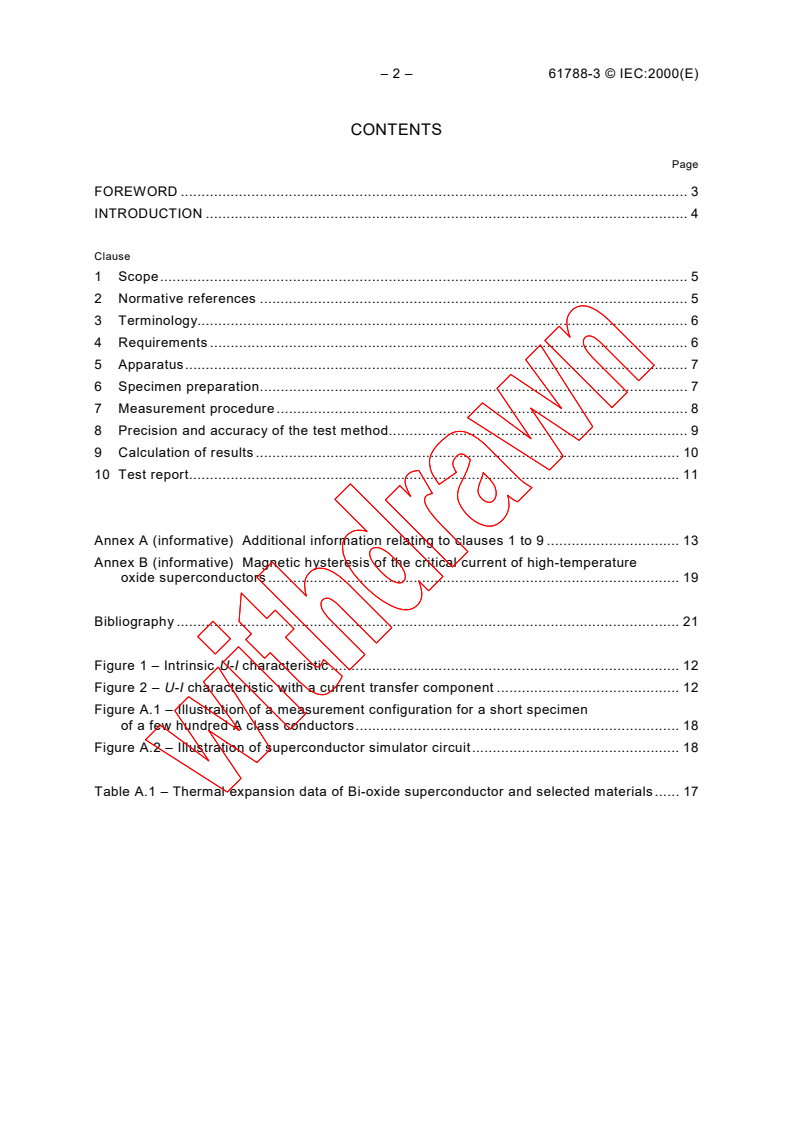
CONTENTS
Page
FOREWORD . 3
INTRODUCTION .4
Clause
1 Scope. 5
2 Normative references . 5
3 Terminology. 6
4 Requirements .6
5 Apparatus. 7
6 Specimen preparation. 7
7 Measurement procedure. 8
8 Precision and accuracy of the test method. 9
9 Calculation of results . 10
10 Test report. 11
Annex A (informative) Additional information relating to clauses 1 to 9 . 13
Annex B (informative) Magnetic hysteresis of the critical current of high-temperature
oxide superconductors . 19
Bibliography . 21
Figure 1 – Intrinsic U-I characteristic . 12
Figure 2 – U-I characteristic with a current transfer component . 12
Figure A.1 – Illustration of a measurement configuration for a short specimen
of a few hundred A class conductors. 18
Figure A.2 – Illustration of superconductor simulator circuit. 18
Table A.1 – Thermal expansion data of Bi-oxide superconductor and selected materials . 17
61788-3 © IEC:2000(E) – 3 –
INTERNATIONAL ELECTROTECHNICAL COMMISSION
__________
SUPERCONDUCTIVITY –
Part 3: Critical current measurement –
DC critical current of Ag-sheathed Bi-2212
and Bi-2223 oxide superconductors
FOREWORD
1) The IEC (International Electrotechnical Commission) is a worldwide organization for standardization comprising
all national electrotechnical committees (IEC National Committees). The object of the IEC is to promote
international co-operation on all questions concerning standardization in the electrical and electronic fields. To
this end and in addition to other activities, the IEC publishes International Standards. Their preparation is
entrusted to technical committees; any IEC National Committee interested in the subject dealt with may
participate in this preparatory work. International, governmental and non-governmental organizations liaising
with the IEC also participate in this preparation. The IEC collaborates closely with the International
Organization for Standardization (ISO) in accordance with conditions determined by agreement between the
two organizations.
2) The formal decisions or agreements of the IEC on technical matters express, as nearly as possible, an
international consensus of opinion on the relevant subjects since each technical committee has representation
from all interested National Committees.
3) The documents produced have the form of recommendations for international use and are published in the form
of standards, technical specifications, technical reports or guides and they are accepted by the National
Committees in that sense.
4) In order to promote international unification, IEC National Committees undertake to apply IEC International
Standards transparently to the maximum extent possible in their national and regional standards. Any
divergence between the IEC Standard and the corresponding national or regional standard shall be clearly
indicated in the latter.
5) The IEC provides no marking procedure to indicate its approval and cannot be rendered responsible for any
equipment declared to be in conformity with one of its standards.
6) Attention is drawn to the possibility that some of the elements of this International Standard may be the subject
of patent rights. The IEC shall not be held responsible for identifying any or all such patent rights.
International Standard IEC 61788-3 has been prepared by IEC technical committee 90:
Superconductivity.
The text of this standard is based on the following documents:
FDIS Report on voting
90/80/FDIS 90/86/RVD
Full information on the voting for the approval of this standard can be found in the report on
voting indicated in the above table.
This publication has been drafted in accordance with the ISO/IEC Directives, Part 3.
Annexes A and B are for information only.
The committee has decided that the contents of this publication will remain unchanged until
2005. At this date, the publication will be
• reconfirmed;
• withdrawn;
• replaced by a revised edition, or
• amended.
A bilingual version of this standard may be issued at a later date.
– 4 – 61788-3 © IEC:2000(E)
INTRODUCTION
In 1986 J.G. Bednorz and K.A. Mueller discovered that some Perovskite type Cu-containing
oxides show superconductivity at temperatures far above those which metallic
superconductors have shown. Since then, extensive R & D work on high-temperature oxide
superconductors has been and is being made worldwide, and its application to high-field
magnet machines, low-loss power transmission, electronics and many other technologies is in
progress [1].
Fabrication technology is essential to the application of high-temperature oxide
superconductors. Among high-temperature oxide superconductors developed so far,
BiSrCaCu oxide (Bi-2212 and Bi-2223) superconductors have been the most successful at
being fabricated into wires and tapes of practical length and superconducting properties.
These conductors can be wound into a magnet to generate a magnetic field of several tesla
[2]. It has also been shown that Bi-2212 and Bi-2223 conductors can substantially raise the
limit of magnetic field generation by a superconducting magnet [3].
In summer 1993, VAMAS-TWA16 started working on the test methods of critical currents in
Bi-oxide superconductors. In September 1997, the TWA16 worked out a guideline (VAMAS
guideline) on the critical current measurement method for Ag-sheathed Bi-2212 and Bi-2223
oxide superconductors. This pre-standardization work of VAMAS was taken as the base for
the IEC standard, described in the present document, on the d.c. critical current test method
of Ag-sheathed Bi-2212 and Bi-2223 oxide superconductors.
The test method covered in this International Standard is intended to give an appropriate and
agreeable technical base to those engineers working in the field of superconductivity
technology.
The critical current of composite superconductors like Ag-sheathed Bi-oxide superconductors
depends on many variables. These variables need to be considered in both the testing and
the application of these materials. Test conditions such as magnetic field, temperature and
relative orientation of the specimen and magnetic field are determined by the particular
application. The test configuration may be determined by the particular conductor through
certain tolerances. The specific critical current criterion may be determined by the particular
application. It may be appropriate to measure a number of test specimens if there are
irregularities in testing.
––––––––––––––
The numbers in brackets refer to the bibliography.
61788-3 © IEC:2000(E) – 5 –
SUPERCONDUCTIVITY –
Part 3: Critical current measurement –
DC critical current of Ag-sheathed Bi-2212
and Bi-2223 oxide superconductors
1 Scope
This part of IEC 61788 covers a test method for the determination of the d.c. critical current of
short and straight Ag- or Ag alloy-sheathed Bi-2212 and Bi-2223 oxide superconductors that
have a monolithic structure and a shape of round wire or flat or square tape containing mono-
or multicores of oxides.
This method is intended for use with superconductors that have critical currents less than
500 A and n-values larger than 5. The test is carried out with and without applying external
magnetic fields. In the test of the tape specimen in magnetic fields, the magnetic fields are
parallel or perpendicular to the tape surface. The test specimen is immersed either in a liquid
helium bath or a liquid nitrogen bath during testing. Deviations from this test method that are
allowed for routine tests and other specific restrictions are given in this standard.
Substantial parts of the test method covered in this standard are in common with, or similar
to, those for Nb Sn composite superconductors (IEC 61788-2). Special features newly found
for oxide superconductors may be classified into two groups. The first group is specific to
oxide composite superconductors, including mechanical fragility originating from the presence
of weak links, cryogen gas bubble formation, aging degradation, magnetic flux flow and creep,
large anisotropy, hysteresis in critical current with magnetic field sweep, etc. The second
group is due to the short length of the specimen used in the standard. A critical current
measurement on such a specimen may easily pick up different voltage signals due to thermal
electromotive force, inductive voltage, thermal noise, current redistribution, specimen motion
relative to the holder, etc. Current transfer voltages may be present due to the short distance
from a current contact to a voltage tap. Short specimen length may reduce mechanical
tolerance against the Lorentz force, for example, by promoting the formation of cryogen gas
bubbles within the composite.
2 Normative references
The following normative documents contain provisions which, through reference in this text,
constitute provisions of this part of IEC 61788. For dated references, subsequent
amendments to, or revisions of, any of these publications do not apply. However, parties to
agreements based on this part of IEC 61788 are encouraged to investigate the possibility of
applying the most recent edition of the normative document indicated below. For undated
references, the latest edition of the normative document referred to applies. Members of IEC
and ISO maintain registers of currently valid International Standards.
IEC 60050-815:2000, International Electrotechnical Vocabulary (IEV) – Part 815: Super-
conductivity
IEC 61788-2:1999, Superconductivity – Part 2: Critical current measurement – DC critical
current of Nb Sn composite superconductors
– 6 – 61788-3 © IEC:2000(E)
3 Terminology
For the purpose of this standard, the definitions given in IEC 60050-815 and the following
definitions apply.
3.1
critical current (I )
c
current at which a specified electric field strength (electric field) criterion (E ) or resistivity
c
criterion (ρ ) is reached in the specimen at a certain value of a static applied magnetic field at
c
a specified temperature either in a liquid helium bath or a liquid nitrogen bath at a constant
pressure. For either E or ρ , there is a corresponding voltage criterion U for a specified
c c c
sample length.
3.2
Bi-2212 and Bi-2223 oxide superconductors are defined in the chemical formulae as follows:
Bi-2212; Bi Sr CaCu O ( x = ~ 8),
2 2 2 x
Bi-2223; (Bi,Pb) Sr Ca Cu O ( x = ~10).
2 2 2 3 x
4 Requirements
The critical current of a superconductor shall be measured by applying a direct current (I) to
the superconductor specimen and then measuring the voltage (U) generated along a section
of the specimen. The current shall be increased from zero and the voltage-current (U-I)
characteristic generated and recorded.
The target precision of this method is a coefficient of variation (standard deviation divided by
the average of the critical current determinations) that is less than 5 % for the measurement
at 0 T and near 4,2 K or 77 K.
The use of a common current transfer correction is excluded from this test method.
Furthermore, if a current transfer signature is pronounced in the measurement, then the
measurement shall be considered invalid.
It is the responsibility of the user of this standard to consult and establish appropriate safety
and health practices and to determine the applicability of regulatory limitations prior to use.
Specific precautionary statements are given below.
Hazards exist in this type of measurement. Very large direct currents with very low voltages
do not necessarily provide a direct personal hazard, but accidental shorting of the current
leads with another conductor, such as tools or transfer lines, can release significant amounts
of energy and cause arcs or burns. It is imperative to isolate and protect current leads from
shorting. Also the energy stored in the superconducting magnets commonly used for the
background magnetic field can cause similar large current and/or voltage pulses or deposit a
large amount of thermal energy in the cryogenic systems causing rapid boil-off or even
explosive conditions. The use of cryogenic liquids is essential to cool the superconductors,
which allows the transition into the superconducting state. Direct contact of skin with cold
liquid transfer lines, storage dewars or apparatus components can cause immediate freezing,
as can direct contact with a spilled cryogen. It is imperative that safety precautions for
handling cryogenic liquids be observed.
61788-3 © IEC:2000(E) – 7 –
5 Apparatus
5.1 Measurement holder material
The measurement holder shall be made from an insulating material or from a conductive non-
ferromagnetic material that is either covered or not covered with an insulating layer.
The critical current may inevitably depend on the measurement holder material due to the
strain induced by the differential thermal contraction between the specimen and the
measurement holder.
The total strain induced in the specimen at the measuring temperature shall be minimized to
be within ±0,1 %. If there is an excess strain due to the differential thermal contraction of the
specimen and the holder, the critical current shall be noted to be determined under an excess
strain state by identification of the holder material.
Suitable measurement holder materials are recommended in A.4.1. Any one of these may be
used.
When a conductive material is used without an insulating layer, the leakage current through
the holder shall be less than 1 % of the total current when the specimen current is at I
c
(see 8.5).
5.2 Measurement holder construction
The holder shall have a flat surface on which a straight specimen can be placed.
The current contact shall be rigidly fastened to the measurement holder to avoid stress
concentration in the region of transition between the holder and the current contact. It is
important to have no difference in level between the mounting surfaces of the current contacts
and the mounting specimen holder.
6 Specimen preparation
6.1 Reaction heat treatment
Reaction heat treatment shall be carried out according to the manufacturer's specification
which includes reaction temperature, period and atmosphere, oxygen partial pressure,
specimen cooling and warming rates, specimen protection method against mechanical strain,
examination of deformation and surface condition of specimen and error limits which must not
be exceeded. Temperature variations within the furnace shall be controlled such as not to
exceed those limits.
Reaction heat treatment can be skipped when it has already been carried out by the
manufacturer.
6.2 Specimen mounting for measurement
After the reaction heat treatment, the ends of the specimen shall be trimmed to suit the
measurement holder.
The specimen shall be mounted to the flat surface of the holder and both ends shall be
soldered to the current contact blocks (see A.6 for solder material).
– 8 – 61788-3 © IEC:2000(E)
For the test in magnetic fields, a low-temperature adhesive (such as epoxy) shall be used to
bond the specimen to the measurement holder to reduce specimen motion against the Lorentz
force.
The bond shall be strong enough to keep the specimen in place against the Lorentz force, in
the case where the applied magnetic field is perpendicular to the specimen surface.
The length of a specimen to be measured shall be defined as follows:
L = 2 × L + L + 2 × L ≥ 5 × W (1)
1 2 3
L , L, L ≥ W (2)
2 3
where
L is the distance between the voltage taps;
L is the length of a specimen to be measured;
L is the length of the soldered part of the current contact;
L is the distance from a current contact to a voltage tap;
W is the width or diameter of a specimen to be measured.
For a specimen with a large current-carrying capacity, L shall be larger. L shall be larger for
a measurement that needs high sensitivity and L shall be larger when current transfer
voltage cannot be neglected.
In the case of the wire specimen the angle between the specimen axis and the magnetic field
shall be (90 ± 9)°. This angle shall be determined with an accuracy of ±2°.
In the case of tape specimens, there are two options in addition to the requirement that the
angle between the longitudinal specimen axis and the magnetic field shall be (90 ± 9)°. In one
option, the magnetic field shall be perpendicular to the specimen surface, the angle deviation
being within ±7°. In the second option, the magnetic field shall be parallel to the specimen
surface, the angle deviation being within ±3°.
The voltage taps shall be placed in the central part along both the specimen length and the
specimen width.
All soldering shall be conducted as quickly as possible so as not to cause thermal damage to
the specimen. Soft voltage leads shall be used and twisted before soldering.
The distance between the voltage taps, L, shall be measured to an accuracy of 5 %. This
voltage tap separation shall be greater than the specimen width.
7 Measurement procedure
For testing, the specimen and the holder shall be mounted in a test cryostat consisting of a
liquid helium or nitrogen dewar, a magnet (when necessary) and a support structure.
The specimen shall be immersed in cryogen for the data acquisition phase. The specimen
may be cooled slowly in cryogen vapour, or inserted slowly into the cryogen bath, or, in the
case of cooling to the 4,2 K range, first slowly immersed in liquid nitrogen and then liquid
helium. The specimen shall be cooled from room temperature to liquid helium (or liquid
nitrogen) temperature over a time period of at least 5 min.
61788-3 © IEC:2000(E) – 9 –
Between each measuring temperature and each magnetic-field angle, the specimen shall be
cooled in zero field, from a temperature above the critical temperature down to the measuring
temperature, and then the field angle with respect to the conductor cross-section shall be
fixed while the field is still zero. This procedural step can only be omitted if one of the
following two conditions is met: only zero field measurements will be made with monotonically
decreasing temperatures or the specimen has a demonstrated magnetic hysteresis of less
than 2 % for the magnetic fields to be measured (see annex B).
The temperature of the cryogen bath shall be measured during each determination of I .
c
Unless a quench protection circuit or resistive shunt is used to protect the specimen from
damage, the specimen current shall be kept low enough so that the specimen does not enter
the normal state.
When using the constant sweep rate method, the current sweep rate shall be lower than 2 I
c
per minute.
When using the step-and-hold current method, the current sweep rate between current set
points shall be lower than 10 I per minute. The current drift during each current set point
c
shall be less than 1 % of I .
c
The relation between the magnetic field and the magnet current shall be measured
beforehand. The magnet current shall be measured before each determination of I .
c
If the magnetic field is parallel to the surface of the measurement holder, the relative direction
of the current to the applied magnetic field shall result in the Lorentz force which pushes the
specimen against the surface of the measurement holder. In the case of the applied magnetic
field perpendicular to the measurement holder surface, either direction of the current relative
to the field is possible, with the condition that the specimen is rigidly mounted to the
measurement holder with appropriate adhesive.
Record the U-I characteristic with increasing current and at monotonically increasing magnetic
fields (see annex B).
The baseline voltage of the U-I characteristic shall be taken as the recorded voltage at zero
current for the step-and-hold current method or the average voltage at approximately 0,1 I for
c
the constant sweep rate method.
8 Precision and accuracy of the test method
8.1 Critical current
The critical current shall be determined from a voltage-current characteristic measured with a
four-terminal technique.
The current source shall provide a d.c. current having a maximum periodic and random
deviation of less than ±2 % at I , within the bandwidth 10 Hz to 10 MHz.
c
A four-terminal standard resistor, with an accuracy of at least 0,5 %, shall be used to
determine the specimen current.
A recorder and the necessary preamplifiers, filters or voltmeters, or a combination thereof,
shall be used to record the U-I characteristic. The resulting record shall allow the
determination of U to a precision of 10 % and the corresponding current to an accuracy of
c
1 % and with a precision of 1 %.
– 10 – 61788-3 © IEC:2000(E)
8.2 Temperature
A cryostat shall provide the necessary environment for measuring I and the specimen shall
c
be measured while immersed in liquid helium or liquid nitrogen. The liquid temperature shall
be reported to an accuracy of ±0,1 K, measured by means of a pressure sensor or an
appropriate temperature sensor.
The difference between the specimen temperature and the bath temperature shall be
minimized.
To convert the pressure observed in the cryostat into a temperature value, the phase diagram
of helium or nitrogen shall be used. The pressure measurement shall be accurate enough to
obtain the required accuracy of the temperature measurement.
8.3 Magnetic field
A magnetic system shall provide the magnetic field to an accurac
...