

IEC 62419:2008
(Main)Control technology - Rules for the designation of measuring instruments
General Information
- Abstract
IEC 62419:2008 is applicable to measurement technology. It defines rules for the unambiguous designation of different types of measuring instruments and of measuring instrument features with the intention of enabling unambiguous technical communication over language boundaries. This standard cancels and replaces IEC/PAS 62419 published in 2005. This first edition constitutes a technical revision.
- Status
- Published
- Publication Date
- 04-Nov-2008
- Technical Committee
- TC 65 - Industrial-process measurement, control and automation
- Drafting Committee
- WG 1 - TC 65/WG 1
- Current Stage
- PPUB - Publication issued
- Start Date
- 05-Nov-2008
- Completion Date
- 30-Nov-2008
Buy Documents
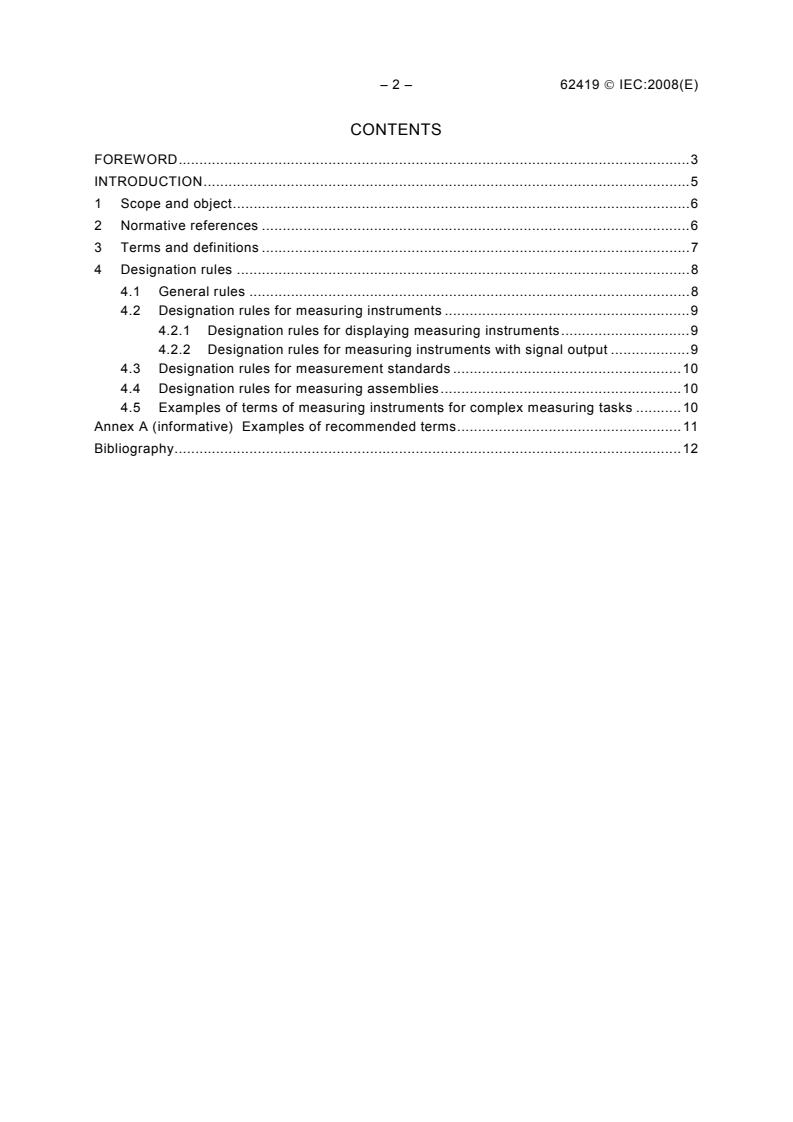
IEC 62419:2008 - Control technology - Rules for the designation of measuring instruments Released:11/5/2008
IEC 62419:2008 - Control technology - Rules for the designation of measuring instruments Released:11/5/2008
Overview
IEC 62419:2008 - Control technology: Rules for the designation of measuring instruments - establishes rules to name and describe measuring instruments and their features unambiguously across language boundaries. Applicable to measurement technology, this first edition (which cancels IEC/PAS 62419:2005) aligns instrument designation with modern metrology practice by recommending designation according to the measured quantity or measurement task rather than by unit. The aim is consistent, clear technical communication in catalogs, documentation, specifications and multilingual contexts.
Key topics and requirements
- Designation principle: Instruments should be named by the measured quantity or measuring task (e.g., temperature measuring instrument, pressure measuring instrument), using either compound nouns or “measuring instrument for …” constructions.
- Secondary component guidance: It is strongly recommended to use “… measuring instrument” as the secondary component in compound terms. Ambiguous secondary terms such as “… sensor” should be avoided; prefer “… sensing element”, “… detector”, “… transducer”, “… transmitter”, “… measuring chain” or “… measuring instrument” depending on function.
- Terminology and form: General grammar/typography guidance (use hyphens to avoid ambiguity, e.g., “moving-coil galvanometer”). Abbreviations are acceptable when context defines the quantity.
- Scope of names: Rules cover displaying instruments, instruments with signal output, measurement standards, measuring assemblies, measuring chains and systems. Examples include displaying measuring instrument, measuring instrument with signal output, measurement standard, and measuring assembly.
- Alignment with metrology vocabulary: Designations are adapted to ISO/IEC Guide 99 (VIM) and IEC vocabulary (IEC 60050 parts), and to SI unit conventions (ISO 1000 / ISO 31 series).
Applications and who uses it
- Useful for manufacturers (product naming, datasheets, catalogs)
- Technical authors and translators creating multilingual documentation
- Procurement teams specifying equipment in tenders and contracts
- Test laboratories and calibration services documenting measurement chains and standards
- System integrators and control engineers who need clear component/function descriptions
- Standards committees and regulators seeking harmonized terminology
Practical uses include product classification, clearer equipment specifications, unambiguous procurement requirements, and consistent metadata for digital catalogues and equipment databases.
Related standards
- ISO/IEC Guide 99 (VIM) - International vocabulary of metrology
- IEC 60050-311 / 312 / 351 - International Electrotechnical Vocabulary (measurement and control technology)
- ISO 1000 / ISO 31 series - Quantities and units (SI usage)
Keywords: IEC 62419, measuring instrument designation, control technology, measurement technology, measurement standard, measuring assembly, VIM, IEC 60050, SI units.
Relations
- Replaces
IEC PAS 62419:2005 - Control technology - Rules for the designation of measuring instruments - Effective Date
- 05-Sep-2023
Buy Documents
IEC 62419:2008 - Control technology - Rules for the designation of measuring instruments Released:11/5/2008
IEC 62419:2008 - Control technology - Rules for the designation of measuring instruments Released:11/5/2008
Get Certified
Connect with accredited certification bodies for this standard

DVS-ZERT GmbH
German welding certification society.
BSMI (Bureau of Standards, Metrology and Inspection)
Taiwan's standards and inspection authority.
CARES (UK Certification Authority for Reinforcing Steels)
UK certification for reinforcing steels and construction.
Sponsored listings
Frequently Asked Questions
IEC 62419:2008 is a standard published by the International Electrotechnical Commission (IEC). Its full title is "Control technology - Rules for the designation of measuring instruments". This standard covers: IEC 62419:2008 is applicable to measurement technology. It defines rules for the unambiguous designation of different types of measuring instruments and of measuring instrument features with the intention of enabling unambiguous technical communication over language boundaries. This standard cancels and replaces IEC/PAS 62419 published in 2005. This first edition constitutes a technical revision.
IEC 62419:2008 is applicable to measurement technology. It defines rules for the unambiguous designation of different types of measuring instruments and of measuring instrument features with the intention of enabling unambiguous technical communication over language boundaries. This standard cancels and replaces IEC/PAS 62419 published in 2005. This first edition constitutes a technical revision.
IEC 62419:2008 is classified under the following ICS (International Classification for Standards) categories: 17.020 - Metrology and measurement in general; 25.040.40 - Industrial process measurement and control. The ICS classification helps identify the subject area and facilitates finding related standards.
IEC 62419:2008 has the following relationships with other standards: It is inter standard links to IEC PAS 62419:2005. Understanding these relationships helps ensure you are using the most current and applicable version of the standard.
IEC 62419:2008 is available in PDF format for immediate download after purchase. The document can be added to your cart and obtained through the secure checkout process. Digital delivery ensures instant access to the complete standard document.
Standards Content (Sample)
IEC 62419
Edition 1.0 2008-11
INTERNATIONAL
STANDARD
Control technology – Rules for the designation of measuring instruments
All rights reserved. Unless otherwise specified, no part of this publication may be reproduced or utilized in any form
or by any means, electronic or mechanical, including photocopying and microfilm, without permission in writing from
either IEC or IEC's member National Committee in the country of the requester.
If you have any questions about IEC copyright or have an enquiry about obtaining additional rights to this publication,
please contact the address below or your local IEC member National Committee for further information.
IEC Central Office
3, rue de Varembé
CH-1211 Geneva 20
Switzerland
Email: inmail@iec.ch
Web: www.iec.ch
About the IEC
The International Electrotechnical Commission (IEC) is the leading global organization that prepares and publishes
International Standards for all electrical, electronic and related technologies.
About IEC publications
The technical content of IEC publications is kept under constant review by the IEC. Please make sure that you have the
latest edition, a corrigenda or an amendment might have been published.
ƒ Catalogue of IEC publications: www.iec.ch/searchpub
The IEC on-line Catalogue enables you to search by a variety of criteria (reference number, text, technical committee,…).
It also gives information on projects, withdrawn and replaced publications.
ƒ IEC Just Published: www.iec.ch/online_news/justpub
Stay up to date on all new IEC publications. Just Published details twice a month all new publications released. Available
on-line and also by email.
ƒ Electropedia: www.electropedia.org
The world's leading online dictionary of electronic and electrical terms containing more than 20 000 terms and definitions
in English and French, with equivalent terms in additional languages. Also known as the International Electrotechnical
Vocabulary online.
ƒ Customer Service Centre: www.iec.ch/webstore/custserv
If you wish to give us your feedback on this publication or need further assistance, please visit the Customer Service
Centre FAQ or contact us:
Email: csc@iec.ch
Tel.: +41 22 919 02 11
Fax: +41 22 919 03 00
IEC 62419
Edition 1.0 2008-11
INTERNATIONAL
STANDARD
Control technology – Rules for the designation of measuring instruments
INTERNATIONAL
ELECTROTECHNICAL
COMMISSION
PRICE CODE
M
ICS 17.020; 25.040.40 ISBN 978-2-88910-698-1
– 2 – 62419 © IEC:2008(E)
CONTENTS
FOREWORD.3
INTRODUCTION.5
1 Scope and object.6
2 Normative references .6
3 Terms and definitions .7
4 Designation rules .8
4.1 General rules .8
4.2 Designation rules for measuring instruments .9
4.2.1 Designation rules for displaying measuring instruments.9
4.2.2 Designation rules for measuring instruments with signal output .9
4.3 Designation rules for measurement standards .10
4.4 Designation rules for measuring assemblies.10
4.5 Examples of terms of measuring instruments for complex measuring tasks .10
Annex A (informative) Examples of recommended terms.11
Bibliography.12
62419 © IEC:2008(E) – 3 –
INTERNATIONAL ELECTROTECHNICAL COMMISSION
____________
CONTROL TECHNOLOGY –
RULES FOR THE DESIGNATION OF MEASURING INSTRUMENTS
FOREWORD
1) The International Electrotechnical Commission (IEC) is a worldwide organization for standardization comprising
all national electrotechnical committees (IEC National Committees). The object of IEC is to promote
international co-operation on all questions concerning standardization in the electrical and electronic fields. To
this end and in addition to other activities, IEC publishes International Standards, Technical Specifications,
Technical Reports, Publicly Available Specifications (PAS) and Guides (hereafter referred to as “IEC
Publication(s)”). Their preparation is entrusted to technical committees; any IEC National Committee interested
in the subject dealt with may participate in this preparatory work. International, governmental and non-
governmental organizations liaising with the IEC also participate in this preparation. IEC collaborates closely
with the International Organization for Standardization (ISO) in accordance with conditions determined by
agreement between the two organizations.
2) The formal decisions or agreements of IEC on technical matters express, as nearly as possible, an international
consensus of opinion on the relevant subjects since each technical committee has representation from all
interested IEC National Committees.
3) IEC Publications have the form of recommendations for international use and are accepted by IEC National
Committees in that sense. While all reasonable efforts are made to ensure that the technical content of IEC
Publications is accurate, IEC cannot be held responsible for the way in which they are used or for any
misinterpretation by any end user.
4) In order to promote international uniformity, IEC National Committees undertake to apply IEC Publications
transparently to the maximum extent possible in their national and regional publications. Any divergence
between any IEC Publication and the corresponding national or regional publication shall be clearly indicated in
the latter.
5) IEC provides no marking procedure to indicate its approval and cannot be rendered responsible for any
equipment declared to be in conformity with an IEC Publication.
6) All users should ensure that they have the latest edition of this publication.
7) No liability shall attach to IEC or its directors, employees, servants or agents including individual experts and
members of its technical committees and IEC National Committees for any personal injury, property damage or
other damage of any nature whatsoever, whether direct or indirect, or for costs (including legal fees) and
expenses arising out of the publication, use of, or reliance upon, this IEC Publication or any other IEC
Publications.
8) Attention is drawn to the Normative references cited in this publication. Use of the referenced publications is
indispensable for the correct application of this publication.
9) Attention is drawn to the possibility that some of the elements of this IEC Publication may be the subject of
patent rights. IEC shall not be held responsible for identifying any or all such patent rights.
International Standard IEC 62419 has been prepared by IEC technical committee 65:
Industrial-process measurement, control and automation.
This standard cancels and replaces IEC/PAS 62419 published in 2005. This first edition
constitutes a technical revision.
The text of this standard is based on the following documents:
FDIS Report on voting
65/429/FDIS 65/430/RVD
Full information on the voting for the approval of this standard can be found in the report on
voting indicated in the above table.
This publication has been drafted in accordance with the ISO/IEC Directives, Part 2.
– 4 – 62419 © IEC:2008(E)
The committee has decided that the contents of this publication will remain unchanged until
the maintenance result date indicated on the IEC web site under "http://webstore.iec.ch" in
the data related to the specific publication. At this date, the publication will be
• reconfirmed,
• withdrawn,
• replaced by a revised edition, or
• amended.
A bilingual version of this publication may be issued at a later date.
62419 © IEC:2008(E) – 5 –
INTRODUCTION
The state of science concerning quantities and units has undergone significant changes in the
last century. During the period from 1920 to 1960 there was a fundamental change in the
comprehension and usage of physical quantities, which was particularly promoted by the
works of Julius Wallot published between 1922 and 1953. In this process the various systems
of physical units and the usage of numerical equations were replaced by the SI-units (see ISO
1000) and the usage of quantity equations. So the quantities were no longer linked to certain
units.
This development culminated in the publishing of the first edition of the German standard DIN
1313 Notation of physical equations in sciences and technology in 1931 and the resolutions of
the tenth general conference of weights and measures in 1954. Since then it has been
considered incorrect to address a quantity by its unit.
In view of this, measuring instruments should not be addressed by the unit of the measured
quantity but only by the measured quantity or the measuring task itself.
Referring to the question of market relevance, it must be stated, that especially with respect
to the international project of standardized classification and documentation in multilingual
equipment descriptions, it is important to critically address the situation regarding the
designation of measuring instruments. Ideally, every manufacturer should use the same
terminology. In practice, there is confusion in the proper designation of measuring instruments
within catalogues and sales brochures which also has consequences in technical literature.
It is not the intention of this standard to enforce particular usages in any language but to
make recommendations that remove the linguistic confusion in this field – or at least, reduce
it. Considering the urgent necessity of unambiguous technical communication over language
boundaries, this is a legitimate goal. This could also be considered to be a matter of global
importance.
– 6 – 62419 © IEC:2008(E)
CONTROL TECHNOLOGY –
RULES FOR THE DESIGNATION OF MEASURING INSTRUMENTS
1 Scope and object
This International Standard is applicable to measurement technology. It defines rules for the
unambiguous designation of different types of measuring instruments and of measuring
instrument features with the intention of enabling unambiguous technical communication over
language boundaries.
The scope of this International Standard is
– the adaptation of the designation of measuring instruments and of measuring instrument
features to the state of science by designating them according to the measuring quantity
or the measuring task instead of the unit, and
– the adaptation of the designation of measuring instruments and of measuring instrument
features to the terms given in the ISO/IEC Guide 99 (VIM).
It is strongly recommended that “……. measuring instrument” is used as secondary
component in compound terms. This is consistent with the objective of standardization,
namely uniformity, especially since the meaning of other secondary components, e.g.
“indicator”, “gauge”, “meter”, is no more descriptive than that of the standard component in
this context. For exceptions see 4.1 and A.2.
The ambiguous secondary component “. sensor” shall not be used. In its place one of the
secondary components “… sensing element”, “. detector”, “. transformer”, “. transducer”,
“… transmitter”, “. measuring instrument” or “. measuring chain” shall be used, depending
on the task of the functional unit being termed. The definitions for detector (detecting device),
transformer, transducer and transmitter are given in IEC 60050-351.
2 Normative references
The following referenced documents are indispensable for the application of this do
...
IEC 62419 ®
Edition 1.0 2008-11
INTERNATIONAL
STANDARD
NORME
INTERNATIONALE
Control technology – Rules for the designation of measuring instruments
Technologie de commande et de régulation – Règles pour la désignation des
instruments de mesure
All rights reserved. Unless otherwise specified, no part of this publication may be reproduced or utilized in any form
or by any means, electronic or mechanical, including photocopying and microfilm, without permission in writing from
either IEC or IEC's member National Committee in the country of the requester. If you have any questions about IEC
copyright or have an enquiry about obtaining additional rights to this publication, please contact the address below or
your local IEC member National Committee for further information.
Droits de reproduction réservés. Sauf indication contraire, aucune partie de cette publication ne peut être reproduite
ni utilisée sous quelque forme que ce soit et par aucun procédé, électronique ou mécanique, y compris la photocopie
et les microfilms, sans l'accord écrit de l'IEC ou du Comité national de l'IEC du pays du demandeur. Si vous avez des
questions sur le copyright de l'IEC ou si vous désirez obtenir des droits supplémentaires sur cette publication, utilisez
les coordonnées ci-après ou contactez le Comité national de l'IEC de votre pays de résidence.
IEC Central Office Tel.: +41 22 919 02 11
3, rue de Varembé Fax: +41 22 919 03 00
CH-1211 Geneva 20 info@iec.ch
Switzerland www.iec.ch
About the IEC
The International Electrotechnical Commission (IEC) is the leading global organization that prepares and publishes
International Standards for all electrical, electronic and related technologies.
About IEC publications
The technical content of IEC publications is kept under constant review by the IEC. Please make sure that you have the
latest edition, a corrigenda or an amendment might have been published.
IEC Catalogue - webstore.iec.ch/catalogue Electropedia - www.electropedia.org
The stand-alone application for consulting the entire The world's leading online dictionary of electronic and
bibliographical information on IEC International Standards, electrical terms containing more than 30 000 terms and
Technical Specifications, Technical Reports and other definitions in English and French, with equivalent terms in 14
documents. Available for PC, Mac OS, Android Tablets and additional languages. Also known as the International
iPad. Electrotechnical Vocabulary (IEV) online.
IEC publications search - www.iec.ch/searchpub IEC Glossary - std.iec.ch/glossary
The advanced search enables to find IEC publications by a More than 55 000 electrotechnical terminology entries in
variety of criteria (reference number, text, technical English and French extracted from the Terms and Definitions
committee,…). It also gives information on projects, replaced clause of IEC publications issued since 2002. Some entries
and withdrawn publications. have been collected from earlier publications of IEC TC 37,
77, 86 and CISPR.
IEC Just Published - webstore.iec.ch/justpublished
Stay up to date on all new IEC publications. Just Published IEC Customer Service Centre - webstore.iec.ch/csc
details all new publications released. Available online and If you wish to give us your feedback on this publication or
also once a month by email. need further assistance, please contact the Customer Service
Centre: csc@iec.ch.
A propos de l'IEC
La Commission Electrotechnique Internationale (IEC) est la première organisation mondiale qui élabore et publie des
Normes internationales pour tout ce qui a trait à l'électricité, à l'électronique et aux technologies apparentées.
A propos des publications IEC
Le contenu technique des publications IEC est constamment revu. Veuillez vous assurer que vous possédez l’édition la
plus récente, un corrigendum ou amendement peut avoir été publié.
Catalogue IEC - webstore.iec.ch/catalogue Electropedia - www.electropedia.org
Application autonome pour consulter tous les renseignements
Le premier dictionnaire en ligne de termes électroniques et
bibliographiques sur les Normes internationales,
électriques. Il contient plus de 30 000 termes et définitions en
Spécifications techniques, Rapports techniques et autres
anglais et en français, ainsi que les termes équivalents dans
documents de l'IEC. Disponible pour PC, Mac OS, tablettes
14 langues additionnelles. Egalement appelé Vocabulaire
Android et iPad.
Electrotechnique International (IEV) en ligne.
Recherche de publications IEC - www.iec.ch/searchpub
Glossaire IEC - std.iec.ch/glossary
La recherche avancée permet de trouver des publications IEC Plus de 55 000 entrées terminologiques électrotechniques, en
en utilisant différents critères (numéro de référence, texte, anglais et en français, extraites des articles Termes et
comité d’études,…). Elle donne aussi des informations sur les Définitions des publications IEC parues depuis 2002. Plus
projets et les publications remplacées ou retirées. certaines entrées antérieures extraites des publications des
CE 37, 77, 86 et CISPR de l'IEC.
IEC Just Published - webstore.iec.ch/justpublished
Service Clients - webstore.iec.ch/csc
Restez informé sur les nouvelles publications IEC. Just
Published détaille les nouvelles publications parues. Si vous désirez nous donner des commentaires sur cette
Disponible en ligne et aussi une fois par mois par email. publication ou si vous avez des questions contactez-nous:
csc@iec.ch.
IEC 62419 ®
Edition 1.0 2008-11
INTERNATIONAL
STANDARD
NORME
INTERNATIONALE
Control technology – Rules for the designation of measuring instruments
Technologie de commande et de régulation – Règles pour la désignation des
instruments de mesure
INTERNATIONAL
ELECTROTECHNICAL
COMMISSION
COMMISSION
ELECTROTECHNIQUE
PRICE CODE
INTERNATIONALE
CODE PRIX M
ICS 17.020; 25.040.40 ISBN 978-2-8322-1458-9
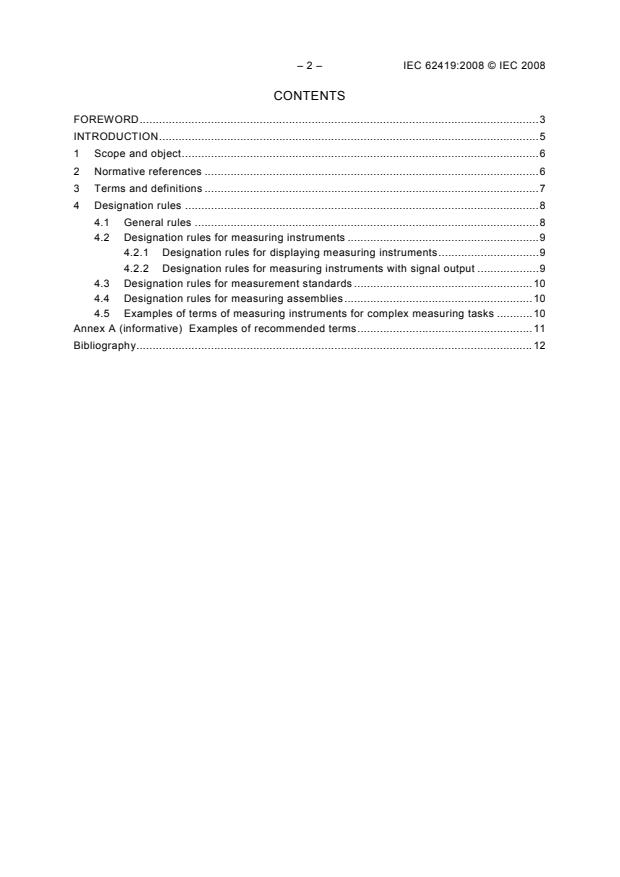
– 2 – IEC 62419:2008 © IEC 2008
CONTENTS
FOREWORD . 3
INTRODUCTION . 5
1 Scope and object . 6
2 Normative references . 6
3 Terms and definitions . 7
4 Designation rules . 8
4.1 General rules . 8
4.2 Designation rules for measuring instruments . 9
4.2.1 Designation rules for displaying measuring instruments . 9
4.2.2 Designation rules for measuring instruments with signal output . 9
4.3 Designation rules for measurement standards . 10
4.4 Designation rules for measuring assemblies . 10
4.5 Examples of terms of measuring instruments for complex measuring tasks . 10
Annex A (informative) Examples of recommended terms . 11
Bibliography . 12
INTERNATIONAL ELECTROTECHNICAL COMMISSION
____________
CONTROL TECHNOLOGY –
RULES FOR THE DESIGNATION OF MEASURING INSTRUMENTS
FOREWORD
1) The International Electrotechnical Commission (IEC) is a worldwide organization for standardization comprising
all national electrotechnical committees (IEC National Committees). The object of IEC is to promote
international co-operation on all questions concerning standardization in the electrical and electronic fields. To
this end and in addition to other activities, IEC publishes International Standards, Technical Specifications,
Technical Reports, Publicly Available Specifications (PAS) and Guides (hereafter referred to as “IEC
Publication(s)”). Their preparation is entrusted to technical committees; any IEC National Committee interested
in the subject dealt with may participate in this preparatory work. International, governmental and non-
governmental organizations liaising with the IEC also participate in this preparation. IEC collaborates closely
with the International Organization for Standardization (ISO) in accordance with conditions determined by
agreement between the two organizations.
2) The formal decisions or agreements of IEC on technical matters express, as nearly as possible, an international
consensus of opinion on the relevant subjects since each technical committee has representation from all
interested IEC National Committees.
3) IEC Publications have the form of recommendations for international use and are accepted by IEC National
Committees in that sense. While all reasonable efforts are made to ensure that the technical content of IEC
Publications is accurate, IEC cannot be held responsible for the way in which they are used or for any
misinterpretation by any end user.
4) In order to promote international uniformity, IEC National Committees undertake to apply IEC Publications
transparently to the maximum extent possible in their national and regional publications. Any divergence
between any IEC Publication and the corresponding national or regional publication shall be clearly indicated in
the latter.
5) IEC provides no marking procedure to indicate its approval and cannot be rendered responsible for any
equipment declared to be in conformity with an IEC Publication.
6) All users should ensure that they have the latest edition of this publication.
7) No liability shall attach to IEC or its directors, employees, servants or agents including individual experts and
members of its technical committees and IEC National Committees for any personal injury, property damage or
other damage of any nature whatsoever, whether direct or indirect, or for costs (including legal fees) and
expenses arising out of the publication, use of, or reliance upon, this IEC Publication or any other IEC
Publications.
8) Attention is drawn to the Normative references cited in this publication. Use of the referenced publications is
indispensable for the correct application of this publication.
9) Attention is drawn to the possibility that some of the elements of this IEC Publication may be the subject of
patent rights. IEC shall not be held responsible for identifying any or all such patent rights.
International Standard IEC 62419 has been prepared by IEC technical committee 65:
Industrial-process measurement, control and automation. This standard cancels and replaces
IEC/PAS 62419 published in 2005. This first edition constitutes a technical revision.
This bilingual version (2014-04) corresponds to the monolingual English version, published in
2008-11.
The text of this standard is based on the following documents:
FDIS Report on voting
65/429/FDIS 65/430/RVD
Full information on the voting for the approval of this standard can be found in the report on
voting indicated in the above table.
The French version of this standard has not been voted upon.
– 4 – IEC 62419:2008 © IEC 2008
This publication has been drafted in accordance with the ISO/IEC Directives, Part 2.
The committee has decided that the contents of this publication will remain unchanged until
the maintenance result date indicated on the IEC web site under "http://webstore.iec.ch" in
the data related to the specific publication. At this date, the publication will be
• reconfirmed,
• withdrawn,
• replaced by a revised edition, or
• amended.
INTRODUCTION
The state of science concerning quantities and units has undergone significant changes in the
last century. During the period from 1920 to 1960 there was a fundamental change in the
comprehension and usage of physical quantities, which was particularly promoted by the
works of Julius Wallot published between 1922 and 1953. In this process the various systems
of physical units and the usage of numerical equations were replaced by the SI-units (see ISO
1000) and the usage of quantity equations. So the quantities were no longer linked to certain
units.
This development culminated in the publishing of the first edition of the German standard DIN
1313 Notation of physical equations in sciences and technology in 1931 and the resolutions of
the tenth general conference of weights and measures in 1954. Since then it has been
considered incorrect to address a quantity by its unit.
In view of this, measuring instruments should not be addressed by the unit of the measured
quantity but only by the measured quantity or the measuring task itself.
Referring to the question of market relevance, it must be stated, that especially with respect
to the international project of standardized classification and documentation in multilingual
equipment descriptions, it is important to critically address the situation regarding the
designation of measuring instruments. Ideally, every manufacturer should use the same
terminology. In practice, there is confusion in the proper designation of measuring instruments
within catalogues and sales brochures which also has consequences in technical literature.
It is not the intention of this standard to enforce particular usages in any language but to
make recommendations that remove the linguistic confusion in this field – or at least, reduce
it. Considering the urgent necessity of unambiguous technical communication over language
boundaries, this is a legitimate goal. This could also be considered to be a matter of global
importance.
– 6 – IEC 62419:2008 © IEC 2008
CONTROL TECHNOLOGY –
RULES FOR THE DESIGNATION OF MEASURING INSTRUMENTS
1 Scope and object
This International Standard is applicable to measurement technology. It defines rules for the
unambiguous designation of different types of measuring instruments and of measuring
instrument features with the intention of enabling unambiguous technical communication over
language boundaries.
The scope of this International Standard is
– the adaptation of the designation of measuring instruments and of measuring instrument
features to the state of science by designating them according to the measuring quantity
or the measuring task instead of the unit, and
– the adaptation of the designation of measuring instruments and of measuring instrument
features to the terms given in the ISO/IEC Guide 99 (VIM).
It is strongly recommended that “……. measuring instrument” is used as secondary
component in compound terms. This is consistent with the objective of standardization,
namely uniformity, especially since the meaning of other secondary components, e.g.
“indicator”, “gauge”, “meter”, is no more descriptive than that of the standard component in
this context. For exceptions see 4.1 and A.2.
The ambiguous secondary component “. sensor” shall not be used. In its place one of the
secondary components “… sensing element”, “. detector”, “. transformer”, “. transducer”,
“… transmitter”, “. measuring instrument” or “. measuring chain” shall be used, depending
on the task of the functional unit being termed. The definitions for detector (detecting device),
transformer, transducer and transmitter are given in IEC 60050-351.
2 Normative references
The following referenced documents are indispensable for the application of this document.
For dated references, only the edition cited applies. For undated references, the latest edition
of the referenced document (including any amendments) applies.
IEC 60050-311, International Electrotechnical Vocabulary – Part 311: General terms relating
to measurements
IEC 60050-312, International Electrotechnical Vocabulary – Part 312: General terms relating
to electrical measurements
IEC 60050-351: 2006, International Electrotechnical Vocabulary – Part 351: Control
Technology
ISO/IEC Guide 99: 2007, International vocabulary of metrology – Basic and general concepts
and associated terms (VIM)
ISO 31 series, Quantities and units
ISO 1000, SI units and recommendations for the use of their multiples and of certain other
units
3 Terms and definitions
For the purposes of this document, the following terms and definitions apply.
3.1
measuring instrument
device intended to be used to make measurements, alone or in conjunction with
supplementary devices
[IEV 311-03-01]
[ISO/IEC Guide 99, 3.1]
NOTE 1 Material measures are also measuring instruments.
NOTE 2 An instrument is also a measuring instrument if its output is transmitted, converted, processed or stored
and cannot be perceived directly by the observer.
NOTE 3 The designation measuring instrument without any supplementary designation components should only
be used as a generic term referring to all types of measuring instruments. In compound expressions, the term
“measuring instrument” should only be used to signify a displaying measuring instrument.
EXAMPLE The Measuring Instruments and Measuring Systems catalogue (also contains, for example, signal
generators and measuring assemblies).
3.1.1
displaying measuring instrument
displaying instrument
measuring instrument where the output signal is presented in visual form
[ISO/IEC Guide 99, 3.4 modified]
NOTE 1 Several parameters may be required to output the measured value, e.g. power and energy when referring
to the supply of electrical energy.
NOTE 2 The output measured value can refer directly to the measured quantity, or it can be derived from this
using a processing method. The processing method can be invariable, manually adjustable or programmable.
NOTE 3 Linguistic usage is not unambiguous. In IEC 60050-311 displaying measuring instruments are also
termed “indicating (measuring) instruments”. In ISO/IEC Guide 99, displaying measuring instrument and indicating
measuring instrument are not synonyms.
3.1.2
measuring instrument with signal output
measuring instrument providing an image of the measured quantity by an output signal
NOTE 1 Several parameters may be required to output the measured value, e.g. power and energy when referring
to the supply of electrical energy.
NOTE 2 The output measured value can refer directly to the measured quantity, or it can be derived from this
using a processing method. The processing method can be invariable, manually adjustable or programmable.
3.1.3
material measure
measuring instrument reproducing or supplying, in a permanent manner during its use,
quantities of one or more given kinds, each with an assigned quantity value
[ISO/IEC Guide 99, 3.6]
EXAMPLES Standard weight, volume measure, standard electric resistor, standard signal generator.
NOTE A material measure can be a measurement standard.
3.2
measuring device
assembly of measuring instruments intended for specified measurement purposes
[IEV 311-03-05, modified]
– 8 – IEC 62419:2008 © IEC 2008
3.3
measuring system
complete set of measuring instruments and other equipment assembled to carry out specific
measurements
[IEV 311-03-06]
[ISO/IEC Guide 99, 3.2 modified]
3.4
measuring chain
series of elements of a measuring instrument or system that constitutes the path of the
measurement signal from the input to the output
[IEV 311-03-07]
[ISO/IEC Guide 99, 3.10 modified]
EXAMPLE Set of transducers and connecting elements between one or more measuring instruments placed
between the sensing element, which is the first element in the chain, and the last element of the chain, e.g. the
indicating, recording or storage device.
3.5
measurement standard
etalon
realization of the definition of a given quantity, with stated quantity value and associated
measurement uncertainty, used as a reference
[ISO/IEC Guide 99, 5.1]
NOTE 1 In a measuring chain, the measurement standard is a functional unit which provides a defined value of a
measured quantity for measuring purposes.
NOTE 2 Several parameters may be required for purposes of definition, e.g. frequency and amplitude of a
sinusoidal a.c. voltage.
NOTE 3 The value can be invariable, manually adjustable or programmable.
3.6
measuring assembly
functional unit performing a measurement task which generally combines other functional
units or measuring instruments to form a common control unit and measurement result output
NOTE The processing method can be fixed, manually adjustable or controlled by a computer.
4 Designation rules
4.1 General rules
There are no particular grammatical rules to be observed in the designation of instruments,
except that the resulting designation is clear and understandable. Hyphens should be used to
avoid ambiguity, e.g. “moving-coil galvanometer” and not “moving coil galvanometer”.
Terms for physical quantities and their units are given in the ISO 31, the ISO/IEC 80000 and
the IEC 60027 series of standards. In addition, terms for their units are given in ISO 1000.
Abbreviated terms (e.g. “tension” instead of “mechanical tension” or “electric tension”) can be
used if the quantity is clearly defined by the context.
The use of “indicator”, “gauge”, or “meter” etc. as secondary components in contexts where
they have an unambiguous or universally agreed meaning, e.g. sight glass flow indicator,
bourdon tube pressure gauge, mirror galvanometer, is not precluded.
4.2 Designation rules for measuring instruments
To designate a measuring instrument, the words “measuring instrument” are combined with a
word indicating the measuring task or measured quantity and written as a compound noun
(“.measuring instrument”) or in dissolved form (“measuring instrument for .”).
NOTE 1 A measuring instrument often has a measurement standard as an internal component or as an
accessory, e.g. Balance with weights, measuring instrument for electrical voltage with integrated voltage
measurement standard.
NOTE 2 Other terms may be used for complex measuring tasks.
EXAMPLES
Compound noun:
temperature measuring instrument
pressure measuring instrument
rotational speed measuring instrument
sound level measuring instrument
Dissolved form: Context-related short form:
measuring instrument for electrical voltage voltage measuring instrument
measuring instrument for alternating voltage alternating voltage measuring instrument
measuring instrument for mechanical tension tension measuring instrument
measuring instrument for electrical power power measuring instrument
4.2.1 Designation rules for displaying measuring instruments
To designate a displaying measuring instrument, the words “displaying instrument” are
combined with a word indicating the measuring task or measured quantity and written as a
compound noun (“…displaying instrument”) or in dissolved form (“displaying instrument for
…”).
NOTE 1 A displaying instrument that requires no external power to indicate the measured quantity is often termed
a “gauge”.
NOTE 2 Other terms may be used for complex measuring tasks.
EXAMPLES
Compound noun:
flow displaying instrument
level displaying instrument
Dissolved form: Context-related short form:
displaying instrument for electrical voltage voltage measuring instrument
measuring instrument for direct current direct current measuring instrument
4.2.2 Designation rules for measuring instruments with signal output
To designate a measuring instrument with signal output, the first component “measuring” shall
be placed in front of a word which indicates the method of transmission or processing.
EXAMPLES
Compound noun:
measuring amplifier
measuring rectifier
measuring demodulator
measuring bridge
measuring transformer
measuring transducer
measuring converter
– 10 – IEC 62419:2008 © IEC 2008
To specify the precise type of measuring transducer, a word which indicates the measured
quantity can be placed in front of “measuring transducer”.
NOTE 1 If the input quantity is electrical, the input and output quantities may not be of the same kind, e.g. a
voltage and a current.
NOTE 2 In certain instances, measuring transducers may also have a specific term in respect of their function (for
example amplifier, converter, transformer, frequency transducer, etc.)
[IEV 312-02-15, definition approximates to ISO/IEC Guide 99, 4.3].
4.3 Designation rules for measurement standards
To designate a measurement standard the words “measurement standard” are combined with
a word indicating the measured quantity and written as a compound noun (“. measurement
standard”) or in dissolved style (“measurement standard for .”).
NOTE Other terms may be used for complex measurement standards.
EXAMPLES
Compound noun:
length measurement standard
mass measurement standard
quartz-time measurement standard
caesium-time measurement standard
Dissolved form: Context-related short form:
measurement standard for electrical voltage voltage measurement standard
measurement standard for electrical resistance resistance measurement standard
Complex measurement standard:
signal generator
triple-point cell
4.4 Designation rules for measuring assemblies
To designate a measuring assembly, the words “measuring assembly” are combined with a
word indicating the measuring task and written as a compound noun (“. measuring
assembly”) or in dissolved form (measuring assembly for .”).
EXAMPLES
Compound noun:
radio communication measuring assembly
frequency response measuring assembly
gas analysis measuring assembly
material constant measuring assembly
Dissolved form: Context-related short form:
measuring assembly for GSM cellular radio units GSM radio measuring assembly
measuring assembly for frequency response frequency response measuring assembly
determination (also: sweep measuring assembly)
measuring assembly for CO and NO components exhaust gas measuring assembly
x
in vehicle exhaust gas
4.5 Examples of terms of measuring instruments for complex measuring tasks
spectrum analyzer
harmonics analyzer
FFT analyzer
measuring receiver
atmospheric pollutant analyzer
Annex A
(informative)
Examples of recommended terms
A.1 Recommended terms
Recommended term Term allowable in context
differential pressure measuring instrument differential pressure meter
flow measuring instrument flow meter, flow gauge
temperature measuring instrument temperature meter, temperature gauge
rotational speed measuring instrument rotational speed transmitter
atomic time measurement standard atomic clock
voltage measuring instrument voltage meter, voltmeter
current measuring instrument current meter, ammeter
resistance measuring instrument resistance meter, ohmmeter
Recommended term Term allowable for specific types
pressure measuring instrument manometer
temperature measuring instrument thermometer
Recommended term Term to be avoided
pressure measuring instrument pressure sensor
temperature measuring instrument temperature sensor
variable-area flow measuring instrument rotameter
A.2 Exceptions
Rules
Terms adopted for
...