


IEC 61936-1:2010
(Main)Power installations exceeding 1 kV a.c. - Part 1: Common rules
Power installations exceeding 1 kV a.c. - Part 1: Common rules
IEC 61936-1:2010 provides common rules for the design and the erection of electrical power installations in systems with nominal voltages above 1 kV a.c. and nominal frequency up to and including 60 Hz, so as to provide safety and proper functioning for the use intended. For the purpose of interpreting this standard, an electrical power installation is considered to be one of the following:
a) Substation, including substation for railway power supply;
b) Electrical installations on mast, pole and tower; Switchgear and/or transformers located outside a closed electrical operating area;
c) One (or more) power station(s) located on a single site. The installation includes generators and transformers with all associated switchgear and all electrical auxiliary systems. Connections between generating stations located on different sites are excluded;
d) The electrical system of a factory, industrial plant or other industrial, agricultural, commercial or public premises. The electrical power installation includes, among others, the following equipment: rotating electrical machines; switchgear; transformers and reactors; converters; cables; wiring systems; batteries; capacitors; earthing systems; buildings and fences which are part of a closed electrical operating area; associated protection, control and auxiliary systems; large air core reactor. NOTE: In general, a standard for an item of equipment takes precedence over this standard. This standard does not apply to the design and erection of any of the following:
- overhead and underground lines between separate installations;
- electric railways;
- mining equipment and installations;
- fluorescent lamp installations;
- installations on ships and off-shore installations;
- electrostatic equipment (e.g. electrostatic precipitators, spray-painting units);
- test sites;
- medical equipment, e.g. medical X-ray equipment.
This standard does not apply to the design of factory-built, type-tested switchgear for which separate IEC standards exist. This standard does not apply to the requirements for carrying out live working on electrical installations. This second edition cancels and replaces the first edition, published in 2002. It constitutes a technical revision. The main changes with respect to the previous edition are listed below:
- new table of references for additional agreements between manufacturer/contractor/planer and user/orderer/owner (4.1.2);
- addition of minimum clearances in air not standardized by IEC but based on current practice in some countries (Annex A);
- deletion of nominal voltages (Table 1, Table 2, Clause 5);
- addition of regulations for fuses (6.2.15);
- simplification of regulations for escape routes (7.5.4);
- deletion of special regulations for operating aisles (7.5.4);
- modification of clearances for fire protection (Table 3);
- modification of safety criteria for earthing systems (10.2.1);
- modified curves of permissibly touch voltages (Figure 12, Annex B);
- deletion of numbering of subclauses without headlines;
- change of "should" to "shall" in many cases or change of subclauses with "should" to a note. The contents of the corrigendum of March 2011 have been included in this copy.
Installations électriques en courant alternatif de puissance supérieure à 1 kV - Partie 1: Règles communes
La CEI 61936-1:2010 fournit des règles communes relatives à la conception et la mise en oeuvre des installations électriques dans des systèmes dont les tensions nominales sont supérieures à 1 kV en courant alternatif et la fréquence nominale inférieure ou égale à 60 Hz, afin d'assurer la sécurité et le fonctionnement correct pour l'utilisation prévue. Pour les besoins d'interprétation de la présente norme, une installation de puissance électrique est considérée comme étant l'une des suivantes:
a) Poste, y compris poste pour alimentation de réseaux ferroviaires;
b) Installations électriques sur mât, pylône et tour; Appareillage et/ou transformateurs situés à l'extérieur d'un local de service électrique fermé;
c) Une ou plusieurs centrales électriques placées dans un site unique. L'installation comprend les générateurs et les transformateurs avec tout l'appareillage et tous les auxiliaires électriques associés. Les liaisons entre les centrales situées sur des sites différents sont exclues;
d) Le réseau électrique d'une usine, installation industrielle ou autres locaux industriels, agricoles, commerciaux ou publics. L'installation de puissance électrique comprend notamment les matériels suivants:
- machines électriques tournantes;
- appareillage;
- transformateurs et réactances;
- convertisseurs;
- câbles;
- canalisations;
- batteries;
- condensateurs;
- installations de mise à la terre;
- bâtiments et clôtures qui font partie d'une zone électrique fermée;
- systèmes associés de protection, de commande et auxiliaires;
- réactance élevée à noyau d'air. NOTE: Généralement, une norme traitant d'un point particulier du matériel prévaut sur la présente norme. La présente norme ne s'applique pas à la conception et la mise en oeuvre des éléments suivants:
- lignes aériennes et souterraines entre des installations différentes;
- lignes de chemin de fer électriques;
- matériels de mine et installations;
- installations d'éclairages fluorescents;
- installations sur les bateaux et les plates-formes en mer;
- matériels électrostatiques (par exemple, précipitateurs électrostatiques, cabines de peinture);
- stations d'essai;
- matériel médical, par exemple, équipement à rayons X.
La présente norme ne s'applique pas à la conception des appareillages préfabriqués soumis à un essai de type pour lesquels des normes spécifiques CEI existent déjà. Cette norme ne s'applique pas aux exigences relatives aux travaux effectués sous tension sur des installations électriques. Cette seconde édition annule et remplace la première édition, publiée en 2002, dont elle constitue une révision technique. Les principaux changements par rapport à l'édition antérieure sont énumérés ci-dessous:
- nouveau tableau de références pour les accords complémentaires entre le constructeur/entrepreneur/planificateur et utilisateur/maître d' uvre/propriétaire (4.1.2);
- ajout d'espaces libres minimaux dans l'air non normalisés par la CEI, mais fondés sur la pratique courante dans certains pays (Annexe A);
- suppression des tensions nominales (Tableaux 1 et 2, Article 5);
- ajout de réglementations applicables aux fusibles (6.2.15);
- simplification des réglementations applicables aux voies d'évacuation (7.5.4);
- suppression des réglementations spéciales applicables aux allées de service (7.5.4); modification des espaces libres pour la protection contre l'incendie (Tableau 3);
- modification des critères de sécurité pour les installations de mise à la terre (10.2.1);
- courbes modifiées des tensions de contact admissibles (Figure 12, Annexe B); suppression de la numérotation des paragraphes sans titre;
- substitution de "il convient" par "doit" dans de nombreux cas ou modification des paragraphes contenant "il convient" par une note. Le contenu du corrigendum de mars 2011 a été pris en considération dans cet exemplaire.
General Information
- Status
- Published
- Publication Date
- 30-Aug-2010
- Technical Committee
- TC 99 - Insulation co-ordination and system engineering of high voltage electrical power installations above 1,0 kV AC and 1,5 kV DC
- Drafting Committee
- MT 4 - TC 99/MT 4
- Current Stage
- DELPUB - Deleted Publication
- Start Date
- 07-Jul-2021
- Completion Date
- 31-Jan-2019
Relations
- Effective Date
- 05-Sep-2023
- Corrected By
IEC 61936-1:2010/COR1:2011 - Corrigendum 1 - Power installations exceeding 1 kV a.c. - Part 1: Common rules - Effective Date
- 05-Sep-2023
- Effective Date
- 05-Sep-2023
- Effective Date
- 05-Sep-2023
Overview
IEC 61936-1:2010, titled Power installations exceeding 1 kV a.c. – Part 1: Common rules, is an international standard published by the International Electrotechnical Commission (IEC). It establishes comprehensive rules for the design and erection of electrical power installations operating at nominal voltages above 1 kV alternating current (a.c.), with nominal frequencies up to and including 60 Hz. The primary objective of the standard is to ensure the safety, reliability, and proper functioning of high-voltage power installations for their intended use.
This standard specifically addresses installations such as substations (including railway power supply substations), electrical equipment mounted on masts or towers, power stations situated on a single site, and electrical systems at factories, industrial plants, and commercial premises. The IEC 61936-1 standard excludes systems such as overhead/underground lines between different installations, electric railways, mining equipment, ships, and offshore installations among others.
Key Topics
IEC 61936-1:2010 comprehensively covers various fundamental and technical aspects critical for the safe and effective design of power installations above 1 kV a.c., including:
Fundamental Requirements
- General rules for safety, proper functionality, and documentation
- Agreements outlining responsibilities between manufacturers, contractors, and users
- Mechanical and electrical requirements addressing loads, insulation levels, and operational safety
Insulation and Clearances
- Minimum clearance distances between live parts to prevent electrical discharge
- Insulation coordination considering voltage levels and neutral earthing methods
Equipment Standards
- Requirements for components such as switchgear, transformers, capacitors, cables, and fuses
- Specifications addressing the selection, installation, and protection of electrical devices
Installation Design
- Circuit arrangement and layout for both indoor and outdoor installations
- Safety measures including aisles, escape routes, lighting, and labeling practices
- Building requirements housing electrical equipment, including structural provisions and fire safety
Earthing and Protection Systems
- Establishing earthing systems compliant with revised safety criteria
- Protective measures against overvoltages, harmonics, and electric shock hazards
Environmental and Special Conditions
- Adaptations for climatic variations, noise control, and effects of small animals or micro-organisms
Notably, this second edition includes amendments such as additional minimum clearances based on current practices, updated safety criteria for earthing, and enhanced requirements for fuses and escape routes.
Applications
IEC 61936-1:2010 serves as an essential reference for:
- Electrical engineers and designers involved in planning and erecting substations and high-voltage power systems
- Manufacturers and contractors ensuring compliance for electrical installations exceeding 1 kV a.c.
- Utility companies managing distribution and transmission infrastructures
- Safety inspectors and regulatory bodies assessing electrical power installation conformity
- Industrial facilities and commercial enterprises designing internal electrical power systems
Implementing the standard guarantees optimized safety and reliability in power installations by harmonizing design practices globally, thus reducing risks related to electrical faults, fire hazards, and operational failures.
Related Standards
IEC 61936-1 aligns with and complements other international standards and technical documents, including:
- IEC 62271 series – Standards for high-voltage switchgear and control gear
- IEC 60071 series – Insulation coordination standards addressing voltage withstand levels and surge protection
- IEC 60364 series – Electrical installations of buildings (low-voltage installations)
- IEC 62262 – Degrees of protection provided by enclosures (IP code) relevant to electrical equipment
- IEC standards covering factory-built, type-tested switchgear, which take precedence over IEC 61936-1 where applicable
Professionals relying on IEC 61936-1 should also consult specialized IEC standards for equipment and installation types excluded from this standard’s scope to ensure comprehensive regulatory compliance and safety.
Keywords: IEC 61936-1, power installations above 1 kV, electrical safety standards, high-voltage installation rules, substation design, electrical power system safety, insulation coordination, electrical equipment requirements, earthing systems, electrical installation compliance.
IEC 61936-1:2010 - Power installations exceeding 1 kV a.c. - Part 1: Common rules

IEC 61936-1:2010+AMD1:2014 CSV - Power installations exceeding 1 kV a.c. - Part 1: Common rules Released:2/26/2014 Isbn:9782832214329
Frequently Asked Questions
IEC 61936-1:2010 is a standard published by the International Electrotechnical Commission (IEC). Its full title is "Power installations exceeding 1 kV a.c. - Part 1: Common rules". This standard covers: IEC 61936-1:2010 provides common rules for the design and the erection of electrical power installations in systems with nominal voltages above 1 kV a.c. and nominal frequency up to and including 60 Hz, so as to provide safety and proper functioning for the use intended. For the purpose of interpreting this standard, an electrical power installation is considered to be one of the following: a) Substation, including substation for railway power supply; b) Electrical installations on mast, pole and tower; Switchgear and/or transformers located outside a closed electrical operating area; c) One (or more) power station(s) located on a single site. The installation includes generators and transformers with all associated switchgear and all electrical auxiliary systems. Connections between generating stations located on different sites are excluded; d) The electrical system of a factory, industrial plant or other industrial, agricultural, commercial or public premises. The electrical power installation includes, among others, the following equipment: rotating electrical machines; switchgear; transformers and reactors; converters; cables; wiring systems; batteries; capacitors; earthing systems; buildings and fences which are part of a closed electrical operating area; associated protection, control and auxiliary systems; large air core reactor. NOTE: In general, a standard for an item of equipment takes precedence over this standard. This standard does not apply to the design and erection of any of the following: - overhead and underground lines between separate installations; - electric railways; - mining equipment and installations; - fluorescent lamp installations; - installations on ships and off-shore installations; - electrostatic equipment (e.g. electrostatic precipitators, spray-painting units); - test sites; - medical equipment, e.g. medical X-ray equipment. This standard does not apply to the design of factory-built, type-tested switchgear for which separate IEC standards exist. This standard does not apply to the requirements for carrying out live working on electrical installations. This second edition cancels and replaces the first edition, published in 2002. It constitutes a technical revision. The main changes with respect to the previous edition are listed below: - new table of references for additional agreements between manufacturer/contractor/planer and user/orderer/owner (4.1.2); - addition of minimum clearances in air not standardized by IEC but based on current practice in some countries (Annex A); - deletion of nominal voltages (Table 1, Table 2, Clause 5); - addition of regulations for fuses (6.2.15); - simplification of regulations for escape routes (7.5.4); - deletion of special regulations for operating aisles (7.5.4); - modification of clearances for fire protection (Table 3); - modification of safety criteria for earthing systems (10.2.1); - modified curves of permissibly touch voltages (Figure 12, Annex B); - deletion of numbering of subclauses without headlines; - change of "should" to "shall" in many cases or change of subclauses with "should" to a note. The contents of the corrigendum of March 2011 have been included in this copy.
IEC 61936-1:2010 provides common rules for the design and the erection of electrical power installations in systems with nominal voltages above 1 kV a.c. and nominal frequency up to and including 60 Hz, so as to provide safety and proper functioning for the use intended. For the purpose of interpreting this standard, an electrical power installation is considered to be one of the following: a) Substation, including substation for railway power supply; b) Electrical installations on mast, pole and tower; Switchgear and/or transformers located outside a closed electrical operating area; c) One (or more) power station(s) located on a single site. The installation includes generators and transformers with all associated switchgear and all electrical auxiliary systems. Connections between generating stations located on different sites are excluded; d) The electrical system of a factory, industrial plant or other industrial, agricultural, commercial or public premises. The electrical power installation includes, among others, the following equipment: rotating electrical machines; switchgear; transformers and reactors; converters; cables; wiring systems; batteries; capacitors; earthing systems; buildings and fences which are part of a closed electrical operating area; associated protection, control and auxiliary systems; large air core reactor. NOTE: In general, a standard for an item of equipment takes precedence over this standard. This standard does not apply to the design and erection of any of the following: - overhead and underground lines between separate installations; - electric railways; - mining equipment and installations; - fluorescent lamp installations; - installations on ships and off-shore installations; - electrostatic equipment (e.g. electrostatic precipitators, spray-painting units); - test sites; - medical equipment, e.g. medical X-ray equipment. This standard does not apply to the design of factory-built, type-tested switchgear for which separate IEC standards exist. This standard does not apply to the requirements for carrying out live working on electrical installations. This second edition cancels and replaces the first edition, published in 2002. It constitutes a technical revision. The main changes with respect to the previous edition are listed below: - new table of references for additional agreements between manufacturer/contractor/planer and user/orderer/owner (4.1.2); - addition of minimum clearances in air not standardized by IEC but based on current practice in some countries (Annex A); - deletion of nominal voltages (Table 1, Table 2, Clause 5); - addition of regulations for fuses (6.2.15); - simplification of regulations for escape routes (7.5.4); - deletion of special regulations for operating aisles (7.5.4); - modification of clearances for fire protection (Table 3); - modification of safety criteria for earthing systems (10.2.1); - modified curves of permissibly touch voltages (Figure 12, Annex B); - deletion of numbering of subclauses without headlines; - change of "should" to "shall" in many cases or change of subclauses with "should" to a note. The contents of the corrigendum of March 2011 have been included in this copy.
IEC 61936-1:2010 is classified under the following ICS (International Classification for Standards) categories: 29.020 - Electrical engineering in general; 29.080.01 - Electrical insulation in general. The ICS classification helps identify the subject area and facilitates finding related standards.
IEC 61936-1:2010 has the following relationships with other standards: It is inter standard links to IEC 61936-1:2010/AMD1:2014, IEC 61936-1:2010/COR1:2011, IEC 61936-1:2021, IEC 61936-1:2002. Understanding these relationships helps ensure you are using the most current and applicable version of the standard.
IEC 61936-1:2010 is available in PDF format for immediate download after purchase. The document can be added to your cart and obtained through the secure checkout process. Digital delivery ensures instant access to the complete standard document.
Standards Content (Sample)
IEC 61936-1 ®
Edition 2.0 2010-08
INTERNATIONAL
STANDARD
NORME
INTERNATIONALE
colour
inside
Power installations exceeding 1 kV a.c. –
Part 1: Common rules
Installations électriques en courant alternatif de puissance supérieure à 1 kV –
Partie 1: Règles communes
All rights reserved. Unless otherwise specified, no part of this publication may be reproduced or utilized in any form or by
any means, electronic or mechanical, including photocopying and microfilm, without permission in writing from either IEC or
IEC's member National Committee in the country of the requester.
If you have any questions about IEC copyright or have an enquiry about obtaining additional rights to this publication,
please contact the address below or your local IEC member National Committee for further information.
Droits de reproduction réservés. Sauf indication contraire, aucune partie de cette publication ne peut être reproduite
ni utilisée sous quelque forme que ce soit et par aucun procédé, électronique ou mécanique, y compris la photocopie
et les microfilms, sans l'accord écrit de la CEI ou du Comité national de la CEI du pays du demandeur.
Si vous avez des questions sur le copyright de la CEI ou si vous désirez obtenir des droits supplémentaires sur cette
publication, utilisez les coordonnées ci-après ou contactez le Comité national de la CEI de votre pays de résidence.
IEC Central Office
3, rue de Varembé
CH-1211 Geneva 20
Switzerland
Email: inmail@iec.ch
Web: www.iec.ch
About the IEC
The International Electrotechnical Commission (IEC) is the leading global organization that prepares and publishes
International Standards for all electrical, electronic and related technologies.
About IEC publications
The technical content of IEC publications is kept under constant review by the IEC. Please make sure that you have the
latest edition, a corrigenda or an amendment might have been published.
ƒ Catalogue of IEC publications: www.iec.ch/searchpub
The IEC on-line Catalogue enables you to search by a variety of criteria (reference number, text, technical committee,…).
It also gives information on projects, withdrawn and replaced publications.
ƒ IEC Just Published: www.iec.ch/online_news/justpub
Stay up to date on all new IEC publications. Just Published details twice a month all new publications released. Available
on-line and also by email.
ƒ Electropedia: www.electropedia.org
The world's leading online dictionary of electronic and electrical terms containing more than 20 000 terms and definitions
in English and French, with equivalent terms in additional languages. Also known as the International Electrotechnical
Vocabulary online.
ƒ Customer Service Centre: www.iec.ch/webstore/custserv
If you wish to give us your feedback on this publication or need further assistance, please visit the Customer Service
Centre FAQ or contact us:
Email: csc@iec.ch
Tel.: +41 22 919 02 11
Fax: +41 22 919 03 00
A propos de la CEI
La Commission Electrotechnique Internationale (CEI) est la première organisation mondiale qui élabore et publie des
normes internationales pour tout ce qui a trait à l'électricité, à l'électronique et aux technologies apparentées.
A propos des publications CEI
Le contenu technique des publications de la CEI est constamment revu. Veuillez vous assurer que vous possédez
l’édition la plus récente, un corrigendum ou amendement peut avoir été publié.
ƒ Catalogue des publications de la CEI: www.iec.ch/searchpub/cur_fut-f.htm
Le Catalogue en-ligne de la CEI vous permet d’effectuer des recherches en utilisant différents critères (numéro de référence,
texte, comité d’études,…). Il donne aussi des informations sur les projets et les publications retirées ou remplacées.
ƒ Just Published CEI: www.iec.ch/online_news/justpub
Restez informé sur les nouvelles publications de la CEI. Just Published détaille deux fois par mois les nouvelles
publications parues. Disponible en-ligne et aussi par email.
ƒ Electropedia: www.electropedia.org
Le premier dictionnaire en ligne au monde de termes électroniques et électriques. Il contient plus de 20 000 termes et
définitions en anglais et en français, ainsi que les termes équivalents dans les langues additionnelles. Egalement appelé
Vocabulaire Electrotechnique International en ligne.
ƒ Service Clients: www.iec.ch/webstore/custserv/custserv_entry-f.htm
Si vous désirez nous donner des commentaires sur cette publication ou si vous avez des questions, visitez le FAQ du
Service clients ou contactez-nous:
Email: csc@iec.ch
Tél.: +41 22 919 02 11
Fax: +41 22 919 03 00
IEC 61936-1 ®
Edition 2.0 2010-08
INTERNATIONAL
STANDARD
NORME
INTERNATIONALE
colour
inside
Power installations exceeding 1 kV a.c. –
Part 1: Common rules
Installations électriques en courant alternatif de puissance supérieure à 1 kV –
Partie 1: Règles communes
INTERNATIONAL
ELECTROTECHNICAL
COMMISSION
COMMISSION
ELECTROTECHNIQUE
PRICE CODE
INTERNATIONALE
XD
CODE PRIX
ICS 29.020; 29.080.01 ISBN 978-2-88912-099-4
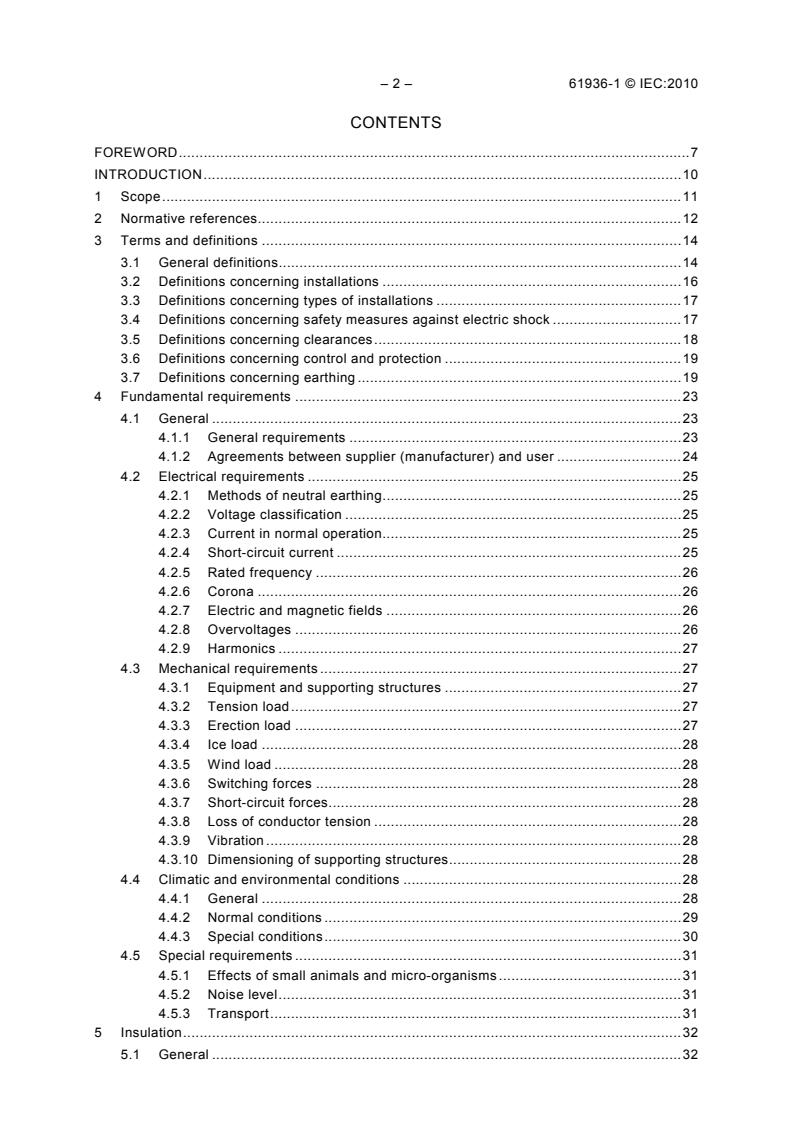
– 2 – 61936-1 © IEC:2010
CONTENTS
FOREWORD.7
INTRODUCTION.10
1 Scope.11
2 Normative references.12
3 Terms and definitions .14
3.1 General definitions.14
3.2 Definitions concerning installations .16
3.3 Definitions concerning types of installations .17
3.4 Definitions concerning safety measures against electric shock .17
3.5 Definitions concerning clearances.18
3.6 Definitions concerning control and protection .19
3.7 Definitions concerning earthing .19
4 Fundamental requirements .23
4.1 General .23
4.1.1 General requirements .23
4.1.2 Agreements between supplier (manufacturer) and user .24
4.2 Electrical requirements .25
4.2.1 Methods of neutral earthing.25
4.2.2 Voltage classification .25
4.2.3 Current in normal operation.25
4.2.4 Short-circuit current .25
4.2.5 Rated frequency .26
4.2.6 Corona .26
4.2.7 Electric and magnetic fields .26
4.2.8 Overvoltages .26
4.2.9 Harmonics .27
4.3 Mechanical requirements .27
4.3.1 Equipment and supporting structures .27
4.3.2 Tension load.27
4.3.3 Erection load .27
4.3.4 Ice load .28
4.3.5 Wind load .28
4.3.6 Switching forces .28
4.3.7 Short-circuit forces.28
4.3.8 Loss of conductor tension .28
4.3.9 Vibration .28
4.3.10 Dimensioning of supporting structures.28
4.4 Climatic and environmental conditions .28
4.4.1 General .28
4.4.2 Normal conditions .29
4.4.3 Special conditions.30
4.5 Special requirements .31
4.5.1 Effects of small animals and micro-organisms.31
4.5.2 Noise level.31
4.5.3 Transport.31
5 Insulation.32
5.1 General .32
61936-1 © IEC:2010 – 3 –
5.2 Selection of insulation level.32
5.2.1 Consideration of methods of neutral earthing .32
5.2.2 Consideration of rated withstand voltages .32
5.3 Verification of withstand values .32
5.4 Minimum clearances of live parts .33
5.4.1 General .33
5.4.2 Minimum clearances in voltage range I.33
5.4.3 Minimum clearances in voltage range II.33
5.5 Minimum clearances between parts under special conditions .35
5.6 Tested connection zones .36
6 Equipment .36
6.1 General requirements .36
6.1.1 Selection .36
6.1.2 Compliance .36
6.1.3 Personnel safety.36
6.2 Specific requirements .36
6.2.1 Switching devices .36
6.2.2 Power transformers and reactors .37
6.2.3 Prefabricated type-tested switchgear.38
6.2.4 Instrument transformers.38
6.2.5 Surge arresters.39
6.2.6 Capacitors .39
6.2.7 Line traps .39
6.2.8 Insulators.39
6.2.9 Insulated cables.39
6.2.10 Conductors and accessories .42
6.2.11 Rotating electrical machines .42
6.2.12 Generating units .43
6.2.13 Generating unit main connections .43
6.2.14 Static converters.43
6.2.15 Fuses .44
6.2.16 Electrical and mechanical Interlocking.44
7 Installations .44
7.1 General requirements .44
7.1.1 Circuit arrangement .44
7.1.2 Documentation.45
7.1.3 Transport routes .45
7.1.4 Aisles and access areas .46
7.1.5 Lighting .46
7.1.6 Operational safety.46
7.1.7 Labelling.46
7.2 Outdoor installations of open design .46
7.2.1 Protective barrier clearances.47
7.2.2 Protective obstacle clearances.47
7.2.3 Boundary clearances .47
7.2.4 Minimum height over access area .47
7.2.5 Clearances to buildings.48
7.2.6 External fences or walls and access doors .48
7.3 Indoor installations of open design .48
– 4 – 61936-1 © IEC:2010
7.4 Installation of prefabricated type-tested switchgear .49
7.4.1 General .49
7.4.2 Additional requirements for gas-insulated metal-enclosed switchgear .49
7.5 Requirements for buildings .51
7.5.1 Introduction .51
7.5.2 Structural provisions .51
7.5.3 Rooms for switchgear .52
7.5.4 Maintenance and operating areas .52
7.5.5 Doors .53
7.5.6 Draining of insulating liquids .53
7.5.7 Air conditioning and ventilation.53
7.5.8 Buildings which require special consideration .54
7.6 High voltage/low voltage prefabricated substations.54
7.7 Electrical installations on mast, pole and tower .54
8 Safety measures.60
8.1 General .60
8.2 Protection against direct contact .60
8.2.1 Measures for protection against direct contact.60
8.2.2 Protection requirements .61
8.3 Means to protect persons in case of indirect contact .62
8.4 Means to protect persons working on electrical installations .62
8.4.1 Equipment for isolating installations or apparatus .62
8.4.2 Devices to prevent reclosing of isolating devices .63
8.4.3 Devices for determining the de-energized state .63
8.4.4 Devices for earthing and short-circuiting.63
8.4.5 Equipment acting as protective barriers against adjacent live parts.64
8.4.6 Storage of personal protection equipment .65
8.5 Protection from danger resulting from arc fault.65
8.6 Protection against direct lightning strokes .65
8.7 Protection against fire.66
8.7.1 General .66
8.7.2 Transformers, reactors .67
8.7.3 Cables .70
8.7.4 Other equipment with flammable liquid .70
8.8 Protection against leakage of insulating liquid and SF .70
8.8.1 Insulating liquid leakage and subsoil water protection.70
8.8.2 SF leakage.72
8.8.3 Failure with loss of SF and its decomposition products .72
8.9 Identification and marking.72
8.9.1 General .72
8.9.2 Information plates and warning plates .72
8.9.3 Electrical hazard warning .73
8.9.4 Installations with incorporated capacitors .73
8.9.5 Emergency signs for emergency exits .73
8.9.6 Cable identification marks .73
9 Protection, control and auxiliary systems.78
9.1 Monitoring and control systems.78
9.2 DC and AC supply circuits .79
9.2.1 General .79
61936-1 © IEC:2010 – 5 –
9.2.2 AC supply .79
9.2.3 DC supply.80
9.3 Compressed air systems.80
9.4 SF gas handling plants.81
9.5 Hydrogen handling plants.81
9.6 Basic rules for electromagnetic compatibility of control systems .82
9.6.1 General .82
9.6.2 Electrical noise sources in high voltage installations .82
9.6.3 Measures to be taken to reduce the effects of high frequency
interference .82
9.6.4 Measures to be taken to reduce the effects of low frequency
interference .83
9.6.5 Measures related to the selection of equipment.83
9.6.6 Other possible measures to reduce the effects of interference.84
10 Earthing systems .84
10.1 General .84
10.2 Fundamental requirements .84
10.2.1 Safety criteria .84
10.2.2 Functional requirements.85
10.2.3 High and low voltage earthing systems.85
10.3 Design of earthing systems.86
10.3.1 General .86
10.3.2 Power system faults.87
10.3.3 Lightning and transients .87
10.4 Construction of earthing systems .88
10.5 Measurements.88
10.6 Maintainability.88
10.6.1 Inspections .88
10.6.2 Measurements .88
11 Inspection and testing.89
11.1 General .89
11.2 Verification of specified performances.90
11.3 Tests during installation and commissioning.90
11.4 Trial running .90
12 Operation and maintenance manual .91
Annex A (normative) Values of rated insulation levels and minimum clearances based
on current practice in some countries .92
Annex B (normative) Method of calculating permissible touch voltages .95
Annex C (normative) Permissible touch voltage according IEEE 80.96
Annex D (normative) Earthing system design flow chart.97
Annex E (informative) Protection measures against direct lightning strokes .97
Bibliography . 101
Figure 1 – Protection against direct contact by protective barriers/protective obstacles
within closed electrical operating areas .55
Figure 2 – Boundary distances and minimum height at the external fence/wall .56
Figure 3 – Minimum heights and working clearances within closed electrical operating
areas .57
Figure 4 – Approaches with buildings (within closed electrical operating areas).58
– 6 – 61936-1 © IEC:2010
Figure 5 – Minimum approach distance for transport.59
Figure 6 – Separating walls between transformers.74
Figure 7 – Fire protection between transformer and building .75
Figure 8 – Sump with integrated catchment tank.76
Figure 9 – Sump with separate catchment tank.76
Figure 10 – Sump with integrated common catchment tank.77
Figure 11 – Example for small transformers without gravel layer and catchment tank .77
Figure 12 – Permissible touch voltage U .89
Tp
Figure C.1 – Permissible touch voltage U according IEEE 80.96
Tp
Figure E.1 – Single shield wire .99
Figure E.2 – Two shield wires.99
Figure E.3 – Single lightning rod.100
Figure E.4 – Two lightning rods .100
Table 1 – Minimum clearances in air – Voltage range I (1 kV < U ≤ 245 kV) .34
m
Table 2 – Minimum clearances in air – Voltage range II (U > 245 kV) .34
m
Table 3 – Guide values for outdoor transformer clearances .68
Table 4 – Minimum requirements for the installation of indoor transformers .69
Table 5 – Minimum requirements for interconnection of low-voltage and high-voltage
earthing systems based on EPR limits .86
Table A.1 – Values of rated insulation levels and minimum clearances in air for 1 kV <
U ≤ 245 kV for highest voltage for installation U not standardized by the IEC based
m m
on current practice in some countries .92
Table A.2 – Values of rated insulation levels and minimum clearances in air for 1 kV <
U ≤ 245 kV for highest voltage for installation U not standardized by IEC based on
m m
current practice in some countries.93
Table A.3 – Values of rated insulation levels and minimum clearances in air for U >
m
245 kV for highest voltages for installation U not standardized by IEC based on
m
current practice in some countries.94
61936-1 © IEC:2010 – 7 –
INTERNATIONAL ELECTROTECHNICAL COMMISSION
____________
POWER INSTALLATIONS EXCEEDING 1 kV AC –
Part 1: Common rules
FOREWORD
1) The International Electrotechnical Commission (IEC) is a worldwide organization for standardization comprising
all national electrotechnical committees (IEC National Committees). The object of IEC is to promote
international co-operation on all questions concerning standardization in the electrical and electronic fields. To
this end and in addition to other activities, IEC publishes International Standards, Technical Specifications,
Technical Reports, Publicly Available Specifications (PAS) and Guides (hereafter referred to as “IEC
Publication(s)”). Their preparation is entrusted to technical committees; any IEC National Committee interested
in the subject dealt with may participate in this preparatory work. International, governmental and non-
governmental organizations liaising with the IEC also participate in this preparation. IEC collaborates closely
with the International Organization for Standardization (ISO) in accordance with conditions determined by
agreement between the two organizations.
2) The formal decisions or agreements of IEC on technical matters express, as nearly as possible, an international
consensus of opinion on the relevant subjects since each technical committee has representation from all
interested IEC National Committees.
3) IEC Publications have the form of recommendations for international use and are accepted by IEC National
Committees in that sense. While all reasonable efforts are made to ensure that the technical content of IEC
Publications is accurate, IEC cannot be held responsible for the way in which they are used or for any
misinterpretation by any end user.
4) In order to promote international uniformity, IEC National Committees undertake to apply IEC Publications
transparently to the maximum extent possible in their national and regional publications. Any divergence
between any IEC Publication and the corresponding national or regional publication shall be clearly indicated in
the latter.
5) IEC itself does not provide any attestation of conformity. Independent certification bodies provide conformity
assessment services and, in some areas, access to IEC marks of conformity. IEC is not responsible for any
services carried out by independent certification bodies.
6) All users should ensure that they have the latest edition of this publication.
7) No liability shall attach to IEC or its directors, employees, servants or agents including individual experts and
members of its technical committees and IEC National Committees for any personal injury, property damage or
other damage of any nature whatsoever, whether direct or indirect, or for costs (including legal fees) and
expenses arising out of the publication, use of, or reliance upon, this IEC Publication or any other IEC
Publications.
8) Attention is drawn to the Normative references cited in this publication. Use of the referenced publications is
indispensable for the correct application of this publication.
9) Attention is drawn to the possibility that some of the elements of this IEC Publication may be the subject of
patent rights. IEC shall not be held responsible for identifying any or all such patent rights.
International Standard IEC 61936-1 has been prepared by IEC technical committee 99: System
engineering and erection of electrical power installations in systems with nominal voltages
above 1 kV a.c. and 1,5 kV d.c., particularly concerning safety aspects.
This second edition cancels and replaces the first edition, published in 2002. It constitutes a
technical revision.
The main changes with respect to the previous edition are listed below:
• new table of references for additional agreements between manufacturer/contractor/planer
and user/orderer/owner (4.1.2)
• addition of minimum clearances in air not standardized by IEC but based on current
practice in some countries (Annex A)
• deletion of nominal voltages (Table 1, Table 2, Clause 5)
• addition of regulations for fuses (6.2.15)
• simplification of regulations for escape routes (7.5.4)
– 8 – 61936-1 © IEC:2010
• deletion of special regulations for operating aisles (7.5.4)
• modification of clearances for fire protection (Table 3)
• modification of safety criteria for earthing systems (10.2.1)
• modified curves of permissibly touch voltages (Figure 12, Annex B)
• deletion of numbering of subclauses without headlines
• change of "should" to "shall" in many cases or change of subclauses with "should" to a note
The text of this standard is based on the following documents:
FDIS Report on voting
99/95/FDIS 99/96/RVD
Full information on the voting for the approval of this standard can be found in the report on
voting indicated in the above table.
This publication has been drafted in accordance with the ISO/IEC Directives, Part 2.
A list of all the parts in the IEC 61936 series, under the general title Power installations
exceeding 1 kV a.c., can be found on the IEC website
The committee has decided that the contents of this publication will remain unchanged until the
stability date indicated on the IEC web site under "http://webstore.iec.ch" in the data related to
the specific publication. At this date, the publication will be
• reconfirmed,
• withdrawn,
• replaced by a revised edition, or
• amended.
The following differences exist in the countries indicated below.
• 4.3.2: The combinations are for example: –40 °C without ice and without wind; –0 °C with ice and without wind;
–20 °C with wind. For special projects even value –50 °C without ice and without wind could be needed
(Finland)
• 4.4.2.2a: Even class –50 °C could be needed (Finland)
• 6.2.4.1: It shall not be fuses in conductors from current transformers (Norway)
• 7.2.1: Barriers for outdoor installations shall have a minimum height of 2,0 m. They shall fulfil the same
requirements as the external fence. The minimum height of live parts behind a barrier shall be N + 300 mm with
a minimum of 800 mm (Finland)
• 7.2.2: The use of protective method obstacles is not allowed in electrical installations outside of buildings
(Finland)
• 7.2.2: Rails, chains and ropes are not allowed as obstacles (Sweden)
• 7.2.2: The height H for outdoor installations shall be at least H = N + 2 500 mm, with a minimum of 3 000 mm
(Sweden)
• 7.2.4: The height H for outdoor installations shall be at least H = N + 2 500 mm, with a minimum of 3 000 mm
(Sweden)
• 7.2.4: The height H for outdoor installations shall be at least H = N + 2 600 mm, with a minimum of 2 800 mm
(Finland)
• 7.2.6: The height of the external fence shall be at least 2 000 mm. The local conditions of snow shall be taken
into account (Finland)
• 7.2.6: The height of the external fence shall be at least 2 500 mm (Australia)
• 7.3: The use of indoor installations of open design is not allowed (Finland)
• 7.3: A rail shall be of not conductive material in the colours yellow/black behind (cell) doors and openings wider
than 0,5 m (Norway)
___________
At the time of writing, future parts are still under consideration.
61936-1 © IEC:2010 – 9 –
• 7.3: Rails, chains and ropes are not allowed as obstacle (Sweden)
• 7.4.1: Outside closed electrical operation areas equipment and cables shall either be constructed with an
earthed intermediate shield or be protected against unintentional contact by placing out of reach. With an
earthed intermediate shield, a metal enclosure for equipment or a screen for cables are understood (Sweden)
• 7.5.4: Gangways longer than 10 m shall be accessible from both ends. Indoor closed restricted access areas
with length exceeding 20 m shall be accessible by doors from both ends (See IEC 60364-7-729) (Sweden)
• 7.5.8: Installations that are difficult to evacuate like Installations in underground, in mountains, wind-power
stations e.g. special conditions shall be imposed to secure safe evacuation in case of fire or accident (Norway)
• 7.7: The minimum height H' of live parts above surfaces accessible to the general public shall be:
- H' = 5 500 mm for rated voltages U up to 24 kV
m
- H' = N + 5 300 mm for rated voltages U above 24 kV (Finland)
m
• 8.2: Exposed conductive parts shall be earthed. Also extraneous conductive parts which by faults, induction, or
influence could become live and be a hazard to persons or damage to property shall be earthed (Sweden)
• 8.2.1.2: The minimum height of protective barriers is 2 300 mm (Finland)
• 8.2.1.2: Rails, chains and ropes are not allowed as obstacles (Sweden)
• 8.2.2.1: Outside closed electrical operation areas equipment and cables shall either be constructed with an
earthed intermediate shield or be protected against unintentional contact by placing out of reach. With an
earthed intermediate shield, a metal enclosure for equipment or a screen for cables are understood (Sweden)
• 8.2.2.2: Rails, chains and ropes are not allowed as obstacles (Sweden)
• 8.2.2.2: The use of protective method obstacles is not allowed in electrical installations of buildings. The use of
protective method placing out of reach is restricted only to situations where the use of insulation or enclosures
or barriers is not practicable (Finland)
• 8.7.2.1: For transformers with below 1000 l special conditions are listed in FEF 2006 §4-9 (Norway)
• 8.9.1: Warning signs, markings and identifications shall be in Norwegian and special cases additional marking
in other language (Norway)
• 10.2.1 and Annex B: Health & Safety Executive (HSE) has advised that HV earthing systems should be
designed according to tolerable voltages based on body impedances not exceeded by 5% of the population, as
given in Table 1 of IEC60479-1:2005 (UK)
• 10.2.1: Permissible touch and step voltages in power installations shall be in accordance with the Federal law
concerning electrical installations (High and low voltage) (SR 734.0) and the Regulations for electrical power
installations (SR 743.2 StV) (Switzerland)
• Figure 1: Rails, chains and ropes are not allowed as obstacles (Sweden)
The contents of the corrigendum of March 2011 have been included in this copy.
IMPORTANT – The 'colour inside' logo on the cover page of this publication indicates
that it contains colours which are considered to be useful for the correct understanding
of its contents. Users should therefore print this document using a colour printer.
– 10 – 61936-1 © IEC:2010
INTRODUCTION
There are many national laws, standards and internal rules dealing with the matter coming
within the scope of this standard and these practices have been taken as a basis for this work.
This part of IEC 61936 contains the minimum requirements valid for IEC countries and some
additional information which ensures an acceptable reliability of an installation and its safe
operation.
The publication of this standard is believed to be a decisive step towards the gradual alignment
all over the world of the practices concerning the design and erection of high voltage power
installations.
Particular requirements for transmission and distribution installations as well as particular
requirements for power generation and industrial installations are included in this standard.
The relevant laws or regulations of an authority having jurisdiction takes precedence.
61936-1 © IEC:2010 – 11 –
POWER INSTALLATIONS EXCEEDING 1 kV AC –
Part 1: Common rules
1 Scope
This part of IEC 61936 provides common rules for the design and the erection of electrical
power installations in systems with nominal voltages above 1 kV a.c. and nominal frequency up
to and including 60 Hz, so as to provide safety and proper functioning for the use intended.
For the purpose of interpreting this standard, an electrical power installation is considered to be
one of the following:
a) Substation, including substation for railway power supply
b) Electrical installations on mast, pole and tower
Switchgear and/or transformers located outside a closed electrical operating area
c) One (or more) power station(s) located on a single site
The installation includes generators and transformers with all associated switchgear and all
electrical auxiliary systems. Connections between generating stations located on different
sites are excluded.
d) The electrical system of a factory, industrial plant or other industrial, agricultural,
commercial or public premises
The electrical power installation includes, among others, the following equipment:
– rotating electrical machines;
– switchgear;
– transformers and reactors;
– converters;
– cables;
– wiring systems;
– batteries;
– capacitors;
– earthing systems;
– buildings and fences which are part of a closed electrical operating area;
– associated protection, control and auxiliary systems;
– large air core reactor.
NOTE In general, a standard for an item of equipment takes precedence over this standard.
This standard does not apply to the design and erection of any of the following:
– overhead and underground lines between separate installations;
– electric railways;
– mining equipment and installations;
– fluorescent lamp installations;
– installations on ships and off-shore installations;
– electrostatic equipment (e.g. electrostatic precipitators, spray-painting units);
– 12 – 61936-1 © IEC:2010
– test sites;
– medical equipment, e.g. medical X-ray equipment.
This standard does not apply to the design of factory-built, type-tested switchgear for which
separate IEC standards exist.
This standard does not apply to the requirements for carrying out live working on el
...
IEC 61936-1 ®
Edition 2.1 2014-02
CONSOLIDATED
VERSION
VERSION
CONSOLIDÉE
colour
inside
Power installations exceeding 1 kV a.c. –
Part 1: Common rules
Installations électriques en courant alternatif de puissance supérieure à 1 kV –
Partie 1: Règles communes
All rights reserved. Unless otherwise specified, no part of this publication may be reproduced or utilized in any form
or by any means, electronic or mechanical, including photocopying and microfilm, without permission in writing from
either IEC or IEC's member National Committee in the country of the requester. If you have any questions about IEC
copyright or have an enquiry about obtaining additional rights to this publication, please contact the address below or
your local IEC member National Committee for further information.
Droits de reproduction réservés. Sauf indication contraire, aucune partie de cette publication ne peut être reproduite
ni utilisée sous quelque forme que ce soit et par aucun procédé, électronique ou mécanique, y compris la photocopie
et les microfilms, sans l'accord écrit de l'IEC ou du Comité national de l'IEC du pays du demandeur. Si vous avez des
questions sur le copyright de l'IEC ou si vous désirez obtenir des droits supplémentaires sur cette publication, utilisez
les coordonnées ci-après ou contactez le Comité national de l'IEC de votre pays de résidence.
IEC Central Office Tel.: +41 22 919 02 11
3, rue de Varembé Fax: +41 22 919 03 00
CH-1211 Geneva 20 info@iec.ch
Switzerland www.iec.ch
About the IEC
The International Electrotechnical Commission (IEC) is the leading global organization that prepares and publishes
International Standards for all electrical, electronic and related technologies.
About IEC publications
The technical content of IEC publications is kept under constant review by the IEC. Please make sure that you have the
latest edition, a corrigenda or an amendment might have been published.
IEC Catalogue - webstore.iec.ch/catalogue Electropedia - www.electropedia.org
The stand-alone application for consulting the entire The world's leading online dictionary of electronic and
bibliographical information on IEC International Standards, electrical terms containing more than 30 000 terms and
Technical Specifications, Technical Reports and other definitions in English and French, with equivalent terms in 14
documents. Available for PC, Mac OS, Android Tablets and additional languages. Also known as the International
iPad. Electrotechnical Vocabulary (IEV) online.
IEC publications search - www.iec.ch/searchpub IEC Glossary - std.iec.ch/glossary
The advanced search enables to find IEC publications by a More than 55 000 electrotechnical terminology entries in
variety of criteria (reference number, text, technical English and French extracted from the Terms and Definitions
committee,…). It also gives information on projects, replaced clause of IEC publications issued since 2002. Some entries
and withdrawn publications. have been collected from earlier publications of IEC TC 37,
77, 86 and CISPR.
IEC Just Published - webstore.iec.ch/justpublished
Stay up to date on all new IEC publications. Just Published IEC Customer Service Centre - webstore.iec.ch/csc
details all new publications released. Available online and If you wish to give us your feedback on this publication or
also once a month by email. need further assistance, please contact the Customer Service
Centre: csc@iec.ch.
A propos de l'IEC
La Commission Electrotechnique Internationale (IEC) est la première organisation mondiale qui élabore et publie des
Normes internationales pour tout ce qui a trait à l'électricité, à l'électronique et aux technologies apparentées.
A propos des publications IEC
Le contenu technique des publications IEC est constamment revu. Veuillez vous assurer que vous possédez l’édition la
plus récente, un corrigendum ou amendement peut avoir été publié.
Catalogue IEC - webstore.iec.ch/catalogue Electropedia - www.electropedia.org
Application autonome pour consulter tous les renseignements
Le premier dictionnaire en ligne de termes électroniques et
bibliographiques sur les Normes internationales,
électriques. Il contient plus de 30 000 termes et définitions en
Spécifications techniques, Rapports techniques et autres
anglais et en français, ainsi que les termes équivalents dans
documents de l'IEC. Disponible pour PC, Mac OS, tablettes
14 langues additionnelles. Egalement appelé Vocabulaire
Android et iPad.
Electrotechnique International (IEV) en ligne.
Recherche de publications IEC - www.iec.ch/searchpub
Glossaire IEC - std.iec.ch/glossary
Plus de 55 000 entrées terminologiques électrotechniques, en
La recherche avancée permet de trouver des publications IEC
en utilisant différents critères (numéro de référence, texte, anglais et en français, extraites des articles Termes et
comité d’études,…). Elle donne aussi des informations sur les Définitions des publications IEC parues depuis 2002. Plus
projets et les publications remplacées ou retirées. certaines entrées antérieures extraites des publications des
CE 37, 77, 86 et CISPR de l'IEC.
IEC Just Published - webstore.iec.ch/justpublished
Service Clients - webstore.iec.ch/csc
Restez informé sur les nouvelles publications IEC. Just
Published détaille les nouvelles publications parues. Si vous désirez nous donner des commentaires sur cette
Disponible en ligne et aussi une fois par mois par email. publication ou si vous avez des questions contactez-nous:
csc@iec.ch.
IEC 61936-1 ®
Edition 2.1 2014-02
CONSOLIDATED
VERSION
VERSION
CONSOLIDÉE
colour
inside
Power installations exceeding 1 kV a.c. –
Part 1: Common rules
Installations électriques en courant alternatif de puissance supérieure à 1 kV –
Partie 1: Règles communes
INTERNATIONAL
ELECTROTECHNICAL
COMMISSION
COMMISSION
ELECTROTECHNIQUE
INTERNATIONALE
ICS 29.020; 29.080.01 ISBN 978-2-8322-1432-9
IEC 61936-1 ®
Edition 2.1 2014-02
REDLINE VERSION
VERSION REDLINE
colour
inside
Power installations exceeding 1 kV a.c. –
Part 1: Common rules
Installations électriques en courant alternatif de puissance supérieure à 1 kV –
Partie 1: Règles communes
– 2 – IEC 61936-1:2010
+AMD1:2014 © IEC 2014
CONTENTS
CONTENTS . 2
FOREWORD . 7
INTRODUCTION . 10
1 Scope . 11
2 Normative references. 12
3 Terms and definitions . 15
3.1 General definitions . 15
3.2 Definitions concerning installations . 17
3.3 Definitions concerning types of installations . 17
3.4 Definitions concerning safety measures against electric shock . 18
3.5 Definitions concerning clearances . 18
3.6 Definitions concerning control and protection . 19
3.7 Definitions concerning earthing . 20
4 Fundamental requirements . 24
4.1 General . 24
4.1.1 General requirements . 24
4.1.2 Agreements between supplier (manufacturer) and user . 24
4.2 Electrical requirements . 25
4.2.1 Methods of neutral earthing . 25
4.2.2 Voltage classification . 26
4.2.3 Current in normal operation . 26
4.2.4 Short-circuit current . 26
4.2.5 Rated frequency . 27
4.2.6 Corona . 27
4.2.7 Electric and magnetic fields . 27
4.2.8 Overvoltages . 27
4.2.9 Harmonics . 27
4.3 Mechanical requirements . 27
4.3.1 Equipment and supporting structures . 27
4.3.2 Tension load . 28
4.3.3 Erection load . 28
4.3.4 Ice load . 28
4.3.5 Wind load . 28
4.3.6 Switching forces . 28
4.3.7 Short-circuit forces. 29
4.3.8 Loss of conductor tension . 29
4.3.9 Vibration Seismic loads . 29
4.3.10 Dimensioning of supporting structures . 29
4.4 Climatic and environmental conditions . 29
4.4.1 General . 29
4.4.2 Normal conditions . 30
4.4.3 Special conditions . 31
4.5 Special requirements . 32
4.5.1 Effects of small animals and micro-organisms . 32
4.5.2 Noise level . 33
4.5.3 Transport . 33
+AMD1:2014 © IEC 2014
5 Insulation . 33
5.1 General . 33
5.2 Selection of insulation level . 33
5.2.1 Consideration of methods of neutral earthing . 33
5.2.2 Consideration of rated withstand voltages . 33
5.3 Verification of withstand values . 33
5.4 Minimum clearances of live parts . 34
5.4.1 General . 34
5.4.2 Minimum clearances in voltage range I . 34
5.4.3 Minimum clearances in voltage range II . 34
5.5 Minimum clearances between parts under special conditions . 37
5.6 Tested connection zones . 37
6 Equipment . 37
6.1 General requirements . 37
6.1.1 Selection . 37
6.1.2 Compliance . 37
6.1.3 Personnel safety . 37
6.2 Specific requirements . 38
6.2.1 Switching devices . 38
6.2.2 Power transformers and reactors . 38
6.2.3 Prefabricated type-tested switchgear . 39
6.2.4 Instrument transformers . 39
6.2.5 Surge arresters . 40
6.2.6 Capacitors . 40
6.2.7 Line traps . 40
6.2.8 Insulators. 40
6.2.9 Insulated cables . 41
6.2.10 Conductors and accessories . 43
6.2.11 Rotating electrical machines . 43
6.2.12 Generating units . 44
6.2.13 Generating unit main connections . 44
6.2.14 Static converters . 45
6.2.15 Fuses . 45
6.2.16 Electrical and mechanical Interlocking . 45
7 Installations . 46
7.1 General requirements . 46
7.1.1 Circuit arrangement . 46
7.1.2 Documentation. 47
7.1.3 Transport routes . 47
7.1.4 Aisles and access areas . 47
7.1.5 Lighting . 47
7.1.6 Operational safety . 48
7.1.7 Labelling . 48
7.2 Outdoor installations of open design . 48
7.2.1 Protective barrier clearances . 48
7.2.2 Protective obstacle clearances . 49
7.2.3 Boundary clearances . 49
7.2.4 Minimum height over access area . 49
7.2.5 Clearances to buildings . 49
– 4 – IEC 61936-1:2010
+AMD1:2014 © IEC 2014
7.2.6 External fences or walls and access doors . 50
7.3 Indoor installations of open design . 50
7.4 Installation of prefabricated type-tested switchgear . 50
7.4.1 General . 50
7.4.2 Additional requirements for gas-insulated metal-enclosed switchgear . 51
7.5 Requirements for buildings . 52
7.5.1 Introduction . 52
7.5.2 Structural provisions . 52
7.5.3 Rooms for switchgear . 53
7.5.4 Maintenance and operating areas . 54
7.5.5 Doors . 54
7.5.6 Draining of insulating liquids . 55
7.5.7 Air conditioning and ventilation . 55
7.5.8 Buildings which require special consideration . 55
7.6 High voltage/low voltage prefabricated substations . 55
7.7 Electrical installations on mast, pole and tower . 56
8 Safety measures . 63
8.1 General . 63
8.2 Protection against direct contact . 63
8.2.1 Measures for protection against direct contact . 63
8.2.2 Protection requirements . 64
8.3 Means to protect persons in case of indirect contact . 65
8.4 Means to protect persons working on electrical installations . 65
8.4.1 Equipment for isolating installations or apparatus . 65
8.4.2 Devices to prevent reclosing of isolating devices . 66
8.4.3 Devices for determining the de-energized state . 66
8.4.4 Devices for earthing and short-circuiting . 66
8.4.5 Equipment acting as protective barriers against adjacent live parts . 67
8.4.6 Storage of personal protection equipment . 68
8.5 Protection from danger resulting from arc fault . 68
8.6 Protection against direct lightning strokes . 68
8.7 Protection against fire . 69
8.7.1 General . 69
8.7.2 Transformers, reactors . 69
8.7.3 Cables . 73
8.7.4 Other equipment with flammable liquid . 73
8.8 Protection against leakage of insulating liquid and SF . 73
8.8.1 Insulating liquid leakage and subsoil water protection . 73
8.8.2 SF leakage . 75
8.8.3 Failure with loss of SF and its decomposition products . 75
8.9 Identification and marking . 75
8.9.1 General . 75
8.9.2 Information plates and warning plates . 76
8.9.3 Electrical hazard warning . 76
8.9.4 Installations with incorporated capacitors . 76
8.9.5 Emergency signs for emergency exits . 76
8.9.6 Cable identification marks . 76
9 Protection, control and auxiliary systems . 83
9.1 Monitoring and control systems . 83
+AMD1:2014 © IEC 2014
9.2 DC and AC supply circuits . 84
9.2.1 General . 84
9.2.2 AC supply . 84
9.2.3 DC supply . 85
9.3 Compressed air systems . 85
9.4 SF gas handling plants. 86
9.5 Hydrogen handling plants . 86
9.6 Basic rules for electromagnetic compatibility of control systems . 87
9.6.1 General . 87
9.6.2 Electrical noise sources in high voltage installations . 87
9.6.3 Measures to be taken to reduce the effects of high frequency
interference . 87
9.6.4 Measures to be taken to reduce the effects of low frequency
interference . 88
9.6.5 Measures related to the selection of equipment . 88
9.6.6 Other possible measures to reduce the effects of interference . 89
10 Earthing systems . 89
10.1 General . 89
10.2 Fundamental requirements . 89
10.2.1 Safety criteria . 89
10.2.2 Functional requirements . 90
10.2.3 High and low voltage earthing systems . 90
10.3 Design of earthing systems . 91
10.3.1 General . 91
10.3.2 Power system faults . 92
10.3.3 Lightning and transients . 92
10.4 Construction of earthing systems . 93
10.5 Measurements . 93
10.6 Maintainability . 93
10.6.1 Inspections . 93
10.6.2 Measurements . 93
11 Inspection and testing . 94
11.1 General . 94
11.2 Verification of specified performances . 95
11.3 Tests during installation and commissioning . 95
11.4 Trial running . 95
12 Operation and maintenance manual . 96
Annex A (normative) Values of rated insulation levels and minimum clearances based
on current practice in some countries . 97
Annex B (normative) Method of calculating permissible touch voltages . 100
Annex C (normative) Permissible touch voltage according IEEE 80 . 101
Annex D (normative) Earthing system design flow chart . 102
Annex E (informative) Protection measures against direct lightning strokes . 104
Bibliography . 108
Figure 1 – Protection against direct contact by protective barriers/protective obstacles
within closed electrical operating areas . 57
Figure 2 – Boundary distances and minimum height at the external fence/wall . 59
– 6 – IEC 61936-1:2010
+AMD1:2014 © IEC 2014
Figure 3 – Minimum heights and working clearances within closed electrical operating
areas . 60
Figure 4 – Approaches with buildings (within closed electrical operating areas) . 61
Figure 5 – Minimum approach distance for transport . 62
Figure 6 – Separating walls between transformers . 77
Figure 7 – Fire protection between transformer and building . 80
Figure 8 – Sump with integrated catchment tank . 81
Figure 9 – Sump with separate catchment tank . 81
Figure 10 – Sump with integrated common catchment tank . 82
Figure 11 – Example for small transformers without gravel layer and catchment tank . 82
Figure 12 – Permissible touch voltage U . 94
Tp
Figure C.1 – Permissible touch voltage U according IEEE 80 . 101
Tp
Figure E.1 – Single shield wire . 105
Figure E.2 – Two shield wires . 105
Figure E.3 – Single lightning rod . 106
Figure E.4 – Two lightning rods . 107
Table 1 – Minimum clearances in air – Voltage range I (1 kV < U ≤ 245 kV) . 35
m
Table 2 – Minimum clearances in air – Voltage range II (U > 245 kV) . 36
m
Table 3 – Guide values for outdoor transformer clearances . 71
Table 4 – Minimum requirements for the installation of indoor transformers . 72
Table 5 – Minimum requirements for interconnection of low-voltage and high-voltage
earthing systems based on EPR limits . 91
Table A.1 – Values of rated insulation levels and minimum clearances in air for 1 kV <
U ≤ 245 kV for highest voltage for installation U not standardized by the IEC based
m m
on current practice in some countries . 97
Table A.2 – Values of rated insulation levels and minimum clearances in air for 1 kV <
U ≤ 245 kV for highest voltage for installation U not standardized by IEC based on
m m
current practice in some countries . 98
Table A.3 – Values of rated insulation levels and minimum clearances in air for U >
m
245 kV for highest voltages for installation U not standardized by IEC based on
m
current practice in some countries . 99
+AMD1:2014 © IEC 2014
INTERNATIONAL ELECTROTECHNICAL COMMISSION
____________
POWER INSTALLATIONS EXCEEDING 1 kV AC –
Part 1: Common rules
FOREWORD
1) The International Electrotechnical Commission (IEC) is a worldwide organization for standardization comprising
all national electrotechnical committees (IEC National Committees). The object of IEC is to promote
international co-operation on all questions concerning standardization in the electrical and electronic fields. To
this end and in addition to other activities, IEC publishes International Standards, Technical Specifications,
Technical Reports, Publicly Available Specifications (PAS) and Guides (hereafter referred to as “IEC
Publication(s)”). Their preparation is entrusted to technical committees; any IEC National Committee interested
in the subject dealt with may participate in this preparatory work. International, governmental and non-
governmental organizations liaising with the IEC also participate in this preparation. IEC collaborates closely
with the International Organization for Standardization (ISO) in accordance with conditions determined by
agreement between the two organizations.
2) The formal decisions or agreements of IEC on technical matters express, as nearly as possible, an international
consensus of opinion on the relevant subjects since each technical committee has representation from all
interested IEC National Committees.
3) IEC Publications have the form of recommendations for international use and are accepted by IEC National
Committees in that sense. While all reasonable efforts are made to ensure that the technical content of IEC
Publications is accurate, IEC cannot be held responsible for the way in which they are used or for any
misinterpretation by any end user.
4) In order to promote international uniformity, IEC National Committees undertake to apply IEC Publications
transparently to the maximum extent possible in their national and regional publications. Any divergence
between any IEC Publication and the corresponding national or regional publication shall be clearly indicated in
the latter.
5) IEC itself does not provide any attestation of conformity. Independent certification bodies provide conformity
assessment services and, in some areas, access to IEC marks of conformity. IEC is not responsible for any
services carried out by independent certification bodies.
6) All users should ensure that they have the latest edition of this publication.
7) No liability shall attach to IEC or its directors, employees, servants or agents including individual experts and
members of its technical committees and IEC National Committees for any personal injury, property damage or
other damage of any nature whatsoever, whether direct or indirect, or for costs (including legal fees) and
expenses arising out of the publication, use of, or reliance upon, this IEC Publication or any other IEC
Publications.
8) Attention is drawn to the Normative references cited in this publication. Use of the referenced publications is
indispensable for the correct application of this publication.
9) Attention is drawn to the possibility that some of the elements of this IEC Publication may be the subject of
patent rights. IEC shall not be held responsible for identifying any or all such patent rights.
This Consolidated version of IEC 61936-1 bears the edition number 2.1. It consists of the
second edition (2010-08) [documents 99/95/FDIS and 99/96/RVD] and its amendment 1
(2014-02) [documents 99/129/FDIS and 99/131/RVD]. The technical content is identical to
the base edition and its amendment.
In this Redline version, a vertical line in the margin shows where the technical content is
modified by amendment 1. Additions and deletions are displayed in red, with deletions
being struck through. A separate Final version with all changes accepted is available in
this publication.
This publication has been prepared for user convenience.
– 8 – IEC 61936-1:2010
+AMD1:2014 © IEC 2014
International Standard IEC 61936-1 has been prepared by IEC technical committee 99: System
engineering and erection of electrical power installations in systems with nominal voltages
above 1 kV a.c. and 1,5 kV d.c., particularly concerning safety aspects.
The main changes with respect to the previous edition are listed below:
• new table of references for additional agreements between manufacturer/contractor/planer
and user/orderer/owner (4.1.2)
• addition of minimum clearances in air not standardized by IEC but based on current
practice in some countries (Annex A)
• deletion of nominal voltages (Table 1, Table 2, Clause 5)
• addition of regulations for fuses (6.2.15)
• simplification of regulations for escape routes (7.5.4)
• deletion of special regulations for operating aisles (7.5.4)
• modification of clearances for fire protection (Table 3)
• modification of safety criteria for earthing systems (10.2.1)
• modified curves of permissibly touch voltages (Figure 12, Annex B)
• deletion of numbering of subclauses without headlines
• change of "should" to "shall" in many cases or change of subclauses with "should" to a note
This publication has been drafted in accordance with the ISO/IEC Directives, Part 2.
A list of all the parts in the IEC 61936 series, under the general title Power installations
exceeding 1 kV a.c., can be found on the IEC website
The committee has decided that the contents of the base publication and its amendment will
remain unchanged until the stability date indicated on the IEC web site under
"http://webstore.iec.ch" in the data related to the specific publication. At this date, the
publication will be
• reconfirmed,
• withdrawn,
• replaced by a revised edition, or
• amended.
The following differences exist in the countries indicated below.
• 4.3.2: The combinations are for example: –40 °C without ice and without wind; –0 °C with ice and without wind;
–20 °C with wind. For special projects even value –50 °C without ice and without wind could be needed
(Finland)
• 4.4.2.2a: Even class –50 °C could be needed (Finland)
• 6.2.4.1: It shall not be fuses in conductors from current transformers (Norway)
• 7.2.1: Barriers for outdoor installations shall have a minimum height of 2,0 m. They shall fulfil the same
requirements as the external fence. The minimum height of live parts behind a barrier shall be N + 300 mm with
a minimum of 800 mm (Finland)
• 7.2.2: The use of protective method obstacles is not allowed in electrical installations outside of buildings
(Finland)
• 7.2.2: Rails, chains and ropes are not allowed as obstacles (Sweden)
• 7.2.2: The height H for outdoor installations shall be at least H = N + 2 500 mm, with a minimum of 3 000 mm
(Sweden)
• 7.2.4: The height H for outdoor installations shall be at least H = N + 2 500 mm, with a minimum of 3 000 mm
(Sweden)
___________
At the time of writing, future parts are still under consideration.
+AMD1:2014 © IEC 2014
• 7.2.4: The height H for outdoor installations shall be at least H = N + 2 600 mm, with a minimum of 2 800 mm
(Finland)
• 7.2.6: The height of the external fence shall be at least 2 000 mm. The local conditions of snow shall be taken
into account (Finland)
• 7.2.6: The height of the external fence shall be at least 2 500 mm (Australia)
• 7.2.6: 50 mm × 200 mm mesh is not accepted (Australia)
• 7.2.6: Guidance regarding fence construction can be found at ENA Doc 015 (Australia)
• 7.3: The use of indoor installations of open design is not allowed (Finland)
• 7.3: A rail shall be of not conductive material in the colours yellow/black behind (cell) doors and openings wider
than 0,5 m (Norway)
• 7.3: Rails, chains and ropes are not allowed as obstacle (Sweden)
• 7.4.1: Outside closed electrical operation areas equipment and cables shall either be constructed with an
earthed intermediate shield or be protected against unintentional contact by placing out of reach. With an
earthed intermediate shield, a metal enclosure for equipment or a screen for cables are understood (Sweden)
• 7.5.4: Gangways longer than 10 m shall be accessible from both ends. Indoor closed restricted access areas
with length exceeding 20 m shall be accessible by doors from both ends (See IEC 60364-7-729) (Sweden)
• 7.5.8: Installations that are difficult to evacuate like Installations in underground, in mountains, wind-power
stations e.g. special conditions shall be imposed to secure safe evacuation in case of fire or accident (Norway)
• 7.7: The minimum height H' of live parts above surfaces accessible to the general public shall be:
- H' = 5 500 mm for rated voltages U up to 24 kV
m
- H' = N + 5 300 mm for rated voltages U above 24 kV (Finland)
m
• 8.2: Exposed conductive parts shall be earthed. Also extraneous conductive parts which by faults, induction, or
influence could become live and be a hazard to persons or damage to property shall be earthed (Sweden)
• 8.2.1.2: The minimum height of protective barriers is 2 300 mm (Finland)
• 8.2.1.2: Rails, chains and ropes are not allowed as obstacles (Sweden)
• 8.2.2.1: Outside closed electrical operation areas equipment and cables shall either be constructed with an
earthed intermediate shield or be protected against unintentional contact by placing out of reach. With an
earthed intermediate shield, a metal enclosure for equipment or a screen for cables are understood (Sweden)
• 8.2.2.2: Rails, chains and ropes are not allowed as obstacles (Sweden)
• 8.2.2.2: The use of protective method obstacles is not allowed in electrical installations of buildings. The use of
protective method placing out of reach is restricted only to situations where the use of insulation or enclosures
or barriers is not practicable (Finland)
• 8.7.1: Fire rating of barriers must be a minimum fire rating of 120 minutes (Australia)
• 8.7.2: The dimensions G1 and G2 are to be measured from the inside edge wall of any bund wall rather than
the measured point shown in Figure 7a) and 7b) from the transformer where the bund wall is wider than the
transformer (Australia)
• 8.7.2.1: For transformers with below 1000 l special conditions are listed in FEF 2006 §4-9 (Norway)
• 8.8.1.3: Spill containment should extend by 50 % of the height of the transformer (Australia)
• 8.9.1: Warning signs, markings and identifications shall be in Norwegian and special cases additional marking
in other language (Norway)
• 10.2.1 and Annex B: Health & Safety Executive (HSE) has advised that HV earthing systems should be
designed according to tolerable voltages based on body impedances not exceeded by 5% of the population, as
given in Table 1 of IEC60479-1:2005 (UK)
• 10.2.1: Permissible touch and step voltages in power installations shall be in accordance with the Federal law
concerning electrical installations (High and low voltage) (SR 734.0) and the Regulations for electrical power
installations (SR 743.2 StV) (Switzerland)
• Figure 1: Rails, chains and ropes are not allowed as obstacles (Sweden)
• Figure 7a): The dimensions G1 and G2 are to be measured from the inside edge wall of any bund wall rather
than the measured point shown in Figure 7a) from the transformer where the bund wall is wider than the
transformer (Australia)
• Figure 7b): The dimensions G1 and G2 are to be measured from the inside edge wall of a
...
Questions, Comments and Discussion
Ask us and Technical Secretary will try to provide an answer. You can facilitate discussion about the standard in here.
Loading comments...