

IEC 61936-1:2021
(Main)Power installations exceeding 1 kV AC and 1,5 kV DC - Part 1: AC
General Information
- Abstract
IEC 61936-1:2021 provides requirements for the design and the erection of electrical power installations in systems with nominal voltages exceeding 1 kV AC and nominal frequency up to and including 60 Hz, so as to provide safety and proper functioning for the use intended.
This document does not apply to the design and erection of any of the following:
– overhead and underground lines between separate electrical power installations;
– electrified railway tracks and rolling stock;
– mining equipment and installations;
– fluorescent lamp installations;
– installations on ships according to IEC 60092 (all parts) and offshore units according to IEC 61892 (all parts), which are used in the offshore petroleum industry for drilling, processing and storage purposes;
– electrostatic equipment (e.g. electrostatic precipitators, spray-painting units);
– test sites;
– medical equipment, e.g. medical X-ray equipment.
This document does not apply to the design of prefabricated, type-tested switchgear and high voltage/low voltage prefabricated substation, for which separate IEC standards exist.
This edition includes the following significant technical changes with respect to the previous edition:
introduction has been rewritten to reflect the status when this document is produced;
the scope has been improved to clarify the application of this document;
missing and obsolete terms and definitions have been updated including improvement of existing terms;
Table 1 has been updated where agreements between supplier and user are needed;
requirements of electromagnetic compatibility have been clarified;
insulation coordination clause (Clause 5) has improved wording for better clarity and the technical content has an updated coordination to the latest versions of the insulation coordination standards;
wording regarding electrical equipment has been improved and made clearer;
subclause for fuses has been improved and reworded;
requirements have been added for labelling when multiple sources are required to be disconnected;
missing requirements for GIS have been reintroduced;
subclause regarding ventilation (HVAC) has been improved;
figures in Clause 7 have been updated and moved to the corresponding subclause;
requirements for transformer installations have been improved including adjustment of editorial typing-errors;
clause on protection, automation and auxiliary systems has been restructured and improved;
protection against lightning strokes has been extended;
clarification of content due to the distinction between erection (and providing electrical safety for the intended use of the electrical power installation) and subsequent activities such as maintenance and repair with safe working procedures;
where no provincial, national or regional regulations are available for safe working procedures, an informative guideline is provided in Annex F. This replaces the former parts of Figure 3 in Clause 7.
- Status
- Published
- Publication Date
- 06-Jul-2021
- Technical Committee
- TC 99 - Insulation co-ordination and system engineering of high voltage electrical power installations above 1,0 kV AC and 1,5 kV DC
- Drafting Committee
- MT 4 - TC 99/MT 4
- Current Stage
- PPUB - Publication issued
- Start Date
- 07-Jul-2021
- Completion Date
- 02-Jul-2021
Buy Documents
REDLINE IEC 61936-1:2021 CMV - Power installations exceeding 1 kV AC and 1,5 kV DC - Part 1: AC Released:7/7/2021
IEC 61936-1:2021 - Power installations exceeding 1 kV AC and 1,5 kV DC - Part 1: AC Released:7/7/2021
Overview
IEC 61936-1:2021, published by the International Electrotechnical Commission (IEC), sets out the requirements for the design and erection of electrical power installations with nominal voltages exceeding 1 kV AC and frequencies up to 60 Hz. This standard addresses safety considerations and proper functioning for high-voltage AC power installations in industrial, commercial, and public environments.
The standard does not cover specific areas such as overhead and underground lines between installations, railway and mining equipment, certain lighting installations, ships, offshore petroleum units, electrostatic equipment, test sites, medical equipment, and prefabricated, type-tested switchgear or substations-these are subject to separate IEC standards.
Key Topics
IEC 61936-1:2021 outlines both general and specific requirements to ensure high levels of safety and operational reliability. Major topics include:
- Scope and Definitions: Clarifies the types of installations and components covered.
- Fundamental Requirements: Addresses mechanical and electrical criteria, climatic and environmental considerations, noise levels, and effects of animals and micro-organisms.
- Insulation Coordination: Ensures appropriate insulation levels, clearances of live parts, and verification of withstand voltages, in line with the latest coordination standards.
- Selection and Installation of Electrical Equipment: Includes safety requirements and installation practices for switchgear, transformers, fuses, cables, surge arresters, and power generation units.
- Design and Erection of Power Installations: Covers the arrangement of circuits, documentation, transport routes, lighting, access for operation, and labelling.
- Protection and Safety Measures: Protection against electric shock, arc faults, direct contact, direct lightning strokes, fire, and leakage of insulating liquids.
- Earthing Systems: Guidance for the design, construction, and inspection of earthing systems for high-voltage facilities.
- Automation and Auxiliary Systems: Guidelines for protection systems, control automation, and auxiliary supplies, including electromagnetic compatibility.
- Inspection, Testing, and Operation: Procedures for verifying performance, conducting tests during commissioning, and preparing operation and maintenance manuals.
The 2021 edition includes updated definitions, improved requirements on electromagnetic compatibility, updates on transformer installations, enhanced lightning protection, updated labelling (especially with multiple sources), and clearer distinction between erection and subsequent maintenance activities.
Applications
IEC 61936-1:2021 is essential for organizations involved in the planning, design, construction, or operation of high-voltage AC power installations. It is particularly valuable for:
- Power Utilities: Ensuring safe and compliant operation of substations and generating stations.
- Industrial Facilities: Addressing internal electrical systems in factories and plants.
- Commercial and Public Premises: Ensuring the integrity and safety of electrical installations in large commercial sites or public buildings.
- Engineering Consultants and Contractors: Providing a comprehensive framework for tendering, designing, constructing, and verifying high-voltage electrical infrastructures.
- National and Regional Authorities: As a reference for regulations, especially in regions where specific prescriptive standards do not exist.
By adhering to IEC 61936-1:2021, stakeholders can align with internationally recognized best practices, thereby improving safety, reliability, and interoperability across global power systems.
Related Standards
When designing or assessing high-voltage AC installations, consider these related standards:
- IEC 60076: Power transformers
- IEC 60204: Electrical equipment of machines
- IEC 60529: Degrees of protection provided by enclosures (IP Code)
- IEC 60364: Low-voltage electrical installations (for coordination at interface levels)
- IEC 60092 and IEC 61892: For shipboard and offshore electrical installations
- IEC 61936-2: Addresses DC installations (where applicable)
Always refer to provincial, national, or regional regulations for requirements that may take precedence over this international standard in your jurisdiction.
Keywords: high voltage installations, IEC 61936-1:2021, AC power safety, power substation design, electrical standards, insulation coordination, earthing, electrical safety, switchgear installation, transformer safety, power plant engineering.
Relations
- Effective Date
- 22-Apr-2026
- Effective Date
- 10-Feb-2026
- Effective Date
- 05-Sep-2023
- Effective Date
- 05-Sep-2023
- Effective Date
- 05-Sep-2023
Buy Documents
REDLINE IEC 61936-1:2021 CMV - Power installations exceeding 1 kV AC and 1,5 kV DC - Part 1: AC Released:7/7/2021
IEC 61936-1:2021 - Power installations exceeding 1 kV AC and 1,5 kV DC - Part 1: AC Released:7/7/2021
Get Certified
Connect with accredited certification bodies for this standard

IMQ S.p.A. (Certification)
Italian electrical product certification.

SLG Prüf- und Zertifizierungs GmbH
German testing and certification body.

UL Solutions
Global safety science company with testing, inspection and certification.
Sponsored listings
Frequently Asked Questions
IEC 61936-1:2021 is a standard published by the International Electrotechnical Commission (IEC). Its full title is "Power installations exceeding 1 kV AC and 1,5 kV DC - Part 1: AC". This standard covers: IEC 61936-1:2021 provides requirements for the design and the erection of electrical power installations in systems with nominal voltages exceeding 1 kV AC and nominal frequency up to and including 60 Hz, so as to provide safety and proper functioning for the use intended. This document does not apply to the design and erection of any of the following: – overhead and underground lines between separate electrical power installations; – electrified railway tracks and rolling stock; – mining equipment and installations; – fluorescent lamp installations; – installations on ships according to IEC 60092 (all parts) and offshore units according to IEC 61892 (all parts), which are used in the offshore petroleum industry for drilling, processing and storage purposes; – electrostatic equipment (e.g. electrostatic precipitators, spray-painting units); – test sites; – medical equipment, e.g. medical X-ray equipment. This document does not apply to the design of prefabricated, type-tested switchgear and high voltage/low voltage prefabricated substation, for which separate IEC standards exist. This edition includes the following significant technical changes with respect to the previous edition: introduction has been rewritten to reflect the status when this document is produced; the scope has been improved to clarify the application of this document; missing and obsolete terms and definitions have been updated including improvement of existing terms; Table 1 has been updated where agreements between supplier and user are needed; requirements of electromagnetic compatibility have been clarified; insulation coordination clause (Clause 5) has improved wording for better clarity and the technical content has an updated coordination to the latest versions of the insulation coordination standards; wording regarding electrical equipment has been improved and made clearer; subclause for fuses has been improved and reworded; requirements have been added for labelling when multiple sources are required to be disconnected; missing requirements for GIS have been reintroduced; subclause regarding ventilation (HVAC) has been improved; figures in Clause 7 have been updated and moved to the corresponding subclause; requirements for transformer installations have been improved including adjustment of editorial typing-errors; clause on protection, automation and auxiliary systems has been restructured and improved; protection against lightning strokes has been extended; clarification of content due to the distinction between erection (and providing electrical safety for the intended use of the electrical power installation) and subsequent activities such as maintenance and repair with safe working procedures; where no provincial, national or regional regulations are available for safe working procedures, an informative guideline is provided in Annex F. This replaces the former parts of Figure 3 in Clause 7.
IEC 61936-1:2021 provides requirements for the design and the erection of electrical power installations in systems with nominal voltages exceeding 1 kV AC and nominal frequency up to and including 60 Hz, so as to provide safety and proper functioning for the use intended. This document does not apply to the design and erection of any of the following: – overhead and underground lines between separate electrical power installations; – electrified railway tracks and rolling stock; – mining equipment and installations; – fluorescent lamp installations; – installations on ships according to IEC 60092 (all parts) and offshore units according to IEC 61892 (all parts), which are used in the offshore petroleum industry for drilling, processing and storage purposes; – electrostatic equipment (e.g. electrostatic precipitators, spray-painting units); – test sites; – medical equipment, e.g. medical X-ray equipment. This document does not apply to the design of prefabricated, type-tested switchgear and high voltage/low voltage prefabricated substation, for which separate IEC standards exist. This edition includes the following significant technical changes with respect to the previous edition: introduction has been rewritten to reflect the status when this document is produced; the scope has been improved to clarify the application of this document; missing and obsolete terms and definitions have been updated including improvement of existing terms; Table 1 has been updated where agreements between supplier and user are needed; requirements of electromagnetic compatibility have been clarified; insulation coordination clause (Clause 5) has improved wording for better clarity and the technical content has an updated coordination to the latest versions of the insulation coordination standards; wording regarding electrical equipment has been improved and made clearer; subclause for fuses has been improved and reworded; requirements have been added for labelling when multiple sources are required to be disconnected; missing requirements for GIS have been reintroduced; subclause regarding ventilation (HVAC) has been improved; figures in Clause 7 have been updated and moved to the corresponding subclause; requirements for transformer installations have been improved including adjustment of editorial typing-errors; clause on protection, automation and auxiliary systems has been restructured and improved; protection against lightning strokes has been extended; clarification of content due to the distinction between erection (and providing electrical safety for the intended use of the electrical power installation) and subsequent activities such as maintenance and repair with safe working procedures; where no provincial, national or regional regulations are available for safe working procedures, an informative guideline is provided in Annex F. This replaces the former parts of Figure 3 in Clause 7.
IEC 61936-1:2021 is classified under the following ICS (International Classification for Standards) categories: 29.020 - Electrical engineering in general; 29.080.01 - Electrical insulation in general. The ICS classification helps identify the subject area and facilitates finding related standards.
IEC 61936-1:2021 has the following relationships with other standards: It is inter standard links to EN ISO 8528-13:2026, EN 50522:2022/A1:2024, IEC 61936-1:2010/AMD1:2014, IEC 61936-1:2010/COR1:2011, IEC 61936-1:2010. Understanding these relationships helps ensure you are using the most current and applicable version of the standard.
IEC 61936-1:2021 is available in PDF format for immediate download after purchase. The document can be added to your cart and obtained through the secure checkout process. Digital delivery ensures instant access to the complete standard document.
Standards Content (Sample)
IEC 61936-1 ®
Edition 3.0 2021-07
COMMENTED VERSION
INTERNATIONAL
STANDARD
colour
inside
Power installations exceeding 1 kV AC and 1,5 kV DC –
Part 1: AC
All rights reserved. Unless otherwise specified, no part of this publication may be reproduced or utilized in any form
or by any means, electronic or mechanical, including photocopying and microfilm, without permission in writing from
either IEC or IEC's member National Committee in the country of the requester. If you have any questions about IEC
copyright or have an enquiry about obtaining additional rights to this publication, please contact the address below or
your local IEC member National Committee for further information.
IEC Central Office Tel.: +41 22 919 02 11
3, rue de Varembé info@iec.ch
CH-1211 Geneva 20 www.iec.ch
Switzerland
About the IEC
The International Electrotechnical Commission (IEC) is the leading global organization that prepares and publishes
International Standards for all electrical, electronic and related technologies.
About IEC publications
The technical content of IEC publications is kept under constant review by the IEC. Please make sure that you have the
latest edition, a corrigendum or an amendment might have been published.
IEC publications search - webstore.iec.ch/advsearchform IEC online collection - oc.iec.ch
The advanced search enables to find IEC publications by a Discover our powerful search engine and read freely all the
variety of criteria (reference number, text, technical publications previews. With a subscription you will always
committee, …). It also gives information on projects, replaced have access to up to date content tailored to your needs.
and withdrawn publications.
Electropedia - www.electropedia.org
IEC Just Published - webstore.iec.ch/justpublished
The world's leading online dictionary on electrotechnology,
Stay up to date on all new IEC publications. Just Published
containing more than 22 000 terminological entries in English
details all new publications released. Available online and
and French, with equivalent terms in 18 additional languages.
once a month by email.
Also known as the International Electrotechnical Vocabulary
(IEV) online.
IEC Customer Service Centre - webstore.iec.ch/csc
If you wish to give us your feedback on this publication or
need further assistance, please contact the Customer Service
Centre: sales@iec.ch.
IEC 61936-1 ®
Edition 3.0 2021-07
COMMENTED VERSION
INTERNATIONAL
STANDARD
colour
inside
Power installations exceeding 1 kV AC and 1,5 kV DC –
Part 1: AC
INTERNATIONAL
ELECTROTECHNICAL
COMMISSION
ICS 29.020; 29.080.01 ISBN 978-2-8322-5014-3
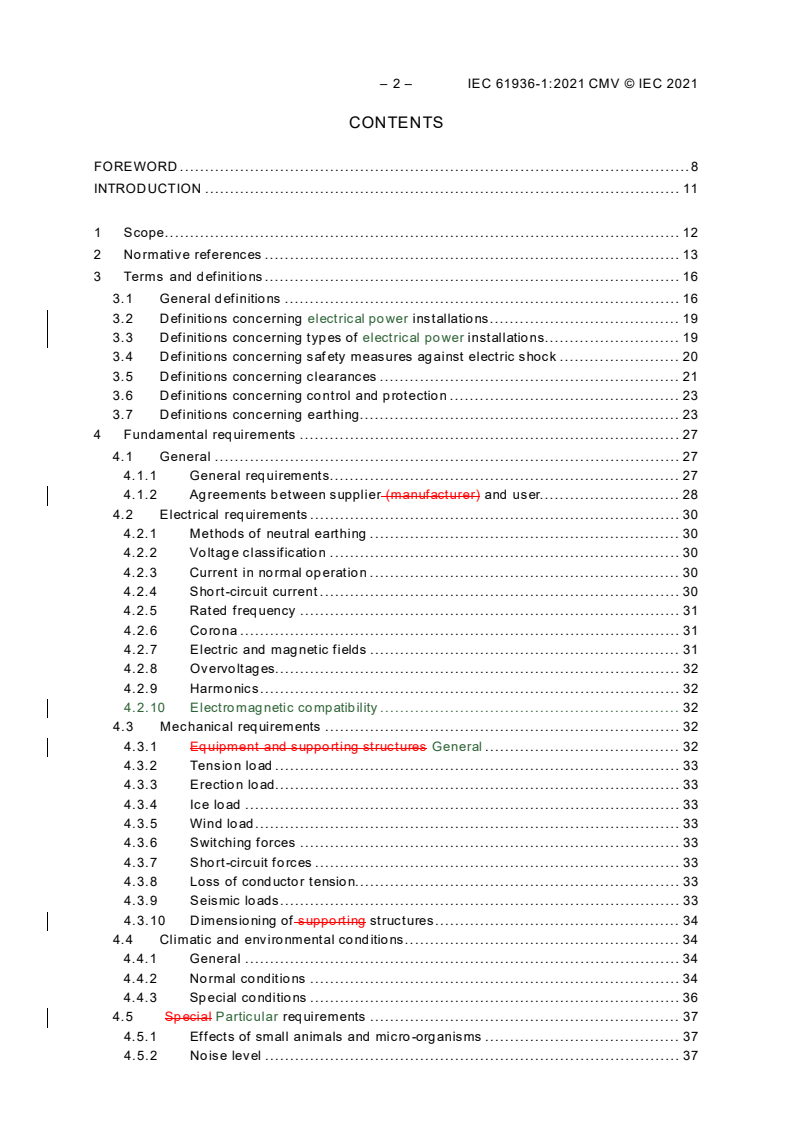
– 2 – IEC 61936-1:2021 CMV © IEC 2021
CONTENTS
FOREWORD . 8
INTRODUCTION . 11
1 Scope . 12
2 Normative references . 13
3 Terms and definitions . 16
3.1 General definitions . 16
3.2 Definitions concerning electrical power installations . 19
3.3 Definitions concerning types of electrical power installations. 19
3.4 Definitions concerning safety measures against electric shock . 20
3.5 Definitions concerning clearances . 21
3.6 Definitions concerning control and protection . 23
3.7 Definitions concerning earthing. 23
4 Fundamental requirements . 27
4.1 General . 27
4.1.1 General requirements. 27
4.1.2 Agreements between supplier (manufacturer) and user. 28
4.2 Electrical requirements . 30
4.2.1 Methods of neutral earthing . 30
4.2.2 Voltage classification . 30
4.2.3 Current in normal operation . 30
4.2.4 Short-circuit current . 30
4.2.5 Rated frequency . 31
4.2.6 Corona . 31
4.2.7 Electric and magnetic fields . 31
4.2.8 Overvoltages. 32
4.2.9 Harmonics . 32
4.2.10 Electromagnetic compatibility . 32
4.3 Mechanical requirements . 32
4.3.1 Equipment and supporting structures General . 32
4.3.2 Tension load . 33
4.3.3 Erection load. 33
4.3.4 Ice load . 33
4.3.5 Wind load . 33
4.3.6 Switching forces . 33
4.3.7 Short-circuit forces . 33
4.3.8 Loss of conductor tension. 33
4.3.9 Seismic loads . 33
4.3.10 Dimensioning of supporting structures . 34
4.4 Climatic and environmental conditions . 34
4.4.1 General . 34
4.4.2 Normal conditions . 34
4.4.3 Special conditions . 36
4.5 Special Particular requirements . 37
4.5.1 Effects of small animals and micro-organisms . 37
4.5.2 Noise level . 37
4.5.3 Transport . 37
5 Insulation . 38
5.1 General . 38
5.2 Selection of insulation level . 38
5.2.1 General . 38
5.2.2 Consideration of methods of neutral earthing . 38
5.2.3 Consideration of rated withstand voltages . 38
5.3 Verification of withstand values. 39
5.4 Minimum clearances of live parts . 39
5.4.1 General . 39
5.4.2 Minimum clearances in voltage range I . 39
5.4.3 Minimum clearances in voltage range II . 40
5.5 Minimum clearances between parts under special conditions . 43
5.6 Tested connection zones . 43
6 Electrical equipment. 43
6.1 General requirements. 43
6.1.1 Selection.
6.1.2 Compliance .
6.1.1 Electrical equipment safety . 44
6.1.2 Personnel User safety . 44
6.2 Specific requirements . 44
6.2.1 Switching devices. 44
6.2.2 Power transformers and reactors . 45
6.2.3 Pref abricated type-tested switchgear . 46
6.2.4 Instrument transformers . 46
6.2.5 Surge arresters. 47
6.2.6 Capacitors . 47
6.2.7 Line traps . 47
6.2.8 Insulators . 48
6.2.9 Insulated cables. 48
6.2.10 Conductors and accessories . 50
6.2.11 Rotating electrical machines . 51
6.2.12 Generating units . 51
6.2.13 Generating unit main connections . 52
6.2.14 Static converters . 52
6.2.15 Fuses . 53
6.2.16 Electrical and mechanical interlocking . 53
7 Electrical power installations . 54
7.1 General . 54
7.1.1 General Common requirements . 54
7.1.2 Circuit arrangement . 54
7.1.3 Documentation . 55
7.1.4 Transport routes . 55
7.1.5 Aisles and access areas . 57
7.1.6 Lighting . 58
7.1.7 Operational safety . 58
7.1.8 Labelling . 58
7.2 Outdoor electrical power installations of open design . 58
7.2.1 General . 58
– 4 – IEC 61936-1:2021 CMV © IEC 2021
7.2.2 Protective barrier clearances. 59
7.2.3 Protective obstacle clearances . 59
7.2.4 Boundary clearances. 61
7.2.5 Minimum height over access area . 63
7.2.6 Clearances to buildings . 65
7.2.7 External f ences or walls and access doors . 68
7.3 Indoor electrical power installations of open design . 68
7.4 Installation of prefabricated type-tested switchgear. 69
7.4.1 General . 69
7.4.2 Additional requirements for gas-insulated metal-enclosed switchgear. 69
7.5 Requirements for buildings . 71
7.5.1 Introduction General . 71
7.5.2 Structural provisions . 71
7.5.3 Rooms for switchgear. 72
7.5.4 Maintenance and operating areas. 72
7.5.5 Doors . 72
7.5.6 Draining of insulating liquids . 73
7.5.7 Air co nd itioning and ventilation Heating, ventilation and air co nditioning
(HVAC) . 73
7.5.8 Buildings which require special consideration . 74
7.6 High voltage/low voltage prefabricated substations . 74
7.7 Electrical power installations on mast, pole and tower . 74
8 Safety measures . 75
8.1 General . 75
8.2 Protection against direct contact . 75
8.2.1 General . 75
8.2.2 Measures for protection against direct contact . 76
8.2.3 Protection requirements . 76
8.3 Means to protect persons in case of indirect contact . 77
8.4 Means to protect persons working on or near electrical power installations . 77
8.4.1 General . 77
8.4.2 Electrical equipment for isolating installations or apparatus . 78
8.4.3 Devices to prevent reclosing of isolating devices. 78
8.4.4 Devices for determining the de-energized state . 78
8.4.5 Devices for earthing and short-circuiting . 78
8.4.6 Equipment acting as protective barriers against adjacent live parts. 79
8.4.7 Storage of personal protection equipment . 80
8.5 Protection from danger resulting from arc fault . 80
8.6 Protection against direct lightning strokes . 81
8.7 Protection against fire . 81
8.7.1 General . 81
8.7.2 Transformers, reactors . 82
8.7.3 Cables. 92
8.7.4 Other equipment with flammable liquid . 92
8.8 Protection against leakage of insulating liquid and SF . 93
8.8.1 Insulating liquid leakage and subsoil water protection . 93
8.8.2 SF leakage . 97
8.8.3 Failure with loss of SF and its decomposition products . 98
8.9 Identification and marking . 98
8.9.1 General . 98
8.9.2 Information plates and warning plates . 99
8.9.3 Electrical hazard warning . 99
8.9.4 Electrical power installations with incorporated capacitors . 99
8.9.5 Emergency signs for emergency exits . 99
8.9.6 Cable identification marks . 99
9 Protection, control automation and auxiliary systems. 99
9.1 Monitoring and control Protection systems. 99
9.2 Automation systems.100
9.3 Auxiliary systems .101
9.3.1 AC and DC supply circuits .101
9.3.2 Compressed air systems .102
9.3.3 SF gas handling plants .103
9.3.4 Hydrogen handling plants .103
9.4 Basic rules for electromagnetic compatibility of control systems.104
9.4.1 General .104
9.4.2 Electrical noise sources in electrical power installations.104
9.4.3 Measures to b e taken to red uce the effects o f high f requency
interference .104
9.4.4 Measures to b e taken to red uce the effects o f low f requency
interference .105
9.4.5 Measures related to the selection of electrical equipment .105
9.4.6 Other possible measures to reduce the effects of interference .106
10 Earthing systems.106
10.1 General .106
10.2 Fundamental requirements .106
10.2.1 Saf ety criteria.106
10.2.2 Functional requirements.107
10.2.3 High and low voltage earthing systems .107
10.3 Design of earthing systems.109
10.3.1 General .109
10.3.2 Power system f aults .109
10.3.3 Lightning and transient overvoltages .110
10.4 Construction of work on earthing systems .110
10.5 Measurements.110
10.6 Maintainability .110
10.6.1 Inspections .110
10.6.2 Measurements.110
11 Inspection and testing .111
11.1 General .111
11.2 Verification of specified performances .112
11.3 Tests during installation and commissioning .112
11.4 Trial running .112
12 Operation and maintenance manual .113
Annex A (normative informative) Values of rated insulation levels and minimum
clearances based on current practice in some countries.114
Annex B (normative) Method of calculating permissible touch voltages .117
– 6 – IEC 61936-1:2021 CMV © IEC 2021
Annex C (normative) Permissible touch voltage according to IEEE 80 .118
Annex D (normative) Earthing system design flow chart .119
Annex E (informative) Protection measures against direct lightning strokes.120
E.1 General .120
E.2 Shield wires .120
E.3 Lightning rods .121
Annex F (informative) Considerations of design for safe working .124
Annex G (inf ormative) List o f no tes co ncerning p articular conditions in certain
countries .126
Bibliography .132
List of comments .136
Figure 1 – Minimum ap p roach d istance for transport within closed electrical o perating
areas. 57
Figure 2 – Pro tection ag ainst d irect contact b y p ro tective b arriers o r p rotective
obstacles within closed electrical operating areas. 61
Figure 3 – Boundary distances and minimum height at the external f ence/wall. 63
Figure 4 – Minimum heig hts and wo rking clearances within closed electrical o perating
areas. 65
Figure 5 – Approaches with buildings (within closed electrical operating areas) . 67
Figure 6 – Separating walls between transformers . 86
Figure 7 – Fire protection between transformer and building . 90
Figure 8 – Example for small transformers without gravel layer and catchment tank . 94
Figure 9 – Sump with integrated catchment tank . 95
Figure 10 – Sump with separate catchment tank . 96
Figure 11 – Sump with integrated common catchment tank . 97
Figure 12 – Permissible touch voltage U .111
Tp
Figure C.1 – Permissible touch voltage U according to IEEE 80 .118
Tp
Figure E.1 – Single shield wire .121
Figure E.2 – Two shield wires .122
Figure E.3 – Single lightning rod .122
Figure E.4 – Two lightning rods.123
Figure F.1 – Working clearances within closed electrical operating areas .125
Table 1 – Ref erences to subclauses where ag reement b etween sup plier and user is
required . 29
Table 2 – Minimum clearances in air – Voltage range I (1 kV < U ≤ 245 kV) . 41
m
Table 3 – Minimum clearances in air – Voltage range II (U > 245 kV) . 42
m
Table 4 – Guide values for outdoor transformer clearances. 84
Table 5 – Minimum requirements for the installation of indoor transformers . 91
Table 6 – Minimum req uirements for interconnection o f low-voltage and high-voltage
earthing systems based on EPR limits .108
Table A.1 – Values o f rated insulation levels and minimum clearances in air f o r
1 kV < U ≤ 245 kV f or highest voltage for installation U no t standardized b y the IEC
m m
based on current practice in some countries .114
Table A.2 – Values o f rated insulation levels and minimum clearances in air f or
1 kV < U ≤ 245 kV f o r highest voltage for installation U no t standardized b y the IEC
m m
based on current practice in some countries .115
Table A.3 – Values o f rated insulation levels and minimum clearances in air f or
U > 245 kV f o r hig hest voltages for installation U no t standardized b y the IEC
m m
based on current practice in some countries .116
– 8 – IEC 61936-1:2021 CMV © IEC 2021
INTERNATIONAL ELECTROTECHNICAL COMMISSION
____________
POWER INSTALLATIONS EXCEEDING
1 kV AC AND 1,5 kV DC –
Part 1: Common rules AC
FOREWORD
1) Th e International El ectrotechnical Commission (IEC) i s a worldwide organization for standardization comprising
al l national electrotechnical committees (IEC National Committees). The object of IEC is to promote international
co -operation on all q uestions concerning standardization in the el ectrical and el ectronic fi elds. To this end and
i n addition to other activities, IEC p ublishes International Standards, T echnical Specifications, T echnical Reports,
Publicly Available Specifications (PAS) and Guides (hereafter referred to as "IEC Publication(s)"). Their
p reparation is entrusted to technical committees; any IEC National Committee interested in the subject dealt with
may p articipate in this p reparatory work. International, governmental and non-governmental organizations liaising
wi th the IEC also participate in this preparation. IEC collaborates closely with the International Organization for
Stan dardization (ISO) in accordance with conditions determined by agreement between the two organizations.
2) Th e formal decisions or agreements of IEC on technical matters express, as nearly as possible, an international
consensus of opinion on the relevant subjects since each technical committee has representation from all
i n terested IEC National Committees.
3) IEC Publications have the form of recommendations for international use and are accepted by IEC National
Co mmittees i n that sense. W hile al l reasonable efforts are made to en sure th at th e technical content of IEC
Publications is accurate, IEC cannot be held responsible for the way in which they are used or for any
mi sinterpretation by any end user.
4) In order to promote international uniformity, IEC National Committees undertake to apply IEC Publications
tr ansparently to the maximum extent possible in their n ational and r egional p ublications. Any divergence between
an y IEC Publication and the corresponding national or regional publication shall be clearly indicated in the latter.
5) IEC itself does not provide any attestation of conformity. Independent certification bodies provide conformity
assessment services and, i n s ome areas, access to IEC marks o f conformity. IEC i s n ot responsible for any
services carried out by independent certification bodies.
6) Al l users should ensure that they have the l atest edition of this publication.
7) No l i ability shall attach to IEC o r i ts d irectors, employees, servants o r agents i ncluding i ndividual experts and
members o f i ts technical committees and IEC National Committees for any personal injury, property damage or
other damage of any nature whatsoever, whether direct or indirect, or for costs (including legal fees) and
expenses arising out of the publication, use of, or reliance upon, this IEC Publication or any other IEC
Publ ications.
8) Atten tion i s d rawn to th e No rmative references cited i n this p ublication. Use o f th e referenced p ublications is
i n dispensable for the correct application of this publication.
9) Atten tion is drawn to the possibility that some of the elements of this IEC Publication may be the subject of patent
ri ghts. IEC shall not be held responsible for identifying any or all such patent rights.
This commented version (CMV) of the official standard IEC 61936-1:2021 edition 3.0
allows the user to identify the changes made to the previous IEC 61936-1:2010+AMD1:
2014 CSV edition 2.1. Futhermore, comments from IEC TC 99 experts are provided to
explain the reasons of the most relevant changes.
A vertical bar appears in the margin wherever a change has been made. Additions are in
green text, deletions are in strikethrough red text. Experts' comments are identified by a
blue-background number. Mouse over a number to display a pop-up note with the
comment.
This publication contains the CMV and the official standard. The full list of comments is
available at the end of the CMV.
International Standard IEC 61936-1 has been prepared by IEC technical committee 99:
Insulation co-ordination and system engineering of high voltage electrical power installations
ab o ve 1,0 kV AC and 1,5 kV D C.
This third edition cancels and replaces the second edition published in 2010 and
Amendment 1:2014. This ed ition constitutes a technical revision.
This edition includes the f ollowing significant technical changes with respect to the previous
edition:
a) intro d uction has b een rewritten to ref lect the status when this d o cument is p roduced;
b) the sco p e has b een improved to clarify the ap plication of this d o cument;
c) missing and obsolete terms and definitions have been updated including improvement of
existing terms;
d) Table 1 has b een up d ated where ag reements b etween sup plier and user are need ed ;
e) req uirements o f electromagnetic compatibility have b een clarified;
f) insulation coordination clause (Clause 5) has improved wording f or better clarity and the
technical content has an updated coordination to the latest versions of the insulation
co o rdination standards;
g) wo rd ing reg arding electrical eq uipment has b een imp roved and mad e clearer;
h) sub clause for f uses has b een imp roved and rewo rded;
i) requirements have been added for labelling when multiple sources are required to be
disconnected;
j) missing req uirements f or GIS have b een reintro duced;
k) subclause reg arding ventilation (HVAC) has b een imp roved;
l) f ig ures in Clause 7 have b een up d ated and mo ved to the corresponding subclause;
m) requirements for transformer installations have been improved including adjustment of
ed ito rial typing-errors;
n) clause on protection, automation and auxiliary systems has been restructured and
improved;
o) p ro tection ag ainst lightning strokes has b een extended;
p) clarification of content due to the distinction between erection (and providing electrical
saf ety f or the intended use of the electrical power installation) and subsequent activities
such as maintenance and rep air with safe wo rking p ro cedures;
q) where no provincial, national or regional regulations are available for safe working
p ro cedures, an inf ormative g uideline is p rovided in Annex F. This rep laces the former parts
o f Fig ure 3 in Clause 7.
The text o f this International Standard is b ased o n the f ollowing d ocuments:
FDIS Rep ort on voting
99/311/FDIS 99/316/RVD
Full inf o rmation o n the vo ting f or its ap proval can b e f o und in the rep o rt o n vo ting ind icated in
the ab o ve tab le.
The lang uag e used f or the d evelopment of this International Standard is Eng lish.
This document was drafted in accordance with ISO/IEC Directives, Part 2, and developed in
acco rdance with ISO/IEC D irectives, Part 1 and ISO/IEC D irectives, IEC Sup plement, available
at www.iec.ch/members_experts/refdocs. The main document types developed by IEC are
d escribed in g reater d etail at www.iec.ch/standardsdev/publications.
– 10 – IEC 61936-1:2021 CMV © IEC 2021
A list o f all p arts in the IEC 61936 series, p ublished und er the g eneral title Power installations
exceeding 1 kV AC and 1,5 kV DC, can b e f o und o n the IEC web site.
A document on principles to be observed in the preparation of safety publications regarding
hig h vo ltage installations is currently und er d evelopment (IEC TS 61936-0).
The co mmittee has d ecided that the co ntents of this document will remain unchanged until the
stability date indicated on the IEC website under webstore.iec.ch in the data related to the
specific document. At this d ate, the document will b e
• reconfirmed,
• withdrawn,
• rep laced b y a revised ed ition, o r
• amended.
The reader' s attention is d rawn to the fact that Annex G lists all of the "in-some-country" clauses
o n d iffering p ractices of a less p ermanent nature relating to the sub ject of this document.
IMPORTANT – The 'colour inside' logo on the cover page of this publication indicates
that it contains colours which are considered to be useful for the correct understanding
of its contents. Users should therefore print this document using a colour printer.
INTRODUCTION
This part of IEC 61936 contains the minimum requirements for the design, erection, and
verif ication o f hig h voltage p ower installations g reater than 1 kV AC. The rules are intended to
provide f or the safety of persons, livestock and property against dangers and damage which
may arise in the reasonable use of such electrical installations and to provide for the proper
f unctioning o f those installations.
There are many provincial, national and regional laws, standards and internal rules d ealing with
the matter co ming within the scope of this document reg arding high voltage power installations.
These p ractices have b een taken as a b asis for this wo rk.
This part of IEC 61936 contains the minimum requirements valid f or IEC countries and some
additional inf ormation which ensures an acceptable reliability of an installation and its safe
operation.
The p ub lication of this standard is b elieved to b e a d ecisive step towards the gradual alignment
all over the world of the practices concerning the design and erection of high voltage power
installations.
This third ed ition of IEC 61936-1, first published in 2001, follows wo rldwide feedback to improve
clarity. It continues the effort to towards the alignment all over the wo rld of p ractices concerning
the d esig n and erection of hig h voltage p ower installations.
Particular requirements for transmission and distribution installations, as well as particular
req uirements f or p ower g eneration and industrial installations, are included in this document.
The relevant laws o r reg ulations o f an autho rity having jurisdiction takes p recedence.
While natio nal standards and reg ulations take p recedence, jurisdictions may elect to ad opt the
req uirements o f this document.
– 12 – IEC 61936-1:2021 CMV © IEC 2021
POWER INSTALLATIONS EXCEEDING
1 kV AC AND 1,5 kV DC –
Part 1: Common rules AC
1 Scope
This p art o f IEC 61936 provides co mmon rules requirements f or the d esign and the erection of
electrical power installations in systems with nominal voltages above exceeding 1 kV AC and
no minal f requency up to and including 60 Hz, so as to p rovide safety and p roper functioning for
the use intend ed.
For the purpose o f interpreting this document, an electrical p o wer installation is co nsidered to
b e o ne o f the f ollowing:
a) sub station, including substation f or railway p o wer supply;
b) electrical power installations on mast, pole and tower, switchgear and/or transformers
lo cated o utside a clo sed electrical o perating area;
c) one (or more) power station(s) located on a single site, the electrical power installation
includes generators and transformers with all associated switchgear and all electrical
auxiliary systems. Connections between generating stations located on different sites are
excluded;
d) the electrical system of a factory, industrial plant or other industrial, agricultural, commercial
or public premises;
e) electrical power installations erected on offshore platforms facilities for the purpose of
g eneration, transmission, d istribution and /or storage of electricity e.g . offshore wind power
f arms; 1
f ) transition to wers/poles (b etween o verhead lines and und erground lines). 2
The electrical p ower installation includes, amo ng o thers, the f ollowing eq uipment:
– ro tating electrical machines;
– switchgear;
– transf ormers and reactors;
– converters;
– cables;
– wiring systems;
– batteries;
– capacitors;
– earthing systems;
– b uild ings and f ences which are p art o f a clo sed electrical o perating area;
– asso ciated p rotection, control and auxiliary systems;
– larg e air co re reacto r.
NOTE 1 In g eneral, a standard for an i tem o f equipment standards take precedence over the requirements of this
d o cument.
This document d o es no t ap ply to the d esign and erection of any o f the f ollowing:
– o verhead and und erground lines b etween sep arate electrical p ower installations;
– electric electrified railway tracks and ro lling stock; 3
– mining eq uipment and installations;
– f luo rescent lamp installations;
– installations on ships according to IEC 60092 (all parts) and offshore units according to
IEC 61892 (all parts), which are used in the offshore petroleum industry for drilling,
p ro cessing and storage p urposes;
– electro static eq uipment (e.g . electrostatic p recipitators, sp ray-painting units);
– test sites;
– med ical eq uipment, e.g . med ical X-ray eq uipment.
This document d oes no t ap p ly to the d esign of p refabricated, type-tested switchgear and high
vo ltage/low vo ltage p refabricated substation, f or which separate IEC stand ards exist.
NOTE 2 Th e scope o f this document does not apply to i nclude the requirements for carrying out live working on
el ectrical power installations. 4
NOTE 3 Th e scope of this document considers safety requirements for HV i nstallations and the i nfluences of HV
i n stallations on LV installations. If not otherwise required in this standard, For low-voltage electrical installations up
to 1 kV, IEC 60364 (all parts) applies.
2 Normative references
The f o llowing documents are referred to in the text in such a way that some or all of their content
co nstitutes req uirements of this d ocument. Fo r d ated references, o nly the ed ition cited applies.
For undated references, the latest edition of the referenced document (including any
amend ments) ap p lies.
IEC 60034-1, Rotating electrical machines – Part 1: Rating and performance
IEC 60034-3, Rotating electrical machines – Part 3: Specific requirements for synchronous
generators driven by steam turbines or combustion gas turbines
IEC 60060-1, High-voltage test techniques – Part 1: General definitions and test requirements
IEC 60071-1:2019, Insulation co-ordination – Part 1: Definitions, principles and rules
IEC 60071-2:1996, Insulation co-ordination – Part 2: Application guidelines
IEC 60076 (all p arts), Power transformers
IEC 60076-2:1993, Power transformers – Part 2: Temperature rise
IEC 60076-11, Power transformers – Part 11: Dry-type transformers
IEC 60079-0, Explosive atmospheres – Part 0: Equipment – General requirements
IEC 60079-10-1, Explosive atmospheres – Part 10-1: Classification of areas – Explosive gas
atmospheres
IEC 60079-10-2, Explosive atmospheres – Part 10-2: Classification of areas – Combustible
Explosive dust atmospheres
IEC 60255 (all p arts), Measuring relays and protection equipment
– 14 – IEC 61936-1:2021 CMV © IEC 2021
IEC 60331-1, Tests for electric cables under fire conditions – Circuit integrity – Part 1: Test
method for fire with shock at a temperature of at least 830 °C for cables of rated voltage up to
and including 0,6/1,0 kV and with an overall diameter exceeding 20 mm
IEC 60331-21, Tests for electric cables under fire conditions – Circuit integrity – Part 21:
Procedures and requirements – Cables of rated voltage up to and including 0,6/1,0 kV
IEC 60332 (all p arts), Tests on electric and optical fibre cables under fire conditions
IEC 60364 (all parts), Low-voltage electrical installations
IEC/TS 60479-1:20052018, Effects of current on human beings and livestock – Part 1: General
aspects
IEC 60529, Degrees of protection provided by enclosures (IP Code)
IEC 60617, Graphical symbols for diagrams
IEC 60721-2-6, Classification of environmental conditions – Part 2-6: Environmental conditions
appearing in nature – Earthquake vibration and shock
IEC 60721-2-7, Classification of environmental conditions – Part 2-7: Environmental conditions
appearing in nature. Fauna and flora
IEC 60754 (all p arts), Test on gases evolved during combustion of materials from cables
IEC 60754-1, Test on gases evolved during combustion of materials from cables – Part 1:
Determination of the amount of halogen a
...
IEC 61936-1 ®
Edition 3.0 2021-07
INTERNATIONAL
STANDARD
NORME
INTERNATIONALE
colour
inside
Power installations exceeding 1 kV AC and 1,5 kV DC –
Part 1: AC
Installations électriques de puissance de tension supérieure à 1 kV en courant
alternatif et 1,5 kV en courant continu –
Partie 1: Courant alternatif
All rights reserved. Unless otherwise specified, no part of this publication may be reproduced or utilized in any form
or by any means, electronic or mechanical, including photocopying and microfilm, without permission in writing from
either IEC or IEC's member National Committee in the country of the requester. If you have any questions about IEC
copyright or have an enquiry about obtaining additional rights to this publication, please contact the address below or
your local IEC member National Committee for further information.
Droits de reproduction réservés. Sauf indication contraire, aucune partie de cette publication ne peut être reproduite
ni utilisée sous quelque forme que ce soit et par aucun procédé, électronique ou mécanique, y compris la photocopie
et les microfilms, sans l'accord écrit de l'IEC ou du Comité national de l'IEC du pays du demandeur. Si vous avez des
questions sur le copyright de l'IEC ou si vous désirez obtenir des droits supplémentaires sur cette publication, utilisez
les coordonnées ci-après ou contactez le Comité national de l'IEC de votre pays de résidence.
IEC Central Office Tel.: +41 22 919 02 11
3, rue de Varembé info@iec.ch
CH-1211 Geneva 20 www.iec.ch
Switzerland
About the IEC
The International Electrotechnical Commission (IEC) is the leading global organization that prepares and publishes
International Standards for all electrical, electronic and related technologies.
About IEC publications
The technical content of IEC publications is kept under constant review by the IEC. Please make sure that you have the
latest edition, a corrigendum or an amendment might have been published.
IEC publications search - webstore.iec.ch/advsearchform IEC online collection - oc.iec.ch
The advanced search enables to find IEC publications by a Discover our powerful search engine and read freely all the
variety of criteria (reference number, text, technical publications previews. With a subscription you will always
committee, …). It also gives information on projects, replaced have access to up to date content tailored to your needs.
and withdrawn publications.
Electropedia - www.electropedia.org
IEC Just Published - webstore.iec.ch/justpublished
The world's leading online dictionary on electrotechnology,
Stay up to date on all new IEC publications. Just Published
containing more than 22 000 terminological entries in English
details all new publications released. Available online and
and French, with equivalent terms in 18 additional languages.
once a month by email.
Also known as the International Electrotechnical Vocabulary
(IEV) online.
IEC Customer Service Centre - webstore.iec.ch/csc
If you wish to give us your feedback on this publication or
need further assistance, please contact the Customer Service
Centre: sales@iec.ch.
A propos de l'IEC
La Commission Electrotechnique Internationale (IEC) est la première organisation mondiale qui élabore et publie des
Normes internationales pour tout ce qui a trait à l'électricité, à l'électronique et aux technologies apparentées.
A propos des publications IEC
Le contenu technique des publications IEC est constamment revu. Veuillez vous assurer que vous possédez l’édition la
plus récente, un corrigendum ou amendement peut avoir été publié.
IEC online collection - oc.iec.ch
Recherche de publications IEC -
webstore.iec.ch/advsearchform Découvrez notre puissant moteur de recherche et consultez
La recherche avancée permet de trouver des publications IEC gratuitement tous les aperçus des publications. Avec un
en utilisant différents critères (numéro de référence, texte, abonnement, vous aurez toujours accès à un contenu à jour
comité d’études, …). Elle donne aussi des informations sur adapté à vos besoins.
les projets et les publications remplacées ou retirées.
Electropedia - www.electropedia.org
IEC Just Published - webstore.iec.ch/justpublished
Le premier dictionnaire d'électrotechnologie en ligne au
Restez informé sur les nouvelles publications IEC. Just
monde, avec plus de 22 000 articles terminologiques en
Published détaille les nouvelles publications parues.
anglais et en français, ainsi que les termes équivalents dans
Disponible en ligne et une fois par mois par email.
16 langues additionnelles. Egalement appelé Vocabulaire
Electrotechnique International (IEV) en ligne.
Service Clients - webstore.iec.ch/csc
Si vous désirez nous donner des commentaires sur cette
publication ou si vous avez des questions contactez-nous:
sales@iec.ch.
IEC 61936-1 ®
Edition 3.0 2021-07
INTERNATIONAL
STANDARD
NORME
INTERNATIONALE
colour
inside
Power installations exceeding 1 kV AC and 1,5 kV DC –
Part 1: AC
Installations électriques de puissance de tension supérieure à 1 kV en courant
alternatif et 1,5 kV en courant continu –
Partie 1: Courant alternatif
INTERNATIONAL
ELECTROTECHNICAL
COMMISSION
COMMISSION
ELECTROTECHNIQUE
INTERNATIONALE
ICS 29.020; 29.080.01 ISBN 978-2-8322-9887-9
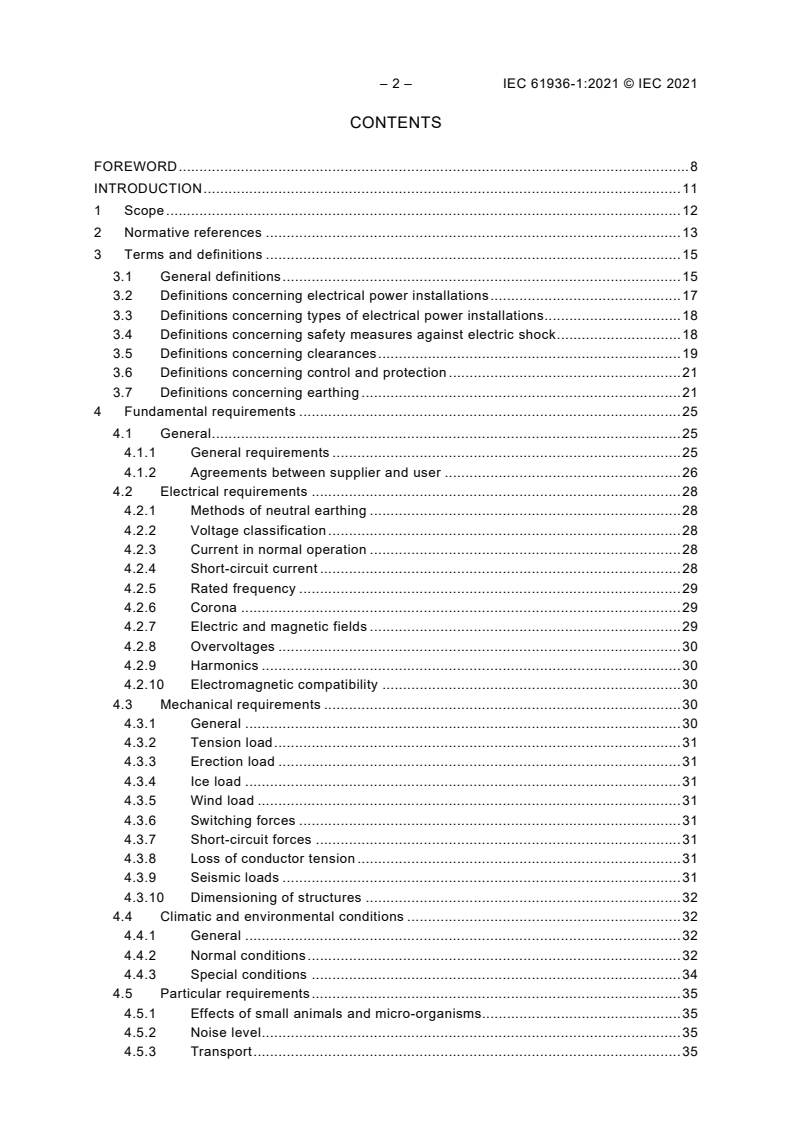
– 2 – IEC 61936-1:2021 © IEC 2021
CONTENTS
FOREWORD . 8
INTRODUCTION . 11
1 Scope . 12
2 Normative references . 13
3 Terms and definitions . 15
3.1 General definitions . 15
3.2 Definitions concerning electrical power installations . 17
3.3 Definitions concerning types of electrical power installations. 18
3.4 Definitions concerning safety measures against electric shock . 18
3.5 Definitions concerning clearances . 19
3.6 Definitions concerning control and protection . 21
3.7 Definitions concerning earthing . 21
4 Fundamental requirements . 25
4.1 General . 25
4.1.1 General requirements . 25
4.1.2 Agreements between supplier and user . 26
4.2 Electrical requirements . 28
4.2.1 Methods of neutral earthing . 28
4.2.2 Voltage classification . 28
4.2.3 Current in normal operation . 28
4.2.4 Short-circuit current . 28
4.2.5 Rated frequency . 29
4.2.6 Corona . 29
4.2.7 Electric and magnetic fields . 29
4.2.8 Overvoltages . 30
4.2.9 Harmonics . 30
4.2.10 Electromagnetic compatibility . 30
4.3 Mechanical requirements . 30
4.3.1 General . 30
4.3.2 Tension load . 31
4.3.3 Erection load . 31
4.3.4 Ice load . 31
4.3.5 Wind load . 31
4.3.6 Switching forces . 31
4.3.7 Short-circuit forces . 31
4.3.8 Loss of conductor tension . 31
4.3.9 Seismic loads . 31
4.3.10 Dimensioning of structures . 32
4.4 Climatic and environmental conditions . 32
4.4.1 General . 32
4.4.2 Normal conditions . 32
4.4.3 Special conditions . 34
4.5 Particular requirements . 35
4.5.1 Effects of small animals and micro-organisms. 35
4.5.2 Noise level . 35
4.5.3 Transport . 35
5 Insulation . 35
5.1 General . 35
5.2 Selection of insulation level. 36
5.2.1 General . 36
5.2.2 Consideration of methods of neutral earthing . 36
5.2.3 Consideration of rated withstand voltages . 36
5.3 Verification of withstand values . 36
5.4 Minimum clearances of live parts . 37
5.4.1 General . 37
5.4.2 Minimum clearances in voltage range I . 37
5.4.3 Minimum clearances in voltage range II . 37
5.5 Minimum clearances between parts under special conditions . 40
5.6 Tested connection zones . 40
6 Electrical equipment . 40
6.1 General requirements . 40
6.1.1 Electrical equipment safety . 40
6.1.2 User safety . 40
6.2 Specific requirements . 41
6.2.1 Switching devices . 41
6.2.2 Power transformers and reactors . 41
6.2.3 Prefabricated type-tested switchgear . 42
6.2.4 Instrument transformers . 42
6.2.5 Surge arresters . 43
6.2.6 Capacitors . 43
6.2.7 Line traps . 44
6.2.8 Insulators . 44
6.2.9 Insulated cables . 44
6.2.10 Conductors and accessories . 47
6.2.11 Rotating electrical machines . 47
6.2.12 Generating units . 48
6.2.13 Generating unit main connections . 48
6.2.14 Static converters . 48
6.2.15 Fuses . 49
6.2.16 Electrical and mechanical interlocking . 49
7 Electrical power installations . 49
7.1 General . 49
7.1.1 Common requirements . 49
7.1.2 Circuit arrangement . 50
7.1.3 Documentation . 51
7.1.4 Transport routes . 51
7.1.5 Aisles and access areas . 52
7.1.6 Lighting . 53
7.1.7 Operational safety . 53
7.1.8 Labelling . 53
7.2 Outdoor electrical power installations of open design . 53
7.2.1 General . 53
7.2.2 Protective barrier clearances . 54
7.2.3 Protective obstacle clearances . 54
7.2.4 Boundary clearances . 55
– 4 – IEC 61936-1:2021 © IEC 2021
7.2.5 Minimum height over access area . 56
7.2.6 Clearances to buildings . 57
7.2.7 External fences or walls and access doors . 59
7.3 Indoor electrical power installations of open design . 59
7.4 Installation of prefabricated type-tested switchgear . 60
7.4.1 General . 60
7.4.2 Additional requirements for gas-insulated metal-enclosed switchgear . 60
7.5 Requirements for buildings . 62
7.5.1 General . 62
7.5.2 Structural provisions . 62
7.5.3 Rooms for switchgear . 63
7.5.4 Maintenance and operating areas . 63
7.5.5 Doors . 63
7.5.6 Draining of insulating liquids . 64
7.5.7 Heating, ventilation and air conditioning (HVAC) . 64
7.5.8 Buildings which require special consideration . 65
7.6 High voltage/low voltage prefabricated substations . 65
7.7 Electrical power installations on mast, pole and tower . 65
8 Safety measures . 65
8.1 General . 65
8.2 Protection against direct contact . 66
8.2.1 General . 66
8.2.2 Measures for protection against direct contact . 66
8.2.3 Protection requirements . 67
8.3 Means to protect persons in case of indirect contact . 68
8.4 Means to protect persons working on or near electrical power installations . 68
8.4.1 General . 68
8.4.2 Electrical equipment for isolating installations or apparatus . 68
8.4.3 Devices to prevent reclosing of isolating devices . 69
8.4.4 Devices for determining the de-energized state . 69
8.4.5 Devices for earthing and short-circuiting . 69
8.4.6 Equipment acting as protective barriers against adjacent live parts . 70
8.4.7 Storage of personal protection equipment . 71
8.5 Protection from danger resulting from arc fault . 71
8.6 Protection against direct lightning strokes . 71
8.7 Protection against fire . 72
8.7.1 General . 72
8.7.2 Transformers, reactors . 73
8.7.3 Cables . 79
8.7.4 Other equipment with flammable liquid . 79
8.8 Protection against leakage of insulating liquid and SF . 80
8.8.1 Insulating liquid leakage and subsoil water protection . 80
8.8.2 SF leakage . 82
8.8.3 Failure with loss of SF and its decomposition products . 83
8.9 Identification and marking . 83
8.9.1 General . 83
8.9.2 Information plates and warning plates . 84
8.9.3 Electrical hazard warning . 84
8.9.4 Electrical power installations with incorporated capacitors . 84
8.9.5 Emergency signs for emergency exits . 84
8.9.6 Cable identification marks . 84
9 Protection, automation and auxiliary systems . 84
9.1 Protection systems. 84
9.2 Automation systems . 85
9.3 Auxiliary systems . 86
9.3.1 AC and DC supply circuits . 86
9.3.2 Compressed air systems . 87
9.3.3 SF gas handling plants . 88
9.3.4 Hydrogen handling plants . 88
9.4 Basic rules for electromagnetic compatibility of control systems . 88
9.4.1 General . 88
9.4.2 Electrical noise sources in electrical power installations . 89
9.4.3 Measures to be taken to reduce the effects of high frequency
interference . 89
9.4.4 Measures to be taken to reduce the effects of low frequency
interference . 89
9.4.5 Measures related to the selection of electrical equipment . 90
9.4.6 Other possible measures to reduce the effects of interference . 91
10 Earthing systems . 91
10.1 General . 91
10.2 Fundamental requirements . 91
10.2.1 Safety criteria . 91
10.2.2 Functional requirements . 92
10.2.3 High and low voltage earthing systems . 92
10.3 Design of earthing systems . 93
10.3.1 General . 93
10.3.2 Power system faults. 94
10.3.3 Lightning and transient overvoltages. 94
10.4 Construction work on earthing systems . 95
10.5 Measurements . 95
10.6 Maintainability . 95
10.6.1 Inspections . 95
10.6.2 Measurements . 95
11 Inspection and testing . 96
11.1 General . 96
11.2 Verification of specified performances . 96
11.3 Tests during installation and commissioning . 97
11.4 Trial running . 97
12 Operation and maintenance manual . 97
Annex A (informative) Values of rated insulation levels and minimum clearances
based on current practice in some countries . 98
Annex B (normative) Method of calculating permissible touch voltages . 101
Annex C (normative) Permissible touch voltage according to IEEE 80 . 102
Annex D (normative) Earthing system design flow chart . 103
– 6 – IEC 61936-1:2021 © IEC 2021
Annex E (informative) Protection measures against direct lightning strokes . 104
E.1 General . 104
E.2 Shield wires . 104
E.3 Lightning rods . 104
Annex F (informative) Considerations of design for safe working . 107
Annex G (informative) List of notes concerning particular conditions in certain
countries . 109
Bibliography . 115
Figure 1 – Minimum approach distance for transport within closed electrical operating
areas . 52
Figure 2 – Protection against direct contact by protective barriers or protective
obstacles within closed electrical operating areas . 55
Figure 3 – Boundary distances and minimum height at the external fence/wall . 56
Figure 4 – Minimum heights within closed electrical operating areas . 57
Figure 5 – Approaches with buildings within closed electrical operating areas . 58
Figure 6 – Separating walls between transformers . 75
Figure 7 – Fire protection between transformer and building . 77
Figure 8 – Example for small transformers without gravel layer and catchment tank . 80
Figure 9 – Sump with integrated catchment tank . 81
Figure 10 – Sump with separate catchment tank . 82
Figure 11 – Sump with integrated common catchment tank . 82
Figure 12 – Permissible touch voltage U . 95
Tp
Figure C.1 – Permissible touch voltage U according to IEEE 80 . 102
Tp
Figure E.1 – Single shield wire . 105
Figure E.2 – Two shield wires . 105
Figure E.3 – Single lightning rod . 106
Figure E.4 – Two lightning rods . 106
Figure F.1 – Working clearances within closed electrical operating areas . 108
Table 1 – References to subclauses where agreement between supplier and user is
required . 27
Table 2 – Minimum clearances in air – Voltage range I (1 kV < U ≤ 245 kV) . 38
m
Table 3 – Minimum clearances in air – Voltage range II (U > 245 kV) . 39
m
Table 4 – Guide values for outdoor transformer clearances . 74
Table 5 – Minimum requirements for the installation of indoor transformers . 78
Table 6 – Minimum requirements for interconnection of low-voltage and high-voltage
earthing systems based on EPR limits . 93
Table A.1 – Values of rated insulation levels and minimum clearances in air for
1 kV < U ≤ 245 kV for highest voltage for installation U not standardized by the IEC
m m
based on current practice in some countries . 98
Table A.2 – Values of rated insulation levels and minimum clearances in air for
1 kV < U ≤ 245 kV for highest voltage for installation U not standardized by the IEC
m m
based on current practice in some countries . 99
Table A.3 – Values of rated insulation levels and minimum clearances in air for
U > 245 kV for highest voltages for installation U not standardized by the IEC
m m
based on current practice in some countries . 100
– 8 – IEC 61936-1:2021 © IEC 2021
INTERNATIONAL ELECTROTECHNICAL COMMISSION
____________
POWER INSTALLATIONS EXCEEDING
1 kV AC AND 1,5 kV DC –
Part 1: AC
FOREWORD
1) The International Electrotechnical Commission (IEC) is a worldwide organization for standardization comprising
all national electrotechnical committees (IEC National Committees). The object of IEC is to promote international
co-operation on all questions concerning standardization in the electrical and electronic fields. To this end and
in addition to other activities, IEC publishes International Standards, Technical Specifications, Technical Reports,
Publicly Available Specifications (PAS) and Guides (hereafter referred to as "IEC Publication(s)"). Their
preparation is entrusted to technical committees; any IEC National Committee interested in the subject dealt with
may participate in this preparatory work. International, governmental and non-governmental organizations liaising
with the IEC also participate in this preparation. IEC collaborates closely with the International Organization for
Standardization (ISO) in accordance with conditions determined by agreement between the two organizations.
2) The formal decisions or agreements of IEC on technical matters express, as nearly as possible, an international
consensus of opinion on the relevant subjects since each technical committee has representation from all
interested IEC National Committees.
3) IEC Publications have the form of recommendations for international use and are accepted by IEC National
Committees in that sense. While all reasonable efforts are made to ensure that the technical content of IEC
Publications is accurate, IEC cannot be held responsible for the way in which they are used or for any
misinterpretation by any end user.
4) In order to promote international uniformity, IEC National Committees undertake to apply IEC Publications
transparently to the maximum extent possible in their national and regional publications. Any divergence between
any IEC Publication and the corresponding national or regional publication shall be clearly indicated in the latter.
5) IEC itself does not provide any attestation of conformity. Independent certification bodies provide conformity
assessment services and, in some areas, access to IEC marks of conformity. IEC is not responsible for any
services carried out by independent certification bodies.
6) All users should ensure that they have the latest edition of this publication.
7) No liability shall attach to IEC or its directors, employees, servants or agents including individual experts and
members of its technical committees and IEC National Committees for any personal injury, property damage or
other damage of any nature whatsoever, whether direct or indirect, or for costs (including legal fees) and
expenses arising out of the publication, use of, or reliance upon, this IEC Publication or any other IEC
Publications.
8) Attention is drawn to the Normative references cited in this publication. Use of the referenced publications is
indispensable for the correct application of this publication.
9) Attention is drawn to the possibility that some of the elements of this IEC Publication may be the subject of patent
rights. IEC shall not be held responsible for identifying any or all such patent rights.
International Standard IEC 61936-1 has been prepared by IEC technical committee 99:
Insulation co-ordination and system engineering of high voltage electrical power installations
above 1,0 kV AC and 1,5 kV DC.
This third edition cancels and replaces the second edition published in 2010 and
Amendment 1:2014. This edition constitutes a technical revision.
This edition includes the following significant technical changes with respect to the previous
edition:
a) introduction has been rewritten to reflect the status when this document is produced;
b) the scope has been improved to clarify the application of this document;
c) missing and obsolete terms and definitions have been updated including improvement of
existing terms;
d) Table 1 has been updated where agreements between supplier and user are needed;
e) requirements of electromagnetic compatibility have been clarified;
f) insulation coordination clause (Clause 5) has improved wording for better clarity and the
technical content has an updated coordination to the latest versions of the insulation
coordination standards;
g) wording regarding electrical equipment has been improved and made clearer;
h) subclause for fuses has been improved and reworded;
i) requirements have been added for labelling when multiple sources are required to be
disconnected;
j) missing requirements for GIS have been reintroduced;
k) subclause regarding ventilation (HVAC) has been improved;
l) figures in Clause 7 have been updated and moved to the corresponding subclause;
m) requirements for transformer installations have been improved including adjustment of
editorial typing-errors;
n) clause on protection, automation and auxiliary systems has been restructured and
improved;
o) protection against lightning strokes has been extended;
p) clarification of content due to the distinction between erection (and providing electrical
safety for the intended use of the electrical power installation) and subsequent activities
such as maintenance and repair with safe working procedures;
q) where no provincial, national or regional regulations are available for safe working
procedures, an informative guideline is provided in Annex F. This replaces the former parts
of Figure 3 in Clause 7.
The text of this International Standard is based on the following documents:
FDIS Report on voting
99/311/FDIS 99/316/RVD
Full information on the voting for its approval can be found in the report on voting indicated in
the above table.
The language used for the development of this International Standard is English.
This document was drafted in accordance with ISO/IEC Directives, Part 2, and developed in
accordance with ISO/IEC Directives, Part 1 and ISO/IEC Directives, IEC Supplement, available
at www.iec.ch/members_experts/refdocs. The main document types developed by IEC are
described in greater detail at www.iec.ch/standardsdev/publications.
A list of all parts in the IEC 61936 series, published under the general title Power installations
exceeding 1 kV AC and 1,5 kV DC, can be found on the IEC website.
A document on principles to be observed in the preparation of safety publications regarding
high voltage installations is currently under development (IEC TS 61936-0).
– 10 – IEC 61936-1:2021 © IEC 2021
The committee has decided that the contents of this document will remain unchanged until the
stability date indicated on the IEC website under webstore.iec.ch in the data related to the
specific document. At this date, the document will be
• reconfirmed,
• withdrawn,
• replaced by a revised edition, or
• amended.
The reader's attention is drawn to the fact that Annex G lists all of the "in-some-country" clauses
on differing practices of a less permanent nature relating to the subject of this document.
IMPORTANT – The 'colour inside' logo on the cover page of this publication indicates
that it contains colours which are considered to be useful for the correct understanding
of its contents. Users should therefore print this document using a colour printer.
INTRODUCTION
This part of IEC 61936 contains the minimum requirements for the design, erection, and
verification of high voltage power installations greater than 1 kV AC. The rules are intended to
provide for the safety of persons, livestock and property against dangers and damage which
may arise in the reasonable use of such electrical installations and to provide for the proper
functioning of those installations.
There are many provincial, national and regional laws, standards and internal rules dealing with
the matter coming within the scope of this document regarding high voltage power installations.
These practices have been taken as a basis for this work.
This third edition of IEC 61936-1, first published in 2001, follows worldwide feedback to improve
clarity. It continues the effort to towards the alignment all over the world of practices concerning
the design and erection of high voltage power installations.
Particular requirements for transmission and distribution installations, as well as particular
requirements for power generation and industrial installations, are included in this document.
While national standards and regulations take precedence, jurisdictions may elect to adopt the
requirements of this document.
– 12 – IEC 61936-1:2021 © IEC 2021
POWER INSTALLATIONS EXCEEDING
1 kV AC AND 1,5 kV DC –
Part 1: AC
1 Scope
This part of IEC 61936 provides requirements for the design and the erection of electrical power
installations in systems with nominal voltages exceeding 1 kV AC and nominal frequency up to
and including 60 Hz, so as to provide safety and proper functioning for the use intended.
For the purpose of interpreting this document, an electrical power installation is considered to
be one of the following:
a) substation, including substation for railway power supply;
b) electrical power installations on mast, pole and tower, switchgear and/or transformers
located outside a closed electrical operating area;
c) one (or more) power station(s) located on a single site, the electrical power installation
includes generators and transformers with all associated switchgear and all electrical
auxiliary systems. Connections between generating stations located on different sites are
excluded;
d) the electrical system of a factory, industrial plant or other industrial, agricultural, commercial
or public premises;
e) electrical power installations on offshore facilities for the purpose of generation,
transmission, distribution and/or storage of electricity;
f) transition towers/poles (between overhead lines and underground lines).
The electrical power installation includes, among others, the following equipment:
– rotating electrical machines;
– switchgear;
– transformers and reactors;
– converters;
– cables;
– wiring systems;
– batteries;
– capacitors;
– earthing systems;
– buildings and fences which are part of a closed electrical operating area;
– associated protection, control and auxiliary systems;
– large air core reactor.
NOTE 1 In general, equipment standards take precedence over the requirements of this document.
This document does not apply to the design and erection of any of the following:
– overhead and underground lines between separate electrical power installations;
– electrified railway tracks and rolling stock;
– mining equipment and installations;
– fluorescent lamp installations;
– installations on ships according to IEC 60092 (all parts) and offshore units according to
IEC 61892 (all parts), which are used in the offshore petroleum industry for drilling,
processing and storage purposes;
– electrostatic equipment (e.g. electrostatic preci
...