

IEC 62047-1:2016
(Main)Semiconductor devices - Micro-electromechanical devices - Part 1: Terms and definitions
General Information
- Abstract
IEC 62047-1:2016 defines terms for micro-electromechanical devices including the process of production of such devices. This edition includes the following significant technical changes with respect to the previous edition:
a) removal of ten terms;
b) revision of twelve terms;
c) addition of sixteen new terms.
- Status
- Published
- Publication Date
- 05-Jan-2016
- Technical Committee
- SC 47F - Micro-electromechanical systems
- Drafting Committee
- WG 1 - TC 47/SC 47F/WG 1
- Current Stage
- PPUB - Publication issued
- Start Date
- 06-Jan-2016
- Completion Date
- 15-Jan-2016
Overview
IEC 62047-1:2016 is an international standard published by the International Electrotechnical Commission (IEC) that sets forth essential terms and definitions for micro-electromechanical devices (MEMD). This document is part 1 of the IEC 62047 series, focusing primarily on standardizing terminology related to the design, production, and application of micro-electromechanical devices. The 2016 edition is the second edition, revising the previous 2005 version, with significant updates including the removal of obsolete terms, revision of existing definitions, and the addition of new terminology to reflect advancements in MEMD technology.
Key Topics
This standard covers a comprehensive glossary of terms associated with micro-electromechanical devices and their manufacturing processes. Key thematic groups of terms include:
General Terms: Definitions that outline what constitute micro-electromechanical devices, micromachines, and microsystem technology (MST). The standard clarifies distinctions between microdevices, systems, and related technologies.
Science and Engineering Concepts: Terms explaining foundational principles such as micro-science and engineering, scale effects on microscopic devices, microtribology (focus on friction and wear at micro scales), biomimetics (imitation of biological mechanisms), and self-organization phenomena in MEMD.
Materials Science: Terminology related to the materials used in MEMD construction, emphasizing microscopic properties and interactions vital for device functionality.
Functional Elements: Descriptions of components like sensors, actuators, resonators, and other mechanical and electrical elements integrated at the micro-scale.
Machining Technology: Terms defining micromachining processes used to fabricate micro-electromechanical devices, crucial for precision manufacturing and assembly.
Bonding and Assembly Technology: Definitions related to methods of joining microscopic components and securing them within systems, highlighting challenges unique to miniature devices.
Measurement Technology: Terminology relating to instruments and techniques used to measure characteristics and performance of MEMD during and after fabrication.
Application Technology: Terms that describe how micro-electromechanical devices are utilized in various industrial and technological fields.
Applications
IEC 62047-1:2016 provides vital terminology that supports:
MEMD Design and Development: Clear, standardized language improves communication among engineers, researchers, and manufacturers working on MEMD innovation.
Manufacturing Process Optimization: Precise definitions of micromachining and bonding techniques enhance quality control and efficiency in MEMD production.
Research and Education: This standard acts as a reference resource for educational curricula and technical research, underpinning fundamental concepts in micro-science and engineering.
Cross-Industry Adoption: With MEMD technologies used in healthcare, automotive, consumer electronics, telecommunications, and aerospace, having unified terms facilitates interdisciplinary collaboration.
International Trade and Compliance: Adoption of IEC standards ensures consistency that aids regulatory compliance and global market acceptance of MEMD products.
Related Standards
IEC 62047-1 is part of a broader series addressing semiconductor and micro-electromechanical devices. Organizations working with MEMD should consider related IEC standards and resources such as:
IEC 62047 series: Additional parts covering specific aspects of MEMD beyond terminology, including testing, specifications, and performance criteria.
ISO/IEC Directives: Guidelines that influence the preparation and maintenance of international standards, providing procedural context.
Electropedia: IEC's online electronic dictionary offering access to over 20,000 electrotechnical terms, a valuable tool for MEMD professionals.
Standards on Tribology and Materials Science: Complementary documents covering friction, wear, and material behavior at micro and nano scales.
Keywords: IEC 62047-1, micro-electromechanical devices, MEMD terminology, micro-electromechanical systems, micromachines, microsystem technology, MEMS definitions, micromachining, microtribology, biomimetics, scale effect, micro-science engineering, standards for MEMD, semiconductor devices standards.
Relations
- Effective Date
- 05-Sep-2023
Frequently Asked Questions
IEC 62047-1:2016 is a standard published by the International Electrotechnical Commission (IEC). Its full title is "Semiconductor devices - Micro-electromechanical devices - Part 1: Terms and definitions". This standard covers: IEC 62047-1:2016 defines terms for micro-electromechanical devices including the process of production of such devices. This edition includes the following significant technical changes with respect to the previous edition: a) removal of ten terms; b) revision of twelve terms; c) addition of sixteen new terms.
IEC 62047-1:2016 defines terms for micro-electromechanical devices including the process of production of such devices. This edition includes the following significant technical changes with respect to the previous edition: a) removal of ten terms; b) revision of twelve terms; c) addition of sixteen new terms.
IEC 62047-1:2016 is classified under the following ICS (International Classification for Standards) categories: 31.080.99 - Other semiconductor devices. The ICS classification helps identify the subject area and facilitates finding related standards.
IEC 62047-1:2016 has the following relationships with other standards: It is inter standard links to IEC 62047-1:2005. Understanding these relationships helps ensure you are using the most current and applicable version of the standard.
IEC 62047-1:2016 is available in PDF format for immediate download after purchase. The document can be added to your cart and obtained through the secure checkout process. Digital delivery ensures instant access to the complete standard document.
Standards Content (Sample)
IEC 62047-1 ®
Edition 2.0 2016-01
INTERNATIONAL
STANDARD
NORME
INTERNATIONALE
Semiconductor devices – Micro-electromechanical devices –
Part 1: Terms and definitions
Dispositifs à semiconducteurs – Dispositifs microélectromécaniques –
Partie 1: Termes et définitions
All rights reserved. Unless otherwise specified, no part of this publication may be reproduced or utilized in any form
or by any means, electronic or mechanical, including photocopying and microfilm, without permission in writing from
either IEC or IEC's member National Committee in the country of the requester. If you have any questions about IEC
copyright or have an enquiry about obtaining additional rights to this publication, please contact the address below or
your local IEC member National Committee for further information.
Droits de reproduction réservés. Sauf indication contraire, aucune partie de cette publication ne peut être reproduite
ni utilisée sous quelque forme que ce soit et par aucun procédé, électronique ou mécanique, y compris la photocopie
et les microfilms, sans l'accord écrit de l'IEC ou du Comité national de l'IEC du pays du demandeur. Si vous avez des
questions sur le copyright de l'IEC ou si vous désirez obtenir des droits supplémentaires sur cette publication, utilisez
les coordonnées ci-après ou contactez le Comité national de l'IEC de votre pays de résidence.
IEC Central Office Tel.: +41 22 919 02 11
3, rue de Varembé Fax: +41 22 919 03 00
CH-1211 Geneva 20 info@iec.ch
Switzerland www.iec.ch
About the IEC
The International Electrotechnical Commission (IEC) is the leading global organization that prepares and publishes
International Standards for all electrical, electronic and related technologies.
About IEC publications
The technical content of IEC publications is kept under constant review by the IEC. Please make sure that you have the
latest edition, a corrigenda or an amendment might have been published.
IEC Catalogue - webstore.iec.ch/catalogue Electropedia - www.electropedia.org
The stand-alone application for consulting the entire The world's leading online dictionary of electronic and
bibliographical information on IEC International Standards, electrical terms containing 20 000 terms and definitions in
Technical Specifications, Technical Reports and other English and French, with equivalent terms in 15 additional
documents. Available for PC, Mac OS, Android Tablets and languages. Also known as the International Electrotechnical
iPad. Vocabulary (IEV) online.
IEC publications search - www.iec.ch/searchpub IEC Glossary - std.iec.ch/glossary
The advanced search enables to find IEC publications by a 65 000 electrotechnical terminology entries in English and
variety of criteria (reference number, text, technical French extracted from the Terms and Definitions clause of
committee,…). It also gives information on projects, replaced IEC publications issued since 2002. Some entries have been
and withdrawn publications. collected from earlier publications of IEC TC 37, 77, 86 and
CISPR.
IEC Just Published - webstore.iec.ch/justpublished
Stay up to date on all new IEC publications. Just Published IEC Customer Service Centre - webstore.iec.ch/csc
details all new publications released. Available online and If you wish to give us your feedback on this publication or
also once a month by email. need further assistance, please contact the Customer Service
Centre: csc@iec.ch.
A propos de l'IEC
La Commission Electrotechnique Internationale (IEC) est la première organisation mondiale qui élabore et publie des
Normes internationales pour tout ce qui a trait à l'électricité, à l'électronique et aux technologies apparentées.
A propos des publications IEC
Le contenu technique des publications IEC est constamment revu. Veuillez vous assurer que vous possédez l’édition la
plus récente, un corrigendum ou amendement peut avoir été publié.
Catalogue IEC - webstore.iec.ch/catalogue Electropedia - www.electropedia.org
Application autonome pour consulter tous les renseignements
Le premier dictionnaire en ligne de termes électroniques et
bibliographiques sur les Normes internationales,
électriques. Il contient 20 000 termes et définitions en anglais
Spécifications techniques, Rapports techniques et autres
et en français, ainsi que les termes équivalents dans 15
documents de l'IEC. Disponible pour PC, Mac OS, tablettes
langues additionnelles. Egalement appelé Vocabulaire
Android et iPad.
Electrotechnique International (IEV) en ligne.
Recherche de publications IEC - www.iec.ch/searchpub
Glossaire IEC - std.iec.ch/glossary
65 000 entrées terminologiques électrotechniques, en anglais
La recherche avancée permet de trouver des publications IEC
en utilisant différents critères (numéro de référence, texte, et en français, extraites des articles Termes et Définitions des
comité d’études,…). Elle donne aussi des informations sur les publications IEC parues depuis 2002. Plus certaines entrées
projets et les publications remplacées ou retirées. antérieures extraites des publications des CE 37, 77, 86 et
CISPR de l'IEC.
IEC Just Published - webstore.iec.ch/justpublished
Service Clients - webstore.iec.ch/csc
Restez informé sur les nouvelles publications IEC. Just
Published détaille les nouvelles publications parues. Si vous désirez nous donner des commentaires sur cette
Disponible en ligne et aussi une fois par mois par email. publication ou si vous avez des questions contactez-nous:
csc@iec.ch.
IEC 62047-1 ®
Edition 2.0 2016-01
INTERNATIONAL
STANDARD
NORME
INTERNATIONALE
Semiconductor devices – Micro-electromechanical devices –
Part 1: Terms and definitions
Dispositifs à semiconducteurs – Dispositifs microélectromécaniques –
Partie 1: Termes et définitions
INTERNATIONAL
ELECTROTECHNICAL
COMMISSION
COMMISSION
ELECTROTECHNIQUE
INTERNATIONALE
ICS 31.080.99 ISBN 978-2-8322-3099-2
– 2 – IEC 62047-1:2016 © IEC 2016
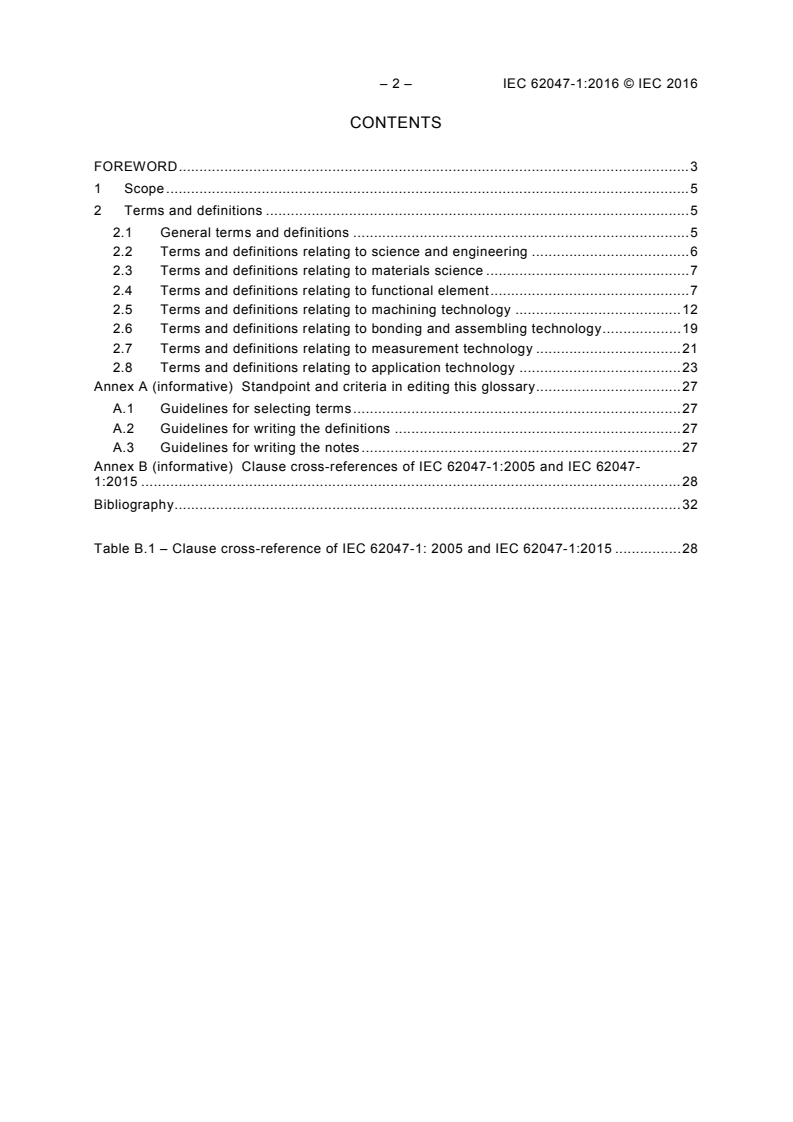
CONTENTS
FOREWORD . 3
1 Scope . 5
2 Terms and definitions . 5
2.1 General terms and definitions . 5
2.2 Terms and definitions relating to science and engineering . 6
2.3 Terms and definitions relating to materials science . 7
2.4 Terms and definitions relating to functional element . 7
2.5 Terms and definitions relating to machining technology . 12
2.6 Terms and definitions relating to bonding and assembling technology . 19
2.7 Terms and definitions relating to measurement technology . 21
2.8 Terms and definitions relating to application technology . 23
Annex A (informative) Standpoint and criteria in editing this glossary . 27
A.1 Guidelines for selecting terms . 27
A.2 Guidelines for writing the definitions . 27
A.3 Guidelines for writing the notes . 27
Annex B (informative) Clause cross-references of IEC 62047-1:2005 and IEC 62047-
1:2015 . 28
Bibliography . 32
Table B.1 – Clause cross-reference of IEC 62047-1: 2005 and IEC 62047-1:2015 . 28
INTERNATIONAL ELECTROTECHNICAL COMMISSION
____________
SEMICONDUCTOR DEVICES –
MICRO-ELECTROMECHANICAL DEVICES –
Part 1: Terms and definitions
FOREWORD
1) The International Electrotechnical Commission (IEC) is a worldwide organization for standardization comprising
all national electrotechnical committees (IEC National Committees). The object of IEC is to promote
international co-operation on all questions concerning standardization in the electrical and electronic fields. To
this end and in addition to other activities, IEC publishes International Standards, Technical Specifications,
Technical Reports, Publicly Available Specifications (PAS) and Guides (hereafter referred to as “IEC
Publication(s)”). Their preparation is entrusted to technical committees; any IEC National Committee interested
in the subject dealt with may participate in this preparatory work. International, governmental and non-
governmental organizations liaising with the IEC also participate in this preparation. IEC collaborates closely
with the International Organization for Standardization (ISO) in accordance with conditions determined by
agreement between the two organizations.
2) The formal decisions or agreements of IEC on technical matters express, as nearly as possible, an international
consensus of opinion on the relevant subjects since each technical committee has representation from all
interested IEC National Committees.
3) IEC Publications have the form of recommendations for international use and are accepted by IEC National
Committees in that sense. While all reasonable efforts are made to ensure that the technical content of IEC
Publications is accurate, IEC cannot be held responsible for the way in which they are used or for any
misinterpretation by any end user.
4) In order to promote international uniformity, IEC National Committees undertake to apply IEC Publications
transparently to the maximum extent possible in their national and regional publications. Any divergence
between any IEC Publication and the corresponding national or regional publication shall be clearly indicated in
the latter.
5) IEC itself does not provide any attestation of conformity. Independent certification bodies provide conformity
assessment services and, in some areas, access to IEC marks of conformity. IEC is not responsible for any
services carried out by independent certification bodies.
6) All users should ensure that they have the latest edition of this publication.
7) No liability shall attach to IEC or its directors, employees, servants or agents including individual experts and
members of its technical committees and IEC National Committees for any personal injury, property damage or
other damage of any nature whatsoever, whether direct or indirect, or for costs (including legal fees) and
expenses arising out of the publication, use of, or reliance upon, this IEC Publication or any other IEC
Publications.
8) Attention is drawn to the Normative references cited in this publication. Use of the referenced publications is
indispensable for the correct application of this publication.
9) Attention is drawn to the possibility that some of the elements of this IEC Publication may be the subject of
patent rights. IEC shall not be held responsible for identifying any or all such patent rights.
International Standard IEC 62047-1 has been prepared by subcommittee 47F: Micro-
electromechanical systems, of IEC technical committee 47: Semiconductor devices.
This second edition cancels and replaces the first edition published in 2005. This edition
constitutes a technical revision.
This edition includes the following significant technical changes with respect to the previous
edition:
a) removal of ten terms;
b) revision of twelve terms;
c) addition of sixteen new terms.
– 4 – IEC 62047-1:2016 © IEC 2016
The text of this standard is based on the following documents:
FDIS Report on voting
47F/232/FDIS 47F/238/RVD
Full information on the voting for the approval of this standard can be found in the report on
voting indicated in the above table.
This publication has been drafted in accordance with the ISO/IEC Directives, Part 2.
A list of all parts in the IEC 62047 series, published under the general title Semiconductor
devices – Micro-electromechanical devices, can be found on the IEC website.
The committee has decided that the contents of this publication will remain unchanged until
the stability date indicated on the IEC web site under "http://webstore.iec.ch" in the data
related to the specific publication. At this date, the publication will be
• reconfirmed,
• withdrawn,
• replaced by a revised edition, or
• amended.
SEMICONDUCTOR DEVICES –
MICRO-ELECTROMECHANICAL DEVICES –
Part 1: Terms and definitions
1 Scope
This part of IEC 62047 defines terms for micro-electromechanical devices including the
process of production of such devices.
2 Terms and definitions
For the purposes of this document, the following terms and definitions apply.
2.1 General terms and definitions
2.1.1
micro-electromechanical device
microsized device, in which sensors, actuators, transducers, resonators, oscillators,
mechanical components and/or electric circuits are integrated
Note 1 to entry: Related technologies are extremely diverse from fundamental technologies such as design,
material, processing, functional element, system control, energy supply, bonding and assembly, electric circuit, and
evaluation to basic science such as micro-science and engineering as well as thermodynamics and tribology in a
micro-scale. If the devices constitute a system, it is sometimes called as MEMS which is an acronym standing for
"micro-electromechanical systems"
2.1.2
MST
microsystem technology
technology to realize microelectrical, optical and machinery systems and even their
components by using micromachining
Note 1 to entry: The term MST is mostly used in Europe.
Note 2 to entry: This note applies to the French language only.
2.1.3
micromachine
2.1.3.1
micromachine,
miniaturized device, the components of which are several millimetres or smaller in size
Note 1 to entry: Various functional device (such as a sensor that utilizes the micromachine technology) is
included.
2.1.3.2
micromachine,
microsystem that consists of an integration of micromachine devices
Note 1 to entry: A molecular machine called a nanomachine is included.
– 6 – IEC 62047-1:2016 © IEC 2016
2.2 Terms and definitions relating to science and engineering
2.2.1
micro-science and engineering
science and engineering for the microscopic world of MEMS
Note 1 to entry: When mechanical systems are miniaturized, various physical parameters change. Two cases
prevail: 1) these changes can be predicted by extrapolating the changes of the macro-world, and 2) the peculiarity
of the microscopic world becomes apparent and extrapolation is not possible. In the latter case, it is necessary to
establish new theoretical and empirical equations for the explanation of phenomena in the microscopic world.
Moreover, new methods of analysis and synthesis to deal with engineering problems must be developed. Materials
science, fluid dynamics, thermodynamics, tribology, control engineering, and kinematics can be systematized as
micro-sciences and engineering supporting micromechatronics.
2.2.2
scale effect
change in effect on the object's behaviour or properties caused by the change in the object's
dimension
Note 1 to entry: The volume of an object is proportional to the third power of its dimension, while the surface area
is proportional to the second power. As a result, the effect of surface force becomes larger than that of the body
force in the microscopic world. For example, the dominant force in the motion of a microscopic object is not the
inertial force but the electrostatic force or viscous force. Material properties of microscopic objects are also
affected by the internal material structure and surface, and, as a result, characteristic values are sometimes
different from those of bulks. Frictional properties in the microscopic world also differ from those in the
macroscopic world. Therefore, those effects must be considered carefully while designing a micromachine.
2.2.3
microtribology
tribology for the microscopic world
Note 1 to entry: Tribology deals with friction and wear in the macroscopic world. On the other hand, when the
dimensions of components such as those in micromachines become extremely small, surface force and viscous
force become dominant instead of gravity and inertial force. According to Coulomb's law of friction, frictional force
is proportional to the normal load. In the micromachine environment, because of the reaction between surface
forces, a large frictional force occurs that would be inconceivable in an ordinary scale environment. Also a very
small quantity of abrasion that would not be a problem in an ordinary scale environment can fatally damage a
micromachine. Microtribology research seeks to reduce frictional forces and to discover conditions that are free of
friction, even on an atomic level. In this research, observation is made of phenomena that occur with friction
surfaces or solid surfaces at from angstrom to nanometer resolution, and analysis of interaction on an atomic level
is performed. These approaches are expected to be applied in solving problems in tribology for the ordinary scale
environment as well as for the micromachine environment.
2.2.4
biomimetics
creating functions that imitate the motions or the mechanisms of organisms
Note 1 to entry: In devising microscopic mechanisms suitable for micromachines, the mechanisms and structures
of organisms that have survived severe natural selection may serve as good examples to imitate. One example is
the microscopic three-dimensional structures that were modelled on the exoskeletons and elastic coupling systems
of insects. In exoskeletons, a hard epidermis is coupled with an elastic body, and all movable parts use the
deformation of the elastic body to move. The use of elastic deformation would be advantageous in the microscopic
world to avoid friction. Also, the exoskeleton structure equates to a closed link mechanism in kinematics and has
the characteristic that some actuator movement can be transmitted to multiple links.
2.2.5
self-organization
organization of a system without any external manipulation or control, where a nonequilibrium
structure emerges spontaneously due to the collective interactions among a number of simple
microscopic objects or phenomena
2.2.6
electro wetting on dielectric
EWOD
wetting of a substrate controlled by the voltage between a droplet and the substrate covered
with a dielectric film
Note 1 to entry: The contact angle of a liquid droplet, typically an electrolyte, on a substrate can be electrically
controlled because the solid-liquid surface interfacial tension can be controlled with the energy stored in the
electric double layer which works as capacitor. Covering the electrode with a dielectric material of determined
thickness, the capacitance can be determined with ease. Electro wetting on dielectric is used typically in
microfluidic devices.
Note 2 to entry: This note applies to the French language only.
2.2.7
stiction
phenomenon that a moving microstructure is stuck to another structure or substrate by
adhesion forces
Note 1 to entry: When structures become smaller, stiction appears significant due to the scale effect that surface
forces predominate over body forces. Stiction frequently occurs in the MEMS fabrication process when small
structures are released during wet etching processes due to the surface tension of liquid. Representative adhesion
forces to cause stiction are van der Waals force, electrostatic force, and surface tension of liquid between
structures.
2.3 Terms and definitions relating to materials science
2.3.1
silicon-on-insulator
SOI
structure composed of an insulator and a thin layer of silicon on it
Note 1 to entry: Sapphire (as in SOS), glass (as in SOG), silicon dioxide, silicon nitride, or even an insulating
form of silicon itself is used as an insulator.
Note 2 to entry: This note applies to the French language only.
2.4 Terms and definitions relating to functional element
2.4.1
actuator,
mechanical device that converts non-kinetic energy into kinetic energy to perform mechanical
work
2.4.2
microactuator
actuator produced by micromachining
Note 1 to entry: For a micromachine to perform mechanical work, the microactuator is indispensable as a basic
component. Major examples are the electrostatic actuator prepared by silicon process, the piezoelectric actuator
that utilizes functional materials like lead zirconate titanate (PZT), the pneumatic rubber-actuator, and so on. Many
other actuators based on various energy conversion principles have been investigated and developed. However,
the energy conversion efficiency of all these actuators deteriorates as their size is reduced. Therefore, the motion
mechanisms of organisms such as the deformation of protein molecules, the flagellar movement of bacteria, and
muscle contraction are being utilized to develop special new actuators for micromachines.
Note 2 to entry: Micro-electrostatic actuators are actuated by a micro-electrostatic field, magnetic microactuators
are driven by a micromagnetic field, and piezoelectric microactuators depend on a microstress field to convey
motion and power.
– 8 – IEC 62047-1:2016 © IEC 2016
2.4.3
light-driven actuator
actuator that uses light as a control signal or an energy source or both
Note 1 to entry: Since the development of photostrictive materials, various light driven actuators have been
proposed. These actuators have simple structures and can be driven by wireless means. A motor is proposed that
utilizes the spin realignment effect, in which a magnetic material absorbs light and the resulting heat changes the
direction of magnetization reversibly. Actuators utilizing thermal expansion, and exploiting polymer photochemical
reactions, are also being studied.
2.4.4
piezoelectric actuator
actuator that uses piezoelectric material
Note 1 to entry: Piezoelectric actuators are classified into the single-plate, bimorph, and stacked types, and the
popular material is lead zirconate titanate (PZT). The features are: 1) quick response, 2) large output force per
volume, 3) ease of miniaturization because of the simple structure, 4) narrow displacement range for easier
microdisplacement control, and 5) high efficiency of energy conversion. Piezoelectric actuators are used for the
actuators for micromachines, such as ultrasonic motor, and vibrator. An applied example is a piezoelectric actuator
for a travelling mechanism which moves by the resonance vibration of a piezoelectric bimorph, and a
micropositioner piezoelectric actuator which amplifies the displacements of a stacked piezoelectric device by a
lever.
2.4.5
shape-memory alloy actuator
actuator that uses shape memory alloy
Note 1 to entry: Shape-memory alloy actuators are compact, light, and produce large forces. These actuators can
be driven repeatedly in a heat cycle or can be controlled arbitrarily by switching the electric current through the
actuator itself. Lately, attempts have been made to use the alloys to build a servosystem that has an appropriate
feedback mechanism and a cooling system, intended for applications where quick response is not necessary
Application examples under development are microgrippers for cell manipulation, microvalves for regulating very
small amounts of flow and active endoscopes for medical use.
2.4.6
sol-gel conversion actuator
actuator that uses the transition between the sol (liquid) state and the gel (solid) state
Note 1 to entry: A sol-gel conversion actuator can work in a similar way to living things. For example, if electrodes
are put on a small particle of sodium polyacrylate gel in an electrolytic solution and a voltage is applied, the
particle repeatedly changes its shape. Sol-gel conversion actuators can be connected in series, sealed in a thin
pipe and fitted with multiple legs, to make a microrobot that moves in one direction and that looks like a centipede.
Another application being conceived is a crawler microrobot that automatically moves through a thin pipe.
2.4.7
electrostatic actuator
actuator that uses electrostatic force
Note 1 to entry: Since the electrostatic actuator has a simple structure and its output force per weight is
increased as the size is reduced, much research is ongoing to apply these characteristics to the actuators of
micromachines. Application examples developed so far on an experimental basis include a wobble motor and a film
electrostatic actuator.
2.4.8
comb-drive actuator
electrostatic actuator, consisting of a series of parallel fingers, fixed in position, engaged and
interleaved with a second, movable set of fingers
Note 1 to entry: The application of an electrostatic charge to the first set of fingers attracts the fingers of the
second set, such that they become more fully engaged in the interdigit spaces of the first set. Then the static
charge is removed and drained, and the second set of fingers is returned to its home position by micromachined
spring tension.
2.4.9
wobble motor
harmonic electrostatic motors
variable-gap electrostatic motor that generates a rolling motion of the rotor on an eccentric
stator without slip
Note 1 to entry: Wobble motors consist of a rotor, a stator with electrodes for the generation of electrostatic force,
and an insulation film on the rotor or stator surface. The rotor rotates in a reverse direction to the revolution.
The rotation speed, V , is given as V = V × (L – L )/ L , where V is the revolution speed, L is the
rot rot rev stat rot rot rev stat
stator circumference, and L is the rotor circumference.
rot
Characteristics of the wobble motor include 1) the ability to easily provide low speed and high torque when the
rotor circumference is very close to the stator circumference, 2) no problems of friction or wear because there are
no sliding parts, 3) the possibility to be fabricated using diverse materials, and 4) an easily increasable aspect ratio.
On the other hand, the revolution of the rotor can cause unnecessary vibration. Production examples include a
wobble motor that supports a rotor by a flexible coupling, and a wobble motor fabricated by the integrated circuit
process and whose rotor rolls at the fulcrum.
2.4.10
microsensor
device, produced for example by micromachining, and which is used for measuring a physical
or chemical quantity by converting it to an electric output
Note 1 to entry: In micromachines, the first field to be developed and realized was that of the microsensor.
Microsensors include mechanical quantity sensors (measuring pressure, acceleration, tactile senses, displacement,
etc.), chemical quantity sensors (measuring ions, oxygen, etc.), electric quantity sensors (measuring magnetism,
current, etc.), biosensors, and optical sensors. In many microsensors, the detecting section containing the
mechanism is integrated with the electronic circuits. The advantages of microsensors are: 1) minimal
environmental disruption, 2) the ability to measure local states of small areas, 3) the integration with circuits, and
4) minimal operating power.
2.4.11
biosensor
sensor that uses organic substances in the device, that is intended for measurement of
organism-related subsystems, or that mimics an organism
Note 1 to entry: A typical biosensor consists of a biologically originated specific material such as an enzyme or an
antibody that identifies the object of measurement and the device that measures a physical or chemical quantity
change related to the identifying reaction. A semiconductor sensor or any of various types of electrode (e.g. ISFET,
micro-oxygen electrode, and fluorescence detection optical sensor) prepared by silicon micromachining technology
can be used as this device. Biosensors are used for blood analysis systems, glucose sensors, microrobots, and so
on.
2.4.12
integrated microprobe
one-piece probe combining a microprobe and a signal processing circuit
Note 1 to entry: The smaller the sensitive part of the sensor, 1) the less interference to the measuring object, 2)
the higher the signal-to-noise ratio in the measurement, and 3) the more small-area local data can be obtained. An
integrated microprobe is a device consisting of a microprobe prepared by micromachining silicon to an ultra-
microscopic needle and incorporating a signal processing circuit. Integrated microprobes made by machining
silicon needles to a diameter of from several nanometers to several micrometers and combining them with an
impedance conversion circuit, etc., are in actual use as microscopic electrodes for organisms, scanning tunneling
microscopes (STMs), and atomic force microscopes (AFMs).
– 10 – IEC 62047-1:2016 © IEC 2016
2.4.13
ISFET
ion-sensitive field-effect transistor
semiconductor sensor integrating an ion-sensitive electrode with a field-effect transistor (FET)
Note 1 to entry: In the ion-sensitive electrode section, the membrane voltage changes according to fluctuations in
pH or carbon dioxide partial pressure in the blood, for example. As the voltage amplifier, the ISFET uses a FET, a
transistor controlling the conductance of the current path (channels) formed by the majority carriers using an
electric field perpendicular to the carrier flow. The ISFET is based on silicon micromachining technology integrating
a detector and amplifier on a silicon substrate. In addition, an ISFET with mechanical components such as a valve
has been developed. The ISFET is used in such fields as medical analysis and environmental instrumentation.
Note 2 to entry: This note applies to the French language only.
2.4.14
accelerometer
measurement transducer that converts an input acceleration to an output (usually an electric
signal) that is proportional to the input acceleration
Note 1 to entry: The accelerometer, based on silicon micromachining technology, is typically composed of a soft
spring and a mass. The accelerometer senses the displacement of the spring caused by the inertia of the
accelerated mass, or detects acceleration from the measurement of the force required to cancel this displacement.
Among today's silicon-made sensors, accelerometers hold particular promise as a next-generation product. There
are many types of accelerometer such as semiconductor strain gauges, capacitance detectors, electromagnetic
servosystems, and electrostatic servosystems. In addition, vibration detection-type accelerometers, which detect
changes in resonance frequencies, and piezoelectric effect-type accelerometers, which use the piezoelectric effect,
are also under development. Continuing development is aimed at applications in a wide variety of fields, including
automobiles, robots, and the space industry.
[SOURCE: ISO 2041:2009, 4.10, modified – Note 1 to entry has been added.]
2.4.15
microgyroscope
microscopic sensor for measuring angular velocity
Note 1 to entry: Microgyroscopes are expected to be applied as microrobot attitude sensors. Rotational and
vibrational gyroscopes are based on the Coriolis force. Ring laser gyroscopes and optical fibre gyroscopes are
based on the Sagnac effect. Among these types of gyroscope, vibrational gyroscopes (the tuning fork- and
resonant piece-types) are suitable for miniaturization and are being developed for miniaturized applications.
2.4.16
diaphragm structure
flexible membrane structure that separates space
Note 1 to entry: In a microscopic region, materials such as single-crystal silicon, polysilicon, and so on are used
for the diaphragm structure. The structure is commonly fabricated by anisotropic etching. The thickness of the
structure can be controlled from several micrometres to several tens of micrometres depending on the application.
The structure can be used to detect pressure changes, or to cause displacement. For example, it is used in the
pressure-sensitive part of a pressure sensor for automobile engines and silicon microphones. Also, it is used as a
membrane to change pressure in microvalves and micropumps.
2.4.17
microcantilever
cantilever produced by micromachining
Note 1 to entry: Microcantilevers are often used in high-resolution microscopes such as the Atomic Force
Microscope (AFM).
2.4.18
microchannel
channel produced by micromachining
Note 1 to entry: Microchannels are often used in fluidic devices such as a lab-on-a-chip. The flow in a
microchannel is different from that in a macroscopic one, and the formulation of the flow is one of the key issues in
micro-science and engineering. A microchannel can be used as an acoustic guide.
2.4.19
micromirror
microsized reflecting mirror that can be actuated to control its reflection angle
2.4.20
scanning mirror
mirror that scans a light beam
Note 1 to entry: Scanning mirrors are developed for laser printers, the scanning parts of optical sensors, the
heads for optical disks, displays and so on. An array of scanning mirrors can be fabricated on a silicon wafer with
an actuator by micromachining technology. The scanning mirror is expected to be one of the practical applications
of micromachine technology.
2.4.21
microswitch
mechanical switch produced by micromachining
Note 1 to entry: The term “microswitch” is already used in commercially available switches that are produced
using conventional techniques.
Note 2 to entry: The main application of a microswitch is that of a microrelay.
2.4.22
optical switch
optical element to switch optical signals without conversion into electric signals
2.4.23
microgripper
mechanical device that grasps microscopic objects
Note 1 to entry: Microgrippers have two roles. They can be used as tools to assemble micromachines or as the
hands of microrobots, etc. In either case, the microgripper has fingers to grasp objects and an actuator to handle
them. Compared to a microrobot hand, microgrippers are structurally large but require precise control. As the
function of a microgripper is simply to grasp an object, multi-degrees of freedom handling requires the combination
of suitable manipulators. Compared to non-contact-type handling using a laser beam, contact-type handling based
on a microgripper or similar device gives better attitude control of the object. However, if the object to be handled
is below several tens of micrometres in size, the attractive forces between the surfaces of the microgripper fingers
and the object handled make manipulation difficult.
2.4.24
micropump
mechanical device that pressurizes and thus transports a small amount of fluid
Note 1 to entry: There are many examples of micropumps mainly fabricated on silicon or glass, for instance, and
using micromachining technology to form a diaphragm together with an actuator. Application examples include a
diaphragm-type pump with a microscopic check valve driven by a piezoelectric element, and an integrated pump
using a thermal expansion actuator along with a microheater. Pumps discharging and sucking fluids by deforming a
diaphragm actuated by a stacked piezoelectric actuator can control the rate by changing the frequency of the
actuator drive. In addition, pulsation-damping pumps can control the fluid flow with a high accuracy by using a dual
pump along with a synchronous buffer pump.
– 12 – IEC 62047-1:2016 © IEC 2016
2.4.25
microvalve
mechanical device that controls the flow of fluid in a microscopic channel
Note 1 to entry: Microvalves, which are composed of such components as actuators and diaphragms, made of
silicon, etc., control the flow in microscopic channels (narrower than several micrometres). For example, a gas flow
control valve is composed of a stacked piezoelectric actuator and a diaphragm. To control high-viscosity fluids
such as blood, it is necessary to enlarge the channel and increase the stroke of the valve drive. A mechanism
using a shape-memory alloy coil and a bias spring has been developed experimentally for this purpose, as well as
a mechanism that alters the channel by an electrostatic, magnetic, or piezoelectric actuator.
2.4.26
CMOS MEMS
integrated MEMS device, in which complementary metal–oxide–semiconductor (CMOS)
signal-processing circuits and MEMS elements are formed on the same silicon substrate
Note 1 to entry: CMOS MEMS is one form of the MEMS device that integrates CMOS signal-processing circuits
and MEMS elements. Usually, the CMOS MEMS is fabricated by performing a MEMS process on the CMOS
preformed wafer, and therefore it is necessary that the MEMS process does not damage the CMOS circuit.
2.4.27
micro fuel cell
micromachined device converting the chemical energy of a fuel directly into electricity by an
electrochemical process
2.4.28
photoelectric transducer
transducer that generates an electric output corresponding to the incident light
Note 1 to entry: Photoelectric transducers are divided into two groups according to their applications: 1) a photo-
detector that handles light signals, and 2) a photovoltaic power system such as a solar battery that responds to
light energy. In the former case, sensitivity and response speed are important, while in the latter case, energy
conversion efficiency is important. Classified by their operating principles, photoelectric transducers can be divided
into a photo-conductive type, typified by photo-conductive cells and image pick-up tubes, and a photovoltaic type,
typified by photodiodes and solar batteries.
2.5 Terms and definitions relating to machining technology
2.5.1
micromachining
machining process used to realize microscopic structures
Note 1 to entry: Micromachining is a general term including wide-ranging machining technologies for microscopic
structures. Depending on the contexts, however, the term can be used with more specific meanings, as follows:
a) machining processes derived from the semiconductor manufacturing technologies, used to realize microscopic
structures for the production of micromachines or MEMS,
b) machining processes used to realize microscopic structures of micromachines or MEMS, applying conventional
machining technologies such as cutting and grinding.
2.5.2
silicon process
processing technologies for silicon
Note 1 to entry: While the silicon process is broadly divided into surface micromachining and bulk micromachining,
most of the technologies involved are the same. The silicon process starts with layer work and continues to a
patterning process, microassembly, annealing, and packaging. Many technologies such as deposition, diffusion,
chemical corrosion, and lithography are combined as working technologies. A feature of the silicon process is the
ability to use batch processing on large wafers for the mass-fabrication of components.
2.5.3
thick film technology
technology that forms thick films on a substrate
Note 1 to entry: A thick film is a film of a thickness of about 5 µm or greater formed by ink-paste coating or spray-
printing and subsequent baking. These films are applied in the manufacture of piezoelectric or magnetic actuators.
2.5.4
thin film technology
technology that forms thin films on a substrate
Note 1 to entry: A thin film is a film formed on a substrate by means of vacuum deposition or ion sputtering, or
any other processes. The film thickness ranges from a layer of single atoms or molecules, to 5 µm thickness.
Usually the term refers to films of a thickness of 1 µm or less. A thin film can change properties such as colour,
reflectivity, and friction coefficient of the substrate, while the shape of the substrate is left practically unchanged.
Phenomena such as optical interference and surface diffusion are noticeably affected by the formation of thin films.
Thin film formations usually take a nonequilibrium, heterogeneous nuclear formation step, which brings on
structural properties different from those of bulk materials produced under ordinary equilibrium conditions. In one
application, thin film technology combined with etching improved the degree of integration of a thermal printer head
that was conventionally manufactured by thick film technology.
2.5.5
bulk micromachining
micromachining that removes a part of the substrate
Note 1 to entry: An example of bulk micromachining is a processing method based on etching by a chemical
solution to remove unnecessary parts of a substrate. Covering the areas to be preserved with a mask of SiO2 or
Si3N4 ensures that etching cannot progress below the surface. Also, a boron-doped layer can stop the etching of
the part below the surface layer. Recently, silicon fusion bonding has been used to fabricate still more complex
structures.
2.5.6
surface micromachining
micromachining that forms various substances in various microshapes on the substrate
surface
Note 1 to entry: Surface micromachining is a processing technique that applies for example chemical vapour
deposition (CVD) to form various thin films on the substrate and uses a mask to perform selective removal of the
substrate surface to produce movable parts and other structures. The dissolved layer that was deposited initially is
called the sacrificial layer. A typical sacrificial layer material is phosphosilicate glass (PSG). This technology is
applied to the fabrication of micro-beams, bearings, and links, etc.
2.5.7
surface modification
process that modifies physical, chemical, or biolochemical properties of the material surface
Note 1 to entry: Surface modification processes include doping for electric applications, deposition of materials
for mechanical/chemical applications, and molecular modification for biochemical applications.
2.5.8
chemical mechanical polishing
CMP
planarization process for a substrate by a combination of mechanical polishing and chemical
etching
Note 1 to entry: Chemical mechanical polishing is applied mainly to planarize steps on a substrate due to the
semiconductor manufacturing process. Because the steps are composed of a plurality of materials such as
substrates, dielectrics and metals, various slurries are used to selectively remove each material. In MEMS devices,
chemical mechanical polishing is used to planarize the bonding surfaces in the wafer level packaging process.
– 14 – IEC 62047-1:2016 © IEC 2016
Note 2 to entry: This note applies to the French language only.
2.5.9
photolithography
technique that transfers a fine pattern onto a substrate by the use of light
Note 1 to entry: In photolithography, a glass plate on which a desired pattern has been drawn is used as a mask.
The mask is placed onto the
...