

IEC 60811-201:2012
(Main)Electric and optical fibre cables - Test methods for non-metallic materials - Part 201: General tests - Measurement of insulation thickness
General Information
- Abstract
IEC 60811-201:2012 gives the methods for measuring the insulation thicknesses which apply to the most common types of insulating compounds (cross-linked, PVC, PE, PP, etc.). IEC 60811-201:2012 cancels and replaces 8.1 of IEC 60811-1-1:1993, which is withdrawn. Full details of the replacements are shown in Annex A of IEC 60811-100:2012. There are no technical changes with respect to the previous edition, but see the Foreword to IEC 60811-100:2012.
This publication is to be read in conjunction with IEC 60811-100:2012.
- Status
- Published
- Publication Date
- 01-Nov-2023
- Technical Committee
- TC 20 - Electric cables
- Drafting Committee
- WG 17 - TC 20/WG 17
- Current Stage
- PPUB - Publication issued
- Start Date
- 12-Mar-2012
- Completion Date
- 31-Mar-2012
Buy Documents
IEC 60811-201:2012 - Electric and optical fibre cables - Test methods for non-metallic materials - Part 201: General tests - Measurement of insulation thickness Released:3/12/2012

IEC 60811-201:2012+AMD1:2017 CSV - Electric and optical fibre cables - Test methods for non-metallic materials - Part 201: General tests - Measurement of insulation thickness Released:7/21/2017
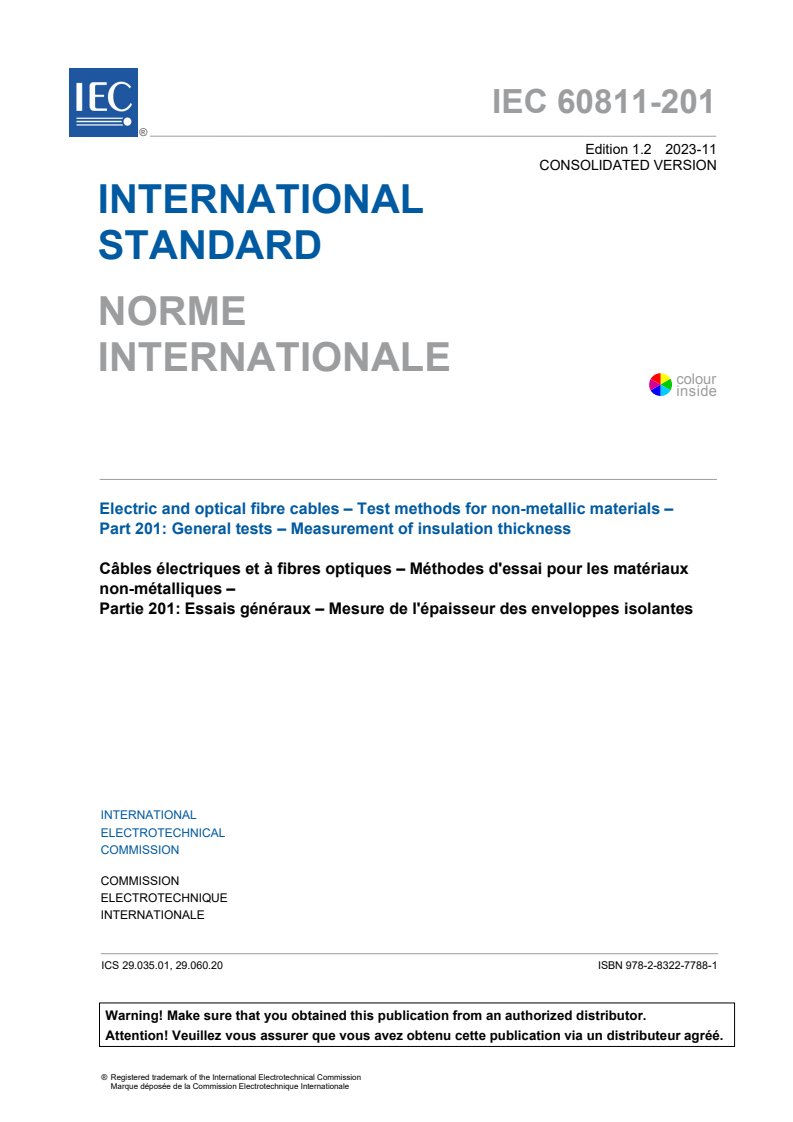

IEC 60811-201:2012+AMD1:2017+AMD2:2023 CSV - Electric and optical fibre cables - Test methods for non-metallic materials - Part 201: General tests - Measurement of insulation thickness Released:11/2/2023
Overview
IEC 60811-201:2012 is an International Electrotechnical Commission (IEC) standard that specifies the test methods for measuring insulation thickness in electric and optical fibre cables. This part of the IEC 60811 series focuses on general test procedures applicable to the most common non-metallic insulating materials such as cross-linked polyethylene (XLPE), PVC, PE, and polypropylene (PP). The standard replaces the previous method outlined in IEC 60811-1-1:1993 and is designed to ensure consistent, accurate measurements of insulation thickness, which is critical to cable quality and performance.
Key Topics
Scope and Application
IEC 60811-201 outlines methods to measure insulation thickness for non-metallic materials used in cables. It applies to various insulating compounds typically employed in electric and optical fibre cable manufacturing.Measurement Equipment
The standard requires the use of precise measuring instruments like a measuring microscope, profile projector, or optical digital image analyzer with a minimum 10x magnification. These tools enable measurement accuracy to 0.01 mm and finer readings up to 0.001 mm for very thin insulation layers.Sample Preparation
Accurate measurement demands removal of any coverings without damaging the insulation. Test pieces must be thin slices cut perpendicularly to the conductor axis. Special care controls marking indentations and layered structures to ensure true insulation thickness measurement.Measurement Procedure
Different conductor profiles require specific measurement approaches:- Circular profiles take six radial readings approximately 60 degrees apart.
- Sector-shaped and stranded conductors have designated patterns for six thickness readings.
- Uneven outer profiles require adapted measurement techniques.
- Screening layers, if present and unremovable, are excluded from the thickness evaluation.
Integration with Other Standards
IEC 60811-201 is part of a broader series and is intended to be used alongside IEC 60811-100, which provides general guidelines for testing non-metallic cable materials.
Applications
Cable Manufacturing Quality Control
Accurate thickness measurement of insulation ensures that cables meet design specifications to provide electrical insulation, resistance to environmental factors, and mechanical protection.Material Evaluation for Non-Metallic Insulators
Assessment of cross-linked polyethylene, PVC, PE, PP, and other insulating compounds for conformity to industry standards and customer requirements.Inspection in Research and Development
Used during the R&D phase to analyze prototype cable insulation and optimize manufacturing processes for electrical and optical fibre cables.Cable Certification and Compliance
Provides objective test data supporting certification procedures and adherence to national or international cable standards.Failure Analysis and Maintenance
Measurement of insulation thickness can identify deterioration or defects in cables in service, aiding in preventative maintenance or failure investigations.
Related Standards
IEC 60811-100:2012
General guidelines and definitions for test methods on non-metallic cable materials, serving as an essential companion document to IEC 60811-201.IEC 60811 Series
A comprehensive series of standards detailing test methods for non-metallic materials used in electric and optical fibre cables, covering chemical, physical, and mechanical testing.ISO/IEC Directives
Provides the framework under which IEC 60811-201:2012 was developed, ensuring international consensus and standardization processes.
Keywords: IEC 60811-201, insulation thickness measurement, electric cables, optical fibre cables, non-metallic materials testing, cross-linked polyethylene insulation, PVC insulation testing, cable quality control, IEC cable standards, cable insulation thickness test methods.
Relations
- Effective Date
- 05-Sep-2023
- Effective Date
- 05-Sep-2023
- Effective Date
- 05-Sep-2023
- Effective Date
- 05-Sep-2023
Buy Documents
IEC 60811-201:2012 - Electric and optical fibre cables - Test methods for non-metallic materials - Part 201: General tests - Measurement of insulation thickness Released:3/12/2012
IEC 60811-201:2012+AMD1:2017 CSV - Electric and optical fibre cables - Test methods for non-metallic materials - Part 201: General tests - Measurement of insulation thickness Released:7/21/2017
IEC 60811-201:2012+AMD1:2017+AMD2:2023 CSV - Electric and optical fibre cables - Test methods for non-metallic materials - Part 201: General tests - Measurement of insulation thickness Released:11/2/2023
Get Certified
Connect with accredited certification bodies for this standard

IMQ S.p.A. (Certification)
Italian electrical product certification.

SLG Prüf- und Zertifizierungs GmbH
German testing and certification body.

UL Solutions
Global safety science company with testing, inspection and certification.
Sponsored listings
Frequently Asked Questions
IEC 60811-201:2012 is a standard published by the International Electrotechnical Commission (IEC). Its full title is "Electric and optical fibre cables - Test methods for non-metallic materials - Part 201: General tests - Measurement of insulation thickness". This standard covers: IEC 60811-201:2012 gives the methods for measuring the insulation thicknesses which apply to the most common types of insulating compounds (cross-linked, PVC, PE, PP, etc.). IEC 60811-201:2012 cancels and replaces 8.1 of IEC 60811-1-1:1993, which is withdrawn. Full details of the replacements are shown in Annex A of IEC 60811-100:2012. There are no technical changes with respect to the previous edition, but see the Foreword to IEC 60811-100:2012. This publication is to be read in conjunction with IEC 60811-100:2012.
IEC 60811-201:2012 gives the methods for measuring the insulation thicknesses which apply to the most common types of insulating compounds (cross-linked, PVC, PE, PP, etc.). IEC 60811-201:2012 cancels and replaces 8.1 of IEC 60811-1-1:1993, which is withdrawn. Full details of the replacements are shown in Annex A of IEC 60811-100:2012. There are no technical changes with respect to the previous edition, but see the Foreword to IEC 60811-100:2012. This publication is to be read in conjunction with IEC 60811-100:2012.
IEC 60811-201:2012 is classified under the following ICS (International Classification for Standards) categories: 29.035.01 - Insulating materials in general; 29.060.20 - Cables; 33.060.30 - Radio relay and fixed satellite communications systems. The ICS classification helps identify the subject area and facilitates finding related standards.
IEC 60811-201:2012 has the following relationships with other standards: It is inter standard links to IEC 60811-1-1:1993, IEC 60811-1-1:1993/AMD1:2001, IEC 60811-201:2012/AMD1:2017, IEC 60811-201:2012/AMD2:2023. Understanding these relationships helps ensure you are using the most current and applicable version of the standard.
IEC 60811-201:2012 is available in PDF format for immediate download after purchase. The document can be added to your cart and obtained through the secure checkout process. Digital delivery ensures instant access to the complete standard document.
Standards Content (Sample)
IEC 60811-201 ®
Edition 1.0 2012-03
INTERNATIONAL
STANDARD
NORME
INTERNATIONALE
Electric and optical fibre cables – Test methods for non-metallic materials –
Part 201: General tests – Measurement of insulation thickness
Câbles électriques et à fibres optiques – Méthodes d’essai pour les matériaux
non-métalliques –
Partie 201: Essais généraux – Mesure de l’épaisseur des enveloppes isolantes
All rights reserved. Unless otherwise specified, no part of this publication may be reproduced or utilized in any form
or by any means, electronic or mechanical, including photocopying and microfilm, without permission in writing from
either IEC or IEC's member National Committee in the country of the requester.
If you have any questions about IEC copyright or have an enquiry about obtaining additional rights to this publication,
please contact the address below or your local IEC member National Committee for further information.
Droits de reproduction réservés. Sauf indication contraire, aucune partie de cette publication ne peut être reproduite ni
utilisée sous quelque forme que ce soit et par aucun procédé, électronique ou mécanique, y compris la photocopie et les
microfilms, sans l'accord écrit de la CEI ou du Comité national de la CEI du pays du demandeur.
Si vous avez des questions sur le copyright de la CEI ou si vous désirez obtenir des droits supplémentaires sur cette
publication, utilisez les coordonnées ci-après ou contactez le Comité national de la CEI de votre pays de résidence.
IEC Central Office Tel.: +41 22 919 02 11
3, rue de Varembé Fax: +41 22 919 03 00
CH-1211 Geneva 20 info@iec.ch
Switzerland www.iec.ch
About the IEC
The International Electrotechnical Commission (IEC) is the leading global organization that prepares and publishes
International Standards for all electrical, electronic and related technologies.
About IEC publications
The technical content of IEC publications is kept under constant review by the IEC. Please make sure that you have the
latest edition, a corrigenda or an amendment might have been published.
Useful links:
IEC publications search - www.iec.ch/searchpub Electropedia - www.electropedia.org
The advanced search enables you to find IEC publications The world's leading online dictionary of electronic and
by a variety of criteria (reference number, text, technical electrical terms containing more than 30 000 terms and
committee,…). definitions in English and French, with equivalent terms in
It also gives information on projects, replaced and additional languages. Also known as the International
withdrawn publications. Electrotechnical Vocabulary (IEV) on-line.
IEC Just Published - webstore.iec.ch/justpublished Customer Service Centre - webstore.iec.ch/csc
Stay up to date on all new IEC publications. Just Published If you wish to give us your feedback on this publication
details all new publications released. Available on-line and or need further assistance, please contact the
also once a month by email. Customer Service Centre: csc@iec.ch.
A propos de la CEI
La Commission Electrotechnique Internationale (CEI) est la première organisation mondiale qui élabore et publie des
Normes internationales pour tout ce qui a trait à l'électricité, à l'électronique et aux technologies apparentées.
A propos des publications CEI
Le contenu technique des publications de la CEI est constamment revu. Veuillez vous assurer que vous possédez
l’édition la plus récente, un corrigendum ou amendement peut avoir été publié.
Liens utiles:
Recherche de publications CEI - www.iec.ch/searchpub Electropedia - www.electropedia.org
La recherche avancée vous permet de trouver des Le premier dictionnaire en ligne au monde de termes
publications CEI en utilisant différents critères (numéro de électroniques et électriques. Il contient plus de 30 000
référence, texte, comité d’études,…). termes et définitions en anglais et en français, ainsi que
Elle donne aussi des informations sur les projets et les les termes équivalents dans les langues additionnelles.
publications remplacées ou retirées. Egalement appelé Vocabulaire Electrotechnique
International (VEI) en ligne.
Just Published CEI - webstore.iec.ch/justpublished
Service Clients - webstore.iec.ch/csc
Restez informé sur les nouvelles publications de la CEI.
Just Published détaille les nouvelles publications parues. Si vous désirez nous donner des commentaires sur
Disponible en ligne et aussi une fois par mois par email. cette publication ou si vous avez des questions
contactez-nous: csc@iec.ch.
IEC 60811-201 ®
Edition 1.0 2012-03
INTERNATIONAL
STANDARD
NORME
INTERNATIONALE
Electric and optical fibre cables – Test methods for non-metallic materials –
Part 201: General tests – Measurement of insulation thickness
Câbles électriques et à fibres optiques – Méthodes d’essai pour les matériaux
non-métalliques –
Partie 201: Essais généraux – Mesure de l’épaisseur des enveloppes isolantes
INTERNATIONAL
ELECTROTECHNICAL
COMMISSION
COMMISSION
ELECTROTECHNIQUE
PRICE CODE
INTERNATIONALE
CODE PRIX L
ICS 29.035.01; 29.060.20 ISBN 978-2-88912-956-0
– 2 – 60811-201 IEC:2012
CONTENTS
FOREWORD . 3
INTRODUCTION . 5
1 Scope . 6
2 Normative references . 6
3 Terms and definitions . 6
4 Test method . 6
4.1 General . 6
4.2 Measuring equipment . 6
4.3 Sample and test pieces preparation. 7
4.4 Measuring procedure . 7
4.5 Evaluation of the measurement results . 7
5 Test report. 7
Bibliography . 11
Figure 1 – Measurement of insulation (circular inner profile) . 8
Figure 2 – Measurement of insulation thickness (sectoral-shaped conductor) . 8
Figure 3 – Measurement of insulation thickness (stranded conductor) . 9
Figure 4 – Measurement of insulation thickness (stranded conductor) . 9
Figure 5 – Measurement of insulation thickness (uneven outer profile) . 10
Figure 6 – Measurement of insulation thickness (twin flat non-sheathed cable) . 10
60811-201 IEC:2012 – 3 –
INTERNATIONAL ELECTROTECHNICAL COMMISSION
____________
ELECTRIC AND OPTICAL FIBRE CABLES –
TEST METHODS FOR NON-METALLIC MATERIALS –
Part 201: General tests –
Measurement of insulation thickness
FOREWORD
1) The International Electrotechnical Commission (IEC) is a worldwide organization for standardization comprising
all national electrotechnical committees (IEC National Committees). The object of IEC is to promote
international co-operation on all questions concerning standardization in the electrical and electronic fields. To
this end and in addition to other activities, IEC publishes International Standards, Technical Specifications,
Technical Reports, Publicly Available Specifications (PAS) and Guides (hereafter referred to as “IEC
Publication(s)”). Their preparation is entrusted to technical committees; any IEC National Committee interested
in the subject dealt with may participate in this preparatory work. International, governmental and non-
governmental organizations liaising with the IEC also participate in this preparation. IEC collaborates closely
with the International Organization for Standardization (ISO) in accordance with conditions determined by
agreement between the two organizations.
2) The formal decisions or agreements of IEC on technical matters express, as nearly as possible, an international
consensus of opinion on the relevant subjects since each technical committee has representation from all
interested IEC National Committees.
3) IEC Publications have the form of recommendations for international use and are accepted by IEC National
Committees in that sense. While all reasonable efforts are made to ensure that the technical content of IEC
Publications is accurate, IEC cannot be held responsible for the way in which they are used or for any
misinterpretation by any end user.
4) In order to promote international uniformity, IEC National Committees undertake to apply IEC Publications
transparently to the maximum extent possible in their national and regional publications. Any divergence
between any IEC Publication and the corresponding national or regional publication shall be clearly indicated in
the latter.
5) IEC itself does not provide any attestation of conformity. Independent certification bodies provide conformity
assessment services and, in some areas, access to IEC marks of conformity. IEC is not responsible for any
services carried out by independent certification bodies.
6) All users should ensure that they have the latest edition of this publication.
7) No liability shall attach to IEC or its directors, employees, servants or agents including individual experts and
members of its technical committees and IEC National Committees for any personal injury, property damage or
other damage of any nature whatsoever, whether direct or indirect, or for costs (including legal fees) and
expenses arising out of the publication, use of, or reliance upon, this IEC Publication or any other IEC
Publications.
8) Attention is drawn to the Normative references cited in this publication. Use of the referenced publications is
indispensable for the correct application of this publication.
9) Attention is drawn to the possibility that some of the elements of this IEC Publication may be the subject of
patent rights. IEC shall not be held responsible for identifying any or all such patent rights.
International Standard IEC 60811-201 has been prepared by IEC technical committee 20:
Electric cables.
This Part 201 of IEC 60811 cancels and replaces 8.1 of IEC 60811-1-1:1993, which is
withdrawn. Full details of the replacements are shown in Annex A of IEC 60811-100:2012.
There are no technical changes with respect to the previous edition, but see the Foreword to
IEC 60811-100:2012.
– 4 – 60811-201 IEC:2012
The text of this standard is based on the following documents:
FDIS Report on voting
20/1280/FDIS 20/1329/RVD
Full information on the voting for the approval of this standard can be found in the report on
voting indicated in the above table.
This publication has been drafted in accordance with the ISO/IEC Directives, Part 2.
This part of IEC 60811 shall be read in conjunction with IEC 60811-100.
A list of all the parts in the IEC 60811 series, published under the general title Electric and
optical fibre cables – Test methods for non-metallic materials, can be found on the IEC
website.
The committee has decided that the contents of this publication will remain unchanged until
the stability date indicated on the IEC web site under "http://webstore.iec.ch" in the data
related to the specific publication. At this date, the publication will be
• reconfirmed,
• withdrawn,
• replaced by a revised edition, or
• amended.
60811-201 IEC:2012 – 5 –
INTRODUCTION
The IEC 60811 series specifies the test methods to be used for testing non-metallic materials
of all types of cables. These test methods are intended to be referenced in standards for
cable construction and for cable materials.
NOTE 1 Non-metallic materials are typically used for insulating, sheathing, bedding, filling or taping within cables.
NOTE 2 These test methods are accepted as basic and fundamental and have been developed and used over
many years principally for the materials in all energy cables. They have also been widely accepted and used for
other cables, in particular optical fibre cables, communication and control cables and cables for ships and offshore
applications.
– 6 – 60811-201 IEC:2012
ELECTRIC AND OPTICAL FIBRE CABLES –
TEST METHODS FOR NON-METALLIC MATERIALS –
Part 201: General tests –
Measurement of insulation thickness
1 Scope
This Part 201 of IEC 60811 gives the methods for measuring the insulation thicknesses which
apply to the most common types of insulating compounds (cross-linked, PVC, PE, PP, etc.).
2 Normative references
The following documents, in whole or in part, are normatively referenced in this document and
are indispensable for its application. For dated references, only the edition cited applies. For
undated references, the latest edition of the referenced document (including any
amendments) applies.
IEC 60811-100:2012, Electric and optical fibre cables – Test methods for non-metallic
materials – Part 100: General
3 Terms and definitions
For the purposes of this document, the terms and definitions given in IEC 60811-100 apply.
4 Test method
4.1 General
This part of IEC 60811 shall be used in conjunction with IEC 60811-100.
Unless otherwise specified, tests shall be carried out at room temperature.
Measurement of insulation thickness may be required as an individual test, or as a step in the
procedure for carrying out other tests, such as the determination of mechanical properties.
In each case, the method of selecting samples shall be in accordance with the relevant cable
standard.
4.2 Measuring equipment
A measuring microscope or a profile projector of at least 10 x magnification or an optical
digital image analyser shall be used. These two types of equipment shall allow a reading of
0,01 mm and an estimated reading to three decimal places when measuring insulation with a
specified thickness less than 0,5 mm.
In case of doubt, the measuring microscope shall be taken as the reference method.
60811-201 IEC:2012 – 7 –
4.3 Sample and test pieces preparation
Any covering shall be removed from the insulation, and the conductor(s), together with
separator (if any) shall be withdrawn, care being taken to avoid damage to the insulation.
Semi-conducting inner and/or outer layers, if bonded to the insulation, shall not be removed.
Each test piece shall consist of a thin slice of insulation. The slice shall be cut with a suitable
device along a plane perpendicular to the longitudinal axis of the conductor.
The cores of non-sheathed flat cables shall not be separated.
If the insulation carries an indented marking, thus giving rise to a local reduction in thickness,
the test piece shall be taken so as to include such marking.
4.4 Measuring procedure
The test piece shall be placed under the measuring equipment with the plane of the cut
perpendicular to the optical axis.
a) When the inner profile of the test piece is of circular form, six measurements shall be
made radially, each approximately 60°, as shown in Figure 1. For sector-shaped cores, six
measurements shall be made as shown in Figure 2.
b) When the insulation is taken from a stranded conductor, six measurements shall be made
radially as shown in Figures 3 and 4.
c) When the outer profile shows unevenness, the measurement shall be carried out as shown
in Figure 5.
d) When there are unremovable screening layers under and/or over the insulation, they shall
be excluded from the measurements.
e) If unremovable screening layers are present under and/or over an opaque insulation, a
measuring microscope shall be used.
f) Flat non-sheathed cables shall be measured according to Figure 6, the thickness of
insulation in the direction of the other core being taken as half the distance between the
conductors.
In all cases, the first measurement shall be taken where the insulation is thinnest.
If the insulation carries an indented marking, this shall not be included in the measurements
made for the calculation of mean thickness.
In any case, the thickness at the position of the indented marking shall comply with the
minimum requirement specified in the relevant standard.
The readings shall be made in
...
IEC 60811-201 ®
Edition 1.1 2017-07
CONSOLIDATED VERSION
INTERNATIONAL
STANDARD
NORME
INTERNATIONALE
colour
inside
Electric and optical fibre cables – Test methods for non-metallic materials –
Part 201: General tests – Measurement of insulation thickness
Câbles électriques et à fibres optiques – Méthodes d’essai pour les matériaux
non-métalliques –
Partie 201: Essais généraux – Mesure de l’épaisseur des enveloppes isolantes
All rights reserved. Unless otherwise specified, no part of this publication may be reproduced or utilized in any form
or by any means, electronic or mechanical, including photocopying and microfilm, without permission in writing from
either IEC or IEC's member National Committee in the country of the requester. If you have any questions about IEC
copyright or have an enquiry about obtaining additional rights to this publication, please contact the address below or
your local IEC member National Committee for further information.
Droits de reproduction réservés. Sauf indication contraire, aucune partie de cette publication ne peut être reproduite
ni utilisée sous quelque forme que ce soit et par aucun procédé, électronique ou mécanique, y compris la photocopie
et les microfilms, sans l'accord écrit de l'IEC ou du Comité national de l'IEC du pays du demandeur. Si vous avez des
questions sur le copyright de l'IEC ou si vous désirez obtenir des droits supplémentaires sur cette publication, utilisez
les coordonnées ci-après ou contactez le Comité national de l'IEC de votre pays de résidence.
IEC Central Office Tel.: +41 22 919 02 11
3, rue de Varembé Fax: +41 22 919 03 00
CH-1211 Geneva 20 info@iec.ch
Switzerland www.iec.ch
About the IEC
The International Electrotechnical Commission (IEC) is the leading global organization that prepares and publishes
International Standards for all electrical, electronic and related technologies.
About IEC publications
The technical content of IEC publications is kept under constant review by the IEC. Please make sure that you have the
latest edition, a corrigenda or an amendment might have been published.
IEC Catalogue - webstore.iec.ch/catalogue Electropedia - www.electropedia.org
The stand-alone application for consulting the entire The world's leading online dictionary of electronic and
bibliographical information on IEC International Standards, electrical terms containing 20 000 terms and definitions in
Technical Specifications, Technical Reports and other English and French, with equivalent terms in 16 additional
documents. Available for PC, Mac OS, Android Tablets and languages. Also known as the International Electrotechnical
iPad. Vocabulary (IEV) online.
IEC publications search - www.iec.ch/searchpub IEC Glossary - std.iec.ch/glossary
The advanced search enables to find IEC publications by a 65 000 electrotechnical terminology entries in English and
variety of criteria (reference number, text, technical French extracted from the Terms and Definitions clause of
committee,…). It also gives information on projects, replaced IEC publications issued since 2002. Some entries have been
and withdrawn publications. collected from earlier publications of IEC TC 37, 77, 86 and
CISPR.
IEC Just Published - webstore.iec.ch/justpublished
Stay up to date on all new IEC publications. Just Published IEC Customer Service Centre - webstore.iec.ch/csc
details all new publications released. Available online and If you wish to give us your feedback on this publication or
also once a month by email. need further assistance, please contact the Customer Service
Centre: csc@iec.ch.
A propos de l'IEC
La Commission Electrotechnique Internationale (IEC) est la première organisation mondiale qui élabore et publie des
Normes internationales pour tout ce qui a trait à l'électricité, à l'électronique et aux technologies apparentées.
A propos des publications IEC
Le contenu technique des publications IEC est constamment revu. Veuillez vous assurer que vous possédez l’édition la
plus récente, un corrigendum ou amendement peut avoir été publié.
Catalogue IEC - webstore.iec.ch/catalogue Electropedia - www.electropedia.org
Application autonome pour consulter tous les renseignements
Le premier dictionnaire en ligne de termes électroniques et
bibliographiques sur les Normes internationales,
électriques. Il contient 20 000 termes et définitions en anglais
Spécifications techniques, Rapports techniques et autres
et en français, ainsi que les termes équivalents dans 16
documents de l'IEC. Disponible pour PC, Mac OS, tablettes
langues additionnelles. Egalement appelé Vocabulaire
Android et iPad.
Electrotechnique International (IEV) en ligne.
Recherche de publications IEC - www.iec.ch/searchpub
Glossaire IEC - std.iec.ch/glossary
La recherche avancée permet de trouver des publications IEC
65 000 entrées terminologiques électrotechniques, en anglais
en utilisant différents critères (numéro de référence, texte,
et en français, extraites des articles Termes et Définitions des
comité d’études,…). Elle donne aussi des informations sur les
publications IEC parues depuis 2002. Plus certaines entrées
projets et les publications remplacées ou retirées.
antérieures extraites des publications des CE 37, 77, 86 et
CISPR de l'IEC.
IEC Just Published - webstore.iec.ch/justpublished
Restez informé sur les nouvelles publications IEC. Just Service Clients - webstore.iec.ch/csc
Published détaille les nouvelles publications parues. Si vous désirez nous donner des commentaires sur cette
Disponible en ligne et aussi une fois par mois par email. publication ou si vous avez des questions contactez-nous:
csc@iec.ch.
IEC 60811-201 ®
Edition 1.1 2017-07
CONSOLIDATED VERSION
INTERNATIONAL
STANDARD
NORME
INTERNATIONALE
colour
inside
Electric and optical fibre cables – Test methods for non-metallic materials –
Part 201: General tests – Measurement of insulation thickness
Câbles électriques et à fibres optiques – Méthodes d’essai pour les matériaux
non-métalliques –
Partie 201: Essais généraux – Mesure de l’épaisseur des enveloppes isolantes
INTERNATIONAL
ELECTROTECHNICAL
COMMISSION
COMMISSION
ELECTROTECHNIQUE
INTERNATIONALE
ICS 29.035.01; 29.060.20 ISBN 978-2-8322-4649-8
IEC 60811-201 ®
Edition 1.1 2017-07
CONSOLIDATED VERSION
REDLINE VERSION
VERSION REDLINE
colour
inside
Electric and optical fibre cables – Test methods for non-metallic materials –
Part 201: General tests – Measurement of insulation thickness
Câbles électriques et à fibres optiques – Méthodes d’essai pour les matériaux
non-métalliques –
Partie 201: Essais généraux – Mesure de l’épaisseur des enveloppes isolantes
– 2 – IEC 60811-201:2012+AMD1:2017 CSV
IEC 2017
CONTENTS
FOREWORD . 3
INTRODUCTION . 5
1 Scope . 6
2 Normative references . 6
3 Terms and definitions . 6
4 Test method . 6
4.1 General . 6
4.2 Measuring equipment . 6
4.3 Sample and test pieces preparation. 7
4.4 Measuring procedure . 7
4.5 Evaluation of the measurement results . 7
5 Test report. 7
Bibliography . 11
Figure 1 – Measurement of insulation (circular inner profile) . 8
Figure 2 – Measurement of insulation thickness (sectoral-shaped conductor) . 8
Figure 3 – Measurement of insulation thickness (stranded conductor) . 9
Figure 4 – Measurement of insulation thickness (stranded conductor) . 9
Figure 5 – Measurement of insulation thickness (uneven outer profile) . 10
Figure 6 – Measurement of insulation thickness (twin flat non-sheathed cable) . 10
IEC 2017
INTERNATIONAL ELECTROTECHNICAL COMMISSION
____________
ELECTRIC AND OPTICAL FIBRE CABLES –
TEST METHODS FOR NON-METALLIC MATERIALS –
Part 201: General tests –
Measurement of insulation thickness
FOREWORD
1) The International Electrotechnical Commission (IEC) is a worldwide organization for standardization comprising
all national electrotechnical committees (IEC National Committees). The object of IEC is to promote
international co-operation on all questions concerning standardization in the electrical and electronic fields. To
this end and in addition to other activities, IEC publishes International Standards, Technical Specifications,
Technical Reports, Publicly Available Specifications (PAS) and Guides (hereafter referred to as “IEC
Publication(s)”). Their preparation is entrusted to technical committees; any IEC National Committee interested
in the subject dealt with may participate in this preparatory work. International, governmental and non-
governmental organizations liaising with the IEC also participate in this preparation. IEC collaborates closely
with the International Organization for Standardization (ISO) in accordance with conditions determined by
agreement between the two organizations.
2) The formal decisions or agreements of IEC on technical matters express, as nearly as possible, an international
consensus of opinion on the relevant subjects since each technical committee has representation from all
interested IEC National Committees.
3) IEC Publications have the form of recommendations for international use and are accepted by IEC National
Committees in that sense. While all reasonable efforts are made to ensure that the technical content of IEC
Publications is accurate, IEC cannot be held responsible for the way in which they are used or for any
misinterpretation by any end user.
4) In order to promote international uniformity, IEC National Committees undertake to apply IEC Publications
transparently to the maximum extent possible in their national and regional publications. Any divergence
between any IEC Publication and the corresponding national or regional publication shall be clearly indicated in
the latter.
5) IEC itself does not provide any attestation of conformity. Independent certification bodies provide conformity
assessment services and, in some areas, access to IEC marks of conformity. IEC is not responsible for any
services carried out by independent certification bodies.
6) All users should ensure that they have the latest edition of this publication.
7) No liability shall attach to IEC or its directors, employees, servants or agents including individual experts and
members of its technical committees and IEC National Committees for any personal injury, property damage or
other damage of any nature whatsoever, whether direct or indirect, or for costs (including legal fees) and
expenses arising out of the publication, use of, or reliance upon, this IEC Publication or any other IEC
Publications.
8) Attention is drawn to the Normative references cited in this publication. Use of the referenced publications is
indispensable for the correct application of this publication.
9) Attention is drawn to the possibility that some of the elements of this IEC Publication may be the subject of
patent rights. IEC shall not be held responsible for identifying any or all such patent rights.
This consolidated version of the official IEC Standard and its amendment has been prepared
for user convenience.
IEC 60811-201 edition 1.1 contains the first edition (2012-03) [documents 20/1280/FDIS and
20/1329/RVD] and its amendment 1 (2017-07) [documents 20/1731/FDIS and 20/1742/RVD].
In this Redline version, a vertical line in the margin shows where the technical content is
modified by amendment 1. Additions are in green text, deletions are in strikethrough red text. A
separate Final version with all changes accepted is available in this publication.
– 4 – IEC 60811-201:2012+AMD1:2017 CSV
IEC 2017
International Standard IEC 60811-201 has been prepared by IEC technical committee 20:
Electric cables.
There are no technical changes with respect to the previous edition, but see the Foreword to
IEC 60811-100:2012.
This publication has been drafted in accordance with the ISO/IEC Directives, Part 2.
This part of IEC 60811 shall be read in conjunction with IEC 60811-100.
A list of all the parts in the IEC 60811 series, published under the general title Electric and
optical fibre cables – Test methods for non-metallic materials, can be found on the IEC
website.
The committee has decided that the contents of the base publication and its amendment will
remain unchanged until the stability date indicated on the IEC web site under
"http://webstore.iec.ch" in the data related to the specific publication. At this date,
the publication will be
• reconfirmed,
• withdrawn,
• replaced by a revised edition, or
• amended.
IMPORTANT – The 'colour inside' logo on the cover page of this publication indicates
that it contains colours which are considered to be useful for the correct
understanding of its contents. Users should therefore print this document using a
colour printer.
IEC 2017
INTRODUCTION
The IEC 60811 series specifies the test methods to be used for testing non-metallic materials
of all types of cables. These test methods are intended to be referenced in standards for
cable construction and for cable materials.
NOTE 1 Non-metallic materials are typically used for insulating, sheathing, bedding, filling or taping within cables.
NOTE 2 These test methods are accepted as basic and fundamental and have been developed and used over
many years principally for the materials in all energy cables. They have also been widely accepted and used for
other cables, in particular optical fibre cables, communication and control cables and cables for ships and offshore
applications.
– 6 – IEC 60811-201:2012+AMD1:2017 CSV
IEC 2017
ELECTRIC AND OPTICAL FIBRE CABLES –
TEST METHODS FOR NON-METALLIC MATERIALS –
Part 201: General tests –
Measurement of insulation thickness
1 Scope
This Part 201 of IEC 60811 gives the methods for measuring the insulation thicknesses which
apply to the most common types of insulating compounds (cross-linked, PVC, PE, PP, etc.).
2 Normative references
The following documents, in whole or in part, are normatively referenced in this document and
are indispensable for its application. For dated references, only the edition cited applies. For
undated references, the latest edition of the referenced document (including any
amendments) applies.
IEC 60811-100:2012, Electric and optical fibre cables – Test methods for non-metallic
materials – Part 100: General
3 Terms and definitions
For the purposes of this document, the terms and definitions given in IEC 60811-100 apply.
4 Test method
4.1 General
This part of IEC 60811 shall be used in conjunction with IEC 60811-100.
Unless otherwise specified, tests shall be carried out at room temperature.
Measurement of insulation thickness may be required as an individual test, or as a step in the
procedure for carrying out other tests, such as the determination of mechanical properties.
In each case, the method of selecting samples shall be in accordance with the relevant cable
standard.
4.2 Measuring equipment
A measuring microscope or a profile projector of at least 10 x magnification or an optical
digital image analyser shall be used. These two types of equipment shall allow a reading of
0,01 mm and an estimated reading to three decimal places when measuring insulation with a
specified thickness less than 0,5 mm.
In case of doubt, the measuring microscope shall be taken as the reference method.
IEC 2017
4.3 Sample and test pieces preparation
Any covering shall be removed from the insulation, and the conductor(s), together with
separator (if any) shall be withdrawn, care being taken to avoid damage to the insulation.
Semi-conducting inner and/or outer layers, if bonded to the insulation, shall not be removed.
Each test piece shall consist of a thin slice of insulation. The slice shall be cut with a suitable
device along a plane perpendicular to the longitudinal axis of the conductor.
The cores of non-sheathed flat cables shall not be separated.
If the insulation carries an indented marking, thus giving rise to a local reduction in thickness,
the test piece shall be taken so as to include such marking.
4.4 Measuring procedure
The test piece shall be placed under the measuring equipment with the plane of the cut
perpendicular to the optical axis.
a) When the inner profile of the test piece is of circular form, six measurements shall be
made radially, each approximately 60°, as shown in Figure 1. For sector-shaped cores, six
measurements shall be made as shown in Figure 2.
b) When the insulation is taken from a stranded conductor, six measurements shall be made
radially as shown in Figures 3 and 4.
c) When the outer profile shows unevenness, the measurement shall be carried out as shown
in Figure 5.
d) When there are unremovable screening layers under and/or over the insulation, they shall
be excluded from the measurements.
e) If unremovable screening layers are present under and/or over an opaque insulation, a
measuring microscope shall be used.
f) Flat non-sheathed cables shall be measured according to Figure 6, the thickness of
insulation in the direction of the other core being taken as half the distance between the
conductors.
In all cases, the first measurement shall be taken where the insulation is thinnest.
If the insulation carries an indented marking, this shall not be included in the measurements
made for the calculation of mean thickness.
In any all cases, the thickness at the position of the indented marking shall comply with the
minimum requirement specified in the relevant standard.
The readings shall be made in millimetres to two decimal places if the specified thickness is
0,5 mm or above and to three estimated decimal places if the specified thickness of the
insulation is less than 0,5 mm.
4.5 Evaluation of the measurement results
The results shall be evaluated as specified in the test requirements of the relevant cable
standard.
5 Test report
The test report shall be in accordance with that given in IEC 60811-100 and shall include
measuring equipment specifications the type of equipment used (microscope, profile projector
or an optical digital image analyser) and the magnification used in the test.
– 8 – IEC 60811-201:2012+AMD1:2017 CSV
IEC 2017
IEC 245/12
Key
t minimum thickness
m
Figure 1 – Measurement of insulation (circular inner profile)
IEC 246/12
Key
t minimum thickness
m
Figure 2 – Measurement of insulation thickness (sectoral-shaped conductor)
IEC 2017
IEC 247/12
Key
t minimum thickness
m
Figure 3 – Measurement of insulation thickness (stranded conductor)
IEC 248/12
Key
t minimum thickness
m
Figure 4 – Measurement of insulation thickness (stranded conductor)
– 10 – IEC 60811-201:2012+AMD1:2017 CSV
IEC 2017
IEC 249/12
Key
t minimum thickness
m
Figure 5 – Measurement of insulation thickness (uneven outer profile)
IEC 250/12
Key
t minimum thickness
m
Figure 6 – Measurement of insulation thickness (twin flat non-sheathed cable)
IEC 2017
Bibliography
IEC 60811-1-1:1993, Common test methods for insulating and sheathing materials of electric
cables – Part 1: Methods for general application – Section 1: Measurement of thickness and
overall dimensions – Tests for determining the mechanical properties
(withdrawn)
____________
– 12 – IEC 60811-201:2012+AMD1:2017 CSV
IEC 2017
SOMMAIRE
AVANT-PROPOS . 13
INTRODUCTION . 15
1 Domaine d'application . 16
2 Références normatives . 16
3 Termes et définitions . 16
4 Méthode d’essai . 16
4.1 Généralités. 16
4.2 Matériel de mesure . 16
4.3 Préparation des échantillons et des éprouvettes . 17
4.4 Méthode de mesure . 17
4.5 Evaluation des résultats de mesure . 17
5 Rapport d'essai . 18
Bibliographie . 21
Figure 1 – Mesure de l'enveloppe isolante (profil intérieur circulaire) . 18
Figure 2 – Mesure de l'épaisseur de l’enveloppe isolante (âme sectorale) . 18
Figure 3 – Mesure de l'épaisseur de l'enveloppe isolante (âme câblée) . 19
Figure 4 – Mesure de l'épaisseur de l'enveloppe isolante (âme câblée) . 19
Figure 5 – Mesure de l'épaisseur de l’enveloppe isolante (profil extérieur irrégulier) . 20
Figure 6 – Mesure de l'épaisseur de l’enveloppe isolante (câble méplat sans gaine à
deux conducteurs) . 20
IEC 2017
COMMISSION ÉLECTROTECHNIQUE INTERNATIONALE
____________
CÂBLES ÉLECTRIQUES ET À FIBRES OPTIQUES –
MÉTHODES D’ESSAI POUR LES MATÉRIAUX NON-MÉTALLIQUES –
Partie 201: Essais généraux –
Mesure de l’épaisseur des enveloppes isolantes
AVANT-PROPOS
1) La Commission Electrotechnique Internationale (IEC) est une organisation mondiale de normalisation
composée de l'ensemble des comités électrotechniques nationaux (Comités nationaux de l’IEC). L’IEC a pour
objet de favoriser la coopération internationale pour toutes les questions de normalisation dans les domaines
de l'électricité et de l'électronique. A cet effet, l’IEC – entre autres activités – publie des Normes
internationales, des Spécifications techniques, des Rapports techniques, des Spécifications accessibles au
public (PAS) et des Guides (ci-après dénommés "Publication(s) de l’IEC"). Leur élaboration est confiée à des
comités d'études, aux travaux desquels tout Comité national intéressé par le sujet traité peut participer. Les
organisations internationales, gouvernementales et non gouvernementales, en liaison avec l’IEC, participent
également aux travaux. L’IEC collabore étroitement avec l'Organisation Internationale de Normalisation (ISO),
selon des conditions fixées par accord entre les deux organisations.
2) Les décisions ou accords officiels de l’IEC concernant les questions techniques représentent, dans la mesure
du possible, un accord international sur les sujets étudiés, étant donné que les Comités nationaux de l’IEC
intéressés sont représentés dans chaque comité d’études.
3) Les Publications de l’IEC se présentent sous la forme de recommandations internationales et sont agréées
comme telles par les Comités nationaux de l’IEC. Tous les efforts raisonnables sont entrepris afin que l’IEC
s'assure de l'exactitude du contenu technique de ses publications; l’IEC ne peut pas être tenue responsable de
l'éventuelle mauvaise utilisation ou interprétation qui en est faite par un quelconque utilisateur final.
4) Dans le but d'encourager l'uniformité internationale, les Comités nationaux de l’IEC s'engagent, dans toute la
mesure possible, à appliquer de façon transparente les Publications de l’IEC dans leurs publications nationales
et régionales. Toutes divergences entre toutes Publications de l’IEC et toutes publications nationales ou
régionales correspondantes doivent être indiquées en termes clairs dans ces dernières.
5) L’IEC elle-même ne fournit aucune attestation de conformité. Des organismes de certification indépendants
fournissent des services d'évaluation de conformité et, dans certains secteurs, accèdent aux marques de
conformité de l’IEC. L’IEC n'est responsable d'aucun des services effectués par les organismes de certification
indépendants.
6) Tous les utilisateurs doivent s'assurer qu'ils sont en possession de la dernière édition de cette publication.
7) Aucune responsabilité ne doit être imputée à l’IEC, à ses administrateurs, employés, auxiliaires ou
mandataires, y compris ses experts particuliers et les membres de ses comités d'études et des Comités
nationaux de l’IEC, pour tout préjudice causé en cas de dommages corporels et matériels, ou de tout autre
dommage de quelque nature que ce soit, directe ou indirecte, ou pour supporter les coûts (y compris les frais
de justice) et les dépenses découlant de la publication ou de l'utilisation de cette Publication de l’IEC ou de
toute autre Publication de l’IEC, ou au crédit qui lui est accordé.
8) L'attention est attirée sur les références normatives citées dans cette publication. L'utilisation de publications
référencées est obligatoire pour une application correcte de la présente publication.
9) L’attention est attirée sur le fait que certains des éléments de la présente Publication de l’IEC peuvent faire
l’objet de droits de brevet. L’IEC ne saurait être tenue pour responsable de ne pas avoir identifié de tels droits
de brevets et de ne pas avoir signalé leur existence.
Cette version consolidée de la Norme IEC officielle et de son amendement a été préparée pour
la commodité de l'utilisateur.
L'IEC 60811-201 édition 1.1 contient la première édition (2012-03) [documents 20/1280/FDIS et
20/1329/RVD] et son amendement 1 (2017-07) [documents 20/1731/FDIS et 20/1742/RVD].
Dans cette version Redline, une ligne verticale dans la marge indique où le contenu technique
est modifié par l’amendement 1. Les ajouts sont en vert, les suppressions sont en rouge,
barrées. Une version Finale avec toutes les modifications acceptées est disponible dans cette
publication.
– 14 – IEC 60811-201:2012+AMD1:2017 CSV
IEC 2017
La Norme internationale IEC 60811-201 a été établie par le comité d’études 20 de l’IEC:
Câbles électriques.
Aucune modification technique n’a été effectuée par rapport à l’édition précédente;
voir cependant l’avant-propos de l’IEC 60811-100:2012.
Cette publication a été rédigée selon les Directives ISO/IEC, Partie 2.
La présente partie de l’IEC 60811 doit être utilisée conjointement avec l’IEC 60811-100.
Une liste de toutes les parties de la série IEC 60811, publiées sous le titre général Câbles
électriques et à fibres optiques – Méthodes d’essai pour les matériaux non-métalliques, peut
être consultée sur le site web de l’IEC.
Le comité a décidé que le contenu de la publication de base et de son amendement ne sera
pas modifié avant la date de stabilité indiquée sur le site web de l’IEC sous
"http://webstore.iec.ch" dans les données relatives à la publication recherchée. A cette date,
la publication sera
• reconduite,
• supprimée,
• remplacée par une édition révisée, ou
• amendée.
IMPORTANT – Le logo "colour inside" qui se trouve sur la page de couverture de cette
publication indique qu'elle contient des couleurs qui sont considérées comme utiles à
une bonne compréhension de son contenu. Les utilisateurs devraient, par conséquent,
imprimer cette publication en utilisant une imprimante couleur.
IEC 2017
INTRODUCTION
La série IEC 60811 précise les méthodes à employer pour les essais des matériaux non-
métalliques sur tous les types de câbles. Ces méthodes d’essai seront citées en référence
dans les normes relatives à la construction des câbles et aux matériaux des câbles.
NOTE 1 Les matériaux non-métalliques sont généralement utilisés pour l’isolation, le gainage, le matelassage, le
remplissage ou l’enrubannage des câbles.
NOTE 2 Ces méthodes d’essai sont reconnues comme fondamentales; elles ont été développées et utilisées
durant de nombreuses années, principalement pour les matériaux dans tous les câbles de distribution d’énergie.
Elles ont aussi été largement reconnues et utilisées pour d’autres types de câbles, en particulier les câbles à fibres
optiques, les câbles de communication et de commande, ainsi que les câbles utilisés à bord des navires et dans
les applications offshore.
– 16 – IEC 60811-201:2012+AMD1:2017 CSV
IEC 2017
CÂBLES ÉLECTRIQUES ET À FIBRES OPTIQUES –
MÉTHODES D’ESSAI POUR LES MATÉRIAUX NON-MÉTALLIQUES –
Partie 201: Essais généraux –
Mesure de l’épaisseur des enveloppes isolantes
1 Domaine d'application
La présente Partie 201 de l’IEC 60811 décrit les méthodes pour la mesure des épaisseurs
des enveloppes isolantes qui s’appliquent aux types les plus courants des mélanges isolants
(réticulés, PVC, PE, PP, etc.).
2 Références normatives
Les documents suivants sont cités en référence de manière normative, en intégralité ou en
partie, dans le présent document et sont indispensables pour son application. Pour les
références datées, seule l’édition citée s’applique. Pour les références non datées, la
dernière édition du document de référence s’applique (y compris les éventuels
amendements).
IEC 60811-100:2011, Câbles électriques et à fibres optiques – Méthodes d'essai pour les
matériaux non-métalliques – Partie 100: Généralités
3 Termes et définitions
Pour les besoins du présent document, les termes et définitions donnés dans l’IEC 60811-100
s’appliquent.
4 Méthode d’essai
4.1 Généralités
La présente partie de l’IEC 60811 doit être utilisée conjointement avec l’IEC 60811-100.
Les essais doivent être effectués à la température ambiante, sauf spécification contraire.
La mesure de l'épaisseur de l'enveloppe isolante peut être exigée à titre d'essai individuel ou
d'opération dans la procédure d'exécution d'autres essais, tels que la détermination des
propriétés mécaniques.
Dans chaque cas, les échantillons doivent être prélevés en utilisant les méthodes indiquées
dans la norme applicable au type de câble considéré.
4.2 Matériel de mesure
On doit utiliser un microscope de mesure ou un projecteur de profil permettant un
grossissement d'au moins 10 fois ou bien un analyseur d’image numérique optique. Ces deux
types d’instruments doivent permettre de lire avec précision le centième de millimètre
(0,01 mm) et d'estimer la troisième décimale lorsqu'on mesure des enveloppes isolantes
d’épaisseurs spécifiées inférieures à 0,5 mm.
En cas de doute, la mesure au microscope doit être prise comme méthode de référence.
IEC 2017
4.3 Préparation des échantillons et des éprouvettes
On doit débarrasser l'enveloppe isolante de ses éventuels revêtements et on doit extraire
l'âme conductrice (ou les âmes conductrices) avec le séparateur (s'il y a lieu), en veillant à ne
pas endommager l'enveloppe isolante. On ne doit pas éliminer les couches semi-conductrices
internes et/ou externes si elles adhérent à l'enveloppe isolante.
Chaque éprouvette doit être constituée par une tranche mince de l'enveloppe isolante. La
tranche doit être coupée avec un appareil approprié suivant un plan perpendiculaire à l'axe
longitudinal de l’âme.
Les conducteurs des câbles méplats sans gaine ne doivent pas être séparés.
Si l'enveloppe isolante porte un marquage en creux, ayant ainsi localement une épaisseur
réduite, l'éprouvette doit être prélevée de manière à inclure un tel marquage.
4.4 Méthode de mesure
L'éprouvette doit être placée sous l'appareil de mesure, le plan de coupe étant
perpendiculaire à l'axe optique.
a) Si le profil intérieur de l'éprouvette est circulaire, on doit procéder à six mesures radiales,
chacune à approximativement 60°, comme indiqué à la Figure 1. Dans le cas de
conducteurs sectoraux, les six mesures doivent être effectuées comme indiqué à la Figure
2.
b) Si l'enveloppe isolante est prélevée sur une âme câblée, on doit effectuer les six mesures
radiales comme indiqué aux Figures 3 et 4.
c) Si le profil extérieur est de forme irrégulière, on doit effectuer la mesure comme indiqué à
la Figure 5.
d) Quand les couches semi-conductrices internes et/ou externes ne peuvent pas être
séparées de l'enveloppe isolante, on doit les exclure de la mesure.
e) Si des couches semi-conductrices internes et/ou externes ne peuvent pas être séparées
d'une enveloppe isolante opaque, on doit utiliser un microscope de mesure.
f) Pour les câbles méplats sans gaine, on doit effectuer les mesures comme indiqué à la
Figure 6, l’épaisseur de l’enveloppe isolante, dans la direction de l'autre conducteur, étant
prise comme la moitié de la distance entre les âmes.
Dans tous les cas, la première mesure doit être effectuée au point où l'enveloppe isolante est
la plus mince.
Si l'enveloppe isolante porte un marquage en creux, celui-ci ne doit pas être inclus dans les
mesures utilisées pour le calcul de l'épaisseur moyenne.
Dans tous les cas, l'épaisseur à l'endroit du marquage en creux doit répondre à l’exigence
d'épaisseur minimale spécifiée dans la norme applicable au type de câble considéré.
Les lectures doivent être effectuées en millimètres à la deuxième décimale, si l'épaisseur
spécifiée de l'enveloppe isolante est supérieure ou égale à 0,5 mm. Pour les épaisseurs
spécifiées de l'enveloppe isolante inférieures à 0,5 mm, les lectures doivent être effectuées en
estimant la troisième décimale.
4.5 Evaluation des résultats de mesure
Les résultats doivent être évalués suivant les exigences d’essai de la norme applicable au
câble considéré.
– 18 – IEC 60811-201:2012+AMD1:2017 CSV
IEC 2017
5 Rapport d'essai
Le rapport d’essai doit être conforme à celui figurant dans l’IEC 60811-100 et doit inclure les
spécifications d'équipements de mesure le type d’équipements utilisé (microscope, projecteur
de profil ou analyseur d’image numérique optique) ainsi que le grossissement utilisé au cours
de l'essai.
IEC 245/12
Légende
t épaisseur minimale
m
Figure 1 – Mesure de l'enveloppe isolante (profil intérieur circulaire)
IEC 246/12
Légende
t épaisseur minimale
m
Figure 2 – Mesure de l'épaisseur de l’enveloppe isolante (âme sectorale)
IEC 2017
IEC 247/12
Légende
t épaisseur minimale
m
Figure 3 – Mesure de l'épaisseur de l'enveloppe isolante (âme câblée)
IEC 248/12
Légende
t épaisseur minimale
m
Figure 4 – Mesure de l'épaisseur de l'enveloppe isolante (âme câblée)
– 20 – IEC 60811-201:2012+AMD1:2017 CSV
IEC 2017
IEC 249/12
Légende
t épaisseur minimale
m
Figure 5 – Mesure de l'épaisseur de l’enveloppe isolante (profil extérieur irrégulier)
IEC 250/12
Légende
t épaisseur minimale
m
Figure 6 – Mesure de l'épaisseur de l’enveloppe isolante
(câble méplat sans gaine à deux conducteurs)
IEC 2017
Bibliographie
IEC 60811-1-1:1993, Méthodes d'essais communes pour les matériaux d'isolation et de
gainage des câbles électriques – Partie 1: Méthodes d'application générale – Section 1:
Mesure des épaisseurs et des dimensions extérieures – Détermination des propriétés
mécaniques
(retirée)
____________
IEC 60811-201 ®
Edition 1.1 2017-07
CONSOLIDATED VERSION
FINAL VERSION
VERSION FINALE
Electric and optical fibre cables – Test methods for non-metallic materials –
Part 201: General tests – Measurement of insulation thickness
Câbles électriques et à fibres optiques – Méthodes d’essai pour les matériaux
non-métalliques –
Partie 201: Essais généraux – Mesure de l’épaisseur des enveloppes isolantes
– 2 – IEC 60811-201:2012+AMD1:2017 CSV
IEC 2017
CONTENTS
FOREWORD . 3
INTRODUCTION . 5
1 Scope . 6
2 Normative references . 6
3 Terms and definitions . 6
4 Test method . 6
4.1 General . 6
4.2 Measuring equipment . 6
4.3 Sample and test pieces preparation. 6
4.4 Measuring procedure . 7
4.5 Evaluation of the measurement results . 7
5 Test report. 7
Bibliography . 11
Figure 1 – Measurement of insulation (circular inner profile) . 8
Figure 2 – Measurement of insulation thickness (sectoral-shaped conductor) . 8
Figure 3 – Measurement of insulation thickness (stranded conductor) . 9
Figure 4 – Measurement of insulation thickness (stranded conductor) . 9
Figure 5 – Measurement of insulation thickness (uneven outer profile) . 10
Figure 6 – Measurement of insulation thickness (twin flat non-sheathed cable) . 10
IEC 2017
INTERNATIONAL ELECTROTECHNICAL COMMISSION
____________
ELECTRIC AND OPTICAL FIBRE CABLES –
TEST METHODS FOR NON-METALLIC MATERIALS –
Part 201: General tests –
Measurement of insulation thickness
FOREWORD
1) The International Electrotechnical Commission (IEC) is a worldwide organization for standardization comprising
all national electrotechnical committees (IEC National Committees). The object of IEC is to promote
international co-operation on all questions concerning standardization in the electrical and electronic fields. To
this end and in addition to other activities, IEC publishes International Standards, Technical Specifications,
Technical Reports, Publicly Available Specifications (PAS) and Guides (hereafter referred to as “IEC
Publication(s)”). Their preparation is entrusted to technical committees; any IEC National Committee interested
in the subject dealt with may participate in this preparatory work. International, governmental and non-
governmental organizations liaising with the IEC also participate in this preparation. IEC collaborates closely
with the International Organization for Standardization (ISO) in accordance with conditions determined by
agreement between the two organizations.
2) The formal decisions or agreements of IEC on technical matters express, as nearly as possible, an international
consensus of opinion on the relevant subjects since each technical committee has representation from all
interested IEC National Committees.
3) IEC Publications have the form of recommendations for international use and are accepted by IEC National
Committees in that sense. While all reasonable efforts are made to ensure that the technical content of IEC
Publications is accurate, IEC cannot be held responsible for the way in which they are used or for any
misinterpretation by any end user.
4) In order to promote international uniformity, IEC National Committees undertake to apply IEC Publications
transparently to the maximum extent possible in their national and regional publications. Any divergence
between any IEC Publication and the corresponding national or regional publication shall be clearly indicated in
the latter.
5) IEC itself does not provide any attestation of conformity. Independent certification bodies provide conformity
assessment services and, in some areas, access to IEC marks of conformity. IEC is not responsible for any
services carried out by independent certification bodies.
6) All users shoul
...
IEC 60811-201 ®
Edition 1.2 2023-11
CONSOLIDATED VERSION
INTERNATIONAL
STANDARD
NORME
INTERNATIONALE
colour
inside
Electric and optical fibre cables – Test methods for non-metallic materials –
Part 201: General tests – Measurement of insulation thickness
Câbles électriques et à fibres optiques – Méthodes d'essai pour les matériaux
non-métalliques –
Partie 201: Essais généraux – Mesure de l'épaisseur des enveloppes isolantes
All rights reserved. Unless otherwise specified, no part of this publication may be reproduced or utilized in any form
or by any means, electronic or mechanical, including photocopying and microfilm, without permission in writing from
either IEC or IEC's member National Committee in the country of the requester. If you have any questions about IEC
copyright or have an enquiry about obtaining additional rights to this publication, please contact the address below or
your local IEC member National Committee for further information.
Droits de reproduction réservés. Sauf indication contraire, aucune partie de cette publication ne peut être reproduite ni
utilisée sous quelque forme que ce soit et par aucun procédé, électronique ou mécanique, y compris la photocopie et
les microfilms, sans l'accord écrit de l'IEC ou du Comité national de l'IEC du pays du demandeur. Si vous avez des
questions sur le copyright de l'IEC ou si vous désirez obtenir des droits supplémentaires sur cette publication, utilisez
les coordonnées ci-après ou contactez le Comité national de l'IEC de votre pays de résidence.
IEC Secretariat Tel.: +41 22 919 02 11
3, rue de Varembé info@iec.ch
CH-1211 Geneva 20 www.iec.ch
Switzerland
About the IEC
The International Electrotechnical Commission (IEC) is the leading global organization that prepares and publishes
International Standards for all electrical, electronic and related technologies.
About IEC publications
The technical content of IEC publications is kept under constant review by the IEC. Please make sure that you have the
latest edition, a corrigendum or an amendment might have been published.
IEC publications search - webstore.iec.ch/advsearchform IEC Products & Services Portal - products.iec.ch
The advanced search enables to find IEC publications by a Discover our powerful search engine and read freely all the
variety of criteria (reference number, text, technical publications previews. With a subscription you will always have
committee, …). It also gives information on projects, replaced access to up to date content tailored to your needs.
and withdrawn publications.
Electropedia - www.electropedia.org
IEC Just Published - webstore.iec.ch/justpublished
The world's leading online dictionary on electrotechnology,
Stay up to date on all new IEC publications. Just Published
containing more than 22 300 terminological entries in English
details all new publications released. Available online and once
and French, with equivalent terms in 19 additional languages.
a month by email.
Also known as the International Electrotechnical Vocabulary
(IEV) online.
IEC Customer Service Centre - webstore.iec.ch/csc
If you wish to give us your feedback on this publication or need
further assistance, please contact the Customer Service
Centre: sales@iec.ch.
A propos de l'IEC
La Commission Electrotechnique Internationale (IEC) est la première organisation mondiale qui élabore et publie des
Normes internationales pour tout ce qui a trait à l'électricité, à l'électronique et aux technologies apparentées.
A propos des publications IEC
Le contenu technique des publications IEC est constamment revu. Veuillez vous assurer que vous possédez l’édition la
plus récente, un corrigendum ou amendement peut avoir été publié.
Recherche de publications IEC - Découvrez notre puissant moteur de recherche et consultez
webstore.iec.ch/advsearchform gratuitement tous les aperçus des publications. Avec un
La recherche avancée permet de trouver des publications IEC abonnement, vous aurez toujours accès à un contenu à jour
en utilisant différents critères (numéro de référence, texte, adapté à vos besoins.
comité d’études, …). Elle donne aussi des informations sur les
projets et les publications remplacées ou retirées. Electropedia - www.electropedia.org
Le premier dictionnaire d'électrotechnologie en ligne au monde,
IEC Just Published - webstore.iec.ch/justpublished
avec plus de 22 300 articles terminologiques en anglais et en
Restez informé sur les nouvelles publications IEC. Just
français, ainsi que les termes équivalents dans 19 langues
Published détaille les nouvelles publications parues.
additionnelles. Egalement appelé Vocabulaire
Disponible en ligne et une fois par mois par email.
Electrotechnique International (IEV) en ligne.
Service Clients - webstore.iec.ch/csc
Si vous désirez nous donner des commentaires sur cette
publication ou si vous avez des questions contactez-nous:
sales@iec.ch.
IEC Products & Services Portal - products.iec.ch
IEC 60811-201 ®
Edition 1.2 2023-11
CONSOLIDATED VERSION
INTERNATIONAL
STANDARD
NORME
INTERNATIONALE
colour
inside
Electric and optical fibre cables – Test methods for non-metallic materials –
Part 201: General tests – Measurement of insulation thickness
Câbles électriques et à fibres optiques – Méthodes d'essai pour les matériaux
non-métalliques –
Partie 201: Essais généraux – Mesure de l'épaisseur des enveloppes isolantes
INTERNATIONAL
ELECTROTECHNICAL
COMMISSION
COMMISSION
ELECTROTECHNIQUE
INTERNATIONALE
ICS 29.035.01, 29.060.20 ISBN 978-2-8322-7788-1
IEC 60811-201 ®
Edition 1.2 2023-11
CONSOLIDATED VERSION
REDLINE VERSION
VERSION REDLINE
colour
inside
Electric and optical fibre cables – Test methods for non-metallic materials –
Part 201: General tests – Measurement of insulation thickness
Câbles électriques et à fibres optiques – Méthodes d'essai pour les matériaux
non-métalliques –
Partie 201: Essais généraux – Mesure de l'épaisseur des enveloppes isolantes
– 2 – IEC 60811-201:2012+AMD1:2017
+AMD2:2023 CSV IEC 2023
CONTENTS
FOREWORD . 3
INTRODUCTION . 5
1 Scope . 6
2 Normative references . 6
3 Terms and definitions . 6
4 Test method . 6
4.1 General . 6
4.2 Measuring equipment . 6
4.3 Sample and test pieces preparation. 7
4.4 Measuring procedure . 7
4.5 Evaluation of the measurement results . 7
5 Test report. 7
Bibliography . 11
Figure 1 – Measurement of insulation (circular inner profile) . 8
Figure 2 – Measurement of insulation thickness (sectoral-shaped conductor) . 8
Figure 3 – Measurement of insulation thickness (stranded conductor) . 9
Figure 4 – Measurement of insulation thickness (stranded conductor) . 9
Figure 5 – Measurement of insulation thickness (uneven outer profile) . 10
Figure 6 – Measurement of insulation thickness (twin flat non-sheathed cable) . 10
+AMD2:2023 CSV IEC 2023
INTERNATIONAL ELECTROTECHNICAL COMMISSION
____________
ELECTRIC AND OPTICAL FIBRE CABLES –
TEST METHODS FOR NON-METALLIC MATERIALS –
Part 201: General tests –
Measurement of insulation thickness
FOREWORD
1) The International Electrotechnical Commission (IEC) is a worldwide organization for standardization comprising
all national electrotechnical committees (IEC National Committees). The object of IEC is to promote
international co-operation on all questions concerning standardization in the electrical and electronic fields. To
this end and in addition to other activities, IEC publishes International Standards, Technical Specifications,
Technical Reports, Publicly Available Specifications (PAS) and Guides (hereafter referred to as “IEC
Publication(s)”). Their preparation is entrusted to technical committees; any IEC National Committee interested
in the subject dealt with may participate in this preparatory work. International, governmental and non-
governmental organizations liaising with the IEC also participate in this preparation. IEC collaborates closely
with the International Organization for Standardization (ISO) in accordance with conditions determined by
agreement between the two organizations.
2) The formal decisions or agreements of IEC on technical matters express, as nearly as possible, an international
consensus of opinion on the relevant subjects since each technical committee has representation from all
interested IEC National Committees.
3) IEC Publications have the form of recommendations for international use and are accepted by IEC National
Committees in that sense. While all reasonable efforts are made to ensure that the technical content of IEC
Publications is accurate, IEC cannot be held responsible for the way in which they are used or for any
misinterpretation by any end user.
4) In order to promote international uniformity, IEC National Committees undertake to apply IEC Publications
transparently to the maximum extent possible in their national and regional publications. Any divergence
between any IEC Publication and the corresponding national or regional publication shall be clearly indicated in
the latter.
5) IEC itself does not provide any attestation of conformity. Independent certification bodies provide conformity
assessment services and, in some areas, access to IEC marks of conformity. IEC is not responsible for any
services carried out by independent certification bodies.
6) All users should ensure that they have the latest edition of this publication.
7) No liability shall attach to IEC or its directors, employees, servants or agents including individual experts and
members of its technical committees and IEC National Committees for any personal injury, property damage or
other damage of any nature whatsoever, whether direct or indirect, or for costs (including legal fees) and
expenses arising out of the publication, use of, or reliance upon, this IEC Publication or any other IEC
Publications.
8) Attention is drawn to the Normative references cited in this publication. Use of the referenced publications is
indispensable for the correct application of this publication.
9) Attention is drawn to the possibility that some of the elements of this IEC Publication may be the subject of
patent rights. IEC shall not be held responsible for identifying any or all such patent rights.
This consolidated version of the official IEC Standard and its amendments has been
prepared for user convenience.
IEC 60811-201 edition 1.2 contains the first edition (2012-03) [documents 20/1280/FDIS
and 20/1329/RVD], its amendment 1 (2017-07) [documents 20/1731/FDIS and
20/1742/RVD] and its amendment 2 (2023-11) [documents 20/2126/FDIS and
20/2136/RVD].
In this Redline version, a vertical line in the margin shows where the technical content
is modified by amendments 1 and 2. Additions are in green text, deletions are in
strikethrough red text. A separate Final version with all changes accepted is available
in this publication.
– 4 – IEC 60811-201:2012+AMD1:2017
+AMD2:2023 CSV IEC 2023
International Standard IEC 60811-201 has been prepared by IEC technical committee 20:
Electric cables.
There are no technical changes with respect to the previous edition, but see the Foreword to
IEC 60811-100:2012.
This publication has been drafted in accordance with the ISO/IEC Directives, Part 2.
This part of IEC 60811 shall be read in conjunction with IEC 60811-100.
A list of all the parts in the IEC 60811 series, published under the general title Electric and
optical fibre cables – Test methods for non-metallic materials, can be found on the IEC
website.
The committee has decided that the contents of this document and its amendments will
remain unchanged until the stability date indicated on the IEC website under webstore.iec.ch
in the data related to the specific document. At this date, the document will be
• reconfirmed,
• withdrawn,
• replaced by a revised edition, or
• amended.
IMPORTANT – The 'colour inside' logo on the cover page of this publication indicates
that it contains colours which are considered to be useful for the correct
understanding of its contents. Users should therefore print this document using a
colour printer.
+AMD2:2023 CSV IEC 2023
INTRODUCTION
The IEC 60811 series specifies the test methods to be used for testing non-metallic materials
of all types of cables. These test methods are intended to be referenced in standards for
cable construction and for cable materials.
NOTE 1 Non-metallic materials are typically used for insulating, sheathing, bedding, filling or taping within cables.
NOTE 2 These test methods are accepted as basic and fundamental and have been developed and used over
many years principally for the materials in all energy cables. They have also been widely accepted and used for
other cables, in particular optical fibre cables, communication and control cables and cables for ships and offshore
applications.
– 6 – IEC 60811-201:2012+AMD1:2017
+AMD2:2023 CSV IEC 2023
ELECTRIC AND OPTICAL FIBRE CABLES –
TEST METHODS FOR NON-METALLIC MATERIALS –
Part 201: General tests –
Measurement of insulation thickness
1 Scope
This Part 201 of IEC 60811 gives the methods for measuring the insulation thicknesses which
apply to the most common types of insulating compounds (cross-linked, PVC, PE, PP, etc.).
2 Normative references
The following documents, in whole or in part, are normatively referenced in this document and
are indispensable for its application. For dated references, only the edition cited applies. For
undated references, the latest edition of the referenced document (including any
amendments) applies.
IEC 60811-100:2012, Electric and optical fibre cables – Test methods for non-metallic
materials – Part 100: General
3 Terms and definitions
For the purposes of this document, the terms and definitions given in IEC 60811-100 apply.
4 Test method
4.1 General
This part of IEC 60811 shall be used in conjunction with IEC 60811-100.
Unless otherwise specified, tests shall be carried out at room temperature.
Measurement of insulation thickness may be required as an individual test, or as a step in the
procedure for carrying out other tests, such as the determination of mechanical properties.
In each case, the method of selecting samples shall be in accordance with the relevant cable
standard.
4.2 Measuring equipment
A measuring microscope or a profile projector of at least 10 x magnification or an optical
digital image analyser shall be used. These two of equipment shall allow a the reading of
0,01 mm and. An estimated reading to three decimal places shall be made when measuring
insulation with a specified thickness less than 0,5 mm.
In case of doubt, the measuring microscope shall be taken as the reference method.
+AMD2:2023 CSV IEC 2023
4.3 Sample and test pieces preparation
Any covering shall be removed from the insulation, and the conductor(s), together with
separator (if any) shall be withdrawn, care being taken to avoid damage to the insulation.
Semi-conducting inner and/or outer layers, if bonded to the insulation, shall not be removed.
Each test piece shall consist of a thin slice of insulation. The slice shall be cut with a suitable
device along a plane perpendicular to the longitudinal axis of the conductor.
The cores of non-sheathed flat cables shall not be separated.
If the insulation carries an indented marking, thus giving rise to a local reduction in thickness,
the test piece shall be taken so as to include such marking.
4.4 Measuring procedure
The test piece shall be placed under the measuring equipment with the plane of the cut
perpendicular to the optical axis.
a) When the inner profile of the test piece is of circular form, six measurements shall be
made radially, each approximately 60°, as shown in Figure 1. For sector-shaped cores, six
measurements shall be made as shown in Figure 2.
b) When the insulation is taken from a stranded conductor, six measurements shall be made
radially as shown in Figures 3 and 4.
c) When the outer profile shows unevenness, the measurement shall be carried out as shown
in Figure 5.
d) When there are unremovable screening layers under and/or over the insulation, they shall
be excluded from the measurements.
e) If unremovable screening layers are present under and/or over an opaque insulation, a
measuring microscope shall be used.
f) Flat non-sheathed cables shall be measured according to Figure 6, the thickness of
insulation in the direction of the other core being taken as half the distance between the
conductors.
In all cases, the first measurement shall be taken where the insulation is thinnest.
If the insulation carries an indented marking, this shall not be included in the measurements
made for the calculation of mean thickness.
In any all cases, the thickness at the position of the indented marking shall comply with the
minimum requirement specified in the relevant standard.
The readings shall be made in millimetres to two decimal places if the specified thickness is
0,5 mm or above and to three estimated decimal places if the specified thickness of the
insulation is less than 0,5 mm.
4.5 Evaluation of the measurement results
The results shall be evaluated as specified in the test requirements of the relevant cable
standard.
5 Test report
The test report shall be in accordance with that given in IEC 60811-100 and shall include
measuring equipment specifications the type of equipment used (microscope, profile projector
or an optical digital image analyser) and the magnification used in the test.
– 8 – IEC 60811-201:2012+AMD1:2017
+AMD2:2023 CSV IEC 2023
IEC 245/12
Key
t minimum thickness
m
Figure 1 – Measurement of insulation (circular inner profile)
IEC 246/12
Key
t minimum thickness
m
Figure 2 – Measurement of insulation thickness (sectoral-shaped conductor)
+AMD2:2023 CSV IEC 2023
IEC 247/12
Key
t minimum thickness
m
Figure 3 – Measurement of insulation thickness (stranded conductor)
IEC 248/12
Key
t minimum thickness
m
Figure 4 – Measurement of insulation thickness (stranded conductor)
– 10 – IEC 60811-201:2012+AMD1:2017
+AMD2:2023 CSV IEC 2023
IEC 249/12
Key
t minimum thickness
m
Figure 5 – Measurement of insulation thickness (uneven outer profile)
IEC 250/12
Key
t minimum thickness
m
Figure 6 – Measurement of insulation thickness (twin flat non-sheathed cable)
+AMD2:2023 CSV IEC 2023
Bibliography
IEC 60811-1-1:1993, Common test methods for insulating and sheathing materials of electric
cables – Part 1: Methods for general application – Section 1: Measurement of thickness and
overall dimensions – Tests for determining the mechanical properties
(withdrawn)
____________
– 12 – IEC 60811-201:2012+AMD1:2017
+AMD2:2023 CSV IEC 2023
SOMMAIRE
AVANT-PROPOS . 13
INTRODUCTION . 15
1 Domaine d'application . 16
2 Références normatives . 16
3 Termes et définitions . 16
4 Méthode d’essai . 16
4.1 Généralités. 16
4.2 Matériel de mesure . 16
4.3 Préparation des échantillons et des éprouvettes . 17
4.4 Méthode de mesure . 17
4.5 Evaluation des résultats de mesure . 18
5 Rapport d'essai . 18
Bibliographie . 22
Figure 1 – Mesure de l'enveloppe isolante (profil intérieur circulaire) . 18
Figure 2 – Mesure de l'épaisseur de l’enveloppe isolante (âme sectorale) . 19
Figure 3 – Mesure de l'épaisseur de l'enveloppe isolante (âme câblée) . 19
Figure 4 – Mesure de l'épaisseur de l'enveloppe isolante (âme câblée) . 20
Figure 5 – Mesure de l'épaisseur de l’enveloppe isolante (profil extérieur irrégulier) . 21
Figure 6 – Mesure de l'épaisseur de l’enveloppe isolante (câble méplat sans gaine à
deux conducteurs) . 21
+AMD2:2023 CSV IEC 2023
COMMISSION ÉLECTROTECHNIQUE INTERNATIONALE
____________
CÂBLES ÉLECTRIQUES ET À FIBRES OPTIQUES –
MÉTHODES D’ESSAI POUR LES MATÉRIAUX NON-MÉTALLIQUES –
Partie 201: Essais généraux –
Mesure de l’épaisseur des enveloppes isolantes
AVANT-PROPOS
1) La Commission Electrotechnique Internationale (IEC) est une organisation mondiale de normalisation
composée de l'ensemble des comités électrotechniques nationaux (Comités nationaux de l’IEC). L’IEC a pour
objet de favoriser la coopération internationale pour toutes les questions de normalisation dans les domaines
de l'électricité et de l'électronique. A cet effet, l’IEC – entre autres activités – publie des Normes
internationales, des Spécifications techniques, des Rapports techniques, des Spécifications accessibles au
public (PAS) et des Guides (ci-après dénommés "Publication(s) de l’IEC"). Leur élaboration est confiée à des
comités d'études, aux travaux desquels tout Comité national intéressé par le sujet traité peut participer. Les
organisations internationales, gouvernementales et non gouvernementales, en liaison avec l’IEC, participent
également aux travaux. L’IEC collabore étroitement avec l'Organisation Internationale de Normalisation (ISO),
selon des conditions fixées par accord entre les deux organisations.
2) Les décisions ou accords officiels de l’IEC concernant les questions techniques représentent, dans la mesure
du possible, un accord international sur les sujets étudiés, étant donné que les Comités nationaux de l’IEC
intéressés sont représentés dans chaque comité d’études.
3) Les Publications de l’IEC se présentent sous la forme de recommandations internationales et sont agréées
comme telles par les Comités nationaux de l’IEC. Tous les efforts raisonnables sont entrepris afin que l’IEC
s'assure de l'exactitude du contenu technique de ses publications; l’IEC ne peut pas être tenue responsable de
l'éventuelle mauvaise utilisation ou interprétation qui en est faite par un quelconque utilisateur final.
4) Dans le but d'encourager l'uniformité internationale, les Comités nationaux de l’IEC s'engagent, dans toute la
mesure possible, à appliquer de façon transparente les Publications de l’IEC dans leurs publications nationales
et régionales. Toutes divergences entre toutes Publications de l’IEC et toutes publications nationales ou
régionales correspondantes doivent être indiquées en termes clairs dans ces dernières.
5) L’IEC elle-même ne fournit aucune attestation de conformité. Des organismes de certification indépendants
fournissent des services d'évaluation de conformité et, dans certains secteurs, accèdent aux marques de
conformité de l’IEC. L’IEC n'est responsable d'aucun des services effectués par les organismes de certification
indépendants.
6) Tous les utilisateurs doivent s'assurer qu'ils sont en possession de la dernière édition de cette publication.
7) Aucune responsabilité ne doit être imputée à l’IEC, à ses administrateurs, employés, auxiliaires ou
mandataires, y compris ses experts particuliers et les membres de ses comités d'études et des Comités
nationaux de l’IEC, pour tout préjudice causé en cas de dommages corporels et matériels, ou de tout autre
dommage de quelque nature que ce soit, directe ou indirecte, ou pour supporter les coûts (y compris les frais
de justice) et les dépenses découlant de la publication ou de l'utilisation de cette Publication de l’IEC ou de
toute autre Publication de l’IEC, ou au crédit qui lui est accordé.
8) L'attention est attirée sur les références normatives citées dans cette publication. L'utilisation de publications
référencées est obligatoire pour une application correcte de la présente publication.
9) L’attention est attirée sur le fait que certains des éléments de la présente Publication de l’IEC peuvent faire
l’objet de droits de brevet. L’IEC ne saurait être tenue pour responsable de ne pas avoir identifié de tels droits
de brevets et de ne pas avoir signalé leur existence.
Cette version consolidée de la Norme IEC officielle et de ses amendements a été
préparée pour la commodité de l'utilisateur.
L'IEC 60811-201 édition 1.2 contient la première édition (2012-03) [documents
20/1280/FDIS et 20/1329/RVD], son amendement 1 (2017-07) [documents 20/1731/FDIS et
20/1742/RVD] et son amendement 2 (2023-11) [documents 20/2126/FDIS et 20/2136/RVD].
Dans cette version Redline, une ligne verticale dans la marge indique où le contenu
technique est modifié par les amendements 1 et 2. Les ajouts sont en vert, les
suppressions sont en rouge, barrées. Une version Finale avec toutes les modifications
acceptées est disponible dans cette publication.
– 14 – IEC 60811-201:2012+AMD1:2017
+AMD2:2023 CSV IEC 2023
La Norme internationale IEC 60811-201 a été établie par le comité d’études 20 de l’IEC:
Câbles électriques.
Aucune modification technique n’a été effectuée par rapport à l’édition précédente; voir
cependant l’avant-propos de l’IEC 60811-100:2012.
Cette publication a été rédigée selon les Directives ISO/IEC, Partie 2.
La présente partie de l’IEC 60811 doit être utilisée conjointement avec l’IEC 60811-100.
Une liste de toutes les parties de la série IEC 60811, publiées sous le titre général Câbles
électriques et à fibres optiques – Méthodes d’essai pour les matériaux non-métalliques, peut
être consultée sur le site web de l’IEC.
Le comité a décidé que le contenu de la publication de base et de ses amendements ne sera
pas modifié avant la date de stabilité indiquée sur le site web de l’IEC sous
"http://webstore.iec.ch" dans les données relatives à la publication recherchée. A cette date,
la publication sera
• reconduite,
• supprimée,
• remplacée par une édition révisée, ou
• amendée.
IMPORTANT – Le logo "colour inside" qui se trouve sur la page de couverture de cette
publication indique qu'elle contient des couleurs qui sont considérées comme utiles à
une bonne compréhension de son contenu. Les utilisateurs devraient, par conséquent,
imprimer cette publication en utilisant une imprimante couleur.
+AMD2:2023 CSV IEC 2023
INTRODUCTION
La série IEC 60811 précise les méthodes à employer pour les essais des matériaux non-
métalliques sur tous les types de câbles. Ces méthodes d’essai seront citées en référence
dans les normes relatives à la construction des câbles et aux matériaux des câbles.
NOTE 1 Les matériaux non-métalliques sont généralement utilisés pour l’isolation, le gainage, le matelassage, le
remplissage ou l’enrubannage des câbles.
NOTE 2 Ces méthodes d’essai sont reconnues comme fondamentales; elles ont été développées et utilisées
durant de nombreuses années, principalement pour les matériaux dans tous les câbles de distribution d’énergie.
Elles ont aussi été largement reconnues et utilisées pour d’autres types de câbles, en particulier les câbles à fibres
optiques, les câbles de communication et de commande, ainsi que les câbles utilisés à bord des navires et dans
les applications offshore.
– 16 – IEC 60811-201:2012+AMD1:2017
+AMD2:2023 CSV IEC 2023
CÂBLES ÉLECTRIQUES ET À FIBRES OPTIQUES –
MÉTHODES D’ESSAI POUR LES MATÉRIAUX NON-MÉTALLIQUES –
Partie 201: Essais généraux –
Mesure de l’épaisseur des enveloppes isolantes
1 Domaine d'application
La présente Partie 201 de l’IEC 60811 décrit les méthodes pour la mesure des épaisseurs
des enveloppes isolantes qui s’appliquent aux types les plus courants des mélanges isolants
(réticulés, PVC, PE, PP, etc.).
2 Références normatives
Les documents suivants sont cités en référence de manière normative, en intégralité ou en
partie, dans le présent document et sont indispensables pour son application. Pour les
références datées, seule l’édition citée s’applique. Pour les références non datées, la
dernière édition du document de référence s’applique (y compris les éventuels
amendements).
IEC 60811-100:2011, Câbles électriques et à fibres optiques – Méthodes d'essai pour les
matériaux non-métalliques – Partie 100: Généralités
3 Termes et définitions
Pour les besoins du présent document, les termes et définitions donnés dans l’IEC 60811-100
s’appliquent.
4 Méthode d’essai
4.1 Généralités
La présente partie de l’IEC 60811 doit être utilisée conjointement avec l’IEC 60811-100.
Les essais doivent être effectués à la température ambiante, sauf spécification contraire.
La mesure de l'épaisseur de l'enveloppe isolante peut être exigée à titre d'essai individuel ou
d'opération dans la procédure d'exécution d'autres essais, tels que la détermination des
propriétés mécaniques.
Dans chaque cas, les échantillons doivent être prélevés en utilisant les méthodes indiquées
dans la norme applicable au type de câble considéré.
4.2 Matériel de mesure
On doit utiliser un microscope de mesure ou un projecteur de profil permettant un
grossissement d'au moins 10 fois ou bien un analyseur d’image numérique optique. Ces deux
types d’instruments doivent permettre de lire avec précision le centième de millimètre
(0,01 mm) et d'estimer la troisième décimale lorsqu'on mesure des enveloppes isolantes
d’épaisseurs spécifiées inférieures à 0,5 mm.
+AMD2:2023 CSV IEC 2023
Un microscope de mesure ou un projecteur de profil doit être utilisé, qui permette
un grossissement d'au moins 10 fois, ou bien un analyseur d’image numérique optique.
Ces types d’instruments doivent permettre de lire avec précision le centième de millimètre
(0,01 mm). Une valeur estimée à trois décimales doit être obtenue lors de la mesure
des enveloppes isolantes dont les épaisseurs spécifiées sont inférieures à 0,5 mm.
En cas de doute, la mesure au microscope doit être prise comme méthode de référence.
4.3 Préparation des échantillons et des éprouvettes
On doit débarrasser l'enveloppe isolante de ses éventuels revêtements et on doit extraire
l'âme conductrice (ou les âmes conductrices) avec le séparateur (s'il y a lieu), en veillant à ne
pas endommager l'enveloppe isolante. On ne doit pas éliminer les couches semi-conductrices
internes et/ou externes si elles adhérent à l'enveloppe isolante.
Chaque éprouvette doit être constituée par une tranche mince de l'enveloppe isolante. La
tranche doit être coupée avec un appareil approprié suivant un plan perpendiculaire à l'axe
longitudinal de l’âme.
Les conducteurs des câbles méplats sans gaine ne doivent pas être séparés.
Si l'enveloppe isolante porte un marquage en creux, ayant ainsi localement une épaisseur
réduite, l'éprouvette doit être prélevée de manière à inclure un tel marquage.
4.4 Méthode de mesure
L'éprouvette doit être placée sous l'appareil de mesure, le plan de coupe étant
perpendiculaire à l'axe optique.
a) Si le profil intérieur de l'éprouvette est circulaire, on doit procéder à six mesures radiales,
chacune à approximativement 60°, comme indiqué à la Figure 1. Dans le cas de
conducteurs sectoraux, les six mesures doivent être effectuées comme indiqué à la Figure
2.
b) Si l'enveloppe isolante est prélevée sur une âme câblée, on doit effectuer les six mesures
radiales comme indiqué aux Figures 3 et 4.
c) Si le profil extérieur est de forme irrégulière, on doit effectuer la mesure comme indiqué à
la Figure 5.
d) Quand les couches semi-conductrices internes et/ou externes ne peuvent pas être
séparées de l'enveloppe isolante, on doit les exclure de la mesure.
e) Si des couches semi-conductrices internes et/ou externes ne peuvent pas être séparées
d'une enveloppe isolante opaque, on doit utiliser un microscope de mesure.
f) Pour les câbles méplats sans gaine, on doit effectuer les mesures comme indiqué à la
Figure 6, l’épaisseur de l’enveloppe isolante, dans la direction de l'autre conducteur, étant
prise comme la moitié de la distance entre les âmes.
Dans tous les cas, la première mesure doit être effectuée au point où l'enveloppe isolante est
la plus mince.
Si l'enveloppe isolante porte un marquage en creux, celui-ci ne doit pas être inclus dans les
mesures utilisées pour le calcul de l'épaisseur moyenne.
Dans tous les cas, l'épaisseur à l'endroit du marquage en creux doit répondre à l’exigence
d'épaisseur minimale spécifiée dans la norme applicable au type de câble considéré.
Les lectures doivent être effectuées en millimètres à la deuxième décimale, si l'épaisseur
spécifiée de l'enveloppe isolante est supérieure ou égale à 0,5 mm. Pour les épaisseurs
– 18 – IEC 60811-201:2012+AMD1:2017
+AMD2:2023 CSV IEC 2023
spécifiées de l'enveloppe isolante inférieures à 0,5 mm, les lectures doivent être effectuées en
estimant la troisième décimale.
4.5 Evaluation des résultats de mesure
Les résultats doivent être évalués suivant les exigences d’essai de la norme applicable au
câble considéré.
5 Rapport d'essai
Le rapport d’essai doit être conforme à celui figurant dans l’IEC 60811-100 et doit inclure les
spécifications d'équipements de mesure le type d’équipements utilisé (microscope, projecteur
de profil ou analyseur d’image numérique optique) ainsi que le grossissement utilisé au cours
de l'essai.
IEC 245/12
Légende
t épaisseur minimale
m
Figure 1 – Mesure de l'enveloppe isolante (profil intérieur circulaire)
+AMD2:2023 CSV IEC 2023
IEC 246/12
Légende
t épaisseur minimale
m
Figure 2 – Mesure de l'épaisseur de l’enveloppe isolante (âme sectorale)
IEC 247/12
Légende
t épaisseur minimale
m
Figure 3 – Mesure de l'épaisseur de l'enveloppe isolante (âme câblée)
– 20 – IEC 60811-201:2012+AMD1:2017
+AMD2:2023 CSV IEC 2023
IEC 248/12
Légende
t épaisseur minimale
m
Figure 4 – Mesure de l'épaisseur de l'enveloppe isolante (âme câblée)
+AMD2:2023 CSV IEC 2023
IEC 249/12
Légende
t épaisseur minimale
m
Figure 5 – Mesure de l'épaisseur de l’enveloppe isolante (profil extérieur irrégulier)
IEC 250/12
Légende
t épaisseur minimale
m
Figure 6 – Mesure de l'épaisseur de l’enveloppe isolante
(câble méplat sans gaine à deux conducteurs)
– 22 – IEC 60811-201:2012+AMD1:2017
+AMD2:2023 CSV IEC 2023
Bibliographie
IEC 60811-1-1:1993, Méthodes d'essais communes pour les matériaux d'isolation et de
gainage des câbles électriques – Partie 1: Méthodes d'application générale – Section 1:
Mesure des épaisseurs et des dimensions extérieures – Détermination des propriétés
mécaniques
(retirée)
____________
IEC 60811-201 ®
Edition 1.2 2023-11
CONSOLIDATED VERSION
FINAL VERSION
VERSION FINALE
Electric and optical fibre cables – Test methods for non-metallic materials –
Part 201: General tests – Measurement of insulation thickness
Câbles électriques et à fibres optiques – Méthodes d'essai pour les matériaux
non-métalliques –
Partie 201: Essais généraux – Mesure de l'épaisseur des enveloppes isolantes
– 2 – IEC 60811-201:2012+AMD1:2017
+AMD2:2023 CSV IEC 2023
CONTENTS
FOREWORD . 3
INTRODUCTION . 5
1 Scope . 6
2 Normative references . 6
3 Terms and definitions . 6
4 Test method . 6
4.1 General . 6
4.2 Measuring equipment . 6
4.3 Sample and test pieces preparation. 6
4.4 Measuring procedure . 7
4.5 Evaluation of the measurement results . 7
5 Test report. 7
Bibliography . 11
Figure 1 – Measurement of insulation (circular inner profile) . 8
Figure 2 – Measurement of insulation thickness (sectoral-shaped conductor) . 8
Figure 3 – Measurement of insulation thickness (stranded conductor) . 9
Figure 4 – Measurement of insulation thickness (stranded conductor) . 9
Figure 5 – Measurement of insulation thickness (uneven outer profile) . 10
Figure 6 – Measurement of insulation thickness (twin flat non-sheathed cable) . 10
+AMD2:2023 CSV IEC 2023
INTERNATIONAL ELECTROTECHNICAL COMMISSION
____________
ELECTRIC AND OPTICAL FIBRE CABLES –
TEST METHODS FOR NON-METALLIC MATERIALS –
Part 201: General tests –
Measurement of insulation thickness
FOREWORD
1) The International Electrotechnical Commission (IEC) is a worldwide organization for standardization comprising
all national electrotechnical committees (IEC National Committees). The object of IEC is to promote
international co-operation on all questions concerning standardization in the electrical and electronic fields. To
this end and in addition to other activities, IEC publishes International Standards, Technical Specifications,
Technical Reports, Publicly Available Specifications (PAS) and Guides (hereafter referred to as “IEC
Publication(s)”). Their preparation is entrusted to technical committees; any IEC National Committee interested
in the subject dealt with may participate in this preparatory work. International, governmental and non-
governmental organizations liaising with the IEC also participate in this preparation. IEC collaborates closely
with the International Organization for Standardization (ISO) in accordance with conditions determined by
agreement between the two organizations.
2) The formal decisions or agreements of IEC on technical matters express, as nearly as possible, an international
consensus of opinion on the relevant subjects since each technical committee has representation from all
interested IEC National Committees.
3) IEC Publications have the form of recommendations for international use and are accepted by IEC National
Committees in that sense. While all reasonable efforts are made to ensure that the technical content of IEC
Publications is accurate, IEC cannot be held responsible for the way in which they are used or for any
misinterpretation by any end user.
4) In order to promote international uniformity, IEC National Committees undertake to apply IEC Publications
transparently to the maximum extent possible in their national and regional publications. Any divergence
between any IEC Publication and the corresponding national or regional publication shall be clearly indicated in
the latter.
5) IEC itself does not prov
...