

IEC 61892-6:2019
(Main)Mobile and fixed offshore units - Electrical installations - Part 6: Installation
General Information
- Abstract
IEC 61892-6:2019 provides specific requirements for the installation of electrical equipment in mobile and fixed offshore units, including pipeline, pumping or "pigging" stations, compressor stations and single buoy moorings, used in the offshore petroleum industry for drilling, production, accommodation, processing, storage and offloading purposes.
It applies to all installations, whether permanent, temporary, transportable or hand-held, to AC installations and DC installations without any voltage level limitation. Referenced equipment standards may give voltage level limitations.
This document specifies requirements such as those concerning
– protection during equipment storage and in the installation period,
– installation of generators and motors,
– installation of transformers,
– installation of switchgear and controlgear assemblies,
– installation of semiconductor converters and UPS,
– installation of secondary cells and batteries,
– installation of luminaires,
– installation of heating and cooking appliances,
– installation of trace and surface heating,
– installation of cables and wiring, both low-voltage and high-voltage cables,
– requirements in relation to earthing and bonding,
– lightning protection;,
– testing of completed installation, and
– documentation.
This document does not apply to
– fixed equipment for medical purposes,
– electrical installations of tankers, and
– control of ignition sources other than those created by electrical equipment.
This fourth edition cancels and replaces the third edition published in 2013. This edition constitutes a technical revision.
This edition includes the following significant technical changes with respect to the previous edition:
a) requirements for protection during equipment storage have been added;
b) the special requirements for distribution board enclosures in accommodation spaces have been deleted;
c) requirements for installation of UPS have been updated;
d) requirements regarding the installation of batteries have been modified;
e) requirements for large single-core cables for three-phase AC have been updated;
f) requirements in relation to cable transit systems have been added;
g) the table on the sizes of earth continuity conductors and equipment earthing connections, set out in IEC 61892-4:2007, has been included;
h) requirements as to the installation of controls and instrumentation have been modified; clauses relevant to design and equipment have been deleted.
- Status
- Published
- Publication Date
- 08-Apr-2019
- Drafting Committee
- MT 18 - TC 18/MT 18
- Current Stage
- PPUB - Publication issued
- Start Date
- 09-Apr-2019
- Completion Date
- 19-Apr-2019
Overview
IEC 61892-6:2019 is a crucial international standard issued by the International Electrotechnical Commission (IEC) that defines specific requirements for the installation of electrical equipment on mobile and fixed offshore units. This includes offshore platforms engaged in petroleum drilling, production, accommodation, processing, storage, and offloading operations. The standard covers a wide range of offshore electrical installations encompassing pipeline facilities, pumping (or pigging) stations, compressor stations, and single buoy moorings.
The scope of IEC 61892-6:2019 applies comprehensively to all types of electrical installations on offshore units-whether permanent, temporary, transportable, or hand-held devices-with no limitation on AC or DC voltage levels unless otherwise specified by referenced equipment standards. Through this standard, the safety, reliability, and performance of electrical installations in harsh offshore environments are significantly enhanced.
Key Topics
IEC 61892-6:2019 addresses practical, safety-focused requirements across many facets of offshore electrical installation:
- Protection during equipment storage and installation: Guidelines ensure that electrical equipment remains safeguarded against environmental impacts and damage during storage and installation phases.
- Installation requirements for key electrical components:
- Generators and motors
- Transformers
- Switchgear and controlgear assemblies
- Semiconductor converters and Uninterruptible Power Systems (UPS)
- Secondary cells and batteries
- Luminaires, including emergency and escape lighting
- Heating and cooking appliances
- Trace and surface heating systems
- Cable and wiring installation: Specifications cover installation practices for both low-voltage and high-voltage cables, including cable runs, bending radius, cleating, splicing, terminations, and cable transit systems.
- Earthing and bonding: Essential requirements for proper equipment earthing, equipotential bonding, and protection against galvanic corrosion to ensure personnel safety and system integrity.
- Lightning protection: Standards for primary and secondary lightning protection systems tailored to offshore conditions.
- Testing and documentation: Procedures for comprehensive inspections, insulation resistance testing, and recording to validate proper installation and ongoing maintenance.
This edition incorporates important revisions such as enhanced protection during equipment storage, updated UPS installation protocols, revised battery installation requirements, inclusion of cable transit system standards, and modifications to controls and instrumentation installation.
Applications
IEC 61892-6:2019 is integral to the offshore petroleum industry, serving as a key reference for:
- Electrical engineers and technicians involved in the design, installation, and commissioning of offshore electrical systems.
- Offshore operators managing electrical infrastructure on drilling rigs, production platforms, single buoy moorings (SBM), and pipeline pumping stations.
- Safety compliance officers needing to meet international safety and operational standards for offshore electrical installations.
- Equipment manufacturers aiming to develop offshore-rated electrical components and systems that conform to globally recognized installation practices.
- Project managers overseeing the integration of complex electrical systems in harsh offshore environments, ensuring reliability and durability.
Adoption of IEC 61892-6:2019 helps reduce downtime, enhances safety for personnel, and promotes sustainable operation through standardized installation practices.
Related Standards
IEC 61892-6:2019 is part of the IEC 61892 series which collectively addresses electrical installations on marine and offshore units. Key related standards include:
- IEC 61892-1: General requirements for electrical installations on mobile and fixed offshore units.
- IEC 61892-2: Electrical installations - System design.
- IEC 61892-3: Electrical installations - Equipment.
- IEC 61892-4: Electrical installations - Protection and control.
- IEC 61892-7: Electrical installations - Hazardous areas.
Together, these standards provide a systemic framework for offshore electrical safety, reliability, and performance.
By following IEC 61892-6:2019 along with related standards, offshore industry stakeholders achieve comprehensive electrical installation compliance, ensuring operational integrity and personnel safety in challenging marine environments.
Relations
- Revises
IEC 61892-6:2013 - Mobile and fixed offshore units - Electrical installations - Part 6: Installation - Effective Date
- 05-Sep-2023
Get Certified
Connect with accredited certification bodies for this standard

DNV
DNV is an independent assurance and risk management provider.

Lloyd's Register
Lloyd's Register is a global professional services organisation specialising in engineering and technology.

FSC International
Forest Stewardship Council certification.
Sponsored listings
Frequently Asked Questions
IEC 61892-6:2019 is a standard published by the International Electrotechnical Commission (IEC). Its full title is "Mobile and fixed offshore units - Electrical installations - Part 6: Installation". This standard covers: IEC 61892-6:2019 provides specific requirements for the installation of electrical equipment in mobile and fixed offshore units, including pipeline, pumping or "pigging" stations, compressor stations and single buoy moorings, used in the offshore petroleum industry for drilling, production, accommodation, processing, storage and offloading purposes. It applies to all installations, whether permanent, temporary, transportable or hand-held, to AC installations and DC installations without any voltage level limitation. Referenced equipment standards may give voltage level limitations. This document specifies requirements such as those concerning – protection during equipment storage and in the installation period, – installation of generators and motors, – installation of transformers, – installation of switchgear and controlgear assemblies, – installation of semiconductor converters and UPS, – installation of secondary cells and batteries, – installation of luminaires, – installation of heating and cooking appliances, – installation of trace and surface heating, – installation of cables and wiring, both low-voltage and high-voltage cables, – requirements in relation to earthing and bonding, – lightning protection;, – testing of completed installation, and – documentation. This document does not apply to – fixed equipment for medical purposes, – electrical installations of tankers, and – control of ignition sources other than those created by electrical equipment. This fourth edition cancels and replaces the third edition published in 2013. This edition constitutes a technical revision. This edition includes the following significant technical changes with respect to the previous edition: a) requirements for protection during equipment storage have been added; b) the special requirements for distribution board enclosures in accommodation spaces have been deleted; c) requirements for installation of UPS have been updated; d) requirements regarding the installation of batteries have been modified; e) requirements for large single-core cables for three-phase AC have been updated; f) requirements in relation to cable transit systems have been added; g) the table on the sizes of earth continuity conductors and equipment earthing connections, set out in IEC 61892-4:2007, has been included; h) requirements as to the installation of controls and instrumentation have been modified; clauses relevant to design and equipment have been deleted.
IEC 61892-6:2019 provides specific requirements for the installation of electrical equipment in mobile and fixed offshore units, including pipeline, pumping or "pigging" stations, compressor stations and single buoy moorings, used in the offshore petroleum industry for drilling, production, accommodation, processing, storage and offloading purposes. It applies to all installations, whether permanent, temporary, transportable or hand-held, to AC installations and DC installations without any voltage level limitation. Referenced equipment standards may give voltage level limitations. This document specifies requirements such as those concerning – protection during equipment storage and in the installation period, – installation of generators and motors, – installation of transformers, – installation of switchgear and controlgear assemblies, – installation of semiconductor converters and UPS, – installation of secondary cells and batteries, – installation of luminaires, – installation of heating and cooking appliances, – installation of trace and surface heating, – installation of cables and wiring, both low-voltage and high-voltage cables, – requirements in relation to earthing and bonding, – lightning protection;, – testing of completed installation, and – documentation. This document does not apply to – fixed equipment for medical purposes, – electrical installations of tankers, and – control of ignition sources other than those created by electrical equipment. This fourth edition cancels and replaces the third edition published in 2013. This edition constitutes a technical revision. This edition includes the following significant technical changes with respect to the previous edition: a) requirements for protection during equipment storage have been added; b) the special requirements for distribution board enclosures in accommodation spaces have been deleted; c) requirements for installation of UPS have been updated; d) requirements regarding the installation of batteries have been modified; e) requirements for large single-core cables for three-phase AC have been updated; f) requirements in relation to cable transit systems have been added; g) the table on the sizes of earth continuity conductors and equipment earthing connections, set out in IEC 61892-4:2007, has been included; h) requirements as to the installation of controls and instrumentation have been modified; clauses relevant to design and equipment have been deleted.
IEC 61892-6:2019 is classified under the following ICS (International Classification for Standards) categories: 29.260.99 - Other electrical equipment for working in special conditions; 47.020.60 - Electrical equipment of ships and of marine structures. The ICS classification helps identify the subject area and facilitates finding related standards.
IEC 61892-6:2019 has the following relationships with other standards: It is inter standard links to IEC 61892-6:2013. Understanding these relationships helps ensure you are using the most current and applicable version of the standard.
IEC 61892-6:2019 is available in PDF format for immediate download after purchase. The document can be added to your cart and obtained through the secure checkout process. Digital delivery ensures instant access to the complete standard document.
Standards Content (Sample)
IEC 61892-6 ®
Edition 4.0 2019-04
INTERNATIONAL
STANDARD
NORME
INTERNATIONALE
Mobile and fixed offshore units – Electrical installations –
Part 6: Installation
Unités mobiles et fixes en mer – Installations électriques –
Partie 6: Installation
All rights reserved. Unless otherwise specified, no part of this publication may be reproduced or utilized in any form
or by any means, electronic or mechanical, including photocopying and microfilm, without permission in writing from
either IEC or IEC's member National Committee in the country of the requester. If you have any questions about IEC
copyright or have an enquiry about obtaining additional rights to this publication, please contact the address below or
your local IEC member National Committee for further information.
Droits de reproduction réservés. Sauf indication contraire, aucune partie de cette publication ne peut être reproduite
ni utilisée sous quelque forme que ce soit et par aucun procédé, électronique ou mécanique, y compris la photocopie
et les microfilms, sans l'accord écrit de l'IEC ou du Comité national de l'IEC du pays du demandeur. Si vous avez des
questions sur le copyright de l'IEC ou si vous désirez obtenir des droits supplémentaires sur cette publication, utilisez
les coordonnées ci-après ou contactez le Comité national de l'IEC de votre pays de résidence.
IEC Central Office Tel.: +41 22 919 02 11
3, rue de Varembé info@iec.ch
CH-1211 Geneva 20 www.iec.ch
Switzerland
About the IEC
The International Electrotechnical Commission (IEC) is the leading global organization that prepares and publishes
International Standards for all electrical, electronic and related technologies.
About IEC publications
The technical content of IEC publications is kept under constant review by the IEC. Please make sure that you have the
latest edition, a corrigendum or an amendment might have been published.
IEC publications search - webstore.iec.ch/advsearchform Electropedia - www.electropedia.org
The advanced search enables to find IEC publications by a The world's leading online dictionary on electrotechnology,
variety of criteria (reference number, text, technical containing more than 22 000 terminological entries in English
committee,…). It also gives information on projects, replaced and French, with equivalent terms in 16 additional languages.
and withdrawn publications. Also known as the International Electrotechnical Vocabulary
(IEV) online.
IEC Just Published - webstore.iec.ch/justpublished
Stay up to date on all new IEC publications. Just Published IEC Glossary - std.iec.ch/glossary
details all new publications released. Available online and 67 000 electrotechnical terminology entries in English and
once a month by email. French extracted from the Terms and Definitions clause of
IEC publications issued since 2002. Some entries have been
IEC Customer Service Centre - webstore.iec.ch/csc collected from earlier publications of IEC TC 37, 77, 86 and
If you wish to give us your feedback on this publication or CISPR.
need further assistance, please contact the Customer Service
Centre: sales@iec.ch.
A propos de l'IEC
La Commission Electrotechnique Internationale (IEC) est la première organisation mondiale qui élabore et publie des
Normes internationales pour tout ce qui a trait à l'électricité, à l'électronique et aux technologies apparentées.
A propos des publications IEC
Le contenu technique des publications IEC est constamment revu. Veuillez vous assurer que vous possédez l’édition la
plus récente, un corrigendum ou amendement peut avoir été publié.
Recherche de publications IEC - Electropedia - www.electropedia.org
webstore.iec.ch/advsearchform Le premier dictionnaire d'électrotechnologie en ligne au
La recherche avancée permet de trouver des publications IEC monde, avec plus de 22 000 articles terminologiques en
en utilisant différents critères (numéro de référence, texte, anglais et en français, ainsi que les termes équivalents dans
comité d’études,…). Elle donne aussi des informations sur les 16 langues additionnelles. Egalement appelé Vocabulaire
projets et les publications remplacées ou retirées. Electrotechnique International (IEV) en ligne.
IEC Just Published - webstore.iec.ch/justpublished Glossaire IEC - std.iec.ch/glossary
Restez informé sur les nouvelles publications IEC. Just 67 000 entrées terminologiques électrotechniques, en anglais
Published détaille les nouvelles publications parues. et en français, extraites des articles Termes et Définitions des
Disponible en ligne et une fois par mois par email. publications IEC parues depuis 2002. Plus certaines entrées
antérieures extraites des publications des CE 37, 77, 86 et
Service Clients - webstore.iec.ch/csc CISPR de l'IEC.
Si vous désirez nous donner des commentaires sur cette
publication ou si vous avez des questions contactez-nous:
sales@iec.ch.
IEC 61892-6 ®
Edition 4.0 2019-04
INTERNATIONAL
STANDARD
NORME
INTERNATIONALE
Mobile and fixed offshore units – Electrical installations –
Part 6: Installation
Unités mobiles et fixes en mer – Installations électriques –
Partie 6: Installation
INTERNATIONAL
ELECTROTECHNICAL
COMMISSION
COMMISSION
ELECTROTECHNIQUE
INTERNATIONALE
ICS 29.260.99; 47.020.60 ISBN 978-2-8322-6671-7
– 2 – IEC 61892-6:2019 © IEC 2019
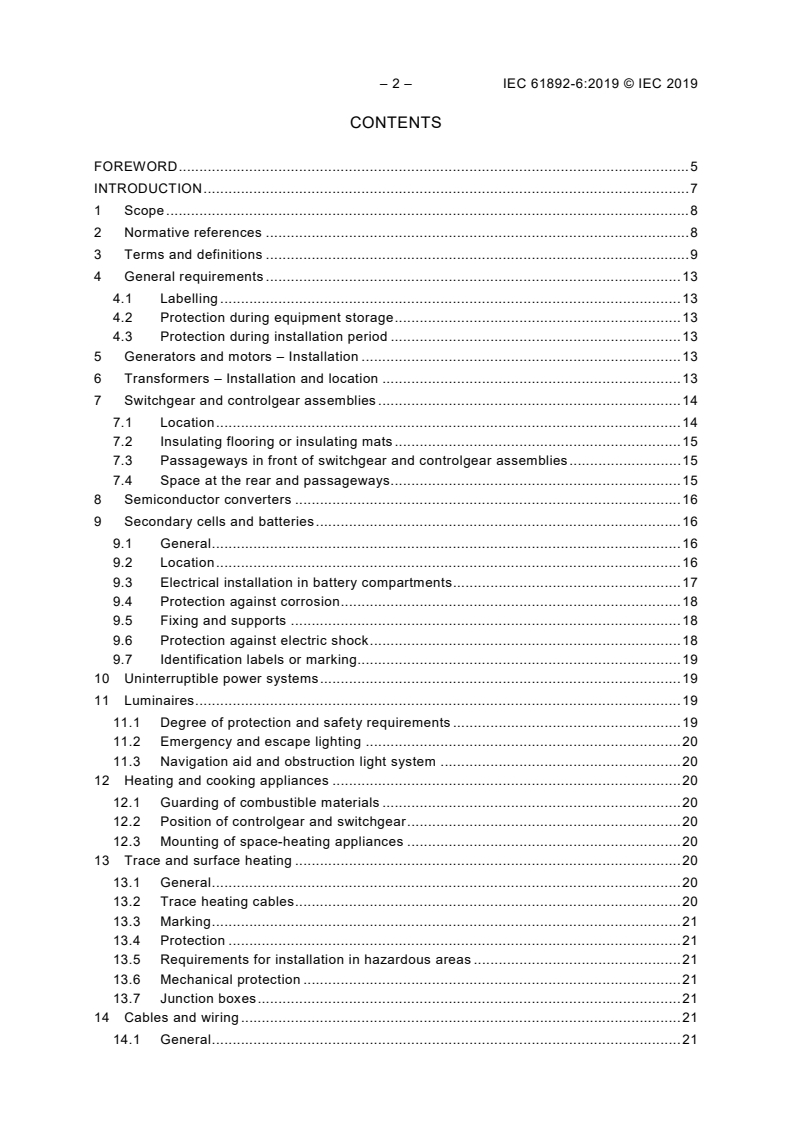
CONTENTS
FOREWORD . 5
INTRODUCTION . 7
1 Scope . 8
2 Normative references . 8
3 Terms and definitions . 9
4 General requirements . 13
4.1 Labelling . 13
4.2 Protection during equipment storage . 13
4.3 Protection during installation period . 13
5 Generators and motors – Installation . 13
6 Transformers – Installation and location . 13
7 Switchgear and controlgear assemblies . 14
7.1 Location . 14
7.2 Insulating flooring or insulating mats . 15
7.3 Passageways in front of switchgear and controlgear assemblies . 15
7.4 Space at the rear and passageways . 15
8 Semiconductor converters . 16
9 Secondary cells and batteries . 16
9.1 General . 16
9.2 Location . 16
9.3 Electrical installation in battery compartments . 17
9.4 Protection against corrosion . 18
9.5 Fixing and supports . 18
9.6 Protection against electric shock . 18
9.7 Identification labels or marking. 19
10 Uninterruptible power systems . 19
11 Luminaires . 19
11.1 Degree of protection and safety requirements . 19
11.2 Emergency and escape lighting . 20
11.3 Navigation aid and obstruction light system . 20
12 Heating and cooking appliances . 20
12.1 Guarding of combustible materials . 20
12.2 Position of controlgear and switchgear . 20
12.3 Mounting of space-heating appliances . 20
13 Trace and surface heating . 20
13.1 General . 20
13.2 Trace heating cables . 20
13.3 Marking . 21
13.4 Protection . 21
13.5 Requirements for installation in hazardous areas . 21
13.6 Mechanical protection . 21
13.7 Junction boxes . 21
14 Cables and wiring . 21
14.1 General . 21
14.2 Installation . 21
14.3 Cable runs . 23
14.4 Bending radius . 23
14.5 Cable cleating and strapping . 24
14.6 Splices and branch circuits . 25
14.7 Cable glands – Blanking and drain plugs. 25
14.8 Cable termination . 25
14.8.1 General . 25
14.8.2 Earthing of braid armour and electrostatic screen of instrument and
intrinsically safe cables . 27
14.9 Cable transit systems . 27
14.10 Cable ladders and trays . 28
15 Equipment earthing and bonding . 29
15.1 General . 29
15.2 Earthing of exposed-conductive-parts . 29
15.3 Equipotential bonding . 31
15.4 Bonding connections . 31
15.5 Connections to the unit structure. 31
15.6 Protection against galvanic corrosion . 32
15.7 Metal coverings of cables. 32
15.8 Cable racks and cable trays . 32
16 Lightning protection . 33
16.1 Primary lightning protection system. 33
16.2 Air terminals . 33
16.3 Secondary lightning protection system . 34
17 Communication . 34
18 Test of completed installation . 35
18.1 Inspections and tests . 35
18.2 Insulation testing instruments . 35
18.3 Insulation resistance . 36
18.3.1 Wiring . 36
18.3.2 Generators and motors . 36
18.3.3 Switchboards, section boards and distribution boards . 36
18.4 Generators . 37
18.5 Switchgear . 37
18.6 Lighting, heating and galley equipment . 37
18.7 Communication systems . 37
18.8 Emergency and safety systems . 37
18.9 Earthing . 38
18.10 Voltage drop . 38
18.11 Requirements of international conventions and regulations . 38
19 Documentation . 38
19.1 General . 38
19.2 Equipment . 38
19.3 Testing . 38
19.4 Maintenance . 39
Annex A (informative) Performance test . 40
A.1 General . 40
– 4 – IEC 61892-6:2019 © IEC 2019
A.2 Motor . 40
A.3 Statutory requirements . 40
A.4 Interference . 40
A.5 Batteries . 40
A.6 Ventilation of battery installations . 40
Annex B (informative) Examples of cable termination . 41
Bibliography . 45
Figure 1 – Recommended arrangement for installation of single-core cables – Flat
configuration . 22
Figure 2 – Recommended arrangement for installation of single-core cables – Trefoil
configuration . 22
Figure B.1 – Equipment with through gland . 41
Figure B.2 – Equipment where earthing is required – with Ex d braid armour clamping
gland . 42
Figure B.3 – Equipment where no earthing is required – with Ex d braid armour
clamping gland – Termination of instrument cable . 43
Figure B.4 – Equipment where earthing is required – Ex d braid armour clamping gland
– Termination of power cable . 44
Figure B.5 – Detail of heat shrink isolation between outer braid armour and
electrostatic screen . 44
Table 1 – Location of batteries versus charging power . 17
Table 2 – Bending radii for cables rated up to 1,8/3 kV . 24
Table 3 – Bending radii for cables rated at 3,6/6,0(7,2) kV and up to and including
18/30 kV . 24
Table 4 – Enclosure-gland type . 25
Table 5 – Sizes of earth continuity conductors and equipment earthing connections . 30
Table 6 – Test voltages . 36
INTERNATIONAL ELECTROTECHNICAL COMMISSION
____________
MOBILE AND FIXED OFFSHORE UNITS –
ELECTRICAL INSTALLATIONS –
Part 6: Installation
FOREWORD
1) The International Electrotechnical Commission (IEC) is a worldwide organization for standardization comprising
all national electrotechnical committees (IEC National Committees). The object of IEC is to promote
international co-operation on all questions concerning standardization in the electrical and electronic fields. To
this end and in addition to other activities, IEC publishes International Standards, Technical Specifications,
Technical Reports, Publicly Available Specifications (PAS) and Guides (hereafter referred to as "IEC
Publication(s)"). Their preparation is entrusted to technical committees; any IEC National Committee interested
in the subject dealt with may participate in this preparatory work. International, governmental and non-
governmental organizations liaising with the IEC also participate in this preparation. IEC collaborates closely
with the International Organization for Standardization (ISO) in accordance with conditions determined by
agreement between the two organizations.
2) The formal decisions or agreements of IEC on technical matters express, as nearly as possible, an international
consensus of opinion on the relevant subjects since each technical committee has representation from all
interested IEC National Committees.
3) IEC Publications have the form of recommendations for international use and are accepted by IEC National
Committees in that sense. While all reasonable efforts are made to ensure that the technical content of IEC
Publications is accurate, IEC cannot be held responsible for the way in which they are used or for any
misinterpretation by any end user.
4) In order to promote international uniformity, IEC National Committees undertake to apply IEC Publications
transparently to the maximum extent possible in their national and regional publications. Any divergence
between any IEC Publication and the corresponding national or regional publication shall be clearly indicated in
the latter.
5) IEC itself does not provide any attestation of conformity. Independent certification bodies provide conformity
assessment services and, in some areas, access to IEC marks of conformity. IEC is not responsible for any
services carried out by independent certification bodies.
6) All users should ensure that they have the latest edition of this publication.
7) No liability shall attach to IEC or its directors, employees, servants or agents including individual experts and
members of its technical committees and IEC National Committees for any personal injury, property damage or
other damage of any nature whatsoever, whether direct or indirect, or for costs (including legal fees) and
expenses arising out of the publication, use of, or reliance upon, this IEC Publication or any other IEC
Publications.
8) Attention is drawn to the Normative references cited in this publication. Use of the referenced publications is
indispensable for the correct application of this publication.
9) Attention is drawn to the possibility that some of the elements of this IEC Publication may be the subject of
patent rights. IEC shall not be held responsible for identifying any or all such patent rights.
International Standard IEC 61892-6 has been prepared by IEC technical committee 18:
Electrical installations of ships and of mobile and fixed offshore units.
This fourth edition cancels and replaces the third edition published in 2013. This edition
constitutes a technical revision.
This edition includes the following significant technical changes with respect to the previous
edition:
a) requirements for protection during equipment storage have been added;
b) the special requirements for distribution board enclosures in accommodation spaces have
been deleted;
c) requirements for installation of UPS have been updated;
d) requirements regarding the installation of batteries have been modified;
– 6 – IEC 61892-6:2019 © IEC 2019
e) requirements for large single-core cables for three-phase AC have been updated;
f) requirements in relation to cable transit systems have been added;
g) the table on the sizes of earth continuity conductors and equipment earthing connections,
set out in IEC 61892-4:2007, has been included;
h) requirements as to the installation of controls and instrumentation have been modified;
clauses relevant to design and equipment have been deleted.
The text of this International Standard is based on the following documents:
FDIS Report on voting
18/1654/FDIS 18/1663/RVD
Full information on the voting for the approval of this International Standard can be found in
the report on voting indicated in the above table.
This document has been drafted in accordance with the ISO/IEC Directives, Part 2.
A list of all parts in the IEC 61892 series, published under the general title Mobile and fixed
offshore units – Electrical installations, can be found on the IEC website.
The committee has decided that the contents of this document will remain unchanged until the
stability date indicated on the IEC website under "http://webstore.iec.ch" in the data related to
the specific document. At this date, the document will be
• reconfirmed,
• withdrawn,
• replaced by a revised edition, or
• amended.
INTRODUCTION
IEC 61892 forms a series of International Standards for safety in the design, selection,
installation, maintenance and use of electrical equipment for the generation, transmission,
storage, distribution and utilization of electrical energy for all purposes in offshore units which
are used for the purpose of exploration or exploitation of petroleum resources.
This part of IEC 61892 incorporates and coordinates, as far as possible, existing rules and
forms a code of interpretation, where applicable, of the requirements of the International
Maritime Organization (IMO), and constitutes a guide for future regulations which may be
prepared and a statement of practice for offshore unit owners, designers, installers and
appropriate organizations.
This document is based on solutions and methods which are in current use, but it is not
intended to impede development of new or improved techniques.
In this revision, voltage limitations have been removed. However, voltage limitations may be
given in the referenced equipment standards. The removal of voltage limitations is considered
necessary due to interconnection of, and supply from shore to offshore units. In such cases,
transmission voltages up to 132 kV AC and 150 kV DC are used and higher voltages are
being planned.
The IEC 61892 series aims to constitute a set of International Standards for the offshore
petroleum industry, but it is not intended to prevent their use beyond petroleum installations.
– 8 – IEC 61892-6:2019 © IEC 2019
MOBILE AND FIXED OFFSHORE UNITS –
ELECTRICAL INSTALLATIONS –
Part 6: Installation
1 Scope
This part of IEC 61892 provides specific requirements for the installation of electrical
equipment in mobile and fixed offshore units, including pipeline, pumping or "pigging"
stations, compressor stations and single buoy moorings, used in the offshore petroleum
industry for drilling, production, accommodation, processing, storage and offloading purposes.
It applies to all installations, whether permanent, temporary, transportable or hand-held, to AC
installations and DC installations without any voltage level limitation. Referenced equipment
standards may give voltage level limitations.
This document specifies requirements such as those concerning
– protection during equipment storage and in the installation period,
– installation of generators and motors,
– installation of transformers,
– installation of switchgear and controlgear assemblies,
– installation of semiconductor converters and UPS,
– installation of secondary cells and batteries,
– installation of luminaires,
– installation of heating and cooking appliances,
– installation of trace and surface heating,
– installation of cables and wiring, both low-voltage and high-voltage cables,
– requirements in relation to earthing and bonding,
– lightning protection;,
– testing of completed installation, and
– documentation.
This document does not apply to
– fixed equipment for medical purposes,
– electrical installations of tankers, and
– control of ignition sources other than those created by electrical equipment.
NOTE 1 For medical rooms, IEC 60364-7-710 provides specific requirements. Requirements for tankers are given
in IEC 60092-502.
NOTE 2 Guidance on protection of non-electrical equipment can be found in ISO 80079-36, ISO 80079-37 and
IMO 2009 MODU Code, 6.7.
2 Normative references
The following documents are referred to in the text in such a way that some or all of their
content constitutes requirements of this document. For dated references, only the edition
cited applies. For undated references, the latest edition of the referenced document (including
any amendments) applies.
IEC 60092-350:2014, Electrical installations in ships – Part 350: General construction and test
methods of power, control and instrumentation cables for shipboard and offshore applications
IEC 60623, Secondary cells and batteries containing alkaline or other non-acid electrolytes –
Vented nickel-cadmium prismatic rechargeable single cells
IEC 60825-2, Safety of laser products – Part 2: Safety of optical fibre communication systems
(OFCS)
IEC 60825-12, Safety of laser products – Part 12: Safety of free space optical communication
systems used for transmission of information
IEC 60896-11, Stationary lead-acid batteries – Part 11: Vented types – General requirements
and methods of tests
IEC 61892-1:2019, Mobile and fixed offshore units – Electrical installations – Part 1: General
requirements and conditions
IEC 61892-3:2019, Mobile and fixed offshore units – Electrical installations – Part 3:
Equipment
IEC 61892-7:2019, Mobile and fixed offshore units – Electrical installations – Part 7:
Hazardous areas
IEC 61914, Cable cleats for electrical installations
IEC 62305-3:2010, Protection against lightning – Part 3: Physical damage to structures and
life hazard
IEC 62485-2:2010, Safety requirements for secondary batteries and battery installations –
Part 2: Stationary batteries
IMO, 2009 MODU Code, Code for the Construction and Equipment of Mobile Offshore Drilling
Units, 2009, 2010 edition
3 Terms and definitions
For the purposes of this document, the terms and definitions given in IEC 61892-1 and the
following apply.
ISO and IEC maintain terminological databases for use in standardization at the following
addresses:
• IEC Electropedia: available at http://www.electropedia.org/
• ISO Online browsing platform: available at http://www.iso.org/obp
3.1
braid armour
covering formed from braided metal wires used to protect a cable from external mechanical
effects
[SOURCE: IEC 60092-350:2014, 3.3, modified – The notes to entry have been deleted.]
– 10 – IEC 61892-6:2019 © IEC 2019
3.2
armour
covering consisting of metal tape(s) or wires, generally used to protect the cable from external
mechanical effects
[SOURCE: IEC 60050-461:2008, 461-05-06]
3.3
electrostatic screen
electrostatic shield (North America)
earthed metallic layer surrounding a cable which confines the electric field generated by the
cable within the cable cores, pair(s), triple(s) or quad(s), and/or protects the core(s), pair(s),
triple(s) or quad(s) from external influence
Note 1 to entry: Metallic sheaths, foils, braids, armours and earthed concentric conductors may also serve as an
electrostatic screen, provided they are effectively earthed.
[SOURCE: IEC 60092-350:2014, 3.9, modified – In the note to entry, the word "grounded" has
been deleted.]
3.4
insulation screen
electrical screen of non-metallic semi-conducting layer in combination with a metallic layer
[SOURCE: IEC 60092-350:2014, 3.18, modified – The second preferred term "core screen"
has been omitted.]
3.5
battery compartment
compartment comprising dedicated rooms, dedicated cabinets and dedicated boxes for
installation of batteries
3.6
battery crate
container with frame walls for holding several cells or batteries
[SOURCE: IEC 60050-482:2004, 482-05-10]
3.7
battery tray
container with a base and walls for holding several cells or batteries
[SOURCE: IEC 60050-482:2004, 482-02-35]
3.8
battery rack
support, stand or grating with one or more levels or tiers for the installation of cells or
mono-bloc containers in a stationary battery
[SOURCE: IEC 60050-482:2004, 482-05-24]
3.9
equipotential bonding
provision of electric connections between conductive parts, intended to achieve
equipotentiality
[SOURCE: IEC 60050-195:1998, 195-01-10]
3.10
cable tray system
cable ladder system
assembly of cable supports consisting of cable tray lengths or cable ladder lengths and other
system components
[SOURCE: IEC 61537:2006, 3.1]
3.11
surface heating
trace heating
utilization of electric trace heater cables, pads, panels and support components, externally
applied and used to raise or maintain the temperature of contents in piping, tanks and
associated equipment
[SOURCE: IEC 60050-426:2008, 426-20-39, modified – The preferred term "surface heating"
has been added.]
3.12
exposed-conductive-part
conductive part which can readily be touched and which is not normally alive, but which may
become alive under fault conditions
Note 1 to entry: Typical exposed-conductive-parts are walls of enclosures, operating handles, etc.
[SOURCE: IEC 60050-441:2000, 441-11-1, modified – Hyphens have been added to the
term.]
3.13
extraneous-conductive-part
conductive part not forming a part of the electrical installation and liable to introduce an
electric potential, generally the electric potential of a local earth
[SOURCE: IEC 60050-195:1998, 195-06-11]
3.14
extra-low voltage
ELV
voltage which does not exceed 50 V AC RMS or 120 V DC between conductors, or between
any conductor and earth.
Note 1 to entry: Information about protection by extra-low voltage is given in IEC 60364-4-41.
3.15
PELV
PELV system
electric system in which the voltage cannot exceed the value of extra-low voltage:
– under normal conditions and
– under single fault conditions, except earth faults in other electric circuits
Note 1 to entry: PELV is the abbreviation for protective extra-low voltage.
[SOURCE: IEC 60050-826:2004: 826-12-32, modified – The abbreviated term "PELV" has
been added.]
– 12 – IEC 61892-6:2019 © IEC 2019
3.16
SELV
SELV system
electric system in which the voltage cannot exceed the value of extra-low voltage:
– under normal conditions and
– under single fault conditions, including earth faults in other electric circuits
Note 1 to entry: SELV is the abbreviation for safety extra-low voltage.
[SOURCE: IEC 60050-826:2004: 826-12-31, modified – The abbreviated term "SELV" has
been added.]
3.17
sealed cell
cell which remains closed and does not release either gas or liquid when operated within the
limits specified by the manufacturer
Note 1 to entry: A sealed cell may be equipped with a safety device to prevent a dangerously high internal
pressure and is designed to operate during its life in its original sealed state.
[SOURCE: IEC 60050-482:2004, 482-05-17]
3.18
support device
system component designed to provide mechanical support and which may limit movement of
a cable runway
[SOURCE: IEC 61537:2006, 3.7, modified – The note to entry has been omitted.]
3.19
system component
part used within the system: cable tray length or cable ladder length, cable tray fitting or cable
ladder fitting, support device, mounting device and system accessory
Note 1 to entry: System components may not necessarily be included together in a system. Different
combinations of system components may be used.
[SOURCE: IEC 61537:2006, 3.2]
3.20
uninterruptible power system
UPS
combination of convertors, switches and energy storage devices (such as batteries),
constituting a power system for maintaining continuity of load power in case of input power
failure
[SOURCE: IEC 62040-1:2017, 3.101, modified – The note to entry has been deleted.]
3.21
VRLA
valve regulated lead acid battery
secondary battery in which cells are closed but have a valve which allows the escape of gas if
the internal pressure exceeds a predetermined value
Note 1 to entry: The cell or battery cannot normally receive additions to the electrolyte.
Note 2 to entry: This note applies to the French language only.
[SOURCE: IEC 60050-482:2004, 482-05-15, modified – A second note to entry has been
added.]
3.22
vented cell
secondary cell having a cover provided with an opening through which products of electrolysis
and evaporation are allowed to escape freely from the cell to the atmosphere
[SOURCE: IEC 60050-482:2004, 482-05-14]
4 General requirements
4.1 Labelling
Each control panel, subpanel, indicating instrument, control handle, alarm, signal lamp,
recording instrument, etc. shall be clearly and systematically identified by means of self-
explanatory and unambiguous labels. Equipment marking/labelling shall be found in the
relevant documentation for the electrical installation.
Regarding requirements for labelling and labels, see IEC 61892-3:2019, 4.5.
4.2 Protection during equipment storage
Where the installation phase requires storage of equipment and materials, instructions
contained in the supplier's documentation shall be followed to avoid damage or deterioration
of equipment or materials.
Particular attention should be given to the storage of batteries in order to preserve their
service lifetime, or the batteries should be purchased and fitted shortly before tow out.
4.3 Protection during installation period
Electrical equipment shall be well protected during the installation period to prevent damage
from welding, painting and similar injurious operations. If the installation phase forecasts a
long-time schedule, appropriate protection against damage due to weather conditions shall be
provided.
After activation, batteries should be kept float charged and under controlled ambient
temperature limits to avoid battery life impairment.
5 Generators and motors – Installation
Generators and large motors should, where practicable, be installed to minimise the effects
from the motion of the mobile unit or floating unit (see IEC 61892-5). For manned units,
generators and motors shall, where practicable, be installed to minimise the impact of noise
and vibration within the living quarters.
Regarding requirements as to layout planning, see IEC 61892-1:2019, 4.9.
Regarding requirements for lubrication, see IEC 61892-3, and for mobile units see also
IEC 61892-5.
6 Transformers – Installation and location
6.1 Transformers shall be installed in sufficiently ventilated compartments, accessible only
to authorized personnel. The one exception to this rule is that air-cooled transformers
– 14 – IEC 61892-6:2019 © IEC 2019
provided with means of protection against accidental contact with live parts need not be
installed in special compartments.
Transformers may be installed outdoors provided the transformer has a suitable IP degree of
protection.
Regarding requirements as to layout planning, see IEC 61892-1:2019, 4.9.
Regarding types of transformers, see IEC 61892-3.
6.2 Use of vibration dampers should be evaluated to ensure that transformers do not cause
unwanted vibration and noise to their surroundings.
NOTE Requirements as to vibration levels in various areas are given in ISO 2631-1.
6.3 Liquid-immersed transformers shall be installed in an area with provisions for
containment and drainage of liquid leakage. Consideration shall be given to the need for fire
detection and extinguishing equipment and thermal and structural class A subdivision for
liquid-immersed transformer installations.
6.4 Suitable arrangements shall be provided for cooling and containing all the liquid which
might escape from a damaged tank.
6.5 Transformers and their connections shall be protected against such mechanical
damage, condensation and corrosion as may reasonably be expected.
6.6 Where liquid cooling is used, consideration shall be given to the provision of a device
capable of detecting leakage into the enclosure and provision of an alarm signal in either
primary or secondary cooling circuit, as relevant. In addition, the forced flow of liquid coolant
shall be monitored in order to operate an alarm in the event of a loss of flow.
A receiving tank shall be provided underneath the transformers and shall be connected to the
open drain system.
The receiving tank may be common to several transformers.
The receiving tank capacity should not be less than 100 % of the volume of liquid of the
transformer, or of the largest transformer in case of a common tank.
Where forced cooling is used, it shall be possible to operate the transformer at reduced power
on failure of a pump or fan. Consideration shall be given to the provision of a suitable
temperature indicator and alarm facilities.
7 Switchgear and controlgear assemblies
7.1 Location
7.1.1 Switchgear and controlgear assemblies shall be installed in easily accessible and
well-ventilated locations where high humidity, combustible gases, acid vapours or similar are
not present, and shall be located well clear of heat sources such as boilers, heated oil tanks,
steam exhaust pipes or other heated pipes.
Power distribution switchgear assemblies shall have enough free space above to allow hot
gas expansion from the arc generated by short-circuit or circuit-breaker opening, according to
the manufacturer's recommendations. In this space, the installation of HVAC ducts, cable
ladders and any other obstructions shall be avoided.
In addition to complying with the appropriate requirements of IEC 61892-3, all switchgear and
controlgear assemblies shall be installed in such a way that no pipes or tanks are located
above them within the same space or at their rear. Where this is unavoidable, pipes shall be
continuous and without openings, flanged joints, valves or other accessories in such
locations. In addition, a drip pan shall be installed for the protection of the switchgear and
controlgear.
7.1.2 Where switchgear and controlgear assemblies are located in dedicated rooms, only
piping and integrated heat exchangers needed for operation of the electrical equipment
should be installed in the switchgear room. If pipes have to be run adjacent to electrical
equipment, there shall be no joints in the immediate vicinity of the electrical equipment. The
piping shall be arranged to minimise the risk of leakage, which may have a detrimental effect
on other equipment in the room.
7.1.3 Doors to electrical rooms shall be lockable. They shall open outwards from the room.
If required by the appropriate authority, the doors to high-voltage rooms shall be equipped
with a manual panic bar device.
Doors to electrical rooms shall be marked with suitable warning signs.
7.2 Insulating flooring
...