

IEC 61892-6:2007
(Main)Mobile and fixed offshore units - Electrical installations - Part 6: Installation
General Information
- Abstract
This part of IEC 61892 contains provisions for electrical installation in mobile and fixed offshore units including pipeline, pumping or 'pigging' stations, compressor stations and exposed location single buoy moorings, used in the offshore petroleum industry for drilling, processing and for storage purposes. This edition includes the following significant technical changes with respect to the previous edition: a) clauses regarding installation of cables have been added; b) the clause regarding secondary cells and batteries have been modified to give requirements also to installation of valve regulated (VRLA) type batteries; c) an informative annex regarding testing of installation has been added.
- Status
- Published
- Publication Date
- 20-Nov-2007
- Current Stage
- DELPUB - Deleted Publication
- Start Date
- 13-Dec-2013
- Completion Date
- 28-Aug-2026

Overview
IEC 61892-6:2007 - "Mobile and fixed offshore units - Electrical installations - Part 6: Installation" provides installation requirements for electrical systems used in offshore petroleum operations. It applies to mobile and fixed offshore units including pipeline, pumping or pigging stations, compressor stations and exposed single buoy moorings used for drilling, processing and storage. Edition 2.0 (2007-11) introduces significant updates including new clauses on cable installation, additional requirements for valve regulated lead acid (VRLA) batteries, and an informative annex on testing of completed installations.
Key topics
The standard addresses practical installation and safety measures across the electrical installation lifecycle. Main technical topics include:
- Earthing and bonding: equipotential bonding, connections to structure, protection against galvanic corrosion and sizing of protective-earthing conductors.
- Cables and wiring: routing, cable-runs, cleating/strapping, terminations, joints, cable ladders and trays.
- Generators, motors and transformers: installation, location and winding isolation requirements.
- Switchgear and controlgear: siting, clearances, insulating mats and access/egress provisions.
- Secondary cells and batteries: location, access, circuit protection and specific requirements for VRLA batteries.
- Lighting, heating and galley appliances: degrees of protection, emergency lighting and mounting.
- Control, instrumentation and communications: layout, labelling, sensor placement, protection against leakage/condensation.
- Lightning protection: air terminals, down conductors and secondary damage prevention.
- Testing and documentation: inspections, insulation testing, performance tests (informative annex) and maintenance records.
Applications
IEC 61892-6 is used to ensure safe, reliable and compliant electrical installations on offshore units. Typical applications:
- Design and installation of power distribution systems on oil & gas platforms and FPSOs
- Installation and routing of power/instrumentation cables, cable trays and gland arrangements
- Battery room installations and selection of charging/protection measures for VRLA batteries
- Commissioning tests, insulation verification and documentation before handover
- Ensuring lightning protection and bonding to reduce corrosion and fault risks
Who uses this standard
- Offshore electrical engineers and designers
- Installation contractors and shipyards
- Commissioning and testing teams
- Maintenance and operations personnel on platforms and single buoy moorings
- Regulatory bodies, classification societies and safety auditors
Related standards
- Other parts of the IEC 61892 series covering equipment, systems and specific electrical requirements for offshore units
- National offshore electrical codes and classification society rules (used in conjunction with IEC requirements)
Practical takeaway: IEC 61892-6:2007 is a hands-on installation standard focused on safe cable installation, earthing/bonding, battery installations (including VRLA), and systematic testing and documentation to support compliant offshore electrical systems.
Relations
- Revises
IEC 61892-6:1999 - Mobile and fixed offshore units - Electrical installations - Part 6: Installation - Effective Date
- 05-Sep-2023
- Revised
IEC 61892-6:2013 - Mobile and fixed offshore units - Electrical installations - Part 6: Installation - Effective Date
- 05-Sep-2023
Get Certified
Connect with accredited certification bodies for this standard

DNV
DNV is an independent assurance and risk management provider.

Lloyd's Register
Lloyd's Register is a global professional services organisation specialising in engineering and technology.

FSC International
Forest Stewardship Council certification.
Sponsored listings
Frequently Asked Questions
IEC 61892-6:2007 is a standard published by the International Electrotechnical Commission (IEC). Its full title is "Mobile and fixed offshore units - Electrical installations - Part 6: Installation". This standard covers: This part of IEC 61892 contains provisions for electrical installation in mobile and fixed offshore units including pipeline, pumping or 'pigging' stations, compressor stations and exposed location single buoy moorings, used in the offshore petroleum industry for drilling, processing and for storage purposes. This edition includes the following significant technical changes with respect to the previous edition: a) clauses regarding installation of cables have been added; b) the clause regarding secondary cells and batteries have been modified to give requirements also to installation of valve regulated (VRLA) type batteries; c) an informative annex regarding testing of installation has been added.
This part of IEC 61892 contains provisions for electrical installation in mobile and fixed offshore units including pipeline, pumping or 'pigging' stations, compressor stations and exposed location single buoy moorings, used in the offshore petroleum industry for drilling, processing and for storage purposes. This edition includes the following significant technical changes with respect to the previous edition: a) clauses regarding installation of cables have been added; b) the clause regarding secondary cells and batteries have been modified to give requirements also to installation of valve regulated (VRLA) type batteries; c) an informative annex regarding testing of installation has been added.
IEC 61892-6:2007 is classified under the following ICS (International Classification for Standards) categories: 29.260.99 - Other electrical equipment for working in special conditions; 47.020.60 - Electrical equipment of ships and of marine structures. The ICS classification helps identify the subject area and facilitates finding related standards.
IEC 61892-6:2007 has the following relationships with other standards: It is inter standard links to IEC 61892-6:1999, IEC 61892-6:2013. Understanding these relationships helps ensure you are using the most current and applicable version of the standard.
IEC 61892-6:2007 is available in PDF format for immediate download after purchase. The document can be added to your cart and obtained through the secure checkout process. Digital delivery ensures instant access to the complete standard document.
Standards Content (Sample)
IEC 61892-6
Edition 2.0 2007-11
INTERNATIONAL
STANDARD
Mobile and fixed offshore units – Electrical installations –
Part 6: Installation
All rights reserved. Unless otherwise specified, no part of this publication may be reproduced or utilized in any form
or by any means, electronic or mechanical, including photocopying and microfilm, without permission in writing from
either IEC or IEC's member National Committee in the country of the requester.
If you have any questions about IEC copyright or have an enquiry about obtaining additional rights to this publication,
please contact the address below or your local IEC member National Committee for further information.
IEC Central Office
3, rue de Varembé
CH-1211 Geneva 20
Switzerland
Email: inmail@iec.ch
Web: www.iec.ch
About the IEC
The International Electrotechnical Commission (IEC) is the leading global organization that prepares and publishes
International Standards for all electrical, electronic and related technologies.
About IEC publications
The technical content of IEC publications is kept under constant review by the IEC. Please make sure that you have the
latest edition, a corrigenda or an amendment might have been published.
ƒ Catalogue of IEC publications: www.iec.ch/searchpub
The IEC on-line Catalogue enables you to search by a variety of criteria (reference number, text, technical committee,…).
It also gives information on projects, withdrawn and replaced publications.
ƒ IEC Just Published: www.iec.ch/online_news/justpub
Stay up to date on all new IEC publications. Just Published details twice a month all new publications released. Available
on-line and also by email.
ƒ Electropedia: www.electropedia.org
The world's leading online dictionary of electronic and electrical terms containing more than 20 000 terms and definitions
in English and French, with equivalent terms in additional languages. Also known as the International Electrotechnical
Vocabulary online.
ƒ Customer Service Centre: www.iec.ch/webstore/custserv
If you wish to give us your feedback on this publication or need further assistance, please visit the Customer Service
Centre FAQ or contact us:
Email: csc@iec.ch
Tel.: +41 22 919 02 11
Fax: +41 22 919 03 00
IEC 61892-6
Edition 2.0 2007-11
INTERNATIONAL
STANDARD
Mobile and fixed offshore units – Electrical installations –
Part 6: Installation
INTERNATIONAL
ELECTROTECHNICAL
COMMISSION
PRICE CODE
W
ICS 29.260.99; 47.020.60 ISBN 2-8318-9392-5
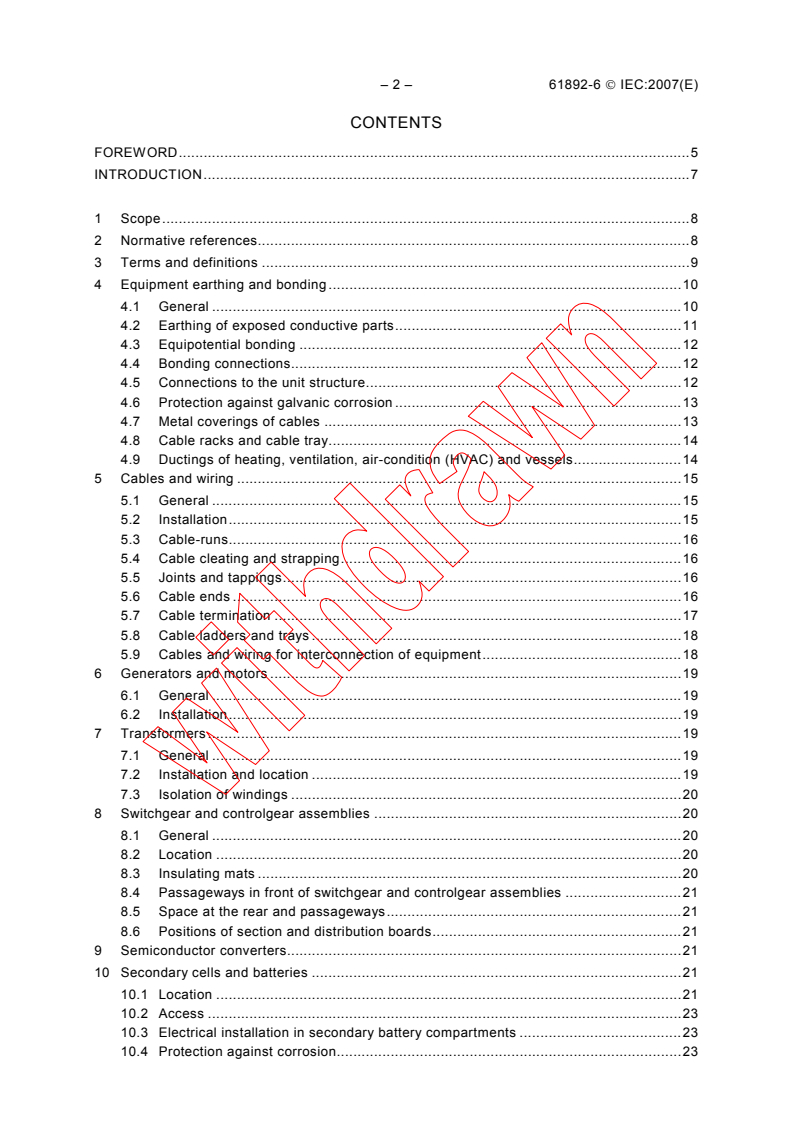
– 2 – 61892-6 © IEC:2007(E)
CONTENTS
FOREWORD.5
INTRODUCTION.7
1 Scope.8
2 Normative references.8
3 Terms and definitions .9
4 Equipment earthing and bonding .10
4.1 General .10
4.2 Earthing of exposed conductive parts.11
4.3 Equipotential bonding .12
4.4 Bonding connections.12
4.5 Connections to the unit structure.12
4.6 Protection against galvanic corrosion .13
4.7 Metal coverings of cables .13
4.8 Cable racks and cable tray.14
4.9 Ductings of heating, ventilation, air-condition (HVAC) and vessels.14
5 Cables and wiring .15
5.1 General .15
5.2 Installation.15
5.3 Cable-runs.16
5.4 Cable cleating and strapping.16
5.5 Joints and tappings.16
5.6 Cable ends .16
5.7 Cable termination .17
5.8 Cable ladders and trays .18
5.9 Cables and wiring for interconnection of equipment.18
6 Generators and motors .19
6.1 General .19
6.2 Installation.19
7 Transformers.19
7.1 General .19
7.2 Installation and location .19
7.3 Isolation of windings .20
8 Switchgear and controlgear assemblies .20
8.1 General .20
8.2 Location .20
8.3 Insulating mats .20
8.4 Passageways in front of switchgear and controlgear assemblies .21
8.5 Space at the rear and passageways.21
8.6 Positions of section and distribution boards.21
9 Semiconductor converters.21
10 Secondary cells and batteries .21
10.1 Location .21
10.2 Access .23
10.3 Electrical installation in secondary battery compartments .23
10.4 Protection against corrosion.23
61892-6 © IEC:2007(E) – 3 –
10.5 Fixing and supports .23
10.6 Protection of circuits from secondary batteries .23
10.7 Additional requirements for valve regulated lead acid (VRLA) type batteries .24
10.8 Protection against electric shock.24
10.9 Identification labels or marking .24
11 Luminaires.25
11.1 General .25
11.2 Degree of protection and safety requirements .25
11.3 Discharge lighting of voltage above 250 V.25
11.4 Emergency and escape lighting.25
11.5 Navigation aid system.25
12 Heating and cooking appliances.26
12.1 Guarding of combustible materials .26
12.2 Position of controlgear and switchgear .26
12.3 Mounting of space-heating appliances .26
13 Trace and surface heating .26
13.1 General .26
13.2 Trace heating cables .26
13.3 Marking .27
13.4 Protection.27
13.5 Requirements for installation in hazardous areas .27
13.6 Mechanical protection.27
13.7 Junction boxes .27
14 Control and instrumentation .27
14.1 General .27
14.2 Layout .27
14.3 Labelling.27
14.4 Labels .28
14.5 Display colours .28
14.6 Protection against fluid leakage .28
14.7 Protection from condensation.28
14.8 Protection during installation period .28
14.9 Sensors.28
14.9.1 Location of sensors.28
14.9.2 Temperature sensors.28
14.9.3 Pressure sensors.28
14.9.4 Enclosure .28
14.9.5 Testing and calibration.29
14.10 Measurements and indications.29
14.10.1 Instrument similarity .29
14.10.2 Direction of scale values.29
14.10.3 Scale division .29
14.10.4 Automatic control sequence.29
14.10.5 Centralized control.29
14.11 Controls.29
14.11.1 Direction of motion .29
14.11.2 Control levers .29
14.11.3 Identification.30
– 4 – 61892-6 © IEC:2007(E)
14.12 Alarm system.30
15 Communication.30
16 Lightning protection .30
16.1 General .30
16.2 Protection against primary structural damage.30
16.3 Air terminals .31
16.4 Down conductors .31
16.5 Protection against secondary damage.31
17 Test of completed installation.32
17.1 General .32
17.2 Inspections and tests .32
17.3 Insulation-testing instruments .32
17.4 Insulation resistance.33
17.4.1 Wiring.33
17.4.2 Generators and motors .33
17.4.3 Switchboards, section boards and distribution boards.33
17.5 Generators .34
17.6 Switchgear .34
17.7 Lighting, heating and galley equipment.34
17.8 Communication systems .34
17.9 Emergency and safety systems.34
17.10 Earthing.34
17.11 Voltage drop.34
17.12 Requirements of International Convention and regulations .34
18 Documentation .35
18.1 General .35
18.2 Equipment .35
18.3 Testing .35
18.4 Maintenance.35
Annex A (informative) Performance test .36
Bibliography .38
Table 1 – Sizes of protective-earthing (PE) conductors and earthing connections.14
Table 2 – Enclosure-gland type .17
Table 3 – Location of batteries versus charging current .22
Table 4 – Test voltages .33
61892-6 © IEC:2007(E) – 5 –
INTERNATIONAL ELECTROTECHNICAL COMMISSION
_____________
MOBILE AND FIXED OFFSHORE UNITS –
ELECTRICAL INSTALLATIONS –
Part 6: Installation
FOREWORD
1) The International Electrotechnical Commission (IEC) is a worldwide organization for standardization comprising
all national electrotechnical committees (IEC National Committees). The object of IEC is to promote
international co-operation on all questions concerning standardization in the electrical and electronic fields. To
this end and in addition to other activities, IEC publishes International Standards, Technical Specifications,
Technical Reports, Publicly Available Specifications (PAS) and Guides (hereafter referred to as “IEC
Publication(s)”). Their preparation is entrusted to technical committees; any IEC National Committee interested
in the subject dealt with may participate in this preparatory work. International, governmental and non-
governmental organizations liaising with the IEC also participate in this preparation. IEC collaborates closely
with the International Organization for Standardization (ISO) in accordance with conditions determined by
agreement between the two organizations.
2) The formal decisions or agreements of IEC on technical matters express, as nearly as possible, an international
consensus of opinion on the relevant subjects since each technical committee has representation from all
interested IEC National Committees.
3) IEC Publications have the form of recommendations for international use and are accepted by IEC National
Committees in that sense. While all reasonable efforts are made to ensure that the technical content of IEC
Publications is accurate, IEC cannot be held responsible for the way in which they are used or for any
misinterpretation by any end user.
4) In order to promote international uniformity, IEC National Committees undertake to apply IEC Publications
transparently to the maximum extent possible in their national and regional publications. Any divergence
between any IEC Publication and the corresponding national or regional publication shall be clearly indicated in
the latter.
5) IEC provides no marking procedure to indicate its approval and cannot be rendered responsible for any
equipment declared to be in conformity with an IEC Publication.
6) All users should ensure that they have the latest edition of this publication.
7) No liability shall attach to IEC or its directors, employees, servants or agents including individual experts and
members of its technical committees and IEC National Committees for any personal injury, property damage or
other damage of any nature whatsoever, whether direct or indirect, or for costs (including legal fees) and
expenses arising out of the publication, use of, or reliance upon, this IEC Publication or any other IEC
Publications.
8) Attention is drawn to the Normative references cited in this publication. Use of the referenced publications is
indispensable for the correct application of this publication.
9) Attention is drawn to the possibility that some of the elements of this IEC Publication may be the subject of
patent rights. IEC shall not be held responsible for identifying any or all such patent rights.
International Standard IEC 61892-6 has been prepared by IEC technical committee 18:
Electrical installations of ships and of mobile and fixed offshore units.
This second edition cancels and replaces the first edition published in 1999. This edition
constitutes a technical revision.
This edition includes the following significant technical changes with respect to the previous
edition:
a) clauses regarding installation of cables have been added;
b) the clause regarding secondary cells and batteries have been modified to give requirements
also to installation of valve regulated (VRLA) type batteries;
c) an informative annex regarding testing of installation has been added.
– 6 – 61892-6 © IEC:2007(E)
The text of this standard is based on the following documents:
FDIS Report on voting
18/1065/FDIS 18/1071/RVD
Full information on the voting for the approval of this standard can be found in the report on
voting indicated in the above table.
This publication has been drafted in accordance with the ISO/IEC Directives, Part 2.
A list of all parts of the IEC 61892 series, under the general title Mobile and fixed offshore
units – Electrical installations, can be found on the IEC website.
The committee has decided that the contents of this publication will remain unchanged until the
maintenance result date indicated on the IEC web site under "http://webstore.iec.ch" in the data
related to the specific publication. At this date, the publication will be
• reconfirmed;
• withdrawn;
• replaced by a revised edition, or
• amended.
A bilingual version of this publication may be issued at a later date.
61892-6 © IEC:2007(E) – 7 –
INTRODUCTION
IEC 61892 forms a series of International Standards intended to ensure safety in the design,
selection, installation, maintenance and use of electrical equipment for the generation, storage,
distribution and utilization of electrical energy for all purposes in offshore units which are used
for the exploration or exploitation of petroleum resources.
This part of IEC 61892 also incorporates and co-ordinates, as far as possible, existing rules
and forms a code of interpretation, where applicable, of the requirements laid down by the
International Maritime Organization, and constitutes a guide for future regulations which may
be prepared and a statement of practice for offshore unit owners, constructors and appropriate
organizations.
This standard is based on equipment and practices which are in current use, but it is not
intended in any way to impede development of new or improved techniques.
The ultimate aim has been to produce a set of International Standards exclusively for the
offshore petroleum industry.
– 8 – 61892-6 © IEC:2007(E)
MOBILE AND FIXED OFFSHORE UNITS –
ELECTRICAL INSTALLATIONS –
Part 6: Installation
1 Scope
This part of IEC 61892 contains provisions for electrical installation in mobile and fixed offshore
units including pipeline, pumping or 'pigging' stations, compressor stations and exposed
location single buoy moorings, used in the offshore petroleum industry for drilling, processing
and for storage purposes.
It applies to all installations, whether permanent, temporary, transportable or hand-held, to a.c.
installations up to and including 35 000 V and d.c. installations up to and including 750 V (a.c.
and d.c. voltages are nominal values).
This standard does not apply to electrical installations in rooms used for medical purposes, or
in tankers.
2 Normative references
The following referenced documents are indispensable for the application of this document. For
dated references, only the edition cited applies. For undated references, the latest edition of
the referenced document (including any amendments) applies.
IEC 60079-14:2002, Electrical apparatus for explosive gas atmospheres – Part 14: Electrical
installations in hazardous areas (other than mines)
IEC 60447:2004, Basic and safety principles for man-machine interface – Actuating principles
IEC 60502-1:2004, Power cables with extruded insulation and their accessories for rated
voltages from 1 kV (U = 1,2 kV) up to 30 kV (U = 36 kV) – Part 1: Cables for rated voltages
m m
of 1 kV (U =1,2 kV) up to 3 kV (U = 3,6 kV)
m m
IEC 60502-2:2005, Power cables with extruded insulation and their accessories for rated
voltages from 1 kV (U =1.2 kV) up to 30 kV (U = 36 kV) – Part 2: Cables for rated voltages
m m
from 6 kV (U = 7,2 kV) up to 30 kV (U = 36 kV)
m m
IEC 60623:2001, Secondary cells and batteries containing alkaline or other non-acid
electrolytes – Vented nickel-cadmium prismatic rechargeable single cells
IEC 60825 (all parts), Safety of laser products
IEC 60896-11:2002, Stationary lead-acid batteries – Part 11: Vented types – General
requirements and methods of test
IEC 61892-1, Mobile and fixed offshore units – Electrical installations – Part 1: General
requirements and conditions
IEC 61892-2, Mobile and fixed offshore units – Electrical installations – Part 2: System design
IEC 61892-3, Mobile and fixed offshore units – Electrical installations – Part 3: Equipment
61892-6 © IEC:2007(E) – 9 –
IEC 61892-4, Mobile and fixed offshore units – Electrical installations – Part 4: Cables
IEC 61892-7, Mobile and fixed offshore units – Electrical installations – Part 7: Hazardous
areas
ISO 8468:1990, Ship's bridge layout and associated equipment – Requirements and guidelines
3 Terms and definitions
For the purposes of this document the terms and definitions given in IEC 61892-1 through
IEC 61892-7 and the following apply.
3.1
appropriate authority
governmental body and/or classification society with whose rules a unit is required to comply
3.2
bonding
connection of non-current-carrying parts to ensure continuity of electrical connection, or to
equalize the potential between parts
3.3
electric surface heating
heat generated in the surface layer of a body to be heated by electrical means in order to raise
or maintain its temperature
3.4
electric surface heating system
system of electric surface heating devices together with any controls, thermal insulation and
protective cladding designed to meet a specified electric surface heating requirement
3.5
emergency switchboard
switchgear and controlgear assembly which is normally supplied by the main switchboard but,
in the event of failure of the main electrical power supply system, is directly supplied by the
emergency source of electrical power or the transitional source of emergency power and is
intended to distribute and control electrical energy to the emergency services for all electrical
consumers essential for the safety of the crew and the unit under emergency conditions
3.6
equipotential bonding
electrical connection putting various exposed conductive parts and extraneous conductive parts
at a substantially equal potential
3.7
exposed conductive part
conductive part which can readily be touched and which is not normally alive, but which may
become alive under fault conditions
NOTE Typical exposed conductive parts are walls of enclosures, operating handles, etc.
3.8
extraneous conductive part
conductive part not forming a part of the electrical installation and liable to propagate a
potential, including earth potential
– 10 – 61892-6 © IEC:2007(E)
3.9
main switchboard
switchgear and controlgear assembly which is directly supplied by the main source of electrical
power and is intended to distribute and control electrical energy to the unit's services
3.10
primary structural damage
damage which can result from lightning strike to units which do not provide a path of low
resistance to earth for the passage of lightning currents, for example units of non-metallic
construction or those having substantial non-metallic members
3.11
safety voltage (extra low voltage)
voltage which does not exceed 50 V a.c. r.m.s. between conductors, or between any conductor
and earth, in a circuit isolated from the supply by means such as a safety isolating transformer,
or converter with separate windings; a voltage which does not exceed 50 V d.c. between
conductors, or between any conductor and earth, in a circuit which is isolated from higher
voltage circuits
NOTE 1 Consideration should be given to the use of equipment operating at less than 50 V under certain
conditions, such as wet surroundings, exposure to heavy seas or powerful water jets where direct contact with live
parts is involved.
NOTE 2 The voltage limit should not be exceeded either at full load or no-load but it is assumed, for the purpose
of this definition, that any transformer or converter is operated at its rated supply voltage.
3.12
secondary damage
damage to units or to their electrical installations, which can result as an indirect consequence
of a lightning strike to a unit or to its immediate vicinity. A path to earth of low resistance may
not prevent secondary damage, which may occur as a result of high values of induced, or
resistance drop voltages produced by the passage of lightning currents
3.13
valve-regulated battery cell
a secondary cell which is closed under normal conditions but which has an arrangement which
allows the escape of gas if the internal pressure exceeds a predetermined value. The cell
cannot normally receive addition to the electrolyte
3.14
vented (secondary) battery cell (Syn. open (secondary) cell)
a secondary cell having a cover provided with an opening through which gaseous products may
escape
NOTE The opening may be fitted with a venting system.
3.15
gastight sealed (secondary) cell
a secondary cell which remains closed and does not release either gas or liquid when operated
within the limits and temperature specified by the manufacturer. The cell may be equipped with
a safety device to prevent dangerously high internal pressure. The cell does not require
addition to the electrolyte and is designed to operate during its life in its original sealed state
4 Equipment earthing and bonding
4.1 General
4.1.1 This clause contains mainly provisions for earthing of exposed conductive parts and
bonding of extraneous conductive parts, various other bonding connections and a table for
sizes of earth-continuity conductors and earthing connections.
61892-6 © IEC:2007(E) – 11 –
4.1.2 All metallic parts of a unit, that are not normally current-carrying parts, shall be
designated as either an exposed conductive part or an extraneous conductive part.
a) Exposed conductive parts shall be connected to earth under the specific conditions for each
type of system earthing:
– for TT- and IT-systems, the exposed conductive parts shall be connected directly to
earth;
– for TN-S systems, the exposed conductive parts shall be connected to the protective
conductor, which is connected to earth at the neutral point of the distribution system.
NOTE 1 For the definition of TT-, IT- and TN-S-systems, see IEC 61892-2.
NOTE 2 Earth or an equipotential bonding system may be the steel structure or the hull of a unit.
b) Extraneous conductive parts shall be connected to an equipotential bonding system.
For units that have separate modules and/or concrete structures, equipotential bonding
shall be installed between extraneous conductive parts.
It shall be ensured that there is no detrimental mutual influence between the different
protective measures applied in the same installation or in part of an installation.
NOTE 1 For earthing requirements of system neutral points, see IEC 61892-2.
NOTE 2 For earthing and bonding requirements in hazardous areas, see IEC 61892-7.
4.1.3 Earth bars, when provided, shall be located in front of equipment and junction boxes to
allow for easy access for usage, inspection and maintenance. All earthing bars and terminals
shall be visible and possible to be checked also after termination of cables. Separate
connections shall be used for each individual earth conductor.
4.2 Earthing of exposed conductive parts
4.2.1 Unless specifically included in the following exemptions, all exposed conductive parts
shall be earthed.
Exemption:
– lamp caps;
– shades, reflectors and guards, supported on lampholders or luminaires constructed of, or
shrouded in, non-conducting material;
– metal parts on, or screws in or through, non-conducting material, which are separated by
such material from current-carrying parts, and from earthed non-current-carrying parts in
such a way that in normal use they cannot become live or come into contact with earthed
parts;
– portable appliances which have a double and/or reinforced insulation (see lEC 61892-1)
provided that the appliances conform with recognized safety requirements;
– bearing housings which are insulated in order to prevent the circulation of current in the
bearings;
– clips for fluorescent lighting tubes;
– equipment supplied at extra-low voltage (safety voltage);
– cable clips;
– equipment of "all-insulated" construction in which the insulation enclosing the equipment is
durable and continuous;
– fixed equipment or parts of equipment which, although not shrouded in insulation material,
are nevertheless protected in such a way that they cannot be touched and cannot come into
contact with exposed metal;
– equipment located in special earth-free rooms.
– 12 – 61892-6 © IEC:2007(E)
4.2.2 Metal parts of portable appliances, other than current-carrying parts and parts exempted
in 4.2.1, shall be connected to earth by means of a conductor in the flexible cable or cord,
which complies with Table 1 and which is connected, for example, through the associated plug
and socket-outlet.
4.2.3 Secondary windings of instrument transformers shall be earthed.
4.2.4 The bonding shall be such as to give a substantially equal potential and a sufficiently
low earth-fault loop impedance to ensure correct operation of protective devices.
4.3 Equipotential bonding
4.3.1 Extraneous conductive parts shall be connected to the equipotential bonding system as
described in 4.4.
4.3.2 Metal frames or enclosures of equipment mounted in direct metallic contact with the unit
structure need no supplementary bonding, provided that the surfaces in contact are clean and
free from rust, scale or paint when installed and are firmly bolted together. Alternatively, they
may be connected to the unit structure by a connection complying with 4.4.
4.3.3 Removable gland plates shall be separately bonded to the parent equipment, unless the
connection between the gland plate and the parent equipment complies with the requirement of
4.3.2.
Enclosures of high-voltage equipment located in hazardous areas shall be connected to PE
and bonded to the main structure.
4.4 Bonding connections
4.4.1 Every bonding connection to earth shall be of copper or other corrosion-resistant
material and shall be securely installed and protected where necessary against damage and
also against galvanic corrosion. Connections shall be secured against becoming loose due to
vibration.
4.4.2 The nominal cross-sectional area of every copper bonding connection shall be not less
than required in Table 1. Every other bonding connection shall have a conductance not less
than that specified for a copper bonding connection.
4.4.3 Equipotential bonding connections for extraneous conductive parts shall have a cross-
sectional area of at least 6 mm .
4.5 Connections to the unit structure
4.5.1 The bonding shall be achieved by means of a separate bonding conductor unless the
parts under consideration are installed in accordance with 4.3.2.
4.5.2 Every connection of an earth conductor or a bonding conductor to the unit structure or
hull shall be made in an accessible position, and shall be secured by a screw of brass or other
corrosion resistant material, which shall be used for this purpose only. In all cases, care shall
be taken to ensure clean metallic surfaces free from rust at the contact areas immediately
before the screw is tightened.
4.5.3 Any electrical or instrumentation equipment attached, but not welded, to the structure
steelwork, for example to hand rails, ladders and stairways, shall be bonded to the nearest
structural steelwork.
4.5.4 To minimize shock from high-frequency voltage induced by the radio transmitter,
handles, handrails, etc., made of metal shall be in good electrical connection with the hull or
superstructure.
61892-6 © IEC:2007(E) – 13 –
4.6 Protection against galvanic corrosion
Methods of securing dissimilar materials, for example aluminium to the structure or steel hull of
a unit, often include insulation to prevent galvanic corrosion between the materials. In such
cases, a separate bonding connection shall be provided between, for example, an aluminium
superstructure and structure or hull, which shall be made in such a manner that galvanic
corrosion is avoided and the points of connection may be readily inspected.
4.7 Metal coverings of cables
4.7.1 All metal coverings of cables shall be earthed at both ends, except in so far as the
provisions given for single-core cables for a.c wiring apply (see 5.2). Single-point earthing is
admitted for final subcircuits (at the supply end) and in those installations (control and
instrumentation cables, intrinsically safe circuits, control circuits, etc.) where it is required for
technical or security reasons, if any.
4.7.2 Earthing connections shall be carried out with conductors that have cross-sectional
areas (see Table 1) related to the current rating of the cables, or by equivalent means, such as
metal clamps gripping the metal covering of the cable and connected to earth.
The metal covering of cables may be earthed by means of glands intended for that purpose
and so designed as to ensure an effective earth connection.
The glands shall be firmly attached to, and in effective contact with, a metal structure earthed
in accordance with this standard.
4.7.3 The electrical continuity of all-metal coverings throughout the length of the cables,
particularly at joints and tappings, shall be ensured.
4.7.4 Metal casings, pipes and conduits or trunking shall be effectively earthed.
4.7.5 Conduits may be earthed by being screwed into a metal enclosure, or by nuts on both
sides of the wall of a metal enclosure, provided the surfaces in contact are clean and free from
rust, scale or paint and that the enclosure is in accordance with these provisions on earthing.
The connections shall be painted immediately after assembly in order to prevent corrosion.
4.7.6 Cable sheaths and armour, and conduits, may be earthed by means of clamps or clips
of corrosion-resistant and galvanically compatible metal, making effective contact with sheath
or armour and earthed metal.
4.7.7 All joints in metal conduits and ducts and in metallic sheaths of cables used for earth
continuity shall be soundly made and protected, where necessary, against corrosion.
4.7.8 Instrument cables without armour shall normally have screens earthed at the control
equipment.
NOTE An evaluation must be made regarding the need for earthing in one or both ends of the armour/screen in
relation to the required suppression of the frequency band.
4.7.9 Instrument cables with armour shall have screen and armour insulated from each other
with the screen earthed at the control equipment only and the armour earthed at both ends,
unless it is required for functional reasons to be earthed at one end only, in which case it shall
normally be earthed at the equipment or, in the case of intrinsically safe circuits, in accordance
with 4.7.10.
NOTE An evaluation must be made regarding the need for earthing in one or both ends of the armour/screen in
relation to the required suppression of the frequency band.
– 14 – 61892-6 © IEC:2007(E)
4.7.10 Intrinsically safe (IS) cables shall normally have a screen connected to the IS earth
bar.
4.7.11 Spare cores of glanded multi-core or multi-pair electrical and instrumentation cables
shall be connected to terminal blocks and be collectively earthed.
NOTE Due to the lack of international provisions covering the use of cable armours, metal sheaths or shields as
protective earthing conductors for connected equipment, reference is made to national codes.
4.7.12 Earthing facility with a local earth bus shall be provided for connection of phase
connections as personnel protection.
4.8 Cable racks and cable tray
Electrical continuity shall be maintained at splices between sections of cable ladder, rack or
tray by the use of splice plates. Additional bonding is not required, unless cable ladder, rack or
tray is insulated from the steel structure or hull to prevent galvanic corrosion. In these cases
bonding shall be carried out as required in 4.4.
4.9 Ductings of heating, ventilation, air-condition (HVAC) and vessels
Vessels and equipment skids, which are not seam-welded to the structural steel, shall be
bonded to earth using the integral earthing bosses supplied with the equipment.
Electrical continuity shall be maintained between HVAC ducting sections and between ducting
and the main structure.
Table 1 – Sizes of protective-earthing (PE) conductors and earthing connections
Cross-sectional
Type of earthing area of associated Minimum cross-sectional area
connection current-carrying of copper earthing connection
conductor
1 PE conductor in Any Same as current-carrying conductor up to and including 16 mm , or
flexible cable or one-half above 16 mm² but at least 16 mm
flexible cord
2 PE conductor Up to and including Same as current-carrying conductor up to and including 16 mm but
2 2
incorporated in 16 mm at least 1,5 mm
fixed cable
2 2
a) insulated PE Over 16 mm 50 % of the current-carrying conductor but at least 16 mm
conductor
2 2 2
b) bare PE conductor 1 mm to 2,5 mm 1 mm
in contact with
2 2 2
4 mm to 6 mm 1,5 mm
metallic covering
3 Separate fixed Not exceeding Same as current-carrying conductor subject to minimum of 1,5 mm
2 2
earthing conductor 2,5 mm for stranded earth conductor, or 2,5 mm for solid earth conductor
Exceeding 2,5 mm One-half of the cross-sectional area of the current-carrying
but not exceeding conductor, subject to a minimum of 2,5 mm
120 mm
2 2
Exceeding 120 mm 70 mm
61892-6 © IEC:2007(E) – 15 –
5 Cables and wiring
5.1 General
This clause contains provi
...