


IEC 80601-2-58:2008
(Main)Medical electrical equipment - Part 2-58: Particular requirements for the basic safety and essential performance of lens removal devices and vitrectomy devices for ophthalmic surgery
Medical electrical equipment - Part 2-58: Particular requirements for the basic safety and essential performance of lens removal devices and vitrectomy devices for ophthalmic surgery
IEC 80601-2-58:2008 applies to the basic safety and essential performance of lens removal devices and vitrectomy devices for ophthalmic surgery and associated accessories that can be connected to this medical electrical equipment.
Appareils électromédicaux - Partie 2-58: Exigences particulières pour la sécurité de base et les performances essentielles des dispositifs de retrait du cristallin et des dispositifs de vitrectomie pour la chirurgie ophtalmique
La CEI 80601-2-58:2008 s'applique à la sécurité de base et aux performances essentielles des dispositifs de retrait du cristallin et des dispositifs de vitrectomie pour la chirurgie ophtalmique et les accessoires liés qui peuvent être raccordés à ces appareils électromédicaux.
General Information
- Status
- Published
- Publication Date
- 20-Oct-2008
- Technical Committee
- SC 62D - Particular medical equipment, software, and systems
- Drafting Committee
- JWG 9 - TC 62/SC 62D/JWG 9
- Current Stage
- DELPUB - Deleted Publication
- Start Date
- 04-Sep-2014
- Completion Date
- 14-Feb-2026
Relations
- Effective Date
- 05-Sep-2023
Overview
IEC 80601-2-58:2008 is an international standard issued by the International Electrotechnical Commission (IEC) that specifies particular requirements for the basic safety and essential performance of lens removal devices and vitrectomy devices used in ophthalmic surgery. This standard covers medical electrical equipment designed for anterior-segment and posterior-segment eye surgeries, including the main equipment console, surgical handpieces, and connected accessories.
The standard ensures that these specialized devices provide safe operation and reliable performance during critical eye procedures, thereby supporting improved surgical outcomes and patient safety in ophthalmic care.
Key Topics
Scope and Application
IEC 80601-2-58 focuses on the safety and performance requirements for lens removal devices and vitrectomy devices, as well as associated accessories linked to this medical electrical equipment. The standard applies primarily to devices used for surgical interventions on the human eye.Basic Safety Requirements
It establishes mandatory measures for electrical, mechanical, radiation, temperature, and other hazard protections associated with these medical devices.Performance Criteria
Ensures the essential functionality of these devices aligns with clinical needs for effective lens removal and vitreoretinal surgery without compromising patient safety.Risk Management
Compliance with IEC 80601-2-58 involves thorough risk management documentation. Manufacturers must consider and mitigate potential hazards during the design and use of these ophthalmic surgical devices.Testing Protocols
The standard details test methods for verifying irrigation and aspiration systems, measurement accuracy, electromagnetic compatibility, device labelling, and documentation requirements.Integration with General IEC 60601 Series
This particular standard complements the general requirements in IEC 60601-1:2005 and associated collateral standards, ensuring a holistic approach to medical electrical equipment safety and performance.
Applications
IEC 80601-2-58 is critical for manufacturers, regulatory bodies, and healthcare providers involved with:
Ophthalmic Surgery Equipment Development
Guiding the design and manufacture of electrical lens removal and vitrectomy devices to meet stringent international safety and efficacy criteria.Surgical Device Certification and Compliance
Supporting compliance documentation and certification processes required for market approval and international distribution.Clinical Use and Maintenance
Ensuring that devices used in anterior and posterior segment eye surgeries perform reliably and safely, reducing risk during cataract extraction and vitreoretinal interventions.Medical Device Accessories Compatibility
Defining requirements for accessories that connect to lens removal and vitrectomy systems, assuring interoperability and safety.
By adhering to these standards, healthcare facilities can enhance patient outcomes and ensure regulatory compliance in ophthalmic surgical practices.
Related Standards
IEC 80601-2-58 is part of the broader IEC 60601 series, which defines general and particular requirements for medical electrical equipment:
- IEC 60601-1:2005 – General requirements for basic safety and essential performance of medical electrical equipment
- IEC 60601-1-2 – Electromagnetic compatibility requirements and tests
- Other collateral standards within IEC 60601 series addressing specific safety and performance aspects relevant to various medical devices
Manufacturers and users should ensure alignment with the latest editions of these standards for complete regulatory and safety adherence.
Keywords: IEC 80601-2-58, ophthalmic surgery devices, lens removal devices, vitrectomy devices, medical electrical equipment, surgical device safety, essential performance, medical device standards, IEC 60601 series, ophthalmology medical devices, risk management, device testing, medical equipment compliance.
Buy Documents
IEC 80601-2-58:2008 - Medical electrical equipment - Part 2-58: Particular requirements for the basic safety and essential performance of lens removal devices and vitrectomy devices for ophthalmic surgery Released:10/21/2008
Get Certified
Connect with accredited certification bodies for this standard

BSI Group
BSI (British Standards Institution) is the business standards company that helps organizations make excellence a habit.

TÜV Rheinland
TÜV Rheinland is a leading international provider of technical services.

TÜV SÜD
TÜV SÜD is a trusted partner of choice for safety, security and sustainability solutions.
Sponsored listings
Frequently Asked Questions
IEC 80601-2-58:2008 is a standard published by the International Electrotechnical Commission (IEC). Its full title is "Medical electrical equipment - Part 2-58: Particular requirements for the basic safety and essential performance of lens removal devices and vitrectomy devices for ophthalmic surgery". This standard covers: IEC 80601-2-58:2008 applies to the basic safety and essential performance of lens removal devices and vitrectomy devices for ophthalmic surgery and associated accessories that can be connected to this medical electrical equipment.
IEC 80601-2-58:2008 applies to the basic safety and essential performance of lens removal devices and vitrectomy devices for ophthalmic surgery and associated accessories that can be connected to this medical electrical equipment.
IEC 80601-2-58:2008 is classified under the following ICS (International Classification for Standards) categories: 11.040.70 - Ophthalmic equipment. The ICS classification helps identify the subject area and facilitates finding related standards.
IEC 80601-2-58:2008 has the following relationships with other standards: It is inter standard links to IEC 80601-2-58:2014. Understanding these relationships helps ensure you are using the most current and applicable version of the standard.
IEC 80601-2-58:2008 is available in PDF format for immediate download after purchase. The document can be added to your cart and obtained through the secure checkout process. Digital delivery ensures instant access to the complete standard document.
Standards Content (Sample)
IEC 80601-2-58
Edition 1.0 2008-10
INTERNATIONAL
STANDARD
NORME
INTERNATIONALE
Medical electrical equipment –
Part 2-58: Particular requirements for the basic safety and essential performance
of lens removal devices and vitrectomy devices for ophthalmic surgery
Appareils électromédicaux –
Partie 2-58: Exigences particulières pour la sécurité de base et les performances
essentielles des dispositifs de retrait du cristallin et des dispositifs de
vitrectomie pour la chirurgie ophtalmique
All rights reserved. Unless otherwise specified, no part of this publication may be reproduced or utilized in any form or by
any means, electronic or mechanical, including photocopying and microfilm, without permission in writing from either IEC or
IEC's member National Committee in the country of the requester.
If you have any questions about IEC copyright or have an enquiry about obtaining additional rights to this publication,
please contact the address below or your local IEC member National Committee for further information.
Droits de reproduction réservés. Sauf indication contraire, aucune partie de cette publication ne peut être reproduite
ni utilisée sous quelque forme que ce soit et par aucun procédé, électronique ou mécanique, y compris la photocopie
et les microfilms, sans l'accord écrit de la CEI ou du Comité national de la CEI du pays du demandeur.
Si vous avez des questions sur le copyright de la CEI ou si vous désirez obtenir des droits supplémentaires sur cette
publication, utilisez les coordonnées ci-après ou contactez le Comité national de la CEI de votre pays de résidence.
IEC Central Office
3, rue de Varembé
CH-1211 Geneva 20
Switzerland
Email: inmail@iec.ch
Web: www.iec.ch
About the IEC
The International Electrotechnical Commission (IEC) is the leading global organization that prepares and publishes
International Standards for all electrical, electronic and related technologies.
About IEC publications
The technical content of IEC publications is kept under constant review by the IEC. Please make sure that you have the
latest edition, a corrigenda or an amendment might have been published.
ƒ Catalogue of IEC publications: www.iec.ch/searchpub
The IEC on-line Catalogue enables you to search by a variety of criteria (reference number, text, technical committee,…).
It also gives information on projects, withdrawn and replaced publications.
ƒ IEC Just Published: www.iec.ch/online_news/justpub
Stay up to date on all new IEC publications. Just Published details twice a month all new publications released. Available
on-line and also by email.
ƒ Electropedia: www.electropedia.org
The world's leading online dictionary of electronic and electrical terms containing more than 20 000 terms and definitions
in English and French, with equivalent terms in additional languages. Also known as the International Electrotechnical
Vocabulary online.
ƒ Customer Service Centre: www.iec.ch/webstore/custserv
If you wish to give us your feedback on this publication or need further assistance, please visit the Customer Service
Centre FAQ or contact us:
Email: csc@iec.ch
Tel.: +41 22 919 02 11
Fax: +41 22 919 03 00
A propos de la CEI
La Commission Electrotechnique Internationale (CEI) est la première organisation mondiale qui élabore et publie des
normes internationales pour tout ce qui a trait à l'électricité, à l'électronique et aux technologies apparentées.
A propos des publications CEI
Le contenu technique des publications de la CEI est constamment revu. Veuillez vous assurer que vous possédez
l’édition la plus récente, un corrigendum ou amendement peut avoir été publié.
ƒ Catalogue des publications de la CEI: www.iec.ch/searchpub/cur_fut-f.htm
Le Catalogue en-ligne de la CEI vous permet d’effectuer des recherches en utilisant différents critères (numéro de référence,
texte, comité d’études,…). Il donne aussi des informations sur les projets et les publications retirées ou remplacées.
ƒ Just Published CEI: www.iec.ch/online_news/justpub
Restez informé sur les nouvelles publications de la CEI. Just Published détaille deux fois par mois les nouvelles
publications parues. Disponible en-ligne et aussi par email.
ƒ Electropedia: www.electropedia.org
Le premier dictionnaire en ligne au monde de termes électroniques et électriques. Il contient plus de 20 000 termes et
définitions en anglais et en français, ainsi que les termes équivalents dans les langues additionnelles. Egalement appelé
Vocabulaire Electrotechnique International en ligne.
ƒ Service Clients: www.iec.ch/webstore/custserv/custserv_entry-f.htm
Si vous désirez nous donner des commentaires sur cette publication ou si vous avez des questions, visitez le FAQ du
Service clients ou contactez-nous:
Email: csc@iec.ch
Tél.: +41 22 919 02 11
Fax: +41 22 919 03 00
IEC 80601-2-58
Edition 1.0 2008-10
INTERNATIONAL
STANDARD
NORME
INTERNATIONALE
Medical electrical equipment –
Part 2-58: Particular requirements for the basic safety and essential performance
of lens removal devices and vitrectomy devices for ophthalmic surgery
Appareils électromédicaux –
Partie 2-58: Exigences particulières pour la sécurité de base et les performances
essentielles des dispositifs de retrait du cristallin et des dispositifs de
vitrectomie pour la chirurgie ophtalmique
INTERNATIONAL
ELECTROTECHNICAL
COMMISSION
COMMISSION
ELECTROTECHNIQUE
PRICE CODE
INTERNATIONALE
U
CODE PRIX
ICS 11.040.70 ISBN 978-2-88910-783-4
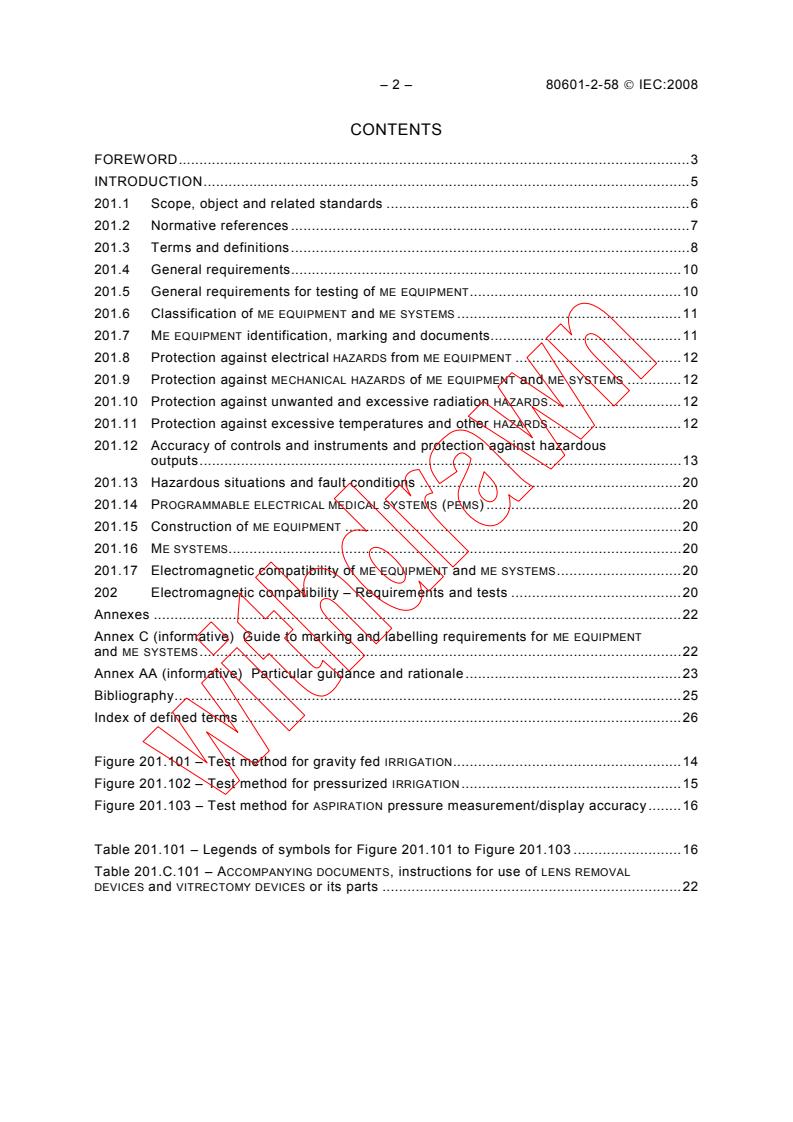
– 2 – 80601-2-58 © IEC:2008
CONTENTS
FOREWORD.3
INTRODUCTION.5
201.1 Scope, object and related standards .6
201.2 Normative references .7
201.3 Terms and definitions.8
201.4 General requirements.10
201.5 General requirements for testing of ME EQUIPMENT.10
201.6 Classification of ME EQUIPMENT and ME SYSTEMS .11
201.7 ME EQUIPMENT identification, marking and documents.11
201.8 Protection against electrical HAZARDS from ME EQUIPMENT .12
201.9 Protection against MECHANICAL HAZARDS of ME EQUIPMENT and ME SYSTEMS .12
201.10 Protection against unwanted and excessive radiation HAZARDS.12
201.11 Protection against excessive temperatures and other HAZARDS.12
201.12 Accuracy of controls and instruments and protection against hazardous
outputs.13
201.13 Hazardous situations and fault conditions .20
201.14 PROGRAMMABLE ELECTRICAL MEDICAL SYSTEMS (PEMS) .20
201.15 Construction of ME EQUIPMENT .20
201.16 ME SYSTEMS.20
201.17 Electromagnetic compatibility of ME EQUIPMENT and ME SYSTEMS.20
202 Electromagnetic compatibility – Requirements and tests .20
Annexes .22
Annex C (informative) Guide to marking and labelling requirements for ME EQUIPMENT
and ME SYSTEMS.22
Annex AA (informative) Particular guidance and rationale.23
Bibliography.25
Index of defined terms .26
Figure 201.101 – Test method for gravity fed IRRIGATION.14
Figure 201.102 – Test method for pressurized IRRIGATION.15
Figure 201.103 – Test method for ASPIRATION pressure measurement/display accuracy.16
Table 201.101 – Legends of symbols for Figure 201.101 to Figure 201.103 .16
Table 201.C.101 – ACCOMPANYING DOCUMENTS, instructions for use of LENS REMOVAL
and VITRECTOMY DEVICES or its parts .22
DEVICES
80601-2-58 © IEC:2008 – 3 –
INTERNATIONAL ELECTROTECHNICAL COMMISSION
____________
MEDICAL ELECTRICAL EQUIPMENT –
Part 2-58: Particular requirements for the basic safety
and essential performance of lens removal devices
and vitrectomy devices for ophthalmic surgery
FOREWORD
1) The International Electrotechnical Commission (IEC) is a worldwide organization for standardization comprising
all national electrotechnical committees (IEC National Committees). The object of IEC is to promote
international co-operation on all questions concerning standardization in the electrical and electronic fields. To
this end and in addition to other activities, IEC publishes International Standards, Technical Specifications,
Technical Reports, and Guides (hereafter referred to as “IEC Publication(s)”). Their preparation is entrusted to
technical committees; any IEC National Committee interested in the subject dealt with may participate in this
preparatory work. International, governmental and non-governmental organizations liaising with the IEC also
participate in this preparation. IEC collaborates closely with the International Organization for Standardization
(ISO) in accordance with conditions determined by agreement between the two organizations.
2) The formal decisions or agreements of IEC on technical matters express, as nearly as possible, an international
consensus of opinion on the relevant subjects since each technical committee has representation from all
interested IEC National Committees.
3) IEC Publications have the form of recommendations for international use and are accepted by IEC National
Committees in that sense. While all reasonable efforts are made to ensure that the technical content of IEC
Publications is accurate, IEC cannot be held responsible for the way in which they are used or for any
misinterpretation by any end user.
4) In order to promote international uniformity, IEC National Committees undertake to apply IEC Publications
transparently to the maximum extent possible in their national and regional publications. Any divergence
between any IEC Publication and the corresponding national or regional publication shall be clearly indicated in
the latter.
5) IEC provides no marking procedure to indicate its approval and cannot be rendered responsible for any
equipment declared to be in conformity with an IEC Publication.
6) All users should ensure that they have the latest edition of this publication.
7) No liability shall attach to IEC or its directors, employees, servants or agents including individual experts and
members of its technical committees and IEC National Committees for any personal injury, property damage or
other damage of any nature whatsoever, whether direct or indirect, or for costs (including legal fees) and
expenses arising out of the publication, use of, or reliance upon, this IEC Publication or any other IEC
Publications.
8) Attention is drawn to the Normative references cited in this publication. Use of the referenced publications is
indispensable for the correct application of this publication.
9) Attention is drawn to the possibility that some of the elements of this IEC Publication may be the subject of
patent rights. IEC shall not be held responsible for identifying any or all such patent rights.
International standard IEC 80601-2-58 has been prepared by IEC subcommittee 62D:
Electromedical equipment, of IEC technical committee 62: Electrical equipment in medical
practice, and ISO subcommittee SC 7: Ophthalmic optics and instruments of ISO technical
committee 172: Optics and photonics.
It is published as a double logo standard.
The text of this particular standard is based on the following documents:
FDIS Report on voting
62D/701/FDIS 62D/723/RVD
Full information on the voting for the approval of this particular standard can be found in the
report on voting indicated in the above table. In ISO, the standard has been approved by
14 P-members out of 15 having cast a vote.
– 4 – 80601-2-58 © IEC:2008
This publication has been drafted in accordance with the ISO/IEC Directives, Part 2.
In this standard, the following print types are used:
– Requirements and definitions: roman type.
– Test specifications: italic type.
– Informative material appearing outside of tables, such as notes, examples and references: in smaller type.
Normative text of tables is also in a smaller type.
ERMS DEFINED IN CLAUSE 3 OF THE GENERAL STANDARD, IN THIS PARTICULAR STANDARD OR AS
– T
NOTED: SMALL CAPITALS.
In referring to the structure of this standard, the term
– “clause” means one of the seventeen numbered divisions within the table of contents,
inclusive of all subdivisions (e.g. Clause 7 includes subclauses 7.1, 7.2, etc.);
– “subclause” means a numbered subdivision of a clause (e.g. 7.1, 7.2 and 7.2.1 are all
subclauses of Clause 7).
References to clauses within this standard are preceded by the term “Clause” followed by the
clause number. References to subclauses within this particular standard are by number only.
In this standard, the conjunctive “or” is used as an “inclusive or” so a statement is true if any
combination of the conditions is true.
The verbal forms used in this standard conform to usage described in Annex H of the ISO/IEC
Directives, Part 2. For the purposes of this standard, the auxiliary verb:
− “shall” means that compliance with a requirement or a test is mandatory for compliance
with this standard;
− “should” means that compliance with a requirement or a test is recommended but is not
mandatory for compliance with this standard;
− “may” is used to describe a permissible way to achieve compliance with a requirement or
test.
An asterisk (*) as the first character of a title or at the beginning of a paragraph or table title
indicates that there is guidance or rationale related to that item in Annex AA.
A list of all parts of the IEC 60601 series, published under the general title Medical electrical
equipment, can be found on the IEC website.
The committee has decided that the contents of this particular standard will remain
unchanged until the maintenance result date indicated on the IEC web site under
“http://webstore.iec.ch” in the data related to the specific publication. At this date, the
publication will be
• reconfirmed;
• withdrawn;
• replaced by a revised edition, or
• amended
80601-2-58 © IEC:2008 – 5 –
INTRODUCTION
LENS REMOVAL DEVICES and VITRECTOMY DEVICES are used widely in ophthalmology to perform
anterior-segment and posterior-segment surgery on the human eye. Commercial use of these
MEDICAL ELECTRICAL EQUIPMENT devices began in the early 1970s. This International Standard
defines particular requirements for BASIC SAFETY and ESSENTIAL PERFORMANCE of LENS
REMOVAL DEVICES and VITRECTOMY DEVICES, comprising an equipment console, surgical
HANDPIECES, and ACCESSORIES connected to this ME EQUIPMENT.
In many parts of the world LENS REMOVAL DEVICES and VITRECTOMY DEVICES are used in
combination by ophthalmic surgeons to perform combined anterior-segment (lens removal)
and posterior-segment (vitreoretinal) surgical PROCEDURES to maximize surgical outcomes.
For this reason both LENS REMOVAL DEVICES and VITRECTOMY DEVICES are covered in this
International Standard.
As all particular standards in the IEC 60601-1 series are based on the general standard
IEC 60601-1:2005, the user of this standard is reminded that RISK MANGEMENT plays an
important role in the use of this particular standard. Compliance with the requirements of this
particular standard should be documented in the RISK MANAGEMENT FILE to ensure the HAZARDS
associated with the product have been considered fully.
– 6 – 80601-2-58 © IEC:2008
MEDICAL ELECTRICAL EQUIPMENT –
Part 2-58: Particular requirements for the basic safety
and essential performance of lens removal devices
and vitrectomy devices for ophthalmic surgery
201.1 Scope, object and related standards
1)
Clause 1 of the general standard applies, except as follows:
201.1.1 Scope
Replacement:
BASIC SAFETY and ESSENTIAL PERFORMANCE of LENS
This International Standard applies to the
REMOVAL DEVICES and VITRECTOMY DEVICES for ophthalmic surgery (as defined in 201.3.208
and 201.3.217) and associated ACCESSORIES that can be connected to this MEDICAL
ELECTRICAL EQUIPMENT, hereafter referred to as ME EQUIPMENT.
If a clause or subclause is specifically intended to be applicable to ME EQUIPMENT only, or to
ME SYSTEMS only, the title and content of that clause or subclause will say so. If that is not the
case, the clause or subclause applies both to ME EQUIPMENT and to ME SYSTEMS, as relevant.
HAZARDS inherent in the intended physiological function of ME EQUIPMENT or ME SYSTEMS
within the scope of this standard are not covered by specific requirements in this standard
except in 7.2.13 and 8.4.1 of the general standard.
NOTE See also 4.2 of the general standard.
201.1.2 Object
Replacement:
The object of this particular standard is to establish particular BASIC SAFETY and ESSENTIAL
PERFORMANCE requirements for LENS REMOVAL DEVICES and VITRECTOMY DEVICES for ophthalmic
surgery (as defined in 201.3.208 and 201.3.217) and associated ACCESSORIES that can be
connected to the ME EQUIPMENT and are to be tested together or individually.
201.1.3 Collateral standards
Addition:
This particular standard refers to those applicable collateral standards that are listed in
Clause 2 of IEC 60601-1 and Clause 201.2 of this particular standard.
IEC 60601-1-2 applies as modified in Clause 202. All other published collateral standards in
the IEC 60601-1 series apply as published.
201.1.4 Particular standards
Replacement:
—————————
1)
The general standard is IEC 60601-1:2005, Medical electrical equipment – Part 1: General requirements for
basic safety and essential performance.
80601-2-58 © IEC:2008 – 7 –
In the IEC 60601 series, particular standards may modify, replace or delete requirements
contained in the general standard as appropriate for the particular ME EQUIPMENT under
consideration, and may add other BASIC SAFETY and ESSENTIAL PERFORMANCE requirements.
A requirement of a particular standard takes priority over the general standard.
For brevity, IEC 60601-1 is referred to in this particular standard as the “general standard”.
Collateral standards are referred to by their document number.
The numbering of clauses and subclauses of this particular standard corresponds to that of
the general standard with the prefix “201” (e.g. 201.1 in this standard addresses the content
of Clause 1 of the general standard) or applicable collateral standard with the prefix “20x”
where x is the final digit(s) of the collateral standard document number (e.g. 202.4 in this
particular standard addresses the content of Clause 4 of the 60601-1-2 collateral standard,
203.4 in this particular standard addresses the content of Clause 4 of the 60601-1-3 collateral
standard, etc.). The changes to the text of the general standard are specified by the use of
the following words:
”Replacement” means that the clause or subclause of the general standard or applicable
collateral standard is replaced completely by the text of this particular standard.
“Addition” means that the text of this particular standard is additional to the requirements of
the general standard or applicable collateral standard.
“Amendment” means that the clause or subclause of the general standard or applicable
collateral standard is amended as indicated by the text of this particular standard.
Subclauses or figures which are additional to those of the general standard are numbered
starting from 201.101. However due to the fact that definitions in the general standard are
numbered 3.1 through 3.139, additional definitions in this standard are numbered beginning
from 201.3.201. Additional annexes are lettered AA, BB, etc., and additional items aa), bb),
etc.
Subclauses or figures which are additional to those of a collateral standard are numbered
starting from 20x, where “x” is the number of the collateral standard, e.g. 202 for IEC 60601-
1-2, 203 for IEC 60601-1-3, etc.
The term “this standard” is used to make reference to the general standard, any applicable
collateral standards and this particular standard taken together.
Where there is no corresponding clause or subclause in this particular standard, the clause or
subclause of the general standard or applicable collateral standard, although possibly not
relevant, applies without modification; where it is intended that any part of the general
standard or applicable collateral standard, although possibly relevant, is not to be applied, a
statement to that effect is given in this particular standard.
201.2 Normative references
NOTE Informative references are listed in the bibliography beginning on page 25.
Clause 2 of the general standard applies, except as follows:
Addition:
IEC 60601-1-2:2007, Medical electrical equipment – Part 1-2: General requirements for basic
safety and essential performance – Collateral standard: Electromagnetic compatibility -
Requirements and tests
– 8 – 80601-2-58 © IEC:2008
IEC 60601-2-2, Medical electrical equipment – Part 2-2: Particular requirements for the basic
safety and essential performance of high frequency surgical equipment and high frequency
2)
surgical accessories
IEC 60601-2-22, Medical electrical equipment – Part 2-22: Particular requirements for the
basic safety and essential performance of surgical, cosmetic, therapeutic and diagnostic laser
equipment
IEC 61847:1998, Ultrasonics – Surgical systems – Measurement and declaration of the basic
output characteristics
ISO 11607-1:2006, Packaging for terminally sterilized medical devices – Part 1: Requirements
for materials, sterile barrier systems and packaging systems
ISO 11607-2:2006, Packaging for terminally sterilized medical devices – Part 2: Validation
requirements for forming, sealing and assembly processes
ISO 15752:2000, Ophthalmic instruments – Endoilluminators – Fundamental requirements
and test methods for optical radiation safety
ISO 17664:2004, Sterilization of medical devices – Information to be provided by the
manufacturer for the processing of resterilizable medical devices
201.3 Terms and definitions
For the purposes of this document, the terms and definitions given in IEC 60601-1:2005,
apply, except as follows:
NOTE An index of defined terms is found beginning on page 26.
Addition:
201.3.201
ASPIRATION
drawing fluid or gas out of the eye by use of suction
201.3.202
DIATHERMY
surgical technique using high frequency (HF) electrical currents used for example to
coagulate blood or bind tissues together
NOTE The terms “cautery” or “coagulation” have also been used in this context.
201.3.203
DRAIN CONTAINER
sealed container (or bag) in which aspirated fluid is collected
201.3.204
HANDPIECE
PROBE
handheld APPLIED PART, an ACCESSORY of LENS REMOVAL DEVICES or VITRECTOMY DEVICES
—————————
th
2)
5 edition, to be published. The title of the fourth edition is IEC 60601-2-2:2006, Medical electrical equipment –
Part 2-2: Particular requirements for the safety of high frequency surgical equipment.
80601-2-58 © IEC:2008 – 9 –
201.3.205
LASER
any device which can be made to produce or amplify electromagnetic radiation in the
wavelength range from 180 nm to 1 mm primarily by the process of controlled stimulated
emission
[IEC 60825-1:2007, definition 3.41]
201.3.206
LASER FRAGMENTATION
method by which the lens is broken into small fragments using LASER energy
201.3.207
LENS REMOVAL
removal of unwanted lens tissue
201.3.208
LENS REMOVAL DEVICE
ME EQUIPMENT or ME SYSTEM designed to remove lens material which incorporates an
IRRIGATION and ASPIRATION function, and a mechanism for LENS REMOVAL such as
PHACOEMULSIFICATION, LIQUEFACTION, or LASER FRAGMENTATION
NOTE These devices may also be used for other ocular surgical purposes.
201.3.209
LIQUEFACTION FRAGMENTATION
LIQUEFACTION
method by which the lens is broken into small fragments by means of pulses of ophthalmic
IRRIGATION solution
201.3.210
OCULAR IRRIGATION
IRRIGATION
introduction of a liquid into the eye
NOTE The term “infusion” has also been used in this context
201.3.211
PHACOFRAGMENTATION
method by which the lens is broken into small fragments using energy such as from ultrasonic
devices
NOTE Refer to the definition of LENS REMOVAL DEVICE in 201.3.208.
Historically PHACOFRAGMENTATION (term is also identified as phacoemulsification) has been a surgical PROCEDURE
that uses ultrasonic energy to fragment (or emulsify) a cataractous lens and removes the lens material through a
small incision. Recently, other emerging energy modalities, including LASER FRAGMENTATION and LIQUEFACTION,
have also been utilized in the removal of the cataractous lens through a small incision.
201.3.212
PHOTORETINITIS
retinal injury resulting from a very intense retinal radiant exposure
[ISO 15752:2000, definition 3.7]
201.3.213
PRIME
PRIMING
pre-operative setup PROCEDURE to fill TUBING SET (fluid path) with ophthalmic IRRIGATION
solution
– 10 – 80601-2-58 © IEC:2008
201.3.214
TIP
hollow needle-like device that is attached to a HANDPIECE
201.3.215
TUBING SET
set of tubes to contain fluid, designed to provide IRRIGATION to the eye and ASPIRATION from
the eye
201.3.216
VITRECTOMY
surgical PROCEDURE to remove vitreous humour, membranes, blood, lens tissue and other
material from the eye, involving IRRIGATION, ASPIRATION and vitreous cutting
NOTE The PROCEDURE may also include illumination, DIATHERMY, fluid/gas exchanges, and injection of viscous
fluids.
201.3.217
VITRECTOMY DEVICE
ME EQUIPMENT or ME SYSTEM used to perform VITRECTOMY
NOTE These devices may also be used for other ocular surgical purposes.
201.4 General requirements
Clause 4 of the general standard applies, except as follows:
201.4.3 * ESSENTIAL PERFORMANCE
Addition:
201.4.3.101 General
For LENS REMOVAL DEVICES and VITRECTOMY DEVICES no ESSENTIAL PERFORMANCE has been
identified in general. If the LENS REMOVAL DEVICES and VITRECTOMY DEVICES have functions
other than those specified in Clause 201.12, the MANUFACTURER shall identify which of these
functions of the ME EQUIPMENT and ME SYSTEMS is ESSENTIAL PERFORMANCE.
Compliance is checked by inspection of the RISK MANAGEMENT FILE.
Additional subclause:
201.4.101 * Additional functions
If there is a DIATHERMY function used for the LENS REMOVAL DEVICE and VITRECTOMY DEVICE,
that function shall meet the requirements of IEC 60601-2-2.
If the ME EQUIPMENT includes a LASER function, that function shall meet the requirements of
IEC 60601-2-22.
If there is an illumination function used to illuminate the eye during surgery that is part of the
ME EQUIPMENT or ME SYSTEM then that portion of the ME EQUIPMENT or ME SYSTEM shall meet
Clause 4.2 of ISO 15752:2000.
201.5 General requirements for testing of ME EQUIPMENT
Clause 5 of the general standard applies.
80601-2-58 © IEC:2008 – 11 –
201.6 Classification of ME EQUIPMENT and ME SYSTEMS
Clause 6 of the general standard applies.
201.7 ME EQUIPMENT identification, marking and documents
Clause 7 of the general standard applies, except as follows:
201.7.9.2.2 Warning and safety notices
Addition:
The instructions for use shall additionally include the following warning and safety notices:
a) a warning to use only recommended TUBING SET(s);
b) if an electrically adjustable ophthalmic IRRIGATION solution support pole is used a warning
not to modify pole height or manually force the pole height because this could cause
incorrect indication of bottle height and PATIENT injury;
c) a warning never to intentionally modify HANDPIECES or TIPS (e.g. do not bend, cut, or
engrave them) as they could break or malfunction;
d) a warning to the OPERATOR not to touch an activated ultrasonic HANDPIECE TIP as injuries
could occur;
e) if applicable, warnings related to lamp replacement (e.g. RISK of injury, ratings of lamp,
damage to lamp, damage to machine, etc.);
f) if applicable, a warning to the OPERATOR that care should be taken to avoid concentrating
the output of an illumination module on a small area of the retina for unnecessarily
prolonged periods of time due to the potential for PHOTORETINITIS and serious permanent
PATIENT injury;
g) if applicable, a warning to the OPERATOR that inadvertent activation of functions that are
intended for PRIMING or tuning HANDPIECES while the HANDPIECE is in the eye can create a
HAZARDOUS SITUATION that could result in PATIENT injury;
h) where gravity is relevant to performance, the ophthalmic IRRIGATION solution source shall
be at or above the PATIENT’s eye level;
i) a warning to the OPERATOR to ensure sufficient volume of IRRIGATION solution for the
PROCEDURE. The level should be monitored during the PROCEDURE;
j) if applicable, a warning to the OPERATOR to ensure that the maximum capacity of the DRAIN
CONTAINER is not exceeded as this could cause a HAZARDOUS SITUATION to the PATIENT.
201.7.9.2.8 Start-up PROCEDURE
Addition:
The instructions for use shall include instructions to perform functional checks of the system
before first use of the day.
201.7.9.2.9 Operating instructions
Addition:
The operating instructions shall additionally include:
a) if applicable, instructions regarding loading, PRIMING, changing, and reloading the TUBING
SET(s), and the TUBING SET(s) change interval to maintain the specified performance;
b) if applicable, instructions regarding the use of clamps on a TUBING SET, the avoidance of
ophthalmic IRRIGATION solution free flow conditions, and the PROCEDURE to be followed
when changing the ophthalmic IRRIGATION solution source;
– 12 – 80601-2-58 © IEC:2008
c) instructions regarding securely attaching plugs, HANDPIECE cables and other connectors.
201.7.9.2.12 Cleaning, disinfection, and sterilization
For parts that are resterilizable, the information for processing shall be in accordance with
ISO 17664:2004. This information shall be provided to the RESPONSIBLE ORGANIZATION or the
OPERATOR.
201.7.9.2.13 Maintenance
Addition:
The instructions for use shall provide the OPERATOR or RESPONSIBLE ORGANIZATION with a
recommendation to inspect all HANDPIECE cables and any cords on a regular basis and a
recommendation as to the action to take if damage (e.g. exposed wire, nicks in the insulation,
deformation, etc.) is observed.
201.8 Protection against electrical HAZARDS from ME EQUIPMENT
Clause 8 of the general standard applies.
201.9 Protection against MECHANICAL HAZARDS of ME EQUIPMENT and ME SYSTEMS
Clause 9 of the general standard applies.
201.10 Protection against unwanted and excessive radiation HAZARDS
Clause 10 of the general standard applies.
201.11 Protection against excessive temperatures and other HAZARDS
Clause 11 of the general standard applies, except as follows:
201.11.1.2 Temperature of APPLIED PARTS
201.11.1.2.1 APPLIED PARTS intended to supply heat to a PATIENT
Replacement:
HANDPIECES for DIATHERMY, PHACOFRAGMENTATION, LASER and LIQUEFACTION are considered to
be APPLIED PARTS intended to supply heat to a PATIENT.
The temperature or clinical effects shall be determined and documented in the RISK
MANAGEMENT FILE.
201.11.6.7 Sterilization of ME EQUIPMENT and ME SYSTEMS
Addition:
The packaging for terminally sterilized ACCESSORIES for LENS REMOVAL DEVICES and
VITRECTOMY DEVICES shall comply with the requirements of ISO 11607-1:2006. Validation
requirements for forming, sealing, and assembly processes for this packaging shall be
consistent with ISO 11607-2:2006.
80601-2-58 © IEC:2008 – 13 –
201.12 Accuracy of controls and instruments and protection against hazardous
outputs
Clause 12 of the general standard applies, except as follows:
201.12.1 Accuracy of controls and instruments
Additional subclause
201.12.1.101 Additional accuracy of controls and instruments requirements
Additional requirements for accuracy of controls and instruments are detailed in subclauses
201.12.1.101.1 to 201.12.1.101.5 and 201.12.1.101.7 to 201.12.1.101.9.
201.12.1.101.1 Accuracy of static IRRIGATION pressure
Static IRRIGATION pressure output shall not deviate from the indicated setting on the LENS
REMOVAL DEVICES and VITRECTOMY DEVICES by more than ± 20 % or ± 10 mmHg (± 1,3 kPa)
whichever is greater for a specific device in a defined configuration (see 201.12.4.101.1 for
hazardous output limit).
Compliance is checked by applying the relevant test method(s) 1 and/or 2:
Test method 1 (Gravity fed IRRIGATION)
(1) Set the test environment temperature to 25 °C ± 5 °C.
TUBING SET(s) and PRIME the device in accordance with the MANUFACTURER’s
(2) Install the
instructions for use.
(3) Zero the pressure meter reading. Connect the pressure meter to the end of the
IRRIGATION tubing and position the pressure meter within ± 2,5 cm of the simulated
PATIENT eye level, see Figure 201.101.
(4) Initiate the flow of fluid in accordance with the MANUFACTURER’s instructions for use.
(5) Set the gravity feed reservoir height to 0 cm or the lowest setting and record the
pressure meter reading after 5 s.
(6) Increase the reservoir height by 20 cm and wait for 5 s and record the pressure meter
reading.
(7) Repeat step 6 until the maximum reservoir height is reached.
(8) Record the pressure meter reading at the maximum reservoir height.
(9) Repeat the readings at the heights used in steps 5, 6 and 7 as the height is decreased
and wait for 5 s and record the pressure meter reading at each point.
(10) Confirm that all the readings are within the stated range.
– 14 – 80601-2-58 © IEC:2008
2 3
IEC 1860/08
For legends, see Table 201.101
Figure 201.101 – Test method for gravity fed IRRIGATION
Test method 2 (pressurized IRRIGATION)
(1) Set the test environment temperature to 25 °C ± 5 °C.
(2) Install the TUBING SET(s) and PRIME the device in accordance with the MANUFACTURER’s
instructions for use.
(3) Zero the pressure meter (PM) reading. Connect the pressure meter to the end of the
IRRIGATION tubing and position the pressure meter within ± 2,5 cm of the simulated
PATIENT eye level, see Figure 201.102.
(4) Initiate the flow of fluid in accordance with the MANUFACTURER’s instructions for use.
(5) Set the test IRRIGATION pressure to 0 mmHg (0 kPa) or lowest setting and record pressure
meter reading after 5 s.
(6) Increase the test pressure values by 20 mmHg (2,7 kPa).
(7) Wait for 5 s and record pressure meter reading.
(8) Repeat step 6 and 7 for test pressure setting in 20 mmHg (2,7 kPa) increments until the
maximum pressure setting is reached.
(9) Repeat the readings used in steps 6, 7 and 8 as the pressure is decreased and wait for
5 s and record the pressure meter reading at each point.
NOTE If necessary it may require reconnection of the IRRIGATION tubing for the decreasing measurements.
(10) Confirm that all the readings are within the stated range.
80601-2-58 © IEC:2008 – 15 –
2 3
IEC 1861/08
For legends, see Table 201.101
Figure 201.102 – Test method for pressurized IRRIGATION
201.12.1.101.2 Accuracy of ASPIRATION pressure
ASPIRATION pressure output shall not deviate from the indicated setting on the LENS REMOVAL
DEVICES and VITRECTOMY DEVICES by more than ± 20 % or ± 30 mmHg (± 4 kPa) whichever is
greater (see 201.12.4.101.2 for hazardous output limit).
Compliance is checked using the following test method:
Test method: ASPIRATION pressure measurement/display accuracy
(1) Install a new TUBING SET to device under test. PRIME the TUBING SET.
(2) Zero the pressure meter (PM) reading. Connect the pressure meter to the end of the
ASPIRATION tubing and position the pressure meter within ± 2,5 cm of the simulated PATIENT
eye level, see Figure 201.103.
(3) In the ASPIRATION mode adjust the vacuum preset to 50 mmHg (6,7 kPa).
(4) For flow-based system, set flow rate at least to 10 ml/min.
(5) Depress (foot) control to activate aspiration vacuum.
(6) Record the pressure meter reading and the vacuum value displayed on the instrument
after 5 s.
(7) Repeat step 5 and 6 for the test pressure values at 100 mmHg (13,3 kPa) increments
steps to the maximum designed vacuum.
(8) Repeat the step 7 tests in the reverse order of pressure values.
(9) Confirm that all the readings are within the stated range.
– 16 – 80601-2-58 © IEC:2008
2 3
IEC 1862/08
For legends, see Table 201.101
Figure 201.103 – Test method for ASPIRATION pressure measurement/display accuracy
Table 201.101 – Legends of symbols for Figure 201.101 to Figure 201.103
Equipment under test
Pressure meter
PATIENT eye level
IRRIGATION tube
Reservoir hanger
Gravity feed reservoir
Spike
Reservoir
Pressurized IRRIGATION TUBING SET
ASPIRATION tube
201.12.1.101.3 Accuracy of DIATHERMY power
If a DIATHERMY function is provided, the total output power and the actual power as a function
of the load resistance shall comply with the requirements of IEC 60601-2-2 (see
201.12.4.101.3 for hazardous output limit).
Compliance is checked using the following test method: Test according to the requirements
of IEC 60601-2-2 and verify the readings are within ranges identified in subclause 201.12.4.101.3
for the DIATHERMY power.
80601-2-58 © IEC:2008 – 17 –
201.12.1.101.4 Accuracy of DIATHERMY frequency
If a DIATHERMY function is provided, the DIATHERMY frequency output shall not deviate by more
than ± 20 % from the NOMINAL frequency stated in the instructions for use (see 201.12.4.101.4
for hazardous output limit).
Compliance is checked using the following test method: Connect the DIATHERMY driver signal
to an oscilloscope using a high frequency 100X and high impedance 10 MΩ oscilloscope
probe.
201.12.1.101.5 Accuracy of illumination output
If an illumination function is provided for settings between 20 % or the lowest setting,
whichever is the greater, and maximum output, then the illumination output shall not deviate
by more than ± 25 % from the displayed or marked value on the device.
Compliance is checked using the following test method:
(1) Attach illumination HANDPIECE connector to the illumination source.
(2) Insert distal end of the illumination HANDPIECE into an integrating sphere photometer.
(3) Turn on illuminator and adjust output to maximum.
(4) Take the reading after 15 min.
(5) Repeat the steps above with illuminator output adjusted to 75 %, 50 %, and 25 % of the
maximum.
(6) Confirm that all the readings are within the stated range.
201.12.1.101.6 * Fragmentation
The LENS REMOVAL DEVICES and VITRECTOMY DEVICES can include one or more fragmentation
functions. Apply the relevant requirements and test methods from subclauses 201.12.1.101.7
to 201.12.1.101.9.
The MANUFACTURER shall determine through the RISK MANAGEMENT PROCESS if one or more TIP
configurations, representing all marketed configurations, are required for testing. Selection of
the appropriate TIP configurations for testing shall be confirmed by checking the RISK
MANAGEMENT FILE. Any TIP configuration(s) used for testing shall be specified in the instructions
for use with the specified performance.
201.12.1.101.7 Accuracy of ultrasonic velocity of TIP
If an ultrasonic fragmentation function is provided, the ultrasonic velocity of the TIP shall not
deviate by more than ± 20 % from the nominal value(s) stated in the instructions for use for
each listed configuration (see 201.12.4.101.7 for hazardous output limit).
Compliance is checked using the following test methods:
(1) Follow IEC 61847:1998, Clause 5 and subclauses 6.1, 6.1.1, 6.1.2, and 6.1.3, to
determine stroke. The test shall be conducted in continuous mode.
(2) Determine frequency:
a) connect the ultrasonic driver signal to an oscilloscope using a high frequency 100X
and high impedance 10 MΩ oscilloscope probe;
b) verify that the values displayed by the device are within ± 20 % of the NOMINAL value(s)
for the ultrasonic frequency(ies);
(3) Determine velocity:
a) multiply stroke by frequency by π to obtain velocity of device under test.
– 18 – 80601-2-58 © IEC:2008
201.12.1.101.8 Accuracy of velocity of fluid entering eye for LIQUEFACTION
If a LIQUEFACTION function is provided, the velocity of fluid entering the eye for LIQUEFACTION
shall not deviate by more than ± 20 % from the values stated in the instructions for use for
each listed configuration (see 201.12.4.101.8 for hazardous output limit).
Compliance is checked using the following test method:
(1) Set up the device under test for LIQUEFACTION mode.
(2) Position force or pressure transducer distal to the LIQUEFACTION TIP. Place force or
pressure transducer perpendicular to the TIP axis at a distance between 0,5 and 1,0 mm.
(Transducer accuracy shall be within 5 % of the measurement.)
(3) Set the device under test into pulsing function.
(4) Measure the time past, in µs, from any accessible trigger point to when force or
pressure is first indicated on the transducer. A recommended trigger point is the
initiation of the electrical power pulse.
(5) Stop the pulsing function.
(6) Move the transducer a controlled distance between 0,5 and 1,0 mm from the
LIQUEFACTION TIP on the axis of the TIP.
(7) Set the device under test into pulsing function.
(8) Measure the time, in microseconds, from the same trigger point to when force or
pressure is first indicated on the transducer.
(9) Stop the pulsing function.
(10) Calculate the fluid velocity by dividing the exact difference in transducer position by the
exact difference in time.
201.12.1.101.9 Accuracy of VITRECTOMY PROBE cut rate
If a VITRECTOMY function is provided, the indicated cut rate and actual cut rate shall not
deviate by more than ± 20 % from the limits stated in the instructions for use for each listed
configuration (see 201.12.4.101.9 for hazardous output limit).
Compliance is checked using the following test method:
(1) Connect VITRECTOMY PROBE to device under test and position under a microscope to
observe the port of the VITRECTOMY PROBE.
(2) Set a stroboscope flash rate to ± 10 % of
...
Questions, Comments and Discussion
Ask us and Technical Secretary will try to provide an answer. You can facilitate discussion about the standard in here.
Loading comments...